Developing a Protocol-Based Expressive Therapies Continuum Assessment Profile (ETC-AP): Current Achievements and Future Perspectives

 , , and
Abstract
1. Introduction
2. Theoretical Framework: From Descriptive ETC to an Operational, Regulation-Oriented Framework
2.1. The Original ETC Framework
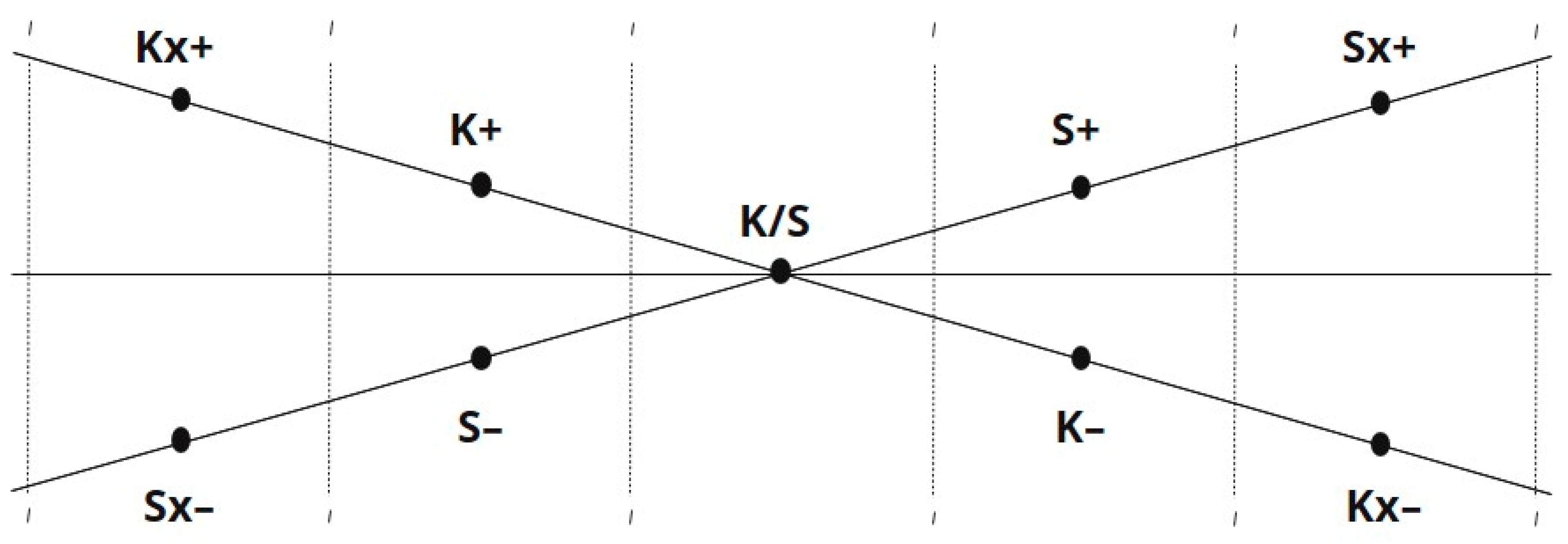
2.2. The Refined Operational Model: Axis Representation and Defined Ranges
2.3. Dimensions of Activation and Inhibition
- Moderate Dominance (+): Indicated by symbols such as K+, S+, etc. This represents high but functional activation, where the continuum’s characteristics are pronounced and constructive.
- Extreme Hyper-arousal (x+): Indicated by Kx+, Sx+, etc. This represents an Extreme Activation, where the continuum dominates the expression to a degree that may become chaotic, rigid, or overwhelming.
- Moderate Inhibition (–): Indicated by K–, S–, etc. This reflects hypo-activity or diminished engagement with the continuum’s specific qualities.
- Extreme Hypo-arousal (x–): Indicated by Kx–, Sx–, etc. This defines the Extreme Inhibition, signifying a complete block or inability to access that particular mode of expression.
2.4. Clinical and Methodological Utility of the Refined Model
2.5. Methodological Principles: Criteria-Guided Scoring and Profile Normalization
- Aggregation as an Intensity Proxy: By summing binary criteria across multiple tasks, the ETC-AP generates a score that reflects the frequency and persistence of specific expressive features. A zero score in this system represents a “baseline absence” within the assessment context, signifying that none of the operationalized criteria were met during the session.
- Standardized Comparability through POMP: To address the varying number of criteria across different continua (or axes), the ETC-AP employs the Percent of Maximum Possible (POMP) transformation (J. Cohen et al., 1999). This converts raw cumulative frequencies into a 0–100 profile range, ensuring that the intervals are mathematically comparable and suitable for quantitative profiling.
3. ETC-AP Development Process
3.1. Phase 1: Conceptualization and Initial Feature Generation (2013–2016, 2021)
3.2. Phase 2: Operational Refinement and Criteria Sifting (2017–2024)
3.3. Phase 3: Development of Profile Construction Logic (2025–2026)
4. Structured Assessment Procedure (ETC-AP)
4.1. Session Plan and Uniform Instructions (ETC-AP Administration)
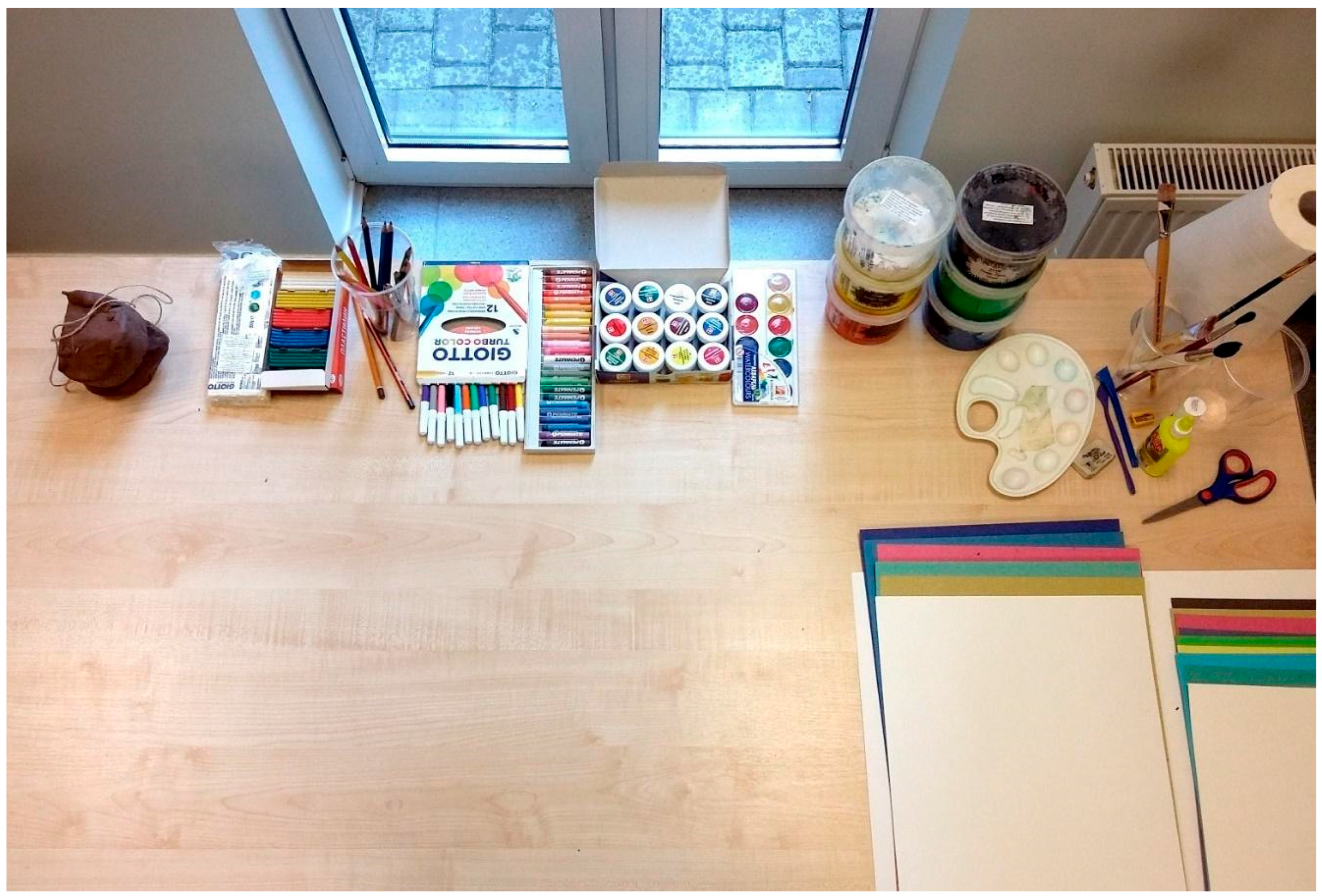
4.1.1. Material Setup and Uniform Environment
4.1.2. Session Phases and Timing
- (a)
- art making (up to 15 min.), followed by
- (b)
- a brief post-task inquiry (up to 10 min.).
4.1.3. Three-Task Structure and Verbatim Instruction
4.1.4. Post-Task Inquiry: Core Prompts and Trauma-Informed Boundaries
4.2. Documentation and Procedural Fidelity
- Coding: The rater determines the presence (1) or absence (0) of each criterion for each of the three artworks.
- Aggregation: Codes are aggregated across the three tasks to summarize how consistently specific criteria appear within the assessment context, yielding cumulative frequencies at the feature/range level.
- Profile Construction: Aggregated values are converted to a common 0–100 normalized profile using Percent of Maximum Possible (POMP) transformation, with proportional weighting applied to reduce the visual imbalance arising from unequal criterion density across ranges (see Section 2.5). At this developmental stage, profile outputs are treated as descriptive indicators to support within-case pattern description and professional communication, not as psychometrically calibrated measurements.
5. Data Processing and Interpretation
5.1. Data Processing Algorithm
- Column B (Criteria Count): This represents the number of unique criteria defined for a specific expressive feature within a range.
- Column C (Maximum Possible Score (MS)): Since the ETC-AP utilizes a three-task structure, the maximum number of points for any range is the number of criteria multiplied by three.1 This reflects the cumulative nature of the assessment across the entire session.
- Column F (POMP): Calculates the percentage of the maximum possible score (POMP) for that specific range:
5.1.1. Methodological Logic of Profile Indicators
5.1.2. Practical Interpretation of Profile Percentages
- ∗
- Higher Percentages (70–100%): Indicate a high concentration or “density” of observed expressive criteria within a specific range. This suggests that the client/patient consistently utilized expressive features associated with that particular ETC activation or inhibition mode across the assessment tasks.
- ∗
- Moderate Percentages (30–60%): Reflect a moderate presence of scorable markers, indicating that while the expressive mode is accessible, it is not the dominant organizing force in the client’s/patient’s current artistic engagement.
- ∗
- Lower Percentages (1–20%): Suggest that only isolated criteria were identified, reflecting a lower availability or less frequent use of that expressive channel under current conditions.
- ∗
- Zero Percent (0%): Indicates that no scorable criteria from that range were identified under the current protocol. As emphasized in Section 7.3, this should be interpreted as a “baseline absence” within the assessment context rather than an absolute phenomenological absence of that expressive modality in the client’s/patient’s creative process.
5.2. The ETC-AP Interpretation Algorithm
- Step I: Relative Continuum Dominance and Inhibition (Horizontal Analysis)
- Step II: Polarity and Energetic Focus (Internal Conflict)
- Step III: Intra-level Midpoint Asymmetry (Vertical Analysis)
- Step IV: Creative-Axis Permeability Across Integration Midpoints (Integrative Capacity)
- Step V: Therapeutic Strategy and Resource Bridging (“Bottom-Up”)
6. Case Study: Clinical Application of the ETC-AP
6.1. Case Vignette: “Kate”
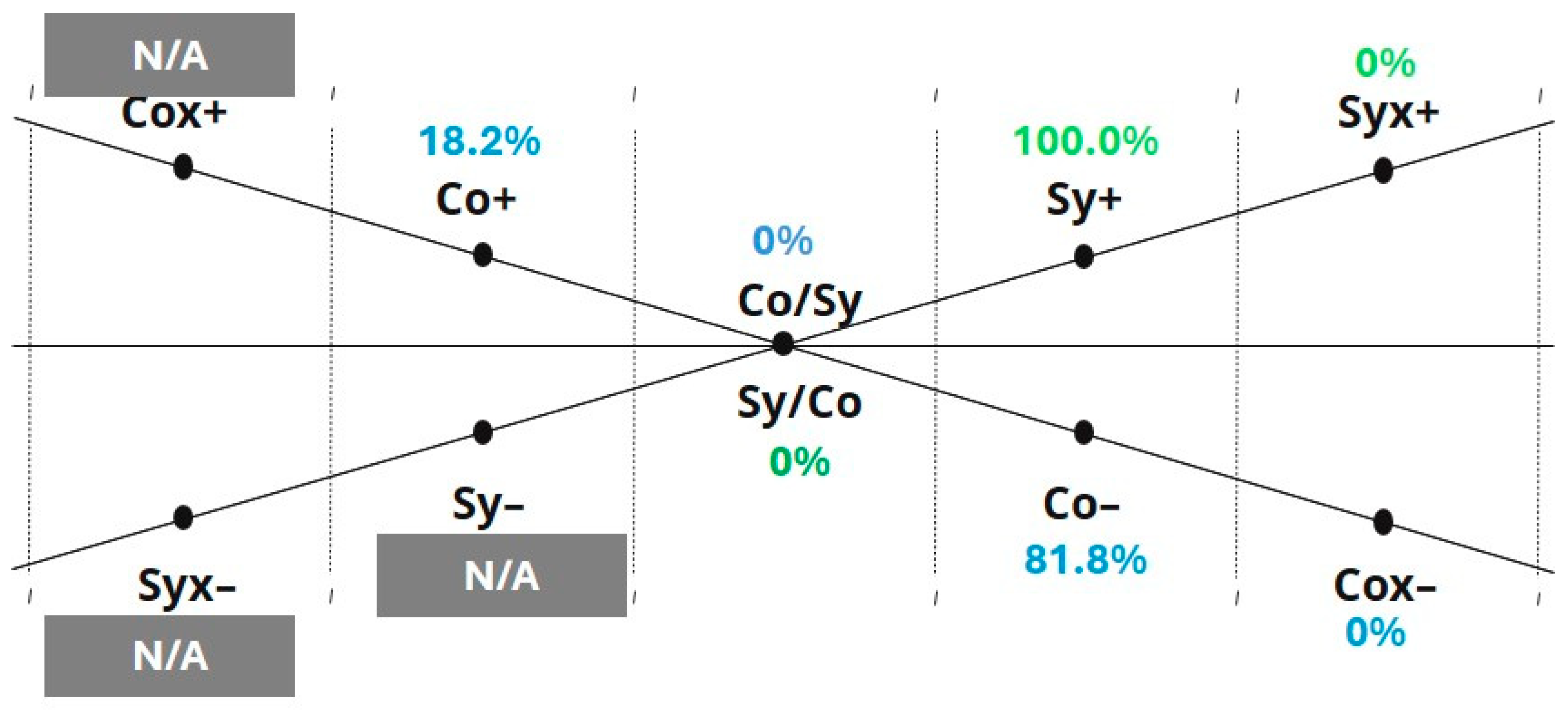
6.2. Case Analysis: Application of the ETC-AP Interpretation Algorithm
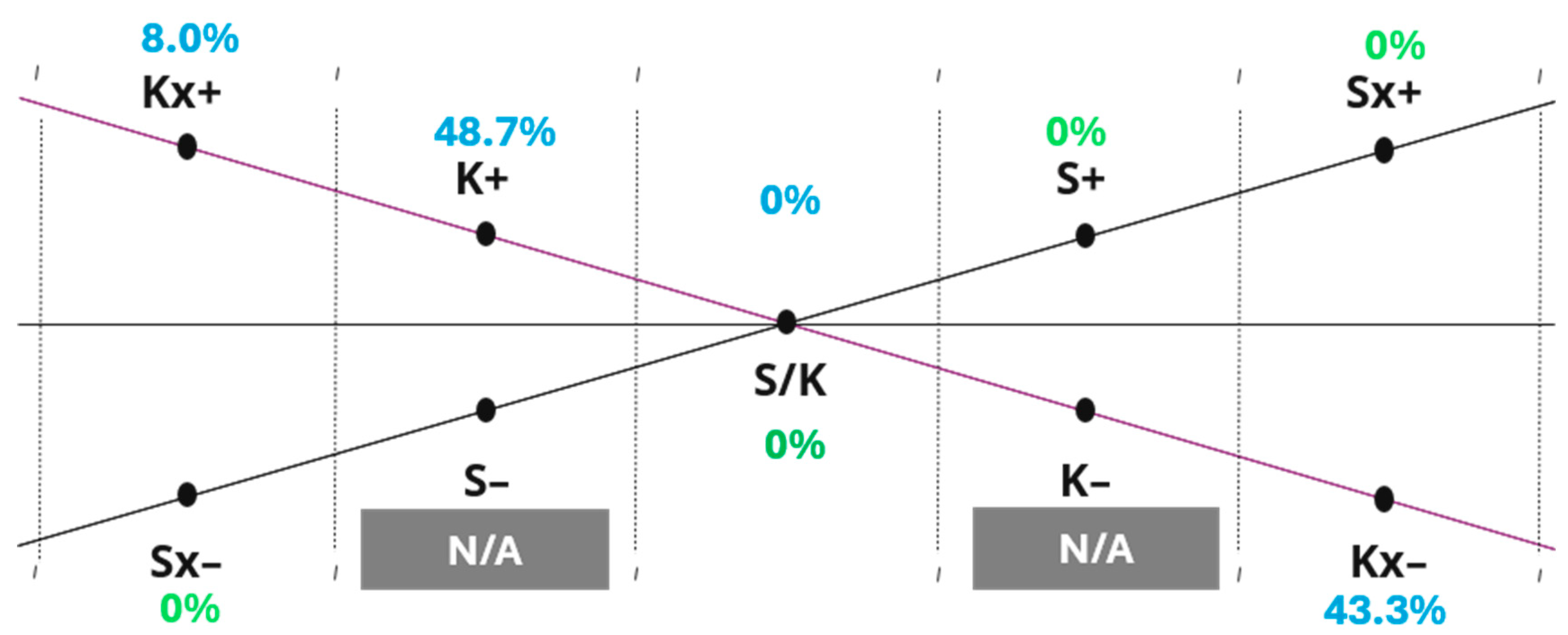
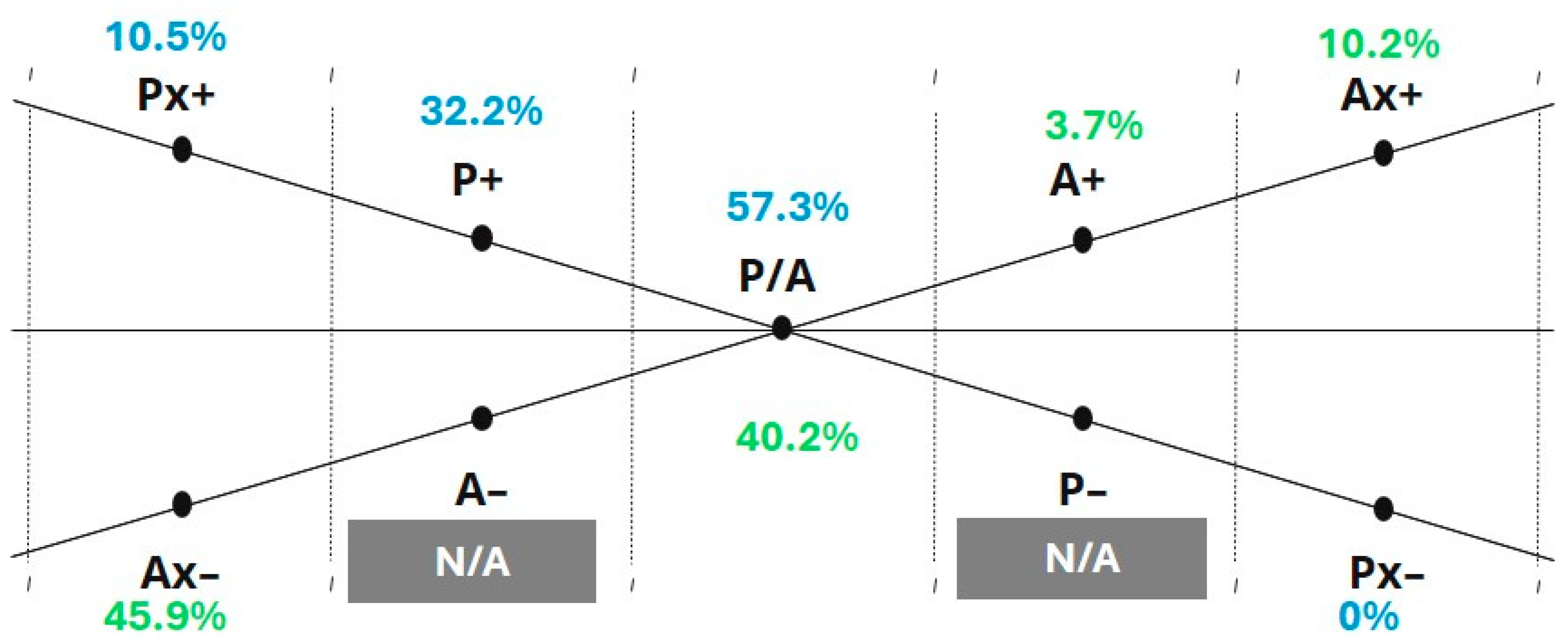
- Step I: Relative Continuum Dominance and Inhibition (Horizontal Analysis)
- Step II: Polarity and Energetic Focus (Internal Conflict)
- Step III: Intra-level Midpoint Asymmetry (Vertical Analysis)
- Step IV: Creative-Axis Permeability Across Integration Midpoints (Integrative Capacity)
- Step V: Clinical Implications and Regulation-Oriented Sequencing (“Bottom-Up” Bridging)
7. Discussion
7.1. Principal Contribution: From Implicit ETC Use to Explicit Operational Reasoning
7.2. Scope and Boundaries of the ETC-AP
7.3. The Meaning of “Zero”: Unobserved Criteria Under Current Conditions
7.4. Procedural Uniformity
7.5. Practical Implications: Communication, Supervision, and Interdisciplinary Dialogue
7.6. Trauma-Informed Relevance: Regulation, Safety, and Non-Pathologizing Interpretation
7.7. Applicability Across Client Groups and Contexts
7.8. Limitations and Future Directions
- Conceptual and developmental limitations. This article presents a methods-oriented framework at an early developmental stage rather than a completed validation study. While grounded in established ETC theory, the protocol requires further refinement to ensure that its operational definitions fully capture the complexity of artistic expression.
- Lack of psychometric validation. The ETC-AP does not currently report empirical evidence of reliability, validity, or sensitivity to change. The numerical profile outputs are normalized indicators derived from a defined procedure and should not be interpreted as psychometrically calibrated measurements with demonstrated interval-scale properties.
- No direct diagnostic or stand-alone use. The ETC-AP is not a diagnostic instrument and does not provide symptom measurement, clinical classification, or outcome evaluation. It should not be used as a stand-alone basis for case formulation or clinical decision-making. Furthermore, while it utilizes trauma-informed language, the approach does not identify trauma exposure or severity; any trauma-related relevance must remain contextual, clinically situated, and integrated with broader assessment data rather than inferred from the profile alone.
- Scoring and temporal limitations. The current scoring procedure summarizes the relative density of observed criteria across tasks but does not capture the temporal sequencing, duration, or moment-to-moment fluctuation of expressive activity. Consequently, intensity scores reflect the cumulative presence of specific expressive markers within the session rather than time investment, temporal dominance, or the chronological unfolding of the art-making process.
- Restricted generalizability. The illustrative case vignette demonstrates the application of the framework within a specific context but cannot support generalizable claims regarding the instrument’s performance across diverse populations or settings.
8. Conclusions
Supplementary Materials
Author Contributions
Funding
Institutional Review Board Statement
Informed Consent Statement
Data Availability Statement
Acknowledgments
Conflicts of Interest
Abbreviations
| ETC | Expressive Therapies Continuum |
| RSU | Rīga Stradiņš University |
| ETC-AP | Expressive Therapies Continuum—Assessment Profile |
Appendix A
Appendix A.1

| Description & Clinical Interpretation | Term & Activation Range | Abbreviation |
|---|---|---|
| Foundational level: focus on pre-verbal, sensorimotor action and physical engagement with art media. | Kinesthetic-Sensory Level | K-S level |
| The dimension of physical energy, rhythm, and motor action in the creative process. | Kinesthetic Continuum | K axis |
| Kinesthetic Over-activation: Erratic, uncontrolled, or destructive motor energy; loss of boundaries. | Extreme Hyper-arousal | Kx+ |
| Constructive Kinesthetic: Intentional, rhythmic movement used to release or channel energy. | Moderate Dominance | K+ |
| K-S Synthesis: Balanced state; movement is purposefully guided by sensory feedback. | Functional Integration | K/S |
| Kinesthetic Hypo-activity: Low physical energy; passive or hesitant interaction with materials. | Moderate Inhibition | K- |
| Kinesthetic Inhibition: Total motor paralysis; inability to initiate or sustain physical art-making. | Extreme Hypo-arousal (Block) | Kx– |
| The dimension of internal physiological sensations and tactile/visual feedback. | Sensory Continuum | S axis |
| Sensory Overload: Flooded by sensations; “stuck” in textures, smells, or overwhelming visual stimuli. | Extreme Hyper-arousal | Sx+ |
| Sensory Awareness: Deep, focused engagement with the tactile and expressive qualities of media. | Moderate Dominance | S+ |
| S-K Synthesis: Sensory input is successfully processed and expressed through motor action. | Functional Integration | S/K |
| Sensory Diminishment: Lack of awareness regarding the physical/aesthetic properties of the media. | Moderate Inhibition | S– |
| Sensory Numbing: Complete disconnection from sensory input; internal or external tactile anesthesia. | Extreme Hypo-arousal (Block) | Sx– |
| The level focusing on structural organization of imagery (form) vs. Emotional expression. | Perceptual-Affective Level | P-A level |
| The dimension of form, boundaries, spatial relationships, and literal representation. | Perceptual Continuum | P axis |
| Perceptual Rigidity: Excessive over-control; hyper-focus on rules/perfection; stiff, lifeless imagery. | Extreme Hyper-arousal | Px+ |
| Perceptual Clarity: Organized structure; clear boundaries and recognizable, literal forms. | Moderate Dominance | P+ |
| P-A Synthesis: Emotions are successfully contained and communicated through a stable visual structure. | Functional Integration | P/A |
| Perceptual Weakness: Difficulty defining boundaries; vague, fluid, or disorganized spatial relationships. | Moderate Inhibition | P– |
| Perceptual Fragmentation: Chaotic imagery; inability to perceive or create a “whole” gestalt. | Extreme Hypo-arousal (Block) | Px– |
| The dimension of emotional experience and expression, accessed via color and fluid media. | Affective Continuum | A axis |
| Affective Flooding: Uncontrolled emotional discharge; feelings overwhelm the ability to maintain form. | Extreme Hyper-arousal | Ax+ |
| Affective Expressiveness: Vibrant, intentional use of media to communicate and process emotional states. | Moderate Dominance | A+ |
| A-P Synthesis: Balance of feeling and form; emotional energy is expressed within structural clarity. | Functional Integration | A/P |
| Affective Constriction: Emotional distance; art appears flat, cold, or overly intellectualized. | Moderate Inhibition | A– |
| Affective Paralysis: Emotional numbing; complete inability to access, identify, or depict feelings. | Extreme Hypo-arousal (Block) | Ax– |
| The level of complex thought, analytical logic, and metaphorical representation. | Cognitive-Symbolic Level | Co-Sy level |
| The dimension of analytical thought, sequential planning, and logical verbalization. | Cognitive Continuum | Co axis |
| Hyper-rationality: Over-intellectualization; obsessive planning that blocks intuitive creative flow. | Extreme Hyper-arousal | Cox+ |
| Cognitive Functioning: Effective problem-solving, logical sequencing, and analytical self-insight. | Moderate Dominance | Co+ |
| Co-Sy Synthesis: Symbols and metaphors are logically integrated and consciously understood. | Functional Integration | Co/Sy |
| Cognitive Weakness: Difficulty with planning, following sequences, or thinking abstractly. | Moderate Inhibition | Co– |
| Cognitive Disorientation: Fragmented thoughts; inability to organize ideas or use logical reasoning. | Extreme Hypo-arousal (Block) | Cox– |
| The dimension of intuition, personal metaphors, and archetypal meaning. | Symbolic Continuum | Sy axis |
| Symbolic Immersion: Lost in “magical thinking” or private symbols without a link to shared reality. | Extreme Hyper-arousal | Syx+ |
| Symbolic Integration: Meaningful use of metaphors to represent deep self-experience and insight. | Moderate Dominance | Sy+ |
| Sy-Co Synthesis: Deep symbolic metaphors are successfully translated into conscious verbal meaning. | Functional Integration | Sy/Co |
| Symbolic Poverty: Art is strictly literal/decorative; lack of metaphorical depth or “inner voice.” | Moderate Inhibition | Sy– |
| Symbolic Void: Complete inability to access or form metaphors; rejection of symbolic meaning. | Extreme Hypo-arousal (Block) | Syx– |
| Integrative Flow: A state of “flow” where all ETC levels can be accessed and integrated to achieve self-actualization and healing. | Creative Axis | CR axis |
Appendix A.2
| Art Materials | Auxiliary Tools |
|---|---|
| Graphite pencils (soft, hard) | Scissors (right-handed, left-handed) |
| Colored pencils (12 colors) | Brushes: |
| Felt-tip markers (12 colors) | for gouache (three sizes: thin size 2, medium size 12, wide size 24) |
| Pastel crayons (12 colors) | for watercolors (three sizes: thin size 2, medium size 6, wide size 12) |
| Watercolors (12 colors) | Water container |
| Gouache paints (12 colors) | Paper towels/napkins |
| Finger paints (6 colors) | Modeling tools for plasticine and clay (at least one sculpting tool) |
| Clay | Glue stick |
| Plasticine (6 colors) | PVA glue |
| Polymer clay (grey) | Eraser |
| White paper (A4, A3, A2) | Pencil sharpener |
| Colored paper (A4) | Wire, string, or another tool for separating clay from a larger block (if needed) |
Appendix B
- ETC-AP Feature Rating Table
| 1. Artwork reference code ___.___.___ 2. Artwork reference code ___.___.___ 3. Artwork reference code ___.___.___ |  |
- Kinesthetic (K)-Sensory (S) level
| Feature 1—Intensity of sensory exploration | ||||||||||||||||
| 1a | Deep absorption in sensory experience | Sx+ | ||||||||||||||
| 1 | 2 | 3 | ||||||||||||||
| 1b | Engages in sensory exploration | S+ | ||||||||||||||
| 1 | 2 | 3 | ||||||||||||||
| 1c | Attempts to avoid contact with art materials | Sx– | ||||||||||||||
| 1 | 2 | 3 | ||||||||||||||
| Feature 2—Description of kinesthetic activity | ||||||||||||||||
| 2a | Engages in agitated, restless, or markedly active kinesthetic activity, focusing on the process rather than the final outcome | Kx+ | ||||||||||||||
| 1 | 2 | 3 | ||||||||||||||
| 2b | Interrupts or does not complete the initiated activity | Kx+ | ||||||||||||||
| 1 | 2 | 3 | ||||||||||||||
| 2c | Destruction of materials | Kx+ | ||||||||||||||
| 1 | 2 | 3 | ||||||||||||||
| 2d | Engages in kinesthetic activity, focusing on the process rather than the final outcome | K+ | ||||||||||||||
| 1 | 2 | 3 | ||||||||||||||
| Feature 3—Level of invested energy | ||||||||||||||||
| 3a | An excessive amount of energy is invested in the creation of the artwork | Kx+ | ||||||||||||||
| 1 | 2 | 3 | ||||||||||||||
| 3b | Invests a moderate amount of energy in creating the artwork | K+ | ||||||||||||||
| 1 | 2 | 3 | ||||||||||||||
| 3c | The artwork is created using the minimal possible amount of energy | Kx– | ||||||||||||||
| 1 | 2 | 3 | ||||||||||||||
| Feature 4—Rhythm in the art-making process | ||||||||||||||||
| 4a | Fast or slow rhythmic movements with high intensity aimed at releasing tension | Kx+ | ||||||||||||||
| 1 | 2 | 3 | ||||||||||||||
| 4b | Rhythmic movements with moderate intensity | K+ | ||||||||||||||
| 1 | 2 | 3 | ||||||||||||||
| 4c | Slow rhythmic movements with a calming quality | K/S | ||||||||||||||
| 1 | 2 | 3 | ||||||||||||||
| 4d | Irregular rhythm of movement | Kx– | ||||||||||||||
| 1 | 2 | 3 | ||||||||||||||
| Feature 5—Range of body movement | ||||||||||||||||
| 5a | Increased range of body movement | Kx+ | ||||||||||||||
| 1 | 2 | 3 | ||||||||||||||
| 5b | Moderate range of body movement | K+ | ||||||||||||||
| 1 | 2 | 3 | ||||||||||||||
| 5c | Reduced range of body movement | Kx– | ||||||||||||||
| 1 | 2 | 3 | ||||||||||||||
| Feature 6—Use of space on the page (This indicator is assessed and marked at two levels: K-S and P-A) | ||||||||||||||||
| 6a | Use of the page: 3/3 and beyond the page margins (more than 80%) | Kx+ | Ax+ | |||||||||||||
| 1 | 2 | 3 | 1 | 2 | 3 | |||||||||||
| 6b | Use of the page: more than 2/3 (70–80%) | K+ | A+ | |||||||||||||
| 1 | 2 | 3 | 1 | 2 | 3 | |||||||||||
| 6c | Use of the page: 1/3 to 2/3 (30–70%) | K+ P+ | ||||||||||||||
| 1 | 2 | 3 | ||||||||||||||
| 6d | Use of the page: reduced or minimal—up to 1/3 (up to 30%) | Ax– | Kx– | |||||||||||||
| 1 | 2 | 3 | 1 | 2 | 3 | |||||||||||
| 1. Artwork reference code ___.___.___ 2. Artwork reference code ___.___.___ 3. Artwork reference code ___.___.___ |  |
- Perceptual (P)-Affective (A) level
| Feature 7—Properties of form/figure | ||||||||||||||||
| 7a | Dominance of geometric or highly geometrized forms/figures | Px+ | ||||||||||||||
| 1 | 2 | 3 | ||||||||||||||
| 7b | Forms/figures are recognizable, structured, and clear | P+ | ||||||||||||||
| 1 | 2 | 3 | ||||||||||||||
| 7c | Forms/figures are recognizable but may be unclear, blurred, or overlapping | P/A | ||||||||||||||
| 1 | 2 | 3 | ||||||||||||||
| 7d | The artwork contains no identifiable forms or figures | Ax+ | ||||||||||||||
| 1 | 2 | 3 | ||||||||||||||
| Feature 8—Proportions of forms/figures | ||||||||||||||||
| 8a | Forms/figures are proportionate to one another | P+ | ||||||||||||||
| 1 | 2 | 3 | ||||||||||||||
| 8b | Forms/figures are disproportionate in relation to one another | A+ | ||||||||||||||
| 1 | 2 | 3 | ||||||||||||||
| Feature 9—Size of forms/figures | ||||||||||||||||
| 9a | Dominance of small-sized forms/figures | Px+ | ||||||||||||||
| 1 | 2 | 3 | ||||||||||||||
| 9b | The artwork contains forms/figures of varying sizes and types | P/A | ||||||||||||||
| 1 | 2 | 3 | ||||||||||||||
| 9c | Dominance of large-sized forms/figures | Ax+ | ||||||||||||||
| 1 | 2 | 3 | ||||||||||||||
| Feature 10—Use of details | ||||||||||||||||
| 10a | Excessive focus on details | Px+ | ||||||||||||||
| 1 | 2 | 3 | ||||||||||||||
| 10b | Contains a sufficient variety of details without excessive focus on them | P+ | ||||||||||||||
| 1 | 2 | 3 | ||||||||||||||
| 10c | Lack of details | Px– | ||||||||||||||
| 1 | 2 | 3 | ||||||||||||||
| Feature 11—Contour lines of forms/figures | ||||||||||||||||
| 11a | Excessive use of contour lines with a strong focus on them | Px+ | ||||||||||||||
| 1 | 2 | 3 | ||||||||||||||
| 11b | Regular, unaccented contour lines | P+ | ||||||||||||||
| 1 | 2 | 3 | ||||||||||||||
| 11c | Free and varied use of contour lines and/or contour lines are not used to define or delimit forms/figures | P/A | ||||||||||||||
| 1 | 2 | 3 | ||||||||||||||
| 11d | Dynamically drawn and/or incomplete contour lines | A+ | ||||||||||||||
| 1 | 2 | 3 | ||||||||||||||
| 11e | Exaggerated, thick, repeatedly retraced contour lines | Ax+ | ||||||||||||||
| 1 | 2 | 3 | ||||||||||||||
| Feature 12—Mixing and blending of colors | ||||||||||||||||
| 12a | Non-selective color mixing is used | Ax+ | ||||||||||||||
| 1 | 2 | 3 | ||||||||||||||
| 12b | Color mixing and blending are used | A+ | ||||||||||||||
| 1 | 2 | 3 | ||||||||||||||
| 12c | No color mixing or blending is used | Ax– | ||||||||||||||
| 1 | 2 | 3 | ||||||||||||||
| Feature 13—Color and content congruence | ||||||||||
| 13a | Color use is incongruent with the content | Ax+ | ||||||||
| 1 | 2 | 3 | ||||||||
| 13b | Color use is congruent with the content | A+ | ||||||||
| 1 | 2 | 3 | ||||||||
| Feature 14—Repetition of forms/figures (This feature is assessed by considering all three created artworks together) | ||||||||||||
| 14a | Multiple repetition of forms/figures | Px+ | ||||||||||
| 1 | 2 | 3 | ||||||||||
| 14b | Partial repetition of forms/figures | P+ | ||||||||||
| 1 | 2 | 3 | ||||||||||
| 14c | Forms/figures are not repeated | P/A | ||||||||||
| 1 | 2 | 3 | ||||||||||
| 1. Artwork reference code ___.___.___ 2. Artwork reference code ___.___.___ 3. Artwork reference code ___.___.___ |  |
- Cognitive (Co)-Symbolic (Sy) level
- Features 16, 17, and 19 should be assessed with consideration of the post-task inquiry.
| Feature 15—Planning and execution of actions | ||||||||||||
| 15a | Is able to plan and sequentially carry out the necessary actions to create the artwork | Co+ | ||||||||||
| 1 | 2 | 3 | ||||||||||
| 15b | Is unable to plan and sequentially carry out the necessary actions to create the artwork | Cox– | ||||||||||
| 1 | 2 | 3 | ||||||||||
| Feature 16—Integration | ||||||||||||
| 16a | The artwork is conceptually and thematically integrated | Co+ | ||||||||||
| 1 | 2 | 3 | ||||||||||
| 16b | The artwork is not conceptually and thematically integrated | Cox– | ||||||||||
| 1 | 2 | 3 | ||||||||||
| Feature 17—Words, numbers, schemes, and pictograms depicted in the artwork | ||||||||||||
| 17a | Words, numbers, schemes, and pictograms are used in a logical manner | Co+ | ||||||||||
| 1 | 2 | 3 | ||||||||||
| 17b | Words, numbers, schemes, and pictograms are used in an illogical manner | Cox– | ||||||||||
| 1 | 2 | 3 | ||||||||||
| Feature 18—Representation of spatial forms/figures and depth | ||||||||||||
| 18a | Forms/figures are represented spatially, and/or the artwork includes perspective | Co+ | ||||||||||
| 1 | 2 | 3 | ||||||||||
| 18b | Forms/figures are not represented spatially, and the artwork does not include perspective | Co– | ||||||||||
| 1 | 2 | 3 | ||||||||||
| Feature 19—Meaning of the symbol | ||||||||||||||
| 19a | Personal symbol | Sy+ | ||||||||||||
| 1 | 2 | 3 | ||||||||||||
| 19b | Universal symbol | Co/Sy | ||||||||||||
| 1 | 2 | 3 | ||||||||||||
| 19c | Peculiar symbols | Syx+ | ||||||||||||
| 1 | 2 | 3 | ||||||||||||
| Feature 20—Exploration of the symbol | ||||||||||||||
| 20a | Identification with the symbol or excessive use of it | Syx+ | ||||||||||||
| 1 | 2 | 3 | ||||||||||||
| 20b | Ability to relate symbols to personal experiences | Sy+ | ||||||||||||
| 1 | 2 | 3 | ||||||||||||
| Feature 21—Metaphor: transfer of meaning based on the comparison of two phenomena | ||||||||||||||
| 21a | Use of personal metaphors | Sy+ | ||||||||||||
| 1 | 2 | 3 | ||||||||||||
| 21b | Use of universal metaphors | Co/Sy | ||||||||||||
| 1 | 2 | 3 | ||||||||||||
| Feature 22—Abstraction | ||||||||||||||
| 22a | The abstract artwork has a clear and logical explanation | Co+ | ||||||||||||
| 1 | 2 | 3 | ||||||||||||
| 22b | The abstract artwork has an unclear and illogical explanation | Cox– | ||||||||||||
| 1 | 2 | 3 | ||||||||||||
| Feature 23—Verbal reflection of the client/patient | ||||||||||||||
| 23a | The reflection is clear and logical | Co+ | ||||||||||||
| 1 | 2 | 3 | ||||||||||||
| 23b | The reflection is unclear and/or chaotic | Cox– | ||||||||||||
| 1 | 2 | 3 | ||||||||||||
Appendix C


| 1 | Given the fact that Feature 14 is scored jointly across all three produced artworks, the value in row 13 under P+ (column B) is recorded as (5 × 3) + 1. |
References
- Anastasi, A. (1985). Psychological testing: Basic concepts and common misconceptions. In A. M. Rogers, & C. J. Scheirer (Eds.), The G. Stanley Hall lecture series (Volume 5, pp. 87–120). American Psychological Association. [Google Scholar] [CrossRef]
- Baker, F., Metcalf, O., Varker, T., & O’Donnell, M. (2018). A systematic review of the efficacy of creative arts therapies in the treatment of adults with PTSD. Psychological Trauma: Theory, Research, Practice, and Policy, 10(6), 643–651. [Google Scholar] [CrossRef] [PubMed]
- Betts, D. J. (2005). A systematic analysis of art therapy assessment and rating instrument literature [Doctoral dissertation, Florida State University]. Available online: https://repository.lib.fsu.edu/islandora/object/fsu:175923 (accessed on 13 January 2026).
- Biggs, Q. M., Wang, J., Fullerton, C. S., Amin, R., Hooke, J. A., Dhanraj, N., & Ursano, R. J. (2025). Implications for optimizing treatment timing: Day of week variation in PTSD symptom clusters. Frontiers in Psychiatry, 16, 1599424. [Google Scholar] [CrossRef] [PubMed]
- Butler, L. D., Critelli, F. M., & Rinfrette, E. S. (2011). Trauma-informed care and mental health. Directions in Psychiatry, 31, 197–210. [Google Scholar]
- Cohen, B. M., Hammer, J., & Singer, S. (1988). The Diagnostic Drawing Series (DDS): A systematic approach to art therapy evaluation and research. The Arts in Psychotherapy, 15(1), 11–21. [Google Scholar] [CrossRef]
- Cohen, J., Cohen, P., Aiken, L. S., & West, S. G. (1999). The problem of units and the circumvention of it: Percent of maximum possible (POMP). Multivariate Behavioral Research, 34(3), 315–346. [Google Scholar] [CrossRef] [PubMed]
- Danilāne, L. (2017). MEPL modeļa mākslinieciskās ekspresijas pazīmju kritēriju paraugu atlase [Master’s thesis, Rīga Stradiņš University]. [Google Scholar]
- Dimsone, K. (2016). Mākslas ekspresijas pakāpenisko līmeņu perceptīvā–afektīvā līmeņa mākslinieciskās ekspresijas pazīmju vērtēšanas kritēriju izstrādes pirmais posms [Master’s thesis, Rīga Stradiņš University]. [Google Scholar]
- Fonzo, G. A. (2018). Diminished positive affect and traumatic stress: A biobehavioral review and commentary on trauma affective neuroscience. Neurobiology of Stress, 9, 214–230. [Google Scholar] [CrossRef] [PubMed]
- Gantt, L., & Tabone, C. (1998). The formal elements art therapy scale: The rating manual. Gargoyle Press. [Google Scholar]
- Haeyen, S., & Wanten, F. (2024). Effectiveness of trauma-focused art therapy (TFAT) for psychological trauma: A mixed-method single-case study. The Arts in Psychotherapy, 91, 102218. [Google Scholar] [CrossRef]
- Hays, R. E., & Lyons, S. J. (1981). The bridge drawing: A projective technique for assessment in art therapy. The Arts in Psychotherapy, 8(3–4), 207–217. [Google Scholar] [CrossRef]
- Hinz, L. D. (2009). Expressive therapies continuum: A framework for using art in therapy (1st ed.). Routledge. [Google Scholar]
- Hinz, L. D. (2019). Expressive therapies continuum: A framework for using art in therapy (2nd ed.). Routledge. [Google Scholar]
- Hinz, L. D., & Lusebrink, V. B. (2024). Using the expressive therapies continuum as a framework in the treatment of trauma: Influence of creativity on resilience. In C. E. Strang, & J. L. King (Eds.), Art therapy and the neuroscience of trauma: Theoretical and practical perspectives. Taylor & Francis. [Google Scholar]
- Huo, Y., Couzner, L., Windsor, T., Laver, K., Dissanayaka, N. N., & Cations, M. (2023). Barriers and enablers for the implementation of trauma-informed care in healthcare settings: A systematic review. Implementation Science Communications, 4, 49. [Google Scholar] [CrossRef] [PubMed]
- Kagin, S. L., & Lusebrink, V. B. (1978). The expressive therapies continuum. Art Psychotherapy, 5(4), 171–180. [Google Scholar] [CrossRef]
- Lusebrink, V. B. (1990). Imagery and visual expression in therapy. Plenum Press. [Google Scholar]
- Lusebrink, V. B. (2010). Assessment and therapeutic application of the Expressive Therapies Continuum: Implications for brain structures and functions. Art Therapy: Journal of the American Art Therapy Association, 27, 168–177. [Google Scholar] [CrossRef]
- Lusebrink, V. B., Martinsone, K., & Dzilna-Šilova, I. (2013). The Expressive Therapies Continuum (ETC): Interdisciplinary bases of the ETC. International Journal of Art Therapy: Inscape, 18(2), 75–85. [Google Scholar] [CrossRef]
- Maddox, G., Bodner, G., Christian, M., & Williamson, P. (2024). On the effectiveness of visual arts therapy for traumatic experiences: A systematic review and meta-analysis. Clinical Psychology & Psychotherapy, 31(4). [Google Scholar] [CrossRef]
- Martinsone, K. (2011). Mākslu terapija. RaKa. [Google Scholar]
- Medicīniskās tehnoloģijas mākslas terapijā. (2010). Medical technologies for art therapy guidelines. Available online: https://dati.zva.gov.lv/mtdb/30-rehabilitacijas-mediciniskie-pakalpojumi/makslu-terapija/izversts-mediciniskas-tehnologijas-makslas-terapija-apraksts (accessed on 13 January 2026).
- Meistere-Peltonena, K. (2016). Mākslas terapijas pakāpenisko līmeņu kinestētiskā–sensorā līmeņa mākslinieciskās ekspresijas pazīmju vērtēšanas kritēriju izstrādes pirmais posms [Master’s thesis, Rīga Stradiņš University]. [Google Scholar]
- Ruttule, L. (2016). Mākslas ekspresijas pakāpenisko līmeņu kognitīvā–simboliskā līmeņa pazīmju vērtēšanas kritēriju izstrādes pirmais posms [Master’s thesis, Rīga Stradiņš University]. [Google Scholar]
- Schouten, K., de Niet, G., Knipscheer, J., Kleber, R., & Hutschemaekers, G. (2014). The effectiveness of art therapy in the treatment of traumatized adults. Trauma, Violence, & Abuse, 16(2), 220–228. [Google Scholar] [CrossRef] [PubMed]
- Skara, K. (2017). MEPL izvērtēšanas instrumenta standartizētas administrēšanas un datu apstrādes procedūras pilotpētījums [Master’s thesis, Rīga Stradiņš University]. [Google Scholar]
- Steinerte, M. (2021). Vizuāli plastiskās mākslas terapijas izvērtēšanas instrumenta MEPL kognitīvā–simboliskā līmeņa precizētu pazīmju kritēriju izstrāde [Master’s thesis, Rīga Stradiņš University]. [Google Scholar]
- Strazdiņa, E. (2016). Izvērtēšana mākslas terapijā: Principi un metodes. Rīga Stradiņš University. Available online: https://www.rsu.lv/sites/default/files/book_download/izvertesana_makslas_terapija.pdf (accessed on 13 January 2026).
- Wang, J., Zhang, B., Yahaya, R., & Abdullah, A. (2025). Colors of the mind: A meta-analysis of creative arts therapy as an approach for post-traumatic stress disorder intervention. BMC Psychology, 13(1), 32. [Google Scholar] [CrossRef] [PubMed]
- Westfall, N., & Nemeroff, C. (2016). State-of-the-art prevention and treatment of PTSD: Pharmacotherapy, psychotherapy, and nonpharmacological somatic therapies. Psychiatric Annals, 46(9), 533–549. [Google Scholar] [CrossRef]


Disclaimer/Publisher’s Note: The statements, opinions and data contained in all publications are solely those of the individual author(s) and contributor(s) and not of MDPI and/or the editor(s). MDPI and/or the editor(s) disclaim responsibility for any injury to people or property resulting from any ideas, methods, instructions or products referred to in the content. |
© 2026 by the authors. Licensee MDPI, Basel, Switzerland. This article is an open access article distributed under the terms and conditions of the Creative Commons Attribution (CC BY) license.
Share and Cite
Strazdiņa, E.; Perepjolkina, V.; Upmale-Puķīte, A.; Akmane, E.; Duhovska, J.; Mārtinsone, K. Developing a Protocol-Based Expressive Therapies Continuum Assessment Profile (ETC-AP): Current Achievements and Future Perspectives. Behav. Sci. 2026, 16, 640. https://doi.org/10.3390/bs16050640
Strazdiņa E, Perepjolkina V, Upmale-Puķīte A, Akmane E, Duhovska J, Mārtinsone K. Developing a Protocol-Based Expressive Therapies Continuum Assessment Profile (ETC-AP): Current Achievements and Future Perspectives. Behavioral Sciences. 2026; 16(5):640. https://doi.org/10.3390/bs16050640
Chicago/Turabian StyleStrazdiņa, Elza, Viktorija Perepjolkina, Anda Upmale-Puķīte, Elīna Akmane, Jana Duhovska, and Kristīne Mārtinsone. 2026. "Developing a Protocol-Based Expressive Therapies Continuum Assessment Profile (ETC-AP): Current Achievements and Future Perspectives" Behavioral Sciences 16, no. 5: 640. https://doi.org/10.3390/bs16050640
APA StyleStrazdiņa, E., Perepjolkina, V., Upmale-Puķīte, A., Akmane, E., Duhovska, J., & Mārtinsone, K. (2026). Developing a Protocol-Based Expressive Therapies Continuum Assessment Profile (ETC-AP): Current Achievements and Future Perspectives. Behavioral Sciences, 16(5), 640. https://doi.org/10.3390/bs16050640