Understanding and Cultivating Effective Listening: A Dialectical Theory of the Tensions Between Intuition and Behavior

Abstract
1. Introduction
1.1. Academic Conceptualizations and Implications of Listening
1.2. Training People to Listen Well
1.3. Present Study Aims
2. Materials and Methods
2.1. Sourcing Data
2.2. Epistemology and Approach to Thematic Analysis
3. Results
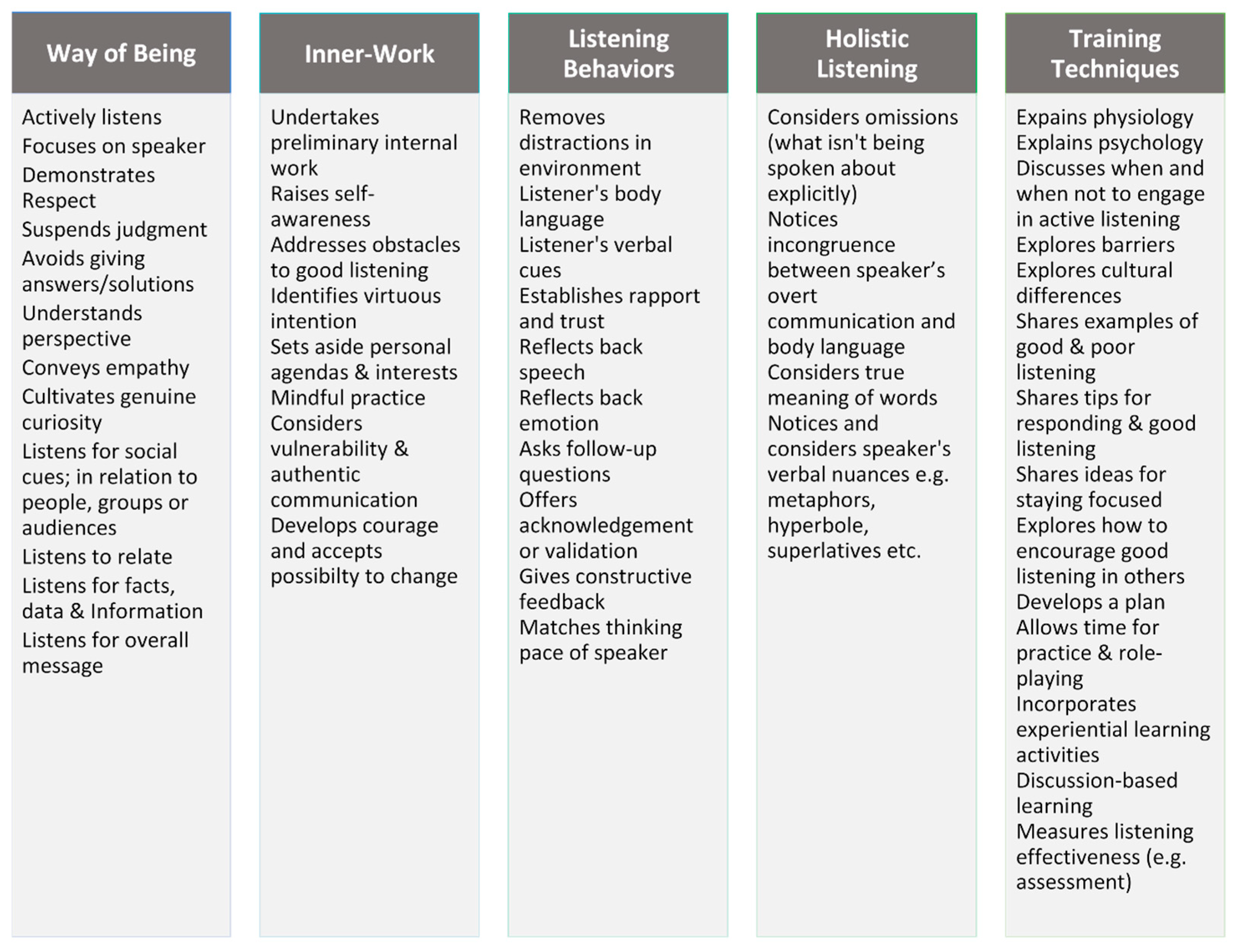
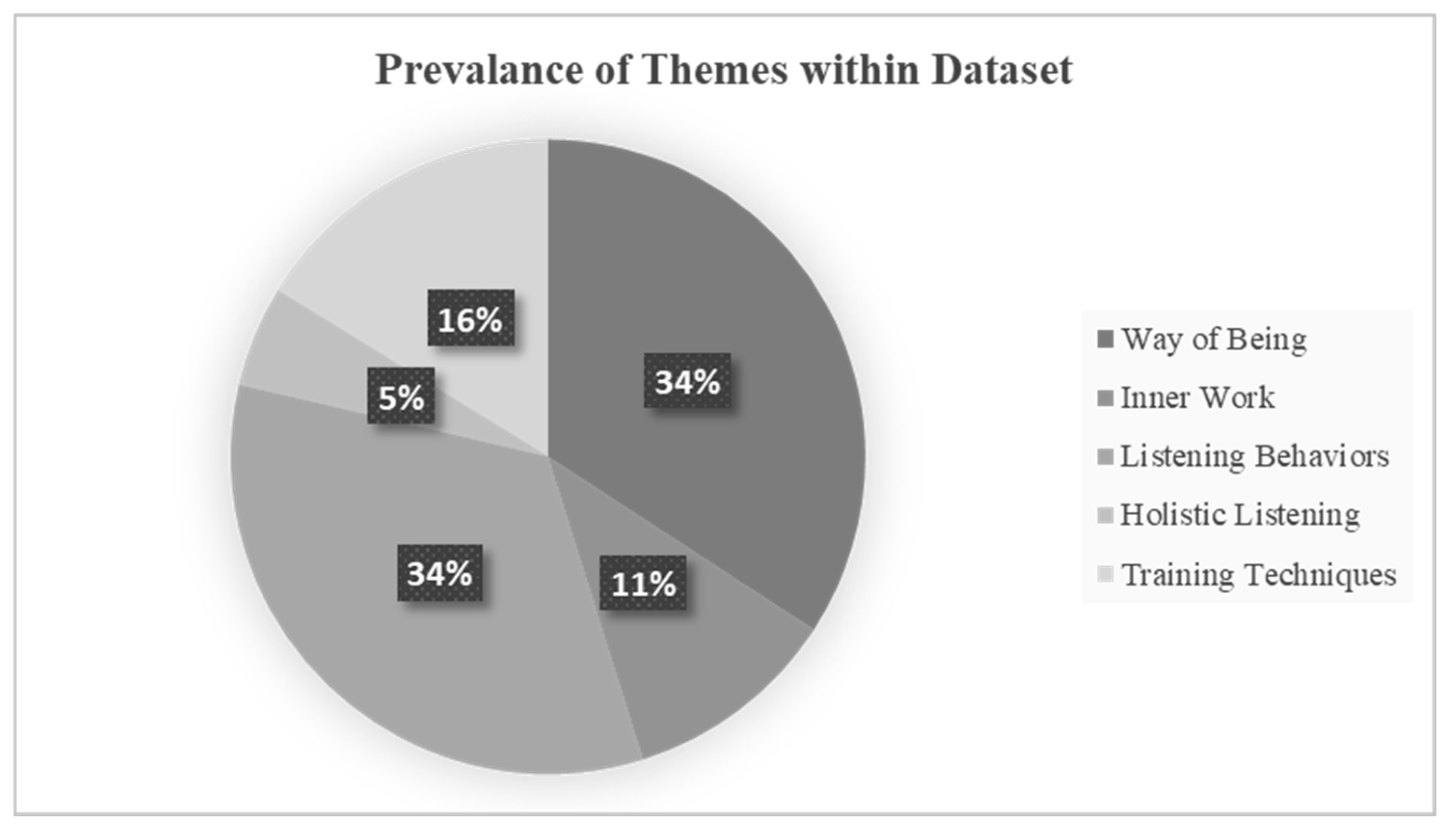
3.1. Themes
3.1.1. Way of Being
3.1.2. Inner- Work
3.1.3. Listening Behaviors
3.1.4. Holistic Listening
3.1.5. Training Techniques
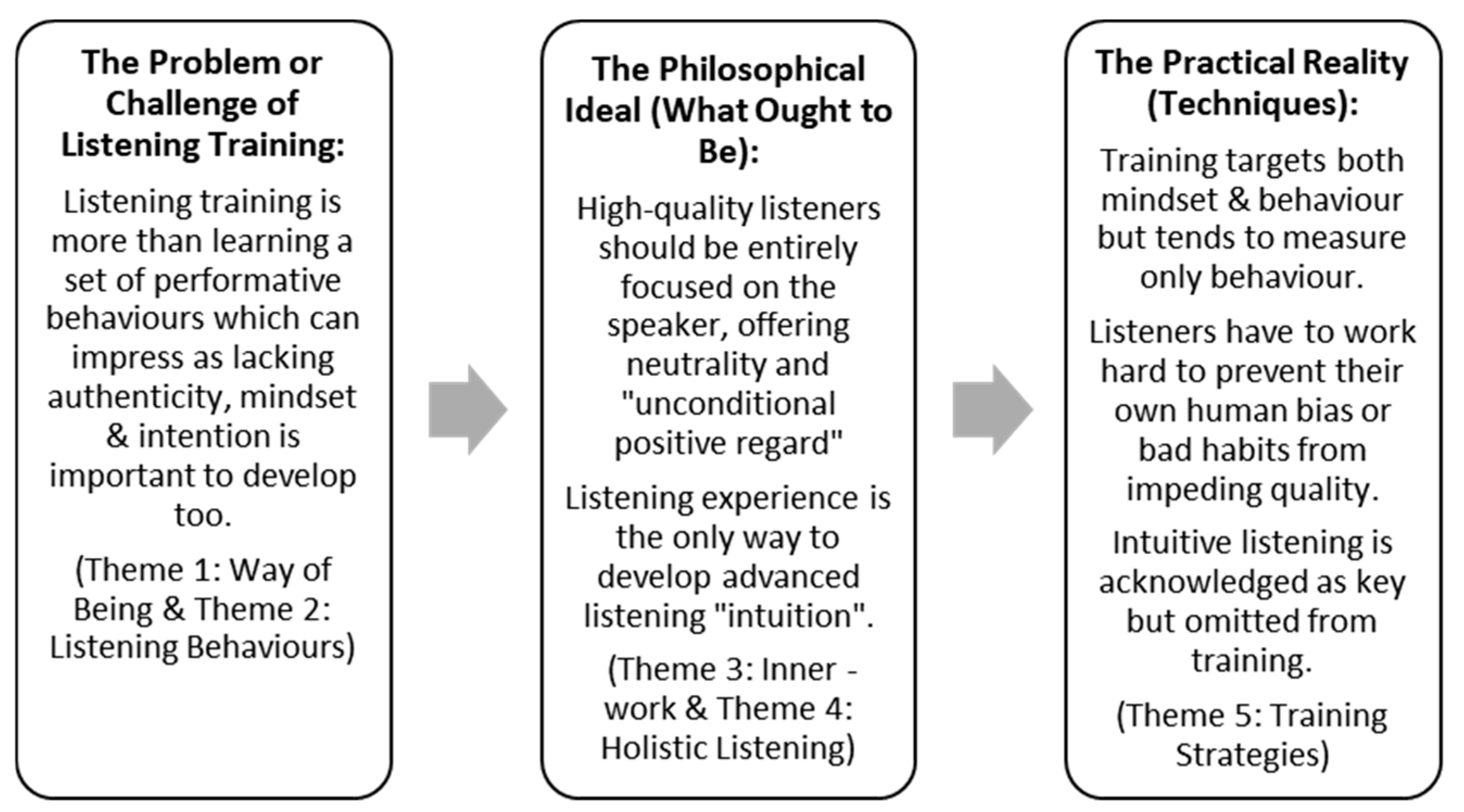
3.2. Critical Analysis of Themes
4. Discussion
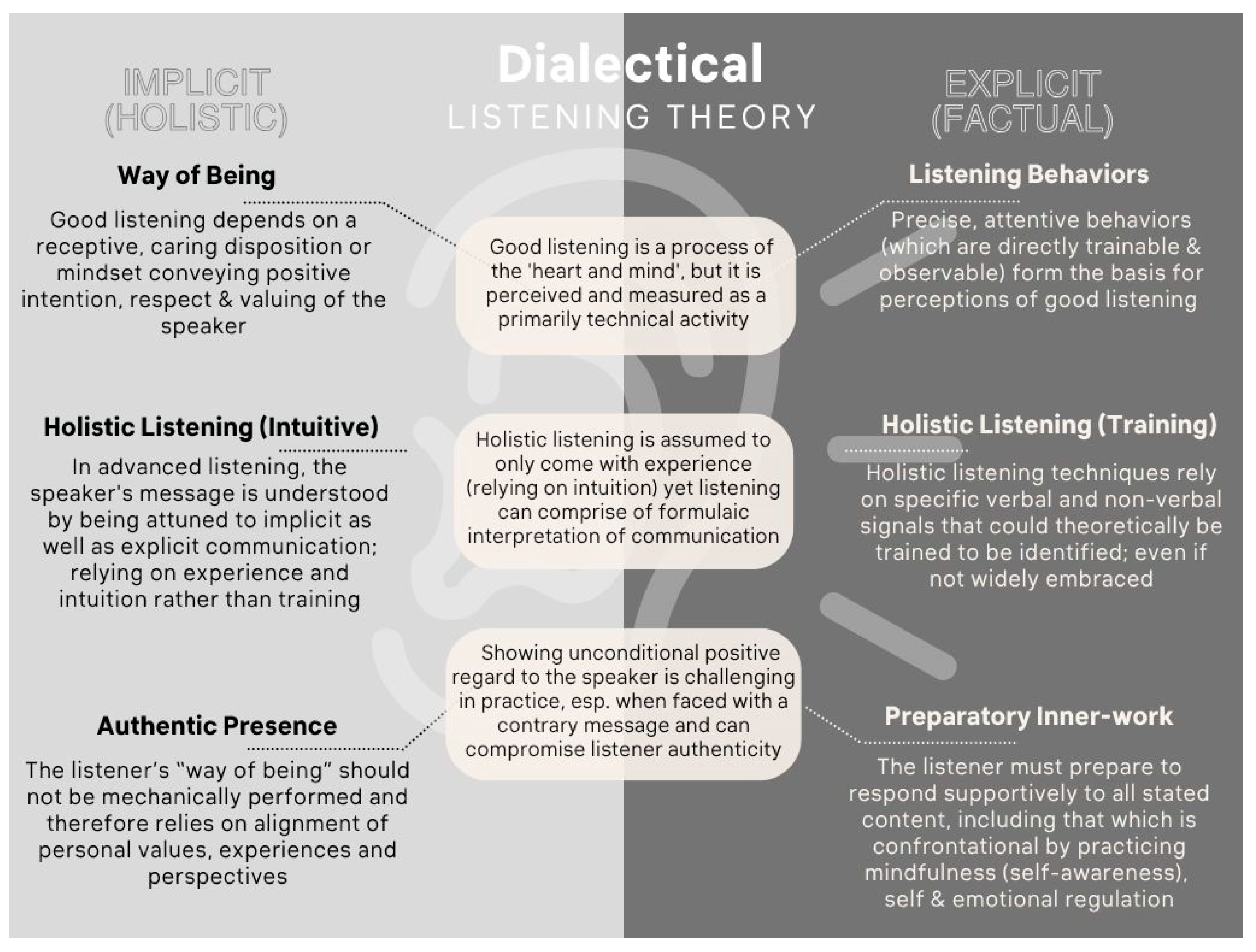
4.1. Tensions Experienced in Cultivating Listening
4.2. Managing the Tensions
4.2.1. Technical Performance Versus Mindset
4.2.2. Intuition Versus Training
4.2.3. Authenticity Versus Unconditional Positive Regard
4.3. Future Research Informed by Dialectical Listening Theory
4.4. Constraints on Generality
5. Conclusions
Supplementary Materials
Author Contributions
Funding
Institutional Review Board Statement
Informed Consent Statement
Data Availability Statement
Conflicts of Interest
Abbreviations
| www | World-wide Web |
| ST-TA | Structured Tabular Thematic Analysis (Robinson, 2022) |
| IRR | Inter-rater Reliability |
| CI | Confidence Interval |
| DLT | Dialectical Listening Theory |
| ICS | Interactive Cognitive Subsystems (Barnard & Teasdale, 1991) |
References
- Aakre, J. M., Lucksted, A., & Browning-McNee, L. A. (2016). Evaluation of youth mental health first aid USA: A program to assist young people in psychological distress. Psychological Services, 13(2), 121–126. [Google Scholar] [CrossRef]
- Adamu, A. A., Raza, S. H., & Mohamad, B. (2022). The interactive effect of mindfulness and internal listening on internal crisis management and its outcomes: The moderating role of emotional exhaustion. Corporate Communications: An International Journal, 28(1), 6–29. [Google Scholar] [CrossRef]
- Aotani, M. (2011). Factors contributing to holistic listening of Kyoto university students: A preliminary study. The International Center Research Bulletin Kyoto University, 1(2), 21–43. [Google Scholar]
- Barnard, P. J., Duke, D. J., Byrne, R. W., & Davidson, I. (2007). Differentiation in cognitive and emotional meanings: An evolutionary analysis. Cognition and Emotion, 21(6), 1155–1183. [Google Scholar] [CrossRef]
- Barnard, P. J., & Teasdale, J. D. (1991). Interacting cognitive subsystems: A systemic approach to cognitive-affective interaction and change. Cognition and Emotion, 5(1), 1–39. [Google Scholar] [CrossRef]
- Beattie, G., Webster, K. A., & Ross, J. A. D. (2014). Do speakers really unconsciously and imagistically gesture about what is important when they are telling a story? Semiotica, 2014(202), 41–79. [Google Scholar] [CrossRef]
- Behrs, D. G. (1994). The effects of an active-listening training program on admissions counselors communication style [Ph.D. thesis, American University]. Available online: https://www.proquest.com/docview/304097921/abstract/6BABE4F57EE04ED1PQ/1 (accessed on 15 August 2022).
- Bhaskar, R. (2008). A realist theory of science. Routledge. [Google Scholar]
- Bodie, G. D. (2011a). The Active-Empathic Listening Scale (AELS): Conceptualization and evidence of validity within the interpersonal domain. Communication Quarterly, 59(3), 277–295. [Google Scholar] [CrossRef]
- Bodie, G. D. (2011b). The understudied nature of listening in interpersonal communication: Introduction to a special issue. International Journal of Listening, 25(1–2), 1–9. [Google Scholar] [CrossRef]
- Bodie, G. D. (2012). Listening as positive communication. In T. J. Socha, & M. J. Pitts (Eds.), The positive side of interpersonal communication (pp. 109–126). Language as Social Action. Peter Lang Publishing. [Google Scholar]
- Bodie, G. D., & Jones, S. M. (2021). Listening fast and slow. In Rationalist bias in communication theory (pp. 172–188). IGI Global. [Google Scholar] [CrossRef]
- Bodie, G. D., Worthington, D., Imhof, M., & Cooper, L. (2008). What would a unified field of listening look like? A proposal linking past perspectives and future endeavors. The International Journal of Listening, 22, 103–122. [Google Scholar] [CrossRef]
- Boyatzis, R. E. (1998). Transforming qualitative information: Thematic analysis and code development (pp. xvi, 184). Sage Publications, Inc. [Google Scholar]
- Braun, V., & Clarke, V. (2006). Using thematic analysis in psychology. Qualitative Research in Psychology, 3(2), 77–101. [Google Scholar] [CrossRef]
- Braun, V., & Clarke, V. (2021). To saturate or not to saturate? Questioning data saturation as a useful concept for thematic analysis and sample-size rationales. Qualitative Research in Sport, Exercise and Health, 13(2), 201–216. [Google Scholar] [CrossRef]
- Brownell, J. (1996). Listening: Attitudes, principles, and skills. Allyn and Bacon. [Google Scholar]
- Burgess, D. J., Beach, M. C., & Saha, S. (2017). Mindfulness practice: A promising approach to reducing the effects of clinician implicit bias on patients. Patient Education and Counseling, 100(2), 372–376. [Google Scholar] [CrossRef]
- Burleson, B. R. (2009). Understanding the outcomes of supportive communication: A dual-process approach. Journal of Social and Personal Relationships, 26(1), 21–38. [Google Scholar] [CrossRef]
- Burleson, B. R. (2011). A constructivist approach to listening. International Journal of Listening, 25(1–2), 27–46. [Google Scholar] [CrossRef]
- Burt, S. (2019). The art of listening in coaching and mentoring. Routledge. [Google Scholar]
- Castro, D. R., Anseel, F., Kluger, A. N., Lloyd, K. J., & Turjeman-Levi, Y. (2018). Mere listening effect on creativity and the mediating role of psychological safety. Psychology of Aesthetics, Creativity, and the Arts, 12(4), 489–502. [Google Scholar] [CrossRef]
- Castro, D. R., Kluger, A. N., & Itzchakov, G. (2016). Does avoidance-attachment style attenuate the benefits of being listened to? European Journal of Social Psychology, 46(6), 762–775. [Google Scholar] [CrossRef]
- Catlaw, T. J., Rawlings, K. C., & Callen, J. C. (2014). The courage to listen. Administrative Theory & Praxis, 36(2), 197–218. [Google Scholar] [CrossRef]
- Chaiken, S. (1980). Heuristic versus systematic information processing and the use of source versus message cues in persuasion. Journal of Personality and Social Psychology, 39(5), 752–766. [Google Scholar] [CrossRef]
- Cohen, J. (1960). A coefficient of agreement for nominal scales. Educational and Psychological Measurement, 20(1), 37–46. [Google Scholar] [CrossRef]
- Coker, D. A., & Burgoon, J. (1987). The nature of conversational involvement and nonverbal encoding patterns. Human Communication Research, 13(4), 463–494. [Google Scholar] [CrossRef]
- Craig, R. T., & Tracy, K. (2014). Building grounded practical theory in applied communication research: Introduction to the special issue. Journal of Applied Communication Research, 42(3), 229–243. [Google Scholar] [CrossRef]
- Cumberland, D. M., Deckard, T. G., & Ellinger, A. D. (2021). Responding to racial injustice by listening and learning from employees. Journal of Workplace Learning, 33(8), 606–618. [Google Scholar] [CrossRef]
- Davidson, J. A., & Versluys, M. (1999). Effects of brief training in cooperation and problem solving on success in conflict resolution. Peace and Conflict: Journal of Peace Psychology, 5(2), 137–148. [Google Scholar] [CrossRef]
- Dhaliwal, R., & Harrower, J. (2009). Reducing prisoner vulnerability and providing a means of empowerment: Evaluating the impact of a Listener Scheme on the Listeners. The British Journal of Forensic Practice, 11(3), 35–43. [Google Scholar] [CrossRef]
- Drollinger, T., Comer, L. B., & Warrington, P. T. (2006). Development and validation of the active empathetic listening scale. Psychology & Marketing, 23(2), 161–180. [Google Scholar] [CrossRef]
- Edmondson, A. C. (2004). Psychological safety, trust, & learning in organisations: A group level lens. In R. M. Kramer, & K. S. Cook (Eds.), Trust and distrust in organizations: Dilemmas and approaches (pp. 239–272). Russell Sage Foundation. [Google Scholar]
- Evans, J. S. B. T., & Stanovich, K. E. (2013). Dual-process theories of higher cognition: Advancing the debate. Perspectives on Psychological Science, 8(3), 223–241. [Google Scholar] [CrossRef]
- Fauth, J. (2006). Toward more (and better) countertransference research. Psychotherapy: Theory, Research, Practice, Training, 43(1), 16–31. [Google Scholar] [CrossRef]
- Fenniman, A. (2010). Understanding each other at work: An examination of the effects of perceived empathetic listening on psychological safety in the supervisor-subordinate relationship (Vol. 71, Issues 1-A, p. 241). ProQuest Information & Learning. [Google Scholar]
- Feyten, C. M. (1991). The power of listening ability: An overlooked dimension in language acquisition. The Modern Language Journal, 75(2), 173–180. [Google Scholar] [CrossRef]
- Fusch, P. I., & Ness, L. R. (2015). Are we there yet? Data saturation in qualitative research. The Qualitative Report, 20(9), 1408–1416. [Google Scholar] [CrossRef]
- Gabbard, G. O. (2001). A contemporary psychoanalytic model of countertransference. Journal of Clinical Psychology, 57(8), 983–991. [Google Scholar] [CrossRef] [PubMed]
- Gable, S. L., Reis, H. T., Impett, E. A., & Asher, E. R. (2004). What do you do when things go right? The intrapersonal and interpersonal benefits of sharing positive events. Journal of Personality and Social Psychology, 87(2), 228–245. [Google Scholar] [CrossRef]
- Garland, D. R. (1981). Training married couples in listening skills: Effects on behavior, perceptual accuracy and marital adjustment. Family Relations, 30(2), 297–306. [Google Scholar] [CrossRef]
- Gearhart, C. C., & Bodie, G. D. (2011). Active-empathic listening as a general social skill: Evidence from bivariate and canonical correlations. Communication Reports, 24(2), 86–98. [Google Scholar] [CrossRef]
- Gelso, C. J., & Hayes, J. A. (2001). Countertransference management. Psychotherapy: Theory/Research/Practice/Training, 38(4), 418–422. [Google Scholar] [CrossRef]
- Gibb, A., Wilson, J. M., Ford, C., & Shook, N. J. (2022). Does mindfulness reduce negative interpretation bias? Cognition and Emotion, 36(2), 284–299. [Google Scholar] [CrossRef] [PubMed]
- Glenn, E. C. (1989). A content analysis of fifty definitions of listening. International Listening Association Journal, 3(1), 21–31. [Google Scholar] [CrossRef]
- Goh, E. C. L. (2012). Integrating mindfulness and reflection in the teaching and learning of listening skills for undergraduate social work students in Singapore. Social Work Education, 31(5), 587–604. [Google Scholar] [CrossRef]
- Graybill, D. (1986). A multiple-outcome evaluation of training parents in active listening. Psychological Reports, 59(3), 1171–1185. [Google Scholar] [CrossRef]
- Haddock, G., Foad, C. M. G., & Thorne, S. (2022). How do people conceptualize mindfulness? Royal Society Open Science, 9(3), 211366. [Google Scholar] [CrossRef]
- Hallgren, K. A. (2012). Computing inter-rater reliability for observational data: An overview and tutorial. Tutorials in Quantitative Methods for Psychology, 8(1), 23–34. Available online: https://www.tqmp.org/RegularArticles/vol08-1/p023/ (accessed on 10 August 2022). [CrossRef]
- Hansen, F. C. B., Resnick, H., & Galea, J. (2002). Better listening: Paraphrasing and perception checking—A study of the effectiveness of a multimedia skills training program. Journal of Technology in Human Services, 20(3–4), 317–331. [Google Scholar] [CrossRef]
- Harro-Loit, H., & Ugur, K. (2019). “Listen first, then ask!” Listening-based journalistic questioning training methods. Journalism Practice, 13(8), 911–915. [Google Scholar] [CrossRef]
- Hauser, M. F. (1984). Message structure, inference making, and recall. Annals of the International Communication Association, 8(1), 378–392. [Google Scholar] [CrossRef]
- Hayes, J. A., Gelso, C. J., Goldberg, S., & Kivlighan, D. M. (2018). Countertransference management and effective psychotherapy: Meta-analytic findings. Psychotherapy, 55(4), 496–507. [Google Scholar] [CrossRef]
- IMARC Group. (2025). Soft skills training market size, share, trends and forecast by soft skill type, channel provider, sourcing, delivery mode, end use industry, and region, 2026–2034 (Report No. SR112026A2598). IMARC Group. Available online: https://www.imarcgroup.com/soft-skills-training-market (accessed on 5 April 2026).
- Imhof, M., & Janusik, L. A. (2006). Development and validation of the Imhof-Janusik listening concepts inventory to measure listening conceptualization differences between cultures. Journal of Intercultural Communication Research, 35(2), 79–98. [Google Scholar] [CrossRef]
- Irwin, J. R., & Brancazio, L. (2014). Seeing to hear? Patterns of gaze to speaking faces in children with autism spectrum disorders. Frontiers in Psychology, 5, 397. [Google Scholar] [CrossRef]
- Itzchakov, G. (2020). Can listening training empower service employees? The mediating roles of anxiety and perspective-taking. European Journal of Work and Organizational Psychology, 29(6), 938–952. [Google Scholar] [CrossRef]
- Itzchakov, G., & Kluger, A. N. (2017). Can holding a stick improve listening at work? The effect of Listening Circles on employees’ emotions and cognitions. European Journal of Work and Organizational Psychology, 26(5), 663–676. [Google Scholar] [CrossRef]
- Itzchakov, G., & Kluger, A. N. (2018). The power of listening in helping people change. Harvard Business Review, 17, 1–7. [Google Scholar]
- Itzchakov, G., Reis, H. T., & Weinstein, N. (2022a). How to foster perceived partner responsiveness: High-quality listening is key. Social and Personality Psychology Compass, 16(1), e12648. [Google Scholar] [CrossRef]
- Itzchakov, G., & Weinstein, N. (2021). High-quality listening supports speakers’ autonomy and self-esteem when discussing prejudice. Human Communication Research, 47(3), 248–283. [Google Scholar] [CrossRef]
- Itzchakov, G., Weinstein, N., & Cheshin, A. (2022b). Learning to listen: Downstream effects of listening training on employees’ relatedness, burnout, and turnover intentions. Human Resource Management, 62(4), 565–580. [Google Scholar] [CrossRef]
- Itzchakov, G., Weinstein, N., Legate, N., & Amar, M. (2020). Can high quality listening predict lower speakers’ prejudiced attitudes? Journal of Experimental Social Psychology, 91, 104022. [Google Scholar] [CrossRef]
- Itzchakov, G., Weinstein, N., Saluk, D., & Amar, M. (2022c). Connection heals wounds: Feeling listened to reduces speakers’ loneliness following a social rejection disclosure. Personality and Social Psychology Bulletin, 49(8), 1273–1294. [Google Scholar] [CrossRef]
- Itzchakov, G., Weinstein, N., Vinokur, E., & Yomtovian, A. (2023). Communicating for workplace connection: A longitudinal study of the outcomes of listening training on teachers’ autonomy, psychological safety, and relational climate. Psychology in the Schools, 60(4), 1279–1298. [Google Scholar] [CrossRef]
- Janusik, L. (2005). Conversational listening span: A prosposed measure of conversational listening. International Journal of Listening, 19(1), 12–28. [Google Scholar] [CrossRef]
- Johansson, M., Hori, T., Skantze, G., Höthker, A., & Gustafson, J. (2016). Making turn-taking decisions for an active listening robot for memory training. In A. Agah, J.-J. Cabibihan, A. M. Howard, M. A. Salichs, & H. He (Eds.), Social robotics (pp. 940–949). Springer International Publishing. [Google Scholar] [CrossRef]
- Kabat-Zinn, J. (2005). Coming to our senses: Healing ourselves and the world through mindfulness. Hachette UK. [Google Scholar]
- Kanter, J. W., Rosen, D. C., Manbeck, K. E., Branstetter, H. M. L., Kuczynski, A. M., Corey, M. D., Maitland, D. W. M., & Williams, M. T. (2020). Addressing microaggressions in racially charged patient-provider interactions: A pilot randomized trial. BMC Medical Education, 20(1), 88. [Google Scholar] [CrossRef]
- Kasriel, E. (2022). Deep listening. Stanford Review. [Google Scholar]
- Kiesler, D. J. (1988). Therapeutic metacommunication: Therapist impact disclosure as feedback in psychotherapy (p. 64). Consulting Psychologists Press. [Google Scholar]
- Kluger, A. N. (2020, July 1–2). Listening as a fountain of positive relationships (at work): Meta-analyses. The 5th Israeli Organizational Behavior Conference, Tel Aviv, Israel. [Google Scholar]
- Kluger, A. N., & Bouskila-Yam, O. (2017). Facilitating Listening Scale (FLS). In D. L. Worthington, & G. D. Bodie (Eds.), The sourcebook of listening research: Methodology and measures (pp. 272–280). John Wiley & Sons, Ltd. [Google Scholar] [CrossRef]
- Kluger, A. N., & Itzchakov, G. (2022). The power of listening at work. Annual Review of Organizational Psychology and Organizational Behavior, 9, 121–146. [Google Scholar] [CrossRef]
- Kluger, A. N., Malloy, T. E., Pery, S., Itzchakov, G., Castro, D. R., Lipetz, L., Sela, Y., Turjeman-Levi, Y., Lehmann, M., New, M., & Borut, L. (2021). Dyadic listening in teams: Social relations model. Applied Psychology, 70(3), 1045–1099. [Google Scholar] [CrossRef]
- Krippendorff, K. (2004). Content analysis: An introduction to its methodology. SAGE. [Google Scholar]
- Kubota, S., Mishima, N., Ikemi, A., & Nagata, S. (1997). A research in the effects of active listening on corporate mental health training. Journal of Occupational Health, 39(4), 274–279. [Google Scholar] [CrossRef]
- Kubota, S., Mishima, N., & Nagata, S. (2004). A study of the effects of active listening on listening attitudes of middle managers. Journal of Occupational Health, 46(1), 60–67. [Google Scholar] [CrossRef] [PubMed]
- Kulik, C. C., Kulik, J. A., & Bangert-Drowns, R. L. (1990). Effectiveness of mastery learning programs: A meta-analysis. Review of Educational Research, 60, 265–299. [Google Scholar] [CrossRef]
- Lachica, N., Stockwell, A., & Gamba, J. (2021). What did I just say? An individualized behavior skills training for listening behaviors of adult participants in romantic relationships. Sexual and Relationship Therapy, 38(1), 732–755. [Google Scholar] [CrossRef]
- Lai, Y.-L., & McDowall, A. (2014). A systematic review (SR) of coaching psychology: Focusing on the attributes of effective coaching psychologists. International Coaching Psychology Review, 9(2), 120–136. [Google Scholar] [CrossRef]
- Landis, J. R., & Koch, G. G. (1977). The measurement of observer agreement for categorical data. Biometrics, 33(1), 159–174. [Google Scholar] [CrossRef] [PubMed]
- Levitt, D. H. (2001). Active listening and counselor self-efficacy: Emphasis on one microskill in beginning counselor training. The Clinical Supervisor, 20(2), 101–115. [Google Scholar] [CrossRef]
- Lipetz, L., Kluger, A. N., & Bodie, G. D. (2020). Listening is listening is listening: Employees’ perception of listening as a holistic phenomenon. International Journal of Listening, 34(2), 71–96. [Google Scholar] [CrossRef]
- Lisper, H.-O., & Rautalinko, E. (1996). Effects of a six hour training of active listening. Scandinavian Journal of Behaviour Therapy, 25(3–4), 117–125. [Google Scholar] [CrossRef]
- Manusov, V., Stofleth, D., Harvey, J. A., & Crowley, J. P. (2020). Conditions and consequences of listening well for interpersonal relationships: Modeling active-empathic listening, social-emotional skills, trait mindfulness, and relational quality. International Journal of Listening, 34(2), 110–126. [Google Scholar] [CrossRef]
- Martin, C. C., & Butera, C. (2022). Can brief interventions improve functioning in engineering student dyads? Journal of Articles in Support of the Null Hypothesis, 19(1), 13. [Google Scholar]
- McHugh, M. L. (2012). Interrater reliability: The kappa statistic. Biochemia Medica, 22(3), 276–282. [Google Scholar] [CrossRef]
- Mishima, N., Kubota, S., & Nagata, S. (2000). The development of a questionnaire to assess the attitude of active listening. Journal of Occupational Health, 42(3), 111–118. [Google Scholar] [CrossRef]
- Nemec, P. B., Spagnolo, A. C., & Soydan, A. S. (2017). Can you hear me now? Teaching listening skills. Psychiatric Rehabilitation Journal, 40(4), 415–417. [Google Scholar] [CrossRef]
- Noon, M. (2018). Pointless diversity training: Unconscious bias, new racism and agency. Work, Employment and Society, 32(1), 198–209. [Google Scholar] [CrossRef]
- Owen, W. F. (1984). Interpretive themes in relational communication. Quarterly Journal of Speech, 70(3), 274–287. [Google Scholar] [CrossRef]
- Passmore, J. (2011). Motivational interviewing techniques: Reflective listening. The Coaching Psychologist, 7(1), 49–52. [Google Scholar] [CrossRef]
- Passmore, J., & Oades, L. G. (2014). Positive psychology coaching—A model for coaching practice. The Coaching Psychologist, 10(2), 68–70. [Google Scholar] [CrossRef]
- Perls, F. S., Hefferline, R., & Goodman, P. (1994). Gestalt therapy: Excitement and growth in the human personality. Gestalt Journal Press. [Google Scholar]
- Pratscher, S. D., Wood, P. K., King, L. A., & Bettencourt, B. A. (2019). Interpersonal mindfulness: Scale development and initial construct validation. Mindfulness, 10(6), 1044–1061. [Google Scholar] [CrossRef]
- Price, A., Zulkosky, K., White, K., & Pretz, J. (2016). Accuracy of intuition in clinical decision making among novice clinicians. Journal of Advanced Nursing, 73(5), 1147–1157. [Google Scholar] [CrossRef] [PubMed]
- Purdy, M. W. (2000). Listening, culture and structures of consciousness: Ways of studying listening. International Journal of Listening, 14(1), 47–68. [Google Scholar] [CrossRef]
- RapidAPI. (n.d.). Top 8 best search engines (of 2022). The RapidAPI Blog. Available online: https://rapidapi.com/blog/best-search-engines/ (accessed on 10 August 2022).
- Rautalinko, E., & Lisper, H.-O. (2004). Effects of training reflective listening in a corporate setting. Journal of Business and Psychology, 18(3), 281–299. [Google Scholar] [CrossRef]
- Rautalinko, E., Lisper, H.-O., & Ekehammar, B. (2007). Reflective listening in counseling: Effects of training time and evaluator social skills. American Journal of Psychotherapy, 61(2), 191–209. [Google Scholar] [CrossRef]
- Rave, R., Itzchakov, G., Weinstein, N., & Reis, H. T. (2022). How to get through hard times: Principals’ listening buffers teachers’ stress on turnover intention and promotes organizational citizenship behavior. Current Psychology, 3, 24233–24248. [Google Scholar] [CrossRef] [PubMed]
- Robinson, O. C. (2022). Conducting thematic analysis on brief texts: The structured tabular approach. Qualitative Psychology, 9(2), 194–208. [Google Scholar] [CrossRef]
- Rogers, C. R. (1942). Counseling and psychotherapy: Newer concepts in practice. Houghton Mifflin. [Google Scholar]
- Rogers, C. R. (1980). A way of being. Houghton Mifflin Co. [Google Scholar]
- Rogers, C. R., & Farson, R. (1957). Active listening. Martino Publishing. [Google Scholar]
- Ross, P. C., & Shoemaker, H. A. (1969). An evaluation of listening training against job relevant criteria. NSPI Journal, 8(4), 14–18. [Google Scholar] [CrossRef]
- Roth, G., Vansteenkiste, M., & Ryan, R. M. (2019). Integrative emotion regulation: Process and development from a self-determination theory perspective. Development and Psychopathology, 31(3), 945–956. [Google Scholar] [CrossRef]
- Sapra, J., & Kumar, B. (2020). Inter-relation of psychological safety, courage and vulnerability in the workplace. International Journal of Engineering Applied Sciences and Technology, 5(3), 562–567. [Google Scholar] [CrossRef]
- Schaefer, E. E. (2018). Using neurofeedback and mindfulness pedagogies to teach open listening. Computers and Composition, 50, 78–104. [Google Scholar] [CrossRef]
- Schlehofer, M. M., Omoto, A. M., & Adelman, J. R. (2008). How do “religion” and “spirituality” differ? Lay definitions among older adults. Journal for the Scientific Study of Religion, 47(3), 411–425. [Google Scholar] [CrossRef]
- Schmader, T., Dennehy, T. C., & Baron, A. S. (2022). Why antibias interventions (need not) fail. Perspectives on Psychological Science, 17, 1381–1403. [Google Scholar] [CrossRef]
- Spunt, R. P. (2013). Mirroring, mentalizing, and the social neuroscience of listening. International Journal of Listening, 27(2), 61–72. [Google Scholar] [CrossRef]
- Stein, H. F. (2021). Listening deeply: An approach to understanding and consulting in organizational culture. Routledge. [Google Scholar] [CrossRef]
- Tanaka, H., Iwasaka, H., Negoro, H., & Nakamura, S. (2020). Analysis of conversational listening skills toward agent-based social skills training. Journal on Multimodal User Interfaces, 14(1), 73–82. [Google Scholar] [CrossRef]
- Tannenbaum, P. H., & Williams, F. (1968). Generation of active and passive sentences as a function of subject or object focus. Journal of Verbal Learning and Verbal Behavior, 7(1), 246–250. [Google Scholar] [CrossRef]
- Tatsumi, A., Sumiyoshi, K., Kawaguchi, H., & Sano, Y. (2010). The effect of short-time active listening training. Sangyo Eiseigaku Zasshi, 52(2), 81. [Google Scholar] [CrossRef] [PubMed]
- Teasdale, J. D., & Barnard, P. J. (1993). Affect, cognition, and change. Lawrence Erlbaum Associates, Ltd. [Google Scholar]
- Teasdale, J. D., & Chaskalson (Kulananda), M. (2011). How does mindfulness transform suffering? II: The transformation of dukkha. Contemporary Buddhism, 12(1), 103–124. [Google Scholar] [CrossRef]
- The Behavioural Insights Team. (2020). Unconscious bias and diversity training—What the evidence says. Government People Group. Available online: https://www.gov.uk/government/publications/unconscious-bias-and-diversity-training-what-the-evidence-says/ (accessed on 23 January 2024).
- Thill, C. (2009). Courageous listening, responsibility for the other and the Northern Territory Intervention. Continuum, 23(4), 537–548. [Google Scholar] [CrossRef]
- Trahan, B. C., & Rockwell, P. (1999). The effects of listening training on nursing home assistants: Residents’ satisfaction with and perceptions of assistants’ listening behavior. International Journal of Listening, 13(1), 62–74. [Google Scholar] [CrossRef]
- Trujillo, J. P., & Holler, J. (2023). Interactionally embedded gestalt principles of multimodal human communication. Perspectives on Psychological Science, 18(5), 1136–1159. [Google Scholar] [CrossRef]
- Tyler, J. A. (2011). Reclaiming rare listening as a means of organizational re-enchantment. Journal of Organizational Change Management, 24(1), 143–157. [Google Scholar] [CrossRef]
- van Nieuwerburgh, C. (2017). An introduction to coaching skills: A practical guide (2nd ed.). SAGE Publications. [Google Scholar]
- Vinokur, E., Yomtovian, A., Marom, M. S., Itzchakov, G., & Baron, L. (2024). Social-based learning and leadership in school: Conflict management training for holistic, relational conflict resolution. Frontiers in Social Psychology, 2, 1412968. [Google Scholar] [CrossRef]
- Wachs, K., & Cordova, J. V. (2007). Mindful relating: Exploring mindfulness and emotion repertoires in intimate relationships. Journal of Marital and Family Therapy, 33(4), 464–481. [Google Scholar] [CrossRef]
- Weinstein, N., Huo, A., & Itzchakov, G. (2021). Parental listening when adolescents self-disclose: A preregistered experimental study. Journal of Experimental Child Psychology, 209, 105178. [Google Scholar] [CrossRef]
- Weinstein, N., Itzchakov, G., & Legate, N. (2022). The motivational value of listening during intimate and difficult conversations. Social and Personality Psychology Compass, 16(2), e12651. [Google Scholar] [CrossRef]
- Weinstein, N., Przybylski, A. K., & Ryan, R. M. (2013). The integrative process: New research and future directions. Current Directions in Psychological Science, 22(1), 69–74. [Google Scholar] [CrossRef]
- Wood, C. M., & Alford, B. L. (2022). An 8-nation empirical test of three interpersonal listening techniques. Journal of Marketing Theory and Practice, 30(3), 361–373. [Google Scholar] [CrossRef]
- Woodcock, C. (2010). The Listening Guide for coaching: Exploring qualitative, relational, voice-centered, evidence based methodology for coaches. Coaching: An International Journal of Theory, Research and Practice, 3(2), 144–154. [Google Scholar] [CrossRef]
- Wouda, J. C., & van de Wiel, H. B. M. (2014). The effects of self-assessment and supervisor feedback on residents’ patient-education competency using videoed outpatient consultations. Patient Education and Counseling, 97(1), 59–66. [Google Scholar] [CrossRef] [PubMed]
- Zhang, Y., Frassinelli, D., Tuomainen, J., Skipper, J. I., & Vigliocco, G. (2021). More than words: Word predictability, prosody, gesture and mouth movements in natural language comprehension. Proceedings of the Royal Society B: Biological Sciences, 288(1955), 20210500. [Google Scholar] [CrossRef]
- Zohoori, A. (2013). A cross-cultural comparison of the HURIER listening profile among Iranian and U.S. Students. International Journal of Listening, 27(1), 50–60. [Google Scholar] [CrossRef]


Disclaimer/Publisher’s Note: The statements, opinions and data contained in all publications are solely those of the individual author(s) and contributor(s) and not of MDPI and/or the editor(s). MDPI and/or the editor(s) disclaim responsibility for any injury to people or property resulting from any ideas, methods, instructions or products referred to in the content. |
© 2026 by the authors. Licensee MDPI, Basel, Switzerland. This article is an open access article distributed under the terms and conditions of the Creative Commons Attribution (CC BY) license.
Share and Cite
Moin, F.K.T.; Itzchakov, G.; Weinstein, N. Understanding and Cultivating Effective Listening: A Dialectical Theory of the Tensions Between Intuition and Behavior. Behav. Sci. 2026, 16, 572. https://doi.org/10.3390/bs16040572
Moin FKT, Itzchakov G, Weinstein N. Understanding and Cultivating Effective Listening: A Dialectical Theory of the Tensions Between Intuition and Behavior. Behavioral Sciences. 2026; 16(4):572. https://doi.org/10.3390/bs16040572
Chicago/Turabian StyleMoin, F. K. Tia, Guy Itzchakov, and Netta Weinstein. 2026. "Understanding and Cultivating Effective Listening: A Dialectical Theory of the Tensions Between Intuition and Behavior" Behavioral Sciences 16, no. 4: 572. https://doi.org/10.3390/bs16040572
APA StyleMoin, F. K. T., Itzchakov, G., & Weinstein, N. (2026). Understanding and Cultivating Effective Listening: A Dialectical Theory of the Tensions Between Intuition and Behavior. Behavioral Sciences, 16(4), 572. https://doi.org/10.3390/bs16040572