Opposing Roles of Testosterone and Cortisol in Prosocial Risk-Taking

Abstract
1. Introduction
2. Materials and Methods
2.1. Participants
2.2. (Prosocial) Risk-Taking Behavior Assessment
2.3. Saliva Samples and Hormone Assays
2.4. Statistical Analyses
3. Results
3.1. Main Effects
3.2. Interaction Effects
4. Discussion
5. Conclusions
Supplementary Materials
Author Contributions
Funding
Institutional Review Board Statement
Informed Consent Statement
Data Availability Statement
Conflicts of Interest
References
- Apicella, C. L., Carré, J. M., & Dreber, A. (2015). Testosterone and economic risk taking: A review. Adaptive Human Behavior and Physiology, 1(3), 358–385. [Google Scholar] [CrossRef] [Scilit]
- Apicella, C. L., Dreber, A., Campbell, B., Gray, P. B., Hoffman, M., & Little, A. C. (2008). Testosterone and financial risk preferences. Evolution and Human Behavior, 29(6), 384–390. [Google Scholar] [CrossRef] [Scilit]
- Armstrong-Carter, E., Do, K. T., Guassi Moreira, J. F., Prinstein, M. J., & Telzer, E. H. (2021). Examining a new prosocial risk-taking scale in a longitudinal sample of ethnically diverse adolescents. Journal of Adolescence, 93, 222–233. [Google Scholar] [CrossRef] [Scilit] [PubMed]
- Bates, D., Maechler, M., Bolker, B., & Walker, S. (2014). lme4: Linear mixed-effects models using S4 classes (Version 1.1-6) [Computer software]. R Package.
- Campbell, I. T., Walker, R. F., Riad-Fahmy, D., Wilson, D. W., & Griffiths, K. (1982). Circadian rhythms of testosterone and cortisol in saliva: Effects of activity-phase shifts and continuous daylight. Chronobiologia, 9(4), 389–396. [Google Scholar] [PubMed]
- Coates, J. M., & Herbert, J. (2008). Endogenous steroids and financial risk taking on a London trading floor. Proceedings of the National Academy of Sciences of the United States of America, 105(16), 6167–6172. [Google Scholar] [CrossRef] [Scilit]
- Cueva, C., Roberts, R. E., Spencer, T., Rani, N., Tempest, M., Tobler, P. N., Herbert, J., & Rustichini, A. (2015). Cortisol and testosterone increase financial risk taking and may destabilize markets. Scientific Reports, 5(1), 11206. [Google Scholar] [CrossRef] [Scilit]
- Dabbs, J. M. (1990). Salivary testosterone measurements: Reliability across hours, days, and weeks. Physiology and Behavior, 48(1), 83–86. [Google Scholar] [CrossRef] [Scilit]
- Dekkers, T. J., van Rentergem, J. A. A., Meijer, B., Popma, A., Wagemaker, E., & Huizenga, H. M. (2019). A meta-analytical evaluation of the dual-hormone hypothesis: Does cortisol moderate the relationship between testosterone and status, dominance, risk taking, aggression, and psychopathy? Neuroscience and Biobehavioral Reviews, 96, 250–271. [Google Scholar] [CrossRef] [Scilit]
- Dickerson, S. S., & Kemeny, M. E. (2004). Acute stressors and cortisol responses: A theoretical integration and synthesis of laboratory research. Psychological Bulletin, 130(3), 355–391. [Google Scholar] [CrossRef] [Scilit]
- Do, K. T., Guassi Moreira, J. F., & Telzer, E. H. (2017). But is helping you worth the risk? Defining prosocial risk taking in adolescence. Developmental Cognitive Neuroscience, 25, 260–271. [Google Scholar] [CrossRef] [Scilit]
- Dreher, J. C., Dunne, S., Pazderska, A., Frodl, T., Nolan, J. J., & O’Doherty, J. P. (2016). Testosterone causes both prosocial and antisocial status-enhancing behaviors in human males. Proceedings of the National Academy of Sciences of the United States of America, 113(41), 11633–11638. [Google Scholar] [CrossRef] [Scilit] [PubMed]
- Eagly, A. H. (2009). The his and hers of prosocial behavior: An examination of the social psychology of gender. American Psychologist, 64(8), 644–658. [Google Scholar] [CrossRef] [Scilit] [PubMed]
- Eisenegger, C., Naef, M., Snozzi, R., Heinrichs, M., & Fehr, E. (2010). Prejudice and truth about the effect of testosterone on human bargaining behaviour. Nature, 463, 356–359. [Google Scholar] [CrossRef] [Scilit] [PubMed]
- Faul, F., Erdfelder, E., Lang, A.-G., & Buchner, A. (2007). G*Power 3: A flexible statistical power analysis program for the social, behavioral, and biomedical sciences. Behavior Research Methods, 39(2), 175–191. [Google Scholar] [CrossRef] [Scilit]
- Griskevicius, V., Tybur, J. M., Sundie, J. M., Cialdini, R. B., Miller, G. F., & Kenrick, D. T. (2007). Blatant benevolence and conspicuous consumption: When romantic motives elicit strategic costly signals. Journal of Personality and Social Psychology, 93(1), 85–102. [Google Scholar] [CrossRef] [Scilit]
- Hobfoll, S. E. (1989). Conservation of resources: A new attempt at conceptualizing stress. American Psychologist, 44(3), 513–524. [Google Scholar] [CrossRef]
- Izuma, K. (2012). The social neuroscience of reputation. Neuroscience Research, 72(4), 283–288. [Google Scholar] [CrossRef] [Scilit]
- Kandasamy, N., Hardy, B., Page, L., Schaffner, M., Graggaber, J., Powlson, A. S., Fletcher, P. C., Gurnell, M., & Coates, J. (2014). Cortisol shifts financial risk preferences. Proceedings of the National Academy of Sciences of the United States of America, 111(9), 3608–3613. [Google Scholar] [CrossRef] [Scilit]
- Kirschbaum, C., Pirke, K. M., & Hellhammer, D. H. (1993). The “Trier social stress test”—A tool for investigating psychobiological stress responses in a laboratory setting. Neuropsychobiology, 28(1–2), 76–81. [Google Scholar] [CrossRef] [Scilit]
- Knight, E. L., Morales, P. J., Christian, C. B., Prasad, S., Harbaugh, W. T., Mehta, P. H., & Mayr, U. (2022). The causal effect of testosterone on men’s competitive behavior is moderated by basal cortisol and cues to an opponent’s status: Evidence for a context-dependent dual-hormone hypothesis. Journal of Personality and Social Psychology, 123(4), 693–716. [Google Scholar] [CrossRef] [Scilit]
- Knight, E. L., Sarkar, A., Prasad, S., & Mehta, P. H. (2020). Beyond the challenge hypothesis: The emergence of the dual-hormone hypothesis and recommendations for future research. Hormones and Behavior, 123, 104657. [Google Scholar] [CrossRef] [Scilit] [PubMed]
- Kurath, J., & Mata, R. (2018). Individual differences in risk taking and endogeneous levels of testosterone, estradiol, and cortisol: A systematic literature search and three independent meta-analyses. Neuroscience and Biobehavioral Reviews, 90, 428–446. [Google Scholar] [CrossRef] [Scilit] [PubMed]
- Lee, J. H., & Lee, S. W. (2021). Monthly variations in serum testosterone levels: Results from testosterone screening of 8,367 middle-aged men. Journal of Urology, 205(5), 1438–1443. [Google Scholar] [CrossRef] [Scilit] [PubMed]
- Li, Y., Météreau, E., Obeso, I., Butera, L., Villeval, M. C., & Dreher, J. C. (2020). Endogenous testosterone is associated with increased striatal response to audience effects during prosocial choices. Psychoneuroendocrinology, 122, 104872. [Google Scholar] [CrossRef] [Scilit]
- Mehta, P. H., & Josephs, R. A. (2010). Testosterone and cortisol jointly regulate dominance: Evidence for a dual-hormone hypothesis. Hormones and Behavior, 58(5), 898–906. [Google Scholar] [CrossRef] [Scilit]
- Mehta, P. H., & Prasad, S. (2015). The dual-hormone hypothesis: A brief review and future research agenda. Current Opinion in Behavioral Sciences, 3, 163–168. [Google Scholar] [CrossRef] [Scilit]
- Mooradian, A. D., Morley, J. E., & Korenman, S. G. (1987). Biological actions of androgens. Endocrine Reviews, 8(1), 1–28. [Google Scholar] [CrossRef] [Scilit]
- Nadler, A., Wibral, M., Dohmen, T., Falk, A., Previtero, A., Weber, B., Camerer, C., Dreber, A., & Nave, G. (2024). Does a single dose of testosterone increase willingness to compete, confidence, and risk-taking in men? Evidence from two randomised placebo-controlled experiments funding. Hormones and Behavior, 66, 105659. [Google Scholar] [CrossRef] [Scilit]
- Prasad, S., Knight, E. L., & Mehta, P. H. (2019). Basal testosterone’s relationship with dictator game decision-making depends on cortisol reactivity to acute stress: A dual-hormone perspective on dominant behavior during resource allocation. Psychoneuroendocrinology, 101, 150–159. [Google Scholar] [CrossRef] [Scilit]
- Schulreich, S., Tusche, A., Kanske, P., & Schwabe, L. (2022). Altruism under stress: Cortisol negatively predicts charitable giving and neural value representations depending on mentalizing capacity. Journal of Neuroscience, 42(16), 3445–3460. [Google Scholar] [CrossRef] [Scilit]
- Sim, M. Y., Kim, S. H., & Kim, K. M. (2017). Seasonal variations and correlations between vitamin D and total testosterone levels. Korean Journal of Family Medicine, 38(5), 270–275. [Google Scholar] [CrossRef] [Scilit]
- Singh, V. (2021). Role of cortisol and testosterone in risky decision-making: Deciphering male decision-making in the Iowa gambling task. Frontiers in Neuroscience, 15, 631195. [Google Scholar] [CrossRef] [Scilit]
- Smith, A. R., Chein, J., & Steinberg, L. (2014). Peers increase adolescent risk taking even when the probabilities of negative outcomes are known. Developmental Psychology, 50(5), 1564–1568. [Google Scholar] [CrossRef] [Scilit]
- Stanton, S. J., Liening, S. H., & Schultheiss, O. C. (2011). Testosterone is positively associated with risk taking in the Iowa Gambling Task. Hormones and Behavior, 59(2), 252–256. [Google Scholar] [CrossRef] [Scilit]
- Stanton, S. J., Welker, K. M., Bonin, P. L., Goldfarb, B., & Carré, J. M. (2021). The effect of testosterone on economic risk-taking: A multi-study, multi-method investigation. Hormones and Behavior, 134, 105014. [Google Scholar] [CrossRef] [Scilit]
- Terburg, D., Morgan, B., & van Honk, J. (2009). The testosterone-cortisol ratio: A hormonal marker for proneness to social aggression. International Journal of Law and Psychiatry, 32(4), 216–223. [Google Scholar] [CrossRef] [Scilit]
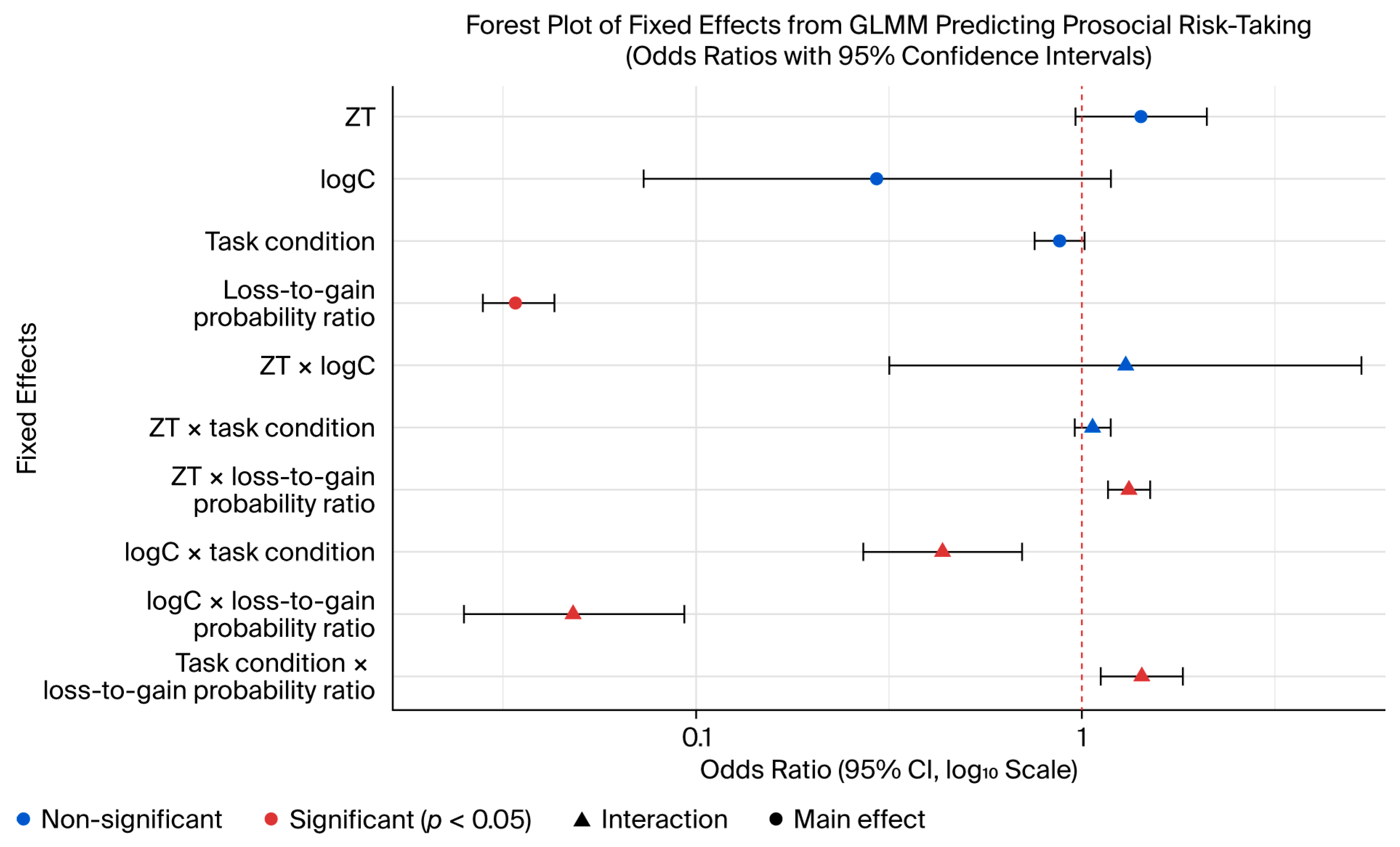



| Variable | Risk-Taking Rate | ||
|---|---|---|---|
| Model 1 | Model 2 (Without LogC) | Model 3 (Without ZT) | |
| Intercept | −0.246 | −0.451 ** | −0.264 |
| ZT | 0.353 | 0.349 * | — |
| LogC | −1.224 | — | −0.982 |
| Loss-to-Gain Probability Ratio | −3.371 ** | −3.911 *** | −3.401 *** |
| Task Condition a | −0.134 | −0.282 *** | −0.137 |
| ZT × Loss-to-Gain Probability Ratio | 0.282 ** | 0.211 ** | — |
| ZT × Task Condition | 0.063 | 0.039 | — |
| ZT × LogC | 0.260 | — | — |
| LogC × Task Condition | −0.833 *** | — | −0.777 ** |
| LogC × Loss-to-Gain Probability Ratio | −3.034 *** | — | −2.777 *** |
| Task Condition × Loss-to-Gain Probability Ratio | 0.357 ** | 0.397 ** | 0.377 ** |
| AIC | 8517.73 | 8603 | 8533.77 |
| BIC | 8605.88 | 8661.77 | 8592.53 |
| Log Likelihood | −4246.86 | −4293.5 | −4258.89 |
Disclaimer/Publisher’s Note: The statements, opinions and data contained in all publications are solely those of the individual author(s) and contributor(s) and not of MDPI and/or the editor(s). MDPI and/or the editor(s) disclaim responsibility for any injury to people or property resulting from any ideas, methods, instructions or products referred to in the content. |
© 2026 by the authors. Licensee MDPI, Basel, Switzerland. This article is an open access article distributed under the terms and conditions of the Creative Commons Attribution (CC BY) license.
Share and Cite
Huang, S.; Zhang, D.; Zhuang, J. Opposing Roles of Testosterone and Cortisol in Prosocial Risk-Taking. Behav. Sci. 2026, 16, 568. https://doi.org/10.3390/bs16040568
Huang S, Zhang D, Zhuang J. Opposing Roles of Testosterone and Cortisol in Prosocial Risk-Taking. Behavioral Sciences. 2026; 16(4):568. https://doi.org/10.3390/bs16040568
Chicago/Turabian StyleHuang, Shunhang, Di Zhang, and Jinying Zhuang. 2026. "Opposing Roles of Testosterone and Cortisol in Prosocial Risk-Taking" Behavioral Sciences 16, no. 4: 568. https://doi.org/10.3390/bs16040568
APA StyleHuang, S., Zhang, D., & Zhuang, J. (2026). Opposing Roles of Testosterone and Cortisol in Prosocial Risk-Taking. Behavioral Sciences, 16(4), 568. https://doi.org/10.3390/bs16040568