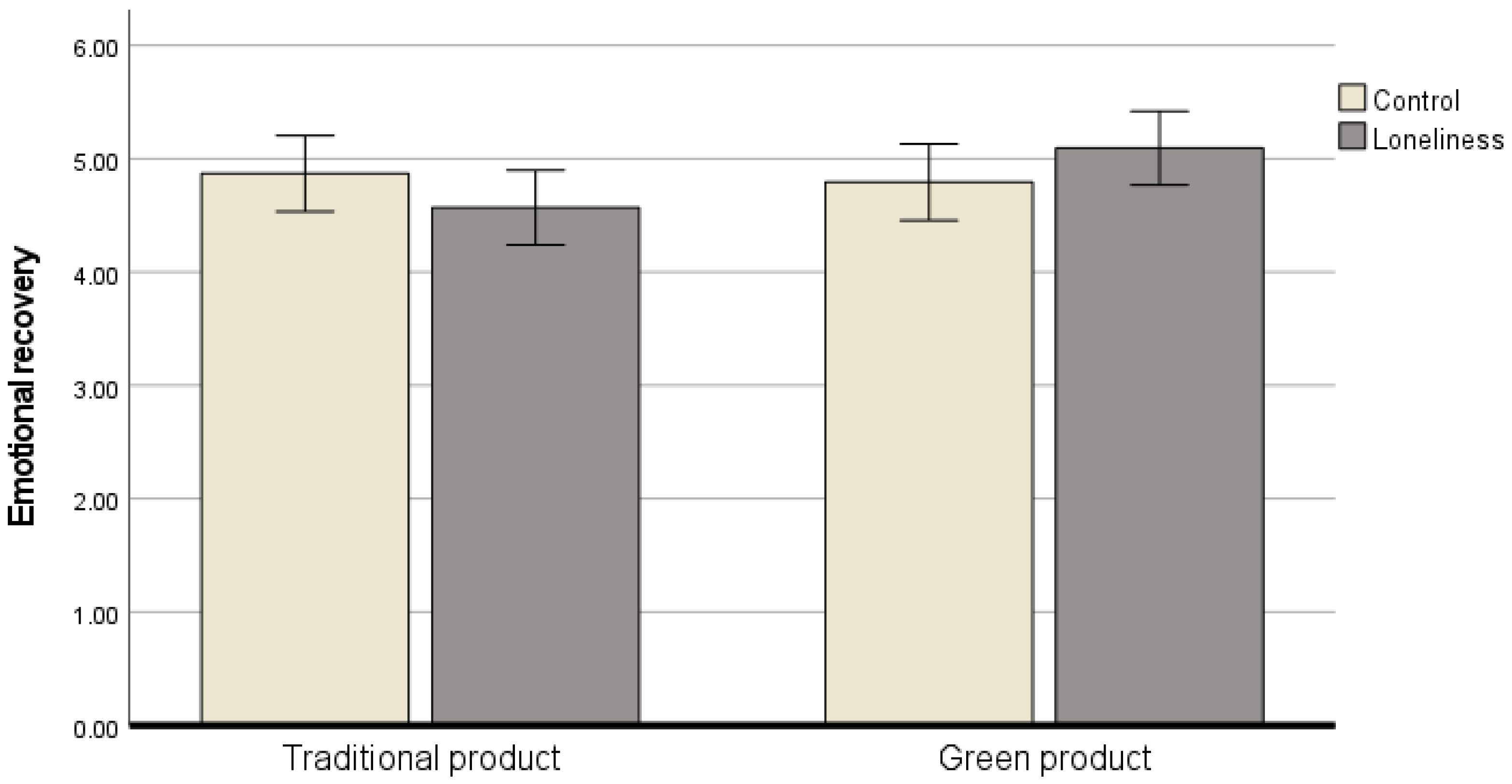


When Do We Recover from Loneliness: The Role of Green Consumption and Social Value


Abstract
1. Introduction
2. Literature Review
2.1. Loneliness
2.2. Green Consumption Behavior
2.3. Social Value as a Psychological Mechanism for Emotional Recovery
3. Methodology
3.1. Preliminary Study
3.1.1. Participants
3.1.2. Method
3.1.3. Results
3.1.4. Discussion
3.2. Study 1
3.2.1. Participants
3.2.2. Method
3.2.3. Results
3.2.4. Discussion
3.3. Study 2
3.3.1. Participants
3.3.2. Method
3.3.3. Results
3.3.4. Discussion
4. Conclusions
4.1. Theoretical Implications
4.2. Practical Implications
4.3. Limitations
Author Contributions
Funding
Institutional Review Board Statement
Informed Consent Statement
Data Availability Statement
Conflicts of Interest
References
- Aitken, R., Watkins, L., Williams, J., & Kean, A. (2020). The positive role of labelling on consumers’ perceived behavioural control and intention to purchase organic food. Journal of Cleaner Production, 255, 120334. [Google Scholar] [CrossRef]
- Barbarossa, C., & De Pelsmacker, P. (2016). Positive and negative antecedents of purchasing eco-friendly products: A comparison between green and non-green consumers. Journal of Business Ethics, 134(2), 229–247. [Google Scholar] [CrossRef]
- Baumeister, R. F., & Leary, M. R. (1995). The need to belong: Desire for interpersonal attachments as a fundamental human motivation. Psychological Bulletin, 117, 57–89. [Google Scholar] [CrossRef]
- Cacioppo, J. T., Hawkley, L. C., Ernst, J. M., Burleson, M., Berntson, G. G., Nouriani, B., & Spiegel, D. (2006). Loneliness within a nomological net: An evolutionary perspective. Journal of Research in Personality, 40(6), 1054–1085. [Google Scholar] [CrossRef]
- Caple, V., Maude, P., Walter, R., & Ross, A. (2023). An exploration of loneliness experienced by people living with mental illness and the impact on their recovery journey: An integrative review. Journal of Psychiatric and Mental Health Nursing, 30(6), 1170–1191. [Google Scholar] [CrossRef] [PubMed]
- Çinar, F., & Toker, K. (2019). An examination of the effect of loneliness on the innovative behavior of health science faculty students. Chinese Medical Journal, 132(2), 171–182. [Google Scholar] [CrossRef]
- Dhir, A., Sadiq, M., Talwar, S., Sakashita, M., & Kaur, P. (2021). Why do retail consumers buy green apparel? A knowledge-attitude-behaviour-context perspective. Journal of Retailing and Consumer Services, 59, 102398. [Google Scholar] [CrossRef]
- Dittmar, H. (2005). Compulsive buying—A growing concern? An examination of gender, age, and endorsement of materialistic values as predictors. British Journal of Psychology, 96(4), 467–491. [Google Scholar] [CrossRef]
- Dunn, E. W., Aknin, L. B., & Norton, M. I. (2008). Spending money on others promotes happiness. Science, 319(5870), 1687–1688. [Google Scholar] [CrossRef] [PubMed]
- Fan, X., Lai, A., & Keh, H. T. (2024). Handmade vs. machine-made: The effects of handmade gifts on social relationships. Marketing Letters, 35(3), 353–366. [Google Scholar] [CrossRef]
- Gao, Y. L., & Mattila, A. S. (2016). The impact of option popularity, social inclusion/exclusion, and self-affirmation on consumers’ propensity to choose green hotels. Journal of Business Ethics, 136(3), 575–585. [Google Scholar] [CrossRef]
- Giebelhausen, M., Chun, H. H., Cronin, J. J., Jr., & Hult, G. T. M. (2016). Adjusting the warm-glow thermostat: How incentivizing participation in voluntary green programs moderates their impact on service satisfaction. Journal of Marketing, 80(4), 56–71. [Google Scholar] [CrossRef]
- Gonçalves, H. M., Lourenço, T. F., & Silva, G. M. (2016). Green buying behavior and the theory of consumption values: A fuzzy-set approach. Journal of Business Research, 69(4), 1484–1491. [Google Scholar] [CrossRef]
- Griskevicius, V., Tybur, J. M., & Van den Bergh, B. (2010). Going green to be seen: Status, reputation, and conspicuous conservation. Journal of Personality and Social Psychology, 98(3), 392. [Google Scholar] [CrossRef]
- Gulledge, A. K., Gulledge, M. H., & Stahmannn, R. F. (2003). Romantic physical affection types and relationship satisfaction. The American Journal of Family Therapy, 31(4), 233–242. [Google Scholar] [CrossRef]
- Guo, Y., Zhang, P., Liao, J., & Wu, F. (2020). Social exclusion and green consumption: A costly signaling approach. Frontiers in Psychology, 11, 535489. [Google Scholar] [CrossRef] [PubMed]
- Hackel, L. M., Zaki, J., & Van Bavel, J. J. (2017). Social identity shapes social valuation: Evidence from prosocial behavior and vicarious reward. Social Cognitive and Affective Neuroscience, 12(8), 1219–1228. [Google Scholar] [CrossRef] [PubMed]
- Hawkley, L. C., & Cacioppo, J. T. (2010). Loneliness matters: A theoretical and empirical review of consequences and mechanisms. Annals of Behavioral Medicine, 40(2), 218–227. [Google Scholar] [CrossRef]
- Hayes, A. F. (2017). Introduction to mediation, moderation, and conditional process analysis: A regression-based approach. Guilford Publications. [Google Scholar]
- Jiao, J., & Wang, J. (2018). Can lonely people behave morally? The joint influence of loneliness and empathy on moral identity. Journal of Consumer Psychology, 28(4), 597–611. [Google Scholar] [CrossRef]
- Johnstone, M. L., & Hooper, S. (2016). Social influence and green consumption behaviour: A need for greater government involvement. Journal of Marketing Management, 32(9–10), 827–855. [Google Scholar] [CrossRef]
- Kasser, T., & Ryan, R. M. (1996). Further examining the American dream: Differential correlates of intrinsic and extrinsic goals. Personality and Social Psychology Bulletin, 22(3), 280–287. [Google Scholar] [CrossRef]
- Kellezi, B., Wakefield, J. R. H., Stevenson, C., McNamara, N., Mair, E., Bowe, M., Wilson, I., & Halder, M. M. (2019). The social cure of social prescribing: A mixed-methods study on the benefits of social connectedness on quality and effectiveness of care provision. BMJ Open, 9(11), e033137. [Google Scholar] [CrossRef] [PubMed]
- Khan, A. N. (2024). Unexpected ally: Can social exclusion boost quality of life through green choices? Social Indicators Research, 175(1), 295–315. [Google Scholar] [CrossRef]
- Koller, M., Floh, A., & Zauner, A. (2011). Further insights into perceived value and consumer loyalty: A “green” perspective. Psychology & Marketing, 28(12), 1154–1176. [Google Scholar] [CrossRef]
- Lanser, I., & Eisenberger, N. I. (2023). Prosocial behavior reliably reduces loneliness: An investigation across two studies. Emotion, 23(6), 1781. [Google Scholar] [CrossRef]
- Lapena, C., Continente, X., Sánchez Mascuñano, A., Pons Vigués, M., Pujol Ribera, E., & López, M. J. (2020). Qualitative evaluation of a community-based intervention to reduce social isolation among older people in disadvantaged urban areas of Barcelona. Health & Social Care in the Community, 28(5), 1488–1503. [Google Scholar]
- Lau, S., Chan, D. W., & Lau, P. S. (1999). Facets of loneliness and depression among Chinese children and adolescents. The Journal of Social Psychology, 139(6), 713–729. [Google Scholar] [CrossRef]
- Lee, J. C., Hall, D. L., & Wood, W. (2018). Experiential or material purchases? Social class determines purchase happiness. Psychological Science, 29(7), 1031–1039. [Google Scholar] [CrossRef]
- Lee, Y., Guo, Y., Li, G., & Chen, F. S. (2024). Prosocial behavior as an antidote to social disconnection: The effects of acts of kindness intervention on daily social contact and loneliness. Journal of Happiness Studies, 25(4), 39. [Google Scholar] [CrossRef]
- Li, J., Irina, Y. Y., Yang, M. X., & Chen, S. (2022). How needs for belongingness and justice influence social identity and performances: Evidence from the hospitality industry. Journal of Hospitality and Tourism Management, 50, 366–374. [Google Scholar] [CrossRef]
- Li, L. Z., & Wang, S. (2020). Prevalence and predictors of general psychiatric disorders and loneliness during COVID-19 in the United Kingdom. Psychiatry Research, 291, 113267. [Google Scholar] [CrossRef] [PubMed]
- Loughran Dommer, S., Swaminathan, V., & Ahluwalia, R. (2013). Using differentiated brands to deflect exclusion and protect inclusion: The moderating role of self-esteem on attachment to differentiated brands. Journal of Consumer Research, 40(4), 657–675. [Google Scholar] [CrossRef]
- Malon, M., Gajos, K., Rajchert, J., Holt-Lunstad, J., & Okruszek, Ł. (2024). Lonely and self-centered? A meta-analysis of the link between prosociality and loneliness. Personality and Social Psychology Bulletin, 52(4), 1040–1055. [Google Scholar] [CrossRef] [PubMed]
- Mandel, N., Rucker, D. D., Levav, J., & Galinsky, A. D. (2017). The compensatory consumer behavior model: How self-discrepancies drive consumer behavior. Journal of Consumer Psychology, 27(1), 133–146. [Google Scholar] [CrossRef]
- Martela, F., & Ryan, R. M. (2016). Prosocial behavior increases well-being and vitality even without contact with the beneficiary: Causal and behavioral evidence. Motivation and Emotion, 40(3), 351–357. [Google Scholar] [CrossRef]
- Masi, C. M., Chen, H.-Y., Hawkley, L. C., & Cacioppo, J. T. (2011). A meta-analysis of interventions to reduce loneliness. Personality and Social Psychology Review, 15(3), 219–266. [Google Scholar] [CrossRef]
- Mazar, N., & Zhong, C. B. (2010). Do green products make us better people? Psychological Science, 21(4), 494–498. [Google Scholar] [CrossRef]
- Mittal, S., & Silvera, D. H. (2018). Never truly alone, we always have our purchases: Loneliness and sex as predictors of purchase attachment and future purchase intentions. Journal of Consumer Behaviour, 17(1), e67–e77. [Google Scholar] [CrossRef]
- Moore, D., & Schultz, N. R., Jr. (1983). Loneliness at adolescence: Correlates, attributions, and coping. Journal of Youth and Adolescence, 12(2), 95–100. [Google Scholar] [CrossRef]
- Nguyen, N., & Johnson, L. W. (2020). Consumer behaviour and environmental sustainability. Journal of Consumer Behaviour, 19(6), 539–541. [Google Scholar] [CrossRef]
- Ni, M. Y., Yao, X. I., Leung, K. S., Yau, C., Leung, C. M., Lun, P., Flores, F. P., Chang, W. C., Cowan, T., & Leung, G. M. (2020). Depression and post-traumatic stress during major social unrest in Hong Kong: A 10-year prospective cohort study. The Lancet, 395(10220), 273–284. [Google Scholar] [CrossRef] [PubMed]
- Okan, İ., Kaya, A., Bilgin, Ü., & Gökyürek, B. (2023). Investigation of ruminative thinking forms and athlete emotion regulation skills of football players playing in U-19 academy development leagues. Journal of ROL Sports Sciences, 4(2), 698–713. [Google Scholar]
- Peplau, L. A., & Perlman, D. (1982). Perspectives on loneliness. In Loneliness: A sourcebook of current theory, research and therapy (pp. 1–18). John Wiley & Sons. [Google Scholar]
- Qu, Z., Li, C., & Yang, Y. (2025). Seeking substitutive satisfaction: The influencing mechanism of loneliness on tourists’ pro-environmental behavior. Journal of Hospitality & Tourism Research, 10963480251362104. [Google Scholar] [CrossRef]
- Ridgway, N. M., Kukar-Kinney, M., & Monroe, K. B. (2008). An expanded conceptualization and a new measure of compulsive buying. Journal of Consumer Research, 35(4), 622–639. [Google Scholar] [CrossRef]
- Ryan, R. M., & Deci, E. L. (2000). Intrinsic and extrinsic motivations: Classic definitions and new directions. Contemporary Educational Psychology, 25(1), 54–67. [Google Scholar] [PubMed]
- Savolainen, I., Oksanen, A., Kaakinen, M., Sirola, A., & Paek, H. J. (2020). The role of perceived loneliness in youth addictive behaviors: Cross-national survey study. JMIR Mental Health, 7(1), e14035. [Google Scholar] [CrossRef]
- Schinka, K. C., Van Dulmen, M. H., Bossarte, R., & Swahn, M. (2013). Association between loneliness and suicidality during middle childhood and adolescence: Longitudinal effects and the role of demographic characteristics. In Loneliness updated (pp. 108–121). Routledge. [Google Scholar]
- Shankar, A., McMunn, A., Banks, J., & Steptoe, A. (2011). Loneliness, social isolation, and behavioral and biological health indicators in older adults. Health Psychology, 30(4), 377. [Google Scholar] [CrossRef]
- Shrum, L. J., Fumagalli, E., & Lowrey, T. M. (2023). Coping with loneliness through consumption. Journal of Consumer Psychology, 33(2), 441–465. [Google Scholar] [CrossRef]
- Snyder, D. G., & Newman, K. P. (2019). Reducing consumer loneliness through brand communities. Journal of Consumer Marketing, 36(2), 337–347. [Google Scholar] [CrossRef]
- Statista Research Department. (2025). Feeling of loneliness among adults worldwide in 2021, by country. Statista. Available online: https://www.statista.com/statistics/1222815/loneliness-among-adults-by-country/ (accessed on 30 November 2025).
- Stein, J. Y., & Tuval-Mashiach, R. (2015). The social construction of loneliness: An integrative conceptualization. Journal of Constructivist Psychology, 28(3), 210–227. [Google Scholar] [CrossRef]
- Sun, Y., Li, T., & Wang, S. (2022). “I buy green products for my benefits or yours”: Understanding consumers’ intention to purchase green products. Asia Pacific Journal of Marketing and Logistics, 34(8), 1721–1739. [Google Scholar] [CrossRef]
- Sweeney, J. C., & Soutar, G. N. (2001). Consumer perceived value: The development of a multiple item scale. Journal of Retailing, 77(2), 203–220. [Google Scholar] [CrossRef]
- Tam, K. Y., & Chan, C. S. (2019). The effects of lack of meaning on trait and state loneliness: Correlational and experience-sampling evidence. Personality and Individual Differences, 141, 76–80. [Google Scholar] [CrossRef]
- Tezer, A., & Bodur, H. O. (2020). The green consumption effect: How using green products improves consumption experience. Journal of Consumer Research, 47(1), 25–39. [Google Scholar] [CrossRef]
- Twenge, J. M., Baumeister, R. F., DeWall, C. N., Ciarocco, N. J., & Bartels, J. M. (2007). Social exclusion decreases prosocial behavior. Journal of Personality and Social Psychology, 92(1), 56. [Google Scholar] [CrossRef]
- Wang, X., Sun, Y., & Kramer, T. (2021). Ritualistic consumption decreases loneliness by increasing meaning. Journal of Marketing Research, 58(2), 282–298. [Google Scholar] [CrossRef]
- White, K., Habib, R., & Hardisty, D. J. (2019). How to SHIFT consumer behaviors to be more sustainable: A literature review and guiding framework. Journal of Marketing, 83(3), 22–49. [Google Scholar] [CrossRef]
- Yang, Y., Liu, Y., Fan, X., Jin, Y., He, C., & Zhu, H. (2023). Loneliness and psychological distress among Chinese medical residents during the COVID-19 pandemic. Frontiers in Psychiatry, 14, 1240643. [Google Scholar]
- Yin, M., & Lee, E. J. (2023). Exposure to loneliness cues reduces prosocial behavior: Evidence from N400 and P300. Frontiers in Psychology, 14, 1094652. [Google Scholar] [CrossRef]
- Ying, L., Yan, Q., Shen, X., & Zhang, C. (2022). Social value orientation moderated the effect of acute stress on individuals’ prosocial behaviors. Frontiers in Psychology, 13, 803184. [Google Scholar] [CrossRef] [PubMed]

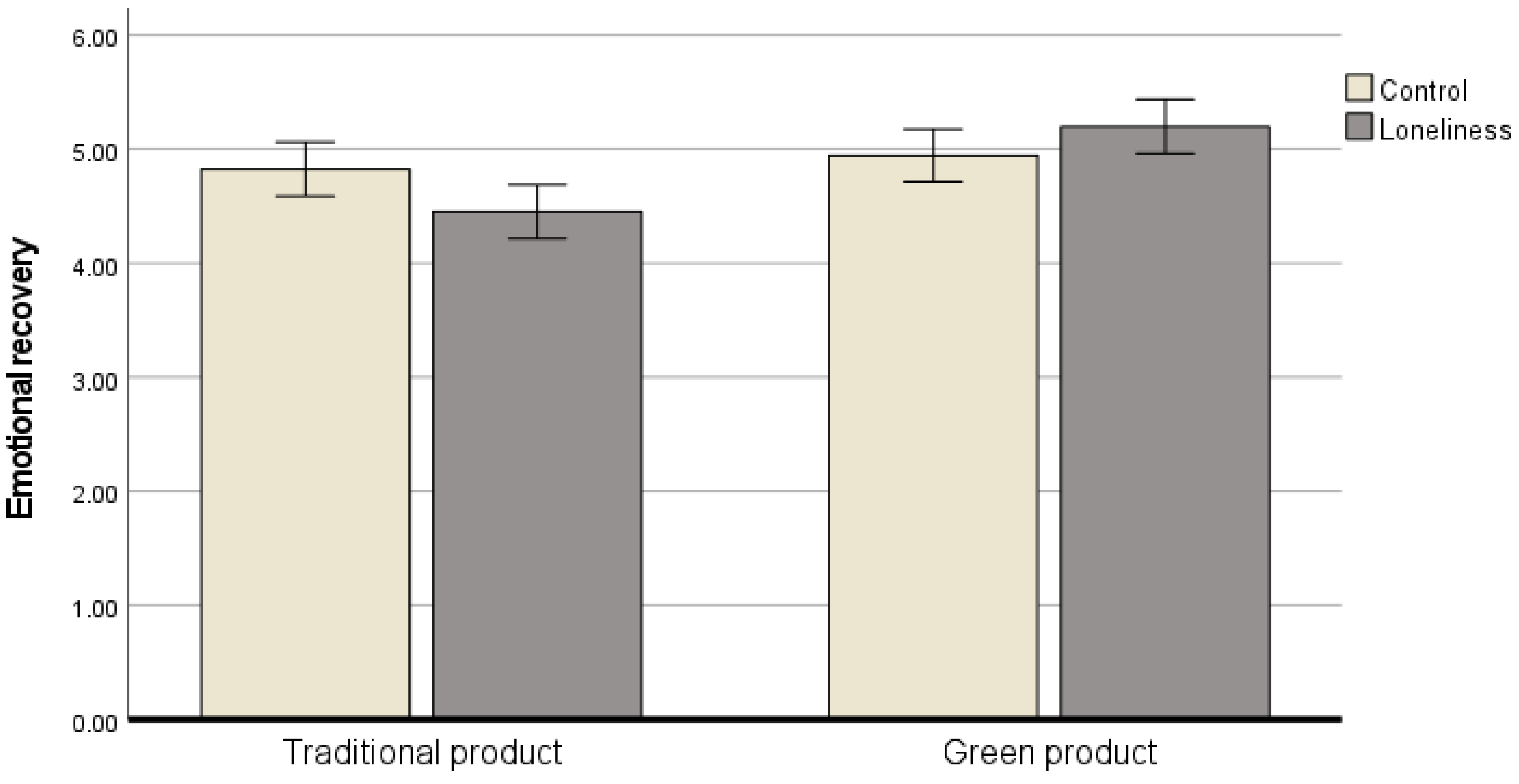
Disclaimer/Publisher’s Note: The statements, opinions and data contained in all publications are solely those of the individual author(s) and contributor(s) and not of MDPI and/or the editor(s). MDPI and/or the editor(s) disclaim responsibility for any injury to people or property resulting from any ideas, methods, instructions or products referred to in the content. |
© 2026 by the authors. Licensee MDPI, Basel, Switzerland. This article is an open access article distributed under the terms and conditions of the Creative Commons Attribution (CC BY) license.
Share and Cite
Yin, M.; Jeon, M. When Do We Recover from Loneliness: The Role of Green Consumption and Social Value. Behav. Sci. 2026, 16, 427. https://doi.org/10.3390/bs16030427
Yin M, Jeon M. When Do We Recover from Loneliness: The Role of Green Consumption and Social Value. Behavioral Sciences. 2026; 16(3):427. https://doi.org/10.3390/bs16030427
Chicago/Turabian StyleYin, Meiling, and Mingyeong Jeon. 2026. "When Do We Recover from Loneliness: The Role of Green Consumption and Social Value" Behavioral Sciences 16, no. 3: 427. https://doi.org/10.3390/bs16030427
APA StyleYin, M., & Jeon, M. (2026). When Do We Recover from Loneliness: The Role of Green Consumption and Social Value. Behavioral Sciences, 16(3), 427. https://doi.org/10.3390/bs16030427