How Is Self-Compassion Associated with Prolonged Grief and Posttraumatic Stress After Bereavement? The Mediating Roles of Perceived Stigma and Anger

Abstract
1. Introduction
2. Methods
2.1. Procedure and Participants
2.2. Measures
2.2.1. Demographic and Loss-Related Variables
2.2.2. Self-Compassion
2.2.3. Prolonged Grief Symptoms
2.2.4. Posttraumatic Stress Symptoms
2.2.5. Perceived Stigma
2.2.6. The Self and Other-Directed Anger
2.3. Statistical Analysis
3. Results
3.1. Sample Characteristics
3.2. Correlations Among Key Variables
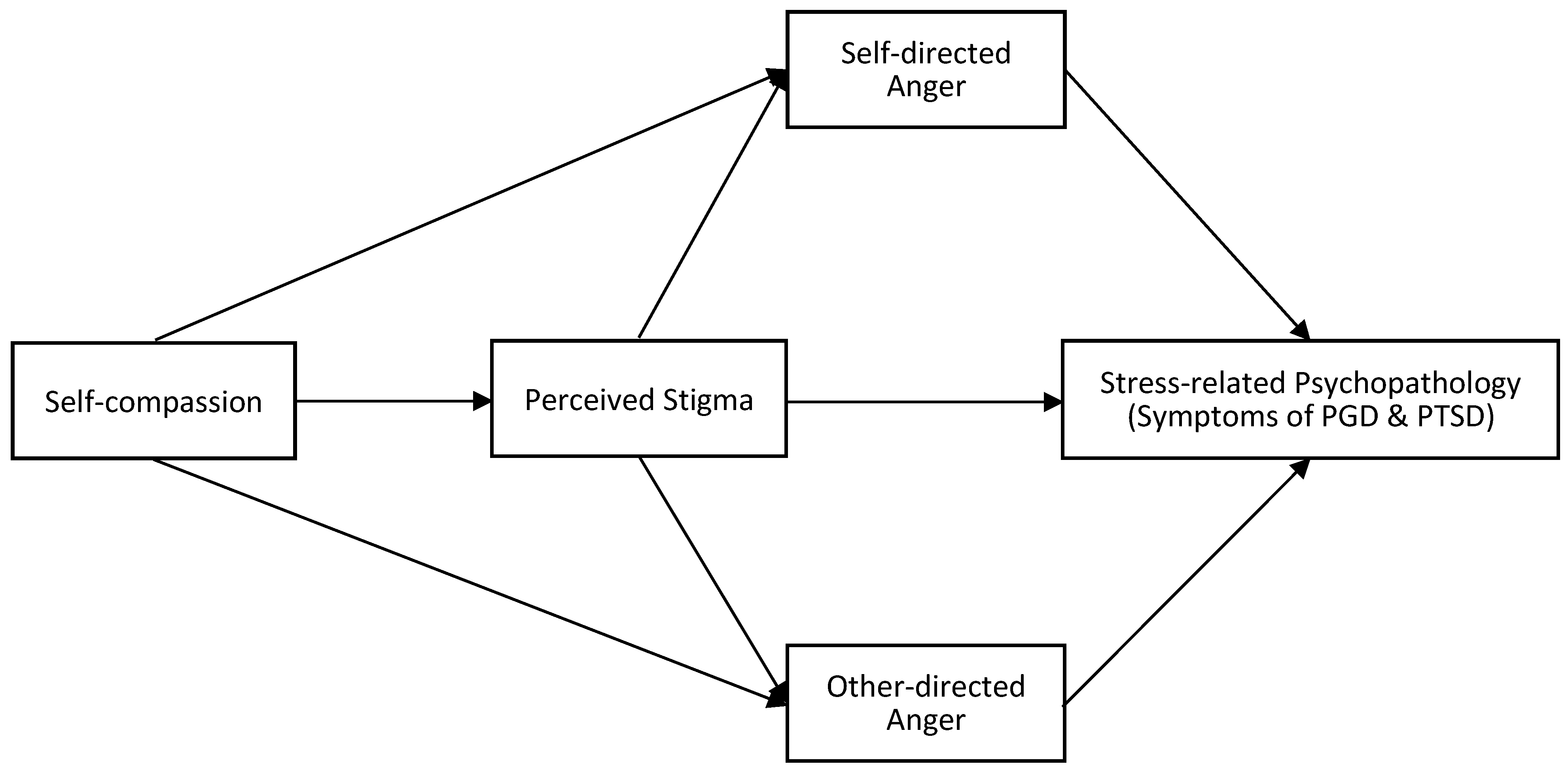
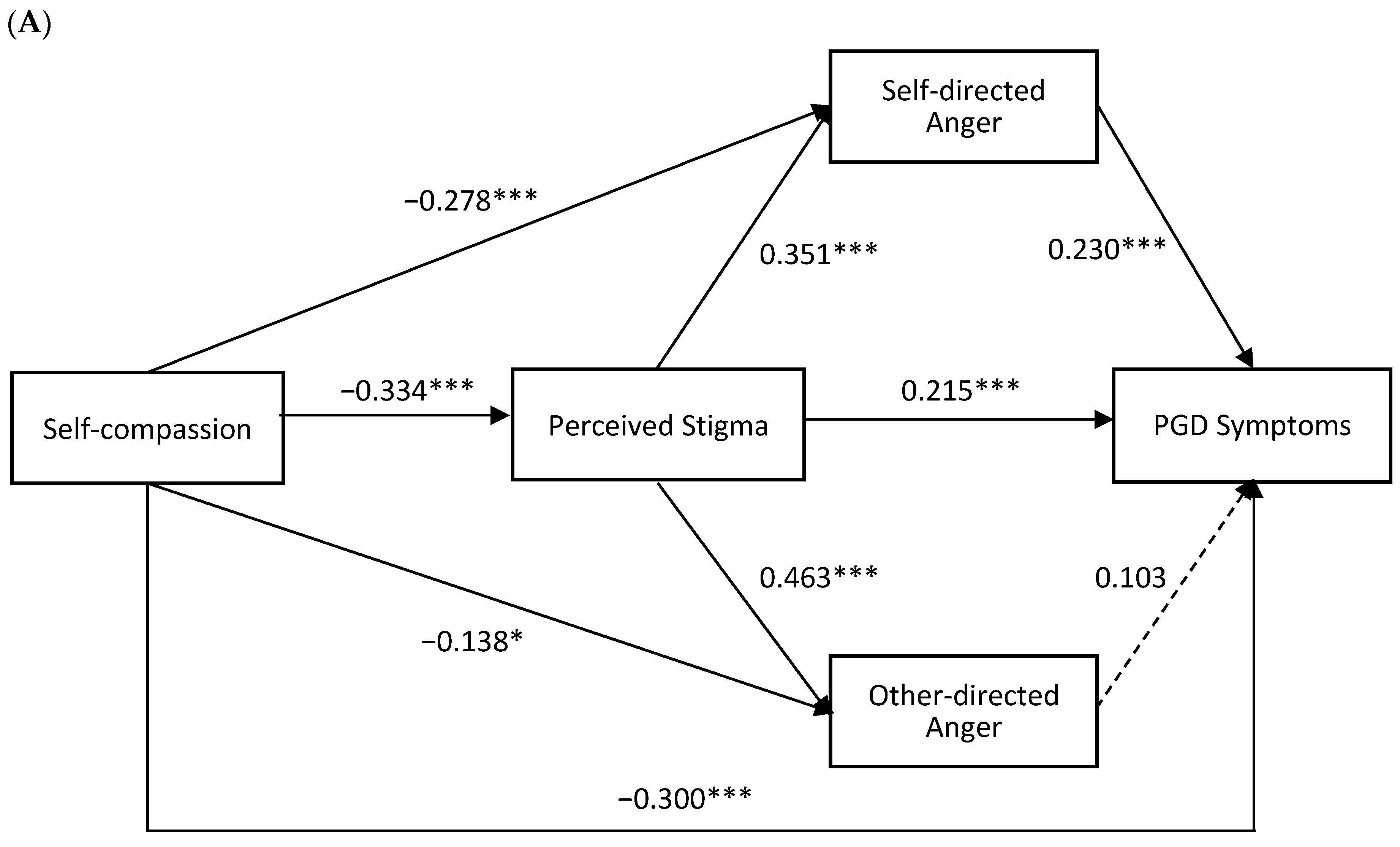
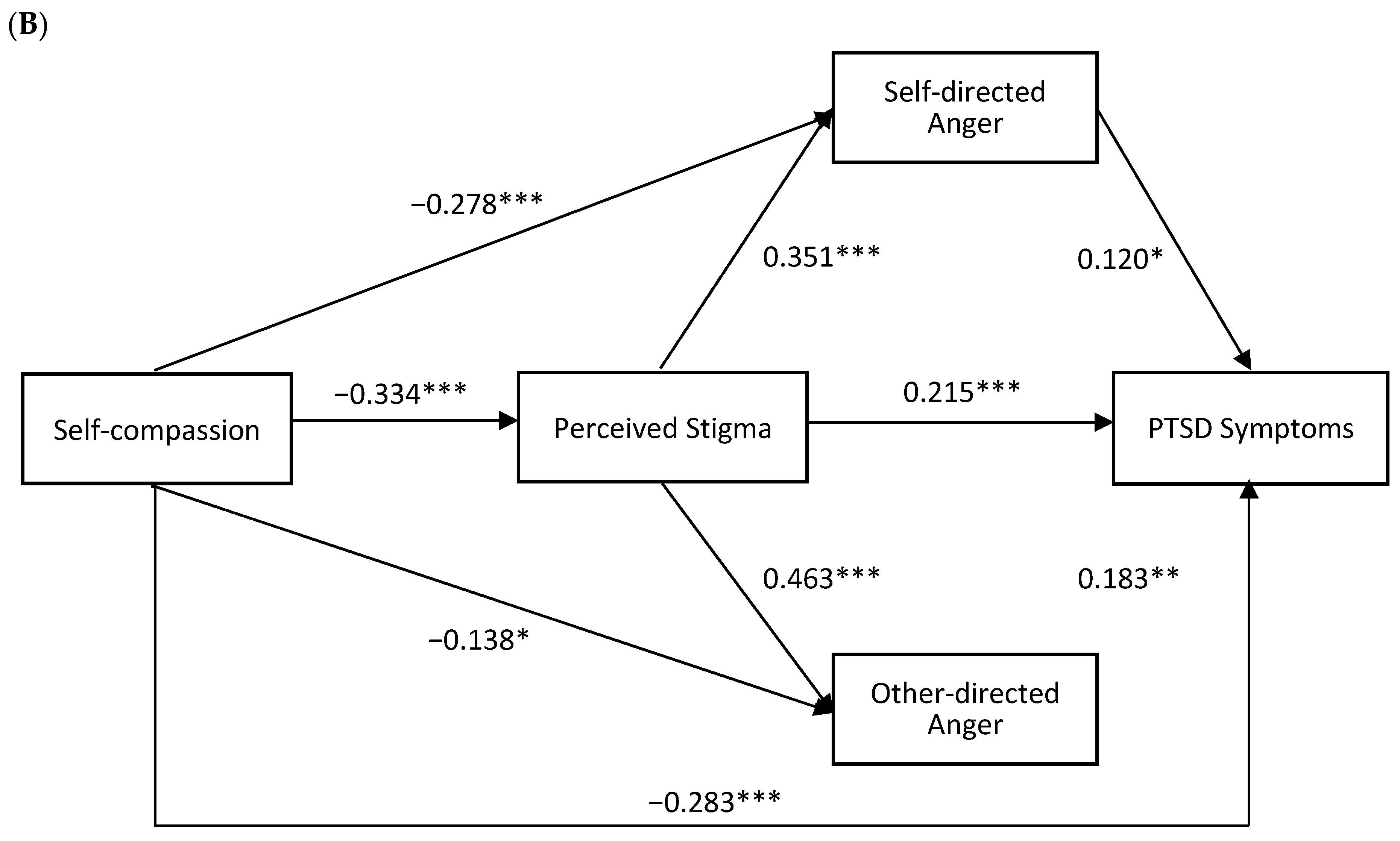
3.3. Serial Mediation by Perceived Stigma and Anger
4. Discussion
4.1. Self-Compassion and PGD and PTSD Symptoms
4.2. Mediating Role of Perceived Stigma
4.3. Distinct Roles of Self-Directed and Other-Directed Anger
4.3.1. Pathway via Perceived Stigma and Self-Directed Anger
4.3.2. Pathway via Perceived Stigma and Other-Directed Anger
4.4. Limitations
5. Conclusions
Author Contributions
Funding
Institutional Review Board Statement
Informed Consent Statement
Data Availability Statement
Conflicts of Interest
References
- Allen, A. B., & Leary, M. R. (2010). Self-compassion, stress, and coping. Social and Personality Psychology Compass, 4(2), 107–118. [Google Scholar] [CrossRef] [Scilit]
- American Psychiatric Association. (2022). Diagnostic and statistical manual of mental disorders: DSM-5 (Vol. 5). American Psychiatric Association. [Google Scholar]
- Andrews, B., Brewin, C. R., Rose, S., & Kirk, M. (2000). Predicting PTSD symptoms in victims of violent crime: The role of shame, anger, and childhood abuse. Journal of Abnormal Psychology, 109(1), 69–73. [Google Scholar] [CrossRef]
- Bailley, S. E., Dunham, K., & Kral, M. J. (2000). Factor structure of the grief experience questionnaire (GEQ). Death Studies, 24(8), 721–738. [Google Scholar] [CrossRef] [Scilit] [PubMed]
- Blevins, C. A., Weathers, F. W., Davis, M. T., Witte, T. K., & Domino, J. L. (2015). The posttraumatic stress disorder checklist for DSM-5 (PCL-5): Development and initial psychometric evaluation. Journal of Traumatic Stress, 28(6), 489–498. [Google Scholar] [CrossRef] [Scilit] [PubMed]
- Boelen, P. A., Eisma, M. C., de Keijser, J., & Lenferink, L. I. M. (2022). Concurrent associations of dimensions of anger with posttraumatic stress, depression, and functional impairment following non-fatal traffic accidents. European Journal of Psychotraumatology, 13(1), 2068912. [Google Scholar] [CrossRef] [Scilit]
- Boelen, P. A., & Lenferink, L. I. (2022). Prolonged grief disorder in DSM-5-TR: Early predictors and longitudinal measurement invariance. Australian & New Zealand Journal of Psychiatry, 56(6), 667–674. [Google Scholar] [CrossRef] [Scilit]
- Buur, C., Zachariae, R., Komischke-Konnerup, K. B., Marello, M. M., Schierff, L. H., & O’Connor, M. (2024). Risk factors for prolonged grief symptoms: A systematic review and meta-analysis. Clinical Psychology Review, 107, 102375. [Google Scholar] [CrossRef] [Scilit]
- Cesur-Soysal, G., & Durak-Batıgün, A. (2022). Prolonged grief, emotion regulation and loss-related factors: An investigation based on cognitive and behavioral conceptualization. Death Studies, 46(6), 1316–1328. [Google Scholar] [CrossRef] [Scilit]
- Chen, C., & Tang, S. (2021). Profiles of grief, post-traumatic stress, and post-traumatic growth among people bereaved due to COVID-19. European Journal of Psychotraumatology, 12(1), 1947563. [Google Scholar] [CrossRef] [Scilit]
- Cooper, C. L., & Quick, J. C. (Eds.). (2017). The handbook of stress and health: A guide to research and practice. Wiley Blackwell. [Google Scholar] [CrossRef] [Scilit]
- Corrigan, P. W. (1998). The impact of stigma on severe mental illness. Cognitive and Behavioral Practice, 5(2), 201–222. [Google Scholar] [CrossRef] [Scilit]
- Dewe, P., & Cooper, G. L. (2007). Coping research and measurement in the context of work-related stress. In G. P. Hodgkinson, & J. K. Ford (Eds.), International review of industrial and organizational psychology 2007 (pp. 141–191). John Wiley & Sons. [Google Scholar] [CrossRef] [Scilit]
- Diedrich, A., Grant, M., Hofmann, S. G., Hiller, W., & Berking, M. (2014). Self-compassion as an emotion regulation strategy in major depressive disorder. Behaviour Research and Therapy, 58, 43–51. [Google Scholar] [CrossRef] [Scilit]
- Doering, B. K., Barke, A., Vogel, A., Comtesse, H., & Rosner, R. (2022). Predictors of prolonged grief disorder in a German representative population sample: Unexpectedness of bereavement contributes to grief severity and prolonged grief disorder. Frontiers in Psychiatry, 13, 853698. [Google Scholar] [CrossRef] [Scilit] [PubMed]
- Eddinger, J. R., Hardt, M. M., & Williams, J. L. (2021). Concurrent treatment for PTSD and prolonged grief disorder: Review of outcomes for exposure- and nonexposure-based treatments. OMEGA-Journal of Death and Dying, 83(3), 446–469. [Google Scholar] [CrossRef] [Scilit] [PubMed]
- Eisma, M. C., & Stroebe, M. S. (2021). Emotion regulatory strategies in complicated grief: A systematic review. Behavior Therapy, 52(1), 234–249. [Google Scholar] [CrossRef] [Scilit]
- Ellsworth, P. C., & Tong, E. M. (2006). What does it mean to be angry at yourself? Categories, appraisals, and the problem of language. Emotion, 6(4), 572–586. [Google Scholar] [CrossRef] [Scilit] [PubMed]
- Else-Quest, N. M., LoConte, N. K., Schiller, J. H., & Hyde, J. S. (2009). Perceived stigma, self-blame, and adjustment among lung, breast and prostate cancer patients. Psychology and Health, 24(8), 949–964. [Google Scholar] [CrossRef] [Scilit]
- Folkman, S., & Moskowitz, J. T. (2004). Coping: Pitfalls and promise. Annual Review of Psychology, 55, 745–774. [Google Scholar] [CrossRef] [Scilit]
- Frijda, N. H. (1986). The emotions. Cambridge University Press. [Google Scholar]
- Gilbert, P., & Procter, S. (2006). Compassionate mind training for people with high shame and self-criticism: Overview and pilot study of a group therapy approach. Clinical Psychology & Psychotherapy: An International Journal of Theory & Practice, 13(6), 353–379. [Google Scholar] [CrossRef] [Scilit]
- Hansen, N., & Sassenberg, K. (2006). Does social identification harm or serve as a buffer? The impact of social identification on anger after experiencing social discrimination. Personality and Social Psychology Bulletin, 32(7), 983–996. [Google Scholar] [CrossRef] [Scilit]
- Hansen, N., & Sassenberg, K. (2011). Exploring the self-directed anger of the stigmatized: The interplay between perceived legitimacy and social identification. Group Processes & Intergroup Relations, 14(6), 807–818. [Google Scholar] [CrossRef] [Scilit]
- Hatzenbuehler, M. L., Weissman, D. G., McKetta, S., Lattanner, M. R., Ford, J. V., Barch, D. M., & McLaughlin, K. A. (2022). Smaller hippocampal volume among Black and Latinx youth living in high-stigma contexts. Journal of the American Academy of Child & Adolescent Psychiatry, 61(6), 809–819. [Google Scholar] [CrossRef] [Scilit]
- Hayes, A. F. (2013). Introduction to mediation, moderation, and conditional process analysis: A regression-based approach. The Guilford Press. [Google Scholar]
- Holmes, T. H., & Rahe, R. H. (1967). The social readjustment rating scale. Journal of Psychosomatic Research, 11(2), 213–218. [Google Scholar] [CrossRef] [Scilit]
- Inwood, E., & Ferrari, M. (2018). Mechanisms of change in the relationship between self-compassion, emotion regulation, and mental health: A systematic review. Applied Psychology. Health and Well-Being, 10(2), 215–235. [Google Scholar] [CrossRef] [Scilit] [PubMed]
- Kennedy, C., Deane, F. P., & Chan, A. Y. C. (2021). Intolerance of uncertainty and psychological symptoms among people with a missing loved one: Emotion regulation difficulties and psychological inflexibility as mediators. Journal of Contextual Behavioral Science, 21, 48–56. [Google Scholar] [CrossRef] [Scilit]
- Killikelly, C., Zhou, N., Merzhvynska, M., Stelzer, E. M., Dotschung, T., Rohner, S., Sun, L. H., & Maercker, A. (2020). Development of the international prolonged grief disorder scale for the ICD-11: Measurement of core symptoms and culture items adapted for Chinese and German-speaking samples. Journal of Affective Disorders, 277, 568–576. [Google Scholar] [CrossRef] [Scilit] [PubMed]
- King, M., Dinos, S., Shaw, J., Watson, R., Stevens, S., Passetti, F., Weich, S., & Serfaty, M. (2007). The stigma scale: Development of a standardised measure of the stigma of mental illness. British Journal of Psychiatry, 190(3), 248–254. [Google Scholar] [CrossRef] [Scilit]
- Komischke-Konnerup, K. B., Zachariae, R., Johannsen, M., Nielsen, L. D., & O’Connor, M. (2021). Co-Occurrence of prolonged grief symptoms and symptoms of depression, anxiety, and posttraumatic stress in bereaved adults: A systematic review and meta-analysis. Journal of Affective Disorders Report, 4, 100140. [Google Scholar] [CrossRef] [Scilit]
- Lazarus, R. S., & Folkman, S. (1984). Stress, appraisal, and coping. Springer Publishing Company. [Google Scholar]
- Lechner-Meichsner, F., Comtesse, H., & Olk, M. (2024). Prevalence, comorbidities, and factors associated with prolonged grief disorder, posttraumatic stress disorder and complex posttraumatic stress disorder in refugees: A systematic review. Conflict and Health, 18(1), 32. [Google Scholar] [CrossRef] [Scilit]
- Lenferink, L. I. M., Nickerson, A., Kashyap, S., de Keijser, J., & Boelen, P. A. (2024). Associations of dimensions of anger with distress following traumatic bereavement. Psychological Trauma: Theory, Research, Practice and Policy, 16(2), 176–183. [Google Scholar] [CrossRef] [Scilit]
- Li, Y., Deng, J., Lou, X., Wang, H., & Wang, Y. (2020). A daily diary study of the relationships among daily self-compassion, perceived stress and health-promoting behaviours. International Journal of Psychology, 55(3), 364–372. [Google Scholar] [CrossRef] [Scilit]
- Lundorff, M., Bonanno, G. A., Johannsen, M., & O’Connor, M. (2020). Are there gender differences in prolonged grief trajectories? A registry-sampled cohort study. Journal of Psychiatric Research, 129, 168–175. [Google Scholar] [CrossRef] [Scilit] [PubMed]
- Matsumoto, A., Santelices, C., & Lincoln, A. K. (2021). Perceived stigma, discrimination and mental health among women in publicly funded substance abuse treatment. Stigma and Health, 6(2), 151–162. [Google Scholar] [CrossRef] [Scilit]
- Meng, R., Yu, Y., Chai, S., Luo, X., Gong, B., Liu, B., Hu, Y., Luo, Y., & Yu, C. (2019). Self-compassion scale--Short form; Chinese Version (SCS-SF) [Database record]. APA PsycTests. [Google Scholar] [CrossRef] [Scilit]
- Mittal, D., Drummond, K. L., Blevins, D., Curran, G., Corrigan, P., & Sullivan, G. (2013). Stigma associated with PTSD: Perceptions of treatment seeking combat veterans. Psychiatric Rehabilitation Journal, 36(2), 86–92. [Google Scholar] [CrossRef] [Scilit]
- Miyagawa, Y., Tóth-Király, I., Knox, M. C., Taniguchi, J., & Niiya, Y. (2022). Development of the Japanese version of the state self-compassion scale (SSCS-J). Frontiers in Psychology, 12, 779318. [Google Scholar] [CrossRef] [Scilit]
- Neff, K. D. (2003). Self-compassion: An alternative conceptualization of a healthy attitude toward oneself. Self and Identity, 2(2), 85–101. [Google Scholar] [CrossRef] [Scilit]
- Neff, K. D. (2016). The self-compassion scale is a valid and theoretically coherent measure of self-compassion. Mindfulness, 7, 264–274. [Google Scholar] [CrossRef] [Scilit]
- Neff, K. D. (2023, October). What is self-compassion? Self-Compassion. Available online: https://self-compassion.org/what-is-self-compassion/ (accessed on 5 January 2026).
- Neff, K. D., & Pommier, E. (2013). The relationship between self-compassion and other-focused concern among college undergraduates, community adults, and practicing meditators. Self and Identity, 12(2), 160–176. [Google Scholar] [CrossRef] [Scilit]
- Orth, U., & Maercker, A. (2009). Posttraumatic anger in crime victims: Directed at the perpetrator and at the self. Journal of Traumatic Stress, 22(2), 158–161. [Google Scholar] [CrossRef] [Scilit]
- Orth, U., & Wieland, E. (2006). Anger, hostility, and posttraumatic stress disorder in trauma-exposed adults: A meta-analysis. Journal of Consulting and Clinical Psychology, 74, 698–706. [Google Scholar] [CrossRef] [Scilit]
- Pitman, A., Rantell, K., Marston, L., King, M., & Osborn, D. (2017). Perceived stigma of sudden bereavement as a risk factor for suicidal thoughts and suicide attempt: Analysis of British cross-sectional survey data on 3387 young bereaved adults. International Journal of Environmental Research and Public Health, 14(3), 286. [Google Scholar] [CrossRef] [Scilit]
- Raes, F., Pommier, E., Neff, K. D., & Van Gucht, D. (2011). Self-compassion scale--short form (SCS-SF) [Database record]. APA PsycTests. [Google Scholar] [CrossRef] [Scilit]
- Robins, C. J., Keng, S. L., Ekblad, A. G., & Brantley, J. G. (2012). Effects of mindfulness-based stress reduction on emotional experience and expression: A randomized controlled trial. Journal of Clinical Psychology, 68(1), 117–131. [Google Scholar] [CrossRef] [Scilit] [PubMed]
- Smeets, E., Neff, K., Alberts, H., & Peters, M. (2014). Meeting suffering with kindness: Effects of a brief self-compassion intervention for female college students. Journal of Clinical Psychology, 70(9), 794–807. [Google Scholar] [CrossRef] [Scilit] [PubMed]
- Stone-Romero, E. F., & Rosopa, P. J. (2011). Experimental tests of mediation models: Prospects, problems, and some solutions. Organizational Research Methods, 14(4), 631–646. [Google Scholar] [CrossRef] [Scilit]
- Szőcs, H., Sandheden, L., Horváth, Z., & Vizin, G. (2022). The mediating role of state shame, guilt, and pride in the relationship between self-compassion and prolonged grief. European Psychiatry, 65(S1), S179–S180. [Google Scholar] [CrossRef] [Scilit]
- Wagner, B., Hofmann, L., & Grafiadeli, R. (2021). The relationship between guilt, depression, prolonged grief, and posttraumatic stress symptoms after suicide bereavement. Journal of Clinical Psychology, 77(11), 2545–2558. [Google Scholar] [CrossRef] [Scilit]
- Weiner, B. (1985). An attributional theory of achievement motivation and emotion. Psychological Review, 92(4), 548. [Google Scholar] [CrossRef]
- Wong, A. E., Dirghangi, S. R., & Hart, S. R. (2019). Self-concept clarity mediates the effects of adverse childhood experiences on adult suicide behavior, depression, loneliness, perceived stress, and life distress. Self and Identity, 18(3), 247–266. [Google Scholar] [CrossRef] [Scilit]
- World Health Organization. (2018). ICD-11 for mortality and morbidity statistics: 6B42 prolonged grief disorder. Available online: https://icd.who.int/browse/2024-01/mms/en#1183832314 (accessed on 21 December 2023).
- Wu, Q., Chi, P., Zeng, X., Lin, X., & Du, H. (2019). Roles of anger and rumination in the relationship between self-compassion and forgiveness. Mindfulness, 10, 272–278. [Google Scholar] [CrossRef] [Scilit]
- Yela, J. R., Crego, A., Buz, J., Sánchez-Zaballos, E., & Gómez-Martínez, M. Á. (2022). Reductions in experiential avoidance explain changes in anxiety, depression and well-being after a mindfulness and self-compassion (MSC) training. Psychology and Psychotherapy: Theory, Research and Practice, 95(2), 402–422. [Google Scholar] [CrossRef] [Scilit]
- Zhang, N., Sandler, I., Tein, J. Y., Wolchik, S., & Donohue, E. (2022). Caregivers’ self-compassion and bereaved children’s adjustment: Testing caregivers’ mental health and parenting as mediators. Mindfulness, 13(2), 462–473. [Google Scholar] [CrossRef] [Scilit]
- Zhao, S., Ren, L., Wang, Q., Long, M., Wu, H., & Wang, Y. (2022). Predictors of prolonged grief disorder in Chinese elderly shidu parents: The role of perceived stigma and perceived stress. Asia-Pacific Psychiatry, 14(2), e12489. [Google Scholar] [CrossRef] [Scilit]
- Zhou, N., Yu, W., Tang, S., Wang, J., & Killikelly, C. (2018). Prolonged grief and post-traumatic growth after loss: Latent class analysis. Psychiatry Research, 267, 221–227. [Google Scholar] [CrossRef] [Scilit]



| Variable | N (M) | % (SD) |
|---|---|---|
| Sex | ||
| Female | 203 | 70.2 |
| Male | 86 | 29.8 |
| Age | 42.27 | 11.37 |
| Sex of deceased | ||
| Female | 119 | 41.2 |
| Male | 170 | 58.8 |
| Age of deceased | 67.62 | 17.74 |
| Time since loss (in years) | 7.85 | 9.25 |
| Relationship with the deceased | ||
| Parent | 134 | 46.4 |
| Grandparent | 77 | 26.6 |
| Spouse | 10 | 3.5 |
| Child | 1 | 0.3 |
| Sibling | 17 | 5.9 |
| Other relative a | 26 | 9.0 |
| Friend | 19 | 6.6 |
| Others b | 5 | 1.7 |
| Cause of death c | ||
| Sudden death | 157 | 54.3 |
| Non-sudden death | 132 | 45.7 |
| Variables | 1 | 2 | 3 | 4 | 5 | 6 |
|---|---|---|---|---|---|---|
| 1. Self-compassion | – | |||||
| 2. Perceived stigma | −0.379 *** | – | ||||
| 3. Self-directed anger | −0.404 *** | 0.477 *** | – | |||
| 4. Other-directed anger | −0.315 *** | 0.533 *** | 0.524 *** | – | ||
| 5. PGD symptoms | −0.476 *** | 0.486 *** | 0.513 *** | 0.424 *** | – | |
| 6. PTSD symptoms | −0.499 *** | 0.559 *** | 0.454 *** | 0.492 *** | 0.756 *** | – |
| M (SD) | 38.15 (5.48) | 8.46 (3.58) | 6.94 (4.87) | 4.42 (4.01) | 20.10 (11.69) | 18.92 (16.90) |
| Actual range | 12–54 | 5–25 | 0–20 | 0–17 | 0–56 | 0–69 |
| Cronbach’s α | 0.70 | 0.92 | 0.90 | 0.88 | 0.94 | 0.97 |
| Pathway | Effects | SE | LLCI | ULCI |
|---|---|---|---|---|
| 1. Self-compassion → PGD symptoms | ||||
| Direct | −0.6409 | 0.1108 | −0.8591 | −0.4227 |
| Indirect | −0.4100 | 0.0672 | −0.5478 | −0.2826 |
| Self-compassion → Perceived stigma → PGD symptoms | −0.1528 | 0.0451 | −0.2458 | −0.0695 |
| Self-compassion → Perceived stigma → Self-directed anger → PGD symptoms | −0.0573 | 0.0197 | −0.0992 | −0.0214 |
| Self-compassion → Perceived stigma → Other-directed anger → PGD symptoms | −0.0338 | 0.0239 | −0.0831 | 0.0113 |
| Self-compassion → Self-directed anger → PGD symptoms | −0.1360 | 0.0539 | −0.2518 | −0.0439 |
| Self-compassion → Other-directed anger → PGD symptoms | −0.0302 | 0.0236 | −0.0829 | 0.0101 |
| 2. Self-compassion → PTSD symptoms | ||||
| Direct | −0.8719 | 0.1564 | −1.1798 | −0.5641 |
| Indirect | −0.6238 | 0.0929 | −0.8143 | −0.4484 |
| Self-compassion → Perceived stigma → PTSD symptoms | −0.3126 | 0.0775 | −0.4789 | −0.1732 |
| Self-compassion → Perceived stigma → Self-directed anger → PTSD symptoms | −0.0433 | 0.0233 | −0.0899 | 0.0027 |
| Self-compassion → Perceived stigma → Other-directed anger → PTSD symptoms | −0.0872 | 0.0326 | −0.1565 | −0.0280 |
| Self-compassion → Self-directed anger → PTSD symptoms | −0.1028 | 0.0609 | −0.2338 | 0.0053 |
| Self-compassion → Other-directed anger → PTSD symptoms | −0.0779 | 0.0410 | −0.1692 | −0.0106 |
Disclaimer/Publisher’s Note: The statements, opinions and data contained in all publications are solely those of the individual author(s) and contributor(s) and not of MDPI and/or the editor(s). MDPI and/or the editor(s) disclaim responsibility for any injury to people or property resulting from any ideas, methods, instructions or products referred to in the content. |
© 2026 by the authors. Licensee MDPI, Basel, Switzerland. This article is an open access article distributed under the terms and conditions of the Creative Commons Attribution (CC BY) license.
Share and Cite
Jiang, X.; Mao, Z.; Wu, Q.; Tang, S. How Is Self-Compassion Associated with Prolonged Grief and Posttraumatic Stress After Bereavement? The Mediating Roles of Perceived Stigma and Anger. Behav. Sci. 2026, 16, 354. https://doi.org/10.3390/bs16030354
Jiang X, Mao Z, Wu Q, Tang S. How Is Self-Compassion Associated with Prolonged Grief and Posttraumatic Stress After Bereavement? The Mediating Roles of Perceived Stigma and Anger. Behavioral Sciences. 2026; 16(3):354. https://doi.org/10.3390/bs16030354
Chicago/Turabian StyleJiang, Xiaorui, Zixing Mao, Qinglu Wu, and Suqin Tang. 2026. "How Is Self-Compassion Associated with Prolonged Grief and Posttraumatic Stress After Bereavement? The Mediating Roles of Perceived Stigma and Anger" Behavioral Sciences 16, no. 3: 354. https://doi.org/10.3390/bs16030354
APA StyleJiang, X., Mao, Z., Wu, Q., & Tang, S. (2026). How Is Self-Compassion Associated with Prolonged Grief and Posttraumatic Stress After Bereavement? The Mediating Roles of Perceived Stigma and Anger. Behavioral Sciences, 16(3), 354. https://doi.org/10.3390/bs16030354