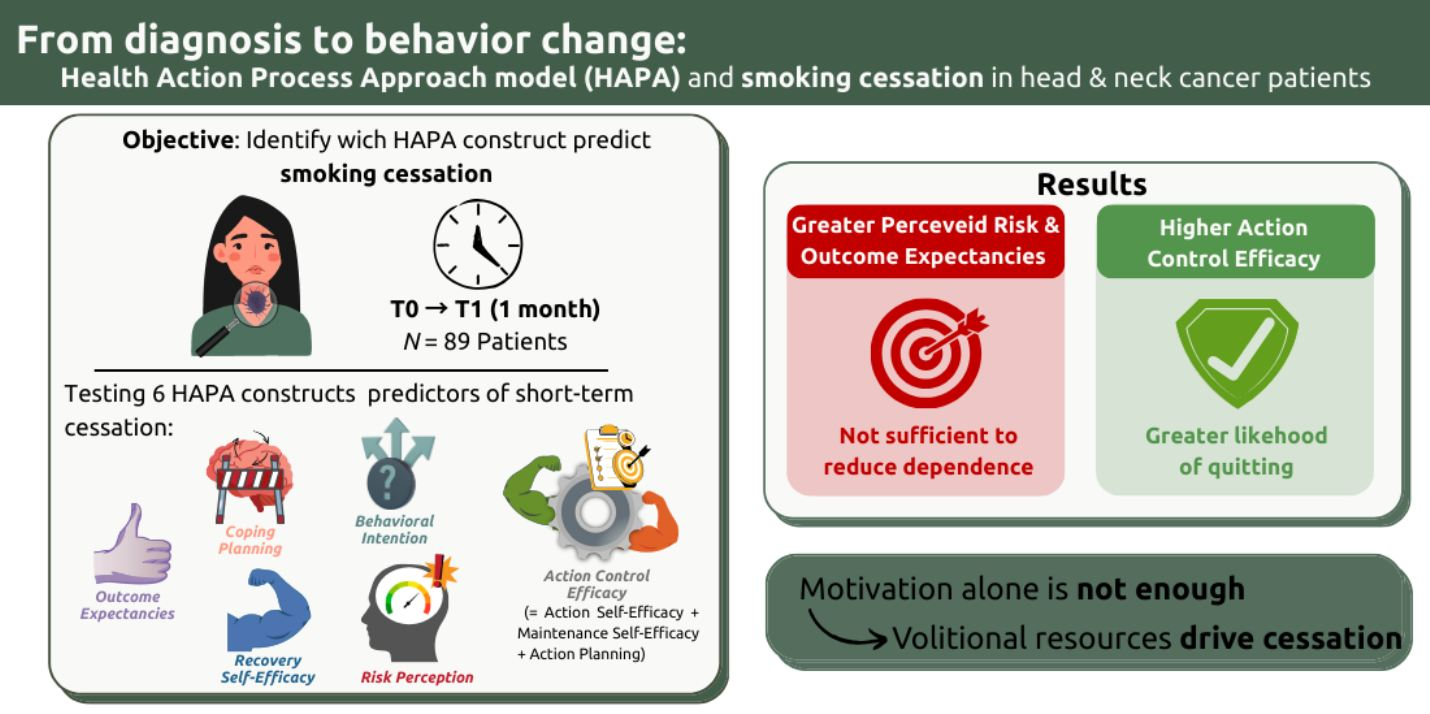

From Diagnosis to Behaviour Change: Applying the Health Action Process Approach to Smoking Cessation After Head and Neck Cancer

 , , ,
, , , 
Abstract
1. Introduction
2. Materials and Methods
2.1. The Participants and Procedures
2.2. Measures
2.2.1. Personal Information
2.2.2. HAPA-Based Smoking Cessation Measure for H&N Cancer Patients
2.2.3. Cigarette Dependence Scale
2.2.4. Tobacco Craving Questionnaire
2.3. Data Preparation and Statistical Analysis
3. Results
3.1. Sample Characteristics and Descriptive Statistics
3.2. Associations Between HAPA Constructs and Smoking Outcomes
3.3. Binomial Logistic Regression Predicting Smoking Status at T1
3.4. Sociodemographic, Clinical, and HAPA Constructs of Smoking Dependence
4. Discussion
5. Conclusions
Author Contributions
Funding
Institutional Review Board Statement
Informed Consent Statement
Data Availability Statement
Acknowledgments
Conflicts of Interest
Abbreviations
| H&N | Head and Neck |
| HAPA | Health Action Process Approach |
References
- Andrade, J., May, J., & Kavanagh, D. (2012). Sensory imagery in craving: From cognitive psychology to new treatments for addiction. Journal of Experimental Psychopathology, 3(2), 127–145. [Google Scholar] [CrossRef]
- Antoni, M. H., Moreno, P. I., & Penedo, F. J. (2023). Stress management interventions to facilitate psychological and physiological adaptation and optimal health outcomes in cancer patients and survivors. Annual Review of Psychology, 74, 423–455. [Google Scholar] [CrossRef] [PubMed]
- Araújo, M.-R., Alvarez, M.-J., Godinho, C. A., Almeida, T., & Pereira, C. R. (2020). Self-regulation in oral hygiene behaviours in adults with gingivitis: The mediating role of coping planning and action control. International Journal of Dental Hygiene, 18(2), 192–200. [Google Scholar] [CrossRef]
- Auriol, C., Cantisano, N., & Raynal, P. (2025). Is smoking acceptable for lung cancer patient? Factors influencing the stigmatization. Stigma and Health, 10(1), 132–141. [Google Scholar] [CrossRef]
- Barg, C. J., Latimer, A. E., Pomery, E. A., Rivers, S. E., Rench, T. A., Prapavessis, H., & Salovey, P. (2012). Examining predictors of physical activity among inactive middle-aged women: An application of the health action process approach. Psychology & Health, 27(7), 829–845. [Google Scholar] [CrossRef]
- Bergman, M., Fountoukidis, G., Smith, D., Ahlgren, J., Lambe, M., & Valachis, A. (2022). Effect of smoking on treatment efficacy and toxicity in patients with cancer: A systematic review and meta-analysis. Cancers, 14(17), 4117. [Google Scholar] [CrossRef] [PubMed]
- Berli, C., Ochsner, S., Stadler, G., Knoll, N., Hornung, R., & Scholz, U. (2015). Volitional processes and daily smoking: Examining inter- and intraindividual associations around a quit attempt. Journal of Behavioral Medicine, 38(2), 306–317. [Google Scholar] [CrossRef]
- Berlin, I., Vorspan, F., Singleton, E. G., Warot, D., Notides, C., & Heishman, S. J. (2005). Reliability and validity of the french version of the tobacco craving questionnaire. European Addiction Research, 11(2), 62–68. [Google Scholar] [CrossRef]
- Bharat, C., Webb, P., Wilkinson, Z., McKetin, R., Grebely, J., Farrell, M., Holland, A., Hickman, M., Tran, L. T., Clark, B., Peacock, A., Darke, S., Li, J., & Degenhardt, L. (2023). Agreement between self-reported illicit drug use and biological samples: A systematic review and meta-analysis. Addiction, 118(9), 1624–1648. [Google Scholar] [CrossRef]
- Burris, J. L., Studts, J. L., DeRosa, A. P., & Ostroff, J. S. (2015). Systematic review of tobacco use after lung or head/neck cancer diagnosis: Results and recommendations for future research. Cancer Epidemiology, Biomarkers & Prevention: A Publication of the American Association for Cancer Research, Cosponsored by the American Society of Preventive Oncology, 24(10), 1450–1461. [Google Scholar] [CrossRef]
- Caini, S., Gorini, G., Del Riccio, M., Saieva, C., Carreras, G., Bonomo, P., Salvestrini, V., Cattaruzza, M. S., Assedi, M., D’Ecclesiis, O., Gaeta, A., Albini, A., Masala, G., & Gandini, S. (2025). Upgrading your best chances: Postdiagnosis smoking cessation boosts life expectancy of patients with cancer—A systematic review and meta-analysis. Tobacco Control, tc-2024-058873. [Google Scholar] [CrossRef]
- Céspedes-Ajún, C., Amghar-Maach, S., & Gay-Escoda, C. (2022). Incidence of mandibular osteoradionecrosis (MORN) after intensity modulated radiotherapy (IMRT) versus 3D conformal radiotherapy (3D-CRT): A systematic review. Medicina Oral Patología Oral y Cirugia Bucal, 27(6), e539–e549. [Google Scholar] [CrossRef] [PubMed]
- Chen, A. M., Chen, L. M., Vaughan, A., Sreeraman, R., Farwell, D. G., Luu, Q., Lau, D. H., Stuart, K., Purdy, J. A., & Vijayakumar, S. (2011). Tobacco smoking during radiation therapy for head-and-neck cancer is associated with unfavorable outcome. International Journal of Radiation Oncology*Biology*Physics, 79(2), 414–419. [Google Scholar] [CrossRef] [PubMed]
- Clark, C. B., Zyambo, C. M., Li, Y., & Cropsey, K. L. (2016). The impact of non-concordant self-report of substance use in clinical trials research. Addictive Behaviors, 58, 74–79. [Google Scholar] [CrossRef]
- Cleere, E. F., Murphy, J., Crotty, T. J., Hintze, J. M., Timon, C. V. I., Kinsella, J., Fitzgerald, C. W. R., & Lennon, P. (2024). HPV overtakes smoking as the leading cause of oropharyngeal cancer in Ireland: Experience of a head and neck surgery tertiary referral centre. Irish Journal of Medical Science, 193, 2161–2169. [Google Scholar] [CrossRef] [PubMed]
- Conlon, M. S. C., Santi, S. A., Meigs, M. L., Davidson, S. M., & Saunders, D. (2020). Cigarette-smoking characteristics and interest in cessation in patients with head-and-neck cancer. Current Oncology, 27(5), 478–485. [Google Scholar] [CrossRef]
- Crippen, M. M., Patel, N., Filimonov, A., Brady, J. S., Merchant, A. M., Baredes, S., & Park, R. C. W. (2019). Association of smoking tobacco with complications in head and neck microvascular reconstructive surgery. JAMA Facial Plastic Surgery, 21(1), 20–26. [Google Scholar] [CrossRef]
- Dai, X., Gil, G. F., Reitsma, M. B., Ahmad, N. S., Anderson, J. A., Bisignano, C., Carr, S., Feldman, R., Hay, S. I., He, J., Iannucci, V., Lawlor, H. R., Malloy, M. J., Marczak, L. B., McLaughlin, S. A., Morikawa, L., Mullany, E. C., Nicholson, S. I., O’Connell, E. M., … Gakidou, E. (2022). Health effects associated with smoking: A burden of proof study. Nature Medicine, 28(10), 2045–2055. [Google Scholar] [CrossRef]
- Dewi, T. S., Lefaan, Y. F., Susilawati, S., Kusumadjati, A., & Arief, E. M. (2022). Correlation analysis between risk factors and mucositis oral in head and neck cancer patients undergoing radiotherapy. Padjadjaran Journal of Dentistry, 34(2), 95. [Google Scholar] [CrossRef]
- Döbler, A., Belnap, B. H., Pollmann, H., Farin, E., Raspe, H., & Mittag, O. (2018). Telephone-delivered lifestyle support with action planning and motivational interviewing techniques to improve rehabilitation outcomes. Rehabilitation Psychology, 63(2), 170–181. [Google Scholar] [CrossRef]
- Etter, J.-F., Le Houezec, J., & Perneger, T. V. (2003). A self-administered questionnaire to measure dependence on cigarettes: The cigarette dependence scale. Neuropsychopharmacology: Official Publication of the American College of Neuropsychopharmacology, 28(2), 359–370. [Google Scholar] [CrossRef]
- Fan Chiang, Y.-H., Lee, Y.-W., Lam, F., Liao, C.-C., Chang, C.-C., & Lin, C.-S. (2023). Smoking increases the risk of postoperative wound complications: A propensity score-matched cohort study. International Wound Journal, 20(2), 391–402. [Google Scholar] [CrossRef]
- Fluharty, M., Taylor, A. E., Grabski, M., & Munafò, M. R. (2017). The association of cigarette smoking with depression and anxiety: A systematic review. Nicotine & Tobacco Research, 19(1), 3–13. [Google Scholar] [CrossRef]
- Frazer, K., Bhardwaj, N., Fox, P., Stokes, D., Niranjan, V., Quinn, S., Kelleher, C. C., & Fitzpatrick, P. (2022). Systematic review of smoking cessation interventions for smokers diagnosed with cancer. International Journal of Environmental Research and Public Health, 19(24), 17010. [Google Scholar] [CrossRef] [PubMed]
- Garip, M., Van Dessel, J., Grosjean, L., Politis, C., & Bila, M. (2021). The impact of smoking on surgical complications after head and neck reconstructive surgery with a free vascularised tissue flap: A systematic review and meta-analysis. British Journal of Oral and Maxillofacial Surgery, 59(3), e79–e98. [Google Scholar] [CrossRef] [PubMed]
- Gladwin, T. E., Figner, B., Crone, E. A., & Wiers, R. W. (2011). Addiction, adolescence, and the integration of control and motivation. Developmental Cognitive Neuroscience, Special Issue on Motivation, 1(4), 364–376. [Google Scholar] [CrossRef]
- Gollwitzer, P. M., & Sheeran, P. (2009). Self-regulation of consumer decision making and behavior: The role of implementation intentions. Journal of Consumer Psychology, 19(4), 593–607. [Google Scholar] [CrossRef]
- Gormley, M., Creaney, G., Schache, A., Ingarfield, K., & Conway, D. I. (2022). Reviewing the epidemiology of head and neck cancer: Definitions, trends and risk factors. British Dental Journal, 233(9), 780–786. [Google Scholar] [CrossRef]
- Guimond, A.-J., Croteau, V. A., Savard, M.-H., Bernard, P., Ivers, H., & Savard, J. (2017). Predictors of smoking cessation and relapse in cancer patients and effect on psychological variables: An 18-month observational study. Annals of Behavioral Medicine, 51(1), 117–127. [Google Scholar] [CrossRef]
- Gwaltney, C. J., Shiffman, S., Balabanis, M. H., & Paty, J. A. (2005). Dynamic self-efficacy and outcome expectancies: Prediction of smoking lapse and relapse. Journal of Abnormal Psychology, 114(4), 661–675. [Google Scholar] [CrossRef]
- Hakulinen, C., Hintsanen, M., Munafò, M. R., Virtanen, M., Kivimäki, M., Batty, G. D., & Jokela, M. (2015). Personality and smoking: Individual-participant meta-analysis of nine cohort studies. Addiction, 110(11), 1844–1852. [Google Scholar] [CrossRef]
- Hardcastle, S. J., Maxwell-Smith, C., & Hagger, M. S. (2022). Predicting physical activity change in cancer survivors: An application of the health action process approach. Journal of Cancer Survivorship, 16(6), 1176–1183. [Google Scholar] [CrossRef]
- Howren, M. B., Christensen, A. J., Karnell, L. H., & Funk, G. F. (2013). Psychological factors associated with head and neck cancer treatment and survivorship: Evidence and opportunities for behavioral medicine. Journal of Consulting and Clinical Psychology, 81(2), 299–317. [Google Scholar] [CrossRef]
- Jassem, J. (2019). Tobacco smoking after diagnosis of cancer: Clinical aspects. Translational Lung Cancer Research, 8(Suppl. 1), S50–S58. [Google Scholar] [CrossRef]
- Jiang, X., Chen, J., Yuan, X., Chen, Y., Sun, Q., Zhao, H., Xu, P., Luo, T., & Peng, J. (2024). Development and psychometric assessment of a health action process approach (HAPA) inventory for home nutritional behavior among postoperative gastric cancer patients. Asia-Pacific Journal of Oncology Nursing, 11(10), 100569. [Google Scholar] [CrossRef]
- Khalifeh, M., Ginex, P., & Boffetta, P. (2024). Reduction of head and neck cancer risk following smoking cessation: A systematic review and meta-analysis. BMJ Open, 14(8), e074723. [Google Scholar] [CrossRef]
- Kock, L., Brown, J., Cox, S., McNeill, A., Robson, D., Shahab, L., Tattan-Birch, H., & Brose, L. (2022). Association of psychological distress with smoking cessation, duration of abstinence from smoking, and use of non-combustible nicotine-containing products: A cross-sectional population survey in great Britain. Social Science Research Network. [Google Scholar] [CrossRef]
- Koob, G. F., & Volkow, N. D. (2016). Neurobiology of addiction: A neurocircuitry analysis. The Lancet Psychiatry, 3(8), 760–773. [Google Scholar] [CrossRef]
- Köpetz, C. E., Lejuez, C. W., Wiers, R. W., & Kruglanski, A. W. (2013). Motivation and self-regulation in addiction: A call for convergence. Perspectives on Psychological Science, 8(1), 3–24. [Google Scholar] [CrossRef]
- Krutz, M., Acharya, P., Chissoe, G., Raj, V., Driskill, L., Krempl, G., Zhao, D., Mhawej, R., & Queimado, L. (2022). Tobacco cessation after head and neck cancer diagnosis is an independent predictor of treatment response and long-term survival. Oral Oncology, 134, 106072. [Google Scholar] [CrossRef]
- Lang, K., Held, T., Meixner, E., Tonndorf-Martini, E., Ristow, O., Moratin, J., Bougatf, N., Freudlsperger, C., Debus, J., & Adeberg, S. (2022). Frequency of osteoradionecrosis of the lower jaw after radiotherapy of oral cancer patients correlated with dosimetric parameters and other risk factors. Head & Face Medicine, 18(1), 7. [Google Scholar] [CrossRef]
- Lee, J. J. W., Kunaratnam, V., Kim, C. J. H., Pienkowski, M., Hueniken, K., Sahovaler, A., Lam, A. C. L., Davies, J. C., Brown, C. M., De Almeida, J. R., Huang, S. H., Waldron, J. N., Spreafico, A., Hung, R. J., Xu, W., Goldstein, D. P., & Liu, G. (2023). Cigarette smoking cessation, duration of smoking abstinence, and head and neck squamous cell carcinoma prognosis. Cancer, 129(6), 867–877. [Google Scholar] [CrossRef]
- Lespine, L.-F., Rueda-Delgado, L. M., Vahey, N., Ruddy, K. L., Kiiski, H., Enz, N., Boyle, R., Rai, L., Pragulbickaite, G., Bricker, J. B., McHugh, L., & Whelan, R. (2025). Changes in inhibition-related brain function and psychological flexibility during smoking abstinence: A machine-learning prediction of time to relapse. European Addiction Research, 31(2), 99–112. [Google Scholar] [CrossRef] [PubMed]
- Li, Q., Tie, Y., Alu, A., Ma, X., & Shi, H. (2023). Targeted therapy for head and neck cancer: Signaling pathways and clinical studies. Signal Transduction and Targeted Therapy, 8(1), 31. [Google Scholar] [CrossRef]
- Lin, H., Lin, H., Zhang, L., Zhang, C., Yang, X., Cao, W., & Chang, C. (2024). Development and psychometric assessment of Health Action Process Approach (HAPA) in terms of smoking cessation among Chinese smokers. Scientific Reports, 14(1), 4056. [Google Scholar] [CrossRef]
- Lindblom, H., & Hägglund, M. (2024). Motivation and goal-pursuit for injury prevention training in amateur football coaches: A cross-sectional study using the Health Action Process Approach. Injury Prevention, 30(1), 20–26. [Google Scholar] [CrossRef]
- Lippke, S., Wiedemann, A. U., Ziegelmann, J. P., Reuter, T., & Schwarzer, R. (2009). Self-efficacy moderates the mediation of intentions into behavior via plans. American Journal of Health Behavior, 33(5), 521–529. [Google Scholar] [CrossRef] [PubMed]
- Ma, S. J., Yu, H., Yu, B., Waldman, O., Khan, M., Chatterjee, U., Santhosh, S., Gill, J., Iovoli, A. J., Farrugia, M., Shevorykin, A., Carl, E., Wooten, K., Gupta, V., McSpadden, R., Kuriakose, M. A., Markiewicz, M. R., Al-Afif, A., Hicks, W. L., Jr., … Singh, A. K. (2022). Association of pack-years of cigarette smoking with survival and tumor progression among patients treated with chemoradiation for head and neck cancer. JAMA Network Open, 5(12), e2245818. [Google Scholar] [CrossRef]
- Macía, P., Barranco, M., Gorbeña, S., & Iraurgi, I. (2020). Expression of resilience, coping and quality of life in people with cancer. PLoS ONE, 15(7), e0236572. [Google Scholar] [CrossRef] [PubMed]
- MacPhail, M., Mullan, B., Sharpe, L., MacCann, C., & Todd, J. (2014). Using the health action process approach to predict and improve health outcomes in individuals with type 2 diabetes mellitus. Diabetes, Metabolic Syndrome and Obesity, 7, 469–479. [Google Scholar] [CrossRef]
- Maghsoodlo, M., Shakibazadeh, E., Mokhtary, Z., Barzin, M., Yaseri, M., & Salimi, Y. (2024). Development and validation of a healthy diet and physical activity tool based on health action process approach among patients undergone bariatric surgery. Journal of Diabetes & Metabolic Disorders, 23(1), 1007–1015. [Google Scholar] [CrossRef]
- Mao, A., & Bottorff, J. L. (2017). A qualitative study on unassisted smoking cessation among Chinese Canadian immigrants. American Journal of Men’s Health, 11(6), 1703–1712. [Google Scholar] [CrossRef]
- Matsui, T. (2024). Exploration of helpful elements contributing to engage in physical activity in patients with cancer. Supportive Care in Cancer, 32(8), 505. [Google Scholar] [CrossRef]
- Maxwell-Smith, C., Hince, D., Cohen, P. A., Bulsara, M. K., Boyle, T., Platell, C., Tan, P., Levitt, M., Salama, P., Tan, J., Salfinger, S., Makin, G., Mohan, G. R. K. A., Jiménez-Castuera, R., & Hardcastle, S. J. (2019). A randomized controlled trial of WATAAP to promote physical activity in colorectal and endometrial cancer survivors. Psycho-Oncology, 28(7), 1420–1429. [Google Scholar] [CrossRef]
- Mäkitie, A. A., Alabi, R. O., Pulkki-Råback, L., Almangush, A., Beitler, J. J., Saba, N. F., Strojan, P., Takes, R., Guntinas-Lichius, O., & Ferlito, A. (2024). Psychological factors related to treatment outcomes in head and neck cancer. Advances in Therapy, 41(9), 3489–3519. [Google Scholar] [CrossRef]
- McBride, C. M. (2003). Understanding the potential of teachable moments: The case of smoking cessation. Health Education Research, 18(2), 156–170. [Google Scholar] [CrossRef]
- McCarter, K., Baker, A. L., Wolfenden, L., Wratten, C., Bauer, J., Beck, A. K., Forbes, E., Carter, G., Leigh, L., Oldmeadow, C., & Britton, B. (2022). Smoking and other health factors in patients with head and neck cancer. Cancer Epidemiology, 79, 102202. [Google Scholar] [CrossRef]
- Mody, M. D., Rocco, J. W., Yom, S. S., Haddad, R. I., & Saba, N. F. (2021). Head and neck cancer. The Lancet, 398(10318), 2289–2299. [Google Scholar] [CrossRef]
- Moghaddam, F., Sargeran, K., Gholami, M., Jamali, J., & Shamshiri, A. R. (2025). Application of health action process approach model to promote toothbrushing behavior among Iranian elderly population: A cluster randomized controlled trial. BMC Geriatrics, 25, 92. [Google Scholar] [CrossRef]
- Mohebbi, E., Guthrie, G., Patil, S., Benjamin, W., IV, Tan, M., Giurintano, J. P., Witek, M. E., Ahn, P. H., Taylor, K., Wolf, G., Fan, R., & Rozek, L. S. (2025). Postdiagnosis smoking cessation and survival outcomes of head and neck cancer patients. Head & Neck, 47(10), 2725–2734. [Google Scholar] [CrossRef]
- Nagappa, B., Marimuthu, Y., Ramaswamy, G., Ganesan, S., Pandjatcharam, J., Thulasingam, M., & Kar, S. (2023). Continued tobacco use among tobacco-related head and neck cancer patients seeking care in a tertiary care facility, South India. Cancer Epidemiology, 86, 102434. [Google Scholar] [CrossRef]
- Naresh, J., Shruti, K., Amit, B., Akash, S., Vinay, V., Ajay, V., & Mitali, D. (2020). Relapse of tobacco consumption in patients treated for head and neck cancer: A cross sectional study. Indian Journal of Surgical Oncology, 11(3), 492–497. [Google Scholar] [CrossRef]
- Parkinson, J., Hannan, T., McDonald, N., Moriarty, S., Nguyen, T.-M., & Hamilton, K. (2023). Health action process approach: Promoting physical activity, and fruit and vegetable intake among Australian adults. Health Promotion International, 38(4), daad095. [Google Scholar] [CrossRef]
- Paul, C. L., Tzelepis, F., Boyes, A. W., D’Este, C., Sherwood, E., & Girgis, A. (2019). Continued smoking after a cancer diagnosis: A longitudinal study of intentions and attempts to quit. Journal of Cancer Survivorship: Research and Practice, 13(5), 687–694. [Google Scholar] [CrossRef]
- Paxton, R. J. (2016). The health action process approach applied to African American breast cancer survivors. Psycho-Oncology, 25(6), 648–655. [Google Scholar] [CrossRef]
- Penfold, C. M., Thomas, S. J., Waylen, A., & Ness, A. R. (2018). Change in alcohol and tobacco consumption after a diagnosis of head and neck cancer: Findings from head and neck 5000. Head & Neck, 40(7), 1389–1399. [Google Scholar] [CrossRef]
- Perdyan, A., & Jassem, J. (2022). Impact of tobacco smoking on outcomes of radiotherapy: A narrative review. Current Oncology, 29(4), 2284–2300. [Google Scholar] [CrossRef]
- Préaubert, A., Dupret-Bories, A., Sordes, F., & Raynal, P. (manuscript under review). Development and psychometric assessment of Health Action Process Approach for smoking cessation in patients with head and neck cancer [Manuscript submitted for publication].
- Radtke, T., Kaklamanou, D., Scholz, U., Hornung, R., & Armitage, C. J. (2014). Are diet-specific compensatory health beliefs predictive of dieting intentions and behaviour? Appetite, 76, 36–43. [Google Scholar] [CrossRef]
- Rahmawati, M. A., Murti, B., & Prasetya, H. (2022). Correlation between theory of planned behavior and smoking cessation: A meta-analysis. Journal of Health Promotion and Behavior, 7(4), 299–312. [Google Scholar] [CrossRef]
- Ranjbaran, S., Shojaeizadeh, D., Dehdari, T., Yaseri, M., & Shakibazadeh, E. (2020). Determinants of medication adherence among Iranian patients with type 2 diabetes: An application of health action process approach. Heliyon, 6(7), e04442. [Google Scholar] [CrossRef]
- Ranjbaran, S., Shojaeizadeh, D., Dehdari, T., Yaseri, M., & Shakibazadeh, E. (2022). The effectiveness of an intervention designed based on health action process approach on diet and medication adherence among patients with type 2 diabetes: A randomized controlled trial. Diabetology & Metabolic Syndrome, 14(1), 1–10. [Google Scholar] [CrossRef]
- Renner, B., Kwon, S., Yang, B.-H., Paik, K.-C., Kim, S. H., Roh, S., Song, J., & Schwarzer, R. (2008). Social-cognitive predictors of dietary behaviors in South Korean men and women. International Journal of Behavioral Medicine, 15(1), 4–13. [Google Scholar] [CrossRef]
- Schnoll, R. A., Martinez, E., Tatum, K. L., Glass, M., Bernath, A., Ferris, D., & Reynolds, P. (2011). Increased self-efficacy to quit and perceived control over withdrawal symptoms predict smoking cessation following nicotine dependence treatment. Addictive Behaviors, 36(1), 144–147. [Google Scholar] [CrossRef]
- Scholz, U., Nagy, G., Göhner, W., Luszczynska, A., & Kliegel, M. (2009). Changes in self-regulatory cognitions as predictors of changes in smoking and nutrition behaviour. Psychology & Health, 24(5), 545–561. [Google Scholar] [CrossRef]
- Schwarzer, R. (2008). Modeling health behavior change: How to predict and modify the adoption and maintenance of health behaviors. Applied Psychology, 57(1), 1–29. [Google Scholar] [CrossRef]
- Schwarzer, R., Lippke, S., & Luszczynska, A. (2011). Mechanisms of health behavior change in persons with chronic illness or disability: The Health Action Process Approach (HAPA). Rehabilitation Psychology, 56(3), 161–170. [Google Scholar] [CrossRef]
- Schwarzer, R., & Luszczynska, A. (2008). How to overcome health-compromising behaviors. European Psychologist, 13(2), 141–151. [Google Scholar] [CrossRef]
- Schwarzer, R., Richert, J., Kreausukon, P., Remme, L., Wiedemann, A. U., & Reuter, T. (2010). Translating intentions into nutrition behaviors via planning requires self-efficacy: Evidence from Thailand and Germany. International Journal of Psychology, 45(4), 260–268. [Google Scholar] [CrossRef]
- Sequeira, M., Pereira, C., & Alvarez, M.-J. (2022). Predicting physical activity in survivors of breast cancer: The health action process approach at the intrapersonal level. International Journal of Behavioral Medicine, 30, 777–789. [Google Scholar] [CrossRef]
- Shiffman, S., Balabanis, M. H., Paty, J. A., Engberg, J., Gwaltney, C. J., Liu, K. S., Gnys, M., Hickcox, M., & Paton, S. M. (2000). Dynamic effects of self-efficacy on smoking lapse and relapse. Health Psychology, 19(4), 315–323. [Google Scholar] [CrossRef]
- Simmons, V. N., Sutton, S. K., Meltzer, L. R., Martinez, U., Palmer, A. M., Meade, C. D., Jacobsen, P. B., McCaffrey, J. C., Haura, E. B., & Brandon, T. H. (2020). Preventing smoking relapse in patients with cancer: A randomized controlled trial. Cancer, 126(23), 5165–5172. [Google Scholar] [CrossRef]
- Smith, J., Nastasi, D. R., Tso, R., Vangaveti, V., Renison, B., & Chilkuri, M. (2019). The effects of continued smoking in head and neck cancer patients treated with radiotherapy: A systematic review and meta-analysis. Radiotherapy and Oncology: Journal of the European Society for Therapeutic Radiology and Oncology, 135, 51–57. [Google Scholar] [CrossRef]
- Smith, J., Woolley, T., Brown, A., Vangaveti, V., & Chilkuri, M. (2021). Smoking cessation in head and neck cancer patients: Factors influencing successes and failures. Journal of Medical Imaging and Radiation Oncology, 65(2), 233–241. [Google Scholar] [CrossRef]
- Smith, S. R., Kroon, J., Schwarzer, R., & Hamilton, K. (2024). Promoting regular parental supervised toothbrushing: An additive intervention design adopting the Health Action Process Approach. Applied Psychology: Health and Well-Being, 16(1), 315–337. [Google Scholar] [CrossRef]
- Streck, J. M., Luberto, C. M., Muzikansky, A., Skurla, S., Ponzani, C. J., Perez, G. K., & Park, E. R. (2021). Ex-amining the effects of stress and psychological distress on smoking abstinence in cancer patients. Preventive Medicine Reports, 23, 101402. [Google Scholar] [CrossRef]
- Sung, H., Ferlay, J., Siegel, R. L., Laversanne, M., Soerjomataram, I., Jemal, A., & Bray, F. (2021). Global cancer statistics 2020: GLOBOCAN estimates of incidence and mortality worldwide for 36 cancers in 185 countries. CA: A Cancer Journal for Clinicians, 71(3), 209–249. [Google Scholar] [CrossRef]
- Tabachnick, B. G., & Fidell, L. S. (2019). Using multivariate statistics (7th ed.). Pearson. [Google Scholar]
- Tan, X.-J., Liu, J.-J., Deng, Y.-K., Li, X.-D., Yang, W.-X., Hu, X., & Xu, L.-M. (2025). Analysis of factors related to radiation-induced oral mucositis in patients with head and neck tumors undergoing radiotherapy. Journal of Stomatology, Oral and Maxillofacial Surgery, 126(2), 102042. [Google Scholar] [CrossRef] [PubMed]
- Tiffany, S. T., & Conklin, C. A. (2000). A cognitive processing model of alcohol craving and compulsive alcohol use. Addiction, 95(8s2), 145–153. [Google Scholar] [CrossRef] [PubMed]
- Torrens, L., Moody, S., De Carvalho, A. C., Kazachkova, M., Abedi-Ardekani, B., Cheema, S., Senkin, S., Cattiaux, T., Cortez Cardoso Penha, R., Atkins, J. R., Gaborieau, V., Chopard, P., Carreira, C., Abbasi, A., Bergstrom, E. N., Vangara, R., Wang, J., Fitzgerald, S., Latimer, C., … Perdomo, S. (2025). The complexity of tobacco smoke-induced mutagenesis in head and neck cancer. Nature Genetics, 57(4), 884–896. [Google Scholar] [CrossRef]
- Underwood, J. M., Townsend, J. S., Tai, E., White, A., Davis, S. P., & Fairley, T. L. (2012). Persistent cigarette smoking and other tobacco use after a tobacco-related cancer diagnosis. Journal of Cancer Survivorship, 6(3), 333–344. [Google Scholar] [CrossRef] [PubMed]
- Van Heest, T., Rubin, N., & Khariwala, S. S. (2022). Persistent tobacco use after treatment for head and neck cancer. JAMA Otolaryngology–Head & Neck Surgery, 148(7), 597–603. [Google Scholar] [CrossRef] [PubMed]
- Van Nes, K. A., Loveren, C. V., & Aartman, I. H. A. (2024). Validation of an improved questionnaire assessing the social cognitive constructs of the Health Action Process Approach among parents regarding brushing their children’s teeth. PLoS ONE, 19(6), e0300432. [Google Scholar] [CrossRef]
- Verro, B., Saraniti, G., Fiumara, S., Ottoveggio, G., & Saraniti, C. (2024). Smoking and alcohol habits in head and neck cancers: How many patients stop after diagnosis? Journal of Cancer Policy, 41, 100498. [Google Scholar] [CrossRef]
- von Kroge, P. R., Bokemeyer, F., Ghandili, S., Bokemeyer, C., & Seidel, C. (2020). The impact of smoking cessation and continuation on recurrence and survival in patients with head and neck cancer: A systematic review of the literature. Oncology Research and Treatment, 43(10), 549–558. [Google Scholar] [CrossRef]
- Williams, R. J., Herzog, T. A., & Simmons, V. N. (2011). Risk perception and motivation to quit smoking: A partial test of the Health Action Process Approach. Addictive Behaviors, 36(7), 789–791. [Google Scholar] [CrossRef] [PubMed]
- Yang, F., Wong, R. J., Zakeri, K., Singh, A., Estilo, C. L., & Lee, N. Y. (2024). Osteoradionecrosis rates after head and neck radiation therapy: Beyond the numbers. Practical Radiation Oncology, 14(4), e264–e275. [Google Scholar] [CrossRef]
- Yzer, M., & van den Putte, B. (2014). Control perceptions moderate attitudinal and normative effects on intention to quit smoking. Psychology of Addictive Behaviors, 28(4), 1153–1161. [Google Scholar] [CrossRef]
- Zhang, C.-Q., Zhang, R., Schwarzer, R., & Hagger, M. S. (2019). A meta-analysis of the health action process approach. Health Psychology, 38(7), 623–637. [Google Scholar] [CrossRef]
- Zhou, S., Li, L., Zhao, Y., Cao, Y., Peng, B., & Zheng, L. (2021). Physical activity under stress: A perspective of HAPA and individual differences. International Journal of Environmental Research and Public Health, 18(22), 12144. [Google Scholar] [CrossRef] [PubMed]

| Mean Age, Years (SD) | 59.6 (10.4) | |
|---|---|---|
| n | % | |
| Gender | ||
| Female | 23 | 25.8 |
| Male | 66 | 74.2 |
| Marital status | ||
| Single | 48 | 53.9 |
| In relationship | 41 | 46.1 |
| Socio-professional status | ||
| Executives and intellectual professions | 7 | 7.9 |
| Self-employed and entrepreneurs | 6 | 6.7 |
| Employees and manual workers | 23 | 25.8 |
| Inactive population | 53 | 59.6 |
| Cancer diagnosis | ||
| Oral cavity cancers | 34 | 38.2 |
| Oropharyngeal cancers | 20 | 22.5 |
| Laryngeal cancers | 19 | 21.3 |
| Hypo- and nasopharyngeal cancers | 11 | 12.4 |
| Other head and neck cancer | 5 | 5.6 |
| Cancer treatment | ||
| Surgery | 44 | 40.7 |
| Radiotherapy | 21 | 19.4 |
| Chemoradiotherapy | 17 | 15.7 |
| Surgery and radiotherapy | 20 | 18.5 |
| Other treatments | 6 | 5.6 |
| Tumor stage | ||
| Stage I/II | 14 | 17.5 |
| Stage III/IV | 66 | 82.5 |
| Number of cigarettes smoked daily T0 | ||
| 2–10 | 54 | 60.7 |
| 11–20 | 27 | 30.3 |
| 21–30+ | 8 | 9 |
| Number of cigarettes smoked daily T1 | ||
| 0 cigarette | 40 | 44.9 |
| 2–10 | 28 | 31.6 |
| 11–20 | 18 | 20.2 |
| 21–30+ | 3 | 3.3 |
| Variables | 1 | 2 | 3 | 4 | 5 | 6 | 7 | 8 | 9 |
|---|---|---|---|---|---|---|---|---|---|
| 1 Cigarette dependence T0 | - | ||||||||
| 2 Cigarette dependence T1 | 0.63 ** | - | |||||||
| 3 Tobacco craving T0 | 0.68 ** | 0.50 ** | - | ||||||
| 4 Tobacco craving T1 | 0.58 ** | 0.71 ** | 0.60 ** | - | |||||
| 5 Risk Perception T0 | 0.02 | −0.04 | −0.02 | 0.06 | - | ||||
| 6 Outcome Expectancies T0 | 0.15 | 0.13 | 0.08 | 0.10 | 0.35 ** | - | |||
| 7 Recovery Self-Efficacy T0 | −0.39 ** | −0.34 ** | −0.36 ** | −0.29 ** | 0.13 | −0.01 | - | ||
| 8 Behavioral Intention T0 | −0.08 | −0.15 | −0.09 | −0.02 | 0.59 ** | 0.44 ** | 0.18 | - | |
| 9 Coping Planning T0 | −0.28 ** | −0.34 ** | −0.26 * | −0.27 * | 0.30 ** | 0.23 * | 0.42 ** | 0.38 ** | - |
| 10 Action Control Efficacy T0 | −0.35 ** | −0.39 ** | −0.39 ** | −0.36 ** | 0.45 ** | 0.30 ** | 0.52 ** | 0.59 ** | 0.61 ** |
| β | t | p | R2 | ΔR2 | |
|---|---|---|---|---|---|
| Step 1 | 0.26 | 0.69 | |||
| Gender | −0.07 | −0.58 | 0.56 | ||
| Age | 0.04 | 0.36 | 0.72 | ||
| Marital status | −0.14 | −1.19 | 0.24 | ||
| Socio-professional status | 0.15 | 1.26 | 0.21 | ||
| Cancer diagnosis | −0.16 | −1.39 | 0.17 | ||
| Cancer treatment | 0.01 | 0.06 | 0.95 | ||
| Tumor stage | −0.06 | −0.50 | 0.62 | ||
| Step 2 | 0.59 | 0.28 | |||
| Gender | −0.09 | −0.84 | 0.41 | ||
| Age | 0.01 | 0.07 | 0.94 | ||
| Marital status | −0.20 | −1.76 | 0.08 | ||
| Socio-professional status | 0.16 | 1.37 | 0.17 | ||
| Cancer diagnosis | −0.04 | −0.37 | 0.72 | ||
| Cancer treatment | −0.06 | −0.55 | 0.59 | ||
| Tumor stage | 0.04 | −0.34 | 0.73 | ||
| HAPA Risk perceptions | 0.34 | 2.92 | 0.01 | ||
| HAPA Outcome expectancies | 0.26 | 2.02 | 0.05 | ||
| HAPA Recovery Self-efficacy | −0.07 | −0.57 | 0.57 | ||
| HAPA Behavioral intention | −0.14 | −0.92 | 0.36 | ||
| HAPA Coping planning | −0.20 | −1.49 | 0.14 | ||
| HAPA Action Control Efficacy | −0.28 | −1.67 | 0.10 |
Disclaimer/Publisher’s Note: The statements, opinions and data contained in all publications are solely those of the individual author(s) and contributor(s) and not of MDPI and/or the editor(s). MDPI and/or the editor(s) disclaim responsibility for any injury to people or property resulting from any ideas, methods, instructions or products referred to in the content. |
© 2026 by the authors. Licensee MDPI, Basel, Switzerland. This article is an open access article distributed under the terms and conditions of the Creative Commons Attribution (CC BY) license.
Share and Cite
Préaubert, A.; Dupret-Bories, A.; Chabrillac, E.; Sordes, F.; Raynal, P. From Diagnosis to Behaviour Change: Applying the Health Action Process Approach to Smoking Cessation After Head and Neck Cancer. Behav. Sci. 2026, 16, 293. https://doi.org/10.3390/bs16020293
Préaubert A, Dupret-Bories A, Chabrillac E, Sordes F, Raynal P. From Diagnosis to Behaviour Change: Applying the Health Action Process Approach to Smoking Cessation After Head and Neck Cancer. Behavioral Sciences. 2026; 16(2):293. https://doi.org/10.3390/bs16020293
Chicago/Turabian StylePréaubert, Anaëlle, Agnès Dupret-Bories, Emilien Chabrillac, Florence Sordes, and Patrick Raynal. 2026. "From Diagnosis to Behaviour Change: Applying the Health Action Process Approach to Smoking Cessation After Head and Neck Cancer" Behavioral Sciences 16, no. 2: 293. https://doi.org/10.3390/bs16020293
APA StylePréaubert, A., Dupret-Bories, A., Chabrillac, E., Sordes, F., & Raynal, P. (2026). From Diagnosis to Behaviour Change: Applying the Health Action Process Approach to Smoking Cessation After Head and Neck Cancer. Behavioral Sciences, 16(2), 293. https://doi.org/10.3390/bs16020293