


Leveraging Student-Athlete Mental Health Through an AI-Augmented Mobile Platform: The ThriveNudge Study Protocol

Abstract
1. Introduction
2. Materials and Methods
2.1. Setting and Design
2.2. Participants
2.3. Sample Size Calculation
2.4. Procedure
2.5. Participant Support and Safety
- Automated flagging: Surveys containing keywords or responses suggesting imminent risk will automatically generate a confidential alert to the principal investigator. Automated flagging is triggered by the presence of predefined keywords and phrases commonly associated with acute psychological distress or self-harm risk. Examples include references to suicidal ideation (e.g., “I want to kill myself,” “I don’t want to be here anymore”), self-harm behaviors (e.g., “cutting,” “hurting myself”), or imminent safety concerns (e.g., “I plan to hurt myself today”). These examples are illustrative rather than exhaustive. Flagging serves solely as an initial screening mechanism to prompt human review and does not initiate any automated decision-making or intervention.
- Review: The investigator will review flagged responses within 24 h to determine whether escalation is warranted.
- Referral and documentation: If a credible concern for participant safety is identified, the investigator will contact the school counselor to initiate a standard welfare check, following district safety procedures. No information will be shared with coaches or peers. When escalation is deemed necessary, only the minimum information required to support participant safety is shared with the designated school counselor. This information is limited to the nature of the concern (e.g., indication of severe distress or self-harm risk), the participant’s school affiliation, and the timing of the flagged response. No raw survey responses, application usage logs, or simulated conversation content will be shared. All communications follow established district welfare-check procedures, and identifying information will be disclosed only to authorized school liaison directly responsible for student support.
- Record keeping: All flagged cases and follow-up actions will be documented in a secure file accessible only to the principal investigator. Records will be deleted four weeks after the study concludes.
2.6. Coach and Student-Athlete Interviews
2.7. App-Based Intervention Development
- (1)
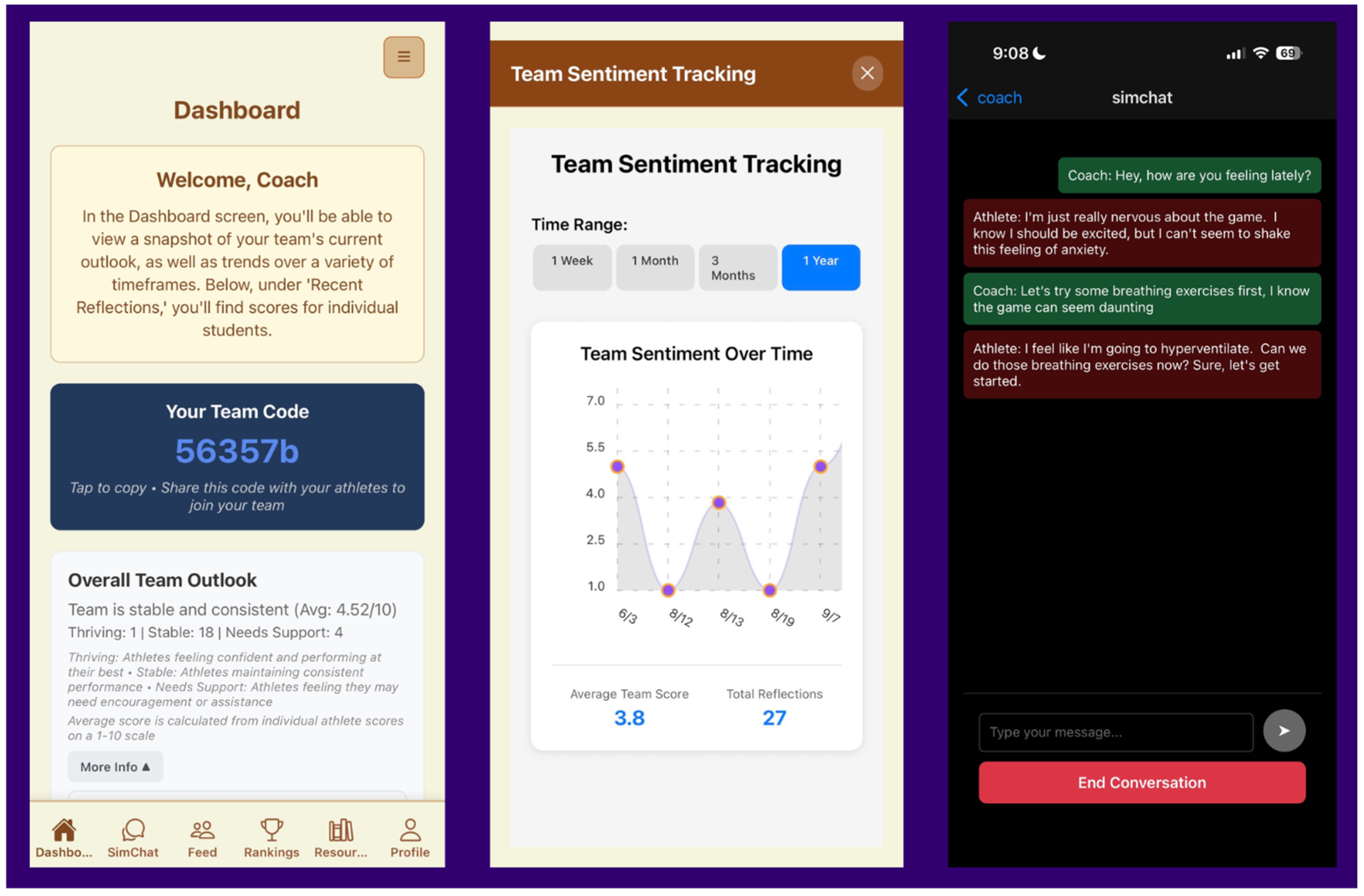
- Coach (human): “Hey, how are you feeling lately?”Athlete (AI): “I’ve been stressing out a lot about the upcoming game. Just hoping everything goes smoothly.”Coach (human): “You’re doing great. I have full confidence in you. Can’t wait to see what you do this weekend.”Athlete (AI): “I know you believe in me, but I just can’t shake this nervousness. What if I mess up in front of everyone? Coach, can we talk about some strategies to calm down before the game? To be honest, I’m really worried.”
- (2)
- Coach (human): “Hey, how are your feeling lately?”Athlete (AI): “I’ve been okay, just trying to stay focused on the games. Got a big match coming up, so I’m trying to manage my nerves.”Coach (human): “I appreciate your focus and dedication to our team. Is there anything I can do to help calm your nerves?”Athlete (AI): “I’ve been practicing deep breathing exercises, helps a bit. Just need to stay positive and believe in the team.”
2.7.1. Coach-Facing Module: Features, Rationale, and Validity
2.7.2. Athlete-Facing Module: Features, Rationale, and Validity
2.7.3. Data Protection & LLM Vendor Risk
2.7.4. Simulation Architecture, Latency, and Availability
2.8. Measures
- (1)
- “When you feel sad or hopeless, are there adults that you can turn to for help?” (Centers for Disease Control and Prevention, 2023);
- (2)
- “During the past two weeks, how often have you been bothered by feeling nervous, anxious, or on edge?” (Kroenke et al., 2007);
- (3)
- “During the past two weeks, how often have you been bothered by not being able to stop or control worrying?” (Kroenke et al., 2007);
- (4)
- “During the past 12 months, did you ever feel so sad or hopeless almost every day for two weeks or more in a row that you stopped doing some usual activities?” (Centers for Disease Control and Prevention, 2023).
2.8.1. Sport Satisfaction
2.8.2. Sport Motivation
2.8.3. Mental Well-Being
2.8.4. Burnout
2.8.5. Coach–Athlete Relationship
2.8.6. Autonomy-Supportive Coaching
2.8.7. User Interface and User Experience
2.9. Data Analysis
3. Limitations
4. Expected Results
5. Conclusions
Author Contributions
Funding
Institutional Review Board Statement
Informed Consent Statement
Conflicts of Interest
Appendix A. Psychometric Instruments
- Sport Satisfaction Instrument (SSI)
- I usually have fun doing sports.
- I usually enjoy playing sports.
- I usually get involved when I am doing sports.
- I usually find time flies when I am doing sports.
- I usually find playing sports interesting.
- In sports, I often daydream instead of thinking about what I’m doing.
- When playing sports, I am usually bored.
- When I practice sports, I wish the competition were over soon.
- Sport Motivation Scale (SMS-II)
- Because I would feel bad about myself if I did not take the time to do it.
- I used to have good reasons for doing sports, but now I am asking myself if I should continue.
- Because it is very interesting to learn how I can improve.
- Because practicing sports reflects the essence of whom I am.
- Because people I care about would be upset with me if I didn’t.
- Because I found it is a good way to develop aspects of myself that I value.
- Because I would not feel worthwhile if I did not.
- Because I think others would disapprove of me if I did not.
- Because I find it enjoyable to discover new performance strategies.
- I don’t know anymore; I have the impression that I am incapable of succeeding in this sport.
- Because participating in sport is an integral part of my life.
- Because I have chosen this sport as a way to develop myself.
- It is not clear to me anymore; I don’t really think my place is in sport.
- Because through sport, I am living in line with my deepest principles.
- Because people around me reward me when I do.
- Because I feel better about myself when I do.
- Because it gives me pleasure to learn more about my sport.
- Because it is one of the best ways I have chosen to develop other aspects of myself.
- The Warwick–Edinburgh Mental Well-being Scale (WEMWBS)
- I’ve been feeling optimistic about the future
- I’ve been feeling useful
- I’ve been feeling relaxed
- I’ve been feeling interested in other people
- I’ve had energy to spare
- I’ve been dealing with problems well
- I’ve been thinking clearly
- I’ve been feeling good about myself
- I’ve been feeling close to other people
- I’ve been feeling confident
- I’ve been able to make up my own mind about things
- I’ve been feeling loved
- I’ve been interested in new things
- I’ve been feeling cheerful
- Athlete Burnout Questionnaire (ABQ)
- I’m accomplishing many worthwhile things in [sport]
- I feel so tired from my training that I have trouble finding energy to do other things
- The effort I spend in [sport] would be better spent doing other things
- I feel overly tired from my [sport] participation
- I am not achieving much in [sport]
- I don’t care as much about my [sport] performance as I used to
- I am not performing up to my ability in [sport]
- I feel “wiped out” from [sport]
- I’m not into [sport] like I used to be
- I feel physically worn out from [sport]
- I feel less concerned about being successful in [sport] than I used to
- I am exhausted by the mental and physical demands of [sport]
- It seems that no matter what I do, I don’t perform as well as I should
- I feel successful at [sport]
- I have negative feelings toward [sport]
- Coach–Athlete Relationship Questionnaire (CART-Q)
- I feel close to my athlete/coach.
- I feel committed to my athlete/coach.
- I feel that my sport career is promising with my athlete/coach.
- I like my athlete/coach.
- I trust my athlete/coach.
- I respect my athlete/coach.
- I feel appreciation for the sacrifices my athlete/coach has experienced in order to improve his/her performance.
- When I coach my athlete/When I am coached by my coach, I feel at ease.
- When I coach my athlete/When I am coached by my coach, I feel responsive to his/her efforts.
- When I coach my athlete/When I am coached by my coach, I am ready to do my best.
- When I coach my athlete/When I am coached by my coach, I adopt a friendly stance.
- Autonomy Supportive Coaching
- My coach gives us choices within specific rules and limits.
- My coach explains why tasks and rules are important.
- My coach lets us take initiative and work on our own.
- My coach makes activities meaningful and challenging to motivate us.
- My coach gives feedback that helps us feel capable without feeling controlled.
- My coach praises behaviors that are within our control, focusing on how well we do them.
- My coach gives each athlete individual attention, listens to our feelings and opinions, and helps us grow and develop.
Appendix B. Interview Guide
- Coaches Interview Guide
- (1)
- When you open the dashboard, what draws your eye first? What do you look for next, and how have you used the coach dashboard this season?
- (2)
- How did athlete check-ins and journals inform your coaching?
- (3)
- How, if at all, have the simulated chats shaped what you say to athletes?
- (4)
- In what ways do notifications fit or not fit your weekly workflow?
- (5)
- Walk me through a moment when ThriveNudge changed a coaching decision or interaction.
- (6)
- What would increase your trust in the app and make it more useful for you and your athletes?
- (7)
- Recall a moment when the screen layout helped or hindered you during practice or right after a game.
- (8)
- Which labels, icons, or features were unclear? How would you rename or reorganize them to match your coaching language and workflow?
- (9)
- Which feature was most useful and which was least useful for you, and why?
- (10)
- What specific changes to the interface (e.g., layout, navigation, wording, visualizations) would most improve your experience with ThriveNudge and better support your coaching?
- (11)
- Is there anything I did not ask that you want to talk about?
- Student-athlete Interview Guide
- (1)
- Walk me through a typical check-in or journal you completed this season, when you did it, and the steps you took.
- (2)
- Think back to a time your coach followed up after seeing your check-in. What happened, and how did it feel?
- (3)
- Recall a moment when the app supported your motivation, mood, or connection with your coach. What made it helpful?
- (4)
- What would increase your trust in the app, protect your privacy, and make you want to use it more often?
- (5)
- When you start a check-in, what stands out on the screen, and what helps you finish?
- (6)
- Describe a time the app felt confusing. Where did you get stuck or feel unsure about what to tap next?
- (7)
- Which words, questions, or icons did not match how you talk about your season? How would you say or show them instead?
- (8)
- Where do you change what gets shared with your coach? What would make those privacy/sharing settings clearer?
- (9)
- Is there anything I did not ask that you want to talk about?
References
- AthleteTalk. (2025). AthleteTalk: Mental health and wellness app. Available online: https://whereathletestalk.com/ (accessed on 1 October 2025).
- Centers for Disease Control and Prevention. (2023). Youth risk behavior surveillance system (YRBSS). Available online: https://www.cdc.gov/yrbs (accessed on 30 September 2025).
- Cosco, T. D., Firth, J., Vahia, I. V., Sixsmith, A., & Torous, J. (2019). Mobilizing mHealth data collection in older adults: Challenges and opportunities. JMIR Aging, 2(1), e10019. [Google Scholar] [CrossRef] [PubMed]
- Coussens, A. H., Stone, M. J., & Donachie, T. C. (2025). Coach–athlete relationships, self-confidence, and psychological wellbeing: The role of perceived and received coach support. European Journal of Sport Science, 35(1), e12226. [Google Scholar] [CrossRef] [PubMed]
- Dailyhuman. (2025). Dailyhuman: Mindset software for sports teams. Available online: https://www.dailyhuman.com/ (accessed on 1 October 2025).
- Danitz, S. B., Stirman, S. W., & Grillo, A. R. (2019). When user-centered design meets implementation science: Integrating provider perspectives in the development of an intimate partner violence intervention. BMC Women’s Health, 19(1), 145. [Google Scholar] [CrossRef] [PubMed]
- Felton, L., & Jowett, S. (2013). “What do coaches do” and “how do they relate”: Their effects on athletes’ psychological needs and functioning. Scandinavian Journal of Medicine & Science in Sports, 23(2), e130–e139. [Google Scholar] [CrossRef]
- Freeman, P., & Rees, T. (2009). How does perceived support lead to better performance? An examination of potential mechanisms. Journal of Applied Sport Psychology, 21(4), 429–441. [Google Scholar] [CrossRef]
- García-Torres, D., Fernández, C., Mira, J. J., Morales, A., & Vicente, M. A. (2025). Using AI-based virtual simulated patients for training in psychopathological interviewing. JMIR Medical Education, 11, e78857. [Google Scholar] [CrossRef]
- Gould, D. (2016). Quality coaching counts. Phi Delta Kappan, 97(8), 13–18. [Google Scholar] [CrossRef]
- Granero-Gallegos, A., Baena-Extremera, A., Gómez-López, M., & Abraldes, J. A. (2014). Psychometric properties of the Sport Satisfaction Instrument (SSI) in female athletes. Psychological Reports, 115(1), 148–164. [Google Scholar] [CrossRef]
- Grugan, M. C., Olsson, L. F., Vaughan, R. S., Madigan, D. J., & Hill, A. P. (2024). Factorial validity and measurement invariance of the Athlete Burnout Questionnaire. Psychology of Sport and Exercise, 73, 102638. [Google Scholar] [CrossRef]
- Guddal, M. H., Stensland, S. Ø., Småstuen, M. C., Johnsen, M. B., Zwart, J.-A., & Storheim, K. (2019). Physical activity and sport participation among adolescents. BMJ Open, 9(9), e028555. [Google Scholar] [CrossRef]
- Hagger, M. S., & Chatzisarantis, N. L. D. (2007). Intrinsic motivation and self-determination in exercise and sport. Human Kinetics. [Google Scholar]
- Hamer, M., Stamatakis, E., & Steptoe, A. (2009). Dose–response relationship between physical activity and mental health. British Journal of Sports Medicine, 43(14), 1111–1114. [Google Scholar] [CrossRef] [PubMed]
- International Organization for Standardization [ISO]. (2022). Information security, cybersecurity and privacy protection—Information security management systems—Requirements (ISO/IEC 27001:2022). ISO.
- Jowett, S. (2009). Factor structure and criterion-related validity of the coach–athlete relationship questionnaire (CART-Q). Group Dynamics: Theory, Research, and Practice, 13(3), 163–177. [Google Scholar] [CrossRef]
- Jowett, S. (2017). Coaching effectiveness: The coach–athlete relationship at its heart. Current Opinion in Psychology, 16, 154–158. [Google Scholar] [CrossRef] [PubMed]
- Kroenke, K., Spitzer, R. L., Williams, J. B., & Löwe, B. (2007). Anxiety disorders in primary care: The GAD-7 and GAD-2. Annals of Internal Medicine, 146(5), 317–325. [Google Scholar] [CrossRef]
- Li, L., Olson, H. O., Tereschenko, I., Wang, A., & McCleery, J. (2025). Impact of coach education on coaching effectiveness in youth sport. International Journal of Sports Science & Coaching, 20(1), 340–356. [Google Scholar] [CrossRef]
- McCarthy, P. J., Jones, M. V., & Clark-Carter, D. (2008). Understanding enjoyment in youth sport. Psychology of Sport and Exercise, 9, 142–156. [Google Scholar] [CrossRef]
- McGorry, P. D., Mei, C., Dalal, N., Alvarez-Jimenez, M., Blakemore, S. J., Browne, V., Dooley, B., Hickie, I. B., Jones, P. B., McDaid, D., Mihalopoulos, C., Wood, S. J., El Azzouzi, F. A., Fazio, J., Gow, E., Hanjabam, S., Hayes, A., Morris, A., Pang, E., … Killackey, E. (2024). The lancet psychiatry commission on youth mental health. The Lancet Psychiatry, 11(9), 731–774. [Google Scholar] [CrossRef]
- Miller, W. R., & Rollnick, S. (2013). Motivational interviewing: Helping people change (3rd ed.). Guilford Press. [Google Scholar]
- Miner, A. S., Milstein, A., Schueller, S., Hegde, R., Mangurian, C., & Linos, E. (2016). Smartphone-based conversational agents and mental health. JAMA Internal Medicine, 176(5), 619–625. [Google Scholar] [CrossRef]
- Moyers, T. B., Rowell, L. N., Manuel, J. K., Ernst, D., & Houck, J. M. (2016). The motivational interviewing treatment integrity code (MITI 4.2.1). Journal of Substance Abuse Treatment, 65, 36–42. [Google Scholar] [CrossRef]
- Newman, A., Donohue, R., & Eva, N. (2017). Psychological safety: A systematic review. Human Resource Management Review, 27(3), 521–535. [Google Scholar] [CrossRef]
- Pelletier, L. G., Rocchi, M. A., Vallerand, R. J., Deci, E. L., & Ryan, R. M. (2013). Validation of the revised sport motivation scale (SMS-II). Psychology of Sport and Exercise, 14(3), 329–341. [Google Scholar] [CrossRef]
- Pereira, P., Santos, F., & Marinho, D. A. (2024). Validation of the sport motivation scale-II. SAGE Open, 14(1), 1–10. [Google Scholar] [CrossRef]
- Pierson, H. M., Hayes, S. C., Gifford, E. V., Roget, N., & Piasecki, M. M. (2007). An examination of the motivational interviewing treatment integrity code. Journal of Substance Abuse Treatment, 32(1), 11–17. [Google Scholar] [CrossRef] [PubMed]
- Prior, E., Dorstyn, D., Taylor, A., & Rose, A. (2024). Attrition in psychological mHealth interventions for young people. Journal of Technology in Behavioral Science, 9(4), 639–651. [Google Scholar] [CrossRef]
- QSR International. (2018). NVivo (Version 12) [Computer software]. QSR. Available online: https://www.qsrinternational.com/nvivo-qualitative-data-analysis-software (accessed on 1 October 2025).
- Raedeke, T. D., & Smith, A. L. (2001). Development and preliminary validation of an athlete burnout measure. Journal of Sport and Exercise Psychology, 23(4), 281–306. [Google Scholar] [CrossRef]
- Ryan, R. M., & Deci, E. L. (2000). Self-determination theory and the facilitation of intrinsic motivation. American Psychologist, 55(1), 68–78. [Google Scholar] [CrossRef]
- Ryan, R. M., & Deci, E. L. (2017). Self-determination theory: Basic psychological needs in motivation, development, and wellness. Guilford Press. [Google Scholar]
- Shatte, A. B. R., Hutchinson, D. M., & Teague, S. J. (2019). Machine learning in mental health. Psychological Medicine, 49(9), 1426–1448. [Google Scholar] [CrossRef]
- Shim, R., Szilagyi, M., & Perrin, J. M. (2022). Epidemic rates of child and adolescent mental health disorders require an urgent response. Pediatrics, 149(5), e2022056611. [Google Scholar] [CrossRef]
- Swann, C., Telenta, J., Draper, G., Liddle, S., Fogarty, A., Hurley, D., & Vella, S. (2018). Youth sport as a context for supporting mental health. Psychology of Sport and Exercise, 35, 55–64. [Google Scholar] [CrossRef]
- Tahira, S. (2023). The association between sports participation and mental health across the lifespan. International Journal of Social Science and Humanities, 5(2), e134601. [Google Scholar] [CrossRef]
- Tennant, R., Hiller, L., Fishwick, R., Platt, S., Joseph, S., Weich, S., Parkinson, J., Secker, J., & Stewart-Brown, S. (2007). The warwick–edinburgh mental well-being scale (WEMWBS). Health and Quality of Life Outcomes, 5, 63. [Google Scholar] [CrossRef]
- Vallerand, R. J. (2000). Deci and Ryan’s self-determination theory. Psychological Inquiry, 11(4), 312–318. [Google Scholar]
- Walton, C. C., Gwyther, K., & Oliver, K. (2023). Psychological safety in sport. Psychology of Sport and Exercise, 64, 102291. [Google Scholar] [CrossRef]
- Woolliams, D., Spencer, K., Walters, S., & Krägeloh, C. (2021). Resolving uncertainties of the CART-Q factor structure. Australian Journal of Psychology, 73(2), 212–222. [Google Scholar] [CrossRef]
Disclaimer/Publisher’s Note: The statements, opinions and data contained in all publications are solely those of the individual author(s) and contributor(s) and not of MDPI and/or the editor(s). MDPI and/or the editor(s) disclaim responsibility for any injury to people or property resulting from any ideas, methods, instructions or products referred to in the content. |
© 2026 by the authors. Licensee MDPI, Basel, Switzerland. This article is an open access article distributed under the terms and conditions of the Creative Commons Attribution (CC BY) license.
Share and Cite
Chakraborty, S.; Mendro, N.; Li, L. Leveraging Student-Athlete Mental Health Through an AI-Augmented Mobile Platform: The ThriveNudge Study Protocol. Behav. Sci. 2026, 16, 268. https://doi.org/10.3390/bs16020268
Chakraborty S, Mendro N, Li L. Leveraging Student-Athlete Mental Health Through an AI-Augmented Mobile Platform: The ThriveNudge Study Protocol. Behavioral Sciences. 2026; 16(2):268. https://doi.org/10.3390/bs16020268
Chicago/Turabian StyleChakraborty, Sameer, Nicholas Mendro, and Longxi Li. 2026. "Leveraging Student-Athlete Mental Health Through an AI-Augmented Mobile Platform: The ThriveNudge Study Protocol" Behavioral Sciences 16, no. 2: 268. https://doi.org/10.3390/bs16020268
APA StyleChakraborty, S., Mendro, N., & Li, L. (2026). Leveraging Student-Athlete Mental Health Through an AI-Augmented Mobile Platform: The ThriveNudge Study Protocol. Behavioral Sciences, 16(2), 268. https://doi.org/10.3390/bs16020268

