Examining the Relationship Between State Anxiety, Anxiety Sensitivity, and Peer Defending Using Virtual Reality

Abstract
1. Introduction
2. Methods
2.1. Participants
2.2. Materials and Measures
2.2.1. Cyberball-VR
2.2.2. Demographics
2.2.3. Bullying Victimization
2.2.4. State Anxiety
2.2.5. Anxiety Sensitivity
2.2.6. Defending Behaviours
2.2.7. Manipulation Check
2.3. Procedure
2.4. Data Analysis
3. Results
3.1. Manipulation Check
3.2. Descriptive Statistics and Correlations
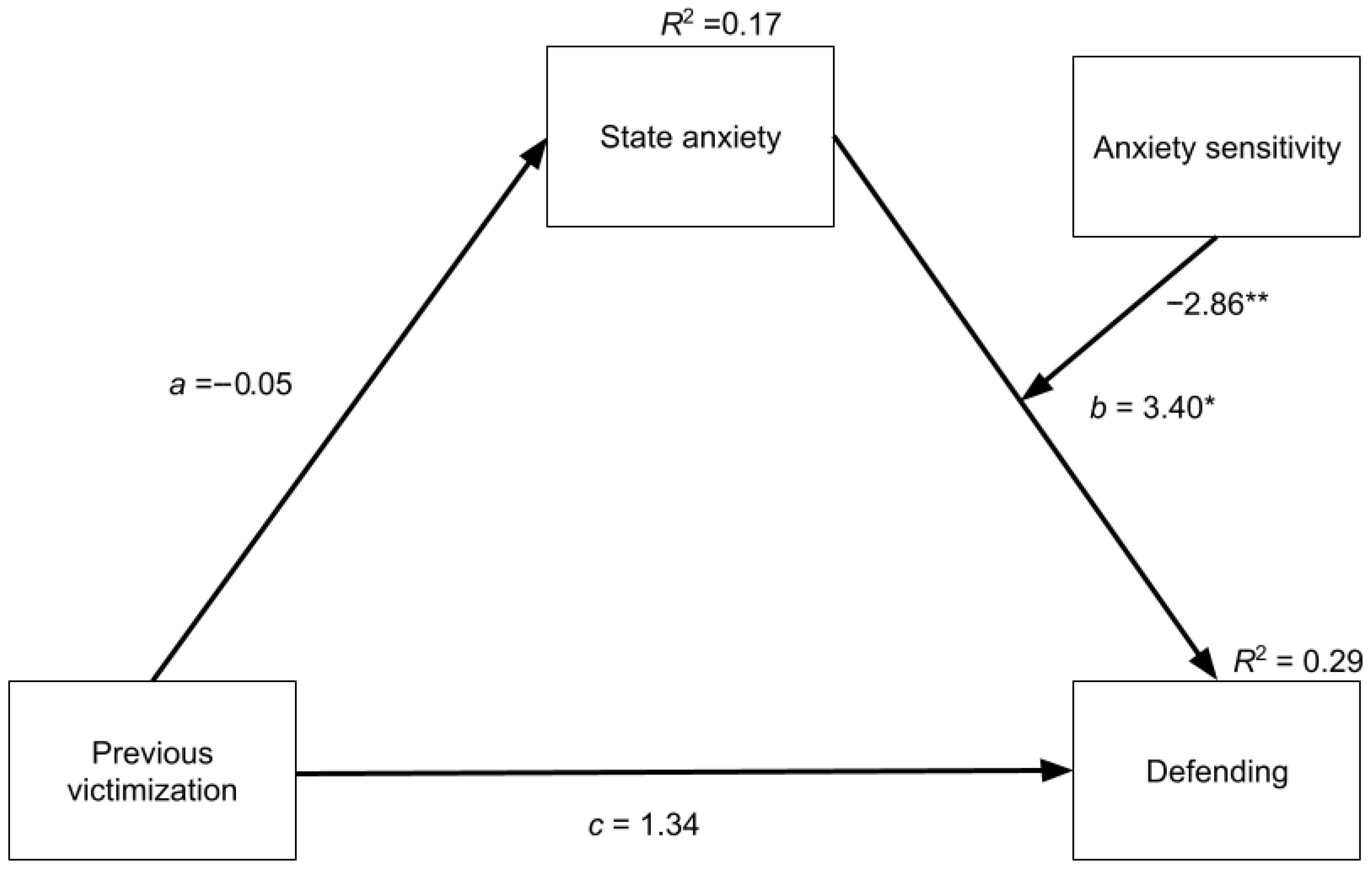
3.3. Moderated Mediation Analysis
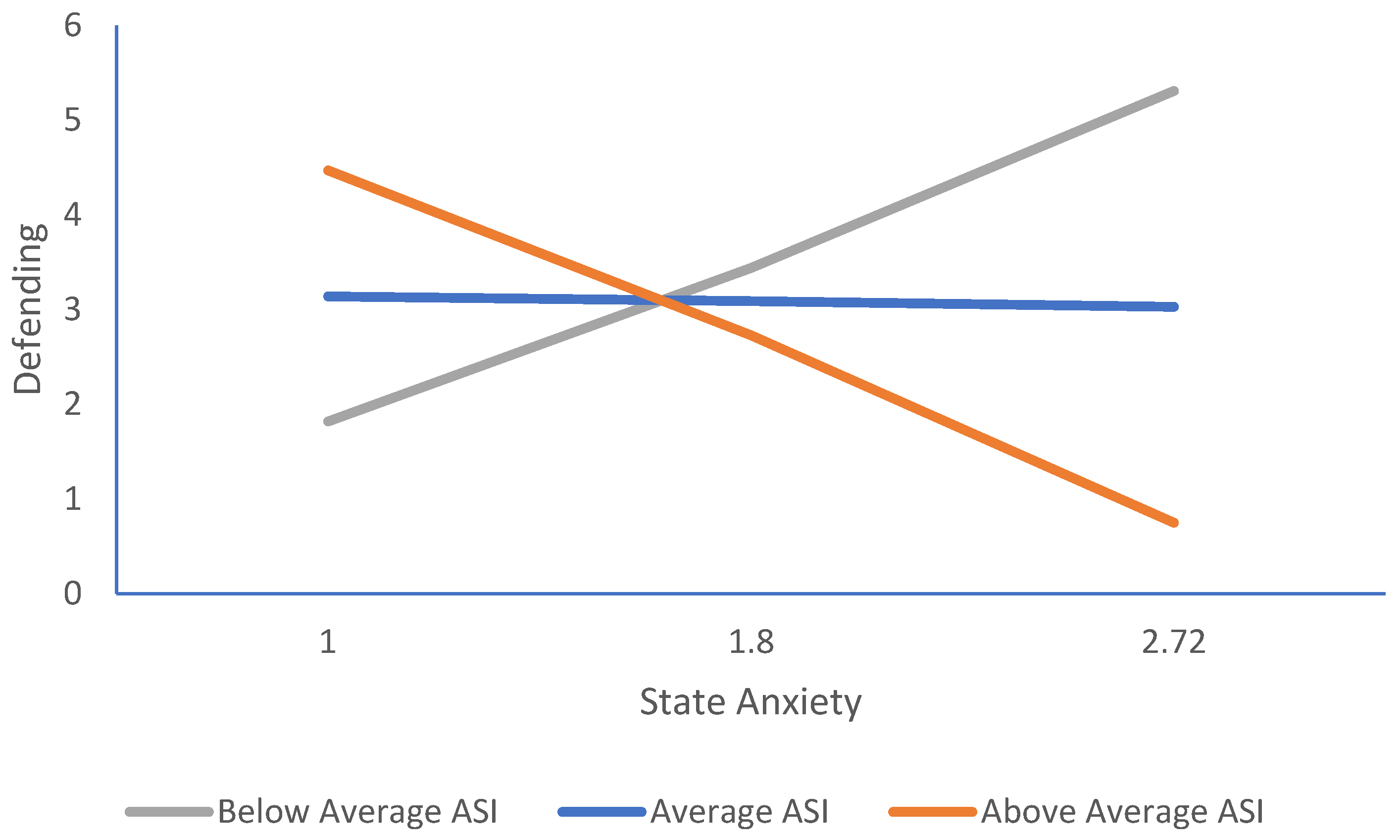
3.4. Post Hoc Moderation Analysis
4. Discussion
Limitations and Future Research
5. Conclusions
Author Contributions
Funding
Institutional Review Board Statement
Informed Consent Statement
Data Availability Statement
Acknowledgments
Conflicts of Interest
| 1 | Age was entered as a covariate as it is negatively correlated with defending. Round 1 state anxiety was entered to control for baseline state anxiety. Condition was entered as a covariate because this study was part of a larger project examining group dynamics, in which participants were assigned to either an in-group victimized condition, an in-group aggressor condition, or a control condition. As shown in Tables 3 and 4, there were no significant condition effects. |
References
- American College Health Association. (2016). American College Health Association-National College health assessment II: Canadian reference groups data report. Spring 2016. American College Health Association. [Google Scholar]
- Barhight, L. R., Hubbard, J. A., & Hyde, C. T. (2013). Children’s physiological and emotional reactions to witnessing bullying predict bystander intervention. Child Development, 84(1), 375–390. [Google Scholar] [CrossRef]
- Bezerra, L. L. D. A. L., Alves, D. L. G., Nunes, B. R., Stelko-Pereira, A. C., Florêncio, R. S., & Gomes, I. L. V. (2023). Anti-bullying interventions with an emphasis on bystanders: A scoping review. Journal of School Health, 93(11), 1036–1044. [Google Scholar] [CrossRef]
- Carlucci, L., Innamorati, M., Ree, M., D’Ignazio, G., & Balsamo, M. (2023). Measuring state and trait anxiety: An application of multidimensional item response theory. Behavioral Sciences, 13(8), 628. [Google Scholar] [CrossRef] [PubMed]
- Children First Canada. (2023). Raising Canada 2023: Top 10 threats to childhood in Canada (pp. 1–105). Available online: https://childrenfirstcanada.org/wp-content/uploads/2023/08/Raising-Canada-2023_V1d.pdf (accessed on 5 January 2026).
- Craig, W., Pagnotta, V., Wadge, S., King, M., & Pickett, W. (2025). The health of young people in Canada: Focus on mental health. Public Health Agency of Canada. Available online: https://www.canada.ca/content/dam/phac-aspc/documents/services/publications/science-research-data/young-people-canada-focus-mental-health/young-people-canada-focus-mental-health.pdf (accessed on 5 January 2026).
- Craig, W. M., & Pepler, D. J. (1998). Observations of bullying and victimization in the school yard. Canadian Journal of School Psychology, 13(2), 41–59. [Google Scholar] [CrossRef]
- Crick, N. R., & Dodge, K. A. (1994). A review and reformulation of social information-processing mechanisms in children’s social adjustment. Psychological Bulletin, 115(1), 74–101. [Google Scholar] [CrossRef]
- Eijigu, T. D., & Teketel, S. Z. (2023). Students’ defending and passive bystanding behaviours when witnessing school bullying in North Western Ethiopia: Roles of personal and situational factors. Journal of Community & Applied Social Psychology, 33(2), 202–220. [Google Scholar] [CrossRef]
- Gaete, J., Valenzuela, D., Godoy, M. I., Rojas-Barahona, C. A., Salmivalli, C., & Araya, R. (2021). Validation of the revised Olweus Bully/Victim Questionnaire (OBVQ-R) among adolescents in Chile. Frontiers in Psychology, 12, 578661. [Google Scholar] [CrossRef]
- Gaffney, H., Ttofi, M. M., & Farrington, D. P. (2021). Effectiveness of school-based programs to reduce bullying perpetration and victimization: An updated systematic review and meta-analysis. Campbell Systematic Reviews, 17(2), e1143. [Google Scholar] [CrossRef] [PubMed]
- Galbraith, M. K., DeWolfe, C. E., Bartel, S., Olthuis, J. V., Watt, M. C., & Stewart, S. H. (2022). Do anxiety sensitivity and impulsivity interact in predicting exercise involvement in emerging adult drinkers and cannabis users? Cognitive Behaviour Therapy, 51(3), 243–256. [Google Scholar] [CrossRef]
- Greenberg, L. s. (2004). Emotion–focused therapy. Clinical Psychology & Psychotherapy, 11(1), 3–16. [Google Scholar] [CrossRef]
- Griffin, J. B. (1990). Anxiety. In H. K. Walker, W. D. Hall, & J. W. Hurst (Eds.), Clinical methods: The history, physical, and laboratory examinations (3rd ed.). Butterworths. Available online: http://www.ncbi.nlm.nih.gov/books/NBK315/ (accessed on 5 January 2026).
- Harmon-Jones, C., Bastian, B., & Harmon-Jones, E. (2016). The discrete emotions questionnaire: A new tool for measuring state self-reported emotions. PLoS ONE, 11(8), e0159915. [Google Scholar] [CrossRef]
- Hawker, D. S. J., & Boulton, M. J. (2000). Twenty years’ research on peer victimization and psychosocial maladjustment: A meta-analytic review of cross-sectional studies. The Journal of Child Psychology and Psychiatry and Allied Disciplines, 41(4), 441–455. [Google Scholar] [CrossRef]
- Hawkins, D. L., Pepler, D. J., & Craig, W. M. (2001). Naturalistic observations of peer interventions in bullying. Social Development, 10(4), 512–527. [Google Scholar] [CrossRef]
- Hayes, A. F. (2017). Introduction to mediation, moderation, and conditional process analysis, second edition: A regression-based approach. Guilford Publications. [Google Scholar]
- Healy, K. L. (2020). Hypotheses for possible iatrogenic impacts of school bullying prevention programs. Child Development Perspectives, 14(4), 221–228. [Google Scholar] [CrossRef]
- Jungert, T., & Perrin, S. (2019). Trait anxiety and bystander motivation to defend victims of school bullying. Journal of Adolescence, 77, 1–10. [Google Scholar] [CrossRef] [PubMed]
- Kaser, A. C., Lambe, L. J., Yunus, F. M., Conrod, P. J., Hadwin, A. F., Keough, M. T., Krank, M. D., Thompson, K., & Stewart, S. H. (2024). Bullying prevalence and associations with mental health problems among canadian undergraduates during the COVID-19 pandemic. International Journal of Bullying Prevention, 1–12. [Google Scholar] [CrossRef]
- Konishi, C., Hymel, S., Wong, T. K. Y., & Waterhouse, T. (2021). School climate and bystander responses to bullying. Psychology in the Schools, 58(8), 1557–1574. [Google Scholar] [CrossRef]
- Lambe, L. J., Cioppa, V. D., Hong, I. K., & Craig, W. M. (2019). Standing up to bullying: A social ecological review of peer defending in offline and online contexts. Aggression and Violent Behavior, 45, 51–74. [Google Scholar] [CrossRef]
- Lambe, L. J., & Craig, W. M. (2022a). Anger and empathy: Exploring the underlying emotional processes of peer defending behaviors using virtual reality. International Journal of Bullying Prevention, 5(4), 348–361. [Google Scholar] [CrossRef]
- Lambe, L. J., & Craig, W. M. (2022b). The co-evolution of friendship, defending behaviors, and peer victimization: A short-term longitudinal social network analysis. Social Development, 31(4), 984–1000. [Google Scholar] [CrossRef]
- Laninga-Wijnen, L., Pouwels, J. L., Giletta, M., & Salmivalli, C. (2024). Feeling better now? Being defended diminishes daily mood problems and self-blame in victims of bullying. British Journal of Educational Psychology, 94(4), 1294–1322. [Google Scholar] [CrossRef]
- Laninga-Wijnen, L., Yanagida, T., & Garandeau, C. F. (2025). Does defending help? The role of peer defending in reducing victimization and enhancing victims’ psychological adjustment. Developmental Psychology, 62(2), 330–349. [Google Scholar] [CrossRef]
- Leal, P. C., Goes, T. C., da Silva, L. C. F., & Teixeira-Silva, F. (2017). Trait vs. State anxiety in different threatening situations. Trends in Psychiatry and Psychotherapy, 39, 147–157. [Google Scholar] [CrossRef]
- Lebowitz, E. R., Shic, F., Campbell, D., Basile, K., & Silverman, W. K. (2015). Anxiety sensitivity moderates behavioral avoidance in anxious youth. Behaviour Research and Therapy, 74, 11–17. [Google Scholar] [CrossRef] [PubMed]
- Lehrbach, K. R., Crane, M. E., Olino, T. M., & Kendall, P. C. (2023). Anxiety sensitivity and experiential avoidance: Relations with anxiety severity and treatment outcomes in anxious youth. Cognitive Therapy and Research, 47(5), 841–850. [Google Scholar] [CrossRef] [PubMed]
- Lemerise, E. A., & Arsenio, W. F. (2000). An integrated model of emotion processes and cognition in social information processing. Child Development, 71(1), 107–118. [Google Scholar] [CrossRef]
- Liu, Y.-L., Chang, C.-Y., & Wang, C.-Y. (2023). Using VR to investigate bystander behavior and the motivational factors in school bullying. Computers & Education, 194, 104696. [Google Scholar] [CrossRef]
- Liu, Y.-L., Jian, T.-E., & Wang, C.-Y. (2025). Utilizing VR technology to explore the moral courage process and bystander behaviors: An experimental trial. Computers in Human Behavior Reports, 17, 100596. [Google Scholar] [CrossRef]
- Marren, C., Mikoška, P., O’Brien, S., & Timulak, L. (2022). A qualitative meta-analysis of the clients’ experiences of emotion-focused therapy. Clinical Psychology & Psychotherapy, 29(5), 1611–1625. [Google Scholar] [CrossRef]
- Mullan, V. M. R., Golm, D., Juhl, J., Sajid, S., & Brandt, V. (2023). The relationship between peer victimisation, self-esteem, and internalizing symptoms in adolescents: A systematic review and meta-analysis. PLoS ONE, 18(3), E0282224. [Google Scholar] [CrossRef] [PubMed]
- Park, S.-J., & Yi, Y. (2023). Assessing differences between simple slopes in simple slopes analysis. Journal of Business Research, 168, 114204. [Google Scholar] [CrossRef]
- Raymond, C., Pichette, F., Beaudin, M., Cernik, R., & Marin, M. F. (2023). Vulnerability to anxiety differently predicts cortisol reactivity and state anxiety during a laboratory stressor in healthy girls and boys. Journal of Affective Disorders, 331, 425–433. [Google Scholar] [CrossRef]
- Reijntjes, A., Kamphuis, J. H., Prinzie, P., & Telch, M. J. (2010). Peer victimization and internalizing problems in children: A meta-analysis of longitudinal studies. Child Abuse & Neglect, 34(4), 244–252. [Google Scholar] [CrossRef]
- Reiss, S., Peterson, R. A., Gursky, D. M., & McNally, R. J. (1986). Anxiety sensitivity, anxiety frequency and the prediction of fearfulness. Behaviour Research and Therapy, 24(1), 1–8. [Google Scholar] [CrossRef] [PubMed]
- Solberg, M. E., & Olweus, D. (2003). Prevalence estimation of school bullying with the Olweus Bully/Victim Questionnaire. Aggressive Behavior, 29(3), 239–268. [Google Scholar] [CrossRef]
- Steggerda, J. C., Kiefer, J. L., Vengurlekar, I. N., Blake, J., Hernandez Rodriguez, J., Pastrana Rivera, F. A., & Cavell, T. A. (2023). Anxiety sensitivity and internalizing symptoms: Co-predictors of persistent peer victimization in elementary school children. Journal of School Violence, 22(2), 153–166. [Google Scholar] [CrossRef]
- Stewart, S. H. (2024). Anxiety sensitivity as a transdiagnostic factor in emotional disorders, addictive disorders, and their comorbidities: How basic research informs intervention research. Canadian Psychology/Psychologie Canadienne, 65(2), 75–92. [Google Scholar] [CrossRef]
- Taylor, S., Zvolensky, M. J., Cox, B. J., Deacon, B., Heimberg, R. G., Ledley, D. R., Abramowitz, J. S., Holaway, R. M., Sandin, B., Stewart, S. H., Coles, M., Eng, W., Daly, E. S., Arrindell, W. A., Bouvard, M., & Cardenas, S. J. (2007). Robust dimensions of anxiety sensitivity: Development and initial validation of the Anxiety Sensitivity Index-3. Psychological Assessment, 19(2), 176–188. [Google Scholar] [CrossRef]
- Vaillancourt, T., Brittain, H., Farrell, A. H., Krygsman, A., & Vitoroulis, I. (2023). Bullying involvement and the transition to high school: A brief report. Aggressive Behavior, 49(4), 409–417. [Google Scholar] [CrossRef] [PubMed]
- Vaillancourt, T., Brittain, H., Krygsman, A., Farrell, A. H., Landon, S., & Pepler, D. (2021). School bullying before and during COVID-19: Results from a population-based randomized design. Aggressive Behavior, 47(5), 557–569. [Google Scholar] [CrossRef] [PubMed]
- van der Ploeg, R., Kretschmer, T., Salmivalli, C., & Veenstra, R. (2017). Defending victims: What does it take to intervene in bullying and how is it rewarded by peers? Journal of School Psychology, 65, 1–10. [Google Scholar] [CrossRef]
- Volk, A. A., Veenstra, R., & Espelage, D. L. (2017). So you want to study bullying? Recommendations to enhance the validity, transparency, and compatibility of bullying research. Aggression and Violent Behavior, 36, 34–43. [Google Scholar] [CrossRef]
- Williams, K. D., & Jarvis, B. (2006). Cyberball: A program for use in research on interpersonal ostracism and acceptance. Behavior Research Methods, 38(1), 174–180. [Google Scholar] [CrossRef] [PubMed]
- World Anti-Bullying Forum. (2021, November). Presenting a proposed revised definition of school bullying. World Anti-Bullying Forum. [Google Scholar]
- Xue, J., Hu, R., Zhang, W., Zhao, Y., Zhang, B., Liu, N., Li, S.-C., & Logan, J. (2021). Virtual reality or augmented reality as a tool for studying bystander behaviors in interpersonal violence: Scoping review. Journal of Medical Internet Research, 23(2), e25322. [Google Scholar] [CrossRef] [PubMed]
- Zadro, L., Williams, K. D., & Richardson, R. (2004). How low can you go? Ostracism by a computer is sufficient to lower self-reported levels of belonging, control, self-esteem, and meaningful existence. Journal of Experimental Social Psychology, 40(4), 560–567. [Google Scholar] [CrossRef]
- Zvolensky, M. J., Goodie, J. L., Ruggiero, K. J., Black, A. L., Larkin, K. T., & Taylor, B. K. (2002). Perceived stress and anxiety sensitivity in the prediction of anxiety-related responding: A multichallenge evaluation. Anxiety, Stress & Coping, 15(3), 211–229. [Google Scholar] [CrossRef]



| N | % | Mean | SD | |
|---|---|---|---|---|
| Age | 40 | 19.17 | 1.40 | |
| Gender | ||||
| Women | 28 | 70.0 | ||
| Men | 12 | 30.0 | ||
| Ethnicity | ||||
| White | 37 | 92.5 | ||
| Asian | 3 | 7.5 |
| Victimization | Δ State Anxiety | Peer Defending | Anxiety Sensitivity | Age | Gender | |
|---|---|---|---|---|---|---|
| Victimization | -- | |||||
| Δ State anxiety | 0.01 | -- | ||||
| Peer defending | 0.26 | −0.14 | -- | |||
| Anxiety sensitivity | −0.01 | −0.05 | 0.23 | -- | ||
| Age | −0.23 | 0.06 | −0.08 | −0.17 | -- | |
| Gender | 0.20 | 0.01 | 0.34 * | 0.10 | −0.20 | -- |
| Mean/Frequency | 63% victimized | 0.32 | 2.83 | 1.22 | 19.17 | 65.2% women 34.8% men |
| SD | 1.01 | 0.49 | 0.74 | 1.40 |
| M (State Anxiety) b [95% CI] | SE | t | p | Y (Defending) b [95% CI] | SE | t | p | |
|---|---|---|---|---|---|---|---|---|
| Predictors | ||||||||
| Intercept | 0.78 [−3.87, 5.43] | 2.29 | 0.34 | 0.74 | −1.27 [−13.63, 11.09] | 6.07 | −0.21 | 0.84 |
| Victimization (a path) | −0.05 [−0.68, 0.58] | 0.31 | −0.16 | 0.87 | 1.33 [−0.34, 3.00] | 0.82 | 1.62 | 0.12 |
| State anxiety (b path) | 3.40 * [0.43, 6.36] | 1.46 | 2.33 | 0.03 | ||||
| Anxiety sensitivity | 4.83 *** [1.63, 8.04] | 1.57 | 3.07 | 0.00 | ||||
| Interaction State anxiety × anxiety sensitivity | −2.86 ** [−5.02, −0.69] | 1.06 | −2.68 | 0.01 | ||||
| Covariates | ||||||||
| State anxiety (Round 1) | 0.41 [0.02, 0.80] | 0.19 | 2.13 | 0.04 * | 0.71 [−0.45, 1.87] | 0.57 | 1.25 | 0.22 |
| Condition | 0.34 [−0.03, 0.70] | 0.18 | 1.89 | 0.07 | −0.27 [−1.28, 0.73] | 0.50 | −0.55 | 0.58 |
| Age | −0.01 [−0.24, 0.21] | 0.11 | −0.12 | 0.90 | −0.14 [−0.76, 0.47] | 0.30 | −0.48 | 0.64 |
| Model R2 | 0.17 | 0.29 | ||||||
| F (df) | 1.83 (4, 35) | 1.91 (7, 32) |
| Defending b [95% CI] | SE | t | p | |
|---|---|---|---|---|
| Predictors | ||||
| Intercept | 1.87 [−10.12, 13.86] | 5.89 | 0.32 | 0.75 |
| State anxiety | 3.51 * [0.48, 6.54] | 1.49 | 2.35 | 0.02 |
| Anxiety Sensitivity | 4.81 ** [1.53, 8.09] | 1.61 | 2.99 | 0.01 |
| Interaction State anxiety × anxiety sensitivity | −2.95 ** [−5.16, −0.74] | 1.09 | −2.71 | 0.01 |
| Covariates | ||||
| State anxiety (Round 1) | 0.86 [−0.31, 2.03] | 0.58 | 1.50 | 0.14 |
| Condition | −0.15 [−1.16, 0.87] | 0.50 | −0.29 | 0.87 |
| Age | −0.29 [−0.89, 0.32] | 0.30 | −0.96 | 0.34 |
| Model R2 | 0.24 | |||
| F (df) | 1.71 (6, 33) |
Disclaimer/Publisher’s Note: The statements, opinions and data contained in all publications are solely those of the individual author(s) and contributor(s) and not of MDPI and/or the editor(s). MDPI and/or the editor(s) disclaim responsibility for any injury to people or property resulting from any ideas, methods, instructions or products referred to in the content. |
© 2026 by the authors. Licensee MDPI, Basel, Switzerland. This article is an open access article distributed under the terms and conditions of the Creative Commons Attribution (CC BY) license.
Share and Cite
MacGillivray, A.; Byron, J.; Redden, R.; Lambe, L.J. Examining the Relationship Between State Anxiety, Anxiety Sensitivity, and Peer Defending Using Virtual Reality. Behav. Sci. 2026, 16, 252. https://doi.org/10.3390/bs16020252
MacGillivray A, Byron J, Redden R, Lambe LJ. Examining the Relationship Between State Anxiety, Anxiety Sensitivity, and Peer Defending Using Virtual Reality. Behavioral Sciences. 2026; 16(2):252. https://doi.org/10.3390/bs16020252
Chicago/Turabian StyleMacGillivray, Anna, Julia Byron, Ralph Redden, and Laura J. Lambe. 2026. "Examining the Relationship Between State Anxiety, Anxiety Sensitivity, and Peer Defending Using Virtual Reality" Behavioral Sciences 16, no. 2: 252. https://doi.org/10.3390/bs16020252
APA StyleMacGillivray, A., Byron, J., Redden, R., & Lambe, L. J. (2026). Examining the Relationship Between State Anxiety, Anxiety Sensitivity, and Peer Defending Using Virtual Reality. Behavioral Sciences, 16(2), 252. https://doi.org/10.3390/bs16020252