Disconnected Connections: How Insecure Attachment and Materialism Drive Phubbing Behaviors

 , , , and
Abstract
1. Introduction
1.1. Attachment and Phubbing
1.2. Materialism
1.3. Attachment, Materialism, and Phubbing
2. Materials and Methods
2.1. Participants
2.2. Design
2.3. Measures
2.3.1. Attachment
2.3.2. Materialism
2.3.3. Enacted Phubbing
2.3.4. Perceived Phubbing
2.4. Statistical Analyses
3. Results
3.1. Descriptive Results
3.2. Correlations
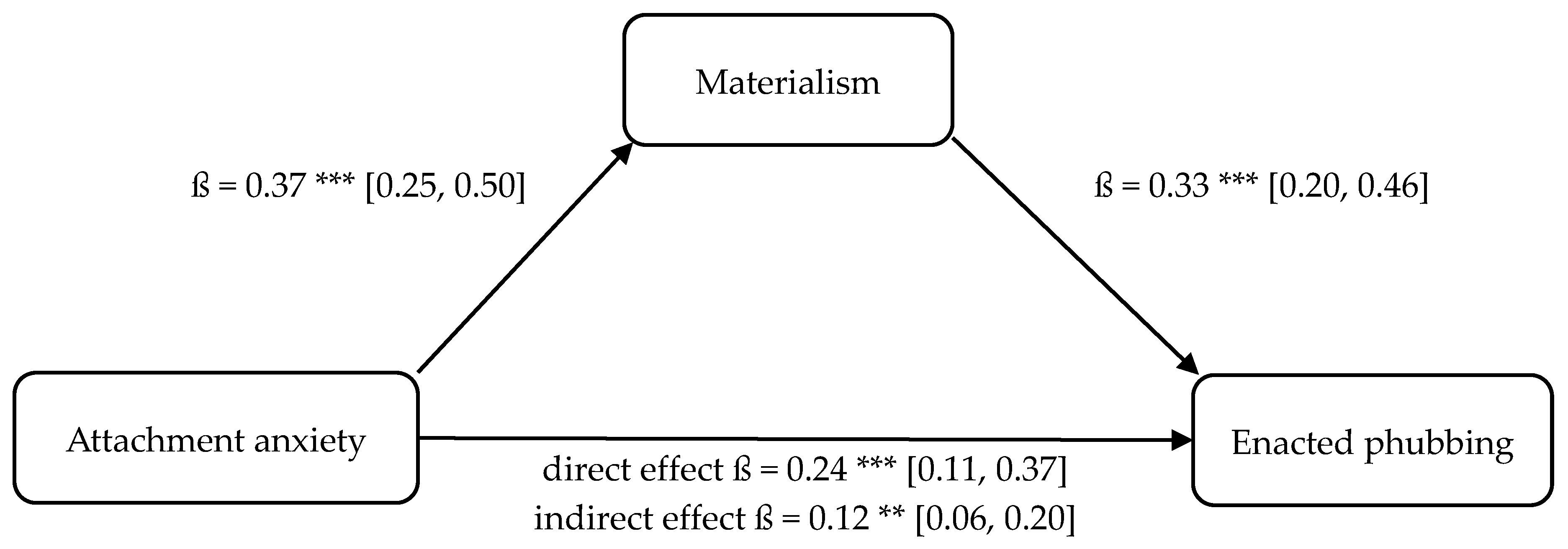
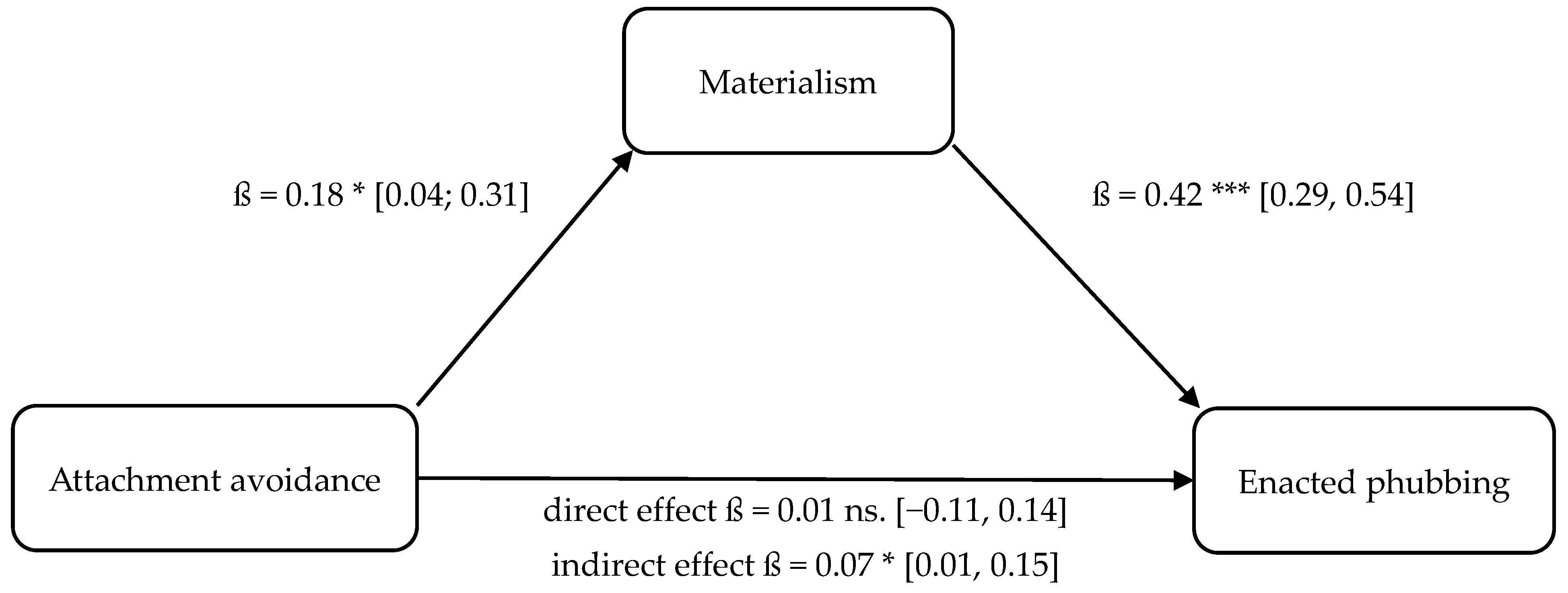
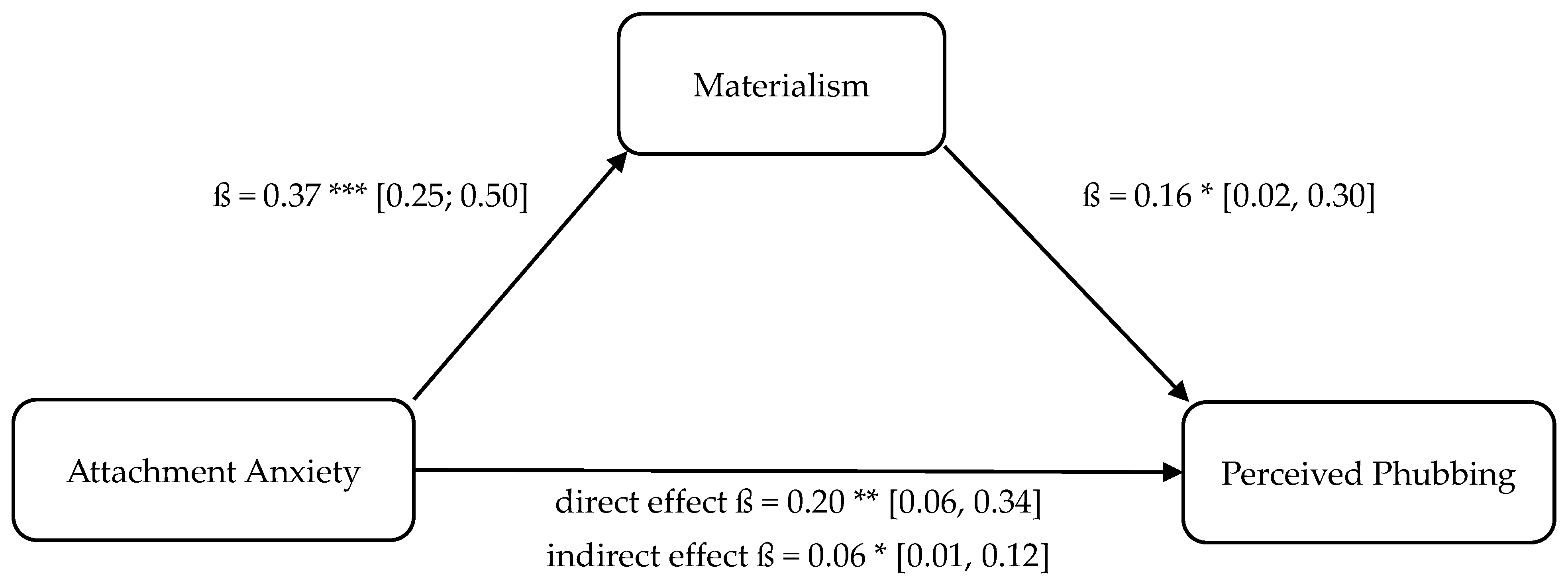
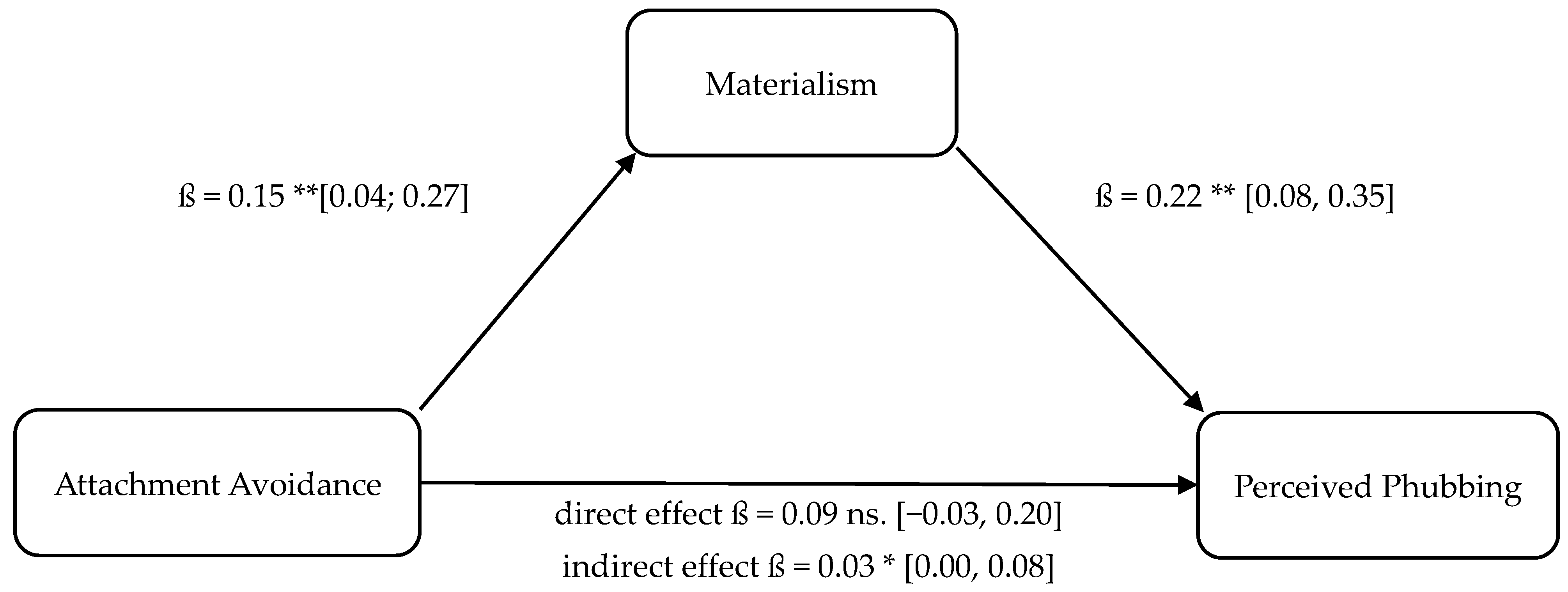
3.3. Mediation Analyses
3.4. Replicability and Post Hoc Power
4. Discussion
4.1. Direct Associations Between Attachment and Phubbing (H1–H4)
4.2. Materialism and Phubbing (H5–H6)
4.3. Attachment and Materialism (H7–H8)
4.4. Materialism as Mediator Between Attachment Insecurity and Phubbing (H9–H12)
4.5. Integration with Existing Models of Phubbing and Social Media Use
5. Limitations
6. Conclusions
Author Contributions
Funding
Institutional Review Board Statement
Informed Consent Statement
Data Availability Statement
Conflicts of Interest
Appendix A. Translation of the Phubbing Scale

| Original Items | German Version | |
|---|---|---|
| 1. | My eyes start wandering on my phone when I’m together with others. | Wenn ich mit anderen zusammen bin, beginnt mein Blick zu meinem Handy zu wandern. |
| 2. | I am always busy with my mobile phone when I’m with my friends. | Ich bin immer mit meinem Handy beschäftigt, wenn ich mit meinen Freund/innen zusammen bin. |
| 3. | People complain about me dealing with my mobile phone. | Andere beschweren sich darüber, dass ich mich mit meinem Handy befasse. |
| 4. | I’m busy with my mobile phone when I’m with friends. | Ich bin mit meinem Handy beschäftigt, wenn ich mit Freund/innen zusammen bin. |
| 5. | I don’t think that I annoy my partner when I’m busy with my mobile phone. | Ich denke nicht, dass ich meine/n Partner/in damit nerve, wenn ich mit meinem Handy beschäftigt bin. |
| 6. | My phone is always within my reach. | Mein Handy ist immer in Reichweite. |
| 7. | When I wake up in the morning, I first check the messages on my phone. | Wenn ich morgens aufwache, checke ich zuerst die Nachrichten auf meinem Handy. |
| 8. | I feel incomplete without my mobile phone. | Ohne mein Handy fühle ich mich unvollständig. |
| 9. | My mobile phone use increases day by day. | Meine Handy-Nutzung wird von Tag zu Tag mehr. |
| 10. | The time allocated to social, personal or professional activities decreases because of my mobile phone. | Die Zeit, die ich sozialen, persönlichen oder beruflichen Aktivitäten widme, nimmt aufgrund meiner Handy-Nutzung ab. |
| Original Items | German Version | |
|---|---|---|
| 1. | During a typical mealtime that my partner and I spend together, my partner pulls out and checks his/her cell phone (slight modification). | Während einer typischen Mahlzeit, die mein/e Partner/in und ich gemeinsam verbringen, holt mein/e Partner/in sein/ihr Handy raus und überprüft es. |
| 2. | My partner places his or her cell phone where they can see it when we are together. | Wenn wir zusammen sind, platziert mein/e Partner/in sein/ihr Handy so, dass er/sie es sehen kann. |
| 3. | My partner keeps his or her cell phone in their hand when he or she is with me. | Mein/e Partner/in behält sein/ihr Handy in der Hand, wenn er/sie mit mir zusammen ist. |
| 4. | When my partner’s cell phone rings or beeps, he/she pulls it out even if we are in the middle of a conversation (slight modification). | Wenn das Handy meines Partners/meiner Partnerin klingelt oder piept, holt er/sie es heraus, auch wenn wir mitten im Gespräch sind. |
| 5. | My partner glances at his/her cell phone when talking to me. | Mein/e Partner/in schaut auf sein/ihr Handy, während er/sie mit mir spricht. |
| 6. | During leisure time that my partner and I are able to spend together, my partner uses his/her cell phone (slight modification). | In der Freizeit, die mein/e Partner/in und ich zusammen verbringen können, nutzt mein/e Partner/in sein/ihr Handy. |
| 7. | My partner does not use his or her phone when we are talking. | Mein/e Partner/in nutzt sein/ihr Handy nicht, wenn wir uns unterhalten. |
| 8. | My partner uses his or her cell phone when we are out together. | Mein/e Partner/in nutzt sein/ihr Handy, wenn wir gemeinsam unterwegs sind. |
| 9. | If there is a lull in our conversation, my partner will check his or her cell phone. | Gibt es eine Pause in unserem Gespräch, checkt mein/e Partner/in sein/ihr Handy. |
References
- Ainsworth, M. D. S., Blehar, M. C., Waters, E., & Wall, S. N. (1978). Patterns of attachment: A psychological study of the strange situation. Lawrence Erlbaum. [Google Scholar]
- Al-Saggaf, Y., & O’Donnell, S. B. (2019). Phubbing: Perceptions, reasons behind, predictors, and impacts. Human Behavior and Emerging Technologies, 1(2), 132–140. [Google Scholar] [CrossRef]
- Bartholomew, K. J., & Horowitz, L. M. (1991). Attachment styles among young adults: A test of a four-category model. Journal of Personality and Social Psychology, 61(2), 226–244. [Google Scholar] [CrossRef] [PubMed]
- Belk, R. W. (2015). Culture and materialism. In S. Ng, & A. Y. Lee (Eds.), Handbook of culture and consumer behavior (pp. 299–323). Oxford University Press. [Google Scholar] [CrossRef]
- Bowlby, J. (1969). Attachment and loss volume I attachment. Basic Books. [Google Scholar]
- Bowlby, J. (1980). Attachment and loss volume II separation. Basic Books. [Google Scholar]
- Brennan, K. A., Clark, C. L., & Shaver, P. R. (1998). Self-report measurement of adult attachment: An integrative overview. In J. A. Simpson, & W. S. Rholes (Eds.), Attachment theory and close relationships (pp. 46–76). Guilford Press. [Google Scholar]
- Bröning, S., & Wartberg, L. (2022). Attached to your smartphone? A dyadic perspective on perceived partner phubbing and attachment in long-term couple relationships. Computers in Human Behavior, 126, 10. [Google Scholar] [CrossRef]
- Carnelley, K. B., Vowels, L. M., Stanton, S. C. E., Millings, A., & Hart, C. M. (2023). Perceived partner phubbing predicts lower relationship quality but partners’ enacted phubbing does not. Computers in Human Behavior, 147, 107860. [Google Scholar] [CrossRef]
- Chan, K., & Prendergast, G. (2007). Materialism and social comparison among adolescents. Social Behavior and Personality: An International Journal, 35(2), 213–228. [Google Scholar] [CrossRef]
- Chang, B., Zhang, J., & Fang, J. (2023). Low self-concept clarity reduces subjective well-being: The mediating effect of materialism. Current Psychology, 43, 14751–14759. [Google Scholar] [CrossRef]
- Chang, L., & Arkin, R. M. (2002). Materialism as an attempt to cope with uncertainty. Psychology & Marketing, 19(5), 389–406. [Google Scholar] [CrossRef]
- Cho, H. J., Jin, B., & Watchravesringkan, K. T. (2016). A cross-cultural comparison of materialism in emerging and newly developed Asian markets. International Journal of Business, Humanities and Technology, 6(1), 1–10. [Google Scholar]
- Chotpitayasunondh, V., & Douglas, K. M. (2016). How “phubbing” becomes the norm: The antecedents and consequences of snubbing via smartphone. Computers in Human Behavior, 63, 9–18. [Google Scholar] [CrossRef]
- Chotpitayasunondh, V., & Douglas, K. M. (2018). The effects of “phubbing” on social interaction. Journal of Applied Social Psychology, 48(6), 304–316. [Google Scholar] [CrossRef]
- Collins, N. L., & Feeney, B. C. (2000). A safe haven: An attachment theory perspective on support seeking and caregiving in intimate relationships. Journal of Personality and Social Psychology, 78(6), 1053. [Google Scholar] [CrossRef]
- D21 Digital Index 2023/24: Annual Situation Report on the Digital Society. (2024). D21-Digital-Index 2023/24: Jährliches lagebild zur digitalen gesellschaft, 2023 D21-Digital-Index 2023/24: Jährliches lagebild zur digitalen gesellschaft. Available online: https://initiatived21.de/publikationen/d21-digital-index (accessed on 30 November 2025).
- David, M. E., & Roberts, J. A. (2017). Phubbed and alone: Phone snubbing, social exclusion, and attachment to social media. Journal of the Association for Consumer Research, 2(2), 155–163. [Google Scholar] [CrossRef]
- David, M. E., & Roberts, J. A. (2020). Developing and testing a scale designed to measure perceived phubbing. International Journal of Environmental Research and Public Health, 17(21), 8152. [Google Scholar] [CrossRef]
- Destatis. (2022). Daten aus den laufenden wirtschaftsrechnungen (LWR) zur ausstattung privater haushalte mit informationstechnik. Available online: https://www.destatis.de/DE/Themen/Gesellschaft-Umwelt/Einkommen-Konsum-Lebensbedingungen/Ausstattung-Gebrauchsgueter/Tabellen/a-infotechnik-d-lwr.html (accessed on 30 November 2025).
- Dittmar, H., Bond, R., Hurst, M., & Kasser, T. (2014). The relationship between materialism and personal well-being: A meta-analysis. Journal of Personality and Social Psychology, 107(5), 879–924. [Google Scholar] [CrossRef] [PubMed]
- Dittmar, H., & Isham, A. (2022). Materialistic value orientation and wellbeing. Current Opinion in Psychology, 46(6), 101337. [Google Scholar] [CrossRef]
- Ergün, N., Göksu, İ., & Sakız, H. (2020). Effects of phubbing: Relationships with psychodemographic variables. Psychological Reports, 123(5), 1578–1613. [Google Scholar] [CrossRef] [PubMed]
- Faber, R., & O’Guinn, T. (1992). A clinical screener for compulsive buying. Journal of Consumer Research, 19(3), 459–469. [Google Scholar] [CrossRef]
- Fraley, R. C., & Dugan, K. A. (2021). The consistency of attachment security across time and relationships. In R. A. Thompson, J. A. Simpson, & L. J. Berlin (Eds.), Attachment: The fundamental questions (pp. 147–153). Guilford Press. [Google Scholar]
- Fraley, R. C., & Shaver, P. R. (2000). Adult romantic attachment: Theoretical developments, emerging controversies, and unanswered questions. Review of General Psychology, 4(2), 132–154. [Google Scholar] [CrossRef]
- Ger, G., & Belk, R. W. (1996). Cross-cultural differences in materialism. Journal of Economic Psychology, 17(1), 55–77. [Google Scholar] [CrossRef]
- Gillath, O., Bunge, S. A., Shaver, P. R., Wendelken, C., & Mikulincer, M. (2005). Attachment-style differences in the ability to suppress negative thoughts: Exploring the neural correlates. Neuroimage, 28(4), 835–847. [Google Scholar] [CrossRef]
- Hayes, A. F. (2022). Introduction to mediation, moderation, and conditional process analysis a regression-based approach (2nd ed.). The Guilford Press. [Google Scholar]
- Ivanova, A., Gorbaniuk, O., Błachnio, A., Przepiórka, A., Mraka, N., Polishchuk, V., & Gorbaniuk, J. (2020). Mobile phone addiction, phubbing, and depression among men and women: A moderated mediation analysis. Psychiatric Quarterly, 91(3), 655–668. [Google Scholar] [CrossRef]
- Karadag, E., Betül Tosuntaş, Ş., Erzen, E., Duru, P., Bostan, N., Mizrak Şahín, B., Çulha, Í., & Babadag, B. (2015). Determinants of phubbing, which is the sum of many virtual addictions: A structural equation model. Journal of Behavioral Addictions, 4(2), 60–74. [Google Scholar] [CrossRef]
- Kasser, T., Ryan, R. M., Couchman, C. E., & Sheldon, K. M. (2004). Materialistic values: Their causes and consequences. In T. Kasser, & A. D. Kanner (Eds.), Psychology and consumer culture: The struggle for a good life in a materialistic world (pp. 11–28). American Psychological Association. [Google Scholar] [CrossRef]
- Kroenke, K., Strine, T. W., Spitzer, R. L., Williams, J. B. W., Berry, J. T., & Mokdad, A. H. (2009). The PHQ-8 as a measure of current depression in the general population. Journal of Affective Disorders, 114(1), 163–173. [Google Scholar] [CrossRef]
- Li, T., & Chan, D. K.-S. (2012). How anxious and avoidant attachment affect romantic relationship quality differently: A meta-analytic review. European Journal of Social Psychology, 42(4), 406–419. [Google Scholar] [CrossRef]
- Long, J., Wang, P., Liu, S., & Lei, L. (2021). Materialism and adolescent problematic smartphone use: The mediating role of fear of missing out and the moderating role of narcissism. Current Psychology, 40, 5842–5850. [Google Scholar] [CrossRef]
- Longmire, S. J., Chan, E. Y., & Lawry, C. A. (2021). Find me strength in things: Fear can explain materialism. Psychology & Marketing, 38(12), 2247–2258. [Google Scholar] [CrossRef]
- Martin, C., Czellar, S., & Pandelaere, M. (2019). Age-related changes in materialism in adults—A self-uncertainty perspective. Journal of Research in Personality, 78, 16–24. [Google Scholar] [CrossRef]
- Maslow, A. H. (1943). A theory of human motivation. Psychological Review, 50(4), 370–396. [Google Scholar] [CrossRef]
- Mikulincer, M., Gillath, O., & Shaver, P. R. (2002). Activation of the attachment system in adulthood: Threat-related primes increase the accessibility of mental representations of attachment figures. Journal of Personality and Social Psychology, 83(4), 881. [Google Scholar] [CrossRef] [PubMed]
- Mikulincer, M., & Shaver, P. (2003). The attachment behavioral system in adulthood: Activation, psychodynamics, and interpersonal processes. Advances in Experimental Social Psychology, 35, 53–152. [Google Scholar] [CrossRef]
- Mikulincer, M., & Shaver, P. (2007). Boosting attachment security to promote mental health, prosocial values, and inter-group tolerance. Psychological Inquiry, 18(3), 139–156. [Google Scholar] [CrossRef]
- Moldes, O., & Ku, L. (2020). Materialistic cues make us miserable: A meta-analysis of the experimental evidence for the effects of materialism on individual and societal well-being. Psychology & Marketing, 37(10), 1396–1419. [Google Scholar] [CrossRef]
- Müller, A., Smits, D. J., Claes, L., Gefeller, O., Hinz, A., & de Zwaan, M. (2013). The German version of the material values scale. GMS Psycho-Social-Medicine, 10, 1–9. [Google Scholar] [CrossRef]
- Neumann, E., Rohmann, E., & Bierhoff, H.-W. (2007). Entwicklung und validierung von skalen zur erfassung von vermeidung und angst in partnerschaften. Diagnostica, 53(1), 33–47. [Google Scholar] [CrossRef]
- Neumann, E., Rohmann, E., & Sattel, H. (2023). The 10-item short form of the german experiences in close relationships scale (ECR-G-10)—Model fit, reliability, and validity. Behavioral Sciences, 13(11), 935. [Google Scholar] [CrossRef]
- Ozimek, P., Baer, F., & Förster, J. (2017). Materialists on Facebook: The self-regulatory role of social comparisons and the objectification of Facebook friends. Heliyon, 3(11), e00449. [Google Scholar] [CrossRef] [PubMed]
- Ozimek, P., Brailovskaia, J., Bierhoff, H.-W., & Rohmann, E. (2024). Materialism in social media–More social media addiction and stress symptoms, less satisfaction with life. Telematics and Informatics Reports, 13, 100117. [Google Scholar] [CrossRef]
- Richins, M., & Fournier, S. (1991). Some theoretical and popular notions concerning materialism. Journal of Social Behavior and Personality, 6(6), 403–414. [Google Scholar]
- Richins, M. L. (2004). The material values scale: Measurement properties and development of a short form. Journal of Consumer Research, 31(1), 209–219. [Google Scholar] [CrossRef]
- Richins, M. L., & Dawson, S. (1992). A consumer values orientation for materialism and its measurement: Scale development and validation. Journal of Consumer Research, 19(3), 303–316. [Google Scholar] [CrossRef]
- Roberts, J. A., & David, M. E. (2016). My life has become a major distraction from my cell phone: Partner phubbing and relationship satisfaction among romantic partners. Computers in Human Behavior, 54, 134–141. [Google Scholar] [CrossRef]
- Roberts, J. A., & David, M. E. (2022). Partner phubbing and relationship satisfaction through the lens of social allergy theory. Personality and Individual Differences, 195, 111676. [Google Scholar] [CrossRef]
- Ross, L. R., & Spinner, B. (2001). General and specific attachment representations in adulthood: Is there a relationship? Journal of Social and Personal Relationships, 18(6), 747–766. [Google Scholar] [CrossRef]
- Schmuck, D., Karsay, K., Matthes, J., & Stevic, A. (2019). “Looking up and feeling down”. The influence of mobile social networking site use on upward social comparison, self-esteem, and well-being of adult smartphone users. Telematics and Informatics, 42, 101240. [Google Scholar] [CrossRef]
- Schneider, F. M., & Hitzfeld, S. (2021). I ought to put down that phone but i phub nevertheless: Examining the predictors of enacted phubbing. Social Science Computer Review, 39(6), 1075–1088. [Google Scholar] [CrossRef]
- Segev, S., Shoham, A., & Gavish, Y. (2015). A closer look into the materialism construct: The antecedents and consequences of materialism and its three facets. Journal of Consumer Marketing, 32(2), 85–98. [Google Scholar] [CrossRef]
- Shrum, L. J., Wong, N., Arif, F., Chugani, S. K., Gunz, A., Lowrey, T. M., Nairn, A., Pandelaere, M., Ross, S. M., Ruvio, A., Scott, K., & Sundie, J. (2013). Reconceptualizing materialism as identity goal pursuits: Functions, processes, and consequences. Journal of Business Research, 66(8), 1179–1185. [Google Scholar] [CrossRef]
- Sun, J., & Miller, C. H. (2023a). Insecure attachment styles and phubbing: The mediating role of problematic smartphone use. Human Behavior and Emerging Technologies, 2023, 4331787. [Google Scholar] [CrossRef]
- Sun, J., & Miller, C. H. (2023b). Smartphone attachment and self-regulation mediate the influence of avoidant attachment style on phubbing. Human Behavior and Emerging Technologies, 2023, 8810293. [Google Scholar] [CrossRef]
- Thomas, T. T., Carnelley, K. B., & Hart, C. M. (2022). Phubbing in romantic relationships and retaliation: A daily diary study. Computers in Human Behavior, 137, 107398. [Google Scholar] [CrossRef]
- Thyroff, A., & Kilbourne, W. E. (2018). Self-enhancement and individual competitiveness as mediators in the materialism/consumer satisfaction relationship. Journal of Business Research, 92, 189–196. [Google Scholar] [CrossRef]
- Vanden Abeele, M. M., Hendrickson, A. T., Pollmann, M. M., & Ling, R. (2019). Phubbing behavior in conversations and its relation to perceived conversation intimacy and distraction: An exploratory observation study. Computers in Human Behavior, 100, 35–47. [Google Scholar] [CrossRef]
- Vanden Abeele, M. M. P., Antheunis, M. L., & Schouten, A. P. (2016). The effect of mobile messaging during a conversation on impression formation and interaction quality. Computers in Human Behavior, 62, 562–569. [Google Scholar] [CrossRef]
- Wang, P., Nie, J., Wang, X., Wang, Y., Zhao, F., Xie, X., Lei, L., & Ouyang, M. (2020). How are smartphones associated with adolescent materialism? Journal of Health Psychology, 25(13–14), 2406–2417. [Google Scholar] [CrossRef]
- Wang, X., Chen, W.-F., Hong, Y.-Y., & Chen, Z. (2022). Perceiving high social mobility breeds materialism: The mediating role of socioeconomic status uncertainty. Journal of Business Research, 139, 629–638. [Google Scholar] [CrossRef]
- Wang, X., Xie, X., Wang, Y., Wang, P., & Lei, L. (2017). Partner phubbing and depression among married Chinese adults: The roles of relationship satisfaction and relationship length. Personality and Individual Differences, 110, 12–17. [Google Scholar] [CrossRef]
- Wei, M., Mallinckrodt, B., Larson, L. M., & Zakalik, R. A. (2005). Adult attachment, depressive symptoms, and validation from self versus others. Journal of Counseling Psychology, 52(3), 368. [Google Scholar] [CrossRef]


| 1 | 2 | 3 | 4 | 5 | |
|---|---|---|---|---|---|
| 1 Attachment anxiety | - | −0.16 * | 0.37 *** | 0.36 *** | 0.26 *** |
| 2 Attachment avoidance | - | 0.18 ** | 0.09 | 0.14 * | |
| 3 Materialism | - | 0.42 *** | 0.24 *** | ||
| 4 Enacted phubbing | - | 0.22 *** | |||
| 5 Perceived phubbing | - |
Disclaimer/Publisher’s Note: The statements, opinions and data contained in all publications are solely those of the individual author(s) and contributor(s) and not of MDPI and/or the editor(s). MDPI and/or the editor(s) disclaim responsibility for any injury to people or property resulting from any ideas, methods, instructions or products referred to in the content. |
© 2026 by the authors. Licensee MDPI, Basel, Switzerland. This article is an open access article distributed under the terms and conditions of the Creative Commons Attribution (CC BY) license.
Share and Cite
Ozimek, P.; Battenfeld, E.; Rohmann, E.; Bierhoff, H.-W.; Hart, C.M.; Perks, R.; Surariu, C. Disconnected Connections: How Insecure Attachment and Materialism Drive Phubbing Behaviors. Behav. Sci. 2026, 16, 216. https://doi.org/10.3390/bs16020216
Ozimek P, Battenfeld E, Rohmann E, Bierhoff H-W, Hart CM, Perks R, Surariu C. Disconnected Connections: How Insecure Attachment and Materialism Drive Phubbing Behaviors. Behavioral Sciences. 2026; 16(2):216. https://doi.org/10.3390/bs16020216
Chicago/Turabian StyleOzimek, Phillip, Esther Battenfeld, Elke Rohmann, Hans-Werner Bierhoff, Claire M. Hart, Rhia Perks, and Carmen Surariu. 2026. "Disconnected Connections: How Insecure Attachment and Materialism Drive Phubbing Behaviors" Behavioral Sciences 16, no. 2: 216. https://doi.org/10.3390/bs16020216
APA StyleOzimek, P., Battenfeld, E., Rohmann, E., Bierhoff, H.-W., Hart, C. M., Perks, R., & Surariu, C. (2026). Disconnected Connections: How Insecure Attachment and Materialism Drive Phubbing Behaviors. Behavioral Sciences, 16(2), 216. https://doi.org/10.3390/bs16020216