University Organizational Support and Engineering Identity Among Engineering Postgraduates: The Sequential Mediating Role of Major Satisfaction and Engineering Belonging

Abstract
1. Introduction
2. Literature Review and Research Hypotheses
2.1. University Organizational Support and Engineering Identity
2.2. The Mediating Role of Major Satisfaction
2.3. The Mediating Role of Engineering Belonging
2.4. The Sequential Mediating Role of Major Satisfaction and Engineering Belonging
3. Research Methods
3.1. Research Sample and Data Sources
3.2. Scale Revision and Validation
3.3. Measurement Tools
3.3.1. University Organizational Support Scale
3.3.2. Major Satisfaction Scale
3.3.3. Engineering Belonging Scale
3.3.4. Engineering Identity Scale
3.4. Statistical Analysis
4. Results
4.1. Common Method Bias Test
4.2. Descriptive Statistics and Correlation Analysis
4.3. Mediation Model Test
- (1)
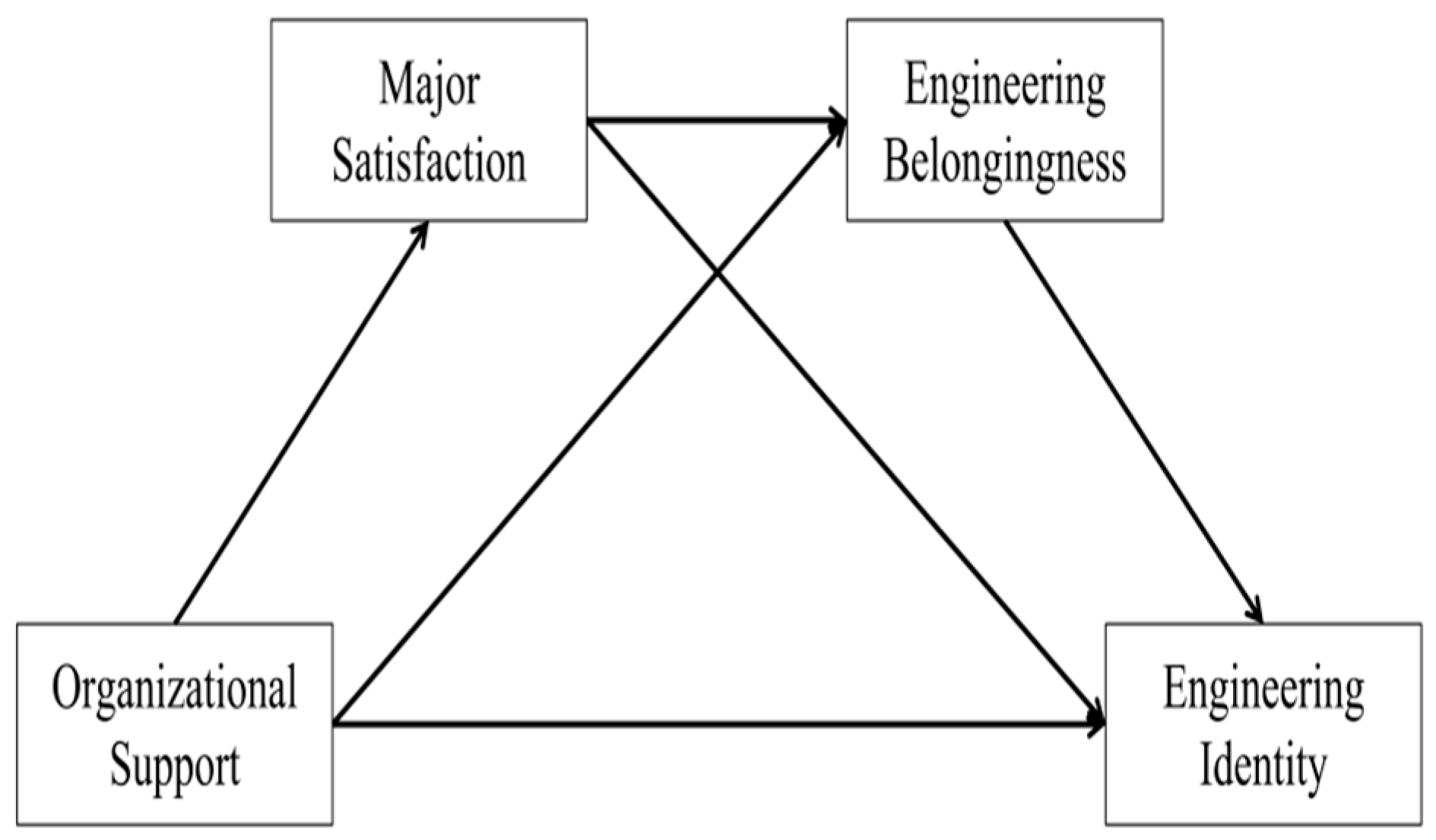
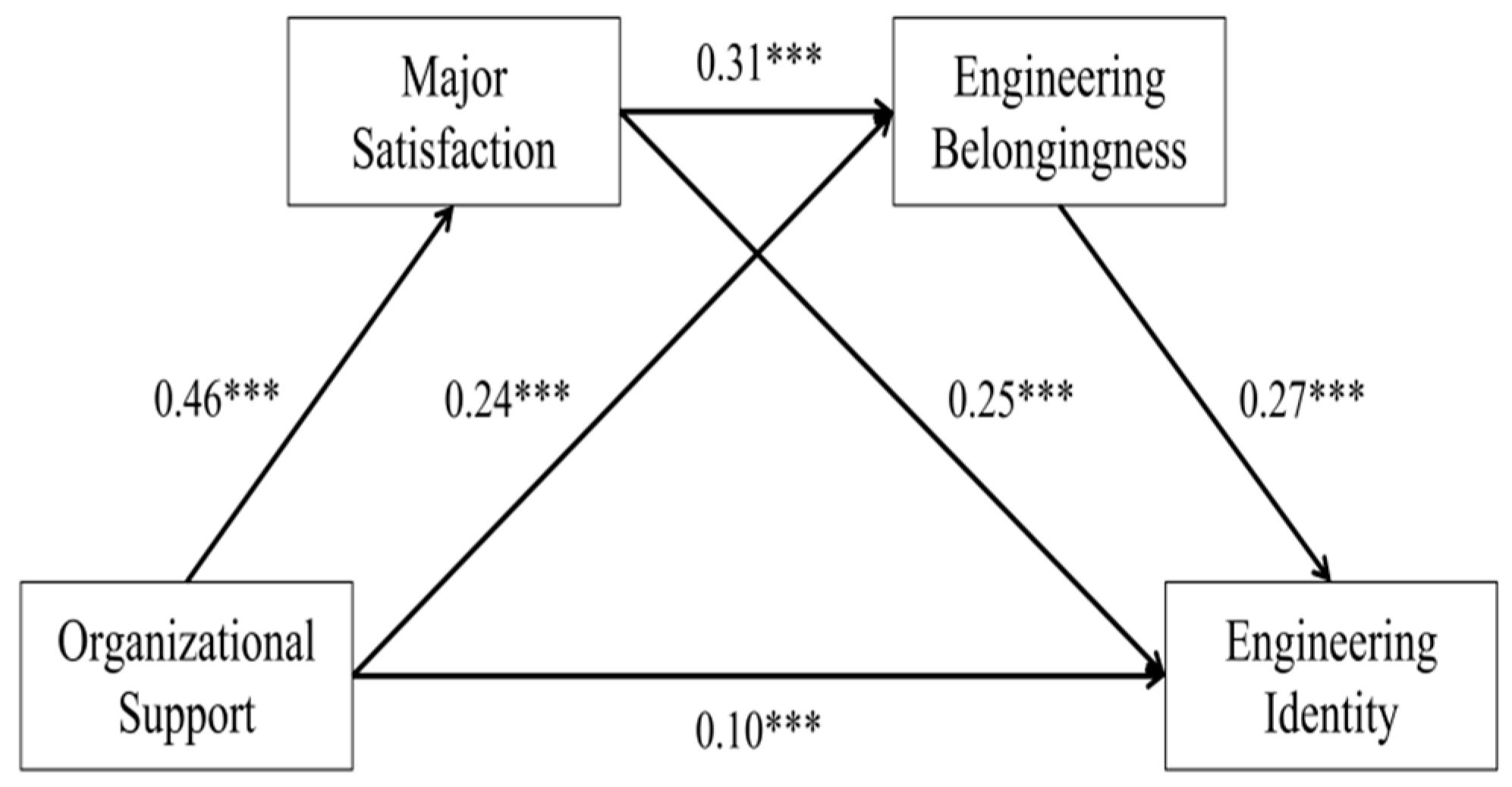
- University organizational support → major satisfaction → engineering identity. The indirect effect of this pathway is 0.116, making up 36.13% of the total indirect effect. Its 95% confidence interval (CI) is [0.080, 0.155], excluding zero, thereby providing support for Hypothesis 2.
- (2)
- University organizational support → engineering belonging → engineering identity. The indirect effect for this pathway is 0.066, with 20.63% of the total indirect effect. Its 95% CI is [0.044, 0.093], which does not include zero, supporting Hypothesis 3.
- (3)
- University organizational support → major satisfaction → engineering belonging → engineering identity. This pathway’s indirect effect is 0.038, about 11.84% of the total indirect effect. Its 95% confidence interval of [0.025, 0.053] excludes zero, confirming the statistical significance of this pathway and supporting Hypothesis 4.
5. Discussion
5.1. University Organizational Support and Engineering Postgraduates’ Engineering Identity
5.2. The Mediating Role of Major Satisfaction
5.3. The Mediating Role of Engineering Belonging
5.4. The Sequential Mediating Role of Major Satisfaction and Engineering Belonging
5.5. Theoretical Implications
5.6. Practical Implications
6. Limitations and Future Research
7. Conclusions
Author Contributions
Funding
Institutional Review Board Statement
Informed Consent Statement
Data Availability Statement
Conflicts of Interest
References
- Abdul Lahtif, A. I., Zakaria, Z. Y., Abdul Rahman, N. F., & Ghazali, N. E. (2025). Developing an engineering identity framework for Malaysia: Insights from a pilot focus group discussion. Jurnal Kejuruteraan, 37(8), 3911–3919. [Google Scholar] [CrossRef]
- Antonio, A. L., & Baek, C. (2022). Beyond survey measures: Exploring international male graduate students’ sense of belonging in electrical engineering. Studies in Graduate and Postdoctoral Education, 13(2), 132–150. [Google Scholar] [CrossRef]
- Bahnson, M., Satterfield, D., Perkins, H., Parker, M., Tsugawa, M., Cass, C., & Kirn, A. (2023). Engineer identity and degree completion intentions in doctoral study. Journal of Engineering Education, 112(2), 445–461. [Google Scholar] [CrossRef]
- Bork, S. J., & Mondisa, J. (2022). Engineering graduate students’ mental health: A scoping literature review. Journal of Engineering Education, 111(3), 665–702. [Google Scholar] [CrossRef]
- Borrego, M., Patrick, A., Martins, L., & Kendall, M. (2018, April 4–6). A new scale for measuring engineering identity in undergraduates. 2018 ASEE Gulf-Southwest Section Annual Conference, Austin, TX, USA. [Google Scholar] [CrossRef]
- Burleson, S. D., Major, D. A., Hu, X., & Shryock, K. J. (2021). Linking undergraduate professional identity development in engineering to major embeddedness and persistence. Journal of Vocational Behavior, 128, 103590. [Google Scholar] [CrossRef]
- Chen, J., Hasan, M. A., Du, X., & Kolmos, A. (2023). Exploring students’ perception of the influence of PBL elements on the development of engineering identity. IEEE Transactions on Education, 66(4), 393–403. [Google Scholar] [CrossRef]
- Chen, Q., Zhang, Q., Yu, F., & Hou, B. (2023). Investigating structural relationships between professional identity, learning engagement, academic self-efficacy, and university support: Evidence from tourism students in China. Behavioral Sciences, 14(1), 26. [Google Scholar] [CrossRef]
- Choe, N. H., & Borrego, M. (2019). Prediction of engineering identity in engineering graduate students. IEEE Transactions on Education, 62(3), 181–187. [Google Scholar] [CrossRef]
- Choe, N. H., Martins, L. L., Borrego, M., & Kendall, M. R. (2019). Professional aspects of engineering: Improving prediction of undergraduates’ engineering identity. Journal of Professional Issues in Engineering Education and Practice, 145(3), 04019006. [Google Scholar] [CrossRef]
- Cohen, S. E., & Syme, S. L. (1985). Social support and health. Academic Press. [Google Scholar]
- Danielak, B. A., Gupta, A., & Elby, A. (2014). Marginalized identities of sense-makers: Reframing engineering student retention. Journal of Engineering Education, 103(1), 8–44. [Google Scholar] [CrossRef]
- Davis, S. C., Nolen, S. B., Cheon, N., Moise, E., & Hamilton, E. W. (2023). Engineering climate for marginalized groups: Connections to peer relations and engineering identity. Journal of Engineering Education, 112(2), 284–315. [Google Scholar] [CrossRef]
- Dehing, A., Jochems, W., & Baartman, L. (2013). The development of engineering students professional identity during workplace learning in industry: A study in Dutch bachelor education. Engineering Education, 8(1), 42–64. [Google Scholar] [CrossRef]
- Ding, Q. (2019). Which matters? Selection or cultivation: The relationship between independent selection, commitment and satisfaction of undergraduate’s professional study. Exploring Educational Development, 39(23), 27–33. [Google Scholar] [CrossRef]
- Doran, K., & Swenson, J. (2022, October 8–11). ‘Do I belong here’: Persistence and retention implications of engineering belongingness and identity in academically at-risk populations. 2022 IEEE Frontiers in Education Conference (FIE) (pp. 1–9), Uppsala, Sweden. [Google Scholar] [CrossRef]
- Düsseldorf. (2024). VDI/IW-ingenieurmonitor 2024/I: Massiver fachkräftemangel in den ingenieur-und informatikberufen. Available online: https://www.bayika.de/de/aktuelles/meldungen/2024-08-16_VDI-IW-Ingenieurmonitor-2024-I-Massiver-Fachkraeftemangel-in-den-Ingenieur-und-Informatikberufen.php (accessed on 6 November 2025).
- Eccles, J. (2009). Who am I and what am I going to do with my life? Personal and collective identities as motivators of action. Educational Psychologist, 44(2), 78–89. [Google Scholar] [CrossRef]
- Eisenberger, R., Huntington, R., Hutchison, S., & Sowa, D. (1986). Perceived organizational support. Journal of Applied Psychology, 71(3), 500–507. [Google Scholar] [CrossRef]
- Eliot, M., & Turns, J. (2011). Constructing professional portfolios: Sense-making and professional identity development for engineering undergraduates. Journal of Engineering Education, 100(4), 630–654. [Google Scholar] [CrossRef]
- Fan, X., Luchok, K., & Dozier, J. (2020). College students’ satisfaction and sense of belonging: Differences between underrepresented groups and the majority groups. SN Social Sciences, 1(1), 22. [Google Scholar] [CrossRef]
- Fang, Y. (2013). The effects of work stress and social support on university teachers’ performance. Science Research Management, 34(5), 136–143. [Google Scholar] [CrossRef]
- Fatima, A., & Ahmad, Y. (2025). Identity-based persistence: Connection between identity factors and academic persistence in engineering students of Pakistan. European Journal of Engineering Education, 50(6), 1411–1437. [Google Scholar] [CrossRef]
- Fletcher, T. L., Jefferson, J. P., Boyd, B., Park, S. E., & Crumpton-Young, L. (2023). Impact of COVID-19 on sense of belonging: Experiences of engineering students, faculty, and staff at historically black colleges and universities (HBCUs). Journal of Engineering Education, 112(2), 488–520. [Google Scholar] [CrossRef]
- Flores, L. Y., Navarro, R. L., Lee, B. H., Hu, X., Diaz, D., & Martinez, L. (2021). Social cognitive predictors of Latinx and White engineering students’ academic satisfaction and persistence intentions: Exploring interactions among social identities and institutional context. Journal of Vocational Behavior, 127, 103580. [Google Scholar] [CrossRef]
- Fouad, N., Fitzpatrick, M., & Liu, J. P. (2011). Persistence of women in engineering careers: A qualitative study of current and former female engineers. Journal of Women and Minorities in Science and Engineering, 17(1), 69–96. [Google Scholar] [CrossRef]
- Garriott, P. O., Navarro, R. L., Flores, L. Y., Lee, H.-S., Carrero Pinedo, A., Slivensky, D., Muñoz, M., Atilano, R., Lin, C.-L., Gonzalez, R., Luna, L., & Lee, B. H. (2019). Surviving and thriving: Voices of Latina/o engineering students at a Hispanic serving institution. Journal of Counseling Psychology, 66(4), 437–448. [Google Scholar] [CrossRef] [PubMed]
- Godwin, A. (2016, January 26–29). The development of a measure of engineering identity. 2016 ASEE Annual Conference & Exposition, New Orleans, LA, USA. [Google Scholar] [CrossRef]
- Godwin, A., & Kirn, A. (2020). Identity-based motivation: Connections between first-year students’ engineering role identities and future-time perspectives. Journal of Engineering Education, 109(3), 362–383. [Google Scholar] [CrossRef]
- Godwin, A., & Lee, W. C. (2017, June 25–28). A cross-sectional study of engineering identity during undergraduate education. 2017 ASEE Annual Conference & Exposition, Columbus, OH, USA. [Google Scholar] [CrossRef]
- Gómez, J., Tayebi, A., & Delgado, C. (2022). Factors that influence career choice in engineering students in Spain: A gender perspective. IEEE Transactions on Education, 65(1), 81–92. [Google Scholar] [CrossRef]
- Han, X., Xu, Q., & Xiao, J. (2023). The influence of school atmosphere on Chinese teachers’ job satisfaction: The chain mediating effect of psychological capital and professional identity. Behavioral Sciences, 13(1), 1. [Google Scholar] [CrossRef]
- Hatmaker, D. M. (2013). Engineering identity: Gender and professional identity negotiation among women engineers. Gender, Work & Organization, 20(4), 382–396. [Google Scholar] [CrossRef]
- Hayes, A. F. (2012). PROCESS: A versatile computational tool for observed variable mediation, moderation, and conditional process modeling. Available online: https://imaging.mrc-cbu.cam.ac.uk/statswiki/FAQ/SobelTest?action=AttachFile&do=get&target=process.pdf (accessed on 5 November 2025).
- Hughes, B. E., Schell, W. J., Tallman, B., Sybesma, T., Kwapisz, M. B., Annand, E., Ranch, S., Krejci, C., Bozic, C., & Kotys-Schwartz, D. (2021). Entering the community of practice: Changes in engineering students’ engineering identities and perceptions of the field. European Journal of Engineering Education, 46(6), 968–986. [Google Scholar] [CrossRef]
- Hund, A. K., Churchill, A. C., Faist, A. M., Havrilla, C. A., Love Stowell, S. M., McCreery, H. F., Ng, J., Pinzone, C. A., & Scordato, E. S. C. (2018). Transforming mentorship in STEM by training scientists to be better leaders. Ecology and Evolution, 8(20), 9962–9974. [Google Scholar] [CrossRef]
- Jensen, K. J., & Cross, K. J. (2021). Engineering stress culture: Relationships among mental health, engineering identity, and sense of inclusion. Journal of Engineering Education, 110(2), 371–392. [Google Scholar] [CrossRef]
- Jensen, K. J., Mirabelli, J. F., Kunze, A. J., Romanchek, T. E., & Cross, K. J. (2023). Undergraduate student perceptions of stress and mental health in engineering culture. International Journal of STEM Education, 10(1), 30. [Google Scholar] [CrossRef]
- Jones, B. D., Osborne, J. W., Paretti, M. C., & Matusovich, H. M. (2014). Relationships among students’ perceptions of a first-year engineering design course and their engineering identification, motivational beliefs, course effort, and academic outcomes. International Journal of Engineering Education, 30(6), 1340–1356. [Google Scholar]
- Jones, B. D., Ruff, C., & Paretti, M. C. (2013). The impact of engineering identification and stereotypes on undergraduate women’s achievement and persistence in engineering. Social Psychology of Education, 16(3), 471–493. [Google Scholar] [CrossRef]
- Ju, T., & Zhu, J. (2023). Exploring senior engineering students’ engineering identity: The impact of practice-oriented learning experiences. International Journal of STEM Education, 10(1), 48. [Google Scholar] [CrossRef]
- Kline, R. B. (1998). Principles and practices of structural equation modeling. Guilford Press. [Google Scholar]
- Lachance, K., Heustis, R. J., Loparo, J. J., & Venkatesh, M. J. (2020). Self-efficacy and performance of research skills among first-semester bioscience doctoral students. CBE–Life Sciences Education, 19(3), ar28. [Google Scholar] [CrossRef]
- Lee, M., Lee, A. A., Lee, G. A., Lira, A. K., Lawson, H. D., Freer, E., Briedis, D., Walton, S. P., & Linnenbrink-Garcia, L. (2025). Exploring supports for belonging as predictors of student outcomes: Different roles of co-curricular and extracurricular activities in engineering by students’ year in college. Journal of Engineering Education, 114(2), e70001. [Google Scholar] [CrossRef]
- Lent, R. W., & Brown, S. D. (2013). Social cognitive model of career self-management: Toward a unifying view of adaptive career behavior across the life span. Journal of Counseling Psychology, 60(4), 557–568. [Google Scholar] [CrossRef] [PubMed]
- Lent, R. W., Brown, S. D., & Hackett, G. (2000). Contextual supports and barriers to career choice: A social cognitive analysis. Journal of Counseling Psychology, 47(1), 36–49. [Google Scholar] [CrossRef]
- Lent, R. W., Singley, D., Sheu, H.-B., Schmidt, J. A., & Schmidt, L. C. (2007). Relation of social-cognitive factors to academic satisfaction in engineering students. Journal of Career Assessment, 15(1), 87–97. [Google Scholar] [CrossRef]
- Li, F., Wu, F., & Xiao, W. (2022). An empirical study on the rate of return of postgraduate education: Discipline and gender perspectives. Explore Educational Development, 42(13), 95–106. [Google Scholar] [CrossRef]
- Li, N., Fan, W., Wiesner, M., Arbona, C., & Hein, S. (2021). Adapting the utrecht-management of identity commitments scale to assess engineering identity formation. Journal of Engineering Education, 110(4), 885–901. [Google Scholar] [CrossRef]
- Li, Y., & Singh, C. (2022). How engineering identity of first-year female and male engineering majors is predicted by their physics self-efficacy and identity. International Journal of Engineering Education, 38(3), 1–15. [Google Scholar]
- Liquete, E., Dekoninck, E., & Wisker, G. (2025). From student to engineer: Identity formation in engineering education. European Journal of Engineering Education, 1–24. [Google Scholar] [CrossRef]
- Litzler, E., & Samuelson, C. (2013, June 23–26). How underrepresented minority engineering students derive a sense of belonging from engineering. 2013 ASEE Annual Conference & Exposition, Atlanta, GA, USA. [Google Scholar]
- Liu, X., Ji, X., Zhang, Y., & Gao, W. (2023). Professional identity and career adaptability among Chinese engineering students: The mediating role of learning engagement. Behavioral Sciences, 13(6), 480. [Google Scholar] [CrossRef] [PubMed]
- Lockhart, M. E., Rambo-Hernandez, K., & Kwok, O. M. (2025). Exploring engineering majors’ engineering identities utilizing a traditional identity framework: Validity evidence for the new EngID scale. European Journal of Engineering Education, 50(4), 855–877. [Google Scholar] [CrossRef]
- Major, J. C., & Kirn, A. (2017, June 25–28). Engineering identity and project-based learning: How does active learning develop student engineering identity? 2017 ASEE Annual Conference & Exposition, Columbus, OH, USA. [Google Scholar] [CrossRef]
- Malone, G. P., Pillow, D. R., & Osman, A. (2012). The general belongingness scale (GBS): Assessing achieved belongingness. Personality and Individual Differences, 52(3), 311–316. [Google Scholar] [CrossRef]
- Marra, R. M., Rodgers, K. A., Shen, D., & Bogue, B. (2012). Leaving engineering: A multi-year single institution study. Journal of Engineering Education, 101(1), 6–27. [Google Scholar] [CrossRef]
- Meyers, K. L., Ohland, M. W., Pawley, A. L., Silliman, S. E., & Smith, K. A. (2012). Factors relating to engineering identity. Global Journal of Engineering Education, 14(1), 119–131. [Google Scholar]
- Miller, A. N., & Orsillo, S. M. (2020). Values, acceptance, and belongingess in graduate school: Perspectives from underrepresented minority students. Journal of Contextual Behavioral Science, 15, 197–206. [Google Scholar] [CrossRef]
- Morelock, J. R. (2017). A systematic literature review of engineering identity: Definitions, factors, and interventions affecting development, and means of measurement. European Journal of Engineering Education, 42(6), 1240–1262. [Google Scholar] [CrossRef]
- Nauta, M. M. (2007). Assessing college students’ satisfaction with their academic majors. Journal of Career Assessment, 15(4), 446–462. [Google Scholar] [CrossRef]
- Oliver, R. L. (1980). A cognitive model of the antecedents and consequences of satisfaction decisions. Journal of Marketing Research, 17(4), 460–469. [Google Scholar] [CrossRef]
- Ong, M., Jaumot-Pascual, N., & Ko, L. T. (2020). Research literature on women of color in undergraduate engineering education: A systematic thematic synthesis. Journal of Engineering Education, 109(3), 581–615. [Google Scholar] [CrossRef]
- Pablo-Lerchundi, I., Núñez-del-Río, M. C., & González-Tirados, R. M. (2015). Career choice in engineering students: Its relationship with motivation, satisfaction and the development of professional plans. Anales de Psicología/Annals of Psychology, 31(1), 268–279. [Google Scholar] [CrossRef]
- Park, C. M., Donnelly, H. K., Rodriguez, A., Esquivel, L., Nardi, C., Trunfio, P., Oliver-Davila, A., Howard, K. A. S., & Solberg, V. S. H. (2023). Developing STEM career identities among Latinx youths: Collaborative design, evaluations, and adaptations during COVID-19. Behavioral Sciences, 13(11), 949. [Google Scholar] [CrossRef] [PubMed]
- Patrick, A., Andrews, M., Riegle-Crumb, C., Kendall, M. R., Bachman, J., & Subbian, V. (2023). Sense of belonging in engineering and identity centrality among undergraduate students at Hispanic-serving institutions. Journal of Engineering Education, 112(2), 316–336. [Google Scholar] [CrossRef]
- Patrick, A. D., Prybutok, A. N., & Borrego, M. (2018). Predicting persistence in engineering through an engineering identity scale. International Journal of Engineering Education, 34(2a), 351–363. [Google Scholar] [CrossRef]
- Perez, T., Cromley, J. G., & Kaplan, A. (2014). The role of identity development, values, and costs in college STEM retention. Journal of Educational Psychology, 106(1), 315–329. [Google Scholar] [CrossRef]
- Perkins, H., Tsugawa-Nieves, M. A., Chestnut, J. N., Miller, B., Kirn, A., & Cass, C. (2017, June 25–28). The role of engineering identity in engineering doctoral students’ experiences. 2017 ASEE Annual Conference & Exposition, Columbus, OH, USA. [Google Scholar] [CrossRef]
- Podsakoff, P. M., MacKenzie, S. B., Lee, J.-Y., & Podsakoff, N. P. (2003). Common method biases in behavioral research: A critical review of the literature and recommended remedies. Journal of Applied Psychology, 88(5), 879–903. [Google Scholar] [CrossRef]
- Polmear, M., Hunsu, N. J., Simmons, D. R., Olaogun, O. P., & Lu, L. (2024). Belonging in engineering: Exploring the predictive relevance of social interaction and individual factors on undergraduate students’ belonging in engineering. Journal of Engineering Education, 113(3), 555–575. [Google Scholar] [CrossRef]
- Preacher, K. J., & Hayes, A. F. (2008). Contemporary approaches to assessing mediation in communication research. In A. F. Hayes, M. D. Slater, & L. B. Snyder (Eds.), The SAGE sourcebook of advanced data analysis methods for communication research (pp. 13–54). SAGE Publications. [Google Scholar] [CrossRef]
- Quezada-Espinoza, M., & Truyol, M. E. (2024, June 23–26). Exploring self-efficacy and sense of belonging in engineering: The role of institutional support. 2024 ASEE Annual Conference & Exposition, Portland, OR, USA. [Google Scholar] [CrossRef]
- Rodriguez, S. L., Lu, C., & Bartlett, M. (2018). Engineering identity development: A review of the higher education literature. International Journal of Education in Mathematics, Science and Technology, 6(3), 254–265. [Google Scholar] [CrossRef]
- Rohde, J., Musselman, L., Benedict, B., Verdin, D., Godwin, A., Kirn, A., Benson, L., & Potvin, G. (2019). Design experiences, engineering identity, and belongingness in early career electrical and computer engineering students. IEEE Transactions on Education, 62(3), 165–172. [Google Scholar] [CrossRef]
- Sanchez, D., Brooks, A. L., Nembhard, H., & Brown, S. (2024). An exploratory study on how mechanical engineering undergraduates perceive participation in professional disciplinary engineering student organizations that influence their engineering identity. International Journal of Mechanical Engineering Education, 52(3), 236–260. [Google Scholar] [CrossRef]
- Schell, W., Hughes, B. E., Tallman, B., Kwapisz, M., Sybesma, T., Annand, E., Bozic, C., Kotys-Schwartz, D. A., & Krejci, C. C. (2021). Understanding the joint development of engineering and leadership identities. Engineering Management Journal, 34(3), 497–507. [Google Scholar] [CrossRef]
- Shah, R., & Gillen, A. L. (2024). A systematic literature review of university-industry partnerships in engineering education. European Journal of Engineering Education, 49(3), 577–603. [Google Scholar] [CrossRef]
- Shen, P., Wu, Y., Liu, Y., & Lian, R. (2024). Linking undergraduates’ future orientation and their employability confidence: The role of vocational identity clarity and internship effectiveness. Acta Psychologica, 248, 104360. [Google Scholar] [CrossRef]
- Simmons, D. R., Hunsu, N. J., & Adesope, O. O. (2019). Enabling multi-dimensional measurement of student engagement in engineering learning environments. International Journal of Engineering Education, 35(6), 1827–1838. [Google Scholar]
- Simmons, D. R., Ye, Y., Hunsu, N. J., & Adesope, O. O. (2017). Development of a survey to explore out-of-class engagement of engineering students. International Journal of Engineering Education, 33(4), 1213–1221. [Google Scholar]
- Soria, K. M., & Stebleton, M. J. (2013). Social capital, academic engagement, and sense of belonging among working-class college students. College Student Affairs Journal, 31(2), 139–153. [Google Scholar]
- Tate, E. D., & Linn, M. C. (2005). How does identity shape the experiences of women of color engineering students? Journal of Science Education and Technology, 14(5), 483–493. [Google Scholar] [CrossRef]
- Tonso, K. L. (2014). Engineering identity. In A. Johri, & B. M. Olds (Eds.), Cambridge handbook of engineering education research (pp. 267–282). Cambridge University Press. [Google Scholar] [CrossRef]
- Trullàs, I., Simo, P., Fusalba, O. R., Fito, A., & Sallan, J. M. (2018). Student-perceived organizational support and perceived employability in the marketing of higher education. Journal of Marketing for Higher Education, 28(2), 266–281. [Google Scholar] [CrossRef]
- Verdín, D. (2021). The power of interest: Minoritized women’s interest in engineering fosters persistence beliefs beyond belongingness and engineering identity. International Journal of STEM Education, 8(1), 33. [Google Scholar] [CrossRef]
- Vogel, F. R., & Human-Vogel, S. (2018). The relevance of identity style and professional identity to academic commitment and academic achievement in a higher education setting. Higher Education Research & Development, 37(3), 620–634. [Google Scholar] [CrossRef]
- Wallwey, C., Dringenberg, E., Braaten, B., Li, Y., & Kajfez, R. (2024). Engineering identity and smartness identity as they relate to women’s participation in engineering. IEEE Transactions on Education, 67(2), 306–316. [Google Scholar] [CrossRef]
- Wang, G., Li, X., & Hu, Y. (2025). How does social support promote professional identity among university students? A moderated mediation model of self-esteem and self-efficacy. Humanities and Social Sciences Communications, 12(1), 872. [Google Scholar] [CrossRef]
- Wei, L., Chen, Y., & Huang, Y. (2025). Exploring the effects of joint university–enterprise training on the professional identity and innovative capacity of engineering graduate students: Based on a systematic literature review and meta-analytic approach. European Journal of Engineering Education, 50(6), 1523–1549. [Google Scholar] [CrossRef]
- Wu, L. L., Fischer, C., Rodriguez, F., Washington, G. N., & Warschauer, M. (2021). Project-based engineering learning in college: Associations with self-efficacy, effort regulation, interest, skills, and performance. SN Social Sciences, 1(12), 287. [Google Scholar] [CrossRef] [PubMed]
- Yang, Y. (2023). Impact of organizational support on students’ information and communication technology self-efficacy, engagement, and satisfaction in a blended learning environment: An empirical study. Sage Open, 13(4), 1–15. [Google Scholar] [CrossRef]
- Ye, X., Cheng, T., & Yang, W. (2025). Learning engagement and professional identity among pre-service teachers: The sequential mediating role of adaptability and self-concept. Behavioral Sciences, 15(7), 881. [Google Scholar] [CrossRef] [PubMed]
- Yu, J., & Ma, A. Q. (2023). Research on the mechanism of major identity, institutional support, and career development on engineering students: An empirical analysis based on a university with advantage in engineering education. Research in Higher Education of Engineering, (5), 86–92. [Google Scholar]
- Zhou, M., Zhu, J., & Wu, H. (2019). The influence of organizational support on the research progress satisfaction of returnee faculty in universities: A case study of 21 universities in Shanghai. Higher Education Exploration, (12), 101–107. [Google Scholar]



| Variable | Number (n) | Percentage (%) | |
|---|---|---|---|
| Gender | Male | 563 | 59.96% |
| Female | 376 | 40.04% | |
| Degree level | Master’s candidate | 602 | 64.11% |
| Doctoral candidate | 337 | 35.89% | |
| School type | Non-double first-class | 358 | 38.13% |
| Double first-class | 581 | 61.87% | |
| Academic ranking | Below 20% | 116 | 12.35% |
| 20–40% | 185 | 19.70% | |
| 40–60% | 340 | 36.21% | |
| 60–80% | 204 | 21.73% | |
| Above 80% | 94 | 10.01% | |
| Engineering practice experience | Non-practice-experienced | 602 | 64.11% |
| Practice-experienced | 337 | 35.89% | |
| Variable | M | SD | 1 | 2 | 3 | 4 |
|---|---|---|---|---|---|---|
| 1. Organizational support | 3.09 | 0.68 | 1 | |||
| 2. Major satisfaction | 3.15 | 0.63 | 0.495 ** | 1 | ||
| 3. Engineering belonging | 3.18 | 0.65 | 0.405 ** | 0.431 ** | 1 | |
| 4. Engineering identity | 3.19 | 0.69 | 0.327 ** | 0.403 ** | 0.405 ** | 1 |
| Outcome Variable | Predictor Variables | R2 | F | β | t |
|---|---|---|---|---|---|
| Major satisfaction | Constant | 0.260 | 54.438 *** | 1.61 | 10.41 |
| Gender | 0.01 | 0.33 | |||
| Degree level | −0.09 * | −2.42 | |||
| School type | 0.15 *** | 3.93 | |||
| Academic ranking | 0.02 | 1.34 | |||
| Engineering practice experience | −0.01 | −0.22 | |||
| University organizational support | 0.46 *** | 17.19 | |||
| Engineering belonging | Constant | 0.239 | 41.799 *** | 1.47 | 8.65 |
| Gender | −0.03 | −0.68 | |||
| Degree level | −0.03 | −0.69 | |||
| School type | 0.07 | 1.82 | |||
| Academic ranking | −0.01 | −0.82 | |||
| Engineering practice experience | 0.01 | 0.38 | |||
| University organizational support | 0.24 *** | 7.70 | |||
| Major satisfaction | 0.31 *** | 9.00 | |||
| Engineering identity | Constant | 0.251 | 39.014 *** | 1.31 | 7.07 |
| Gender | −0.09 * | −2.25 | |||
| Degree level | −0.12 * | −2.78 | |||
| School type | 0.05 | 1.20 | |||
| Academic ranking | 0.01 | 0.62 | |||
| Engineering practice experience | 0.09 * | 2.24 | |||
| University organizational support | 0.10 *** | 2.93 | |||
| Major satisfaction | 0.25 *** | 6.76 | |||
| Engineering belonging | 0.27 *** | 7.83 |
| Effect | Boot SE | Boot LLCI | Boot ULCI | Effect Rate | |
|---|---|---|---|---|---|
| Total effect | 0.320 | 0.031 | 0.259 | 0.382 | 100% |
| Direct effect | 0.101 | 0.035 | 0.033 | 0.169 | 31.53% |
| Total mediation effect | 0.220 | 0.024 | 0.175 | 0.269 | 68.59% |
| University organizational support → Major satisfaction → Engineering identity | 0.116 | 0.019 | 0.080 | 0.155 | 36.13% |
| University organizational support → Engineering belonging → Engineering identity | 0.066 | 0.012 | 0.044 | 0.093 | 20.63% |
| University organizational support → Major satisfaction → Engineering belonging → Engineering identity | 0.038 | 0.007 | 0.025 | 0.053 | 11.84% |
Disclaimer/Publisher’s Note: The statements, opinions and data contained in all publications are solely those of the individual author(s) and contributor(s) and not of MDPI and/or the editor(s). MDPI and/or the editor(s) disclaim responsibility for any injury to people or property resulting from any ideas, methods, instructions or products referred to in the content. |
© 2026 by the authors. Licensee MDPI, Basel, Switzerland. This article is an open access article distributed under the terms and conditions of the Creative Commons Attribution (CC BY) license.
Share and Cite
Li, W.; Lu, J.; Cao, L.; Xiao, M. University Organizational Support and Engineering Identity Among Engineering Postgraduates: The Sequential Mediating Role of Major Satisfaction and Engineering Belonging. Behav. Sci. 2026, 16, 199. https://doi.org/10.3390/bs16020199
Li W, Lu J, Cao L, Xiao M. University Organizational Support and Engineering Identity Among Engineering Postgraduates: The Sequential Mediating Role of Major Satisfaction and Engineering Belonging. Behavioral Sciences. 2026; 16(2):199. https://doi.org/10.3390/bs16020199
Chicago/Turabian StyleLi, Weiwei, Jinfeng Lu, Liangyu Cao, and Min Xiao. 2026. "University Organizational Support and Engineering Identity Among Engineering Postgraduates: The Sequential Mediating Role of Major Satisfaction and Engineering Belonging" Behavioral Sciences 16, no. 2: 199. https://doi.org/10.3390/bs16020199
APA StyleLi, W., Lu, J., Cao, L., & Xiao, M. (2026). University Organizational Support and Engineering Identity Among Engineering Postgraduates: The Sequential Mediating Role of Major Satisfaction and Engineering Belonging. Behavioral Sciences, 16(2), 199. https://doi.org/10.3390/bs16020199