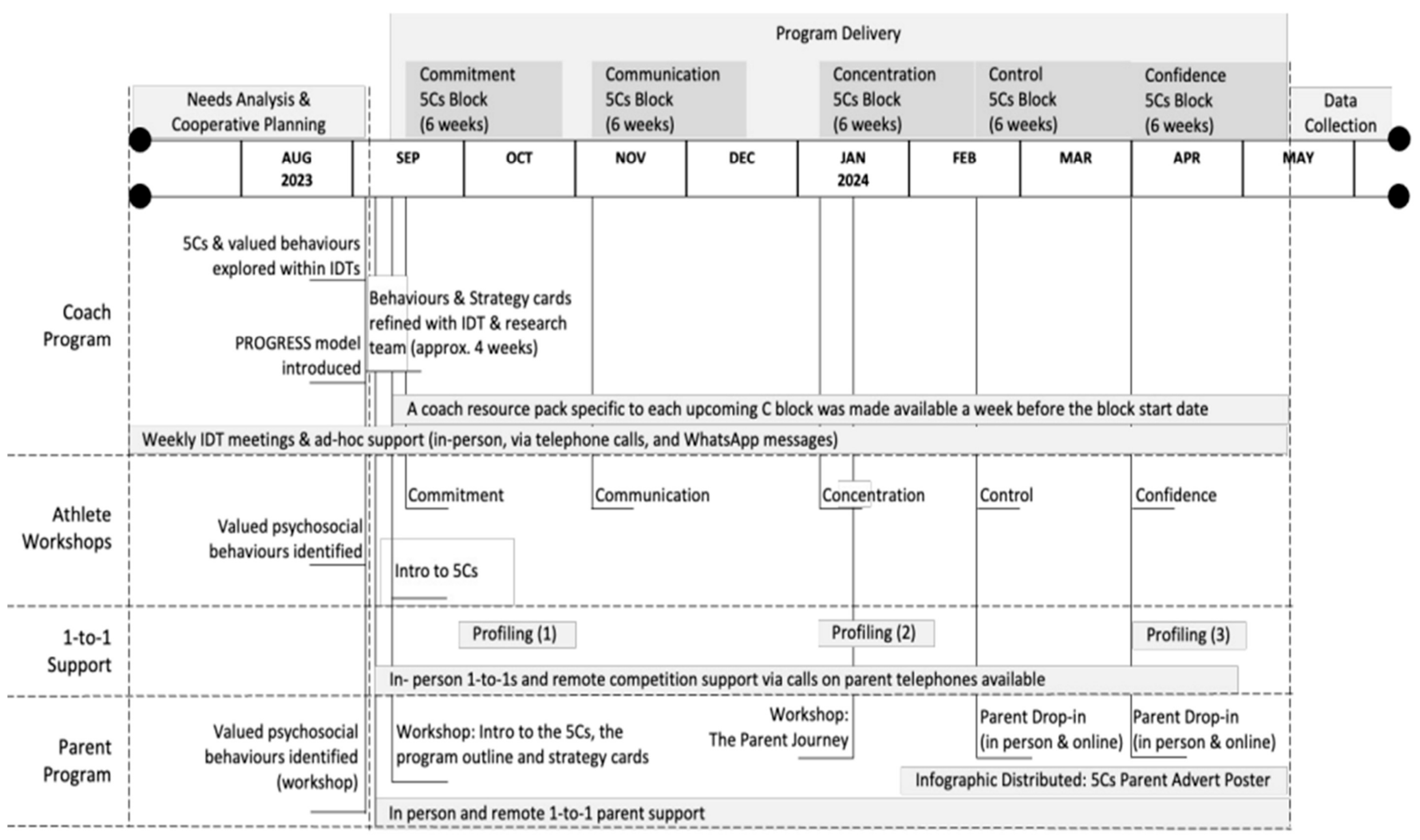
Applying the 5Cs Framework to Elite Youth Tennis: Impact Factors in a Talent Development Environment

Abstract
1. Introduction
The Present Study
2. Method
2.1. Philosophical Position and Research Design
2.2. The Research Team
2.3. Participants and Research Context
2.4. The 5Cs Psychosocial Development Program
2.5. Programme Planning
2.6. The Squad-Level Curriculum
2.7. The Coach Education Program
2.8. Individualised Athlete Support
2.9. The Parent Development Programme
2.10. Procedure
2.11. Data Collection
2.12. Data Analysis
3. Results
3.1. Specific to Tennis and Individualised to the Player
“Showing Confidence could be a technical thing—having racket speed on the second serve, or it could be their superior body language, or it could be a tactical thing when under pressure—I’m still going to look to execute my wide serve and early pattern.”
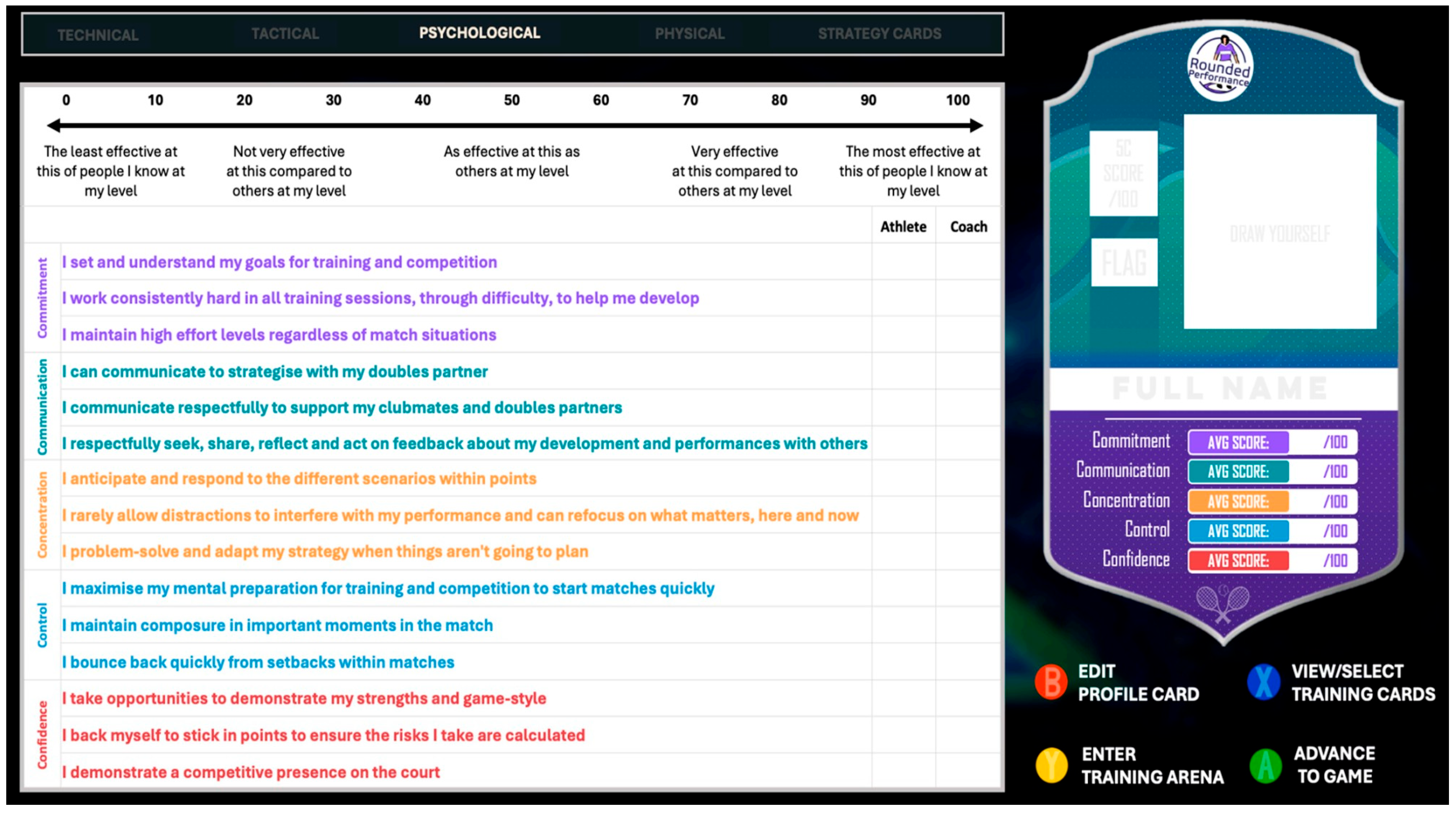
“The 5Cs, you can adapt to a specific player and know what they need to do. It’s a lot more helpful than most things that are built for what is assumed and pre-built… the 5Cs Profiling and the Strategy Cards, it really captures [the needs of] the specific player.”
“It puts everything you have learned into a structure; what you need to have in a child, and in yourself, to be successful in that sport… The 5Cs were easy to remember. They were exactly what I saw before every single serve, every single return on the court that he had to go through… it put the structure into what I was seeing, and then we could work on these.”
“In training, it will be easy to keep your confidence, commitment and control because, I mean, you’re not very mentally tough if you’re beating yourself up and getting really pissed in training, but it might be a bit harder to keep concentration because you’ve not got the drive.”
“I think communication is still an aspect of tennis, but it’s just not as important as control, concentration and confidence. Maybe planning what you’re going to do before a tournament with a psychologist or a coach. … after the match as well, or when you’re home, I think communication is probably more important than it is on court because you’re not allowed to really communicate in competition.”
“They might be concentrating very hard, but their confidence level may be shattered seeing the opponent if they know that the opponent is probably a stronger player or if they are playing a very weak player [and] they know that you are going to win, then their concentration level can go down, or if they are playing in a Grade One, they might get nervous in a bigger stage, and then confidence can drop as well.”
3.2. Developmentally Collaborative and Integrated Across the System
“Involving staff in the selection of valued behaviours is a bit like the players having ownership with it, so it feels a bit more like it’s our own identity, our own thing… The buy-in from the coaching staff is then high because we’re delivering what we believe in.”
“It was a really smart profiling tool to get parents and athletes to buy into something that’s quite difficult to feel… Where the crossover becomes really good is the link of parents’ understanding of behaviours and the goals. The players had an idea of “these are the things we need to be good at to be a certain tennis player”. We were now using similar language, and they are way more skilled, a bit like us… They were definitely better at going; “My concentration wasn’t quite as good, and I need to do X, Y and Z.”
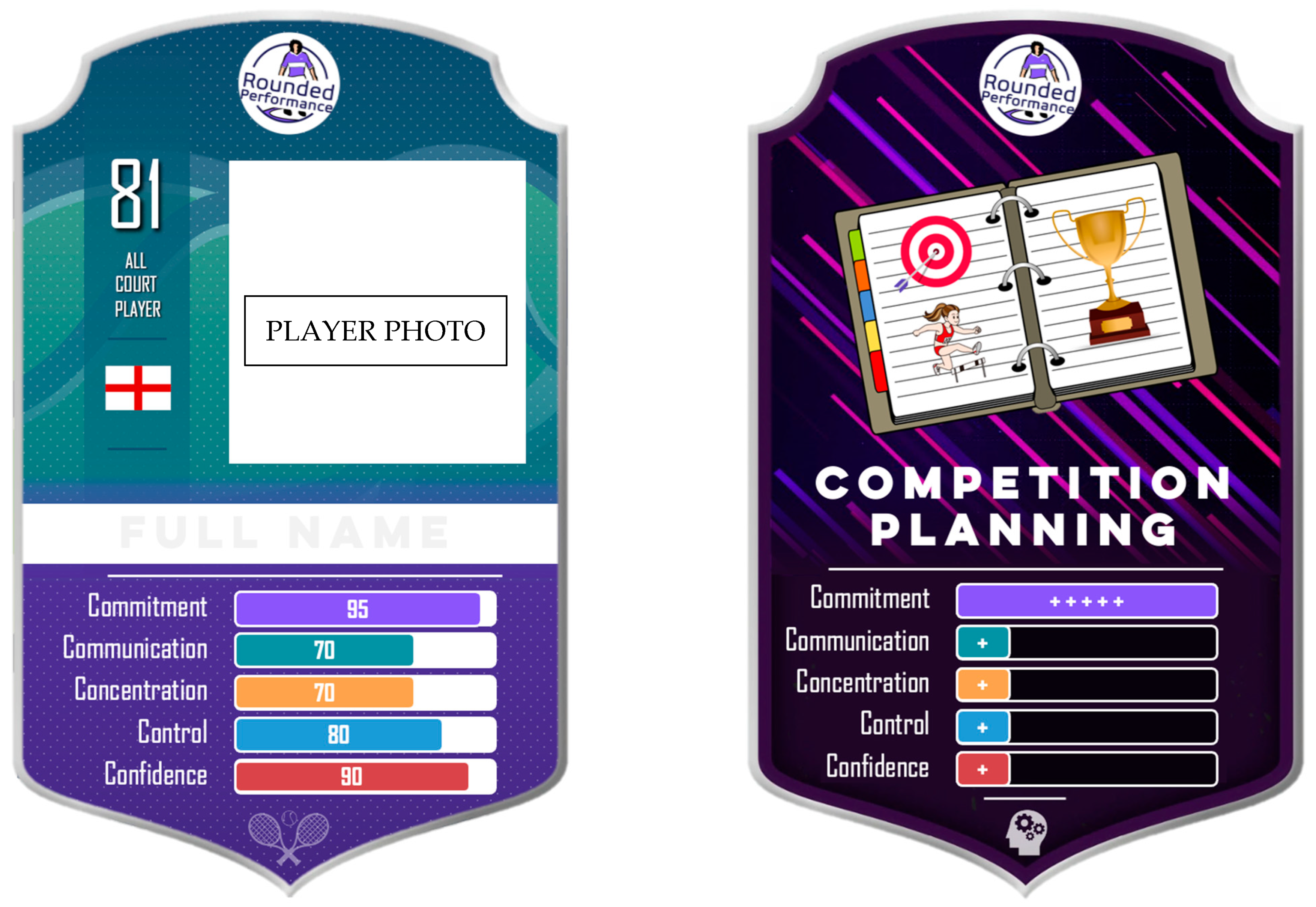
“Having that competition planning sheet is important for us… it’s probably given us a bit of like, “Alright, okay, let’s talk about this”, “Let’s set your goals”… and just trying to reinforce stuff that she’s maybe talking to you and the coaches about.”
“The workshops for parents, informal and formal chats and the remote support helped…. Other parents shared what they felt, and I thought, “Yeah, I feel like that!”. But you don’t talk about that with others because you always think you’re giving away your top secrets, your weaknesses… We had good conversations after that evening. I was working with the other parents and felt more connected with them.… I’m feeling much better because I know if I’m not feeling good, I can call you [the SP]… I don’t want to leave that with a coach… I don’t want to discuss it with my husband because then we argue… I can’t talk to Tom about how I feel because I don’t want to worry him… Through you as the SPP, I’m getting constructive help to deal with situations… I tell Tom “When you want to talk to me about something, you talk about that. If you don’t want to, it’s okay, you’ve got [SPP]”.
“Because of how simple the 5Cs is and because of our little team meetings and conversations…I think that’s why players are responding to it better; because it’s coming at them from all angles a bit more consistently… those booklets that you put together for us are easily digestible for coaches to jump on court and deliver”.
[Eric continues] “In matches, you’ve got one sentence to try and impact what they’re doing, whether it’s the change of set or before the next serve. Whereas at training, you’re building that body of work about what that word means… At tournaments, it’s really easy to go ‘come on concentrate’, or ‘fully commit here’. To each player, that might mean something different because of what they’ve been working on in their individual goals… That’s been achieved through the way it’s been delivered; in the way the model has been presented to us and integrated”.
“It’s not mental skills over here, technical over there; everything comes together and that’s where it becomes more powerful. That’s why it’s been really effective, we’ve seen players improve a lot in these 5C areas, match performance and results because the gap between mental skills and tennis has merged. So, it’s very easy for everything to be reinforced in the gym, with you, on court, and at the match. The clarity and the crossover is what’s actually the best thing about it.”
“It was like an apprenticeship from being absolutely poor… it just trained me how to be a good parent for him… It’s a long journey with these mental programmes. I find some parents I’ve spoken to here expected quicker wins. That doesn’t come because the child’s brain has to be mature enough to take these things in… They look really grown up but don’t get fooled… as a parent, when somebody told me why they can’t physically do that—they can’t physically control that, that’s when the penny dropped, and I could accept that behaviour more”.
“If the players are having five [workshops] on each of the five C’s, the parents are either involved in that or have their own separate ones [for] their understanding of the behaviours and what we’re expecting with players… If they’re a bit more on the same page, hopefully that learning happens a bit faster.”
3.3. Evidences Growth Through Accessible and Innovative Strategies
“I think the cards have been a really good way to introduce psychosocial strategies with younger age groups… in an easy, accessible, understandable way so that they have fun doing it and integrating in…They were quite proud of having it first and foremost; it was something they wanted to show off… Little kids need reminding way more often… having a card really highlighted the mental strategy hanging off the back of your bag… If someone came onto the court for the lesson, that just reminded me when I saw it hanging outside: “I’m working on World Class Acting today!”
“I think this probably comes into Control—the reset. That’s what I think he’s developed the most. I’ve seen him do a bit of the breathing and the reset routine, making sure he uses his towel and stuff like that… Mr Bobblehead, that was a good Strategy Card, and he doesn’t show that [negative body language] quite as much.”
“It’s noticeable in their reset routines, goal-setting, reviewing their games, and the behaviours they’ve been working on; they’re visibly doing these things. As a result, they’re more resilient competitors… they’re coming through difficult things and winning at a level they weren’t doing before… Shreya having her best results over this last period.… Rhea, who’s having more ups and downs, is still probably competing at the best level she has—she’s had National Camp selection … The impact on [a non-participant athlete] has been huge; she was struggling to get over the line in some of the important moments and matches and she won an ITF in four months… Them being better is born out of doing those behaviours more… using a towel, taking more time doing those things… they’re more equipped with loads of tools and they’ve got a much larger understanding of those tools and why they’re doing them.”
“All of the Cs have been good so far in my tournaments… It’s not perfect, obviously, but I’m doing everything way better… I remember that I used the ‘Sponge Human’ and ‘Reset Routine’ cards in my match… they made me better… by making me feel more controlled and relaxed… Sponge Human was mainly a concentration strategy, concentration plus communication. Yeah, about communicating with yourself… Concentration, well, that’s one of my worst Cs, but I try to look at my strengths as much as I can. My Reset Routine helped me to be calm, focused, and clear to bounce back with energy… I’ve been better at that… and at what happens next… I play better.”
4. Discussion
Future Research Recommendations and Practical Implications
Author Contributions
Funding
Institutional Review Board Statement
Informed Consent Statement
Data Availability Statement
Acknowledgments
Conflicts of Interest
References
- Arthur, R. A., Callow, N., Roberts, R., & Glendinning, F. (2019). Coaches coaching psychological skills—Why not? A framework and questionnaire development. Journal of Sport and Exercise Psychology, 41(1), 10–23. [Google Scholar] [CrossRef]
- Bean, C., Kramers, S., Camiré, M., & Forneris, T. (2018). The implicit/explicit continuum of life skills development and transfer. Quest, 70(4), 456–470. [Google Scholar] [CrossRef]
- Braun, V., & Clarke, V. (2019). Reflecting on reflexive thematic analysis. Qualitative Research in Sport, Exercise and Health, 11, 589–597. [Google Scholar] [CrossRef]
- British Psychological Society. (2024). Qualification in sport and exercise psychology (Stage 2). Available online: https://www.bps.org.uk/bps-qualifications/sport-and-exercise-psychology (accessed on 23 February 2024).
- Collins, D. J., & Macnamara, A. (2017). Making champs and super-champs—Current views, contradictions, and future directions. Frontiers in Psychology, 8, 823. [Google Scholar] [CrossRef]
- Creswell, J. W., & Creswell, J. D. (2019). Research design: Qualitative, quantitative and mixed methods approaches (5th ed.). Sage. [Google Scholar]
- DCMS. (2017). Duty of care in sport review. Available online: https://www.gov.uk/government/publications/duty-of-care-in-sport-review (accessed on 2 September 2025).
- Deci, E. L., & Ryan, R. M. (1985). Intrinsic motivation and self-determination in human behavior. Plenum Press. [Google Scholar]
- Dohme, L.-C., Bloom, G. A., Piggott, D., & Backhouse, S. (2020). Development, implementation, and evaluation of an athlete-informed mental skills training program for elite youth tennis players. Journal of Applied Sport Psychology, 32(5), 429–449. [Google Scholar] [CrossRef]
- Dohme, L.-C., Piggott, D., Backhouse, S., & Morgan, G. (2019). Psychological skills and characteristics facilitative of youth athletes’ development: A systematic review. The Sport Psychologist, 33(4), 261–275. [Google Scholar] [CrossRef]
- Dorsch, T. E., Smith, A. L., Blazo, J. A., Coakley, J., Côté, J., Wagstaff, C. R. D., Warner, S., & King, M. Q. (2022). Toward an integrated understanding of the youth sport system. Research Quarterly for Exercise and Sport, 93(1), 105–119. [Google Scholar] [CrossRef]
- Foster, D., Maynard, I., Butt, J., & Hays, K. (2016). Delivery of psychological skills training to youngsters. Journal of Applied Sport Psychology, 28(1), 62–77. [Google Scholar] [CrossRef]
- Fraser-Thomas, J. L., Côté, J., & Deakin, J. (2005). Youth sport programs: An avenue to foster positive youth development. Physical Education & Sport Pedagogy, 10(1), 19–40. [Google Scholar] [CrossRef]
- Harwood, C. (2008). Developmental consulting in a professional football academy: The 5Cs coaching efficacy program. The Sport Psychologist, 22(1), 109–133. [Google Scholar] [CrossRef]
- Harwood, C., & Anderson, R. (2015). Coaching psychological skills in youth football. Bennion Kearny Limited. [Google Scholar]
- Harwood, C., Barker, J., & Anderson, R. (2015). Psychosocial development in youth soccer players: Assessing the effectiveness of the 5Cs intervention program. The Sport Psychologist, 29(4), 319–334. [Google Scholar] [CrossRef]
- Harwood, C., & Knight, C. (2009). Stress in youth sport: A developmental investigation of tennis parents. Psychology of Sport and Exercise, 10(4), 447–456. [Google Scholar] [CrossRef]
- Harwood, C., & Knight, C. J. (2015). Parenting in youth sport: A position paper on parenting expertise. Psychology of Sport and Exercise, 16, 24–35. [Google Scholar] [CrossRef]
- Harwood, C., & Thrower, S. N. (2019). Performance enhancement and the young athlete: Mapping the landscape and navigating future directions. Kinesiology Review, 8(3), 171–179. [Google Scholar] [CrossRef]
- Hauser, L.-L., Harwood, C., Höner, O., O’Connor, D., & Wachsmuth, S. (2024). Talent development environments within sports: A scoping review examining functional and dysfunctional environmental features. International Review of Sport and Exercise Psychology, 17(2), 1105–1131. [Google Scholar] [CrossRef]
- Henriksen, K., Larsen, C. H., Storm, L. K., & Ryom, K. (2014). Sport psychology interventions with young athletes: The perspective of the sport psychology practitioner. Journal of Clinical Sport Psychology, 8(3), 245–260. [Google Scholar] [CrossRef]
- Holt, N. L., Neely, K. C., Slater, L. G., Camiré, M., Côté, J., Fraser-Thomas, J., MacDonald, D., & Tamminen, K. (2017). A grounded theory of positive youth development through sport based on results from a qualitative meta-study. International Review of Sport and Exercise Psychology, 10(1), 1–49. [Google Scholar] [CrossRef]
- Horne, E., Woolf, J., & Green, C. (2020). Relationship dynamics between parents and coaches: Are they failing young athletes? Managing Sport and Leisure, 27(3), 224–240. [Google Scholar] [CrossRef]
- Johnson, C. A., & Gilbert, J. N. (2004). The psychological uniform: Using mental skills in youth sport. Strategies, 18(2), 5–9. [Google Scholar] [CrossRef]
- Knight, C. J., & Harwood, C. G. (2009). Exploring parent-related coaching stressors in British tennis: A developmental investigation. International Journal of Sports Science & Coaching, 4(4), 545–565. [Google Scholar] [CrossRef]
- Kramers, S., Thrower, S. N., Steptoe, K., & Harwood, C. G. (2023). Parental strategies for supporting children’s psychosocial development within and beyond elite sport. Journal of Applied Sport Psychology, 35, 498–520. [Google Scholar] [CrossRef]
- Lauer, E. E., Lerman, M., Zakrajsek, R. A., & Lauer, L. (2020). The creation of a mental skills training program in elite youth tennis: A coach-driven approach to developing resilient, confident competitors. International Sport Coaching Journal, 7(1), 74–81. [Google Scholar] [CrossRef]
- Lawn Tennis Association. (2023). Regional player development centres. LTA. Available online: https://www.lta.org.uk/compete/performance/player-pathway/regional-player-development-centres/ (accessed on 23 February 2024).
- Lewis, F. R., Knight, C. J., & Mellalieu, S. D. (2017). Emotional experiences in youth tennis. Psychology of Sport and Exercise, 29, 69–83. [Google Scholar] [CrossRef]
- MacNamara, Á., Button, A., & Collins, D. (2010a). The role of psychological characteristics in facilitating the pathway to elite performance part 1: Identifying mental skills and behaviors. The Sport Psychologist, 24(1), 52–73. [Google Scholar] [CrossRef]
- MacNamara, Á., Button, A., & Collins, D. (2010b). The role of psychological characteristics in facilitating the pathway to elite performance part 2: Examining environmental and stage-related differences in skills and behaviors. The Sport Psychologist, 24(1), 74–96. [Google Scholar] [CrossRef]
- Mitchell, T. O., Cowburn, I. H. J., Alder, D. B., Till, K., Littlewood, M. A., Cook, T., & Piggott, D. (2024). Integrating psychosocial skill and characteristic development into an English academy soccer coaching program: A preliminary investigation. International Sport Coaching Journal, 12, 156–168. [Google Scholar] [CrossRef]
- Mitchell, T. O., Cowburn, I. H. J., Piggott, D., Littlewood, M. A., Cook, T., & Till, K. (2022). Fostering psychosocial characteristics within an English soccer academy. The Sport Psychologist, 36(2), 139–149. [Google Scholar] [CrossRef]
- Mossman, G. J., Robertson, C., Williamson, B., & Cronin, L. (2021). Development and initial validation of the life skills scale for sport—Transfer scale (LSSS-TS). Psychology of Sport and Exercise, 54, 101906. [Google Scholar] [CrossRef]
- Nicholls, J. G. (1989). The competitive ethos and democratic education. Harvard University Press. [Google Scholar]
- O’Donnell, K., Elliott, S. K., & Drummond, M. J. (2022). Exploring parent and coach relationships in youth sport: A qualitative study. Qualitative Research in Sport, Exercise and Health, 14(7), 1023–1044. [Google Scholar] [CrossRef]
- Palinkas, L. A., Horwitz, S. M., Green, C. A., Wisdom, J. P., Duan, N., & Hoagwood, K. (2015). Purposeful sampling for qualitative data collection and analysis in mixed method implementation research. Administration and Policy in Mental Health and Mental Health Services Research, 42(5), 533–544. [Google Scholar] [CrossRef]
- Poucher, Z. A., Tamminen, K. A., Caron, J. G., & Sweet, S. N. (2019). Thinking through and designing qualitative research studies: A focused mapping review of 30 years of qualitative research in sport psychology. International Review of Sport and Exercise Psychology, 13(1), 163–186. [Google Scholar] [CrossRef]
- Raskin, J. D. (2008). The evolution of constructivism. Journal of Constructivist Psychology, 21(1), 1–24. [Google Scholar] [CrossRef]
- Shenton, A. K. (2004). Strategies for ensuring trustworthiness in qualitative research projects. Education for Information, 22(2), 63–75. [Google Scholar] [CrossRef]
- Sheridan, D., Coffee, P., & Lavallee, D. (2014). A systematic review of social support in youth sport. International Review of Sport and Exercise Psychology, 7(1), 198–228. [Google Scholar] [CrossRef]
- Simons, H. (2009). Case study research in practice (1st ed.). SAGE Publications, Inc. [Google Scholar]
- Sparkes, A. C., & Smith, B. (2013). Qualitative research methods in sport, exercise and health. Routledge. [Google Scholar] [CrossRef]
- Steptoe, K., King, T., & Harwood, C. (2019). The consistent psycho-social development of young footballers: Implementing the 5C’s as a vehicle for interdisciplinary cohesion. In Football psychology (pp. 61–73). Routledge. [Google Scholar]
- Tagliavini, E. F., Harwood, C. G., Jowett, S., & Thrower, S. N. (2024). A collective case study of parent–athlete–coach triads in British youth tennis. The Sport Psychologist, 38(1), 14–27. [Google Scholar] [CrossRef]
- Thrower, S. N., Barker, J. B., Bruton, A. M., Coffee, P., Cumming, J., Harwood, C. G., Howells, K., Knight, C. J., McCarthy, P. J., & Mellalieu, S. D. (2023). Enhancing wellbeing, long-term development, and performance in youth sport: Insights from experienced applied sport psychologists working with young athletes in the United Kingdom. Journal of Applied Sport Psychology, 36(3), 519–541. [Google Scholar] [CrossRef]
- Thrower, S. N., Barker, J. B., Bruton, A. M., Coffee, P., Cumming, J., Harwood, C. G., Howells, K., Knight, C. J., McCarthy, P. J., & Mellalieu, S. D. (2024). BPS DSEP position statement: Psychological skills training in youth sport. Sport & Exercise Psychology Review, 19(1), 4–20. [Google Scholar] [CrossRef]
- VanWynsbergh, R., & Kahn, S. (2007). Redefining case study. International Journal of Qualitative Methods, 6(2), 80–94. [Google Scholar] [CrossRef]
- Visek, A. J., Achrati, S. M., Mannix, H. M., McDonnell, K., Harris, B. S., & DiPietro, L. (2015). The fun integration theory: Toward sustaining children and adolescents sport participation. Journal of Physical Activity and Health, 12(3), 424–433. [Google Scholar] [CrossRef]
- Wolfenden, L. E., & Holt, N. L. (2005). Talent development in elite junior tennis: Perceptions of players, parents, and coaches. Journal of Applied Sport Psychology, 17(2), 108–126. [Google Scholar] [CrossRef]


| Case(s) | Pseudonym | Role | Age | Gender | Ethnicity |
|---|---|---|---|---|---|
| 1 | Rhea | Player | 13 | Female | Asian Indian |
| Devansh | Father | 46 | Male | Asian Indian | |
| 2 | Alan | Player | 13 | Male | White British |
| Chloe | Mother | 52 | Female | White British | |
| 3 | Tom | Player | 14 | Male | White British |
| Clara | Mother | 45 | Female | German | |
| 4 | Brian | Player | 11 | Male | White British |
| Jade | Mother | 42 | Female | White British | |
| 5 | Shreya | Player | 12 | Female | Asian British |
| Leila | Mother | 46 | Female | Asian British | |
| All | Eric | Coach | 39 | Male | White British |
| All | Liam | Coach | 39 | Male | White British |
Disclaimer/Publisher’s Note: The statements, opinions and data contained in all publications are solely those of the individual author(s) and contributor(s) and not of MDPI and/or the editor(s). MDPI and/or the editor(s) disclaim responsibility for any injury to people or property resulting from any ideas, methods, instructions or products referred to in the content. |
© 2026 by the authors. Licensee MDPI, Basel, Switzerland. This article is an open access article distributed under the terms and conditions of the Creative Commons Attribution (CC BY) license.
Share and Cite
Harwood, C.; Porter, K. Applying the 5Cs Framework to Elite Youth Tennis: Impact Factors in a Talent Development Environment. Behav. Sci. 2026, 16, 166. https://doi.org/10.3390/bs16020166
Harwood C, Porter K. Applying the 5Cs Framework to Elite Youth Tennis: Impact Factors in a Talent Development Environment. Behavioral Sciences. 2026; 16(2):166. https://doi.org/10.3390/bs16020166
Chicago/Turabian StyleHarwood, Chris, and Kieran Porter. 2026. "Applying the 5Cs Framework to Elite Youth Tennis: Impact Factors in a Talent Development Environment" Behavioral Sciences 16, no. 2: 166. https://doi.org/10.3390/bs16020166
APA StyleHarwood, C., & Porter, K. (2026). Applying the 5Cs Framework to Elite Youth Tennis: Impact Factors in a Talent Development Environment. Behavioral Sciences, 16(2), 166. https://doi.org/10.3390/bs16020166