


Exploring Cat–Human Interaction as a Psychosocial Resource in Autism and ADHD: Risks, Engagement, and Well-Being

 ,
,  , ,
, ,  and
and
Abstract
1. Introduction
1.1. Psychosocial Benefits of Companion Animals
1.2. Inconsistent Findings in the Pet–Human Literature
1.3. Pet–Human-Related Factors Framework
1.4. Neurodiversity and Well-Being
1.5. The Present Study: Research Questions and Hypotheses
2. Materials and Methods
2.1. Participants
2.2. Materials
2.3. Procedure
2.4. Data Analysis
3. Results
3.1. Neurodiverse Traits and Well-Being (H1)
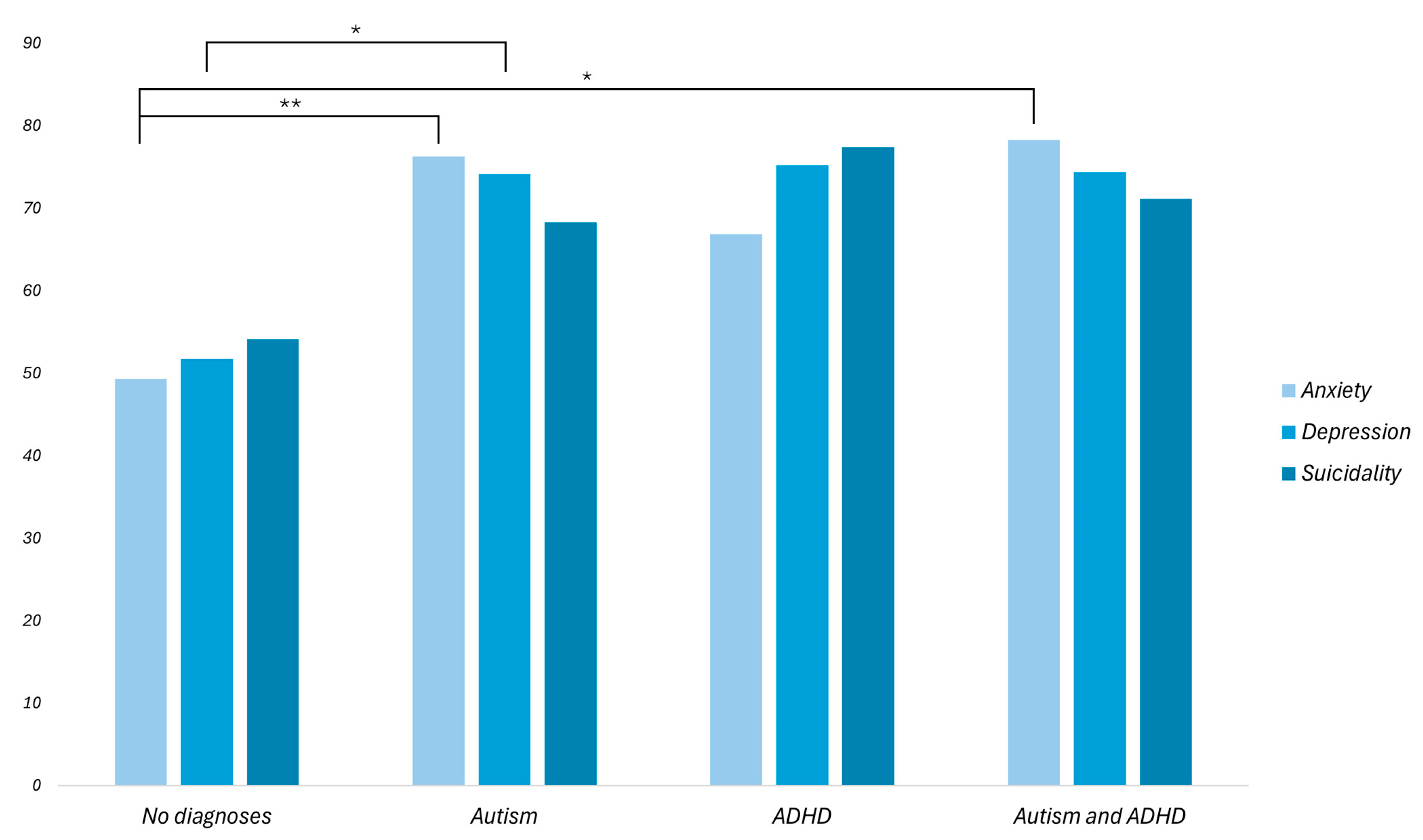
3.2. Neurodevelopmental Diagnoses and Well-Being (H2)
3.3. Cat–Human-Related Factors and Well-Being (H3)
3.4. Engagement in Cat–Human-Related Factors (H4)
4. Discussion
4.1. Neurodiverse Traits and Well-Being
4.2. Formal Diagnoses and Well-Being
4.3. Cat–Human-Related Factors and Well-Being
4.4. Engagement in Cat–Human-Related Factors
4.5. Limitations and Future Directions
5. Conclusions
Author Contributions
Funding
Institutional Review Board Statement
Informed Consent Statement
Data Availability Statement
Acknowledgments
Conflicts of Interest
Abbreviations
| CHRFs | Cat–Human-Related Factors |
| APA | American Psychiatric Association |
| ADHD | Attention-Deficit Hyperactivity Disorder |
References
- Adler, L. A., Spencer, T., Faraone, S. V., Kessler, R. C., Howes, M. J., Biederman, J., & Secnik, K. (2006). Validity of pilot adult ADHD self-report scale (ASRS) to rate adult ADHD symptoms. Annals of Clinical Psychiatry, 18(3), 145–148. [Google Scholar] [CrossRef] [PubMed]
- Agnew-Blais, J. C., Polanczyk, G. V., Danese, A., Wertz, J., Moffitt, T. E., & Arseneault, L. (2018). Young adult mental health and functional outcomes among individuals with remitted, persistent and late-onset ADHD. The British Journal of Psychiatry, 213(3), 526–534. [Google Scholar] [CrossRef]
- Allen, K. (2003). Are pets a healthy pleasure? The influence of pets on blood pressure. Current Directions in Psychological Science, 12(6), 236–239. [Google Scholar] [CrossRef]
- Allison, C., Auyeung, B., & Baron-Cohen, S. (2012). Toward brief “red flags” for autism screening: The short autism spectrum quotient and the short quantitative checklist in 1000 cases and 3000 controls. Journal of the American Academy of Child & Adolescent Psychiatry, 51(2), 202–212. [Google Scholar] [CrossRef]
- Amat, M., Camps, T., & Manteca, X. (2016). Stress in owned cats: Behavioural changes and welfare implications. Journal of Feline Medicine and Surgery, 18(8), 577–586. [Google Scholar] [CrossRef] [PubMed]
- American Psychiatric Association (APA). (1994). Diagnostic and statistical manual of mental disorders (4th ed.). American Psychiatric Association. [Google Scholar]
- American Psychiatric Association (APA). (2022). Diagnostic and statistical manual of mental disorders (5th ed., text rev.). American Psychiatric Association. [Google Scholar] [CrossRef]
- Amiot, C. E., & Bastian, B. (2015). Toward a psychology of human–Animal relations. Psychological Bulletin, 141(1), 6–47. [Google Scholar] [CrossRef] [PubMed]
- Applebaum, J. W., Tomlinson, C. A., Matijczak, A., McDonald, S. E., & Zsembik, B. A. (2020). The concerns, difficulties, and stressors of caring for pets during COVID-19: Results from a large survey of US pet owners. Animals, 10(10), 1882. [Google Scholar] [CrossRef]
- Atherton, G., Edisbury, E., Piovesan, A., & Cross, L. (2023a). ‘They ask no questions and pass no criticism’: A mixed-methods study exploring pet ownership in autism. Journal of Autism and Developmental Disorders, 53(8), 3280–3294. [Google Scholar] [CrossRef]
- Atherton, G., Piovesan, A., & Cross, L. (2023b). Autism, pets, and the importance of seeing human. Autism Research, 16(9), 1765–1774. [Google Scholar] [CrossRef]
- Bao, K. J., & Schreer, G. (2016). Pets and happiness: Examining the association between pet ownership and wellbeing. Anthrozoös, 29(2), 283–296. [Google Scholar] [CrossRef]
- Barcelos, A. M., Kargas, N., Assheton, P., Maltby, J., Hall, S., & Mills, D. S. (2023a). Dog owner mental health is associated with dog behavioural problems, dog care and dog-facilitated social interaction: A prospective cohort study. Scientific Reports, 13(1), 21734. [Google Scholar] [CrossRef]
- Barcelos, A. M., Kargas, N., Maltby, J., Hall, S., Assheton, P., & Mills, D. S. (2021a). Theoretical foundations to the impact of dog-related activities on human hedonic well-being, life satisfaction and eudaimonic well-being. International Journal of Environmental Research and Public Health, 18(23), 12382. [Google Scholar] [CrossRef]
- Barcelos, A. M., Kargas, N., Maltby, J., Hall, S., & Mills, D. S. (2020). A framework for understanding how activities associated with dog ownership relate to human well-being. Scientific Reports, 10(1), 11363. [Google Scholar] [CrossRef]
- Barcelos, A. M., Kargas, N., Maltby, J., & Mills, D. S. (2023b). Potential psychosocial explanations for the impact of pet ownership on human well-being: Evaluating and expanding current hypotheses. Human-Animal Interactions, 2023, 8. [Google Scholar] [CrossRef]
- Barcelos, A. M., Kargas, N., & Mills, D. (2024). The effects of dog behavioural problems on owner well-being: A review of the literature and future directions. Pets, 1(1), 53–69. [Google Scholar] [CrossRef]
- Barcelos, A. M., Kargas, N., Packham, C., & Mills, D. S. (2021b). Understanding the impact of dog ownership on autistic adults: Implications for mental health and suicide prevention. Scientific Reports, 11(1), 23655. [Google Scholar] [CrossRef]
- Barker, S. B., Schubert, C. M., Barker, R. T., Kuo, S. I. C., Kendler, K. S., & Dick, D. M. (2018). The relationship between pet ownership, social support, and internalizing symptoms in students from the first to fourth year of college. Applied Developmental Science, 24(3), 279–293. [Google Scholar] [CrossRef] [PubMed]
- Barker, S. B., & Wolen, A. R. (2008). The benefits of human–companion animal interaction: A review. Journal of Veterinary Medical Education, 35(4), 487–495. [Google Scholar] [CrossRef]
- Baron-Cohen, S., Wheelwright, S., Skinner, R., Martin, J., & Clubley, E. (2001). The autism-spectrum quotient (AQ): Evidence from Asperger syndrome/high-functioning autism, males and females, scientists and mathematicians. Journal of Autism and Developmental Disorders, 31(1), 5–17. [Google Scholar] [CrossRef] [PubMed]
- Beetz, A. M. (2017). Theories and possible processes of action in animal assisted interventions. Applied Developmental Science, 21(2), 139–149. [Google Scholar] [CrossRef]
- Beetz, A. M., Uvnäs-Moberg, K., Julius, H., & Kotrschal, K. (2012). Psychosocial and psychophysiological effects of human-animal interactions: The possible role of oxytocin. Frontiers in Psychology, 3, 26183. [Google Scholar] [CrossRef]
- Bradley, L., & Bennett, P. C. (2015). Companion-animals’ effectiveness in managing chronic pain in adult community members. Anthrozoös, 28(4), 635–647. [Google Scholar] [CrossRef]
- Brooks, H. L., Rushton, K., Lovell, K., Bee, P., Walker, L., Grant, L., & Rogers, A. (2018). The power of support from companion animals for people living with mental health problems: A systematic review and narrative synthesis of the evidence. BMC Psychiatry, 18(1), 31. [Google Scholar] [CrossRef]
- Brumpton, H. L., & Kargas, N. (2026). Perceived benefits and barriers for autistic adults accessing therapeutic horse riding for mental health. Behavioral Sciences, 16(1), 84. [Google Scholar] [CrossRef]
- Burrows, K. E., & Adams, C. L. (2008). Challenges of service-dog ownership for families with autistic children: Lessons for veterinary practitioners. Journal of Veterinary Medical Education, 35(4), 559–566. [Google Scholar] [CrossRef]
- Busch, C., Tucha, L., Talarovicova, A., Fuermaier, A. B., Lewis-Evans, B., & Tucha, O. (2016). Animal-assisted interventions for children with attention deficit/hyperactivity disorder: A theoretical review and consideration of future research directions. Psychological Reports, 118(1), 292–331. [Google Scholar] [CrossRef] [PubMed]
- Byström, K. M., & Persson, C. A. L. (2015). The meaning of companion animals for children and adolescents with autism: The parents’ perspective. Anthrozoös, 28(2), 263–275. [Google Scholar] [CrossRef]
- Capp, S., De Burca, A., Aydin, Ü., Agnew-Blais, J., Lautarescu, A., Ronald, A., Happé, F., & McLoughlin, G. (2024). Depression and anxiety are increased in autism and ADHD: Evidence from a young adult community-based sample. JCPP Advances, 5, e70003. [Google Scholar] [CrossRef] [PubMed]
- Carlisle, G. K. (2014). Pet dog ownership decisions for parents of children with autism spectrum disorder. Journal of Pediatric Nursing, 29(2), 114–123. [Google Scholar] [CrossRef] [PubMed]
- Carlisle, G. K., Johnson, R. A., Wang, Z., Brosi, T. C., Rife, E. M., & Hutchison, A. (2020). Exploring human–Companion animal interaction in families of children with autism. Journal of Autism and Developmental Disorders, 50(8), 2793–2805. [Google Scholar] [CrossRef]
- Carr, E. C. J., Norris, J. M., Alix Hayden, K., Pater, R., & Wallace, J. E. (2020). A scoping review of the health and social benefits of dog ownership for people who have chronic pain. Anthrozoös, 33(2), 207–224. [Google Scholar] [CrossRef]
- Carr, E. C. J., Wallace, J. E., Onyewuchi, C., Hellyer, P. W., & Kogan, L. (2018). Exploring the meaning and experience of chronic pain with people who live with a dog: A qualitative study. Anthrozoös, 31(5), 551–565. [Google Scholar] [CrossRef]
- Cassidy, S., Bradley, L., Shaw, R., & Baron-Cohen, S. (2018). Risk markers for suicidality in autistic adults. Molecular Autism, 9, 42. [Google Scholar] [CrossRef]
- Choi, W., Woo, Y. S., Wang, S., Lim, H. K., & Bahk, W. (2022). The prevalence of psychiatric comorbidities in adult ADHD compared with non-ADHD populations: A systematic literature review. PLoS ONE, 17(11), e0277175. [Google Scholar] [CrossRef]
- Cohen, L., Manion, M., & Morrison, M. (2018). Research methods in education (8th ed.). Routledge. [Google Scholar] [CrossRef]
- Corrêa, G. F., Barcelos, A. M., & Mills, D. S. (2021). Dog-related activities and human well-being in Brazilian dog owners: A framework and cross-cultural comparison with a British study. Science Progress, 104(4), 368504211050277. [Google Scholar] [CrossRef] [PubMed]
- DeLoache, J. S., Pickard, M. B., & LoBue, V. (2011). How very young children think about animals. In P. McCardle, S. McCune, J. A. Griffin, & V. Maholmes (Eds.), How animals affect us: Examining the influences of human–Animal interaction on child development and human health (pp. 85–99). American Psychological Association. [Google Scholar] [CrossRef]
- Denenberg, S., Landsberg, G. M., Horwitz, D., & Seksel, K. (2005). A comparison of cases referred to behaviorists in three different countries. In Current issues and research in veterinary behavioral medicine (pp. 56–62). Purdue University Press. Available online: https://www.researchgate.net/profile/Greta-Berteselli/publication/281782239_Evaluation_of_immunological_stress_and_behavioural_parameters_in_dogs_canis_familiaris_with_anxiety-related_disordersProceedings_of_the_5th_International_Veterinary_Behavioural_Meeting_D_Mills_E_Levin/links/5ad5bb01458515c60f54c664/Evaluation-of-immunological-stress-and-behavioural-parameters-in-dogs-canis-familiaris-with-anxiety-related-disordersProceedings-of-the-5th-International-Veterinary-Behavioural-Meeting-D-Mills-E-L.pdf#page=75 (accessed on 15 December 2025).
- Ein, N., Li, L., & Vickers, K. (2018). The effect of pet therapy on the physiological and subjective stress response: A meta-analysis. Stress and Health, 34(4), 477–489. [Google Scholar] [CrossRef] [PubMed]
- Faul, F., Erdfelder, E., Lang, A. G., & Buchner, A. (2007). G*Power 3: A flexible statistical power analysis program for the social, behavioral, and biomedical sciences. Behavior Research Methods, 39(2), 175–191. [Google Scholar] [CrossRef] [PubMed]
- Fayyad, J., Sampson, N. A., Hwang, I., Adamowski, T., Aguilar-Gaxiola, S., Al-Hamzawi, A., Andrade, L. H. S. G., Borges, G., de Girolamo, G., Florescu, S., Gureje, O., Haro, J. M., Hu, C., Karam, E. G., Lee, S., Navarro-Mateu, F., O’Neill, S., Pennell, B. E., Piazza, M., … Kessler, R. C. (2016). The descriptive epidemiology of DSM-IV adult ADHD in the world health organization world mental health surveys. ADHD Attention Deficit and Hyperactivity Disorders, 9, 47–65. [Google Scholar] [CrossRef]
- Friedmann, E., & Krause-Parello, C. A. (2018). Companion animals and human health: Benefits, challenges, and the road ahead for human-animal interaction. Revue Scientifique et Technique (International Office of Epizootics), 37(1), 71–82. [Google Scholar] [CrossRef]
- Friedmann, E., & Son, H. (2009). The human–Companion animal bond: How humans benefit. Veterinary Clinics of North America: Small Animal Practice, 39(2), 293–326. [Google Scholar] [CrossRef]
- Garcha, J., & Smith, A. P. (2023). Associations between autistic and ADHD traits and the well-being and mental health of university students. Healthcare, 12(1), 14. [Google Scholar] [CrossRef]
- Gee, N. R., & Mueller, M. K. (2019). A systematic review of research on pet ownership and animal interactions among older adults. Anthrozoös, 32(2), 183–207. [Google Scholar] [CrossRef]
- Gee, N. R., Rodriguez, K. E., Fine, A. H., & Trammell, J. P. (2021). Dogs supporting human health and well-being: A biopsychosocial approach. Frontiers in Veterinary Science, 8, 630465. [Google Scholar] [CrossRef]
- Ghirardi, L., Pettersson, E., Taylor, M. J., Freitag, C. M., Franke, B., Asherson, P., Larsson, H., & Kuja-Halkola, R. (2019). Genetic and environmental contribution to the overlap between ADHD and ASD trait dimensions in young adults: A twin study. Psychological Medicine, 49(10), 1713–1721. [Google Scholar] [CrossRef] [PubMed]
- Greenland, S., Senn, S. J., Rothman, K. J., Carlin, J. B., Poole, C., Goodman, S. N., & Altman, D. G. (2016). Statistical tests, P values, confidence intervals, and power: A guide to misinterpretations. European Journal of Epidemiology, 31(4), 337–350. [Google Scholar] [CrossRef]
- Griffith, G. M., Totsika, V., Nash, S., & Hastings, R. P. (2011). ‘I just don’t fit anywhere’: Support experiences and future support needs of individuals with Asperger syndrome in middle adulthood. Autism, 16(5), 532–546. [Google Scholar] [CrossRef] [PubMed]
- Gullone, E. (2000). The biophilia hypothesis and life in the 21st century: Increasing mental health or increasing pathology? Journal of Happiness Studies, 1(3), 293–322. [Google Scholar] [CrossRef]
- Harwood, C., Kaczmarek, E., & Drake, D. (2019). Parental perceptions of the nature of the relationship children with autism spectrum disorders share with their canine companion. Journal of Autism and Developmental Disorders, 49, 248–259. [Google Scholar] [CrossRef]
- Hawkins, R. D., Hawkins, E. L., & Tip, L. (2021). “I can’t give up when I have them to care for”: People’s experiences of pets and their mental health. Anthrozoös, 34(4), 543–562. [Google Scholar] [CrossRef]
- Hedley, D., & Uljarević, M. (2018). Systematic review of suicide in autism spectrum disorder: Current trends and implications. Current Developmental Disorders Reports, 5, 65–76. [Google Scholar] [CrossRef]
- Herzog, H. (2011). The impact of pets on human health and psychological well-being: Fact, fiction, or hypothesis? Current Directions in Psychological Science, 20(4), 236–239. [Google Scholar] [CrossRef]
- Herzog, H. (2021, May 24). Women dominate research on human-animal bond. Psychology Today. Available online: https://www.psychologytoday.com/us/blog/animals-and-us/202105/women-dominate-research-the-human-animal-bond (accessed on 4 November 2025).
- Hinshaw, S. P., Owens, E. B., Zalecki, C., Huggins, S. P., Montenegro-Nevado, A. J., Schrodek, E., & Swanson, E. N. (2012). Prospective follow-up of girls with attention-deficit/hyperactivity disorder into early adulthood: Continuing impairment includes elevated risk for suicide attempts and self-injury. Journal of Consulting and Clinical Psychology, 80(6), 1041. [Google Scholar] [CrossRef]
- Hirvikoski, T., Mittendorfer-Rutz, E., Boman, M., Larsson, H., Lichtenstein, P., & Bölte, S. (2016). Premature mortality in autism spectrum disorder. The British Journal of Psychiatry, 208(3), 232–238. [Google Scholar] [CrossRef]
- Hollocks, M. J., Lerh, J. W., Magiati, I., Meiser-Stedman, R., & Brugha, T. S. (2019). Anxiety and depression in adults with autism spectrum disorder: A systematic review and meta-analysis. Psychological Medicine, 49(4), 559–572. [Google Scholar] [CrossRef]
- Horowitz, A., & Hecht, J. (2016). Examining dog–human play: The characteristics, affect, and vocalizations of a unique interspecific interaction. Animal Cognition, 19, 779–788. [Google Scholar] [CrossRef] [PubMed]
- Hossain, M. M., Khan, N., Sultana, A., Ma, P., McKyer, E. L. J., Ahmed, H. U., & Purohit, N. (2020). Prevalence of comorbid psychiatric disorders among people with autism spectrum disorder: An umbrella review of systematic reviews and meta-analyses. Psychiatry Research, 287, 112922. [Google Scholar] [CrossRef] [PubMed]
- Howell, T. J., Bowen, J., Fatjó, J., Calvo, P., Holloway, A., & Bennett, P. C. (2017). Development of the cat-owner relationship scale (CORS). Behavioural Processes, 141, 305–315. [Google Scholar] [CrossRef]
- Howlin, P., & Magiati, I. (2017). Autism spectrum disorder: Outcomes in adulthood. Current Opinion in Psychiatry, 30(2), 69–76. [Google Scholar] [CrossRef] [PubMed]
- Howlin, P., & Taylor, J. L. (2015). Addressing the need for high quality research on autism in adulthood: Autism in adulthood [Special issue]. Autism, 19(7), 771–773. [Google Scholar] [CrossRef]
- Hughes, M. J., Verreynne, M. L., Harpur, P., & Pachana, N. A. (2020). Companion animals and health in older populations: A systematic review. Clinical Gerontologist, 43(4), 365–377. [Google Scholar] [CrossRef]
- Ines, M., Ricci-Bonot, C., & Mills, D. S. (2021). My cat and me—A study of cat owner perceptions of their bond and relationship. Animals, 11(6), 1601. [Google Scholar] [CrossRef]
- Janevic, M. R., Shute, V., Connell, C. M., Piette, J. D., Goesling, J., & Fynke, J. (2019). The role of pets in supporting cognitive-behavioral chronic pain self-management: Perspectives of older adults. Journal of Applied Gerontology, 39(10), 1088–1096. [Google Scholar] [CrossRef] [PubMed]
- Janssens, M., Eshuis, J., Peeters, S., Lataster, J., Reijnders, J., Enders-Slegers, M., & Jacobs, N. (2020). The pet-effect in daily life: An experience sampling study on emotional wellbeing in pet owners. Anthrozoös, 33(4), 579–588. [Google Scholar] [CrossRef]
- Johnson, E. A., Portillo, A., Bennett, N. E., & Gray, P. B. (2021). Exploring women’s oxytocin responses to interactions with their pet cats. PeerJ: Life & Environment, 9, e12393. [Google Scholar] [CrossRef]
- Jolliffe, R., Adams, D., & Simpson, K. (2023). Trait anxiety in individuals on the autism spectrum: A systematic review. Review Journal of Autism and Developmental Disorders, 10(3), 523–545. [Google Scholar] [CrossRef]
- Julius, H., Beetz, A., Kotrschal, K., Turner, D., & Uvnäs-Moberg, K. (2013). Attachment to pets: An integrative view of human-animal relationships with implications for therapeutic practice. Hogrefe Publishing. [Google Scholar]
- Kenny, L., Hattersley, C., Molins, B., Buckley, C., Povey, C., & Pellicano, E. (2016). Which terms should be used to describe autism? Perspectives from the UK autism community. Autism, 20(4), 442–462. [Google Scholar] [CrossRef]
- Kerulo, G., Kargas, N., Mills, D. S., Law, G., VanFleet, R., Faa-Thompson, T., & Winkle, M. Y. (2020). Animal-assisted interventions: Relationship between standards and qualifications. People and Animals: The International Journal of Research and Practice, 3(1), 4. [Google Scholar] [CrossRef]
- Kessler, R. C., Adler, L., Ames, M., Demler, O., Faraone, S., Hiripi, E., Howes, M. J., Jin, R., Secnik, K., & Spencer, T. (2005). The World Health Organization Adult ADHD Self-Report Scale (ASRS): A short screening scale for use in the general population. Psychological Medicine, 35(2), 245–256. [Google Scholar] [CrossRef]
- Kooij, J., Bijlenga, D., Salerno, L., Jaeschke, R., Bitter, I., Balazs, J., Thome, J., Dom, G., Kasper, S., & Filipe, C. N. (2018). Updated European Consensus Statement on diagnosis and treatment of adult ADHD. European Psychiatry, 56(1), 14–34. [Google Scholar] [CrossRef]
- Kroenke, K., Spitzer, R. L., & Williams, J. B. (2001). The PHQ-9: Validity of a brief depression severity measure. Journal of General Internal Medicine, 16(9), 606–613. [Google Scholar] [CrossRef]
- Lai, M., Kassee, C., Besney, R., Bonato, S., Hull, L., Mandy, W., Szatmari, P., & Ameis, S. H. (2019). Prevalence of co-occurring mental health diagnoses in the autism population: A systematic review and meta-analysis. The Lancet Psychiatry, 6(10), 819–829. [Google Scholar] [CrossRef]
- Landry, O., & Chouinard, P. A. (2019). Why we should study the broader autism phenotype in typically developing populations. In Building bridges: Cognitive development in typical and atypical development (pp. 36–47). Routledge. [Google Scholar] [CrossRef]
- Li, P., Yao, J., Xu, Y., & Zhou, F. (2023). Impact of pet companionship on student development: A meta-analysis. Best Evidence in Chinese Education, 14(1), 1727–1743. [Google Scholar] [CrossRef]
- Lisk, C., Lawson, L. M., & Vaduvathiriyan, P. (2021). The impact of animal exposure for children with ASD: A scoping review. Review Journal of Autism and Developmental Disorders, 8(4), 471–481. [Google Scholar] [CrossRef]
- Love, H. A. (2021). Best friends come in all breeds: The role of pets in suicidality. Anthrozoös, 34(2), 175–186. [Google Scholar] [CrossRef]
- Mayes, S. D., Calhoun, S. L., Mayes, R. D., & Molitoris, S. (2012). Autism and ADHD: Overlapping and discriminating symptoms. Research in Autism Spectrum Disorders, 6(1), 277–285. [Google Scholar] [CrossRef]
- McConnell, A. R., Brown, C. M., Shoda, T. M., Stayton, L. E., & Martin, C. E. (2011). Friends with benefits: On the positive consequences of pet ownership. Journal of Personality and Social Psychology, 101(6), 1239–1252. [Google Scholar] [CrossRef] [PubMed]
- Merkouri, A., Graham, T. M., O’Haire, M. E., Purewal, R., & Westgarth, C. (2022). Dogs and the good life: A cross-sectional study of the association between the dog–owner relationship and owner mental wellbeing. Frontiers in Psychology, 13, 903647. [Google Scholar] [CrossRef]
- Miltiades, H., & Shearer, J. (2011). Attachment to pet dogs and depression in rural older adults. Anthrozoös, 24(2), 147–154. [Google Scholar] [CrossRef]
- National Collaborating Centre for Mental Health. (2012). Autism: Recognition, referral, diagnosis and management of adults on the autism spectrum. British Psychological Society. Available online: https://pubmed.ncbi.nlm.nih.gov/26065067/ (accessed on 8 November 2025).
- O’Haire, M. (2010). Companion animals and human health: Benefits, challenges, and the road ahead. Journal of Veterinary Behavior, 5(5), 226–234. [Google Scholar] [CrossRef]
- Osman, A., Bagge, C. L., Gutierrez, P. M., Konick, L. C., Kopper, B. A., & Barrios, F. X. (2001). The suicidal behaviors questionnaire-revised (SBQ-R): Validation with clinical and nonclinical samples. Assessment, 8(4), 443–454. [Google Scholar] [CrossRef]
- Panagiotidi, M., Overton, P. G., & Stafford, T. (2019). Co-occurrence of ASD and ADHD traits in an adult population. Journal of Attention Disorders, 23(12), 1407–1415. [Google Scholar] [CrossRef]
- Pereira, J. M., & Fonte, D. (2018). Pets enhance antidepressant pharmacotherapy effects in patients with treatment resistant major depressive disorder. Journal of Psychiatric Research, 104, 108–113. [Google Scholar] [CrossRef]
- Pilling, S., Baron-Cohen, S., Megnin-Viggars, O., Lee, R., & Taylor, C. (2012). Recognition, referral, diagnosis, and management of adults with autism: Summary of NICE guidance. BMJ, 344, e4082. [Google Scholar] [CrossRef]
- Purewal, R., Christley, R., Kordas, K., Joinson, C., Meints, K., Gee, N., & Westgarth, C. (2017). Companion animals and child/adolescent development: A systematic review of the evidence. International Journal of Environmental Research and Public Health, 14(3), 234. [Google Scholar] [CrossRef] [PubMed]
- Rai, D., Culpin, I., Heuvelman, H., Magnusson, C. M., Carpenter, P., Jones, H. J., Emond, A. M., Zammit, S., Golding, J., & Pearson, R. M. (2018). Association of autistic traits with depression from childhood to age 18 years. JAMA Psychiatry, 75(8), 835–843. [Google Scholar] [CrossRef]
- Ravenscroft, S. J., Barcelos, A. M., & Mills, D. S. (2021). Cat-human related activities associated with human well-being. Human-Animal Interaction Bulletin, 11(2), 79–95. [Google Scholar] [CrossRef]
- Raymaker, D. M., McDonald, K. E., Ashkenazy, E., Gerrity, M., Baggs, A. M., Kripke, C., Hourston, S., & Nicolaidis, C. (2017). Barriers to healthcare: Instrument development and comparison between autistic adults and adults with and without other disabilities. Autism, 21(8), 972–984. [Google Scholar] [CrossRef] [PubMed]
- Rodriguez, K. E., Herzog, H., & Gee, N. R. (2021). Variability in human-animal interaction research. Frontiers in Veterinary Science, 7, 619600. [Google Scholar] [CrossRef] [PubMed]
- Rong, Y., Yang, C. J., Jin, Y., & Wang, Y. (2021). Prevalence of attention-deficit/hyperactivity disorder in individuals with autism spectrum disorder: A meta-analysis. Research in Autism Spectrum Disorders, 83, 101759. [Google Scholar] [CrossRef]
- Sasson, N. J., Faso, D. J., Nugent, J., Lovell, S., Kennedy, D. P., & Grossman, R. B. (2017). Neurotypical peers are less willing to interact with those with autism based on thin slice judgments. Scientific Reports, 7(1), 0700. [Google Scholar] [CrossRef]
- Schoenfeld-Tacher, R., Hellyer, P., Cheung, L., & Kogan, L. (2017). Public perceptions of service dogs, emotional support dogs, and therapy dogs. International Journal of Environmental Research and Public Health, 14(6), 642. [Google Scholar] [CrossRef]
- Schuck, S. E. B., & Childress, A. (2023). Companion animals in the treatment of ADHD. In N. R. Gee, L. D. Towsend, & R. L. Findling (Eds.), The Role of companion animals in the treatment of mental disorders. American Psychiatric Association Publishing. [Google Scholar]
- Scoresby, K. J., Strand, E. B., Ng, Z., Brown, K. C., Stilz, C. R., Strobel, K., Barroso, C. S., & Souza, M. (2021). Pet ownership and quality of life: A systematic review of the literature. Veterinary Sciences, 8(12), 332. [Google Scholar] [CrossRef]
- Segers, M., & Rawana, J. (2014). What do we know about suicidality in autism spectrum disorders? A systematic review. Autism Research, 7(4), 507–521. [Google Scholar] [CrossRef]
- Septier, M., Stordeur, C., Zhang, J., Delorme, R., & Cortese, S. (2019). Association between suicidal spectrum behaviors and attention-deficit/hyperactivity disorder: A systematic review and meta-analysis. Neuroscience & Biobehavioral Reviews, 103, 109–118. [Google Scholar] [CrossRef]
- Serpell, J., McCune, S., Gee, N., & Griffin, J. A. (2017). Current challenges to research on animal-assisted interventions. Applied Developmental Science, 21(3), 223–233. [Google Scholar] [CrossRef]
- Sibley, M. H., Arnold, L. E., Swanson, J. M., Hechtman, L. T., Kennedy, T. M., Owens, E., Molina, B. S. G., Jensen, P. S., Hinshaw, S. P., Roy, A., Chronis-Tuscano, A., Newcorn, J. H., & Rohde, L. A. (2022). Variable patterns of remission from ADHD in the multimodal treatment study of ADHD. American Journal of Psychiatry, 179(2), 142–151. [Google Scholar] [CrossRef] [PubMed]
- Smith, B. (2012). The ‘pet effect’: Health related aspects of companion animal ownership. Australian Family Physician, 41(6), 439–442. Available online: https://pubmed.ncbi.nlm.nih.gov/22675689/ (accessed on 4 November 2025). [PubMed]
- Solmi, M., Song, M., Yon, D. K., Lee, S. W., Fombonne, E., Kim, M. S., Park, S., Lee, M. H., Hwang, J., Keller, R., Koyanagi, A., Jacob, L., Dragioti, E., Smith, L., Correll, C. U., Fusar-Poli, P., Croatto, G., Carvalho, A. F., Oh, J. W., … Cortese, S. (2022). Incidence, prevalence, and global burden of autism spectrum disorder from 1990 to 2019 across 204 countries. Molecular Psychiatry, 27(10), 4172–4180. [Google Scholar] [CrossRef] [PubMed]
- Song, P., Zha, M., Yang, Q., Zhang, Y., Li, X., & Rudan, I. (2021). The prevalence of adult attention-deficit hyperactivity disorder: A global systematic review and meta-analysis. Journal of Global Health, 11, 04009. [Google Scholar] [CrossRef]
- Souter, M. A., & Miller, M. D. (2007). Do animal-assisted activities effectively treat depression? A meta-analysis. Anthrozoös, 20(2), 167–180. [Google Scholar] [CrossRef]
- South, M., Beck, J. S., Lundwall, R., Christensen, M., Cutrer, E. A., Gabrielsen, T. P., Cox, J. C., & Lundwall, R. A. (2020). Unrelenting depression and suicidality in women with autistic traits. Journal of Autism and Developmental Disorders, 50, 3606–3619. [Google Scholar] [CrossRef]
- Spitzer, R. L., Kroenke, K., & Williams, J. B. (1999). Validation and utility of a self-report version of PRIME-MD: The PHQ primary care study. JAMA, 282(18), 1737–1744. [Google Scholar] [CrossRef] [PubMed]
- Spitzer, R. L., Kroenke, K., Williams, J. B., & Löwe, B. (2006). A brief measure for assessing generalized anxiety disorder: The GAD-7. Archives of Internal Medicine, 166(10), 1092–1097. [Google Scholar] [CrossRef] [PubMed]
- Sugawara, A., Masud, M. M., Yokoyama, A., Mizutani, W., Watanuki, S., Yanai, K., Itoh, M., & Tashiro, M. (2012). Effects of presence of a familiar pet dog on regional cerebral activity in healthy volunteers: A positron emission tomography study. Anthrozoös, 25(1), 25–34. [Google Scholar] [CrossRef]
- Sun, Y., Huang, Z., Xu, S., Wang, Y., Wang, J., Lei, C., Li, W., Wang, Y., Qu, D., & Chen, R. (2024). Suicide risk with ASD traits or ADHD traits in non-clinical young adults. Humanities and Social Sciences Communications, 11(1), 1186. [Google Scholar] [CrossRef]
- Taboas, A., Doepke, K., & Zimmerman, C. (2023). Preferences for identity-first versus person-first language in a US sample of autism stakeholders. Autism, 27(2), 565–570. [Google Scholar] [CrossRef]
- Taylor, M. J., Charman, T., & Ronald, A. (2015). Where are the strongest associations between autistic traits and traits of ADHD? Evidence from a community-based twin study. European Child & Adolescent Psychiatry, 24, 1129–1138. [Google Scholar] [CrossRef]
- Teo, J. T., Johnstone, S. J., Römer, S. S., & Thomas, S. J. (2022). Psychophysiological mechanisms underlying the potential health benefits of human-dog interactions: A systematic literature review. International Journal of Psychophysiology, 180, 27–48. [Google Scholar] [CrossRef]
- Turner, D. C. (2017). A review of over three decades of research on cat-human and human-cat interactions and relationships. Behavioural Processes, 141, 297–304. [Google Scholar] [CrossRef]
- Van Bourg, J., Patterson, J. E., & Wynne, C. D. (2020). Pet dogs (Canis lupus familiaris) release their trapped and distressed owners: Individual variation and evidence of emotional contagion. PLoS ONE, 15(4), e0231742. [Google Scholar] [CrossRef] [PubMed]
- Wells, D. L. (2019). The state of research on human–animal relations: Implications for human health. Anthrozoös, 32(2), 169–181. [Google Scholar] [CrossRef]
- Wisdom, J. P., Saedi, G. A., & Green, C. A. (2009). Another breed of “service” animals: STARS study findings about pet ownership and recovery from serious mental illness. American Journal of Orthopsychiatry, 79(3), 430–436. [Google Scholar] [CrossRef]
- Wood, L., Martin, K., Christian, H., Nathan, A., Lauritsen, C., Houghton, S., Kawachi, S., & McCune, S. (2015). The pet factor-companion animals as a conduit for getting to know people, friendship formation and social support. PLoS ONE, 10(4), e0122085. [Google Scholar] [CrossRef] [PubMed]
- Wright, H., Hall, S., Hames, A., Hardiman, J., Mills, R., PAWS Project Team & Mills, D. (2015). Pet dogs improve family functioning and reduce anxiety in children with autism spectrum disorder. Anthrozoös, 28(4), 611–624. [Google Scholar] [CrossRef]
- Yong, M. H., & Ruffman, T. (2014). Emotional contagion: Dogs and humans show a similar physiological response to human infant crying. Behavioural Processes, 108, 155–165. [Google Scholar] [CrossRef] [PubMed]
- Zahid, S., & Upthegrove, R. (2017). Suicidality in autistic spectrum disorders. Crisis, 38(4), 237–246. [Google Scholar] [CrossRef]
- Zalsman, G., & Shilton, T. (2016). Adult ADHD: A new disease? International Journal of Psychiatry in Clinical Practice, 20(2), 70–76. [Google Scholar] [CrossRef]
- Zilcha-Mano, S., Mikulincer, M., & Shaver, P. R. (2012). Pets as safe havens and secure bases: The moderating role of pet attachment orientations. Journal of Research in Personality, 46(5), 571–580. [Google Scholar] [CrossRef]

| Factor | Response Options |
|---|---|
| Friendly conversations with others due to the presence of your cat | Zero (0)–35 or more (35) times overall |
| Feeding your cat main meals | Zero (0)–35 or more (35) times overall |
| Aggressive behaviour displayed by your cat (e.g., biting, lunging) | Zero (0)–35 or more (35) times overall |
| An inability to provide for your cat (e.g., not able to be at home with or feed them) | Zero (0)–35 or more (35) times overall |
| Anxious behaviour displayed by your cat (e.g., fear of people, separation anxiety) | Zero (0)–35 or more (35) times overall |
| Vocalisation episodes displayed by your cat | Zero (0)–35 or more (35) times overall |
| Destructive behaviour displayed by your cat (e.g., chewed, scratched, stolen items) | Zero (0)–35 or more (35) times overall |
| Affectionate physical contact with your cat (e.g., petting, cuddling, kissing) | Zero (0)–35 or more (35) times per day in the last 7 days |
| House soiling by your cat with urine or faeces (e.g., on inappropriate surfaces) | Zero (0)–35 or more (35) times overall |
| Proportion of time awake in close proximity with your cat (e.g., in the same room or outside together) | 0–100% times overall |
| Physical health of your cat (e.g., medical issues, sickness, injuries) | Excellent (7), Very good (6), Good (5), Neither good nor poor (4), Poor (3), Very poor (2), Extremely poor (1) |
| n | Mdn | IQR | Autistic Traits | ADHD Traits | Anxiety | Depression | Suicidality | |
|---|---|---|---|---|---|---|---|---|
| Autistic Traits | 127 | 5 | 4 | – | ||||
| ADHD Traits | 125 | 4 | 3 | 0.44 ** | – | |||
| Anxiety | 124 | 7 | 7 | 0.45 ** | 0.47 ** | – | ||
| Depression | 126 | 8 | 8 | 0.41 ** | 0.49 ** | 0.75 ** | – | |
| Suicidality | 125 | 6 | 5.5 | 0.27 ** | 0.33 ** | 0.54 ** | 0.54 ** | – |
| Anxiety | Depression | Suicidality | |
|---|---|---|---|
| Social interaction due to the cat | 0.06 | 0.10 | 0.03 |
| Feeding the cat | 0.01 | −0.04 | 0.07 |
| Aggressive cat behaviour | 0.04 | −0.01 | −0.02 |
| Inability to provide for the cat | 0.11 | 0.20 * | 0.19 * |
| Anxious cat behaviour | 0.26 ** | 0.25 ** | 0.11 |
| Cat vocalisation episodes | 0.05 | −0.05 | 0.07 |
| Destructive cat behaviour | 0.05 | 0.12 | 0.10 |
| Affectionate physical contact with the cat | 0.10 | −0.02 | 0.17 |
| Cat soiling in the house | 0.06 | 0.13 | 0.09 |
| Close proximity to the cat | 0.22 * | 0.17 | 0.17 |
| Physical health of the cat | 0.16 | 0.22 * | −0.01 |
Disclaimer/Publisher’s Note: The statements, opinions and data contained in all publications are solely those of the individual author(s) and contributor(s) and not of MDPI and/or the editor(s). MDPI and/or the editor(s) disclaim responsibility for any injury to people or property resulting from any ideas, methods, instructions or products referred to in the content. |
© 2026 by the authors. Licensee MDPI, Basel, Switzerland. This article is an open access article distributed under the terms and conditions of the Creative Commons Attribution (CC BY) license.
Share and Cite
Widdison, L.; Barcelos, A.M.; Tsiora, S.; Zarie, A.; Mills, D.S.; Kargas, N. Exploring Cat–Human Interaction as a Psychosocial Resource in Autism and ADHD: Risks, Engagement, and Well-Being. Behav. Sci. 2026, 16, 162. https://doi.org/10.3390/bs16020162
Widdison L, Barcelos AM, Tsiora S, Zarie A, Mills DS, Kargas N. Exploring Cat–Human Interaction as a Psychosocial Resource in Autism and ADHD: Risks, Engagement, and Well-Being. Behavioral Sciences. 2026; 16(2):162. https://doi.org/10.3390/bs16020162
Chicago/Turabian StyleWiddison, Lily, Ana Maria Barcelos, Stamatina Tsiora, Andrei Zarie, Daniel S. Mills, and Niko Kargas. 2026. "Exploring Cat–Human Interaction as a Psychosocial Resource in Autism and ADHD: Risks, Engagement, and Well-Being" Behavioral Sciences 16, no. 2: 162. https://doi.org/10.3390/bs16020162
APA StyleWiddison, L., Barcelos, A. M., Tsiora, S., Zarie, A., Mills, D. S., & Kargas, N. (2026). Exploring Cat–Human Interaction as a Psychosocial Resource in Autism and ADHD: Risks, Engagement, and Well-Being. Behavioral Sciences, 16(2), 162. https://doi.org/10.3390/bs16020162

