The Effect of Parental Psychological Control on Real-Life Social Avoidance in College Students: A Moderated Chain Mediation Model


Abstract
1. Introduction
1.1. The Relationship Between Parental Psychological Control and Social Avoidance
1.2. The Mediating Role of Basic Psychological Needs
1.3. The Mediating Role of Problematic Smartphone Use
1.4. The Chain Mediating Role of Basic Psychological Needs and Problematic Smartphone Use
1.5. The Moderating Role of Interpersonal Sensitivity
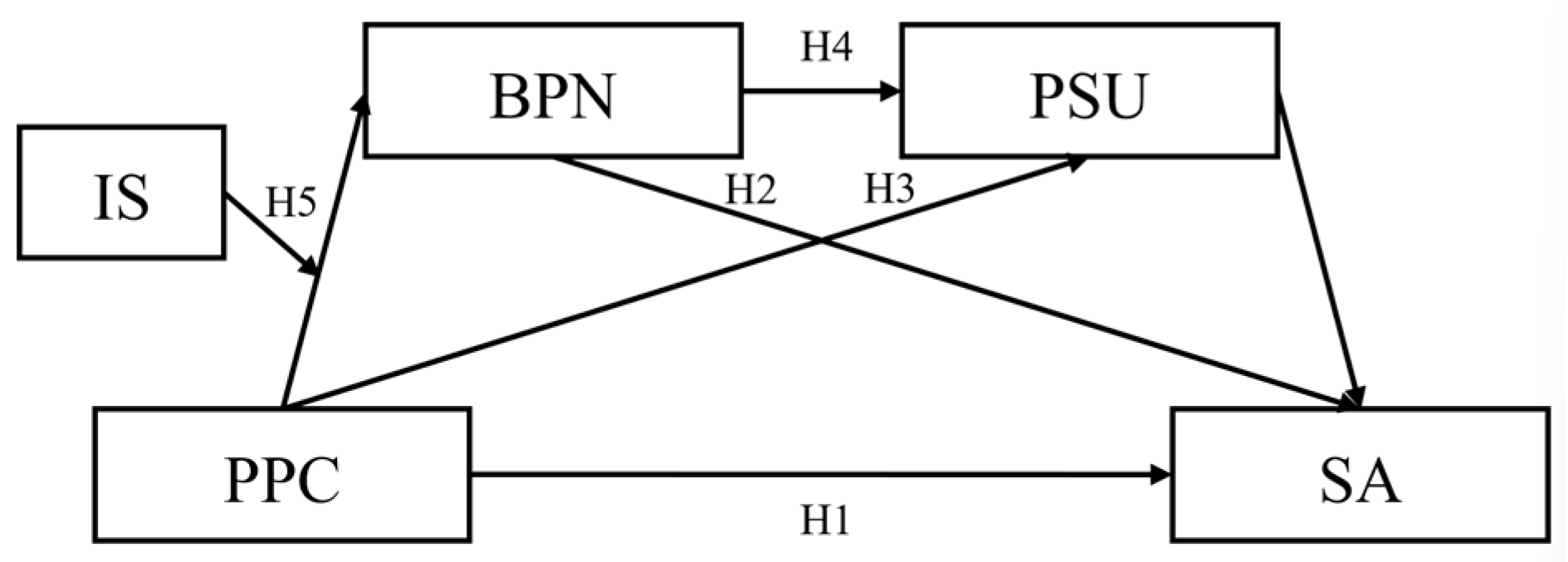
1.6. The Present Study
2. Methods
2.1. Participants
2.2. Measures
2.2.1. Parental Psychological Control Scale (PPCS)
2.2.2. Basic Psychological Needs Scale (BPNS)
2.2.3. Smartphone Addiction Scale (SAS)
2.2.4. Social Avoidance and Distress Scale (SADS)
2.2.5. Interpersonal Sensitivity Scale (ISS)
2.3. Data Analysis
3. Results
3.1. Common Method Bias Test
3.2. Descriptive Statistics and Correlation Analysis
3.3. Mediation Effect Analysis
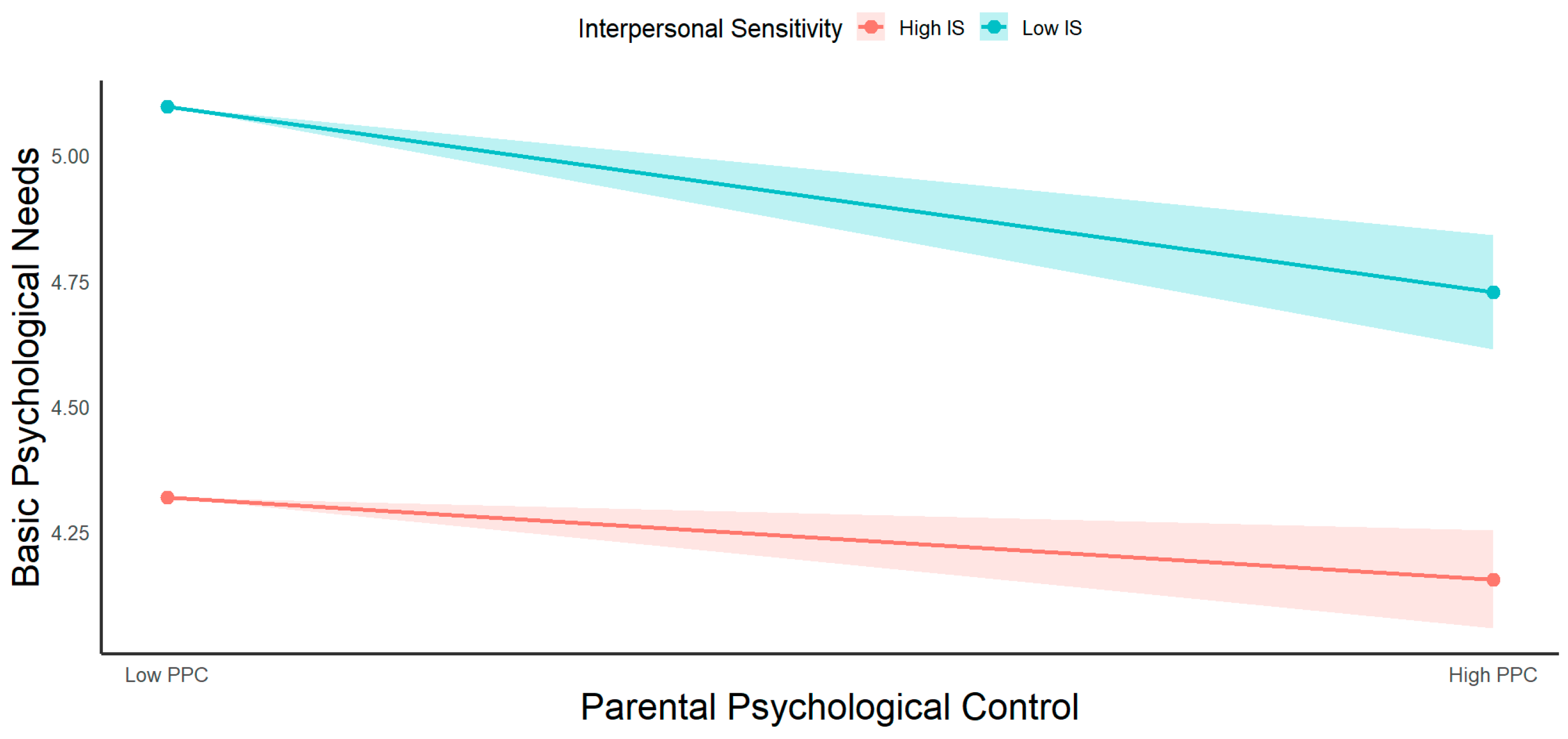
3.4. Moderation Effect Analysis
4. Discussion
4.1. The Effect of Parental Psychological Control on Social Avoidance
4.2. The Mediating Roles of Basic Psychological Needs and Problematic Smartphone Use
4.3. The Moderating Role of Interpersonal Sensitivity
4.4. Implications and Limitations
5. Conclusions
Author Contributions
Funding
Institutional Review Board Statement
Informed Consent Statement
Data Availability Statement
Acknowledgments
Conflicts of Interest
References
- Abu Khait, A., Menger, A., Al-Atiyyat, N., Hamaideh, S. H., Al-Modallal, H., & Rayapureddy, H. (2024). The association between proneness to smartphone addiction and social anxiety among school students and the mediating role of social support: A call to advance Jordanian adolescents’ mental health. Journal of the American Psychiatric Nurses Association, 31(2), 183–196. [Google Scholar] [CrossRef] [PubMed]
- Assor, A., Roth, G., & Deci, E. L. (2004). The emotional costs of parents’ conditional regard: A self-determination theory analysis. Journal of Personality, 72(1), 47–88. [Google Scholar] [CrossRef] [PubMed]
- Barber, B. K. (1996). Parental psychological control: Revisiting a neglected construct. Child Development, 67(6), 3296–3319. [Google Scholar] [CrossRef] [PubMed]
- Bernieri, F. J. (2001). Toward a taxonomy of interpersonal sensitivity. In J. A. Hall, & F. J. Bernieri (Eds.), Interpersonal sensitivity (pp. 17–34). Psychology Press. [Google Scholar]
- Billieux, J. (2012). Problematic use of the mobile phone: A literature review and a pathways model. Current Psychiatry Reviews, 8(4), 299–307. [Google Scholar] [CrossRef]
- Bowlby, J. (1982). Attachment and loss: Retrospect and prospect. American Journal of Orthopsychiatry, 52(4), 664–678. [Google Scholar] [CrossRef]
- Boyce, P., & Parker, G. (1989). Development of a scale to measure interpersonal sensitivity. Australian and New Zealand Journal of Psychiatry, 23(3), 341–351. [Google Scholar] [CrossRef]
- Bronfenbrenner, U. (1979). The ecology of human development: Experiments by nature and design. Harvard University Press. [Google Scholar]
- Butkovic, A., Tomas, J., Spanic, A. M., Hlupic, T. V., & Bratko, D. (2020). Emerging adults versus middle-aged adults: Do they differ in psychological needs, self-esteem, and life satisfaction? Journal of Happiness Studies, 21(3), 779–798. [Google Scholar] [CrossRef]
- Celikkaleli, O., & Ata, R. (2025). The effect of basic need dissatisfaction and lack of social support on problematic Internet use in emerging adults: The mediating role of regulatory emotional self-efficacy. Acta Psychologica, 254, 104857. [Google Scholar] [CrossRef]
- Chao, R. K. (1994). Beyond parental control and authoritarian parenting style: Understanding Chinese parenting through the cultural notion of training. Child Development, 65(4), 1111–1119. [Google Scholar] [CrossRef]
- Chen, P., Zhang, J., Li, H., & Fu, M. (2021). Relationships between parenting behaviors and adolescents’ creativity in China: The mediating role of autonomous motivation. The Journal of Psychology, 155(5), 457–472. [Google Scholar] [CrossRef]
- Cheng, S., Bi, R. X., & Wang, J. L. (2021). More than 80% of college students interviewed believe they have mild social anxiety. China Youth Daily, 011. [Google Scholar] [CrossRef]
- Chyung, Y. J., Lee, Y. A., Ahn, S. J., & Bang, H. S. (2022). Associations of perceived parental psychological control with depression, anxiety in children and adolescents: A meta-analysis. Marriage & Family Review, 58(2), 158–197. [Google Scholar]
- Costa, S., Cuzzocrea, F., Gugliandolo, M. C., & Larcan, R. (2015). Associations between parental psychological control and autonomy support, and psychological outcomes in adolescents: The mediating role of need satisfaction and need frustration. Child Indicators Research, 8(4), 861–878. [Google Scholar] [CrossRef]
- Deci, E. L., & Ryan, R. M. (2012). Motivation, personality, and development within embedded social contexts: An overview of self-determination theory. The Oxford Handbook of Human Motivation, 18(6), 85–107. [Google Scholar]
- De Paoli, T., Fuller-Tyszkiewicz, M., & Krug, I. (2017). Insecure attachment and maladaptive schema in disordered eating: The mediating role of rejection sensitivity. Clinical Psychology & Psychotherapy, 24(6), 1273–1284. [Google Scholar] [CrossRef]
- Feldman, S., & Downey, G. (1994). Rejection sensitivity as a mediator of the impact of childhood exposure to family violence on adult attachment behavior. Development and Psychopathology, 6(1), 231–247. [Google Scholar] [CrossRef]
- Gagné, M. (2003). The role of autonomy support and autonomy orientation in prosocial behavior engagement. Motivation and Emotion, 27(3), 199–223. [Google Scholar] [CrossRef]
- Gazelle, H., & Rubin, K. H. (2019). Social withdrawal and anxiety in childhood and adolescence: Interaction between individual tendencies and interpersonal learning mechanisms in development: Introduction to the special issue. Journal of Abnormal Child Psychology, 47(7), 1101–1106. [Google Scholar] [CrossRef]
- Hall, J. A., Andrzejewski, S. A., & Yopchick, J. E. (2009). Psychosocial correlates of interpersonal sensitivity: A meta-analysis. Journal of Nonverbal Behavior, 33(3), 149–180. [Google Scholar] [CrossRef]
- Kaibin, Z., Yu, L., Yiming, S., Dandan, B., Chu, Z., Ruijun, C., & Zheng, J. (2025). Mobile phone addiction and interpersonal problems among Chinese young adults: The mediating roles of social anxiety and loneliness. BMC Psychology, 13(1), 372. [Google Scholar] [CrossRef]
- Kardefelt-Winther, D. (2014). A conceptual and methodological critique of internet addiction research: Towards a model of compensatory internet use. Computers in Human Behavior, 31(1), 351–354. [Google Scholar] [CrossRef]
- Kim, J., & Cicchetti, D. (2010). Longitudinal pathways linking child maltreatment, emotion regulation, peer relations, and psychopathology. Journal of Child Psychology and Psychiatry, 51(6), 706–716. [Google Scholar] [CrossRef] [PubMed]
- Kim, J. H. (2018). Psychological issues and problematic use of smartphone: ADHD’s moderating role in the associations among loneliness, need for social assurance, need for immediate connection, and problematic use of smartphone. Computers in Human Behavior, 80, 390–398. [Google Scholar] [CrossRef]
- Kou, D. X., & Wang, X. Y. (2023). The effect of power on interpersonal sensitivity. Advances in Psychological Science, 31(1), 108. [Google Scholar] [CrossRef]
- Kurker, F., & Surucu, A. (2024). Social media addiction mediates the relationship between basic psychological needs satisfaction and academic procrastination. Psychology in the Schools, 61(7), 2701–2721. [Google Scholar] [CrossRef]
- Kwon, M., Lee, J. Y., Won, W. Y., Park, J. W., Min, J. A., Hahn, C., Gu, X., Choi, J. H., & Kim, D. J. (2013). Development and validation of a smartphone addiction scale (SAS). PLoS ONE, 8(2), e56936. [Google Scholar] [CrossRef]
- La Guardia, J. G., Ryan, R. M., Couchman, C. E., & Deci, E. L. (2000). Within-person variation in security of attachment: A self-determination theory perspective on attachment, need fulfillment, and well-being. Journal of Personality and Social Psychology, 79(3), 367–384. [Google Scholar] [CrossRef]
- Lemieux, R., Lajoie, S., & Trainor, N. E. (2013). Affinity-seeking, social loneliness, and social avoidance among Facebook users. Psychological Reports, 112(2), 545–552. [Google Scholar] [CrossRef]
- Li, Q., & Wang, H. (2019). The effects of social pressure and decision maker’role on helping decision-making among persons with different interpersonal sensitivity. Journal of Psychological Science, 42(3), 626–632. [Google Scholar]
- Li, X., Li, D., & Newman, J. (2013). Parental behavioral and psychological control and problematic Internet use among Chinese adolescents: The mediating role of self-control. Cyberpsychology, Behavior, and Social Networking, 16(6), 442–447. [Google Scholar] [CrossRef]
- Lian, L., You, X., Huang, J., & Yang, R. (2016). Who overuses smartphones? Roles of virtues and parenting style in smartphone addiction among Chinese college students. Computers in Human Behavior, 65, 92–99. [Google Scholar] [CrossRef]
- Liu, J. S., Lin, L. L., Lv, Y., Wei, C. B., Zhou, Y., & Chen, X. Y. (2013). Reliability and validity of the Chinese version of the basic psychological needs scale. Chinese Mental Health Journal, 27(10), 791–795. [Google Scholar]
- Liu, X., Cui, L., Wu, H., Liu, B., & Yang, Y. (2022a). Profiles and transition of mental health problems among Chinese adolescents: The predictive role of friendship quality, parental autonomy support, and psychological control. Journal of Adolescence, 94(1), 19–33. [Google Scholar] [CrossRef]
- Liu, X., Lu, H., Zhou, Z., Chao, M., & Liu, T. (2022b). Development of a computerized adaptive test for problematic mobile phone use. Frontiers in Psychology, 13, 892387. [Google Scholar] [CrossRef] [PubMed]
- Liu, Y., Liu, R. D., Ding, Y., Wang, J., Zhen, R., & Xu, L. (2016). How online basic psychological need satisfaction influences self-disclosure online among Chinese adolescents: Moderated mediation effect of exhibitionism and narcissism. Frontiers in Psychology, 7, 1279. [Google Scholar] [CrossRef]
- Loeb, E. L., Kansky, J., Tan, J. S., Costello, M. A., & Allen, J. P. (2021). Perceived psychological control in early adolescence predicts lower levels of adaptation into mid-adulthood. Child Development, 92(2), e158–e172. [Google Scholar] [CrossRef]
- Man, D. H., Li, Y. J., & Zhang, J. H. (2015). Relationship between parental control, self-esteem and primary school student’s social creativity. Studies of Psychology and Behavior, 13(1), 81–86. [Google Scholar]
- Marian, M. (2013). Social-cognitive predictors of interpersonal sensitivity. Journal of Psychological and Educational Research (JPER), 21(2), 97–106. [Google Scholar]
- Meshi, D., Tamir, D. I., & Heekeren, H. R. (2015). The emerging neuroscience of social media. Trends in Cognitive Sciences, 19(12), 771–782. [Google Scholar] [CrossRef]
- Monroe, S. M., & Simons, A. D. (1991). Diathesis-stress theories in the context of life stress research: Implications for the depressive disorders. Psychological Bulletin, 110(3), 406. [Google Scholar] [CrossRef]
- Ng, F. F. Y., Pomerantz, E. M., & Deng, C. (2014). Why are Chinese mothers more controlling than American mothers? “My child is my report card”. Child Development, 85(1), 355–369. [Google Scholar] [CrossRef] [PubMed]
- Parent, N. (2023). Basic need satisfaction through social media engagement: A developmental framework for understanding adolescent social media use. Human Development, 67(1), 1–17. [Google Scholar] [CrossRef]
- Peng, C., Wang, L. X., Guo, Z., Sun, P., Yao, X., Yuan, M., & Kou, Y. (2024). Bidirectional longitudinal associations between parental psychological control and peer victimization among Chinese adolescents: The mediating role of basic psychological need satisfaction. Journal of Youth and Adolescence, 53(4), 967–981. [Google Scholar] [CrossRef]
- Peng, C. Z., Fan, X. L., & Li, L. C. (2003). The validity and reliability of social avoidance and distress scale in Chinese students. Chinese Journal of Clinical Psychology, 11(4), 279–281. [Google Scholar]
- Ryan, R. M., Duineveld, J. J., Di Domenico, S. I., Ryan, W. S., Steward, B. A., & Bradshaw, E. L. (2022). We know this much is (meta-analytically) true: A meta-review of meta-analytic findings evaluating self-determination theory. Psychological Bulletin, 148(11–12), 813. [Google Scholar] [CrossRef]
- Salaam, B., & Kyere, E. (2025). Parental psychological control and youths’ internalizing symptoms in majority world contexts: A meta-analysis. Journal of Family Psychology, 39(5), 561–581. [Google Scholar] [CrossRef]
- Sanchez-Fernandez, M., & Borda-Mas, M. (2023). Problematic smartphone use and specific problematic Internet uses among university students and associated predictive factors: A systematic review. Education and Information Technologies, 28(6), 7111–7204. [Google Scholar] [CrossRef]
- Shang, A., Feng, L., Yan, G., & Sun, L. (2025). The relationship between self-esteem and social avoidance among university students: Chain mediating effects of resilience and social distress. BMC Psychology, 13(1), 116. [Google Scholar] [CrossRef]
- Snodgrass, S. E. (1985). Women’s intuition: The effect of subordinate role on interpersonal sensitivity. Journal of Personality and Social Psychology, 49(1), 146–155. [Google Scholar] [CrossRef]
- Soenens, B., Elliot, A. J., Goossens, L., Vansteenkiste, M., Luyten, P., & Duriez, B. (2005). The intergenerational transmission of perfectionism: Parents’ psychological control as an intervening variable. Journal of Family Psychology, 19(3), 358–366. [Google Scholar] [CrossRef] [PubMed]
- Soenens, B., & Vansteenkiste, M. (2010). A theoretical upgrade of the concept of parental psychological control: Proposing new insights on the basis of self-determination theory. Developmental Review, 30(1), 74–99. [Google Scholar] [CrossRef]
- Soenens, B., Vansteenkiste, M., & Van Petegem, S. (2015). Let us not throw out the baby with the bathwater: Applying the principle of universalism without uniformity to autonomy-supportive and controlling parenting. Child Development Perspectives, 9(1), 44–49. [Google Scholar] [CrossRef]
- Tan, T., Zhong, Y., & Zhang, J. (2025). A study on the current situation and influencing factors of college students’ social barriers: A case study of a university in Beijing. Youth of The Time, (8), 123–125. Available online: https://kns.cnki.net/kcms2/article/abstract?v=zYSMMY9t1se0YzgBV2F9wL5WcDyC0wyuWgRN_UmEV3wGSsKepet3NvKCGEELpDY_zGocGgfRafovBuT-UOrFY8TyuacdYuOhxThu-uFE50EMmprNrYNnR-9jpz_8apeTAq3UnxxbDrEeP-xF6iz1-dTYZ-71z754SYaJ0N4eO8JOe26EfHx8pg==&uniplatform=NZKPT&language=CHS (accessed on 15 November 2021).
- Triandis, H. C. (1995). Individualism and collectivism. Westview Press. [Google Scholar]
- Tu, Y., Su, Y., Yang, K., Jin, L., Li, B., Chen, W., Yuan, Y., & Wu, D. (2025). The role of depression and interpersonal trust between anxiety and social avoidance among college students: A structural equation model. Current Psychology, 44(5), 3420–3431. [Google Scholar] [CrossRef]
- Van Ingen, D. J., Freiheit, S. R., Steinfeldt, J. A., Moore, L. L., Wimer, D. J., Knutt, A. D., Scapinello, S., & Roberts, A. (2015). Helicopter parenting: The effect of an overbearing caregiving style on peer attachment and self-efficacy. Journal of College Counseling, 18(1), 7–20. [Google Scholar] [CrossRef]
- Vansteenkiste, M., & Ryan, R. M. (2013). On psychological growth and vulnerability: Basic psychological need satisfaction and need frustration as a unifying principle. Journal of Psychotherapy Integration, 23(3), 263–280. [Google Scholar] [CrossRef]
- Wang, J., Li, L., Wu, Q., Zhang, N., Shangguan, R., & Yang, G. (2025). Effects of parental psychological control on mobile phone addiction among college students: The mediation of loneliness and the moderation of physical activity. BMC Psychology, 13(1), 60. [Google Scholar] [CrossRef]
- Wang, Q., Pomerantz, E. M., & Chen, H. (2007). The role of parents’ control in early adolescents’ psychological functioning: A longitudinal investigation in the United States and China. Child Development, 78(5), 1592–1610. [Google Scholar] [CrossRef]
- Watson, D., & Friend, R. (1969). Measurement of social-evaluative anxiety. Journal of Consulting and Clinical Psychology, 33(4), 448–457. [Google Scholar] [CrossRef]
- Wei, J., Dang, J., Mi, Y., & Zhou, M. (2024). Mobile phone addiction and social anxiety among Chinese adolescents: Mediating role of interpersonal problems. Anales de Psicología/Annals of Psychology, 40(1), 103–109. [Google Scholar] [CrossRef]
- Wong, T. Y., Yuen, K. S., & Li, W. O. (2015). A basic need theory approach to problematic Internet use and the mediating effect of psychological distress. Frontiers in Psychology, 5, 1562. [Google Scholar] [CrossRef]
- Xiang, M. Q., Wang, Z. R., & Ma, B. (2019). Reliability and validity of Chinese version of the smartphone addiction scale in adolescents. Chinese Journal of Clinical Psychology, 27(5), 959–964. [Google Scholar]
- Yan, F., Zhang, Q., Ran, G., Li, S., & Niu, X. (2020). Relationship between parental psychological control and problem behaviours in youths: A three-level meta-analysis. Children and Youth Services Review, 112, 104900. [Google Scholar] [CrossRef]
- Yang, C., Huebner, E. S., & Tian, L. (2024). Longitudinal associations among basic psychological need satisfaction at school, self-esteem, and suicidal ideation from middle childhood to early adolescence: Disentangling between-and within-person associations. Journal of Adolescence, 96(7), 1590–1602. [Google Scholar] [CrossRef] [PubMed]
- Yeh, Y. C., Ko, H. C., Wu, J. Y. W., & Cheng, C. P. (2008). Gender differences in relationships of actual and virtual social support to internet addiction mediated through depressive symptoms among college students in Taiwan. Cyberpsychology & Behavior, 11(4), 485–487. [Google Scholar]
- Yuan, Y., Jiang, S., Yan, S., Chen, L., Zhang, M., Zhang, J., Luo, L., Jeong, J., Lv, Y., & Jiang, K. (2022). The relationship between depression and social avoidance of college students: A moderated mediation model. Journal of Affective Disorders, 300, 249–254. [Google Scholar] [CrossRef]
- Zhang, X., Li, J., Xie, F., Chen, X., Xu, W., & Hudson, N. W. (2022). The relationship between adult attachment and mental health: A meta-analysis. Journal of Personality and Social Psychology, 123(5), 1089. [Google Scholar] [CrossRef]
- Zhang, X., Yao, R., Wang, X., Liu, Q., Han, Y., Gao, F., Du, H. Y., Zhu, X. Z., & Fan, J. (2024). The effect of adolescent life events on internet addiction: The mediating effect of maladaptive cognitive emotion regulation strategies and obsessive-compulsive symptoms. Chinese Journal of Clinical Psychology, 32(5), 977–981, 1006. [Google Scholar]
- Zhou, J., Zou, F., & Gong, X. (2024). The reciprocal relations between parental psychological control and social anxiety and the mediating role of self-concept clarity among Chinese early adolescents. Journal of Youth and Adolescence, 53(10), 2363–2377. [Google Scholar] [CrossRef]
- Zhu, J., Liu, M., Shu, X., Xiang, S., Jiang, Y., & Li, Y. (2022). The moderating effect of marital conflict on the relationship between social avoidance and socio-emotional functioning among young children in suburban China. Frontiers in Psychology, 13, 1009528. [Google Scholar] [CrossRef]



| Variable | M | SD | Min | Max | Skewness | Kurtosis | 1 | 2 | 3 | 4 | 5 |
|---|---|---|---|---|---|---|---|---|---|---|---|
| 1. PPC | 2.36 | 0.81 | 1.00 | 5.00 | 0.595 | −0.039 | 1 | ||||
| 2. SA | 3.17 | 0.69 | 1.04 | 5.00 | −0.114 | 0.103 | 0.212 *** | 1 | |||
| 3. BPN | 4.59 | 0.81 | 1.16 | 6.89 | 0.193 | 0.288 | −0.304 *** | −0.596 *** | 1 | ||
| 4. PSU | 3.46 | 0.80 | 1.16 | 6.00 | 0.198 | 0.390 | 0.328 *** | 0.282 *** | −0.345 *** | 1 | |
| 5. IS | 2.68 | 0.49 | 1.05 | 4.00 | 0.079 | 0.262 | 0.358 *** | 0.498 *** | −0.493 *** | 0.482 *** | 1 |
| Regression Equation | Overall Fit Indices | Significance of Regression Coefficients | |||||
|---|---|---|---|---|---|---|---|
| Outcome Variable | Predictors | R2 | F | β | Boot LLCI | Boot ULCI | t |
| BPN | Gender | 0.094 | 48.559 *** | 0.060 | −0.021 | 0.141 | 1.462 |
| Age | 0.004 | −0.034 | 0.042 | 0.193 | |||
| PPC | −0.300 | −0.349 | −0.250 | −11.923 *** | |||
| PSU | Gender | 0.186 | 80.153 *** | 0.136 | 0.059 | 0.212 | 3.486 *** |
| Age | 0.053 | 0.017 | 0.089 | 2.890 ** | |||
| PPC | 0.246 | 0.197 | 0.294 | 9.869 *** | |||
| BPN | −0.272 | −0.322 | −0.223 | −10.842 *** | |||
| SA | Gender | 0.366 | 162.283 *** | 0.084 | 0.026 | 0.142 | 2.820 ** |
| Age | −0.001 | −0.029 | 0.026 | −0.090 | |||
| PPC | 0.013 | −0.025 | 0.052 | 0.675 | |||
| BPN | −0.486 | −0.526 | −0.447 | −24.450 *** | |||
| PSU | 0.066 | 0.027 | 0.106 | 3.276 ** | |||
| Path | Effect | Percentage of Total Effect | Lower Limit of 95% CI | Upper Limit of 95% CI |
|---|---|---|---|---|
| Total effect | 0.181 | 0.137 | 0.224 | |
| Direct effect | 0.013 | 7.182% | −0.025 | 0.052 |
| Total indirect effect | 0.168 | 92.818% | 0.136 | 0.199 |
| PPC → BPN → SA | 0.146 | 80.663% | 0.118 | 0.179 |
| PPC → PSU → SA | 0.016 | 8.840% | 0.005 | 0.028 |
| PPC → BPN → PSU → SA | 0.005 | 2.762% | 0.002 | 0.01 |
| Regression Equation | Overall Fit Indices | Significance of Regression Coefficients | |||||
|---|---|---|---|---|---|---|---|
| Outcome Variable | Predictors | R2 | F | β | Boot LLCI | Boot ULCI | t |
| BPN | Gender | 0.268 | 103.303 *** | 0.068 | −0.005 | 0.141 | 1.837 |
| Age | −0.007 | −0.041 | 0.028 | −0.379 | |||
| PPC | −0.155 | −0.203 | −0.107 | −6.318 *** | |||
| IS | −0.712 | −0.794 | −0.634 | −17.874 *** | |||
| PPC × IS | 0.126 | 0.04 | 0.207 | 3.024 ** | |||
| PSU | Gender | 0.186 | 80.153 *** | 0.136 | 0.059 | 0.212 | 3.486 ** |
| Age | 0.053 | 0.017 | 0.089 | 2.890 ** | |||
| PPC | 0.246 | 0.197 | 0.294 | 9.869 *** | |||
| BPN | −0.272 | −0.322 | −0.223 | −10.842 *** | |||
| SA | Gender | 0.366 | 162.283 *** | 0.084 | 0.026 | 0.142 | 2.820 ** |
| Age | −0.001 | −0.029 | 0.026 | −0.090 | |||
| PPC | 0.013 | −0.025 | 0.052 | 0.675 | |||
| BPN | −0.486 | −0.526 | −0.447 | −24.450 *** | |||
| PSU | 0.066 | 0.027 | 0.106 | 3.276 ** | |||
Disclaimer/Publisher’s Note: The statements, opinions and data contained in all publications are solely those of the individual author(s) and contributor(s) and not of MDPI and/or the editor(s). MDPI and/or the editor(s) disclaim responsibility for any injury to people or property resulting from any ideas, methods, instructions or products referred to in the content. |
© 2025 by the authors. Licensee MDPI, Basel, Switzerland. This article is an open access article distributed under the terms and conditions of the Creative Commons Attribution (CC BY) license.
Share and Cite
Ye, P.; Zhang, L.; Li, Y.; Lu, F.; Bian, Y. The Effect of Parental Psychological Control on Real-Life Social Avoidance in College Students: A Moderated Chain Mediation Model. Behav. Sci. 2026, 16, 34. https://doi.org/10.3390/bs16010034
Ye P, Zhang L, Li Y, Lu F, Bian Y. The Effect of Parental Psychological Control on Real-Life Social Avoidance in College Students: A Moderated Chain Mediation Model. Behavioral Sciences. 2026; 16(1):34. https://doi.org/10.3390/bs16010034
Chicago/Turabian StyleYe, Panqin, Lin Zhang, Yan Li, Furong Lu, and Yufang Bian. 2026. "The Effect of Parental Psychological Control on Real-Life Social Avoidance in College Students: A Moderated Chain Mediation Model" Behavioral Sciences 16, no. 1: 34. https://doi.org/10.3390/bs16010034
APA StyleYe, P., Zhang, L., Li, Y., Lu, F., & Bian, Y. (2026). The Effect of Parental Psychological Control on Real-Life Social Avoidance in College Students: A Moderated Chain Mediation Model. Behavioral Sciences, 16(1), 34. https://doi.org/10.3390/bs16010034