The Impact of Societal Ageing on Individual Consumers’ Insurance Purchase Intentions: A Review and Research Agenda


Abstract
1. Introduction
2. Methodology
2.1. Search Strategy
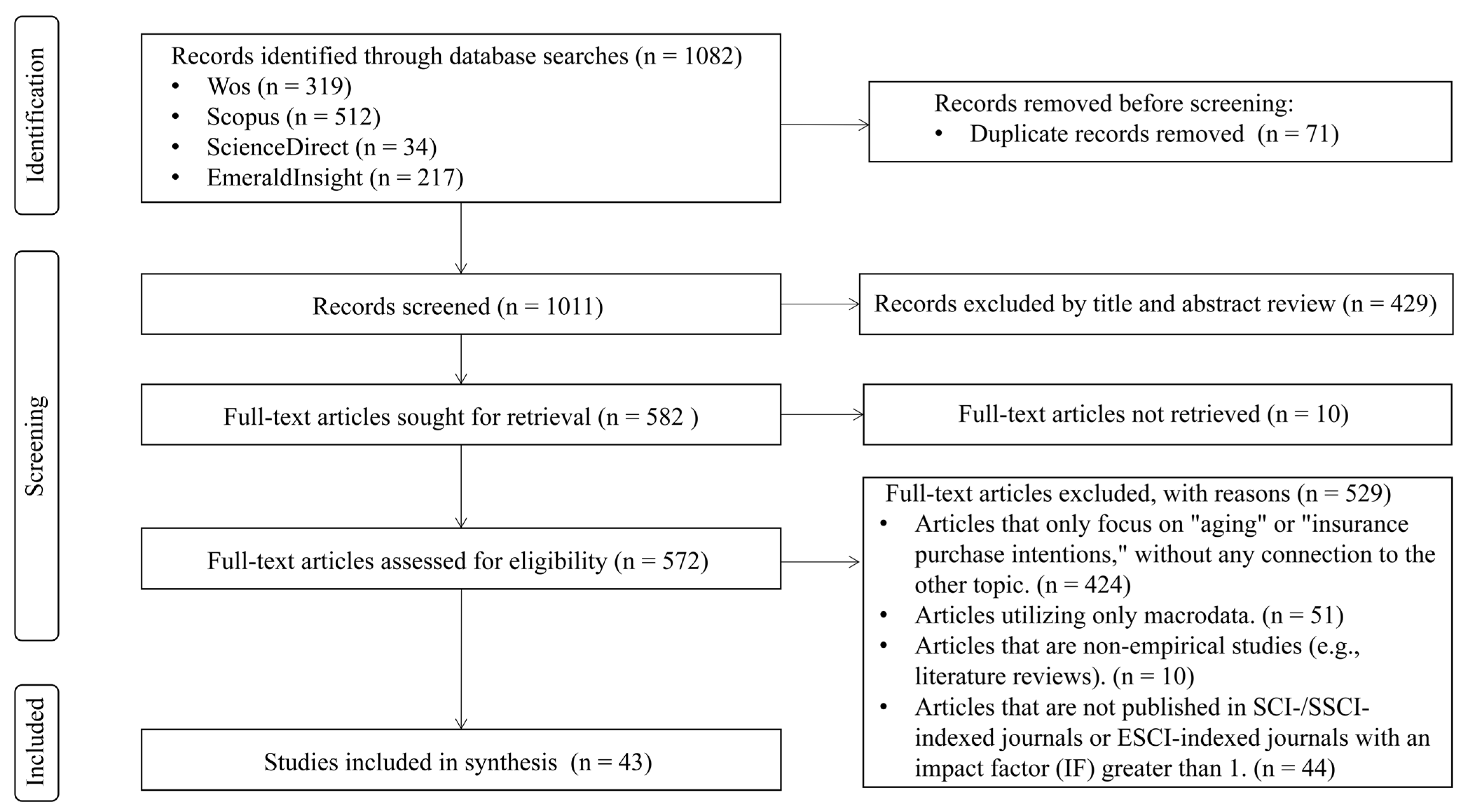
2.2. Study Selection
2.3. Data Extraction and Synthesis
3. Results Based on TCCM Framework
3.1. Theories
3.2. Contexts
3.3. Characteristics
3.3.1. Subject’s Age
3.3.2. Antecedents Related to Ageing
3.3.3. Corresponding Decision
3.4. Methods
3.5. Updated Evidence from the Top-Up Search
4. Discussion of Key Aspects
4.1. Lack of Direct Integration of Ageing into Insurance Research
4.2. Overemphasis on Elderly Consumers While Neglecting Non-Elderly Populations
4.3. Fragmented Use of Ageing-Related Variables Without Conceptual Clarity
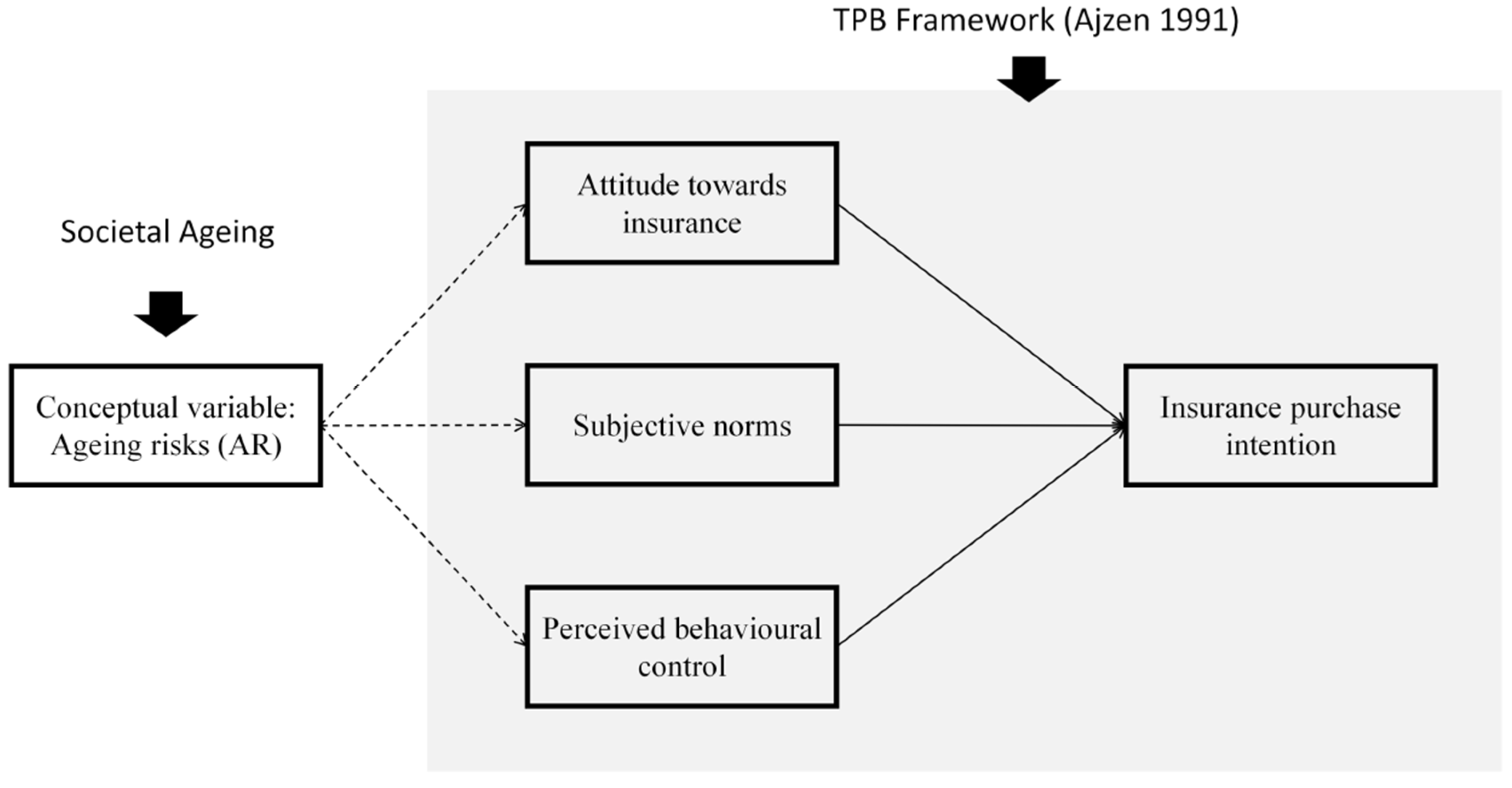
5. Conceptual Framework: The Role of Societal Ageing in Insurance Purchase Intentions
6. Future Research Directions
7. Conclusions
Supplementary Materials
Author Contributions
Funding
Institutional Review Board Statement
Informed Consent Statement
Data Availability Statement
Acknowledgments
Conflicts of Interest
Appendix A. Updated Evidence from the November 2025 Top-Up Search
| No. | Article |
| 1 | Chen, Y., & Zhao, H. (2023). Long-term care insurance, mental health of the elderly and its spillovers. Frontiers in public health, 11, 982656. https://doi.org/10.3389/fpubh.2023.982656 |
| 2 | Cheng, B., Li, J., Han, Y., Zhang, T., Huang, J., & Chen, H. (2023). A qualitative investigation of barriers and facilitators involved in the implementation of endowment insurance in China’s construction industry. Buildings, 13(4), 1063. https://doi.org/10.3390/buildings13041063 |
| 3 | Gousia, K. (2023). Cognitive abilities and long-term care insurance: Evidence from European data. The Geneva Papers on Risk and Insurance-Issues and Practice, 48(1), 68–101. https://doi.org/10.1057/s41288-021-00240-8 |
| 4 | Blanchard, S. J., & Trudel, R. (2024). Life insurance, loss aversion, and temporal orientation: a field experiment and replication with young adults. Marketing Letters, 35(4), 575–587. https://doi.org/10.1007/s11002-023-09712-4 |
| 5 | Chen, X., Guo, Y., Lu, C., Wang, Y., & Wen, H. (2024). Does subjective life expectancy matter in purchasing life insurance among middle-aged and older adult? Evidence from China. Frontiers in Public Health, 12, 1426366. https://doi.org/10.3389/fpubh.2024.1426366 |
| 6 | Jin, W., Wang, J., & Hu, X. (2024). Preference of urban and rural older people in Shandong Province for long-term care insurance: based on discrete choice experiment. Frontiers in Public Health, 12, 1445273. https://doi.org/10.3389/fpubh.2024.1445273 |
| 7 | Long, Z., Niu, J., & Yi, F. (2024). Driving factors and micro-mechanism of residents’ participation intention in individual pension system. Heliyon, 10(2). https://doi.org/10.1016/j.heliyon.2024.e24488 |
| 8 | Barman, P., Karmakar, R., Roy, A., & Dakua, M. (2025). Mass Media Exposure Moderates the Association of Education and Wealth with Enrollment in Health Insurance Among Older Adults Aged 60 Years and Older in India. Journal of Aging & Social Policy, 37(3), 451–475. https://doi.org/10.1080/08959420.2024.2401713 |
| 9 | Ci, Z. (2025). Children as insurance revisited: Impact of children on private insurance adoption among older parents. Journal of Risk and Insurance, 92(1), 116–138. https://doi.org/10.1111/jori.12492 |
| 10 | Feng, C., Ying, Z., Yang, L., Wu, L., & Liu, B. (2025). How do children’s cohabitation and family asset reserves impact rural individuals’ participation in commercial pension insurance?. Frontiers in Public Health, 13, 1548241. https://doi.org/10.3389/fpubh.2025.1548241 |
| 11 | Han, B., Liu, C., & Ling, W. (2025). Impact of financial literacy and awareness of children’s pension responsibilities on the willingness to purchase pension insurance: Evidence based on survey data (CLASS). Finance Research Letters, 76, 107015. https://doi.org/10.1016/j.frl.2025.107015 |
| 12 | Liu, J., Hao, J., Maitland, E., Nicholas, S., Wang, J., & Leng, A. (2025). Shaping Long-term Care Insurance Intentions Among Chinese Adults Aged 50–70: Role of Information Interventions in Health Risks. Innovation in Aging, igaf054. https://doi.org/10.1093/geroni/igaf054 |
| 13 | Zheng, Z., Hafizuddin-Syah, B. A. M., Zaki, H. O., & Tan, Q. L. (2025). From Aging Risks to Insurance Purchase Intentions: A Cross-Cultural Integration of Social Influence and Planned Behavior Theories. Journal of Consumer Behaviour. https://doi.org/10.1002/cb.70070 |
| 14 | Zhou, L., Zhu, W., Cui, Y., Chen, Y., & Xu, X. (2025). Research on the impact of residents’ pension insurance choices based on their cognition of pension responsibility. Frontiers in Public Health, 13, 1592206. https://doi.org/10.3389/fpubh.2025.1592206 |
References
- Adnand, F. E. M., Rose, R. A. C., Aiyub, K., Lyndon, N., & Hussain, M. Y. (2021). Health awareness affecting ageing trend in Kuala Lumpur. Geografia, 17(3), 221–233. [Google Scholar] [CrossRef] [Scilit]
- Ajzen, I. (1985). From intentions to actions: A theory of planned behavior. In Action control: From cognition to behavior (pp. 11–39). Springer. [Google Scholar] [CrossRef] [Scilit]
- Ajzen, I. (1991). The theory of planned behavior. Organizational Behavior and Human Decision Processes, 50(2), 179–211. [Google Scholar] [CrossRef] [Scilit]
- Alavi, K., Sail, R. M., Idris, K., & Abu Samah, A. (2010). Experiences of adult children caring for aged parents: A study among low income urban Malay. Akademik, 78(1), 77–87. [Google Scholar]
- Al Mamun, A., Rahman, M. K., Yang, Q., Jannat, T., Salameh, A. A., & Fazal, S. A. (2022). Predicting the willingness and purchase of travel insurance during the COVID-19 pandemic. Frontiers in Public Health, 10, 907005. [Google Scholar] [CrossRef] [Scilit]
- Ampaw, S., Nketiah-Amponsah, E., & Owoo, N. S. (2018). Gender perspective on life insurance demand in Ghana. International Journal of Social Economics, 45(12), 1631–1646. [Google Scholar] [CrossRef] [Scilit]
- Aziz, S., Husin, M. M., Hussin, N., & Afaq, Z. (2019). Factors that influence individuals’ intentions to purchase family takaful mediating role of perceived trust. Asia Pacific Journal of Marketing and Logistics, 31(1), 81–104. [Google Scholar] [CrossRef] [Scilit]
- Baharin, R., & Saad, S. (2018). Ageing population and health care expenditure: Evidence using time series analysis. Geografia, 14(4), 65–73. [Google Scholar] [CrossRef] [Scilit]
- Bangaan Abdullah, H. S., Yakob, R., Yakob, S., & Sharif, N. S. (2022). Indicators of having a micro-family takaful plan amongst low-income earners. Journal of Islamic Marketing, 13(12), 2695–2716. [Google Scholar] [CrossRef] [Scilit]
- Barman, P., Karmakar, R., Roy, A., & Dakua, M. (2025). Mass media exposure moderates the association of education and wealth with enrollment in health insurance among older adults aged 60 years and older in India. Journal of Aging & Social Policy, 37(3), 451–475. [Google Scholar] [CrossRef] [Scilit]
- Basu, R., Paul, J., & Singh, K. (2022). Visual merchandising and store atmospherics: An integrated review and future research directions. Journal of Business Research, 151, 397–408. [Google Scholar] [CrossRef] [Scilit]
- Blanchard, S. J., & Trudel, R. (2024). Life insurance, loss aversion, and temporal orientation: A field experiment and replication with young adults. Marketing Letters, 35(4), 575–587. [Google Scholar] [CrossRef] [Scilit]
- Broyles, I. H., Sperber, N. R., Voils, C. I., Konetzka, R. T., Coe, N. B., & Van Houtven, C. H. (2016). Understanding the context for long-term care planning. Medical Care Research and Review, 73(3), 349–368. [Google Scholar] [CrossRef] [Scilit]
- Charrois, T. L. (2015). Systematic reviews: What do you need to know to get started? The Canadian Journal of Hospital Pharmacy, 68(2), 144. [Google Scholar] [CrossRef] [Scilit]
- Chen, X., Guo, Y., Lu, C., Wang, Y., & Wen, H. (2024). Does subjective life expectancy matter in purchasing life insurance among middle-aged and older adult? Evidence from China. Frontiers in Public Health, 12, 1426366. [Google Scholar] [CrossRef] [Scilit]
- Chen, Y., & Zhao, H. (2023). Long-term care insurance, mental health of the elderly and its spillovers. Frontiers in Public Health, 11, 982656. [Google Scholar] [CrossRef] [Scilit]
- Cheng, B., Li, J., Han, Y., Zhang, T., Huang, J., & Chen, H. (2023). A qualitative investigation of barriers and facilitators involved in the implementation of endowment insurance in China’s construction industry. Buildings, 13(4), 1063. [Google Scholar] [CrossRef] [Scilit]
- Choe, Y., Kim, H., & Choi, Y. (2022). Willingness to pay for travel insurance as a risk reduction behavior: Health-related risk perception after the outbreak of COVID-19. Service Business, 16(3), 445–467. [Google Scholar] [CrossRef] [Scilit]
- Ci, Z. (2025). Children as insurance revisited: Impact of children on private insurance adoption among older parents. Journal of Risk and Insurance, 92(1), 116–138. [Google Scholar] [CrossRef] [Scilit]
- Colón-Morales, C. M., Giang, W. C., & Alvarado, M. (2021). Informed decision-making for health insurance enrollment: Survey study. JMIR Formative Research, 5(8), e27477. [Google Scholar] [CrossRef] [Scilit]
- Costa-Font, J., & Courbage, C. (2015). Crowding out of long-term care insurance: Evidence from European expectations data. Health Economics, 24, 74–88. [Google Scholar] [CrossRef] [Scilit]
- Costa-Font, J., & Font, M. (2009). Does ‘early purchase’ improve the willingness to pay for long-term care insurance? Applied Economics Letters, 16(13), 1301–1305. [Google Scholar] [CrossRef] [Scilit]
- Costa-Font, J., & Rovira-Forns, J. (2008). Who is willing to pay for long-term care insurance in Catalonia? Health Policy, 86(1), 72–84. [Google Scholar] [CrossRef] [Scilit]
- Cox, P. R. (1956). The aging of populations and its economic and social implications. United Nations, Department of Economic and Social Affairs. [Google Scholar]
- Dong, H., Kouyate, B., Cairns, J., Mugisha, F., & Sauerborn, R. (2003). Willingness-to-pay for community-based insurance in Burkina Faso. Health Economics, 12(10), 849–862. [Google Scholar] [CrossRef] [Scilit] [PubMed]
- Dragos, S. L., Dragos, C. M., & Muresan, G. M. (2020). From intention to decision in purchasing life insurance and private pensions: Different effects of knowledge and behavioural factors. Journal of Behavioral and Experimental Economics, 87, 101555. [Google Scholar] [CrossRef] [Scilit]
- Eling, M., Ghavibazoo, O., & Hanewald, K. (2021). Willingness to take financial risks and insurance holdings: A European survey. Journal of Behavioral and Experimental Economics, 95, 101781. [Google Scholar] [CrossRef] [Scilit]
- Feng, C., Ying, Z., Yang, L., Wu, L., & Liu, B. (2025). How do children’s cohabitation and family asset reserves impact rural individuals’ participation in commercial pension insurance? Frontiers in Public Health, 13, 1548241. [Google Scholar] [CrossRef] [Scilit]
- Foster, L. (2018). Active ageing, pensions and retirement in the UK. Journal of Population Ageing, 11, 117–132. [Google Scholar] [CrossRef] [Scilit]
- Frees, E. W., & Sun, Y. (2010). Household life insurance demand: A multivariate two-part model. North American Actuarial Journal, 14(3), 338–354. [Google Scholar] [CrossRef] [Scilit]
- Gomersall, J. S., Jadotte, Y. T., Xue, Y., Lockwood, S., Riddle, D., & Preda, A. (2015). Conducting systematic reviews of economic evaluations. JBI Evidence Implementation, 13(3), 170–178. [Google Scholar] [CrossRef] [Scilit]
- Gousia, K. (2023). Cognitive abilities and long-term care insurance: Evidence from European data. The Geneva Papers on Risk and Insurance-Issues and Practice, 48(1), 68–101. [Google Scholar] [CrossRef] [Scilit]
- Guido, G., Amatulli, C., & Sestino, A. (2020). Elderly consumers and financial choices: A systematic review. Journal of Financial Services Marketing, 25, 76–85. [Google Scholar] [CrossRef] [Scilit]
- Guillemette, M. A., Martin, T. K., Cummings, B. F., & James, R. N. (2016). Determinants of the stated probability of purchase for longevity insurance. The Geneva Papers on Risk and Insurance-Issues and Practice, 41, 4–23. [Google Scholar] [CrossRef] [Scilit]
- Han, B., Liu, C., & Ling, W. (2025). Impact of financial literacy and awareness of children’s pension responsibilities on the willingness to purchase pension insurance: Evidence based on survey data (CLASS). Finance Research Letters, 76, 107015. [Google Scholar] [CrossRef] [Scilit]
- Hanoch, Y., & Rice, T. (2006). Can limiting choice increase social welfare? The elderly and health insurance. The Milbank Quarterly, 84(1), 37–73. [Google Scholar] [CrossRef] [Scilit]
- He, A. J., Qian, J., Chan, W. S., & Chou, K. L. (2023). Willingness to purchase hypothetical private long-term care insurance plans in a super-ageing society: Evidence from Hong Kong. Journal of Aging & Social Policy, 35(6), 780–805. [Google Scholar] [CrossRef] [Scilit]
- Hettich, D., Hattula, S., & Bornemann, T. (2018). Consumer decision-making of older people: A 45-year review. The Gerontologist, 58(6), e349–e368. [Google Scholar] [CrossRef] [Scilit]
- Jaafar, R., Daly, K. J., & Mishra, A. V. (2019). Challenges facing Malaysia pension scheme in an era of ageing population. Finance Research Letters, 30, 334–340. [Google Scholar] [CrossRef] [Scilit]
- Jin, W., Wang, J., & Hu, X. (2024). Preference of urban and rural older people in Shandong Province for long-term care insurance: Based on discrete choice experiment. Frontiers in Public Health, 12, 1445273. [Google Scholar] [CrossRef] [Scilit]
- Kai, Y., Kany, Z., Chen, Z., Sun, X., & Tang, W. (2021). Social learning? Conformity? Or comparison?—An empirical study on the impact of peer effects on Chinese seniors’ intention to purchase travel insurance. Tourism Management Perspectives, 38, 100809. [Google Scholar] [CrossRef] [Scilit]
- Lambregts, T. R., & Schut, F. T. (2019). A systematic review of the reasons for low uptake of long-term care insurance and life annuities: Could integrated products counter them. Netspar Survey Paper, 55, 4–72. [Google Scholar]
- Li, D., Lv, J., Jing, L., Cao, C., & Shi, Y. (2022). Exploring the intention of middle-aged and elderly consumers to participate in inclusive medical insurance. IEEE Access, 10, 71398–71413. [Google Scholar] [CrossRef] [Scilit]
- Li, D., Moshirian, F., Nguyen, P., & Wee, T. (2007). The demand for life insurance in OECD countries. Journal of Risk and Insurance, 74(3), 637–652. [Google Scholar] [CrossRef] [Scilit]
- Li, G., Li, Z., & Lv, X. (2021). The ageing population, dependency burdens and household commercial insurance purchase: Evidence from China. Applied Economics Letters, 28(4), 294–298. [Google Scholar] [CrossRef] [Scilit]
- Lin, H., & Prince, J. T. (2016). Determinants of private long-term care insurance purchase in response to the partnership program. Health Services Research, 51(2), 687–703. [Google Scholar] [CrossRef] [Scilit]
- Lin, Y., & Grace, M. F. (2007). Household life cycle protection: Life insurance holdings, financial vulnerability, and portfolio implications. Journal of Risk and Insurance, 74(1), 141–173. [Google Scholar] [CrossRef] [Scilit]
- Liu, J., Hao, J., Maitland, E., Nicholas, S., Wang, J., & Leng, A. (2025). Shaping long-term care insurance intentions among Chinese adults aged 50–70: Role of information interventions in health risks. Innovation in Aging, 9, igaf054. [Google Scholar] [CrossRef] [Scilit]
- Long, Z., Niu, J., & Yi, F. (2024). Driving factors and micro-mechanism of residents’ participation intention in individual pension system. Heliyon, 10(2), e24488. [Google Scholar] [CrossRef] [Scilit] [PubMed]
- Löckenhoff, C. E., & Carstensen, L. L. (2007). Aging, emotion, and health-related decision strategies: Motivational manipulations can reduce age differences. Psychology and Aging, 22(1), 134. [Google Scholar] [CrossRef] [Scilit]
- Mellor, J. M. (2001). Long-term care and nursing home coverage: Are adult children substitutes for insurance policies? Journal of Health Economics, 20(4), 527–547. [Google Scholar] [CrossRef] [Scilit]
- Nagarajan, N. R., & Sixsmith, A. (2023). Policy initiatives to address the challenges of an older population in the workforce. Ageing International, 48(1), 41–77. [Google Scholar] [CrossRef] [Scilit]
- Nebolsina, E. (2020). The impact of demographic burden on insurance density. SAGE Open, 10(4), 2158244020983024. [Google Scholar] [CrossRef] [Scilit]
- Nosi, C., D’Agostino, A., Pagliuca, M. M., & Pratesi, C. A. (2014). Saving for old age: Longevity annuity buying intention of Italian young adults. Journal of Behavioral and Experimental Economics, 51, 85–98. [Google Scholar] [CrossRef] [Scilit]
- Nosratnejad, S., Rashidian, A., Mehrara, M., Jafari, N., Moeeni, M., & Babamohamadi, H. (2016). Factors influencing basic and complementary health insurance purchasing decisions in Iran: Analysis of data from a national survey. World Medical & Health Policy, 8(2), 179–196. [Google Scholar] [CrossRef] [Scilit]
- Ondruška, T., Pastorakova, E., & Brokešová, Z. (2020). Determinants of individual life-related insurance consumption: The case of the Slovak Republic. Ekonomicky Casopis, 68(8), 846–863. [Google Scholar] [CrossRef] [Scilit]
- Outreville, J. F. (1996). Life insurance markets in developing countries. Journal of Risk and Insurance, 63, 263–278. [Google Scholar] [CrossRef] [Scilit]
- Page, M. J., McKenzie, J. E., Bossuyt, P. M., Boutron, I., Hoffmann, T. C., Mulrow, C. D., Shamseer, L., Tetzlaff, J. M., Akl, E. A., Brennan, S. E., Chou, R., Glanville, J., Grimshaw, J. M., Hróbjartsson, A., Lalu, M. M., Li, T., Loder, E. W., Mayo-Wilson, E., McDonald, S., … Moher, D. (2021). The PRISMA 2020 statement: An updated guideline for reporting systematic reviews. BMJ, 372, n71. [Google Scholar] [CrossRef] [Scilit] [PubMed]
- Paton Schmidt, A. (2019). The impact of cognitive style, consumer demographics and cultural values on the acceptance of Islamic insurance products among American consumers. International Journal of Bank Marketing, 37(2), 492–506. [Google Scholar] [CrossRef] [Scilit]
- Patterson, I. (2007). Information sources used by older adults for decision making about tourist and travel destinations. International Journal of Consumer Studies, 31(5), 528–533. [Google Scholar] [CrossRef] [Scilit]
- Paul, J., Khatri, P., & Kaur Duggal, H. (2023). Frameworks for developing impactful systematic literature reviews and theory building: What, why and how? Journal of Decision Systems, 33(4), 537–550. [Google Scholar] [CrossRef] [Scilit]
- Paul, J., & Rosado-Serrano, A. (2019). Gradual internationalization vs. born-global/international new venture models: A review and research agenda. International Marketing Review, 36(6), 830–858. [Google Scholar] [CrossRef] [Scilit]
- Pinquart, M., & Sörensen, S. (2003). Differences between caregivers and noncaregivers in psychological health and physical health: A meta-analysis. Psychology and Aging, 18(2), 250. [Google Scholar] [CrossRef] [Scilit]
- Price, M. M., Crumley-Branyon, J. J., Leidheiser, W. R., & Pak, R. (2016). Effects of information visualization on older adults’ decision-making performance in a medicare plan selection task: A comparative usability study. JMIR Human Factors, 3(1), e5106. [Google Scholar] [CrossRef] [Scilit]
- Reid, R. O., Deb, P., Howell, B. L., Conway, P. H., & Shrank, W. H. (2016). The roles of cost and quality information in Medicare Advantage plan enrollment decisions: An observational study. Journal of General Internal Medicine, 31, 234–241. [Google Scholar] [CrossRef] [Scilit]
- Rice, T., Hanoch, Y., & Cummings, J. (2010). What factors influence seniors’ desire for choice among health insurance options? Survey results on the Medicare prescription drug benefit. Health Economics, Policy and Law, 5(4), 437–457. [Google Scholar] [CrossRef] [Scilit]
- Rizwan, S., Al-Malkawi, H. A., Gadar, K., Sentosa, I., & Abdullah, N. (2021). Impact of brand equity on purchase intentions: Empirical evidence from the health takāful industry of the United Arab Emirates. ISRA International Journal of Islamic Finance, 13(3), 349–365. [Google Scholar] [CrossRef] [Scilit]
- Shaffril, H. A. M., Samsuddin, S. F., & Samah, A. A. (2021). The ABC of systematic literature review: The basic methodological guidance for beginners. Quality & Quantity: International Journal of Methodology, 55(4), 1319–1346. [Google Scholar] [CrossRef] [Scilit]
- Shafie, A. A., & Hassali, M. A. (2013). Willingness to pay for voluntary community-based health insurance: Findings from an exploratory study in the state of Penang, Malaysia. Social Science & Medicine, 96, 272–276. [Google Scholar] [CrossRef] [Scilit]
- Sowa, P. M., Kault, S., Byrnes, J., Ng, S. K., Comans, T., & Scuffham, P. A. (2018). Private health insurance incentives in Australia: In search of cost-effective adjustments. Applied Health Economics and Health Policy, 16, 31–41. [Google Scholar] [CrossRef] [Scilit] [PubMed]
- Szrek, H., & Bundorf, M. K. (2011). Age and the purchase of prescription drug insurance by older adults. Psychology and Aging, 26(2), 308. [Google Scholar] [CrossRef] [Scilit]
- Tam, L., Tyquin, E., Mehta, A., & Larkin, I. (2021). Determinants of attitude and intention towards private health insurance: A comparison of insured and uninsured young adults in Australia. BMC Health Services Research, 21(1), 246. [Google Scholar] [CrossRef] [Scilit] [PubMed]
- Taylor, A. J., & Ward, D. R. (2006). Consumer attributes and the UK market for private medical insurance. International Journal of Bank Marketing, 24(7), 444–460. [Google Scholar] [CrossRef] [Scilit]
- Tennyson, S., & Yang, H. K. (2014). The role of life experience in long-term care insurance decisions. Journal of Economic Psychology, 42, 175–188. [Google Scholar] [CrossRef] [Scilit]
- Tolani, S., Rao, A., Worku, G. B., & Osman, M. (2019). System and neural network analysis of intent to buy and willingness to pay insurance premium. Managerial Finance, 45(1), 147–168. [Google Scholar] [CrossRef] [Scilit]
- Wang, Q., Abiiro, G. A., Yang, J., Li, P., & De Allegri, M. (2021a). Preferences for long-term care insurance in China: Results from a discrete choice experiment. Social Science & Medicine, 281, 114104. [Google Scholar] [CrossRef] [Scilit]
- Wang, Q., Wang, J., & Gao, F. (2021b). Who is more important, parents or children? Economic and environmental factors and health insurance purchase. The North American Journal of Economics and Finance, 58, 101479. [Google Scholar] [CrossRef] [Scilit]
- Wang, Q., Zhou, Y., Ding, X., & Ying, X. (2018). Demand for long-term care insurance in China. International Journal of Environmental Research and Public Health, 15(1), 6. [Google Scholar] [CrossRef] [Scilit]
- Wu, G., & Gong, J. (2023). Investigating the intention of purchasing private pension scheme based on an integrated FBM-UTAUT model: The case of China. Frontiers in Psychology, 14, 1136351. [Google Scholar] [CrossRef] [Scilit] [PubMed]
- Xu, X., Zhang, L., Chen, L., & Wei, F. (2020). Does COVID-2019 have an impact on the purchase intention of commercial long-term care insurance among the elderly in China? Healthcare, 8, 126. [Google Scholar] [CrossRef] [Scilit]
- Yagi, B. F., Luster, J. E., Scherer, A. M., Farron, M. R., Smith, J. E., & Tipirneni, R. (2022). Association of health insurance literacy with health care utilization: A systematic review. Journal of General Internal Medicine, 37(2), 375–389. [Google Scholar] [CrossRef] [Scilit] [PubMed]
- Yeh, S. C. J., Wang, W. C., Chou, H. C., & Chen, S. H. S. (2021). Private long-term care insurance decision: The role of income, risk propensity, personality, and life experience. Healthcare, 9, 102. [Google Scholar] [CrossRef] [Scilit]
- Yeung, F., Lai, K. K., & Lee, Y. P. (2013, November 14–16). Effect of affordability on insurance purchase in Hong Kong. 2013 Sixth International Conference on Business Intelligence and Financial Engineering (pp. 324–328), Hangzhou, China. [Google Scholar] [CrossRef] [Scilit]
- Ying, X. H., Hu, T. W., Ren, J., Chen, W., Xu, K., & Huang, J. H. (2007). Demand for private health insurance in Chinese urban areas. Health Economics, 16(10), 1041–1050. [Google Scholar] [CrossRef] [Scilit]
- Zhang, C. (2015). Children, old-age support and pension in rural China. China Agricultural Economic Review, 7(3), 405–420. [Google Scholar] [CrossRef] [Scilit]
- Zheng, Z., Hafizuddin-Syah, B. A. M., Omar Zaki, H., & Tan, Q. L. (2024a). A scoping review of the impact of ageing on individual consumers’ insurance purchase intentions. Heliyon, 10(18), e37501. [Google Scholar] [CrossRef] [Scilit]
- Zheng, Z., Hafizuddin-Syah, B. A. M., Omar Zaki, H., & Tan, Q. L. (2024b). Impact of aging on consumer behavior: A review and research agenda. International Journal of Consumer Studies, 48(6), e70000. [Google Scholar] [CrossRef] [Scilit]
- Zheng, Z., Hafizuddin-Syah, B. A. M., Omar Zaki, H., & Tan, Q. L. (2025a). Aging and its societal impact: A bibliometric analysis. SAGE Open, 15(3), 21582440251362564. [Google Scholar] [CrossRef] [Scilit]
- Zheng, Z., Hafizuddin-Syah, B. A. M., Omar Zaki, H., & Tan, Q. L. (2025b). From aging risks to insurance purchase intentions: A cross-cultural integration of social influence and planned behavior theories. Journal of Consumer Behaviour. [Google Scholar] [CrossRef] [Scilit]
- Zhou, L., Zhu, W., Cui, Y., Chen, Y., & Xu, X. (2025). Research on the impact of residents’ pension insurance choices based on their cognition of pension responsibility. Frontiers in Public Health, 13, 1592206. [Google Scholar] [CrossRef] [Scilit] [PubMed]
- Zniva, R., & Weitzl, W. (2016). It’s not how old you are but how you are old: A review on aging and consumer behavior. Management Review Quarterly, 66(4), 267–297. [Google Scholar] [CrossRef] [Scilit]



| Database | Search Strategy | Search Results |
|---|---|---|
| Web of Science (WOS) | (((TS = (aging OR ageing OR senescence)) AND TS = (insurance)) AND TS = (purchas* OR buy* OR acquire OR obtain OR shopping OR procure OR decision-making)) AND TS = (intent* OR desire OR willingness OR motivation) | 319 |
| Scopus | (TITLE-ABS-KEY(aging OR ageing OR senescence) AND (insurance) AND (purchas* OR buy* OR acquire OR obtain OR shopping OR procure OR decision-making) AND (intent* OR desire OR willingness OR motivation)) | 512 |
| ScienceDirect | (aging OR ageing) AND (insurance) AND (purchase OR buy OR decision-making) AND (motivation OR intention OR willingness) | 34 |
| Emerald Insight | abstract:“insurance” AND (abstract:“aging” OR “ageing” OR “senescence”) AND (abstract:“purchase” OR “purchasing” OR “buying” OR “buy” OR “obtain” OR “shopping” OR “acquire” OR “procure” OR “decision-making”) AND (abstract:“intention” OR “intent” OR “motivation” OR “willingness” OR “desire”) + title:“insurance” AND (title:“aging” OR “ageing” OR “senescence”) AND (title:“purchase” OR “purchasing” OR “buying” OR “buy” OR “obtain” OR “shopping” OR “acquire” OR “procure” OR “decision-making”) AND (title:“intention” OR “intent” OR “motivation” OR “willingness” OR “desire”) | 217 |
| Total | - | 1082 |
| Article | Theories | Contexts | Characteristics | Methods | ||||||
|---|---|---|---|---|---|---|---|---|---|---|
| Country | Insurance Types | Antecedents Related to Ageing | Subject’s Age | Corresponding Decision | Research Design | Data Collection | Sample Size | Data Analysis | ||
| Mellor (2001) | Theory of intrafamily moral hazard | USA | long-term care insurance | age; family insurance expectations (self-insurance); marital status; health status | 50+ | whether purchased insurance; purchase intention | quantitative | secondary data | Large national database | single-equation probit regression; bivariate probit regression; ordered probit regression |
| Dong et al. (2003) | not specified | Burkina Faso | health insurance | age; marital status | 20–70 | willingness to pay | quantitative | questionnaire survey | 800 families | contingent valuation method (take-it-or-leave-it (TIOLI); bidding game) |
| Hanoch and Rice (2006) | Theory of bounded rationality | USA | health insurance | age; cognitive abilities | 65+ | decision-making performance | qualitative | secondary data | / | content analysis |
| Taylor and Ward (2006) | not specified | UK | medical insurance | age; health status; marital status; number of dependents; saving behaviour | not specified | whether purchased insurance | quantitative | secondary data | Large national database | random-effects logistic regression |
| Löckenhoff and Carstensen (2007) | Theory of positivity effect | USA | medical insurance | age; health status | 22–39; 62–93 | decision-making performance | quantitative | questionnaire survey | 120 | correlation analysis |
| Ying et al. (2007) | not specified | China | health insurance | age; marital status; health status | not specified | willingness to pay | quantitative | secondary data | Large national database | logistic regression |
| Costa-Font and Rovira-Forns (2008) | not specified | Spain | long-term care insurance | age; risk perception; family insurance expectations (self-insurance); health status; number of dependents | 55+ | willingness to pay | mix | questionnaire survey + focus group | 400 | contingent valuation method (single-bounded discrete referendum); probit regression |
| Costa-Font and Font (2009) | Utility maximisation theory | Spain | long-term care insurance | age; health status; risk perception | 55+ | willingness to pay | mix | questionnaire survey + focus group | 400 | discrete choice experiment (DCE); linearized logistic regression |
| Rice et al. (2010) | Theory of bounded rationality | USA | health insurance | age; health status | 65+ | purchase preference | quantitative | secondary data | Large national database | weighted logistic regression; weighted multinomial regression |
| Szrek and Bundorf (2011) | not specified | USA | health insurance | age; cognitive abilities | 65+ | purchase intention | qualitative | experiment | 281 | logistic regression |
| Shafie and Hassali (2013) | not specified | Malaysia | health insurance | age; health status; presence of private insurance coverage; marital status | not specified | purchase preference; willingness to pay | quantitative | questionnaire survey | 472 | contingent valuation method (bidding game); multinomial logit regression |
| Yeung et al. (2013) | not specified | China (HK) | life insurance, health insurance | age; health status; marital status; number of dependents | not specified | whether purchased insurance | quantitative | questionnaire survey | / | logistic regression |
| Nosi et al. (2014) | Theory of Reasoned Action (TRA) | Italy | longevity annuity insurance | age; interpersonal influence | 25–35 | purchase intention | quantitative | questionnaire survey | 7480 | PLS-SEM |
| Tennyson and Yang (2014) | Rational economic theory | USA | long-term care insurance | age; caregiving experience; health status; marital status; number of dependents | 50–72 | purchase intention | quantitative | secondary data | Large national database | Two-limit Tobit model |
| Costa-Font and Courbage (2015) | State-dependent utility framework; Theory of intrafamily moral hazard | Europe | long-term care insurance | age; family insurance expectations (self-insurance); public insurance expectations; risk perceptions; life expectancy expectations; anticipated dependence; health status | not specified | purchase intention | quantitative | secondary data | Large international database | linear probability regression |
| Zhang (2015) | not specified | China | social old-age insurance | age; number of dependents; presence of private insurance coverage | 50–64 | purchase intention | quantitative | secondary data | Large national database | difference-in-differences (DID) analysis |
| Broyles et al. (2016) | Life course theory | USA | long-term care insurance | age; caregiving experience; interpersonal influence; perceived economic instability | 28–73 | purchase intention | qualitative | focus group | 59 | content analysis |
| Guillemette et al. (2016) | Utility maximisation theory | USA | longevity annuity insurance | age; health status; marital status; risk propensity | not specified | purchase intention | quantitative | secondary data | Large national database | linear probability regression |
| H. Lin and Prince (2016) | not specified | USA | long-term care insurance | age; bequest motive; health status; marital status; number of dependents | 50–69 | whether purchased insurance | quantitative | secondary data | Large national database | linear probability regression |
| Nosratnejad et al. (2016) | not specified | Iran | health insurance | age; marital status; number of dependents; public insurance expectations | not specified | whether purchased insurance | quantitative | secondary data | Large national database | logistic regression |
| Price et al. (2016) | not specified | USA | medical insurance | age; cognitive abilities; health status; marital status | 65–80 | decision-making performance | quantitative | experiment | 23 | repeated measures analysis |
| Reid et al. (2016) | not specified | USA | medical insurance | age | 60+ | purchase intention | quantitative | secondary data | Large national database | conditional logit regression |
| Ampaw et al. (2018) | Insurance demand theory | Ghana | life insurance | age; number of dependents; health status; marital status | not specified | whether purchased insurance | quantitative | secondary data | Large national database | logit regression |
| Sowa et al. (2018) | not specified | Australia | health insurance | age | not specified | willingness to pay | quantitative | secondary data | Large national database | microsimulation approach |
| Wang et al. (2018) | not specified | China | long-term care insurance | age; health status; marital status | not specified | willingness to pay | quantitative | questionnaire survey | 1743 families | contingent valuation method (bidding game); random-effects logistic regression |
| Aziz et al. (2019) | Intention-behaviour theories (TPB, TRA); Commitment-trust theory | Pakistan | Islamic insurance (takaful) | age; marital status | 24–50 | purchase intention | quantitative | questionnaire survey | 224 | PLS-SEM |
| Paton Schmidt (2019) | Cue utilisation theory | USA | Islamic insurance (takaful) | age; cognitive abilities | average 38 | purchase intention | quantitative | questionnaire survey | 371 | correlation analysis; linear regression |
| Tolani et al. (2019) | not specified | UAE | health insurance | age; risk perception; health status; marital status | not specified | willingness to pay | quantitative | secondary data | Local insurer database | double hurdle model; neural network |
| Dragos et al. (2020) | Theory of Planned Behaviour (TPB) | Romania | life insurance | age; marital status | 18–65 | whether purchased insurance; purchase intention | quantitative | questionnaire survey | 1579 | logit regression; multinomial logit regression |
| Ondruška et al. (2020) | not specified | Slovak | life insurance | age; marital status; number of dependents; saving behaviour | 18–62 | purchase intention | quantitative | questionnaire survey | 870 | binary logistic regression |
| Xu et al. (2020) | not specified | China | long-term care insurance | age; marital status; number of dependents; saving behaviour; interpersonal influence; anticipated dependence | 45+ | purchase intention | quantitative | questionnaire survey | 3987 | multivariate logistic regression |
| Colón-Morales et al. (2021) | not specified | USA | health insurance | age; marital status; number of dependents | not specified | frequency of using health insurance | quantitative | questionnaire survey | 126 | Spearman’s correlation test |
| Eling et al. (2021) | Prospect theory; Utility theory | Europe | life insurance, long-term care insurance | age; marital status; number of dependents; health status; life expectancy expectations; risk propensity; saving behaviour | 50+ | whether purchased insurance | quantitative | secondary data | Large international database | binary logit model |
| Rizwan et al. (2021) | Theory of Planned Behaviour (TPB) | UAE | Islamic insurance (takaful) | age | not specified | purchase intention | quantitative | questionnaire survey | 300 | SEM |
| Tam et al. (2021) | Situational Theory of Problem Solving; Theory of Planned Behaviour (TPB) | Australia | health insurance | age; health status | 18–30 | purchase intention | quantitative | questionnaire survey | 594 | SEM |
| Wang et al. (2021a) | Random Utility Theory | China | long-term care insurance | age; marital status; number of dependents; health status | 20–75 | purchase preference | quantitative | questionnaire survey | 1067 | discrete choice experiment (DCE) |
| Wang et al. (2021b) | Insurance demand theory | China | health insurance | age | not specified | priority of insurance purchase | quantitative | secondary data | Local insurer database | multinomial logit regression |
| Kai et al. (2021) | Theory of peer effects | China | travel insurance | age; cognitive age; risk perception; interpersonal influence | 65+ | purchase intention | quantitative | questionnaire survey | 1023 | logistic regression |
| Yeh et al. (2021) | Expected utility theory (EUT); Prospect theory | China (TW) | long-term care insurance | age; marital status; number of dependents; risk propensity; health status; family insurance expectations (self-insurance) | not specified | whether purchased insurance; purchase intention | quantitative | questionnaire survey | 1373 | multinomial logistic regression |
| Choe et al. (2022) | not specified | Korea | travel insurance | age; risk perception; number of dependents | not specified | willingness to pay | quantitative | questionnaire survey | 470 | contingent valuation method (double-bounded dichotomous choice) |
| D. Li et al. (2022) | Trust transfer theory | China | medical insurance | age | 40+ | purchase intention | quantitative | questionnaire survey | 247 | PLS-SEM |
| He et al. (2023) | not specified | China (HK) | long-term care insurance | age; bequest motive; cognitive abilities; anticipated dependence; health status; number of dependents; marital status; family insurance expectations (self-insurance) | 50–59 | purchase intention | quantitative | questionnaire survey | 1105 | discrete choice experiment (DCE) |
| Wu and Gong (2023) | FBM (Fuzzy Trace Theory); UTAUT (Unified Theory of Acceptance and Use of Technology) | China | longevity annuity insurance | age; interpersonal influence; anticipated dependence; risk perception | 20–49 | purchase intention | quantitative | questionnaire survey | 462 | SEM |
| Directions | Research Questions Examples |
|---|---|
| Validating and Extending the AR Construct | 1. How can an ageing risks index be developed and validated to measure perceived financial and health uncertainties associated with societal ageing? |
| 2. How do different dimensions of ageing risks (e.g., financial security, healthcare affordability, intergenerational dependency) uniquely influence insurance purchase intentions? | |
| 3. To what extent does exposure to ageing-related events (e.g., parental caregiving, retirement planning) influence individuals’ perceptions of ageing risks and subsequent insurance decisions? | |
| Broadening Geographical and Insurance Product Diversity | 4. How do pension system differences across countries shape consumers’ reliance on private insurance for ageing-related financial security? |
| 5. How do regulatory frameworks in emerging markets influence the accessibility and affordability of insurance products for ageing-related needs? | |
| 6. What role does cultural variation in intergenerational financial responsibility play in shaping demand for long-term care and life insurance? | |
| Examining Non-Elderly Populations | 7. How do anticipated caregiving responsibilities influence young adults’ willingness to purchase long-term care or life insurance? |
| 8. To what extent do financial concerns about ageing parents’ medical expenses affect middle-aged individuals’ insurance decisions? | |
| 9. How do workplace ageing policies and retirement expectations influence younger employees’ engagement with health and pension insurance? | |
| Incorporating Mixed-Methods Approaches | 10. How do qualitative interviews with family caregivers reveal decision-making patterns that differ from survey-based findings on ageing and insurance? |
| 11. How does experimental manipulation of risk communication about ageing-related financial insecurity affect insurance purchase intentions? | |
| 12. What insights can be gained from longitudinal studies tracking individuals’ insurance decisions as they age and experience shifts in financial and caregiving responsibilities? |
Disclaimer/Publisher’s Note: The statements, opinions and data contained in all publications are solely those of the individual author(s) and contributor(s) and not of MDPI and/or the editor(s). MDPI and/or the editor(s) disclaim responsibility for any injury to people or property resulting from any ideas, methods, instructions or products referred to in the content. |
© 2026 by the authors. Licensee MDPI, Basel, Switzerland. This article is an open access article distributed under the terms and conditions of the Creative Commons Attribution (CC BY) license.
Share and Cite
Bangaan Abdullah, M.H.-S.; Zheng, Z.; Zaki, H.O.; Tan, Q.L. The Impact of Societal Ageing on Individual Consumers’ Insurance Purchase Intentions: A Review and Research Agenda. Behav. Sci. 2026, 16, 143. https://doi.org/10.3390/bs16010143
Bangaan Abdullah MH-S, Zheng Z, Zaki HO, Tan QL. The Impact of Societal Ageing on Individual Consumers’ Insurance Purchase Intentions: A Review and Research Agenda. Behavioral Sciences. 2026; 16(1):143. https://doi.org/10.3390/bs16010143
Chicago/Turabian StyleBangaan Abdullah, Mohd Hafizuddin-Syah, Zhangwei Zheng, Hafizah Omar Zaki, and Qin Lingda Tan. 2026. "The Impact of Societal Ageing on Individual Consumers’ Insurance Purchase Intentions: A Review and Research Agenda" Behavioral Sciences 16, no. 1: 143. https://doi.org/10.3390/bs16010143
APA StyleBangaan Abdullah, M. H.-S., Zheng, Z., Zaki, H. O., & Tan, Q. L. (2026). The Impact of Societal Ageing on Individual Consumers’ Insurance Purchase Intentions: A Review and Research Agenda. Behavioral Sciences, 16(1), 143. https://doi.org/10.3390/bs16010143