The Role of Attachment in Emotional Support Provision in Adult Child–Parent Relationships: A Dyadic Response Surface Analysis


Abstract
1. Introduction
1.1. Attachment Theory
1.2. Adult Attachment and Support Processes
1.3. Attachment Similarity and Support Provision
2. Materials and Methods
2.1. Procedure and Participants
2.2. Measures
2.2.1. Emotional Support Provision
2.2.2. Attachment Orientation
2.3. Analytical Strategy
b3 × x2(actor effect) adult child + b4 × x × y (actor effect × partner’s effect) adult child + b5 × y2 (partner effect) adult child + e adult child
2.4. Confirmatory Analysis
3. Results
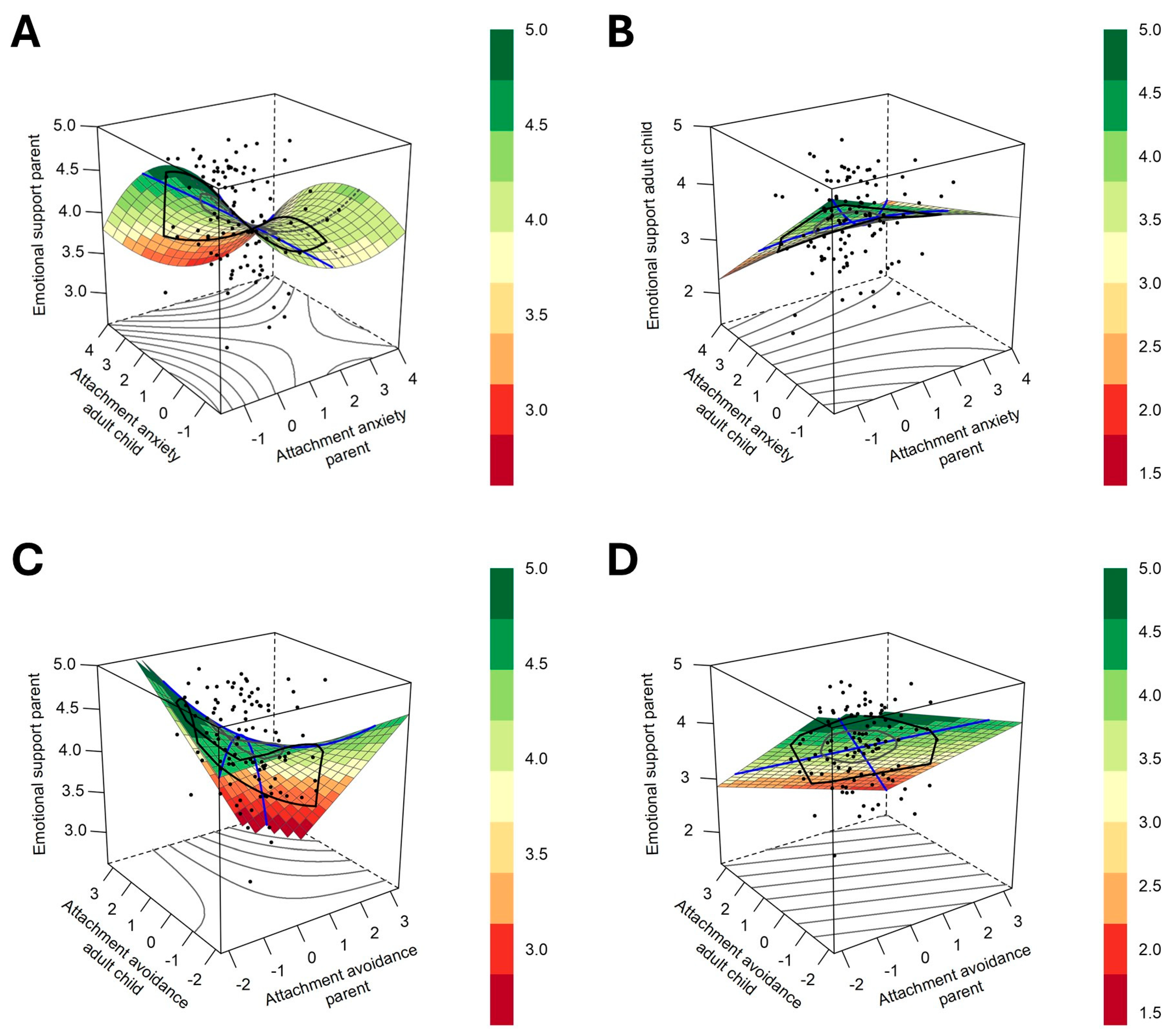
3.1. Parents’ and Adult Children’s Attachment Anxiety and Own Emotional Support Provision
3.2. Parent’s and Adult Children’s Attachment Avoidance and Own Emotional Support Provision
4. Discussion
4.1. (Dis)Similarities in Parents’ and Adult Children’s Attachment Anxiety and Their Own Emotional Support Provision
4.2. (Dis)Similarities in Parents’ and Adult Children’s Attachment Avoidance and Their Own Emotional Support Provision
4.3. Limitations and Further Research
5. Conclusions
Supplementary Materials
Author Contributions
Funding
Institutional Review Board Statement
Informed Consent Statement
Data Availability Statement
Conflicts of Interest
References
- Allen, B. (Ed.). (2023). The historical foundations of contemporary attachment theory: From John Bowlby to Mary Ainsworth. In The science and clinical practice of attachment theory: A guide from infancy to adulthood (pp. 13–35). American Psychological Association. [Google Scholar] [CrossRef]
- Ayalon, L., & Segel-Karpas, D. (2022). When she worries I worry too: COVID-19 worries in the context of daughters’ and mothers’ relations. Research on Aging, 44(1), 3–9. [Google Scholar] [CrossRef]
- Bartholomew, K., & Horowitz, L. M. (1991). Attachment styles among young adults: A test of a four-category model. Journal of Personality and Social Psychology, 61(2), 226. [Google Scholar] [CrossRef] [PubMed]
- Bertogg, A., & Manzoni, A. (2025). Intergenerational support and later life health: Associations by role, type and direction of support. Journal of Marriage and Family. [Google Scholar] [CrossRef]
- Bijaoui, S. F., & Katz, R. (2024). Families and (post) modernism: Jewish families in Israel. In H. Hartman (Ed.), The Jewish family in global perspective (pp. 187–208). Springer Nature Switzerland. [Google Scholar] [CrossRef]
- Birditt, K. S., Hartnett, C. S., Fingerman, K. L., Zarit, S., & Antonucci, T. C. (2015). Extending the intergenerational stake hypothesis: Evidence of an intraindividual stake and implications for well-being. Journal of Marriage and the Family, 77(4), 877–888. [Google Scholar] [CrossRef] [PubMed]
- Boerner, K., Kim, Y. K., Gallagher, E. A., Kim, K., & Jopp, D. S. (2022). “I’m getting older too”: Challenges and benefits experienced by very old parents and their children. Journal of Applied Gerontology: The Official Journal of the Southern Gerontological Society, 41(3), 769–779. [Google Scholar] [CrossRef]
- Bowlby, J. (1982). Attachment and loss. Basic Books. (Original work published 1969). [Google Scholar]
- Brandão, T., Brites, R., Hipólito, J., & Nunes, O. (2022). Attachment orientations and family functioning: The mediating role of emotion regulation. The Journal of Psychology, 157(1), 1–12. [Google Scholar] [CrossRef]
- Buchinger, L., Richter, D., & Heckhausen, J. (2022). The development of life goals across the adult life span. The Journals of Gerontology. Series B, Psychological Sciences and Social Sciences, 77(5), 905–915. [Google Scholar] [CrossRef]
- Bui, C. N., Kim, K., & Fingerman, K. L. (2022). Support now to care later: Intergenerational support exchanges and older parents’ care receipt and expectations. The Journals of Gerontology. Series B, Psychological Sciences and Social Sciences, 77(7), 1315–1324. [Google Scholar] [CrossRef]
- Carpenter, B. D. (2001). Attachment bonds between adult daughters and their older mothers: Associations with contemporary caregiving. The Journals of Gerontology Series B: Psychological Sciences and Social Sciences, 56(5), P257–P266. [Google Scholar] [CrossRef]
- Carr, D., & Utz, R. L. (2020). Families in later life: A decade in review. Journal of Marriage and the Family, 82(1), 346–363. [Google Scholar] [CrossRef]
- Carstensen, L. L. (2021). Socioemotional selectivity theory: The role of perceived endings in human motivation. The Gerontologist, 61(8), 1188–1196. [Google Scholar] [CrossRef]
- Carstensen, L. L., Fung, H. H., & Charles, S. T. (2003). Socioemotional selectivity theory and the regulation of emotion in the second half of life. Motivation and Emotion, 27(2), 103–123. [Google Scholar] [CrossRef]
- Carter, C., & McGoldrick, M. (2005). Overview: The expanded family life cycle individual, family, and social perspectives. In C. Carter, & M. McGoldrick (Eds.), The expanded family life cycle: Individual, family, and social perspectives (3rd ed., pp. 1–25). Allyn and Bacon. [Google Scholar]
- Charenkova, J. (2023). “Parenting my parents”: Perspectives of adult children on assuming and remaining in the caregiver’s role. Frontiers in Public Health, 11, 1059006. [Google Scholar] [CrossRef] [PubMed]
- Chin, B., & Feeney, B. (2022). Physiological bases of secure base support provision in a longitudinal study of married older adult couples. Psychophysiology, 59(8), e14044. [Google Scholar] [CrossRef] [PubMed]
- Cicirelli, V. G. (2010). Attachment relationships in old age. Journal of Social and Personal Relationships, 27(2), 191–199. [Google Scholar] [CrossRef]
- Collins, N. L., & Feeney, B. C. (2000). A safe haven: An attachment theory perspective on support seeking and caregiving in intimate relationships. Journal of Personality and Social Psychology, 78(6), 1053–1073. [Google Scholar] [CrossRef]
- Collins, N. L., & Feeney, B. C. (2004). Working models of attachment shape perceptions of social support: Evidence from experimental and observational studies. Journal of Personality and Social Psychology, 87(3), 363–383. [Google Scholar] [CrossRef]
- Collins, N. L., & Ford, M. B. (2010). Responding to the needs of others: The caregiving behavioral system in intimate relationships. Journal of Social and Personal Relationships, 27(2), 235–244. [Google Scholar] [CrossRef]
- Conradi, H. J., Noordhof, A., & Kamphuis, J. H. (2021). Satisfying and stable couple relationships: Attachment similarity across partners can partially buffer the negative effects of attachment insecurity. Journal of Marital and Family Therapy, 47(3), 682–697. [Google Scholar] [CrossRef]
- Damman, M., & van Duijn, R. (2017). Intergenerational support in the transition from work to retirement. Work, Aging and Retirement, 3(1), 66–76. [Google Scholar] [CrossRef]
- Deres-Cohen, K., Lipsitz-Odess, I., Fisher, H., Ramseyer, F. T., Lutz, W., & Zilcha-Mano, S. (2022). Shedding light on the effects of supportive techniques on nonverbal synchrony and their moderators in psychotherapy for depression. Psychotherapy Research: Journal of the Society for Psychotherapy Research, 32(4), 470–483. [Google Scholar] [CrossRef]
- Ebner, N. C., Freund, A. M., & Baltes, P. B. (2006). Developmental changes in personal goal orientation from young to late adulthood: From striving for gains to maintenance and prevention of losses. Psychology and Aging, 21(4), 664–678. [Google Scholar] [CrossRef]
- Feeney, B. C., & Collins, N. L. (2015). A new look at social support: A theoretical perspective on thriving through relationships. Personality and Social Psychology Review, 19(2), 113–147. [Google Scholar] [CrossRef]
- Feeney, J. A., & Hohaus, L. (2001). Attachment and spousal caregiving. Personal Relationships, 8(1), 21–39. [Google Scholar] [CrossRef]
- Fingerman, K. L., & Birditt, K. S. (2011). Relationships between adults and their aging parents. In K. W. Schaie, & S. L. Willis (Eds.), Handbook of the psychology of aging (7th ed., pp. 219–232). Elsevier Academic Press. [Google Scholar] [CrossRef]
- Fingerman, K. L., Huo, M., & Birditt, K. S. (2020). Mothers, fathers, daughters, and sons: Gender differences in adults’ intergenerational ties. Journal of Family Issues, 41(9), 1597–1625. [Google Scholar] [CrossRef] [PubMed]
- Fingerman, K. L., Kim, K., Tennant, P. S., Birditt, K. S., & Zarit, S. H. (2016). Intergenerational support in a daily context. The Gerontologist, 56(5), 896–908. [Google Scholar] [CrossRef]
- Fingerman, K. L., Sechrist, J., & Birditt, K. (2012). Changing views on intergenerational ties. Gerontology, 59(1), 64–70. [Google Scholar] [CrossRef] [PubMed]
- Fingerman, K. L., Zhou, Z., & Gao, S. (2024). Intergenerational ties in late life. Current Opinion in Psychology, 55, 101743. [Google Scholar] [CrossRef] [PubMed]
- Florian, V., Mikulincer, M., & Bucholtz, I. (2010). Effects of adult attachment style on the perception and search for social support. The Journal of Psychology, 129(6), 665–676. [Google Scholar] [CrossRef]
- Fogel-Yaakobi, S., Golland, Y., Levit-Binnun, N., Borelli, J. L., Mikulincer, M., & Shai, D. (2023). The moderating role of attachment in the association between physiological synchrony in married couples and supportive behavior in the transition to parenthood. Psychophysiology, 60(7), e14263. [Google Scholar] [CrossRef]
- Fraley, R. C., Waller, N. G., & Brennan, K. A. (2000). An item-response theory analysis of self-report measures of adult attachment. Journal of Personality and Social Psychology, 78, 350–365. [Google Scholar] [CrossRef]
- Garcia-Mendoza, M. D. C., Coimbra, S., Sánchez-Queija, I., & Parra, Á. (2024). Intergenerational solidarity during emerging adulthood: Associations with psychological distress and satisfaction with life in southern Europe. Psychology Research and Behavior Management, 17, 2449–2463. [Google Scholar] [CrossRef] [PubMed]
- George, C., & Wargo Aikins, J. (2023). Developing a secure base in family intervention: Using the adult attachment projective system to assess attachment in family relationships. Frontiers in Psychology, 14, 1291661. [Google Scholar] [CrossRef] [PubMed]
- Gillath, O., Shaver, P. R., & Mikulincer, M. (2005). An attachment-theoretical approach to compassion and altruism. In P. Gilbert (Ed.), Compassion: Conceptualisations, research and use in psychotherapy (pp. 121–147). Routledge. [Google Scholar]
- Hu, J., & Zhou, T. (2024). Parent-adolescent congruence and discrepancy in perceived parental emotion socialization to anger and sadness: Using response surface analysis to examine the links with adolescent depressive symptoms. Journal of Youth and Adolescence, 53(1), 67–78. [Google Scholar] [CrossRef]
- Jessee, L., & Carr, D. (2025). Parent-child disconnectedness and older European adults’ mental health: Do patterns differ by marital status and gender? The Journals of Gerontology, Series B: Psychological Sciences and Social Sciences, 80, gbaf024. [Google Scholar] [CrossRef]
- Kivlighan, M., Bardhoshi, G., Wang, K., Anders, C., & Zilcha-Mano, S. (2024). Members’ goal orientation and working alliance in group therapy: A response surface analysis. Journal of Counseling Psychology, 71(3), 179. [Google Scholar] [CrossRef] [PubMed]
- Lewis, M., & Michalson, L. (2025). The socialization of emotions. In Emotion and early interaction (pp. 189–212). Routledge. [Google Scholar]
- McLeod, S., Berry, K., Hodgson, C., & Wearden, A. (2020). Attachment and social support in romantic dyads: A systematic review. Journal of Clinical Psychology, 76(1), 59–101. [Google Scholar] [CrossRef]
- Merz, E. M., Schuengel, C., & Schulze, H. J. (2007). Intergenerational solidarity: An attachment perspective. Journal of Aging Studies, 21(2), 175–186. [Google Scholar] [CrossRef]
- Mikulincer, M., Gillath, O., Halevy, V., Avihou, N., Avidan, S., & Eshkoli, N. (2001). Attachment theory and reactions to others’ needs: Evidence that activation of the sense of attachment security promotes empathic responses. Journal of Personality and Social Psychology, 81(6), 1205–1224. [Google Scholar] [CrossRef]
- Mikulincer, M., & Shaver, P. R. (2003). The attachment behavioral system in adulthood: Activation, psychodynamics, and interpersonal processes. In Advances in experimental social psychology (Vol. 35, pp. 53–152). Academic Press Inc. [Google Scholar] [CrossRef]
- Mikulincer, M., & Shaver, P. R. (2020). Enhancing the “broaden and build” cycle of attachment security in adulthood: From the laboratory to relational contexts and societal systems. International Journal of Environmental Research and Public Health, 17(6), 2054. [Google Scholar] [CrossRef]
- Mikulincer, M., & Shaver, P. R. (2023a). Attachment theory applied: Fostering personal growth through healthy relationships. The Guilford Press. [Google Scholar]
- Mikulincer, M., & Shaver, P. R. (2023b). Attachment theory expanded: Security dynamics in individuals, dyads, groups, and societies. The Guilford Press. [Google Scholar]
- Mikulincer, M., & Shaver, P. R. (2024). Implications of attachment processes for emotion regulation. In J. J. Gross, & B. Q. Ford (Eds.), Handbook of emotion regulation (3rd ed., pp. 160–166). The Guilford Press. [Google Scholar]
- Mikulincer, M., Shaver, P. R., Gillath, O., & Nitzberg, R. A. (2005). Attachment, caregiving, and altruism: Boosting attachment security increases compassion and helping. Journal of Personality and Social Psychology, 89(5), 817–839. [Google Scholar] [CrossRef]
- Min, J., Johnson, M. D., Anderson, J. R., & Yurkiw, J. (2022). Support exchanges between adult children and their parents across life transitions. Journal of Marriage and Family, 84(2), 367–392. [Google Scholar] [CrossRef]
- Min, J., Silverstein, M., & Lendon, J. P. (2012). Intergenerational transmission of values over the family life course. Advances in Life Course Research, 17(3), 112–120. [Google Scholar] [CrossRef]
- Morais, D., Faria, C., & Fernandes, L. (2024). Filial maturity and caregiving to aging parents. Geriatrics, 9(1), 17. [Google Scholar] [CrossRef]
- O’Shaughnessy, R., Berry, K., Dallos, R., & Bateson, K. (2023). Attachment theory: The basics. Routledge. [Google Scholar]
- Romano, D., Karantzas, G. C., Marshall, E. M., Simpson, J. A., Feeney, J. A., McCabe, M. P., Lee, J., & Mullins, E. R. (2020). Carer burden and dyadic attachment orientations in adult children-older parent dyads. Archives of Gerontology and Geriatrics, 90, 104170. [Google Scholar] [CrossRef]
- Rosseel, Y. (2012). lavaan: An R package for structural equation modeling. Journal of Statistical Software, 48(2), 1–36. [Google Scholar] [CrossRef]
- Schönbrodt, F. D. (2016). Testing fit patterns with polynomial regression models. Available online: https://osf.io/3889z (accessed on 19 November 2025).
- Schönbrodt, F. D., & Humberg, S. (2023). RSA: An R package for response surface analysis (version 0.10.6). Available online: https://CRAN.R-project.org/package=RSA (accessed on 19 November 2025).
- Schönbrodt, F. D., Humberg, S., & Nestler, S. (2018). Testing similarity effects with dyadic response surface analysis. European Journal of Personality, 32(6), 627–641. [Google Scholar] [CrossRef]
- Segel-Karpas, D., & Ayalon, L. (2022). Adult daughters’ emotional response to COVID-19: The role of worry, solidarity, conflict, and ambivalence in the relationship with the mother. Aging & Mental Health, 26(3), 578–585. [Google Scholar] [CrossRef]
- Shakespeare-Finch, J., & Obst, P. L. (2011). The development of the 2-Way Social Support Scale: A measure of giving and receiving emotional and instrumental support. Journal of Personality Assessment, 93(5), 483–490. [Google Scholar] [CrossRef]
- Simpson, J. A., & Overall, N. C. (2014). Partner buffering of attachment insecurity. Current Directions in Psychological Science, 23(1), 54–59. [Google Scholar] [CrossRef]
- Simpson, J. A., Rholes, W. S., Eller, J., & Paetzold, R. L. (2021). Major principles of attachment theory: Overview, hypotheses, and research ideas. In P. A. M. Van Lange, E. T. Higgins, & A. W. Kruglanski (Eds.), Social psychology: Handbook of basic principles (3rd ed., pp. 222–239). The Guilford Press. [Google Scholar]
- Simpson, J. A., Rholes, W. S., Oriña, M. M., & Grich, J. (2002). Working models of attachment, support giving, and support seeking in a stressful situation. Personality and Social Psychology Bulletin, 28(5), 598–608. [Google Scholar] [CrossRef]
- Song, Y., Wu, J., Zhou, Z., Tian, Y., Li, W., & Xie, H. (2024). Parent-adolescent discrepancies in educational expectations, relationship quality, and study engagement: A multi-informant study using response surface analysis. Frontiers in Psychology, 15, 1288644. [Google Scholar] [CrossRef] [PubMed]
- Thargay, T., & Giri, V. N. (2025). Surface of marital harmony: Insights into attachment similarity using dyadic response surface analysis. Contemporary Family Therapy, 47(2), 187–201. [Google Scholar] [CrossRef]
- Wright, A. J., & Jackson, J. J. (2024). Is parent personality associated with adolescent outcomes for their child? A response surface analysis approach. Infant and Child Development, 33(2), e2395. [Google Scholar] [CrossRef]
- Wuestefeld, P., Goodwin, P., & Intrieri, R. (2022). The relationship between attachment, relationship quality, and daily stress among dementia caregivers. Innovation in Aging, 6, 869–870. [Google Scholar] [CrossRef]
- Yang, J., Kim, J., & Kim, M. (2024). A comparison of the methods for detecting dyadic patterns in the actor-partner interdependence model. Behavior Research Methods, 56(5), 4946–4957. [Google Scholar] [CrossRef] [PubMed]
- Zhou, Z., Zhang, S., Kim, Y. K., Birditt, K. S., & Fingerman, K. L. (2024). Need to belong, daily social engagement, and transient loneliness in late life. Journal of Social and Personal Relationships, 41(1), 115–136. [Google Scholar] [CrossRef]


| M | SD | 1 | 2 | 3 | 4 | 5 | |
|---|---|---|---|---|---|---|---|
| 1. Emotional support parent | 4.33 | 0.58 | |||||
| 2. Emotional support adult child | 3.93 | 0.75 | 0.43 *** | ||||
| 3. Attachment anxiety parent | 2.34 | 0.88 | −0.44 *** | −0.28 ** | |||
| 4. Attachment avoidance parent | 3.00 | 0.80 | −0.46 *** | −0.45 *** | 0.61 *** | ||
| 5. Attachment anxiety adult child | 2.59 | 1.08 | −0.32 *** | −0.51 *** | 0.32 ** | 0.25 ** | |
| 6. Attachment avoidance adult child | 3.15 | 1.12 | −0.39 *** | −0.64 *** | 0.41 *** | 0.34 *** | 0.72 *** |
| Emotional Support Provision Parents | Emotional Support Provision Adult Children | |||||
|---|---|---|---|---|---|---|
| Regression coefficients | B | SE | 95% CI | B | SE | 95% CI |
| Actor effects linear (b1) | −0.30 *** | 0.05 | [−0.41, −0.20] | −0.36 *** | 0.08 | [−0.53, −0.21] |
| Partner effects linear (b2) | −0.03 | 0.07 | [−0.17, 0.10] | −0.10 | 0.07 | [−0.24, 0.03] |
| Actor effects squared (b3) | 0.07 + | 0.04 | [0.01, 0.16] | |||
| Actor × partner (b4) | 0.02 | 0.06 | [−0.13, 0.12] | 0.05 | 0.07 | [−0.10, 0.20] |
| Partner effects squared (b5) | −0.06 | 0.05 | [−0.14, 0.04] | |||
| Response surface parameters | ||||||
| Slope along LOC (a1) | −0.32 *** | 0.08 | [−0.49, −0.19] | −0.46 *** | 0.08 | [−0.62, −0.31] |
| Curvature along LOC (a2) | 0.03 | 0.07 | [−0.14, 0.15] | 0.06 | 0.07 | [−0.10, 0.20] |
| Slope along LOIC (a3) | −0.27 ** | 0.10 | [−0.46, −0.08] | −0.26 * | 0.13 | [−0.52, −0.02] |
| Curvature along LOIC (a4) | −0.01 | 0.11 | [−0.19, 0.24] | −0.06 | 0.07 | [−0.20, 0.10] |
| Emotional Support Provision Parents | Emotional Support Provision Adult Children | |||||
|---|---|---|---|---|---|---|
| Regression coefficients | B | SE | 95% CI | B | SE | 95% CI |
| Actor effects linear (b1) | −0.28 *** | 0.05 | [−0.38, −0.19] | −0.44 *** | 0.07 | [−0.58, −0.32] |
| Partner effects linear (b2) | −0.07 | 0.05 | [−0.18, 0.03] | −0.17 ** | 0.06 | [−0.28, −0.06] |
| Actor effects squared (b3) | ||||||
| Actor × partner (b4) | −0.13 * | 0.06 | [−0.26, −0.01] | |||
| Partner effects squared (b5) | ||||||
| Response surface parameters | ||||||
| Slope along LOC (a1) | −0.35 *** | 0.05 | [−0.46, −0.25] | −0.61 *** | 0.06 | [−0.74, −0.50] |
| Curvature along LOC (a2) | −0.13 * | 0.06 | [−0.26, 0.01] | |||
| Slope along LOIC (a3) | −0.20 * | 0.08 | [−0.37, −0.04] | −0.27 ** | 0.11 | [−0.48, −0.07] |
| Curvature along LOIC (a4) | 0.14 * | 0.06 | [0.01, 0.26] | |||
Disclaimer/Publisher’s Note: The statements, opinions and data contained in all publications are solely those of the individual author(s) and contributor(s) and not of MDPI and/or the editor(s). MDPI and/or the editor(s) disclaim responsibility for any injury to people or property resulting from any ideas, methods, instructions or products referred to in the content. |
© 2026 by the authors. Licensee MDPI, Basel, Switzerland. This article is an open access article distributed under the terms and conditions of the Creative Commons Attribution (CC BY) license.
Share and Cite
Carasso, E.; Segel-Karpas, D.; Estlein, R. The Role of Attachment in Emotional Support Provision in Adult Child–Parent Relationships: A Dyadic Response Surface Analysis. Behav. Sci. 2026, 16, 106. https://doi.org/10.3390/bs16010106
Carasso E, Segel-Karpas D, Estlein R. The Role of Attachment in Emotional Support Provision in Adult Child–Parent Relationships: A Dyadic Response Surface Analysis. Behavioral Sciences. 2026; 16(1):106. https://doi.org/10.3390/bs16010106
Chicago/Turabian StyleCarasso, Ella, Dikla Segel-Karpas, and Roi Estlein. 2026. "The Role of Attachment in Emotional Support Provision in Adult Child–Parent Relationships: A Dyadic Response Surface Analysis" Behavioral Sciences 16, no. 1: 106. https://doi.org/10.3390/bs16010106
APA StyleCarasso, E., Segel-Karpas, D., & Estlein, R. (2026). The Role of Attachment in Emotional Support Provision in Adult Child–Parent Relationships: A Dyadic Response Surface Analysis. Behavioral Sciences, 16(1), 106. https://doi.org/10.3390/bs16010106