
Satisfaction in Romantic Relationships: The Role of Body Appreciation, Sexual Esteem and Sexual Assertiveness
 , ,
, ,  ,
,  , ,
, , 
Abstract
1. Introduction
1.1. Sexual Assertiveness and Relationship Satisfaction
1.2. The Role of Body Appreciation and Sexual Esteem on Sexual Assertiveness
1.3. Current Study
2. Materials and Methods
2.1. Participants and Procedures
2.2. Measures
2.3. Data Analysis
3. Results
3.1. Descriptive Results
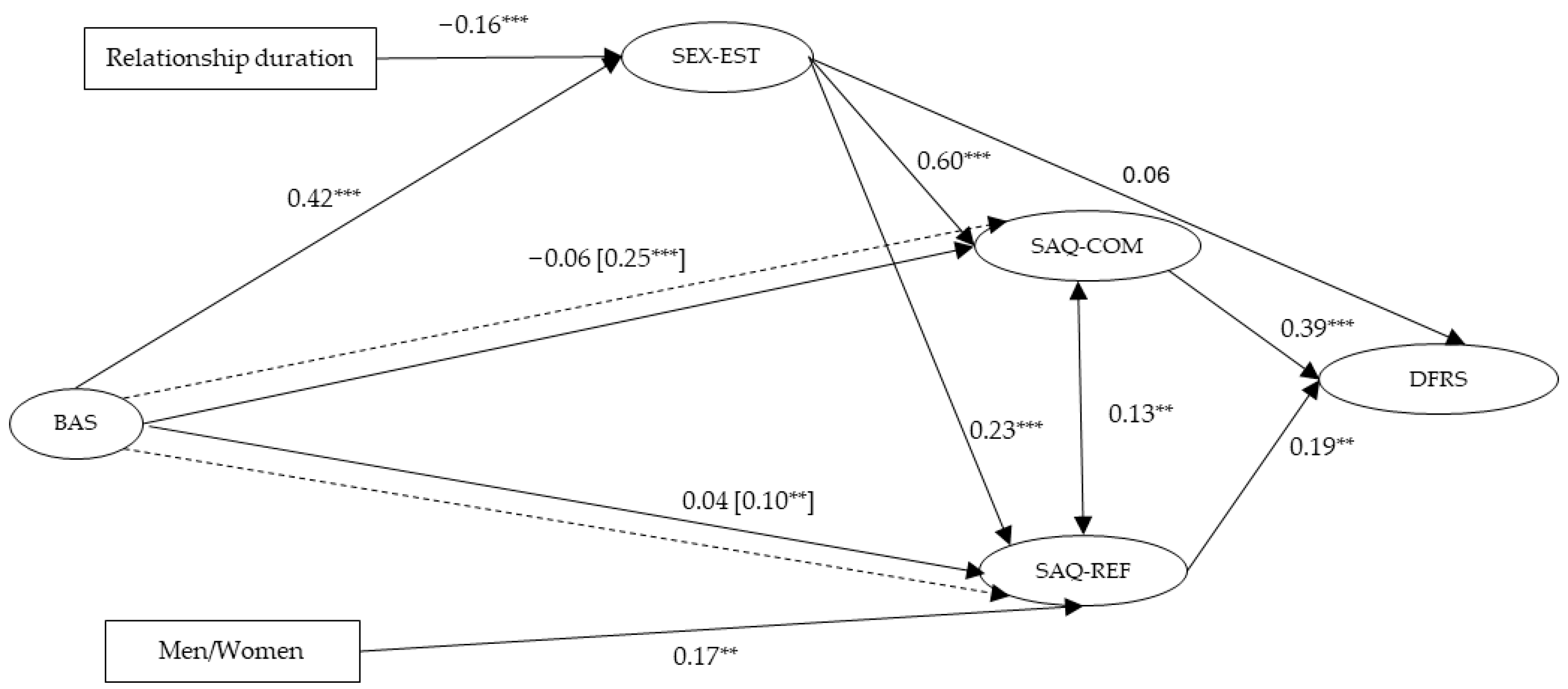
3.2. Hypothesis Testing
4. Discussion
4.1. Interpretation of Hypothesis Testing
4.2. Limitations and Future Directions
4.3. Practical Implications
Supplementary Materials
Author Contributions
Funding
Institutional Review Board Statement
Informed Consent Statement
Data Availability Statement
Conflicts of Interest
References
- Anglim, J., Horwood, S., Smillie, L. D., Marrero, R. J., & Wood, J. K. (2020). Predicting psychological and subjective well-being from personality: A meta-analysis. Psychological Bulletin, 146(4), 279. [Google Scholar] [CrossRef]
- Asparouhov, T., & Muthén, B. (2010). Simple second order chi-square correction. Mplus Technical Appendix, 1(1), 1–8. [Google Scholar]
- Beaulieu, N., Bergeron, S., Brassard, A., Byers, E. S., & Péloquin, K. (2023). Toward an integrative model of intimacy, sexual satisfaction, and relationship satisfaction: A prospective study in long-term couples. The Journal of Sex Research, 60(8), 1100–1112. [Google Scholar] [CrossRef]
- Bennett-Brown, M., & Denes, A. (2023). Testing the communication during sexual activity model: An examination of the associations among personality characteristics, sexual communication, and sexual and relationship satisfaction. Communication Research, 50(1), 106–127. [Google Scholar] [CrossRef]
- Birnbaum, G. E., & Muise, A. (2025). The interplay between sexual desire and relationship functioning. Nature Reviews Psychology, 4(3), 193–206. [Google Scholar] [CrossRef]
- Boket, E., Bahrami, M., Kolyaie, L., & Hosseini, S. (2016). The effect of assertiveness skills training on reduction of verbal victimization of high school students. International Journal of Humanities and Cultural Studies, 3(2), 690–699. [Google Scholar]
- Brassard, A., Dupuy, E., Bergeron, S., & Shaver, P. R. (2015). Attachment insecurities and women’s sexual function and satisfaction: The mediating roles of sexual self-esteem, sexual anxiety, and sexual assertiveness. The Journal of Sex Research, 52(1), 110–119. [Google Scholar] [CrossRef]
- Browne, M. W., & Cudeck, R. (1992). Alternative ways of assessing model fit. Sociological Methods & Research, 21(2), 230–258. [Google Scholar] [CrossRef]
- Bühler, J. L., Weidmann, R., Wünsche, J., Burriss, R. P., & Grob, A. (2020). Daily responsiveness, expectations, and self–disclosure: How the average levels and within–person variability of three relationship components mediate personality–relationship transactions in romantic couples. European Journal of Personality, 34(3), 367–392. [Google Scholar] [CrossRef]
- Cahill, V. A., Malouff, J. M., Little, C. W., & Schutte, N. S. (2020). Trait perspective taking and romantic relationship satisfaction: A meta-analysis. Journal of Family Psychology, 34(8), 1025–1035. [Google Scholar] [CrossRef]
- Carberry, S., MacConaill, S., & Fortune, D. G. (2025). Couples’ experiences of coping with multiple sclerosis: A qualitative systematic review and metasynthesis. Disability and Rehabilitation, 47(4), 814–826. [Google Scholar] [CrossRef]
- Casale, S., Prostamo, A., Giovannetti, S., & Fioravanti, G. (2021). Translation and validation of an Italian version of the Body Appreciation Scale-2. Body Image, 37, 1–5. [Google Scholar] [CrossRef]
- Cassepp-Borges, V., Gonzales, J. E., Frazier, A., & Ferrer, E. (2025). Love and relationship satisfaction as a function of romantic relationship stages. Trends in Psychology, 33, 1027–1042. [Google Scholar] [CrossRef]
- Chen, F. F. (2007). Sensitivity of goodness of fit indexes to lack of measurement invariance. Structural Equation Modeling: A Multidisciplinary Journal, 14(3), 464–504. [Google Scholar] [CrossRef]
- Chesli, S. R., Bostani Khalesi, Z., & Chenari, S. S. (2024). The role of sexual self-esteem, sexual desire, and sexual assertiveness in the female sexual function. Psicologia: Reflexão e Crítica, 37(1), 21. [Google Scholar] [CrossRef]
- Choi, J., & Lim, J. (2023). Does your childhood attachment make you bully your lover? The role of rejection sensitivity and romantic relationship satisfaction. Emerging Adulthood, 11(6), 1423–1432. [Google Scholar] [CrossRef]
- Couture, S., Fernet, M., Hébert, M., Guyon, R., Lévesque, S., & Paradis, A. (2023). “I just want to feel good without making you feel bad”: Sexual assertiveness negotiation in adolescent romantic relationships. Archives of Sexual Behavior, 52(7), 3063–3079. [Google Scholar] [CrossRef]
- Dai, F., Fongkaew, W., Lirtmunlikaporn, S., Viseskul, N., & Chaloumsuk, N. (2021). Predictors of the sexual assertiveness among chinese female college students: A cross-sectional study. Pacific Rim International Journal of Nursing Research, 25(4), 626–638. Available online: https://he02.tci-thaijo.org/index.php/PRIJNR/article/view/253366 (accessed on 10 December 2025).
- Deutsch, A. R., Hoffman, L., & Wilcox, B. L. (2014). Sexual self-concept: Testing a hypothetical model for men and women. The Journal of Sex Research, 51(8), 932–945. [Google Scholar] [CrossRef]
- Dobson, K., Zhu, J., Balzarini, R. N., & Campbell, L. (2020). Responses to sexual advances and satisfaction in romantic relationships: Is yes good and no bad? Social Psychological and Personality Science, 11(6), 801–811. [Google Scholar] [CrossRef]
- Downward, P., Rasciute, S., & Kumar, H. (2022). Mental health and satisfaction with partners: A longitudinal analysis in the UK. BMC Psychology, 10(1), 15. [Google Scholar] [CrossRef]
- Du Rocher Schudlich, T. D., Papp, L. M., & Cummings, E. M. (2011). Relations between spouses’ depressive symptoms and marital conflict: A longitudinal investigation of the role of conflict resolution styles. Journal of Family Psychology, 25(4), 531–540. [Google Scholar] [CrossRef]
- Fallis, E. E., Rehman, U. S., Woody, E. Z., & Purdon, C. (2016). The longitudinal association of relationship satisfaction and sexual satisfaction in long-term relationships. Journal of Family Psychology, 30(7), 822–831. [Google Scholar] [CrossRef]
- Fee, A., McIlfatrick, S., & Ryan, A. (2020). Examining the support needs of older male spousal caregivers of people with a long-term condition: A systematic review of the literature. International Journal of Older People Nursing, 15(3), e12318. [Google Scholar] [CrossRef]
- Frederick, D. A., Lever, J., Gillespie, B. J., & Garcia, J. R. (2017). What keeps passion alive? Sexual satisfaction is associated with sexual communication, mood setting, sexual variety, oral sex, orgasm, and sex frequency in a national U.S. study. The Journal of Sex Research, 54(2), 186–201. [Google Scholar] [CrossRef]
- Freihart, B. K., McMahon, L. N., Hahnel-Peeters, R. K., & Meston, C. M. (2023). Relationship satisfaction. In T. K. Shackelford (Ed.), Encyclopedia of sexual psychology and behavior (pp. 1–9). Springer International Publishing. [Google Scholar] [CrossRef]
- Fu, W., Zhang, W., Dong, Y., & Chen, G. (2025). Parental control and adolescent social anxiety: A focus on emotional regulation strategies and socioeconomic influences in China. British Journal of Developmental Psychology, 43(1), 82–97. [Google Scholar] [CrossRef]
- Fuller-Iglesias, H. R. (2015). Social ties and psychological well-being in late life: The mediating role of relationship satisfaction. Aging & Mental Health, 19(12), 1103–1112. [Google Scholar] [CrossRef]
- Gil-Llario, M. D., Fernández-García, O., Gil-Juliá, B., Estruch-García, V., & Ballester-Arnal, R. (2022). Development and psychometric properties of an instrument for the assessment of assertiveness in sexual relations. Sexuality Research and Social Policy, 19(3), 1255–1269. [Google Scholar] [CrossRef]
- Gimmel, L., Becker-Hebly, I., & Wieczorek, L. L. (2024). Sexual assertiveness of university students in Germany: The role of sources and topics in sexuality education. American Journal of Sexuality Education, 1–23. [Google Scholar] [CrossRef]
- Grower, P., & Ward, L. M. (2018). Examining the unique contribution of body appreciation to heterosexual women’s sexual agency. Body Image, 27, 138–147. [Google Scholar] [CrossRef]
- Gunst, A., Alanko, K., Nickull, S., Dewitte, M., Källström, M., Antfolk, J., & Jern, P. (2024). A qualitative content analysis of perceived individual and relational consequences of sexual compliance and their contributors. Archives of Sexual Behavior, 53(8), 3025–3041. [Google Scholar] [CrossRef]
- Hassebrauck, M., & Fehr, B. (2002). Dimensions of relationship quality. Personal Relationships, 9(3), 253–270. [Google Scholar] [CrossRef]
- Hayes, A. F. (2018). Partial, conditional, and moderated moderated mediation: Quantification, inference, and interpretation. Communication Monographs, 85(1), 4–40. [Google Scholar] [CrossRef]
- Heinrichs, K. D., MacKnee, C., Auton-Cuff, F., & Domene, J. F. (2009). Factors affecting sexual self-esteem among young adult women in long-term heterosexual relationships. The Canadian Journal of Human Sexuality, 18(4), 183. [Google Scholar]
- Hu, L., & Bentler, P. M. (1999). Cutoff criteria for fit indexes in covariance structure analysis: Conventional criteria versus new alternatives. Structural Equation Modeling: A Multidisciplinary Journal, 6(1), 1–55. [Google Scholar] [CrossRef]
- Jones, A. C., Robinson, W. D., & Seedall, R. B. (2018). The role of sexual communication in couples’ sexual outcomes: A dyadic path analysis. Journal of Marital and Family Therapy, 44(4), 606–623. [Google Scholar] [CrossRef]
- Keizer, R. (2014). Relationship satisfaction. In A. C. Michalos (Ed.), Encyclopedia of quality of life and well-being research (pp. 5437–5443). Springer. [Google Scholar] [CrossRef]
- Kline, R. B. (2015). Principles and practice of structural equation modeling (4th ed.). Guilford Press. [Google Scholar]
- Krahé, B., & Berger, A. (2017). Longitudinal pathways of sexual victimization, sexual self-esteem, and depression in women and men. Psychological Trauma: Theory, Research, Practice and Policy, 9(2), 147–155. [Google Scholar] [CrossRef]
- Li, C. (2016). Confirmatory factor analysis with ordinal data: Comparing robust maximum likelihood and diagonally weighted least squares. Behavior Research Methods, 48(3), 936–949. [Google Scholar] [CrossRef]
- Linardon, J., McClure, Z., Tylka, T. L., & Fuller-Tyszkiewicz, M. (2022). Body appreciation and its psychological correlates: A systematic review and meta-analysis. Body Image, 42, 287–296. [Google Scholar] [CrossRef]
- Loshek, E., & Terrell, H. K. (2015). The development of the Sexual Assertiveness Questionnaire (SAQ): A comprehensive measure of sexual assertiveness for women. The Journal of Sex Research, 52(9), 1017–1027. [Google Scholar] [CrossRef]
- López Alvarado, S. L., Van Parys, H., Jerves, E., & Enzlin, P. (2020). Development of sexual assertiveness and its function for human sexuality: A literature review. International Journal of Psychology, 54, e948. [Google Scholar] [CrossRef]
- Mallory, A. B. (2022). Dimensions of couples’ sexual communication, relationship satisfaction, and sexual satisfaction: A meta-analysis. Journal of Family Psychology, 36(3), 358–371. [Google Scholar] [CrossRef]
- Matera, C., Casati, C., Paradisi, M., Di Gesto, C., & Nerini, A. (2024). Positive body image and psychological wellbeing among women and men: The mediating role of body image coping strategies. Behavioral Sciences, 14(5), 378. [Google Scholar] [CrossRef]
- May, A., & Johnston, K. L. (2022). Ego-centred and partner/activity-focused sexual satisfaction: The role of self-esteem and sexual assertiveness in cisgender heterosexual women. Sex Roles, 86(3), 179–188. [Google Scholar] [CrossRef]
- Ménard, A. D., & Offman, A. (2009). The interrelationships between sexual self-esteem, sexual assertiveness and sexual satisfaction. Canadian Journal of Human Sexuality, 18(1–2), 35–45. [Google Scholar]
- Moradi, B., & Huang, Y.-P. (2008). Objectification theory and psychology of women: A decade of advances and future directions. Psychology of Women Quarterly, 32(4), 377–398. [Google Scholar] [CrossRef]
- Moyano, N., Granados, R., Durán, C. A., & Galarza, C. (2021). Self-esteem, attitudes toward love, and sexual assertiveness among pregnant adolescents. International Journal of Environmental Research and Public Health, 18(3), 1270. [Google Scholar] [CrossRef] [PubMed]
- Muthén, L., & Muthén, B. (2017). Mplus version 8 user’s guide. 1998–2017. Statistical analysis with latent variables. Available online: https://www.statmodel.com/download/usersguide/MplusUserGuideVer_8.pdf (accessed on 18 November 2025).
- Nagy, L., Koós, M., Kraus, S. W., Demetrovics, Z., Potenza, M. N., Ballester-Arnal, R., Batthyány, D., Bergeron, S., Billieux, J., Briken, P., Burkauskas, J., Cárdenas-López, G., Carvalho, J., Castro-Calvo, J., Chen, L., Chen, J.-K., Ciocca, G., Corazza, O., Csako, R., … Bőthe, B. (2025). Sexual assertiveness across cultures, genders, and sexual orientations: Validation of the short Sexual Assertiveness Questionnaire (SAQ-9). Assessment. [Google Scholar] [CrossRef] [PubMed]
- Neto, F., Karandashev, V., Cassepp-Borges, V., Oliveira, E. N., & Neto, J. (2023). Determinants of satisfaction with love life in Brazil and Portugal. Personality and Individual Differences, 205, 112076. [Google Scholar] [CrossRef]
- Nickull, S., Jern, P., Niu, C., Källström, M., & Gunst, A. (2025). Predictors of perceived positive and negative consequences of sexual compliance. Journal of Sex & Marital Therapy, 51(2), 142–162. [Google Scholar] [CrossRef]
- Oesterle, D. W., Jarnecke, A. M., & Gilmore, A. K. (2022). Sexual re-assault among college women differs based on sexual refusal assertiveness and assertive resistance strategy intentions. Journal of Interpersonal Violence, 37(19–20), NP17473–NP17491. [Google Scholar] [CrossRef]
- Putnick, D. L., & Bornstein, M. H. (2016). Measurement invariance conventions and reporting: The state of the art and future directions for psychological research. Developmental Review, 41, 71–90. [Google Scholar] [CrossRef]
- Raffagnino, R., & Matera, C. (2015). Assessing relationship satisfaction: Development and validation of the dyadic-familial relationship satisfaction scale. Journal of Couple & Relationship Therapy, 14(4), 322–341. [Google Scholar] [CrossRef]
- Rhemtulla, M., Brosseau-Liard, P., & Savalei, V. (2012). When can categorical variables be treated as continuous? A comparison of robust continuous and categorical SEM estimation methods under suboptimal conditions. Psychological Methods, 17(3), 354–373. [Google Scholar] [CrossRef]
- Robbins, A.-R., & Reissing, E. D. (2018). Appearance dissatisfaction, body appreciation, and sexual health in women across adulthood. Archives of Sexual Behavior, 47(3), 703–714. [Google Scholar] [CrossRef]
- Roberson, P. N. E., Norona, J. C., Lenger, K. A., & Olmstead, S. B. (2018). How do relationship stability and quality affect wellbeing?: Romantic relationship trajectories, depressive symptoms, and life satisfaction across 30 years. Journal of Child and Family Studies, 27(7), 2171–2184. [Google Scholar] [CrossRef]
- Rollero, C. (2016). The experience of men caring for a partner with multiple sclerosis. Journal of Nursing Scholarship, 48(5), 482–489. [Google Scholar] [CrossRef] [PubMed]
- Rollero, C. (2022). Mass media beauty standards, body surveillance, and relationship satisfaction within romantic couples. International Journal of Environmental Research and Public Health, 19(7), 3833. [Google Scholar] [CrossRef] [PubMed]
- Rollero, C., Moyano, N., & Roccato, M. (2023). The role of sexual consent and past non-consensual sexual experiences on rape supportive attitudes in a heterosexual community sample. Sexuality & Culture, 27(4), 1352–1368. [Google Scholar] [CrossRef]
- Ruffieux, M., Nussbeck, F. W., & Bodenmann, G. (2014). Long-term prediction of relationship satisfaction and stability by stress, coping, communication, and well-being. Journal of Divorce & Remarriage, 55(6), 485–501. [Google Scholar] [CrossRef]
- Sánchez-Fuentes, M. D., Hidalgo-Muñoz, A. R., Moyano, N., & Gómez-Berrocal, C. (2025). Sexual and agency norms: Effect on young women’s self-perception and attitude toward sexual consent. Behavioral Sciences, 15(3), 250. [Google Scholar] [CrossRef]
- Schermelleh-Engel, K., Moosbrugger, H., & Müller, H. (2003). Evaluating the fit of structural equation models: Tests of significance and descriptive goodness-of-fit measures. Methods of Psychological Research, 8(2), 23–74. [Google Scholar] [CrossRef]
- Schuster, I., Tomaszewska, P., & Krahé, B. (2023). A theory-based intervention to reduce risk and vulnerability factors of sexual aggression perpetration and victimization in German university students. The Journal of Sex Research, 60(8), 1206–1221. [Google Scholar] [CrossRef] [PubMed]
- Snell, W. E., Fisher, T. D., & Walters, A. S. (1993). The multidimensional sexuality questionnaire: An objective self-report measure of psychological tendencies associated with human sexuality. Annals of Sex Research, 6(1), 27–55. [Google Scholar] [CrossRef]
- Tylka, T. L., & Wood-Barcalow, N. L. (2015). The body appreciation scale-2: Item refinement and psychometric evaluation. Body Image, 12, 53–67. [Google Scholar] [CrossRef]
- Vandenberg, R. J., & Lance, C. E. (2000). A review and synthesis of the measurement invariance literature: Suggestions, practices, and recommendations for organizational research. Organizational Research Methods, 3(1), 4–70. [Google Scholar] [CrossRef]
- Vowels, L. M., & Mark, K. P. (2020). Strategies for mitigating sexual desire discrepancy in relationships. Archives of Sexual Behavior, 49(3), 1017–1028. [Google Scholar] [CrossRef] [PubMed]
- Warrier, M. G., Sadasivan, A., Balasubramaian, B., Nair, M. G., Nashi, S., Vengalil, S., Nalini, A., & Thomas, P. T. (2022). A meta-ethnographic synthesis of lived experience of spouse caregivers in chronic illness. Qualitative Social Work, 21(2), 431–454. [Google Scholar] [CrossRef]
- Wu, T., & Zheng, Y. (2021). Effect of sexual esteem and sexual communication on the relationship between body image and sexual function in Chinese heterosexual women. The Journal of Sexual Medicine, 18(3), 474–486. [Google Scholar] [CrossRef]
- Zhang, H., Xie, L., Lo, S. S. T., Fan, S., & Yip, P. (2022). Female sexual assertiveness and sexual satisfaction among Chinese couples in Hong Kong: A dyadic approach. The Journal of Sex Research, 59(2), 203–211. [Google Scholar] [CrossRef]


| M (SD) | Mmen (DS) | Mwomen (DS) | Range | α | t-Test (df) | Cohen’s d | |
|---|---|---|---|---|---|---|---|
| SAQ-COM | 5.52 (1.16) | 5.58 (1.01) | 5.45 (1.29) | 1–7 | 0.83 | 1.21 (443.28) | 0.11 |
| SAQ-REF | 5.14 (1.37) | 5.02 (1.37) | 5.26 (1.37) | 1–7 | 0.76 | −1.90 (470) | 0.17 |
| BAS | 3.43 (0.83) | 3.66 (0.75) | 3.21 (0.86) | 1–5 | 0.93 | 6.10 *** (460.81) | 0.56 |
| SEX-EST | 3.32 (0.94) | 3.47 (0.93) | 3.19 (0.92) | 1–5 | 0.91 | 3.33 *** (470) | 0.31 |
| DFRS | 3.11 (0.63) | 3.14 (0.61) | 3.08 (0.64) | 0–4 | 0.89 | 1.04 (470) | 0.09 |
| 1 | 2 | 3 | 4 | 5 | 6 | 7 | |
|---|---|---|---|---|---|---|---|
| 1. SAQ-COM | - | ||||||
| 2. SAQ-REF | 0.26 *** | - | |||||
| 3. BAS | 0.15 *** | 0.11 * | - | ||||
| 4. SEX-EST | 0.50 *** | 0.22 *** | 0.41 *** | - | |||
| 5. DFRS | 0.42 *** | 0.26 *** | 0.17 *** | 0.32 *** | - | ||
| 6. Relationship duration | −0.09 | −0.08 | 0.003 | −0.16 *** | −0.05 | - | |
| 7. Men/Women | −0.06 | 0.08 | −0.27 *** | −0.15 *** | −0.05 | - | - |
| Paths | Β | B | (SE) | BC 95% CI |
|---|---|---|---|---|
| Direct effects | ||||
| BAS→SEX-EST | 0.42 *** | 0.47 *** | (0.05) | [0.37, 0.58] |
| BAS→SAQ-COM | −0.06 | −0.08 | (0.05) | [−0.19, 0.03] |
| BAS→SAQ-REF | 0.04 | 0.04 | (0.05) | [−0.06, 0.15] |
| SEX-EST→SAQ-COM | 0.60 *** | 0.65 *** | (0.06) | [0.52, 0.79] |
| SEX-EST→SAQ-REF | 0.23 *** | 0.21 *** | (0.05) | [0.12, 0.31] |
| SEX-EST→DFRS | 0.06 | 0.06 | (0.06) | [−0.06, 0.17] |
| SAQ-COM→DFRS | 0.39 *** | 0.36 *** | (0.06) | [0.26, 0.48] |
| SAQ-REF→DFRS | 0.19 *** | 0.20 *** | (0.05) | [0.10, 0.31] |
| Men/Women→SEX-EST | 0.01 | 0.01 | (0.08) | [−0.17, 0.19] |
| Relationship duration→SEX-EST | −0.16 *** | −0.004 *** | (0.001) | [−0.006, −0.003] |
| Men/Women→SAQ-COM | 0.00 | 0.001 | (0.08) | [−0.20, 0.20] |
| Relationship duration→SAQ-COM | −0.03 | −0.001 | (0.001) | [−0.003, 0.001] |
| Men/Women→SAQ-REF | 0.17 *** | 0.35 *** | (0.09) | [0.18, 0.54] |
| Relationship duration→SAQ-REF | −0.08 | −0.002 | (0.001) | [−0.003, 0.000] |
| Men/Women→DFRS | −0.05 | −0.11 | (0.08) | [−0.29, 0.07] |
| Relationship duration→DFRS | 0.04 | 0.001 | (0.001) | [−0.001, 0.003] |
| Indirect effects | ||||
| BAS→SEX-EST→SAQ-COM | 0.25 *** | 0.31 *** | (0.05) | [0.22, 0.40] |
| BAS→SEX-EST→SAQ-REF | 0.10 ** | 0.10 ** | (0.03) | [0.05, 0.15] |
| χ2 | df | RMSEA | CFI | SRMR | Δχ2 (df) | ΔRMSEA | ΔCFI | ΔSRMR | |
|---|---|---|---|---|---|---|---|---|---|
| M1 (baseline) | 1795.38 * | 1421 | 0.033 | 0.907 | 0.072 | - | - | - | - |
| M2 (structural) | 1827.18 * | 1438 | 0.033 | 0.906 | 0.078 | 29.58 * (17) | 0.000 | −0.001 | 0.006 |
Disclaimer/Publisher’s Note: The statements, opinions and data contained in all publications are solely those of the individual author(s) and contributor(s) and not of MDPI and/or the editor(s). MDPI and/or the editor(s) disclaim responsibility for any injury to people or property resulting from any ideas, methods, instructions or products referred to in the content. |
© 2025 by the authors. Licensee MDPI, Basel, Switzerland. This article is an open access article distributed under the terms and conditions of the Creative Commons Attribution (CC BY) license (https://creativecommons.org/licenses/by/4.0/).
Share and Cite
Rizzo, M.; Matera, C.; Caso, D.; Donizzetti, A.R.; Grano, C.; Nerini, A.; Rollero, C. Satisfaction in Romantic Relationships: The Role of Body Appreciation, Sexual Esteem and Sexual Assertiveness. Behav. Sci. 2025, 15, 1730. https://doi.org/10.3390/bs15121730
Rizzo M, Matera C, Caso D, Donizzetti AR, Grano C, Nerini A, Rollero C. Satisfaction in Romantic Relationships: The Role of Body Appreciation, Sexual Esteem and Sexual Assertiveness. Behavioral Sciences. 2025; 15(12):1730. https://doi.org/10.3390/bs15121730
Chicago/Turabian StyleRizzo, Marco, Camilla Matera, Daniela Caso, Anna Rosa Donizzetti, Caterina Grano, Amanda Nerini, and Chiara Rollero. 2025. "Satisfaction in Romantic Relationships: The Role of Body Appreciation, Sexual Esteem and Sexual Assertiveness" Behavioral Sciences 15, no. 12: 1730. https://doi.org/10.3390/bs15121730
APA StyleRizzo, M., Matera, C., Caso, D., Donizzetti, A. R., Grano, C., Nerini, A., & Rollero, C. (2025). Satisfaction in Romantic Relationships: The Role of Body Appreciation, Sexual Esteem and Sexual Assertiveness. Behavioral Sciences, 15(12), 1730. https://doi.org/10.3390/bs15121730