

Patterns of Caregiver Communicative Behaviors Among Low-Income Chinese Immigrant Mothers of Children with Autism—An Exploratory Study

Abstract
1. Introduction
2. Methods
2.1. Participants
2.2. Data Collection Procedures
2.3. Measures
2.4. Analysis
3. Results
3.1. Caregiver Communication Patterns and Engagement Quality
3.2. Correlations Between Caregiver and Child Characteristics and Communicative Behaviors and Joint Engagement
4. Discussion
4.1. Implication for Policy and Practice
4.2. Limitations
4.3. Future Directions
5. Conclusions
Author Contributions
Funding
Institutional Review Board Statement
Informed Consent Statement
Data Availability Statement
Acknowledgments
Conflicts of Interest
Abbreviations
| JERI | Joint Engagement Rating Inventory |
| CARS | Childhood Autism Rating Scale |
References
- Adamson, L. B., Bakeman, R., & Suma, K. (2020). The joint engagement rating inventory. Department of Psychology, Georgia State University. Available online: https://sites.gsu.edu/bakeman/adamson-memos/ (accessed on 21 March 2025).
- Akhtar, N., Dunham, F., & Dunham, P. J. (1991). Directive interactions and early vocabulary development: The role of joint attentional focus. Journal of Child Language, 18(1), 41–49. [Google Scholar] [CrossRef] [PubMed]
- Artis, J., Watson, L. R., & Crais, E. R. (2022). Parent coaching behaviors used within an adapted responsive teaching intervention. Journal of Early Intervention, 44(4), 331–352. [Google Scholar] [CrossRef]
- Bakeman, R., & Gottman, J. M. (n.d.). Observing interaction: An introduction to sequential analysis. Cambridge University Press. [Google Scholar]
- Bernier, R., Mao, A., & Yen, J. (2010). Psychopathology, families, and culture: Autism. Child and Adolescent Psychiatric Clinics of North America, 19(4), 855–867. [Google Scholar] [CrossRef] [PubMed]
- Bornstein, M. H. (2012). Cultural approaches to parenting. Parenting, 12(2–3), 212–221. [Google Scholar] [CrossRef]
- Brislin, R. W. (1970). Back-translation for cross-cultural research. Journal of Cross-Cultural Psychology, 1(3), 185–216. [Google Scholar] [CrossRef]
- Cheah, C. S. L., Li, J., Zhou, N., Yamamoto, Y., & Leung, C. Y. Y. (2015). Understanding Chinese immigrant and European American mothers’ expressions of warmth. Developmental Psychology, 51(12), 1802–1811. [Google Scholar] [CrossRef]
- Chen, X., & Huang, A. X. (2025). Training Asian immigrant parents to teach Manding to children with autism spectrum disorder. Journal of Behavioral Education, 34(1), 184–212. [Google Scholar] [CrossRef]
- Chinese immigrants in the United States. (2025). Migration Policy Institute. Available online: https://www.migrationpolicy.org/article/chinese-immigrants-united-states (accessed on 30 June 2025).
- Conway, L. J., Levickis, P. A., Smith, J., Mensah, F., Wake, M., & Reilly, S. (2018). Maternal communicative behaviours and interaction quality as predictors of language development: Findings from a community-based study of slow-to-talk toddlers. International Journal of Language & Communication Disorders, 53(2), 339–354. [Google Scholar] [CrossRef]
- Crowell, J. A., Keluskar, J., & Gorecki, A. (2019). Parenting behavior and the development of children with autism spectrum disorder. Comprehensive Psychiatry, 90, 21–29. [Google Scholar] [CrossRef]
- Dow, D., Day, T. N., Kutta, T. J., Nottke, C., & Wetherby, A. M. (2020). Screening for autism spectrum disorder in a naturalistic home setting using the systematic observation of red flags (SORF) at 18–24 months. Autism Research, 13(1), 122–133. [Google Scholar] [CrossRef]
- Edmunds, S. R., Kover, S. T., & Stone, W. L. (2019). The relation between parent verbal responsiveness and child communication in young children with or at risk for autism spectrum disorder: A systematic review and meta-analysis. Autism Research, 12(5), 715–731. [Google Scholar] [CrossRef] [PubMed]
- Fante, C., Zagaria, A., Dioni, B., Raffin, C., Capelli, F., Manari, T., Lenzo, V., De Luca Picione, R., & Musetti, A. (2024). Self-efficacy as a mediator between involvement in intervention and quality of life in parents of children and adolescents with autism spectrum disorder. Research in Autism Spectrum Disorders, 113, 102351. [Google Scholar] [CrossRef]
- Fernández Cerero, J., Montenegro Rueda, M., & López Meneses, E. (2024). The impact of parental involvement on the educational development of students with autism spectrum disorder. Children, 11(9), 1062. [Google Scholar] [CrossRef] [PubMed]
- Gao, P., Zhou, C., Ruan, Z., Zhang, Z., & Fang, X. (2024). Association between caregiver-child interaction and autistic-like behaviors at around three years of age. Journal of Affective Disorders, 355, 326–332. [Google Scholar] [CrossRef] [PubMed]
- Gardiner, E., & French, C. (2011). The relevance of cultural sensitivity in early intervention. Exceptionality Education International, 21(3), 34–49. [Google Scholar] [CrossRef]
- Glick, J. E., Hanish, L. D., Yabiku, S. T., & Bradley, R. H. (2012). Migration timing and parenting practices: Contributions to social development in preschoolers with foreign-born and native-born mothers. Child Development, 83(5), 1527–1542. [Google Scholar] [CrossRef]
- Golson, M. E., Ficklin, E., Haverkamp, C. R., McClain, M. B., & Harris, B. (2022). Cultural differences in social communication and interaction: A gap in autism research. Autism Research, 15(2), 208–214. [Google Scholar] [CrossRef]
- Grinker, R., Daley, T. C., & Mandell, D. S. (2013). Culture and autism. In F. R. Volkmar (Ed.), Encyclopedia of autism spectrum disorders (pp. 830–837). Springer International Publishing. [Google Scholar]
- Hill, N. E. (2006). Disentangling ethnicity, socioeconomic status and parenting: Interactions, influences and meaning. Vulnerable Children and Youth Studies, 1(1), 114–124. [Google Scholar] [CrossRef]
- Hirsh-Pasek, K., Zosh, J. M., Golinkoff, R. M., Gray, J. H., Robb, M. B., & Kaufman, J. (2015). Putting education in “educational” apps: Lessons from the science of learning. Psychological Science in the Public Interest, 16(1), 3–34. [Google Scholar] [CrossRef]
- Huang, C.-Y., Cheah, C. S. L., Lamb, M. E., & Zhou, N. (2017). Associations between parenting styles and perceived child effortful control within Chinese families in the United States, the United Kingdom, and Taiwan. Journal of Cross-Cultural Psychology, 48(6), 795–812. [Google Scholar] [CrossRef]
- Kasari, C., Lawton, K., Shih, W., Barker, T. V., Landa, R., Lord, C., Orlich, F., King, B., Wetherby, A., & Senturk, D. (2014). Caregiver-mediated intervention for low-resourced preschoolers with autism: An RCT. Pediatrics, 134(1), e72–e79. [Google Scholar] [CrossRef] [PubMed]
- Keen, D., Couzens, D., Muspratt, S., & Rodger, S. (2010). The effects of a parent-focused intervention for children with a recent diagnosis of autism spectrum disorder on parenting stress and competence. Research in Autism Spectrum Disorders, 4(2), 229–241. [Google Scholar] [CrossRef]
- Kim, S. H., Grzadzinski, R., Martinez, K., & Lord, C. (2019). Measuring treatment response in children with autism spectrum disorder: Applications of the brief observation of social communication change to the autism diagnostic observation schedule. Autism, 23(5), 1176–1185. [Google Scholar] [CrossRef] [PubMed]
- Kim, S. Y., Chen, Q., Wang, Y., Shen, Y., & Orozco-Lapray, D. (2013). Longitudinal linkages among parent-child acculturation discrepancy, parenting, parent-child sense of alienation, and adolescent adjustment in Chinese immigrant families. Developmental Psychology, 49(5), 900–912. [Google Scholar] [CrossRef]
- Koegel, L. K., Koegel, R. L., Ashbaugh, K., & Bradshaw, J. (2014). The importance of early identification and intervention for children with or at risk for autism spectrum disorders. International Journal of Speech-Language Pathology, 16(1), 50–56. [Google Scholar] [CrossRef]
- Kosic, A. (2025). Individual factors in acculturation: An overview of key dimensions. Behavioral Sciences, 15(6), 827. [Google Scholar] [CrossRef]
- Kurzrok, J., McBride, E., & Grossman, R. B. (2021). Autism-specific parenting self-efficacy: An examination of the role of parent-reported intervention involvement, satisfaction with intervention-related training, and caregiver burden. Autism, 25(5), 1395–1408. [Google Scholar] [CrossRef]
- Landa, R. J. (2018). Efficacy of early interventions for infants and young children with, and at risk for, autism spectrum disorders. International Review of Psychiatry, 30(1), 25–39. [Google Scholar] [CrossRef]
- Language spoken at home. (n.d.). Census.Gov. Available online: https://www.census.gov/acs/www/about/why-we-ask-each-question/language/ (accessed on 20 June 2025).
- Lee, J. D., Kang, V. Y., Terol, A. K., & Joo, S. (2025). Examining the efficacy of culturally responsive interventions for autistic children and their families: A meta-analysis. Journal of Autism and Developmental Disorders, 55(2), 706–726. [Google Scholar] [CrossRef]
- Levickis, P., Reilly, S., Girolametto, L., Ukoumunne, O. C., & Wake, M. (2014). Maternal behaviors promoting language acquisition in slow-to-talk toddlers: Prospective community-based study. Journal of Developmental & Behavioral Pediatrics, 35(4), 274–281. [Google Scholar] [CrossRef]
- Lin, S. C., Yu, S. M., & Harwood, R. L. (2012). Autism spectrum disorders and developmental disabilities in children from immigrant families in the United States. Pediatrics, 130(Suppl. S2), S191–S197. [Google Scholar] [CrossRef] [PubMed]
- Lin, X., & Yang, C. (2024). Parental involvement to promote the social-emotional well-being of Asian immigrant youth: A cultural mismatch of teachers and parents’ perspectives. School Psychology Review, 54(5), 591–613. [Google Scholar] [CrossRef]
- Lindly, O., Bear, C. R., Henderson, D. E., Kirby, B. R., Begay, V., Shui, A., Dababnah, S., & Magaña, S. M. (2025). Pilot study of a strengths-based education program for Diné (Navajo) families of autistic children: Feasibility, fidelity, acceptability, and initial outcomes. Research in Autism, 127, 202658. [Google Scholar] [CrossRef]
- Loncarevic, A., Maybery, M. T., Barbaro, J., Dissanayake, C., Green, J., Hudry, K., Iacono, T., Slonims, V., Varcin, K. J., Wan, M. W., Wray, J., & Whitehouse, A. J. O. (2024). Parent-child interactions may help to explain relations between parent characteristics and clinically observed child autistic behaviours. Journal of Autism and Developmental Disorders, 54(7), 2742–2756. [Google Scholar] [CrossRef]
- Lopez, K. (2024). Parent-mediated autism intervention through a culturally informed lens: Parents taking action and pivotal response training with Latine families. Healthcare, 12(23), 2381. [Google Scholar] [CrossRef]
- Lorio, C. M., Woods, J. J., & Snyder, P. (2021). An exploration of reflective conversations in early intervention caregiver coaching sessions. Journal of Early Intervention, 43(4), 314–338. [Google Scholar] [CrossRef]
- Lu, J. P., Yang, Z. W., Shu, M. Y., & Su, L. Y. (2004). Reliability, validity analysis of the childhood autism rating scale. China Journal of Modern Medicine, 13, 119–121. [Google Scholar]
- Magaña, S., Dababnah, S., Xu, Y., Torres, M. G., Rieth, S. R., Corsello, C., Rangel, E., Brookman-Frazee, L., & Vanegas, S. B. (2021). Cultural adaptations of a parent training program for families of children with ASD/IDD: Parents taking action. In International review of research in developmental disabilities (Vol. 61, pp. 263–300). Elsevier. [Google Scholar] [CrossRef]
- Magaña, S., Lopez, K., & Machalicek, W. (2017). Parents taking action: A psycho-educational intervention for latino parents of children with autism spectrum disorder. Family Process, 56(1), 59–74. [Google Scholar] [CrossRef]
- McCauley, J. B., & Solomon, M. (2022). Characterizing parent–child interactions in families of autistic children in late childhood. Social Sciences, 11(3), 100. [Google Scholar] [CrossRef]
- McDuffie, A., & Yoder, P. (2010). Types of parent verbal responsiveness that predict language in young children with autism spectrum disorder. Journal of Speech, Language, and Hearing Research, 53(4), 1026–1039. [Google Scholar] [CrossRef]
- Ortega, A., & Ludwig, T. (2023). Immigrant English proficiency, children’s educational performance, and parental involvement. Review of Economics of the Household, 21(2), 693–719. [Google Scholar] [CrossRef]
- Palmer, J. S., & Riley, T. N. (2025). Culturally adapted interventions for students with autism: A systematic review. School Psychology, 40(2), 145–158. [Google Scholar] [CrossRef] [PubMed]
- Roberts, M. Y., & Kaiser, A. P. (2011). The effectiveness of parent-implemented language interventions: A meta-analysis. American Journal of Speech-Language Pathology, 20(3), 180–199. [Google Scholar] [CrossRef] [PubMed]
- Russell, K. M., & Ingersoll, B. (2021). Factors related to parental therapeutic self-efficacy in a parent-mediated intervention for children with autism spectrum disorder: A mixed methods study. Autism, 25(4), 971–981. [Google Scholar] [CrossRef]
- Russell, S. T., Crockett, L. J., & Chao, R. K. (2010). Introduction: Asian American parenting and parent-adolescent relationships. In S. T. Russell, L. J. Crockett, & R. K. Chao (Eds.), Asian American parenting and parent-adolescent relationships (pp. 1–15). Springer New York. [Google Scholar] [CrossRef]
- Schofield, T., Beaumont, K., Widaman, K., Jochem, R., Robins, R., & Conger, R. (2012). Parent and child fluency in a common language: Implications for the parent–child relationship and later academic success in Mexican American families. Journal of Family Psychology, 26(6), 869–879. [Google Scholar] [CrossRef]
- Schopler, E., Van Bourgondien, M. E., Wellman, G. J., & Love, S. R. (2010). The childhood autism rating scale (CARS2) (2nd ed.). Western Psychological Services. [Google Scholar]
- Sengonul, T. (2022). A review of the relationship between parental involvement and children’s academic achievement and the role of family socioeconomic status in this relationship. Pegem Journal of Education and Instruction, 12(2), 32–57. [Google Scholar] [CrossRef]
- Shaw, K. A., Williams, S., Patrick, M. E., Valencia-Prado, M., Durkin, M. S., Howerton, E. M., Ladd-Acosta, C. M., Pas, E. T., Bakian, A. V., Bartholomew, P., Nieves-Muñoz, N., Sidwell, K., Alford, A., Bilder, D. A., DiRienzo, M., Fitzgerald, R. T., Furnier, S. M., Hudson, A. E., Pokoski, O. M., … Maenner, M. J. (2025). Prevalence and early identification of autism spectrum disorder among children aged 4 and 8 years—Autism and developmental disabilities monitoring network, 16 sites, United States, 2022. MMWR. Surveillance Summaries, 74(2), 1–22. [Google Scholar] [CrossRef]
- Shorey, S., Ng, E. D., Haugan, G., & Law, E. (2020). The parenting experiences and needs of Asian primary caregivers of children with autism: A meta-synthesis. Autism, 24(3), 591–604. [Google Scholar] [CrossRef]
- Siller, M., & Sigman, M. (2008). Modeling longitudinal change in the language abilities of children with autism: Parent behaviors and child characteristics as predictors of change. Developmental Psychology, 44(6), 1691–1704. [Google Scholar] [CrossRef]
- Son, E., Parish, S. L., & Igdalsky, L. (2017). Disparities in health care quality among Asian children with special health care needs. Health & Social Work, 42(2), 95–102. [Google Scholar] [CrossRef]
- Suvarna, V., Farrell, L., Adams, D., Emerson, L.-M., & Paynter, J. (2024). Parenting practices and externalizing behaviors in autistic children: A systematic literature review. Clinical Child and Family Psychology Review, 27(1), 235–256. [Google Scholar] [CrossRef] [PubMed]
- Xia, X. (2024). Parental involvement and Chinese children’s cognitive and social-emotional school readiness: Differential effects across family socioeconomic status. Children and Youth Services Review, 161, 107647. [Google Scholar] [CrossRef]
- Xu, Y., Chen, F., Mirza, M., & Magaña, S. (2025). A mixed-method evaluation of the feasibility and acceptability of parents taking action among underserved Chinese immigrant families of children with Autism. Journal of Child and Family Studies, 34(7), 1881–1895. [Google Scholar] [CrossRef]
- Xu, Y., Zeng, W., Wang, Y., & Magaña, S. (2022). Barriers to service access for immigrant families of children with developmental disabilities: A scoping review. Intellectual and Developmental Disabilities, 60(5), 382–404. [Google Scholar] [CrossRef]
- Yamamoto, Y., Li, J., & Bempechat, J. (2022). Reconceptualizing parental involvement: A sociocultural model explaining Chinese immigrant parents’ school-based and home-based involvement. Educational Psychologist, 57(4), 267–280. [Google Scholar] [CrossRef]
- Yang, X., & Crehan, E. T. (2023). Understanding the experiences and needs in autism education: A semi-structured interview among Chinese American parents of autistic children. Autism & Developmental Language Impairments, 8, 23969415231217191. [Google Scholar] [CrossRef]
- Zhang, Q., & Wills, M. (2016). A U.S.-Chinese comparison of affectionate communication in parent-child relationships. Communication Research Reports, 33(4), 317–323. [Google Scholar] [CrossRef]
- Zhang, X., Liu, J., Sopper, C., Wang, J.-H., Yau, Y., & Scott, J. C. (2024). What is supportive parenting? Perspectives from Chinese immigrant caregivers with low-income living in the greater Boston area. Journal of Cross-Cultural Psychology, 55(4), 386–408. [Google Scholar] [CrossRef]
- Zheng, Q., Rabbani, P., Lin, Y., Mansour, D., & Huang, Y. (2024, November 9–13). SOAP.AI: A collaborative tool for documenting human behavior in videos through multimodal generative AI. Companion Publication of the 2024 Conference on Computer-Supported Cooperative Work and Social Computing (pp. 87–90), San José, Costa Rica. [Google Scholar]


| Demographic Variables | Mean or n (%) | SD |
|---|---|---|
| Child | ||
| Age (years) | 3.6 | 1.4 |
| Sex | ||
| Male | 9 (82) | |
| Female | 2 (18) | |
| US Born | 11 (100) | |
| Age of diagnosis (months) | 26 | 5.9 |
| Autism Level of Support Needed (CARS2) | ||
| Mild to Moderate Support | 4 (36.4) | |
| High Support Needs | 7 (63.6) | |
| Caregiver | ||
| Sex | ||
| Male | 0 | |
| Female | 11 (100) | |
| Age (years) | 33.5 | 5.9 |
| Years in US | 11.7 | 5.9 |
| Speaks English | ||
| Not well | 6 (54.5) | |
| Well | 3 (27.3) | |
| Very well | 2 (18.2) | |
| Education Level | ||
| High School or Less | 4 (36.4) | |
| Some College to Bachelor’s | 4 (36.4) | |
| Graduate Degree | 3 (27.3) | |
| Income | ||
| <$35,000 a | 6 (54.5) | |
| ≥$35,000 | 5 (45.5) | |
| Employed | 6 (54.5) | |
| Married or Living Together | 10 (90.9) |
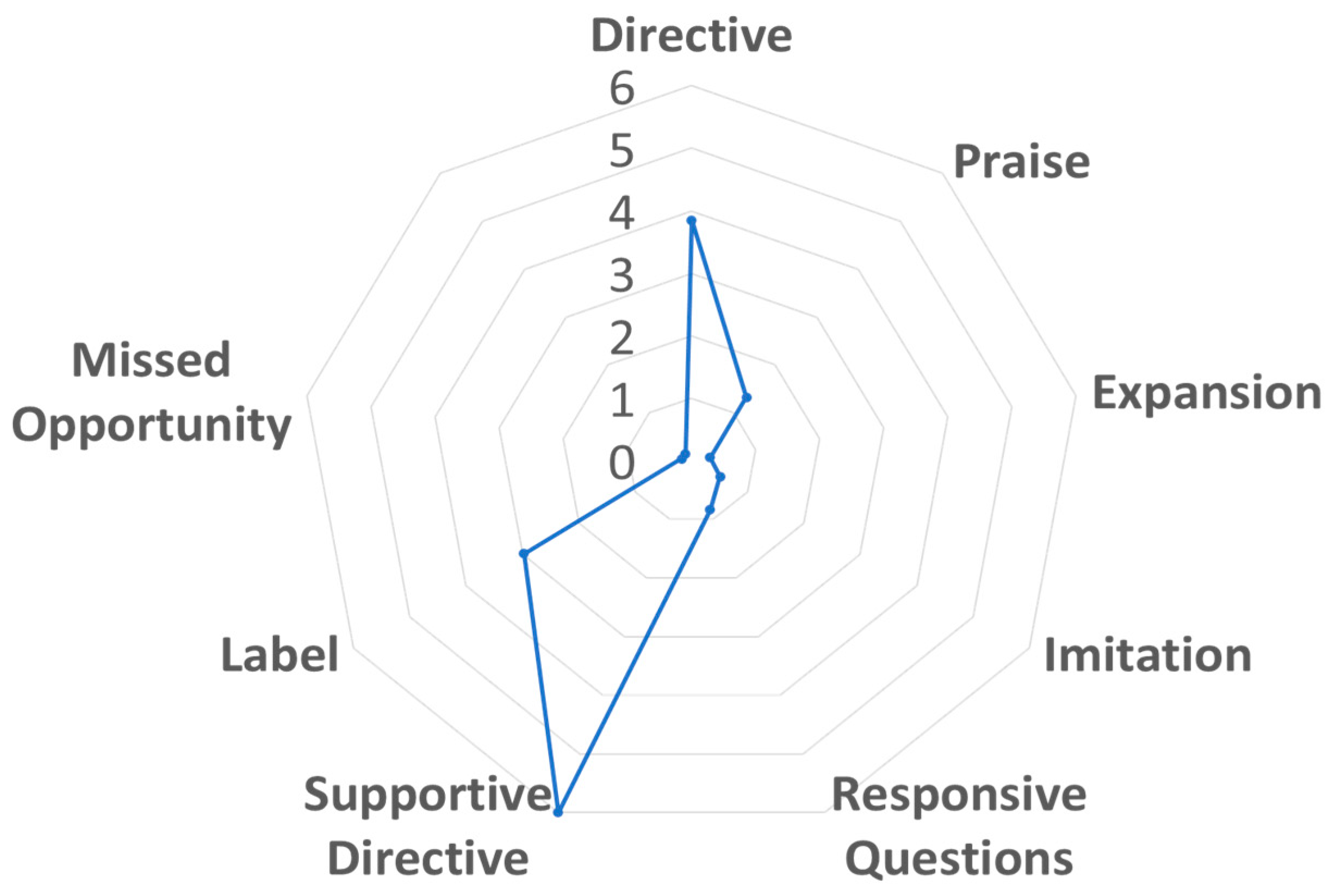
| Caregiver Communicative Behaviors (Rate per Minute) | Mean | Standard Deviation |
|---|---|---|
| Supportive Directive | 6.0 | 3.1 |
| Directive | 3.9 | 2.9 |
| Praise | 1.3 | 0.9 |
| Label | 3.0 | 2.7 |
| Responsive Question | 0.8 | 0.7 |
| Imitation | 0.5 | 0.4 |
| Expansion | 0.3 | 0.4 |
| Missed Opportunity | 0.2 | 0.2 |
| Engagement Quality (Scale 1–7) | ||
| Fluency and Connectedness | 3.6 | 1.2 |
| Language Facilitation | 4.4 | 1.5 |
| Scaffolding | 4.3 | 1.3 |
| Calm Authority | 4.3 | 1.1 |
| Follow Child’s Focus | 4.0 | 1.1 |
| Affect | 3.9 | 1.6 |
| Communication Temptation | 3.7 | 1.5 |
| Supportive Directive | Directive | Praise | Label | Responsive Question | Imitation | Expansion | Missed Opportunity | ||
|---|---|---|---|---|---|---|---|---|---|
| Caregiver Characteristics | Income | −0.06 | −0.56 * | −0.08 | 0 | 0.54 * | −0.06 | 0.25 | −0.48 |
| Education | −0.14 | −0.52 * | 0.12 | 0.16 | 0.28 | −0.08 | 0.32 | −0.54 * | |
| English Fluency | −0.64 * | −0.43 | −0.37 | 0.14 | 0.07 | 0.53 * | 0.53 * | 0.07 | |
| Years in US | −0.10 | −0.17 | −0.08 | −0.04 | 0.16 | 0.29 | −0.02 | 0.14 | |
| Self-efficacy in Using EBS | 0.25 | −0.25 | 0.46 | 0.26 | 0.34 | −0.08 | 0.38 | −0.61 * | |
| Child Characteristics | Age of Diagnosis | −0.49 | −0.30 | −0.42 | −0.14 | −0.38 | 0.17 | −0.13 | 0.39 |
| CARS | 0.20 | 0.65 ** | 0.08 | −0.22 | −0.26 | −0.25 | −0.37 | 0.06 | |
| Fluency and Connectedness | Scaffolding | Affect | Following Child’s Focus | Calm Authority | Language Facilitation | Communication Temptation | ||
|---|---|---|---|---|---|---|---|---|
| Caregiver Characteristics | Income | 0.36 | 0.27 | 0.18 | 0.56 * | 0.44 | 0.34 | 0.40 |
| Education | 0.27 | 0.47 | 0.24 | 0.45 | 0.38 | 0.42 | 0.45 | |
| English Fluency | 0.19 | −0.07 | 0.02 | 0.21 | −0.05 | 0.07 | −0.02 | |
| Years in US | 0.04 | −0.12 | −0.14 | −0.08 | −0.22 | −0.22 | −0.24 | |
| Self-efficacy in Using EBS | 0.56 * | 0.88 ** | 0.69 ** | 0.66 ** | 0.75 ** | 0.85 ** | 0.76 ** | |
| Child Characteristics | Age of Diagnosis | −0.36 | −0.38 | −0.52 * | −0.38 | −0.51 | −0.53 * | −0.45 |
| CARS | −0.23 | −0.26 | −0.19 | −0.29 | −0.14 | −0.23 | −0.23 | |
Disclaimer/Publisher’s Note: The statements, opinions and data contained in all publications are solely those of the individual author(s) and contributor(s) and not of MDPI and/or the editor(s). MDPI and/or the editor(s) disclaim responsibility for any injury to people or property resulting from any ideas, methods, instructions or products referred to in the content. |
© 2025 by the authors. Licensee MDPI, Basel, Switzerland. This article is an open access article distributed under the terms and conditions of the Creative Commons Attribution (CC BY) license (https://creativecommons.org/licenses/by/4.0/).
Share and Cite
Xu, Y.; Kapetanakos, X.; Meehan, M.; Tam, J.; Vanegas, S.B. Patterns of Caregiver Communicative Behaviors Among Low-Income Chinese Immigrant Mothers of Children with Autism—An Exploratory Study. Behav. Sci. 2025, 15, 1693. https://doi.org/10.3390/bs15121693
Xu Y, Kapetanakos X, Meehan M, Tam J, Vanegas SB. Patterns of Caregiver Communicative Behaviors Among Low-Income Chinese Immigrant Mothers of Children with Autism—An Exploratory Study. Behavioral Sciences. 2025; 15(12):1693. https://doi.org/10.3390/bs15121693
Chicago/Turabian StyleXu, Yue, Xian Kapetanakos, Madeleine Meehan, Jocelyn Tam, and Sandra Beatriz Vanegas. 2025. "Patterns of Caregiver Communicative Behaviors Among Low-Income Chinese Immigrant Mothers of Children with Autism—An Exploratory Study" Behavioral Sciences 15, no. 12: 1693. https://doi.org/10.3390/bs15121693
APA StyleXu, Y., Kapetanakos, X., Meehan, M., Tam, J., & Vanegas, S. B. (2025). Patterns of Caregiver Communicative Behaviors Among Low-Income Chinese Immigrant Mothers of Children with Autism—An Exploratory Study. Behavioral Sciences, 15(12), 1693. https://doi.org/10.3390/bs15121693