The Relationship Between Evaluative Concerns Perfectionism and Depression in Early Adults: The Mediating Effect of Rumination and the Mediated Moderation Effect of Mindfulness

Abstract
1. Introduction
2. Methods
2.1. Participants
2.2. Measures
2.2.1. Evaluative Concerns Perfectionism
2.2.2. Rumination
2.2.3. Mindfulness
2.2.4. Depression
2.2.5. Control Variables
2.3. Analysis
3. Results
3.1. Descriptive Statistics and Correlation Analysis Between Major Variables
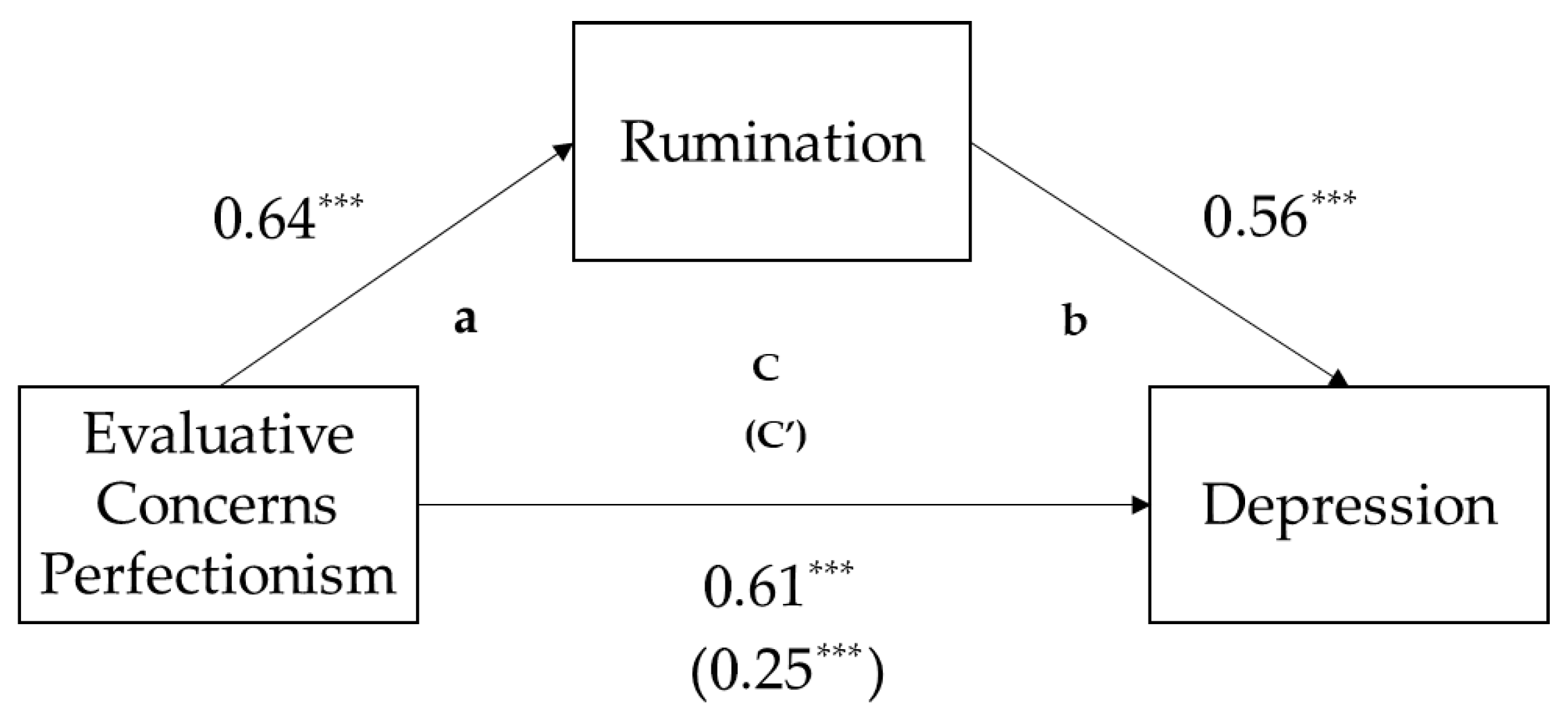
3.2. Mediation Effect
3.3. Moderating Effect
3.3.1. The Moderating Effect of Mindfulness on the Relationship Between Evaluative Concerns Perfectionism and Depression
3.3.2. The Moderating Effect of Mindfulness on the Relationship Between Rumination and Depression
3.4. Mediated Moderating Effect
3.4.1. Mediated Moderating Effect of Nonjudging of Experience on the Relationship Between Evaluative Concerns Perfectionism, Rumination, and Depression
3.4.2. Mediated Moderating Effect of Acting with Awareness on the Relationship Between Evaluative Concerns Perfectionism, Rumination, and Depression
4. Discussion
Author Contributions
Funding
Institutional Review Board Statement
Informed Consent Statement
Data Availability Statement
Acknowledgments
Conflicts of Interest
References
- Aiken, L. S., West, S. G., & Reno, R. R. (1991). Multiple regression: Testing and interpreting interactions. Sage. [Google Scholar]
- Baer, R. A., Smith, G. T., & Allen, K. B. (2004). Assessment of mindfulness by self-report: The Kentucky inventory of mindfulness skills. Assessment, 11(3), 191–206. [Google Scholar] [CrossRef] [PubMed]
- Baer, R. A., Smith, G. T., Hopkins, J., Krietemeyer, J., & Toney, L. (2006). Using self-report assessment methods to explore facets of mindfulness. Assessment, 13(1), 27–45. [Google Scholar] [CrossRef]
- Baron, R. M., & Kenny, D. A. (1986). The moderator–mediator variable distinction in social psychological research: Conceptual, strategic, and statistical considerations. Journal of Personality and Social Psychology, 51(6), 1173. [Google Scholar] [CrossRef]
- Cash, M., & Whittingham, K. (2010). What facets of mindfulness contribute to psychological well-being and depressive, anxious, and stress-related symptomatology? Mindfulness, 1(3), 177–182. [Google Scholar] [CrossRef]
- Choi, J. H. (2020). The relationship between evaluative concerns perfectionism and depression: Mediating effects of rumination and mindfulness [Unpublished Master’s thesis, Sogang University]. [Google Scholar]
- Choi, J. W. (2021). The relationship between perfectionistic self-presentation and depression on early adulthood: The moderating effects of unconditional self-acceptance and self-efficacy [Unpublished Master’s thesis, Silla University]. [Google Scholar]
- Choi, M., Yoo, J., & Hyun, M. (2005). The relationship between evaluative and personal standards perfectionism and depression: Mediating and moderating effects of self-efficacy. Korean Journal of Psychology: Health, 10(1), 1–15. [Google Scholar]
- Chon, K. K. (2001). Integrated adaptation of CES-D in Korea. Korean Journal of Health Psychology, 6, 59. [Google Scholar]
- Dunkley, D. M., Blankstein, K. R., Halsall, J., Williams, M., & Winkworth, G. (2000). The relation between perfectionism and distress: Hassles, coping, and perceived social support as mediators and moderators. Journal of Counseling Psychology, 47(4), 437. [Google Scholar] [CrossRef]
- Dunkley, D. M., Zuroff, D. C., & Blankstein, K. R. (2003). Self-critical perfectionism and daily affect: Dispositional and situational influences on stress and coping. Journal of Personality and Social Psychology, 84(1), 234. [Google Scholar] [CrossRef] [PubMed]
- Eisenlohr-Moul, T. A., Walsh, E. C., Charnigo, R. J., Jr., Lynam, D. R., & Baer, R. A. (2012). The “what” and the “how” of dispositional mindfulness: Using interactions among subscales of the five-facet mindfulness questionnaire to understand its relation to substance use. Assessment, 19(3), 276–286. [Google Scholar] [CrossRef] [PubMed]
- Flett, G. L., Madorsky, D., Hewitt, P. L., & Heisel, M. J. (2002). Perfectionism cognitions, rumination, and psychological distress. Journal of Rational-Emotive and Cognitive-Behavior Therapy, 20, 33–47. [Google Scholar] [CrossRef]
- Frost, R. O., Marten, P., Lahart, C., & Rosenblate, R. (1990). The dimensions of perfectionism. Cognitive Therapy and Research, 14, 449–468. [Google Scholar] [CrossRef]
- Harris, P. W., Pepper, C. M., & Maack, D. J. (2008). The relationship between maladaptive perfectionism and depressive symptoms: The mediating role of rumination. Personality and Individual Differences, 44(1), 150–160. [Google Scholar] [CrossRef]
- Hayes, A. F. (2017). Introduction to mediation, moderation, and conditional process analysis: A regression-based approach. Guilford Publications. [Google Scholar]
- Hayes, A. F., & Rockwood, N. J. (2020). Conditional process analysis: Concepts, computation, and advances in the modeling of the contingencies of mechanisms. American Behavioral Scientist, 64(1), 19–54. [Google Scholar] [CrossRef]
- Hayes, S. C., Strosahl, K. D., & Wilson, K. G. (2016). Acceptance and commitment therapy (2nd ed.). The Guilford Press. [Google Scholar]
- Henkel, V., Mergl, R., Kohnen, R., Allgaier, A. K., Moller, H. J., & Hegerl, U. (2009). Implications of the DSM’s emphasis on sadness and anhedonia in major depressive disorder. Journal of Affective Disorders, 114(1–3), 79–87. [Google Scholar]
- Hewitt, P. L., & Flett, G. L. (1991). Dimensions of perfectionism in unipolar depression. Journal of Abnormal Psychology, 100(1), 98. [Google Scholar] [CrossRef]
- Hong, Y. G. (2016). The Effect of the self-focused attention on social phobia through the moderating of mindfulness. Korean Journal of Youth Studies, 23(12), 105–128. [Google Scholar] [CrossRef]
- Jang, A. K., & Lee, J. Y. (2011). The effects of evaluative concerns perfectionism upon the college students’s depression and anxiety with validation from others as a mediating factor. Korean Journal of Counseling, 12(3), 881–896. [Google Scholar] [CrossRef]
- Josefsson, T., Larsman, P., Broberg, A. G., & Lundh, L. G. (2011). Self-reported mindfulness mediates the relation between meditation experience and psychological well-being. Mindfulness, 2, 49–58. [Google Scholar] [CrossRef]
- Jury, T. K., & Jose, P. E. (2019). Does rumination function as a longitudinal mediator between mindfulness and depression? Mindfulness, 10, 1091–1104. [Google Scholar] [CrossRef]
- Kabat-Zinn, J. (1994). Wherever you go, there you are: Mindfulness meditation in everyday life. Hyperion. [Google Scholar]
- Kim, H. H., & Kim, C. D. (2011). The classification between evaluative concerns perfectionists and personal standards perfectionists. Korean Journal of Counseling, 12(1), 373–391. [Google Scholar]
- Kim, H. J., & Son, C. N. (2006). The relationship between adaptive perfectionism, maladaptive perfectionism and selfesteem, daily hassles, rumination, depression. The Korean Journal of Stress, 14(1), 23–31. [Google Scholar]
- Kim, J., Lee, Y., & Lee, M. J. (2018). Analysis of psychological & emotional problems and countermeasures against young adults in their 20s. National Youth Policy Institute. [Google Scholar]
- Kim, J. M. (2009). The mediating effect of self-criticism and shame in the relation between maladaptive perfectionism and maladaptive emotion in university students. Korean Journal of Youth Studies, 16(10), 205–225. [Google Scholar]
- Kim, N. H. (2016). The relation between evaluative concerned perfectionism and depression: The mediating effect of self-criticism and rumination [Unpublished Master’s thesis, Ajou University]. [Google Scholar]
- Kim, S. J., Kim, J. H., & Youn, S. C. (2010). Validation of the Korean-ruminative response scale (K-RRS). Korean Journal of Clinical Psychology, 29(1), 1–19. [Google Scholar]
- Korea Disease Control and Prevention Agency. (2024). Available online: https://www.phwr.org/journal/view.html?doi=10.56786/PHWR.2024.17.15.3 (accessed on 10 June 2024).
- Kwak, H. M., & Chung, N. W. (2022). The influence of evaluative concerns perfectionism on depression: A moderated mediating effect of self-acceptance through internalized shame. The Korean Journal of Counseling and Psychotherapy, 34(1), 111–133. [Google Scholar] [CrossRef]
- Kwon, I. J. (2010). The relationship between perfectionism and depression among college students: The mediating effects of mindfulness and self-criticism [Master’s thesis, Kyungpook National University]. [Google Scholar]
- Kwon, S. M. (2013). Modern abnormal psychology. Hakjisa. [Google Scholar]
- Lee, H. K. (2020). Moderated mediation analysis using PROCESS macro (p. 185). Shinyoungsa. [Google Scholar]
- Lundh, L. G. (2004). Perfectionism and acceptance. Journal of Rational-Emotive and Cognitive-Behavior Therapy, 22, 251–265. [Google Scholar] [CrossRef]
- Nolen-Hoeksema, S. (2000). The role of rumination in depressive disorders and mixed anxiety/depressive symptoms. Journal of Abnormal Psychology, 109(3), 504. [Google Scholar] [CrossRef] [PubMed]
- Nolen-Hoeksema, S., & Morrow, J. (1991). A prospective study of depression and posttraumatic stress symptoms after a natural disaster: The 1989 Loma Prieta Earthquake. Journal of Personality and Social Psychology, 61(1), 115. [Google Scholar] [CrossRef] [PubMed]
- Park, S. H., & Sung, S. Y. (2008). The moderating effect of mindfulness between self-focused attention and psychological well-being. Korean Journal of Counseling and Psychotherapy, 20(4), 1127–1147. [Google Scholar]
- Powers, T. A., Zuroff, D. C., & Topciu, R. A. (2004). Covert and overt expressions of self-criticism and perfectionism and their relation to depression. European Journal of Personality, 18(1), 61–72. [Google Scholar] [CrossRef]
- Prakash, R. S., Hussain, M. A., & Schirda, B. (2015). The role of emotion regulation and cognitive control in the association between mindfulness disposition and stress. Psychology and Aging, 30(1), 160. [Google Scholar] [CrossRef]
- Saggino, A., Bartoccini, A., Sergi, M. R., Romanelli, R., Macchia, A., & Tommasi, M. (2017). Assessing mindfulness on samples of Italian children and adolescents: The validation of the Italian version of the child and adolescent mindfulness measure. Mindfulness, 8(5), 1364–1372. [Google Scholar] [CrossRef]
- Shafran, R., Cooper, Z., & Fairburn, C. G. (2002). Clinical perfectionism: A cognitive–behavioural analysis. Behaviour Research and Therapy, 40(7), 773–791. [Google Scholar] [CrossRef] [PubMed]
- Shahar, B., & Nitzan-Assayag, Y. (2020). Self-critical perfectionism and lower mindfulness and self-compassion predict anxious and depressive symptoms over two years. Journal of Psychopathology and Behavioral Assessment, 42(1), 122–136. [Google Scholar]
- Sherry, S. B., Gautreau, C. M., Mushquash, A. R., Sherry, D. L., & Allen, S. L. (2014). Self-critical perfectionism confers vulnerability to depression after controlling for neuroticism: A longitudinal study of middle-aged, community-dwelling women. Personality and Individual Differences, 69, 1–4. [Google Scholar] [CrossRef]
- Short, M. M., & Mazmanian, D. (2013). Perfectionism and negative repetitive thoughts: Examining a multiple mediator model in relation to mindfulness. Personality and Individual Differences, 55(6), 716–721. [Google Scholar] [CrossRef]
- Song, H. S., & Bae, S. M. (2020). The moderating effects of the facets of mindfulness on the relationship between daily life stress and suicidal ideation among Korean college students. International Journal of Mental Health and Addiction, 20(1), 136–151. [Google Scholar] [CrossRef]
- Sun, S. M. (2022). The relationship between socially prescribed perfectionism and somatization symptoms: The mediating effect of perseverative cognition and the moderated mediating effect of mindfulness [Unpublished Master’s thesis, Chonnam National University]. [Google Scholar]
- Won, D., & Kim, K. H. (2006). Validation of the Korean version of five-factor mindfulness questionnaire. The Korean Journal of Health Psychology, 11(4), 871–886. [Google Scholar]
- Won, D. R. (2007). The effect of mindfulness, meaning making and autonomous regulation of behavior on psychological well-being [Unpublished Ph.D. thesis, Chungnam National University]. [Google Scholar]
- Yi, I. H. (2008). Adaptive and maladaptive effects of self-focused attention on over-general autobiographical memory and depression. Korean Journal of Clinical Psychology, 27(3), 633–651. [Google Scholar]
- Yoo, S. K., Choi, B. Y., & Kang, Y. S. (2020). Mediating and moderating effects of mindfulness between brooding, reflection and depression, psychological well-being. Asian Journal of Education, 21(2), 517–545. [Google Scholar] [CrossRef]


| Variable | 1 | 2 | 3 | 4 | M | SD |
|---|---|---|---|---|---|---|
| 1. Evaluative concerns perfectionism | 1 | 0.64 *** | −0.54 *** | 0.61 *** | 92.86 | 18.25 |
| 2. Rumination | 0.64 *** | 1 | −0.48 *** | 0.72 *** | 48.65 | 13.16 |
| 3. Mindfulness | −0.54 *** | −0.48 *** | 1 | −0.61 *** | 122.01 | 14.75 |
| 4. Depression | 0.61 *** | 0.72 *** | −0.61 *** | 1 | 38.29 | 10.64 |
| Independent Variable | Dependent Variable: Depression | ||||||
|---|---|---|---|---|---|---|---|
| Unstandardized Coefficient | t | LLCI | ULCI | F | R2 | ||
| B | SE | ||||||
| Evaluative concerns perfectionism | 0.31 | 0.03 | 11.99 *** | 0.26 | 0.37 | 46.20 *** | 0.41 |
| Nonjudging of experience | −0.29 | 0.09 | −3.29 ** | −0.47 | −0.12 | ||
| Evaluative concerns perfectionism × Nonjudging of experience | −0.02 | 0.00 | −4.26 *** | −0.03 | −0.01 | ||
| Evaluative concerns perfectionism | 0.32 | 0.02 | 13.08 *** | 0.27 | 0.36 | 44.92 *** | 0.40 |
| Describing | −0.36 | 0.08 | −4.56 *** | −0.51 | −0.20 | ||
| Evaluative concerns perfectionism × Describing | 0.00 | 0.00 | 0.30 | −0.00 | 0.01 | ||
| Evaluative concerns perfectionism | 0.27 | 0.03 | 10.97 *** | 0.22 | 0.32 | 57.93 *** | 0.47 |
| Acting with awareness | −0.54 | 0.08 | −7.11 *** | −0.69 | −0.39 | ||
| Evaluative concerns perfectionism × Acting with awareness | −0.02 | 0.00 | −4.87 *** | −0.02 | −0.01 | ||
| Evaluative concerns perfectionism | 0.35 | 0.02 | 15.08 *** | 0.31 | 0.40 | 41.56 *** | 0.39 |
| Observing | −0.12 | 0.08 | −1.61 | −0.27 | 0.03 | ||
| Evaluative concerns perfectionism × Observing | 0.01 | 0.00 | 1.96 | 0.00 | 0.01 | ||
| Evaluative concerns perfectionism | 0.33 | 0.02 | 14.27 *** | 0.29 | 0.38 | 46.95 *** | 0.42 |
| Nonreactivity | −0.39 | 0.09 | −4.33 *** | −0.57 | −0.21 | ||
| Evaluative concerns perfectionism × Nonreactivity | 0.01 | 0.00 | 1.93 | 0.00 | 0.01 | ||
| Independent Variable | Dependent Variable: Depression | ||||||
|---|---|---|---|---|---|---|---|
| Unstandardized Coefficient | t | LLCI | ULCI | F | R2 | ||
| B | SE | ||||||
| Rumination | 0.57 | 0.03 | 17.57 *** | 0.50 | 0.63 | 82.84 *** | 0.56 |
| Nonjudging of experience | −0.08 | 0.08 | −1.02 | −0.24 | 0.08 | ||
| Rumination × Nonjudging of experience | −0.03 | 0.01 | −5.05 *** | −0.04 | −0.02 | ||
| Rumination | 0.54 | 0.03 | 19.01 *** | 0.49 | 0.60 | 84.44 *** | 0.56 |
| Describing | −0.35 | 0.07 | −5.28 *** | −0.48 | −0.22 | ||
| Rumination × Describing | 0.01 | 0.01 | 1.14 | −0.00 | 0.01 | ||
| Rumination | 0.51 | 0.03 | 16.32 *** | 0.45 | 0.58 | 93.73 *** | 0.59 |
| Acting with awareness | −0.35 | 0.07 | −5.01 *** | −0.49 | −0.21 | ||
| Rumination × Acting with awareness | −0.03 | 0.00 | −6.09 *** | −0.03 | −0.02 | ||
| Rumination | 0.61 | 0.03 | 21.83 *** | 0.55 | 0.66 | 85.70 *** | 0.56 |
| Observing | −0.32 | 0.07 | −4.94 *** | −0.45 | −0.19 | ||
| Rumination × Observing | 0.01 | 0.00 | 1.83 | −0.00 | 0.02 | ||
| Rumination | 0.56 | 0.03 | 20.83 *** | 0.51 | 0.62 | 90.56 *** | 0.58 |
| Nonreactivity | −0.49 | 0.08 | −6.34 *** | −0.64 | −0.34 | ||
| Rumination × Nonreactivity | 0.00 | 0.01 | 0.82 | −0.01 | 0.01 | ||
| Step 1 | Dependent variable: Depression | ||||
| Unstandardized coefficient | t | LLCI | ULCI | ||
| B | SE | ||||
| Evaluative concerns perfectionism × Nonjudging of experience | −0.02 | 0.00 | −4.26 *** | −0.03 | −0.01 |
| Step 2 | Dependent variable: Rumination | ||||
| Unstandardized coefficient | t | LLCI | ULCI | ||
| B | SE | ||||
| Evaluative concerns perfectionism | 0.35 | 0.03 | 11.57 *** | 0.29 | 0.41 |
| Step 3 | Dependent variable: Depression | ||||
| Unstandardized coefficient | t | LLCI | ULCI | ||
| B | SE | ||||
| Evaluative concerns perfectionism | 0.16 | 0.03 | 6.24 *** | 0.11 | 0.21 |
| Nonjudging of experience | 0.03 | 0.08 | 0.38 | −0.12 | 0.18 |
| Evaluative concerns perfectionism × Nonjudging of experience | −0.01 | 0.00 | −2.95 ** | −0.02 | −0.00 |
| Rumination | 0.47 | 0.04 | 12.93 *** | 0.40 | 0.54 |
| Rumination × Nonjudging of experience | −0.02 | 0.01 | −2.89 ** | −0.03 | −0.01 |
| Step 1 | Dependent variable: Depression | ||||
| Unstandardized coefficient | t | LLCI | ULCI | ||
| B | SE | ||||
| Evaluative concerns perfectionism × Acting with awareness | −0.02 | 0.00 | −4.87 *** | −0.02 | −0.01 |
| Step 2 | Dependent variable: Rumination | ||||
| Unstandardized coefficient | t | LLCI | ULCI | ||
| B | SE | ||||
| Evaluative concerns perfectionism | 0.35 | 0.03 | 11.57 *** | 0.29 | 0.41 |
| Step 3 | Dependent variable: Depression | ||||
| Unstandardized coefficient | t | LLCI | ULCI | ||
| B | SE | ||||
| Evaluative concerns perfectionism | 0.13 | 0.02 | 5.28 *** | 0.08 | 0.18 |
| Acting with awareness | −0.27 | 0.07 | −3.88 *** | −0.40 | −0.13 |
| Evaluative concerns perfectionism × Acting with awareness | −0.01 | 0.00 | −2.72 ** | −0.02 | −0.00 |
| Rumination | 0.43 | 0.04 | 12.19 *** | 0.36 | 0.50 |
| Rumination × Acting with awareness | −0.02 | 0.01 | −2.89 ** | −0.03 | −0.01 |
Disclaimer/Publisher’s Note: The statements, opinions and data contained in all publications are solely those of the individual author(s) and contributor(s) and not of MDPI and/or the editor(s). MDPI and/or the editor(s) disclaim responsibility for any injury to people or property resulting from any ideas, methods, instructions or products referred to in the content. |
© 2025 by the authors. Licensee MDPI, Basel, Switzerland. This article is an open access article distributed under the terms and conditions of the Creative Commons Attribution (CC BY) license (https://creativecommons.org/licenses/by/4.0/).
Share and Cite
Chae, H.-J.; Bae, S.M. The Relationship Between Evaluative Concerns Perfectionism and Depression in Early Adults: The Mediating Effect of Rumination and the Mediated Moderation Effect of Mindfulness. Behav. Sci. 2025, 15, 1692. https://doi.org/10.3390/bs15121692
Chae H-J, Bae SM. The Relationship Between Evaluative Concerns Perfectionism and Depression in Early Adults: The Mediating Effect of Rumination and the Mediated Moderation Effect of Mindfulness. Behavioral Sciences. 2025; 15(12):1692. https://doi.org/10.3390/bs15121692
Chicago/Turabian StyleChae, Hyun-Ju, and Sung Man Bae. 2025. "The Relationship Between Evaluative Concerns Perfectionism and Depression in Early Adults: The Mediating Effect of Rumination and the Mediated Moderation Effect of Mindfulness" Behavioral Sciences 15, no. 12: 1692. https://doi.org/10.3390/bs15121692
APA StyleChae, H.-J., & Bae, S. M. (2025). The Relationship Between Evaluative Concerns Perfectionism and Depression in Early Adults: The Mediating Effect of Rumination and the Mediated Moderation Effect of Mindfulness. Behavioral Sciences, 15(12), 1692. https://doi.org/10.3390/bs15121692