


Knowledge Sharing in AI-Enabled Workplaces: A Social Cognitive Perspective on Usefulness Perceptions and Competition


Abstract
1. Introduction
2. Theory and Hypothesis Development
2.1. Social Cognitive Theory
2.2. Perceived AI Usefulness and Knowledge Sharing Behavior
2.3. Anticipated Positive Response as a Mediator
2.4. The Moderating Role of Organizational Competitive Climate
3. Methods
3.1. Participants and Procedure
3.2. Measurement Adaptation and Translation
3.3. Measures
3.4. Analytical Strategy
4. Results
4.1. Preliminary Analyses
4.2. Hypothesis Testing
5. Discussion
5.1. Theoretical Contributions
5.2. Methodological Contributions
5.3. Practical Implications
5.4. Limitations and Future Directions
5.5. Conclusions
Author Contributions
Funding
Institutional Review Board Statement
Informed Consent Statement
Data Availability Statement
Conflicts of Interest
References
- Abbasi, S. G., Alaghbari, M. A., Shabbir, M. S., & Abbas, M. (2020). Organizational culture and knowledge sharing behavior: Moderated mediation model. Utopía y Praxis Latinoamericana, 25(Esp. 10), 480–490. [Google Scholar]
- Akkiraju, R., Srivastava, B., Ivan, A. A., Goodwin, R., & Syeda-Mahmood, T. (2006, September 18–22). Semaplan: Combining planning with semantic matching to achieve web service composition. 2006 IEEE International Conference on Web Services (ICWS’06) (pp. 37–44), Chicago, IL, USA. [Google Scholar]
- Akram, T., Lei, S., Haider, M. J., & Hussain, S. T. (2020). The impact of organizational justice on employee innovative work behavior: Mediating role of knowledge sharing. Journal of Innovation & Knowledge, 5(2), 117–129. [Google Scholar] [CrossRef]
- Bandura, A. (1982). Self-efficacy mechanism in human agency. American Psychologist, 37(2), 122. [Google Scholar] [CrossRef]
- Bandura, A. (1986). Social foundations of thought and action. Pearson. [Google Scholar]
- Bandura, A. (1997). Self-efficacy: The exercise of control. W H Freeman/Times Books/Henry Holt & Co. [Google Scholar]
- Bandura, A. (1999). Social cognitive theory: An agentic perspective. Asian Journal of Social Psychology, 2(1), 21–41. [Google Scholar] [CrossRef]
- Bavik, Y. L., Tang, P. M., Shao, R., & Lam, L. W. (2018). Ethical leadership and employee knowledge sharing: Exploring dual-mediation paths. The leadership quarterly, 29(2), 322–332. [Google Scholar] [CrossRef]
- Binsaeed, R. H., Yousaf, Z., Grigorescu, A., Samoila, A., Chitescu, R. I., & Nassani, A. A. (2023). Knowledge sharing key issue for digital technology and artificial intelligence adoption. Systems, 11(7), 316. [Google Scholar] [CrossRef]
- Brislin, R. W. (1986). The wording and translation of research instruments. In Field methods in cross-cultural research. Sage. [Google Scholar]
- Brown, S. D., & Lent, R. W. (2019). Social cognitive career theory at 25: Progress in studying the domain satisfaction and career self-management models. Journal of Career Assessment, 27(4), 563–578. [Google Scholar] [CrossRef]
- Brown, S. P., Cron, W. L., & Slocum, J. W., Jr. (1998). Effects of trait competitiveness and perceived intraorganizational competition on salesperson goal setting and performance. Journal of Marketing, 62(4), 88–98. [Google Scholar] [CrossRef]
- Carrillo, P., Robinson, H., Al-Ghassani, A., & Anumba, C. (2004). Knowledge management in UK construction: Strategies, resources and barriers. Project Management Journal, 35(1), 46–56. [Google Scholar] [CrossRef]
- Castaneda, D. I., & Cuellar, S. (2020). Knowledge sharing and innovation: A systematic review. Knowledge and Process Management, 27(3), 159–173. [Google Scholar] [CrossRef]
- Cetindamar, D., Kitto, K., Wu, M., Zhang, Y., Abedin, B., & Knight, S. (2022). Explicating AI literacy of employees at digital workplaces. IEEE Transactions on Engineering Management, 71, 810–823. [Google Scholar] [CrossRef]
- Chai, S., Das, S., & Rao, H. R. (2011). Factors affecting bloggers’ knowledge sharing: An investigation across gender. Journal of Management Information Systems, 28(3), 309–342. [Google Scholar] [CrossRef]
- Chen, F. F. (2007). Sensitivity of goodness of fit indexes to lack of measurement invariance. Structural Equation Modeling: A Multidisciplinary Journal, 14(3), 464–504. [Google Scholar] [CrossRef]
- Cheung, G. W., & Rensvold, R. B. (2002). Evaluating goodness-of-fit indexes for testing measurement invariance. Structural Equation Modeling, 9(2), 233–255. [Google Scholar] [CrossRef]
- Choung, H., David, P., & Ross, A. (2023). Trust in AI and its role in the acceptance of AI technologies. International Journal of Human–Computer Interaction, 39(9), 1727–1739. [Google Scholar] [CrossRef]
- Chowdhury, S., Budhwar, P., Dey, P. K., Joel-Edgar, S., & Abadie, A. (2022). AI-employee collaboration and business performance: Integrating knowledge-based view, socio-technical systems and organisational socialisation framework. Journal of Business Research, 144, 31–49. [Google Scholar] [CrossRef]
- Colquitt, J. A., LePine, J. A., & Noe, R. A. (2000). Toward an integrative theory of training motivation: A meta-analytic path analysis of 20 years of research. Journal of Applied Psychology, 85(5), 678. [Google Scholar] [CrossRef]
- Compeau, D. R., & Higgins, C. A. (1995). Computer self-efficacy: Development of a measure and initial test. MIS Quarterly, 19(2), 189–211. [Google Scholar] [CrossRef]
- Connelly, C. E., Ford, D. P., Turel, O., Gallupe, B., & Zweig, D. (2014). ‘I’m busy (and competitive)!’ Antecedents of knowledge sharing under pressure. Knowledge Management Research & Practice, 12(1), 74–85. [Google Scholar] [CrossRef]
- Connelly, C. E., Zweig, D., Webster, J., & Trougakos, J. P. (2012). Knowledge hiding in organizations. Journal of Organizational Behavior, 33(1), 64–88. [Google Scholar] [CrossRef]
- Constant, D., Sproull, L., & Kiesler, S. (1996). The kindness of strangers: The usefulness of electronic weak ties for technical advice. Organization Science, 7(2), 119–135. [Google Scholar] [CrossRef]
- Cortiñas-Lorenzo, K., Lindley, S., Larsen-Ledet, I., & Mitra, B. (2024). Through the looking-glass: Transparency implications and challenges in enterprise AI knowledge systems. arXiv, arXiv:2401.09410. [Google Scholar] [CrossRef]
- Cropanzano, R., & Mitchell, M. S. (2005). Social exchange theory: An interdisciplinary review. Journal of Management, 31(6), 874–900. [Google Scholar] [CrossRef]
- David, E. M., Kim, T. Y., Rodgers, M., & Chen, T. (2021). Helping while competing? The complex effects of competitive climates on the prosocial identity and performance relationship. Journal of Management Studies, 58(6), 1507–1531. [Google Scholar] [CrossRef]
- Davis, F. D. (1989). Perceived usefulness, perceived ease of use, and user acceptance of information technology. MIS Quarterly, 13(3), 319–340. [Google Scholar] [CrossRef]
- Dietz, L., Burmeister, A., & Fasbender, U. (2022). Age and knowledge exchange: Ability, motivation, and opportunities. In Age and work (pp. 259–276). Routledge. [Google Scholar]
- Edmondson, A. (1999). Psychological safety and learning behavior in work teams. Administrative Science Quarterly, 44(2), 350–383. [Google Scholar] [CrossRef]
- Exline, J. J., Single, P. B., Lobel, M., & Geyer, A. L. (2004). Glowing praise and the envious gaze: Social dilemmas surrounding the public recognition of achievement. Basic and Applied Social Psychology, 26(2–3), 119–130. [Google Scholar]
- Farooq, R. (2024). Does feedback-seeking behavior trigger knowledge sharing at work: The role of gender. VINE Journal of Information and Knowledge Management Systems, 54(6), 1360–1378. [Google Scholar] [CrossRef]
- Ferrin, D. L., Bligh, M. C., & Kohles, J. C. (2007). Can I trust you to trust me? A theory of trust, monitoring, and cooperation in interpersonal and intergroup relationships. Group & Organization Management, 32(4), 465–499. [Google Scholar]
- Fletcher, T. D., Major, D. A., & Davis, D. D. (2008). The interactive relationship of competitive climate and trait competitiveness with workplace attitudes, stress, and performance. Journal of Organizational Behavior: The International Journal of Industrial, Occupational and Organizational Psychology and Behavior, 29(7), 899–922. [Google Scholar] [CrossRef]
- Fornell, C., & Larcker, D. F. (1981). Evaluating structural equation models with unobservable variables and measurement error. Journal of Marketing Research, 18(1), 39–50. [Google Scholar] [CrossRef]
- Haefner, N., Wincent, J., Parida, V., & Gassmann, O. (2021). Artificial intelligence and innovation management: A review, framework, and research agenda. Technological Forecasting and Social Change, 162, 120392. [Google Scholar] [CrossRef]
- Hao, Q., Zhang, B., Shi, Y., & Yang, Q. (2022). How trust in coworkers fosters knowledge sharing in virtual teams? A multilevel moderated mediation model of psychological safety, team virtuality, and self-efficacy. Frontiers in Psychology, 13, 899142. [Google Scholar] [CrossRef] [PubMed]
- Hassani, H., Silva, E. S., Unger, S., TajMazinani, M., & Mac Feely, S. (2020). Artificial intelligence (AI) or intelligence augmentation (IA): What is the future? Ai, 1(2), 8. [Google Scholar] [CrossRef]
- Hayes, A. F. (2013). Introduction to mediation, moderation, and conditional process analysis. Guilford Press. [Google Scholar]
- He, X., Zheng, Y., & Wei, Y. (2024). The double-edged sword effect of illegitimate tasks on employee creativity: Positive and negative coping perspectives. Psychology Research and Behavior Management, 2024, 485–500. [Google Scholar] [CrossRef] [PubMed]
- Hsu, M. H., Ju, T. L., Yen, C. H., & Chang, C. M. (2007). Knowledge sharing behavior in virtual communities: The relationship between trust, self-efficacy, and outcome expectations. International Journal of Human-Computer Studies, 65(2), 153–169. [Google Scholar] [CrossRef]
- Igbaria, M., & Iivari, J. (1995). The effects of self-efficacy on computer usage. Omega, 23(6), 587–605. [Google Scholar] [CrossRef]
- Imran, U. D., Ghazwan, M. F., & Firmansyah, F. (2025). The effect of recognition and appreciation on employee motivation and performance. Economics and Digital Business Review, 6(1), 1–18. [Google Scholar] [CrossRef]
- Jia, J., Ning, X., & Liu, W. (2025). The consequences and theoretical explanation of workplace AI on employees: A systematic literature review. Journal of Digital Management, 1(1), 14. [Google Scholar] [CrossRef]
- Johnson, M., Albizri, A., Harfouche, A., & Fosso-Wamba, S. (2022). Integrating human knowledge into artificial intelligence for complex and ill-structured problems: Informed artificial intelligence. International Journal of Information Management, 64, 102479. [Google Scholar] [CrossRef]
- Kankanhalli, A., Tan, B. C., & Wei, K. K. (2005). Contributing knowledge to electronic knowledge repositories: An empirical investigation. MIS Quarterly, 29(1), 113–143. [Google Scholar] [CrossRef]
- Kollock, P. (1999). The economies of online cooperation: Gifts and public goods in cyberspace. In Communities in cyberspace (pp. 220–239). Routledge. [Google Scholar]
- Kooij, D. T., De Lange, A. H., Jansen, P. G., Kanfer, R., & Dikkers, J. S. (2011). Age and work-related motives: Results of a meta-analysis. Journal of Organizational Behavior, 32(2), 197–225. [Google Scholar] [CrossRef]
- Lam, L., Nguyen, P., Le, N., & Tran, K. (2021). The relation among organizational culture, knowledge management, and innovation capability: Its implication for open innovation. Journal of Open Innovation: Technology, Market, and Complexity, 7(1), 66. [Google Scholar] [CrossRef]
- Lazazzara, A., & Za, S. (2020). The effect of subjective age on knowledge sharing in the public sector. Personnel Review, 49(1), 303–323. [Google Scholar] [CrossRef]
- Li, H., & Kim, S. (2024). Developing AI literacy in HRD: Competencies, approaches, and implications. Human Resource Development International, 27(3), 345–366. [Google Scholar] [CrossRef]
- Lin, L. H. (2011). Cultural and organizational antecedents of guanxi: The Chinese cases. Journal of Business Ethics, 99(3), 441–451. [Google Scholar] [CrossRef]
- Mariani, M. M., Machado, I., Magrelli, V., & Dwivedi, Y. K. (2023). Artificial intelligence in innovation research: A systematic review, conceptual framework, and future research directions. Technovation, 122, 102623. [Google Scholar] [CrossRef]
- McEvily, B., Perrone, V., & Zaheer, A. (2003). Trust as an organizing principle. Organization Science, 14(1), 91–103. [Google Scholar] [CrossRef]
- Memmert, L., & Bittner, E. (2022, January 4–7). Complex problem solving through human-AI collaboration: Literature review on research contexts. 55th Hawaii International Conference on System Sciences, Virtual Event/Maui, HI, USA. [Google Scholar]
- Morandini, S., Fraboni, F., De Angelis, M., Puzzo, G., Giusino, D., & Pietrantoni, L. (2023). The impact of artificial intelligence on workers’ skills: Upskilling and reskilling in organisations. Informing Science, 26, 39–68. [Google Scholar] [CrossRef]
- Ng, T. W., & Feldman, D. C. (2010). The relationships of age with job attitudes: A meta-analysis. Personnel Psychology, 63(3), 677–718. [Google Scholar] [CrossRef]
- Nguyen, M., Malik, A., & Sharma, P. (2021). How to motivate employees to engage in online knowledge sharing? Differences between posters and lurkers. Journal of Knowledge Management, 25(7), 1811–1831. [Google Scholar] [CrossRef]
- Nonaka, L., Takeuchi, H., & Umemoto, K. (1996). A theory of organizational knowledge creation. International Journal of Technology Management, 11(7–8), 833–845. [Google Scholar]
- Olan, F., Arakpogun, E. O., Suklan, J., Nakpodia, F., Damij, N., & Jayawickrama, U. (2022). Artificial intelligence and knowledge sharing: Contributing factors to organizational performance. Journal of Business Research, 145, 605–615. [Google Scholar] [CrossRef]
- O’Neill, B. S., & Adya, M. (2007). Knowledge sharing and the psychological contract: Managing knowledge workers across different stages of employment. Journal of Managerial Psychology, 22(4), 411–436. [Google Scholar] [CrossRef]
- Osasona, F., Amoo, O. O., Atadoga, A., Abrahams, T. O., Farayola, O. A., & Ayinla, B. S. (2024). Reviewing the ethical implications of AI in decision making processes. International Journal of Management & Entrepreneurship Research, 6(2), 322–335. [Google Scholar] [CrossRef]
- Perumal, S., & Sreekumaran Nair, S. (2022). Impact of views about knowledge and workplace relationships on tacit knowledge sharing. Knowledge Management Research & Practice, 20(3), 410–421. [Google Scholar]
- Podsakoff, P. M., MacKenzie, S. B., Lee, J. Y., & Podsakoff, N. P. (2003). Common method biases in behavioral research: A critical review of the literature and recommended remedies. Journal of Applied Psychology, 88(5), 879. [Google Scholar] [CrossRef]
- Raisch, S., & Krakowski, S. (2021). Artificial intelligence and management: The automation–augmentation paradox. Academy of Management Review, 46(1), 192–210. [Google Scholar] [CrossRef]
- Ren, X., & Sun, X. (2024). How do enterprise social media affordances affect knowledge sharing within project teams: The social cognitive theory view. Information Technology & People, 37(6), 2183–2202. [Google Scholar]
- Rezaei, M., Pironti, M., & Quaglia, R. (2024). AI in knowledge sharing, which ethical challenges are raised in decision-making processes for organisations? Management Decision, ahead-of-print. [Google Scholar] [CrossRef]
- Schunk, D. H., & DiBenedetto, M. K. (2020). Motivation and social cognitive theory. Contemporary Educational Psychology, 60, 101832. [Google Scholar] [CrossRef]
- Schunk, D. H., & DiBenedetto, M. K. (2021). Self-efficacy and human motivation. In Advances in motivation science (Vol. 8, pp. 153–179). Elsevier. [Google Scholar]
- Wang, S., & Noe, R. A. (2010). Knowledge sharing: A review and directions for future research. Human Resource Management Review, 20(2), 115–131. [Google Scholar] [CrossRef]
- Wang, Z., & Wang, N. (2012). Knowledge sharing, innovation and firm performance. Expert Systems with Applications, 39(10), 8899–8908. [Google Scholar] [CrossRef]
- Wasko, M. M., & Faraj, S. (2000). “It is what one does”: Why people participate and help others in electronic communities of practice. The Journal of Strategic Information Systems, 9(2–3), 155–173. [Google Scholar] [CrossRef]
- Williams, M., & Polman, E. (2015). Is it me or her? How gender composition evokes interpersonally sensitive behavior on collaborative cross-boundary projects. Organization Science, 26(2), 334–355. [Google Scholar] [CrossRef]
- Wisniewski, B., Zierer, K., & Hattie, J. (2020). The power of feedback revisited: A meta-analysis of educational feedback research. Frontiers in Psychology, 10, 487662. [Google Scholar] [CrossRef] [PubMed]
- Wu, W., Ni, D., Wu, S., Lu, L., Zhang, X., & Hao, S. (2021). Envy climate and group performance in full-service hotels: The roles of intragroup relationship conflict and competitive climate. International Journal of Contemporary Hospitality Management, 33(10), 3494–3513. [Google Scholar] [CrossRef]
- Yu, J., Huang, L., & Wang, Z. (2024). Workplace competitive climate: A literature review and future prospects. Human Resources Development of China, 41(12), 68–91. [Google Scholar]
- Yu, X., Xu, S., & Ashton, M. (2023). Antecedents and outcomes of artificial intelligence adoption and application in the workplace: The socio-technical system theory perspective. Information Technology & People, 36(1), 454–474. [Google Scholar]
- Zhan, X., Wan, Y., Li, Z., Zhang, M., & Wang, Z. (2025). The impact mechanism of gig workers self-leadership on proactive service behavior from the perspective of social cognitive theory. Chinese Journal of Management, 22(01), 65–73. [Google Scholar]
- Zhou, J., Liang, Z., Fang, Y., & Zhou, Z. (2024). Exploring public response to ChatGPT with sentiment analysis and knowledge map. IEEE Access, 12, 50504–50516. [Google Scholar] [CrossRef]
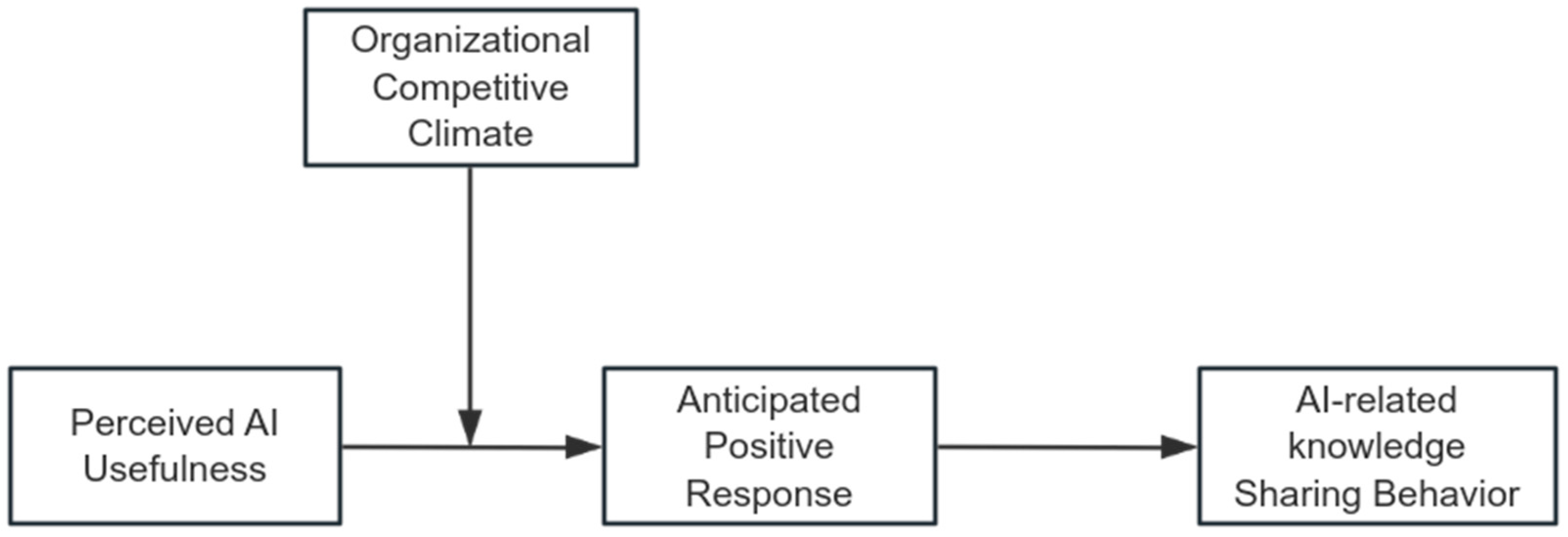
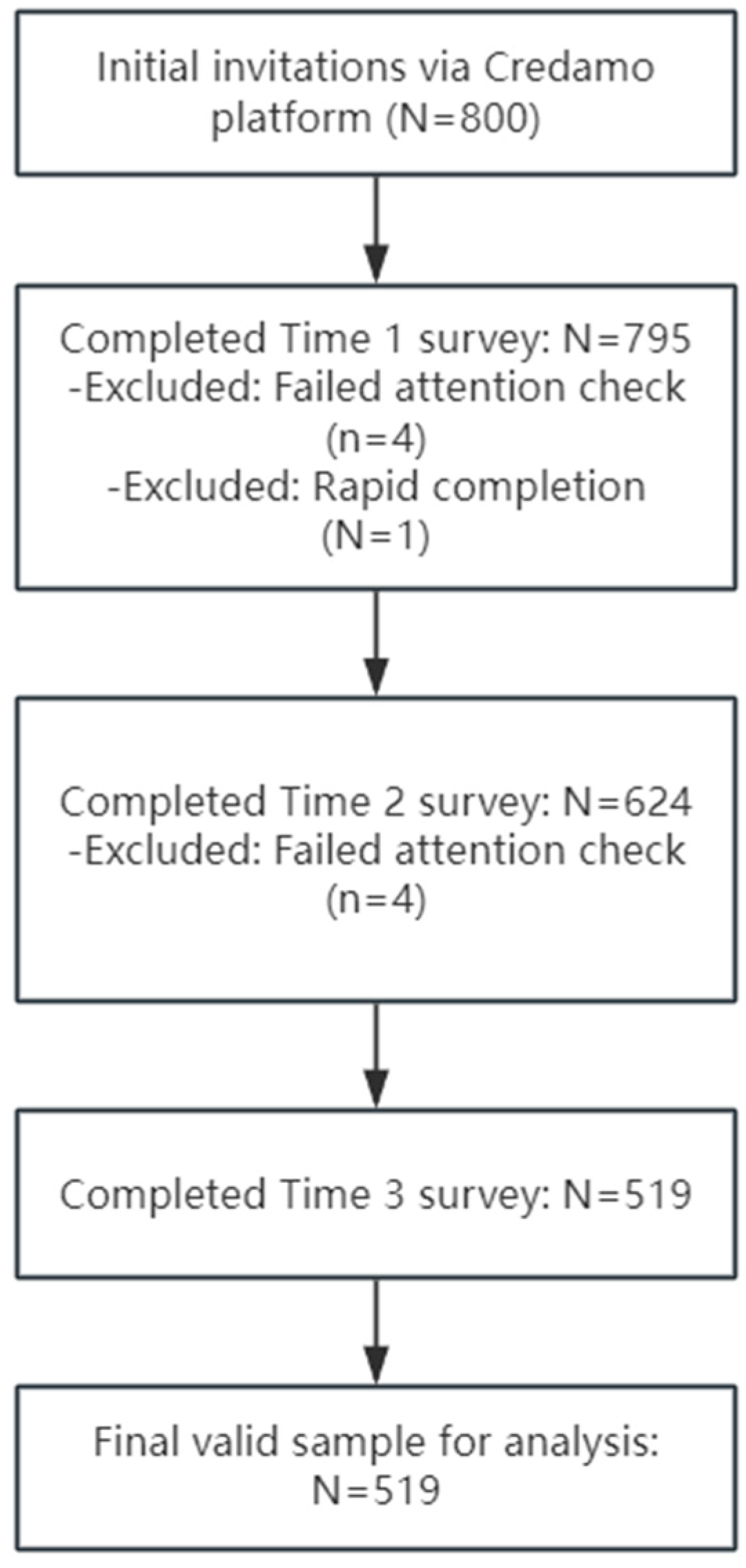
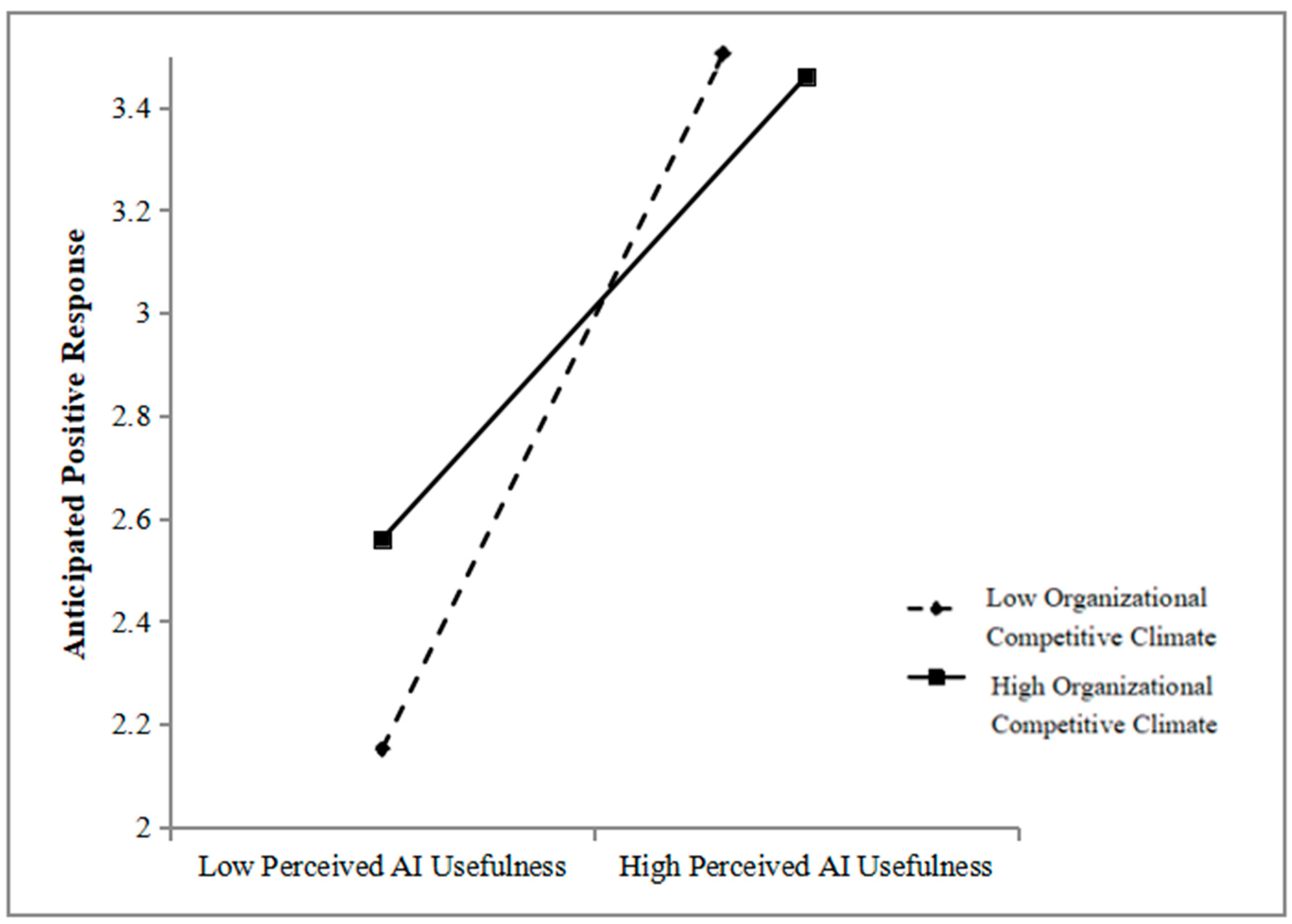

| AVE | CR | |
|---|---|---|
| Perceived AI usefulness | 0.403 | 0.771 |
| Anticipated positive response | 0.520 | 0.864 |
| AI-related knowledge sharing behavior | 0.428 | 0.786 |
| Organizational competitive climate | 0.668 | 0.889 |
| Perceived AI Usefulness | Anticipated Positive Response | AI-Related Knowledge Sharing Behavior | Organizational Competitive Climate | |
|---|---|---|---|---|
| Perceived AI usefulness | — | |||
| Anticipated positive response | 0.653 | — | ||
| AI-related knowledge sharing behavior | 0.668 | 0.738 | — | |
| Organizational competitive climate | 0.261 | 0.103 | 0.032 | — |
| Model | Variables | χ2 | df | χ2/df | TLI | CFI | RMSEA | SRMR |
|---|---|---|---|---|---|---|---|---|
| Four-Factor | PAIU, APR, KSB, OCC | 401.775 | 156 | 2.575 | 0.900 | 0.918 | 0.055 | 0.055 |
| Three-Factor | PAIU, APR + KSB, OCC | 502.641 | 159 | 3.161 | 0.863 | 0.885 | 0.065 | 0.060 |
| Two-Factor | PAIU, APR + KSB + OCC | 1313.252 | 161 | 8.157 | 0.545 | 0.615 | 0.118 | 0.109 |
| One-Factor | PAIU + APR + KSB + OCC | 1468.388 | 162 | 9.064 | 0.488 | 0.563 | 0.125 | 0.113 |
| M | SD | 1 | 2 | 3 | 4 | 5 | 6 | |
|---|---|---|---|---|---|---|---|---|
| 1. Gender | 0.520 | 0.500 | — | |||||
| 2. Age | 2.550 | 0.661 | −0.080 | — | ||||
| 3. Perceived AI usefulness | 4.330 | 0.379 | −0.093 * | 0.106 * | — | |||
| 4. Anticipated positive response | 4.030 | 0.568 | 0.076 | 0.133 ** | 0.448 ** | — | ||
| 5. AI-related knowledge sharing behavior | 4.094 | 0.462 | 0.018 | 0.100 * | 0.413 ** | 0.556 ** | — | |
| 6. Organizational competitive climate | 3.578 | 0.921 | −0.041 | 0.077 | 0.173 ** | 0.074 | 0.019 | — |
| AI-Related Knowledge Sharing Behavior | Anticipated Positive Response | AI-Related Knowledge Sharing Behavior | ||||
|---|---|---|---|---|---|---|
| M1 | M2 | M3 | ||||
| b | SE | b | SE | b | SE | |
| Constant | 1.78 *** | 0.22 | 0.83 ** | 0.27 | 1.47 *** | 0.20 |
| Gender | 0.06 | 0.04 | 0.14 | 0.04 | 0.00 | 0.03 |
| Age | 0.04 | 0.03 | 0.08 | 0.03 | 0.01 | 0.03 |
| Perceived AI usefulness | 0.50 *** | 0.05 | 0.67 *** | 0.06 | 0.25 *** | 0.05 |
| Anticipated positive response | 0.38 *** | 0.03 | ||||
| R2 | 0.18 *** | 0.22 *** | 0.34 *** | |||
| ΔF | 36.98 *** | 49.52 *** | 67.00 *** | |||
| Anticipated Positive Response | AI-Related Knowledge Sharing Behavior | |||||
|---|---|---|---|---|---|---|
| b | SE | 95% CI | b | SE | 95% CI | |
| Constant | 3.75 *** | 0.09 | [3.57, 3.95] | 2.55 *** | 0.14 | [2.27, 2.83] |
| Gender | 0.14 ** | 0.04 | [0.05, 0.23] | 0.00 | 0.34 | [−0.06, 0.07] |
| Age | 0.09 * | 0.03 | [0.02, 0.15] | 0.01 | 0.03 | [−0.04, 0.06] |
| Perceived AI usefulness | 0.65 *** | 0.06 | [0.53, 0.75] | 0.25 *** | 0.05 | [0.15, 0.35] |
| Organizational competitive climate | 0.01 | 0.03 | [−0.04, 0.06] | |||
| Perceived AI usefulness × Organizational competitive climate | −0.19 * | 0.08 | [−0.36, −0.03] | |||
| Anticipated positive response | 0.38 *** | |||||
| R2 | 0.23 *** | 0.34 *** | ||||
| F | 31.00 *** | 67.00 *** | ||||
| Conditional Indirect Effect at High and Low Levels of Organizational Competitive Climate | Effect | SE | 95% CI |
|---|---|---|---|
| −1 SD (−0.92) organizational competitive climate | 0.31 | 0.05 | [0.22, 0.41] |
| Mean (0) organizational competitive climate | 0.24 | 0.04 | [0.18, 0.32] |
| +1 SD (0.92) organizational competitive climate | 0.18 | 0.05 | [0.10, 0.28] |
| Index of Moderated Mediation | −0.07 | 0.03 | [−0.14, −0.01] |
Disclaimer/Publisher’s Note: The statements, opinions and data contained in all publications are solely those of the individual author(s) and contributor(s) and not of MDPI and/or the editor(s). MDPI and/or the editor(s) disclaim responsibility for any injury to people or property resulting from any ideas, methods, instructions or products referred to in the content. |
© 2025 by the authors. Licensee MDPI, Basel, Switzerland. This article is an open access article distributed under the terms and conditions of the Creative Commons Attribution (CC BY) license (https://creativecommons.org/licenses/by/4.0/).
Share and Cite
Zhong, C.; Wang, Y. Knowledge Sharing in AI-Enabled Workplaces: A Social Cognitive Perspective on Usefulness Perceptions and Competition. Behav. Sci. 2025, 15, 1635. https://doi.org/10.3390/bs15121635
Zhong C, Wang Y. Knowledge Sharing in AI-Enabled Workplaces: A Social Cognitive Perspective on Usefulness Perceptions and Competition. Behavioral Sciences. 2025; 15(12):1635. https://doi.org/10.3390/bs15121635
Chicago/Turabian StyleZhong, Chuling, and Yao Wang. 2025. "Knowledge Sharing in AI-Enabled Workplaces: A Social Cognitive Perspective on Usefulness Perceptions and Competition" Behavioral Sciences 15, no. 12: 1635. https://doi.org/10.3390/bs15121635
APA StyleZhong, C., & Wang, Y. (2025). Knowledge Sharing in AI-Enabled Workplaces: A Social Cognitive Perspective on Usefulness Perceptions and Competition. Behavioral Sciences, 15(12), 1635. https://doi.org/10.3390/bs15121635

