Intuition or Deliberation? The Effects of Decision-Making Modes on Adolescents’ Honest Behaviors: The Moderating Roles of Honesty Tendencies and Victim Situations

Abstract
1. Introduction
2. Pre-Experiments
2.1. Pre-Experiment 1: Determination of the Presentation Time of the Images in the Spot-the-Difference Task
2.1.1. Experimental Purpose
2.1.2. Participants
2.1.3. Materials and Procedure
2.1.4. Results and Discussion
2.1.5. Conclusions
2.2. Pre-Experiment 2: Determination of the Duration of Time Pressure in the Spot-the-Difference Task
2.2.1. Experimental Purpose
2.2.2. Participants
2.2.3. Materials and Procedure
2.2.4. Results and Discussion
2.2.5. Conclusions
3. Formal Experiment
3.1. Experimental Purpose and Assumptions
- (1)
- In victimless situations, adolescents with low honesty tendency exhibited significantly less honest behaviors in the intuitive than in the deliberate decision-making mode, whereas adolescents with high honesty tendency exhibited significantly more honest behaviors in the intuitive than in the deliberate decision-making mode.
- (2)
- In victim situations, adolescents with high and low honesty tendencies both exhibited more honest behaviors in the intuitive than in the deliberate decision-making mode.
3.2. Methods
3.2.1. Participants
3.2.2. Experimental Design
3.2.3. Experimental Materials and Tasks
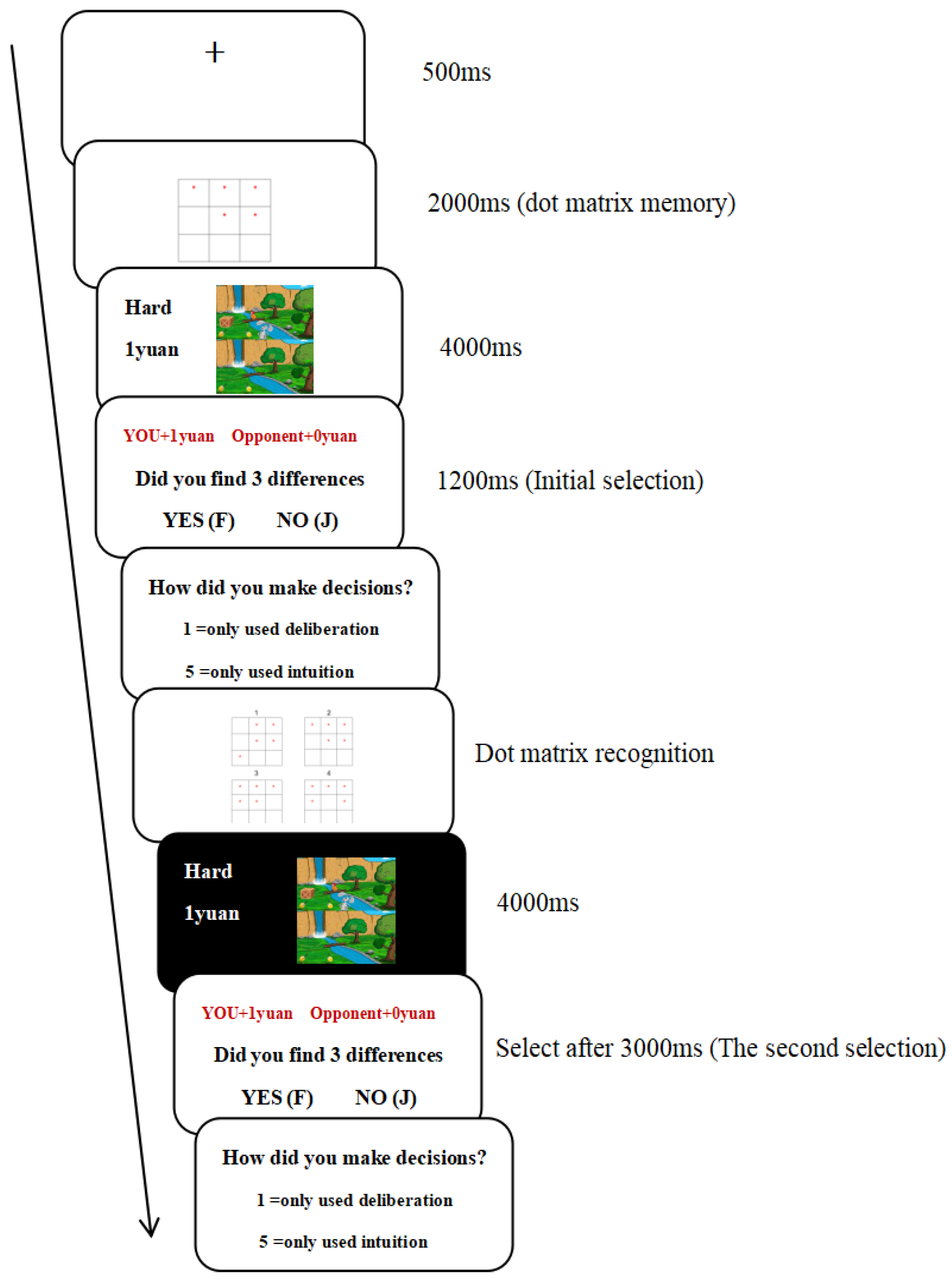
3.2.4. Experimental Procedure
3.2.5. Data Analyses
3.3. Results
3.3.1. Manipulation Checks for Decision-Making Modes
3.3.2. Normal Distribution Test
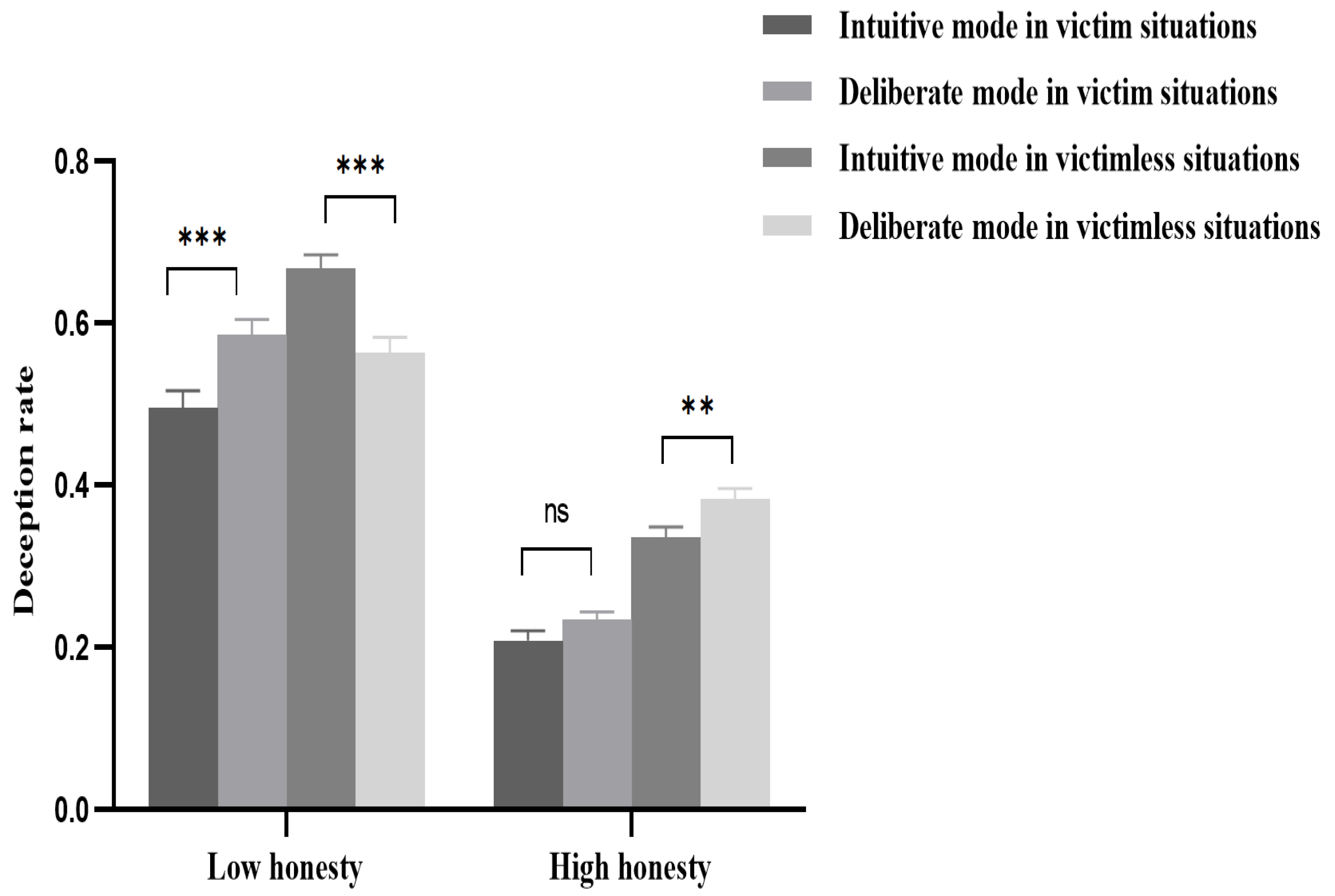
3.3.3. Deception Rate
4. Discussion
4.1. Honesty Tendencies and Decision-Making Modes Influence Adolescents’ Honest Behaviors in Victimless Situations
4.2. Honesty Tendencies and Decision-Making Modes Influence Adolescents’ Honest Behaviors in Victim Situations
4.3. Limitations and Future Directions
5. Conclusions
Author Contributions
Funding
Institutional Review Board Statement
Informed Consent Statement
Data Availability Statement
Acknowledgments
Conflicts of Interest
Abbreviations
| ANOVA | Analysis of variance |
| HEXACO | Honesty–humility, Emotionality, Extraversion, Agreeableness, Conscientiousness, and Openness to experience |
| M | Mean |
| SHH | Social heuristic hypothesis |
| SD | Standard deviation |
References
- Amir, A., Kogut, T., & Bereby-Meyer, Y. (2016). Careful cheating: People cheat groups rather than individuals. Frontiers in Psychology, 7, 371–378. [Google Scholar] [CrossRef]
- Ashton, M. C., Lee, K., & De Vries, R. E. (2014). The HEXACO honesty-humility, agreeableness, and emotionality factors: A review of research and theory. Personality and Social Psychology Review, 18(2), 139–152. [Google Scholar] [CrossRef]
- Ashton, M. C., Lee, K., Perugini, M., Szarota, P., De Vries, R. E., Di Blas, L., & De Raad, B. (2004). A six-factor structure of personality-descriptive adjectives: Solutions from psycholexical studies in seven languages. Journal of Personality and Social Psychology, 86(2), 356–366. [Google Scholar] [CrossRef]
- Bago, B., & De Neys, W. (2017). Fast logic? Examining the time course assumption of dual process theory. Cognition, 158, 90–109. [Google Scholar] [CrossRef]
- Barneron, M., Choshen-hillel, S., & Yaniv, I. (2021). Reaping a benefit at the expense of multiple others: How are the losses of others counted? Organizational Behavior and Human Decision Processes, 164, 136–146. [Google Scholar] [CrossRef]
- Bereby-Meyer, Y., Hayakawa, S., Shalvi, S., Corey, J. D., Costa, A., & Keysar, B. (2020). Honesty speaks a second language. Topics in Cognitive Science, 12(2), 632–643. [Google Scholar] [CrossRef]
- Bilancini, E., Boncinelli, L., Capraro, V., Celadin, T., & Paolo, R. D. (2020). “Do the right thing” for whom? An experiment on ingroup favouritism, group assorting and moral suasion. Judgment and Decision Making, 15(2), 182–192. [Google Scholar] [CrossRef]
- Capraro, V. (2017). Does the truth come naturally? Time pressure increases honesty in one-shot deception games. Economics Letters, 158, 54–57. [Google Scholar] [CrossRef]
- Capraro, V., Schulz, J., & Rand, D. G. (2019). Time pressure and honesty in a deception game. Journal of Behavioral and Experimental Economics, 79, 93–99. [Google Scholar] [CrossRef]
- Cohen, T. R., Panter, A. T., & Turan, N. (2012). Guilt proneness and moral character. Current Directions in Psychological Science, 21(5), 355–359. [Google Scholar] [CrossRef]
- Cohn, A., Maréchal, M. A., Tannenbaum, D., & Zünd, C. L. (2019). Civic honesty around the globe. Science, 365(6448), 70–73. [Google Scholar] [CrossRef]
- Cruyssen, I. V. D., D’hondt, J., Meijer, E., & Verschuere, B. (2020). Does honesty require time? Two preregistered direct replications of experiment 2 of Shalvi, Eldar, and Bereby-Meyer (2012). Psychological Science, 31(4), 460–467. [Google Scholar] [CrossRef]
- Decety, J., & Cacioppo, S. (2012). The speed of morality: A high-density electrical neuroimaging study. Journal of Neurophysiology, 108(11), 3068–3072. [Google Scholar] [CrossRef]
- De Vries, R. E., Pathak, R. D., Van Gelder, J. L., & Singh, G. (2017). Explaining unethical business decisions: The role of personality, environment, and states. Personality and Individual Differences, 117, 188–197. [Google Scholar] [CrossRef]
- Dickert, S., Sagara, N., & Slovic, P. (2011). Affective motivations to help others: A two-stage model of donation decisions. Journal of Behavioral Decision Making, 24(4), 361–376. [Google Scholar] [CrossRef]
- Dubois, D., Rucker, D. D., & Galinsky, A. D. (2015). Social class, power, and selfishness: When and why upper and lower class individuals behave unethically. Journal of Personality and Social Psychology, 108(3), 436–449. [Google Scholar] [CrossRef] [PubMed]
- Evans, A. M., Dillon, K. D., & Rand, D. G. (2015). Fast but not intuitive, slow but not reflective: Decision conflict drives reaction times in social dilemmas. Journal of Experimental Psychology: General, 144(5), 951–966. [Google Scholar] [CrossRef]
- Evans, J. S. B. T., & Stanovich, K. E. (2013). Dual-process theories of higher cognition: Advancing the debate. Perspectives on Psychological Science, 8(3), 223–241. [Google Scholar] [CrossRef]
- Fan, W., Huang, Z., Jian, Z., & Zhong, Y. (2022). The effects of ritual and self-control resources depletion on deceptive behavior: Evidence from behavioral and ERPs studies. Psychophysiology, 60(4), e14210. [Google Scholar] [CrossRef] [PubMed]
- Faul, F., Erdfelder, E., Lang, A. G., & Buchner, A. G. (2007). G*power 3: A flexible statistical power analysis program for the social, behavioral, and biomedical sciences. Behavior Research Methods, 39(2), 175–191. [Google Scholar] [CrossRef]
- Field, A. (2018). Discovering statistics using IBM SPSS statistics (5th ed.). Sage Publications. [Google Scholar]
- Foerster, A., Wirth, R., Berghoefer, F. L., Kunde, W., & Pfister, R. (2019). Capacity limitations of dishonesty. Journal of Experimental Psychology: General, 148(6), 943–961. [Google Scholar] [CrossRef]
- Gangemi, A., Rizzotto, C., Riggio, F., Dahò, M., & Mancini, F. (2025). Guilt emotion and decision-making under uncertainty. Frontiers in Psychology, 16, 151875. [Google Scholar] [CrossRef]
- Garbe, L., Rau, R., & Toppe, T. (2020). Influence of perceived threat of COVID-19 and HEXACO personality traits on toilet paper stockpiling. PLoS ONE, 15(6), e0234232. [Google Scholar] [CrossRef] [PubMed]
- Gächter, S., & Schulz, J. F. (2016). Intrinsic honesty and the prevalence of rule violations across societies. Nature, 531(7595), 496–499. [Google Scholar] [CrossRef] [PubMed]
- Glass, G. V., Peckham, P. D., & Sanders, J. R. (1972). Consequences of failure to meet assumptions underlying the fixed effects analyses of variance and covariance. Review of Educational Research, 42(3), 237–288. [Google Scholar] [CrossRef]
- Gneezy, U. (2005). Deception: The role of consequences. The American Economic Review, 95(1), 384–394. [Google Scholar] [CrossRef]
- Gordon-Hecker, T., Shalvi, S., Uzefovsky, F., & Bereby-Meyer, Y. (2024). Cognitive empathy boosts honesty in children and young adolescents. Journal of Experimental Child Psychology, 241, 105869. [Google Scholar] [CrossRef] [PubMed]
- Greene, J. D., & Paxton, J. M. (2009). Patterns of neural activity associated with honest and dishonest moral decisions. Proceedings of the National Academy of Sciences of the United States of America, 106(30), 12506–12511. [Google Scholar] [CrossRef]
- Grosch, K., & Rau, H. A. (2017). Gender differences in honesty: The role of social value orientation. Journal of Economic Psychology, 62, 258–267. [Google Scholar] [CrossRef]
- Guo, Z., Li, W., Yang, Y., & Kou, Y. (2021). Honesty-Humility and unethical behavior in adolescents: The mediating role of moral disengagement and the moderating role of system justification. Journal of Adolescence, 90(1), 11–22. [Google Scholar] [CrossRef]
- Guo, Z., Yang, Y., Li, W., Yao, X., & Kou, Y. (2023). Longitudinal relations among honesty-humility, moral disengagement, and unethical behavior in adolescents: A between-and within-person analysis. Journal of Research in Personality, 106, 104401. [Google Scholar] [CrossRef]
- Haidt, J. (2001). The emotional dog and its rational tail: A social intuitionist approach to moral judgment. Psychological Review, 108(4), 814–834. [Google Scholar] [CrossRef] [PubMed]
- Hart, C. L., Jones, J. M., Terrizzi, J. A., & Curtis, D. A. (2019). Development of the lying in everyday situations scale. The American Journal of Psychology, 132(3), 343–352. [Google Scholar] [CrossRef]
- Hausladen, C. I., & Nikolaychuk, O. (2024). Color me honest! Time pressure and (dis)honest behavior. Frontiers in Behavioral Economics, 2, 1337312. [Google Scholar] [CrossRef]
- Heck, D. W., Thielmann, I., Moshagen, M., & Hilbig, B. E. (2018). Who lies? A large scale reanalysis linking basic personality traits to unethical decision making. Judgment and Decision Making, 13(4), 356–371. [Google Scholar] [CrossRef]
- Hilbig, B. E. (2022). Personality and behavioral dishonesty. Current Opinion in Psychology, 47, 101378. [Google Scholar] [CrossRef]
- Hilbig, B. E., & Zettler, I. (2015). When the cat’s away, some mice will play: A basic trait account of dishonest behavior. Journal of Research in Personality, 57, 72–88. [Google Scholar] [CrossRef]
- Hou, J., Zhang, C., Zhao, F., & Guo, H. (2023). Underlying mechanism to the identifiable victim effect in collective donation action intentions: Does emotional reactions and perceived responsibility matter? VOLUNTAS: International Journal of Voluntary and Nonprofit Organizations, 34(3), 552–572. [Google Scholar] [CrossRef]
- Huber, C., Litsios, C., Nieper, A., & Promann, T. (2023). On social norms and observability in (dis) honest behavior. Journal of Economic Behavior & Organization, 212, 1086–1099. [Google Scholar] [CrossRef]
- Kang, Z. Y., & Fu, C. Y. (2021). Investigation and research on honesty condition of youth: A case study of Guizhou Province. Credit Reference, 39(5), 77–83. [Google Scholar]
- Kanngiesser, P., Jahnavi, S., & Jan, K. W. (2024). Cheating and the effect of promises in Indian and German children. Child Development, 95(1), 16–23. [Google Scholar] [CrossRef]
- Keller, T., & Kiss, H. J. (2025). Who cheats? Adolescents’ background characteristics and dishonest behavior: A comprehensive literature review and insights from two consecutive surveys. The Journal of Early Adolescence, 45(4), 451–480. [Google Scholar] [CrossRef]
- Klein, S. A., Thielmann, I., Hilbig, B. E., & Heck, D. W. (2020). On the robustness of the association between honesty-humility and dishonest behavior for varying incentives. Journal of Research in Personality, 88, 104006. [Google Scholar] [CrossRef]
- Köbis, N. C., Verschuere, B., Bereby-Meyer, Y., Rand, D., & Shalvi, S. (2019). Intuitive honesty versus dishonesty: Meta-analytic evidence. Perspectives on Psychological Science, 14(5), 778–796. [Google Scholar] [CrossRef]
- Lee, S., & Feeley, T. H. (2016). The identifiable victim effect: A meta-analytic review. Social Influence, 11(3), 199–215. [Google Scholar] [CrossRef]
- Li, C. Y., Zeng, C., Wang, C. S., & Ren, J. (2022). People’s honest behavior is done automatically or deliberately: An explanation from the social heuristic hypothesis. Journal of Psychologocal Science, 45(1), 171–177. [Google Scholar] [CrossRef]
- MacDonell, E. T., & Willoughby, T. (2020). Investigating honesty-humility and impulsivity as predictors of aggression in children and youth. Aggressive Behavior, 46(1), 97–106. [Google Scholar] [CrossRef] [PubMed]
- Malti, T., Galarneau, E., & Peplak, J. (2021). Moral development in adolescence. Journal of Research on Adolescence, 31(4), 1097–1113. [Google Scholar] [CrossRef]
- Markowitz, D. M. (2021). Revisiting the relationship between deception and design: A replication and extension of Hancock et al. (2004). Human Communication Research, 48(1), 158–167. [Google Scholar] [CrossRef]
- Mazar, N., Amir, O., & Ariely, D. (2008). The dishonesty of honest people: A theory of self-concept maintenance. Journal of Marketing Research, 45(6), 633–644. [Google Scholar] [CrossRef]
- Meldrum, R. C., Trucco, E. M., Cope, L. M., Zucker, R. A., & Heitzeg, M. M. (2018). Brain activity, low self-control, and delinquency: An fMRI study of at-risk adolescents. Journal of Criminal Justice, 56, 107–117. [Google Scholar] [CrossRef]
- Meub, L., Proeger, T., Schneider, T., & Bizer, K. (2016). The victim matters-experimental evidence on lying, moral costs and moral cleansing. Applied Economics Letters, 23(16), 1162–1167. [Google Scholar] [CrossRef]
- Mischkowski, D., Thielmann, I., & Glöckner, A. (2018). Think it through before making a choice? Processing mode does not influence social mindfulness. Journal of Experimental Social Psychology, 74, 85–97. [Google Scholar] [CrossRef]
- Motro, D., Ordóñez, L. D., Pittarello, A., & Welsh, D. T. (2018). Investigating the effects of anger and guilt on unethical behavior: A dual-process approach. Journal of Business Ethics, 152(1), 133–148. [Google Scholar] [CrossRef]
- Nagel, J. A., Patel, K. R., Rothstein, E. G., & Watts, L. L. (2021). Unintended consequences of performance incentives: Impacts of framing and structure on performance and cheating. Ethics & Behavior, 31(7), 498–515. [Google Scholar] [CrossRef]
- Pitesa, M., Thau, S., & Pillutla, M. M. (2013). Cognitive control and socially desirable behavior: The role of interpersonal impact. Organizational Behavior and Human Decision Processes, 122(2), 232–243. [Google Scholar] [CrossRef]
- Rand, D. G. (2016). Cooperation, fast and slow: Meta-analytic evidence for a theory of social heuristics and self-interested deliberation. Psychological Science, 27(9), 1192–1206. [Google Scholar] [CrossRef] [PubMed]
- Rand, D. G., Brescoll, V. L., Everett, J. A. C., Capraro, V., & Barcelo, H. (2016). Social heuristics and social roles: Intuition favors altruism for women but not for men. Journal of Experimental Psychology: General, 145(4), 389–396. [Google Scholar] [CrossRef]
- Rand, D. G., & Epstein, Z. G. (2014). Risking your life without a second thought: Intuitive decision-making and extreme altruism. PLoS ONE, 9(10), e109687. [Google Scholar] [CrossRef]
- Rand, D. G., Peysakhovich, A., Kraft-Todd, G. T., Newman, G. E., Wurzbacher, O., Greene, J. D., & Nowak, M. A. (2014). Social heuristics shape intuitive cooperation. Nature Communications, 5, 3677. [Google Scholar] [CrossRef]
- Reis, M., Pfister, R., & Foerster, A. (2023). Cognitive load promotes honesty. Psychological Research, 87(3), 826–844. [Google Scholar] [CrossRef] [PubMed]
- Shalvi, S., Eldar, O., & Bereby-Meyer, Y. (2012). Honesty requires time (and lack of justifications). Psychological Science, 23(10), 1264–1270. [Google Scholar] [CrossRef]
- Shi, R., Liu, C., Tang, H. L., Hao, J. Y., & Shen, W. B. (2024). Spontaneous giving: Processing mode and emergency affect prosocial behavior. Psychology Bulletin, 56(9), 1239–1251. [Google Scholar] [CrossRef]
- Shi, R., Qi, W., Ding, Y., Liu, C., & Shen, W. B. (2020). Under what circumstances is helping an impulse? Emergency and prosocial traits affect intuitive prosocial behavior. Personality and Individual Differences, 159, 109828. [Google Scholar] [CrossRef]
- Sijtsema, J. J., Garofalo, C., Jansen, K., & Klimstra, T. A. (2019). Disengaging from evil: Longitudinal associations between the dark triad, moral disengagement, and antisocial behavior in adolescence. Journal of Abnormal Child Psychology, 47(8), 1351–1365. [Google Scholar] [CrossRef]
- Soraperra, I., Weisel, O., & Ploner, M. (2018). Is the victim Max (Planck) or Moritz? How victim type and social value orientation affect dishonest behavior. Journal of Behavioral Decision Making, 32(2), 168–178. [Google Scholar] [CrossRef]
- Speer, S. P. H., Martinovici, A., Smidts, A., & Boksem, M. A. S. (2023). The acute effects of stress on dishonesty are moderated by individual differences in moral default. Scientific Reports, 13(1), 3984. [Google Scholar] [CrossRef]
- Speer, S. P. H., Smidts, A., & Boksem, M. A. S. (2020). Cognitive control increases honesty in cheaters but cheating in those who are honest. Proceedings of the National Academy of Sciences of the United States of America, 117(32), 19080–19091. [Google Scholar] [CrossRef]
- Speer, S. P. H., Smidts, A., & Boksem, M. A. S. (2021). Cognitive control promotes either honesty or dishonesty, depending on one’s moral default. Journal of Neuroscience, 41(42), 8815–8825. [Google Scholar] [CrossRef] [PubMed]
- Stavropoulou, G., & Stavropoulos, N. (2020). Simple and discrimination reaction time in young 7–17-year-old athletes. Journal of Physical Education & Sport, 20(2), 823–827. [Google Scholar] [CrossRef]
- Steinberg, L. (2008). A social neuroscience perspective on adolescent risk-taking. Developmental Review, 28(1), 78–106. [Google Scholar] [CrossRef] [PubMed]
- Suchotzki, K., Verschuere, B., Bockstaele, B. V., Ben-Shakhar, G., & Crombez, G. (2017). Lying takes time: A meta-analysis on reaction time measures of deception. Psychological Bulletin, 143(4), 428–453. [Google Scholar] [CrossRef] [PubMed]
- Sznycer, D. (2019). Forms and functions of the self-conscious emotions. Trends in Cognitive Sciences, 23(2), 143–157. [Google Scholar] [CrossRef]
- Tang, M., Li, W. Q., Liu, F. H., & Yuan, B. (2019). The association between guilt and prosocial behavior: A systematic review and meta-analysis. Advances in Psychological Science, 27(5), 773–788. [Google Scholar] [CrossRef]
- Tangney, J. P., Stuewig, J., & Mashek, D. J. (2007). Moral emotions and moral behavior. Annual Review of Psychology, 58(1), 345–372. [Google Scholar] [CrossRef]
- Thompson, V. A., & Johnson, S. C. (2014). Conflict, metacognition, and analytic thinking. Thinking & Reasoning, 20(2), 215–244. [Google Scholar] [CrossRef]
- Thunström, L. (2019). Preferences for fairness over losses. Journal of Behavioral and Experimental Economics, 83, 101469. [Google Scholar] [CrossRef]
- Timpau, C. (2015). The role of moral values in development personality teenagers. Revista Romaneasca pentru Educatie Multidimensionala, 7(1), 75–88. [Google Scholar] [CrossRef]
- Vadera, A. K., & Pathki, C. S. (2021). Competition and cheating: Investigating the role of moral awareness, moral identity, and moral elevation. Journal of Organizational Behavior, 42(8), 1060–1081. [Google Scholar] [CrossRef]
- Volk, A. A., Schiralli, K., Xia, X., Zhao, J., & Dane, A. V. (2018). Adolescent bullying and personality: A cross-cultural approach. Personality and Individual Differences, 125, 126–132. [Google Scholar] [CrossRef]
- Wang, L. Y., Huang, Q., & Chang, Y. L. (2024). Moral resilience cultivation strategies from the perspective of traditional culture. Chinese Medical Ethics, 37(2), 234–238. [Google Scholar] [CrossRef]
- Wang, X. M., Wang, Y. R., Pang, X. W., & Zhao, Q. Y. (2022). The influence of time constraint on cooperation: A moderated chain mediation model. Journal of Psychologocal Science, 45(2), 425–432. [Google Scholar] [CrossRef]
- Wang, Y., Kong, S., Liu, L., Qiu, S., Chen, Y., & Xu, S. (2024). Cognitive load increases self-serving cheating. Psychologia, 66(1), 56–66. [Google Scholar] [CrossRef]
- Wang, Y. H., & Luo, J. L. (2024). Intuitive logic: Conflict detection and the mechanism of individual differences. Journal of Psychologocal Science, 47(1), 52–60. [Google Scholar] [CrossRef]
- Warner, C. H., Fortin, M., & Melkonian, T. (2022). When are we more ethical? A review and categorization of the factors influencing dual-process ethical decision-making. Journal of Business Ethics, 189(4), 843–882. [Google Scholar] [CrossRef]
- Weenig, M. W. H., & Maarleveld, M. (2002). The impact of time constraint on information search strategies in complex choice tasks. Journal of Economic Psychology, 23(6), 689–702. [Google Scholar] [CrossRef]
- Xiong, C. Q., Xu, J. Y., Ma, D. Y., & Liu, Y. F. (2021). The effect of opponent’s emotional facial expressions on individuals’ cooperation and underlying mechanism in prisoner’s dilemma game. Psychology Bulletin, 53(8), 919–933. [Google Scholar] [CrossRef]
- Yang, H. B., & Chen, X. Y. (2020). Differences of trust levels between intuitive processing and deliberate processing on the positive reciprocity. Journal of Psychologocal Science, 43(6), 1470–1476. [Google Scholar] [CrossRef]
- Zettler, I., Thielmann, I., Hilbig, B. E., & Moshagen, M. (2020). The nomological net of the HEXACO model of personality: A large-scale meta-analytic investigation. Perspectives on Psychological Science, 15(3), 723–760. [Google Scholar] [CrossRef]
- Zhang, F. F., Liu, W. J., & Huo, R. (2022). Analysis on the development status and influencing factors of adolescent integrity behavior in the new era: An empirical survey based on 77367 adolescents. Credit Reference, 40(3), 66–71. [Google Scholar] [CrossRef]
- Zhang, H. Y., Xu, Y., & Zhao, H. H. (2021). The relationship between virtuous personality and internet altruistic behavior: A moderated mediation analysis. Journal of Psychologocal Science, 44(3), 619–625. [Google Scholar] [CrossRef]
- Zhang, Y., Zhai, Y., Zhou, X., Zhang, Z., Gu, R., Luo, Y., & Feng, C. (2022). Loss context enhances preferences for generosity but reduces preferences for honesty: Evidence from a combined behavioural-computational approach. European Journal of Social Psychology, 53(1), 183–194. [Google Scholar] [CrossRef]
- Zhao, H., Xu, Y., Li, L., Liu, J., & Cui, F. (2024). The neural mechanisms of identifiable victim effect in prosocial decision-making. Human Brain Mapping, 45(2), e26609. [Google Scholar] [CrossRef] [PubMed]



| Honesty Tendency | Decision-Making Mode | Victim Situations | Victimless Situations | ||
|---|---|---|---|---|---|
| M | SD | M | SD | ||
| high (n = 40) | intuitive | 0.21 | 0.08 | 0.34 | 0.08 |
| deliberate | 0.23 | 0.06 | 0.38 | 0.08 | |
| low (n = 40) | intuitive | 0.49 | 0.13 | 0.67 | 0.11 |
| deliberate | 0.58 | 0.12 | 0.56 | 0.12 | |
Disclaimer/Publisher’s Note: The statements, opinions and data contained in all publications are solely those of the individual author(s) and contributor(s) and not of MDPI and/or the editor(s). MDPI and/or the editor(s) disclaim responsibility for any injury to people or property resulting from any ideas, methods, instructions or products referred to in the content. |
© 2025 by the authors. Licensee MDPI, Basel, Switzerland. This article is an open access article distributed under the terms and conditions of the Creative Commons Attribution (CC BY) license (https://creativecommons.org/licenses/by/4.0/).
Share and Cite
Yin, H.; Zhang, H. Intuition or Deliberation? The Effects of Decision-Making Modes on Adolescents’ Honest Behaviors: The Moderating Roles of Honesty Tendencies and Victim Situations. Behav. Sci. 2025, 15, 1535. https://doi.org/10.3390/bs15111535
Yin H, Zhang H. Intuition or Deliberation? The Effects of Decision-Making Modes on Adolescents’ Honest Behaviors: The Moderating Roles of Honesty Tendencies and Victim Situations. Behavioral Sciences. 2025; 15(11):1535. https://doi.org/10.3390/bs15111535
Chicago/Turabian StyleYin, Haowen, and Honglai Zhang. 2025. "Intuition or Deliberation? The Effects of Decision-Making Modes on Adolescents’ Honest Behaviors: The Moderating Roles of Honesty Tendencies and Victim Situations" Behavioral Sciences 15, no. 11: 1535. https://doi.org/10.3390/bs15111535
APA StyleYin, H., & Zhang, H. (2025). Intuition or Deliberation? The Effects of Decision-Making Modes on Adolescents’ Honest Behaviors: The Moderating Roles of Honesty Tendencies and Victim Situations. Behavioral Sciences, 15(11), 1535. https://doi.org/10.3390/bs15111535