


Developing Speaking Skills in Third-Grade Students Through the Analysis of Visual Material in Two Languages (Lithuanian and English)


Abstract
1. Introduction
- To examine the scientific literature on the analysis of visual material in terms of content analysis in two languages in primary school.
- To reveal how to develop students’ skills in two languages (Lithuanian as their native language and English as a foreign language) during a single lesson, when the material is presented in one language but analyzed in two languages.
- Describe students’ experiences in developing bilingual skills based on an analysis of visual material.
2. Theoretical Basis for Developing the Speaking Skills of Third-Grade Students Using Visual Material Analysis in Two Languages
2.1. Developing English as a Second Language Skills in Third Grade
2.2. Developing the Lithuanian Language Skills of 3rd Grade Students as Their First Language
2.3. Bilingualism and Its Role in Developing Students’ Language Skills
2.4. Methodology for Analyzing Visual Materials in Developing Students’ Language Skills
- How do primary school students react to activities where English language skills are combined with Lithuanian language skills (when part of the lesson is conducted in one language and the other part in another language)?
- What tasks do children manage to perform most effectively, and in what cases is it difficult to express an idea in a particular language?
3. Methodology
3.1. Characteristics of the Study Participants
3.2. Research Methodology and Organization
3.3. Empirical Research by Stages
3.3.1. Stage 1—Planning the Activity Study
- ✓
- Lithuanian language lesson (individual work).
- ✓
- English language lesson (individual work).
- ✓
- Lithuanian language lesson (individual work).
- ✓
- English lesson (individual work).
- ✓
- Integrated English and Lithuanian lesson (pair work).
- ✓
- Integrated English and Lithuanian lesson (pair work).
3.3.2. Stage 2—Educational Process and Data Collection
3.3.3. Stage 3—Analysis of Collected Data
3.4. Research Ethics
4. Analysis of Empirical Research Data
4.1. Lithuanian and English Language Lessons Analysis and Description of Context
4.2. Analysis of the Results of Integrated Bilingual Lessons 1
4.3. Analysis of the Results of Integrated Bilingual Lessons 2
4.4. Analysis of Reflections
5. Discussion and Conclusions
6. Limitations of the Study
Author Contributions
Funding
Institutional Review Board Statement
Informed Consent Statement
Data Availability Statement
Conflicts of Interest
Appendix A. Mind Maps
Mind map for 1st Lithuanian language lessons, using program Canva Pro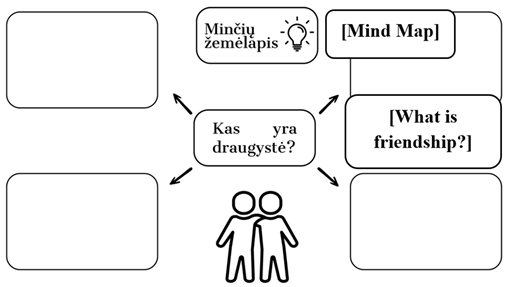 |
Mind map of the 2nd Lithuanian language lessons, using program Canva Pro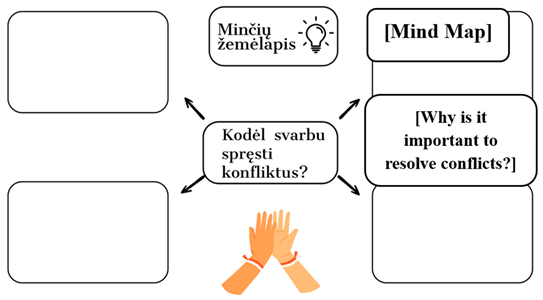 |
Mind map of the 1st English lesson, using program Canva Pro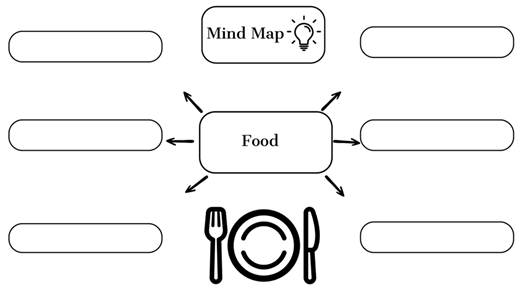 |
Mind map of the 2nd English lesson, using program Canva Pro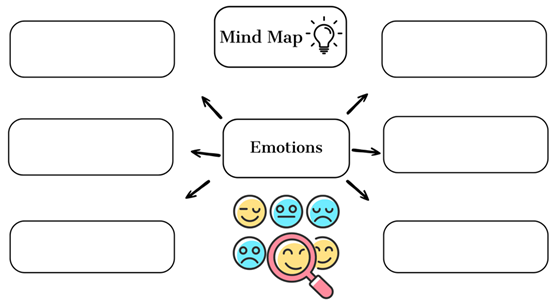 |
Mind maps 1st integrated bilingual (Lithuanian and English) lesson, using program Canva Pro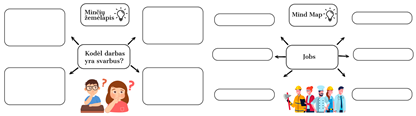 |
Mind maps 2nd integrated bilingual (Lithuanian and English) lesson, using program Canva Pro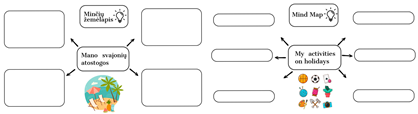 |
Appendix B. Visual Material Analysis Tasks
1st Lithuanian language lesson visual material analysis tasks, using program Canva Pro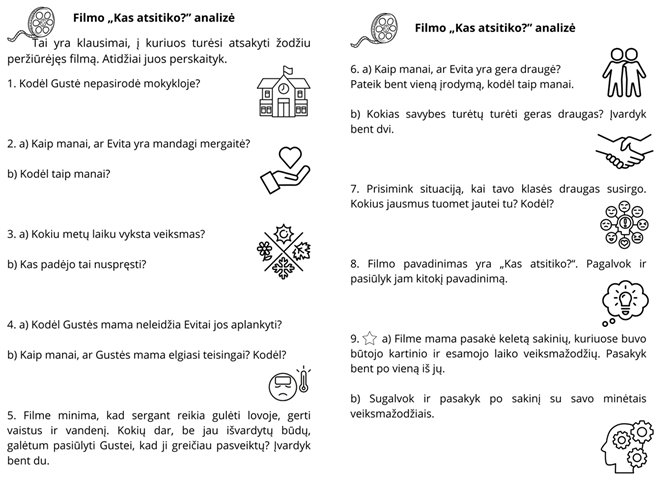 |
2nd Lithuanian language lesson visual material analysis tasks, using program Canva Pro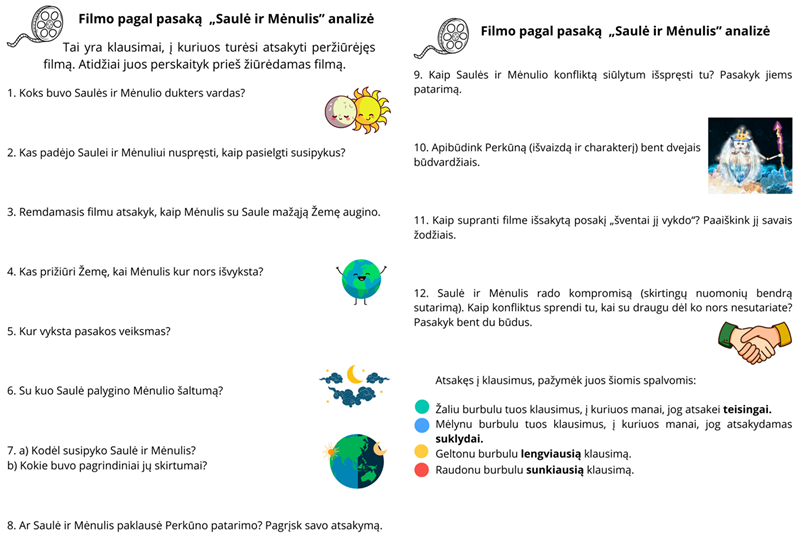 |
1st English lesson visual material analysis tasks, using program Canva Pro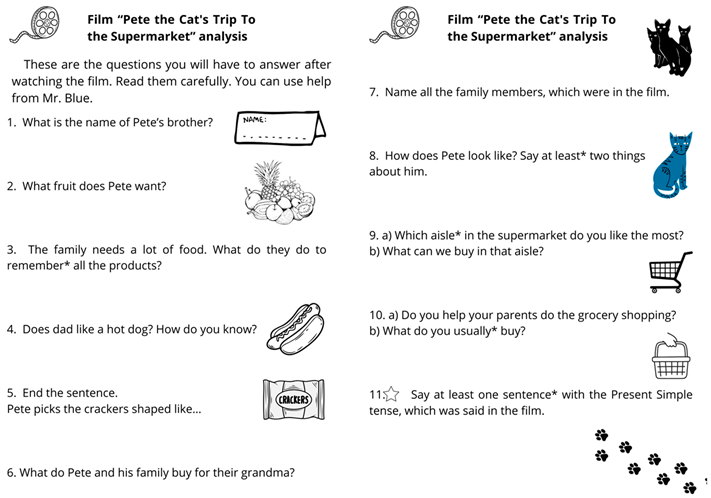 |
2nd English lesson visual material analysis tasks, using program Canva Pro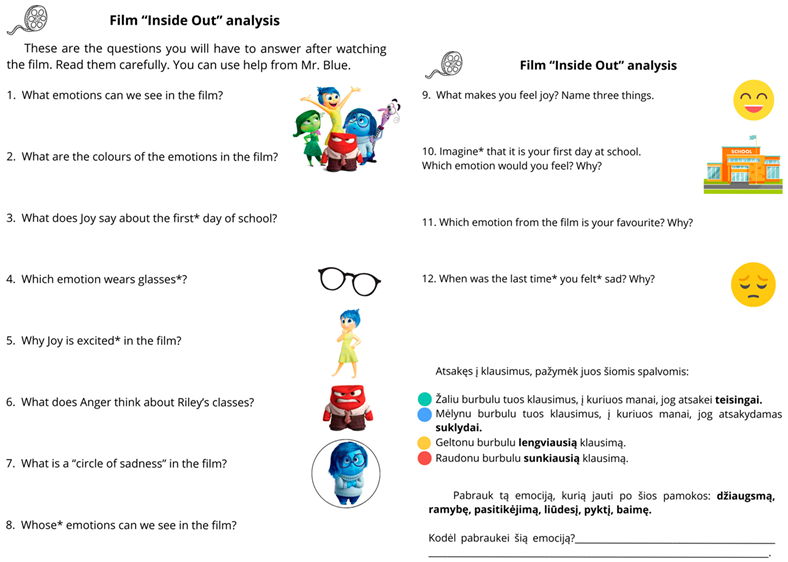 |
Example of integrated bilingual (Lithuanian and English) audiovisual material tasks for Lesson 1 (prepared by the authors of this paper using program Canva Pro)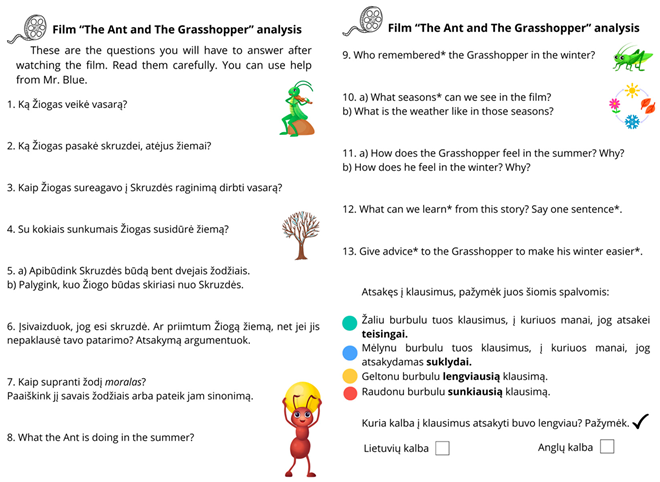 |
Example of integrated bilingual (Lithuanian and English) audiovisual material tasks for Lesson 2 (prepared by the authors of this paper using program Canva Pro)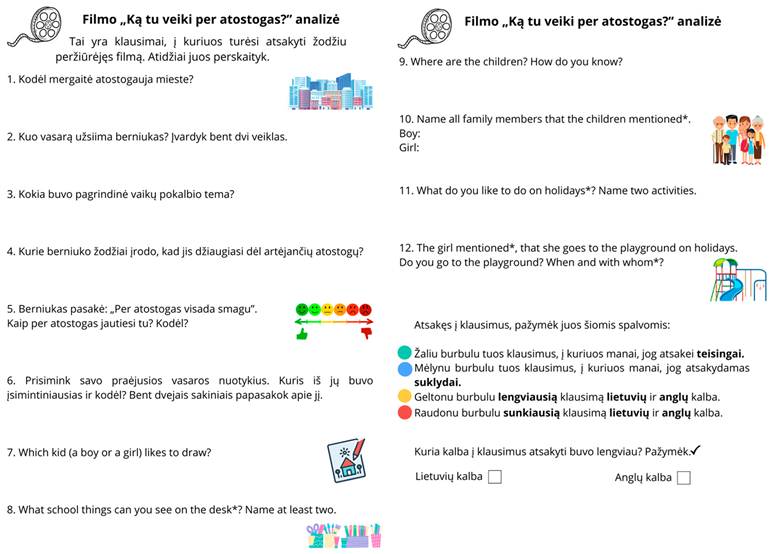 |
Appendix C. Reflections Using the Unfinished Sentence Method, Applied After Educational Activities
Reflections on Lithuanian language lessons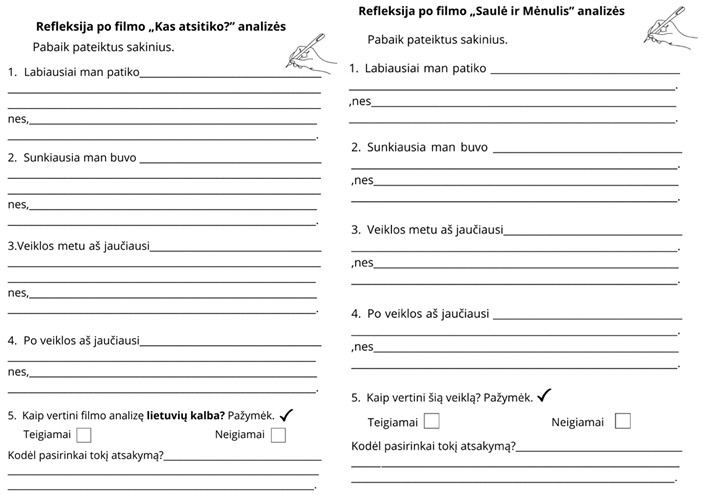 |
Reflections on English lessons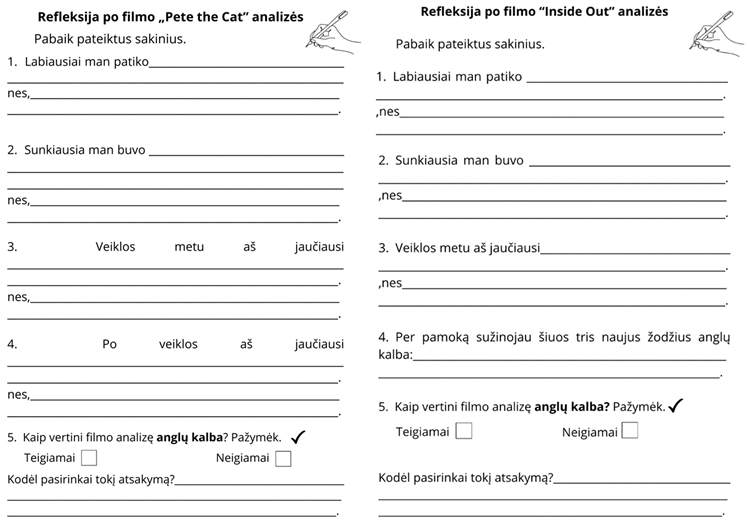 |
Reflections on integrated Lithuanian and English language lessons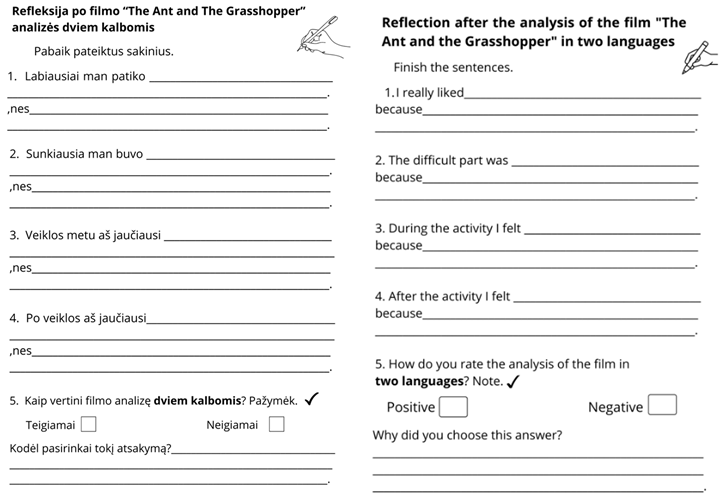 |
Appendix D. Mr. Blue Support System
Support systems for English language lessons, using program Canva Pro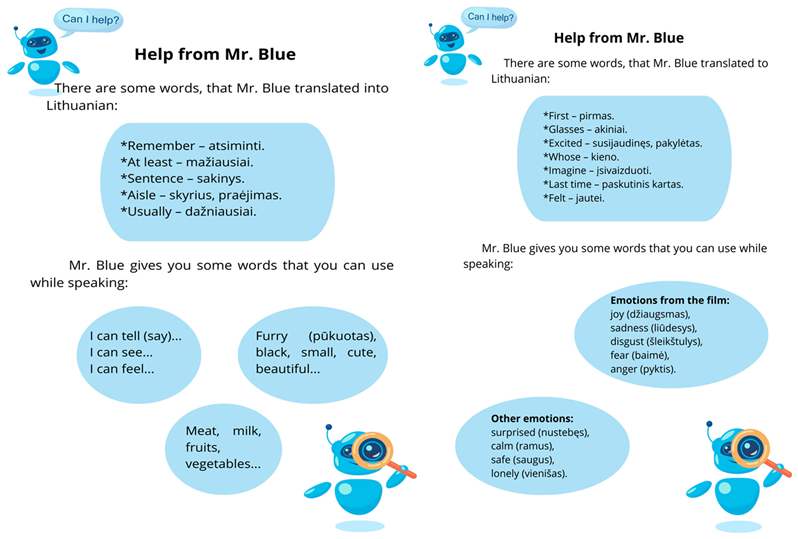 |
Help system for integrated Lithuanian and English language lessons, using program Canva Pro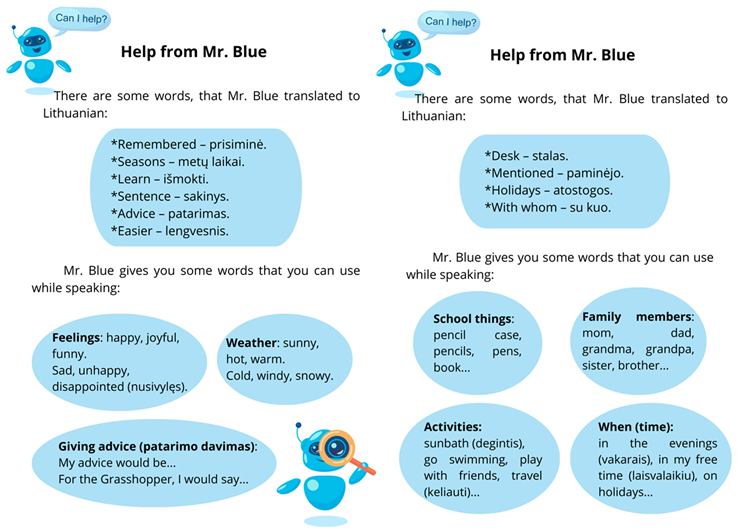 |
References
Sources of Empirical Data
English lessons video recording “Pete the Cat’s Trip To the Supermarket.” https://www.youtube.com/watch?v=8F48Oymo8Xk&t=12s (accessed on 10 January 2024).English lesson video clip from “Inside Out”. https://www.youtube.com/watch?v=Whwyu09a8KE (accessed on 10 January 2024).Integrated Lithuanian and English content: “What are you doing during the holidays?” https://www.youtube.com/watch?v=XOUH2YbGDRs (accessed on 10 January 2024).Integrated Lithuanian and English language lesson content: “The Ant and The Grasshopper”. https://youtu.be/wp-5YdA61uM?si=fdzREB932Kbd_yMK (accessed on 10 January 2024).Video recording of a Lithuanian language lesson: “Lithuanian language for little ones. Lithuanian language lesson. What happened?” https://www.youtube.com/watch?v=l6HRiB4XI-M (accessed on 10 January 2024).Video recording of Lithuanian language lessons “The Sun and the Moon”. https://www.youtube.com/watch?v=TtIJrccmXNM&list=PLzBPUmeJTgOf4LH8ZRIPXNP36SeWOgLYw (accessed on 10 January 2024).Secondary Source
- Ahmad, S. (2015). Improving students skills in translations by using students-teams achievement division (STAD) technique. Al-Ta’lim, 22(2), 119–128. [Google Scholar] [CrossRef]
- Ahmad, Z. (2020). Peer observation as a professional development intervention in EFL pedagogy: A case of a reading lesson on developing the top-down processing skills of the preparatory year students. Online Submission, 3(1), 1–15. Available online: https://eric.ed.gov/?id=ED602730 (accessed on 17 April 2025).
- Aksu Ataç, B., & Günay-Köprülü, S. (2018). The role of subtitles in foreign language teaching. International Online Journal of Education and Teaching, 5(3), 525–533. Available online: https://eric.ed.gov/?id=EJ1258474 (accessed on 17 April 2025).
- Aljohani, M. (2017). Principles of “constructivism” in foreign language teaching. Journal of Literature and Art Studies, 7(1), 97–107. [Google Scholar] [CrossRef][Green Version]
- Alluri, P. (2018). Enhancing English language teaching through films in general foundation programs. Arab World English Journal, 1, 146–154. [Google Scholar] [CrossRef]
- Ampa, A. T., Rasyid, M. A., Rahman, M. A., Haryanto, H., & Muhammad Basri, D. (2013). The implementation of multimedia learning materials in teaching English speaking skills. International Journal of English Language Education. [Google Scholar] [CrossRef]
- Anderson, L. W., & Krathwohl, D. R. (2001). A taxonomy for learning, teaching and assessing: A revision of bloom’s taxonomy of educational objectives: Complete edition. Longman. [Google Scholar]
- Antar, D. (2023). The use of drama in developing the skill of speaking in standard Arabic among third grade Arabic speaking students. Theory & Practice in Language Studies (TPLS), 13(7), 1601–1613. [Google Scholar] [CrossRef]
- Ashcroft, R. J., Garner, J., & Hadingham, O. (2018). Incidental vocabulary learning through watching movies. Australian Journal of Applied Linguistics, 1(3), 135–147. [Google Scholar] [CrossRef]
- Avello, D., & Muñoz, C. (2023). The development of receptive language skills from captioned video viewing in primary school EFL learners. Education Sciences, 13(5), 479. [Google Scholar] [CrossRef]
- Baba, K. (2009). Aspects of lexical proficiency in writing summaries in a foreign language. Journal of Second Language Writing, 18, 191–208. [Google Scholar] [CrossRef]
- Beacco, J.-C. (2013). Éthique et politique en didactique des langues. Autour de la notion de responsabilité. Les Éditions Didier. [Google Scholar]
- Biglari, N., & Struys, E. (2021). Native language interference in English L2 word recognition and word integration skills. Theory & Practice in Language Studies (TPLS), 11(1), 1–11. [Google Scholar] [CrossRef]
- Bloom, B. S., Engelhart, M. D., Furst, E. J., Hill, W. H., & Krathwohl, D. R. (1956). Taxonomy of educational objectives: The classification of educational goals. Vol. Handbook I: Cognitive domain. David McKay Company. [Google Scholar]
- Bottomley, J. (2018). Talking movies: Using film as part of language study and academic development. The Journal of Research and Scholarly Activity at University Campus Oldham, 1, 1–16. [Google Scholar]
- Brohy, C. (2002). L’enseignement bilingue dans/par/à travers la forêt = Zweisprachiger Unterricht im/mit dem Wald und durch den Wald: Actes des 4èmes Rencontres des enseignant(e)s bilingues. Institut de recherche et de documentation pédagogique. [Google Scholar]
- Carignan, I., Beaudry, M.-C., & Larose, F. (2016). La recherche-action et la recherche-développement au service de la littératie. Les Éditions de l’université de Sherbrooke. [Google Scholar] [CrossRef]
- Castro, D. C., Franco-Jenkins, X., & Chaparro-Moreno, L. J. (2025). The effects of dual language education on young bilingual children’s learning: A systematic review of research. Education Sciences, 15(3), 312. [Google Scholar] [CrossRef]
- Cicėnaitė-Milaševičiūtė, A. D., & Juškevičienė, A. (2020). Pradinių klasių mokinių kalbinių gebėjimų ugdymas(is) taikant neurodidaktikos principus lietuvių kalbos pamokose [Development of primary school student language skills: Application of principles of neurodidactics in Lithuanian language classes]. Švietimas: Politika, vadyba, kokybė/Education Policy, Management and Quality, 12(2), 58–76. [Google Scholar] [CrossRef]
- Cummins, J. (2002). Rights and responsibilities of educators of bilingual/bicultural children. Counterpoints. Making a Difference in the Lives of Bilingual/Bicultural Children, 134, 195–210. [Google Scholar]
- Davis, L. (2023). Ideological foundations, curricular models, and the path of bilingual education. Curriculum & Teaching Dialogue, 25(1), 203–216. [Google Scholar]
- Dixon, L. Q. (2005). Bilingual education policy in Singapore: An analysis of its sociohistorical roots and current academic outcomes. International Journal of Bilingual Education and Bilingualism, 8(1), 25–47. [Google Scholar] [CrossRef]
- Djamàa, S. (2018). From book to screen: Adopting cinematic adaptations of literature in the EFL classroom to hone students’ critical thinking skills. Computers in the Schools, 35(2), 88–110. [Google Scholar] [CrossRef]
- Eden, C., & Ackermann, F. (2018). Theory into practice, practice to theory: Action research in method development. European Journal of Operational Research, 271(3), 1145–1155. [Google Scholar] [CrossRef]
- Elt, O. U. P. (2015). Mother Language Day: Why learning a foreign language is important. Teaching English with Oxford. Available online: https://teachingenglishwithoxford.oup.com/2015/02/24/mother-language-day-why-learning-a-foreign-language-is-important/ (accessed on 17 April 2025).
- Ergül, H. (2023). Translanguaging realities: The use of first language in microteaching practices vs. young learner classrooms. Bartin University Journal of Faculty of Education, 12(4), 751–761. [Google Scholar] [CrossRef]
- Fajardo Dack, T. M., & Salamea Avila, M. J. (2023). Developing speaking skills in EFL young learners through visual and audiovisual materials. Revista Metropolitana de Ciencias Aplicadas, 2631–2662. Available online: http://dspace.ucuenca.edu.ec/handle/123456789/41595 (accessed on 17 April 2025).
- Fu, X., & Relyea, J. E. (2024). Exploring the role of mind mapping tools in scaffolding narrative writing in English for middle-school EFL students. Education Sciences, 14(10), 1119. [Google Scholar] [CrossRef]
- Gajo, L. (2006). Types de savoirs dans l’enseignement bilingue: Problématicité, opacité, densité. Education et Sociétés Plurilingues, 20, 75–87. [Google Scholar]
- Gajo, L., & Grobet, A. (2011). Saturation des savoirs et variété des enseignements bilingues. In A.-C. Berthaud, X. Gradoux, & G. Steffen (Eds.), Plurilinguismes et construction des savoirs. Cahiers de l’ILSL (Vol. 30, pp. 71–94). Centre de Linguistique et des Sciences du Langage. [Google Scholar]
- Güneş, Ç., & Sarıgöz, İ. H. (2021). Speaking struggles of young EFL learners. International Journal of Curriculum and Instruction, 13(2), 1267–1308. Available online: https://files.eric.ed.gov/fulltext/EJ1292324.pdf (accessed on 17 April 2025).
- Hestiana, M., & Anita, A. (2022). The role of movie subtitles to improve students’ vocabulary. Journal of English Language Teaching and Learning, 3(1), 46–53. [Google Scholar] [CrossRef]
- Jakavonytė-Staškuvienė, D. (2017). Kalbų didaktikos integravimas kitų dalykų pamokose pradinėse klasėse (Šveicarijos patirtis) [Integration of language teaching into other subjects in primary school (Swiss experience)]. In Towards research-based education: An edited collection of research studies (pp. 266–309). Lietuvos Edukologijos Universiteto Leidykla. [Google Scholar]
- Jakavonytė-Staškuvienė, D., & Žemgulienė, A. (2016). Pradinių klasių mokinių kalbinių gebėjimų integruotas ugdymas įvairių dalykų pamokose: Istorinio laiko tėkmės supratimo atvejis [Integrated development of language skills of primary school pupils in various subjects: The case of understanding the historical timeline]. Verbum, 7, 223–240. [Google Scholar] [CrossRef]
- Jayakodi, K., Bandara, M., Perera, I., & Meedeniya, D. (2016). WordNet and cosine similarity based classifier of exam questions using bloom’s taxonomy: International journal of emerging technologies in learning. International Journal of Emerging Technologies in Learning, 11(4), 142–149. [Google Scholar] [CrossRef]
- Kathirvel, K., & Hashim, H. (2020). The use of audio-visual materials as strategies to enhance speaking skills among ESL young learners. Creative Education, 11(12), 2599–2608. [Google Scholar] [CrossRef]
- Key Competences for Lifelong Learning in the European Schools. (2018). Schola Europaea: Office of the Secretary-General, Pedagogical Development Unit. Available online: https://www.eursc.eu/BasicTexts/2018-09-D-69-en-2.pdf (accessed on 17 April 2025).
- Kirckhoff, M. (1992). Mind mapping. Einführung in eine creative methode. PLS. [Google Scholar]
- Kiruthiga, E., & Christopher, G. (2022). The impact of affective factors in English speaking skills. Theory & Practice in Language Studies, 12(12), 2478–2485. [Google Scholar] [CrossRef]
- Krekeler, C. (1997). Mind Mapping im Unterricht. Materialien Deutsch ALS Fremdsprache, Heft, 46, 72–84. [Google Scholar]
- Kurt, D. S. (2021). Constructivist learning theory. Educational Technology. Available online: https://educationaltechnology.net/constructivist-learning-theory/ (accessed on 17 April 2025).
- Lee, S. H., & Muncie, J. (2006). From receptive to productive: Improving ESL learners’ use of vocabulary in a post-reading composition task. TESOL Quarterly, 40, 295–320. [Google Scholar] [CrossRef]
- Li, Y. (2025). Listen or read? The impact of proficiency and visual complexity on learners’ reliance on captions. Behavioral Sciences, 15(4), 542. [Google Scholar] [CrossRef]
- Lithuanian General Program for The First Foreign Language. (2022). Lietuvos bendroji pirmosios užsienio kalbos programa [Lithuanian general program for the first foreign language]. Nacionalinė Švietimo Agentūra. [Google Scholar]
- Lithuanian Language and Literature General Program for Primary Education. (2022). Lietuvos pradinio ugdymo lietuvių kalbos ir literatūros bendroji programa [Lithuanian language and literature general program for primary education]. Nacionalinė Švietimo Agentūra. [Google Scholar]
- Lo, H.-C., & Wang, T.-H. (2024). A study on the design of embedded visual image teaching aids to assist young children’s cognitive and fine motor development. Journal of Intelligence, 12(10), 102. [Google Scholar] [CrossRef] [PubMed]
- López-Pérez, M., de la Montaña Conchiña, J. L., Bravo Galán, J. L., & de la Maya Retamar, G. (2023). Bilingual science lexicon of pre-serviced primary school teachers. Education Sciences, 13(5), 464. [Google Scholar] [CrossRef]
- Mat Halif, M., Hassan, N., Sumardi, N. A., Shekh Omar, A., Ali, S., Abdul Aziz, R., Abdul Majid, A., & Salleh, N. F. (2020). Moderating effects of student motivation on the relationship between learning styles and student engagement. Asian Journal of University Education, 16(2), 93. [Google Scholar] [CrossRef]
- Mereckaitė, I. (2022). Language as a tool empowering students to be independent in sociocultural environment. Journal of Education, Culture & Society, 13(1), 93–110. [Google Scholar] [CrossRef]
- Mwaniki, M., Arias, M. B., & Wiley, T. G. (2017). Bilingual education policy. In O. García, A. Lin, & S. May (Eds.), Bilingual and multilingual education. Encyclopedia of language and education. Springer. [Google Scholar] [CrossRef]
- Nair, V., & Yunus, M. M. (2021). A systematic review of digital storytelling in improving speaking skills. Sustainability, 13(17), 9829. [Google Scholar] [CrossRef]
- Oh, M. H., Mancilla-Martinez, J., & Hwang, J. K. (2023). Revisiting the traditional conceptualizations of vocabulary knowledge as predictors of dual language learners’ English reading achievement in a new destination state. Applied Psycholinguistics, 44(1), 51–75. [Google Scholar] [CrossRef]
- Olinghouse, N. G., & Wilson, J. (2013). The relationship between vocabulary and writing quality in three genres. Reading and Writing, 26, 45–65. [Google Scholar] [CrossRef]
- Ortiz, A. A., Fránquiz, M. E., & Lara, G. P. (2022). Educational equity for emergent bilinguals: What’s wrong with this picture? Bilingual Research Journal, 45(1), 1–7. [Google Scholar] [CrossRef]
- Pantet, J. (2007). Ces obscurs objets de l’acquisition: Objets traités et modes de traitement dans l’acquisition du Français Langue Etrangère. Mémoire de Licence, UNIL. [Google Scholar]
- Petrošienė, K. (2022). Mąstytojų ugdymas Lietuvoje: Sekant J. Baranovos ir L. Duoblienės kelrodžiu [The education of thinkers in Lithuania: Following the example of J. Baranova and L. Duoblienė]. Problemos, 123–127. [Google Scholar] [CrossRef]
- Qi, W., & Jiang, Y. (2021). Use of a Graphic Organiser as a pedagogical instrument for the sustainable development of EFL learners’ English reading comprehension. Sustainability, 13(24), 13748. [Google Scholar] [CrossRef]
- Rakickienė, L. (2021). Mokyklinio amžiaus vaiko ir jaunuolio kognityviosios ir socialinės-emocinės raidos aprašas [Description of the cognitive and social-emotional development of school-age children and adolescents. Nacionalinė švietimo agentūra. [Google Scholar]
- Rashtchi, M., Khoshnevisan, B., & Shirvani, M. (2021). Integration of audiovisual input via TED-ED videos and language skills to enhance vocabulary learning. Mextesol Journal, 45(1), n1. [Google Scholar] [CrossRef]
- Richards, J. C., & Farrell, T. S. C. (2005). Professional development for language teachers. Cambridge University Press. [Google Scholar] [CrossRef]
- Roslim, N., Azizul, A. F., Nimehchisalem, V., & Abdullah, M. H. T. (2021). Exploring movies for language teaching and learning at the tertiary level. Asian Journalof University Education, 17(3), 271–280. [Google Scholar] [CrossRef]
- Salape, R. L., Maming, J. B., & Maravilla, W. H. G. (2023). Content-based approach in developing listening comprehension in English language: Basis for proposed listening activities. International Journal of Multidisciplinary: Applied Business & Education Research, 4(1), 250–255. [Google Scholar] [CrossRef]
- Suarez, M., & Beato, M. S. (2023). False memory in a second language: The importance of controlling the knowledge of word meaning. PLoS ONE, 18(5), e0285747. [Google Scholar] [CrossRef]
- Suhendi, A., & Purwarno, P. (2018, April 18–19). Constructivist learning theory: The contribution to foreign language learning and teaching. AICLL: Annual International Conference on Language and Literature, Medan, Indonesia. [Google Scholar]
- Suleiman Al Qunayeer, H. (2021). An investigation of the relationship between reading comprehension, vocabulary knowledge, and English language proficiency level of Saudi EFL learners. Advances in Language and Literary Studies, 12(2), 59–69. [Google Scholar] [CrossRef]
- Swinburne Romine, R., Schuster, J., Karvonen, M., Thompson, W. J., Erickson, K., Simmering, V., & Bechard, S. (2025). Learning maps as cognitive models for instruction and assessment. Education Sciences, 15(3), 365. [Google Scholar] [CrossRef]
- Universal Lithuanian Encyclopedia. (2025). Visuotinė lietuvių enciklopedija. LNB Mokslo Ir Enciklopedijų Leidybos Centras. Available online: www.vle.lt (accessed on 17 April 2025).
- Using Film and Media in the Language Classroom: Reflections on Research-Led Teaching. (2019). Using film and media in the language classroom: Reflections on research-led teaching. Available online: https://web-s-ebscohost-com.ezproxy.vdu.lt:2443/ehost/ebookviewer/ebook/bmxlYmtfXzIxODI3MDlfX0FO0?sid=aef02804-45a9-4f8a-a0d7-0ea2ad4efc07@redis&vid=3&format=EB&rid=2 (accessed on 17 April 2025).
- Vilkienė, L. (2011). Dvikalbis ugdymas Lietuvoje: Už ar prieš? [Bilingual education in Lithuania: For or against?]. Kalba Ir Kontekstai, 4(1), 367–375. [Google Scholar]
- Vu, T. B. H. (2023). Teaching English speaking skills: An investigation into Vietnamese EFL teachers’ beliefs and practices. Issues in Educational Research, 33(1), 428–450. Available online: http://www.iier.org.au/iier33/vu.pdf (accessed on 17 April 2025).
- Vygotsky, L. S. (1978). Mind in society: The development of higher psychological processes. Harvard University Press. [Google Scholar]
- Vygotsky’s Theory—An Overview Science Direct Topics. (2020). Vygotsky’s theory—An overview science direct topics. Available online: https://www.sciencedirect.com/topics/psychology/vygotskys-theory (accessed on 17 April 2025).
- Wang, Z. (2023). The relationship between Chinese EFL learners’ foreign language writing enjoyment and writing vocabulary strategy. Theory & Practice in Language Studies (TPLS), 13(8), 1969–1975. [Google Scholar] [CrossRef]
- Weinstock, D. M. (2022). The political ethics of bilingual education. In Handbook of Philosophy of Education (pp. 1–12). Routledge. [Google Scholar]
- Woolfolk, A. E. (1993). Educational psychology. Allyn and Bacon. [Google Scholar]
- Yangin Ersanli, C. (2023). The effect of using augmented reality with storytelling on young learners’ vocabulary learning and retention: Artırılmış Gerçeklik ile Hikâye Anlatımının Çocuk Öğrenenlerin Sözcük Öğrenimi ve Hatırda Kalıcılığına Etkisi. Novitas-Royal, 17(1), 62–72. [Google Scholar]
- Yani, L. H. F. (2022). Students’ perception of using film as an English learning media. FITK UIN Syarif Hidayatullah Jakarta. Available online: https://repository.uinjkt.ac.id/dspace/handle/123456789/62776 (accessed on 17 April 2025).
- Zayas-Martínez, F., Estrada-Chichón, J. L., & Segura-Caballero, N. (2024). Pre-service CLIL teachers’ conceptions on bilingual education: Impact of initial training on the development of their teaching skills. Education Sciences, 14(12), 1331. [Google Scholar] [CrossRef]
- Žydžiūnaitė, V., & Sabaliauskas, S. (2017). Kokybiniai tyrimai: Principai ir metodai [Qualitative research: Principles and methods]. Vaga. [Google Scholar]


| Abstract Concept | Contents |
|---|---|
| Existence | Being, non-being as existence. Being, non-being in a specific place. Having, not having. Happening, non-happening. |
| Area | Location. Layout. Distance. |
| Movement | Method. Direction. Origin by location. Distribution. Speed. |
| Dimensions, parameters | Size. Shape. Length, width. Area. Weight. Temperature. |
| Time | Specific and/or defined time. Time reference. General classification. Repetition. Anticipation, recurrence. Delay. Sequence. Reference to the present. Reference to the past. Reference to the future. Continuous duration. Interrupted action. Continuity. Temporariness. Beginning. End. Constancy. Change. |
| Quantity | Number. Quantity. Degree. Comparison. |
| Physical characteristic | Dryness, moisture. Visibility and/or appearance. Audibility and/or sound. Taste. Smell. Texture and/or texture. Color. Age. Physical condition (of a person or object). Accessibility. Cleanliness. Material. Fullness, emptiness. |
| Evaluated characteristic | Value, price. Quality. Fairness, unfairness. Success, failure. Ability, inability. Importance, unimportance. Difficulty, ease. |
| Connections and relationships | Relationships between actions and/or events. Instrument, means, method. Recipient. Dependence and/or ownership. Connection. Inclusion, separation, exclusion. Cause, motive. Purpose. Definiteness, indefiniteness. |
| Achievements | Learning Content for Grades 3–4 |
|---|---|
| A2. Participates in various communication situations, listens and speaks, taking into account the situation, purpose, and audience | Preparation for speaking a monolog (independently, purposefully, in a planned manner), participation in conversations, inclusion of nonverbal means of communication. Consideration of the addressee and the communication situation—demonstrating interest, respecting opinions, observing language etiquette. Emotional, expressive, self-expressive and engaging storytelling, coherent speech, development of the topic. Detailed description, clear information, explanation of what is being done or what happened and how. Expressing and justifying one’s opinion, relying on personal experience and known context. |
| A3. Uses linguistic means appropriately and adheres to language norms | Correct pronunciation, stress, intonation, pausing, and logical stress. Also, enriching language with new words and expressions and applying them in different situations. |
| A4. Uses listening and speaking strategies | Reflecting on one’s own speech, explaining one’s successes and failures, justifying and suggesting what could be done better (this skill is developed with the help of the teacher). Experimenting with and applying various speaking strategies or strategies for preparing for speech. |
| Film Analysis in the General Program of the Lithuanian Language and Literature | Film Analysis in the First Foreign Language General Program |
|---|---|
| Cognitive skills: interpretation is the students’ comments on and reveals their own interpretation of the meaning of the film. Students develop their civic identity and civic power by evaluating the content of audiovisual texts. Cultural expression skills: works are presented that feature interesting expressive solutions (e.g., films, videos). Links to literature and other arts: films based on literary works are discussed. Selected periodicals for children (e.g., films) are discussed. | Students develop digital competence when they understand the videos and films they watch. They understand the theme of all short, simple videos and animated films about familiar topics. A separate skill is identified—the comprehension of audiovisual text. |
| Students | Answers in Lithuanian (Level of Interpretation and Evaluation) | Answers in English (Level of Knowledge and Understanding) |
|---|---|---|
| Arminas and Aistė | Kadsumokėtum mokesčius, paskolas, kad nusipirktum valgyti [To pay taxes, loans, to buy food]. | Policeman, doctor, teacher, actor. |
| Orinta and Tadas | Kaduždirbtum pinigų, galėtum išsilavinti ir pirkti tai, ko nori [To earn money, get an education, and buy what you want]. | Zookeeper, singer, nurse, housewife. |
| Edita and Laura | Kadbūtum atsakingas, turėtum pinigų ir kad galėtum ko nors naujo išmokti [To be responsible, have money, and be able to learn something new]. | Housewife, fireman, driver, designer. |
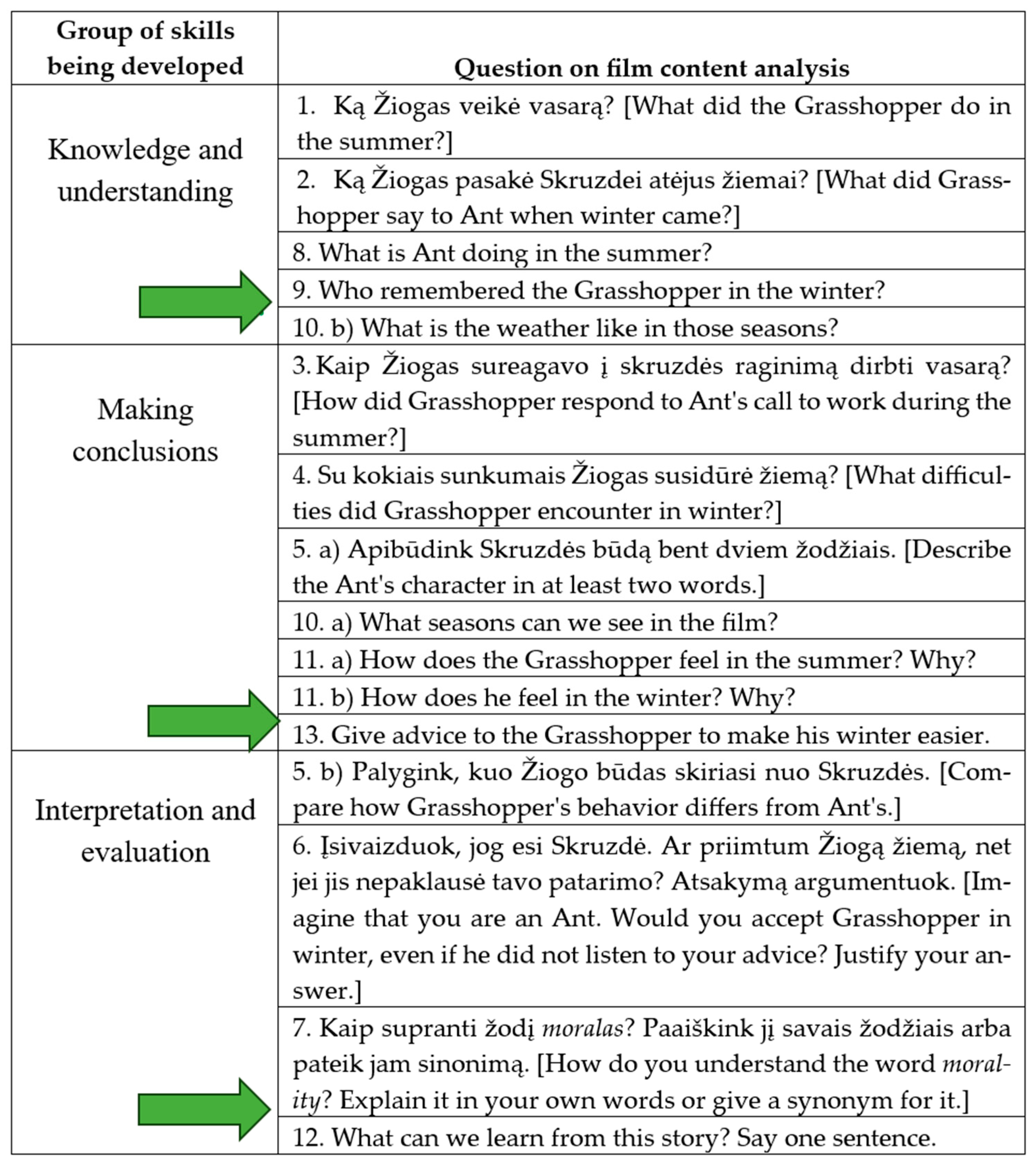
| (a) Apibūdink Skruzdės būdą bent dviem žodžiais. [Describe the Ant’s behavior in at least two words.] (level of interpretation and evaluation) (n = 20) (b) Palygink, kuo Žiogo būdas skiriasi nuo Skruzdės. [Compare how the way a Grasshopper walks differs from that of an Ant.] (level of interpretation and evaluation) (n = 20) | ||
| Students | Students’ answers | Researchers’ comments |
| Simona and Aistis | (a) Meili, nes padėjo Žiogui, ir darbšti, nes dirbo visą vasarą [She was kind because she helped the Grasshopper, and she was hardworking because she worked all summer]. (b) Skruzdė buvo darbšti ir geraširdė, o Žiogas buvo tinginys ir visai nedarbštus [The Ant was hardworking and kind-hearted, while the Grasshopper was lazy and not hardworking at all]. | After analyzing the answers, it can be seen that the students know various synonyms good, kind, warm-hearted, friendly, sincere. The students perfectly link the film to the question asked and give specific, accurate answers. |
| Orinta and Tadas | (a) Draugiška ir gera. Ji davė Žiogui žiemą valgyti [Friendly and kind. She gave Grasshopper food to eat in winter]. (b) Skruzdė dirbo, kaupė atsargas, o Žiogas nedirbo, nekaupė maisto žiemai [The Ant worked and gathered supplies, while Grasshopper did not work and did not gather food for winter]. | |
| Domas and Tomas | (a) Geraširdė ir darbšti, nes Žiogas jos neklausė vasarą, bet ji jam vis tiek padėjo žiemą [She is kind-hearted and hard-working because the Grasshopper did not listen to her in the summer, but she still helped him in the winter]. (b) Žiogas tinginys ir užsispyręs, Skruzdė darbšti ir nuoširdi [The Grasshopper is lazy and stubborn, while the Ant is hard-working and sincere]. | |
| Įsivaizduok, jog esi Skruzdė. Ar priimtum Žiogą žiemą, net jei jis nepaklausė tavo patarimo? Atsakymą argumentuok. [Imagine you are an Ant. Would you take in a Grasshopper in winter, even if he didn’t ask for your help? Explain your answer.] (level of interpretation and evaluation) (n = 18) | ||
| Arminas and Aistė | Taip, mumsbūtų jo gaila žiemą, todėl priimtume ir pasakytume, jog reikia rūpintis savimi [Yes, we would feel sorry for him in winter, so we would accept and say that he needs to take care of himself]. | The students discussed this question at length and debated how they would act. The answers given by each pair of students were very different, revealing their moral attitudes, beliefs, ability to argue coherently and empathize with another character (in this case, the Ant). |
| Edita and Laura | Taip,nes jis buvo išalkęs ir sušalęs ir labai prašėsi užeiti į namus [Yes, because he was hungry and cold and begged to come in]. | |
| Aurelija and Domantas | Ne,nes jis buvo tinginys ir neklausė patarimo [No, because he was lazy and didn’t listen to advice]. | |
| What is the Ant doing in the summer? (level of knowledge and understanding) (n = 42) | ||
| Orinta and Tadas | The ant is working to have food. | Since the question concerns knowledge and understanding, the students’ answers are similar, but it can be noted that each pair presents the answer from a different perspective, i.e., they work to have food, they store food for winter, they work hard in summer. The students structure their sentences correctly, and it has also been noted that they use words from the film to expand the content of their sentences. |
| Domas and Tomas | The ant is gathering food for the winter. | |
| Aurelija and Domantas | The ant is working hard in the summer. | |
| Give advice to the Grasshopper to make his winter easier. (level of making conclusions) (n = 30) | ||
| Edita and Laura | Build a house in the summer because it is cold in winter. | This question was answered most effectively—all pairs of students gave the Grasshopper lots of advice. The students based their advice on the film and their own knowledge, and helped each other with words they knew. Also, from Simona and Aistis’ answers, it can be seen that the pair relied on the support system. |
| Arminas and Aistė | Start working, because job is first, fun is later. | |
| Simona and Aistis | My advice for the grasshopper would be: don‘t be lazy and go to work. | |
| Students | Answers in Lithuanian (Level of Making Conclusions) | Answers in English (Level of Knowledge and Understanding) |
|---|---|---|
| Simona and Aistė | Saulė,jūra, pliažas ir geros draugės [Sun, sea, beach, and good friends]. | Riding a bike, playing with friends, swimming, sunbathing, eating watermelon and no school. |
| Tadas and Arminas | Gerasoras, ledai, krepšinis ir laikas su draugais [Good weather, ice cream, basketball, and time with friends]. | Basketball, football, tennis, sea, computer games, playground, |
| Aurelija and Aistis | Žaidimai su draugais, kelionės, važiuoti pas senelius, važinėtis dviračiu [Playing games with friends, traveling, visiting grandparents, riding a bike]. | Sleep, be with friends, playing games, listen to music, visit grandma and grandpa, read a book. |
| Berniukas pasakė: „Per atostogas visada smagu”. Kaip per atostogas jautiesi tu? Kodėl? [The boy said, “Holidays are always fun.” How do you feel during the holidays? Why?] (level of interpretation and evaluation) (n = 24) | ||
| Students | Students’ answers | Researchers’ comments |
| Arminas and Tadas | Gerai, nes galime kasdien žaisti futbolą ir krepšinį ir nereikia anksti keltis [That’s good because we can play soccer and basketball every day and don’t have to get up early]. | When analyzing the students’ responses, it was noticed that children often described their well-being using the word “good,” which indicates that children do not know the words to describe their feelings. It is positive that children came up with individual reasons why they feel “good.” Also, many pairs of students said that they felt good because they could do something, but did not specify what. |
| Orinta and Domantas | Linksmai, nes galima aplankyti įvairių pasaulio vietų ir sužinoti vis kažką arba su artimiausiais draugais ir šeima vykti prie ežero su palapinėm [It’s fun because you can visit different places around the world and learn something new, or go to the lake with your closest friends and family and pitch a tent]. | |
| Simona and Aistė | Gerai, nes galima aplankyti žmones, kuriuos seniai matei ir aktyviai leisti laiką, ten pavyzdžiui, su dviračiais [It is beneficial because you can visit people you have not seen for a long time and actively spend time there, for example, riding bicycles]. | |
| Prisimink savo praėjusios vasaros nuotykius. Kuris iš jų buvo įsimintiniausias ir kodėl? Bent dvejais sakiniais papasakok apie jį. [Think back to your adventures last summer. Which one was the most memorable and why? Describe it in at least two sentences.] (level of interpretation and evaluation) (n = 20) | ||
| Edita and Tomas | Edita: kai per praeitas vasaros atostogas pirmą kartą skridau lėktuvu. Man labai patiko, nes nuo šešių metų svajojau kažkur skristi ir mano svajonė išsipildė [when I flew on an airplane for the first time last summer. I really enjoyed it because I had dreamed of flying somewhere since I was six years old, and my dream came true]. Tomas: kai laimėjau futbolo varžybas. Tos varžybos tokios buvo svarbios, daug ruošiausi, ir laimėjau [when I won the soccer game. That game was so important, I prepared a lot, and I won]. | This question was discussed most extensively by all students, who listened very attentively to each other and responded to their friends’ stories. Although the students worked in pairs, they were asked to think about this question independently and individually. This was performed so that all students could verbally express what was memorable to them and what was personally important to them. All the stories were very different, and the students tried to answer in two sentences, but after sharing, they had questions for each other that would have been unfair not to ask. Therefore, the lesson lasted longer than planned. It is important to note that if the topic is relevant and interesting to children, and they are able to express their experiences more freely, then students speak boldly, share their experiences, and even want to continue the discussion after the lesson has ended. Such situations demonstrate the quality of the educational process and the possibilities for involving every child. |
| Domas and Laura | Domas: kai po ilgo laiko aš susitikau su savo geru draugu, kuris gyvena Vokietijoje. Ta diena buvo geriausia vasaros diena, nors įsimintinų įvykių buvo daug [when, after a long time, I met my good friend who lives in Germany. That day was the best day of the summer, even though there were many memorable events]. Laura: įsimintiniausias nuotykis man kai aš suradau mažą, vienišą kačiuką ir jisai buvo iki rugsėjo mėnesio pas mus. Tada mes radom jam šeimininkus [my most memorable adventure was when I found a small, lonely kitten, and he stayed with us until September. Then we found him a home]. | |
| Aurelija and Aistis | Aurelija: aš per vasaros atostogas buvau laukiniam paplūdimyje Latvijoje. Šis įvykis man įsimintiniausias, nes laukiau jo visą vasarą ir ten buvo labai gražu [during my summer vacation, I went to a wild beach in Latvia. This event was the most memorable for me because I had been looking forward to it all summer, and it was very beautiful there]. Aistis: mano nuotykis liūdnas, kai nukritau nuo dviračio. Aš tada susilaužiau koją ir gulėjau visą vasarą namie [my adventure was sad when I fell off my bike. I broke my leg and had to stay home all summer]. | |
| Where are the children? How do you know? (level of making conclusions) (n = 46) | ||
| Arminas and Tadas | They are in school because there are markers, papers, books on the table. | This question revealed the different things that students notice and the reasons why they decided that children are at school. The children supported their answers with arguments and demonstrated a wide vocabulary related to school items. |
| Domas and Laura | In school because of school items like pencils, pens, study books and everything else. | |
| Orinta and Domantas | Children are in the classroom because kids wearing school uniforms. | |
| The girl mentioned that she goes to the playground on holidays. Do you go to the playground? When and with whom? (level of making conclusions) (n = 30) | ||
| Aurelija and Aistis | Yes, we go to the playground with our family in the summer. | The students identified this question as the difficult one to answer in English, but it was unique in that the students answered it in parts: first, they answered each question separately, and then combined their answers into a single sentence. In addition, the students actively used the help system when answering this question. |
| Simona and Aistė | I go to the playground with my friends in the summer. | |
| Edita and Tomas | Sometimes with friends in summer. | |
Disclaimer/Publisher’s Note: The statements, opinions and data contained in all publications are solely those of the individual author(s) and contributor(s) and not of MDPI and/or the editor(s). MDPI and/or the editor(s) disclaim responsibility for any injury to people or property resulting from any ideas, methods, instructions or products referred to in the content. |
© 2025 by the authors. Licensee MDPI, Basel, Switzerland. This article is an open access article distributed under the terms and conditions of the Creative Commons Attribution (CC BY) license (https://creativecommons.org/licenses/by/4.0/).
Share and Cite
Jakavonytė-Staškuvienė, D.; Streikutė, G. Developing Speaking Skills in Third-Grade Students Through the Analysis of Visual Material in Two Languages (Lithuanian and English). Behav. Sci. 2025, 15, 1362. https://doi.org/10.3390/bs15101362
Jakavonytė-Staškuvienė D, Streikutė G. Developing Speaking Skills in Third-Grade Students Through the Analysis of Visual Material in Two Languages (Lithuanian and English). Behavioral Sciences. 2025; 15(10):1362. https://doi.org/10.3390/bs15101362
Chicago/Turabian StyleJakavonytė-Staškuvienė, Daiva, and Guostė Streikutė. 2025. "Developing Speaking Skills in Third-Grade Students Through the Analysis of Visual Material in Two Languages (Lithuanian and English)" Behavioral Sciences 15, no. 10: 1362. https://doi.org/10.3390/bs15101362
APA StyleJakavonytė-Staškuvienė, D., & Streikutė, G. (2025). Developing Speaking Skills in Third-Grade Students Through the Analysis of Visual Material in Two Languages (Lithuanian and English). Behavioral Sciences, 15(10), 1362. https://doi.org/10.3390/bs15101362

