Individuals with High Mindfulness Are Better at Metacognitive Ability: A Latent Profile Analysis Approach

 , ,
, ,
Abstract
1. Introduction
2. Materials and Methods
2.1. Participants
2.2. Five Facet Mindfulness Questionnaire (FFMQ)
2.3. College Student Metacognitive Ability Scale (CSMAS)
2.4. Data Analysis
3. Results
3.1. Test of Common Method Bias
3.2. Descriptive Statistics of Key Variables
3.3. Latent Profile Analysis Results
3.4. Relationship Between Demographic Variables and Latent Types of Mindfulness
3.5. Effects of Mindfulness Profiles on Metacognitive Functioning
4. Discussion
5. Limitations and Conclusions
Author Contributions
Funding
Institutional Review Board Statement
Informed Consent Statement
Data Availability Statement
Acknowledgments
Conflicts of Interest
References
- Aldahadha, B. (2020). Metacognition, mindfulness attention awareness, and their relationships with depression and anxiety. Journal of Rational-Emotive & Cognitive-Behavior Therapy, 39(2), 183–200. [Google Scholar] [CrossRef]
- Asparouhov, T., & Muthén, B. (2014). Auxiliary variables in mixture modeling: Three-step approaches using Mplus. Structural Equation Modeling, 21(3), 329–341. [Google Scholar] [CrossRef]
- Baer, R., Smith, G., Hopkins, J., Krietemeyer, J., & Toney, L. (2006). Using self-report assessment methods to explore facets of mindfulness. Assessment, 13(1), 27–45. [Google Scholar] [CrossRef] [PubMed]
- Baird, B., Mrazek, M., Phillips, D., & Schooler, J. (2014). Domain-specific enhancement of metacognitive ability following meditation training. Journal of Experimental Psychology-General, 143(5), 1972–1979. [Google Scholar] [CrossRef]
- Bakk, Z., & Vermunt, J. K. (2016). Robustness of stepwise latent class modeling with continuous distal outcomes. Structural Equation Modeling, 23(1), 20–31. [Google Scholar] [CrossRef]
- Bokk, O., & Forster, B. (2022). The effect of a short mindfulness meditation on somatosensory attention. Mindfulness, 13(1), 2022–2030. [Google Scholar] [CrossRef]
- Bolck, A., Croon, M., & Hagenaars, J. (2004). Estimating latent structure models with categorical variables: One-step versus three-step estimators. Political Analysis, 12(1), 3–27. [Google Scholar] [CrossRef]
- Borchers, A., & Pieler, T. (2010). Programming pluripotent precursor cells derived from Xenopus embryos to generate specific tissues and organs. Genes, 1(3), 413–426. [Google Scholar] [CrossRef]
- Böckler, A., & Singer, T. (2022). Longitudinal evidence for differential plasticity of cognitive functions: Mindfulness-based mental training enhances working memory, but not perceptual discrimination, response inhibition, and metacognition. Journal of Experimental Psychology: General, 151(7), 1573–1590. [Google Scholar] [CrossRef]
- Bravo, A. J., Boothe, L. G., & Pearson, M. R. (2016). Getting personal with mindfulness: A latent profile analysis of mindfulness and psychological outcomes. Mindfulness, 7(2), 420–432. [Google Scholar] [CrossRef]
- Burgos Julián, F., Ruiz-Íñiguez, R., Peña, F., Carralero-Montero, A., & Santed-Germán, M. Á. (2022). Mindfulness-based and mindfulness-informed interventions in bipolar disorder: A meta-analysis based on Becker’s method. Clinical Psychology & Psychotherapy, 29(4), 1172–1185. [Google Scholar] [CrossRef]
- Carlon, H. A., Earnest, J., & Hurlocker, M. C. (2023). Is mindfulness associated with safer cannabis use? A latent profile analysis of dispositional mindfulness among college students who use cannabis. Mindfulness, 14(4), 797–807. [Google Scholar] [CrossRef]
- Cheli, S., Caligiani, L., Martella, F., De Bartolo, P., Mancini, F., & Fioretto, L. (2019). Mindfulness and metacognition in facing with fear of recurrence: A proof-of-concept study with breast-cancer women. Psycho-Oncology, 28(3), 600–606. [Google Scholar] [CrossRef]
- Chen, X., Wang, L., & Liu, Y. (2020). Psychometric evaluation of the Five Facet Mindfulness Questionnaire in Chinese university students. Psychological Assessment, 32(5), 456–469. [Google Scholar]
- Csikos, C. (2022). Metacognitive and non-metacognitive processes in arithmetic performance: Can there be more than one meta-level? Journal of Intelligence, 10(3), 53. [Google Scholar] [CrossRef] [PubMed]
- Deng, Y.-Q., Liu, X., Rodriguez, M., & Xia, C.-Y. (2011). The Five Facet Mindfulness Questionnaire: Psychometric properties of the Chinese version. Mindfulness, 2, 123–128. [Google Scholar] [CrossRef]
- Deng, Y.-Q., Zhang, B., Zheng, X., Liu, Y., Wang, X., & Zhou, C. (2019). The role of mindfulness and self-control in the relationship between mind-wandering and metacognition. Personality and Individual Differences, 141, 51–56. [Google Scholar] [CrossRef]
- De Souza Marcovski, F. C., & Miller, L. J. (2023). A latent profile analysis of the five facets of mindfulness in a U.S. adult sample: Spiritual and psychological differences among four profiles. Current Psychology, 42(17), 14223–14236. [Google Scholar] [CrossRef]
- Efklides, A. (2002). Feelings and judgments as subjective evaluations of cognitive processing: How reliable are they? Psychology: The Journal of the Hellenic Psychological Society, 9(2), 163–184. [Google Scholar] [CrossRef]
- Fendel, J., Bürkle, J., & Göritz, A. (2020). Mindfulness-based interventions to reduce burnout and stress in physicians: A study protocol for a systematic review and meta-analysis. BMJ OPEN, 9(11), e032295. [Google Scholar] [CrossRef]
- Flavell, J. H. (1979). Metacognition and cognitive monitoring: A new area of cognitive-developmental inquiry. American Psychologist, 34(10), 906–911. [Google Scholar] [CrossRef]
- Ford, C. G., Wilson, J. M., Altman, N., Strough, J., & Shook, N. J. (2020). Profiles of mindfulness across adulthood. Mindfulness, 11(6), 1557–1569. [Google Scholar] [CrossRef]
- Gu, J., Karl, A., Baer, R., Strauss, C., Barnhofer, T., & Crane, C. (2017). Latent profile analysis of the Five Facet Mindfulness Questionnaire in a sample with a history of recurrent depression. Assessment, 27(1), 149–163. [Google Scholar] [CrossRef] [PubMed]
- Hamasaki, H. (2023). The effects of mindfulness on glycemic control in people with diabetes: An overview of systematic reviews and meta-analyses. Medicines, 10(9), 53. [Google Scholar] [CrossRef] [PubMed]
- Jawad, Y., Thorburn, R., Ma, R., Sachdeva, K., Fu, R., Basnet, S., Daskalopoulou, S. S., & Chaiton, M. (2023). The efficacy of digital mindfulness-based interventions in reducing perceived stress: A systematic review and meta-analysis of randomized controlled trials. Journal of Medical Internet Research, 25(1), e40268. [Google Scholar]
- Jiang, L., Yang, C., Pi, Z., Li, Y., Liu, S., & Yi, X. (2023). Individuals with high metacognitive ability are better at divergent and convergent thinking. Journal of Intelligence, 11(8), 162. [Google Scholar] [CrossRef]
- Kabat-Zinn, J. (2003). Mindfulness-based interventions in context: Past, present, and future. Clinical Psychology: Science and Practice, 10(2), 144–156. [Google Scholar] [CrossRef]
- Lam, K. F. Y., Lim, H. A., Kua, E. H., Griva, K., & Mahendran, R. (2018). Mindfulness and cancer patients’ emotional states: A latent profile analysis among newly diagnosed cancer patients. Mindfulness, 9(2), 521–533. [Google Scholar] [CrossRef]
- Lecuona, O., García-Rubio, C., de Rivas, S., Moreno-Jiménez, J. E., & Rodríguez-Carvajal, R. (2022). Unraveling heterogeneities in mindfulness profiles: A review and latent profile analysis of the Five Facet Mindfulness Questionnaire Short-Form (FFMQ-SF) in the Spanish Population. Mindfulness, 13(8), 2031–2046. [Google Scholar] [CrossRef]
- Levinson, D., Stoll, E., Kindy, S., Merry, H., & Davidson, R. (2014). A mind you can count on: Validating breath counting as a behavioral measure of mindfulness. Frontiers in Psychology, 5, 1202. [Google Scholar] [CrossRef]
- Li Anthony, W., Mills, D. J., Stanmyre, J. F., & Nower, L. (2023). Facets of mindfulness among video game players: A latent profile analysis. Psychology of Addictive Behaviors, 37(7), 894–905. [Google Scholar] [CrossRef]
- Michaelsen, M. M., Graser, J., Onescheit, M., Tuma, M. P., Werdecker, L., Pieper, D., & Esch, T. (2023). Mindfulness-based and mindfulness-informed interventions at the workplace: A systematic review and meta-regression analysis of RCTs. Mindfulness, 14, 1271–1304. [Google Scholar] [CrossRef]
- Norman, E., Pfuhl, G., Sæle, R. G., Svartdal, F., Låg, T., & Dahl, T. I. (2019). Metacognition in psychology. Metacognition and Learning, 14(3), 335–362. [Google Scholar] [CrossRef]
- Nylund-Gibson, K., Asparouhov, T., & Muthén, B. (2007). Deciding on the number of classes in latent class analysis and growth mixture modeling: A monte carlo simulation study. Structural Equation Modeling: A Multidisciplinary Journal, 14(4), 535–569. [Google Scholar] [CrossRef]
- Pearson, M. R., Lawless, A. K., Brown, D. B., & Bravo, A. J. (2015). Mindfulness and emotional outcomes: Identifying subgroups of college students using latent profile analysis. Personality and Individual Differences, 76, 33–38. [Google Scholar] [CrossRef]
- Podsakoff, P. M., MacKenzie, S. B., Lee, J.-Y., & Podsakoff, N. P. (2003). Common method biases in behavioral research: A critical review of the literature and recommended remedies. Journal of Applied Psychology, 88(5), 879–903. [Google Scholar] [CrossRef]
- Podsakoff, P. M., & Organ, D. W. (1986). Self-reports in organizational research: Problems and prospects. Journal of Management, 12(4), 531–544. [Google Scholar] [CrossRef]
- Razavizadeh Tabadkan, B. B. Z., & Mohammadi Poor, M. (2016). Relationship between meta-cognitive beliefs and mindfulness with ruminative thoughts in students. International Journal of Mental Health and Addiction, 14(6), 1052–1056. [Google Scholar] [CrossRef]
- Sahdra, B. K., Ciarrochi, J., & Parker, P. D. (2023). Dynamic mindfulness profiles: A person-centered approach to studying individual differences in contemplative practice. Mindfulness, 14(1), 1–15. [Google Scholar]
- Schmidt, C., Reyes, G., Barrientos, M., Langer, A., & Sackur, J. (2019). Meditation focused on self-observation of the body impairs metacognitive efficiency. Consciousness and Cognition, 70, 1–12. [Google Scholar] [CrossRef]
- Schmidt, J. R., Smout, C. A., & Tang, Y.-Y. (2023). Mindfulness enhances cognitive control: Meta-analytic evidence for frontoparietal network engagement. Nature Reviews Neuroscience, 24(5), 297–312. [Google Scholar]
- Sharpe, L., Richmond, B., Menzies, R. E., Forrest, D., Crombez, G., & Colagiuri, B. (2024). A synthesis of meta-analyses of mindfulness-based interventions in pain. Pain, 165(1), 18–28. [Google Scholar] [CrossRef]
- Solem, S., Hagen, R., Wang, C., Hjemdal, O., Waterloo, K., Eisemann, M., & Halvorsen, M. (2017). Metacognitions and mindful attention awareness in depression: A comparison of currently depressed, previously depressed and never depressed individuals. Clinical Psychology & Psychotherapy, 24(1), 94–102. [Google Scholar] [CrossRef]
- Stoltzfus, G., Nibbelink, B. L., Vredenburg, D., & Hyrum, E. (2011). Gender, gender role, and creativity. Social Behavior and Personality: An International Journal, 39(3), 425–432. [Google Scholar] [CrossRef]
- Sun, L., & Tian, A. (2015). The relationship between metacognitive ability and emotional intelligence of college students. Journal of Heze University, 37(3), 97–100. [Google Scholar] [CrossRef]
- Verhaeghen, P. (2020). Mindfulness as attention training: Meta-analyses on the links between attention performance and mindfulness interventions, long-term meditation practice, and trait mindfulness. Mindfulness, 12(3), 564–581. [Google Scholar] [CrossRef]
- Wang, G., Liu, X., & Lei, J. (2023). Effects of mindfulness-based intervention for women with infertility: A systematic review and meta-analysis. Archives of Women’s Mental Health, 26(2), 245–258. [Google Scholar] [CrossRef]
- Wang, S., Zhou, Y., & Liu, W. (2022). Cross-cultural validation of mindfulness measures: New evidence from Chinese technical university students. Asian Journal of Social Psychology, 25(3), 456–470. [Google Scholar]
- Williams, C., Patricia Taylor, E., & Schwannauer, M. (2016). A web-based survey of mother-infant bond, attachment experiences, and metacognition in post-traumatic stress following childbirth. Infant Mental Health Journal, 37(3), 259–273. [Google Scholar] [CrossRef]
- Yalçın, İ., Can, N., Mançe Çalışır, Ö., Yalçın, S., & Çolak, B. (2022). Latent profile analysis of COVID-19 fear, depression, anxiety, stress, mindfulness, and resilience. Current Psychology, 41(1), 459–469. [Google Scholar] [CrossRef]
- Zhang, J., Zheng, S., Hu, Z., & Wang, J. (2024). Effects of mindfulness on depression in college students: Mediating role of psychological resilience and moderating role of gender. BMC Psychology, 12(1), 27. [Google Scholar] [CrossRef]


| M | SD | 1 | 2 | 3 | 4 | 5 | 6 | 7 | 8 | |
|---|---|---|---|---|---|---|---|---|---|---|
| 1 Observing | 3.30 | 0.62 | 1.00 | |||||||
| 2 Describing | 3.20 | 0.55 | 0.29 ** | 1.00 | ||||||
| 3 Acting with Awareness | 3.08 | 0.68 | −0.33 ** | 0.28 ** | 1.00 | |||||
| 4 Non-judging | 2.83 | 0.60 | −0.52 ** | 0.02 | 0.58 ** | 1.00 | ||||
| 5 Non-reacting | 3.12 | 0.54 | 0.55 ** | 0.12 ** | −0.47 ** | −0.56 ** | 1.00 | |||
| 6 Planning | 3.61 | 0.63 | 0.32 ** | 0.28 ** | 0.17 ** | −0.13 ** | 0.26 ** | 1.00 | ||
| 7 Monitoring | 3.57 | 0.68 | 0.33 ** | 0.30 ** | 0.15 ** | −0.17 ** | 0.25 ** | 0.81 ** | 1.00 | |
| 8 Adjustment | 3.71 | 0.58 | 0.30 ** | 0.29 ** | 0.19 ** | −0.13 ** | 0.24 ** | 0.85 ** | 0.73 ** | 1.00 |
| 9 Evaluation | 3.75 | 0.64 | 0.33 ** | 0.28 ** | 0.15 ** | −0.19 ** | 0.27 ** | 0.816 ** | 0.82 ** | 0.81 ** |
| Model | k | BIC | aBIC | Entropy | LMR (p) | BLRT (p) | Category Probabilities |
|---|---|---|---|---|---|---|---|
| 2C | 16 | 5751.70 | 5700.90 | 0.76 | <0.001 | <0.001 | 0.695/0.305 |
| 3C | 22 | 5615.75 | 5545.89 | 0.82 | <0.001 | <0.001 | 0.296/0.617/0.087 |
| 4C | 28 | 5400.23 | 5311.33 | 0.82 | 0.002 | <0.001 | 0.186/0.163/0.546/0.100 |
| 5C | 34 | 5390.70 | 5282.74 | 0.84 | 1.000 | <0.001 | 0.158/0.187/0.553/0.029/0.073 |
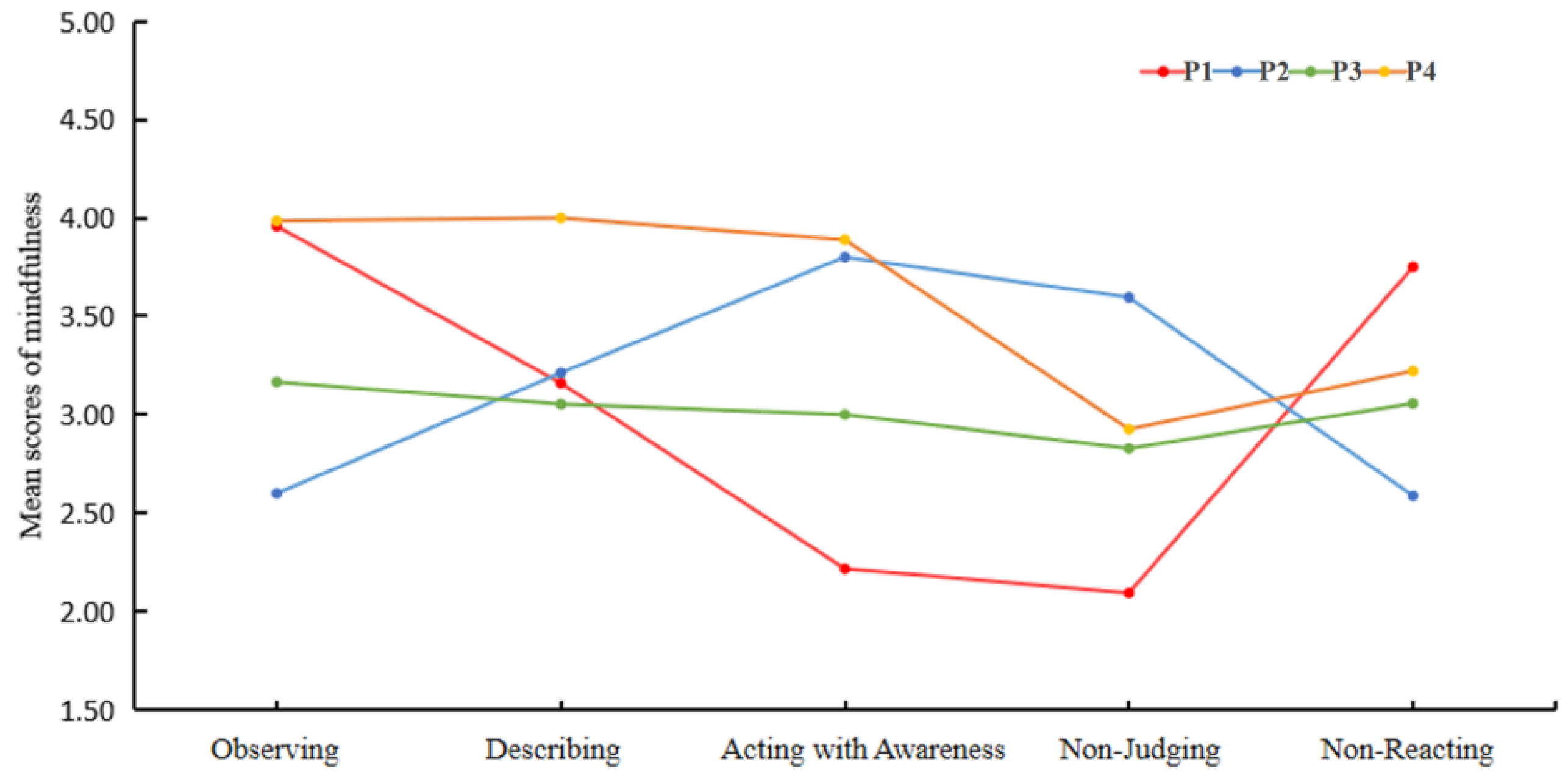
| Latent Categories | n | Proportion | Observing | Describing | Acting with Awareness | Non-Judging | Non-Reacting |
|---|---|---|---|---|---|---|---|
| H/L | 128 | 18.58% | 3.96 (0.46) | 3.16 (0.58) | 2.22 (0.45) | 2.09 (0.41) | 3.75 (0.48) |
| A/J | 116 | 16.84% | 2.60 (0.45) | 3.21 (0.54) | 3.80 (0.36) | 3.60 (0.41) | 2.59 (0.42) |
| MM | 376 | 54.57% | 3.17 (0.37) | 3.05 (0.42) | 3.00 (0.40) | 2.83 (0.34) | 3.06 (0.34) |
| HM | 69 | 10.01% | 3.99 (0.43) | 4.00 (0.48) | 3.89 (0.48) | 2.93 (0.60) | 3.22 (0.52) |
| P1 | P2 | P3 | P4 | BCH (χ2) | P1 VS. P2 | P1 VS. P3 | P1 VS. P4 | P2 VS. P3 | P2 VS. P4 | P3 VS. P4 | |
|---|---|---|---|---|---|---|---|---|---|---|---|
| Planning | 3.90(0.06) | 3.50(0.07) | 3.42(0.03) | 4.27(0.07) | 129.34 *** | 19.67 *** | 40.86 *** | 14.92 *** | 1.05 | 60.74 *** | 108.52 *** |
| Monitoring | 3.87(0.07) | 3.36(0.06) | 3.40(0.04) | 4.27(0.08) | 126.97 *** | 29.18 *** | 31.49 *** | 15.08 *** | 0.24 | 82.31 *** | 99.72 *** |
| Adjustment | 3.93(0.06) | 3.59(0.06) | 3.56(0.03) | 4.33(0.07) | 117.91 *** | 17.02 *** | 28.91 *** | 19.90 *** | 0.21 | 65.46 *** | 101.88 *** |
| Evaluation | 4.05(0.06) | 3.59(0.06) | 3.58(0.04) | 4.39(0.07) | 136.49 *** | 27.36 *** | 38.52 *** | 13.82 *** | 0.02 | 75.58 *** | 110.89 *** |
Disclaimer/Publisher’s Note: The statements, opinions and data contained in all publications are solely those of the individual author(s) and contributor(s) and not of MDPI and/or the editor(s). MDPI and/or the editor(s) disclaim responsibility for any injury to people or property resulting from any ideas, methods, instructions or products referred to in the content. |
© 2025 by the authors. Licensee MDPI, Basel, Switzerland. This article is an open access article distributed under the terms and conditions of the Creative Commons Attribution (CC BY) license (https://creativecommons.org/licenses/by/4.0/).
Share and Cite
Jiang, L.; Zhang, S.; Li, J.; Gong, Y.; Sun, N.; Wang, H.; Xiao, T.; Yi, X. Individuals with High Mindfulness Are Better at Metacognitive Ability: A Latent Profile Analysis Approach. Behav. Sci. 2025, 15, 1341. https://doi.org/10.3390/bs15101341
Jiang L, Zhang S, Li J, Gong Y, Sun N, Wang H, Xiao T, Yi X. Individuals with High Mindfulness Are Better at Metacognitive Ability: A Latent Profile Analysis Approach. Behavioral Sciences. 2025; 15(10):1341. https://doi.org/10.3390/bs15101341
Chicago/Turabian StyleJiang, Lan, Shang Zhang, Jinglin Li, Yuhong Gong, Na Sun, Haihong Wang, Tao Xiao, and Xinfa Yi. 2025. "Individuals with High Mindfulness Are Better at Metacognitive Ability: A Latent Profile Analysis Approach" Behavioral Sciences 15, no. 10: 1341. https://doi.org/10.3390/bs15101341
APA StyleJiang, L., Zhang, S., Li, J., Gong, Y., Sun, N., Wang, H., Xiao, T., & Yi, X. (2025). Individuals with High Mindfulness Are Better at Metacognitive Ability: A Latent Profile Analysis Approach. Behavioral Sciences, 15(10), 1341. https://doi.org/10.3390/bs15101341