Article

Neuroticism Mediates the Association between Autistic Traits and Choice Reaction Time among Young Adults


by
Kassandra De Jesus Cintron
and
Xiao Yang
*
Department of Psychology, Old Dominion University, 346G Mills Godwin Life Sciences Building, Norfolk, VA 23529, USA
*
Author to whom correspondence should be addressed.
Behav. Sci. 2024, 14(10), 903; https://doi.org/10.3390/bs14100903
Submission received: 2 August 2024 / Revised: 24 September 2024 / Accepted: 4 October 2024 / Published: 7 October 2024

Abstract

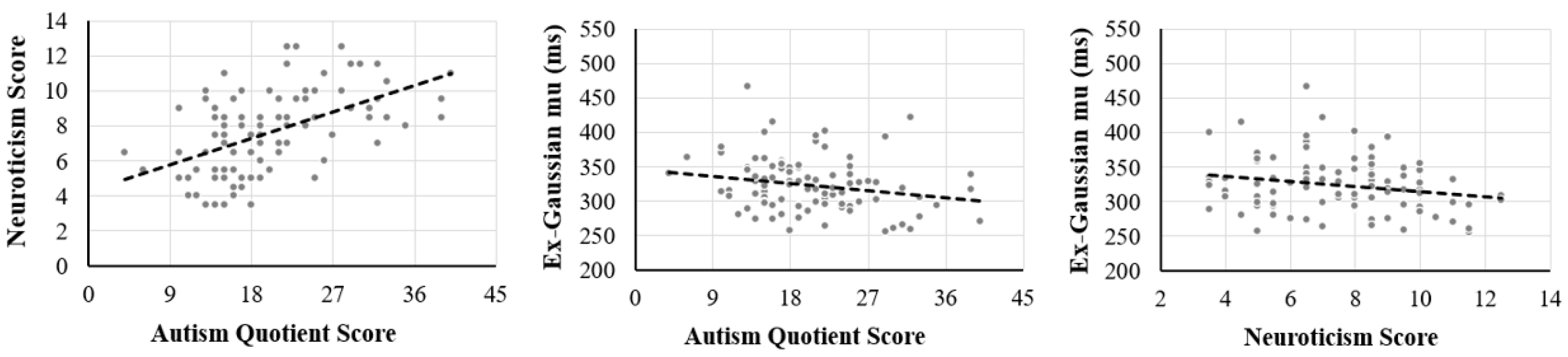
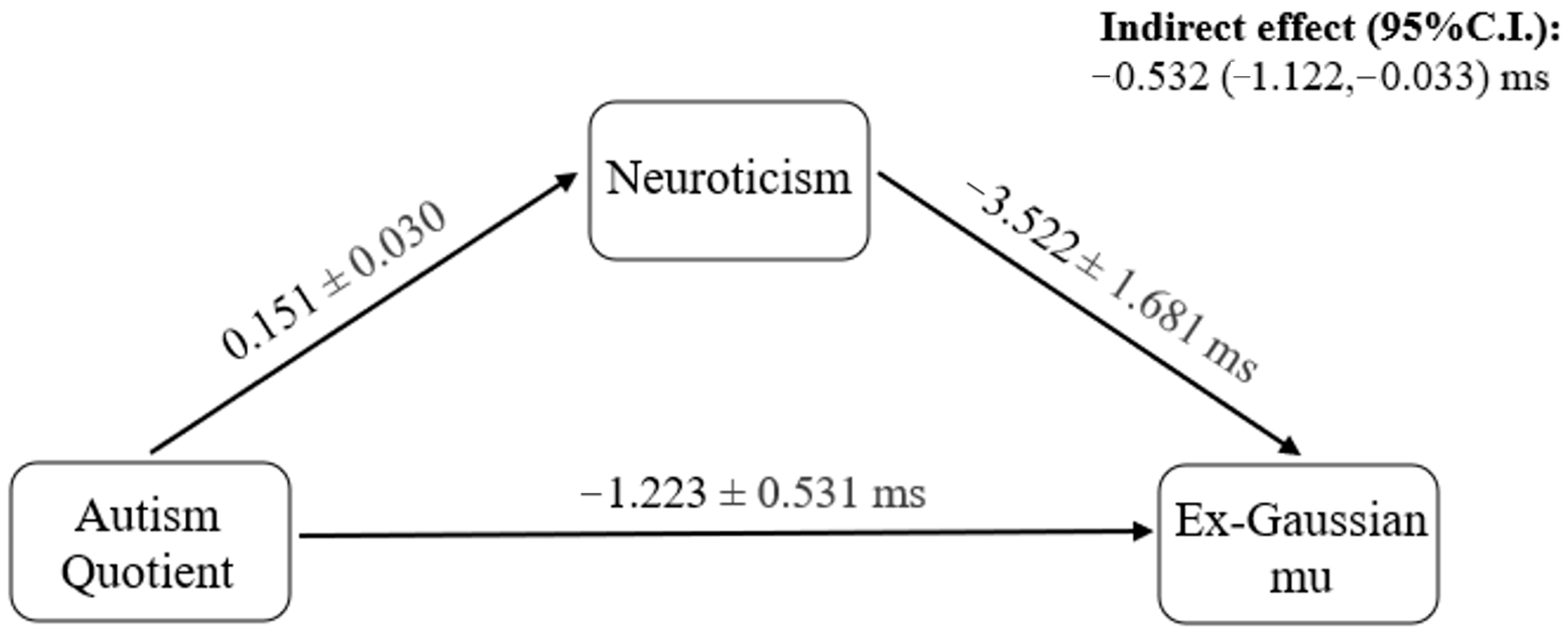
Autism spectrum disorder (ASD) is a neurodevelopmental disorder that influences an individual’s cognitive functions and social interaction. While most studies have focused on children and adolescents diagnosed with ASD, elevated levels of autistic traits in subclinical populations may also influence individuals’ daily functioning. Autistic traits are also linked to the Big Five personality. In particular, neuroticism (emotion instability) has been shown to be positively associated with autistic traits, which may contribute to behavioral symptoms of autistic traits. The present study aimed to investigate the association between autistic symptoms and sensorimotor processing among a subclinical population. One hundred young adults (Mage = 20.32 years; SD = 3.69 years; 69 female) completed a choice reaction time (RT) task, and their behavioral performance was analyzed using the ex-Gaussian modeling. The Autism Quotient (AQ) and the Ten-Item Personality Inventory (TIPI) were used to assess autistic traits and neuroticism, respectively. The mediation analysis was conducted to examine the behavioral mechanism through which autistic traits influence sensorimotor processing. The results showed that the AQ score was negatively correlated with RT and positively correlated with neuroticism score. Importantly, the mediation analysis indicated an indirect effect, suggesting that neuroticism mediates the association between the AQ score and RT. The findings indicated a possible mechanism of the association between autistic traits and sensorimotor responses and suggested that neuroticism should be included as an intervention target for ASD. The present study contributes to the research on autistic traits and has practical implications for future intervention programs to improve daily functioning among individuals with ASD.
Keywords: autistic symptoms; neuroticism; choice reaction time; ex-Gaussian modeling autistic symptoms; neuroticism; choice reaction time; ex-Gaussian modeling