A Follow-Up Study on the Influence of Personal, Family, and School Factors on Learning Outcomes of Students with Disabilities in Senior High School

Abstract
1. Introduction
2. Literature Review
2.1. Learning Outcomes
2.2. In-School and Post-School Outcomes
3. Methodology
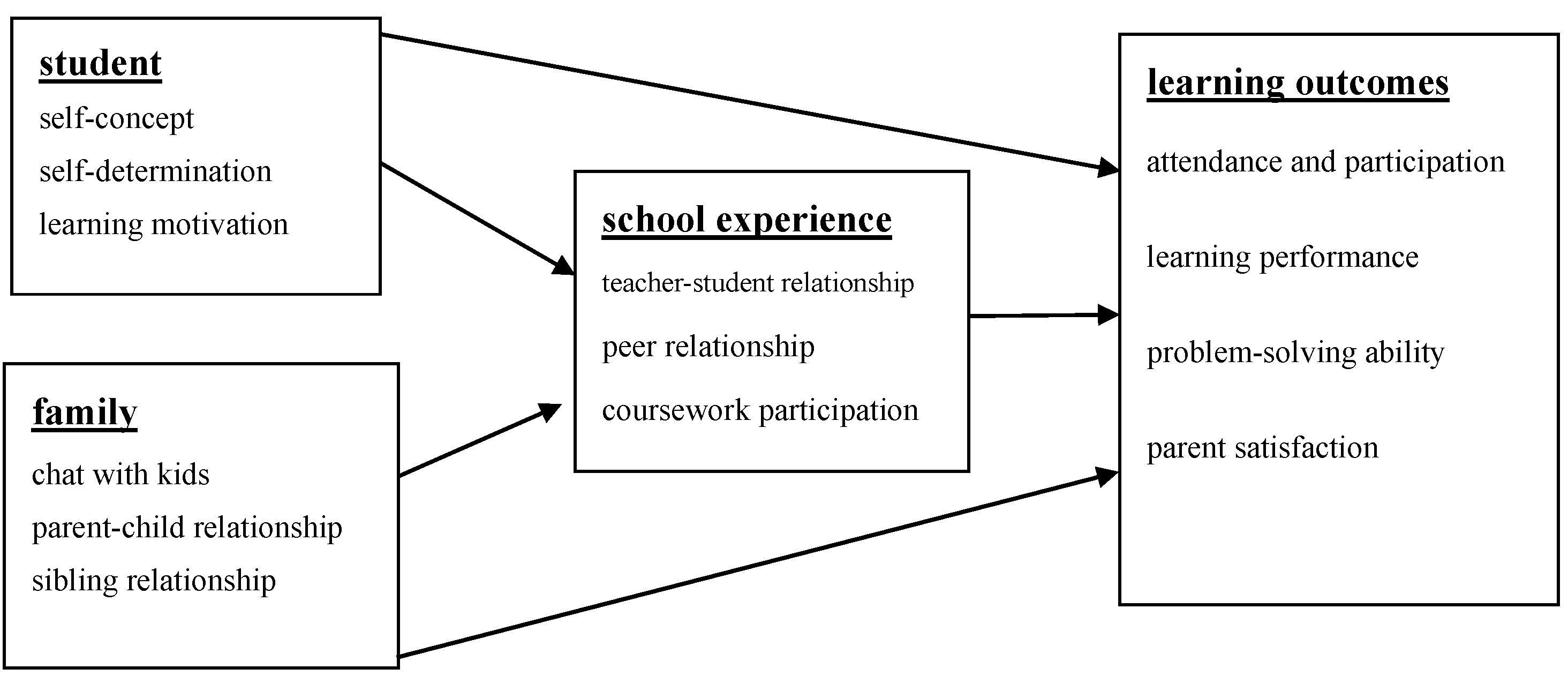
3.1. Research Model
3.2. Participants
3.3. Measures
3.4. Data Analysis
4. Results
4.1. In-School and Post-School Learning Outcomes of Students with Disabilities
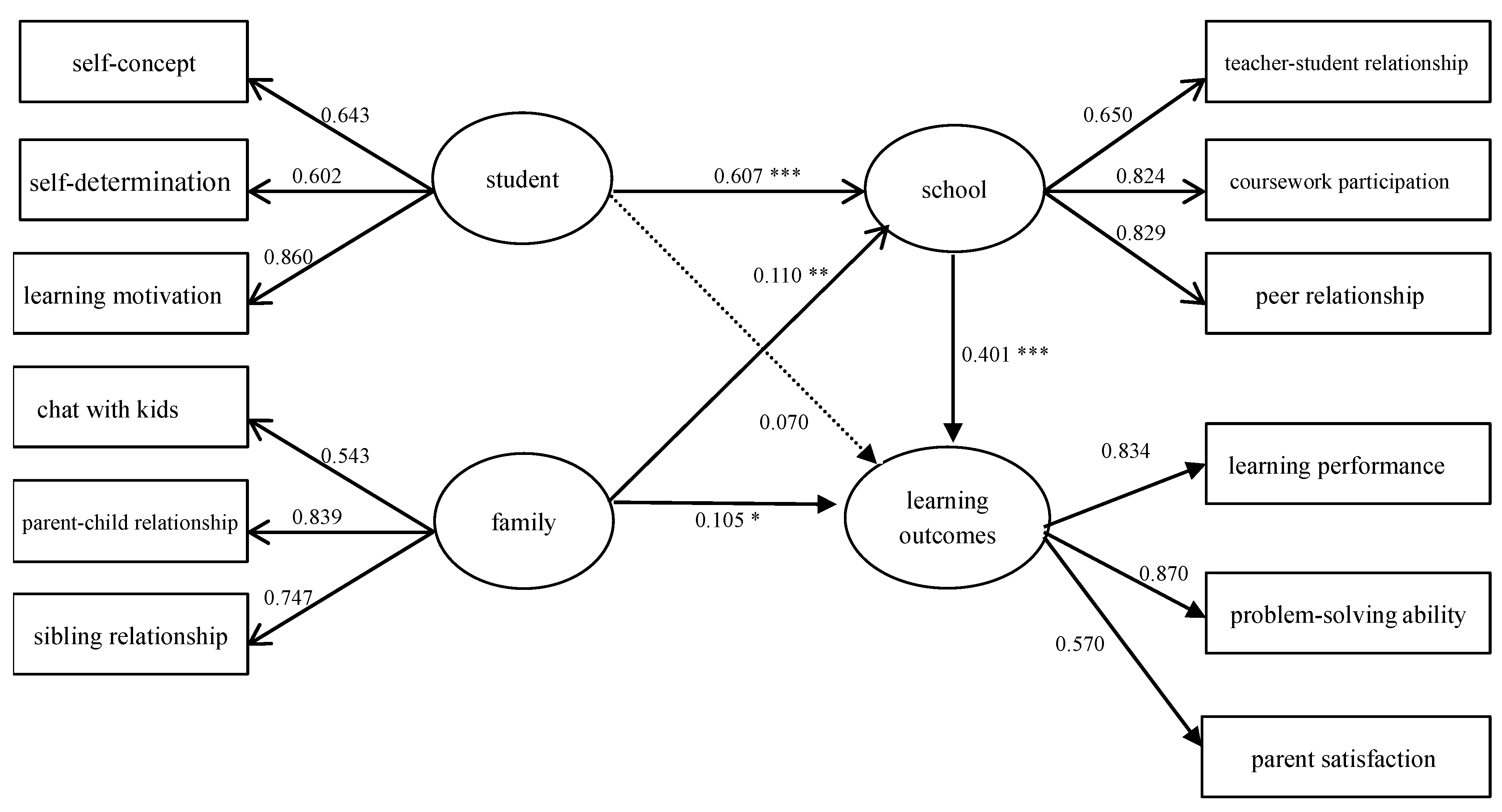
4.2. The Learning Outcomes Impact Model
4.3. Prediction of In-School Outcomes on Post-School Outcomes
5. Discussion
6. Conclusions
Author Contributions
Funding
Institutional Review Board Statement
Informed Consent Statement
Data Availability Statement
Acknowledgments
Conflicts of Interest
References
- DeStefano, L. Evaluating effectiveness: A comparison of federal expectations and local capabilities for evaluation among federally funded model demonstration programs. Educ. Eval. Policy Anal. 1992, 14, 157–168. [Google Scholar] [CrossRef]
- U.S. Department of Education. A History of the Individuals with Disabilities Education Act. 2023. Available online: https://sites.ed.gov/idea/IDEA-History (accessed on 30 May 2023).
- Wolfe, P.S.; Hall, T.E. Making inclusion a reality for students with severe disabilities. Teach. Except. Child. 2003, 35, 56–60. [Google Scholar] [CrossRef] [Scilit]
- The Council for Exceptional Children. IDEA 1997: Let’s Make It Work; The Council for Exceptional Children: Arlington, VA, USA, 1998. [Google Scholar]
- Rothstein, L.; Johnson, S.F. Special Education Law; Sage: Newcastle upon Tyne, UK, 2009. [Google Scholar]
- Barrat, V.X.; Berliner, B.; Voight, A.; Tran, L.; Huang, C.W.; Yu, A.; Chen-Gaddini, M. School Mobility, Dropout, and Graduation Rates across Student Disability Categories in Utah. REL 2015-055. Regional Educational Laboratory West. 2014. Available online: https://eric.ed.gov/?id=ED548546 (accessed on 2 January 2023).
- Wagner, M. The Transition Experiences of Young People with Disabilities. A Summary of Findings from the National Longitudinal Transition Study of Special Education Students. 1993. Available online: https://eric.ed.gov/?id=ED365086 (accessed on 5 January 2023).
- Wagner, M.; Marder, C.; Blackorby, J.; Cameto, R.; Newman, L.; Levine, P.; Davies-Mercier, E. The Achievements of Youth with Disabilities during Secondary School; SRI International: Menlo Park, CA, USA, 2003. [Google Scholar]
- Wagner, M.; Newman, L.; Cameto, R.; Levine, P. The Academic Achievement and Functional Performance of Youth with Disabilities. A Report from the National Longitudinal Transition Study-2 (NLTS2). NCSER 2006-3000. Online Submission. 2006. Available online: https://eric.ed.gov/?id=ED494936 (accessed on 6 January 2023).
- Newman, L.; Wagner, M.; Cameto, R.; Knokey, A.M. The Post-High School Outcomes of Youth with Disabilities up to 4 Years after High School: A Report From the National Longitudinal Transition Study-2 (NLTS2); NCSER 2009-3017; National Center for Special Education Research: Washington, DC, USA, 2009.
- Wagner, M.; Newman, L.; Cameto, R.; Levine, P.; Garza, N. An Overview of Findings from Wave 2 of the National Longitudinal Transition Study-2 (NLTS2); NCSER 2006-3004; National Center for Special Education Research: Washington, DC, USA, 2006.
- Summers, A.A. School social systems and student achievement: Schools can make a difference: Wilbur Brookover, Charles Beady, Patricia Flood, John Schweitzer, and Joe Wisenbaker. New York: Praeger, 1979. Pp. 237. No price listed (cloth). Econ. Educ. Rev. 1981, 1, 397–400. [Google Scholar] [CrossRef] [Scilit]
- Mortimore, P.; Sammons, P.; Stoll, L.; Lewis, D.; Ecob, R. A study of effective junior schools. Int. J. Educ. Res. 1989, 13, 753–768. [Google Scholar] [CrossRef] [Scilit]
- Paul, S.M. Outcomes of students with disabilities in a developing country: Tobago. Int. J. Spec. Educ. 2011, 26, 194–211. [Google Scholar]
- Rutter, M. Fifteen Thousand Hours: Secondary Schools and Their Effects on Children; Harvard University Press: Cambridge, MA, USA, 1979. [Google Scholar]
- DeStefano, L.; Wagner, M. Outcome Assessment in Special Education: Lessons Learned. 1991. Available online: https://eric.ed.gov/?id=ED327565 (accessed on 8 January 2023).
- Spady, W.G. Outcome-Based Education: Critical Issues and Answers; American Association of School Administrators: Arlington, VA, USA, 1994. [Google Scholar]
- Liao, C.-W.; Tseng, Y.-J.; Liao, Y.-H.; Chen, B.-S.; Ho, W.-S.; Wang, I.-C.; Lin, H.-I.; Chen, I.-M. A Practical Curriculum Design and Learning Effectiveness Evaluation of Competence-Oriented Instruction Strategy Integration: A Case Study of Taiwan Skills-Based Senior High School. Behav. Sci. 2023, 13, 43. [Google Scholar] [CrossRef] [Scilit] [PubMed]
- Sun, S.-J.; Lee, X.-B. A Preliminary Study of Special Education Teacher Students’ Competence in 108 Curriculum Literacy Oriented Teaching Practices. Nantou Spec. Educ. J. 2022, 31, 1–7. [Google Scholar]
- Thurlow, M.L.; Sinclair, M.F.; Johnson, D.R. Students with Disabilities Who Drop Out of School: Implications for Policy and Practice. Issue Brief: Examining Current Challenges in Secondary Education and Transition. 2022. Available online: https://eric.ed.gov/?id=ED468582 (accessed on 2 March 2023).
- Carnevale, A.P.; Fry, R.A. Crossing the Great Divide: Can We Achieve Equity When Generation Y Goes to College? Leadership 2000 Series; 2000. Available online: https://eric.ed.gov/?id=ED443907 (accessed on 6 March 2023).
- National Center on Secondary Education and Transition. A National Leadership Summit on Improving Results for Youth: State Priorities and Needs for Assistance. 2003. Available online: http://www.ncset.org/summit03/NCSETSummit03findings.pdf (accessed on 30 May 2023).
- Wagner, M.; Newman, L.; Cameto, R.; Garza, N.; Levine, P. After High School: A First Look at the Postschool Experiences of Youth with Disabilities. A Report from the National Longitudinal Transition Study-2 (NLTS2). Online Submission. 2005. Available online: https://eric.ed.gov/?id=ED494935 (accessed on 2 March 2023).
- Wang, Y.-Q.; Sun, S.-J. The effectiveness of integrating table games into social skills programmes to enhance social skills and peer acceptance of students with intellectual disabilities. Bull. East. Taiwan Spec. Educ. 2020, 22, 27–57. [Google Scholar]
- Wu, Y.C.; Sun, S.-J. The Study of Promoting Peer Intera ction for the Students with Intellectual Disabilities in Regular Classroom by Super Skills Courses. J. Res. Spec. Educ. Assist. Technol. 2019, 11, 23–57. [Google Scholar] [CrossRef]
- Newman, L.; Wagner, M.; Knokey, A.M.; Marder, C.; Nagle, K.; Shaver, D.; Wei, X. The Post-High School Outcomes of Young Adults with Disabilities up to 8 Years after High School: A Report from the National Longitudinal Transition Study-2 (NLTS2); NCSER 2011-3005; National Center for Special Education Research: Washington, DC, USA, 2011.
- Sun, S.-J.; Huang, T.-Y. School support services model for students with disabilities in general education classrooms: Using data from the special needs education longitudinal study in Taiwan. J. Lit. Art Stud. 2016, 6, 1063–1077. [Google Scholar] [CrossRef] [Scilit]
- Sun, S.-J.; Huang, T.-Y. The performance and influence factors on the learning outcomes of students with disabilities in high school. Dev. Spec. Educ. 2020, 70, 35–52. [Google Scholar]
- Fornell, C.; Larcker, D.F. Evaluating structural equation models with unobservable variables and measurement error. J. Mark. Res. 1981, 18, 39–50. [Google Scholar] [CrossRef] [Scilit]
- Newman, L. Family Involvement in the Educational Development of Youth with Disabilities: A Special Topic Report of Findings from the National Longitudinal Transition Study-2 (NLTS2). Online Submission. 2005. Available online: https://eric.ed.gov/?id=ED489979 (accessed on 2 January 2023).
- Dell’Anna, S.; Pellegrini, M.; Ianes, D.; Vivanet, G. Learning, social, and psychological outcomes of students with moderate, severe, and complex disabilities in inclusive education: A systematic review. Int. J. Disabil. Dev. Educ. 2022, 69, 2025–2041. [Google Scholar] [CrossRef] [Scilit]
- Doren, B.; Gau, J.M.; Lindstrom, L.E. The relationship between parent expectations and postschool outcomes of adolescents with disabilities. Except. Child. 2012, 79, 7–23. [Google Scholar] [CrossRef] [Scilit]
- Chiang, H.M.; Cheung, Y.K.; Hickson, L.; Xiang, R.; Tsai, L.Y. Predictive factors of participation in postsecondary education for high school leavers with autism. J. Autism Dev. Disord. 2012, 42, 685–696. [Google Scholar] [CrossRef] [Scilit]
- Chiang, H.M.; Cheung, Y.K.; Li, H.; Tsai, L.Y. Factors associated with participation in employment for high school leavers with autism. J. Autism Dev. Disord. 2013, 43, 1832–1842. [Google Scholar] [CrossRef] [Scilit]
- Brock, M.E.; Biggs, E.E.; Carter, E.W.; Cattey, G.N.; Raley, K.S. Implementation and generalization of peer support arrangements for students with severe disabilities in inclusive classrooms. J. Spec. Educ. 2016, 49, 221–232. [Google Scholar] [CrossRef] [Scilit]


| n | % | ||
|---|---|---|---|
| Residence area | Taipei, Keelung, Yilan | 124 | 25.0 |
| Taoyuan, Hsinchu, Miaoli | 82 | 16.5 | |
| Taichung, Changhua, Nantou | 121 | 24.4 | |
| Yunlin, Chiayi, Tainan | 78 | 15.7 | |
| Kaohsiung, Pingtung | 70 | 14.1 | |
| Hualien, Taitung, and Outlying Islands | 21 | 4.2 | |
| Gender | Male | 321 | 64.7 |
| Female | 175 | 35.3 | |
| Disability category | Intellectual disabilities | 16 | 3.2 |
| Visual impairments | 30 | 6.0 | |
| Hearing impairments | 53 | 10.7 | |
| Speech or language impairments | 8 | 1.6 | |
| Orthopedic disabilities | 88 | 17.7 | |
| Other health impairments | 66 | 13.3 | |
| Emotional and behavior disorders | 46 | 9.3 | |
| Learning disabilities | 84 | 16.9 | |
| Multiple disabilities | 17 | 3.4 | |
| Autism | 65 | 13.1 | |
| Other significant disabilities | 23 | 4.6 | |
| Total | 496 | 100% |
| Latent Variables | Observed Variables | Questionnaire Source | Questions |
|---|---|---|---|
| Student | Self-concept | Student |
|
| Self-determination | Student |
| |
| Learning motivation | Student |
| |
| Family | Chat with kids | Parent |
|
| Parent-child relationship | Student |
| |
| Sibling relationship | Student |
| |
| School experience | Peer relationship | Student |
|
| Teacher-student relationship | Student |
| |
| Coursework participation | Student |
|
| Latent Variables | Observed Variables | Questionnaire Source | Questions |
|---|---|---|---|
| In-school outcomes | Attendance and participation | Teacher |
|
| Learning performance | Teacher |
| |
| Problem-solving ability | Teacher |
| |
| Parent satisfaction | Parent |
| |
| Post-school outcomes | Postsecondary education | Student |
|
| Employment | Student |
| |
| Social adaptation | Student |
| |
| Satisfaction | Student, Parent |
|
| Latent Variables | Observed Variables | Questions | Options | Frequency | % |
|---|---|---|---|---|---|
| Learning | Attendance and participation | How is the student’s attendance? | Full attendance | 227 | 45.8 |
| Outcomes | Sometimes absent | 260 | 52.4 | ||
| Often absent | 7 | 1.4 | |||
| Almost absent | 2 | 0.4 | |||
| How does the student participate in school activities? | All participate | 348 | 70.2 | ||
| Mostly participated | 116 | 23.4 | |||
| Rarely participate | 25 | 5.0 | |||
| Never participate | 7 | 1.4 | |||
| Learning performance | Pay attention in class | Often | 248 | 50.0 | |
| Sometimes | 178 | 35.9 | |||
| Rarely | 61 | 12.3 | |||
| Never | 9 | 1.8 | |||
| Follow the teacher’s instructions | Often | 384 | 77.4 | ||
| Sometimes | 107 | 21.6 | |||
| Rarely | 5 | 1.0 | |||
| Never | 0 | 0.0 | |||
| Complete homework on time | Often | 284 | 57.3 | ||
| Sometimes | 154 | 31.0 | |||
| Rarely | 50 | 10.1 | |||
| Never | 8 | 1.6 | |||
| Focus on learning task | Often | 243 | 49.0 | ||
| Sometimes | 195 | 39.3 | |||
| Rarely | 54 | 10.9 | |||
| Never | 4 | 0.8 | |||
| Problem-solving ability | Make your own choices and decisions | Very agree | 153 | 30.8 | |
| Agree | 234 | 47.2 | |||
| Not very agree | 88 | 17.7 | |||
| Disagree | 19 | 3.8 | |||
| Find a way to solve the problem | Very agree | 121 | 24.4 | ||
| Agree | 238 | 48.0 | |||
| Not very agree | 109 | 22.0 | |||
| Disagree | 26 | 5.2 | |||
| Arrange your own time | Very agree | 133 | 26.8 | ||
| Agree | 227 | 45.8 | |||
| Not very agree | 102 | 20.6 | |||
| Disagree | 33 | 6.7 | |||
| Understand future career development | Very agree | 108 | 21.8 | ||
| Agree | 211 | 42.5 | |||
| Not very agree | 120 | 24.2 | |||
| Disagree | 48 | 9.7 | |||
| Parent satisfaction | The child gets along with the teachers | Very satisfied | 158 | 31.9 | |
| Satisfied | 285 | 57.5 | |||
| Not very satisfied | 28 | 5.6 | |||
| Dissatisfied | 6 | 1.2 | |||
| The child gets along with classmates | Very satisfied | 134 | 27.0 | ||
| Satisfied | 263 | 53.0 | |||
| Not very satisfied | 63 | 12.7 | |||
| Dissatisfied | 17 | 3.4 | |||
| The child participates in school activities | Very satisfied | 121 | 24.4 | ||
| Satisfied | 289 | 58.3 | |||
| Not very satisfied | 44 | 8.9 | |||
| Dissatisfied | 8 | 1.6 | |||
| The child’s learning progress | Very satisfied | 90 | 18.1 | ||
| Satisfied | 306 | 61.7 | |||
| Not very satisfied | 67 | 13.5 | |||
| Dissatisfied | 17 | 3.4 |
| Latent Variables | Observed Variables | Questions | Options | Frequency | % |
|---|---|---|---|---|---|
| Learning | Postsecondary education | Do you have enough information when choosing a university department? | Very enough | 66 | 16.3 |
| Outcomes | Enough | 207 | 51.2 | ||
| Not enough | 36 | 8.9 | |||
| Very not enough | 6 | 1.5 | |||
| Do you think college life is happy? | Very happy | 113 | 28.0 | ||
| Happy | 188 | 46.5 | |||
| Not happy | 12 | 3.0 | |||
| Unhappy | 2 | 0.5 | |||
| Are you satisfied with your learning performance? | Very satisfied | 57 | 14.1 | ||
| Satisfied | 207 | 51.2 | |||
| Not very satisfied | 45 | 11.1 | |||
| Dissatisfied | 6 | 1.5 | |||
| Employment | Are you satisfied with the salary of the job? | Very satisfied | 7 | 1.7 | |
| Satisfied | 29 | 7.2 | |||
| Not very satisfied | 6 | 1.5 | |||
| Dissatisfied | 1 | 0.2 | |||
| Do you have any difficulties at work? | No difficulty | 12 | 3.0 | ||
| Not too difficult | 28 | 6.9 | |||
| Some difficulty | 2 | 0.5 | |||
| Very difficult | 1 | 0.2 | |||
| Do you like your current job? | Extremely like | 8 | 2.0 | ||
| Slightly like | 31 | 7.7 | |||
| Don’t really like | 4 | 1.0 | |||
| Social adaptation | Could you arrange your free time? | Definitely yes | 161 | 39.9 | |
| Probably yes | 176 | 43.6 | |||
| Probably not | 59 | 14.6 | |||
| Definitely not | 8 | 2.0 | |||
| Could you do housework? | Definitely yes | 182 | 45.0 | ||
| Probably yes | 165 | 40.8 | |||
| Probably not | 44 | 10.9 | |||
| Definitely not | 13 | 3.2 | |||
| Could you manage your money? | Definitely yes | 191 | 47.3 | ||
| Probably yes | 174 | 43.1 | |||
| Probably not | 31 | 7.7 | |||
| Definitely not | 8 | 2.0 | |||
| Satisfaction | Are you satisfied with your living environment? | Very satisfied | 163 | 40.3 | |
| Satisfied | 221 | 54.7 | |||
| Not very satisfied | 19 | 4.7 | |||
| Dissatisfied | 1 | 0.2 | |||
| Are you happy with your life now? | Very happy | 144 | 35.6 | ||
| Happy | 234 | 57.9 | |||
| Not happy | 22 | 5.4 | |||
| Unhappy | 4 | 1.0 | |||
| Are you satisfied with your child’s current living situation? | Very satisfied | 65 | 16.1 | ||
| Satisfied | 269 | 66.6 | |||
| Not very satisfied | 60 | 14.9 | |||
| Dissatisfied | 10 | 2.5 |
| Independent Variables | B | SEB | β | R2 | ∆R2 | F |
|---|---|---|---|---|---|---|
| Parent satisfaction | 0.225 | 0.054 | 0.204 *** | 0.054 | 0.054 | 22.826 *** |
| Learning performance | 0.225 | 0.073 | 0.150 ** | 0.076 | 0.022 | 9.469 ** |
| Independent Variables | B | SEB | β | R2 | ∆R2 | F |
|---|---|---|---|---|---|---|
| Learning performance | −0.198 | 0.063 | −0.155 ** | 0.024 | 0.022 | 9.904 ** |
| Independent Variables | B | SEB | β | R2 | ∆R2 | F |
|---|---|---|---|---|---|---|
| Parent satisfaction | 0.101 | 0.027 | 0.184 *** | 0.044 | 0.044 | 18.459 *** |
| Problem-solving ability | 0.072 | 0.027 | 0.133 ** | 0.061 | 0.017 | 7.258 ** |
| Independent Variables | B | SEB | β | R2 | ∆R2 | F |
|---|---|---|---|---|---|---|
| Parent satisfaction | 0.160 | 0.020 | 0.363 *** | 0.132 | 0.132 | 60.742 *** |
Disclaimer/Publisher’s Note: The statements, opinions and data contained in all publications are solely those of the individual author(s) and contributor(s) and not of MDPI and/or the editor(s). MDPI and/or the editor(s) disclaim responsibility for any injury to people or property resulting from any ideas, methods, instructions or products referred to in the content. |
© 2023 by the authors. Licensee MDPI, Basel, Switzerland. This article is an open access article distributed under the terms and conditions of the Creative Commons Attribution (CC BY) license (https://creativecommons.org/licenses/by/4.0/).
Share and Cite
Sun, S.-J.; Ho, W.-S. A Follow-Up Study on the Influence of Personal, Family, and School Factors on Learning Outcomes of Students with Disabilities in Senior High School. Behav. Sci. 2023, 13, 554. https://doi.org/10.3390/bs13070554
Sun S-J, Ho W-S. A Follow-Up Study on the Influence of Personal, Family, and School Factors on Learning Outcomes of Students with Disabilities in Senior High School. Behavioral Sciences. 2023; 13(7):554. https://doi.org/10.3390/bs13070554
Chicago/Turabian StyleSun, Shu-Jou, and Wei-Sho Ho. 2023. "A Follow-Up Study on the Influence of Personal, Family, and School Factors on Learning Outcomes of Students with Disabilities in Senior High School" Behavioral Sciences 13, no. 7: 554. https://doi.org/10.3390/bs13070554
APA StyleSun, S.-J., & Ho, W.-S. (2023). A Follow-Up Study on the Influence of Personal, Family, and School Factors on Learning Outcomes of Students with Disabilities in Senior High School. Behavioral Sciences, 13(7), 554. https://doi.org/10.3390/bs13070554