



Impact of Gender on STEAM Education in Elementary School: From Individuals to Group Compositions


Abstract
1. Introduction
- (1)
- Do gender differences affect students’ learning behavior in STEAM education?
- (2)
- Do different gender groupings affect students’ learning behavior in STEAM education?
- (3)
- Do girls and boys perform differently in same- and mixed-gender groups during STEAM education?
2. Method
2.1. Research Design
2.2. Participants
2.3. Research Context and Procedure
2.4. Data Collection
2.5. Data Analysis
3. Results
3.1. Boys vs. Girls
3.2. Girl-Only Groups vs. Boy-Only Groups vs. Mixed-Gender Groups
3.3. The Influence of Group Gender Composition on Gender Performance
3.3.1. Boys in Boy-Only Groups vs. Boys in Mixed-Gender Groups
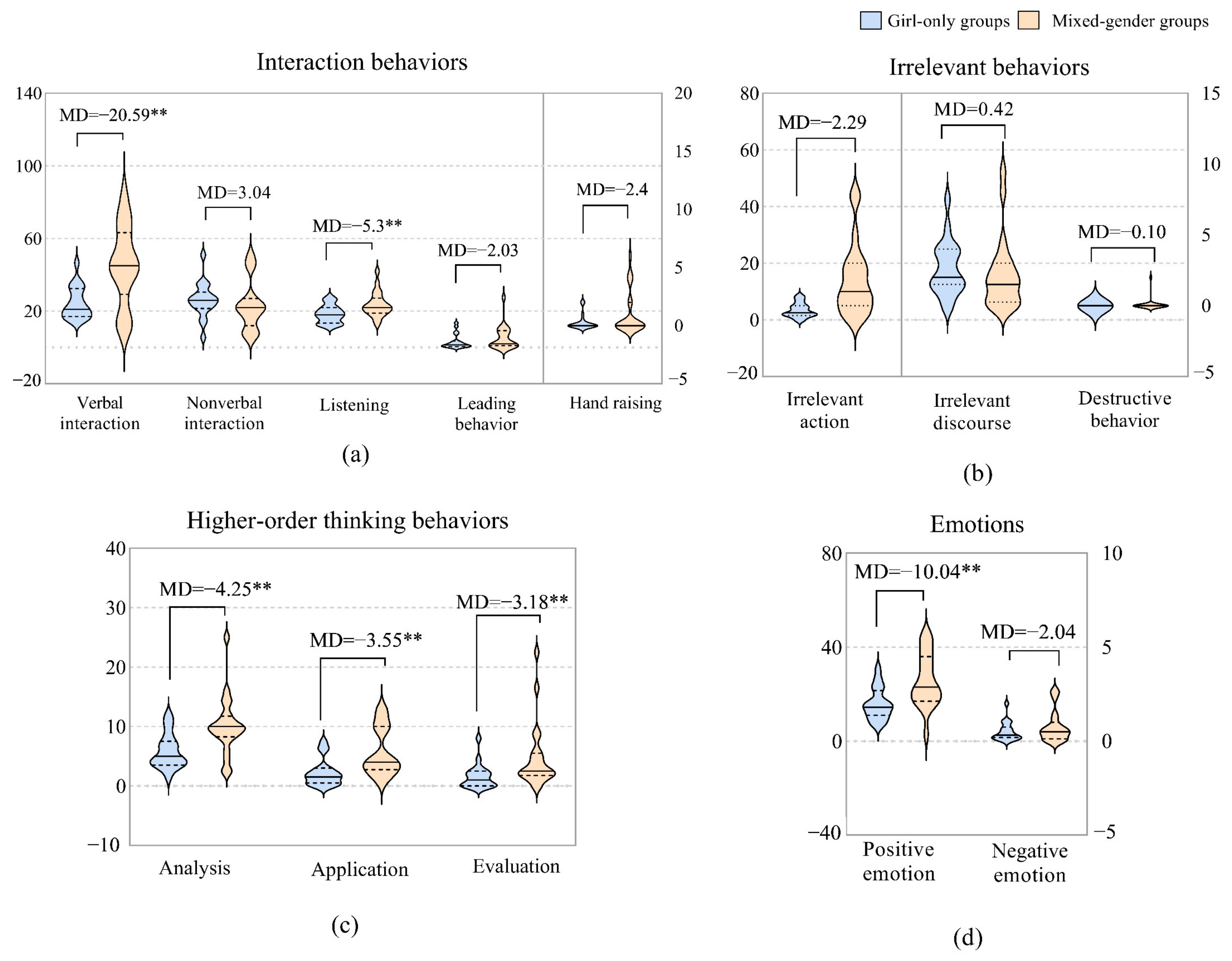
3.3.2. Girls in Girl-Only Groups vs. Girls in Mixed-Gender Groups
4. Discussion and Conclusions
4.1. Do Gender Differences Affect Students’ Learning Behavior in STEAM Education?
4.2. Do Different Gender Groupings Affect Students’ Learning Behavior in STEAM Education?
4.3. Do Girls and Boys Perform Differently in Same- and Mixed-Gender Groups during STEAM Education?
4.4. Implication for STEAM Education Practice
4.5. Limitations and Future Research
Author Contributions
Funding
Institutional Review Board Statement
Informed Consent Statement
Data Availability Statement
Conflicts of Interest
Appendix A

| Items | Gender | Gender Grouping | ||||||||
|---|---|---|---|---|---|---|---|---|---|---|
| Boy (N = 47) | Girl (N = 39) | Boy-Only (N = 27) | Mixed (N = 40) | Girl-Only (N = 19) | ||||||
| M | SD | M | SD | M | SD | M | SD | M | SD | |
| Higher-Order Thinking Behavior | ||||||||||
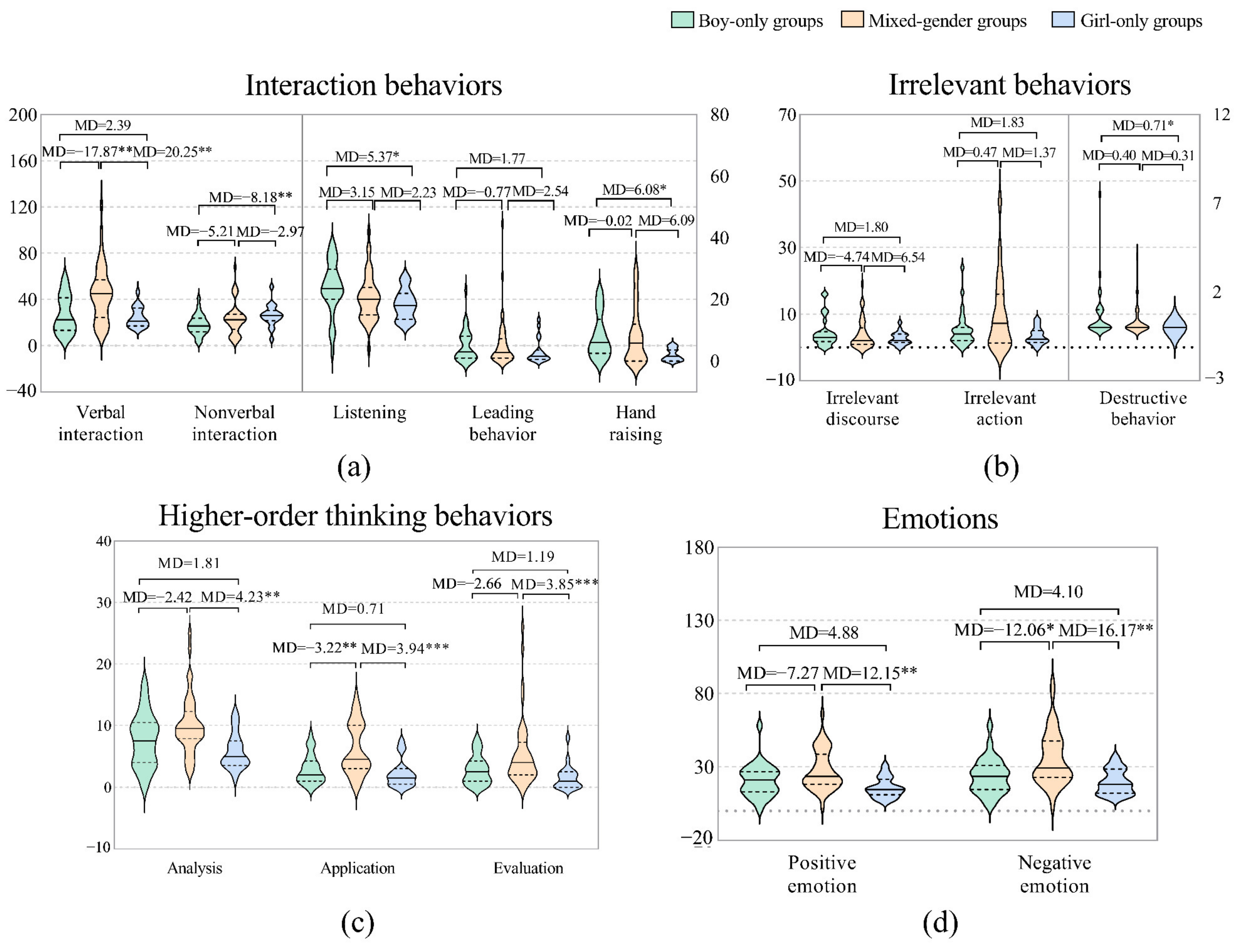
| Analysis | 8.66 | 4.71 | 8.08 | 4.53 | 7.66 | 4.35 | 10.07 | 4.84 | 5.84 | 4.62 |
| Application | 4.41 | 3.74 | 4.05 | 3.71 | 2.9 | 2.34 | 6.12 | 4.13 | 2.18 | 3.71 |
| Evaluation | 4.19 | 4.38 | 3.28 | 4.48 | 2.79 | 2.33 | 5.45 | 5.59 | 1.61 | 4.42 |
| Emotion | ||||||||||
| Positive Emotions | 24.61 | 13.84 | 21.06 | 10.56 | 20.67 | 11.24 | 27.94 | 13.5 | 15.79 | 12.55 |
| Negative Emotions | 30.59 | 17.98 | 25.59 | 13.58 | 23.6 | 12.14 | 35.67 | 18.35 | 19.5 | 16.28 |
| Interaction Behavior | ||||||||||
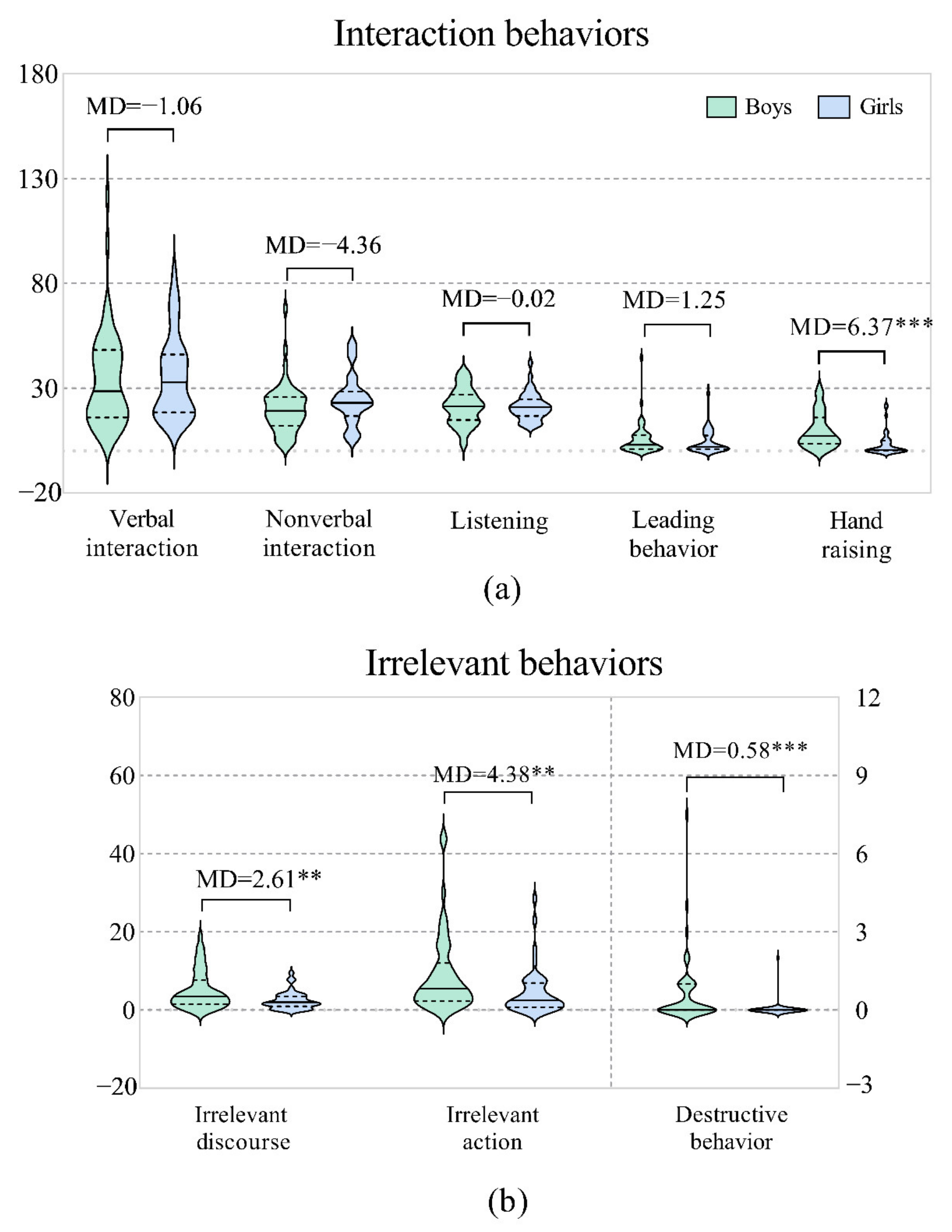
| Verbal Interaction | 34.33 | 23.3 | 35.39 | 19.84 | 26.97 | 16.41 | 44.83 | 24.72 | 24.58 | 21.72 |
| Nonverbal Interaction | 20.2 | 11.87 | 24.56 | 11.9 | 17.98 | 8.72 | 23.19 | 14.16 | 26.16 | 12.01 |
| Listening | 21.13 | 8.59 | 21.15 | 6.5 | 23.74 | 8.62 | 20.6 | 7.64 | 18.37 | 7.69 |
| Leader Behavior | 5.52 | 7.43 | 4.28 | 5.52 | 4.98 | 5.35 | 5.75 | 8.19 | 3.21 | 6.64 |
| Hand Raising | 9.66 | 8.38 | 3.29 | 5.55 | 8.1 | 7.17 | 8.12 | 9.21 | 2.03 | 7.89 |
| Irrelevant Behavior | ||||||||||
| Irrelevant Discourse | 5.02 | 4.8 | 2.41 | 2.24 | 4.47 | 4.37 | 4 | 4.52 | 2.63 | 4.07 |
| Irrelevant Action | 9.05 | 9.97 | 4.68 | 6.13 | 5.28 | 5.13 | 10.01 | 11.26 | 3.47 | 8.71 |
| Destructive Behavior | 0.63 | 1.31 | 0.05 | 0.32 | 0.71 | 1.52 | 0.31 | 0.77 | 0 | 1.03 |
Appendix B
| Items | Boy | Girl | ||||||
|---|---|---|---|---|---|---|---|---|
| Boy-Only (N = 29) | Mixed (N = 21) | Girl-Only (N = 19) | Mixed (N = 21) | |||||
| M | SD | M | SD | M | SD | M | SD | |
| Higher-Order Thinking Behavior | ||||||||
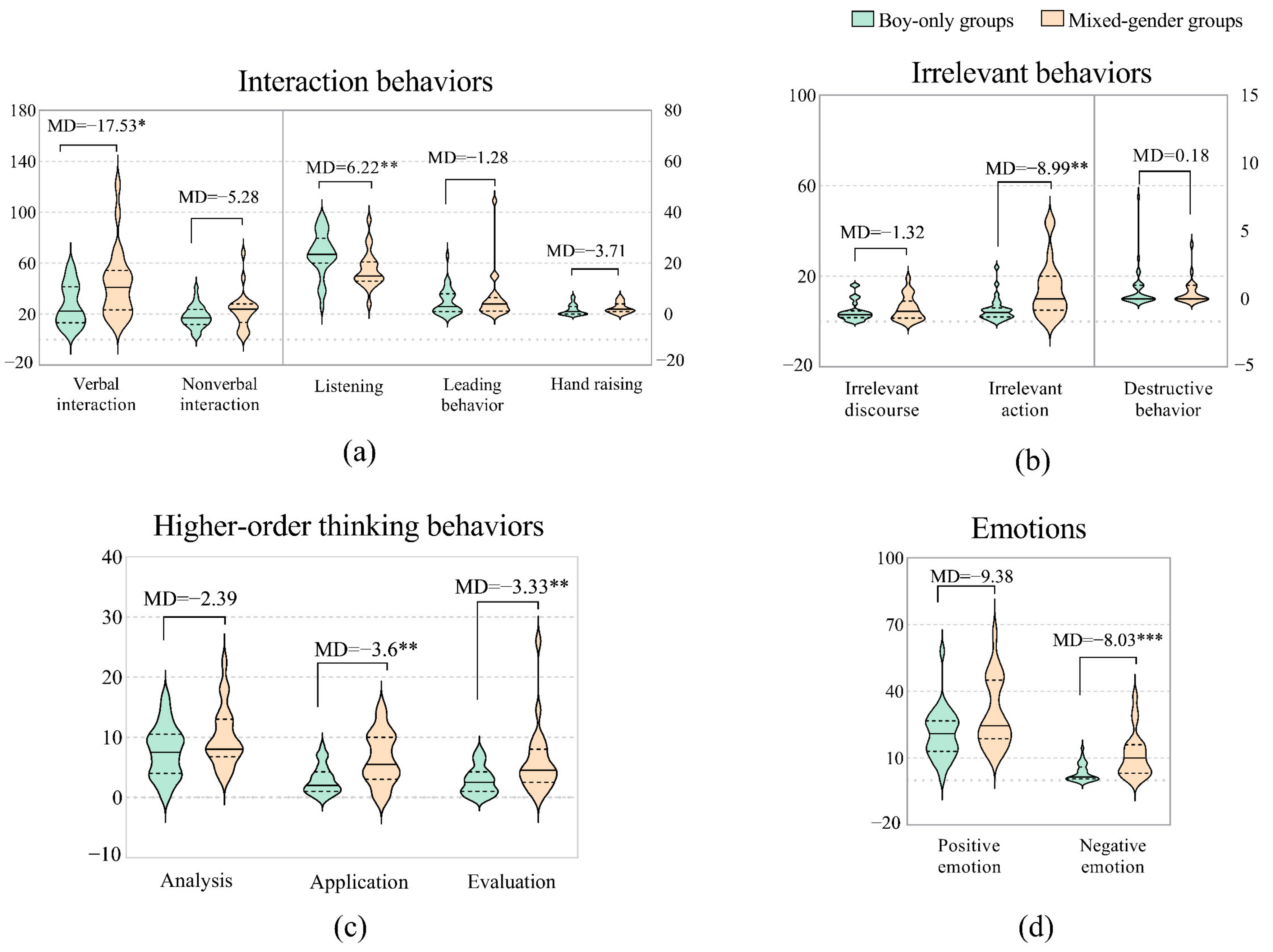
| Analysis | 7.66 | 4.35 | 10.05 | 4.95 | 5.84 | 2.88 | 10.10 | 4.86 |
| Application | 2.90 | 2.34 | 6.50 | 4.32 | 2.18 | 2.22 | 5.74 | 4.01 |
| Evaluation | 2.79 | 2.33 | 6.12 | 5.71 | 1.61 | 2.02 | 4.79 | 5.52 |
| Emotion | ||||||||
| Positive Emotions | 20.67 | 11.24 | 30.05 | 15.45 | 15.79 | 6.75 | 25.83 | 11.22 |
| Negative Emotions | 3.40 | 3.86 | 11.43 | 10.21 | 4.05 | 3.98 | 6.10 | 6.70 |
| Interaction Behavior | ||||||||
| Verbal Interaction | 26.97 | 16.41 | 44.50 | 27.67 | 24.58 | 8.82 | 45.17 | 22.06 |
| Nonverbal Interaction | 17.98 | 8.72 | 23.26 | 14.89 | 26.16 | 9.55 | 23.12 | 13.76 |
| Listening | 23.74 | 8.62 | 17.52 | 7.30 | 18.37 | 4.91 | 23.67 | 6.83 |
| Leader Behavior | 4.98 | 5.35 | 6.26 | 9.70 | 3.21 | 4.01 | 5.24 | 6.54 |
| Hand Raising | 8.10 | 7.17 | 11.81 | 9.57 | 2.03 | 1.98 | 4.43 | 7.33 |
| Irrelevant Behavior | ||||||||
| Irrelevant Discourse | 4.47 | 4.37 | 5.79 | 5.36 | 2.63 | 1.91 | 2.21 | 2.53 |
| Irrelevant Action | 5.28 | 5.13 | 14.26 | 12.54 | 3.47 | 2.51 | 5.76 | 8.06 |
| Destructive Behavior | 0.71 | 1.52 | 0.52 | 0.97 | 0.00 | 0.00 | 0.10 | 0.44 |
References
- Xie, Y.; Fang, M.; Shauman, K. STEM education. Annu. Rev. Sociol. 2015, 41, 331. [Google Scholar] [CrossRef] [Scilit] [PubMed]
- Chiu, J.L.; Malcolm, P.T.; Hecht, D.; DeJaegher, C.J.; Pan, E.A.; Bradley, M.; Burghardt, M.D. WISEngineering: Supporting precollege engineering design and mathematical understanding. Comput. Educ. 2013, 67, 142–155. [Google Scholar] [CrossRef] [Scilit]
- Sochacka, N.W.; Guyotte, K.W.; Walther, J. Learning together: A collaborative autoethnographic exploration of STEAM (STEM + the arts) education. J. Eng. Educ. 2016, 105, 15–42. [Google Scholar] [CrossRef] [Scilit]
- Yakman, G. What is the Point of STE@M? A Brief Overview. 2010. Available online: https://steamedu.com/wp-content/uploads/2016/01/What_is_the_Point_of_STEAM_A_Brief_Overv.pdf (accessed on 12 June 2022).
- Tseng, K.H.; Chang, C.C.; Lou, S.J.; Chen, W.P. Attitudes towards science, technology, engineering and mathematics (STEM) in a project-based learning (PJBL) environment. Int. J. Technol. Des. Educ. 2013, 23, 87–102. [Google Scholar] [CrossRef] [Scilit]
- Lamb, R.; Akmal, T.; Petrie, K. Development of a cognition-priming model describing learning in a stem classroom. J. Res. Sci. Teach. 2015, 52, 410–437. [Google Scholar] [CrossRef] [Scilit]
- Taylor, K.; Baek, Y. Grouping matters in computational robotic activities. Comput. Hum. Behav. 2019, 93, 99–105. [Google Scholar] [CrossRef] [Scilit]
- Pomerantz, E.M.; Saxon, J.L.; Kenney, G.A. Self-Evaluation: The Development of Sex Differences. In Cognitive Social Psychology: On the Tenure and Future of Social Cognition; Moskowitz, G.B., Ed.; Erlbaum: Mahwah, NJ, USA, 2001; pp. 59–74. [Google Scholar]
- Chaplin, T.M.; Aldao, A. Gender differences in emotion expression in children: A meta-analytic review. Psychol. Bull. 2013, 139, 735–765. [Google Scholar] [CrossRef] [Scilit]
- Pomerantz, E.M.; Altermatt, E.R.; Saxon, J.L. Making the grade but feeling distressed: Gender differences in academic performance and internal distress. J. Educ. Psychol. 2002, 94, 396–404. [Google Scholar] [CrossRef]
- Kuhn, J.T.; Holling, H. Gender, reasoning ability, and scholastic achievement: A multilevel mediation analysis. Learn. Individ. Differ. 2009, 19, 229–233. [Google Scholar] [CrossRef] [Scilit]
- Halpern, D.F.; Straight, C.A.; Stephenson, C.L. Beliefs about cognitive gender differences: Accurate for direction, underestimated for size. Sex Roles 2011, 64, 336–347. [Google Scholar] [CrossRef] [Scilit]
- Strand, S.; Deary, I.; Smith, P. Sex differences in cognitive abilities test scores: A UK national picture. Br. J. Educ. Psychol. 2006, 76, 463–480. [Google Scholar] [CrossRef] [Scilit]
- Kimball, M.M. A new perspective on women’s math achievement. Psychol. Bull. 1989, 105, 198–214. [Google Scholar] [CrossRef]
- Voyer, D.; Voyer, S.D. Gender differences in scholastic achievement: A meta-analysis. Psychol. Bull. 2014, 140, 1174–1204. [Google Scholar] [CrossRef] [Scilit]
- Siddiq, F.; Scherer, R. Is there a gender gap? A meta-analysis of the gender differences in students’ ICT literacy. Educ. Res. Rev. 2019, 27, 205–217. [Google Scholar] [CrossRef] [Scilit]
- Catsambis, S. Gender, race, ethnicity, and science education in the middle grades. J. Res. Sci. Teach. 1995, 32, 243–257. [Google Scholar] [CrossRef] [Scilit]
- Jiang, M.; Li, Y.; Zheng, J.; Han, X. Gender group differences on behavior patterns in collaborative problem solving through Lego. J. Comput. Educ. 2017, 4, 1–19. [Google Scholar] [CrossRef] [Scilit]
- Willoughby, T.; Wood, E.; Desjarlais, M.; Williams, L.; Leacy, K.; Sedore, L. Social interaction during computer-based activities: Comparisons by number of sessions, gender, school-level, gender composition of the group, and computer-child ratio. Sex Roles 2009, 61, 864–878. [Google Scholar] [CrossRef] [Scilit]
- González-Gómez, F.; Guardiola, J.; Rodríguez, Ó.M.; Alonso, M.Á.M. Gender differences in e-learning satisfaction. Comput. Educ. 2012, 58, 283–290. [Google Scholar] [CrossRef] [Scilit]
- Bennett, J.; Hogarth, S.; Lubben, F.; Campbell, B.; Robinson, A. Talking science: The research evidence on the use of small group discussions in science teaching. Int. J. Sci. Educ. 2010, 32, 69–95. [Google Scholar] [CrossRef] [Scilit]
- Zhan, Z.; Fong, P.; Mei, H.; Liang, T. Effects of gender grouping on students’ group performance, individual achievements and attitudes in computer-supported collaborative learning. Comput. Hum. Behav. 2015, 48, 587–596. [Google Scholar] [CrossRef] [Scilit]
- Cheng RW, Y.; Lam, S.F.; Chan JC, Y. When high achievers and low achievers work in the same group: The roles of group heterogeneity and processes in project-based learning. Br. J. Educ. Psychol. 2008, 78, 205–221. [Google Scholar] [CrossRef] [Scilit]
- Harskamp, E.; Ding, N.; Suhre, C. Group composition and its effect on girl and boy problem-solving in science education. Educ. Res. 2008, 50, 307–318. [Google Scholar] [CrossRef] [Scilit]
- Webb, N.M.; Mastergeorge, A.M. The development of students’ helping behavior and learning in peer-directed small groups. Cogn. Instr. 2003, 21, 361–428. [Google Scholar] [CrossRef] [Scilit]
- Walker, H.A.; Ilardi, B.C.; McMahon, A.M.; Fennell, M.L. Gender, interaction, and leadership. Soc. Psychol. Q. 1996, 59, 255–272. [Google Scholar] [CrossRef] [Scilit]
- Herro, D.; Quigley, C.; Andrews, J.; Delacruz, G. Co-Measure: Developing an assessment for student collaboration in STEAM activities. Int. J. STEM Educ. 2017, 4, 1–12. [Google Scholar] [CrossRef] [Scilit]
- Fredricks, J.A.; Blumenfeld, P.C.; Paris, A.H. School engagement: Potential of the concept, state of the evidence. Rev. Educ. Res. 2004, 74, 59–109. [Google Scholar] [CrossRef] [Scilit]
- Krathwohl, D.R. A revision of Bloom’s taxonomy: An overview. Theory Pract. 2002, 41, 212–218. [Google Scholar] [CrossRef] [Scilit]
- Stets, J.E. Future Directions in the Sociology of Emotions. Emot. Rev. 2010, 2, 265–268. [Google Scholar] [CrossRef] [Scilit]
- Li, J.; Luo, H.; Zhao, L.; Zhu, M.; Ma, L.; Liao, X. Promoting STEAM Education in Primary School through Cooperative Teaching: A Design-Based Research Study. Sustainability 2022, 14, 10333. [Google Scholar] [CrossRef] [Scilit]
- Li, Y.; Anderson, R.C.; Nguyen-Jahiel, K.; Dong, T.; Archodidou, A.; Kim, I.H.; Kuo, L.J.; Clark, A.M.; Wu, X.; Jadallah, M.; et al. Emergent leadership in children’s discussion groups. Cogn. Instr. 2007, 25, 75–111. [Google Scholar] [CrossRef] [Scilit]
- De Winter, J.C.; Gosling, S.D.; Potter, J. Comparing the Pearson and Spearman correlation coefficients across distributions and sample sizes: A tutorial using simulations and empirical data. Psychol. Methods 2016, 21, 273–290. [Google Scholar] [CrossRef] [Scilit] [PubMed]
- American Association of University Women. How Schools Shortchange Girls: A Study of Major Findings of Girls and Education; American Association of University Women: Washington, DC, USA, 1992. [Google Scholar]
- Cheung, C.K.; Yeung, W.K. Gender differential in deviant friends’ influence on children’s academic self-esteem. Child. Youth Serv. Rev. 2010, 32, 1750–1757. [Google Scholar] [CrossRef] [Scilit]
- Archer, J.; Pearson, N.A.; Westeman, K.E. Aggressive behaviour of children aged 6–11: Gender differences and their magnitude. Br. J. Sociol Psychol. 2011, 27, 371–384. [Google Scholar] [CrossRef] [Scilit] [PubMed]
- Kuhn, T.M.; Ebert, J.S.; Gracey, K.A.; Chapman, G.L.; Epstein, R.A. Evidence-Based Interventions for Adolescents with Disruptive Behaviors in School-Based Settings. Child Adolesc. Psychiatr. Clin. N. Am. 2015, 24, 305–317. [Google Scholar] [CrossRef] [Scilit]
- Wang, M.T.; Degol, J.L.; Amemiya, J.; Parr, A.; Guo, J. Classroom climate and children’s academic and psychological wellbeing: A systematic review and meta-analysis. Dev. Rev. 2020, 57, 100912. [Google Scholar] [CrossRef] [Scilit]
- Bandura, A. Social Foundations of Thought and Action: A Social Cognitive Theory; Prentice Hall: Englewood Cliffs, NJ, USA, 1986. [Google Scholar]
- Duke, D.L. Why don’t girls misbehave more than boys in school? J. Youth Adolesc. 1986, 7, 141–157. [Google Scholar] [CrossRef] [Scilit]
- Bleidorn, W.; Arslan, R.C.; Denissen, J.J.; Rentfrow, P.J.; Gebauer, J.E.; Potter, J.; Gosling, S.D. Age and gender differences in self-esteem—A cross-cultural window. J. Personal. Soc. Psychol. 2016, 111, 396–410. [Google Scholar] [CrossRef] [Scilit]
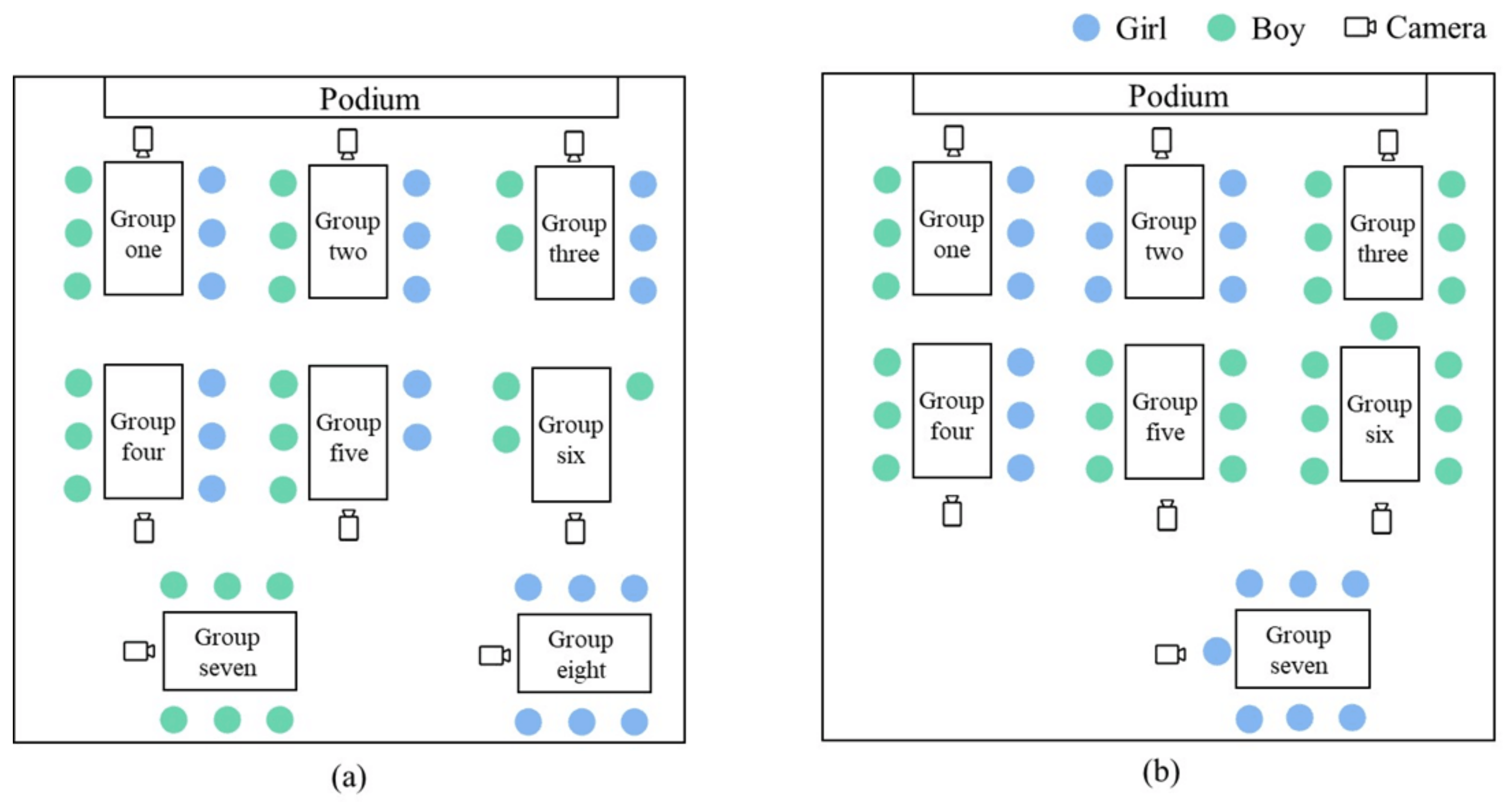
| Boy-Only Groups (5) | Girl-Only Groups (3) | Mixed-Gender Groups (7) | Total (15) | |
|---|---|---|---|---|
| Boys | 27 | 0 | 20 | 47 |
| Girls | 0 | 19 | 20 | 39 |
| Total | 27 | 19 | 40 | 86 |
| Dimensions | Codes | Description |
|---|---|---|
| Cognitive | Higher-order thinking behaviors | |
| Analysis | Identify the problem, justify decisions, make logical reasoning, etc. | |
| Application | Apply subject knowledge or technical skills to solve problems | |
| Evaluation | Comments and gestures of approval/disapproval/feedback | |
| Emotional | Positive emotions | Expression of joy, pride, interest, confidence, and excitement |
| Negative emotions | Expression of shame, boredom, frustration, and anger | |
| Behavior | Interaction behaviors | |
| Verbal interaction | Communication through oral conversation | |
| Nonverbal interaction | Communication through writing, gestures or eye contact. | |
| Listening | Listen attentively to peers during group work | |
| Leading behavior | Plan, organize, opinion seeking, task facilitation, management | |
| Hand raising | Actively raise hand to answer the teacher’s question or request | |
| Irrelevant behaviors | ||
| Irrelevant discourse | Chitchat unrelated to group work, off-topic discussion | |
| Irrelevant action | Actions unrelated to group work, distracted behaviors | |
| Destructive behavior | Sabotage group work, quarrel, fight, disrespectful behaviors, etc. |
Publisher’s Note: MDPI stays neutral with regard to jurisdictional claims in published maps and institutional affiliations. |
© 2022 by the authors. Licensee MDPI, Basel, Switzerland. This article is an open access article distributed under the terms and conditions of the Creative Commons Attribution (CC BY) license (https://creativecommons.org/licenses/by/4.0/).
Share and Cite
Ma, L.; Luo, H.; Liao, X.; Li, J. Impact of Gender on STEAM Education in Elementary School: From Individuals to Group Compositions. Behav. Sci. 2022, 12, 308. https://doi.org/10.3390/bs12090308
Ma L, Luo H, Liao X, Li J. Impact of Gender on STEAM Education in Elementary School: From Individuals to Group Compositions. Behavioral Sciences. 2022; 12(9):308. https://doi.org/10.3390/bs12090308
Chicago/Turabian StyleMa, Lin, Heng Luo, Xiaofang Liao, and Jie Li. 2022. "Impact of Gender on STEAM Education in Elementary School: From Individuals to Group Compositions" Behavioral Sciences 12, no. 9: 308. https://doi.org/10.3390/bs12090308
APA StyleMa, L., Luo, H., Liao, X., & Li, J. (2022). Impact of Gender on STEAM Education in Elementary School: From Individuals to Group Compositions. Behavioral Sciences, 12(9), 308. https://doi.org/10.3390/bs12090308

