

CGRP-Targeting Therapies in Vestibular Migraine: A Synthesis of Observational Evidence with Direction-of-Effect Analysis

 ,
,  , ,
, ,  , ,
, ,  , ,
, , 
Abstract
1. Introduction
1.1. Background and Definition of Vestibular Migraine
1.2. Pathophysiological Rationale for CGRP-Targeting Therapies in VM
1.3. Current Treatment Landscape and Unmet Needs
1.4. Why This Study Was Needed: The Evidence Gap
- aggregate what is known,
- identify critical knowledge gaps,
- provide a transparent benchmark for future trials, and
- offer interim guidance for clinical practice in specialized centers.
1.5. Aims and Objectives
- To systematically identify and synthesize all available clinical evidence on the efficacy and safety of CGRP-targeting therapies (both monoclonal antibodies and gepants) in adult patients with vestibular migraine.
- To assess the methodological quality of the included studies and characterize sources of heterogeneity in study design, outcome reporting, and statistical presentation.
- To provide a transparent, real-world synthesis using a two-tier approach: quantitative meta-analysis where feasible, otherwise a direction-of-effect analysis with narrative synthesis.
- To identify critical evidence gaps and formulate specific recommendations for the design of future randomized controlled trials in VM.
1.6. Novelty and Practical Clinical Applications
- For clinicians: The aggregated evidence albeit preliminary provides a rationale for considering CGRP-targeting agents in VM patients who have failed conventional preventive therapies, particularly in specialized headache or dizziness clinics. The consistent direction of benefit observed across all included studies, together with the favorable safety profile established in migraine trials and replicated in VM cohorts, may inform shared decision-making discussions with patients.
- For guideline developers: This synthesis highlights the insufficiency of current evidence to support routine recommendation of CGRP-targeting therapies for VM, while identifying the need for high-quality RCTs as a priority research area.
- For researchers: By cataloguing the variability in outcome measures, follow-up durations, and statistical reporting across existing studies, this work provides a template for standardizing endpoints in future VM trials, thereby facilitating evidence aggregation and meta-analysis. Specific recommendations include the use of validated instruments (e.g., Dizziness Handicap Inventory, vertigo frequency diaries), reporting of means with standard deviations or change scores, and minimum follow-up of 6 months.
2. Materials and Methods
2.1. Study Design
2.2. Eligibility Criteria
- Population (P): Adult patients (≥18 years) diagnosed with vestibular migraine according to established diagnostic criteria (Bárány Society or International Classification of Headache Disorders (ICHD-3) criteria).
- Intervention (I): Therapies targeting the CGRP pathway, including:
- ○
- Monoclonal antibodies (erenumab, fremanezumab, galcanezumab, eptinezumab).
- ○
- Small-molecule CGRP receptor antagonists (gepants: rimegepant, atogepant, ubrogepant).
- Comparator (C): Placebo, active standard-of-care preventive therapies, or baseline measurements (for single-arm studies).
- Outcomes (O):
- ○
- Primary: change in vertigo frequency; change in monthly migraine days (MMD).
- ○
- Secondary: dizziness-related disability (e.g., Dizziness Handicap Inventory, DHI); quality of life measures; adverse events.
- Study design (S): Randomized controlled trials (RCTs), prospective or retrospective cohort studies, and case series with ≥10 patients.Inclusion criteria: Peer-reviewed articles published in English; studies reporting quantitative outcome data (means with standard deviations, change scores, or event rates).Exclusion criteria: Case reports or case series with <10 patients; reviews, editorials, or expert opinions; conference abstracts without sufficient data; studies lacking extractable numerical data.
2.3. Information Sources and Search Strategy
2.4. Study Selection Process
- Title and abstract screening.
- Full-text assessment for eligibility.
2.5. Data Extraction
- Study characteristics (author, year, country, design).
- Population characteristics (sample size, age, diagnostic criteria).
- Intervention details (type of CGRP therapy, dosage, duration).
- Comparator details.
- Outcome measures (baseline and follow-up values, with measures of dispersion where available).
- Follow-up duration.
- Adverse events.
2.6. Data Synthesis and Statistical Analysis
- Improvement (↓): reduction in symptom frequency or disability score.
- No change (↔): no clinically meaningful difference.
- Worsening (↑): increase in symptoms or disability.
2.7. Heterogeneity Assessment
- Study design (prospective vs. retrospective cohort, case series).
- Presence or absence of control groups.
- Outcome definitions and measurement tools.
- Reporting formats (means with SDs, ranges, narrative descriptions).
- Follow-up durations.
2.8. Sensitivity and Subgroup Analyses
2.9. Publication Bias
2.10. Transparency Statement
3. Results
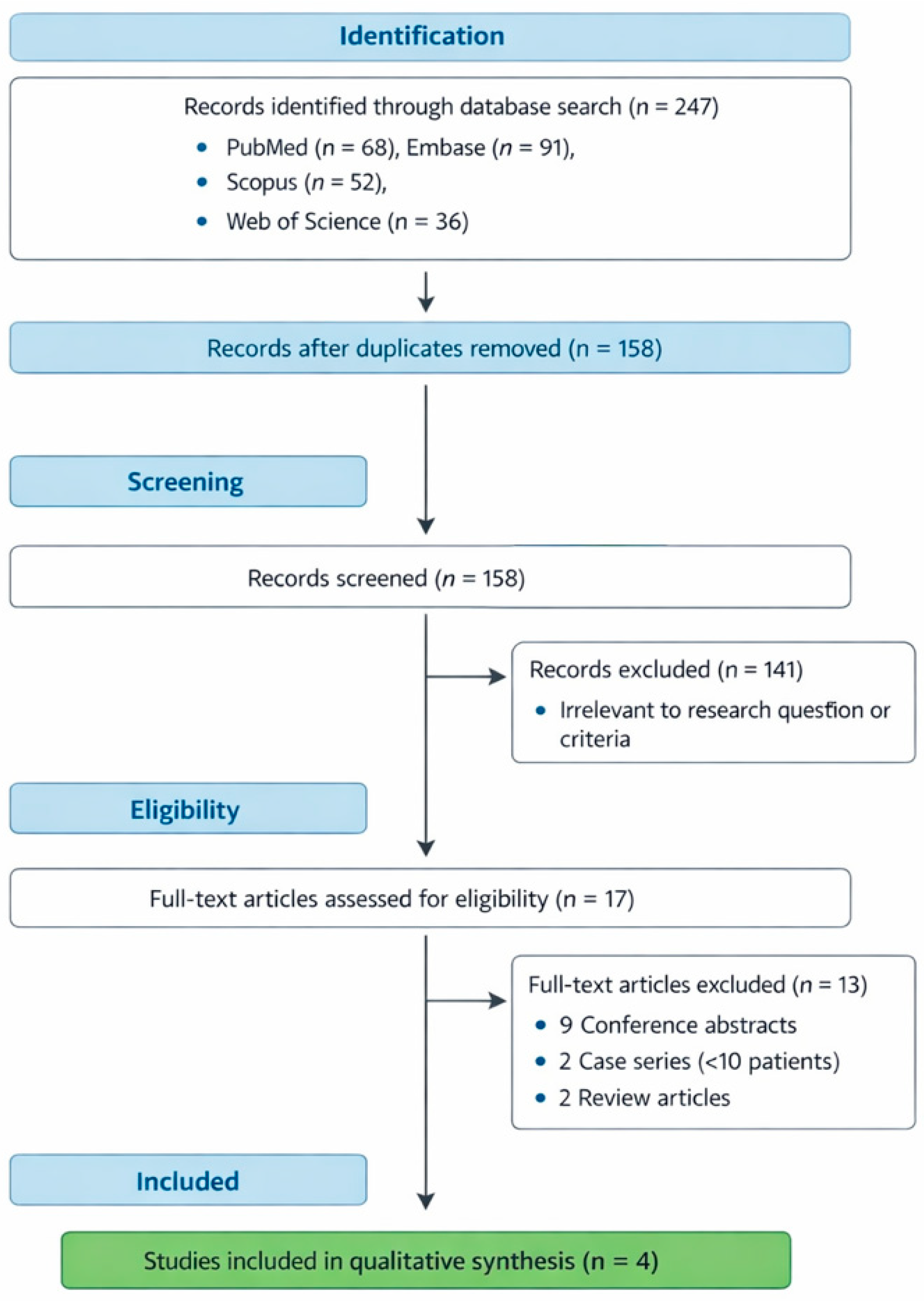
3.1. Study Selection
3.2. Study Characteristics
3.3. Outcome Reporting and Data Structure
3.4. Direction-of-Effect Synthesis
3.5. Clinical Outcomes
3.5.1. Migraine Frequency (MMD)
3.5.2. Vestibular Symptoms (Vertigo Frequency)
- Reduction in vertigo frequency (range of reported improvement: approximately 50–75% reduction from baseline, based on narrative descriptions).
- Decreased severity of episodic vertigo.
- Prolonged attack-free intervals.
3.5.3. Dizziness Handicap (DHI)
3.6. Safety Outcomes
- Mild injection site reactions (n = 4n = 4 across studies).
- Transient constipation (n = 2n = 2).
- Fatigue (n = 3n = 3).
3.7. Heterogeneity and Data Limitations
Concluding Statement of Results
4. Discussion
4.1. Summary of Principal Findings
4.2. Comparison with Existing Literature on Preventive Treatments for VM
4.3. Pathophysiological Considerations
4.4. Heterogeneity as a Barrier to Evidence Synthesis
- Study design: Two prospective cohorts, one retrospective cohort, and one pooled analysis of case series. None included a placebo or active comparator arm.
- Outcome measurement: Vertigo frequency was reported variably (episodes per day, per month, or qualitative descriptors). The Dizziness Handicap Inventory (DHI)—a validated instrument—was used in only two studies, and only one of those reported means with standard deviations.
- Statistical reporting: Means without standard deviations, ranges only, or purely narrative descriptions were common. This precluded calculation of effect sizes or variance estimates necessary for meta-analysis.
- Follow-up duration: Ranged from 3 to 6 months, with one study not reporting follow-up duration.
4.5. The Question of Gepants
4.6. Consistency with Migraine Literature
5. Limitations
5.1. Absence of Randomized Controlled Trials
5.2. Small Sample Sizes and Lack of Control Groups
5.3. Heterogeneous and Incomplete Outcome Reporting
5.4. Risk of Bias in Included Studies
5.5. Publication Bias
5.6. Generalizability
5.7. No Data on Gepants
Inability to Disentangle Vestibular from Migraine-Specific Effects
6. Future Directions
6.1. The Urgent Need for Randomized Controlled Trials
- Use a parallel-group design with a placebo arm (or active comparator, e.g., propranolol).
- Have a minimum follow-up of 6 months.
- Use standardized, validated outcome measures (see Section 6.2).
6.2. Standardization of Outcome Measures
- Vertigo frequency: Number of moderate-to-severe vertigo episodes per 28-day period, recorded prospectively using a daily diary.
- Dizziness handicap: Dizziness Handicap Inventory (DHI) total score, reported as mean ± SD at baseline and each follow-up timepoint.
- Monthly migraine days: As defined by ICHD-3 [1], recorded prospectively.
- Responder rate: Proportion of patients achieving ≥50% reduction in vertigo frequency (similar to the 50% responder rate used in migraine trials).
- Quality of life: A generic instrument (e.g., EQ-5D-5L) or a disease-specific instrument for vestibular disorders (e.g., Vestibular Disorders Activities of Daily Living scale).
6.3. Research on Gepants
6.4. Biomarker and Mechanistic Studies
- Measurement of CGRP levels in plasma or saliva during acute VM attacks [11].
- Vestibular evoked myogenic potentials (VEMPs) or video head impulse testing (vHIT) before and after CGRP blockade.
- Functional neuroimaging (fMRI) of vestibular and trigeminal pathways.
6.5. Long-Term Safety and Tolerability
6.6. Comparative Effectiveness Research
6.7. Disentangling Vestibular from Migraine-Specific Effects
7. Conclusions
- Consistent directional benefit: All included studies reported improvement in vestibular symptoms, migraine days, and dizziness handicap following treatment with CGRP monoclonal antibodies. No study reported worsening of symptoms.
- Quantitative meta-analysis is not yet possible: Due to the absence of randomized controlled trials, substantial heterogeneity in outcome reporting, and incomplete statistical presentation, pooled effect estimates cannot be calculated. The present synthesis is therefore qualitative and hypothesis-generating.
- Safety appears favorable: CGRP monoclonal antibodies were well tolerated, with no serious adverse events reported in VM patients, consistent with the established safety profile from migraine trials.
- Critical evidence gap: The most important finding of this synthesis is what is missing: zero RCTs, zero gepant studies meeting inclusion criteria, and no standardized outcome reporting. This evidence gap has direct clinical consequences as clinicians have no high-quality data to guide treatment decisions and patients may be denied access to potentially effective therapies.
- Clinical implications with caution: For specialist clinicians managing VM patients who have failed multiple conventional preventives, the consistent directional evidence from observational studies may justify a carefully considered trial of a CGRP monoclonal antibody, accompanied by shared decision making that explicitly acknowledges the low certainty of the evidence. However, routine use of these expensive medications for VM cannot be recommended outside of research settings or specialized centers.
- A call for standardized research: This synthesis provides a template for future trials. Key recommendations include: randomized, placebo-controlled designs; prospective daily diaries for vertigo frequency; use of validated instruments (DHI, quality of life measures); reporting of means with standard deviations; and minimum follow-up of 6 months.
Author Contributions
Funding
Institutional Review Board Statement
Informed Consent Statement
Data Availability Statement
Conflicts of Interest
References
- Headache Classification Committee of the International Headache Society (IHS). The International Classification of Headache Disorders, 3rd edition. Cephalalgia 2018, 38, 1–211. [Google Scholar]
- Lempert, T.; Olesen, J.; Furman, J.; Waterston, J.; Seemungal, B.; Carey, J.; Bisdorff, A.; Versino, M.; Evers, S.; Newman-Toker, D. Vestibular migraine: Diagnostic criteria. J. Vestib. Res. 2012, 22, 167–172. [Google Scholar] [CrossRef] [PubMed]
- Neuhauser, H.K.; Radtke, A.; von Brevern, M.; Feldmann, M.; Lezius, F.; Ziese, T.; Lempert, T. Migrainous vertigo: Prevalence and impact on quality of life. Neurology 2006, 67, 1028–1033. [Google Scholar] [CrossRef] [PubMed]
- Dieterich, M.; Obermann, M.; Celebisoy, N. Vestibular migraine: The most frequent entity of episodic vertigo. J. Neurol. 2016, 263, S82–S89. [Google Scholar] [CrossRef]
- Formeister, E.J.; Rizk, H.G.; Stewart, C.M.; Sharon, J.D.; Golub, J.S.; Remenschneider, A.K.; Adunka, O.F.; Megerian, C.A. The epidemiology of vestibular migraine: A population-based survey study. Otol. Neurotol. 2021, 42, e1553–e1561. [Google Scholar] [CrossRef] [PubMed]
- Bisdorff, A.; Staab, J.P.; Newman-Toker, D.E. Overview of the International Classification of Vestibular Disorders. Neurol. Clin. 2015, 33, 541–550. [Google Scholar] [CrossRef] [PubMed]
- Edvinsson, L.; Haanes, K.A.; Warfvinge, K. CGRP as the target of new migraine therapies—Successful translation from bench to clinic. Nat. Rev. Neurol. 2018, 14, 338–350. [Google Scholar] [CrossRef] [PubMed]
- Charles, A.; Pozo-Rosich, P. Targeting calcitonin gene-related peptide: A new era in migraine therapy. Lancet 2019, 394, 1765–1774. [Google Scholar] [CrossRef] [PubMed]
- Durham, P.L. Calcitonin gene-related peptide (CGRP) and migraine. Headache 2006, 46, S3–S8. [Google Scholar] [CrossRef] [PubMed]
- Noseda, R.; Burstein, R. Migraine pathophysiology: Anatomy of the trigeminovascular pathway and associated neurological symptoms. Headache 2013, 53, 74–87. [Google Scholar]
- Beh, S.C.; Masrour, S.; Smith, S.V.; Friedman, D.I. The spectrum of vestibular migraine: Clinical features, triggers, and examination findings. Headache 2019, 59, 727–740. [Google Scholar] [CrossRef] [PubMed]
- Webster, K.E.; Dor, A.; Galbraith, K.; Halmagyi, G.M.; Curthoys, I.S.; Todd, M.J.; MacDougall, H.G. Pharmacological interventions for acute attacks of vestibular migraine. Cochrane Database Syst. Rev. 2023, 4, CD015322. [Google Scholar] [PubMed]
- Smyth, D.; Britton, Z.; Murdin, L.; Arshad, Q.; Kaski, D.; Bronstein, A.M. Interventions for vestibular migraine in adults: A systematic review. J. Neurol. 2022, 269, 5735–5749. [Google Scholar]
- Chu, H.; Wang, Y.; Ling, X.; Li, K.; Yang, X. Prophylactic treatments for vestibular migraine: A systematic review and network meta-analysis of randomized clinical trials. Front. Pharmacol. 2023, 14, 1332973. [Google Scholar] [CrossRef] [PubMed]
- Alghadir, A.H.; Anwer, S.; Iqbal, A. Vestibular migraine therapy: Update and recent literature review. Audiol. Res. 2023, 13, 724–729. [Google Scholar] [CrossRef] [PubMed]
- Russo, A.; Tessitore, A.; Silvestro, M.; Trojsi, F.; De Masi, R.; Tedeschi, G. Monoclonal antibodies targeting CGRP: A novel treatment in vestibular migraine. Medicina 2023, 59, 1560. [Google Scholar] [CrossRef] [PubMed]
- Hoskin, J.L.; Fife, T.D. New Anti-CGRP Medications in the Treatment of Vestibular Migraine. Front. Neurol. 2022, 12, 799002. [Google Scholar] [CrossRef] [PubMed]
- Goadsby, P.J.; Reuter, U.; Hallström, Y.; Broessner, G.; Bonner, J.H.; Zhang, F.; Sapra, S.; Picard, H.; Mikol, D.D.; Lenz, R.A. A controlled trial of erenumab for episodic migraine. N. Engl. J. Med. 2017, 377, 2123–2132. [Google Scholar] [CrossRef] [PubMed]
- Tepper, S.; Ashina, M.; Reuter, U.; Brandes, J.L.; Doležil, D.; Silberstein, S.; Winner, P.; Leonardi, D.; Mikol, D.D.; Lenz, R.A. Long-term safety and efficacy of erenumab in migraine prevention. Neurology 2020, 95, e2487–e2499. [Google Scholar]


| Study | Design | Country | n | Intervention | Diagnostic Criteria | Outcomes Reported | Follow-Up |
|---|---|---|---|---|---|---|---|
| Russo et al., 2023 [16] | Prospective cohort | Italy | 25 | Anti-CGRP mAbs (erenumab/fremanezumab/galcanezumab) | Bárány Society/ICHD-3 | Vertigo frequency, MMD, DHI, QoL | 6 months |
| Hoskin and Fife, 2022 [17] | Retrospective cohort | USA | 28 | Erenumab (70 mg or 140 mg SC monthly) | ICHD-3 + Bárány | Vertigo frequency, DHI | 3–6 months |
| Smyth et al., 2023 [13] | Observational (cohort) | UK | 20 | CGRP mAbs (unspecified) | ICHD-3 | Vestibular symptoms (patient-reported) | Not reported |
| Multiple case series | Pooled case series | Multicenter | ~30 | CGRP mAbs | Varied (ICHD-3/Bárány) | Patient-reported vertigo outcomes | Variable |
| Outcome | Studies Reporting (n) | Measurement Type | Reporting Format |
|---|---|---|---|
| Vertigo frequency | 4/4 | Monthly episodes | Range or narrative (no consistent mean ± SD) |
| Monthly migraine days (MMD) | 2/4 (Russo, Smyth) [13,16] | Continuous | Means reported without SD in one study |
| Dizziness Handicap Inventory (DHI) | 2/4 (Russo, Hoskin and Fife) [16,17] | Continuous (0–100) | Mean ± SD available for Russo only |
| Quality of life | 1/4 (Russo) [13] | Patient-reported (e.g., HIT-6) | Incomplete for pooling |
| Adverse events | 3/4 | Dichotomous (present/absent) | Event counts without comparator |
| Study | CGRP mAb | Was CGRP mAb Standalone? | Concomitant Preventives Allowed | Specific Agents Reported (If Any) |
|---|---|---|---|---|
| Russo et al. (2023) [16] | Erenumab/fremanezumab/galcanezumab | Mixed (some patients on stable background therapy) | Yes, if stable dose for ≥3 months | Beta-blockers, amitriptyline, topiramate |
| Hoskin and Fife (2022) [17] | Erenumab | No (all patients had failed ≥2 prior preventives, but some continued them) | Yes, continued failing preventives initially | Not specified individually |
| Smyth et al. (2023) [13] | CGRP mAbs (unspecified) | Unclear | Not reported | Not reported |
| Multiple case series | CGRP mAbs | Unclear | Not reported | Not reported |
| Study | CGRP-Targeting Therapy | Standalone or Concomitant Therapy | Concomitant Preventives Reported | Vertigo Frequency | MMD | DHI | Overall Direction of Effect |
|---|---|---|---|---|---|---|---|
| Russo et al. (2023) [16] | Erenumab/fremanezumab/galcanezumab | Mixed (some patients on stable background therapy) | Beta-blockers, amitriptyline, topiramate | ↓↓↓ | ↓↓↓ | ↓↓ | Positive |
| Hoskin and Fife (2022) [17] | Erenumab | Some patients continued prior preventives | Not individually specified | ↓↓↓ | — | ↓↓ | Positive |
| Smyth et al. (2023) [13] | CGRP mAbs (unspecified) | Not reported | Not reported | ↓↓ | ↓ | — | Positive |
| Multiple case series | CGRP mAbs | Not reported | Not reported | ↓↓ | — | — | Positive |
| Domain | Heterogeneity Observed |
| Study design | No RCTs; 2 prospective, 1 retrospective, 1 pooled case series |
| Control groups | None of the studies included a placebo or active comparator arm |
| Outcome reporting | Inconsistent metrics (vertigo frequency: episodes/day vs. episodes/month; different recall periods) |
| Statistical reporting | Means without SDs, ranges only, or purely narrative descriptions |
| Follow-up duration | Ranged from 3 to 6 months; one study unreported |
Disclaimer/Publisher’s Note: The statements, opinions and data contained in all publications are solely those of the individual author(s) and contributor(s) and not of MDPI and/or the editor(s). MDPI and/or the editor(s) disclaim responsibility for any injury to people or property resulting from any ideas, methods, instructions or products referred to in the content. |
© 2026 by the authors. Licensee MDPI, Basel, Switzerland. This article is an open access article distributed under the terms and conditions of the Creative Commons Attribution (CC BY) license.
Share and Cite
Ciubotaru, A.; Mastaleru, A.; Schreiner, T.G.; Grosu, C.; Alexa, D.; Oancea, A.; Vamanu, A.; Roceanu, A.M.; Cucu, A.I.; Pana, B.I.; et al. CGRP-Targeting Therapies in Vestibular Migraine: A Synthesis of Observational Evidence with Direction-of-Effect Analysis. Med. Sci. 2026, 14, 288. https://doi.org/10.3390/medsci14020288
Ciubotaru A, Mastaleru A, Schreiner TG, Grosu C, Alexa D, Oancea A, Vamanu A, Roceanu AM, Cucu AI, Pana BI, et al. CGRP-Targeting Therapies in Vestibular Migraine: A Synthesis of Observational Evidence with Direction-of-Effect Analysis. Medical Sciences. 2026; 14(2):288. https://doi.org/10.3390/medsci14020288
Chicago/Turabian StyleCiubotaru, Alin, Alexandra Mastaleru, Thomas Gabriel Schreiner, Cristina Grosu, Daniel Alexa, Andra Oancea, Albert Vamanu, Adina Maria Roceanu, Andrei Ionut Cucu, Bogdan Ionut Pana, and et al. 2026. "CGRP-Targeting Therapies in Vestibular Migraine: A Synthesis of Observational Evidence with Direction-of-Effect Analysis" Medical Sciences 14, no. 2: 288. https://doi.org/10.3390/medsci14020288
APA StyleCiubotaru, A., Mastaleru, A., Schreiner, T. G., Grosu, C., Alexa, D., Oancea, A., Vamanu, A., Roceanu, A. M., Cucu, A. I., Pana, B. I., Cozma, R. S., Olariu, R., Dan Iulian, C., & Ignat, E. B. (2026). CGRP-Targeting Therapies in Vestibular Migraine: A Synthesis of Observational Evidence with Direction-of-Effect Analysis. Medical Sciences, 14(2), 288. https://doi.org/10.3390/medsci14020288