Next Article in Journal
Human-in-the-Loop Enhances Machine Learning Inference in Intraoperative Optical Coherence Tomography Glioma Imaging
Previous Article in Journal
Antimicrobial Efficacy of Endogenous Blue Light Photoinactivation (400–470 nm) Against Escherichia coli: A Systematic Review of In Vitro Evidence and Clinical Implications
 
 
medsci-logo
Article Menu

Article Menu

Article

L-Type Voltage-Gated Ca2+ Channels Are Targeted by Terpenes from Hyptis crenata Essential Oil in Vascular Electromechanical Coupling


by
André Nogueira Cardeal dos Santos
1,2,*,
José Ednésio da Cruz Freire
3,
Francisco Sydney Henrique Félix
1,
Marília Cavalcante Araújo
1,
Savyo Mikael Lacerda Gomes
1,
Alexandre Lucas Lima França Cabral
1,
Amanda Batista Nascimento
1,
Cleisla Costa Barbosa
1,
Marcus Vinícius Vieira Torquato
1,
Lívia de Souza Oliveira
1,
Luiz Henrique Batista Assunção
1,
Sofia Moura de Sousa Brasil
1,
Cecília Bessa Freitas
1,
Julianne Ferreira da Silva
1,
João Henrique Andrade de Menezes
1,
Átila Pereira-Gonçalves
1,4,
José Henrique Leal-Cardoso
5,
Adélia Justina Aguiar Aquino
6 and
Andrelina Noronha Coelho de Sousa
1,*
1
Experimental Physiology Laboratory, Superior Institute of Biomedical Sciences, State University of Ceará, Fortaleza 60714-903, CE, Brazil
2
Department of Biomedicine and Pharmacy, Fametro University Center, Fortaleza 60010-470, CE, Brazil
3
Biochemistry and Gene Expression Laboratory, Superior Institute of Biomedical Sciences, State University of Ceará, Fortaleza 60714-903, CE, Brazil
4
Faculty of Education and Integrated Sciences of Crateús, FAEC, State University of Ceará, Fortaleza 63704-155, CE, Brazil
5
Electrophysiology Laboratory, Superior Institute of Biomedical Sciences, State University of Ceará, Fortaleza 60714-903, CE, Brazil
6
Department of Mechanical Engineering and Aerospace, Texas Tech University, Lubbock, TX 79409, USA
*
Authors to whom correspondence should be addressed.
Med. Sci. 2026, 14(2), 262; https://doi.org/10.3390/medsci14020262
Submission received: 20 March 2026 / Revised: 6 May 2026 / Accepted: 18 May 2026 / Published: 20 May 2026
(This article belongs to the Section Cardiovascular Disease)

Abstract

Background: Electromechanical coupling is a fundamental process in the regulation of vascular smooth muscle contraction. It is characterized by changes in electrical potential membrane (depolarization). Voltage-gated calcium channels (VGCCs) play a central role in this process by mediating calcium influx necessary for vascular contraction. As highly conserved macromolecules in mammals, VGCCs represent translationally relevant targets for the development of vasorelaxant agents. Inhibition of these channels reduces calcium influx and attenuates the tonic smooth muscle contraction, making them strategic targets for novel therapeutic approaches. This is particularly important given the high prevalence of cardiovascular diseases, which remain the leading cause of global mortality. Methods: The aim of this study is to investigate the mechanism of action of terpenes in VGCCs. Terpenes are phytochemicals that have been widely studied as drug candidates. To this end, the oil from Hyptis crenata was extracted and characterized, revealing monoterpenes and sesquiterpenes as its main constituents. Results: In vitro assays on isolated aortic rings, with and without endothelium, demonstrated that these compounds reverse and block KCl (80 mM)-induced contractions in an endothelium-independent manner. Conclusions: Analyses of the ionic influx of calcium and barium indicated a progressive blockade of contraction, reinforcing the hypothesis of a direct interaction with the macromolecules of the VGCCs. Computational analyses, for the first time, suggest a potential synergistic interaction among terpenes in their binding to these macromolecules.

1. Introduction

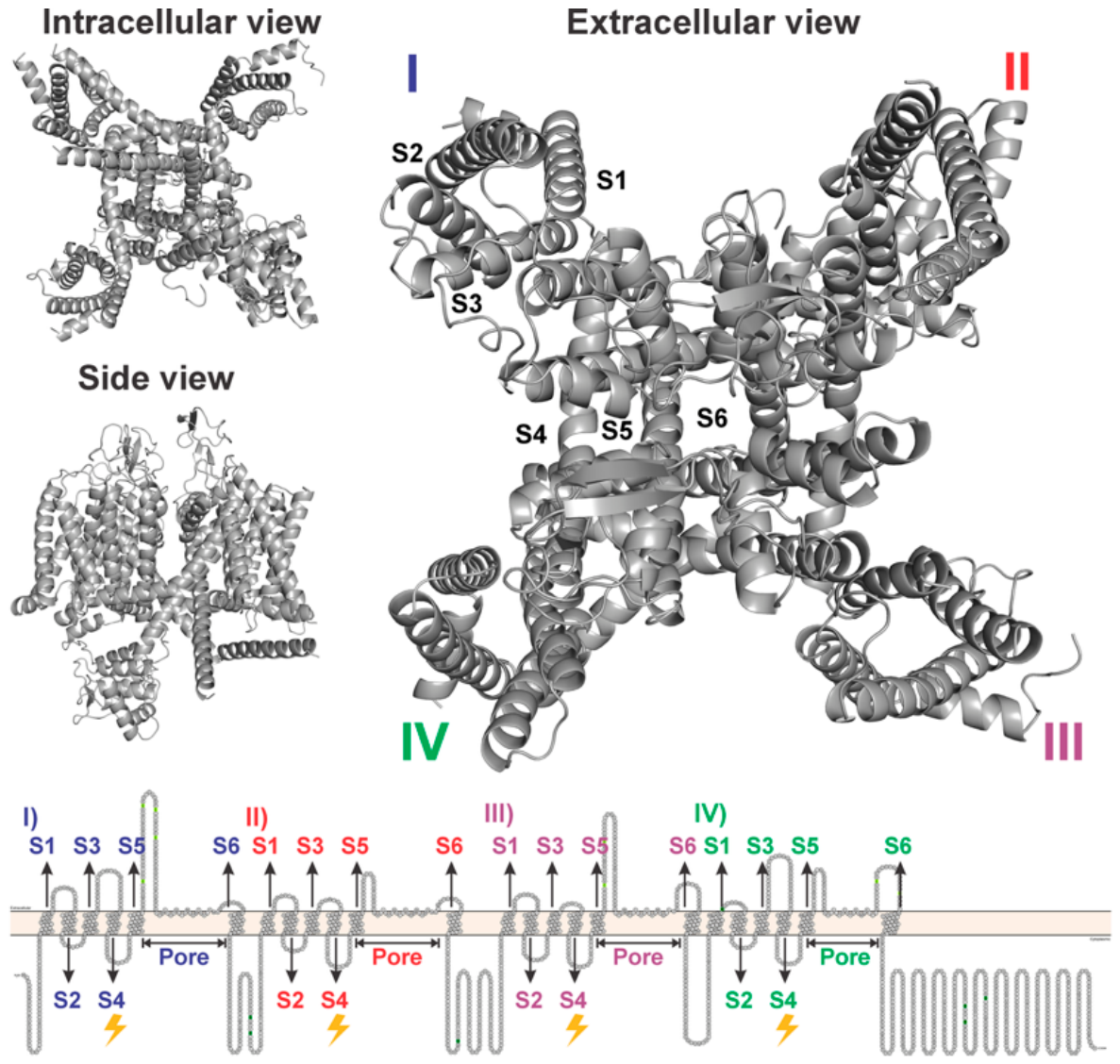
Vascular smooth muscle cells (VSMCs) regulate arterial tone through a tightly orchestrated system of signaling pathways that transduce extracellular cues into contractile responses [1]. Among these, the electromechanical coupling mechanism, initiated by membrane depolarization and mediated by voltage-gated calcium channels (VGCCs), plays a central role in the dynamic control of vessel diameter and tissue perfusion (see Figure 1) [2,3,4].
The influx of Ca2+ through L-type VGCCs is a primary trigger for actomyosin interaction [5], linking membrane excitability to mechanical force generation [6,7]. Due to their pivotal role in contractile activation, VGCCs have been extensively studied at the structural, functional, and pharmacological levels [8,9]. In addition to the pore-forming α1 subunit, voltage-gated calcium channels are composed of auxiliary subunits, including α2δ, β, and, in some isoforms, γ subunits. These auxiliary components play essential roles in channel trafficking to the plasma membrane, the stabilization of channel expression, and modulation of biophysical properties such as voltage dependence, kinetics, and current amplitude. In particular, the β subunit regulates channel gating and surface expression, while the α2δ subunit is critically involved in membrane targeting and pharmacological sensitivity, highlighting their importance in the functional regulation of VGCCs [8,9]. The α1-subunit, highly conserved across vertebrates, harbors critical domains for voltage sensing, pore formation, and ligand recognition [10]. These conserved features support their translational relevance and explain why VGCCs remain prominent molecular targets in the modulation of vascular reactivity. Small molecules capable of modulating VGCC activity can produce immediate and reversible changes in vascular tone, underscoring their therapeutic potential.
Natural products have emerged as valuable sources of ion channel modulators due to their structural diversity, bioactivity, and long-standing use in traditional medicine [11,12,13]. Essential oils (EOs), in particular, are complex mixtures of volatile secondary metabolites produced by aromatic plants. Many EOs exhibit pronounced effects on excitable and contractile tissues, and their biological activity is largely attributed to terpenoids, especially mono- and sesquiterpenes, which are the most abundant and pharmacologically active constituents [9,10,14,15]. Their small size, lipophilicity, and conformational flexibility favor interaction with membrane proteins, including calcium channels involved in electromechanical coupling. The essential oil of Hyptis crenata (EOHc), a South American aromatic species widely used in Brazilian folk medicine for inflammatory and gastrointestinal conditions [16,17], is particularly rich in terpenes such as camphor, β-caryophyllene, 1,8-cineole, β-caryophyllene oxide, and aromadendrene [18,19,20]. Other research demonstrates that the oil provides anti-edematogenic, anxiolytic, and hepatoprotective effects [21,22,23]. Previous studies have shown that EOHc induces smooth muscle relaxation, suggesting an effect on calcium-dependent contractile mechanisms. However, the precise molecular targets and signaling pathways involved in vascular smooth muscle remain poorly defined, and the interaction between its constituent terpenes and VGCCs has not been directly addressed. Importantly, the terpenes identified in EOHc are not unique to H. crenata, but are widely distributed among essential oils from various medicinal plants [24,25,26,27]. This ubiquity reinforces their broader pharmacological relevance and suggests that findings obtained from H. crenata may have generalizable implications for ion channel modulation.
In this study, we investigated the effect of EOHc on the electromechanical coupling pathway in rat aortic rings, both in the presence and absence of functional endothelium. Contractile responses were elicited by high-potassium depolarization (KCl, 80 mM), and cumulative concentrations of EOHc were applied to evaluate concentration-dependent relaxation. To further explore ion influx pathways, additional assays involving calcium and barium-induced contractions were performed. To help investigate these mechanisms, molecular simulation techniques, particularly molecular docking, have become indispensable tools. Docking calculations allow for the prediction of ligand–receptor interactions at the atomic level, enabling researchers to estimate binding affinities and identify key residues involved in molecular recognition [28,29]. To complement the functional data and explore potential molecular interactions, we also performed docking simulations targeting the α1-subunit of L-type VGCCs, aiming to identify putative binding sites for the major terpenes in EOHc.

2. Materials and Methods

2.1. Extraction and EOHc Characterization

This study was carried out using essential oil extracted from the dried leaves of Hyptis crenata, collected in the municipality of São Raimundo das Mangabeiras, in the state of Maranhão, Brazil. The essential oil extraction was carried out at the Superior Institute of Biomedical Sciences of the State University of Ceará (ISCB/UECE) through steam distillation. At the Technological Development Park (PADETEC) of the Federal University of Ceará (UFC), Fortaleza, Ceará, Brazil; the chemical composition of EOHc was analyzed, then an Agilent 7890B gas chromatograph coupled to a 5977A mass selective detector (quadrupole) equipped with a flame ionization detector was used to perform gas chromatography-mass spectrometry (GC-MS). The system was manufactured by Agilent Technologies, Santa Clara, CA, USA. Separation was conducted with an HP-5 MS methylpolysiloxane column (30 m × 0.25 mm × 0.25 μm; Agilent Technologies, Santa Clara, CA, USA). The injector, detector, and transfer line temperatures were set to 250 °C, 150 °C, and 280 °C, respectively. The oven temperature was initially set at 70 °C, increased at 4 °C/min to 180 °C, and subsequently ramped at 10 °C/min to 250 °C, resulting in a total run time of 34.5 min. Using MassHunter B.06.00 software (Agilent Technologies), mass spectra were recorded in the 40–600 m/z range. Compound identification was accomplished through a comparison of the acquired spectra with reference spectra from the National Institute of Standards and Technology (NIST) library.

2.2. Solutions

The Krebs–Henseleit solution (KHS) used had the following composition (in mM): 118.0 NaCl, 25 NaHCO3, 4.7 KCl, 1.2 KH2PO4, 1.2 MgSO4, 2.5 CaCl2, 0.026 EDTA, and 11 glucose, maintained at 37 °C with the pH adjusted to 7.4 using 1 M HCl and/or 1 M NaOH. The EOHc was prepared by diluting stock solutions directly in distilled water with 0.1% Tween. The calcium-free (ØCa2+) solution was prepared by omitting CaCl2 from the Krebs–Henseleit solution and adding 0.2 mM ethylene glycol-bis(β-aminoethyl ether)-N,N,N′,N′-tetraacetic acid (EGTA). All salts and reagents, including nifedipine (NIFE), were of analytical grade and obtained from Sigma-Aldrich (St. Louis, MI, USA).

2.3. Animals

Male Wistar rats (Rattus norvegicus) with weights between 200 and 300 g were obtained from the Christus University Center (UNICHRISTUS) and housed at the ISCB/UECE. The animals were maintained under controlled humidity and a temperature of 23 ± 2 °C, with a 12-h light/dark cycle and ad libitum access to water and food. All procedures followed the guidelines of the Brazilian College of Animal Experimentation (COBEA). The animal study protocol was approved by the Institutional Ethics Committee of the State University of Ceará (protocol code 31032.001146/2023-23, approved on 17 August 2023).

2.4. Preparation of Tissue

The animals were euthanized, followed by dissection of the thoracic aorta, which was sectioned into segments measuring 4–5 mm in length. The segments were maintained in a 5 mL chamber containing KHS and aerated with a carbogenic mixture (95% O2 and 5% CO2), at a temperature of 37 °C and pH 7.4. The contractile activity of the tissue was measured using a force transducer (Grass Technologies, Model FT03, West Warwick, RI, USA), with one end of the preparation connected to the transducer and the other to a fixed base via a stainless-steel rod. The transducer was coupled to a preamplifier (Model PM-100, DATAQ Instruments, Akron, OH, USA), which was connected to a data acquisition system (PowerLab 4/35, ADInstruments, Sydney, Australia), in turn linked to a computer. Data were visualized using LabChart 8.0 Pro software (ADInstruments). Data collected were stored in files using LabChart software (ADInstruments, Inc., Colorado Springs, CO, USA). Isolated aortic rings were subjected to a resting tension of 1 g and allowed to stabilize for 1 h. All protocols were initiated with a contraction induced by the addition of 80 mM KCl (K80) to the aortic rings. Upon reaching a stable plateau, the amplitude of the response was established as a reference value. Only those experiments that exhibited reproducible contractions of ≥1.5 gF were considered for experimental analysis. All experiments included a control preparation subjected to the same experimental protocols but without the essential oil concentrations. Endothelial integrity was accessed by initially contracting the tissue with 1 μM norepinephrine (NE), and after reaching a stable plateau, 10 μM of acetylcholine (ACh) was added to induce relaxation. Endothelial integrity was confirmed when the tissue exhibited a relaxation greater than 75%.

2.5. Electromechanical Coupling Reversal Protocol

Aortic rings were pre-contracted with K+ 80 mM to induce contraction through electromechanical coupling, following assessment of endothelial viability and integrity. Once the contraction plateaued, cumulative concentrations of EOHc (10, 30, 60, 100, 300, and 600 µg/mL) were added to the aortic rings with and without endothelium. Similarly, the vehicle control (Tween) was added to aortic rings under the same conditions.

2.6. Electromechanical Coupling Blocking Protocol

After assessing endothelial viability and integrity, the aortic rings were initially contracted with K+ 80 mM to induce contraction through electromechanical coupling. This contraction was established as a reference for subsequent K80-induced contractions, which were elicited after prior immersion in non-cumulative concentrations (10, 30, 60, 100, 300, 600 and 1000 µg/mL) of EOHc.

2.7. Calcium and Barium Ionic Curves Protocol

Once tissue viability had been assessed, the aortas were immersed in a Ca2+-free medium containing EGTA. K+ 80 mM was added to the extracellular solution. Increasing cumulative concentrations of CaCl2 (0.1, 0.3, 1, 3, 10, and 30 mM) were administered to induce contraction. After washing the tissue with a Ca2+-free solution, followed by the addition of K80, the preparations were incubated with different concentrations of EOHc (10, 100, 300, and 600 µg/mL). Tween was added in a similar manner at a single concentration of 600 µg/mL. The ability of CaCl2 (0.1, 0.3, 1, 3, 10, and 30 mM) to induce contraction was then reassessed. Additionally, the effects of NIFE (10−8, 10−7, and 10−6 µM), diluted in 0.05% DMSO, on BaCl2-induced contractions were evaluated using the same experimental protocol.

2.8. Statistical Analyses

The experimental data are expressed as the mean ± S.E.M. Statistical analysis and graph generations were performed using GraphPad Prism 8.0.2. Results were considered statistically significant when the null hypothesis probability was less than 5% (p < 0.05). The Student’s t-test and one- or two-way analysis of variance (ANOVA) were used, followed by Bonferroni’s and/or Tukey’s t-test and the Holm–Sidak multiple comparison method, when appropriate. Logarithmic interpolation was performed for calculations in each experiment.

2.9. Molecular Structure Analysis

We utilized the α1S subunit model of the L-type voltage-dependent calcium channel from Rattus norvegicus, as described in the literature [8]. Initially, the amino acid sequence of the L-type voltage-dependent calcium channel α1S (ID: rno:682930) from R. norvegicus was retrieved in FASTA format from the Kyoto Encyclopedia of Genes and Genomes (KEGG) database [30,31]. The native Ca2+ channel sequence of Oryctolagus cuniculus (NCBI Reference Sequence: NP_001095190.1) served as the template sequence. A structural model of the α1S subunit from R. norvegicus was predicted using the Swiss-Model server [32], employing the crystallographic structure of the Ca2+ channel from O. cuniculus (PDB ID: 5GJV) as a template. The initial model underwent structural refinement using the WinCoot software v0.9.8.92 (https://bernhardcl.github.io/coot/wincoot-download.html accessed on 16 April 2025) and was subsequently subjected to energy minimization via the YASARA server [33,34]. The final optimized model was validated through root mean square deviation (RMSD) calculations using the PyMOL Molecular Graphics System (version 1.7.4; Schrödinger LLC, New York, NY, USA). The physicochemical properties of the structure were assessed using the MolProbity server (http://molprobity.biochem.duke.edu/ accessed on 16 April 2025), while its overall structural quality was evaluated using the QMEAN [35] and VoroMQA [36] servers. Although CaV1.2 is the predominant L-type calcium channel expressed in vascular smooth muscle, the CaV1.1 structure was selected as a template due to its early availability and extensive structural validation. CaV1.1 and CaV1.2 share approximately 80% amino acid identity, with highly conserved transmembrane segments and ligand-binding regions. These conserved features support the use of CaV1.1 as a reliable surrogate model for predicting interactions relevant to CaV1.2. Furthermore, the recently resolved cryo-EM structure of human CaV1.2 corroborates the structural conservation among L-type calcium channels and reinforces the translational relevance of the present findings [37].

2.10. Molecular Docking Studies

We utilized AutoDock Tools v. 1.5.6 [38] and AutoDock Vina v. 1.2.0 [28,29,39] to obtain more detailed structural results from our computations. Initially, we conducted simulations of site-directed redocking, with all torsional bonds of the ligands allowed to rotate freely while maintaining the host receptors in a rigid state. This validation process was applied to the following models for the L-type VGCC subunit α1S: the crystal structure (PDB ID: 6JP5), co-crystallized with the ligand nifedipine, and a newly generated model based on the R. norvegicus organism. All polar hydrogens were added to the L-type VGCC subunit α1S structure, and the targets were properly parameterized with Gasteiger charges. Similarly, the ligands camphor (CID: 2537), caryophyllene (CID: 5281515), caryophyllene oxide (CID: 1742210), cineole (CID: 2758), and aromadendrene (CID: 91354) were prepared and parameterized using the same charge model. All simulations were performed under the following conditions: the number of conformations was set to 50, the exhaustiveness to 33, and the seed to 2009. For the VGCC subunit α1S and the ligand system, the box dimensions were uniformly set at XYZ = 30 Å, with center coordinates of X= −10.839, Y= 7.562, and Z= −4.064.

2.11. Virtual Screening, Pharmacokinetics, and Toxicity Prediction

SMILES strings of the major OEHc compounds were obtained from PubChem and evaluated using multiple in silico platforms, including pKCSM [40], ADMETlab 2 [41], SwissADME [42], Molinspiration Cheminformatics [43], AI Drug Lab [44], CODD-PRED [45], PRED-hERGG [46], XenoSite [47], VNN-ADMET [48], ToxinPRED [49], and ADMETopt [50]. Physicochemical properties analyzed included molecular weight, topological polar surface area (TPSA), partition coefficient (LogP), distribution coefficient (LogD), aqueous solubility (LogS), volume of distribution at steady state (VDss), and hydrogen bond capacity. ADME predictions encompassed gastrointestinal absorption, Caco-2 permeability, glycoprotein P (P-gp) interaction, plasma protein binding, volume of distribution, blood–brain barrier (BBB) and central nervous system (CNS) permeability, metabolism via CYP450 enzymes, and total clearance. Toxicity models assessed mutagenicity, carcinogenicity, hepatotoxicity, human Ether-à-go-go-related gene (hERG) inhibition, and other systemic effects. Drug-likeness was evaluated using the Lipinski, Pfizer, GSK, Golden Triangle, and Veber rules.

3. Results

3.1. Chemical Composition

The EOHc yield obtained by distillation was 1.2%. Chromatographic analysis revealed 47 peaks, with 99.99% of the constituents identified. The major constituents were camphor (28.16%), followed by β-caryophyllene (16.81%), caryophyllene oxide (peak 36: 7.27%; peak 45: 1.83%; peak 47: 0.51%; total: 9.61%), eucalyptol/cineole (7.33%), and Alloaromadendrene (peak 26: 4.48%; peak 29: 0.94%; total 5,42%), as shown in Figures S1–S47 and Table S1. These major constituents can be classified into two groups: monoterpenes (camphor and 1,8-cineole) and sesquiterpenes (β-caryophyllene, β-caryophyllene oxide, and aromadendrene). Literature reports have highlighted their potential pharmacological effects, including anti-inflammatory, antioxidant, gastroprotective, hepatoprotective, neuroprotective, and dermatoprotective activity, as well as their ability to modulate smooth muscle relaxation.

3.2. Electromechanical Coupling Reversal and Blocking Protocol

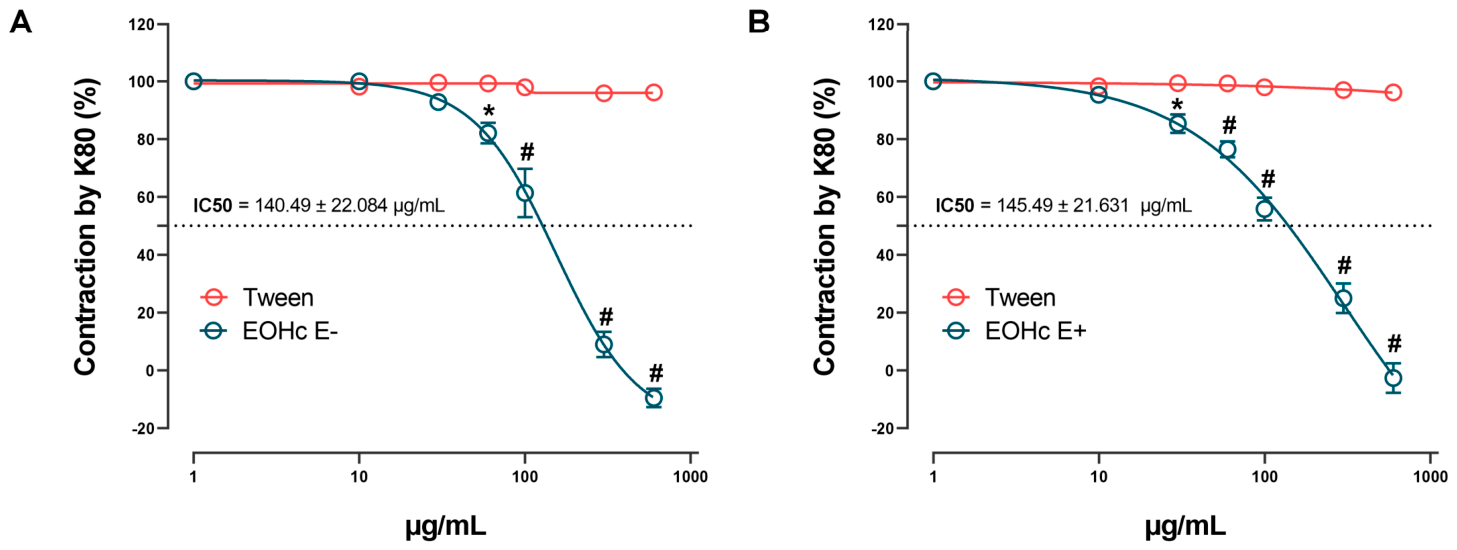
The influence of EOHc on the steady-state (plateau) of K+-induced contractions was evaluated using increasing cumulative concentrations of the oil (10, 30, 60, 100, 300, and 600 μg/mL) in rat aortic preparations precontracted with 80 mM KCl. Experiments were conducted on both endothelium-intact and endothelium-denuded aortas (see Figure 2).
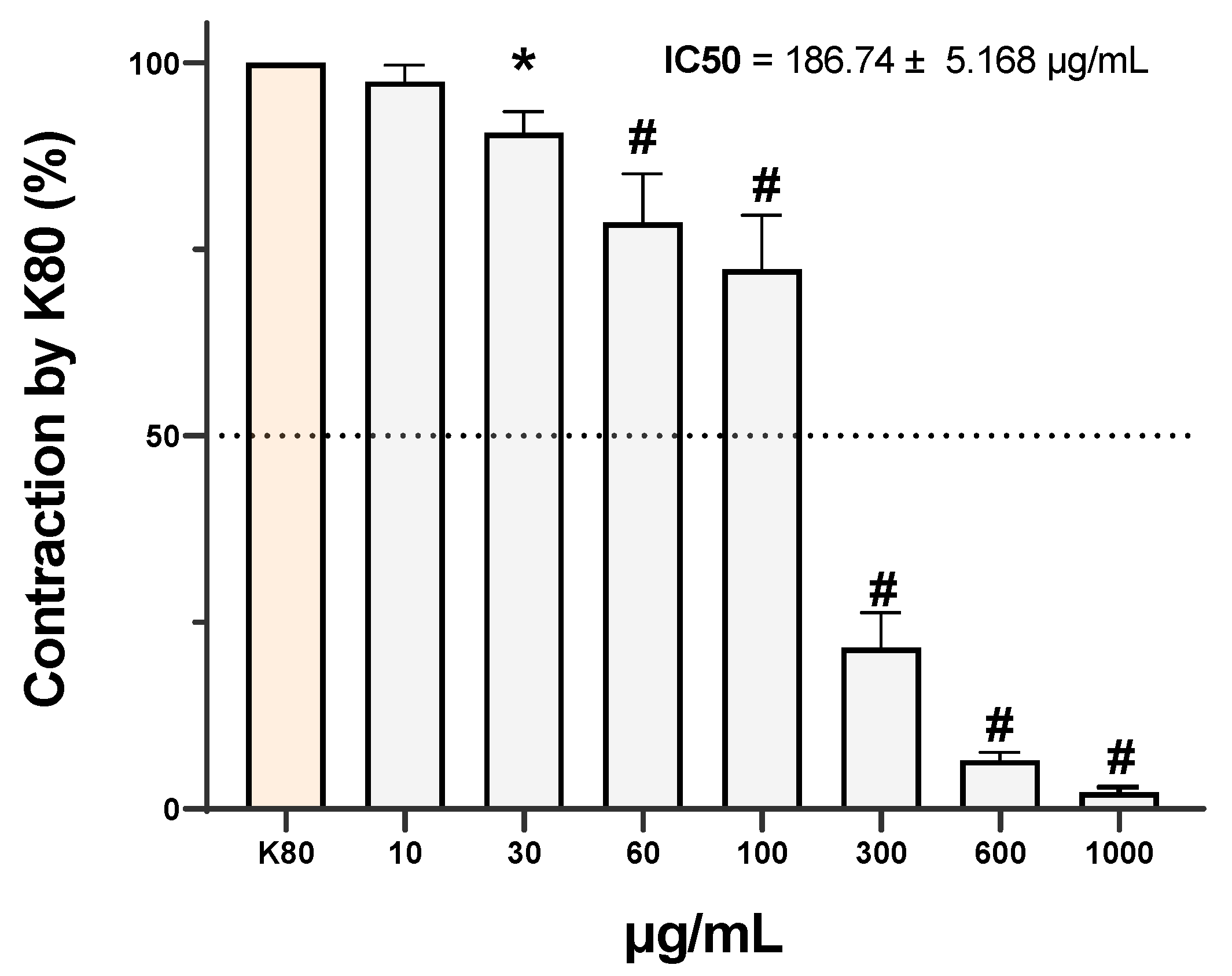
The results showed that EOHc induced concentration-dependent relaxation. Statistical analysis (two-way ANOVA followed by Bonferroni’s test) revealed significant differences at 60 μg/mL (p < 0.01) and at higher concentrations (p < 0.0001). Additional analysis determined IC50 values of 140.49 ± 22.084 μg/mL in endothelium-denuded aortas (Figure 2A) and 145.49 ± 21.631 μg/mL in endothelium-intact aortas (Figure 2B). No statistically significant difference was found between the IC50 values of the two groups (Student’s t-test, p > 0.05). Non-cumulative concentrations of the oil (10, 30, 60, 100, 300, 600, and 1000 μg/mL) in rat aortic preparations resulted in a concentration-dependent inhibition induced by EOHc (see Figure 3). Statistical analysis using one-way ANOVA followed by Dunnett’s test confirmed significant inhibition at concentrations ≥ 30 μg/mL (p < 0.01), with a more pronounced effect observed at higher concentrations (p < 0.0001) compared to the K80 control. Under this non-cumulative concentration protocol, EOHc demonstrated an IC50 value of 186.74 ± 5.168 μg/mL.

3.3. Evaluation of Voltage-Dependent Calcium Channel Involvement Using Calcium and Barium Ion Curves

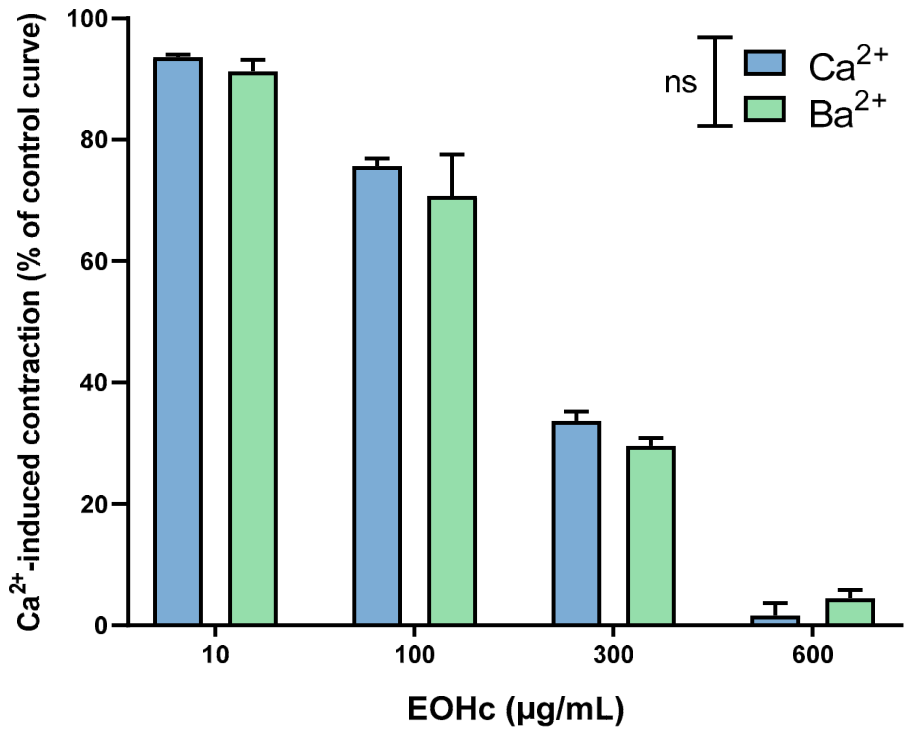
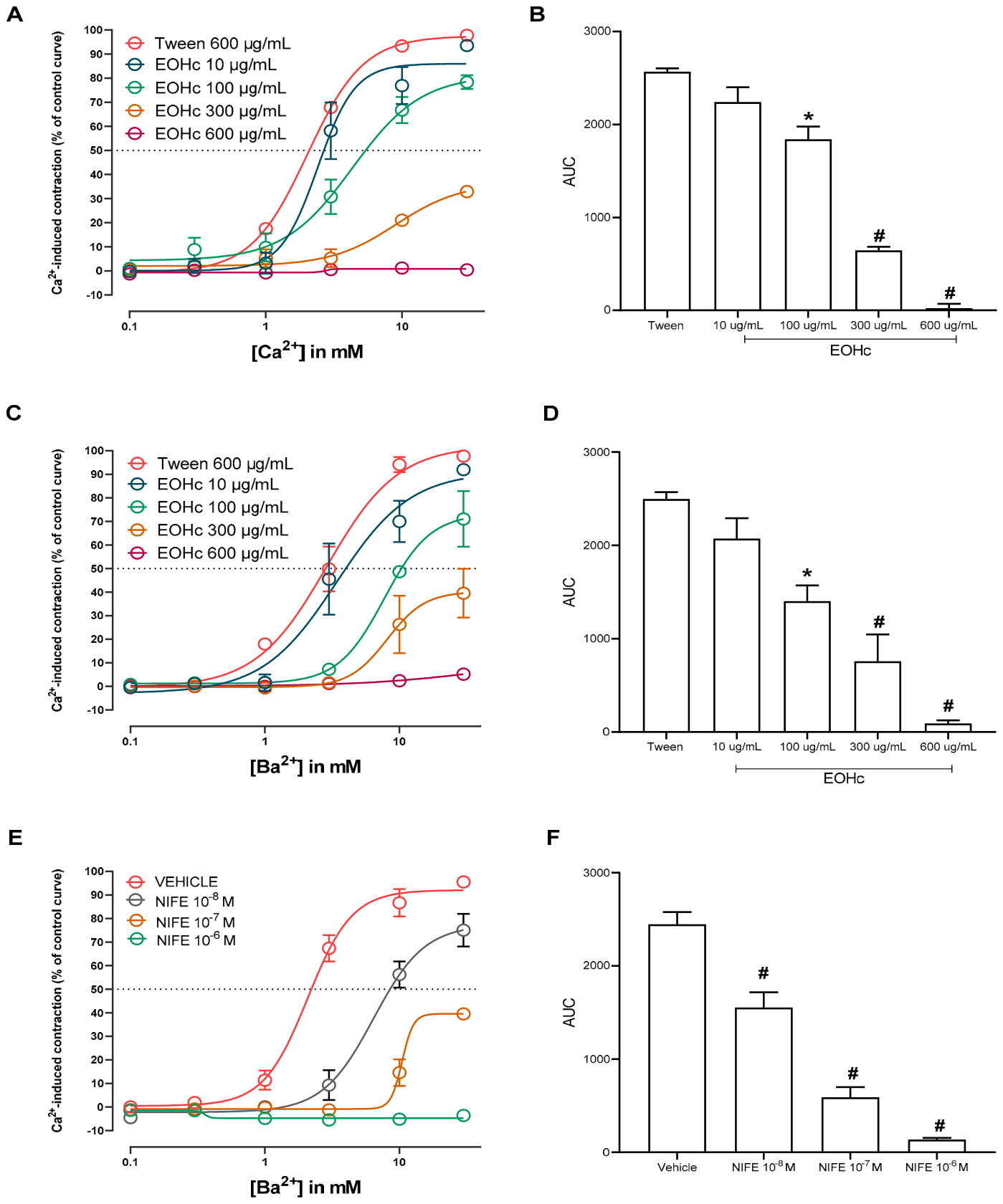
The evaluation of the calcium response curve revealed that the cumulative addition of Ca2+ in a calcium-free medium following K80-induced depolarization produced concentration-dependent contractions, with a maximal response observed at 30 mM Ca2+ (Figure 4A). Administration of EOHc at 10 μg/mL did not produce a statistically significant difference from the control (Tween). However, concentrations of 100 μg/mL and 300 μg/mL significantly reduced the Ca2+-induced contractile response (p < 0.0001), as indicated by a shift of the curve to the right and a decrease in its amplitude, while 600 μg/mL completely abolished contraction. This rightward shift suggests a reduction in Ca2+ sensitivity in accord the requirement of a tenfold increase in extracellular Ca2+ concentration to achieve a 20% contraction level in the presence of 300 μg/mL EOHc compared to the control (600 μg/mL Tween). Analysis of the area under the curve confirmed this significant attenuation of contractile response at concentrations ≥ 100 μg/mL, thereby reinforcing the hypothesis of a concentration-dependent inhibitory effect (Figure 4B).
To investigate whether EOHc activity was associated with the modulation of VGCCs, concentration–response curves were obtained using Ba2+. The data showed a similar pattern to that observed for Ca2+: EOHc significantly reduced Ba2+-induced contractions at 100 μg/mL (* p < 0.001) and 300 μg/mL (# p < 0.0001), and completely suppressed the contractile response at 600 μg/mL (Figure 4C,D). The area under the Ba2+ curve further confirmed a significant reduction at concentrations ≥ 100 μg/mL, indicating inhibition of VGCCs-mediated ion influx. To further confirm the involvement of VGCCs in the vasorelaxant effect of EOHc, concentration–response curves to Ba2+ were also obtained in the presence of NIFE, a selective L-type calcium channel blocker. NIFE significantly reduced Ba2+-induced contractions at 10−7 µM (# p < 0.0001) and completely abolished the contractile response at 10−6 µM (# p < 0.0001), while 10−8 µM produced a partial inhibitory effect (Figure 4E,F). The comparison between the Ca2+ and Ba2+ response curves revealed that although EOHc attenuated contractions induced by both ions, no statistically significant differences were observed between the areas under the curves of the two groups, regardless of the tested concentration (Figure 5).

3.4. Model Structure and Validation

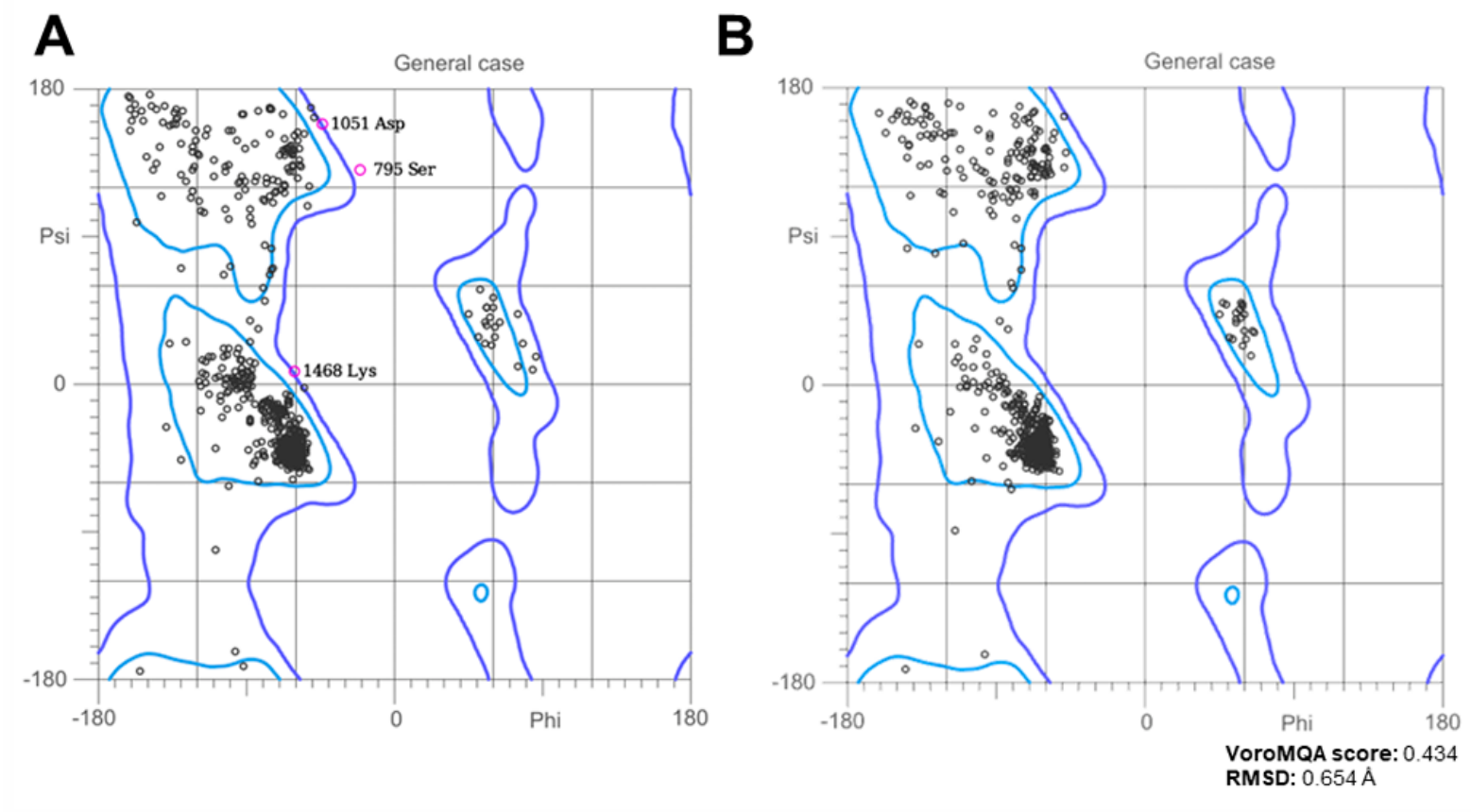
To assess the structural quality of the modeled voltage-dependent L-type calcium channel, Ramachandran plots were generated before (Figure 6A) and after (Figure 6B) energy minimization using YASARA. Initially, a significant number of residues were found outside the allowed regions, indicating structural strain and potential inaccuracies in the model. Following energy minimization, a redistribution of residues into the favored regions was observed, suggesting an improvement in structural stability. Additionally, structural validation was performed using VoroMQA, VERIFY3D, QMEAN, and RMSD calculations. The VoroMQA score of 0.434 suggests a moderate structural quality, as values above 0.4 are typically associated with high-quality models. The RMSD of 0.654 Å, calculated using PyMOL, indicates that the structural refinement did not cause major perturbations while optimizing the model.

3.5. Site-Specific Molecular Docking Results and Interaction Mapping

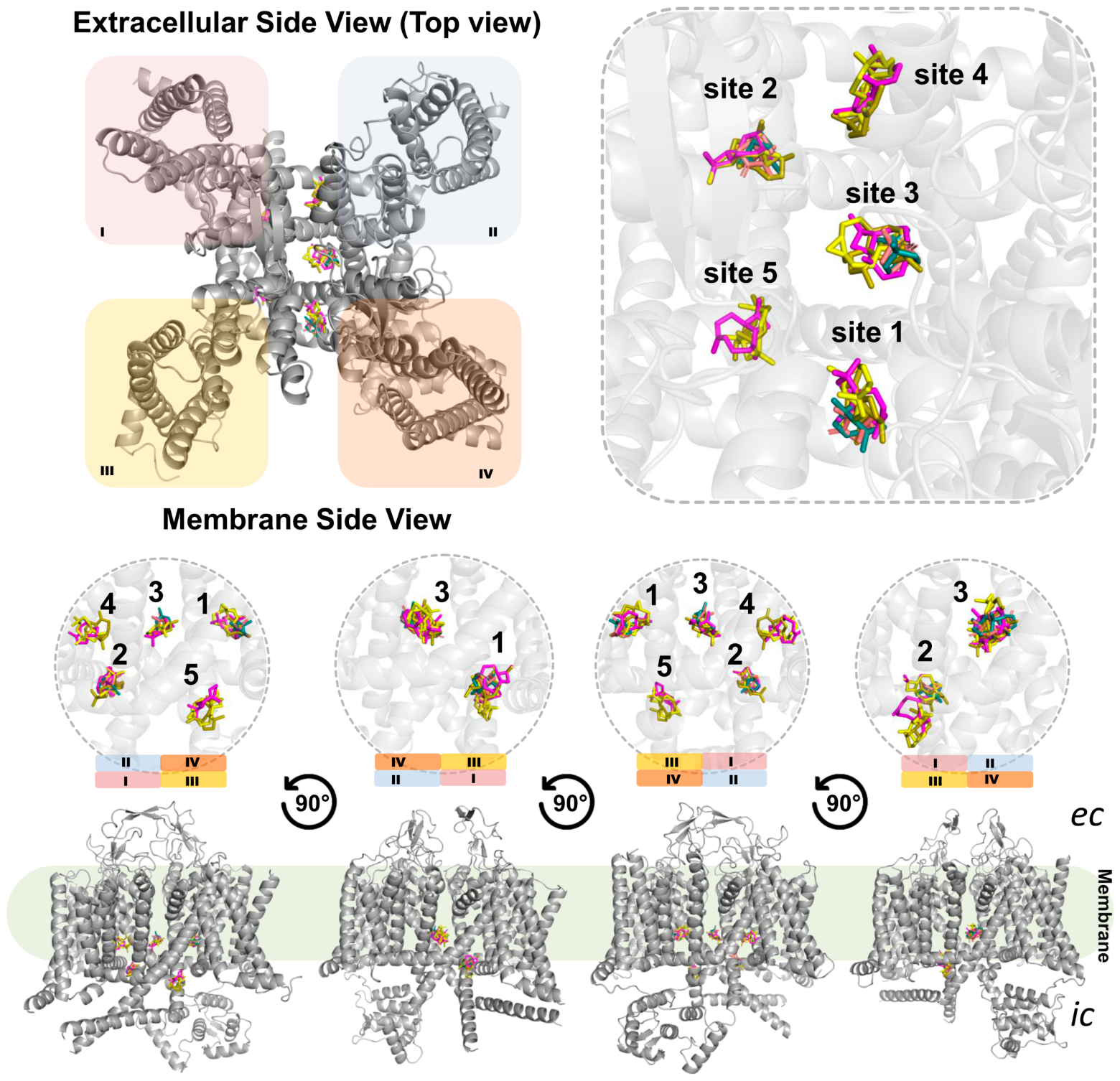
Molecular docking calculations were performed using a search box of the entire pore region formed by the S5 and S6 segments and the adjacent areas including the voltage sensor located in the S4 segment. This configuration made it possible to assess both direct interactions within the pore and potential modulation of the voltage sensor mediated by the S4 segment. A total of 20 simulations were carried out resulting in multiple interaction configurations. A detailed analysis of all generated configurations resulted in five main interaction sites (Sites 1–5) within the α1S subunit (Table S2). The specific characteristics of these interaction sites are described and analyzed in detail in the following sections.
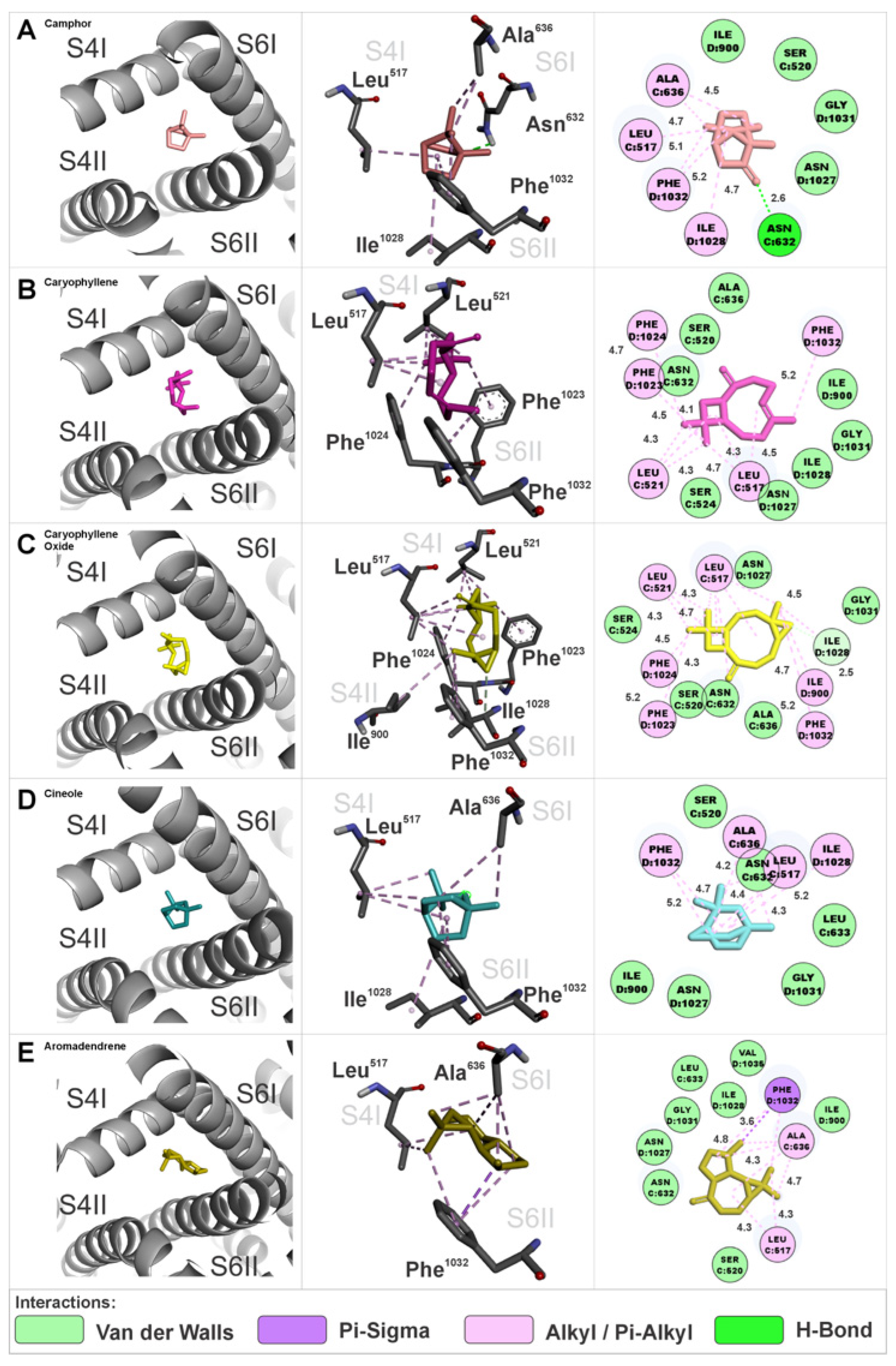
At interaction site 1, the EOHc constituents were anchored in a region defined by the S4 segment of domain I, the S6 segment of domain I, the S4 segment of domain II, and the S6 segment of domain II. The amino acids involved in these interactions are presented in three-dimensional and two-dimensional representations specific to each constituent (Figure 7A–E). The calculated Gibbs free energy variation (ΔG) values for the major constituents were as follows: (A) camphor (ΔG = −6.0 kcal.mol−1), (B) β-caryophyllene (ΔG = −7.9 kcal.mol−1), (C) β-caryophyllene oxide (ΔG = −8.0 kcal.mol−1), (D) cineole (ΔG = −6.2 kcal.mol−1), and (E) aromadendrene (ΔG = −7.5 kcal.mol−1).
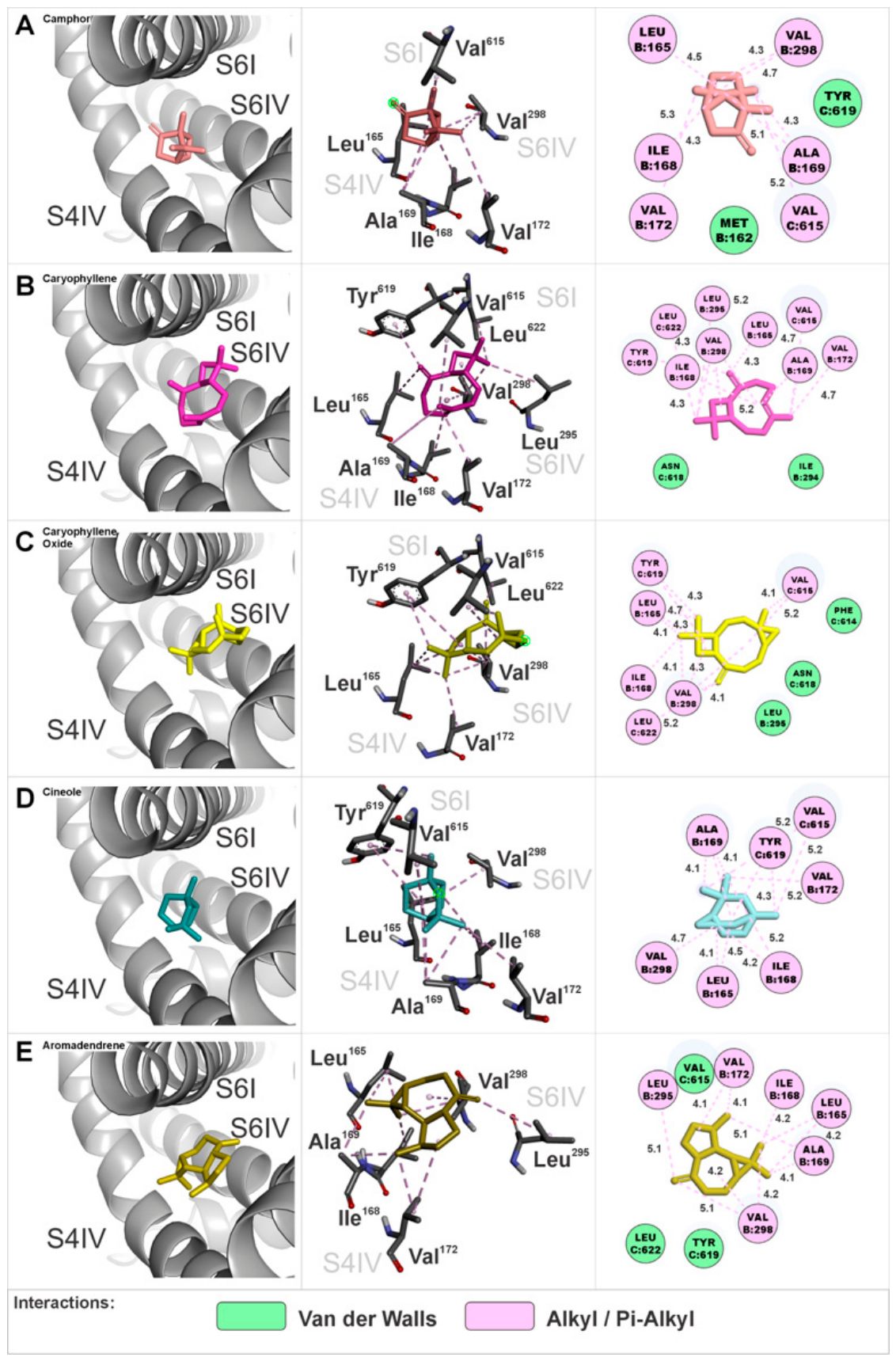
The EOHc constituents at interaction site 2 were anchored in a region composed of the S4 segment of domain IV, the S6 segment of domain I, and the S6 segment of domain IV. The amino acids involved in these interactions are presented in three-dimensional and two-dimensional representations specific to each constituent (Figure 8A–E). The calculated Gibbs free energy variation (ΔG) values for the major constituents were as follows: (A) camphor (ΔG = −5.7 kcal.mol−1), (B) β-caryophyllene (ΔG = −7.9 kcal.mol−1), (C) β-caryophyllene oxide (ΔG = −7.8 kcal.mol−1), (D) cineole (ΔG = −5.6 kcal.mol−1), and (E) aromadendrene (ΔG = −7.4 kcal.mol−1).
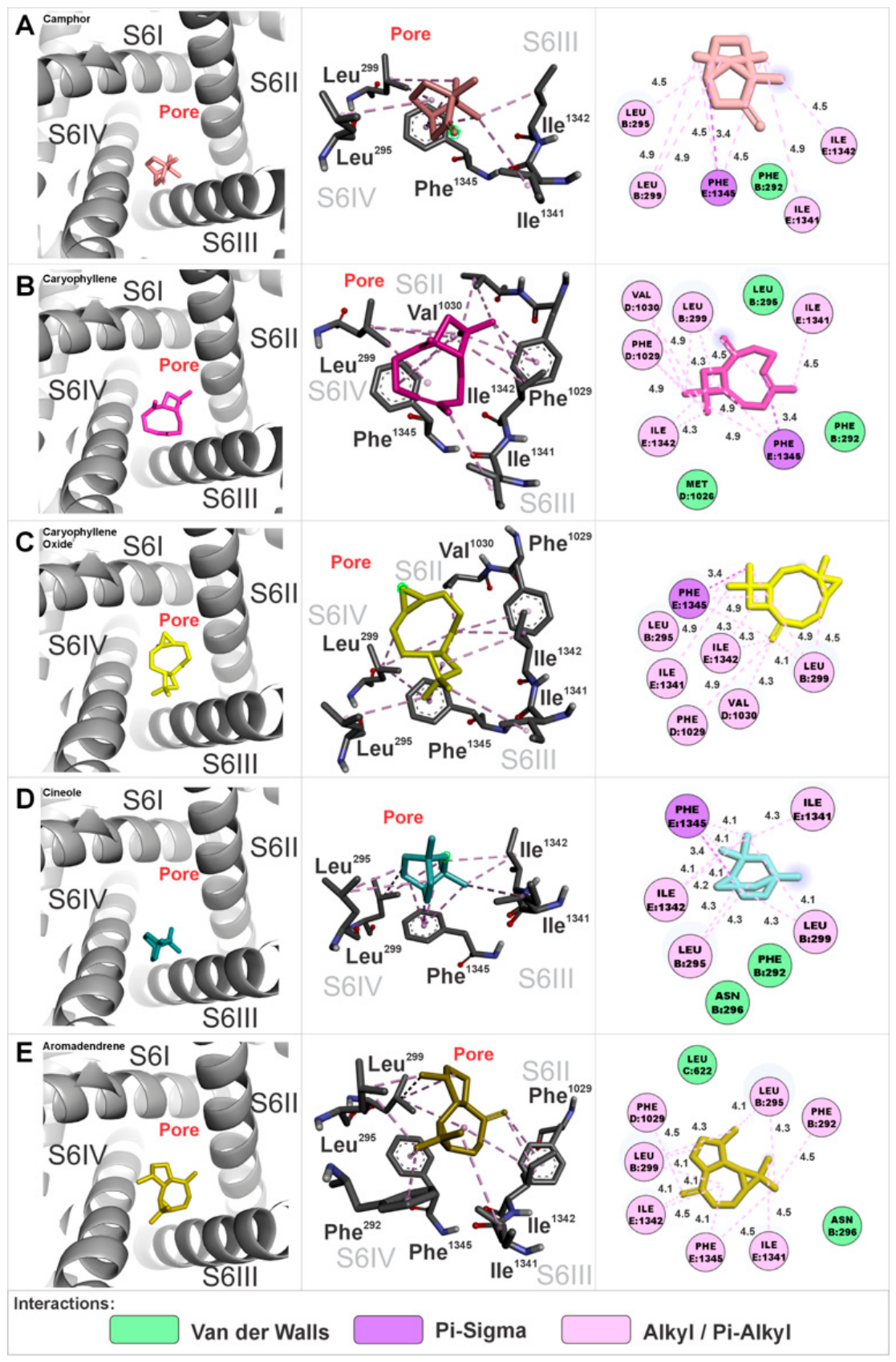
Interaction site 3 is located in the pore-forming region of the channel, anchoring the constituent molecules of EOHc in an area composed of the S6 segments of domains I, II, III, and IV. The amino acids involved in these interactions are represented in detail in three-dimensional and two-dimensional figures specific to each constituent (Figure 9A–E).
Notably, this region serves as the binding site for calcium channel blockers belonging to the phenylalkylamine and benzothiazepine classes, represented by compounds such as verapamil and diltiazem, respectively. The calculated Gibbs free energy variation (ΔG) values for the major constituents were as follows: (A) camphor (ΔG = −5.6 kcal.mol−1), (B) β-caryophyllene (ΔG = −7.3 kcal.mol−1), (C) β-caryophyllene oxide (ΔG = −7.3 kcal.mol−1), (D) cineole (ΔG = −5.5 kcal.mol−1), and (E) aromadendrene (ΔG = −7.6 kcal.mol−1).
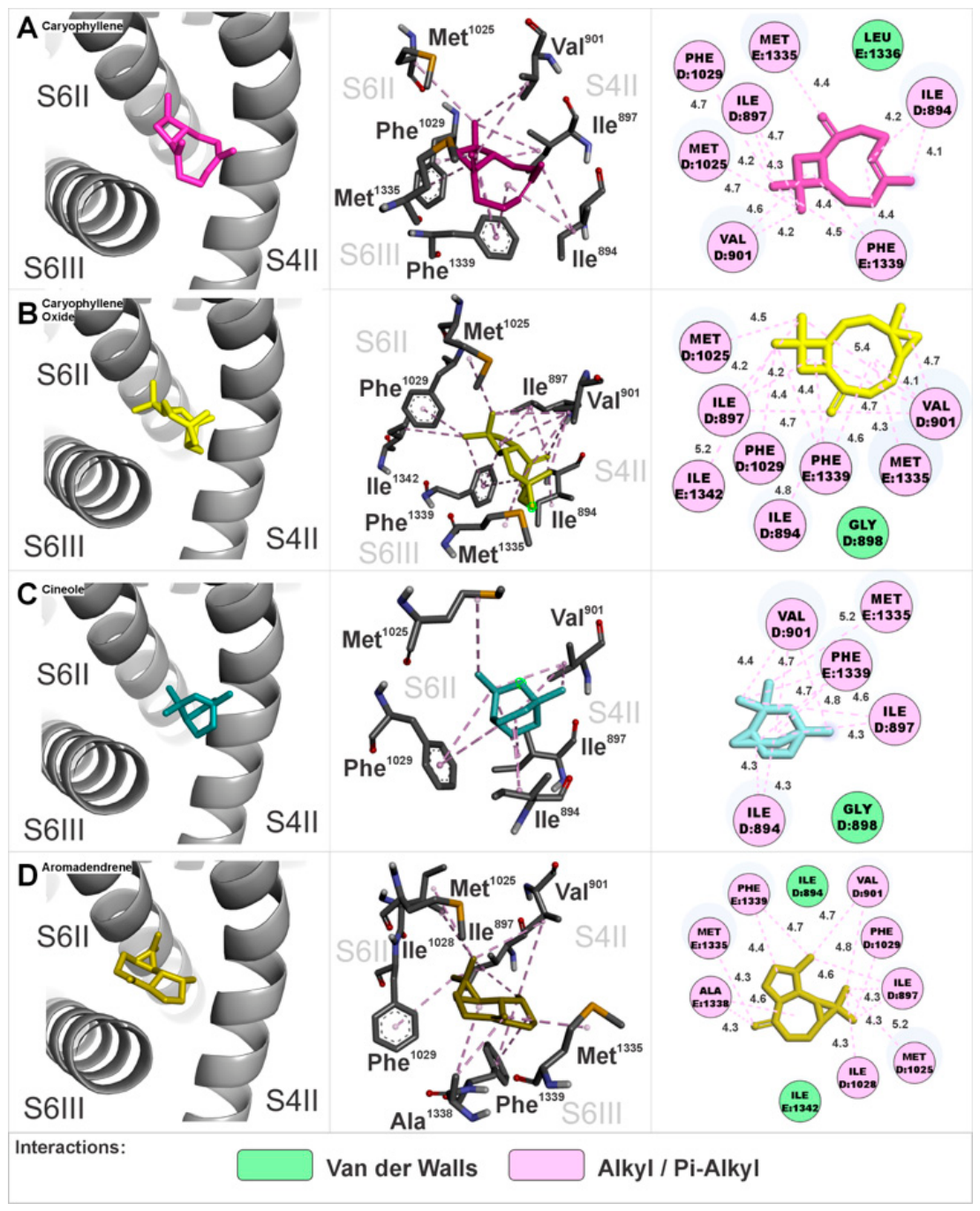
Anchoring of EOHc constituents at interaction site 4 was in a region composed of the S4 segment of domain II as well as the S6 segments of domains II and III. The amino acids involved in these interactions are represented in detail in three-dimensional and two-dimensional figures specific to each constituent (Figure 10A–D).
We noted that camphor did not exhibit anchoring at this site, unlike the other constituents. It is important to point out that this a region adjacent to the canonical dihydropyridine-binding pocket, such as NIFE and Bay K. The calculated Gibbs free energy variation (ΔG) values for the major constituents were as follows: (A) β-caryophyllene (ΔG = −7.4 kcal.mol−1), (B) β-caryophyllene oxide (ΔG = −7.2 kcal.mol−1), (C) cineole (ΔG = −5.3 kcal.mol−1), and (D) aromadendrene (ΔG = −7.3 kcal.mol−1).
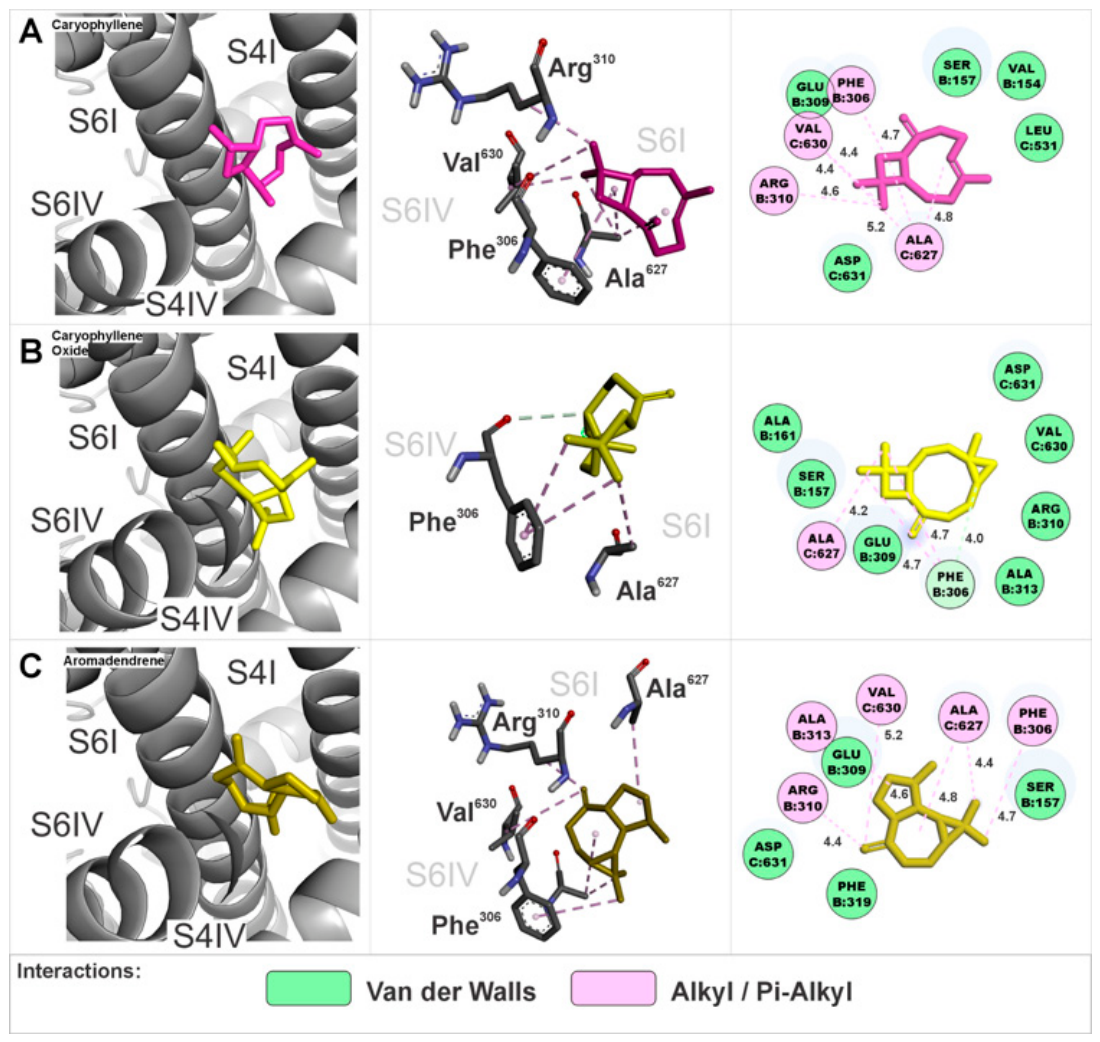
All of the interaction site 5 anchoring of EOHc constituents was found in a region composed of the S4 segments of domains I and IV as well as the S6 segments of domains I and IV. The amino acids involved in these interactions are detailed in three-dimensional and two-dimensional representations specific to each constituent (Figure 11A–C). The calculated Gibbs free energy variation (ΔG) values for the major compounds were: (A) β-caryophyllene (ΔG = −6.9 kcal.mol−1), (B) β-caryophyllene oxide (ΔG = −6.8 kcal.mol−1), and (C) aromadendrene (ΔG = −6.9 kcal.mol−1). The monoterpenoids did not exhibit anchoring at this site.

3.6. Molecular Bioprospecting

In silico predictions of the five major ligands revealed that molecular weight (MW), topological polar surface area (tPSA), and partition coefficient (LogP) conform to Lipinski’s Rule of Five, with no violations observed. However, only the major monoterpenes (camphor and cineole) met Pfizer’s rule (LogP < 3), whereas only the sesquiterpenes (caryophyllene, caryophyllene oxide, and aromadendrene) complied with the Golden Triangle rule (MW > 200 Da and LogP < 5). All compounds showed one hydrogen bond acceptor and no hydrogen bond donors. Quantitative estimate of drug-likeness (QED) scores ranged from 0.445 to 0.521, indicating moderate drug-likeness. The predicted gastrointestinal absorption (GIA) was high for most compounds, primarily driven by passive diffusion. Human intestinal absorption (HIA) was estimated at up to 95%. However, the Caco-2 cell permeability results suggest only moderate permeability. None of the compounds acted as inhibitors of P-glycoprotein (P-gp) classes I or II, though camphor was predicted to be a P-gp substrate. The volume of distribution at steady state (VDss) ranged from 2.14 to 5.67 L/kg, suggesting moderate to extensive tissue distribution. All compounds showed high blood–brain barrier (BBB) permeability, indicating potential CNS exposure. Total clearance varied between 0.04 and 0.762 mL/min/kg, with monoterpenes displaying higher clearance rates, implying faster elimination. None of the compounds interacted with the renal OCT2 transporter, suggesting low potential for renal drug–drug interactions. Aromadendrene and caryophyllene oxide were predicted to inhibit CYP2C19, CYP2C9, CYP2D6, and CYP3A4 enzymes but were unlikely to act as substrates. Camphor, cineole, and caryophyllene showed no relevant CYP450 interactions, indicating a lower risk for metabolic drug–drug interactions. Toxicity predictions indicated low mutagenic risk (AMES ≤ 0.025) and low potential for hepatotoxicity, DILI, nephrotoxicity, hematotoxicity, and cardiotoxicity (no hERG I/II inhibition). However, the high BBB permeability raises concern for potential neurotoxicity, warranting further investigation into CNS safety (Table S3).

4. Discussion

4.1. Electromechanical Coupling Reversal and Blocking Protocol

Electromechanical coupling in vascular smooth muscle relies on membrane depolarization to activate VGCCs [51], leading to increased intracellular Ca2+ levels and subsequent contractile responses via the calmodulin–MLCK pathway [52]. In this study, EOHc effectively reversed contractions induced by K80, displaying similar IC50 values in preparations with and without endothelium, indicating an endothelium-independent mechanism. Notably, under the pre-contracted (blockade) condition, the IC50 was slightly higher, suggesting increased sensitivity of depolarized cells to EOHc.
While KCl-induced depolarization primarily activates VGCCs, additional pathways, such as store-operated calcium channels (SOCCs), transient receptor potential (TRP) channels, and Rho-kinase signaling, may also contribute to the contractile response [53,54]. Thus, although EOHc reversed and attenuated K+-induced contractions, this effect alone is insufficient to attribute its mechanism exclusively to VGCC inhibition. To further dissect the specificity of EOHc’s action, we employed Ca2+ and Ba2+ cumulative concentration–response protocols under depolarizing conditions.

4.2. Evaluation of Voltage-Dependent Calcium Channel Involvement Using Calcium and Barium Ion Curves

This experiment aimed to elucidate the involvement of voltage-gated calcium channels (VGCCs) in vascular contraction and to investigate whether the mechanism of action of EOHc terpenes involves the direct blockade of these channels. In terms of membrane ion channels [55], the nearly identical inhibition of contractions induced by Ca2+ and Ba2+ suggests that the inhibitory effect is mediated specifically through the blockade of VGCCs [56]. This conclusion is supported by the fact that while Ca2+ can enter the cell through multiple pathways [57], Ba2+ is highly selective for VGCCs, as it does not readily permeate other calcium-permeable channels [58]. Furthermore, the hypothesis that this blockade occurs primarily through intracellular mechanisms is improbable. For such a hypothesis to be valid, it would be necessary to assume that the intracellular effects of Ba2+ on the contractile machinery are identical to those of Ca2+. Given that Ba2+ is a poor substitute for Ca2+ in activating downstream signaling pathways (such as the calmodulin-MLCK cascade), the equipotent inhibition observed indicates that EOHc acts as a direct modulator of VGCC-mediated influx, thereby interfering with electromechanical coupling in vascular smooth muscle [59,60,61].
The comparison between the Ca2+ and Ba2+ response curves revealed that although EOHc attenuated contractions induced by both ions, no statistically significant differences were observed between the areas under the curves of the two groups, regardless of the tested concentration. This finding indicates that the inhibitory effect of EOHc primarily occurs through the modulation of Ca2+ entry via VGCCs, with no result influence on downstream intracellular signaling pathways. Therefore, the present results support the hypothesis that EOHc acts as a direct modulator of VGCC-mediated Ca2+ influx, thereby affecting electromechanical coupling in vascular smooth muscle. Accordingly, in silico analyses using molecular docking were performed to elucidate and support the potential interactions of the molecules in this channel.
The use of NIFE as a pharmacological control was essential to confirm the functional presence of VGCCs in the rat aortic rings under the experimental conditions employed. Since Ba2+ is a well-established permeant ion capable of passing through L-type calcium channels and sustaining smooth muscle contraction; the marked inhibition of Ba2+-induced contractions by NIFE demonstrates that the contractile responses obtained in this model were probability mediated by L-type VGCC activation [59,60,61]. The progressive reduction in vascular contraction observed in the presence of NIFE, culminating in near-complete blockade at the highest concentration tested, validates the sensitivity and reliability of the experimental protocol for evaluating compounds that interfere with calcium influx through these channels. Thus, the similarity between the inhibitory profile produced by NIFE and that observed with EOHc strengthens our hypothesis that the vasorelaxant effect of the extract is, at least in part, associated with the blockade of L-type calcium channels in vascular smooth muscle.

4.3. Structural Consistency and Translational Potential of VGCCs

VGCCs are complex transmembrane proteins composed of five subunits: α1, α2, β, γ, and δ [62]. Among these, the α1 subunit is the primary component, as it contains the selective pore responsible for calcium ion influx into the intracellular environment. The remaining subunits play structural and regulatory roles, modulating channel activity. The α1 subunit consists of four distinct domains (I, II, III, and IV), each of which comprises six transmembrane segments (S1 to S6) [63]. The S4 segment plays a crucial role in voltage sensitivity, as it functions as a sensor for membrane potential variations. The S5 and S6 segments, on the other hand, along with interdomain regions, form the central pore of the channel, enabling the selective passage of calcium ions [63]. Experimental results indicated that the constituents present in EOHc act through an electromechanical mechanism, blocking and/or modulating voltage-dependent calcium channels. This hypothesis was investigated further by a molecular docking analysis, focusing on the α1S subunit of the L-type calcium channel.
It is important to highlight the translational potential of this biological target, given that the amino acid sequence of this channel is highly consistent among mammals with over 95% identity [10]. Furthermore, the interaction sites of dihydropyridines such as nifedipine, phenylalkylamines such as verapamil, and benzodiazepines such as diltiazem, are 100% consistent for these molecules [10,64]. The anchoring of the major terpenes present in EOHc to these sites therefore suggests a high likelihood of translational applicability across different mammalian species. The experimental findings support this hypothesis and demonstrate contraction reversal, indicating that the voltage-dependent calcium channel is the primary molecular target of these compounds. The effects observed in this study may then have translational relevance for other mammalian species. Previous studies have reported the involvement of terpenes in the modulation of this specific channel. Recent evidence has also suggested that cineole, one of the major monoterpenes, may act as a blocker of this target [9,14,65]. However, this hypothesis has not yet been thoroughly investigated. The present study provides a more detailed elucidation of this mechanism of action, not only for cineole but also for other EOHc constituents, and offers a stronger foundation for future investigations into their pharmacological potential.

4.4. Progressive and Synergistic Blockade of VGCCs Channels by EOHc Terpenes: A Molecular Docking Approach

Given that the experimental findings suggested the interaction of terpenes present in EOHc on VGCCs, a pharmacodynamics analysis was conducted using docking computations to further elucidate the molecular mechanisms underlying this interaction. Molecular docking analysis identified five preferential interaction sites, referred to as hotspots or interaction clusters. These clusters are located between segments S4 and S6 in each of the four domains (I, II, III, and IV). The distribution of these interactions may suggest a synergistic mechanism of action, in which small molecules, such as EOHc terpenes with a molecular weight below 300 Daltons, anchor at these sites in a concentration-dependent manner. As the EOHc concentration increases, a greater number of these clusters become occupied, leading to a progressive modulation of the channel. The interaction sites can be categorized into two main functional groups based on their effects on channel activity. Modulatory sites (clusters 1, 2, 4, and 5): The major constituents of EOHc bind laterally to the pore, forming interactions between segments S4 and S6 without completely obstructing calcium influx. Notably, cluster 4 corresponds to the binding site of dihydropyridines such as nifedipine [64]. This interaction suggests a modulatory role in the channel’s activation and inactivation kinetics. Blocking site (cluster 3): This site is particularly relevant, as interactions occur between the four S6 segments, which directly form the channel pore. The anchoring of molecules at this site may result in an effective blockade of calcium ion passage, thereby preventing smooth vascular muscle contraction. This region is also known to serve as the binding site for calcium channel blockers of the phenylalkylamine class such as verapamil, and the benzothiazepine class such as diltiazem [64].
A key experimental finding supporting the hypothesis of progressive, concentration-dependent VGCC blockade by EOHc is the rightward shift in the calcium response curve. When the extracellular calcium concentration is increased in the presence of 10 and 100 µg/mL of EOHc, the contraction percentage remains constant, which indicates a partial modulatory effect on channel activity. This effect may be attributed to the occupation of lateral clusters (sites 1, 2, 4, and 5) or even cluster 3, acting as a “sub-gate” at lower concentrations. As the extracellular calcium gradient increases, however, the molecules are progressively displaced from the pore interaction site. This displacement allows calcium ions to overcome the channel blockade, as reflected in the contraction percentages observed at 100 and 300 µg/mL. In contrast, a complete inhibition of calcium-induced contraction was observed at 600 µg/mL, suggesting that all interaction clusters, including site 3, were occupied by EOHc molecules, resulting in a full blockade of calcium influx (Figure 12). The vasorelaxant effect of the essential oil may result from cooperative interactions among its constituents. Molecular docking suggests that monoterpenes and sesquiterpenes can bind to distinct sites of L-type voltage-gated calcium channels, potentially producing additive or synergistic effects. However, these findings should be interpreted with caution, as they are based on computational predictions. Definitive confirmation of synergism requires quantitative analyses, such as isobolographic methods or combination index (CI) determinations, which should be addressed in future studies.

4.5. Potential Involvement of Different Calcium Channel Subtypes

Although L-type calcium channels (particularly CaV1.2) are the primary mediators of electromechanical coupling in vascular smooth muscle, low-threshold calcium channels (e.g., CaV3.x) are also expressed and may contribute to vascular tone under specific conditions. However, the experimental approaches employed in this study, including KCl-induced depolarization and Ca2+/Ba2+-induced contraction assays, predominantly assess high-voltage-activated channels, supporting the involvement of L-type calcium channels. Furthermore, given the high structural conservation among L-type isoforms, it is plausible that terpene compounds from Hyptis crenata essential oil may interact not only with CaV1.2 but also with CaV1.3. Nevertheless, further studies are required to evaluate isoform-specific interactions and the potential contribution of low-threshold calcium channels [37,64].

4.6. Prediction of Physicochemical and Pharmacokinetic Properties and Main Limitations

All five ligands complied with Lipinski’s Rule of Five, suggesting favorable oral bioavailability [66]. However, differences emerged under other pharmacokinetic filters [67]. According to Pfizer’s rule (LogP < 3) and the Golden Triangle (MW > 200 Da and LogP < 5), monoterpenes (LogP < 3) showed better solubility but may have reduced permeability, while sesquiterpenes (LogP > 3) were more hydrophobic, which may hinder gastrointestinal dissolution [68]. Most compounds demonstrated high predicted gastrointestinal absorption, with human intestinal absorption exceeding 90% [69]. Despite moderate Caco-2 permeability, the absence of P-glycoprotein interaction favors absorption via passive diffusion. The presence of hydrogen bond acceptors and the absence of donors further support membrane permeability [70].
The VDss values suggest tissue accumulation, particularly for sesquiterpenes, which showed higher VDss compared to monoterpenes [71]. All compounds are lipophilic and of low molecular weight, facilitating BBB permeability [72]. While advantageous for CNS-targeted drugs, this also raises concerns about potential neurotoxicity [73]. Major sesquiterpenes (aromadendrene and caryophyllene oxide) inhibit key CYP450 isoforms (CYP2C19, CYP2C9, CYP2D6, CYP3A4), indicating potential drug–drug interaction risks [74]. Other molecules showed minimal interaction with these enzymes, suggesting a lower likelihood of metabolic interference [75]. Monoterpenes exhibited faster clearance, potentially requiring more frequent dosing. Sesquiterpenes showed slower clearance, which may enhance efficacy but also increase accumulation and toxicity risk [76]. None of the compounds interacted with OCT2, reducing concerns about renal drug–drug interactions [77,78,79]. Toxicological predictions indicate low mutagenic, hepatotoxic, and hematological risk, as evidenced by negative Ames test results. Low or absent hERG channel inhibition suggests minimal cardiotoxicity. However, given the high BBB permeability, further studies are needed to evaluate the neurotoxicity risks [46,80,81].

5. Conclusions

The key original study was to demonstrate the synergistic interaction between terpenes and voltage-dependent calcium channels, suggesting a potential modulatory mechanism. While many studies in the literature on vasorelaxant agents highlight their effects and propose possible mechanisms of action, few provide an in-depth exploration of the molecular behavior of these compounds and their direct interaction with ion channels. Calcium channels play a central role in various physiological processes [82] by regulating the influx of this ion into the cell. Calcium is involved in essential mechanisms such as vascular smooth muscle contraction [83], neurotransmitter release [84], ATP production [85], bioenergetic processes [86], and blood pH homeostasis [87]. The modulation of these channels may therefore have implications not only for vascular function but also for other physiological processes [88,89,90]. This study accordingly contributes to the understanding of the effects of terpenes on calcium channels, and suggests a possible synergistic interaction that may be associated with their therapeutic potential. The results presented herein provide a basis for future investigations that support the identification of molecular interaction patterns of these small molecules with different biological targets and expanding perspectives for the development of novel therapeutic approaches.
We concluded from this study that the terpenes present in EOHc exert vasorelaxant effects on the isolated rat aorta through electromechanical coupling, independently of the endothelium. This effect occurs via the blockade and modulation of voltage-dependent calcium channels, with a synergistic interaction of EOHc molecules at key regions of these channels. Elucidation of the molecular behavior of these interactions may serve as a foundation for the development of pharmacological strategies, and expand the potential applications of small molecules in vascular function regulation and other calcium-mediated physiological processes.

Supplementary Materials

The following supporting information can be downloaded at: https://www.mdpi.com/article/10.3390/medsci14020262/s1, Table S1. GC-MS peak list of the essential oil, including retention time, peak area, height, and relative abundance. Figure S1. Total ion chromatogram (TIC) of the essential oil from Hyptis crenata obtained by GC-MS analysis. Figure S2. Mass spectrum of Peak 1 assigned to Bicyclo[3.1.0]hex-2-ene, 2-methyl-5-(1-methylethyl)-. Figure S3. Mass spectrum of Peak 2 assigned to 2,6,6-Trimethylbicyclo[3.1.1]hept-2-ene. Figure S4. Mass spectrum of Peak 3 assigned to Camphene. Figure S5. Mass spectrum of Peak 4 assigned to Bicyclo[3.1.1]heptane, 6,6-dimethyl-2-methylene-. Figure S6. Mass spectrum of Peak 5 assigned to β-Myrcene. Figure S7. Mass spectrum of Peak 6 assigned to 1,3-Cyclohexadiene, 1-methyl-4-(1-methylethyl)-. Figure S8. Mass spectrum of Peak 7 assigned to o-Cymene. Figure S9. Mass spectrum of Peak 8 assigned to D-Limonene. Figure S10. Mass spectrum of Peak 9 assigned to Eucalyptol. Figure S11. Mass spectrum of Peak 10 assigned to γ-Terpinene. Figure S12. Mass spectrum of Peak 11 assigned to Bicyclo[3.1.0]hexan-2-ol, 2-methyl-5-(1-methylethyl)-. Figure S13. Mass spectrum of Peak 12 assigned to 2-Carene. Figure S14. Mass spectrum of Peak 13 assigned to Bicyclo[3.1.0]hexan-2-ol, 2-methyl-5-(1-methylethyl)-. Figure S15. Mass spectrum of Peak 14 assigned to (+)-2-Bornanone. Figure S16. Mass spectrum of Peak 15 assigned to endo-Borneol. Figure S17. Mass spectrum of Peak 16 assigned to Terpinen-4-ol. Figure S18. Mass spectrum of Peak 17 assigned to α-Terpineol. Figure S19. Mass spectrum of Peak 18 assigned to Thymol. Figure S20. Mass spectrum of Peak 19 assigned to Phenol, 2-methyl-5-(1-methylethyl)-. Figure S21. Mass spectrum of Peak 20 assigned to Thymol. Figure S22. Mass spectrum of Peak 21 assigned to Isoledene. Figure S23. Mass spectrum of Peak 22 assigned to 1H-Cycloprop[e]azulene derivative. Figure S24. Mass spectrum of Peak 23 assigned to Caryophyllene. Figure S25. Mass spectrum of Peak 24 assigned to Guaia-1(10),11-diene. Figure S26. Mass spectrum of Peak 25 assigned to α-Panasinsen. Figure S27. Mass spectrum of Peak 26 assigned to Alloaromadendrene. Figure S28. Mass spectrum of Peak 27 assigned to α-Guaiene. Figure S29. Mass spectrum of Peak 28 assigned to 1,4,7-Cycloundecatriene derivative. Figure S30. Mass spectrum of Peak 29 assigned to Alloaromadendrene. Figure S31. Mass spectrum of Peak 30 assigned to Azulene derivative. Figure S32. Mass spectrum of Peak 31 assigned to 1H-Cycloprop[e]azulene derivative. Figure S33. Mass spectrum of Peak 32 assigned to Naphthalene derivative. Figure S34. Mass spectrum of Peak 33 assigned to Alloaromadendrene oxide-(1). Figure S35. Mass spectrum of Peak 34 assigned to Alloaromadendrene. Figure S36. Mass spectrum of Peak 35 assigned to (-)-Spathulenol. Figure S37. Mass spectrum of Peak 36 assigned to Caryophyllene oxide. Figure S38. Mass spectrum of Peak 37 assigned to 1H-Cycloprop[e]azulene derivative. Figure S39. Mass spectrum of Peak 38 assigned to 2-Naphthalenemethanol derivative. Figure S40. Mass spectrum of Peak 39 assigned to Caryophyllene. Figure S41. Mass spectrum of Peak 40 assigned to 8-epi-γ-eudesmol. Figure S42. Mass spectrum of Peak 41 assigned to Guaia-1(10),11-diene. Figure S43. Mass spectrum of Peak 42 assigned to Tetracyclo[6.3.2.0(2,5).0(1,8)]tridecan-9-ol derivative. Figure S44. Mass spectrum of Peak 43 assigned to (-)-Aristolene. Figure S45. Mass spectrum of Peak 44 assigned to Guaiol. Figure S46. Mass spectrum of Peak 45 assigned to Caryophyllene oxide. Figure S47. Mass spectrum of Peak 46 assigned to Cycloheptane derivative. Figure S48. Mass spectrum of Peak 47 assigned to Caryophyllene oxide. Table S2. Molecular docking interactions of selected compounds with the target protein across five predicted binding sites, including amino acid residues, interaction types, and binding affinities. Table S3. In silico physicochemical, pharmacokinetic, and toxicological profiling of Camphor, Caryophyllene, Caryophyllene Oxide, Cineole, and Aromadendrene.

Author Contributions

Conceptualization, A.N.C.d.S. (André Nogueira Cardeal dos Santos) and A.N.C.d.S. (Andrelina Noronha Coelho de Sousa); methodology, A.N.C.d.S. (André Nogueira Cardeal dos Santos), J.E.d.C.F. and A.N.C.d.S. (Andrelina Noronha Coelho de Sousa); software, A.N.C.d.S. (André Nogueira Cardeal dos Santos); validation, A.N.C.d.S. (André Nogueira Cardeal dos Santos), J.E.d.C.F. and F.S.H.F.; formal analysis, A.N.C.d.S. (André Nogueira Cardeal dos Santos); investigation, A.N.C.d.S. (André Nogueira Cardeal dos Santos), M.C.A., S.M.L.G., A.L.L.F.C., A.B.N., C.C.B., M.V.V.T., L.d.S.O., L.H.B.A., S.M.d.S.B., C.B.F., J.F.d.S. and J.H.A.d.M.; resources, A.N.C.d.S. (Andrelina Noronha Coelho de Sousa), Á.P.-G., J.H.L.-C. and A.J.A.A.; data curation, A.N.C.d.S. (André Nogueira Cardeal dos Santos); writing—original draft preparation, A.N.C.d.S. (André Nogueira Cardeal dos Santos); writing—review and editing, A.N.C.d.S. (André Nogueira Cardeal dos Santos), J.E.d.C.F. and A.N.C.d.S. (Andrelina Noronha Coelho de Sousa); visualization, A.N.C.d.S. (André Nogueira Cardeal dos Santos); supervision, A.N.C.d.S. (Andrelina Noronha Coelho de Sousa), J.H.L.-C. and A.J.A.A.; project administration, A.N.C.d.S. (Andrelina Noronha Coelho de Sousa) and J.H.L.-C.; funding acquisition, A.N.C.d.S. (Andrelina Noronha Coelho de Sousa) and J.E.d.C.F. All authors have read and agreed to the published version of the manuscript.

Funding

This research was funded by the Coordination for the Improvement of Higher Education Personnel (CAPES), Brazil, Grant Number 001.

Institutional Review Board Statement

The animal study protocol was approved by the Institutional Ethics Committee of the State University of Ceara (protocol code 31032.001146/2023-23, approved in 17 August 2023).

Informed Consent Statement

Patient consent was waived due to Animal research, without human subjects.

Data Availability Statement

The original contributions presented in this study are included in the article/Supplementary Materials. Further inquiries can be directed to the corresponding author(s).

Acknowledgments

The authors would like to thank the laboratories and technical staff of the State University of Ceará for their support during the experimental procedures.

Conflicts of Interest

The authors declare no conflicts of interest.

References

  1. Ma, J.; Li, Y.; Yang, X.; Liu, K.; Zhang, X.; Zuo, X.; Ye, R.; Wang, Z.; Shi, R.; Meng, Q.; et al. Signaling Pathways in Vascular Function and Hypertension: Molecular Mechanisms and Therapeutic Interventions. Signal Transduct. Target. Ther. 2023, 8, 168. [Google Scholar] [CrossRef]
  2. Pereira da Silva, E.A.; Martín-Aragón Baudel, M.M.; Navedo, M.F.; Nieves-Cintrón, M. Ion channel molecular complexes in vascular smooth muscle. Front. Physiol. 2022, 13, 999369. [Google Scholar] [CrossRef]
  3. Cheng, L.; Chen, H.; Maboh, R.N.; Wang, H. Effects of Cacna1d D307G Mutation on Blood Pressure and Kidney Function in Rats with Salt Loading. Kidney Blood Press. Res. 2025, 50, 46–60. [Google Scholar] [CrossRef]
  4. Su, C.; Huang, T.; Zhang, M.; Zhang, Y.; Zeng, Y.; Chen, X. Glucocorticoid Receptor Signaling in the Brain and Its Involvement in Cognitive Function. Neural Regen. Res. 2025, 20, 2520–2537. [Google Scholar] [CrossRef]
  5. Andonian, B.J.; Hippensteel, J.A.; Abuabara, K.; Boyle, E.M.; Colbert, J.F.; Devinney, M.J.; Faye, A.S.; Kochar, B.; Lee, J.; Litke, R.; et al. Inflammation and Aging-Related Disease: A Transdisciplinary Inflammaging Framework. Geroscience 2025, 47, 515–542. [Google Scholar] [CrossRef]
  6. Chen Cardenas, S.M.; Baker, T.A.; Shimoda, L.A.; Bernal-Mizrachi, E.; Punjabi, N.M. L-Type Calcium Channel Blockade Worsens Glucose Tolerance and β-Cell Function in C57BL6/J Mice Exposed to Intermittent Hypoxia. Am. J. Physiol. Endocrinol. Metab. 2025, 328, E161–E172. [Google Scholar] [CrossRef]
  7. Yuan, R.; Gao, M.; Xu, H.; Liang, Q.; Qian, L.; Wang, Y.; Zhang, H.; Qiang, E.; Yun, W. Alantolactone Mitigates the Elevation of Blood Pressure in Mice Induced by Angiotensin II by Inhibiting Calcium Channel Activation. BMC Cardiovasc. Disord. 2025, 25, 7. [Google Scholar] [CrossRef] [PubMed]
  8. Araújo, M.C.; Pereira-Gonçalves, Á.; dos Santos, A.N.C.; da Cruz Freire, J.E.; Peireira-de-Morais, L.; Henrique-Félix, F.S.; Sousa-Júlio, N.C.C.; Leal-Cardoso, J.H.; Coelho-de-Souza, A.N. Effect of Eugenol on Detrusor Muscle: Potential for Overactive Bladder Treatment. Int. Neurourol. J. 2024, 28, 253–263. [Google Scholar] [CrossRef] [PubMed]
  9. Pereira-Gonçalves, Á.; Ferreira-da-Silva, F.W.; de Holanda-Angelin-Alves, C.M.; Cardoso-Teixeira, A.C.; Coelho-de-Souza, A.N.; Leal-Cardoso, J.H. 1,8-Cineole Blocks Voltage-Gated L-Type Calcium Channels in Tracheal Smooth Muscle. Pflug. Arch.-Eur. J. Physiol. 2018, 470, 1803–1813. [Google Scholar] [CrossRef] [PubMed]
  10. Hosey, M.M.; Chien, A.J.; Puri, T.S. Structure and Regulation of L-Type Calcium Channels: A Current Assessment of the Properties and Roles of Channel Subunits. Trends Cardiovasc. Med. 1996, 6, 265–273. [Google Scholar] [CrossRef]
  11. Chukwuma, C.I. Antioxidative, Metabolic and Vascular Medicinal Potentials of Natural Products in the Non-Edible Wastes of Fruits Belonging to the Citrus and Prunus Genera: A Review. Plants 2024, 13, 191. [Google Scholar] [CrossRef] [PubMed]
  12. Manville, R.W.; Baldwin, S.N.; Eriksen, E.Ø.; Jepps, T.A.; Abbott, G.W. Medicinal Plant Rosemary Relaxes Blood Vessels by Activating Vascular Smooth Muscle KCNQ Channels. FASEB J. 2023, 37, e23125. [Google Scholar] [CrossRef]
  13. Lyoussi, B.; Bakour, M.; Cherkaoui-Tangi, K.; El-Hilaly, J.; Hano, C. Ethnobotanical Survey and Pharmacological Screening of Medicinal Plants Used as Antihypertensive in Sefrou Province (Middle-North of Morocco): Benefits and Challenges. Front. Biosci. (Sch. Ed.) 2023, 15, 4. [Google Scholar] [CrossRef] [PubMed]
  14. Santos, A.N.C.D.; da Cruz Freire, J.E.; de Abreu Gomes Vasconcelos, Y.; Honório, J.E.R.; Cardoso, J.H.L.; de Souza, A.N.C. Possible Adjuvant Role of Cineole in Controlling Vascular Smooth Muscle Dysfunction. Am. J. Biomed. Sci. Res. 2024, 21, 68–69. [Google Scholar] [CrossRef]
  15. Liu, S.; Long, Y.; Yu, S.; Zhang, D.; Yang, Q.; Ci, Z.; Cui, M.; Zhang, Y.; Wan, J.; Li, D.; et al. Borneol in Cardio-Cerebrovascular Diseases: Pharmacological Actions, Mechanisms, and Therapeutics. Pharmacol. Res. 2021, 169, 105627. [Google Scholar] [CrossRef]
  16. Alves-Soares, R.; de Oliveira, H.D.; Campos, D.d.C.O.; Gomes-Vasconcelos, Y.d.A.; Ferreira-da-Silva, F.W.; Silva-Alves, K.S.; Coelho-de-Souza, L.N.; Diniz, L.R.L.; Leal-Cardoso, J.H.; Coelho-de-Souza, A.N. The Essential Oil of Hyptis crenata Inhibits the Increase in Secretion of Inflammatory Mediators. Plants 2022, 11, 3048. [Google Scholar] [CrossRef]
  17. Diniz, L.R.L.; Vieira, C.F.X.; dos Santos, E.C.; Lima, G.C.; Aragão, K.K.V.; Vasconcelos, R.P.; Araújo, P.C.d.C.; Vasconcelos, Y.d.A.G.; Oliveira, A.C.d.; Oliveira, H.D.d.; et al. Gastroprotective Effects of the Essential Oil of Hyptis crenata Pohl Ex Benth. on Gastric Ulcer Models. J. Ethnopharmacol. 2013, 149, 694–700. [Google Scholar] [CrossRef]
  18. Cardeal dos Santos, A.N.; da Cruz Freire, J.E.; Coelho-de-Souza, A.N. Pharmacokinetic and Toxicological Profile in Pharmaceutical Bioprospecting of Caryophyllene Molecules Using Computational Biology for Therapeutic Purposes. Silico Pharmacol. 2025, 13, 105. [Google Scholar] [CrossRef]
  19. Violante, I.M.P.; Garcez, W.S.; Barbosa, C.d.S.; Garcez, F.R. Chemical Composition and Biological Activities of Essential Oil from Hyptis crenata Growing in the Brazilian Cerrado. Nat. Prod. Commun. 2012, 7, 1387–1389. [Google Scholar] [CrossRef] [PubMed]
  20. Lima, M.N.N.d.; Costa, J.S.d.; Guimarães, B.A.; Freitas, J.J.S.; Setzer, W.N.; Silva, J.K.R.d.; Maia, J.G.S.; Figueiredo, P.L.B. Chemometrics of the Composition and Antioxidant Capacity of Hyptis crenata Essential Oils from Brazil. Molecules 2023, 28, 3371. [Google Scholar] [CrossRef]
  21. Lacerda Gomes, S.M.; Cardeal Dos Santos, A.N.; Izidorio, J.L.G.; Da Cruz Freire, J.E.; Canuto, K.M.; Araújo, M.C.; Félix, F.S.H.; Torquato, M.V.V.; Martins, J.E.R.; Gomes-Vasconcelos, Y.A.; et al. Anxiolytic-Like Effect of Hyptis crenata Essential Oil: Behavioral Insights and In Silico SERT Modulation. ACS Omega 2026, 11, 17589–17604. [Google Scholar] [CrossRef]
  22. Coelho-de-Souza, A.N.; Alves-Soares, R.; Oliveira, H.D.; Gomes-Vasconcelos, Y.A.; Souza, P.J.C.; Santos-Nascimento, T.; Oliveira, K.A.; Diniz, L.R.L.; Guimarães-Pereira, J.; Leal-Cardoso, J.H. The Essential Oil of Hyptis crenata Pohl Ex Benth. Presents an Antiedematogenic Effect in Mice. Braz. J. Med. Biol. Res. 2021, 54, e9422. [Google Scholar] [CrossRef] [PubMed]
  23. Lima, G.C.; Vasconcelos, Y.D.A.G.; De Santana Souza, M.T.; Oliveira, A.S.; Bomfim, R.R.; De Albuquerque Júnior, R.L.C.; Camargo, E.A.; Portella, V.G.; Coelho-de-Souza, A.N.; Diniz, L.R.L. Hepatoprotective Effect of Essential Oils from Hyptis crenata in Sepsis-Induced Liver Dysfunction. J. Med. Food 2018, 21, 709–715. [Google Scholar] [CrossRef] [PubMed]
  24. Mathur, A.; Meena, A.; Luqman, S. Monoterpenoids: An Upcoming Class of Therapeutic Agents for Modulating Cancer Metastasis. Phytother. Res. 2024, 38, 939–969. [Google Scholar] [CrossRef]
  25. Wiart, C.; Kathirvalu, G.; Raju, C.S.; Nissapatorn, V.; Rahmatullah, M.; Paul, A.K.; Rajagopal, M.; Sathiya Seelan, J.S.; Rusdi, N.A.; Lanting, S.; et al. Antibacterial and Antifungal Terpenes from the Medicinal Angiosperms of Asia and the Pacific: Haystacks and Gold Needles. Molecules 2023, 28, 3873. [Google Scholar] [CrossRef] [PubMed]
  26. Đukanović, Đ.; Bojić, M.G.; Marinković, S.; Trailović, S.; Stojiljković, M.P.; Škrbić, R. Vasorelaxant Effect of Monoterpene Carvacrol on Isolated Human Umbilical Artery. Can. J. Physiol. Pharmacol. 2022, 100, 755–762. [Google Scholar] [CrossRef]
  27. Nuermaimaiti, M.; Turak, A.; Yang, Q.; Tang, B.; Zang, Y.; Li, J.; Aisa, H.A. Sesquiterpenes from Artemisia sieversiana and Their Anti-Inflammatory Activities. Fitoterapia 2021, 154, 104996. [Google Scholar] [CrossRef]
  28. Trott, O.; Olson, A.J. AutoDock Vina: Improving the Speed and Accuracy of Docking with a New Scoring Function, Efficient Optimization, and Multithreading. J. Comput. Chem. 2010, 31, 455–461. [Google Scholar] [CrossRef]
  29. da Cruz Freire, J.E.; Cardeal dos Santos, A.N.; Coelho de Souza, A.N.; de Oliveira, A.C.; Nicolete, R.; de Sousa, B.L.; Martins da Silva, J.H.; Gomes Vasconcelos, Y.d.A.; da Silva, I.N.G.; Soares, P.M.; et al. Molecular and Immunological Properties of a Chimeric Glycosyl Hydrolase 18 Based on Immunoinformatics Approaches: A Design of a New Anti-Leishmania Vaccine. ACS Pharmacol. Transl. Sci. 2025, 8, 78–96. [Google Scholar] [CrossRef]
  30. Kanehisa, M.; Goto, S. KEGG: Kyoto Encyclopedia of Genes and Genomes. Nucleic Acids Res. 2000, 28, 27–30. [Google Scholar] [CrossRef]
  31. Kanehisa, M.; Furumichi, M.; Sato, Y.; Kawashima, M.; Ishiguro-Watanabe, M. KEGG for Taxonomy-Based Analysis of Pathways and Genomes. Nucleic Acids Res. 2023, 51, D587–D592. [Google Scholar] [CrossRef]
  32. Waterhouse, A.; Bertoni, M.; Bienert, S.; Studer, G.; Tauriello, G.; Gumienny, R.; Heer, F.T.; de Beer, T.A.P.; Rempfer, C.; Bordoli, L.; et al. SWISS-MODEL: Homology Modelling of Protein Structures and Complexes. Nucleic Acids Res. 2018, 46, W296–W303. [Google Scholar] [CrossRef]
  33. Land, H.; Humble, M.S. YASARA: A Tool to Obtain Structural Guidance in Biocatalytic Investigations. Methods Mol. Biol. 2018, 1685, 43–67. [Google Scholar] [CrossRef] [PubMed]
  34. Ozvoldik, K.; Stockner, T.; Krieger, E. YASARA Model-Interactive Molecular Modeling from Two Dimensions to Virtual Realities. J. Chem. Inf. Model. 2023, 63, 6177–6182. [Google Scholar] [CrossRef] [PubMed]
  35. Benkert, P.; Künzli, M.; Schwede, T. QMEAN Server for Protein Model Quality Estimation. Nucleic Acids Res. 2009, 37, W510–W514. [Google Scholar] [CrossRef]
  36. Olechnovič, K.; Venclovas, Č. VoroMQA Web Server for Assessing Three-Dimensional Structures of Proteins and Protein Complexes. Nucleic Acids Res. 2019, 47, W437–W442. [Google Scholar] [CrossRef]
  37. Gao, S.; Yao, X.; Chen, J.; Huang, G.; Fan, X.; Xue, L.; Li, Z.; Wu, T.; Zheng, Y.; Huang, J.; et al. Structural Basis for Human Cav1.2 Inhibition by Multiple Drugs and the Neurotoxin Calciseptine. Cell 2023, 186, 5363–5374.e16. [Google Scholar] [CrossRef]
  38. Goodsell, D.S.; Olson, A.J. Automated Docking of Substrates to Proteins by Simulated Annealing. Proteins 1990, 8, 195–202. [Google Scholar] [CrossRef]
  39. Gonzatti, M.B.; Júnior, J.E.M.; Rocha, A.J.; de Oliveira, J.S.; Evangelista, A.J.d.J.; Fonseca, F.M.P.; Ceccatto, V.M.; de Oliveira, A.C.; da Cruz Freire, J.E. Mechanism of Molecular Interaction of Sitagliptin with Human DPP4 Enzyme—New Insights. Adv. Med. Sci. 2023, 68, 402–408. [Google Scholar] [CrossRef]
  40. Pires, D.E.V.; Blundell, T.L.; Ascher, D.B. pkCSM: Predicting Small-Molecule Pharmacokinetic and Toxicity Properties Using Graph-Based Signatures. J. Med. Chem. 2015, 58, 4066–4072. [Google Scholar] [CrossRef] [PubMed]
  41. Xiong, G.; Wu, Z.; Yi, J.; Fu, L.; Yang, Z.; Hsieh, C.; Yin, M.; Zeng, X.; Wu, C.; Lu, A.; et al. ADMETlab 2.0: An Integrated Online Platform for Accurate and Comprehensive Predictions of ADMET Properties. Nucleic Acids Res. 2021, 49, W5–W14. [Google Scholar] [CrossRef]
  42. Daina, A.; Michielin, O.; Zoete, V. SwissADME: A Free Web Tool to Evaluate Pharmacokinetics, Drug-Likeness and Medicinal Chemistry Friendliness of Small Molecules. Sci. Rep. 2017, 7, 42717. [Google Scholar] [CrossRef]
  43. Rajagopal, D.; Narayanaswamy, R.; Prabhakaran, V.-S. Sivelestat (Neutrophil Elastase Inhibitor) as an Anti-Inflammatory and Anti-Viral Agent: An In Silico Study. Cureus 2024, 16, e56846. [Google Scholar] [CrossRef]
  44. Tian, H.; Ketkar, R.; Tao, P. ADMETboost: A Web Server for Accurate ADMET Prediction. J. Mol. Model. 2022, 28, 408. [Google Scholar] [CrossRef]
  45. Yin, X.; Wang, X.; Li, Y.; Wang, J.; Wang, Y.; Deng, Y.; Hou, T.; Liu, H.; Luo, P.; Yao, X. CODD-Pred: A Web Server for Efficient Target Identification and Bioactivity Prediction of Small Molecules. J. Chem. Inf. Model. 2023, 63, 6169–6176. [Google Scholar] [CrossRef]
  46. Braga, R.C.; Alves, V.M.; Silva, M.F.B.; Muratov, E.; Fourches, D.; Lião, L.M.; Tropsha, A.; Andrade, C.H. Pred-hERG: A Novel Web-Accessible Computational Tool for Predicting Cardiac Toxicity. Mol. Inform. 2015, 34, 698–701. [Google Scholar] [CrossRef]
  47. Matlock, M.K.; Hughes, T.B.; Swamidass, S.J. XenoSite Server: A Web-Available Site of Metabolism Prediction Tool. Bioinformatics 2015, 31, 1136–1137. [Google Scholar] [CrossRef] [PubMed]
  48. Schyman, P.; Liu, R.; Desai, V.; Wallqvist, A. vNN Web Server for ADMET Predictions. Front. Pharmacol. 2017, 8, 889. [Google Scholar] [CrossRef] [PubMed]
  49. Rathore, A.S.; Choudhury, S.; Arora, A.; Tijare, P.; Raghava, G.P.S. ToxinPred 3.0: An Improved Method for Predicting the Toxicity of Peptides. Comput. Biol. Med. 2024, 179, 108926. [Google Scholar] [CrossRef]
  50. Yang, H.; Sun, L.; Wang, Z.; Li, W.; Liu, G.; Tang, Y. ADMETopt: A Web Server for ADMET Optimization in Drug Design via Scaffold Hopping. J. Chem. Inf. Model. 2018, 58, 2051–2056. [Google Scholar] [CrossRef] [PubMed]
  51. Johansson, B. Electromechanical and Mechanoelectrical Coupling in Vascular Smooth Muscle. Angiologica 1971, 8, 129–143. [Google Scholar] [CrossRef]
  52. Ali, W.; Ali, N.; Ullah, A.; Rahman, S.U.; Ahmad, S. Pitavastatin and Lovastatin Exhibit Calcium Channel Blocking Activity Which Potentiate Vasorelaxant Effects of Amlodipine: A New Futuristic Dimension in Statin’s Pleiotropy. Medicina 2023, 59, 1805. [Google Scholar] [CrossRef]
  53. McNeish, A.J.; Jimenez-Altayo, F.; Cottrell, G.S.; Garland, C.J. Statins and Selective Inhibition of Rho Kinase Protect Small Conductance Calcium-Activated Potassium Channel Function (KCa2.3) in Cerebral Arteries. PLoS ONE 2012, 7, e46735. [Google Scholar] [CrossRef]
  54. Neves, K.B.; Harvey, A.P.; Moreton, F.; Montezano, A.C.; Rios, F.J.; Alves-Lopes, R.; Nguyen Dinh Cat, A.; Rocchicciolli, P.; Delles, C.; Joutel, A.; et al. ER Stress and Rho Kinase Activation Underlie the Vasculopathy of CADASIL. JCI Insight 2019, 4, e131344. [Google Scholar] [CrossRef] [PubMed]
  55. Nozohour, Y.; Maham, M.; Dalir-Naghadeh, B. Spasmolytic Effect of 1,8 Cineole Is Mediated through Calcium Channel Blockade in the Bovine Ileum. Vet. Res. Forum 2022, 13, 357–362. [Google Scholar] [CrossRef]
  56. Coelho-de-Souza, L.N.; Leal-Cardoso, J.H.; de Abreu Matos, F.J.; Lahlou, S.; Magalhães, P.J. Relaxant Effects of the Essential Oil of Eucalyptus tereticornis and Its Main Constituent 1,8-Cineole on Guinea-Pig Tracheal Smooth Muscle. Planta Med. 2005, 71, 1173–1175. [Google Scholar] [CrossRef]
  57. Semyanov, A.; Henneberger, C.; Agarwal, A. Making Sense of Astrocytic Calcium Signals—From Acquisition to Interpretation. Nat. Rev. Neurosci. 2020, 21, 551–564. [Google Scholar] [CrossRef] [PubMed]
  58. Smith, P.A.; Aschroft, F.M.; Fewtrell, C.M. Permeation and Gating Properties of the L-Type Calcium Channel in Mouse Pancreatic Beta Cells. J. Gen. Physiol. 1993, 101, 767–797. [Google Scholar] [CrossRef] [PubMed]
  59. Kar, K.; Puri, V.N.; Patnaik, G.K.; Sur, R.N.; Dhawan, B.N.; Kulshrestha, D.K.; Rastogi, R.P. Spasmolytic Constituents of Cedrus deodara (Roxb.) Loud: Pharmacological Evaluation of Himachalol. J. Pharm. Sci. 1975, 64, 258–262. [Google Scholar] [CrossRef]
  60. Lima, F.J.B.; Brito, T.S.; Freire, W.B.S.; Costa, R.C.; Linhares, M.I.; Sousa, F.C.F.; Lahlou, S.; Leal-Cardoso, J.H.; Santos, A.A.; Magalhães, P.J.C. The Essential Oil of Eucalyptus tereticornis, and Its Constituents Alpha- and Beta-Pinene, Potentiate Acetylcholine-Induced Contractions in Isolated Rat Trachea. Fitoterapia 2010, 81, 649–655. [Google Scholar] [CrossRef]
  61. Câmara, C.C.; Nascimento, N.R.; Macêdo-Filho, C.L.; Almeida, F.B.; Fonteles, M.C. Antispasmodic Effect of the Essential Oil of Plectranthus barbatus and Some Major Constituents on the Guinea-Pig Ileum. Planta Med. 2003, 69, 1080–1085. [Google Scholar] [CrossRef]
  62. Zamponi, G.W.; Striessnig, J.; Koschak, A.; Dolphin, A.C. The Physiology, Pathology, and Pharmacology of Voltage-Gated Calcium Channels and Their Future Therapeutic Potential. Pharmacol. Rev. 2015, 67, 821–870. [Google Scholar] [CrossRef]
  63. Fallon, J.L.; Halling, D.B.; Hamilton, S.L.; Quiocho, F.A. Structure of Calmodulin Bound to the Hydrophobic IQ Domain of the Cardiac Cav1.2 Calcium Channel. Structure 2005, 13, 1881–1886. [Google Scholar] [CrossRef] [PubMed]
  64. Zhao, Y.; Huang, G.; Wu, J.; Wu, Q.; Gao, S.; Yan, Z.; Lei, J.; Yan, N. Molecular Basis for Ligand Modulation of a Mammalian Voltage-Gated Ca2+ Channel. Cell 2019, 177, 1495–1506.e12. [Google Scholar] [CrossRef] [PubMed]
  65. Nascimento, N.R.F.; Refosco, R.M.D.C.; Vasconcelos, E.C.F.; Kerntopf, M.R.; Santos, C.F.; Batista, F.J.A.; De Sousa, C.M.; Fonteles, M.C. 1,8-Cineole Induces Relaxation in Rat and Guinea-Pig Airway Smooth Muscle. J. Pharm. Pharmacol. 2009, 61, 361–366. [Google Scholar] [CrossRef]
  66. Lipinski, C.A.; Lombardo, F.; Dominy, B.W.; Feeney, P.J. Experimental and Computational Approaches to Estimate Solubility and Permeability in Drug Discovery and Development Settings. Adv. Drug Deliv. Rev. 2001, 46, 3–26. [Google Scholar] [CrossRef]
  67. Cardeal dos Santos, A.N.; Oliveira, P.E.G.d.; da Cruz Freire, J.E.; Araújo dos Santos, S.; Júnior, J.E.R.H.; Andrade, C.R.d.; Sousa, B.L.d.; Silva, W.M.B.d.; de Oliveira, A.C.; Ceccatto, V.M.; et al. Computational Profiling of Monoterpenoid Phytochemicals: Insights for Medicinal Chemistry and Drug Design Strategies. Int. J. Mol. Sci. 2025, 26, 7671. [Google Scholar] [CrossRef] [PubMed]
  68. Karami, T.K.; Hailu, S.; Feng, S.; Graham, R.; Gukasyan, H.J. Eyes on Lipinski’s Rule of Five: A New “Rule of Thumb” for Physicochemical Design Space of Ophthalmic Drugs. J. Ocul. Pharmacol. Ther. 2022, 38, 43–55. [Google Scholar] [CrossRef]
  69. Hubatsch, I.; Ragnarsson, E.G.E.; Artursson, P. Determination of Drug Permeability and Prediction of Drug Absorption in Caco-2 Monolayers. Nat. Protoc. 2007, 2, 2111–2119. [Google Scholar] [CrossRef]
  70. Elmeliegy, M.; Vourvahis, M.; Guo, C.; Wang, D.D. Effect of P-Glycoprotein (P-Gp) Inducers on Exposure of P-Gp Substrates: Review of Clinical Drug-Drug Interaction Studies. Clin. Pharmacokinet. 2020, 59, 699–714. [Google Scholar] [CrossRef]
  71. Korzekwa, K.; Nagar, S. Drug Distribution Part 2. Predicting Volume of Distribution from Plasma Protein Binding and Membrane Partitioning. Pharm. Res. 2017, 34, 544–551. [Google Scholar] [CrossRef]
  72. Bruno, C.D.; Harmatz, J.S.; Duan, S.X.; Zhang, Q.; Chow, C.R.; Greenblatt, D.J. Effect of Lipophilicity on Drug Distribution and Elimination: Influence of Obesity. Br. J. Clin. Pharmacol. 2021, 87, 3197–3205. [Google Scholar] [CrossRef]
  73. López-Aguirre, M.; Castillo-Ortiz, M.; Viña-González, A.; Blesa, J.; Pineda-Pardo, J.A. The Road Ahead to Successful BBB Opening and Drug-Delivery with Focused Ultrasound. J. Control. Release 2024, 372, 901–913. [Google Scholar] [CrossRef]
  74. Mohi-Ud-Din, R.; Mir, R.H.; Mir, P.A.; Banday, N.; Shah, A.J.; Sawhney, G.; Bhat, M.M.; Batiha, G.E.; Pottoo, F.H. Dysfunction of ABC Transporters at the Surface of BBB: Potential Implications in Intractable Epilepsy and Applications of Nanotechnology Enabled Drug Delivery. Curr. Drug Metab. 2022, 23, 735–756. [Google Scholar] [CrossRef] [PubMed]
  75. Murray, M. Role of CYP Pharmacogenetics and Drug-Drug Interactions in the Efficacy and Safety of Atypical and Other Antipsychotic Agents. J. Pharm. Pharmacol. 2006, 58, 871–885. [Google Scholar] [CrossRef]
  76. van den Anker, J.; Reed, M.D.; Allegaert, K.; Kearns, G.L. Developmental Changes in Pharmacokinetics and Pharmacodynamics. J. Clin. Pharmacol. 2018, 58, S10–S25. [Google Scholar] [CrossRef]
  77. Krishnan, S.; Ramsden, D.; Ferguson, D.; Stahl, S.H.; Wang, J.; McGinnity, D.F.; Hariparsad, N. Challenges and Opportunities for Improved Drug-Drug Interaction Predictions for Renal OCT2 and MATE1/2-K Transporters. Clin. Pharmacol. Ther. 2022, 112, 562–572. [Google Scholar] [CrossRef]
  78. Shu, W.; Ma, L.; Hu, X.; Zhang, M.; Chen, W.; Ma, W.; Huang, J.; Li, J. Drug-Drug Interaction between Crizotinib and Entecavir via Renal Secretory Transporter OCT2. Eur. J. Pharm. Sci. 2020, 142, 105153. [Google Scholar] [CrossRef] [PubMed]
  79. Suo, Y.; Wright, N.J.; Guterres, H.; Fedor, J.G.; Butay, K.J.; Borgnia, M.J.; Im, W.; Lee, S.-Y. Molecular Basis of Polyspecific Drug and Xenobiotic Recognition by OCT1 and OCT2. Nat. Struct. Mol. Biol. 2023, 30, 1001–1011. [Google Scholar] [CrossRef]
  80. Rácz, A.; Bajusz, D.; Miranda-Quintana, R.A.; Héberger, K. Machine Learning Models for Classification Tasks Related to Drug Safety. Mol. Divers. 2021, 25, 1409–1424. [Google Scholar] [CrossRef] [PubMed]
  81. Vandenberg, J.I.; Perry, M.D.; Perrin, M.J.; Mann, S.A.; Ke, Y.; Hill, A.P. hERG K+ Channels: Structure, Function, and Clinical Significance. Physiol. Rev. 2012, 92, 1393–1478. [Google Scholar] [CrossRef] [PubMed]
  82. Wang, Y.; Qiu, X.-Y.; Liu, J.-Y.; Tan, B.; Wang, F.; Sun, M.-J.; Jiang, X.-H.; Ji, X.-M.; Xu, C.-L.; Wang, Y.; et al. (+)-Borneol Enantiomer Ameliorates Epileptic Seizure via Decreasing the Excitability of Glutamatergic Transmission. Acta Pharmacol. Sin. 2023, 44, 1600–1611. [Google Scholar] [CrossRef]
  83. Bkaily, G.; Jacques, D. Morphological and Functional Remodeling of Vascular Endothelium in Cardiovascular Diseases. Int. J. Mol. Sci. 2023, 24, 1998. [Google Scholar] [CrossRef]
  84. Halvorson, B.D.; Whitehead, S.N.; McGuire, J.J.; Wiseman, R.W.; Frisbee, J.C. Endothelium-Dependent Impairments to Cerebral Vascular Reactivity with Type 2 Diabetes Mellitus in the Goto-Kakizaki Rat. Am. J. Physiol.-Regul. Integr. Comp. Physiol. 2019, 317, R149–R159. [Google Scholar] [CrossRef]
  85. Borbolis, F.; Ploumi, C.; Palikaras, K. Calcium-Mediated Regulation of Mitophagy: Implications in Neurodegenerative Diseases. npj Metab. Health Dis. 2025, 3, 4. [Google Scholar] [CrossRef]
  86. Sarkar, A.; Pawar, S.V.; Chopra, K.; Jain, M. Gamut of Glycolytic Enzymes in Vascular Smooth Muscle Cell Proliferation: Implications for Vascular Proliferative Diseases. Biochim. Biophys. Acta Mol. Basis Dis. 2024, 1870, 167021. [Google Scholar] [CrossRef]
  87. Wesson, D.E. Does Acid Stress Cause Vascular Dysfunction? J. Am. Soc. Nephrol. 2023, 34, 1299–1301. [Google Scholar] [CrossRef] [PubMed]
  88. Principe, D.R.; Aissa, A.F.; Kumar, S.; Pham, T.N.D.; Underwood, P.W.; Nair, R.; Ke, R.; Rana, B.; Trevino, J.G.; Munshi, H.G.; et al. Calcium Channel Blockers Potentiate Gemcitabine Chemotherapy in Pancreatic Cancer. Proc. Natl. Acad. Sci. USA 2022, 119, e2200143119. [Google Scholar] [CrossRef]
  89. Ilatovskaya, D.V.; Behr, A.; Staruschenko, A.; Hall, G.; Palygin, O. Mechanistic Insights Into Redox Damage of the Podocyte in Hypertension. Hypertension 2025, 82, 14–25. [Google Scholar] [CrossRef] [PubMed]
  90. Catterall, W.A. Voltage-Gated Calcium Channels. Cold Spring Harb. Perspect. Biol. 2011, 3, a003947. [Google Scholar] [CrossRef]
Figure 1. Representations of the VGCCs alpha-subunit structure from different angles. Includes views from the intracellular side, extracellular side, and a side view, along with a schematic diagram of the S1–S6 organization in the four domains (I–IV).
Medsci 14 00262 g001
Figure 2. Effect of EOHc on 80 mM KCl-induced contraction in rat aortic rings. (A) Response in endothelium-denuded aorta (E−). (B) Response in endothelium-intact aorta (E+). Data points represent the mean ± standard error of the mean (SEM) from n = 6 experiments. The vehicle control (Tween) showed no significant effect on contraction. EOHc induced a concentration-dependent relaxation, with a significant effect starting at 30 μg/mL (E+) 60 μg/mL (E−) * p < 0.01, and becoming more pronounced at higher concentrations, # p < 0.0001, two-way ANOVA, Bonferroni’s test. The IC50 values were 140.49 ± 22.084 μg/mL for endothelium-denuded aorta and 145.49 ± 21.631 μg/mL for endothelium-intact aorta, with no statistically significant difference between the groups (one-way ANOVA, Tukey’s test).
Medsci 14 00262 g002
Figure 3. Effect of EOHc on 80 mM KCl-induced contraction in rat aortic rings. EOHc was applied at non-cumulative concentrations (10, 30, 60, 100, 300, 600, and 1000 μg/mL) before contraction induction. Data are expressed as mean ± standard error of the mean (SEM) from n = 4 experiments. EOHc induced a concentration-dependent inhibition, with a significant effect starting at 30 μg/mL (* p < 0.01) and becoming more pronounced at higher concentrations (# p < 0.0001, one-way ANOVA, Dunnett’s test). The IC50 value was 186.74 ± 5.168 μg/mL.
Medsci 14 00262 g003
Figure 4. The effect of EOHc on Ca2+ and Ba2+-induced contractions in rat aortic rings maintained depolarized in a calcium-free medium was evaluated. (A) The contractile effect curve induced by increasing Ca2+ concentrations demonstrated a concentration-dependent response. (B) Analysis of the area under the curve revealed that EOHc at concentrations of 100 μg/mL and 300 μg/mL significantly reduced the Ca2+-induced contractile response, while 600 μg/mL resulted in complete blockade. (C) The contractile effect curve induced by increasing Ba2+ concentrations was also assessed. (D) The area under the curve analysis indicated that EOHc significantly inhibited Ba2+-induced contractions at concentrations ≥ 100 μg/mL (* p < 0.001 and # p < 0.0001). (E) The contractile effect curve induced by increasing Ba2+ concentrations in the presence of NIFE demonstrated a concentration-dependent inhibitory effect on vascular contraction. (F) Analysis of the area under the curve showed that NIFE significantly reduced the Ba2+-induced contractile response at concentrations of 10−8 μM, 10−7 μM and 10−6 μM, with near-complete inhibition observed at the highest concentration tested. Data are expressed as mean ± standard error of the mean (SEM) and were analyzed using one-way ANOVA followed by Tukey’s test.
Medsci 14 00262 g004
Figure 5. Comparison of the effects of EOHc on Ca2+- and Ba2+-induced contractions in depolarized rat aortic rings. Although EOHc significantly reduced the contractile responses induced by both ions, the comparison between the curves did not reveal any statistically significant differences at any concentration (one-way ANOVA followed by Tukey’s test).
Medsci 14 00262 g005
Figure 6. Ramachandran plots of the voltage-dependent L-type calcium channel model before (A) and after (B) energy minimization using YASARA. The black dots represent the distribution of backbone dihedral angles (Φ and Ψ) of the amino acid residues. After minimization, a greater number of residues are located within the allowed and favored regions, indicating an improvement in structural quality. The VoroMQA score (0.434) and RMSD (0.654 Å) were used to assess model refinement, suggesting moderate improvement while maintaining structural integrity.
Medsci 14 00262 g006
Figure 7. Interaction site 1 in the α1S subunit of the VGCCs, involving segments S4 and S6 of domain I, and S4 and S6 of domain II. Three-dimensional and two-dimensional representations illustrate the amino acids interacting with the EOHc constituents.
Medsci 14 00262 g007
Figure 8. Interaction site 2 in the α1S subunit of the VGCCs, involving segments S6 of domain I and S4 and S6 of domain IV. Three-dimensional and two-dimensional representations illustrate the amino acids interacting with the EOHc constituents.
Medsci 14 00262 g008
Figure 9. Interaction site 3 in the α1S subunit of the VGCCs, involving segments S6 of domain I, S6 of domain II, S6 of domain III, and S6 of domain IV, which form the channel pore. Three-dimensional and two-dimensional representations illustrate the amino acids interacting with the EOHc constituents.
Medsci 14 00262 g009
Figure 10. Interaction site 4 in the α1S subunit of the VGCCs, involving segments S4 of domain II, S6 of domain II, and S6 of domain III. Three-dimensional and two-dimensional representations illustrate the amino acids interacting with the EOHc constituents.
Medsci 14 00262 g010
Figure 11. Interaction site 5 in the α1S subunit of the calcium channel, involving segments S4 of domain I, S4 of domain IV, S6 of domain I, and S6 of domain IV. Three-dimensional and two-dimensional representations illustrate the amino acids interacting with the EOHc constituents.
Medsci 14 00262 g011
Figure 12. Structural mapping of ligand-binding sites in a membrane protein. Extracellular and membrane side views reveal the spatial distribution of five distinct binding sites (sites 1–5), with ligands shown in multiple colors representing different docking conformations. Enlarged panels highlight each site, demonstrating consistent clustering and overlap of ligand poses within defined cavities. Membrane side view obtained by successive 90° rotations illustrate the orientation of binding sites across the membrane, with the lipid bilayer indicated, separating the extracellular (ec) and intracellular (ic) regions. The protein is depicted in gray cartoon representation, while ligands are shown as colored sticks. The four homologous domains of the α1 subunit (domains I–IV) are indicated using color-coded regions to facilitate topological orientation and structural interpretation (domain I, purple; domain II, blue; domain III, yellow; domain IV, orange). Enlarged panels emphasize each binding site, demonstrating the overlap and preferential localization of ligands in specific regions of the channel.
Medsci 14 00262 g012
Disclaimer/Publisher’s Note: The statements, opinions and data contained in all publications are solely those of the individual author(s) and contributor(s) and not of MDPI and/or the editor(s). MDPI and/or the editor(s) disclaim responsibility for any injury to people or property resulting from any ideas, methods, instructions or products referred to in the content.