
Review

A One Health Perspective on Cancer: A Narrative Review
by
Sílvia A. C. Duarte
1,2,
Rosário Pinto-Leite
3 and
Felisbina L. Queiroga
2,*
1
Department of Medical Oncology, Local Health Unit Trás-os-Montes and Alto Douro, 5000-508 Vila Real, Portugal
2
CECAV, School of Agrarian and Veterinary Sciences, University of Trás-os-Montes and Alto Douro (UTAD), 5000-801 Vila Real, Portugal
3
Genetics Laboratory, Local Health Unit Trás-os-Montes and Alto Douro, 5000-508 Vila Real, Portugal
*
Author to whom correspondence should be addressed.
Med. Sci. 2026, 14(2), 221; https://doi.org/10.3390/medsci14020221
Submission received: 30 March 2026 / Revised: 22 April 2026 / Accepted: 27 April 2026 / Published: 29 April 2026
(This article belongs to the Special Issue Feature Papers in Section “Cancer and Cancer-Related Research”)

Abstract

Cancer is a major public health challenge worldwide, with increasing incidence and a growing economic and societal burden. Despite therapeutic advances, prevention remains the most effective strategy to reduce its impact. The One Health approach, which recognizes the interconnection between human, animal, and environmental health, provides a valuable framework to address cancer risk factors in a more integrated and sustainable way. This narrative review addresses cancer through a One Health lens. Human health aspects include the global burden, major lifestyle and infectious risk factors, and key prevention strategies. Environmental determinants of cancer are summarized with emphasis on climate change, air pollution, occupational exposures, microplastics, ultraviolet radiation, and nutrition/food safety. Animal health contributions include insights from comparative oncology, which offer translational opportunities for prevention, diagnosis, and treatment, and from microbiome research revealing promising biomarkers for early detection and treatment response. Integrating cancer prevention into the One Health framework is essential for addressing the complex interplay between environmental, animal, and human health. A multidisciplinary approach can enhance public health policies, promote sustainable prevention measures, and improve early detection and treatment strategies, ultimately reducing healthcare costs and advancing global health outcomes.

1. Introduction

One Health is an integrated approach that seeks to balance and optimize human, animal and environmental health, recognizing their close interdependence. Its implementation is grounded in principles of equity between disciplines, sociopolitical and multicultural parity, socioecological balance, and transdisciplinary collaboration [1]. This approach aims not only to limit the impact of global health crises but, more importantly, to prevent them [2]. While traditionally applied to zoonoses, antimicrobial resistance and environmental hazards, One Health relevance extends to chronic diseases, including cancer, whose determinants span biological, behavioral, and ecological domains.
Stressful variations in ecosystems caused by anthropogenic activities often trigger slow adaptive responses as systems strive to establish a new equilibrium [3]. Human-induced environmental changes, such as habitat degradation, deforestation, intensive agriculture, pollution, and climate change, disrupt ecosystems with direct implication for human well-being, through food security, biodiversity loss, emerging infections, and chronic diseases such as cancer [4,5]. These disruptions alter exposure to carcinogens, affect immune and metabolic health, and shape behavioral risk patterns. Integrating cancer into the One Health framework offers opportunities to reduce exposure to shared risk factors across species [6,7,8], encourage human behavioral changes to promote healthier lifestyles [9,10], foster translational research [11,12] and develop early detection mechanisms based on animal sentinel data [13] and ecosystem monitoring [14,15].
The One Health cross-disciplinary approach extends beyond biology, ecology and medicine to incorporate economics and social sciences. This broader perspective is particularly important given the economic burden of cancer, which poses a significant threat to the sustainability of healthcare systems, disproportionately affecting lower-income countries [16]. The rise in cancer-related health expenditures exceeds the increase in cancer incidence, a financial challenge projected to worsen in the coming years [17]. From a One Health perspective, strategies focusing on cost-effective prevention and equitable access to affordable care are essential to mitigate economic strain on vulnerable healthcare systems.
The purpose of this narrative review is to highlight the relevance of integrating cancer prevention and control within the holistic One Health framework to promote sustainable health practices. From a human health perspective, this review examines the global burden of cancer, considering its epidemiological, societal, and economic impacts. It explores key lifestyle risk factors and the oncogenic role of infections, as well as strategies for effective cancer prevention and control. From an environmental health standpoint, the review addresses critical links between cancer and factors such as climate change, air pollution, occupational exposures, microplastics, ultraviolet radiation, and issues related to nutrition and food safety. From an animal health perspective, it analyses the translational insights gained from comparative oncology and the influence of microbiomes on cancer.

2. Materials and Methods

This narrative review was developed through a structured literature search in the PubMed, Scopus, and Web of Science databases. No strict temporal restrictions were applied, however, priority was given to studies published within the past decade to ensure the inclusion of the most current evidence, while key earlier publications were included for contextual relevance. In addition, authoritative reports and online resources from international health organizations and professional societies, including the World Health Organization, International Agency for Research on Cancer, European Society for Medical Oncology, American Cancer Society, and the Food and Agriculture Organization of the United Nations, were consulted to incorporate current clinical guidelines and policy-relevant information. The literature search was conducted between January 2024 and December 2025.
The search strategy was adapted to each database using combinations of free-text terms and controlled vocabulary (MeSH in PubMed), with equivalent terms applied across platforms. No language restrictions were applied. Search strings combined core concepts related to cancer and One Health with environmental, animal, and epidemiological domains using Boolean operators (“AND”, “OR”). The following keywords were included: “cancer”, “One Health”, “cancer burden”, “cancer prevention”, “cancer control”, “environmental exposures”, “climate change”, “air pollution”, “occupational carcinogens”, “microplastics”, “ultraviolet radiation”, “food safety”, “comparative oncology”, and “microbiome”. Additionally, reference lists of selected articles were screened to identify additional relevant studies.
Eligible publications included peer-reviewed original experimental and observational research articles, narrative and systematic reviews, meta-analyses, consensus statements, and clinical guidelines that contributed to the understanding of cancer within a One Health perspective. Study selection was performed through screening of titles and abstracts followed by full-text assessment. Exclusion criteria included non-peer-reviewed sources, studies not directly relevant to the One Health framework, and publications lacking sufficient methodological detail or scientific rigor. Evidence was prioritized according to study design, with systematic reviews and meta-analyses considered higher-level evidence, followed by observational studies and experimental models. When human data were limited, findings from animal and in vitro studies were included to illustrate potential biological mechanisms. Conflicting findings were addressed through comparative evaluation of study quality, consistency, and plausibility.
Given the narrative nature of this review, a formal systematic review protocol was not applied, as the objective was to provide a broad, integrative, and interdisciplinary synthesis rather than a quantitative systematic analysis. Consequently, inherent limitations include potential selection bias, heterogeneity of sources, and the absence of formal systematic screening and quantitative synthesis. These limitations were considered in the interpretation of the findings.

3. One Health: Historical Context and Concept

The One Health underlying ideology has been recognized since the 19th century, with Rudolf Virchow (1821–1902) establishing comparative medicine by connecting disease processes in animals and humans [18]. The term “One Medicine” was introduced in 1976 by Calvin Schwabe, the pioneer of veterinary epidemiology, advocating for an integrated approach to human, animal, and environmental health.
While the concept of One Health is longstanding, it was only in the 21st century that it was formally established as a comprehensive health approach. A key milestone was the 2004 symposium in New York City, One World, One Health: Building Interdisciplinary Bridges to Health in a Globalized World, where experts from human and animal health fields identified 12 key priorities, known as the “Manhattan Principles”, aimed to prevent major diseases of the 21st century, ensuring the preservation of Earth’s biological integrity for future generations.
In 2008, the Food and Agriculture Organization of the United Nations (FAO), World Organization for Animal Health (WOAH), World Health Organization (WHO), United Nations International Children’s Emergency Fund (UNICEF), United Nations System Influenza Coordination (UNSIC) and The World Bank published a joint strategy titled Contributing to One World, One Health, which emphasized emerging infectious diseases at the human–animal–ecosystem interface [19]. That same year, the International Ministerial Conference on Avian and Pandemic Influenza in Egypt, with participation from over 120 countries and 26 organizations, officially endorsed One Health as a global, political framework for addressing infectious threats such as H5N1.
In May 2010, the Centers for Disease Control and Prevention (CDC), WOAH, FAO, and WHO convened the Stone Mountain Meeting in Georgia to define actionable steps for implementing One Health. This was followed by the first International One Health Congress in Melbourne in 2011, which gathered participants from 60 countries to explore the benefits of a collaborative One Health approach.
Acknowledging the urgency of addressing future threats like the COVID-19 pandemic, the Quadripartite Organizations (WHO, FAO, WOAH, and UNEP) established the One Health High-Level Expert Panel (OHHLEP) in May 2021, an independent advisory group, to provide evidence-based scientific and policy recommendations on One Health-related matters that support improved cooperation among governments [2].
OHHLEP formally defined One Health as an integrated approach aimed at sustainably balancing and optimizing the health of humans, animals, and ecosystems. This definition emphasizes their interconnectedness and interdependence, highlighting the need for cross-disciplinary collaboration to enhance well-being, address public health challenges, and promote sustainable development [1]. To support this, OHHLEP developed the One Health Joint Plan of Action, which includes a Theory of Change and serves as a strategic framework for the Quadripartite and other aligned institutions [20].
During its first term (2021–2023), OHHLEP focused on preventing and mitigating zoonotic pandemics, as detailed in its 2023 Annual Report [21]. In its second term (2024-ongoing), the panel aims to broaden its scope across all One Health action areas and strengthen ties with regional and international initiatives.
A critical next step is expanding One Health’s focus to include noncommunicable diseases with high global impact, such as cancer, which are potentially preventable, strongly linked to environmental risk factors, and sometimes directly related to animal species. This broader application aligns with the principles of One Health and enhances its relevance for addressing 21st-century health challenges.

4. Global Burden of Cancer

Cancer is a leading cause of death globally and a significant contributor to the burden of noncommunicable diseases. Its societal impact is expected to grow as prevalence and morbidity increase, placing greater demands on cancer care services [22]. In 2022, an estimated 20 million new cancer cases were diagnosed, a number projected to increase to 35 million by 2050, with 19 million cases in males and 16 million in females, representing a 77% increase in less than 30 years [23]. Cancer-related deaths are projected to reach 18.5 million by 2050, reflecting an increase of approximately 50% [23].
When assessing the global landscape of cancer distribution, relevant aspects differentiate low- or middle-income countries from high- or very high-income countries. Table 1 presents global cancer statistics stratified by the Human Development Index (HDI) levels—very high, high, medium, and low—as defined by the United Nations Development Program (UNDP). The data were retrieved from the Global Cancer Observatory, developed by the International Agency for Research on Cancer (IARC) [24,25,26]. The most common cancer types are listed in order of frequency and the main risk factors associated with cancer burden are presented by HDI group.
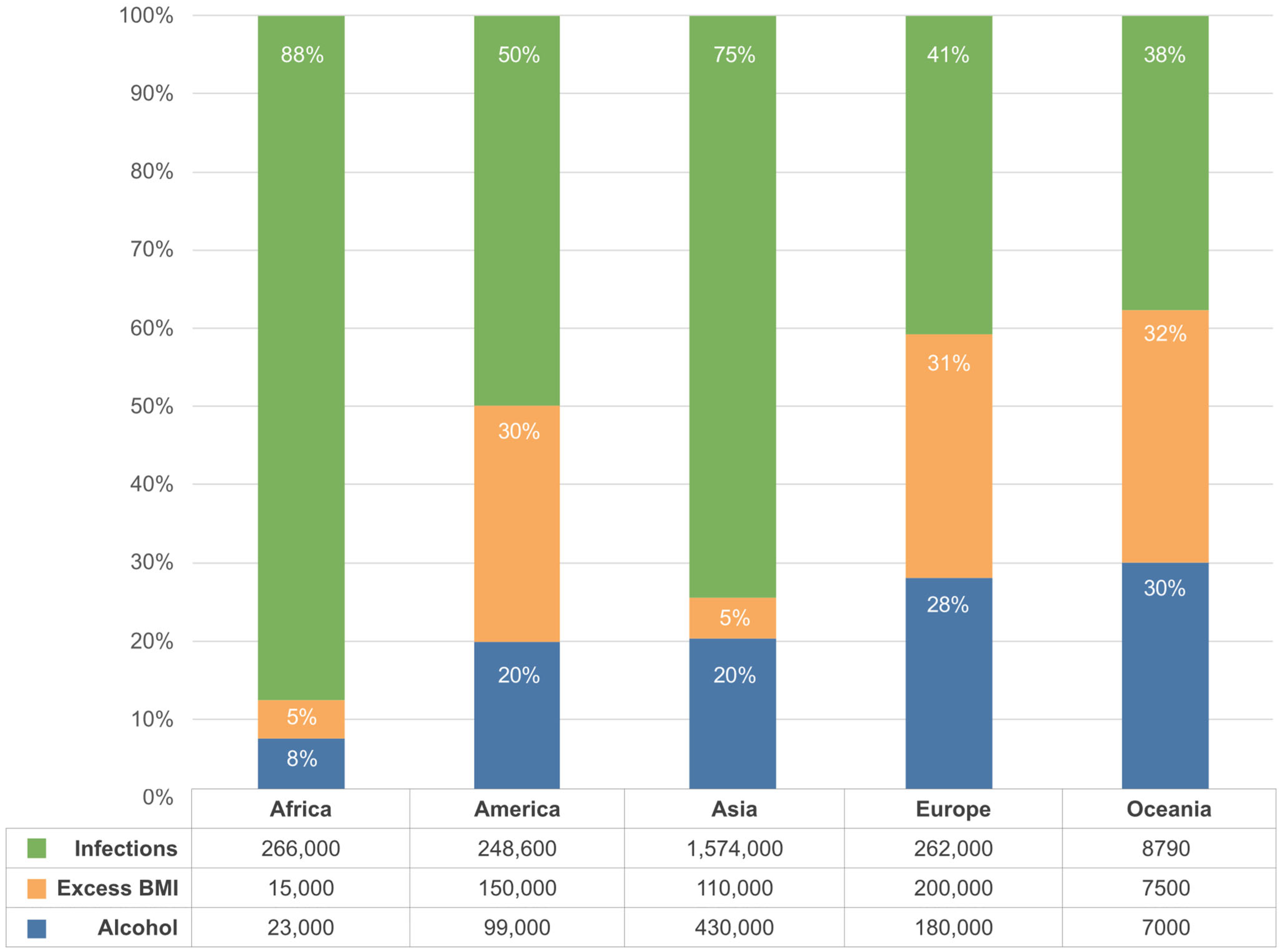
In low- or middle-income countries, infection-related cancers account for a substantial share of the burden, particularly cervical, liver, and gastric cancers linked to human papillomavirus (HPV), hepatitis B and C virus, and Helicobacter pylori [33]. Parasitic infections also play a role, with Schistosoma haematobium associated with bladder cancer and liver flukes (Opisthorchis viverrini and Clonorchis sinensis) with cholangiocarcinoma [31]. Globally, infectious agents are estimated to cause about 15% of all new cancer cases annually, with two-thirds occurring in low- and middle-income settings [32]. Cancers of the cervix, liver and stomach accounted for 2.5 million new cases globally in 2022, representing one in eight diagnoses and nearly one in five cancer deaths [23]. In contrast, high-income countries show a predominance of cancers associated with western lifestyle factors—such as lung, female breast, colorectal, and prostate cancer [33]—driven by obesity, physical inactivity, diet, smoking, alcohol, and reproductive patterns [27,28,29]. Figure 1 illustrates the estimated number of new cancer cases in 2020 attributable to alcohol consumption, excess high body mass index (BMI) and infections, stratified by continent [36,37,38].
However, in the last decade, low- and middle-income countries are experiencing an epidemiological transition with a change in the profile of the most common cancer types [33]. As the socioeconomic conditions and developmental status of these countries improve, there is a shift from a predominance of infection-related cancers to an increasing burden of cancers associated with western lifestyle risk factors and population aging [30,34]. In 2019, nearly half of global cancer deaths were attributed to modifiable risk factors, with smoking, alcohol consumption and high BMI being the leading contributors, while unsafe sex predominated in countries with low socio-demographic index [30]. Importantly, tobacco use remains the single most preventable cause of death and disease, and a major driver of global health inequities [35].
Within this context, particular attention is given to lung cancer in men and breast cancer in women, the most frequently diagnosed cancers worldwide. Lung cancer remains the leading cause of cancer mortality, with 2.2 million new cases and 1.8 million deaths in 2020 [39], predominantly driven by tobacco use, which accounted for 2.5 million cancer deaths globally in 2019 [40]. While smoking prevalence and lung cancer rates are declining in high-income countries, they are rising in many middle-income countries and remain high in Asia and parts of Europe, reflecting the delayed implementation of effective tobacco control measures [40,41,42]. Breast cancer became the most frequently diagnosed cancer globally in 2020, with 2.3 million new cases and 685,000 deaths, showing an 88% higher incidence in high-income countries due to the prevalence of reproductive, hormonal, and lifestyle risk factors, as well as increased detection through screening programs [39]. However, mortality is 17% higher in low- and middle-income countries, reflecting inequities in healthcare access and early detection [39]. The rising incidence in transitioning regions, such as South America, Africa, and Asia, reflects shifts in lifestyle and sociocultural norms, marked by women’s increasing participation in the workforce and greater access to birth control [41]. Additionally, increased life expectancy, obesity, and westernized dietary habits are further amplifying breast cancer risk. These evolving trends highlight the importance of integrating breast cancer prevention and control into broader public health strategies that consider social, cultural, and economic contexts [43].
Cancer is a leading cause of premature mortality [44]. In 2020, an estimated 183 million years of life lost (YLLs) were attributed to premature cancer death, of which two-thirds considered preventable, and one-third considered treatable. Lung cancer was the leading contributor to preventable premature YLLs in medium- and high-income countries, whereas cervical cancer led in low-income countries. Colorectal and breast cancers were the major treatable cancers across all countries, underscoring the substantial potential for reducing cancer mortality through both preventative measures and curative interventions [45].
Global cancer incidence and mortality patterns are heterogeneous and strongly influenced by levels of human development. Populations transitioning from lower to higher development levels show a decline in infection-related cancers, offset by a rise in cancers associated with westernized lifestyles and the tobacco epidemic [39]. Although the absolute burden is expected to remain higher in high-income countries due to aging populations, the fastest growth in incidence is predicted in low- and middle-income countries, with projected increases in new cases of 142% and 99% by 2050, respectively [23]. Without effective control strategies that prioritize both prevention and treatment, these increases could severely strain healthcare systems in economically fragile regions already challenged by limited resources and humanitarian crises [46]. Importantly, these comparisons are based on population-level data and should not be interpreted as reflecting individual-level risk or causal relationships. Differences observed across development levels may be influenced by multiple contextual factors, including healthcare access, diagnostic capacity, demographic structure, and exposure distributions.
The escalating global cancer burden is driven by population growth and aging, alongside shifts in exposure to risk factors often linked to socioeconomic development. Globally, the burden of cancer is significant in every country, regardless of development level, and is expected to continue rising in the future.

5. Economic Burden of Cancer

Cancer management is often linked to substantial financial burdens. These arise from direct costs, including expenses for diagnostics, treatments, and hospitalizations, as well as indirect costs from lost productivity due to morbidity and premature mortality, collectively exerting significant economic pressure [17,47,48,49]. The rising costs of innovative treatments combined with improved survival and an aging population further amplify the financial toxicity of cancer care [50].
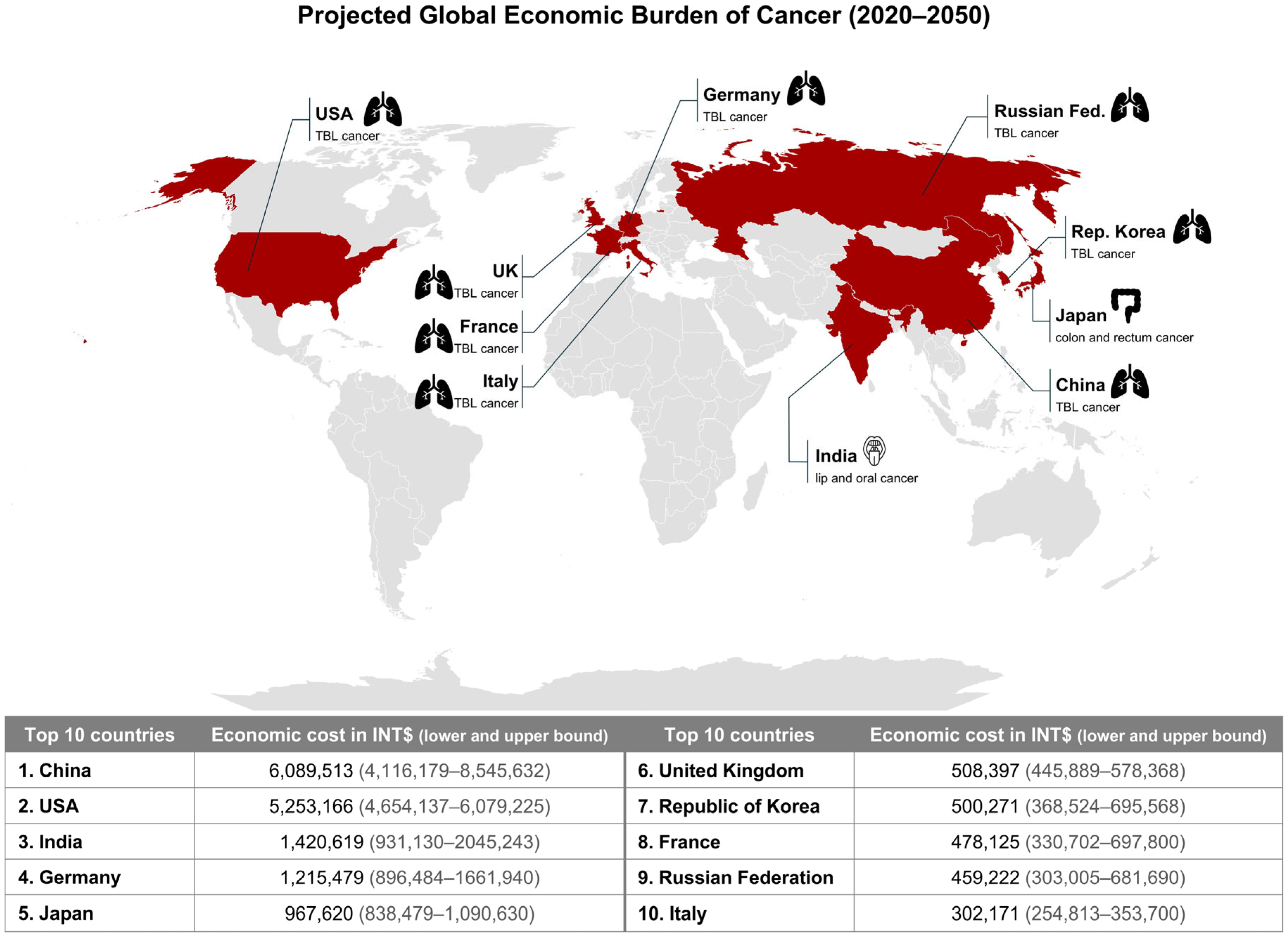
The global economic burden of cancer from 2020 to 2050 was estimated to be INT $25.2 trillion. China bears the highest economic cost of cancer, estimated at INT $6.1 trillion, followed by the United States of America at INT $5.3 trillion and India at INT $1.4 trillion (Figure 2). The three cancers with the highest economic burden were lung cancer (INT $3.9 trillion), colorectal cancer (INT $2.8 trillion) and breast cancer (INT $2.0 trillion) [16]. However, such estimates are influenced by healthcare system capacity, expenditure patterns, and modelling assumptions, and should therefore be interpreted cautiously rather than as direct measures of prevention needs or opportunities.
The economic burden of cancer varies, not only by cancer type but also across income groups. High-income countries faced an economic loss of INT $12.8 trillion, equivalent to INT $10,294 per capita. In contrast, lower-income countries incurred a substantially smaller burden of INT $168 billion, translating to a per capita loss of INT $174 [16]. While high-income countries incur the greatest macroeconomic costs, low- and middle-income countries bear most of the human burden, compounded by the lack of infrastructure, inadequate funding, and limited access to affordable treatments [51]. Particularly in low-income countries, investing in cancer care delivers substantial health and economic benefits [52].
Individually, cancer patients often face financial challenges due to direct medical and non-medical costs associated with diagnosis, treatment, and follow-up [53], as well as indirect costs from reduced productivity or job loss [48,54]. They are 71% more likely than the general population to experience a severe adverse financial event [55]. This phenomenon, known as financial toxicity, negatively affects both survival outcomes [56] and quality of life [57], as it encompasses multiple domains: the psychological domain, contributing to anxiety, depression, and fatigue [58]; the behavioral domain, leading to reduced adherence to treatment due to high costs [59]; and the material domain, manifesting as housing and food insecurity [60]. With the rising costs of cancer care, it is imperative for clinicians, oncology organizations, and health systems to collaborate in raising awareness and alleviating the financial burden on patients.
Tobacco, the leading preventable cause of cancer worldwide [61], represented, in 2012, a total economic cost, including healthcare expenses and productivity losses, estimated at US $1436 billion [62]. It is estimated that if China, the world’s largest producer and consumer of tobacco, implemented a comprehensive tobacco control measures it could save US $1 trillion between 2015 and 2030, accounting for the preventable burden of non-communicable diseases (NCDs) attributable to tobacco use, including cancer [63].
Investing in prevention guided by One Health principles is projected to significantly reduce the costs associated with crisis response [64]. Prioritizing effective health interventions to mitigate the cancer burden is essential to ensuring economic stability.

6. Prevent and Control Cancer

To curb the anticipated rise in cancer incidence and costs, it is essential to prioritize strategies that promote access to comprehensive and cost-effective cancer prevention, early diagnosis, treatment, and survivorship and palliative care.
Cancer control is a growing global health priority, prompting international organizations to set measurable goals and implement strategies to reduce incidence, improve outcomes, and address care disparities. In May 2017, governments reaffirmed this commitment by adopting World Health Assembly Cancer Resolution 70.12. The WHO’s Global Action Plan for the Prevention and Control of NCDs 2013–2030 set a target of reducing premature mortality from NCDs, including cancer, by 33.3% by 2030. The European Commission developed the Europe’s Beating Cancer Plan supports Member States to address the cancer care continuum through research and innovation. At the 77th World Health Assembly in June 2024, priorities were reiterated: strengthening health systems; addressing modifiable risk factors (regulation and taxation particularly of tobacco, alcohol, and unhealthy foods); tackling social, environmental, and commercial determinants of cancer; addressing the cancer workforce crisis; accelerating cervical cancer elimination; reducing financial burdens; and investing in research, innovative, and digital health [65].
Prevention, encompassing its five levels, is an effective strategy for cancer control, with up to half of all cancers being preventable [66]. Although such estimates are useful to illustrate the potential preventable burden of cancer, they should be interpreted cautiously, as results may vary according to expo-sure prevalence, modelling assumptions, causal frameworks, counterfactual scenarios, and source populations across studies. Primordial prevention addresses the underlying social, environmental, and economic determinants of health to reduce risk factors. Primary prevention lowers risk through lifestyle modifications, elimination of carcinogenic exposures, like tobacco, alcohol and air pollution, health promotion strategies and proactive health measures such as healthy eating, exercise, vaccination, risk-reducing surgeries, and chemoprevention. Secondary prevention enables early detection through screening and treatment of precancerous lesions. Tertiary prevention improves quality of life by minimizing treatment toxicities, reducing disability and enhancing survivorship or palliative care. Quaternary prevention protects against unnecessary interventions, avoiding harm from overdiagnosis or overtreatment of low-risk conditions [67].
Tobacco smoking is a major preventable contributor to cancer morbidity and premature mortality [68]. Classified by the International Agency for Research on Cancer (IARC) as carcinogen, it is linked to multiple cancers, including cancers of the head and neck, lung, esophagus, stomach, colorectum, pancreas, uterine cervix, kidney, renal pelvis, ureter, and urinary bladder, chronic myeloid leukemia and acute myeloid leukemia [69]. Countries implementing strong tobacco control measures, particularly under the WHO Framework Convention on Tobacco Control, have achieved marked declines in smoking prevalence. Effective strategies include higher taxation, smoke-free legislation, public education, advertising bans, health warnings or standardized packaging, and access to cessation and rehabilitation treatments. Strengthening these measures could prevent approximately 1.65 million lung cancer cases over 20 years, representing 19.8% of projected new lung cancer cases in men and 23.2% in women [70]. Among modifiable risk factors, tobacco cessation offers the greatest potential for cancer prevention, capable of averting millions of deaths annually.
Alcohol has been classified as a carcinogen by the IARC since 1988, with sufficient evidence linking its consumption to hepatocellular carcinoma, esophageal squamous cell carcinoma, oral cavity, pharynx, larynx, colorectal, and breast cancer [69]. Globally, alcohol consumption is associated with approximately 740,000 new cancer cases annually [71]. In the European Union, light to moderate alcohol consumption caused nearly 23,000 new cancer cases in 2017, representing 13.3% of all alcohol-related cancers, with almost half occurring in women with breast cancer [72]. While traditionally more common in men, alcohol consumption, particularly binge drinking, is rising among women [73]. There is no evidence that alcohol’s purported cardiovascular benefits mitigate cancer risk, nor is there a safe threshold of consumption below which the carcinogenic effects of alcohol are absent [74]. Complementing efforts to enhance health literacy, the WHO’s Less Alcohol Unit focuses on addressing the underlying factors that influence the acceptability, availability, and affordability of alcohol. These efforts aim to accelerate the adoption of high-impact interventions as part of the Global Strategy to Reduce the Harmful Use of Alcohol.
Cervical cancer illustrates the effectiveness of integrated prevention. HPV infection causes 99% of cases [75], making it highly preventable through primordial prevention (promote health literacy encouraging safe sex practices), primary prevention (HPV vaccination), secondary prevention (population-based screening programs and treatment of precancerous lesions), and tertiary prevention (treatment of early-stage disease). The Europe’s Beating Cancer Plan targets 90% HPV vaccination coverage for girls and increased coverage in boys by 2030. The WHO aims to eliminate cervical cancer as a public health problem by reducing incidence to below 4 per 100,000 women [76]. However, prevention is unevenly implemented, with low-income countries bearing a disproportionate burden, where the incidence and mortality rates exceed the threshold set by the WHO [77]. Beyond HPV, approximately 90% of other infection-related cancers worldwide are attributed to Helicobacter pylori, hepatitis B virus (HBV), and hepatitis C virus (HCV), all preventable or treatable through vaccination, treatment and behavioral interventions that limit their transmission [78].
Addressing the commercial determinants of health is essential for cancer prevention. A WHO Regional Office for Europe report shows that harmful products, (including tobacco, alcohol, ultra-processed foods, sugar-sweetened beverages, and fossil fuels) and associated industry practices contribute significantly to rising cancer and NCD rates. These factors cause approximately 2.7 million deaths annually, equivalent to over 7400 daily deaths, accounting for nearly 25% of all deaths in the WHO European Region. The report calls for strong financial reforms and strict regulation to curb industry influence [79].
While several modifiable cancer risk factors are well-documented, advancing prevention requires stronger political commitment. Improving health literacy, especially among young people, is pivotal in promoting behavioral changes that reduce cancer risk, including minimizing tobacco and alcohol use, maintaining a healthy lifestyle through diet and exercise, practicing safe sex, protecting against sun exposure, and participating in routine cancer screening programs [80].
The 2021 NCD Country Capacity Survey assessed global progress in NCD prevention and control. Taxation on alcohol and tobacco was reported by 97% and 88% of countries, respectively. National screening programs for breast and cervical cancer were reported by 63% and 69% of countries, respectively, but were far more common in high-income settings. Access to cancer diagnosis and treatment improved modestly, yet inequalities remained. Radiotherapy was accessible in only 26% of low-income countries compared to 89% of high-income countries, while cancer centers or specialized departments were present in 56% and 93% of these countries, respectively. The availability of palliative care was globally limited, with community- or home-based care reported by 43% of countries [81]. A WHO survey revealed significant gaps in cancer care coverage, with only 39% of countries providing essential cancer management within universal health coverage and just 28% including palliative care [51]. These disparities drive excess morbidity, mortality, and financial hardship, underscoring the urgent need for increased investment in comprehensive cancer services.
While addressing modifiable cancer risk factors is essential for fostering a healthier society, it will not eliminate the cancer burden, since incidence is closely linked to aging. Projections suggest that even with a hypothetical total elimination of smoking, obesity, and alcohol consumption, the incidence of breast and colorectal cancers would remain unchanged by 2050 compared to 2021. This outcome reflects the overwhelming influence of demographic shift, which surpasses the potential of prevention efforts [82]. As population aging drives cancer incidence, control strategies must extend beyond risk reduction to include early diagnosis and effective, accessible, and affordable treatments for all patients. Additionally, in ageing populations, competing risks of death may attenuate the observable impact of preventive interventions on absolute cancer risk, highlighting the need for nuanced interpretation of prevention benefits.
Clinicians, as independent stakeholders in the healthcare system, play a role in advocating for optimal patient outcomes and ensuring that cancer control strategies reflect local realities, including prevalent cancer types and available resources. The European Society for Medical Oncology (ESMO) Leaders Generation Program has outlined national-level priorities for policymakers, health planners, clinicians, patients, and civil society to improve global access to high-quality cancer care [83]. In preparation for the 2025 UN High-level Meeting on NCD prevention and control, ESMO issued further recommendations to accelerate cancer prevention and equitable care. Key actions include: promoting universal health coverage to ensure equitable access without imposing financial hardship on patients; comprise cancer services into health emergency and pandemic preparedness; strengthening the oncology workforce through education, training and retention; enhancing diversity and inclusivity in clinical trials; securing public funding for independent research; and advancing prevention through stricter tobacco and alcohol control, expanded HPV and HBV vaccination, and air quality legislation aligning with the WHO recommendations to lower the annual limit value for fine particulate matter (PM2.5) to 5 μg/m3.
Research investment is essential for driving innovation in oncology. While clinical trials are widely acknowledged as a pivotal tool for advancing patient care and expediting the development and commercialization of groundbreaking treatments, patient enrolment remains below 5% [84]. In November 2024, EU Member States endorsed the Budapest Declaration on the New European Competitiveness Deal, committing to allocate 3% of GDP to research and development by 2030.
To effectively reduce the global burden of cancer, it is crucial to recognize that a substantial proportion of cancers are preventable and that prevention strategies are both impactful and cost-effective. Cancer control policies should therefore be tailored to regional needs and allocate balanced investments across prevention, treatment, and palliative care to maximize health outcomes and reduce cancer-related morbidity and mortality.

7. Cancer Through the One Health Lens

The One Health concept meets the challenges of modern medicine by providing a holistic approach to understand diseases arising from the complex connections among humans, animals, and the environment. A key challenge in operationalizing the One Health framework in oncology lies in the methodological integration of data across these three domains. Integrated exposure modelling approaches can combine environmental monitoring data with individual- and population-level health information to better characterize cumulative and interacting determinants of cancer risk. Complementing this, cross-species surveillance can identify shared cancer patterns and sentinel events in animal populations that may signal environmental hazards relevant to humans. Translational epidemiology further strengthens this framework by linking findings from experimental models and veterinary oncology with human studies, improving inference regarding carcinogenic mechanisms. Together, these integrative methodologies allows a more comprehensive understanding of cancer and support more informed policy design, enabling alignment of environmental regulation, occupational safety measures, and public health interventions based on converging evidence across systems [85].

7.1. Environmental Health and Cancer

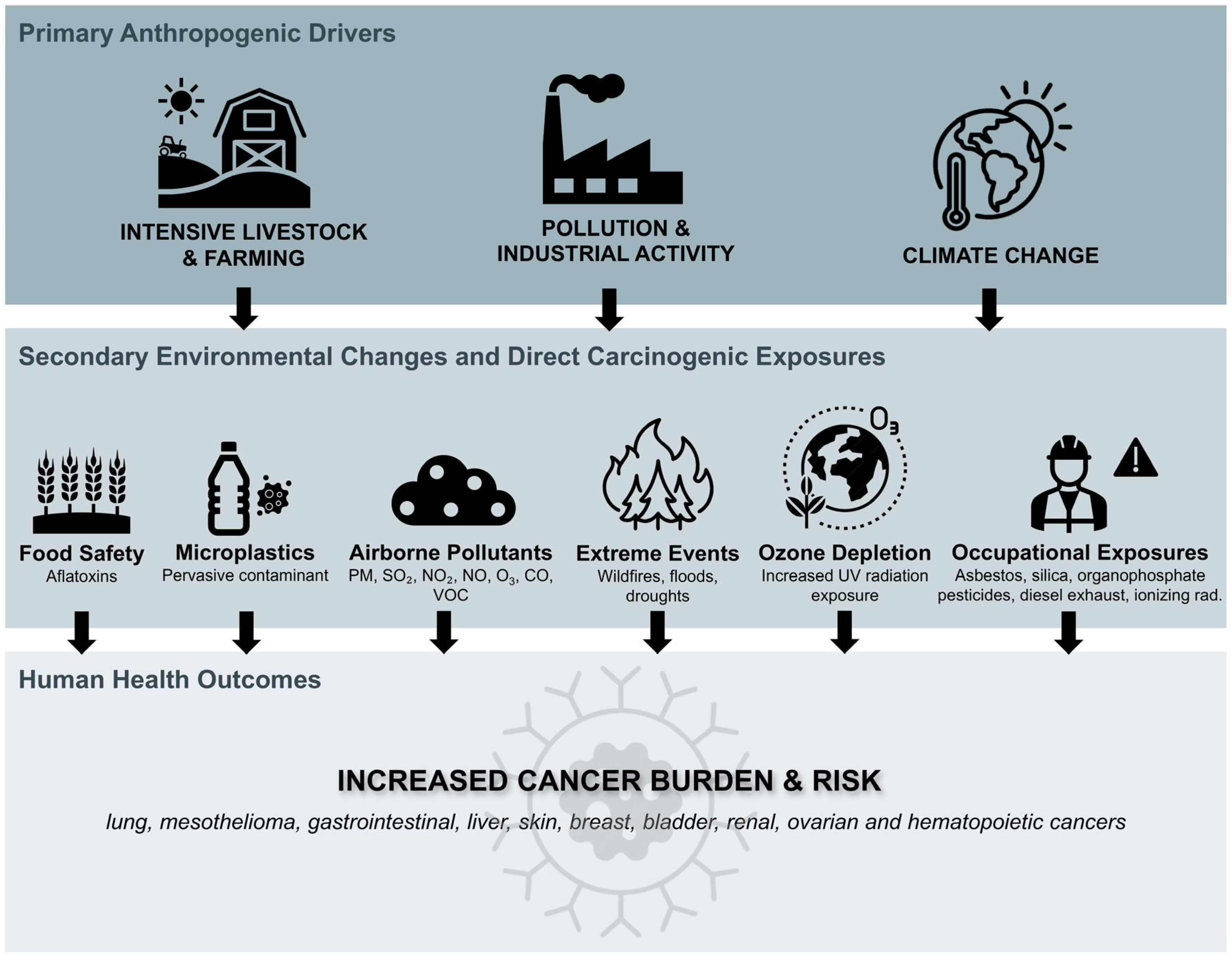
Cancer development is increasingly recognized as influenced by environmental factors. A One Health perspective underscores the interplay between environmental changes and cancer risk, revealing how disruptions to ecosystems and exposure to carcinogenic substances contribute to disease (Figure 3).

7.1.1. Climate Change

The impact of climate change on climate-sensitive infectious diseases, food security, and undernutrition are well documented [86]; however, its effects on chronic diseases such as cancer remain less clear. Greenhouse gases released into the atmosphere by human activities are the primary drivers of global warming, causing a steady increase in the Earth’s surface temperature [87]. This leads to a cascade of environmental shifts such as sea-level rise, droughts, floods, wildfires, and extreme weather events, which indirectly affect cancer risk factors such as air pollution, ultraviolet radiation exposure, food and water insecurity, while also facilitating the spread of infections by carcinogenic agents. These effects are mainly linked to cancers of the lung, upper respiratory tract, skin, gastrointestinal tract, and liver [15]. The resulting strain on healthcare systems is expected to difficult access to health care and disrupt essential resources for effective cancer control [88]. Furthermore, cancer patients are a vulnerable population to the health threats of climate change due to the physical, psychological, and socioeconomic consequences of cancer diagnosis and treatment [89].

7.1.2. Air Pollution

Outdoor air pollution is classified by the IARC as a Group 1 carcinogen. Household air pollution from burning of coal is also classified as a Group 1 carcinogen, and household burning of biomass fuel as Group 2A. Major ambient air pollutants, largely from fossil and biomass fuel combustion, include particulate matter (PM), sulfur dioxide, nitrogen dioxide, nitrogen oxide, carbon monoxide, ozone and volatile organic compounds [90]. PM encompasses a wide range of chemically and physically varied aerosols comprising solid particles or liquid droplets suspended in the air. Fine particulate matter (PM2.5), defined as airborne particles or droplets with an aerodynamic diameter ≤ 2.5 µm, is primarily originated from combustion and poses significant health risks due to its toxic compounds, such as heavy metals, and its ability to penetrate deep into the respiratory tract and interact with mucosal surfaces [91]. PM2.5 exposure patterns vary with sociodemographic development. Household air pollution is higher at lower social development index (SDI) and declines as sociodemographic conditions improve. In contrast, ambient PM rises with industrialization and subsequently declines as air quality management measures are implemented at higher SDI levels [30]. The Global Burden of Disease Study 2019 identified air pollution as one of the top five leading causes of attributable deaths worldwide [30]. Short-term exposure to PM2.5 and PM10 is linked to cardiovascular, respiratory, and cerebrovascular mortality [92]. Furthermore, several meta-analyses of cohort studies reported significant adverse associations between PM2.5 exposure and lung cancer incidence and mortality [90,93,94,95]. A mechanistic basis for PM2.5 driven lung cancer, particularly among never-smokers and in the absence of classical carcinogen-driven mutagenesis, has been proposed [96]. Additionally, air pollution exposure in lung cancer patients worsens clinical outcomes, increasing hospital admissions [97] and reducing survival in early stage non-small cell lung cancer [98]. Beyond lung cancer, systemic absorption of pollutants suggests possible associations with other cancers, including breast [99,100,101], bladder [102], brain [103], gastric [104], and hematopoietic cancers [105], though evidence remains less robust. The WHO’s 2021 air quality guideline recommends that annual average PM2.5 concentrations not exceed 5 µg/m3, yet most urban populations live in areas exceeding this threshold [106]. It is estimated that nearly one-third of PM2.5-attributable deaths between 2000 and 2019 could have been prevented if cities had met the previous WHO 2005 guideline of 10 μg/m3 [107]. Given the link between rising PM2.5 concentrations and cancer burden a comprehensive public health strategy is essential to both mitigate emissions and prevent pollution-related cancer.

7.1.3. Occupational Exposures

Estimating the cancer burden attributed to occupational exposures is challenging due to exposure variability, long latency periods between exposure and cancer development, and the lack of comprehensive data, particularly in low- and middle-income countries [108]. From 1990 to 2017, asbestos, silica, and diesel engine exhaust were the three leading occupational carcinogens [109]. Certain associations between exposures and specific cancers are well-established, including asbestos with mesothelioma, lung, laryngeal, and ovarian cancers [110]; arsenic with bladder, kidney, skin, liver, and colon cancers [111], and ionizing radiation with multiple cancer types [112]. Pesticides are widely used, resulting in significant occupational and environmental exposure globally. Research conducted mostly in vitro and animal models demonstrated the carcinogenic potential of pesticides, revealing their capacity to induce genotoxicity, hormone disruption, oxidative stress, inflammation, and immune modulation [113,114]. In 2017, the IARC classified five organophosphate pesticides (tetrachlorvinphos, parathion, malathion, diazinon and glyphosate) as probably (Group 2A) or possibly carcinogenic to humans (Group 2B). Despite subsequent high-quality studies, evidence in human carcinogenicity remains incomplete, and numerous potentially carcinogenic pesticides were not included in the IARC assessment [115]. Identifying such chemicals is a public health priority to guide regulatory actions in order to reduce cancer incidence.

7.1.4. Microplastics

The widespread distribution of microplastics, defined as plastic particles smaller than 5 mm, is well-documented, with their presence confirmed across all environmental compartments, including marine and freshwater ecosystems, soils, atmosphere, and biota [116], and entering the food chain [117], particularly through plastic food-contact materials [118]. Microplastics pose a threat not only to the environment, but also to human health. Human exposure occurs mainly via ingestion, inhalation, and dermal contact [119]. Once internalized, microplastics can damage cell membranes, impair detoxifying mechanisms, induce oxidative stress, inflammation, genotoxicity, metabolic disruption, and cell death. These effects are often interconnected, reflecting the complex interplay of microplastic-induced cytotoxicity [119,120,121]. Although the cytotoxic effects of microplastics are well-established, growing concerns about their carcinogenic potential have prompted active research. Experimental studies have identified several mechanisms that may be associated with carcinogenic processes, including: persistence and bioaccumulation within biological systems [122,123]; size-dependent reactive oxygen species generation and subsequent DNA damage [124]; epigenetic regulation through DNA methylation, histone modifications, and non-coding RNA regulation, which modulate gene expression patterns associated with cancer initiation and progression [125,126]; chronic inflammation and immune modulation that reshape the tumor microenvironment while impairing immune surveillance [127,128]; endocrine disruption with potential links to hormone-related cancers [129,130]; and enhance cell migration, potentially facilitating metastasis [123]. The presence of microplastics in tumor cells has also been associated with disease progression in breast cancer, ovarian cancer, gastric cancer, cutaneous squamous cell carcinoma [131,132,133,134,135] and with treatment resistance in gastric cancer [136]. Most evidence derives from in vitro on human cell lines or in vivo on animal models, with scarce human exposure data particularly among occupationally exposed populations [137]. Emerging observational data exploring proxy exposure pathways, such as bottled water consumption, suggest potential population-level exposure patterns associated with selected non-cancer health outcomes, although no causal relationship with cancer has been established to date [138]. Comprehensive risk assessment of microplastics and their potential impact on cancer remains incomplete, hindering timely decision-making for health policies and effective mitigation strategies.

7.1.5. Ultraviolet Radiation

The cause–effect relationship between increased exposure to ultraviolet (UV) radiation and the rising incidence of squamous cell carcinoma, basal cell carcinoma, and melanoma is well-established [139]. Since 1992, the IARC has classified solar and UV radiation as Group 1 carcinogens. While skin cancer risk increases with age, cumulative lifetime UV exposure remains the main driver [140]. UV radiation promotes tumorigenesis through gene mutations, epigenetic alterations, and immunosuppression [141]. Ozone depletion, driven by anthropogenic atmospheric emissions of aerosols such as chlorofluorocarbons, has led to increased UV radiation exposure at the Earth’s surface, significantly contributing to the global burden of skin cancer [15]. In response to the urgent need to protect the stratospheric ozone layer, the 1987 Montreal Protocol on Substances That Deplete the Ozone Layer was enacted. Since its implementation, significant reductions in ozone-depleting substances have been observed [142], mitigating a projected increase of up to 2 million additional skin cancer cases by 2030 [143]. However, the persistence of long-lived compounds and the continued emissions of unregulated compounds like dichloromethane, delays ozone layer recovery until at least 2060, perpetuating the hazard posed by increased UV radiation for several decades [144]. Additionally, there is an interplay between climate change and ozone depletion that influences climate patterns and UV radiation intensity. For instance, reduced cloud cover and higher UV irradiance at lower latitudes are expected to exacerbate the incidence of skin cancer in these regions [145]. Beyond skin cancer, UV radiation and ozone depletion adversely affect ocular health, immune system function, and ecosystems, thereby threatening food security and exacerbating climate-related health challenges [144]. Moreover, rising temperatures linked to climate change alter human behavior, increasing sun exposure through outdoor activities and reduced use of protective clothing, which further contributes to higher skin cancer incidence [146].

7.1.6. Nutrition and Food Safety

In relation to nutrition, a diet rich in whole grains, vegetables, fruit and beans is protective against cancer susceptibility, whereas consumption of red and processed meats, sugar-sweetened beverages, and alcohol, as well as body fatness and obesity resulting from unhealthy diet and physical inactivity, raises risk [147]. Concerns regarding health, food security, and environmental sustainability are increasingly associated with the production and consumption of red and processed meats. Over the past 50 years, global meat production and consumption have risen significantly and are projected to increase by an additional 50% by 2050 [148]. Intensive livestock farming contributes to unsustainable environmental consequences, including greenhouse gas emissions, excessive freshwater use, land degradation, and biodiversity loss [149]. While red meat provides essential nutrients, such as highly bioavailable iron and vitamin B12, excessive intake is linked to an elevated risk of NCDs, including cancer [149]. In 2015, IARC classified consumption of red meat as probably carcinogenic (Group 2A) and processed meat as carcinogenic to humans (Group 1), with strong evidence for colorectal cancer risk and growing evidence for breast, endometrial, esophageal squamous-cell carcinoma, lung, renal cell, and hepatocellular carcinomas, extending the range of risks initially reported by the IARC [150]. In the United States, a 30% reduction in processed meat consumption over a decade could prevent 53,300 cases of colorectal cancer and 16,700 deaths [151]. Strong evidence supports the protective effects of plant-based diets in reducing cancer incidence and mortality [152,153], as well as the harmful effects of high red and processed meat consumption. Dietary shifts limiting red and processed meats benefit both human health and environmental sustainability by reducing greenhouse gas emissions and improving food security particularly in vulnerable populations [154]. A modelling study estimated that by 2050, changes in food supply due to climate change, including reduced availability of fruits and vegetables, could result in approximately 534,000 global deaths, including deaths from cancer. Notably, the health impacts of dietary and weight-related factors linked to climate change may surpass other climate-related health challenges [155].
In the context of food safety, mycotoxins illustrate how food safety intersects with cancer risk. Produced by fungi such as Aspergillus, Penicillium, and Fusarium, they thrive under warm and humid conditions, often exacerbated by monsoons, unseasonal rainfall during harvest, and flash floods [156]. Major mycotoxins, including aflatoxins, ochratoxins, fumonisins, deoxynivalenol, and zearalenone, frequently co-occur in contaminated food, amplifying their toxic effects through synergistic interactions [157]. Contamination can occur at any point in the food supply chain, from pre-harvest to processing and storage. Consumption of mycotoxin-contaminated food poses serious health risks to humans and animals, including acute and chronic effects such as hepatotoxicity, nephrotoxicity, neurotoxicity, immunotoxicity, and carcinogenicity, thus highlighting their critical impact on public health and food security [156]. Aflatoxins, produced by Aspergillus species, have been classified by IARC as carcinogenic to humans (Group 1), primarily due to their strong association with hepatocellular carcinoma. The interaction between mycotoxins and oncogenic viruses in human carcinogenesis has been documented, with aflatoxin B1 consistently associated with hepatocellular carcinoma in individuals infected with HBV [158]. Emerging evidence indicates that aflatoxins are likely to become a significant concern in regions previously unaffected, including Europe [159]. Climate change, through rising temperatures and water scarcity, is expected to increase the risk of aflatoxin contamination in maize throughout Southern and Central Europe within the next three decades, driven by environmental conditions favorable to Aspergillus flavus proliferation and subsequent aflatoxin B1 production. Additionally, climate change-induced abiotic stress is anticipated to weaken the resilience of crops, thereby making them more susceptible to fungal diseases [160,161]. Prevention, continuous monitoring, and detoxification strategies are essential to safeguard food safety, limit cancer risks, and protect vulnerable economies [162].

7.2. Animal Health and Cancer

The One Health perspective highlights how comparative oncology offers valuable insights into tumor biology and how microbiome research reveals promising biomarkers for early detection and treatment response.

7.2.1. Comparative Oncology

The biological complexity of cancer has driven the development of increasingly sophisticated experimental models. In vitro systems have evolved from simple 2D monolayer cell cultures and spheroid cultures to more advanced 3D organoid cultures and microfluidic models, such as tumor-on-a-chip platforms [163]. Similarly, in vivo models have progressed from patient cell line-derived xenografts in immunodeficient mice to patient-derived xenografts and genetically engineered mouse models to transgenic models in non-mouse species designed to develop tumors and naturally occurring tumors in companion animals [164].
Comparative oncology is a multidisciplinary field of research that studies naturally occurring cancers in animals, particularly companion animals, to gain insights into cancer biology, prevention, and treatment [165] (Table 2).
However, such estimates are influenced by healthcare system capacity, expenditure patterns, and modelling assumptions, and should therefore be interpreted cautiously rather than as direct measures of prevention needs or opportunities [171,176,177]. While murine models have been useful for studying cancer biology, they often fail to accurately reflect key characteristics of human cancers [178]. Pet dogs are among the most extensively studied models in comparative oncology research due to compelling factors: they exhibit a relatively high tumor incidence [179]; share significant histopathological characteristics with human cancers, including tumor heterogeneity and microenvironmental interactions, molecular and genetic features, such as tumorigenesis signaling pathways, oncogenic drivers, mutational profiles and epigenetic signatures [180,181]; demonstrate strong parallels in biological behavior, including patterns of response or resistance to conventional therapies, metastasis, and recurrence [11]; cancers occurring naturally in immunocompetent animal models experience complex interactions between the tumor and the immune system enabling the evaluation of immunotherapy targets and the assessment of efficacy [181]; and their cohabitation with humans exposes them to similar environmental risk factors, making them valuable sentinels for identifying potential environmental carcinogens [182,183].
Comparative oncology clinical trials are increasingly valued for their ability to rapidly evaluate drug safety and efficacy, leveraging the shorter lifespans of companion animals to accelerate drug evaluation, eliminating agents with poor therapeutic indices and prioritizing those likely to succeed in Phase I human trials. They also allow access to innovative treatment options for pets when conventional therapies are ineffective. These efforts ultimately advance both veterinary and human oncology [177,178]. A reverse-translational approach integrates naturally occurring animal cancers into preclinical research and applies human data to improve veterinary care, promoting efficient, bidirectional knowledge exchange [184].
The interdisciplinary field of comparative oncology bridges human and veterinary medicine, providing a unique platform to investigate carcinogenesis across species. By integrating scientific findings from both domains, researchers can uncover molecular and genetic profiles that lead to the identification of novel therapeutic targets and the development of innovative treatments, ultimately benefiting both humans and animals. This approach has already yielded insights into tumor biology and has accelerated the translation of research findings into clinical practice [165,177].

7.2.2. Microbiome

The human microbiome refers to the collective genome of microorganisms, including bacteria, fungi, viruses, and archaea that colonize the human body. Its metagenome exceeds the human genome by approximately 100-fold, providing vast genetic and functional diversity [185]. Moreover, microbiome composition is highly individualized, varying not only between individuals but also within a single person over time, influenced by factors such as age, environment, and health status [186].
In healthy states, the microbiota engages in a symbiotic relationship with the host, contributing to physiological processes such as digestion, metabolism, and immune system regulation [187,188,189]. However, disruptions from infection [190], antibiotic overuse [191], or unhealthy lifestyle behaviors, including diets high in processed foods and low in fiber, physical inactivity and nicotine exposure [192], can cause microbial dysbiosis, an imbalance linked to chronic inflammation, immune evasion, and oncogenic metabolites, which collectively promote carcinogenesis [193]. Low-biomass microbial populations have been detected in previously considered sterile tissues, such as the pancreas and liver, highlighting their potential influence on cancer biology [193].
Certain microorganisms are recognized as key contributors to carcinogenesis: Helicobacter pylori is strongly linked to gastric cancer, primarily through its ability to induce chronic inflammation and disrupt cellular signaling; Fusobacterium nucleatum, pathogenic Escherichia coli, and enterotoxigenic Bacteroides fragilis are implicated in colorectal cancer; and Salmonella enterica has been associated with gallbladder cancer [193]. Dysbiosis has also been linked to the onset and progression of lung cancer [194], head and neck squamous cell carcinoma [195], and breast cancer [196]. Furthermore, the intratumoral microbiome, comprising distinct microbial ecosystems within tumor tissues that vary across cancer types [197], appears to be organized in microniches that interact with immune and epithelial cells that support cancer progression [198], and may influence treatment efficacy and prognosis [199,200]. However, the directionality and causality of these associations remain uncertain and may be influenced by confounding factors.
While dysbiosis may lead to drug resistance, a healthy microbiome can enhance treatment efficacy. Efforts to modulate the microbiome as a therapeutic strategy are actively being explored, including fecal microbiota transplantation, probiotics, prebiotics, antibiotics, phage therapy, and dietary interventions [193,201]. Microbial signatures are emerging as promising biomarkers for early cancer detection, prognosis, and treatment stratification in colorectal [202], lung [203], and breast cancers [204].
The field of cancer microbiome research holds immense potential for advancing diagnostics and therapeutics. Microbial signatures in tumors and body fluids could serve as biomarkers for early cancer detection, while microbiome-targeting therapies offer opportunities to optimize treatment efficacy. Despite these promising developments, significant challenges remain in clarifying the causal relationships between microbiota and cancer, emphasizing the need for further research to fully harness the potential of this emerging field [201].

8. Conclusions and Future Directions

The global burden of cancer is escalating driven by demographic changes, persistent exposure to modifiable risk factors, and widening disparities in prevention and care. This growing burden places substantial pressure on health systems, economies, and societies worldwide. A One Health perspective provides a comprehensive framework to address the multifactorial nature of cancer, recognizing the interconnected influences of human behavior, environmental change, microbial ecosystems, and cross-species insights from comparative oncology. Effective implementation of One Health strategies requires coordinated governance that bridges research, policy, and clinical practice, ensuring that scientific advances translate into meaningful public health outcomes. For clinicians, adopting a One Health perspective implies expanding their role beyond individual patient care to include active participation in prevention, interdisciplinary collaboration, and public health advocacy. This includes promoting lifestyle modifications, recognizing environmental and occupational risk factors, supporting vaccination and screening programs, and contributing to the translation of One Health evidence into clinical practice and public health action. Future research should focus on developing integrative methodologies, including cross-species surveillance, exposure modelling, and translational epidemiology, to better understand complex carcinogenic pathways. Through transdisciplinary collaboration, this approach has the potential to strengthen cancer prevention, control, and management while developing evidence-based strategies that simultaneously protect human, animal, and environmental health.

Author Contributions

Conceptualization, S.A.C.D., R.P.-L. and F.L.Q.; methodology, S.A.C.D., R.P.-L. and F.L.Q.; validation, S.A.C.D., R.P.-L. and F.L.Q.; investigation (literature review), S.A.C.D. and F.L.Q.; resources, S.A.C.D., R.P.-L. and F.L.Q.; data curation, S.A.C.D., R.P.-L. and F.L.Q.; writing—original draft preparation, S.A.C.D.; writing—review and editing, S.A.C.D., R.P.-L. and F.L.Q.; visualization, S.A.C.D.; supervision, R.P.-L. and F.L.Q.; project administration, S.A.C.D., R.P.-L. and F.L.Q.; funding acquisition, F.L.Q. All authors have read and agreed to the published version of the manuscript.

Funding

This research was funded by the Fundação para a Ciência e a Tecnologia (FCT) under the scope of project UID/00772/2025, DOI https://doi.org/10.54499/UID/00772/2025.

Institutional Review Board Statement

Not applicable.

Informed Consent Statement

Not applicable.

Data Availability Statement

No new data were created or analyzed in this study.

Conflicts of Interest

The authors declare no conflicts of interest.

Abbreviations

The following abbreviations are used in this manuscript:
BMIBody Mass Index
CDCCenters for Disease Control and Prevention
COVID-19Coronavirus Disease 2019
DNADeoxyribonucleic Acid
ESMOEuropean Society for Medical Oncology
FAOFood and Agriculture Organization of the United Nations
GDPGross Domestic Product
HBVHepatitis B Virus
HCVHepatitis C Virus
HDIHuman Development Index
HPVHuman Papillomavirus
IARCInternational Agency for Research on Cancer
INT $International dollars at constant 2017 prices
MeSHMedical Subject Headings
NCDNon-communicable Diseases
OHHLEPOne Health High-Level Expert Panel
PMParticulate Matter
PM2.5Fine Particulate Matter
PM10Particulate Matter with an aerodynamic diameter ≥ 10 µg
RNARibonucleic Acid
SDISocial Development Index
TBLTracheal, Bronchus, and Lung
UNUnited Nations
UNDPUnited Nations Development Program
UNEPUnited Nations Environment Program
UNICEFUnited Nations International Children’s Emergency Fund
UNSICUnited Nations System Influenza Coordination
UVUltraviolet
UKUnited Kingdom
USAUnited States of America
WHOWorld Health Organization
WOAHWorld Organization for Animal Health
YLLsYears of Life Lost

References

  1. Adisasmito, W.B.; Almuhairi, S.; Behravesh, C.B.; Bilivogui, P.; Bukachi, S.A.; Casas, N.; Becerra, N.C.; Charron, D.F.; Chaudhary, A.; Zanella, J.R.C. One Health: A new definition for a sustainable and healthy future. PLoS Pathog. 2022, 18, e1010537. [Google Scholar] [CrossRef]
  2. Mettenleiter, T.C.; Markotter, W.; Charron, D.F.; Adisasmito, W.B.; Almuhairi, S.; Behravesh, C.B.; Bilivogui, P.; Bukachi, S.A.; Casas, N.; Becerra, N.C. The one health high-level expert panel (OHHLEP). One Health 2023, 5, 18. [Google Scholar] [CrossRef] [PubMed]
  3. Gabor, C.R.; Kivlin, S.N.; Hua, J.; Bickford, N.; Reiskind, M.O.B.; Wright, T.F. Understanding organismal capacity to respond to anthropogenic change: Barriers and solutions. Integr. Comp. Biol. 2021, 61, 2132–2144. [Google Scholar] [CrossRef]
  4. World Health Organization. A Health Perspective on the Role of the Environment in One Health; (WHO/EURO:2022-5290-45054-64214); Licence: CC BY-NC-SA 3.0 IGO; WHO Regional Office for Europe: Copenhagen, Denmark, 2022. [Google Scholar]
  5. Giraudeau, M.; Sepp, T.; Ujvari, B.; Ewald, P.W.; Thomas, F. Human activities might influence oncogenic processes in wild animal populations. Nat. Ecol. Evol. 2018, 2, 1065–1070. [Google Scholar] [CrossRef]
  6. Baines, C.; Lerebours, A.; Thomas, F.; Fort, J.; Kreitsberg, R.; Gentes, S.; Meitern, R.; Saks, L.; Ujvari, B.; Giraudeau, M. Linking pollution and cancer in aquatic environments: A review. Environ. Int. 2021, 149, 106391. [Google Scholar] [CrossRef]
  7. Parida, L.; Patel, T.N. Systemic impact of heavy metals and their role in cancer development: A review. Environ. Monit. Assess. 2023, 195, 766. [Google Scholar] [CrossRef]
  8. Ashraf, S.A.; Mahmood, D.; Abd Elmoneim, O.E.; Siddiqui, A.J.; Khan, M.I.; Ashfaq, F.; Patel, M.; Snoussi, M.; Kieliszek, M.; Adnan, M. Exposure to pesticide residues in honey and its potential cancer risk assessment. Food Chem. Toxicol. 2023, 180, 114014. [Google Scholar] [CrossRef] [PubMed]
  9. Liang, H.; Zhou, X.; Zhu, Y.; Li, D.; Jing, D.; Su, X.; Pan, P.; Liu, H.; Zhang, Y. Association of outdoor air pollution, lifestyle, genetic factors with the risk of lung cancer: A prospective cohort study. Environ. Res. 2023, 218, 114996. [Google Scholar] [CrossRef]
  10. Sun, M.; Fritz, J.; Häggström, C.; Bjørge, T.; Nagel, G.; Manjer, J.; Engeland, A.; Zitt, E.; van Guelpen, B.; Stattin, P. Metabolically (un) healthy obesity and risk of obesity-related cancers: A pooled study. JNCI J. Natl. Cancer Inst. 2023, 115, 456–467. [Google Scholar] [CrossRef]
  11. Schiffman, J.D.; Breen, M. Comparative oncology: What dogs and other species can teach us about humans with cancer. Philos. Trans. R. Soc. B Biol. Sci. 2015, 370, 20140231. [Google Scholar] [CrossRef] [PubMed]
  12. Seluanov, A.; Gladyshev, V.N.; Vijg, J.; Gorbunova, V. Mechanisms of cancer resistance in long-lived mammals. Nat. Rev. Cancer 2018, 18, 433–441. [Google Scholar] [CrossRef]
  13. Sepp, T.; Ujvari, B.; Ewald, P.W.; Thomas, F.; Giraudeau, M. Urban environment and cancer in wildlife: Available evidence and future research avenues. Proc. R. Soc. B 2019, 286, 20182434. [Google Scholar] [CrossRef]
  14. Dujon, A.M.; Ujvari, B.; Thomas, F. Cancer risk landscapes: A framework to study cancer in ecosystems. Sci. Total Environ. 2021, 763, 142955. [Google Scholar] [CrossRef]
  15. Hiatt, R.A.; Beyeler, N. Cancer and climate change. Lancet Oncol. 2020, 21, e519–e527. [Google Scholar] [CrossRef]
  16. Chen, S.; Cao, Z.; Prettner, K.; Kuhn, M.; Yang, J.; Jiao, L.; Wang, Z.; Li, W.; Geldsetzer, P.; Bärnighausen, T. Estimates and projections of the global economic cost of 29 cancers in 204 countries and territories from 2020 to 2050. JAMA Oncol. 2023, 9, 465–472. [Google Scholar] [CrossRef]
  17. Hofmarcher, T.; Lindgren, P.; Wilking, N.; Jönsson, B. The cost of cancer in Europe 2018. Eur. J. Cancer 2020, 129, 41–49. [Google Scholar] [CrossRef]
  18. Zinsstag, J.; Schelling, E.; Waltner-Toews, D.; Tanner, M. From “one medicine” to “one health” and systemic approaches to health and well-being. Prev. Vet. Med. 2011, 101, 148–156. [Google Scholar] [CrossRef]
  19. Food and Agriculture Organization of the United Nations; World Organisation for Animal Health; World Health Organization; United Nations Children’s Fund; The World Bank, United Nations System Influenza Coordinator. Contributing to One World, One Health: A Strategic Framework for Reducing Risks of Infectious Diseases at the Animal–Human–Ecosystems Interface. 14 October 2008. Available online: https://openknowledge.fao.org/items/7eae6352-bbc9-497d-b6e4-d808c13641b1 (accessed on 25 January 2024).
  20. Food and Agriculture Organization of the United Nations (FAO); United Nations Environment Programme (UNEP); World Health Organization (WHO); World Organisation for Animal Health (WOAH). One Health Joint Plan of Action (2022–2026): Working Together for the Health of Humans, Animals, Plants and the Environment; FAO: Rome, Italy, 2022. [Google Scholar] [CrossRef]
  21. Food and Agriculture Organization of the United Nations (FAO). Taking a Multisectoral, One Health Approach: A Tripartite Guide to Addressing Zoonotic Diseases in Countries; FAO: Rome, Italy, 2019; Available online: https://www.fao.org/3/cd0473en/cd0473en.pdf (accessed on 25 January 2024).
  22. American Cancer Society. Cancer Atlas, 3rd ed.; American Cancer Society: Atlanta, GA, USA, 2019; Available online: https://canceratlas.cancer.org (accessed on 27 January 2024).
  23. Bray, F.; Laversanne, M.; Sung, H.; Ferlay, J.; Siegel, R.L.; Soerjomataram, I.; Jemal, A. Global cancer statistics 2022: GLOBOCAN estimates of incidence and mortality worldwide for 36 cancers in 185 countries. CA A Cancer J. Clin. 2024, 74, 229–263. [Google Scholar] [CrossRef]
  24. International Agency for Research on Cancer (IARC). Cancer Today: Globocan 2022 (Version 1.1) [Internet]; IARC: Lyon, France, 2024; Available online: https://gco.iarc.fr/today/en/dataviz/pie-prevalence?mode=population&types=2&group_populations=0&populations=981_982_983_984 (accessed on 7 November 2025).
  25. International Agency for Research on Cancer (IARC). Cancer Tomorrow: Globocan 2022 (Version 1.1) [Internet]; IARC: Lyon, France, 2024; Available online: https://gco.iarc.fr/tomorrow/en/dataviz/tables?populations=981_982_983_984&years=2050 (accessed on 7 November 2025).
  26. International Agency for Research on Cancer (IARC). Cancer Today: Globocan 2022 (Version 1.1) [Internet]; IARC: Lyon, France, 2024; Available online: https://gco.iarc.fr/today/en/dataviz/pie?mode=cancer&group_populations=1&populations=981_982_983_984&types=0 (accessed on 7 November 2025).
  27. Lu, L.; Mullins, C.S.; Schafmayer, C.; Zeißig, S.; Linnebacher, M. A global assessment of recent trends in gastrointestinal cancer and lifestyle-associated risk factors. Cancer Commun. 2021, 41, 1137–1151. [Google Scholar] [CrossRef]
  28. Nabila, S.; Choi, J.-Y.; Abe, S.K.; Islam, M.R.; Rahman, M.S.; Saito, E.; Shin, A.; Merritt, M.A.; Katagiri, R.; Shu, X.-O. Differential patterns of reproductive and lifestyle risk factors for breast cancer according to birth cohorts among women in China, Japan and Korea. Breast Cancer Res. 2024, 26, 15. [Google Scholar] [CrossRef]
  29. Ziglioli, F.; Patera, A.; Isgrò, G.; Campobasso, D.; Guarino, G.; Maestroni, U. Impact of modifiable lifestyle risk factors for prostate cancer prevention: A review of the literature. Front. Oncol. 2023, 13, 1203791. [Google Scholar] [CrossRef]
  30. GBD 2019 Cancer Risk Factors Collaborators. The global burden of cancer attributable to risk factors, 2010–19: A systematic analysis for the Global Burden of Disease Study 2019. Lancet 2022, 400, 563–591. [Google Scholar] [CrossRef]
  31. Machicado, C.; Marcos, L.A. Carcinogenesis associated with parasites other than Schistosoma, Opisthorchis and Clonorchis: A systematic review. Int. J. Cancer 2016, 138, 2915–2921. [Google Scholar] [CrossRef] [PubMed]
  32. Plummer, M.; de Martel, C.; Vignat, J.; Ferlay, J.; Bray, F.; Franceschi, S. Global burden of cancers attributable to infections in 2012: A synthetic analysis. Lancet Glob. Health 2016, 4, e609–e616. [Google Scholar] [CrossRef]
  33. Bray, F.; Jemal, A.; Grey, N.; Ferlay, J.; Forman, D. Global cancer transitions according to the Human Development Index (2008–2030): A population-based study. Lancet Oncol. 2012, 13, 790–801. [Google Scholar] [CrossRef]
  34. Maule, M.; Merletti, F. Cancer transition and priorities for cancer control. Lancet Oncol. 2012, 13, 745–746. [Google Scholar] [CrossRef] [PubMed]
  35. Shibuya, K.; Ciecierski, C.; Guindon, E.; Bettcher, D.W.; Evans, D.B.; Murray, C.J. WHO Framework Convention on Tobacco Control: Development of an evidence based global public health treaty. BMJ 2003, 327, 154–157. [Google Scholar] [CrossRef]
  36. International Agency for Research on Cancer. Global Cancer Observatory: Cancer Attributable to Obesity [Internet]; IARC: Lyon, France, 2025; Available online: https://gco.iarc.fr/causes/obesity/tools-bars (accessed on 7 November 2025).
  37. International Agency for Research on Cancer. Global Cancer Observatory: Cancer Attributable to Alcohol [Internet]; IARC: Lyon, France, 2025; Available online: https://gco.iarc.fr/causes/alcohol/tools-bars?mode=1&sex=0&population=900&population_group=4&country=4&continent=0&cancer=40&key=attr_cases&lock_scale=0&nb_results=10&age_group=3&colored=1 (accessed on 7 November 2025).
  38. International Agency for Research on Cancer. Global Cancer Observatory: Cancer Attributable to Infections [Internet]; IARC: Lyon, France, 2025; Available online: https://gco.iarc.fr/causes/infections/tools-bars?mode=1&sex=0&population=continent&country=4&continent=0&agent=0&cancer=0&key=attr_cases&lock_scale=0&nb_results=10 (accessed on 7 November 2025).
  39. Sung, H.; Ferlay, J.; Siegel, R.L.; Laversanne, M.; Soerjomataram, I.; Jemal, A.; Bray, F. Global cancer statistics 2020: GLOBOCAN estimates of incidence and mortality worldwide for 36 cancers in 185 countries. CA A Cancer J. Clin. 2021, 71, 209–249. [Google Scholar] [CrossRef] [PubMed]
  40. Sharma, R.; Rakshit, B. Global burden of cancers attributable to tobacco smoking, 1990–2019: An ecological study. EPMA J. 2023, 14, 167–182. [Google Scholar] [CrossRef]
  41. Bray, F.; Soerjomataram, I. The changing global burden of cancer: Transitions in human development and implications for cancer prevention and control. In Cancer: Disease Control Priorities, 3rd ed.; Gelband, H., Jha, P., Sankaranarayanan, R., Horton, S., Eds.; The International Bank for Reconstruction and Development/The World Bank: Washington, DC, USA, 2015; Volume 3, Chapter 2. [Google Scholar] [CrossRef]
  42. World Health Organization. WHO Global Report on Trends in Prevalence of Tobacco Use 2000–2030; Licence: CC BY-NC-SA 3.0 IGO; World Health Organization: Geneva, Switzerland, 2024; Available online: https://www.who.int/publications/i/item/9789240088283 (accessed on 7 November 2025).
  43. Brinton, L.; Gaudet, M.; Gierach, G. Breast Cancer. In Cancer Epidemiology and Prevention, 4th ed.; Thun, M., Linet, M.S., Cerhan, J.R., Haiman, C.A., Schottenfeld, D., Eds.; Oxford University Press: Oxford, UK, 2018; pp. 861–888. [Google Scholar]
  44. Bray, F.; Laversanne, M.; Weiderpass, E.; Soerjomataram, I. The ever-increasing importance of cancer as a leading cause of premature death worldwide. Cancer 2021, 127, 3029–3030. [Google Scholar] [CrossRef]
  45. Frick, C.; Rumgay, H.; Vignat, J.; Ginsburg, O.; Nolte, E.; Bray, F.; Soerjomataram, I. Quantitative estimates of preventable and treatable deaths from 36 cancers worldwide: A population-based study. Lancet Glob. Health 2023, 11, e1700–e1712. [Google Scholar] [CrossRef]
  46. Burki, T. Non-communicable diseases in humanitarian settings. Lancet Oncol. 2024, 25, 422. [Google Scholar] [CrossRef]
  47. Bradley, C.J.; Yabroff, K.R.; Dahman, B.; Feuer, E.J.; Mariotto, A.; Brown, M.L. Productivity costs of cancer mortality in the United States: 2000–2020. JNCI J. Natl. Cancer Inst. 2008, 100, 1763–1770. [Google Scholar] [CrossRef] [PubMed]
  48. Hanly, P.; Soerjomataram, I.; Sharp, L. Measuring the societal burden of cancer: The cost of lost productivity due to premature cancer-related mortality in Europe. Int. J. Cancer 2015, 136, E136–E145. [Google Scholar] [CrossRef]
  49. Ortega-Ortega, M.; Hanly, P.; Pearce, A.; Soerjomataram, I.; Sharp, L. Projected impact on labour productivity costs of cancer-related premature mortality in Europe 2018–2040. Appl. Health Econ. Health Policy 2023, 21, 877–889. [Google Scholar] [CrossRef]
  50. Khan, H.M.; Ramsey, S.; Shankaran, V. Financial toxicity in cancer care: Implications for clinical care and potential practice solutions. J. Clin. Oncol. 2023, 41, 3051–3058. [Google Scholar] [CrossRef]
  51. World Health Organization. WHO Global Survey on the Inclusion of Cancer Care in Health-Benefit Packages 2020–2021; Licence: CC BY-NC-SA 3.0 IGO; World Health Organization: Geneva, Switzerland, 2024. [Google Scholar] [CrossRef]
  52. Ward, Z.J.; Scott, A.M.; Hricak, H.; Atun, R. Global costs, health benefits, and economic benefits of scaling up treatment and imaging modalities for survival of 11 cancers: A simulation-based analysis. Lancet Oncol. 2021, 22, 341–350. [Google Scholar] [CrossRef]
  53. Lee, S.; Olvera, R.G.; Shiu-Yee, K.; Rush, L.J.; Tarver, W.L.; Blevins, T.; McAlearney, A.S.; Andersen, B.L.; Paskett, E.D.; Carson, W.E. Short-term and long-term financial toxicity from breast cancer treatment: A qualitative study. Support. Care Cancer 2024, 32, 24. [Google Scholar] [CrossRef]
  54. de Boer, A.G.; Taskila, T.; Ojajńrvi, A.; Van Dijk, F.J.; Verbeek, J.H. Cancer survivors and unemployment: A meta-analysis and meta-regression. JAMA Oncol. 2009, 301, 753–762. [Google Scholar] [CrossRef] [PubMed]
  55. Shankaran, V.; Li, L.; Fedorenko, C.; Sanchez, H.; Du, Y.; Khor, S.; Kreizenbeck, K.; Ramsey, S. Risk of adverse financial events in patients with cancer: Evidence from a novel linkage between cancer registry and credit records. J. Clin. Oncol. 2022, 40, 884–891. [Google Scholar] [CrossRef]
  56. Yabroff, K.R.; Han, X.; Song, W.; Zhao, J.; Nogueira, L.; Pollack, C.E.; Jemal, A.; Zheng, Z. Association of medical financial hardship and mortality among cancer survivors in the United States. JNCI J. Natl. Cancer Inst. 2022, 114, 863–870. [Google Scholar] [CrossRef] [PubMed]
  57. Pangestu, S.; Rencz, F. Comprehensive score for financial toxicity and health-related quality of life in patients with cancer and survivors: A systematic review and meta-analysis. Value Health 2023, 26, 300–316. [Google Scholar] [CrossRef] [PubMed]
  58. Dee, E.C.; Nipp, R.D.; Muralidhar, V.; Yu, Z.; Butler, S.S.; Mahal, B.A.; Nguyen, P.L.; Sanford, N.N. Financial worry and psychological distress among cancer survivors in the United States, 2013–2018. Support. Care Cancer 2021, 29, 5523–5535. [Google Scholar] [CrossRef] [PubMed]
  59. Doshi, J.A.; Li, P.; Huo, H.; Pettit, A.R.; Armstrong, K.A. Association of patient out-of-pocket costs with prescription abandonment and delay in fills of novel oral anticancer agents. J. Clin. Oncol. 2018, 36, 476–482. [Google Scholar] [CrossRef]
  60. Fan, Q.; Keene, D.E.; Banegas, M.P.; Gehlert, S.; Gottlieb, L.M.; Yabroff, K.R.; Pollack, C.E. Housing insecurity among patients with cancer. JNCI J. Natl. Cancer Inst. 2022, 114, 1584–1592. [Google Scholar] [CrossRef]
  61. Wild, C.P.; Weiderpass, E.; Stewart, B.W. World Cancer Report: Cancer Research for Cancer Prevention; IARC: Lyon, France, 2020. [Google Scholar]
  62. Goodchild, M.; Nargis, N.; d’Espaignet, E.T. Global economic cost of smoking-attributable diseases. Tob. Control 2018, 27, 58–64. [Google Scholar] [CrossRef]
  63. Chen, S.; Kuhn, M.; Prettner, K.; Bloom, D.E. Noncommunicable diseases attributable to tobacco use in China: Macroeconomic burden and tobacco control policies. Health Aff. 2019, 38, 1832–1839. [Google Scholar] [CrossRef]
  64. World Bank. Putting Pandemics Behind Us: Investing in One Health to Reduce Risks of Emerging Infectious Diseases [Internet]; World Bank: Washington, DC, USA, 2022; Available online: https://documents.worldbank.org/en/publication/documents-reports/documentdetail/099125010162240946/p17840200ca7ff098091b7014001a08952e (accessed on 7 November 2025).
  65. Casolino, R.; Mikkelsen, B.; Ilbawi, A. Elevating cancer on the global health agenda: Towards the fourth High-level Meeting on NCDs 2025. Ann. Oncol. 2024, 35, 933–935. [Google Scholar] [CrossRef]
  66. Vineis, P.; Wild, C.P. Global cancer patterns: Causes and prevention. Lancet Glob. Health 2014, 383, 549–557. [Google Scholar] [CrossRef]
  67. Rebbeck, T.R. Precision prevention of cancer. Cancer Epidemiol. Biomark. Prev. 2014, 23, 2713–2715. [Google Scholar] [CrossRef]
  68. Kulhánová, I.; Forman, D.; Vignat, J.; Espina, C.; Brenner, H.; Storm, H.H.; Bauld, L.; Soerjomataram, I. Tobacco-related cancers in Europe: The scale of the epidemic in 2018. Eur. J. Cancer 2020, 139, 27–36. [Google Scholar] [CrossRef]
  69. International Agency for Research on Cancer. List of Classifications by Cancer Sites with Sufficient or Limited Evidence in Humans; IARC Monographs: Lyon, France, 2024. [Google Scholar]
  70. Gredner, T.; Mons, U.; Niedermaier, T.; Brenner, H.; Soerjomataram, I. Impact of tobacco control policies implementation on future lung cancer incidence in Europe: An international, population-based modeling study. Lancet Reg. Health–Eur. 2021, 4, 100074. [Google Scholar] [CrossRef]
  71. Rumgay, H.; Shield, K.; Charvat, H.; Ferrari, P.; Sornpaisarn, B.; Obot, I.; Islami, F.; Lemmens, V.E.; Rehm, J.; Soerjomataram, I. Global burden of cancer in 2020 attributable to alcohol consumption: A population-based study. Lancet Oncol. 2021, 22, 1071–1080. [Google Scholar] [CrossRef]
  72. Rovira, P.; Rehm, J. Estimation of cancers caused by light to moderate alcohol consumption in the European Union. Eur. J. Public Health 2021, 31, 591–596. [Google Scholar] [CrossRef]
  73. Grucza, R.A.; Sher, K.J.; Kerr, W.C.; Krauss, M.J.; Lui, C.K.; McDowell, Y.E.; Hartz, S.; Virdi, G.; Bierut, L.J. Trends in adult alcohol use and binge drinking in the early 21st-century United States: A meta-analysis of 6 National Survey Series. Alcohol. Clin. Exp. Res. 2018, 42, 1939–1950. [Google Scholar] [CrossRef]
  74. Anderson, B.O.; Berdzuli, N.; Ilbawi, A.; Kestel, D.; Kluge, H.P.; Krech, R.; Mikkelsen, B.; Neufeld, M.; Poznyak, V.; Rekve, D. Health and cancer risks associated with low levels of alcohol consumption. Lancet Public Health 2023, 8, e6–e7. [Google Scholar] [CrossRef] [PubMed]
  75. Marth, C.; Landoni, F.; Mahner, S.; McCormack, M.; Gonzalez-Martin, A.; Colombo, N. Cervical cancer: ESMO Clinical Practice Guidelines for diagnosis, treatment and follow-up. Ann. Oncol. 2017, 28, iv72–iv83. [Google Scholar] [CrossRef] [PubMed]
  76. World Health Organization. Global Strategy to Accelerate the Elimination of Cervical Cancer as a Public Health Problem [Internet]; World Health Organization: Geneva, Switzerland, 2020; Available online: https://www.who.int/publications/i/item/9789240014107 (accessed on 7 November 2025).
  77. Singh, D.; Vignat, J.; Lorenzoni, V.; Eslahi, M.; Ginsburg, O.; Lauby-Secretan, B.; Arbyn, M.; Basu, P.; Bray, F.; Vaccarella, S. Global estimates of incidence and mortality of cervical cancer in 2020: A baseline analysis of the WHO Global Cervical Cancer Elimination Initiative. Lancet Glob. Health 2023, 11, e197–e206. [Google Scholar] [CrossRef]
  78. de Martel, C.; Georges, D.; Bray, F.; Ferlay, J.; Clifford, G.M. Global burden of cancer attributable to infections in 2018: A worldwide incidence analysis. Lancet Glob. Health 2020, 8, e180–e190. [Google Scholar] [CrossRef]
  79. World Health Organization; Regional Office for Europe. Commercial Determinants of Noncommunicable Diseases in the WHO European Region; Licence: CC BY-NC-SA 3.0 IGO; WHO Regional Office for Europe: Copenhagen, Denmark, 2024. [Google Scholar]
  80. Stein, C.; Colditz, G. Modifiable risk factors for cancer. Br. J. Cancer 2004, 90, 299–303. [Google Scholar] [CrossRef] [PubMed]
  81. World Health Organization. Assessing National Capacity for the Prevention and Control of Noncommunicable Diseases: Report on 2023 Global Survey; Licence: CC BY-NC-SA 3.0 IGO; World Health Organization: Geneva, Switzerland, 2025. [Google Scholar]
  82. Palshof, F.K.; Mørch, L.S.; Køster, B.; Engholm, G.; Storm, H.H.; Andersson, T.M.-L.; Kroman, N. Non-preventable cases of breast, prostate, lung, and colorectal cancer in 2050 in an elimination scenario of modifiable risk factors. Sci. Rep. 2024, 14, 8577. [Google Scholar] [CrossRef] [PubMed]
  83. Prager, G.W.; Braga, S.; Bystricky, B.; Qvortrup, C.; Criscitiello, C.; Esin, E.; Sonke, G.S.; Martínez, G.; Frenel, J.-S.; Karamouzis, M. Global cancer control: Responding to the growing burden, rising costs and inequalities in access. ESMO Open 2018, 3, e000285. [Google Scholar] [CrossRef]
  84. Bloomberg New Economy International Cancer Coalition; Adewole, T.; Albrecht, B.; Beg, S.; Brawley, O.; Chang, I.-F.; Daly, B.; de Claro, A.; Dent, J.; Dickler, M.; et al. Advancing Global Health Equity in Oncology Clinical Trial Access. Cancer Discov. 2024, 14, 2317–2323. [Google Scholar] [CrossRef] [PubMed]
  85. Kostadinov, K.; Iskrov, G.; Musurlieva, N.; Stefanov, R. An Evaluation of Rare Cancer Policies in Europe: A Survey Among Healthcare Providers. Cancers 2025, 17, 164. [Google Scholar] [CrossRef] [PubMed]
  86. Watts, N.; Amann, M.; Arnell, N.; Ayeb-Karlsson, S.; Belesova, K.; Boykoff, M.; Byass, P.; Cai, W.; Campbell-Lendrum, D.; Capstick, S. The 2019 report of The Lancet Countdown on health and climate change: Ensuring that the health of a child born today is not defined by a changing climate. Lancet 2019, 394, 1836–1878. [Google Scholar] [CrossRef]
  87. Bilgili, M.; Tumse, S.; Nar, S. Comprehensive Overview on the Present State and Evolution of Global Warming, Climate Change, Greenhouse Gasses and Renewable Energy. Arab. J. Sci. Eng. 2024, 49, 14503–14531. [Google Scholar] [CrossRef]
  88. Al-Marwani, S. Climate change impact on the healthcare provided to patients. Bull. Natl. Res. Cent. 2023, 47, 51. [Google Scholar] [CrossRef]
  89. Nogueira, L.M.; Crane, T.E.; Ortiz, A.P.; D’Angelo, H.; Neta, G. Climate Change and Cancer. Cancer Epidemiol. Biomark. Prev. 2023, 32, 869–875. [Google Scholar] [CrossRef]
  90. Karimi, B.; Samadi, S. Long-term exposure to air pollution on cardio-respiratory, and lung cancer mortality: A systematic review and meta-analysis. J. Environ. Health Sci. Eng. 2024, 22, 75–95. [Google Scholar] [CrossRef]
  91. Turner, M.C.; Andersen, Z.J.; Baccarelli, A.; Diver, W.R.; Gapstur, S.M.; Pope, C.A., III; Prada, D.; Samet, J.; Thurston, G.; Cohen, A. Outdoor air pollution and cancer: An overview of the current evidence and public health recommendations. CA Cancer J. Clin. 2020, 70, 460–479. [Google Scholar] [CrossRef]
  92. Orellano, P.; Reynoso, J.; Quaranta, N.; Bardach, A.; Ciapponi, A. Short-term exposure to particulate matter (PM10 and PM2.5), nitrogen dioxide (NO2), and ozone (O3) and all-cause and cause-specific mortality: Systematic review and meta-analysis. Environ. Int. 2020, 142, 105876. [Google Scholar] [CrossRef]
  93. Pope, C.A., III; Coleman, N.; Pond, Z.A.; Burnett, R. Fine particulate air pollution and human mortality: 25+ years of cohort studies. Environ. Res. 2020, 183, 108924. [Google Scholar] [CrossRef]
  94. Chen, J.; Atkinson, R.W.; Andersen, Z.J.; Oftedal, B.; Stafoggia, M.; Lim, Y.-H.; Bekkevold, T.; Krog, N.H.; Renzi, M.; Zhang, J. Long-term exposure to ambient air pollution and risk of lung cancer—A comparative analysis of incidence and mortality in four administrative cohorts in the ELAPSE study. Environ. Res. 2024, 263, 120236. [Google Scholar] [CrossRef]
  95. Ramamoorthy, T.; Nath, A.; Singh, S.; Mathew, S.; Pant, A.; Sheela, S.; Kaur, G.; Sathishkumar, K.; Mathur, P. Assessing the global impact of ambient air pollution on cancer incidence and mortality: A comprehensive meta-analysis. JCO Glob. Oncol. 2024, 10, e2300427. [Google Scholar] [CrossRef] [PubMed]
  96. Swanton, C.; Hill, W.; Lim, E.; Lee, C.; Weeden, C.; Augustine, M.; Chen, K.; Kuan, F.; Marongiu, F.; Rodrigues, F. LBA1 Mechanism of action and an actionable inflammatory axis for air pollution induced non-small cell lung cancer: Towards molecular cancer prevention. Ann. Oncol. 2022, 33, S1413. [Google Scholar] [CrossRef]
  97. Yazdi, M.D.; Wang, Y.; Di, Q.; Zanobetti, A.; Schwartz, J. Long-term exposure to PM2.5 and ozone and hospital admissions of Medicare participants in the Southeast USA. Environ. Int. 2019, 130, 104879. [Google Scholar] [CrossRef]
  98. Eckel, S.P.; Cockburn, M.; Shu, Y.-H.; Deng, H.; Lurmann, F.W.; Liu, L.; Gilliland, F.D. Air pollution affects lung cancer survival. Thorax 2016, 71, 891–898. [Google Scholar] [CrossRef]
  99. Cheng, I.; Tseng, C.; Wu, J.; Yang, J.; Conroy, S.M.; Shariff-Marco, S.; Li, L.; Hertz, A.; Gomez, S.L.; Le Marchand, L. Association between ambient air pollution and breast cancer risk: The multiethnic cohort study. Int. J. Cancer 2020, 146, 699–711. [Google Scholar] [CrossRef]
  100. Kayyal-Tarabeia, I.; Zick, A.; Kloog, I.; Levy, I.; Blank, M.; Agay-Shay, K. Beyond lung cancer: Air pollution and bladder, breast and prostate cancer incidence. Int. J. Epidemiol. 2024, 53, dyae093. [Google Scholar] [CrossRef]
  101. Wang, R.; Wang, P.; Zhou, Y.; Wang, Y.; Xu, C.; Wang, Z.; Wang, W. Association between long-term ambient air pollution exposure and the incidence of breast cancer: A meta-analysis based on updated evidence. Ecotoxicol. Environ. Saf. 2025, 289, 117472. [Google Scholar] [CrossRef] [PubMed]
  102. Li, J.; Deng, Z.; Soerensen, S.J.C.; Kachuri, L.; Cardenas, A.; Graff, R.E.; Leppert, J.T.; Langston, M.E.; Chung, B.I. Ambient air pollution and urological cancer risk: A systematic review and meta-analysis of epidemiological evidence. Nat. Commun. 2024, 15, 5116. [Google Scholar] [CrossRef]
  103. Shen, L.-T.; Ge, M.-W.; Hu, F.-H.; Jia, Y.-J.; Tang, W.; Zhang, W.-Q.; Zhao, D.-Y.; Shen, W.-Q.; Chen, H.-L. The connection between six common air pollution particles and adult brain tumors: A meta-analysis of 26,217,930 individuals. Environ. Sci. Pollut. Res. 2023, 30, 108525–108537. [Google Scholar] [CrossRef]
  104. Nagel, G.; Chen, J.; Jaensch, A.; Skodda, L.; Rodopoulou, S.; Strak, M.; de Hoogh, K.; Andersen, Z.J.; Bellander, T.; Brandt, J. Long-term exposure to air pollution and incidence of gastric and the upper aerodigestive tract cancers in a pooled European cohort: The ELAPSE project. Int. J. Cancer 2024, 154, 1900–1910. [Google Scholar] [CrossRef] [PubMed]
  105. Taj, T.; Chen, J.; Rodopoulou, S.; Strak, M.; de Hoogh, K.; Poulsen, A.H.; Andersen, Z.J.; Bellander, T.; Brandt, J.; Zitt, E. Long-term exposure to ambient air pollution and risk of leukemia and lymphoma in a pooled European cohort. Environ. Pollut. 2024, 343, 123097. [Google Scholar] [CrossRef] [PubMed]
  106. World Health Organization. WHO Global Air Quality Guidelines: Particulate Matter (PM2.5 and PM10), Ozone, Nitrogen Dioxide, Sulfur Dioxide and Carbon Monoxide; Licence: CC BY-NC-SA 3.0 IGO; World Health Organization: Geneva, Switzerland, 2021. [Google Scholar]
  107. Southerland, V.A.; Brauer, M.; Mohegh, A.; Hammer, M.S.; Van Donkelaar, A.; Martin, R.V.; Apte, J.S.; Anenberg, S.C. Global urban temporal trends in fine particulate matter (PM2.5) and attributable health burdens: Estimates from global datasets. Lancet Planet. Health 2022, 6, e139–e146. [Google Scholar] [CrossRef] [PubMed]
  108. Khoe, L.C.; Saldi, S.R.F.; Isbayuputra, M.; Mansyur, M.; Wiseman, V.; Asante, A. Global trends in occupational disease reporting: A systematic review. medRxiv 2024. [Google Scholar] [CrossRef]
  109. Li, N.; Zhai, Z.; Zheng, Y.; Lin, S.; Deng, Y.; Xiang, G.; Yao, J.; Xiang, D.; Wang, S.; Yang, P. Association of 13 occupational carcinogens in patients with cancer, individually and collectively, 1990–2017. JAMA Netw. Open 2021, 4, e2037530. [Google Scholar] [CrossRef]
  110. Li, X.; Su, X.; Wei, L.; Zhang, J.; Shi, D.; Wang, Z. Assessing trends and burden of occupational exposure to asbestos in the United States: A comprehensive analysis from 1990 to 2019. BMC Public Health 2024, 24, 1404. [Google Scholar] [CrossRef]
  111. Tchounwou, P.B.; Udensi, U.K.; Isokpehi, R.D.; Yedjou, C.G.; Kumar, S. Arsenic and cancer. In Handbook of Arsenic Toxicology; Elsevier: Amsterdam, The Netherlands, 2023; pp. 607–630. [Google Scholar] [CrossRef]
  112. Richardson, D.B.; Laurier, D.; Leuraud, K.; Gillies, M.; Haylock, R.; Kelly-Reif, K.; Bertke, S.; Daniels, R.D.; Thierry-Chef, I.; Moissonnier, M. Site-specific cancer mortality after low level exposure to ionizing radiation: Findings from an update of the International Nuclear workers Study (INWORKS). Am. J. Epidemiol. 2025, 194, 1285–1294. [Google Scholar] [CrossRef]
  113. Lanzarin, G.A.; Félix, L.M.; Fontaínhas-Fernandes, A.; Monteiro, S.M.; Venâncio, C. Effects of glyphosate or glyphosate-based herbicide during the zebrafish life cycle: A review addressing the mechanisms of toxicity. Water 2023, 15, 2276. [Google Scholar] [CrossRef]
  114. Martinek, R.; Lózsa, R.; Póti, Á.; Németh, E.; Várady, G.; Szabó, P.; Szüts, D. Comprehensive investigation of the mutagenic potential of six pesticides classified by IARC as probably carcinogenic to humans. Chemosphere 2024, 362, 142700. [Google Scholar] [CrossRef]
  115. Cavalier, H.; Trasande, L.; Porta, M. Exposures to pesticides and risk of cancer: Evaluation of recent epidemiological evidence in humans and paths forward. Int. J. Cancer 2023, 152, 879–912. [Google Scholar] [CrossRef]
  116. Allen, S.; Allen, D.; Karbalaei, S.; Maselli, V.; Walker, T.R. Micro (nano) plastics sources, fate, and effects: What we know after ten years of research. J. Hazard. Mater. Adv. 2022, 6, 100057. [Google Scholar] [CrossRef]
  117. Eze, C.G.; Nwankwo, C.E.; Dey, S.; Sundaramurthy, S.; Okeke, E.S. Food chain microplastics contamination and impact on human health: A review. Environ. Chem. Lett. 2024, 22, 1889–1927. [Google Scholar] [CrossRef]
  118. Shruti, V.; Kutralam-Muniasamy, G. Migration testing of microplastics in plastic food-contact materials: Release, characterization, pollution level, and influencing factors. TrAC Trends Anal. Chem. 2024, 170, 117421. [Google Scholar] [CrossRef]
  119. Khan, A.; Jia, Z. Recent insights into uptake, toxicity, and molecular targets of microplastics and nanoplastics relevant to human health impacts. Iscience 2023, 26, 106061. [Google Scholar] [CrossRef] [PubMed]
  120. Płuciennik, K.; Sicińska, P.; Misztal, W.; Bukowska, B. Important Factors Affecting Induction of Cell Death, Oxidative Stress and DNA Damage by Nano-and Microplastic Particles In Vitro. Cells 2024, 13, 768. [Google Scholar] [CrossRef]
  121. Shi, Q.; Tang, J.; Liu, R.; Wang, L. Toxicity in vitro reveals potential impacts of microplastics and nanoplastics on human health: A review. Crit. Rev. Environ. Sci. Technol. 2022, 52, 3863–3895. [Google Scholar] [CrossRef]
  122. Cetin, M.; Demirkaya Miloglu, F.; Kilic Baygutalp, N.; Ceylan, O.; Yildirim, S.; Eser, G.; Gul, H.İ. Higher number of microplastics in tumoral colon tissues from patients with colorectal adenocarcinoma. Environ. Chem. Lett. 2023, 21, 639–646. [Google Scholar] [CrossRef]
  123. Brynzak-Schreiber, E.; Schögl, E.; Bapp, C.; Cseh, K.; Kopatz, V.; Jakupec, M.A.; Weber, A.; Lange, T.; Toca-Herrera, J.L.; Del Favero, G. Microplastics role in cell migration and distribution during cancer cell division. Chemosphere 2024, 353, 141463. [Google Scholar] [CrossRef]
  124. Ding, R.; Chen, Y.; Shi, X.; Li, Y.; Yu, Y.; Sun, Z.; Duan, J. Size-dependent toxicity of polystyrene microplastics on the gastrointestinal tract: Oxidative stress related-DNA damage and potential carcinogenicity. Sci. Total Environ. 2024, 912, 169514. [Google Scholar] [CrossRef] [PubMed]
  125. Banikazemi, Z.; Farshadi, M.; Rajabi, A.; Homayoonfal, M.; Sharifi, N.; Chaleshtori, R.S. Nanoplastics: Focus on the role of microRNAs and long non-coding RNAs. Chemosphere 2022, 308, 136299. [Google Scholar] [CrossRef]
  126. Subramanian, D.; Manogaran, G.P.; Dharmadurai, D. A systematic review on the impact of micro-nanoplastics on human health: Potential modulation of epigenetic mechanisms and identification of biomarkers. Chemosphere 2024, 363, 142986. [Google Scholar] [CrossRef]
  127. Cheng, Y.; Yang, Y.; Bai, L.; Cui, J. Microplastics: An often-overlooked issue in the transition from chronic inflammation to cancer. J. Transl. Med. 2024, 22, 959. [Google Scholar] [CrossRef] [PubMed]
  128. Zhao, J.; Zhang, H.; Shi, L.; Jia, Y.; Sheng, H. Detection and quantification of microplastics in various types of human tumor tissues. Ecotoxicol. Environ. Saf. 2024, 283, 116818. [Google Scholar] [CrossRef]
  129. Doherty, L.F.; Bromer, J.G.; Zhou, Y.; Aldad, T.S.; Taylor, H.S. In utero exposure to diethylstilbestrol (DES) or bisphenol-A (BPA) increases EZH2 expression in the mammary gland: An epigenetic mechanism linking endocrine disruptors to breast cancer. Horm. Cancer 2010, 1, 146–155. [Google Scholar] [CrossRef]
  130. Winz, C.; Suh, N. Understanding the mechanistic link between bisphenol A and cancer stem cells: A cancer prevention perspective. J. Cancer Prev. 2021, 26, 18. [Google Scholar] [CrossRef]
  131. Wang, Y.; Xu, X.; Jiang, G. Microplastics exposure promotes the proliferation of skin cancer cells but inhibits the growth of normal skin cells by regulating the inflammatory process. Ecotoxicol. Environ. Saf. 2023, 267, 115636. [Google Scholar] [CrossRef]
  132. Park, J.H.; Hong, S.; Kim, O.-H.; Kim, C.-H.; Kim, J.; Kim, J.-W.; Hong, S.; Lee, H.J. Polypropylene microplastics promote metastatic features in human breast cancer. Sci. Rep. 2023, 13, 6252. [Google Scholar] [CrossRef] [PubMed]
  133. Rafazi, P.; Haghi-Aminjan, H.; Bagheri, Z.; Rahimifard, M. Microplastics and cancer progression: A comparative study of 2D and 3D gastric cancer models using ISO Compliant protocols. Results Eng. 2024, 24, 103329. [Google Scholar] [CrossRef]
  134. Palacios-Arreola, M.I.; Moreno-Mendoza, N.A.; Nava-Castro, K.E.; Segovia-Mendoza, M.; Perez-Torres, A.; Garay-Canales, C.A.; Morales-Montor, J. The endocrine disruptor compound bisphenol-A (BPA) regulates the intra-tumoral immune microenvironment and increases lung metastasis in an experimental model of breast cancer. Int. J. Mol. Sci. 2022, 23, 2523. [Google Scholar] [CrossRef]
  135. Hoffmann, M.; Fiedor, E.; Ptak, A. Bisphenol A and its derivatives tetrabromobisphenol A and tetrachlorobisphenol A induce apelin expression and secretion in ovarian cancer cells through a peroxisome proliferator-activated receptor gamma-dependent mechanism. Toxicol. Lett. 2017, 269, 15–22. [Google Scholar] [CrossRef]
  136. Kim, H.; Zaheer, J.; Choi, E.-J.; Kim, J.S. Enhanced ASGR2 by microplastic exposure leads to resistance to therapy in gastric cancer. Theranostics 2022, 12, 3217. [Google Scholar] [CrossRef]
  137. Dzierżyński, E.; Gawlik, P.J.; Puźniak, D.; Flieger, W.; Jóźwik, K.; Teresiński, G.; Forma, A.; Wdowiak, P.; Baj, J.; Flieger, J. Microplastics in the Human Body: Exposure, Detection, and Risk of Carcinogenesis: A State-of-the-Art Review. Cancers 2024, 16, 3703. [Google Scholar] [CrossRef] [PubMed]
  138. Dolcini, J.; Chiavarini, M.; Firmani, G.; Ponzio, E.; D’Errico, M.M.; Barbadoro, P. Consumption of Bottled Water and Chronic Diseases: A Nationwide Cross-Sectional Study. Int. J. Environ. Res. Public Health 2024, 21, 1074. [Google Scholar] [CrossRef]
  139. International Agency for Research on Cancer. A review of human carcinogens. Part D: Radiation. In IARC Monographs on the Evaluation of Carcinogenic Risks to Humans; IARC: Lyon, France, 2012; Volume 100D, pp. 1–341. [Google Scholar]
  140. Salminen, A.; Kaarniranta, K.; Kauppinen, A. Photoaging: UV radiation-induced inflammation and immunosuppression accelerate the aging process in the skin. Inflamm. Res. 2022, 71, 817–831. [Google Scholar] [CrossRef]
  141. Barnes, B.M.; Shyne, A.; Gunn, D.A.; Griffiths, C.E.; Watson, R.E. Epigenetics and ultraviolet radiation: Implications for skin ageing and carcinogenesis. Ski. Health Dis. 2024, 4, e410. [Google Scholar] [CrossRef]
  142. World Meteorological Organization. Scientific Assessment of Ozone Depletion: 2018. In Global Ozone Research and Monitoring Project–Report No. 58; World Meteorological Organization: Geneva, Switzerland, 2018; 588p. [Google Scholar]
  143. van Dijk, A.; Slaper, H.; den Outer, P.N.; Morgenstern, O.; Braesicke, P.; Pyle, J.A.; Garny, H.; Stenke, A.; Dameris, M.; Kazantzidis, A. Skin cancer risks avoided by the Montreal Protocol—Worldwide modeling integrating coupled climate-chemistry models with a risk model for UV. Photochem. Photobiol. 2013, 89, 234–246. [Google Scholar] [CrossRef]
  144. Parker, E.R. The influence of climate change on skin cancer incidence–a review of the evidence. Int. J. Women’s Dermatol. 2021, 7, 17–27. [Google Scholar] [CrossRef]
  145. Andrady, A.; Aucamp, P.J.; Austin, A.T.; Bais, A.F.; Ballare, C.L.; Barnes, P.W.; Bernhard, G.H.; Bjoern, L.O.; Bornman, J.F.; Congdon, N. Environmental effects of ozone depletion and its interactions with climate change: Progress report, 2016. Photochem. Photobiol. Sci. Off. J. Eur. Photochem. Assoc. Eur. Soc. Photobiol. 2017, 16, 107. [Google Scholar] [CrossRef]
  146. Bharath, A.; Turner, R. Impact of climate change on skin cancer. J. R. Soc. Med. 2009, 102, 215–218. [Google Scholar] [CrossRef]
  147. International, W.C.R.F. Diet, Nutrition, Physical Activity and Cancer: A Global Perspective: A Summary of the Third Expert Report; World Cancer Research Fund International: London, UK, 2018. [Google Scholar]
  148. FAO. The Future of Food and Agriculture—Alternative Pathways to 2050; Licence: CC BY-NC-SA 3.0 IGO; FAO: Rome, Italy, 2018; p. 224. [Google Scholar]
  149. World Health Organization. Red and Processed Meat in the Context of Health and the Environment: Many Shades of Red and Green: Information Brief; Licence: CC BY-NC-SA 3.0 IGO; World Health Organization: Geneva, Switzerland, 2023. [Google Scholar]
  150. Farvid, M.S.; Sidahmed, E.; Spence, N.D.; Mante Angua, K.; Rosner, B.A.; Barnett, J.B. Consumption of red meat and processed meat and cancer incidence: A systematic review and meta-analysis of prospective studies. Eur. J. Epidemiol. 2021, 36, 937–951. [Google Scholar] [CrossRef] [PubMed]
  151. Kennedy, J.; Alexander, P.; Taillie, L.S.; Jaacks, L.M. Estimated effects of reductions in processed meat consumption and unprocessed red meat consumption on occurrences of type 2 diabetes, cardiovascular disease, colorectal cancer, and mortality in the USA: A microsimulation study. Lancet Planet. Health 2024, 8, e441–e451. [Google Scholar] [CrossRef]
  152. Shah, U.A.; Iyengar, N.M. Plant-based and ketogenic diets as diverging paths to address cancer: A review. JAMA Oncol. 2022, 8, 1201–1208. [Google Scholar] [CrossRef]
  153. Tan, J.; Zhang, S.; Jiang, Y.; Li, J.; Yang, C. Plant-based diet and risk of all-cause mortality: A systematic review and meta-analysis. Front. Nutr. 2024, 11, 1481363. [Google Scholar] [CrossRef]
  154. Dietz, W.H. Climate change and malnutrition: We need to act now. J. Clin. Investig. 2020, 130, 556–558. [Google Scholar] [CrossRef]
  155. Springmann, M.; Mason-D’Croz, D.; Robinson, S.; Garnett, T.; Godfray, H.C.J.; Gollin, D.; Rayner, M.; Ballon, P.; Scarborough, P. Global and regional health effects of future food production under climate change: A modelling study. Lancet 2016, 387, 1937–1946. [Google Scholar] [CrossRef]
  156. Mafe, A.N.; Büsselberg, D. Mycotoxins in Food: Cancer Risks and Strategies for Control. Foods 2024, 13, 3502. [Google Scholar] [CrossRef] [PubMed]
  157. Lee, H.J.; Ryu, D. Worldwide occurrence of mycotoxins in cereals and cereal-derived food products: Public health perspectives of their co-occurrence. J. Agric. Food Chem. 2017, 65, 7034–7051. [Google Scholar] [CrossRef]
  158. Mouchtaris Michailidis, T.; De Saeger, S.; Khoueiry, R.; Odongo, G.A.; Bader, Y.; Dhaenens, M.; Herceg, Z.; De Boevre, M. The interplay of dietary mycotoxins and oncogenic viruses toward human carcinogenesis: A scoping review. Crit. Rev. Food Sci. Nutr. 2024, 65, 5008–5026. [Google Scholar] [CrossRef] [PubMed]
  159. Battilani, P.; Toscano, P.; Van der Fels-Klerx, H.; Moretti, A.; Camardo Leggieri, M.; Brera, C.; Rortais, A.; Goumperis, T.; Robinson, T. Aflatoxin B1 contamination in maize in Europe increases due to climate change. Sci. Rep. 2016, 6, 24328. [Google Scholar] [CrossRef] [PubMed]
  160. Casu, A.; Camardo Leggieri, M.; Toscano, P.; Battilani, P. Changing climate, shifting mycotoxins: A comprehensive review of climate change impact on mycotoxin contamination. Compr. Rev. Food Sci. Food Saf. 2024, 23, e13323. [Google Scholar] [CrossRef]
  161. Chhaya, R.S.; O’Brien, J.; Cummins, E. Feed to fork risk assessment of mycotoxins under climate change influences-recent developments. Trends Food Sci. Technol. 2022, 126, 126–141. [Google Scholar] [CrossRef]
  162. Agriopoulou, S.; Stamatelopoulou, E.; Varzakas, T. Advances in occurrence, importance, and mycotoxin control strategies: Prevention and detoxification in foods. Foods 2020, 9, 137. [Google Scholar] [CrossRef]
  163. Antunes, N.; Kundu, B.; Kundu, S.C.; Reis, R.L.; Correlo, V. In vitro cancer models: A closer look at limitations on translation. Bioengineering 2022, 9, 166. [Google Scholar] [CrossRef]
  164. Khanna, C.; Hunter, K. Modeling metastasis in vivo. Carcinogenesis 2005, 26, 513–523. [Google Scholar] [CrossRef]
  165. Riccardo, F.; Aurisicchio, L.; Impellizeri, J.A.; Cavallo, F. The importance of comparative oncology in translational medicine. Cancer Immunol. Immunother. 2015, 64, 137–148. [Google Scholar] [CrossRef]
  166. Jain, M.; Goel, A. Current Insights in Murine Models for Breast Cancer: Present, Past and Future. Curr. Pharm. Des. 2024, 30, 2267–2275. [Google Scholar] [CrossRef]
  167. Silva, J.; Azevedo, T.; Aires, I.; Peixoto, F.; Neuparth, M.J.; Queiroga, F.L.; Seixas, F.; Ferreira, R.; Faustino-Rocha, A.I.; Duarte, J.A. Interplay Between Western Diet and Mammary Cancer: Data from a Chemically-induced Model in Wistar Rats. Anticancer Res. 2024, 44, 4843–4856. [Google Scholar] [CrossRef]
  168. Carvalho, M.I.; Raposo, T.P.; Silva-Carvalho, R.; Pires, I.; Prada, J.; Gregório, H.; Queiroga, F.L. The dog as a model to study the tumor microenvironment. In Tumor Microenvironment: Novel Concepts; Springer: Cham, Switzerland, 2021; pp. 123–152. [Google Scholar] [CrossRef]
  169. de Andrés, P.J.; Cáceres, S.; Illera, J.C.; Crespo, B.; Silván, G.; Queiroga, F.L.; Illera, M.J.; Pérez-Alenza, M.D.; Peña, L. Hormonal homologies between canine mammary cancer and human breast cancer in a series of cases. Vet. Sci. 2022, 9, 395. [Google Scholar] [CrossRef] [PubMed]
  170. Khanna, C.; Lindblad-Toh, K.; Vail, D.; London, C.; Bergman, P.; Barber, L.; Breen, M.; Kitchell, B.; McNeil, E.; Modiano, J.F. The dog as a cancer model. Nat. Biotechnol. 2006, 24, 1065–1066. [Google Scholar] [CrossRef]
  171. Raposo, T.P.; Arias-Pulido, H.; Chaher, N.; Fiering, S.N.; Argyle, D.J.; Prada, J.; Pires, I.; Queiroga, F.L. Comparative aspects of canine and human inflammatory breast cancer. Semin. Oncol. 2017, 44, 288–300. [Google Scholar] [CrossRef]
  172. Vazquez, E.; Lipovka, Y.; Cervantes-Arias, A.; Garibay-Escobar, A.; Haby, M.M.; Queiroga, F.L.; Velazquez, C. Canine mammary cancer: State of the art and future perspectives. Animals 2023, 13, 3147. [Google Scholar] [CrossRef]
  173. Monteiro, M.; Petrucci, G.; Queiroga, F.L. Prognostic Insights in Feline Mammary Carcinomas: Clinicopathological Factors and the Proposal of a New Staging System. Animals 2025, 15, 779. [Google Scholar] [CrossRef]
  174. Petrucci, G.; Henriques, J.; Gregório, H.; Vicente, G.; Prada, J.; Pires, I.; Lobo, L.; Medeiros, R.; Queiroga, F. Metastatic feline mammary cancer: Prognostic factors, outcome and comparison of different treatment modalities–a retrospective multicentre study. J. Feline Med. Surg. 2021, 23, 549–556. [Google Scholar] [CrossRef]
  175. White, R.; Rose, K.; Zon, L. Zebrafish cancer: The state of the art and the path forward. Nat. Rev. Cancer 2013, 13, 624–636. [Google Scholar] [CrossRef]
  176. Carvalho, P.T.; Niza-Ribeiro, J.; Amorim, I.; Queiroga, F.; Severo, M.; Ribeiro, A.I.; Pinello, K. Comparative epidemiological study of breast cancer in humans and canine mammary tumors: Insights from Portugal. Front. Vet. Sci. 2023, 10, 1271097. [Google Scholar] [CrossRef] [PubMed]
  177. Garden, O.; Volk, S.; Mason, N.; Perry, J. Companion animals in comparative oncology: One Medicine in action. Vet. J. 2018, 240, 6–13. [Google Scholar] [CrossRef] [PubMed]
  178. Gordon, I.; Paoloni, M.; Mazcko, C.; Khanna, C. The Comparative Oncology Trials Consortium: Using spontaneously occurring cancers in dogs to inform the cancer drug development pathway. PLoS Med. 2009, 6, e1000161. [Google Scholar] [CrossRef]
  179. Schwartz, S.M.; Urfer, S.R.; White, M.; Megquier, K.; Shrager, S.; Dog Aging Project Consortium; Ruple, A. Lifetime prevalence of malignant and benign tumours in companion dogs: Cross-sectional analysis of Dog Aging Project baseline survey. Vet. Comp. Oncol. 2022, 20, 797–804. [Google Scholar] [CrossRef]
  180. Cahill, J.A.; Smith, L.A.; Gottipati, S.; Torabi, T.S.; Graim, K. Bringing the Genomic Revolution to Comparative Oncology: Human and Dog Cancers. Annu. Rev. Biomed. Data Sci. 2024, 7, 107–129. [Google Scholar] [CrossRef]
  181. Oh, J.H.; Cho, J.-Y. Comparative oncology: Overcoming human cancer through companion animal studies. Exp. Mol. Med. 2023, 55, 725–734. [Google Scholar] [CrossRef]
  182. Sévère, S.; Marchand, P.; Guiffard, I.; Morio, F.; Venisseau, A.; Veyrand, B.; Le Bizec, B.; Antignac, J.-P.; Abadie, J. Pollutants in pet dogs: A model for environmental links to breast cancer. Springerplus 2015, 4, 27. [Google Scholar] [CrossRef] [PubMed]
  183. Reif, J.S. Animal sentinels for environmental and public health. Public Health Rep. 2011, 126, 50–57. [Google Scholar] [CrossRef]
  184. Schneider, B.; Balbas-Martinez, V.; Jergens, A.E.; Troconiz, I.F.; Allenspach, K.; Mochel, J.P. Model-based reverse translation between veterinary and human medicine: The one health initiative. CPT Pharmacomet. Syst. Pharmacol. 2018, 7, 65–68. [Google Scholar] [CrossRef]
  185. Turnbaugh, P.J.; Ley, R.E.; Hamady, M.; Fraser-Liggett, C.M.; Knight, R.; Gordon, J. The human microbiome project. Nature 2007, 449, 804–810. [Google Scholar] [CrossRef] [PubMed]
  186. Gilbert, J.A.; Blaser, M.J.; Caporaso, J.G.; Jansson, J.K.; Lynch, S.V.; Knight, R. Current understanding of the human microbiome. Nat. Med. 2018, 24, 392–400. [Google Scholar] [CrossRef]
  187. Nieuwdorp, M.; Gilijamse, P.W.; Pai, N.; Kaplan, L.M. Role of the microbiome in energy regulation and metabolism. Gastroenterology 2014, 146, 1525–1533. [Google Scholar] [CrossRef]
  188. Opo, F.D.M.; Teklemariam, A.D.; Pervin, R.; Hossain, M.A. Role of the microbiome in the function and diseases of the digestive system. Microbiome Immun. Dig. Health Nutr. 2022, 93–105. [Google Scholar] [CrossRef]
  189. Thaiss, C.A.; Zmora, N.; Levy, M.; Elinav, E. The microbiome and innate immunity. Nature 2016, 535, 65–74. [Google Scholar] [CrossRef]
  190. Gupta, A.; Singh, V.; Mani, I. Dysbiosis of human microbiome and infectious diseases. Prog. Mol. Biol. Transl. Sci. 2022, 192, 33–51. [Google Scholar] [CrossRef]
  191. Fishbein, S.R.; Mahmud, B.; Dantas, G. Antibiotic perturbations to the gut microbiome. Nat. Rev. Microbiol. 2023, 21, 772–788. [Google Scholar] [CrossRef]
  192. Martinez, J.E.; Kahana, D.D.; Ghuman, S.; Wilson, H.P.; Wilson, J.; Kim, S.C.; Lagishetty, V.; Jacobs, J.P.; Sinha-Hikim, A.P.; Friedman, T.C. Unhealthy lifestyle and gut dysbiosis: A better understanding of the effects of poor diet and nicotine on the intestinal microbiome. Front. Endocrinol. 2021, 12, 667066. [Google Scholar] [CrossRef]
  193. Cullin, N.; Antunes, C.A.; Straussman, R.; Stein-Thoeringer, C.K.; Elinav, E. Microbiome and cancer. Cancer Cell 2021, 39, 1317–1341. [Google Scholar] [CrossRef]
  194. Liu, N.-N.; Ma, Q.; Ge, Y.; Yi, C.-X.; Wei, L.-Q.; Tan, J.-C.; Chu, Q.; Li, J.-Q.; Zhang, P.; Wang, H. Microbiome dysbiosis in lung cancer: From composition to therapy. NPJ Precis. Oncol. 2020, 4, 33. [Google Scholar] [CrossRef]
  195. Frank, D.N.; Qiu, Y.; Cao, Y.; Zhang, S.; Lu, L.; Kofonow, J.M.; Robertson, C.E.; Liu, Y.; Wang, H.; Levens, C.L. A dysbiotic microbiome promotes head and neck squamous cell carcinoma. Oncogene 2022, 41, 1269–1280. [Google Scholar] [CrossRef] [PubMed]
  196. Peters, B.A.; Kelly, L.; Wang, T.; Loudig, O.; Rohan, T.E. The breast microbiome in breast cancer risk and progression: A narrative review. Cancer Epidemiol. Biomark. Prev. 2024, 33, 9–19. [Google Scholar] [CrossRef] [PubMed]
  197. Nejman, D.; Livyatan, I.; Fuks, G.; Gavert, N.; Zwang, Y.; Geller, L.T.; Rotter-Maskowitz, A.; Weiser, R.; Mallel, G.; Gigi, E. The human tumor microbiome is composed of tumor type–specific intracellular bacteria. Science 2020, 368, 973–980. [Google Scholar] [CrossRef]
  198. Galeano Niño, J.L.; Wu, H.; LaCourse, K.D.; Kempchinsky, A.G.; Baryiames, A.; Barber, B.; Futran, N.; Houlton, J.; Sather, C.; Sicinska, E. Effect of the intratumoral microbiota on spatial and cellular heterogeneity in cancer. Nature 2022, 611, 810–817. [Google Scholar] [CrossRef] [PubMed]
  199. Chen, G.; Ren, Q.; Zhong, Z.; Li, Q.; Huang, Z.; Zhang, C.; Yuan, H.; Feng, Z.; Chen, B.; Wang, N. Exploring the gut microbiome’s role in colorectal cancer: Diagnostic and prognostic implications. Front. Immunol. 2024, 15, 1431747. [Google Scholar] [CrossRef]
  200. Wang, G.; Wang, H.; Ji, X.; Wang, T.; Zhang, Y.; Jiang, W.; Meng, L.; Wu, H.-J.; Xing, X.; Ji, J. Intratumoral microbiome is associated with gastric cancer prognosis and therapy efficacy. Gut Microbes 2024, 16, 2369336. [Google Scholar] [CrossRef] [PubMed]
  201. Dai, J.-H.; Tan, X.-R.; Qiao, H.; Liu, N. Emerging clinical relevance of microbiome in cancer: Promising biomarkers and therapeutic targets. Protein Cell 2024, 15, 239–260. [Google Scholar] [CrossRef] [PubMed]
  202. Zwezerijnen-Jiwa, F.H.; Sivov, H.; Paizs, P.; Zafeiropoulou, K.; Kinross, J. A systematic review of microbiome-derived biomarkers for early colorectal cancer detection. Neoplasia 2023, 36, 100868. [Google Scholar] [CrossRef] [PubMed]
  203. Marshall, E.A.; Filho, F.S.; Sin, D.D.; Lam, S.; Leung, J.M.; Lam, W.L. Distinct bronchial microbiome precedes clinical diagnosis of lung cancer. Mol. Cancer 2022, 21, 68. [Google Scholar] [CrossRef]
  204. Jarman, R.; Ribeiro-Milograna, S.; Kalle, W. Potential of the microbiome as a biomarker for early diagnosis and prognosis of breast cancer. J. Breast Cancer 2020, 23, 579. [Google Scholar] [CrossRef]
Figure 1. Estimated number of new cancer cases in 2020 attributable to alcohol consumption, excess BMI, and infections, by continent. The stacked columns represent the relative proportion (%) of cancer cases attributable to each risk factor within each continent, while the table reports absolute case numbers. Data source: Global Cancer Observatory, International Agency for Research on Cancer (IARC).
Medsci 14 00221 g001
Figure 2. Projected Global Economic Burden of Cancer (2020–2050). Map illustrates the total projected cancer-attributable macroeconomic cost by country, measured in INT$ and discounted at an annual rate of 2%. The top five countries bearing the highest economic burden are highlighted and labeled with their leading contributor cancer type by cost. Data source: Chen et al., JAMA Oncol. 2023; 9(4): 465–472 [16]. INT $—international dollars at constant 2017 prices; USA—United States of America; TBL—tracheal, bronchus, and lung; UK—United Kingdom.
Medsci 14 00221 g002
Figure 3. The Interconnected Pathways from Environmental Disruption to Human Cancer. Schematic representation of the pathways linking primary anthropogenic drivers to increased cancer risk through environmental mediators. The One Health perspective emphasizes that disruptions in environmental health are not isolated but are interconnected systems that directly and indirectly impact human health. Climate change and pollution act as force multipliers, exacerbating multiple exposure pathways simultaneously.
Medsci 14 00221 g003
Table 1. Global Cancer Profile by Human Development Index Classification.
Countries by HDI *Estimated New Cancer Cases 2022 [24]Mortality 2022 [24]Projected New Cancer Cases 2050 (Variation in %) [25]Most Common Cancer Types [26]Main Risk Factors
Very High HDI9,296,171 (46.6%)3,643,502 (37.4%)13,168,937 (+41.7%)Lung (13.6%), Breast (10.9%), Colorectum (10.4%), Prostate (7.8%), Stomach (5.0%), Thyroid (4.6%)High body mass index, physical inactivity, unhealthy diets, smoking, alcohol consumption, reproductive behaviors [27,28,29,30]
High HDI7,436,122 (37.2%)3,991,272 (41.0%)12,199,088 (+64.1%)
Medium HDI2,424,245 (12.1%)1,560,054 (16.0%)4,829,078 (+99.2%)Breast (14.4%), Cervix uteri (8.9%), Lung (6.1%), Lip and Oral Cavity (6.1%), Colorectum (5.8%)Infectious agents (human papillomavirus, hepatitis B and C virus, Helicobacter pylori, Schistosoma haematobium, Opisthorchis viverrine, Clonorchis sinensis) [30,31,32], smoking, alcohol consumption, diet [30,33,34,35]
Low HDI812,211 (4.1%)544,600 (5.6%)1,966,488 (+142.1%)
* HDI—Human Development Index.
Table 2. Animal models in comparative oncology: representative cancer types and their translational relevance to human cancer research.
Animal ModelCancer TypeRelevance to Translational Research
Rodent [166,167]Breast, Lung, Colorectal, MelanomaGenetically engineered models, rapid tumor progression, widely used in drug screening, cost-effective model.
Dog [168,169,170,171,172]Osteosarcoma, Hemangiosarcoma, Mammary Tumors, Bladder Cancer, Gliomas, Melanoma, LymphomaSimilar spontaneous tumors to humans, excellent model for immunotherapy and metastasis studies.
Cat [173,174]Oral Squamous Cell Carcinoma, Lymphoma, Mammary TumorsComparable tumor behavior to humans, useful for studying naturally occurring cancers.
Zebrafish [175]Melanoma, Brain Tumors, LeukemiaHigh-throughput screening, developmental cancer studies, transparent embryos allow real-time tumor monitoring.
Disclaimer/Publisher’s Note: The statements, opinions and data contained in all publications are solely those of the individual author(s) and contributor(s) and not of MDPI and/or the editor(s). MDPI and/or the editor(s) disclaim responsibility for any injury to people or property resulting from any ideas, methods, instructions or products referred to in the content.