
The Evolution of Blood Pressure Thresholds and Targets over Time: A Historical Review

 , , , , , ,
  and
and 
Abstract
1. Introduction
2. Materials and Methods
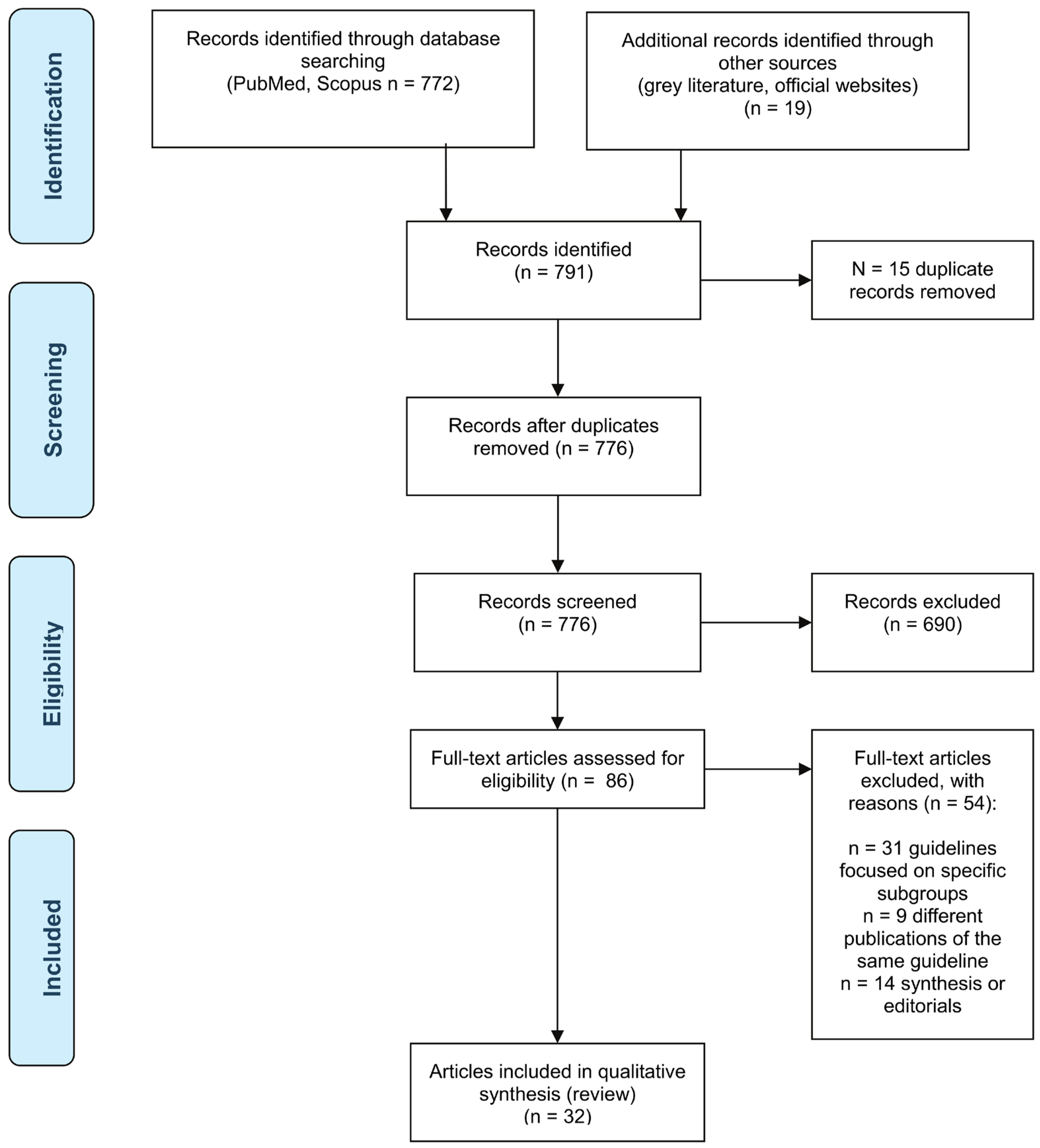
2.1. Literature Search and Inclusion Criteria
- (a)
- World Health Organization (WHO) and International Society of Hypertension (ISH);
- (b)
- US National Institute of Health/Heart, Lung and Blood Institute—Joint National Committee on Prevention, Detection, Evaluation, and Treatment of High Blood Pressure (JNC);
- (c)
- American Heart Association (AHA);
- (d)
- American College of Cardiology (ACC);
- (e)
- European Society of Cardiology (ESC);
- (f)
- European Society of Hypertension (ESH);
- (g)
- UK National Institute for Health and Care Excellence (NICE).
2.2. Data Extraction
3. Results
3.1. Hypertension Thresholds and Targets Before the Implementation of the Clinical Guidelines
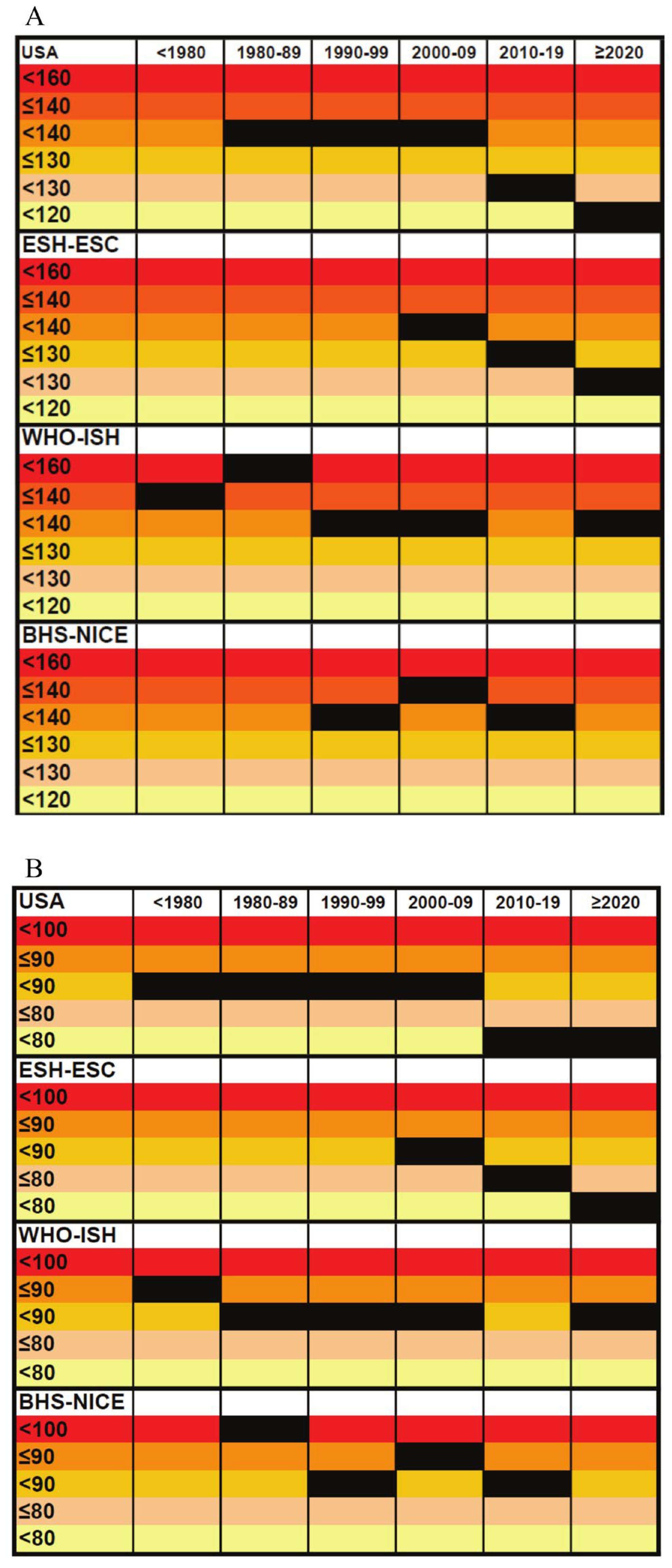
3.2. US Guidelines: JNC and ACC/AHA
3.3. International Guidelines: WHO and ISH
3.4. European Guidelines: ESH and ESC
3.5. UK Guidelines: BHS and NICE
4. Discussion
Author Contributions
Funding
Institutional Review Board Statement
Informed Consent Statement
Data Availability Statement
Conflicts of Interest
References
- WHO. Team for Management of Screening, Diagnosis and Treatment, Surveillance, Monitoring and Reporting (SMR). In Global Report on Hypertension 2025: High Stakes—Turning Evidence into Action; World Health Organization: Geneva, Switzerland, 2025. [Google Scholar]
- Fuchs, F.D.; Whelton, P.K. High Blood Pressure and Cardiovascular Disease. Hypertension 2020, 75, 285–292. [Google Scholar] [CrossRef]
- Brook, R.D.; Appel, L.J.; Rubenfire, M.; Ogedegbe, G.; Bisognano, J.D.; Elliott, W.J.; Fuchs, F.D.; Hughes, J.W.; Lackland, D.T.; Staffileno, B.A.; et al. Beyond medications and diet: Alternative approaches to lowering blood pressure: A scientific statement from the american heart association. Hypertension 2013, 61, 1360–1383. [Google Scholar] [CrossRef] [PubMed]
- Carey, R.M.; Wright, J.T., Jr.; Taler, S.J.; Whelton, P.K. Guideline-Driven Management of Hypertension: An Evidence-Based Update. Circ. Res. 2021, 128, 827–846. [Google Scholar] [CrossRef] [PubMed]
- Evbayekha, E.O.; Okobi, O.E.; Okobi, T.; Ibeson, E.C.; Nwafor, J.N.; Ozobokeme, O.E.; Olawoye, A.; Ngoladi, I.A.; Boms, M.G.; Habib, F.A.; et al. The Evolution of Hypertension Guidelines Over the Last 20+ Years: A Comprehensive Review. Cureus 2022, 14, e31437. [Google Scholar] [CrossRef] [PubMed]
- McEvoy, J.W.; McCarthy, C.P.; Bruno, R.M.; Brouwers, S.; Canavan, M.D.; Ceconi, C.; Christodorescu, R.M.; Daskalopoulou, S.S.; Ferro, C.J.; Gerdts, E.; et al. 2024 ESC Guidelines for the management of elevated blood pressure and hypertension. Eur. Heart J. 2024, 45, 3912–4018. [Google Scholar] [CrossRef]
- Herberth, J.; Soliman, K.M.; Fulop, T.; Basile, J.N. How We Got Where We Are in Blood Pressure Targets. Curr. Hypertens. Rep. 2021, 23, 33. [Google Scholar] [CrossRef]
- Philip, R.; Beaney, T.; Appelbaum, N.; Gonzalvez, C.R.; Koldeweij, C.; Golestaneh, A.K.; Poulter, N.; Clarke, J.M. Variation in hypertension clinical practice guidelines: A global comparison. BMC Med. 2021, 19, 117. [Google Scholar] [CrossRef]
- Messerli, F.H.; Bangalore, S. The Blood Pressure Landscape: Schism Among Guidelines, Confusion Among Physicians, and Anxiety Among Patients. J. Am. Coll. Cardiol. 2018, 72, 1313–1316. [Google Scholar] [CrossRef]
- Pastore, M.C.; Carmona De Azevedo Bellagamba, C.; Liga, R.; Stefanini, A.; Durante, M.; D’Ascenzi, F.; Pedrinelli, R.; Cameli, M. How the Latest Guidelines Are Changing the Diagnostic and Therapeutic Landscape of Arterial Hypertension. J. Clin. Med. 2025, 14, 7694. [Google Scholar] [CrossRef]
- Devos, P.; Menard, J. Trends in Worldwide Research in Hypertension Over the Period 1999-2018: A Bibliometric Study. Hypertension 2020, 76, 1649–1655. [Google Scholar] [CrossRef]
- Jones, D.W.; Ferdinand, K.C.; Taler, S.J.; Johnson, H.M.; Shimbo, D.; Abdalla, M.; Altieri, M.M.; Bansal, N.; Bello, N.A.; Bress, A.P.; et al. 2025 AHA/ACC/AANP/AAPA/ABC/ACCP/ACPM/AGS/AMA/ASPC/NMA/PCNA/SGIM Guideline for the Prevention, Detection, Evaluation, and Management of High Blood Pressure in Adults: A Report of the American College of Cardiology/American Heart Association Joint Committee on Clinical Practice Guidelines. J. Am. Coll. Cardiol. 2025, 86, 1567–1678. [Google Scholar] [CrossRef]
- Whelton, P.K.; Carey, R.M.; Aronow, W.S.; Casey, D.E., Jr.; Collins, K.J.; Dennison Himmelfarb, C.; DePalma, S.M.; Gidding, S.; Jamerson, K.A.; Jones, D.W.; et al. 2017 ACC/AHA/AAPA/ABC/ACPM/AGS/APhA/ASH/ASPC/NMA/PCNA Guideline for the Prevention, Detection, Evaluation, and Management of High Blood Pressure in Adults: A Report of the American College of Cardiology/American Heart Association Task Force on Clinical Practice Guidelines. Hypertension 2018, 71, e13–e115. [Google Scholar] [CrossRef] [PubMed]
- Report of the Joint National Committee on Detection, Evaluation, and Treatment of High Blood Pressure. A cooperative study. JAMA 1977, 237, 255–261. [CrossRef]
- The 1980 report of the Joint National Committee on Detection, Evaluation, and Treatment of High Blood Pressure. Arch. Intern. Med. 1980, 140, 1280–1285. [CrossRef]
- Carey, R.M.; Cutler, J.; Friedewald, W.; Gant, N.; Hulley, S.; Iacono, J.; Maxwell, M.; McNellis, D.; Payne, G.; Shapiro, A.; et al. The 1984 Report of the Joint National Committee on Detection, Evaluation, and Treatment of High Blood Pressure. Arch. Intern. Med. 1984, 144, 1045–1057. [Google Scholar] [CrossRef]
- Chobanian, A.V.; Alderman, M.H.; DeQuattro, V.; Frohlich, E.D.; Gifford, R.W.; Hill, M.N.; Kaplan, N.M.; Langford, H.G.; Moore, M.A.; Nickey, W.A.; et al. The 1988 report of the Joint National Committee on Detection, Evaluation, and Treatment of High Blood Pressure. Arch. Intern. Med. 1988, 148, 1023–1038. [Google Scholar] [CrossRef]
- The fifth report of the Joint National Committee on Detection, Evaluation, and Treatment of High Blood Pressure (JNC V). Arch. Intern. Med. 1993, 153, 154–183. [CrossRef]
- The sixth report of the Joint National Committee on prevention, detection, evaluation, and treatment of high blood pressure. Arch. Intern. Med. 1997, 157, 2413–2446. [CrossRef]
- Chobanian, A.V.; Bakris, G.L.; Black, H.R.; Cushman, W.C.; Green, L.A.; Izzo, J.L., Jr.; Jones, D.W.; Materson, B.J.; Oparil, S.; Wright, J.T., Jr.; et al. Seventh report of the Joint National Committee on Prevention, Detection, Evaluation, and Treatment of High Blood Pressure. Hypertension 2003, 42, 1206–1252. [Google Scholar] [CrossRef]
- James, P.A.; Oparil, S.; Carter, B.L.; Cushman, W.C.; Dennison-Himmelfarb, C.; Handler, J.; Lackland, D.T.; LeFevre, M.L.; MacKenzie, T.D.; Ogedegbe, O.; et al. 2014 evidence-based guideline for the management of high blood pressure in adults: Report from the panel members appointed to the Eighth Joint National Committee (JNC 8). JAMA 2014, 311, 507–520. [Google Scholar] [CrossRef]
- Zanchetti, A.; Cifkova, R.; Fagard, R.; Kjeldsen, S.; Mancia, G.; Poulter, N.; Rahn, K.N.; Rodicio, J.L.; Ruilope, L.M.; Staessen, J.; et al. 2003 European Society of Hypertension-European Society of Cardiology guidelines for the management of arterial hypertension. J. Hypertens. 2003, 21, 1011–1053. [Google Scholar] [CrossRef]
- Mancia, G.; Fagard, R.; Narkiewicz, K.; Redon, J.; Zanchetti, A.; Bohm, M.; Christiaens, T.; Cifkova, R.; De Backer, G.; Dominiczak, A.; et al. 2013 ESH/ESC Practice Guidelines for the Management of Arterial Hypertension. Blood Press. 2014, 23, 3–16. [Google Scholar] [CrossRef] [PubMed]
- Mansia, G.; De Backer, G.; Dominiczak, A.; Cifkova, R.; Fagard, R.; Germano, G.; Grassi, G.; Heagerty, A.M.; Kjeldsen, S.E.; Laurent, S.; et al. 2007 ESH-ESC Guidelines for the management of arterial hypertension: The task force for the management of arterial hypertension of the European Society of Hypertension (ESH) and of the European Society of Cardiology (ESC). Blood Press. 2007, 16, 135–232. [Google Scholar] [CrossRef] [PubMed]
- Williams, B.; Mancia, G.; Spiering, W.; Agabiti Rosei, E.; Azizi, M.; Burnier, M.; Clement, D.; Coca, A.; De Simone, G.; Dominiczak, A.; et al. 2018 Practice Guidelines for the management of arterial hypertension of the European Society of Cardiology and the European Society of Hypertension. Blood Press. 2018, 27, 314–340. [Google Scholar] [CrossRef] [PubMed]
- Mancia, G.; Kreutz, R.; Brunstrom, M.; Burnier, M.; Grassi, G.; Januszewicz, A.; Muiesan, M.L.; Tsioufis, K.; Agabiti-Rosei, E.; Algharably, E.A.E.; et al. 2023 ESH Guidelines for the management of arterial hypertension The Task Force for the management of arterial hypertension of the European Society of Hypertension: Endorsed by the International Society of Hypertension (ISH) and the European Renal Association (ERA). J. Hypertens. 2023, 41, 1874–2071. [Google Scholar] [CrossRef]
- WHO Expert Committee on Arterial Hypertension; World Health Organization. Arterial Hypertension: Report of a WHO Expert Committee; World Health Organization—WHO: Geneva, Switzerland, 1978. [Google Scholar]
- Unger, T.; Borghi, C.; Charchar, F.; Khan, N.A.; Poulter, N.R.; Prabhakaran, D.; Ramirez, A.; Schlaich, M.; Stergiou, G.S.; Tomaszewski, M.; et al. 2020 International Society of Hypertension Global Hypertension Practice Guidelines. Hypertension 2020, 75, 1334–1357. [Google Scholar] [CrossRef]
- Grozss, F. Guidelines for the treatment of mild hypertension: Memorandum from a WHO/ISH meeting. Bull. World Health Organ. 1983, 61, 53–56. [Google Scholar]
- 1986 Guidelines for the treatment of mild hypertension: Memorandum from a WHO/ISH meeting. Bull. World Health Organ. 1986, 64, 31–35.
- Zanchetti, A.; Chalmers, J.; Corvol, P.; Doyle, A.E.; Ganten, D.; Gyarfas, I.; Hansson, L.; Johnston, C.I.; Julius, S.; Langford, H.; et al. 1989 guidelines for the management of mild hypertension: Memorandum from a WHO/ISH meeting. Bull. World Health Organ. 1989, 67, 493–498. [Google Scholar]
- 1993 guidelines for the management of mild hypertension: Memorandum from a WHO/ISH meeting. Bull. World Health Organ. 1993, 71, 503–517.
- Chalmers, J.; MacMahon, S.; Mancia, G.; Whitworth, J.; Beilin, L.; Hansson, L.; Neal, B.; Rodgers, A.; Ni Mhurchu, C.; Clark, T. 1999 World Health Organization-International Society of Hypertension Guidelines for the management of hypertension. Guidelines sub-committee of the World Health Organization. Clin. Exp. Hypertens. 1999, 21, 1009–1060. [Google Scholar] [CrossRef] [PubMed]
- Whitworth, J.A. 2003 World Health Organization (WHO)/International Society of Hypertension (ISH) statement on management of hypertension. J. Hypertens. 2003, 21, 1983–1992. [Google Scholar] [CrossRef] [PubMed]
- WHO Guidelines Review Committee; Department of Noncommunicable Diseases, Rehabilitation and Disability, NCD. Guideline for the Pharmacological Treatment of Hypertension in Adults; World Health Organization: Geneva, Switzerland, 2021. [Google Scholar]
- Swales, J.D.; Ramsay, L.E.; Coope, J.R.; Pocock, S.J.; Robertson, J.I.S.; Sever, P.S.; Shaper, A.G. Treating mild hypertension. Report of the British Hypertension Society working party. BMJ 1989, 298, 694–698. [Google Scholar] [CrossRef] [PubMed][Green Version]
- National Clinical Guideline Centre (UK) (Ed.) Hypertension: The Clinical Management of Primary Hypertension in Adults, 2011 ed.; National Institute for Health and Clinical Excellence—NICE: London, UK, 2011. [Google Scholar]
- National Guideline Centre (UK). Hypertension in Adults: Diagnosis and Management. NICE Guideline Reference Number: NG136; National Guideline Centre (UK): London, UK, 2019. [Google Scholar]
- North of England Hypertension Guideline Development Group (UK) (Ed.) Essential Hypertension: Managing Adult Patients in Primary Care, 2004 ed.; University of Newcastle upon Tyne: Newcastle upon Tyne, UK, 2004. [Google Scholar]
- Ramsay, L.; Williams, B.; Johnston, G.; MacGregor, G.; Poston, L.; Potter, J.; Poulter, N.; Russell, G. Guidelines for management of hypertension: Report of the third working party of the British Hypertension Society. J. Hum. Hypertens. 1999, 13, 569–592. [Google Scholar] [CrossRef]
- Sever, P.; Beevers, G.; Bulpitt, C.; Lever, A.; Ramsay, L.; Reid, J.; Swales, J. Management guidelines in essential hypertension: Report of the second working party of the British Hypertension Society. BMJ 1993, 306, 983–987. [Google Scholar] [CrossRef][Green Version]
- Williams, B.; Poulter, N.R.; Brown, M.J.; Davis, M.; McInnes, G.T.; Potter, J.F.; Sever, P.S.; Thom, S.M. British Hypertension Society guidelines for hypertension management 2004 (BHS-IV): Summary. BMJ 2004, 328, 634–640. [Google Scholar] [CrossRef]
- Julius, S.; Kjeldsen, S.E.; Weber, M.; Brunner, H.R.; Ekman, S.; Hansson, L.; Hua, T.; Laragh, J.; McInnes, G.T.; Mitchell, L.; et al. Outcomes in hypertensive patients at high cardiovascular risk treated with regimens based on valsartan or amlodipine: The VALUE randomised trial. Lancet 2004, 363, 2022–2031. [Google Scholar] [CrossRef]
- Wright, J.T., Jr.; Williamson, J.D.; Whelton, P.K.; Snyder, J.K.; Sink, K.M.; Rocco, M.V.; Reboussin, D.M.; Rahman, M.; Oparil, S.; Lewis, C.E.; et al. A Randomized Trial of Intensive versus Standard Blood-Pressure Control. N. Engl. J. Med. 2015, 373, 2103–2116. [Google Scholar] [CrossRef]
- Yusuf, S.; Teo, K.K.; Pogue, J.; Dyal, L.; Copland, I.; Schumacher, H.; Dagenais, G.; Sleight, P.; Anderson, C. Telmisartan, ramipril, or both in patients at high risk for vascular events. N. Engl. J. Med. 2008, 358, 1547–1559. [Google Scholar] [CrossRef]
- Shaw, H.B. An Address on the treatment of hypertension based upon the consideration of the cause. Br. Med. J. 1910, 2, 1761–1764. [Google Scholar] [CrossRef][Green Version]
- Beckett, N.; Peters, R.; Tuomilehto, J.; Swift, C.; Sever, P.; Potter, J.; McCormack, T.; Forette, F.; Gil-Extremera, B.; Dumitrascu, D.; et al. Immediate and late benefits of treating very elderly people with hypertension: Results from active treatment extension to Hypertension in the Very Elderly randomised controlled trial. BMJ 2011, 344, d7541. [Google Scholar] [CrossRef]
- Cunningham, R.L. Mechanism and Clinical Aspects of Chronic Arterial Hypertension. Cal. State J. Med. 1912, 10, 303–305. [Google Scholar] [PubMed]
- Johnston-Lavis, H.J. An Analysis of a Series of Cases of Hypertension and Hypotension Treated at Vittel. Br. Med. J. 1913, 1, 1050–1052. [Google Scholar] [CrossRef] [PubMed][Green Version]
- Mahmood, S.S.; Levy, D.; Vasan, R.S.; Wang, T.J. The Framingham Heart Study and the epidemiology of cardiovascular disease: A historical perspective. Lancet 2014, 383, 999–1008. [Google Scholar] [CrossRef] [PubMed]
- British Cardiac Society. Prevention of coronary heart disease. Report of a Joint Working Party of the Royal College of Physicians of London and the British Cardiac Society. J. R. Coll. Physicians Lond. 1976, 10, 213–275. [Google Scholar]
- Balshem, H.; Helfand, M.; Schunemann, H.J.; Oxman, A.D.; Kunz, R.; Brozek, J.; Vist, G.E.; Falck-Ytter, Y.; Meerpohl, J.; Norris, S.; et al. GRADE guidelines: 3. Rating the quality of evidence. J. Clin. Epidemiol. 2011, 64, 401–406. [Google Scholar] [CrossRef]
- Eccles, M.; Freemantle, N.; Mason, J. North of England evidence based guideline development project: Guideline on the use of aspirin as secondary prophylaxis for vascular disease in primary care. North of England Aspirin Guideline Development Group. BMJ 1998, 316, 1303–1309. [Google Scholar] [CrossRef]
- Piepho, R.W.; Beal, J. An overview of antihypertensive therapy in the 20th century. J. Clin. Pharmacol. 2000, 40, 967–977. [Google Scholar] [CrossRef]
- Agarwal, R. Implications of Blood Pressure Measurement Technique for Implementation of Systolic Blood Pressure Intervention Trial (SPRINT). J. Am. Heart Assoc. 2017, 6, e004536. [Google Scholar] [CrossRef]
- Saiz, L.C.; Gorricho, J.; Garjon, J.; Celaya, M.C.; Erviti, J.; Leache, L. Blood pressure targets for the treatment of people with hypertension and cardiovascular disease. Cochrane Database Syst. Rev. 2020, 9, CD010315. [Google Scholar] [CrossRef]
- McCormack, T.; Boffa, R.J.; Jones, N.R.; Carville, S.; McManus, R.J. The 2018 ESC/ESH hypertension guideline and the 2019 NICE hypertension guideline, how and why they differ. Eur. Heart J. 2019, 40, 3456–3458. [Google Scholar] [CrossRef]
- Rose, G. Sick individuals and sick populations. Int. J. Epidemiol. 1985, 14, 32–38. [Google Scholar] [CrossRef]
- Bakris, G.; Ali, W.; Parati, G. ACC/AHA Versus ESC/ESH on Hypertension Guidelines: JACC Guideline Comparison. J. Am. Coll. Cardiol. 2019, 73, 3018–3026. [Google Scholar] [CrossRef] [PubMed]
- Parker, C.N.; Van Netten, J.J.; Parker, T.J.; Jia, L.; Corcoran, H.; Garrett, M.; Kwok, C.F.; Nather, A.; Que, M.T.; Srisawasdi, G.; et al. Differences between national and international guidelines for the management of diabetic foot disease. Diabetes Metab. Res. Rev. 2019, 35, e3101. [Google Scholar] [CrossRef] [PubMed]
- Jia, X.; Pang, Y.; Liu, L.S. Online Health Information Seeking Behavior: A Systematic Review. Healthcare 2021, 9, 1740. [Google Scholar] [CrossRef] [PubMed]
- Djulbegovic, B.; Trikalinos, T.A.; Roback, J.; Chen, R.; Guyatt, G. Impact of quality of evidence on the strength of recommendations: An empirical study. BMC Health Serv. Res. 2009, 9, 120. [Google Scholar] [CrossRef]
- Tricoci, P.; Allen, J.M.; Kramer, J.M.; Califf, R.M.; Smith, S.C., Jr. Scientific evidence underlying the ACC/AHA clinical practice guidelines. JAMA 2009, 301, 831–841. [Google Scholar] [CrossRef]
- Mourtzinis, G.; Manhem, K.; Kahan, T.; Schioler, L.; Isufi, J.; Ljungman, C.; Andersson, T.; Hjerpe, P. Socioeconomic status affects achievement of blood pressure target in hypertension: Contemporary results from the Swedish primary care cardiovascular database. Scand. J. Prim. Health Care 2021, 39, 519–526. [Google Scholar] [CrossRef]



| Year and Edition | Ref. | HBP Definition, in mmHg | NPI Before PT | Treatment Threshold, in mmHg | Treatment Target, in mmHg | High-Risk Condition(s) | Quality and Strength of the Recommendations [Supporting Evidence] |
|---|---|---|---|---|---|---|---|
| 1977 JNC 1 (NHLBI) | [14] | DBP ≥ 90 | 3–6 months | ≥105 DBP; 90–105 DBP for HR | <90 DBP | High SBP; familiar history of complications due to high BP; organ damage; male sex; smoke; DM; high cholesterol | NR |
| 1980 JNC 2 (NHLBI) | [15] | DBP ≥ 90 with: 90–104 mild; 105–114 moderate; ≥115 severe | Recommended for uncomplicated mild HBP | ≥105 DBP; 90–105 DBP for HR | <90 DBP | High SBP; familiar history of complications due to high BP; organ damage; smoke; DM; high cholesterol | NR |
| 1984 JNC 3 (NHLBI) | [16] | DBP ≥ 90 or SBP ≥ 140 in 2 or more measurements (DBP 85–89 high-normal) | Recommended for those with (a) DBP 90–94 mmHg and no RF; (b) isolated SBP ≥ 160 mmHg | ≥95 DBP | <90 DBP; <160 SBP | Organ damage; male sex; smoke; DM; high cholesterol | NR |
| 1988 JNC 4 (NHLBI) | [17] | DBP ≥ 90 or SBP ≥ 140 in 2 or more measurements | Recommended for those with (a) DBP 90–94 mmHg and no HR; (b) isolated SBP ≥ 160 mmHg | ≥95 DBP; 90–94 DBP for HR | <140/90 BP; <160 if isolated HBP | Organ damage; male sex; smoke; DM; high cholesterol | NR |
| 1993 JNC 5 (NHLBI) | [18] | SBP ≥ 140 and/or DBP ≥ 90 (high-normal 130–139 SBP; 85–89 DBP) | 3–6 months | SBP > 140 AND or DBP > 90 (stage I HBP) | <140 SBP AND <90 DBP (ideally ≤130/85 for older individuals) | Organ damage; established CVD; CKD; dyslipidemia; smoke; physical inactivity; obesity | NR |
| 1997 JNC 6 (NHLBI) | [19] | SBP ≥ 140 or DBP ≥ 90 (high-normal 130–139 SBP OR 85–89 DBP) | 12 months for stage I HBP (140–159 SBP or 90–99 DBP) and no RF; 6 months for stage I HBP and 1 RF | BP > 140 or DBP > 90 | <140 SBP and <90 DBP (optimal BP for CV risk is <120/80) | Risk stratification based upon BP levels plus presence/absence of organ damage, smoke, dyslipidemia, DM | Explicit mention to the strength of supporting evidence, and to grade it according to study design. No details provided on the strength of the recommendations |
| 2003 JNC 7 (NHLBI) | [20] | SBP ≥ 140 or DBP ≥ 90 (stage I: SBP 140–159 or DBP 90–99; stage II: SBP ≥ 160 or DBP ≥ 100); pre-HBP: SBP 120–139 OR DBP 80–89 | 120–139 SBP or 80–89 DBP if no RF is present (unclear the duration of NPI) | BP > 140 or DBP > 90 | <140 SBP and <90 DBP in the absence of RF; <130/80 in the presence of DM or CKD; <120/80 when in pre-HBP | Risk stratification based upon BP levels plus presence/absence of organ damage, smoke, dyslipidemia, DM | Explicit mention to the strength of supporting evidence, and to grade it according to study design. No details provided on the strength of the recommendations |
| 2014 JNC8 (NHLBI) | [21] | Not specifically addressed, only thresholds for PT defined | Not specifically addressed | ≥60 y: SBP ≥ 150 or DBP ≥ 90 (grade A); <60 y: DBP ≥ 90 (grade A only for 30–59 y); SBP ≥ 140 (grade E); all ages, CKD and/or DM: SBP ≥ 140 OR DBP ≥ 90 (grade E) | ≥60 y: SBP < 150/DBP < 90; <60 y: SBP < 140/DBP < 90; CKD ± DM: SBP < 140/DBP < 90 | Risk stratification based upon BP levels plus age; DM; CKD | Systematic literature review restricted to RCTs and m-a of RCTs; quality scored in High, Medium, and Low. Strength of recommendation grading system developed by the National Heart, Lung, and Blood Institute’s (NHLBI’s) Evidence-Based Methodology Lead |
| 2017 ACC/AHA | [13] | SBP ≥ 130 or DBP ≥ 80 (stage I: SBP 130–139 or DBP 80–89; stage II: SBP ≥ 140 or DBP ≥ 90); pre-HBP: SBP 120–129 and DBP < 80; masked HBP: NBP OM; HBP out of OM; white coat HBP: HBP OM; NBP out of OM. White coat HBP: monitor to detect transition to HBP; if 120–129 or 75–79: monitor for masked HBP | 3 months for pre-HBP, masked HBP and white coat HBP; 3–6 months for stage I HBP and ASCVD < 10% | Primary prevention: (a) ASCVD < 10% plus SBP ≥ 140 or DBP ≥ 90; (b) ASCVD ≥ 10% plus SBP ≥ 130 or DBP ≥ 80. Secondary prevention: SBP ≥ 130 or DBP ≥ 80, and clinical CVD | <130/80 (recommended for ASCVD ≥ 10% or clinical CVD; reasonable for ASCVD < 10%) | Risk stratification based upon: clinical CVD history, BP levels, plus 10-year risk of incident CVD computed using the ACC/AHA Pooled Cohort Equations (atherosclerotic CVD risk—ASCVD—estimator) | Systematic literature review to include all the available evidence, rated through LoE A-E. LoE and strength of the recommendation (COR I–III) are determined independently: any CoR can be associated with any LoE. Feasible to score the strength of each recommendation [SPRINT; ACCORD trial] |
| 2025 ACC/AHA | [12] | SBP ≥ 130 or DBP ≥ 80 (stage I: SBP 130–139 or DBP 80–89; stage II: SBP ≥ 140 or DBP ≥ 90); pre-HBP: SBP 120–129 and DBP < 80 | 3–6 months in case of stage I HBP plus: no history of CVD, no DM, no CKD, PREVENT CVD risk < 7.5% | Primary prevention: (a) failure of NPI with stage I HBP, no DM or CKD, PREVENT CVD risk < 7.5%; (b) stage I HBP plus DM or CKD or PREVENT CVD risk ≥ 7.5%. Secondary prevention: SBP ≥ 130 or DBP ≥ 80, and clinical CVD. SBP ≥ 140 or DBP ≥ 90 irrespective of clinical CVD and CVD risk | At least < 130 SBP, encouraged < 120 SBP; < 80 DBP (recommended for all HBP, irrespective of increased PREVENT CVD ≥ 7.5%) | Risk stratification based upon: clinical CVD history, BP levels, plus 10-year risk of incident CVD computed using the ACC/AHA PREVENT CVD Risk estimator | Systematic literature review to include all the available evidence, rated through LoE A-E. LoE and strength of the recommendation (COR I-III) are determined independently: any CoR can be associated with any LoE. Feasible to score the strength of each recommendation |
| Year and Edition | Ref. | HBP Definition, in mmHg | NPI Before PT | Treatment Threshold, in mmHg | Treatment Target, in mmHg | High-Risk Condition(s) | Quality and Strength of the Recommendations [Supporting Evidence] |
|---|---|---|---|---|---|---|---|
| 1978 WHO | [27] | SBP ≥ 160 and/or DBP ≥ 95; borderline HBP: 140–160 SBP and/or 90–95 DBP | NA | SBP > 140 or DBP > 90 | ≤140/90 | Not specifically addressed | NR |
| 1983 WHO/ISH | [29] | DBP 90–105 (mild) | 1–6 months | DBP > 100 after 1 month of NPI or DBP > 95 after 3 months of NPI | <90 DBP | Not specifically addressed | NR |
| 1986 WHO/ISH | [30] | DBP 90–104 (mild) | 1–6 months | DBP ≥ 100 after 1 month of NPI or DBP ≥ 95 after 3 months of NPI | <90 DBP | High SBP; age; history of CVD; renal disease; high cholesterol; familiar history of CVD | NR |
| 1989 WHO/ISH | [31] | DBP 90–104 (mild) | 1–6 months | DBP ≥ 100 after 3 months of NPI; DBP 95–99 after 3 months of NPI in presence of HR; DBP 90–94 after 6 months of NPI in presence of HR; DBP 95–99 after 6 months of NPI | <90 DBP and lower SBP if ≥160 | SBP ≥ 160 mmHg; male gender; age; history of CVD; renal disease; familiar history of CVD; smoke | NR |
| 1993 WHO/ISH | [32] | SBP 140–180 and/or DBP 90–105 (mild); ≥180 SBP and/or ≥105 DBP (moderate/severe) | 3–6 months | SBP ≥ 140 or DBP ≥ 90 in presence of HR and for elderly subjects; SBP ≥ 160 or DBP ≥ 95 in absence of HR | Mild HBP and age < 60 y: target of 130–120/80; severe HBP and elderly subjects: <140/90 | Male gender; age; history of CVD; renal disease; familiar history of CVD; smoke; cholesterol total and HDL; impaired fasting glucose | NR |
| 1999 WHO/ISH | [33] | SBP ≥ 140 and/or DBP ≥ 90 with: mild (SBP 140–159/DBP 90–99; moderate: 160–179/100–109; severe: ≥180 and/or ≥110) | 3–6 months | SBP ≥ 140 or DBP ≥ 90 after 3–6 months of NPI and medium risk; SBP ≥ 150 or DBP ≥ 95 after 6–12 months of NPI and low risk | <130 SBP/85 DBP in young, middle-aged and DM subjects; <140/90 in elderly subjects | Risk stratification based upon BP levels plus presence/absence of organ damage, smoke, dyslipidemia, DM, history of CVD (10-y risk of CVD: low: <15%; medium: 15–20%; high: 20–30%; very high: >30%) | NR |
| 2003 WHO/ISH | [34] | SBP ≥ 140 and/or DBP ≥ 90 | NA | SBP ≥ 140 or DBP ≥ 90, based upon risk category | <140 SBP; optimal: <130 SBP and <80 DBP | Risk stratification based upon BP levels plus presence/absence of organ damage, age, gender, smoke, dyslipidemia, DM, history of CVD (10-y risk of CVD: low: <15%; medium: 15–20%; high: ≥20%) | NR |
| 2020 ISH | [28] | SBP ≥ 140 and/or DBP ≥ 90 (high-normal 130–139 SBP and/or 85–89) | 3–6 months | SBP 140–159 or DBP 90–99 plus CVD/CKD/DM/OD | <140 SBP and <90 DBP; <65 y: <130 SBP and <80 DBP | Risk stratification based upon BP levels plus presence/absence of ≥1 RF (CVD history, organ damage, smoke, inactivity, DM, CKD) | Each recommendation classified as “Essential” or “Optimal”, but no explicit reference to supporting evidence |
| 2021 WHO/ISH | [35] | SBP ≥ 140 and/or DBP ≥ 90 | NA | SBP ≥ 140 or DBP ≥ 90; SBP 130–139 and CVD or DM or CKD or high CVD risk (STRONG R; Moderate-High LoE; CONDITIONAL R for DM or CKD or high CVD risk) | <140 SBP and <90 DBP (STRONG R; Moderate LoE); <130 SBP in the presence of CVD (STRONG R; Moderate LoE) or DM or CKD or high CVD risk (CONDITIONAL R; Moderate LoE) | Risk stratification based upon BP levels plus presence/absence of ≥1 RF (CVD history, organ damage, smoke, inactivity, DM, CKD) | Systematic literature review to include all the available evidence, rated through GRADE approach (high, moderate, low, very low Evidence—Strong vs. Weak or Conditional Recommendations) |
| Year and Edition | Ref. | HBP Definition, in mmHg | NPI Before PT | Treatment Threshold, in mmHg | Treatment Target, in mmHg | High-Risk Condition(s) | Quality and Strength of the Recommendations [Supporting Evidence] |
|---|---|---|---|---|---|---|---|
| 2003 ESH/ESC | [22] | SBP ≥ 140 or DBP ≥ 90 (high-normal 130–139 SBP or 85–89) | Based upon individual risk, but at least 3 months | SBP ≥ 180 and/or DBP ≥ 110; SBP 140–179 and/or DBP 90–109 and moderate risk; SBP ≥ 140 and/or DBP ≥ 90 after 3 months of NPI; SBP 130–139 and/or DBP 85–89 and very high/high risk | SBP < 140 and DBP < 90; for DM: SBP < 130 and/or DBP < 80 | Risk stratification based on Framingham criteria or the SCORE Chart: CV risk low, moderate, high and very high based upon BP levels + n. of risk factors (male gender, smoke, dyslipidemia, obesity, familiar history of CVD, CRP), presence of OD or DM | NR |
| 2007 ESH/ESC | [24] | SBP ≥ 140 and/or DBP ≥ 90 (high-normal 130–139 SBP and/or 85–89) | Based upon individual risk, no better specified than for “several weeks”. Start PT if unsuccessful | SBP ≥ 180 and/or DBP ≥ 110; SBP 140–179 and/or DBP 90–109 if ≥3 risk factors, or OD, or DM, or CKD; SBP ≥ 140 and/or DBP ≥ 90 after “several” months of NPI; SBP 120–139 and/or DBP 80–89 and established CVD or CKD | SBP < 140 and DBP < 90; for subjects with DM, stroke, myocardial infarction, proteinuria, or high/very high risk: SBP < 130 and/or DBP < 80 | Risk stratification based upon the Framingham criteria or the SCORE Chart: CV risk low, moderate, high and very high based upon BP levels plus number of risk factors (RF) (male gender, smoke, dyslipidemia, obesity, familiar history of CVD, CRP), presence of OD or DM | NR |
| 2013 ESH/ESC | [23] | SBP ≥ 140 and/or DBP ≥ 90 (high-normal 130–139 SBP and/or 85–89) | Based upon individual risk, no better specified than for “several weeks”. Start PT if unsuccessful | SBP ≥ 180 and/or DBP ≥ 110 (I); SBP 140–179 and/or DBP 90–109 if ≥3 risk factors, or OD, or DM, or CKD (I); SBP ≥ 140 and/or DBP ≥ 90 after “several” months of NPI (II); in individuals ≥ 80 y and SBP 140–159 and/or DBP 90–99, irrespective of risk category (II) | SBP < 140 and DBP < 90; for subjects with DM DBP < 85 (ALL I) | Risk stratification based upon the Framingham criteria or the SCORE Chart: CV risk low, moderate, high and very high according to SBP and DBP and number of RFs, OD, DM, CKD or symptomatic CVD | Strength of the recommendation (I to III) based upon the quality of the available evidence (A to C) |
| 2018 ESH/ESC | [25] | SBP ≥ 140 and/or DBP ≥ 90 (high-normal 130–139 SBP and/or 85–89) | 3–6 months in case of SBP 140–159 or DBP 90–99 and no CVD, CKD, or OD (low-moderate risk) | SBP ≥ 160 and/or DBP ≥ 100; SBP 140–159 and/or DBP 90–99 and CVD, CKD, or OD (I); SBP 140–159 and/or DBP 90–99 and low-moderate risk, after 3–6 months of NPI (I); SBP 130–139 and/or DBP 85–89 and CVD (coronary artery disease) (II) | in subjects < 65 y: SBP < 130; in subjects 65–79 y: SBP ≤ 130 and DBP ≤ 80; in subjects ≥ 80 y: SBP < 140 (ALL I) | Risk stratification based upon the SCORE Chart: CV risk low, moderate, high and very high according to SBP and DBP, number of RFs, and organ damage, DM, CKD or symptomatic CVD | Strength of the recommendation (I to III) based upon the quality of the available evidence (A to C) [SPRINT; ONTARGET trial; VALUE trial] [43,44,45] |
| 2023 ESH | [26] | SBP ≥ 140 and/or DBP ≥ 90 (high-normal 130–139 SBP and/or 85–89) | 3–6 months in case of SBP 140–149 and/or DBP 90–94 and no CVD, CKD, or OD (low-moderate risk) | SBP ≥ 140 and/or DBP ≥ 90 and symptomatic, or organ damage, or CKD, or established CVD (I); after unsuccessful 3–6 months of NPI in case of SBP 140–149 and/or DBP 90–94 and no CVD, CKD, or OD (I); ≥60 y: SBP ≥ 140 (any DBP) (I) | ideal: SBP < 130 and DBP< 80; 18–64 y: SBP < 130 and DBP < 80; 65–79 y: SBP < 140 and DBP < 80; ≥80 y: SBP 140–150 (ALL I) | Risk stratification based upon the SCORE2 Chart: CV risk low, moderate, high and very high according to sex, age, SBP, smoke, non-HDL cholesterol, CVD, DM, OD | Strength of the recommendation (I to III) based upon the quality of the available evidence (A to C) |
| 2024 ESC | [6] | SBP ≥ 140 or DBP ≥ 90 (Elevated BP: SBP 120–139 or DBP: 70–89) | In case of SBP < 120 and DBP < 70 (normal); SBP 120–139 and DBP 70–89 (elevated BP) when: ≥85 y, moderate-to-severe frailty, symptomatic orthostatic hypotension, life expectancy < 3 y | SBP ≥ 140 and/or DBP ≥ 90 (I); SBP 120–139 and/or DBP 70–89 (excluding those in NPI) with 10-y CV risk ≥ 5% (I); SBP ≥ 130 and/or DBP ≥ 80 and CVD, CKD, DM, OD, familiar hypercholesterolemia, if NPI unsuccessful (I) | SBP < 130 (I) and/or DBP < 80 (II); SBP< 140 among: symptomatic subjects, frail subjects of any age, ≥85 y, lifespan < 3 y (II) | Risk stratification based upon the SCORE2 Chart: CV risk low, moderate, high and very high according to sex, age, SBP, smoke, non-HDL cholesterol, CVD, DM, OD | Strength of the recommendation (I to III) based upon the quality of the available evidence (A to C) |
| Year and Edition | Ref. | HBP Definition, in mmHg | NPI Before PT | Treatment Threshold, in mmHg | Treatment Target, in mmHg | High-Risk Condition(s) | Quality and Strength of the Recommendations [Supporting Evidence] |
|---|---|---|---|---|---|---|---|
| 1989 BHS I | [36] | NR (refer to DBP threshold) | NR. Active monitoring 3–6 m after initial BP assessment | DBP ≥ 100 after 3–4 months of active monitoring | Not addressed | Age, gender, CVD | NR |
| 1993 BHS II | [41] | NR (refer to DBP threshold) | 3–6 months | DBP ≥ 100; DBP ≥ 100 after 3–4 months of active monitoring; DBP 90–99 after 3–4 months of active monitoring if: >60 y or HR; among elderly: (a) SBP ≥ 160 and/or DBP ≥ 90 plus OD; (b) SBP 160–199 and DBP ≥ 95 | DBP < 90; SBP < 160 | OD, CVD history, DM, older age (>60 y), smoke, male gender, Col tot, familiar CVD | NR |
| 1999 BHS III | [40] | SBP ≥ 140 and/or DBP ≥ 90 (high-normal 135–139 SBP and/or 85–89) | 3–6 months | SBP ≥ 160 and/or DBP ≥ 100 (A); SBP ≥ 140 OR DBP ≥ 90 with DM (B); SBP 140–159 or DBP 90–99 with OD or DM or CVD complications or 10 y CHD risk ≥ 15% (B) | SBP < 140 and DBP < 90; SBP < 140 and DBP < 80 in DM (A) | Risk stratification based upon the Joint British Societies Cardiac Risk Assessor computer programme (CHD risk chart or Framingham risk chart): CVD history, ColTot, BP values, DM, OD | Strength of evidence rated using the North of England evidence-based Guidelines (I to IV evidence rating, and A to D strength of recommendations) |
| 2004 BHS IV | [46] | SBP ≥ 140 and/or DBP ≥ 90 (high-normal 135–139 SBP and/or 85–89) | Up to 6 months | SBP ≥ 160 and/or DBP ≥ 100 (A); SBP140–159 and/or DBP 90–99 if DM, or OD or 10 y CVD risk ≥ 20% (B) | minimum acceptable: SBP < 150 and DBP < 90; non-DM: SBP < 140 and DBP < 85; DM: SBP < 130 and DBP < 80 (B) | Risk stratification based upon the Joint British Societies Cardiac Risk Assessor computer programme (CHD risk chart or Framingham risk chart): CVD history, ColTot, BP values, DM, OD | Strength of evidence rated using the North of England evidence-based Guidelines (I to IV evidence rating, and A to D strength of recommendations) |
| 2004 NICE | [39] | SBP ≥ 140 and/or DBP ≥ 90 | Up to 12 months | SBP ≥ 160 and/or DBP ≥ 100 (A); SBP > 140 and DBP > 90 if DM, or OD, or 10 y CVD risk ≥ 20% or CHD risk ≥ 15% or current CVD (A) | SBP ≤ 140 and/or DBP ≤ 90 (A) | Risk stratification based upon the Joint British Societies Cardiac Risk Assessor computer programme (CHD risk chart or Framingham risk chart): CVD history, ColTot, BP values, DM, OD | Strength of evidence rated using the AHRQ Classification (I to III evidence rating, and A to C strength of recommendations) |
| 2011 NICE | [37] | SBP ≥ 140 and/or DBP ≥ 90 | Based upon individual risk | SBP ≥ 150 and/or DBP ≥ 95; SBP140–159 and/or DBP 90–99 if OD, CVD, DM, CKD, 10 y CVD risk ≥20% | SBP < 140 and/or DBP < 90; for those ≥80 y: <150 and/or DBP < 90 | Risk stratification based upon the Joint British Societies Cardiac Risk Assessor computer programme (CHD risk chart or Framingham risk chart): CVD history, ColTot, BP values, DM, OD | Quality of the supporting evidence rated as above, but overall rating of the strength of the recommendations not provided |
| 2019 (upd. 2023) NICE | [38] | SBP ≥ 140 and/or DBP ≥ 90 | Based upon individual risk (NICE CPG on CVD) | SBP ≥ 160 and/or DBP ≥ 100; subjects ≥ 80 y: SBP ≥ 150 and/or DBP ≥ 90; SBP140–159 and/or DBP 90–99 if 10 y CVD risk ≥ 20% | Subjects < 80 y: SBP < 140 and/or DBP < 90; SBP < 130 and/or DBP < 80 if DM or CKD. Subjects ≥ 80 y: SBP < 150 and/or DBP < 90; SBP < 140 and/or DBP < 90 if CKD; SBP < 130 and/or DBP < 80 if CKD plus ACR ≥ 70 mg/mmol | Risk stratification based upon the Joint British Societies Cardiac Risk Assessor computer programme (CHD risk chart or Framingham risk chart): CVD history, ColTot, BP values, DM, OD | GRADE approach for quality rating (high, moderate, low, very low LoE) and A to C strength of recommendations declared, but no details provided [HIVET] [47] |
| Issuing Organization | ACC/AHA | ESH/ESC | WHO/ISH | NICE |
|---|---|---|---|---|
| Diagnostic thresholds (in mmHg) | SBP ≥ 130 or DBP ≥ 80 | SBP ≥ 140 or DBP ≥ 90 | SBP ≥ 140 and/or DBP ≥ 90 | SBP ≥ 140 and/or DBP ≥ 90 |
| Treatment thresholds (in mmHg) | SBP > 130 or DBP > 80 | SBP ≥ 140 and/or DBP ≥ 90 | SBP ≥ 140 or DBP ≥ 90 | SBP 140–159 and/or DBP 90–99 (10 y CVD risk ≥ 20%); always with SBP ≥ 160 and/or DBP ≥ 100 |
| Treatment targets (in mmHg) | SBP ≤ 130 (encouraged < 120 SBP); DBP < 80 DBP (recommended for all individuals, irrespective of increased cardiovascular risk) | SBP < 130; DBP < 80 | SBP < 140; DBP < 90 | SBP < 140; DBP < 90 |
| Evidence-grading approach | Grading scheme based upon Level of Evidence: (A) ≥1 RCT/meta-analysis; (B) 1 RCT/non-randomized studies; (C) expert opinion/standard of care and Class of Recommendation (I to III) | Grading scheme based upon Level of Evidence: (A) ≥1 RCT/meta-analysis; (B) 1 RCT/non-randomized studies; (C) expert opinion/standard of care and Class of Recommendation (I to III) | Certainty of evidence: High, Moderate, Low, Very Low according to GRADE approach. Evidence strength: Strong or Weak/Conditional based upon the Committee confidence that desirable effects of adhering to the recommendation outweighs undesirable effects | Grading scheme based upon Level of Evidence: (I) ≥ 1 RCT/meta-analysis; (II) non-randomized studies/quasi-experimental studies; (III) descriptive/case-control studies; (IV) expert opinion. Strength of recommendation classified from A to D |
Disclaimer/Publisher’s Note: The statements, opinions and data contained in all publications are solely those of the individual author(s) and contributor(s) and not of MDPI and/or the editor(s). MDPI and/or the editor(s) disclaim responsibility for any injury to people or property resulting from any ideas, methods, instructions or products referred to in the content. |
© 2026 by the authors. Licensee MDPI, Basel, Switzerland. This article is an open access article distributed under the terms and conditions of the Creative Commons Attribution (CC BY) license.
Share and Cite
Flacco, M.E.; Minoia, F.; Brunini, G.; Rosticci, M.; Fiore, M.; Cicolini, G.; Acuti Martellucci, C.; Borghi, C.; Manzoli, L. The Evolution of Blood Pressure Thresholds and Targets over Time: A Historical Review. Med. Sci. 2026, 14, 203. https://doi.org/10.3390/medsci14020203
Flacco ME, Minoia F, Brunini G, Rosticci M, Fiore M, Cicolini G, Acuti Martellucci C, Borghi C, Manzoli L. The Evolution of Blood Pressure Thresholds and Targets over Time: A Historical Review. Medical Sciences. 2026; 14(2):203. https://doi.org/10.3390/medsci14020203
Chicago/Turabian StyleFlacco, Maria Elena, Flavia Minoia, Gabriele Brunini, Martina Rosticci, Matteo Fiore, Giancarlo Cicolini, Cecilia Acuti Martellucci, Claudio Borghi, and Lamberto Manzoli. 2026. "The Evolution of Blood Pressure Thresholds and Targets over Time: A Historical Review" Medical Sciences 14, no. 2: 203. https://doi.org/10.3390/medsci14020203
APA StyleFlacco, M. E., Minoia, F., Brunini, G., Rosticci, M., Fiore, M., Cicolini, G., Acuti Martellucci, C., Borghi, C., & Manzoli, L. (2026). The Evolution of Blood Pressure Thresholds and Targets over Time: A Historical Review. Medical Sciences, 14(2), 203. https://doi.org/10.3390/medsci14020203