
Evolutionary Integration and Glucocorticoid Regulation of the Respiratory System: Structure, Function, and Homeostatic Adaptation


Abstract
1. Introduction
2. Evolutionary and Embryological Origins of the Respiratory System: Linking Bioenergetic Demand to Structural Innovation
2.1. Bioenergetic Pressures and the Need for Oxygen Exchange
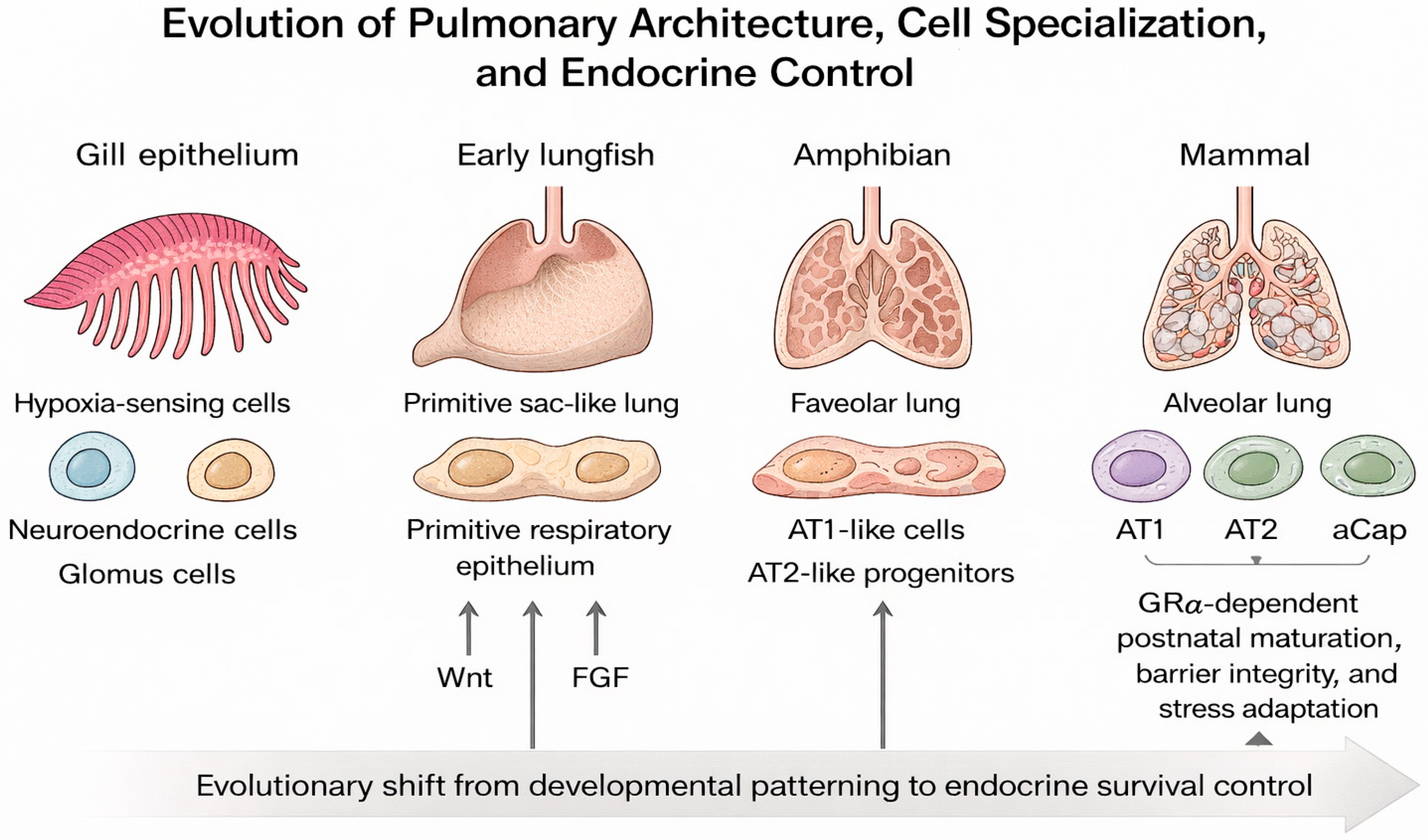
2.2. From Gills to Lungs: Evolutionary Transitions in Vertebrate Respiration
2.3. Embryological Specification of the Respiratory Tract
2.4. Evolution of Specialized Respiratory Cells
2.5. Cellular Crosstalk and Structural Complexity
2.6. Summary and Evolutionary Significance
3. The Evolution of Glucocorticoid Signaling and Its Role in Shaping Vertebrate Respiratory Adaptation
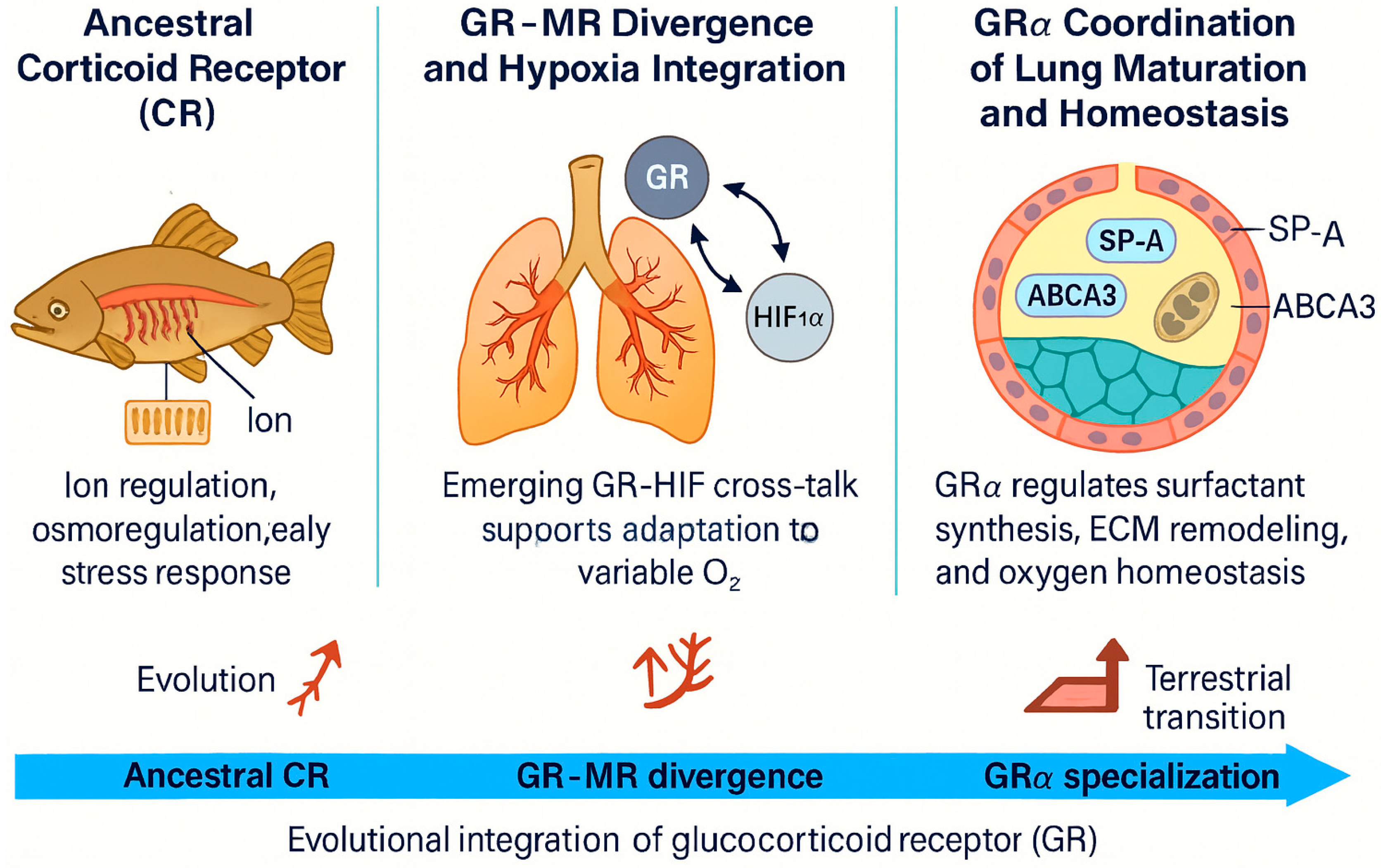
3.1. Evolutionary Emergence of GR and Its Functional Integration
3.2. GR Regulation of Lung Development: Evidence from Genetic Models
3.3. Molecular Pathways Under GR Control in Developing Lung

| Cell/Structure | GRα Expression | Principal GRα-Supported Functions for Pulmonary Homeostasis |
|---|---|---|
| Ciliated airway epithelial cells | Yes | Supports epithelial differentiation and mucociliary clearance programs; coordinates anti-inflammatory transcriptional responses with NF-κB [22,87,88]. |
| Goblet/secretory cells | Indirect regulation | Modulates mucin dynamics and epithelial defense during infection/inflammation [72,89]. |
| Conducting airway epithelium (bulk) | Yes | GR–NF-κB cooperation to repress inflammatory genes; clock-dependent control of epithelial inflammatory tone [88,90,91]. |
| Alveolar type II (AT2) cells | Yes | Induces/coordinates surfactant system (SP-B, SP-C, SP-A, ABCA3); tunes mRNA stability and promoter activity [92,93,94,95,96,97]. |
| Alveolar type I (AT1) cells | Yes (lower than AT2, context-dependent) | Barrier support and maturation; tight-junction integrity and permeability control [34,98,99]. |
| Alveolar epithelium (barrier function, general) | Yes | Rapid/non-genomic ion transport effects relevant to fluid balance; circadian gating of GC action on inflammation [90,100,101]. |
| Pulmonary endothelial cells | Yes | Vascular homeostasis; Wnt/β-catenin restraint; angiogenesis control; regeneration programs after injury [27,73,74,102,103]. |
| Airway smooth muscle (ASM) | Yes | Anti-proliferative/anti-hypertrophic signaling; synergism with β2-agonists; modulation of EGFR signaling and transcriptome. |
| Mesenchyme/fibroblasts & ECM | Yes (developmental and adult) | Guides mesenchymal differentiation for morphogenesis; regulates ECM remodeling and fibroblast activation programs [14,63,104,105,106]. |
| Alveolar macrophages (AM) | Yes | GR-mediated repression of inflammatory pathways (e.g., p38 MAPK); gene-specific repression of inflammatory programs [107,108,109]. |
| Interstitial macrophages (IM) | Yes | Nerve-associated/regulatory IM subsets; antigen handling and local immune regulation under homeostasis [110,111,112,113]. |
| Lung epithelial cells (antigen presentation, immune orchestration) | Yes | Antigen presentation to shape CD4+ TRM and barrier immunity; integration with UPR/AP pathways during stress [114,115] |
| Lymphatic endothelial cells (LECs) | Yes (contextual evidence) | Immune tolerance/antigen scavenging; PD-L1–mediated T-cell regulation; lymphatic function in resolution of inflammation/ARDS [116,117,118,119] |
| Respiratory microbiome–epithelium interface * | — | GR programs intersect with epithelial–microbiome crosstalk shaping local immunity and homeostasis [120,121,122] |
| Developmental lung compartments (summary) | Widespread (cell-type specific) | GR controls branching/maturation and cell-lineage decisions; GR loss disrupts epithelial proportions and viability [69,123,124,125]. |
3.4. Evolutionary and Translational Implications
Section Summary and Translational Implications
4. Glucocorticoid Receptors in Fetal Lung Development and Respiratory Function
4.1. Mesenchymal Differentiation and Epithelial–Mesenchymal Crosstalk
4.2. Transcriptional Regulation and Surfactant Synthesis
4.3. Effects of GR Deficiency by Cell Type
4.4. Broader Developmental and Systemic Roles
Developmental Implications
5. The Respiratory System: Complexity, Architecture, and Biofunctional Beauty
5.1. Anatomical and Functional Overview
5.2. Structural-Functional Integration
5.3. Pulmonary Vasculature Architecture and Function
5.4. Pulmonary Interstitium: The Lung’s Immuno-Structural Interface
5.5. Immune and Microbial Surveillance
5.6. Respiratory Musculature and Mechanics
5.7. Gas Exchange and Developmental Adaptation
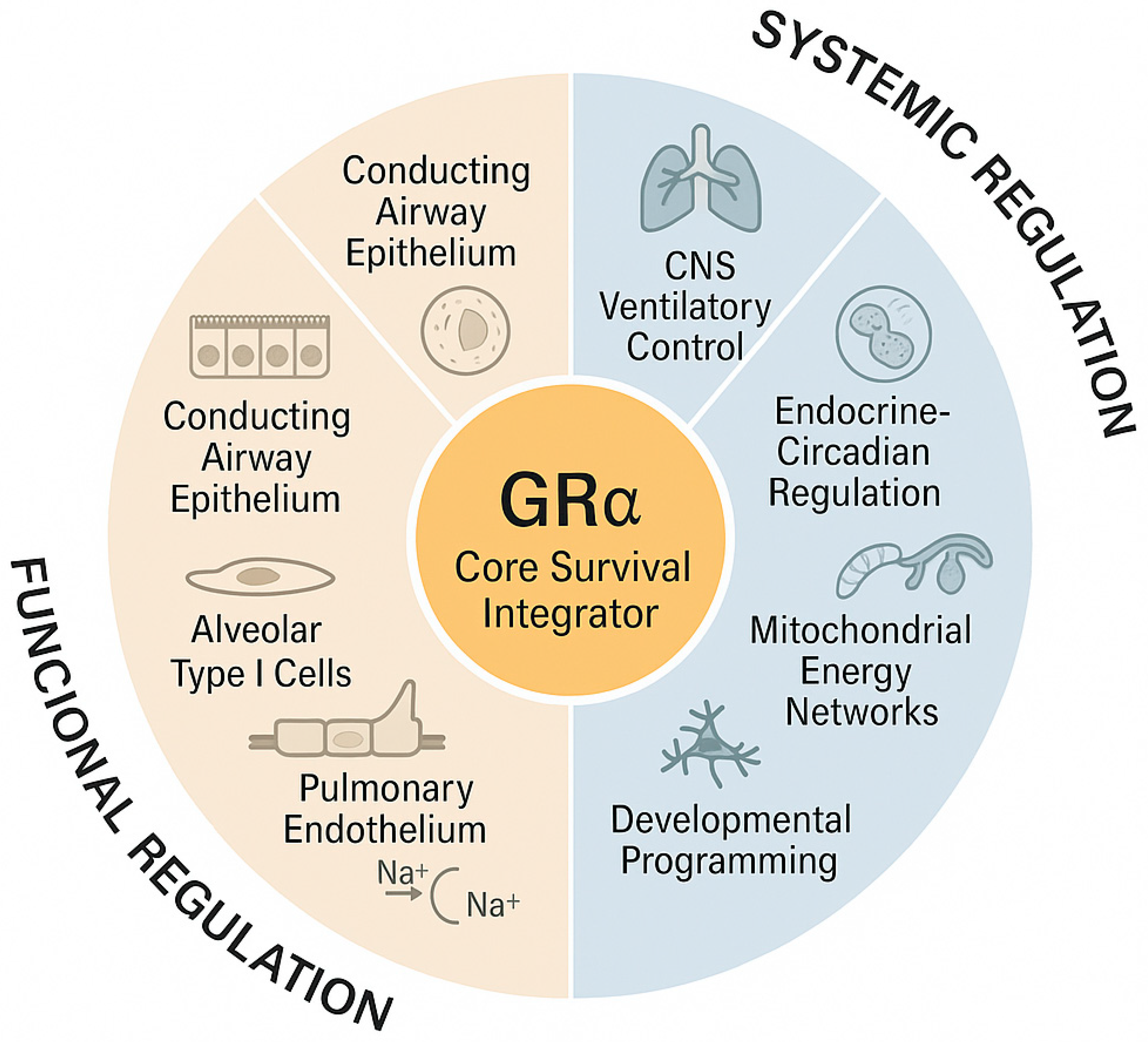
Functional Integration of Respiratory Homeostasis
6. GC-GRα Signaling Regulation of Lung Function: Integrating Gas Exchange, Barrier Integrity, Fluid Clearance, and Inflammatory Control
6.1. Glucocorticoid Receptor Regulation of Tracheobronchial Tree and Airway Tone Regulation
6.2. Glucocorticoid Receptor Regulation of Surfactant Production and Airspace Patency
6.3. Glucocorticoid Receptor Regulation of Alveolar-Capillary Barrier Integrity and Interstitial Homeostasis
6.4. Glucocorticoid Receptor Regulation of Pulmonary Lymphatics
6.5. Glucocorticoid Receptor Regulation of Alveolar Immune Responses and Inflammatory Signaling
Clinical Relevance and Integrative Perspective
6.6. Glucocorticoid Receptor Regulation of Cardiopulmonary Vascular Coupling and Endothelial Homeostasis
6.7. Glucocorticoid Receptor Regulation of Mitochondrial Function and Oxidative Balance
6.8. Glucocorticoid Receptor Signaling in Airway Hydration
6.9. Glucocorticoid Receptor Regulation of Oxygenation and CO2 Homeostasis
6.10. Glucocorticoid Receptor Modulation of Hypoxic Ventilatory Response
7. Conclusions—Glucocorticoid Receptor Regulation of the Pulmonary System
Author Contributions
Funding
Institutional Review Board Statement
Informed Consent Statement
Data Availability Statement
Acknowledgments
Conflicts of Interest
Abbreviations
| GRα | glucocorticoid receptor alpha |
| MR | mineralocorticoid receptor |
| CR | corticoid receptor |
| HIF1α | hypoxia-inducible factor 1 alpha |
| SP-A | surfactant protein A |
| ABCA3 | ATP-binding cassette subfamily A member 3 |
| ECM | extracellular matrix |
| O2 | oxygen |
References
- Sackville, M.A.; Gillis, J.A.; Brauner, C.J. The origins of gas exchange and ion regulation in fish gills: Evidence from structure and function. J. Comp. Physiol. B 2024, 194, 557–568. [Google Scholar] [CrossRef]
- Brauner, C.J.; Rombough, P.J. Ontogeny and paleophysiology of the gill: New insights from larval and air-breathing fish. Respir. Physiol. Neurobiol. 2012, 184, 293–300. [Google Scholar] [CrossRef]
- Wilson, J.M.; Laurent, P. Fish gill morphology: Inside out. J. Exp. Zool. 2002, 293, 192–213. [Google Scholar] [CrossRef]
- Cupello, C.; Hirasawa, T.; Tatsumi, N.; Yabumoto, Y.; Gueriau, P.; Isogai, S.; Matsumoto, R.; Saruwatari, T.; King, A.; Hoshino, M.; et al. Lung evolution in vertebrates and the water-to-land transition. eLife 2022, 11, e77156. [Google Scholar] [CrossRef]
- Liem, K. Form and Function of Lungs: The Evolution of Air Breathing Mechanisms. Integr. Comp. Biol. 1988, 28, 739–759. [Google Scholar] [CrossRef]
- Cadiz, L.; Jonz, M.G. A comparative perspective on lung and gill regeneration. J. Exp. Biol. 2020, 223, jeb226076. [Google Scholar] [CrossRef]
- Zhang, R.; Liu, Q.; Pan, S.; Zhang, Y.; Qin, Y.; Du, X.; Yuan, Z.; Lu, Y.; Song, Y.; Zhang, M.; et al. A single-cell atlas of West African lungfish respiratory system reveals evolutionary adaptations to terrestrialization. Nat. Commun. 2023, 14, 5630. [Google Scholar] [CrossRef]
- White, S.; Danowitz, M.; Solounias, N. Embryology and evolutionary history of the respiratory tract. Edorium J. Anat. Embryo. 2016, 3, 54–62. [Google Scholar] [CrossRef]
- Kimura, Y.; Nakamuta, N.; Nikaido, M. Plastic loss of motile cilia in the gills of Polypterus in response to high CO2 or terrestrial environments. Ecol. Evol. 2023, 13, e9964. [Google Scholar] [CrossRef] [PubMed]
- Meyer, A.; Schloissnig, S.; Franchini, P.; Du, K.; Woltering, J.M.; Irisarri, I.; Wong, W.Y.; Nowoshilow, S.; Kneitz, S.; Kawaguchi, A.; et al. Giant lungfish genome elucidates the conquest of land by vertebrates. Nature 2021, 590, 284–289. [Google Scholar] [CrossRef] [PubMed]
- Milsom, W.K.; Gilmour, K.M.; Perry, S.; Gargaglioni, L.H.; Hedrick, M.S.; Kinkead, R.; Wang, T. Control of breathing in ectothermic vertebrates. Compr. Physiol. 2022, 12, 3869–3988. [Google Scholar] [CrossRef] [PubMed]
- Chang, L.; Chen, Q.; Wang, B.; Liu, J.; Zhang, M.; Zhu, W.; Jiang, J. Single cell RNA analysis uncovers the cell differentiation and functionalization for air breathing of frog lung. Commun. Biol. 2024, 7, 665. [Google Scholar] [CrossRef]
- Hsia, C.C.; Schmitz, A.; Lambertz, M.; Perry, S.F.; Maina, J.N. Evolution of air breathing: Oxygen homeostasis and the transitions from water to land and sky. Compr. Physiol. 2013, 3, 849–915. [Google Scholar] [CrossRef]
- Farmer, C.G. The Evolution of Unidirectional Pulmonary Airflow. Physiology 2015, 30, 260–272. [Google Scholar] [CrossRef]
- Butler, R.; Barrett, P.; Gower, D. Reassessment of the Evidence for Postcranial Skeletal Pneumaticity in Triassic Archosaurs, and the Early Evolution of the Avian Respiratory System. PLoS ONE 2012, 7, e34094. [Google Scholar] [CrossRef]
- O’Rahilly, R.; Müller, F. Respiratory and Alimentary Relations in Staged Human Embryos. Ann. Otol. Rhinol. Laryngol. 1984, 93, 421–429. [Google Scholar] [CrossRef]
- Shu, W.; Guttentag, S.; Wang, Z.; Andl, T.; Ballard, P.; Lu, M.M.; Piccolo, S.; Birchmeier, W.; Whitsett, J.A.; Millar, S.E.; et al. Wnt/β-catenin signaling acts upstream of N-myc, BMP4, and FGF signaling to regulate proximal–distal patterning in the lung. Dev. Biol. 2005, 283, 226–239. [Google Scholar] [CrossRef]
- Aros, C.J.; Pantoja, C.J.; Gomperts, B.N. Wnt signaling in lung development, regeneration, and disease progression. Commun. Biol. 2021, 4, 601. [Google Scholar] [CrossRef]
- Volckaert, T.; De Langhe, S.P. Wnt and FGF mediated epithelial-mesenchymal crosstalk during lung development. Dev. Dyn. 2015, 244, 342–366. [Google Scholar] [CrossRef] [PubMed]
- Yin, Y.; Ornitz, D.M. FGF9 and FGF10 activate distinct signaling pathways to direct lung epithelial specification and branching. Sci. Signal. 2020, 13, eaay4353. [Google Scholar] [CrossRef] [PubMed]
- Frum, T.; Hsu, P.P.; Hein, R.F.; Conchola, A.S.; Zhang, C.J.; Utter, O.R.; Anand, A.; Zhang, Y.; Clark, S.G.; Glass, I.; et al. Opposing roles for TGFβ-and BMP-signaling during nascent alveolar differentiation in the developing human lung. NPJ Regen. Med. 2023, 8, 48. [Google Scholar] [CrossRef]
- Whitsett, J.A.; Kalin, T.V.; Xu, Y.; Kalinichenko, V.V. Building and regenerating the lung cell by cell. Physiol. Rev. 2019, 99, 513–554. [Google Scholar] [CrossRef] [PubMed]
- Bird, A.; McDougall, A.; Seow, B.; Hooper, S.; Cole, T. Glucocorticoid regulation of lung development: Lessons learned from conditional GR knockout mice. Mol. Endocrinol. 2015, 29, 158–171. [Google Scholar] [CrossRef]
- Yang, X.; Chen, Y.; Yang, Y.; Li, S.; Mi, P.; Jing, N. The molecular and cellular choreography of early mammalian lung development. Med. Rev. 2024, 4, 192–206. [Google Scholar] [CrossRef] [PubMed]
- Gillich, A.; Zhang, F.; Farmer, C.; Travaglini, K.; Tan, S.; Gu, M.; Zhou, B.; Feinstein, J.; Krasnow, M.; Metzger, R. Capillary cell-type specialization in the alveolus. Nature 2020, 586, 785–789. [Google Scholar] [CrossRef]
- Fidalgo, M.; Fonseca, C.; Caldas, P.; Raposo, A.; Balboni, T.; Henao-Mišíková, L.; Grosso, A.; Vasconcelos, F.; Franco, C. Aerocyte specification and lung adaptation to breathing is dependent on alternative splicing changes. Life Sci. Alliance 2022, 5, e202201554. [Google Scholar] [CrossRef] [PubMed]
- Godoy, R.S.; Cober, N.D.; Cook, D.P.; McCourt, E.; Deng, Y.; Wang, L.; Schlosser, K.; Rowe, K.; Stewart, D.J. Single-cell transcriptomic atlas of lung microvascular regeneration after targeted endothelial cell ablation. eLife 2023, 12, e80900. [Google Scholar] [CrossRef]
- Safaie Qamsari, E.; Cober, N.D.; Soares Godoy, R.; Wang, L.; Schlosser, K.; Stewart, D. Discovery and Characterization of Transient Endothelial Stem-Like Cells Responsible for Rapid Lung Microvascular Regeneration Post Endothelial Ablation. Circulation 2023, 148, A16783. [Google Scholar] [CrossRef]
- Raredon, M.S.B.; Adams, T.S.; Suhail, Y.; Schupp, J.C.; Poli, S.; Neumark, N.; Leiby, K.L.; Greaney, A.M.; Yuan, Y.; Horien, C.; et al. Single-cell connectomic analysis of adult mammalian lungs. Sci. Adv. 2019, 5, eaaw3851. [Google Scholar] [CrossRef]
- Chen, D.; Sun, J.; Zhu, J.; Ding, X.; Lan, T.; Wang, X.; Wu, W.; Ou, Z.; Zhu, L.; Ding, P.; et al. Single cell atlas for 11 non-model mammals, reptiles and birds. Nat. Commun. 2021, 12, 7083. [Google Scholar] [CrossRef]
- Hockman, D.; Burns, A.J.; Schlosser, G.; Gates, K.P.; Jevans, B.; Mongera, A.; Fisher, S.; Unlu, G.; Knapik, E.W.; Kaufman, C.K.; et al. Evolution of the hypoxia-sensitive cells involved in amniote respiratory reflexes. eLife 2017, 6, e21231. [Google Scholar] [CrossRef]
- Milsom, W.K.; Burleson, M.L. Peripheral arterial chemoreceptors and the evolution of the carotid body. Respir. Physiol. Neurobiol. 2007, 157, 4–11. [Google Scholar] [CrossRef] [PubMed]
- Kameda, Y. Comparative morphological and molecular studies on the oxygen-chemoreceptive cells in the carotid body and fish gills. Cell Tissue Res. 2021, 384, 255–273. [Google Scholar] [CrossRef]
- Satora, L.; Gawlikowski, T.; Tański, A.; Formicki, K. Quest for breathing: Proliferation of alveolar type 1 cells. Histochem. Cell Biol. 2022, 157, 393–401. [Google Scholar] [CrossRef]
- Domyan, E.T.; Sun, X. Patterning and plasticity in development of the respiratory lineage. Dev. Dyn. 2011, 240, 477–485. [Google Scholar] [CrossRef]
- Harris-Johnson, K.S.; Domyan, E.T.; Vezina, C.M.; Sun, X. beta-Catenin promotes respiratory progenitor identity in mouse foregut. Proc. Natl. Acad. Sci. USA 2009, 106, 16287–16292. [Google Scholar] [CrossRef]
- Sapoval, B.; Filoche, M. Optimisations and evolution of the mammalian respiratory system. Eur. Phys. J. E 2013, 36, 105. [Google Scholar] [CrossRef] [PubMed]
- Zepp, J.; Morrisey, E. Cellular crosstalk in the development and regeneration of the respiratory system. Nat. Rev. Mol. Cell Biol. 2019, 20, 551–566. [Google Scholar] [CrossRef] [PubMed]
- Penkala, I.J.; Liberti, D.C.; Pankin, J.; Sivakumar, A.; Kremp, M.M.; Jayachandran, S.; Katzen, J.; Leach, J.P.; Windmueller, R.; Stolz, K.; et al. Age-dependent alveolar epithelial plasticity orchestrates lung homeostasis and regeneration. Cell Stem Cell 2021, 28, 1775–1789.e5. [Google Scholar] [CrossRef]
- Dudchenko, O.; Ordovas-Montanes, J.; Bingle, C.D. Respiratory epithelial cell types, states and fates in the era of single-cell RNA-sequencing. Biochem. J. 2023, 480, 921–939. [Google Scholar] [CrossRef]
- Van Konijnenburg, D.H.; Nigrovic, P.; Zanoni, I. Regional specialization within the mammalian respiratory immune system. Trends Immunol. 2024, 45, P871–P891. [Google Scholar] [CrossRef]
- Guo, M.; Du, Y.; Gokey, J.; Ray, S.; Bell, S.; Adam, M.; Sudha, P.; Perl, A.; Deshmukh, H.; Potter, S.; et al. Single cell RNA analysis identifies cellular heterogeneity and adaptive responses of the lung at birth. Nat. Commun. 2019, 10, 37. [Google Scholar] [CrossRef]
- Riccetti, M.; Gokey, J.J.; Aronow, B.; Perl, A.T. The elephant in the lung: Integrating lineage-tracing, molecular markers, and single cell sequencing data to identify distinct fibroblast populations during lung development and regeneration. Matrix Biol. 2020, 91–92, 51–74. [Google Scholar] [CrossRef] [PubMed]
- Tata, P.R.; Rajagopal, J. Plasticity in the lung: Making and breaking cell identity. Development 2017, 144, 755–766. [Google Scholar] [CrossRef]
- Brust, R.; Corcoran, A.; Richerson, G.; Nattie, E.; Dymecki, S. Functional and developmental identification of a molecular subtype of brain serotonergic neuron specialized to regulate breathing dynamics. Cell Rep. 2014, 9, 2152–2165. [Google Scholar] [CrossRef]
- Carroll, S.M.; Ortlund, E.A.; Thornton, J.W. Mechanisms for the evolution of a derived function in the ancestral glucocorticoid receptor. PLoS Genet. 2011, 7, e1002117. [Google Scholar] [CrossRef]
- Baker, M.E. Steroid receptors and vertebrate evolution. Mol. Cell. Endocrinol. 2019, 496, 110526. [Google Scholar] [CrossRef] [PubMed]
- Harms, M.J.; Thornton, J.W. Historical contingency and its biophysical basis in glucocorticoid receptor evolution. Nature 2014, 512, 203–207. [Google Scholar] [CrossRef]
- Kodama, T.; Shimizu, N.; Yoshikawa, N.; Makino, Y.; Ouchida, R.; Okamoto, K.; Hisada, T.; Nakamura, H.; Morimoto, C.; Tanaka, H. Role of the glucocorticoid receptor for regulation of hypoxia-dependent gene expression. J. Biol. Chem. 2003, 278, 33384–33391. [Google Scholar] [CrossRef] [PubMed]
- Vettori, A.; Greenald, D.; Wilson, G.; Peron, M.; Facchinello, N.; Markham, E.; Sinnakaruppan, M.; Matthews, L.; McKeating, J.; Argenton, F.; et al. Glucocorticoids promote Von Hippel Lindau (pVHL) degradation and Hif-1α stabilization. Proc. Natl. Acad. Sci. USA 2017, 114, 9948–9953. [Google Scholar] [CrossRef]
- Vanderhaeghen, T.; Beyaert, R.; Libert, C. Bidirectional Crosstalk Between Hypoxia Inducible Factors and Glucocorticoid Signalling in Health and Disease. Front. Immunol. 2021, 12, 684085. [Google Scholar] [CrossRef]
- Marchi, D.; Santhakumar, K.; Markham, E.; Li, N.; Storbeck, K.H.; Krone, N.; Cunliffe, V.T.; van Eeden, F.J.M. Bidirectional crosstalk between Hypoxia-Inducible Factor and glucocorticoid signalling in zebrafish larvae. PLoS Genet. 2020, 16, e1008757. [Google Scholar] [CrossRef]
- Bridgham, J.T.; Ortlund, E.A.; Thornton, J.W. An epistatic ratchet constrains the direction of glucocorticoid receptor evolution. Nature 2009, 461, 515–519. [Google Scholar] [CrossRef]
- Jimeno, B.; Rubalcaba, J.G. Modelling the role of glucocorticoid receptor as mediator of endocrine responses to environmental challenge. Philos. Trans. R. Soc. Lond. B Biol. Sci. 2024, 379, 20220501. [Google Scholar] [CrossRef] [PubMed]
- Meduri, G. Glucocorticoid receptor alpha: Origins and functions of the master regulator of homeostatic corrections in health and critical illness. Explor. Endocr. Metab. Dis. 2025, 2, 101426. [Google Scholar] [CrossRef]
- Bury, N.R. The evolution, structure and function of the ray finned fish (Actinopterygii) glucocorticoid receptors. Gen. Comp. Endocrinol. 2017, 251, 4–11. [Google Scholar] [CrossRef][Green Version]
- Stolte, E.H.; van Kemenade, B.M.; Savelkoul, H.F.; Flik, G. Evolution of glucocorticoid receptors with different glucocorticoid sensitivity. J. Endocrinol. 2006, 190, 17–28. [Google Scholar] [CrossRef]
- Cole, T.; Blendy, J.; Monaghan, A.; Krieglstein, K.; Schmid, W.; Aguzzi, A.; Fantuzzi, G.; Hummler, E.; Unsicker, K.; Schiitz, G. Targeted disruption of the glucocorticoid receptor gene blocks adrenergic chromaffin cell development and severely retards lung maturation. Genes Dev. 1995, 9, 1608–1621. [Google Scholar] [CrossRef] [PubMed]
- Bird, A.D.; Choo, Y.L.; Hooper, S.B.; McDougall, A.R.; Cole, T.J. Mesenchymal glucocorticoid receptor regulates the development of multiple cell layers of the mouse lung. Am. J. Respir. Cell Mol. Biol. 2014, 50, 419–428. [Google Scholar] [CrossRef]
- Schmid, W.; Cole, T.; Blendy, J.; Schütz, G. Molecular genetic analysis of glucocorticoid signalling in development. J. Steroid Biochem. Mol. Biol. 1995, 53, 33–35. [Google Scholar] [CrossRef]
- Li, A.; Hardy, R.; Stoner, S.; Tuckermann, J.; Seibel, M.; Zhou, H. Deletion of mesenchymal glucocorticoid receptor attenuates embryonic lung development and abdominal wall closure. PLoS ONE 2013, 8, e63578. [Google Scholar] [CrossRef]
- Short, K.L.; Bird, A.D.; Seow, B.K.; Ng, J.; McDougall, A.R.; Wallace, M.J.; Hooper, S.B.; Cole, T.J. Glucocorticoid signalling drives reduced versican levels in the fetal mouse lung. J. Mol. Endocrinol. 2020, 64, 155–164. [Google Scholar] [CrossRef]
- Bridges, J.P.; Sudha, P.; Lipps, D.; Wagner, A.; Guo, M.; Du, Y.; Brown, K.; Filuta, A.; Kitzmiller, J.; Stockman, C.; et al. Glucocorticoid regulates mesenchymal cell differentiation required for perinatal lung morphogenesis and function. Am. J. Physiol. Lung Cell. Mol. Physiol. 2020, 319, L239–L255. [Google Scholar] [CrossRef] [PubMed]
- Bird, A.; Tan, K.; Olsson, P.; Zięba, M.; Flecknoe, S.; Liddicoat, D.; Mollard, R.; Hooper, S.; Cole, T. Identification of glucocorticoid-regulated genes that control cell proliferation during murine respiratory development. J. Physiol. 2007, 585, 187–201. [Google Scholar] [CrossRef] [PubMed]
- Kaplan, F.; Comber, J.; Sladek, R.; Hudson, T.J.; Muglia, L.J.; Macrae, T.; Gagnon, S.; Asada, M.; Brewer, J.A.; Sweezey, N.B. The growth factor midkine is modulated by both glucocorticoid and retinoid in fetal lung development. Am. J. Respir. Cell Mol. Biol. 2003, 28, 33–41. [Google Scholar] [CrossRef]
- Bolt, R.J.; van Weissenbruch, M.M.; Lafeber, H.N.; Delemarre-van de Waal, H.A. Glucocorticoids and lung development in the fetus and preterm infant. Pediatr. Pulmonol. 2001, 32, 76–91. [Google Scholar] [CrossRef]
- Mendelson, C. Role of transcription factors in fetal lung development and surfactant protein gene expression. Annu. Rev. Physiol. 2000, 62, 875–915. [Google Scholar] [CrossRef] [PubMed]
- Sweezey, N.; Mawdsley, C.; Ghibu, F.; Song, L.; Buch, S.; Moore, A.; Antakly, T.; Post, M. Differential regulation of glucocorticoid receptor expression by ligand in fetal rat lung cells. Pediatr. Res. 1995, 38, 506–512. [Google Scholar] [CrossRef][Green Version]
- Cole, T.J.; Solomon, N.M.; Van Driel, R.; Monk, J.A.; Bird, D.; Richardson, S.J.; Dilley, R.J.; Hooper, S.B. Altered epithelial cell proportions in the fetal lung of glucocorticoid receptor null mice. Am. J. Respir. Cell Mol. Biol. 2004, 30, 613–619. [Google Scholar] [CrossRef]
- Brönnegård, M.; Okret, S. Regulation of the glucocorticoid receptor in fetal rat lung during development. J. Steroid Biochem. Mol. Biol. 1991, 39, 13–17. [Google Scholar] [CrossRef]
- Barnes, N.; Ahern, G.; Bécamel, C.; Bockaert, J.; Camilleri, M.; Chaumont-Dubel, S.; Claeysen, S.; Cunningham, K.; Fone, K.; Gershon, M.; et al. International Union of Basic and Clinical Pharmacology. CX. Classification of Receptors for 5-hydroxytryptamine; Pharmacology and Function. Pharmacol. Rev. 2021, 73, 310–520. [Google Scholar] [CrossRef]
- Chatterjee, M.; Van Putten, J.; Strijbis, K. Defensive Properties of Mucin Glycoproteins during Respiratory Infections—Relevance for SARS-CoV-2. mBio 2020, 11, e02374-20. [Google Scholar] [CrossRef]
- Zhou, H.; Mehta, S.; Srivastava, S.P.; Grabinska, K.; Zhang, X.; Wong, C.; Hedayat, A.; Perrotta, P.; Fernández-Hernando, C.; Sessa, W.C.; et al. Endothelial cell-glucocorticoid receptor interactions and regulation of Wnt signaling. JCI Insight 2020, 5, e131384. [Google Scholar] [CrossRef] [PubMed]
- Liu, B.; Zhou, H.; Zhang, T.; Gao, X.; Tao, B.; Xing, H.; Zhuang, Z.; Dardik, A.; Kyriakides, T.; Goodwin, J. Loss of endothelial glucocorticoid receptor promotes angiogenesis via upregulation of Wnt/β-catenin pathway. Angiogenesis 2021, 24, 631–645. [Google Scholar] [CrossRef]
- Wepler, M.; Preuss, J.M.; Merz, T.; Hartmann, C.; Wachter, U.; McCook, O.; Vogt, J.; Kress, S.; Gröger, M.; Fink, M.; et al. Impaired glucocorticoid receptor dimerization aggravates LPS-induced circulatory and pulmonary dysfunction. Front. Immunol. 2020, 10, 3152. [Google Scholar] [CrossRef] [PubMed]
- Hirst, S.; Lee, T. Airway smooth muscle as a target of glucocorticoid action in the treatment of asthma. Am. J. Respir. Crit. Care Med. 1998, 158, S201–S206. [Google Scholar] [CrossRef]
- Roth, M.; Johnson, P.; Rüdiger, J.; King, G.; Ge, Q.; Burgess, J.K.; Anderson, G.; Tamm, M.; Black, J. Interaction between glucocorticoids and β2 agonists on bronchial airway smooth muscle cells through synchronised cellular signalling. Lancet 2002, 360, 1293–1299. [Google Scholar] [CrossRef]
- Nino, G.; Hu, A.; Grunstein, J.; Grunstein, M. Mechanism of glucocorticoid protection of airway smooth muscle from proasthmatic effects of long-acting beta2-adrenoceptor agonist exposure. J. Allergy Clin. Immunol. 2010, 125, 1020–1027. [Google Scholar] [CrossRef] [PubMed][Green Version]
- Yang, S.; Zhang, L. Glucocorticoids and vascular reactivity. Curr. Vasc. Pharmacol. 2004, 2, 1–12. [Google Scholar] [CrossRef]
- Liu, B.; Zhang, T.N.; Knight, J.K.; Goodwin, J.E. The Glucocorticoid Receptor in Cardiovascular Health and Disease. Cells 2019, 8, 1227. [Google Scholar] [CrossRef]
- Franchimont, D. Overview of the actions of glucocorticoids on the immune response: A good model to characterize new pathways of immunosuppression for new treatment strategies. Ann. N. Y. Acad. Sci. 2004, 1024, 124–137. [Google Scholar] [CrossRef]
- Sgambellone, S.; Febo, M.; Durante, M.; Marri, S.; Villano, S.; Bereshchenko, O.; Migliorati, G.; Masini, E.; Riccardi, C.; Bruscoli, S.; et al. Role of histamine H4 receptor in the anti-inflammatory pathway of glucocorticoid-induced leucin zipper (GILZ) in a model of lung fibrosis. Inflamm. Res. 2023, 72, 2037–2052. [Google Scholar] [CrossRef]
- Winoto, A.; Littman, D. Nuclear Hormone Receptors in T Lymphocytes. Cell 2002, 109, S57–S66. [Google Scholar] [CrossRef] [PubMed]
- Shimba, A.; Cui, G.; Tani-Ichi, S.; Ogawa, M.; Abe, S.; Okazaki, F.; Kitano, S.; Miyachi, H.; Yamada, H.; Hara, T.; et al. Glucocorticoids Drive Diurnal Oscillations in T Cell Distribution and Responses by Inducing Interleukin-7 Receptor and CXCR4. Immunity 2018, 48, 286–298.e6. [Google Scholar] [CrossRef]
- Almawi, W.Y.; Lipman, M.L.; Stevens, A.C.; Zanker, B.; Hadro, E.T.; Strom, T.B. Abrogation of glucocorticoid-mediated inhibition of T cell proliferation by the synergistic action of IL-1, IL-6, and IFN-gamma. J. Immunol. 1991, 146, 3523–3527. [Google Scholar] [CrossRef]
- Braun, T.P.; Marks, D.L. The regulation of muscle mass by endogenous glucocorticoids. Front. Physiol. 2015, 6, 12. [Google Scholar] [CrossRef] [PubMed]
- Whitsett, J.A. Airway Epithelial Differentiation and Mucociliary Clearance. Ann. Am. Thorac. Soc. 2018, 15, S143–S148. [Google Scholar] [CrossRef]
- Kadiyala, V.; Sasse, S.K.; Altonsy, M.O.; Berman, R.; Chu, H.W.; Phang, T.L.; Gerber, A.N. Cistrome-based Cooperation between Airway Epithelial Glucocorticoid Receptor and NF-κB Orchestrates Anti-inflammatory Effects. J. Biol. Chem. 2016, 291, 12673–12687. [Google Scholar] [CrossRef] [PubMed]
- Song, D.; Iverson, E.; Kaler, L.; Boboltz, A.; Scull, M.A.; Duncan, G.A. MUC5B mobilizes and MUC5AC spatially aligns mucociliary transport on human airway epithelium. Sci. Adv. 2022, 8, eabq5049. [Google Scholar] [CrossRef]
- Gibbs, J.; Ince, L.; Matthews, L.; Mei, J.; Bell, T.; Yang, N.; Saer, B.; Begley, N.; Poolman, T.; Pariollaud, M.; et al. An epithelial circadian clock controls pulmonary inflammation and glucocorticoid action. Nat. Med. 2014, 20, 919–926. [Google Scholar] [CrossRef]
- Bansal, A.; Mostafa, M.M.; Kooi, C.; Sasse, S.K.; Michi, A.N.; Shah, S.V.; Leigh, R.; Gerber, A.N.; Newton, R. Interplay between nuclear factor-κB, p38 MAPK, and glucocorticoid receptor signaling synergistically induces functional TLR2 in lung epithelial cells. J. Biol. Chem. 2022, 298, 101747. [Google Scholar] [CrossRef] [PubMed]
- Mendelson, C.; Boggaram, V. Hormonal control of the surfactant system in fetal lung. Annu. Rev. Physiol. 1991, 53, 415–440. [Google Scholar] [CrossRef]
- Ballard, P.; Ertsey, R.; Gonzales, L.; Gonzales, J. Transcriptional regulation of human pulmonary surfactant proteins SP-B and SP-C by glucocorticoids. Am. J. Respir. Cell Mol. Biol. 1996, 14, 599–607. [Google Scholar] [CrossRef]
- Yoshida, I.; Ban, N.; Inagaki, N. Expression of ABCA3, a causative gene for fatal surfactant deficiency, is up-regulated by glucocorticoids in lung alveolar type II cells. Biochem. Biophys. Res. Commun. 2004, 323, 547–555. [Google Scholar] [CrossRef]
- Tillis, C.C.; Huang, H.W.; Bi, W.; Pan, S.; Bruce, S.R.; Alcorn, J.L. Glucocorticoid regulation of human pulmonary surfactant protein-B (SP-B) mRNA stability is independent of activated glucocorticoid receptor. Am. J. Physiol. Lung Cell. Mol. Physiol. 2011, 300, L940–L950. [Google Scholar] [CrossRef] [PubMed]
- Liley, H.; White, R.; Benson, B.; Ballard, P. Glucocorticoids both stimulate and inhibit production of pulmonary surfactant protein A in fetal human lung. Proc. Natl. Acad. Sci. USA 1988, 85, 9096–9100. [Google Scholar] [CrossRef]
- Islam, K.; Mendelson, C. Glucocorticoid/glucocorticoid receptor inhibition of surfactant protein-A (SP-A) gene expression in lung type II cells is mediated by repressive changes in histone modification at the SP-A promoter. Mol. Endocrinol. 2008, 22, 585–596. [Google Scholar] [CrossRef] [PubMed]
- Kielgast, F.; Schmidt, H.; Braubach, P.; Winkelmann, V.; Thompson, K.; Frick, M.; Dietl, P.; Wittekindt, O. Glucocorticoids Regulate Tight Junction Permeability of Lung Epithelia by Modulating Claudin 8. Am. J. Respir. Cell Mol. Biol. 2016, 54, 707–717. [Google Scholar] [CrossRef]
- Kutsuzawa, N.; Ito, Y.; Kagawa, S.; Kohno, C.; Takiguchi, H.; Asano, K. Dexamethasone restores TNFα-induced epithelial barrier dysfunction in primary rat alveolar epithelial cells. PLoS ONE 2023, 18, e0295684. [Google Scholar] [CrossRef]
- Urbach, V.; Verriere, V.; Grumbach, Y.; Bousquet, J.; Harvey, B. Rapid anti-secretory effects of glucocorticoids in human airway epithelium. Steroids 2006, 71, 323–328. [Google Scholar] [CrossRef]
- Hynes, D.; Harvey, B.J. Dexamethasone reduces airway epithelial Cl− secretion by rapid non-genomic inhibition of KCNQ1, KCNN4 and KATP K+ channels. Steroids 2019, 151, 108459. [Google Scholar] [CrossRef] [PubMed]
- Schupp, J.C.; Adams, T.S.; Cosme, C., Jr.; Raredon, M.S.B.; Yuan, Y.; Omote, N.; Poli, S.; Chioccioli, M.; Rose, K.A.; Manning, E.P.; et al. Integrated Single-Cell Atlas of Endothelial Cells of the Human Lung. Circulation 2021, 144, 286–302. [Google Scholar] [CrossRef] [PubMed]
- Niethamer, T.; Levin, L.; Morley, M.; Babu, A.; Zhou, S.; Morrisey, E. Atf3 defines a population of pulmonary endothelial cells essential for lung regeneration. eLife 2022, 12, e83835. [Google Scholar] [CrossRef]
- Xie, Y.; Tolmeijer, S.; Oskam, J.; Tonkens, T.; Meijer, A.; Schaaf, M. Glucocorticoids inhibit macrophage differentiation towards a pro-inflammatory phenotype upon wounding without affecting their migration. Dis. Model. Mech. 2018, 12, dmm037887. [Google Scholar] [CrossRef]
- Zhou, Y.; Horowitz, J.C.; Naba, A.; Ambalavanan, N.; Atabai, K.; Balestrini, J.; Bitterman, P.B.; Corley, R.A.; Ding, B.S.; Engler, A.J.; et al. Extracellular matrix in lung development, homeostasis and disease. Matrix Biol. 2018, 73, 77–104. [Google Scholar] [CrossRef]
- Hackett, T.L.; Vriesde, N.; Al-Fouadi, M.; Mostaco-Guidolin, L.; Maftoun, D.; Hsieh, A.; Coxson, N.; Usman, K.; Sin, D.D.; Booth, S.; et al. The Role of the Dynamic Lung Extracellular Matrix Environment on Fibroblast Morphology and Inflammation. Cells 2022, 11, 185. [Google Scholar] [CrossRef]
- Bhattacharyya, S.; Brown, D.E.; Brewer, J.A.; Vogt, S.K.; Muglia, L.J. Macrophage glucocorticoid receptors regulate Toll-like receptor 4-mediated inflammatory responses by selective inhibition of p38 MAP kinase. Blood 2007, 109, 4313–4319. [Google Scholar] [CrossRef]
- Sacta, M.A.; Tharmalingam, B.; Coppo, M.; Rollins, D.A.; Deochand, D.K.; Benjamin, B.; Yu, L.; Zhang, B.; Hu, X.; Li, R.; et al. Gene-specific mechanisms direct glucocorticoid-receptor-driven repression of inflammatory response genes in macrophages. eLife 2018, 7, e34864. [Google Scholar] [CrossRef]
- Escoter-Torres, L.; Caratti, G.; Mechtidou, A.; Tuckermann, J.; Uhlenhaut, N.H.; Vettorazzi, S. Fighting the Fire: Mechanisms of Inflammatory Gene Regulation by the Glucocorticoid Receptor. Front. Immunol. 2019, 10, 1859. [Google Scholar] [CrossRef]
- Ural, B.B.; Yeung, S.T.; Damani-Yokota, P.; Devlin, J.C.; de Vries, M.; Vera-Licona, P.; Samji, T.; Sawai, C.M.; Jang, G.; Perez, O.A.; et al. Identification of a nerve-associated, lung-resident interstitial macrophage subset with distinct localization and immunoregulatory properties. Sci. Immunol. 2020, 5, eaax8756. [Google Scholar] [CrossRef] [PubMed]
- Gibbings, S.; Thomas, S.; Atif, S.; McCubbrey, A.; Desch, N.; Danhorn, T.; Leach, S.; Bratton, D.; Henson, P.; Janssen, W.; et al. Three Unique Interstitial Macrophages in the Murine Lung at Steady State. Am. J. Respir. Cell Mol. Biol. 2017, 57, 66. [Google Scholar] [CrossRef]
- Schyns, J.; Bai, Q.; Ruscitti, C.; Radermecker, C.; De Schepper, S.; Chakarov, S.; Farnir, F.; Pirottin, D.; Ginhoux, F.; Boeckxstaens, G.; et al. Non-classical tissue monocytes and two functionally distinct populations of interstitial macrophages populate the mouse lung. Nat. Commun. 2019, 10, 3964. [Google Scholar] [CrossRef] [PubMed]
- Legrand, C.; Vanneste, D.; Hego, A.; Sabatel, C.; Mollers, K.; Schyns, J.; Maréchal, P.; Abinet, J.; Tytgat, A.; Liégeois, M.; et al. Lung Interstitial Macrophages Can Present Soluble Antigens and Induce Foxp3+ Regulatory T Cells. Am. J. Respir. Cell Mol. Biol. 2024, 70, 446–456. [Google Scholar] [CrossRef]
- Shenoy, A.T.; Lyon De Ana, C.; Arafa, E.I.; Salwig, I.; Barker, K.A.; Korkmaz, F.T.; Ramanujan, A.; Etesami, N.S.; Soucy, A.M.; Martin, I.M.C.; et al. Antigen presentation by lung epithelial cells directs CD4+ TRM cell function and regulates barrier immunity. Nat. Commun. 2021, 12, 5834. [Google Scholar] [CrossRef] [PubMed]
- Osorio, F.; Lambrecht, B.; Janssens, S. Antigen presentation unfolded: Identifying convergence points between the UPR and antigen presentation pathways. Curr. Opin. Immunol. 2018, 52, 100–107. [Google Scholar] [CrossRef] [PubMed]
- Rouhani, S.J.; Eccles, J.D.; Riccardi, P.; Peske, J.D.; Tewalt, E.F.; Cohen, J.N.; Liblau, R.; Mäkinen, T.; Engelhard, V.H. Roles of lymphatic endothelial cells expressing peripheral tissue antigens in CD4 T-cell tolerance induction. Nat. Commun. 2015, 6, 6771. [Google Scholar] [CrossRef]
- Tewalt, E.F.; Cohen, J.N.; Rouhani, S.J.; Engelhard, V.H. Lymphatic endothelial cells—Key players in regulation of tolerance and immunity. Front. Immunol. 2012, 3, 305. [Google Scholar] [CrossRef]
- Zhang, P.H.; Zhang, W.W.; Wang, S.S.; Wu, C.H.; Ding, Y.D.; Wu, X.Y.; Smith, F.G.; Hao, Y.; Jin, S.W. Efficient pulmonary lymphatic drainage is necessary for inflammation resolution in ARDS. JCI Insight 2024, 9, e173440. [Google Scholar] [CrossRef]
- Reed, H.O.; Wang, L.; Sonett, J.; Chen, M.; Yang, J.; Li, L.; Aradi, P.; Jakus, Z.; D’Armiento, J.; Hancock, W.W.; et al. Lymphatic impairment leads to pulmonary tertiary lymphoid organ formation and alveolar damage. J. Clin. Investig. 2019, 129, 2514–2526. [Google Scholar] [CrossRef]
- Invernizzi, R.; Lloyd, C.; Molyneaux, P. Respiratory microbiome and epithelial interactions shape immunity in the lungs. Immunology 2020, 160, 171–182. [Google Scholar] [CrossRef]
- Man, W.; De Steenhuijsen Piters, W.; Bogaert, D. The microbiota of the respiratory tract: Gatekeeper to respiratory health. Nat. Rev. Microbiol. 2017, 15, 259–270. [Google Scholar] [CrossRef]
- McAleer, J.P.; Kolls, J.K. Contributions of the intestinal microbiome in lung immunity. Eur. J. Immunol. 2018, 48, 39–49. [Google Scholar] [CrossRef]
- Manwani, N.; Gagnon, S.; Post, M.; Joza, S.; Muglia, L.; Cornejo, S.; Kaplan, F.; Sweezey, N.B. Reduced viability of mice with lung epithelial-specific knockout of glucocorticoid receptor. Am. J. Respir. Cell Mol. Biol. 2010, 43, 599–606. [Google Scholar] [CrossRef]
- Habermehl, D.; Parkitna, J.R.; Kaden, S.; Brügger, B.; Wieland, F.; Gröne, H.J.; Schütz, G. Glucocorticoid activity during lung maturation is essential in mesenchymal and less in alveolar epithelial cells. Mol. Endocrinol. 2011, 25, 1280–1288. [Google Scholar] [CrossRef]
- Laresgoiti, U.; Nikolić, M.Z.; Rao, C.; Brady, J.L.; Richardson, R.V.; Batchen, E.J.; Chapman, K.E.; Rawlins, E.L. Lung epithelial tip progenitors integrate glucocorticoid- and STAT3-mediated signals to control progeny fate. Development 2016, 143, 3686–3699. [Google Scholar] [CrossRef]
- Ninan, K.; Liyanage, S.K.; Murphy, K.E.; Asztalos, E.V.; McDonald, S.D. Evaluation of Long-term Outcomes Associated With Preterm Exposure to Antenatal Corticosteroids: A Systematic Review and Meta-analysis. JAMA Pediatr. 2022, 176, e220483. [Google Scholar] [CrossRef] [PubMed]
- Sarid, E.B.; Stoopler, M.L.; Morency, A.M.; Garfinkle, J. Neurological implications of antenatal corticosteroids on late preterm and term infants: A scoping review. Pediatr. Res. 2022, 92, 1225–1239. [Google Scholar] [CrossRef]
- Seckl, J.; Holmes, M. Mechanisms of Disease: Glucocorticoids, their placental metabolism and fetal ‘programming’ of adult pathophysiology. Nat. Clin. Pract. Endocrinol. Metab. 2007, 3, 479–488. [Google Scholar] [CrossRef] [PubMed]
- El Agha, E.; Thannickal, V.J. The lung mesenchyme in development, regeneration, and fibrosis. J. Clin. Investig. 2023, 133, e170498. [Google Scholar] [CrossRef] [PubMed]
- Cole, T.; Seow, B.; Short, K. SUN-015 Glucocorticoid Induction And Direct Genomic Regulation Of The Transcriptional Regulators Hif3a And Zbtb16 During Fetal Mouse Lung Development. J. Endocr. Soc. 2019, 3, SUN-015. [Google Scholar] [CrossRef]
- Mishra, R.; Mendelson, C.R. SAT010 Role Of Glucocorticoids In Induction Of Autophagy During Fetal Lung Development. J. Endocr. Soc. 2023, 7, bvad114.1748. [Google Scholar] [CrossRef]
- Chen, J.; Mishra, R.; Yu, Y.; McDonald, J.G.; Eckert, K.M.; Gao, L.; Mendelson, C.R. Decreased 11β-hydroxysteroid dehydrogenase 1 in lungs of steroid receptor coactivator (Src)-1/-2 double-deficient fetal mice is caused by impaired glucocorticoid and cytokine signaling. FASEB J. 2020, 34, 16243–16261. [Google Scholar] [CrossRef]
- Hsia, C.; Hyde, D.; Weibel, E. Lung Structure and the Intrinsic Challenges of Gas Exchange. Compr. Physiol. 2016, 6, 827–895. [Google Scholar] [CrossRef]
- Travaglini, K.; Nabhan, A.; Penland, L.; Sinha, R.; Gillich, A.; Sit, R.; Chang, S.; Conley, S.; Mori, Y.; Seita, J.; et al. A molecular cell atlas of the human lung from single cell RNA sequencing. Nature 2019, 587, 619–625. [Google Scholar] [CrossRef] [PubMed]
- Meyerholz, D. 9—Respiratory System. In Comparative Anatomy and Histology: A Mouse, Rat, and Human Atlas, 2nd ed.; Reuting, P.M., Dintzis, S.M., Montine, K.S., Eds.; Academic Press: Cambridge, MA, USA, 2018; pp. 147–162. [Google Scholar] [CrossRef]
- Martins, L.; Glimm, H.; Scholl, C. Single-cell RNA sequencing of mouse lower respiratory tract epithelial cells: A meta-analysis. Cells Dev. 2023, 174, 203847. [Google Scholar] [CrossRef]
- Popko, S. Morphological features of the respiratory part in guinea pigs lung in dynamics of experimental allergic inflammatory process. Rep. Morphol. 2022, 28, 54–58. [Google Scholar] [CrossRef]
- Balczon, R.; Lin, M.T.; Voth, S.; Nelson, A.R.; Schupp, J.C.; Wagener, B.M.; Pittet, J.F.; Stevens, T. Lung endothelium, tau, and amyloids in health and disease. Physiol. Rev. 2024, 104, 533–587. [Google Scholar] [CrossRef] [PubMed]
- Huh, D.; Matthews, B.; Mammoto, A.; Montoya-Zavala, M.; Hsin, H.; Ingber, D. Reconstituting Organ-Level Lung Functions on a Chip. Science 2010, 328, 1662–1668. [Google Scholar] [CrossRef]
- Capandová, M.; Sedláková, V.; Voráč, Z.; Kotasová, H.; Dumková, J.; Moran, L.; Jaros, J.; Antol, M.; Bohačiaková, D.; Hampl, A. Using Polycaprolactone Nanofibers for the Proof-of-Concept Construction of the Alveolar-Capillary Interface. J. Biomed. Mater. Res. Part A 2024, 113, e37824. [Google Scholar] [CrossRef] [PubMed]
- Hopkins, S.; Stickland, M. The Pulmonary Vasculature. Semin. Respir. Crit. Care Med. 2023, 44, 538–554. [Google Scholar] [CrossRef]
- Townsley, M. Structure and composition of pulmonary arteries, capillaries, and veins. Compr. Physiol. 2012, 2, 675–709. [Google Scholar] [CrossRef]
- Mühlfeld, C.; Weibel, E.R.; Hahn, U.; Kummer, W.; Nyengaard, J.R.; Ochs, M. Is length an appropriate estimator to characterize pulmonary alveolar capillaries? A critical evaluation in the human lung. Anat. Rec. Adv. Integr. Anat. Evol. Biol. 2010, 293, 1270–1275. [Google Scholar] [CrossRef]
- Stauber, H.; Waisman, D.; Korin, N.; Sznitman, J. Red blood cell dynamics in biomimetic microfluidic networks of pulmonary alveolar capillaries. Biomicrofluidics 2017, 11, 014103. [Google Scholar] [CrossRef] [PubMed]
- Xie, T.; Wang, Y.; Deng, N.; Huang, G.; Taghavifar, F.; Geng, Y.; Liu, N.; Kulur, V.; Yao, C.; Chen, P.; et al. Single-Cell Deconvolution of Fibroblast Heterogeneity in Mouse Pulmonary Fibrosis. Cell Rep. 2018, 22, 3625–3640. [Google Scholar] [CrossRef]
- O’Dwyer, D.N.; Gurczynski, S.J.; Moore, B.B. Pulmonary immunity and extracellular matrix interactions. Matrix Biol. 2018, 73, 122–134. [Google Scholar] [CrossRef]
- Ashworth, E.T.; Burrowes, K.S.; Clark, A.R.; Ebrahimi, B.S.S.; Tawhai, M.H. An in silico approach to understanding the interaction between cardiovascular and pulmonary lymphatic dysfunction. Am. J. Physiol. Heart Circ. Physiol. 2023, 324, H318–H329. [Google Scholar] [CrossRef] [PubMed]
- Meduri, G.U.; Eltorky, M.A. Understanding ARDS-associated fibroproliferation. Intensive Care Med. 2015, 41, 517–520. [Google Scholar] [CrossRef]
- Trivedi, A.; Reed, H.O. The lymphatic vasculature in lung function and respiratory disease. Front. Med. 2023, 10, 1118583. [Google Scholar] [CrossRef] [PubMed]
- Hirosue, S.; Vokali, E.; Raghavan, V.R.; Rincon-Restrepo, M.; Lund, A.W.; Corthésy-Henrioud, P.; Capotosti, F.; Halin Winter, C.; Hugues, S.; Swartz, M.A. Steady-state antigen scavenging, cross-presentation, and CD8+ T cell priming: A new role for lymphatic endothelial cells. J. Immunol. 2014, 192, 5002–5011. [Google Scholar] [CrossRef]
- den Braanker, H.; van Stigt, A.C.; Kok, M.R.; Lubberts, E.; Bisoendial, R.J. Single-Cell RNA Sequencing Reveals Heterogeneity and Functional Diversity of Lymphatic Endothelial Cells. Int. J. Mol. Sci. 2021, 22, 11976. [Google Scholar] [CrossRef]
- Tewalt, E.F.; Cohen, J.N.; Rouhani, S.J.; Guidi, C.J.; Qiao, H.; Fahl, S.P.; Conaway, M.R.; Bender, T.P.; Tung, K.S.; Vella, A.T.; et al. Lymphatic endothelial cells induce tolerance via PD-L1 and lack of costimulation leading to high-level PD-1 expression on CD8 T cells. Blood 2012, 120, 4772–4782. [Google Scholar] [CrossRef]
- Yeo, K.P.; Angeli, V. Bidirectional Crosstalk between Lymphatic Endothelial Cell and T Cell and Its Implications in Tumor Immunity. Front. Immunol. 2017, 8, 83. [Google Scholar] [CrossRef] [PubMed][Green Version]
- Santambrogio, L.; Berendam, S.J.; Engelhard, V.H. The Antigen Processing and Presentation Machinery in Lymphatic Endothelial Cells. Front. Immunol. 2019, 10, 1033. [Google Scholar] [CrossRef]
- Pegu, A.; Qin, S.; Fallert Junecko, B.A.; Nisato, R.E.; Pepper, M.S.; Reinhart, T.A. Human lymphatic endothelial cells express multiple functional TLRs. J. Immunol. 2008, 180, 3399–3405. [Google Scholar] [CrossRef]
- González-Loyola, A.; Bovay, E.; Kim, J.; Lozano, T.W.; Sabine, A.; Renevey, F.; Arroz-Madeira, S.; Rapin, A.; Wypych, T.P.; Rota, G.; et al. FOXC2 controls adult lymphatic endothelial specialization, function, and gut lymphatic barrier preventing multiorgan failure. Sci. Adv. 2021, 7, eabf4335. [Google Scholar] [CrossRef]
- Trivedi, A.; Lu, T.M.; Summers, B.; Kim, K.; Rhee, A.J.; Houghton, S.; Byers, D.E.; Lis, R.; Reed, H.O. Lung lymphatic endothelial cells undergo inflammatory and prothrombotic changes in a model of chronic obstructive pulmonary disease. Front. Cell Dev. Biol. 2024, 12, 1344070. [Google Scholar] [CrossRef]
- Turley, S.; Cremasco, V.; Astarita, J. Immunological hallmarks of stromal cells in the tumour microenvironment. Nat. Rev. Immunol. 2015, 15, 669–682. [Google Scholar] [CrossRef]
- West, N. Coordination of Immune-Stroma Crosstalk by IL-6 Family Cytokines. Front. Immunol. 2019, 10, 1093. [Google Scholar] [CrossRef]
- Mueller, S.; Germain, R. Stromal cell contributions to the homeostasis and functionality of the immune system. Nat. Rev. Immunol. 2009, 9, 618–629. [Google Scholar] [CrossRef] [PubMed]
- Worrell, J.C.; MacLeod, M.K.L. Stromal-immune cell crosstalk fundamentally alters the lung microenvironment following tissue insult. Immunology 2021, 163, 239–249. [Google Scholar] [CrossRef] [PubMed]
- Lai, Y.; Wei, X.; Ye, T.; Hang, L.; Mou, L.; Su, J. Interrelation Between Fibroblasts and T Cells in Fibrosing Interstitial Lung Diseases. Front. Immunol. 2021, 12, 747335. [Google Scholar] [CrossRef]
- Gong, Z.; Li, Q.; Shi, J.; Wei, J.; Li, P.; Chang, C.H.; Shultz, L.D.; Ren, G. Lung fibroblasts facilitate pre-metastatic niche formation by remodeling the local immune microenvironment. Immunity 2022, 55, 1483–1500.e9. [Google Scholar] [CrossRef]
- Mun, J.-Y.; Leem, S.; Lee, J.; Kim, H.S. Dual Relationship Between Stromal Cells and Immune Cells in the Tumor Microenvironment. Front. Immunol. 2022, 13, 864739. [Google Scholar] [CrossRef] [PubMed]
- Noack, M.; Miossec, P. Importance of lymphocyte–stromal cell interactions in autoimmune and inflammatory rheumatic diseases. Nat. Rev. Rheumatol. 2021, 17, 550–564. [Google Scholar] [CrossRef]
- Koenen, M.; Culemann, S.; Vettorazzi, S.; Caratti, G.; Frappart, L.; Baum, W.; Krönke, G.; Baschant, U.; Tuckermann, J.P. Glucocorticoid receptor in stromal cells is essential for glucocorticoid-mediated suppression of inflammation in arthritis. Ann. Rheum. Dis. 2018, 77, 1610–1618. [Google Scholar] [CrossRef] [PubMed]
- Meduri, G.U.; Tolley, E.A.; Chinn, A.; Stentz, F.; Postlethwaite, A. Procollagen types I and III aminoterminal propeptide levels during acute respiratory distress syndrome and in response to methylprednisolone treatment. Am. J. Respir. Crit. Care Med. 1998, 158, 1432–1441. [Google Scholar] [CrossRef] [PubMed]
- Heung, L.; Wiesner, D.; Wang, K.; Rivera, A.; Hohl, T. Immunity to fungi in the lung. Semin. Immunol. 2023, 66, 101728. [Google Scholar] [CrossRef]
- Bals, R.; Hiemstra, P. Innate immunity in the lung: How epithelial cells fight against respiratory pathogens. Eur. Respir. J. 2004, 23, 327–333. [Google Scholar] [CrossRef]
- Leiva-Juarez, M.; Kolls, J.; Evans, S.; Evans, S. Lung epithelial cells: Therapeutically inducible effectors of antimicrobial defense. Mucosal Immunol. 2017, 11, 21–34. [Google Scholar] [CrossRef]
- Weitnauer, M.; Mijošek, V.; Dalpke, A. Control of local immunity by airway epithelial cells. Mucosal Immunol. 2015, 9, 287–298. [Google Scholar] [CrossRef]
- Hernández-Santos, N.; Wiesner, D.; Fites, J.; McDermott, A.; Warner, T.; Wüthrich, M.; Klein, B. Lung Epithelial Cells Coordinate Innate Lymphocytes and Immunity against Pulmonary Fungal Infection. Cell Host Microbe 2018, 23, 511–522. [Google Scholar] [CrossRef]
- Sharma, L.; Feng, J.-J.; Britto, C.; Cruz, C.D. Mechanisms of Epithelial Immunity Evasion by Respiratory Bacterial Pathogens. Front. Immunol. 2020, 11, 91. [Google Scholar] [CrossRef] [PubMed]
- De Waal, A.; Hiemstra, P.; Ottenhoff, T.; Joosten, S.; Van Der Does, A. Lung epithelial cells interact with immune cells and bacteria to shape the microenvironment in tuberculosis. Thorax 2022, 77, 408–416. [Google Scholar] [CrossRef] [PubMed]
- Planté-Bordeneuve, T.; Pilette, C.; Froidure, A. The Epithelial-Immune Crosstalk in Pulmonary Fibrosis. Front. Immunol. 2021, 12, 631235. [Google Scholar] [CrossRef] [PubMed]
- Lloyd, C.; Marsland, B. Lung Homeostasis: Influence of Age, Microbes, and the Immune System. Immunity 2017, 46, 549–561. [Google Scholar] [CrossRef]
- Gupta, N.; Kumar, R.; Agrawal, B. New Players in Immunity to Tuberculosis: The Host Microbiome, Lung Epithelium, and Innate Immune Cells. Front. Immunol. 2018, 9, 709. [Google Scholar] [CrossRef]
- Miller, A.; Bianchi, A.; Bishop, B. Neural Control of the Respiratory Muscles; CRC Press: Boca Raton, FL, USA, 1996. [Google Scholar]
- Molkov, Y.; Shevtsova, N.; Park, C.; Ben-Tal, A.; Smith, J.; Rubin, J.; Rybak, I. A Closed-Loop Model of the Respiratory System: Focus on Hypercapnia and Active Expiration. PLoS ONE 2014, 9, e109894. [Google Scholar] [CrossRef]
- De Troyer, A.; Boriek, A.M. Mechanics of the respiratory muscles. Compr. Physiol. 2011, 1, 1273–1300. [Google Scholar] [CrossRef]
- Mantilla, C.; Sieck, G. Invited review: Mechanisms underlying motor unit plasticity in the respiratory system. J. Appl. Physiol. 2003, 94, 1230–1241. [Google Scholar] [CrossRef]
- Guyenet, P.; Bayliss, D. Neural Control of Breathing and CO2 Homeostasis. Neuron 2015, 87, 946–961. [Google Scholar] [CrossRef]
- Souza, G.; Stornetta, D.S.; Abbott, S.B.G. Interactions between Arousal State and CO2 Determine the Activity of Central Chemoreceptor Neurons That Drive Breathing. J. Neurosci. 2025, 45, e1587242024. [Google Scholar] [CrossRef] [PubMed]
- Laveneziana, P.; Niérat, M.; LoMauro, A.; Aliverti, A. A case of unexplained dyspnoea: When lung function testing matters! Breathe 2018, 14, 325–332. [Google Scholar] [CrossRef]
- Kassel, K.; Schulte, N.; Toews, M. Modulation of epidermal growth factor receptor binding to human airway smooth muscle cells by glucocorticoids and beta2-adrenergic receptor agonists. Am. J. Physiol. Lung Cell. Mol. Physiol. 2009, 296, L693–L699. [Google Scholar] [CrossRef]
- Ramos-Ramírez, P.; Tliba, O. Glucocorticoid Insensitivity in Asthma: The Unique Role for Airway Smooth Muscle Cells. Int. J. Mol. Sci. 2022, 23, 8966. [Google Scholar] [CrossRef]
- Solaligue, D.S.; Rodríguez-Castillo, J.A.; Ahlbrecht, K.; Morty, R. Recent advances in our understanding of the mechanisms of late lung development and bronchopulmonary dysplasia. Am. J. Physiol. Lung Cell. Mol. Physiol. 2017, 313, L1101–L1153. [Google Scholar] [CrossRef] [PubMed]
- West, J.B. Respiratory Physiology: The Essentials; Lippincott Williams & Wilkins: Philadelphia, PA, USA, 2012. [Google Scholar]
- Schmidlin, F.; Scherrer, D.; Landry, Y.; Gies, J. Glucocorticoids inhibit the bradykinin B2 receptor increase induced by interleukin-1beta in human bronchial smooth muscle cells. Eur. J. Pharmacol. 1998, 354, R7–R8. [Google Scholar] [CrossRef] [PubMed]
- Sasse, S.; Kadiyala, V.; Danhorn, T.; Panettieri, R.; Phang, T.; Gerber, A. Glucocorticoid Receptor ChIP-Seq Identifies PLCD1 as a KLF15 Target that Represses Airway Smooth Muscle Hypertrophy. Am. J. Respir. Cell Mol. Biol. 2017, 57, 226. [Google Scholar] [CrossRef]
- Abraham, S.; Lawrence, T.; Kleiman, A.; Warden, P.; Medghalchi, M.; Tuckermann, J.; Saklatvala, J.; Clark, A. Antiinflammatory effects of dexamethasone are partly dependent on induction of dual specificity phosphatase 1. J. Exp. Med. 2006, 203, 1883–1889. [Google Scholar] [CrossRef]
- Hammer, M.; Mages, J.r.; Dietrich, H.; Servatius, A.; Howells, N.; Cato, A.C.; Lang, R. Dual specificity phosphatase 1 (DUSP1) regulates a subset of LPS-induced genes and protects mice from lethal endotoxin shock. J. Exp. Med. 2006, 203, 15–20. [Google Scholar] [CrossRef]
- Zhao, Q.; Wang, X.; Nelin, L.D.; Yao, Y.; Matta, R.; Manson, M.E.; Baliga, R.S.; Meng, X.; Smith, C.V.; Bauer, J.A. MAP kinase phosphatase 1 controls innate immune responses and suppresses endotoxic shock. J. Exp. Med. 2006, 203, 131–140. [Google Scholar] [CrossRef]
- Wang, X.; Nelin, L.D.; Kuhlman, J.R.; Meng, X.; Welty, S.E.; Liu, Y. The role of MAP kinase phosphatase-1 in the protective mechanism of dexamethasone against endotoxemia. Life Sci. 2008, 83, 671–680. [Google Scholar] [CrossRef]
- Grunstein, M. Homeostatic glucocorticoid signaling in airway smooth muscle: A roadmap to asthma pathogenesis. Front. Endocrinol. 2023, 13, 1077389. [Google Scholar] [CrossRef]
- Meduri, G.U. Glucocorticoids and GRα signaling in critical illness: Phase-specific homeostatic corrections across systems. Semin. Respir. Crit. Care Med. 2025. Available online: https://www.thieme-connect.de/products/ejournals/abstract/10.1055/a-2691-6148 (accessed on 15 December 2025).
- Alcorn, J.; Islam, K.; Young, P.; Mendelson, C. Glucocorticoid inhibition of SP-A gene expression in lung type II cells is mediated via the TTF-1-binding element. Am. J. Physiol. Lung Cell. Mol. Physiol. 2004, 286, L767–L776. [Google Scholar] [CrossRef]
- Schmidt, A.F.; Kannan, P.S.; Bridges, J.; Presicce, P.; Jackson, C.M.; Miller, L.A.; Kallapur, S.G.; Chougnet, C.A.; Jobe, A.H. Prenatal inflammation enhances antenatal corticosteroid-induced fetal lung maturation. JCI Insight 2020, 5, e139452. [Google Scholar] [CrossRef]
- Kokkinopoulou, I.; Moutsatsou, P. Mitochondrial Glucocorticoid Receptors and Their Actions. Int. J. Mol. Sci. 2021, 22, 6054. [Google Scholar] [CrossRef] [PubMed]
- Förster, C.; Silwedel, C.; Golenhofen, N.; Burek, M.; Kietz, S.; Mankertz, J.; Drenckhahn, D. Occludin as direct target for glucocorticoid-induced improvement of blood-brain barrier properties in a murine in vitro system. J. Physiol. 2005, 565, 475–486. [Google Scholar] [CrossRef]
- Aranda, C.; Arredondo-Amador, M.; Ocón, B.; Lavín, J.; Aransay, A.; Martínez-Augustin, O.; Medina, F. Intestinal epithelial deletion of the glucocorticoid receptor NR3C1 alters expression of inflammatory mediators and barrier function. FASEB J. 2019, 33, 14067–14082. [Google Scholar] [CrossRef] [PubMed]
- Zheng, G.; Victor Fon, G.; Meixner, W.; Creekmore, A.; Zong, Y.; Dame, M.K.; Colacino, J.; Dedhia, P.H.; Hong, S.; Wiley, J.W. Chronic stress and intestinal barrier dysfunction: Glucocorticoid receptor and transcription repressor HES1 regulate tight junction protein Claudin-1 promoter. Sci. Rep. 2017, 7, 4502. [Google Scholar] [CrossRef]
- Nemati, B.; Atmodjo, W.; Gagnon, S.; Humes, D.; McKerlie, C.; Kaplan, F.; Sweezey, N.B. Glucocorticoid receptor disruption delays structural maturation in the lungs of newborn mice. Pediatr. Pulmonol. 2008, 43, 125–133. [Google Scholar] [CrossRef]
- Zitnik, R.; Whiting, N.; Elias, J. Glucocorticoid inhibition of interleukin-1-induced interleukin-6 production by human lung fibroblasts: Evidence for transcriptional and post-transcriptional regulatory mechanisms. Am. J. Respir. Cell Mol. Biol. 1994, 10, 643–650. [Google Scholar] [CrossRef] [PubMed]
- Jangani, M.; Poolman, T.M.; Matthews, L.; Yang, N.; Farrow, S.N.; Berry, A.; Hanley, N.; Williamson, A.J.; Whetton, A.D.; Donn, R.; et al. The methyltransferase WBSCR22/Merm1 enhances glucocorticoid receptor function and is regulated in lung inflammation and cancer. J. Biol. Chem. 2014, 289, 8931–8946. [Google Scholar] [CrossRef]
- Kadmiel, M.; Cidlowski, J.A. Glucocorticoid receptor signaling in health and disease. Trends Pharmacol. Sci. 2013, 34, 518–530. [Google Scholar] [CrossRef] [PubMed]
- Mao, L.; Wei, W.; Chen, J. Biased regulation of glucocorticoid receptors signaling. Biomed. Pharmacother. 2023, 165, 115145. [Google Scholar] [CrossRef] [PubMed]
- Caratti, G.; Caratti, G.; Poolman, T.; Hurst, R.; Ince, L.; Ince, L.; Knight, A.; Krakowiak, K.; Durrington, H.; Gibbs, J.; et al. Caveolin1 interacts with the glucocorticoid receptor in the lung but is dispensable for its anti-inflammatory actions in lung inflammation and Trichuris Muris infection. Sci. Rep. 2019, 9, 8581. [Google Scholar] [CrossRef]
- Barilli, A.; Visigalli, R.; Ferrari, F.; Bianchi, M.; Dall’Asta, V.; Rotoli, B. Immune-Mediated Inflammatory Responses of Alveolar Epithelial Cells: Implications for COVID-19 Lung Pathology. Biomedicines 2022, 10, 618. [Google Scholar] [CrossRef]
- He, X.; Qian, Y.-B.; Li, Z.; Fan, E.; Li, Y.; Wu, L.; Billiar, T.; Wilson, M.; Shi, X.; Fan, J. TLR4-Upregulated IL-1β and IL-1RI Promote Alveolar Macrophage Pyroptosis and Lung Inflammation through an Autocrine Mechanism. Sci. Rep. 2016, 6, 31663. [Google Scholar] [CrossRef]
- Xavier, A.M.; Anunciato, A.K.; Rosenstock, T.R.; Glezer, I. Gene Expression Control by Glucocorticoid Receptors during Innate Immune Responses. Front. Endocrinol. 2016, 7, 31. [Google Scholar] [CrossRef]
- Zeyen, L.; Seternes, O.M.; Mikkola, I. Crosstalk between p38 MAPK and GR Signaling. Int. J. Mol. Sci. 2022, 23, 3322. [Google Scholar] [CrossRef]
- Hoppstädter, J.; Diesel, B.; Linnenberger, R.; Hachenthal, N.; Flamini, S.; Minet, M.; Leidinger, P.; Backes, C.; Grässer, F.; Meese, E. Amplified host defense by toll-like receptor-mediated downregulation of the glucocorticoid-induced leucine zipper (GILZ) in macrophages. Front. Immunol. 2019, 9, 3111. [Google Scholar] [CrossRef]
- Akhter, M.S.; Goodwin, J. Endothelial Dysfunction in Cardiorenal Conditions: Implications of Endothelial Glucocorticoid Receptor-Wnt Signaling. Int. J. Mol. Sci. 2023, 24, 14261. [Google Scholar] [CrossRef] [PubMed]
- Limbourg, F.; Liao, J. Nontranscriptional actions of the glucocorticoid receptor. J. Mol. Med. 2003, 81, 168–174. [Google Scholar] [CrossRef]
- Thakkar, C.; Alikunju, S.; Rizvi, W.; Abbas, A.; Yang, Z.; Sayed, D. Abstract P1148: Glucocorticoid Receptor—Klf9 Axis Regulates Cardiomyocyte Metabolic Homeostasis. Circ. Res. 2023, 133, AP1148. [Google Scholar] [CrossRef]
- Rog-Zielinska, E.; Thomson, A.; Kenyon, C.; Brownstein, D.; Moran, C.; Szumska, D.; Michailidou, Z.; Richardson, J.; Owen, E.; Watt, A.; et al. Glucocorticoid receptor is required for foetal heart maturation. Hum. Mol. Genet. 2013, 22, 3269–3282. [Google Scholar] [CrossRef]
- Oakley, R.; Cruz-Topete, D.; He, B.; Foley, J.; Myers, P.; Xu, X.; Gomez-Sanchez, C.; Chambon, P.; Willis, M.; Cidlowski, J. Cardiomyocyte glucocorticoid and mineralocorticoid receptors directly and antagonistically regulate heart disease in mice. Sci. Signal. 2019, 12, eaau9685. [Google Scholar] [CrossRef] [PubMed]
- Cruz-Topete, D.; Oakley, R.; Cidlowski, J. Glucocorticoid Signaling and the Aging Heart. Front. Endocrinol. 2020, 11, 347. [Google Scholar] [CrossRef] [PubMed]
- An, B.; Jung, N.-K.; Park, C.Y.; Oh, I.; Choi, Y.; Park, J.-I.; Lee, S.-W. Epigenetic and Glucocorticoid Receptor-Mediated Regulation of Glutathione Peroxidase 3 in Lung Cancer Cells. Mol. Cells 2016, 39, 631–638. [Google Scholar] [CrossRef]
- Du, J.; Wang, Y.; Hunter, R.; Wei, Y.L.; Blumenthal, R.; Falke, C.; Khairova, R.; Zhou, R.L.; Yuan, P.X.; Machado-Vieira, R.; et al. Dynamic regulation of mitochondrial function by glucocorticoids. Proc. Natl. Acad. Sci. USA 2009, 106, 3543–3548. [Google Scholar] [CrossRef]
- Lee, S.R.; Kim, H.K.; Song, I.S.; Youm, J.; Dizon, L.A.; Jeong, S.H.; Ko, T.H.; Heo, H.J.; Ko, K.S.; Rhee, B.D.; et al. Glucocorticoids and their receptors: Insights into specific roles in mitochondria. Prog. Biophys. Mol. Biol. 2013, 112, 44–54. [Google Scholar] [CrossRef] [PubMed]
- Meduri, G.U.; Psarra, A.-M.G. The Glucocorticoid System: A Multifaceted Regulator of Mitochondrial Function, Endothelial Homeostasis, and Intestinal Barrier Integrity. Semin. Respir. Crit. Care Med. 2026. Available online: https://www.thieme-connect.de/products/ejournals/abstract/10.1055/a-2684-3689 (accessed on 15 December 2025). [CrossRef]
- Karra, A.G.; Sioutopoulou, A.; Gorgogietas, V.; Samiotaki, M.; Panayotou, G.; Psarra, A.-M.G. Proteomic analysis of the mitochondrial glucocorticoid receptor interacting proteins reveals pyruvate dehydrogenase and mitochondrial 60 kDa heat shock protein as potent binding partners. J. Proteom. 2022, 257, 104509. [Google Scholar] [CrossRef]
- Dang, R.; Hou, X.; Huang, X.; Huang, C.; Zhao, X.; Wang, X.; Zhang, N.; Yang, Y.; Li, N.; Liu, S.; et al. Effects of the glucocorticoid-mediated mitochondrial translocation of glucocorticoid receptors on oxidative stress and pyroptosis in BV-2 Microglia. J. Mol. Neurosci. 2024, 74, 30. [Google Scholar] [CrossRef] [PubMed]
- Lapp, H.E.; Bartlett, A.A.; Hunter, R.G. Stress and glucocorticoid receptor regulation of mitochondrial gene expression. J. Mol. Endocrinol. 2019, 62, R121–R128. [Google Scholar] [CrossRef]
- Morgan, D.J.; Poolman, T.M.; Williamson, A.J.; Wang, Z.; Clark, N.R.; Ma’ayan, A.; Whetton, A.D.; Brass, A.; Matthews, L.C.; Ray, D.W. Glucocorticoid receptor isoforms direct distinct mitochondrial programs to regulate ATP production. Sci. Rep. 2016, 6, 26419. [Google Scholar] [CrossRef]
- Lockett, J.; Inder, W.J.; Clifton, V.L. The glucocorticoid receptor: Isoforms, functions, and contribution to glucocorticoid sensitivity. Endocr. Rev. 2024, 45, 593–624. [Google Scholar] [CrossRef]
- Vettorazzi, S.; Nalbantoglu, D.; Gebhardt, J.C.M.; Tuckermann, J. A guide to changing paradigms of glucocorticoid receptor function—A model system for genome regulation and physiology. FEBS J. 2021, 289, 5718–5743. [Google Scholar] [CrossRef]
- Hou, Y.; Xie, J.; Wang, S.; Li, D.; Wang, L.; Wang, H.; Ni, X.; Leng, S.; Li, G.; Hou, M.; et al. Glucocorticoid receptor modulates myeloid-derived suppressor cell function via mitochondrial metabolism in immune thrombocytopenia. Cell. Mol. Immunol. 2022, 19, 764–776. [Google Scholar] [CrossRef]
- Meduri, G.U.; Chrousos, G.P. General Adaptation in Critical Illness: Glucocorticoid Receptor-alpha Master Regulator of Homeostatic Corrections. Front. Endocrinol. 2020, 11, 161. [Google Scholar] [CrossRef] [PubMed]
- Li, R.; Jia, Y.; Pan, S.; Li, X.; Song, H.; Zhao, R. Glucocorticoid Receptor Mediates the Effect of High-Fat Diet on Mitochondrial Oxidative Phosphorylation in Mouse Liver. DNA Cell Biol. 2015, 35, 51–58. [Google Scholar] [CrossRef] [PubMed]
- Laube, M.; Bossmann, M.; Thome, U. Glucocorticoids Distinctively Modulate the CFTR Channel with Possible Implications in Lung Development and Transition into Extrauterine Life. PLoS ONE 2015, 10, e0124833. [Google Scholar] [CrossRef]
- Zhou, L.; Fang, L.; Tamm, M.; Stolz, D.; Roth, M. Extracellular Heat Shock Protein 70 Increases the Glucocorticoid Receptor and Dual-Specificity Phosphatase 1 via Toll-like Receptor 4 and Attenuates Inflammation in Airway Epithelial Cells. Int. J. Mol. Sci. 2023, 24, 11700. [Google Scholar] [CrossRef]
- Ramos-Ramírez, P.; Tliba, O. Glucocorticoid receptor β (GRβ): Beyond its dominant-negative function. Int. J. Mol. Sci. 2021, 22, 3649. [Google Scholar] [CrossRef]
- Pujols, L.; Mullol, J.; Torrego, A.; Picado, C. Glucocorticoid receptors in human airways. Allergy 2004, 59, 1042–1052. [Google Scholar] [CrossRef]
- Tao, T.; Lan, J.; Lukács, G.; Hache, R.; Kaplan, F. Importin 13 regulates nuclear import of the glucocorticoid receptor in airway epithelial cells. Am. J. Respir. Cell Mol. Biol. 2006, 35, 668–680. [Google Scholar] [CrossRef]
- Bhandare, R.; Damera, G.; Banerjee, A.; Flammer, J.; Keslacy, S.; Rogatsky, I.; Panettieri, R.; Amrani, Y.; Tliba, O. Glucocorticoid receptor interacting protein-1 restores glucocorticoid responsiveness in steroid-resistant airway structural cells. Am. J. Respir. Cell Mol. Biol. 2010, 42, 9–15. [Google Scholar] [CrossRef][Green Version]
- Bauer, A.; Tronche, F.; Wessely, O.; Kellendonk, C.; Reichardt, H.M.; Steinlein, P.; Schütz, G.; Beug, H. The glucocorticoid receptor is required for stress erythropoiesis. Genes Dev. 1999, 13, 2996–3002. [Google Scholar] [CrossRef]
- Lee, H.Y.; Gao, X.; Barrasa, M.I.; Li, H.; Elmes, R.R.; Peters, L.L.; Lodish, H.F. PPAR-α and glucocorticoid receptor synergize to promote erythroid progenitor self-renewal. Nature 2015, 522, 474–477. [Google Scholar] [CrossRef] [PubMed]
- Gehrand, A.L.; Phillips, J.; Welhouse, K.D.; Siddiqui, H.; Schulgit, M.; Hoffman, J.; Hunt, H.; Raff, H. Glucocorticoid Receptor Antagonist Alters Corticosterone and Receptor-sensitive mRNAs in the Hypoxic Neonatal Rat. Endocrinology 2022, 163, bqab232. [Google Scholar] [CrossRef]
- Leonard, M.O.; Godson, C.; Brady, H.R.; Taylor, C.T. Potentiation of glucocorticoid activity in hypoxia through induction of the glucocorticoid receptor. J. Immunol. 2005, 174, 2250–2257. [Google Scholar] [CrossRef] [PubMed]
- Zhang, P.; Fang, L.; Wu, H.; Ding, P.; Shen, Q.; Liu, R. Down-regulation of GRα expression and inhibition of its nuclear translocation by hypoxia. Life Sci. 2016, 146, 92–99. [Google Scholar] [CrossRef] [PubMed]
- Henriquez, A.R.; Snow, S.J.; Schladweiler, M.C.; Miller, C.N.; Dye, J.A.; Ledbetter, A.D.; Richards, J.E.; Mauge-Lewis, K.; McGee, M.A.; Kodavanti, U.P. Adrenergic and glucocorticoid receptor antagonists reduce ozone-induced lung injury and inflammation. Toxicol. Appl. Pharmacol. 2018, 339, 161–171. [Google Scholar] [CrossRef]
- Auger, J.P.; Zimmermann, M.; Faas, M.; Stifel, U.; Chambers, D.; Krishnacoumar, B.; Taudte, R.V.; Grund, C.; Erdmann, G.; Scholtysek, C.; et al. Metabolic rewiring promotes anti-inflammatory effects of glucocorticoids. Nature 2024, 629, 184–192. [Google Scholar] [CrossRef] [PubMed]
- Meduri, G.U. Glucocorticoid receptor alpha as a core survival receptor: Mechanisms, and implications for health and critical illness. Explor. Endocr. Metab. Dis. 2025, 2, 101451. [Google Scholar] [CrossRef]


| Evolutionary Stage | Dominant Respiratory Structure | Oxygen Strategy/Efficiency | Key Endocrine Integration | Representative Species | Functional Relevance to GRα Evolution |
|---|---|---|---|---|---|
| Primitive aquatic vertebrates | Pharyngeal slits (gills) | Counter-current exchange; ion and acid–base regulation | CR (ancestral corticoid receptor) | Lampreys, hagfish | Ion balance and early stress response signaling [1,2,3] |
| Early bony fish (Osteichthyes) | Gills + unpaired lung diverticulum | Dual respiration; emergence of air-breathing capacity | Partial CR/GR signaling; early corticosteroids | Polypterus, Lepidosiren | Initiation of glucocorticoid-mediated oxygen control [4,5,6] |
| Transitional forms (Tiktaalik) | Gills and vascularized lungs | Bimodal respiration; buccal-pump ventilation | Divergence of GR and MR; early GR–HIF1α cross-talk | Tiktaalik roseae | Establishment of oxygen-dependent GR regulation [8,9,10] |
| Amphibians and early tetrapods | Paired, compartmentalized lungs | Improved compliance; partial unidirectional flow | Functional HPA axis; GR–MR co-activation | Frogs, salamanders | GR-regulated surfactant synthesis and vascular remodeling [4,11,12] |
| Birds | Parabronchial lungs with air sacs | Continuous unidirectional airflow; maximal efficiency | GR–HIF1α coordination for oxygen homeostasis | Gallus gallus | GR control of erythropoiesis and metabolic resilience [14,15] |
| Mammals | Alveolated lungs with diaphragm | Continuous negative-pressure ventilation; high metabolic demand | Fully integrated GRα system regulating surfactant, ECM, and vascular integrity | Mus musculus, Homosapiens | Complete systemic integration of GRα in oxygen and stress homeostasis [8,13] |
| Pulmonary Compartment | Principal GRα Actions | Key Molecular Mediators | Functional Outcome |
|---|---|---|---|
| Airway epithelium [69,88,92,108] | Induces surfactant system; restores epithelial tight junctions; represses NF-κB and AP-1 pathways | SP-B, SP-C, ABCA3, claudin-8, occludin, DUSP1, GILZ | Enhanced mucosal defense and epithelial repair |
| Pulmonary endothelium [27,73,74] | Restrains Wnt/β-catenin activation; maintains eNOS–NO signaling; limits vascular leak | GR–Wnt interaction, eNOS, caveolin-1, DUSP1, | Preserved endothelial integrity and reduced edema. |
| Airway and vascular smooth muscles [77,108,185,186] | Reduces hyperresponsiveness; enhances β2-adrenergic responsiveness; limits EGFR-driven remodeling | β2-AR, KLF15, DUSP1, MAPK pathway | Bronchodilation and controlled vascular tone. |
| Mesenchyme fibroblast [63,105,106] | Modulates TGF-β–Smad axis; limits collagen I/III synthesis; promotes matrix turnover | Versican, IL-6, TGF-β signaling axis, DUSP1, PPARγ | Controlled ECM remodeling and anti-fibrotic balance |
| Alveolar and interstitial macrophages [107,108,109] | Represses pro-inflammatory genes; induces GILZ and MKP-1; drives resolution programs | GILZ, DUSP1, MAPK dephosphorylation, IL-10 | Inflammatory resolution and tissue protection |
| Lymphatic endothelium [116,117,119] | Promotes immune tolerance and antigen presentation and immune regulation; coordinates fluid drainage | PD-L1, FOXC2, VEGFR-3 | Resolution of inflammation and edema prevention |
| Respiratory muscles and mitochondria [86,108] | Supports oxidative phosphorylation, redox balance, and ATP generation | PGC-1α, KLF9, mt-GR, SOD2 | Sustained ventilatory capacity and metabolic resilience |
| Homeostatic Phase | Dominant Pulmonary Targets | Core GRα Functions | Key Mediators | Representative Outcomes |
|---|---|---|---|---|
| Priming phase | Airway epithelium, macrophages | Activates innate defense, surfactant synthesis, and cytokine control | NF-κB repression, SP-B/SP-C, ABCA3 | Rapid containment of injury and restoration of gas exchange |
| Modulatory phase | Endothelium, fibroblasts | Limits inflammation, stabilizes vascular barrier, and regulates ECM turnover, and reprograms immunometabolism to restrain inflammatory signaling | GILZ, DUSP1, itaconate (TCA-cycle–derived), TGF-β inhibition | Reduced permeability, anti-fibrotic remodeling |
| Restorative phase | Macrophages, epithelial and muscle cells | Promotes resolution of inflammation, mitochondrial recovery, and tissue repair | PGC-1α, IL-10, Annexin 1 | Structural recovery, endurance restoration, restored homeostasis |
Disclaimer/Publisher’s Note: The statements, opinions and data contained in all publications are solely those of the individual author(s) and contributor(s) and not of MDPI and/or the editor(s). MDPI and/or the editor(s) disclaim responsibility for any injury to people or property resulting from any ideas, methods, instructions or products referred to in the content. |
© 2026 by the authors. Licensee MDPI, Basel, Switzerland. This article is an open access article distributed under the terms and conditions of the Creative Commons Attribution (CC BY) license.
Share and Cite
Meduri, G.U.; Torres, A. Evolutionary Integration and Glucocorticoid Regulation of the Respiratory System: Structure, Function, and Homeostatic Adaptation. Med. Sci. 2026, 14, 90. https://doi.org/10.3390/medsci14010090
Meduri GU, Torres A. Evolutionary Integration and Glucocorticoid Regulation of the Respiratory System: Structure, Function, and Homeostatic Adaptation. Medical Sciences. 2026; 14(1):90. https://doi.org/10.3390/medsci14010090
Chicago/Turabian StyleMeduri, Gianfranco Umberto, and Antoni Torres. 2026. "Evolutionary Integration and Glucocorticoid Regulation of the Respiratory System: Structure, Function, and Homeostatic Adaptation" Medical Sciences 14, no. 1: 90. https://doi.org/10.3390/medsci14010090
APA StyleMeduri, G. U., & Torres, A. (2026). Evolutionary Integration and Glucocorticoid Regulation of the Respiratory System: Structure, Function, and Homeostatic Adaptation. Medical Sciences, 14(1), 90. https://doi.org/10.3390/medsci14010090