
Application of Medicinal Mushrooms for the Treatment of Peripheral Nerve Injury: A Systematic Review

 , and
, and
Abstract
1. Introduction
2. Materials and Methods
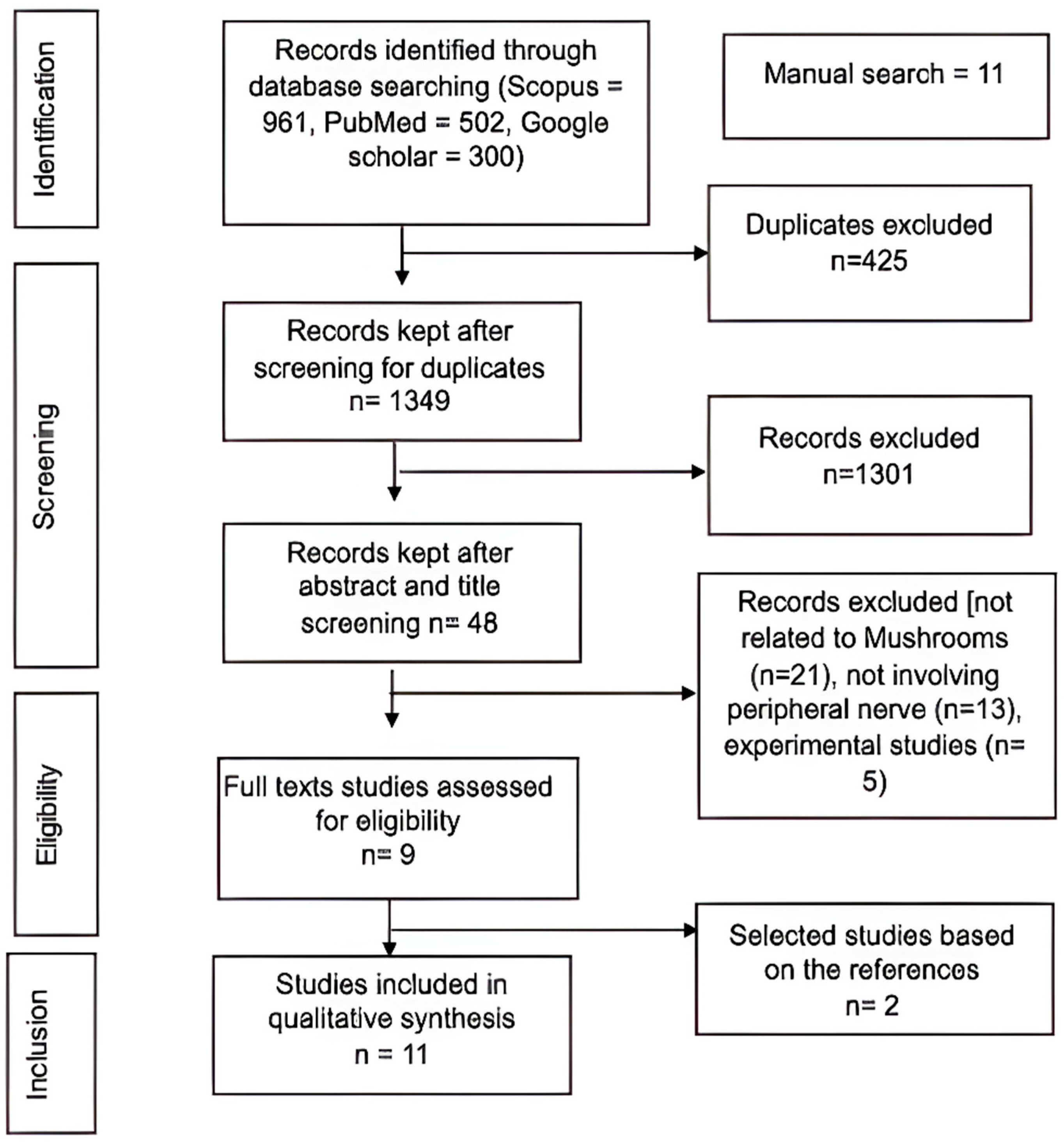
2.1. Study Selection
2.2. Data Extraction and Data Analysis
2.3. Assessment of Methodological Quality and Risk of Bias
3. Results
3.1. Descriptive Findings

| Type of Mushroom | Ingredients | Experimental Model | Effective Concentration and Method of Administration | Type of PNI | Biological Effects | Mechanism of Action | Reference |
|---|---|---|---|---|---|---|---|
| Amanita muscaria | Muscimol | In vivo (SD rats) | Direct injection of 400 μg/mL of muscimol into a hole drilled in the right L5 DRG | Sciatic crush injury for the experimental group and nerve mobilisation of the sciatic nerve without crush injury in the control group | Promoted peripheral nerve regeneration in rats with SNI (prevented the development of thermal and mechanical hypersensitivity and mechanical allodynia, improved basal membrane integrity, and increased). | Normalisation of PMP22 protein expression level by GABAergic modulation in the ipsilateral DRG | Naik et al. [20] |
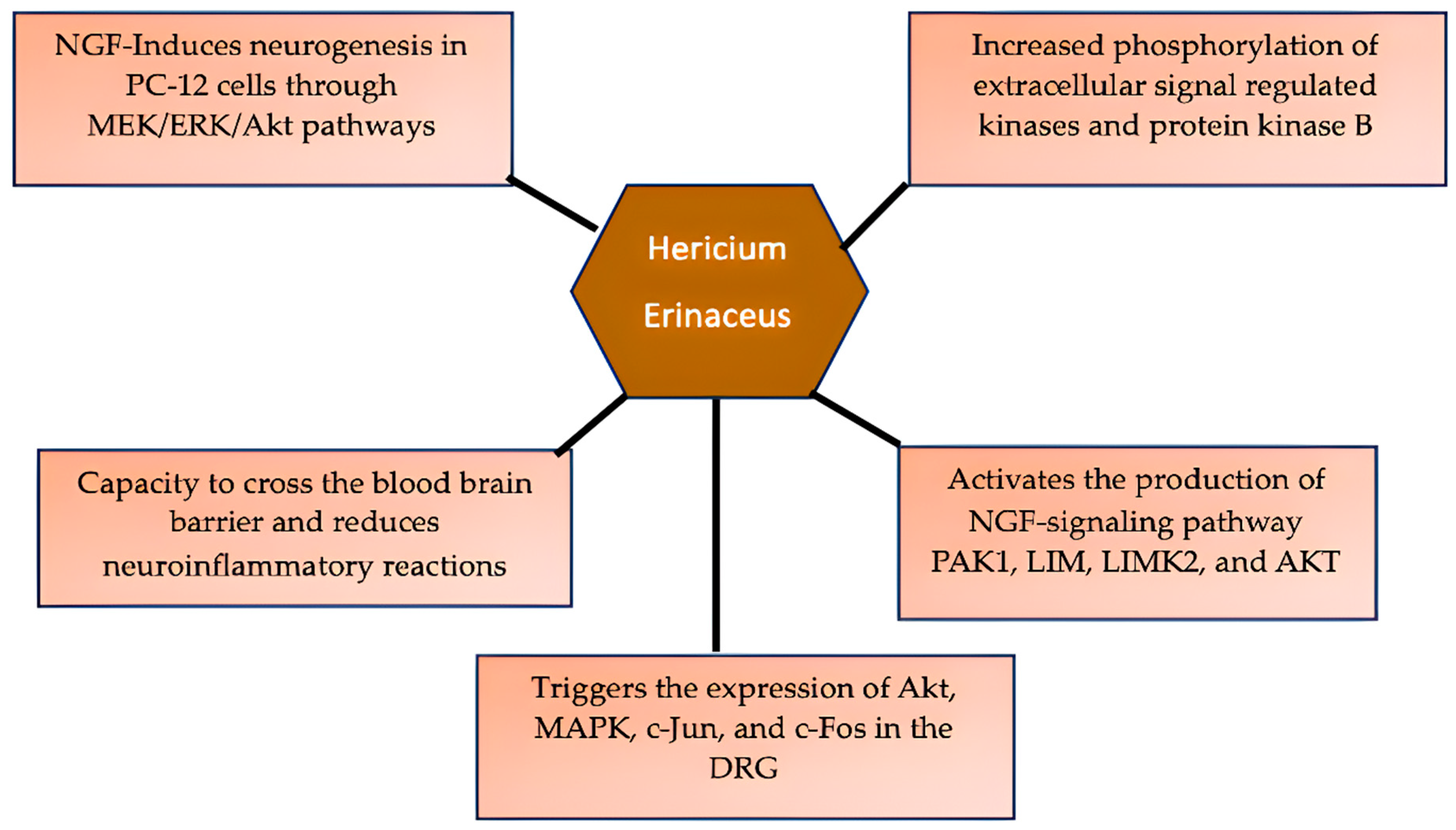
| Aqueous extract | In vivo (SD rats) | Daily oral administration at 10 mL per kg | Sciatic nerve injury | Promoted peripheral nerve regeneration in rats following peroneal nerve crush. | Protein synthesis and activation of several signalling pathways, such as Akt, MAPK, c-Jun, and C-fos | Wang et al. [9] | |
| Hericium erinaceus | Polysaccharide | In vivo (SD rats) | Daily oral administration of polysaccharide from H. erinaceus at 30 mg/mL/kg body weight/day) for 14 days | Peroneal crush injury | Promoted sensory functional recovery following peroneal nerve crush in rats (reduced withdrawal reflex latency). | Activation of Akt and p38 MAPK signalling and increasing expression of RECA-1 | Wong et al. [25] |
| Aqueous extract | In vivo (SD rats) | Daily oral administration of aqueous extract of fresh fruit bodies at 30 mL/kg for 14 days | Peroneal nerve crush | Promoted peripheral nerve regeneration post-peroneal nerve crush (increased PFL, improved axon morphology and development of the neuromuscular junction). | Activation of Akt and p38 MAPK signalling and increasing expression of RECA-1. Restoration of the integrity of the blood–brain barrier | Wong et al. [26] | |
| Erinacine S | In vitro (rats and mice cortical neuron cultures) | 1 ug/mL, 100 ng/mL, 10 ng/mL, and 1 ng/mL were inoculated into the primary neurone and DRG cultures | DRG neuron cultures | Erinacine S depicted significant effects on neurite outgrowth in neurons of the peripheral nervous system. Cortical neuron attachment on CSPGs, length of neurites, and axon regeneration were also increased. | The accumulation of neurosteroids, pregnenolone and progesterone, was induced by Erinacine S, which is responsible for neurite outgrowth enhancement | Lin et al. [21] | |
| Hot aqueous extracts | In vitro (primary cultures of DRG neurons from mice) | Treatment groups comprised 25 μg/mL of HE, 50 ng/mL of NGF, and a combination of both HE and NGF. Pre-treatment with PBS was performed before axon transection | DRG neuron cultures | Both NGF and HE depicted neuroprotective and neurodegenerative effects on axotomized peripheral sensory neurons; the effects were maximised when both treatments were combined. | NA | Üstün & Ayhan [24] | |
| N-de phenylethyl isohericerin (NDPIH), and its hydrophobic derivative, hericene A | In vitro (cultured hippocampal neurons from mice) | Direct inoculation of extracts into cultured hippocampal neurons | Hippocampal neuron cultures | The combination of N-de phenylethyl isohericerin (NDPIH) and its hydrophobic derivative, hericene A, was highly effective in promoting marked axon outgrowth and neurite branching in the cultured cells, reflecting potent neurotrophic activity. NDPIH-induced neurotrophic activity was partly prevented by ANA-12’s inhibition of tropomyosin receptor kinase B (TrkB), indicating a potential relationship with BDNF signalling. | ERK1/2 signalling was activated by NDPIH without the presence of TrkB in HEK-293T cells—an event that was insensitive to ANA-12 in the presence of TrkB | Martínez-Mármol et al. [13] | |
| Lignosus rhinocerotis | Aqueous extract | In vivo (SD rats) | Daily oral administration of aqueous extract at 500–1000 mg/kg | Complete sciatic crush injury | Promoted motor and sensory functional recovery in rats with SNI (improved WRL and toe-spreading reflex). | NA | Farha et al. [27] |
| Sclerotium extract combined with nerve growth factor (NGF) | In vitro (PC-12Adh cell line) | Inoculation of 20 ug/mL of sclerotium extract and 30 ng/mL of NGF into PC-12 ADH cell lines | PC-12 ADH cell lines | Treatment with aqueous extract alone induced neurite outgrowths of 24.4% at 20 μg/mL (w/v), whereas when combined with 30 ng/mL (w/v) of NGF, the neurite outgrowth increased to 42.1%. | NA | Lee-Fang Eik et al. [23] | |
| Hot aqueous and ethanolic extracts, and crude polysaccharides | In vitro (rat pheochromocytoma (PC-12) cells) | Rat pheochromocytoma (PC-12) cells | The hot aqueous extract exhibited neuritogenic activity comparable to NGF in PC-12 cells. However, the extracts and crude polysaccharides stimulated neuritogenesis without stimulating the production of NGF in PC-12 cells. No significant difference in protein expression in NGF- and hot aqueous extract-treated cells for both total and phosphorylated p44/42 MAPK. | The extracts stimulated neurogenic activity in PC-12 cells that mimicked NGF activity via the MEK/ERK1/2 signalling pathway | Seow et al. [14] | ||
| Flammulina velutipes | Nerve-guided conduits (NGCs) (labelled FVC) | In vitro and in vivo (SD rats) | Direct inoculation into cell lines and oral administration to rats | Sciatic nerve defects | FVC effectively stimulated nerve functional recovery and axonal outgrowth when applied to ameliorate critical-sized sciatic nerve defects in a rat model. | Growth-associated protein 43 (GAP-43) was increasingly expressed in the FVC group compared to the autograft group. FVC upregulated the phosphorylation of signal transducer and activation of transcription-3 (P-STAT3), thereby leading to the secretion of GAP-43 | Chen et al. [22] |
3.2. Quality Appraisal Results
3.3. Peripheral Nerve Regenerative Properties of Amanita muscaria
3.4. Peripheral Nerve Regenerative Properties of Hericium erinaceus
3.5. Peripheral Nerve Regenerative Properties of Lignosus rhinocerotis
3.6. Peripheral Nerve Regenerative Properties of Flammulina velutipes
4. Discussion
5. Conclusions and Future Recommendations
Author Contributions
Funding
Institutional Review Board Statement
Informed Consent Statement
Data Availability Statement
Conflicts of Interest
References
- Navarro, X. Functional evaluation of peripheral nerve regeneration and target reinnervation in animal models: A critical overview. Eur. J. Neurosci. 2016, 43, 271–286. [Google Scholar] [CrossRef] [PubMed]
- Wojtkiewicz, D.M.; Saunders, J.; Domeshek, L.; Novak, C.B.; Kaskutas, V.; Mackinnon, S.E. Social impact of peripheral nerve injuries. Hand 2015, 10, 161–167. [Google Scholar] [CrossRef]
- Li, N.Y.; Onor, G.I.; Lemme, N.J.; Gil, J.A. Epidemiology of peripheral nerve injuries in sports, exercise, and recreation in the United States, 2009–2018. Phys. Sportsmed. 2020, 49, 355–362. [Google Scholar] [CrossRef] [PubMed]
- Scholz, T.; Krichevsky, A.; Sumarto, A.; Jaffurs, D.; Wirth, G.; Paydar, K.; Evans, G.R.D. Peripheral nerve injuries: An international survey of current treatments and future perspectives. J. Reconstr. Microsurg. 2009, 25, 339–344. [Google Scholar] [CrossRef]
- Antoniadis, G.; Kretschmer, T.; Pedro, M.T.; König, R.W.; Heinen, C.P.; Richter, H.P. Iatrogenic nerve injuries-prevalence, diagnosis and treatment. Dtsch. Arztebl. Int. 2014, 111, 273–279. [Google Scholar] [PubMed]
- Popa, V.I.; Racasan, O.F.; Margina, A.C.; Silviu Cortan, S.; Neagu, P.; Sebe, I.T. Advances in peripheral nerve regeneration: Materials, methods, techniques. Modern. Med. 2016, 23, 257–269. [Google Scholar]
- Angius, D.; Wang, H.; Spinner, R.J.; Gutierrez-Cotto, Y.; Yaszemski, M.J.; Windebank, A.J. Systematic review of animal models used to study nerve regeneration in tissue-engineered scaffolds. Biomaterials 2012, 33, 8034–8039. [Google Scholar] [CrossRef]
- Grinsell, D.; Keating, C.P. Peripheral nerve reconstruction after injury: A review of clinical and experimental therapies. BioMed Res. Int. 2014, 2014, 698256. [Google Scholar] [CrossRef]
- Wang, E.W.; Zhang, J.; Huang, J.H. Repairing peripheral nerve injury using tissue engineering techniques. Neural Regen. Res. 2015, 10, 1393–1394. [Google Scholar] [CrossRef]
- Yow, Y.Y.; Goh, T.K.; Nyiew, K.Y.; Lim, L.W.; Phang, S.M.; Lim, S.H.; Ratnayeke, S.; Wong, K.H. Therapeutic potential of complementary and alternative medicines in peripheral nerve regeneration: A systematic review. Cells 2021, 10, 2194. [Google Scholar] [CrossRef]
- Brunelli, B.; Gorson, K.C. The use of complementary and alternative medicines by patients with peripheral neuropathy. J. Neurol. Sci. 2004, 218, 59–66. [Google Scholar] [CrossRef] [PubMed]
- Yadav, S.K.; Ir, R.; Jeewon, R.; Doble, M.; Hyde, K.D.; Kaliappan, I.; Jeyaraman, R.; Reddi, R.N.; Krishnan, J.; Durairajan, S.S.K.; et al. A mechanistic review on medicinal mushrooms-derived bioactive compounds: Potential mycotherapy candidates for alleviating neurological disorders. Planta Medica 2020, 86, 1161–1175. [Google Scholar] [CrossRef] [PubMed]
- Martínez-Mármol, R.; Chai, Y.; Conroy, J.N.; Khan, Z.; Hong, S.; Kim, S.B.; Gormal, R.S.; Lee, D.H.; Lee, J.K.; Coulson, E.J.; et al. Hericerin derivatives activate a pan-neurotrophic pathway in central hippocampal neurons converging to ERK1/2 signalling enhancing spatial memory. J. Neurochem. 2023, 165, 791–808. [Google Scholar] [CrossRef]
- Seow, S.L.-S.; Eik, L.-F.; Naidu, M.; David, P.; Wong, K.-H.; Sabaratnam, V. Lignosus rhinocerotis (Cooke) Ryvarden mimics the neuritogenic activity of nerve growth factor via MEK/ERK1/2 signalling pathway in PC-12 cells. Sci. Rep. 2015, 5, 16349. [Google Scholar] [CrossRef] [PubMed]
- De Silva, D.D.; Rapior, S.; Sudraman, E.; Stadler, M.; Xu, J.; Alias, S.A.; Hyde, K.D. Bioactive metabolites from macrofungi: Ethnopharmacology, biological activities and chemistry. Fungal Divers. 2013, 62, 1–40. [Google Scholar] [CrossRef]
- Phan, C.W.; David, P.; Sabratnam, V. Edible and medicinal mushrooms: Emerging brain food for the mitigation of neurodegenerative diseases. J. Med. Food 2017, 20, 1–10. [Google Scholar] [CrossRef]
- Choo, S.; Phillips, R.; White, J.; Nuelle, J.A. Neuromodulators can promote nerve regeneration and accelerate functional recovery after peripheral nerve injury: A systematic review. J. Orthop. 2023, 47, 122–147. [Google Scholar] [CrossRef]
- Campbell, M.; McKenzie, J.E.; Sowden, A.; Katikireddi, S.V.; Brennan, S.E.; Ellis, S.; Hartmann-Boyce, J.; Ryan, R.; Shepperd, S.; Thomas, J.; et al. Synthesis without meta-analysis (Swim) in systematic reviews: Reporting guideline. BMJ 2020, 368, l6890. [Google Scholar] [CrossRef]
- Hooijmans, C.R.; Rovers, M.M.; de Vries, R.B.; Leenaars, M.; Ritskes-Hoitinga, M.; Langendam, M.W. SYRCLE’s risk of bias tool for animal studies. BMC Med. Res. Methodol. 2014, 14, 43. [Google Scholar] [CrossRef]
- Naik, A.K.; Latham, J.R.; Obradovic, A.; Jevtovic-Todorovic, V. Dorsal root ganglion application of muscimol prevents hyperalgesia and stimulates myelin protein expression after sciatic nerve injury in rats. Anesth. Analg. 2012, 114, 674–682. [Google Scholar] [CrossRef]
- Lin, C.Y.; Chen, Y.J.; Hsu, C.H.; Lin, Y.H.; Chen, P.T.; Kuo, T.H.; Ho, C.T.; Chen, H.H.; Huang, S.J.; Chiu, H.C.; et al. Erinacine S from Hericium erinaceus mycelium promotes neuronal regeneration by inducing neurosteroid accumulation. J. Food Drug Anal. 2023, 31, 32–54. [Google Scholar] [CrossRef]
- Chen, F.; Wu, M.; Wu, P.; Xiao, A.; Ke, M.; Huselstein, C.; Cai, L.; Tong, Z.; Chen, Y. Natural Flammulina velutipes -based nerve guidance conduit as a potential biomaterial for peripheral nerve regeneration: In vitro and in vivo studies. ACS Biomater. Sci. Eng. 2021, 7, 3821–3834. [Google Scholar] [CrossRef]
- Lee, K.F.; Chen, J.H.; Teng, C.C.; Shen, C.H.; Hsieh, M.C.; Lu, C.C.; Lee, K.C.; Lee, L.Y.; Chen, W.P.; Chen, C.C.; et al. Protective effects of Hericium erinaceus mycelium and its isolated erinacine A against ischemia-injury-induced neuronal cell death via the inhibition of iNOS/p38 MAPK and nitrotyrosine. Int. J. Mol. Sci. 2014, 15, 15073–15089. [Google Scholar] [CrossRef]
- Üstün, R.; Ayhan, P. Regenerative activity of Hericium erinaceus on axonal injury model using in vitro laser microdissection technique. Neurol. Res. 2019, 41, 265–274. [Google Scholar] [CrossRef]
- Wong, K.H.; Kanagasabapathy, G.; Naidu, M.; David, P.; Sabaratnam, V. Hericium erinaceus (Bull.: Fr.) Pers., a medicinal mushroom, activates peripheral nerve regeneration. Chin. J. Integr. Med. 2016, 22, 759–767. [Google Scholar] [CrossRef] [PubMed]
- Wong, K.H.; Kanagasabapathy, G.; Bakar, R.; Phan, C.W.; Sabaratnam, V. Restoration of sensory dysfunction following peripheral nerve injury by the polysaccharide from culinary and medicinal mushroom, Hericium erinaceus (Bull.: Fr.) Pers. through its neuroregenerative action. Food Sci. Technol. 2015, 35, 712–721. [Google Scholar] [CrossRef]
- Farha, M.; Parkianathan, L.; Amir, N.A.I.A.; Sabaratnam, V.; Wong, K.H. Functional recovery enhancement by tiger milk mushroom, Lignosus rhinocerotis, in a sciatic nerve crush injury model and morphological study of its neurotoxicity. J. Anim. Plant Sci. 2019, 29, 930–942. [Google Scholar]
- Zhang, C.C.; Cao, C.Y.; Kubo, M.; Harada, K.; Yan, X.-T.; Fukuyama, Y.; Gao, J.-M. Chemical constituents from Hericium erinaceus promote neuronal survival and potentiate neurite outgrowth via the TrkA/Erk1/2 pathway. Int. J. Mol. Sci. 2017, 18, 1659. [Google Scholar] [CrossRef] [PubMed]
- Namikawa, K.; Honma, M.; Abe, K.; Takeda, M.; Mansur, K.; Obata, T.; Miwa, A.; Okado, H.; Kiyama, H. Akt/protein kinase B prevents injury-induced motoneuron death and accelerates axonal regeneration. J. Neurosci. 2002, 20, 2875–2886. [Google Scholar]
- Raman, J.; Lakshmanan, H.; John, P.A.; Zhijian, C.; Periasamy, V.; David, P.; Naidu, M.; Sabaratnam, V. Neurite out-growth stimulatory effects of myco-synthesised AuNPs from Hericium erinaceus (Bull.: Fr.) Pers. on pheochromocytoma (PC-12) cells. Int. J. Nanomed. 2015, 10, 5853–5863. [Google Scholar]
- Li, X.; Wang, Z.; Wang, L.; Walid, E.; Zhang, H. In vitro antioxidant and anti-proliferation activities of polysaccharides from various extracts of different mushrooms. Int. J. Mol. Sci. 2012, 13, 5801–5817. [Google Scholar] [CrossRef]
- Contato, A.G.; Conte-Junior, C.A. Lion’s Mane Mushroom (Hericium erinaceus): A Neuroprotective Fungus with Antioxidant, Anti-Inflammatory, and Antimicrobial Potential-A Narrative Review. Nutrients. 2025, 8, 1307. [Google Scholar] [CrossRef] [PubMed]
- Charalampopoulos, I.; Remboutsika, E.; Margioris, A.N.; Gravanis, A. Neurosteroids as modulators of neurogenesis and neuronal survival. Trends Endocrinol. Metabol. 2008, 19, 300–307. [Google Scholar] [CrossRef]
- Djebaili, M.; Guo, Q.; Pettus, E.H.; Hoffman, S.W.; Stein, D.G. The neurosteroids progesterone and allopregnanolone reduce cell death, gliosis, and functional deficits after traumatic brain injury in rats. J. Neurotrauma 2005, 22, 106–118. [Google Scholar] [CrossRef]
- Lu, C.C.; Hsu, Y.J.; Chang, C.J.; Lin, C.S.; Martel, J.; Ojcius, D.M.; Ko, Y.F.; Lai, H.C.; Young, J.D. Immunomodulatory properties of medicinal mushrooms: Differential effects of water and ethanol extracts on NK cell-mediated cytotoxicity. Innate Immunity 2016, 22, 522–533. [Google Scholar] [CrossRef]
- Pilipenko, V.; Pupure, J.; Rumaks, J.; Beitnere, U.; Dzirkale, Z.; Skumbins, R.; Klusa, V. GABAA agonist muscimol ameliorates learning/memory deficits in streptozocin-induced Alzheimer’s disease non-transgenic rat model. SpringerPlus 2015, 4, 36. [Google Scholar] [CrossRef]
- Voynova, M.; Shkondrov, A.; Kondeva-Burdina, M.; Krasteva, I. Toxicological and pharmacological profile of Amanita muscaria (L.) Lam.—A new rising opportunity for biomedicine. Pharmacia 2020, 67, 317–323. [Google Scholar] [CrossRef]
- Savickaitė, E.; Laubner-Sakalauskienė, G. Emerging Risks of Amanita Muscaria: Case Reports on Increasing Consumption and Health Risks. Acta Medica Litu. 2025, 32, 182–189. [Google Scholar] [CrossRef] [PubMed]
- Meisel, E.M.; Morgan, B.; Schwartz, M.; Kazzi, Z.; Cetin, H.; Sahin, A. Two Cases of Severe Amanita Muscaria Poisoning Including a Fatality. Wilderness Environ. Med. 2022, 33, 412–416. [Google Scholar] [CrossRef] [PubMed]
- Caillaud, M.; Chantemargue, B.; Richard, L.; Vignaud, L.; Favreau, F.; Faye, P.-A.; Vignoles, P.; Sturtz, F.; Trouillas, P.; Vallat, J.-M.; et al. Local low-dose curcumin treatment improves functional recovery and remyelination in a rat model of sciatic nerve crush through inhibition of oxidative stress. Neuropharmacology 2018, 139, 98–116. [Google Scholar] [CrossRef]


| Group 1 | Group 2 | Group 3 |
|---|---|---|
| Mushroom, Hericium Amanita, Lignosus, Alternative, Natural, Complementary | Peripheral nerve, Nerve injury, Nerve crush, Neuroprotective, Regeneration, Therapeutic, Treatment, Repair, In vivo, In vitro | Function, Recovery |
| Scopus |
|---|
| (Mushroom) OR (Hericium) OR (Amanita) OR (Lignosus) OR (Alternative) OR (Natural) OR (Complementary) AND (Peripheral nerve) AND (Nerve Injury) OR (Nerve crush) OR (Neuroprotective) OR (Regeneration) OR (Therapeutic) OR (Treatment) OR (Repair) OR (In vivo) OR (In vitro) AND (Function) OR (Recovery) Search within Article, Abstract, and Keywords. Year = 2010–2024, results limited to research articles = 961 |
| PubMed |
| Query #1: TS= (Mushroom OR Hericium OR Amanita OR Lignosus OR Alternative OR Natural OR Complementary) Query #2: TS= (“Peripheral nerve” OR “Nerve Injury” OR “Nerve crush” OR “Neuroprotective” OR “Regeneration” OR “Therapeutic” OR “Treatment” OR “Repair” OR “In vivo” OR “In vitro”) Query #3: TS= (Functional OR Recovery) Query #4 #1 AND #2 AND #3 and Article (Document Types) and English (Languages) Year = 2010–2024, results limited to research articles = 502 |
| Google Scholar |
| (Mushroom) OR (Hericium) OR (Amanita) OR (Lignosus) OR (Alternative) OR (Natural) OR (Complementary) AND (Peripheral nerve) OR (Nerve Injury) OR (Nerve crush) OR (Neuroprotective) OR (Regeneration) OR (Therapeutic) OR (Treatment) OR (Repair) OR (In vivo) OR (In vitro) AND (Function) OR (Recovery) Year = 2010–2024, Results = 152,000, screening limited to the first 300 articles after sorting based on relevance |
| Reference | D1 | D2 | D3 | D4 | D5 | D6 | D7 | D8 | D9 | D10 | Overall |
|---|---|---|---|---|---|---|---|---|---|---|---|
| Naik et al. [19] | Unclear | Yes | Unclear | Unclear | Unclear | Unclear | Unclear | Yes | Yes | Yes | Low |
| Wang et al. [9] | Unclear | Yes | Unclear | Unclear | Unclear | Unclear | Unclear | Yes | Yes | Yes | Low |
| Wong et al. [25] | Unclear | Yes | Unclear | Yes | Unclear | Unclear | Unclear | Yes | Yes | Yes | Moderate |
| Wong et al. [26] | Unclear | Yes | Unclear | Yes | Unclear | Unclear | Unclear | Yes | Yes | Yes | Moderate |
| Lin et al. [21] | Unclear | Yes | Yes | Unclear | Unclear | Unclear | Unclear | Yes | Yes | Yes | Moderate |
| Üstün & Ayhan [24] | Unclear | Yes | Unclear | Unclear | Unclear | Unclear | Unclear | Unclear | Yes | Yes | Low |
| Martínez-Mármol et al. [13] | Unclear | Yes | Unclear | Unclear | Unclear | Unclear | Yes | Unclear | Yes | Yes | Low |
| Farha et al. [27] | Unclear | Yes | Unclear | Unclear | Unclear | Unclear | Unclear | Yes | Yes | Yes | Low |
| Lee-Fang Eik et al. [23] | Unclear | Yes | Unclear | Unclear | Unclear | Unclear | Unclear | Yes | Yes | Yes | Low |
| Seow et al. [14] | Unclear | Yes | Unclear | Unclear | Unclear | Unclear | Unclear | Unclear | Yes | Yes | Low |
| Chen et al. [22] | Unclear | Yes | Unclear | Unclear | Unclear | Unclear | Unclear | Unclear | Yes | Yes | Low |
Disclaimer/Publisher’s Note: The statements, opinions and data contained in all publications are solely those of the individual author(s) and contributor(s) and not of MDPI and/or the editor(s). MDPI and/or the editor(s) disclaim responsibility for any injury to people or property resulting from any ideas, methods, instructions or products referred to in the content. |
© 2026 by the authors. Licensee MDPI, Basel, Switzerland. This article is an open access article distributed under the terms and conditions of the Creative Commons Attribution (CC BY) license.
Share and Cite
Taib, N.A.B.; Eshak, Z.B.; Muhammad, H.B.; Che Ramli, M.D.B. Application of Medicinal Mushrooms for the Treatment of Peripheral Nerve Injury: A Systematic Review. Med. Sci. 2026, 14, 42. https://doi.org/10.3390/medsci14010042
Taib NAB, Eshak ZB, Muhammad HB, Che Ramli MDB. Application of Medicinal Mushrooms for the Treatment of Peripheral Nerve Injury: A Systematic Review. Medical Sciences. 2026; 14(1):42. https://doi.org/10.3390/medsci14010042
Chicago/Turabian StyleTaib, Nurul Aini Binti, Zolkapli Bin Eshak, Hussin Bin Muhammad, and Muhammad Danial Bin Che Ramli. 2026. "Application of Medicinal Mushrooms for the Treatment of Peripheral Nerve Injury: A Systematic Review" Medical Sciences 14, no. 1: 42. https://doi.org/10.3390/medsci14010042
APA StyleTaib, N. A. B., Eshak, Z. B., Muhammad, H. B., & Che Ramli, M. D. B. (2026). Application of Medicinal Mushrooms for the Treatment of Peripheral Nerve Injury: A Systematic Review. Medical Sciences, 14(1), 42. https://doi.org/10.3390/medsci14010042