The management of perineal pain and the promotion of wound healing following episiotomies and lacerations are critical components of postpartum care, with evidence supporting a combination of pharmacological and non-pharmacological strategies. Non-pharmacological approaches, such as cryotherapy and transcutaneous electrical nerve stimulation (TENS), have been identified as promising conservative therapies for managing early postpartum pain, offering alternatives with limited adverse effects [
11]. Emerging evidence also supports the use of specific technologies. Ultimately, optimal outcomes depend on accurate diagnosis, appropriate surgical repair techniques, and the integration of these evidence-based interventions into a comprehensive, individualized care plan. A recent meta-analysis by Kurnaz et al. [
18] highlights that interventions performed within the first 24 h after episiotomy did not reduce pain. However, the effects of the interventions were observed on the second day, with cold application identified as the most effective method. Additionally, interventions did not affect healing during the first three days, but a more pronounced improvement was noted in the intervention group by the fifth day. Healing began around the 7th–10th days, even without intervention. The REEDA score (redness, edema, ecchymosis, discharge, and approximation) decreased most significantly in the patients who received perineal education (diet, Kegel exercise, infection symptoms, and perineal hygiene).
4.2. Interpretation
These results support the proposed mechanisms of PBM, which promote anti-inflammatory mediators and endorphin release for rapid analgesia, even in women with severe baseline pain. Furthermore, PBM represents a promising option for daily therapy in populations with chronic pain. Studies such as da Silva et al. [
20] reinforce that PBM acts to modulate inflammatory processes and improve microcirculation, facilitating not only tissue repair but also providing relief from postoperative pain. Additionally, work by Nonarath et al. [
21] and Rosa et al. [
22] shows that PBM can reduce oxidative stress and modulate cytokine expression, which may explain the analgesic response observed in this cohort. The literature has well-documented the effects of PBM in various clinical contexts. The therapeutic effects of 808 nm PBM on pain and tissue repair are mediated by complex biomodulatory pathways. At this infrared wavelength, photons penetrate deeply into the tissue and are primarily absorbed by cytochrome c oxidase in the mitochondrial respiratory chain. This interaction enhances ATP synthesis and leads to the photodissociation of nitric oxide (NO), which promotes local vasodilation and improves oxygen delivery to the damaged tissue. For analgesia, 808 nm PBM modulates the inflammatory response by downregulating pro-inflammatory cytokines (e.g., TNF-α and IL-6) and increasing anti-inflammatory mediators, like IL-10, effectively reducing perineal edema and pressure-induced nociception. Regarding tissue regeneration, the therapy stimulates fibroblast proliferation and activates the TGF-β signaling pathway, which is essential for collagen deposition and extracellular matrix remodeling. These combined mechanisms explain the significant reduction in NPS scores and the healing rates observed, particularly in patients receiving multiple sessions. Previous studies, such as those by Chougala & Mahishale [
23] and Constant et al. [
19], corroborate the findings of this study, reinforcing the results of PBM for pain and perineal healing in the obstetric context.
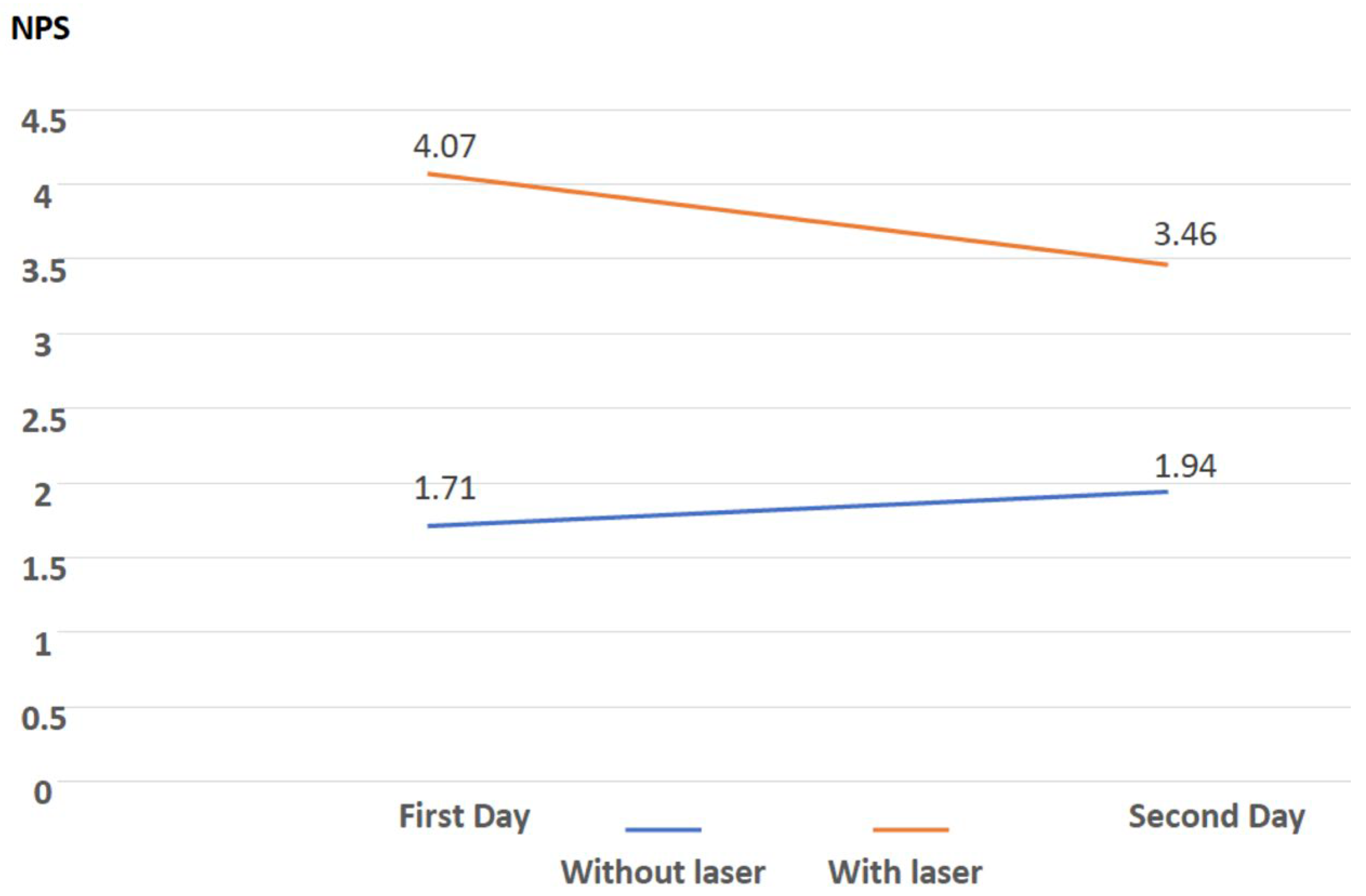
It is important to highlight that women who chose laser therapy initially had significantly higher baseline pain (NPS scores) than those in the conventional treatment group. However, PBM application is associated with a significant reduction in pain in subsequent days, with significant pre- versus post-session differences.
Moreover, women receiving two laser sessions showed a more consistent and statistically significant pain reduction. Analysis of the three subgroups revealed that the most significant pain reduction (NPS) occurred in those receiving PBM on both days. Women treated only on day one exhibited an initial sharp reduction in pain, which diminished by day three. Those treated only on day two displayed an initial increase in pain, followed by a significant decrease after laser application. Those who received only one session did not differ significantly from controls, suggesting either a cumulative therapeutic effect associated with two PBM sessions or, as evidenced in the systematic review by Kurnaz et al. [
18], an influence of the timing of laser introduction on the clinical response to pain. Regarding the results of our study, unfortunately, due to the variable sample sizes between groups and across assessment days, it was not possible to determine whether there was a difference in the evolution of participants who received laser treatment only on the first day compared to those treated only on the second day.
However, the within-group differences in the mean NPS pain scores among patients who underwent laser therapy were both statistically significant and clinically relevant. For the subgroup of patients who received a single laser session, the difference in NPS pain scores over the three-day assessment period clearly exceeded the minimal clinically important difference (MCID~2 points), although this finding was obtained from a small sample. The subgroup that received two laser sessions also demonstrated a clinically significant, albeit borderline, improvement (~1.35 points). Furthermore, at the end of follow-up, patients who received two sessions presented better outcomes than those who received no laser sessions. The main reported effect was a mean difference of 1.6761 points in NPS scores (two sessions vs. zero sessions), with a p-value of 0.000191. In terms of clinical relevance, this mean effect of 1.67 points is likely clinically meaningful and closely approaches the more conservative Minimal Clinically Important Difference (MCID) threshold (~2 points). Moreover, since the 95% confidence interval includes values above 2, it is plausible that the true (population) effect may be clinically strong in certain scenarios. In contrast, for the subgroup that received no laser sessions, the 0.75-point difference over the three days was clearly not clinically significant. These data reinforce and corroborate the statistical difference found, suggesting that the laser, in this population, is related to a greater improvement in pain than conventional treatment.
In this study, the association between lower Apgar scores and the choice of laser therapy suggests that the Apgar score may serve as a proxy for factors contributing to greater perineal pain, such as prolonged labor, instrumental delivery, or newborn size. Women with more extensive lacerations also opted more frequently for PBM, reinforcing the link between injury severity and pain levels [
18].
Unfortunately, we did not carry out an analysis about other covariates such as age, type and number of previous labors, delivery type, parity, Apgar score, analgesic medications used, or laser use on the first or second day. Future post hoc analyses of these factors may clarify their influence on treatment response and provide new directions for research. We chose not to include all these adjustments in the models presented in this manuscript in order to parsimoniously preserve caution in the presentation of the results. First, increasing the number of covariates in the statistical model elevates the risk of Type I errors (false positives) due to multiple testing, particularly when these analyses were not pre-specified. Second, given the observational nature of our study and the fact that our sample size was not predetermined but rather reflected the real-world characteristics of the service and patient flow during the study period, we must exercise caution when expanding the number of covariates in our models. With a relatively small sample size, the inclusion of numerous covariates would lead to model overfitting, resulting in unstable estimates and inflated standard errors. This could produce spurious associations that are not reproducible. In observational studies with limited samples, each additional covariate reduces the degrees of freedom and increases the risk of Type I errors, particularly when these analyses were not pre-specified in a protocol. Our sample size was determined by the natural patient flow (convenience sample), meaning it provides adequate power only for the primary analyses and the limited set of covariates originally planned. Expanding the model post hoc to include multiple new covariates would violate key statistical assumptions and could generate misleading conclusions. Therefore, to maintain the statistical rigor and interpretability of our study, we have opted to retain the focus on the covariates defined in our original protocol.
For healing, REEDA scores improved most significantly in women receiving two laser sessions within the first two days. Although the PSM analysis did not reach the conventional statistical significance threshold (p < 0.05), a positive trend was observed at a 10% alpha level. Naturally, we acknowledge that p-values above the conventional threshold do not constitute conclusive evidence and should be interpreted with caution as suggestive findings, possibly limited by statistical power, heterogeneity of exposure, and the short observation period and sample. Moreover, the follow-up period limited to hospitalization, up to 72 h, does not allow evaluation of tissue remodeling or complete healing of second- and third-degree perineal lacerations, which in fact occur over several weeks. This assessment was primarily to analyze the early aspects of the healing process, such as early inflammatory signs, edema, ecchymosis, hyperemia, wound edge approximation, and pain evolution, which are clinically relevant parameters in the immediate postpartum period and can be captured by instruments such as the REEDA scale and the NPS. In addition, the early treatment assessment was precisely to demonstrate that there was no worsening of inflammatory signs in patients treated with PBM, as these signs may worsen in the first days in the absence of specific wound care.
We acknowledge that this short-term assessment of tissue healing should be interpreted only as an initial signal of the inflammatory phase and the early repair process rather than as an endpoint of definitive healing. A clinically meaningful time horizon for evaluating perineal healing would be a long-term follow-up until complete wound healing, since the first 24–72 h to approximately 6 weeks postpartum aligns with routine postpartum review and the expected timeline of tissue repair. Clinically relevant complications also include wound infection, suture dehiscence, persistent pain with functional impact, dyspareunia, urinary symptoms, and anorectal symptoms. Therefore, in addition to clinical instruments, such as the REEDA scale, future studies should include patient-reported outcomes, quality-of-life and treatment satisfaction questionnaires, and evaluation of return to sexual activity and urinary/anorectal symptoms. Despite these limitations, these preliminary results show a trend toward lower REEDA scores (indicating better outcomes) in the laser group, as suggested by the negative coefficient—an effect that could be confirmed in larger studies.
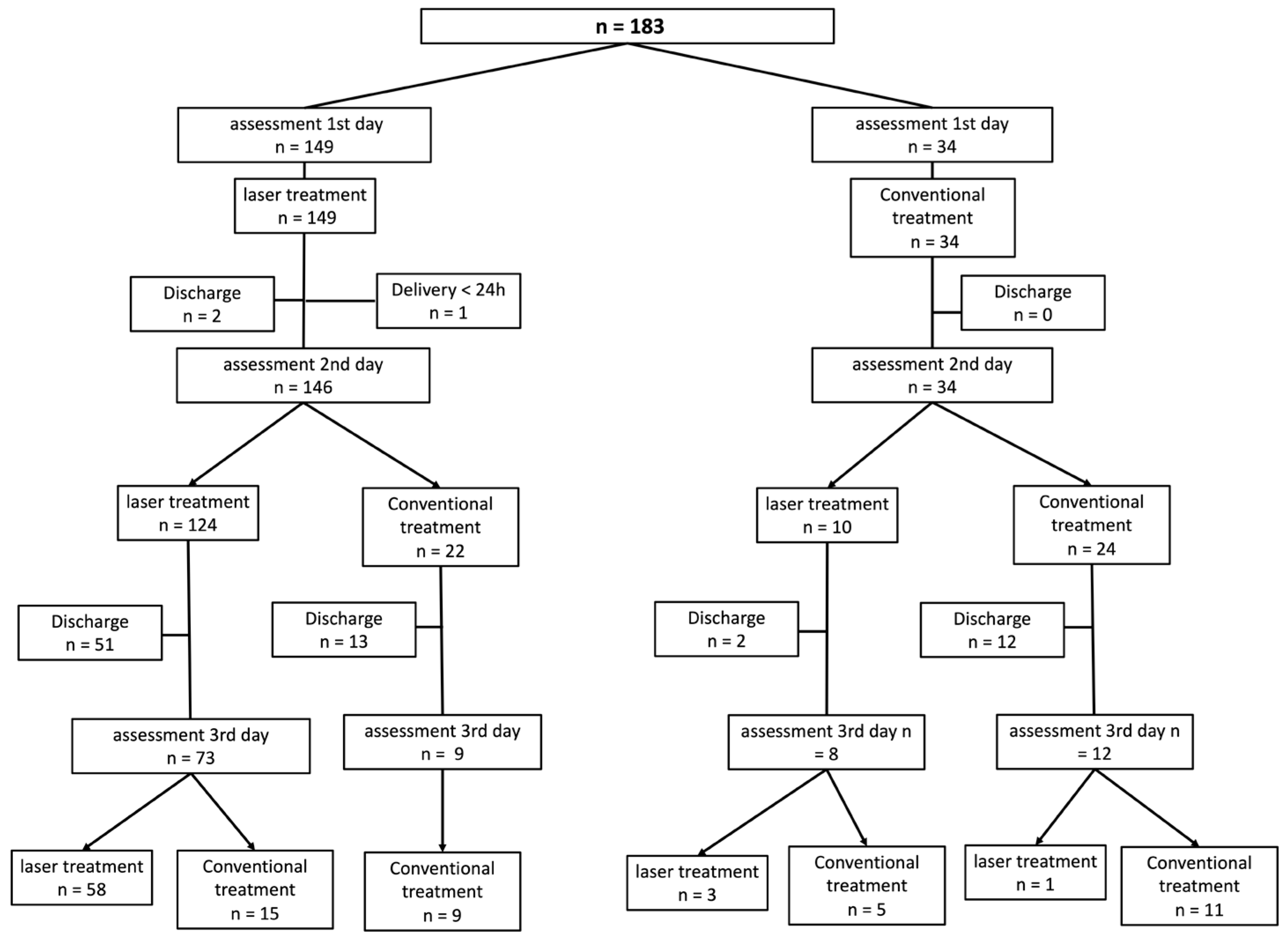
The last relevant aspect that impacted our results was the migration of participants between treatment subgroups throughout hospitalization, which increased data heterogeneity and analytical complexity. Despite this challenge, migration provided a rare opportunity in observational studies to compare outcomes between users and non-users of the laser therapy. This migration highlights inherent methodological challenges in pragmatic clinical studies within real-world settings, where treatment choices are guided by clinical need rather than research protocols. Although such studies require complex analysis, they generate highly applicable results by evaluating interventions under actual clinical conditions. This approach assesses not just effectiveness but also feasibility, acceptability, and impact on healthcare workflows.
Future research on the use of PBM in the postpartum period should focus on standardizing application parameters, conducting larger observational and randomized clinical trials, evaluating long-term outcomes, elucidating underlying cellular mechanisms, comparing PBM with other therapies, and analyzing cost-effectiveness. These initiatives are essential to consolidate the efficacy, safety, and applicability of PBM for pain management and perineal healing and to further support these promising results.
4.3. Strengths and Limitations of the Study
This study assessed PBM for pain relief and perineal healing postpartum, demonstrating that PBM is associated with a significant reduction in pain compared to conventional treatment. With a substantial sample of women, it observed both immediate effects and continuous improvement trends. While further studies on healing are needed, the results support the clinical potential of PBM and underscore the value of observational research in real-world hospital settings. By monitoring implemented protocols without artificial intervention, this study provides findings that can be directly and rapidly translated into clinical practice, enabling continuous improvements in care.
While randomized controlled trials (RCTs) operating under strictly controlled ideal conditions remain the gold standard for efficacy analysis, this ‘real-world’ observational design offers a good external validity by demonstrating the feasibility of PBM within a routine hospital workflow. This approach respects patient autonomy and pragmatic clinical practice, thereby aligning the results with clinical effectiveness. Although RCTs excel at isolating the specific effects of a therapy, our observational study contributes insights often overlooked by controlled trials, as it evaluates the intervention precisely as it occurs in a university hospital setting, facilitating a direct and rapid translation of findings into clinical practice. By allowing patients to transition between groups (migration between laser and conventional treatment), the study captures the acceptability and perceived need for the therapy among women—nuances that the forced randomization of an RCT might mask. Furthermore, whereas RCTs often employ highly restrictive inclusion criteria, this study demonstrates that PBM is effective in a diverse population with varying degrees of laceration extent and baseline pain levels. It also confirms that PBM implementation caused no adverse events and was successfully integrated with conventional therapies (analgesics and anti-inflammatories) without requiring supplemental analgesia. Moreover, to reinforce the robustness of these conclusions within a real-world setting, propensity score matching (PSM) was utilized to balance the main baseline covariates between groups, thereby minimizing the selection bias inherent in observational designs. By demonstrating that pain reduction was statistically significant even after propensity score matching, our results suggest a robust association that approaches the internal validity of an RCT while maintaining the external validity of an already implemented clinical protocol.
Of course, this study has its limitations. The NPS is a subjective measure dependent on individual perception and may be influenced by emotional, cultural, and clinical context factors, in addition to not capturing qualitative aspects of pain, such as functional or emotional impact. The REEDA scale also has a subjective component, as the assessment of items such as redness and edema may vary between examiners, potentially leading to interobserver variability. Moreover, a short REEDA scale follow-up period may have obscured more significant healing differences emerging over weeks. Furthermore, REEDA primarily evaluates superficial aspects of healing and may not fully reflect deeper tissue changes. Despite these limitations, when used in a standardized and combined manner, both scales constitute complementary and useful instruments for a comprehensive evaluation of postoperative recovery.
Other limitations involve the inability to control for natural pain resolution, potential placebo effects, and the prolonged actions of the analgesic block routinely administered during the surgical labor period. We also did not analyze the influence of other covariates—such as the type and number of previous labors, differences noted between subgroups, analgesic medications used, baseline laceration extent, or Apgar differences, as well as the timing of laser use (i.e., whether women chose treatment on the first or second day), natural recovery, placebo/context effects, and analgesic/anesthetic carryover—on outcomes. Future exploratory post hoc analyses of these factors may clarify their effects on treatment response and provide new insights for further research.




 ,
,