3.1. VSTEM Field Characteristics Excited by Vertical Electric Dipole
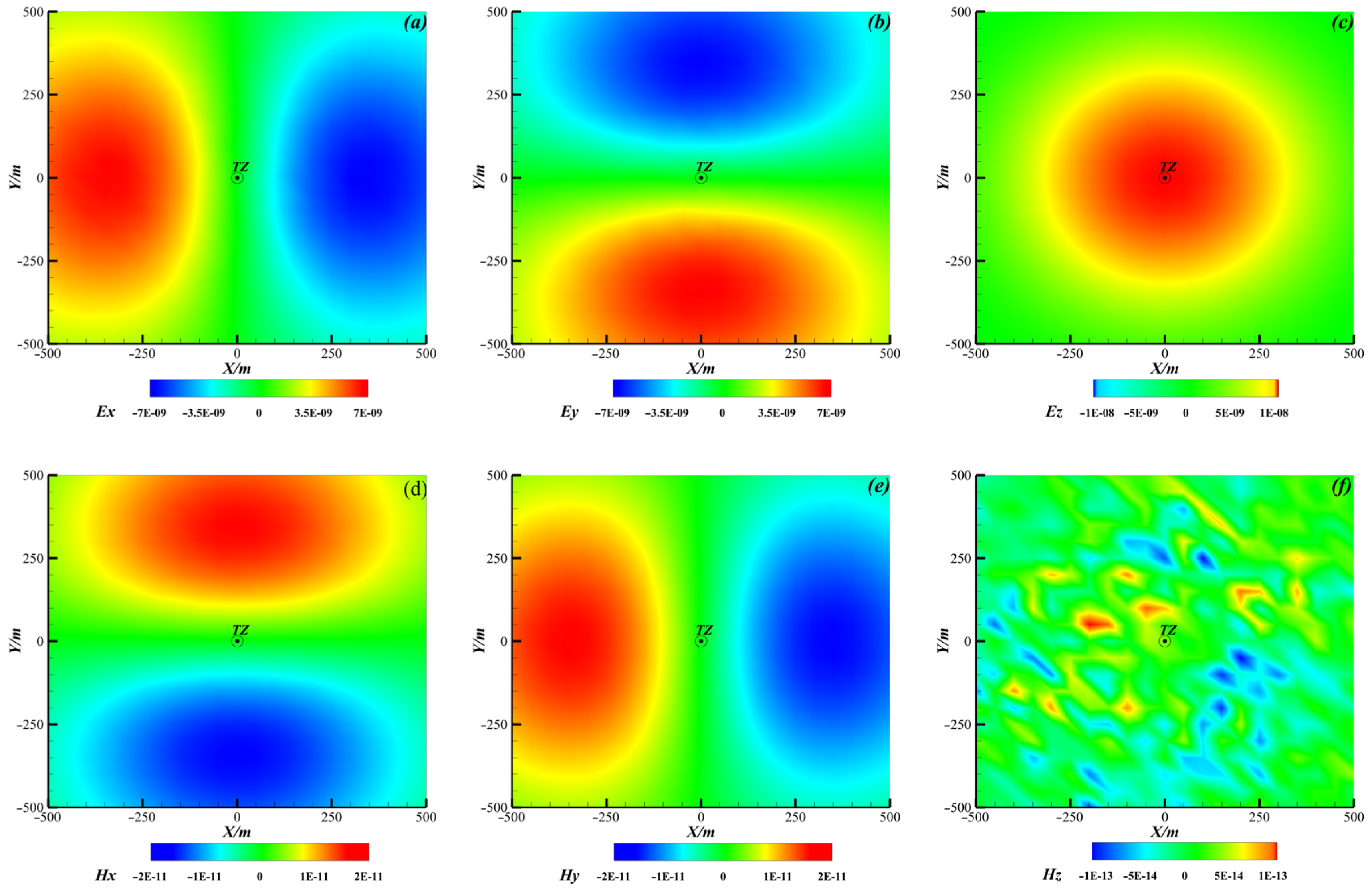
Analyzing the fields excited by a Vertical Electric Dipole (VED) produced by marine VED sources is essential for enhancing the geometric arrangement of transmitters and receiver stations during field operations. A well-structured survey line design should guarantee that receivers are located in areas where the target electromagnetic fields exhibit strong signal intensity and consistent spatial distribution. This study calculated the response values of six electromagnetic fields at a depth of 900 m at two specific time gates: early time (0.01 s) and late time (0.1 s), and presented their planar distribution maps (refer to
Figure 2). The simulation domain encompasses an area of 1000 m × 1000 m, with coordinates in the x and y directions extending from −500 m to 500 m.
Figure 2 depicts the planar distribution characteristics of the underground VSTEM fields generated by VED sources at t = 0.01 s. The examination of this figure indicates the ensuing findings: The extreme value region of the
Ex field shows a dipole-like distribution that is symmetric on both the left and right sides, with its center positioned directly beneath the transmitter. The distribution of field values is continuous and uniform along the y-axis, nearing zero exclusively on the central axis where x = 0. The extreme value region of the
Ey field exhibits symmetry concerning the point directly beneath the transmitter and its perpendicular bisector. This region demonstrates an orthogonal relationship to the
Ex field. The distribution of field values is continuous and uniform along the x-axis, with the field value reaching zero along the symmetry axis at y = 0. The extreme value region of the
Ez field creates an axially symmetric ring distribution centered directly beneath the transmitter. The field value reaches its peak in the central area and decreases uniformly with a radial gradient outward in all directions. There are no zero-value regions or polarity reversals throughout the entire plane, which indicates optimal distribution stability. The distribution characteristics of the d
Hx/dt field closely resemble those of the
Ey field, exhibiting extreme values along the positive and negative y-axis directions, while the field value remains zero on the symmetry axis at x = 0. The extreme value region of the d
Hy/dt field is located on both the positive and negative sides of the transmitter along the x-axis, exhibiting a distribution pattern that closely aligns with the
Ex field. The d
Hz/dt field displays low field values throughout the entire plane, which restricts its practical application in real-world exploration.
HxHyHxHyMarine VSTEM methods primarily utilize fixed seabed array observations or towed continuous profile observations. Therefore, the selection of observation time windows and the spatial arrangement of survey points must be carefully designed in conjunction with the temporal diffusion laws of the transient field. Consequently, the five components (Ex, Ey, Ez, dHx/dt, dHy/dt) are all appropriate for practical observation during the designated observation time window: To achieve stable and effective signals for the Ex, Ey, dHx/dt, and dHy/dt fields, which exhibit zero-value symmetry axes, it is essential to design the geometric relationship between the transmitter and survey points carefully. Specifically, the receiver points should be positioned outside the axial regions where the field values of the corresponding components are zero, ensuring optimal signal acquisition throughout the entire time window. The dHz/dt field shows very low values during the entire observation period. Its effective signals are easily obscured by marine environmental noise and instrument background noise, making it practically unobservable throughout the survey.
This study focuses on analyzing the vertical diffusion laws of the VSTEM field originating from marine VED sources within seabed strata that exhibit typical electrical anomalies. The objective is to explain the influence mechanisms of different resistivity anomaly layers on the characteristics of transient field propagation. To accomplish this, two varieties of three-layer geoelectric models were developed, representing real-world situations in marine VSTEM exploration: the H-type conductive anomaly model and the K-type resistive anomaly model.
Table 1 presents the model parameters. The vertical profile distribution characteristics of the
Ex field,
Ey field,
Ez field, d
Hx/dt field, and d
Hy/dt field, as excited by the VED sources, were simulated at three specific time instances: 0.01 s, 0.1 s, and 0.5 s. The profiles align with the strike of the transmitting source, extending from depths of 0 to 2000 m beneath the seabed and spanning a lateral range of −1000 m to 1000 m. The field values are presented in base-10 logarithmic format following the application of their absolute values.
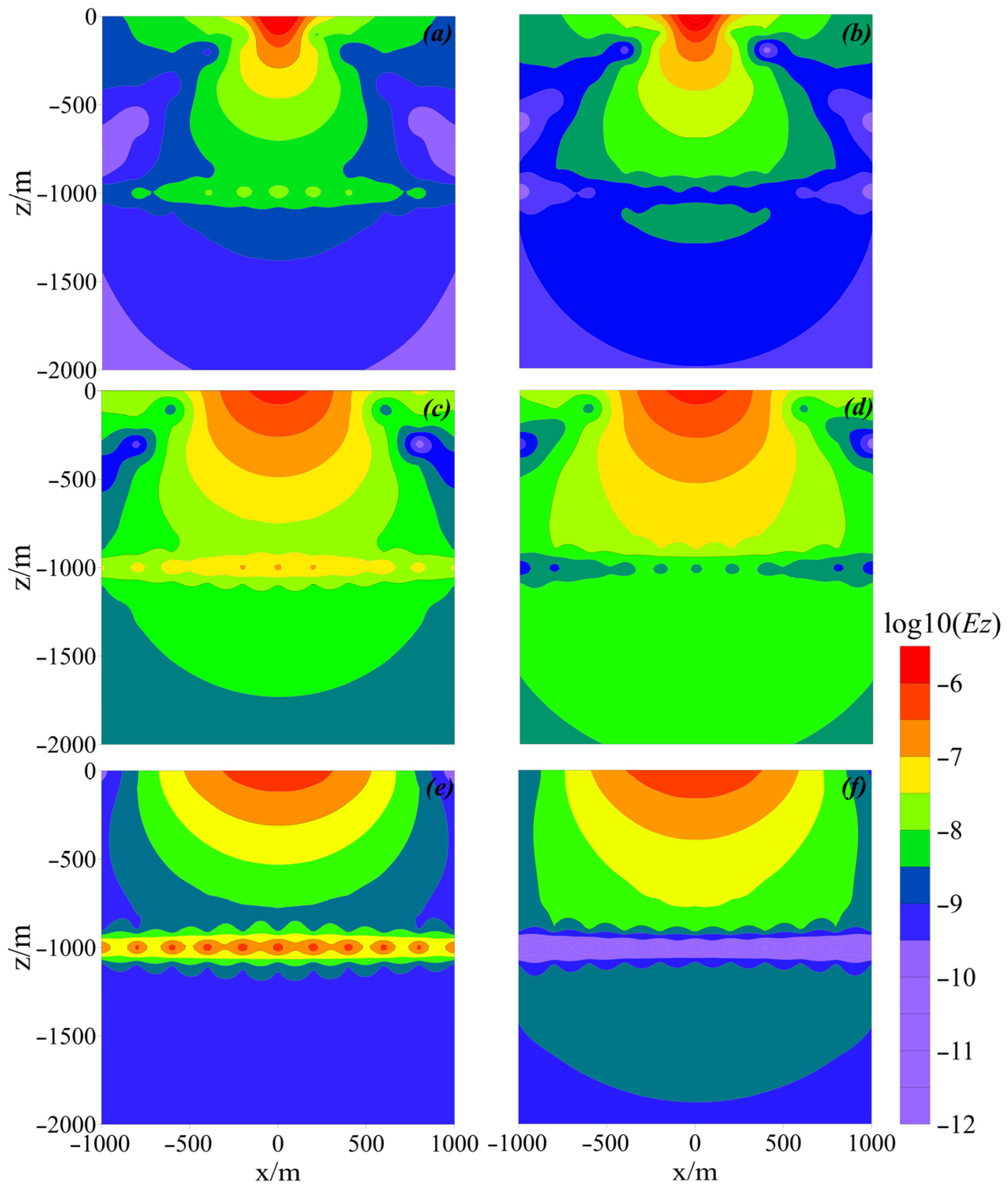
Figure 3,
Figure 4,
Figure 5,
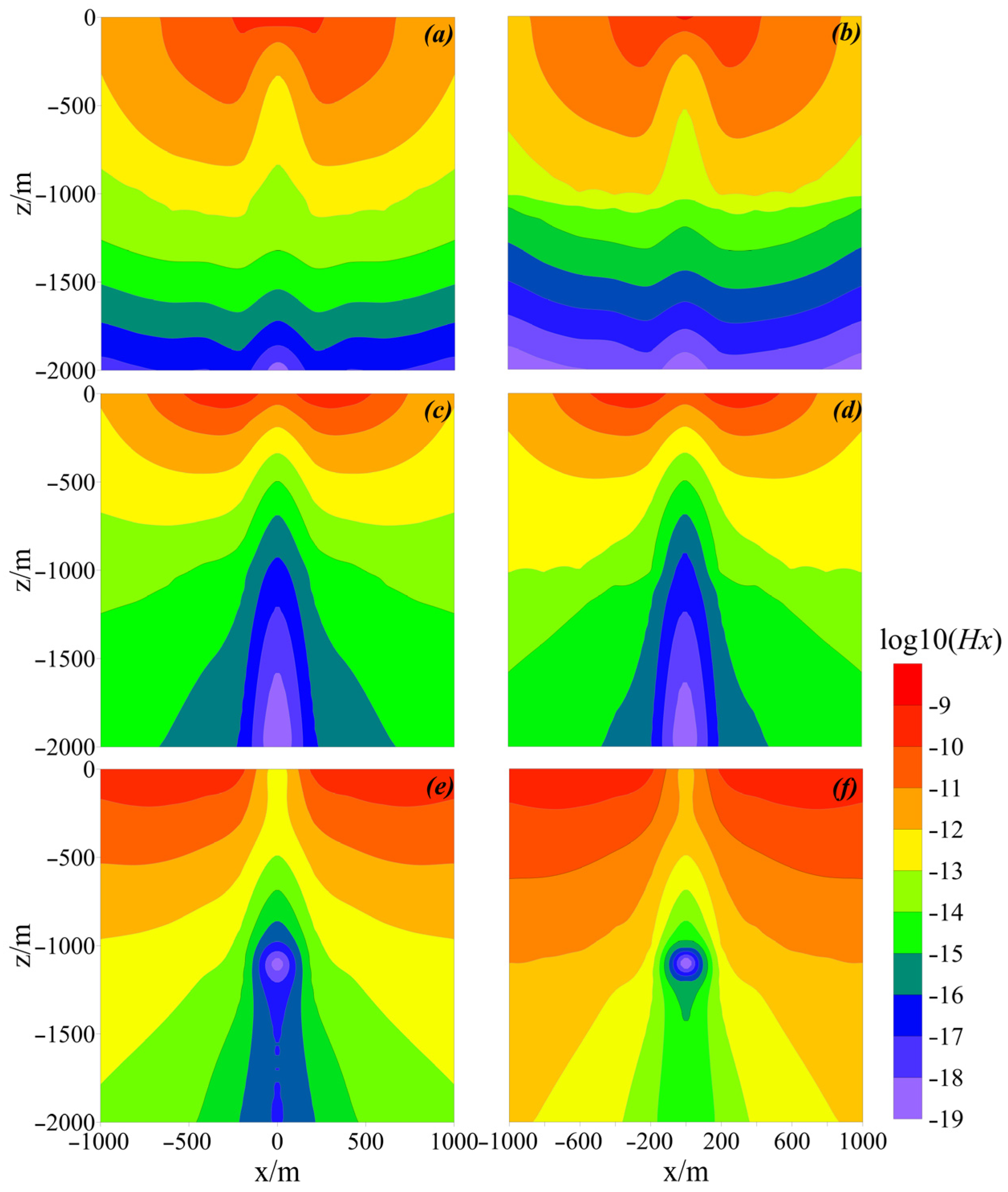
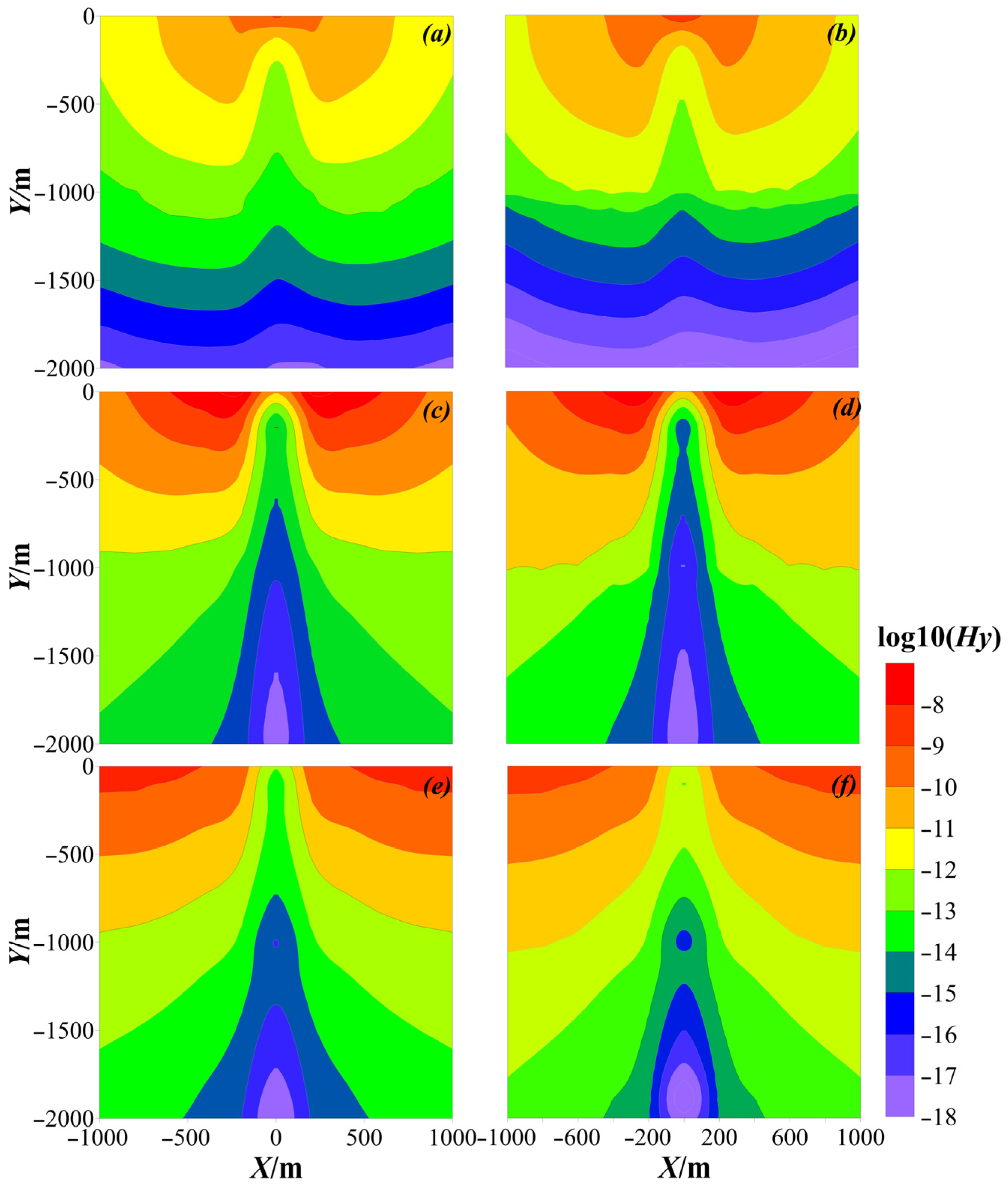
Figure 6 and
Figure 7 illustrate the vertical diffusion maps for
Ex,
Ey, Ez, d
Hx/dt, and d
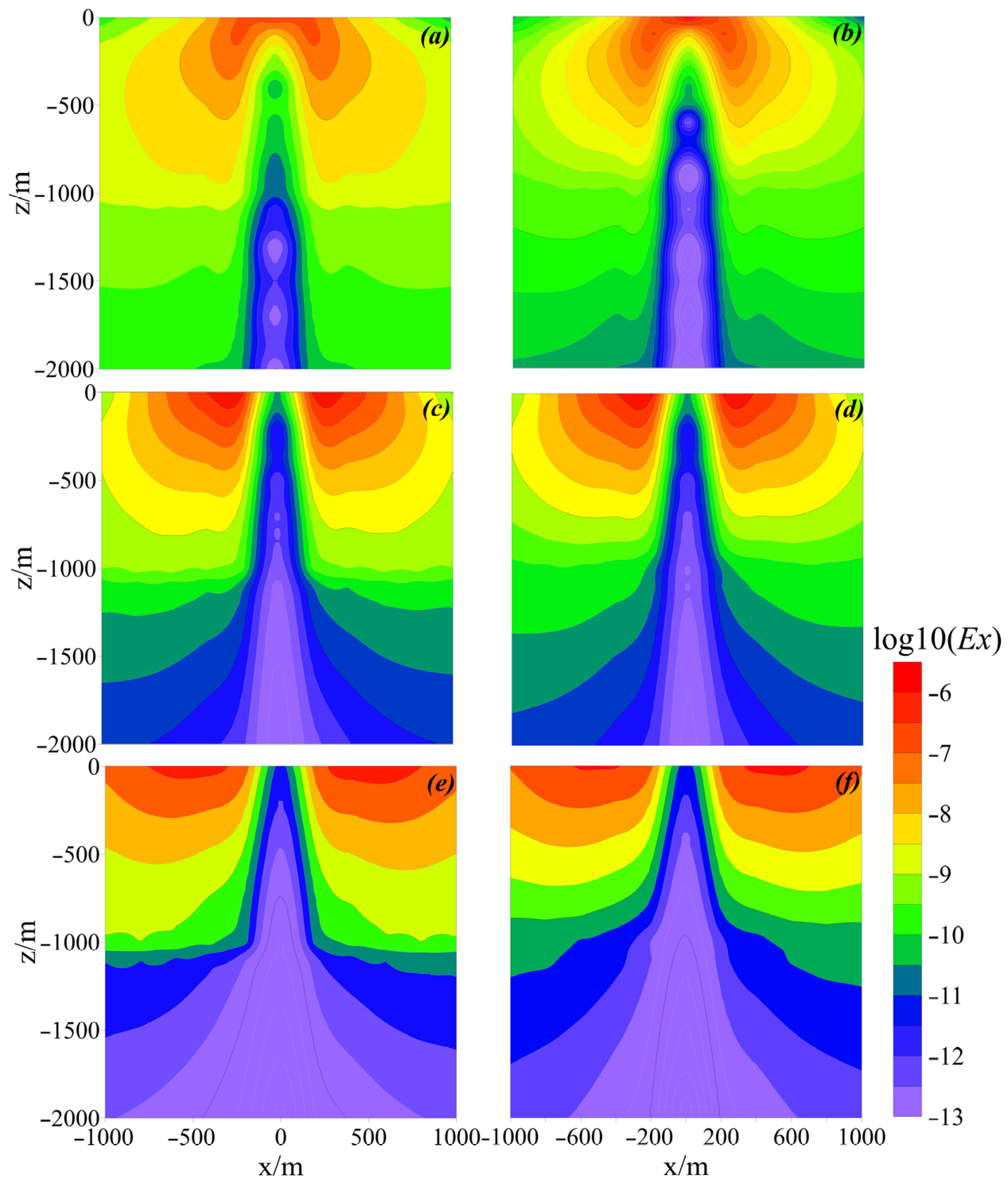
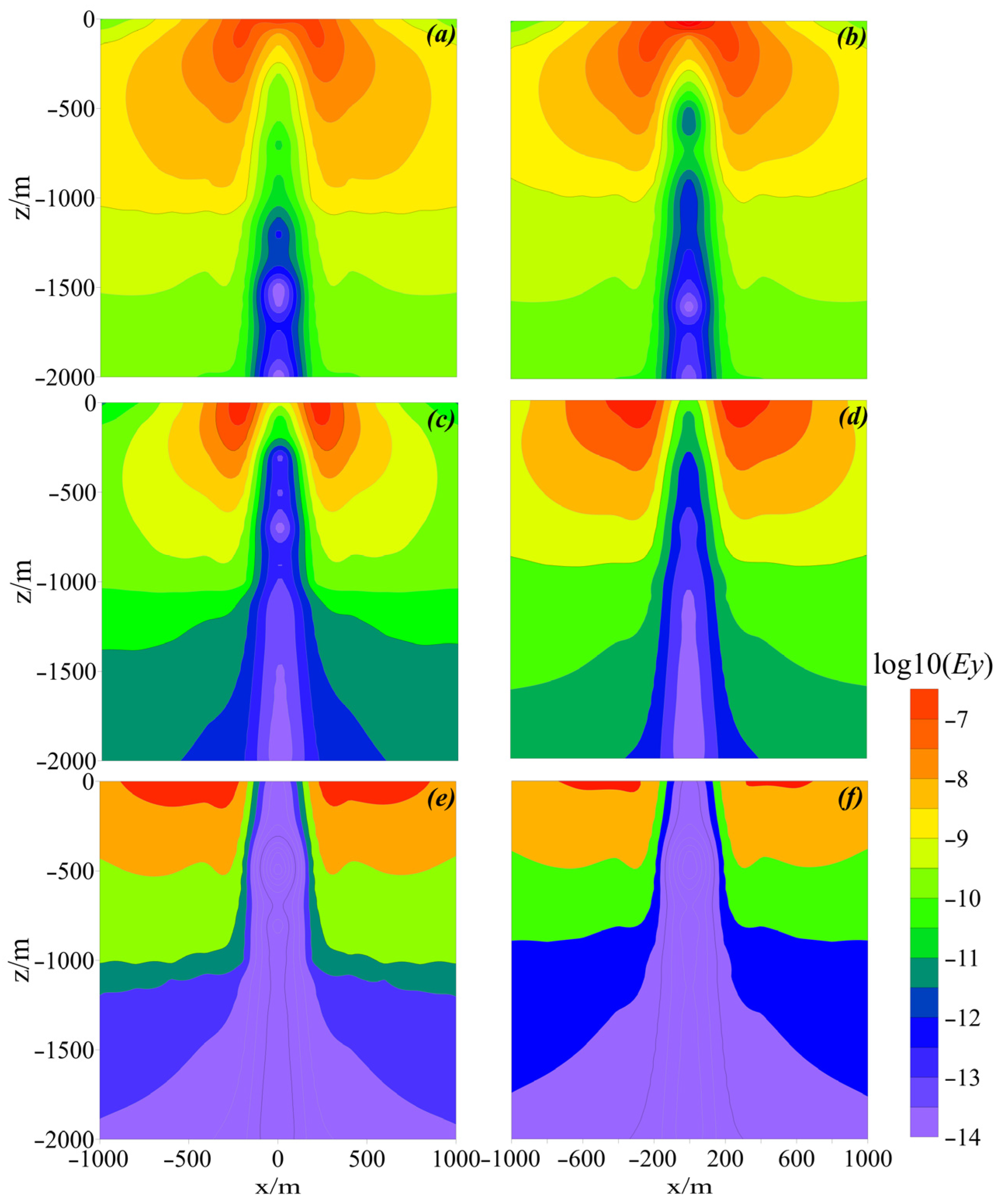
Hy/dt, respectively. Each figure presents the simulation results for the H-type model on the left side (a,c,e), and the results for the K-type model on the right side (b,d,f). Additionally, in each figure, the first row (a,b), the second row (c,d), and the third row (e,f) represent the vertical diffusion maps at 0.01 s, 0.1 s, and 0.5 s, respectively.
Figure 3 indicates the vertical diffusion maps of the
Ex field at various time instances, displaying a logarithmic distribution range of field values from −6 to −13. The total strength of the electric field is considerably greater than that of the magnetic field. At the initial stage (0.01 s), the region of elevated values in the
Ex field has already progressed downward along the central axis to a depth of 2000 m, significantly ahead of the associated magnetic fields. The data show that the vertical diffusion velocity of electric fields is considerably greater than that of magnetic fields, enabling penetration into the anomaly layers even at early stages. At this stage, a minor distinction in field distribution between the resistive and conductive models is noted: the shallow field values in the K-type model are marginally greater than those in the H-type model, indicating the initial shielding effect of the resistive layer on the early electric field, with field energy starting to accumulate above the resistive layer.
At the intermediate stage (0.1 s), separate variations are noted in the Ex field distribution between the two models. The H-type model illustrates that the high-value band of the Ex field exhibits important narrowing and accumulation within the conductive layer at a depth of 1000 m. Field values establish local extrema within this layer, resulting in a notable reduction in diffusion velocity. The occurrence of this phenomenon is attributed to a substantial increase in the induced current density within the conductive layer, which results in significant dissipation of electric field energy. The K-type model shows a notable change in the amplitude of the Ex field as it traverses the resistive layer at a depth of 1000 m. The field values that exceed the resistive layer exhibit a significant increase, whereas those located within and beneath the layer diminish swiftly. Contour lines display a clear vertical displacement at the resistive layer, indicating its significant shielding effect on the electric field. Induced currents face challenges in developing within the resistive layer, which hinders the efficient downward transmission of electric field energy; as a result, a significant portion of energy stays trapped above the resistive layer.
In the final phase (0.5 s), the H-type model demonstrates that the high-value region of the Ex field consistently gathers at the conductive layer depth (1000 m), resulting in the formation of a closed high-value trap within that layer. The gradients of field values above and below the conductive layer are significantly large, resulting in highly stable identification characteristics of the conductive anomaly. The K-type model indicates an overall upward shift in the high-value zone of the Ex field. A specific low-value belt is established at the location of the resistive layer, situated at a depth of 1000 m. Values in the field above the resistive layer have experienced global attenuation, whereas values in deeper fields exhibit only minimal diffusion. The resistive layer maintains a consistent shielding effect on the vertical propagation of the late-stage electric field. The main identification feature for the resistive anomaly is defined by this layered low-value belt.
Figure 4 shows the vertical diffusion maps of the
Ey field across various time instances. The
Ey field is distributed orthogonally in relation to the
Ex field. The response pattern to resistive anomalies aligns with that of the
Ex field; however, it demonstrates enhanced lateral focusing and improved identification accuracy for thin resistive layers. During the initial phase (0.01 s), the distinction in shallow field values between the resistive and conductive models is more evident in the
Ey field compared to the
Ex field, suggesting a greater effectiveness in the early detection of resistive anomalies. During the intermediate stage (0.1 s), the amplitude mutation of the
Ey field at the position of the resistive layer is more significant, resulting in enhanced identification characteristics for both the upper and lower interfaces of the resistive layer. At the late stage (0.5 s), the low-value anomaly belt created by the
Ey field in the resistive model exhibits more defined boundaries, indicating enhanced accuracy in identifying vertical and lateral boundaries for thin resistive layers when compared to the
Ex field.
Figure 5 presents the vertical diffusion maps of the
Ez field at various time instances, featuring a logarithmic distribution range from −6 to −12. At the initial phase (0.01 s), the elevated region of the
Ez field is localized in the near-surface area (0–500 m), exhibiting an axisymmetric ring-like pattern. A clear horizontal low-value zone is established at a depth of 1000 m, whereas deeper field values decline quickly. This indicates the layered distribution features of the vertical electric field during the initial periods and highlights its significant responsiveness to stratigraphic boundaries. This feature arises from the charge accumulation effect of the vertical electric field at electrical interfaces. At stratigraphic boundaries where resistivity changes abruptly, charges of opposite signs accumulate. These function as a series of electric dipoles oriented perpendicular to the interface, resulting in notable variations in the
Ez field at the interface.
During the intermediate stage (0.1 s), the high-value region of the Ez field shifts downward as a complete entity. A continuous horizontal high-value belt is established at a depth of 1000 m, with field values exhibiting distinct segmented characteristics throughout the vertical profile, extending to a depth of 2000 m. The horizontal layered distribution pattern of the contour lines shows a marked enhancement, suggesting that the mid-stage Ez field has effectively penetrated through strata at different depths and has created stable field anomalies at electrical interfaces.
At the late stage (0.5 s), the high-value belt of the Ez field reaches stability at a depth of 1000 m. Field values in both shallow and deep regions exhibit significant decay, leaving only a continuous, closed high-value anomaly present at this particular depth. The horizontal continuity of the contour lines is notably robust, indicating the accurate identification capability of the late-stage Ez field for stratigraphic electrical interfaces. The distribution of its field anomalies along horizontal interfaces illustrates a vertical resolution that significantly exceeds that of horizontal electric and magnetic fields.
Figure 6 depicts the vertical diffusion maps of the d
Hx/dt field at various time instances, with the logarithmic distribution range of field values extending from −9 to −19. During the initial phase (0.01 s), the area of high values in the d
Hx/dt field is focused within the shallow strata, specifically between 0 and 500 m below the seabed. The contour lines typically display a nearly horizontal layered arrangement, with a minor downward bulge noted along the central axis of the transmitter source (X = 0 m). The field distributions observed in the H-type model and the K-type model exhibit negligible differences, suggesting that the energy from the early transient field has yet to reach the anomaly layer located at a depth of 1000 m. As a result, the resistive and conductive anomalies do not significantly influence the shallow field distribution; rather, the propagation of the field is mainly determined by the conductivity properties of the overlying background layers.
At the intermediate stage (0.1 s), the transient field energy has reached the anomaly layers, leading to notable differences in field distribution between the two models. In the H-type model, the high-value zone of the dHx/dt field reaches a depth of 1500 m. Distinct field value accumulation takes place at the conductive layer position (1000 m depth), characterized by narrowing contour lines within the layer and a significant reduction in diffusion velocity. Conversely, in the K-type model, the high-value zone of the dHx/dt field shows a distinct amplitude change as it traverses the resistive layer at a depth of 1000 m. The field values present above the resistive layer are significantly higher than those in the H-type model at the same time. In contrast, the values present within and beneath the layer demonstrate a rapid decline. At the late stage (0.5 s), differences in field distribution between the two models become more apparent. The H-type model indicates that the high-value anomaly of the Hx field is consistently located at the conductive layer depth of 1000 m. Field values establish a closed high-value trap within the conductive layer, whereas values beneath the layer diminish quickly. This shows the prolonged accumulation impact of the conductive body on magnetic field energy, resulting in unique identification characteristics for conductive anomalies. In the K-type model, there is an overall upward shift in the high-value zone of the dHx/dt field. A unique low-value belt is established at the position of the resistive layer, located at a depth of 1000 m. The values in the field above the resistive layer have diminished considerably, while the deep field values exhibit only minimal diffusion. This shows that the resistive layer maintains a continuous shielding effect on the vertical propagation of the late-stage magnetic field. The response of field values to resistive anomalies is primarily characterized by low-value anomalies, serving as the core identification marker.
Figure 7 presents the vertical diffusion maps of the d
Hy/dt field at different time instances, showcasing a logarithmic distribution range of field values from −8 to −18. The overall magnitude of the field surpasses that of the
Hx field, and its response patterns to resistive and conductive anomalies exhibit certain similarities to those of the d
Hx/dt field. During the initial phase (0.01 s), the high-value region of the d
Hy/dt field is similarly focused in the shallow layers (0–500 m), showing no notable variations in field distribution between the resistive and conductive models, which aligns with the characteristics of the d
Hx/dt field at the same moment.
During the intermediate stage (0.1 s), the differentiation characteristics between the resistive and conductive models for the dHy/dt field are significantly more pronounced compared to those for the dHx/dt field. The H-type model indicates that the high-value band of the dHy/dt field creates a clear accumulation within the conductive layer at a depth of 1000 m. The contour lines become significantly narrower within this layer, and there is a notable decrease in the vertical diffusion velocity, underscoring the pronounced confinement effect of the conductive layer on the field. The dHy/dt field in the K-type model shows a notable amplitude mutation at the position of the resistive layer. A distinct high-value accumulation develops above the resistive layer, whereas field values within and beneath the layer experience a steep decline. The response characteristics of the resistive interface are more distinct compared to those of the dHx/dt field. This suggests that the dHy/dt field exhibits greater sensitivity to vertical electrical variations within the strata, making it more effective for detecting thin-layer anomalies.
At the late stage (0.5 s), in the H-type model, the dHy/dt field exhibits a well-defined, closed high-value anomaly core located at the conductive layer position (1000 m depth). The gradient of the field value throughout the conductive layer is significantly pronounced, resulting in a clearly defined identification marker for the conductive anomaly. The dHy/dt field in the K-type resistive model creates a notable low-value anomaly belt at the position of the resistive layer, located at a depth of 1000 m. The distinguishing features of field values situated above and below the resistive layer are evident, showcasing a notably enhanced ability to detect resistive anomalies in comparison to the dHx/dt field.
3.2. Analysis of Target Resolution Capability Under Different Transmitter Configurations
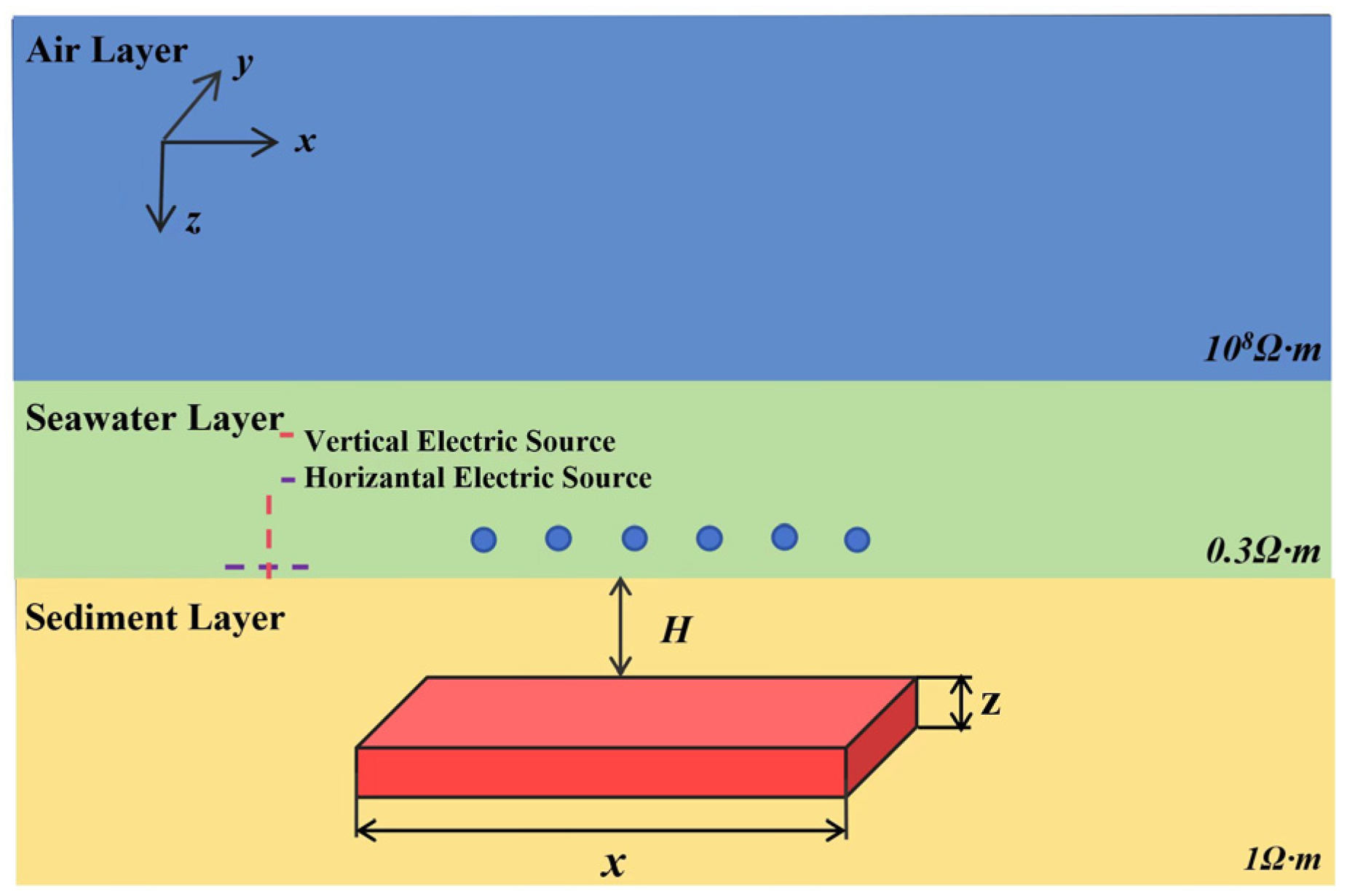
A layered marine model, illustrated in
Figure 8, is used to assess the resolution capability of different transmitter configurations concerning variations in the target’s x-direction. The model consists of a 500 m thick seawater layer with a resistivity of 0.3 Ω·m, an air layer that has a resistivity of 10
8 Ω·m, and a seabed sediment layer below it with a resistivity of 1 Ω·m.
A resistive hydrocarbon reservoir anomaly is located within the sediment layer, characterized by a resistivity of 100 Ω·m. The anomaly has defined dimensions of 4000 m in the y-direction and 200 m in the z-direction, with its extension length in the x-direction varying between two scenarios: 2000 m and 4000 m. The anomaly’s center is positioned at the coordinates (0, 0, −700).
Two configurations for the transmitter are examined: a horizontal long wire and a vertical long wire. The two sources each measure 300 m in length, with their centers located at coordinates (−6000, 0, 40) and (−6000, 0, 190), respectively. Each source is divided into a superposition of 100 uniform electric dipoles. A current of 1 A is applied using a downward step-off waveform.
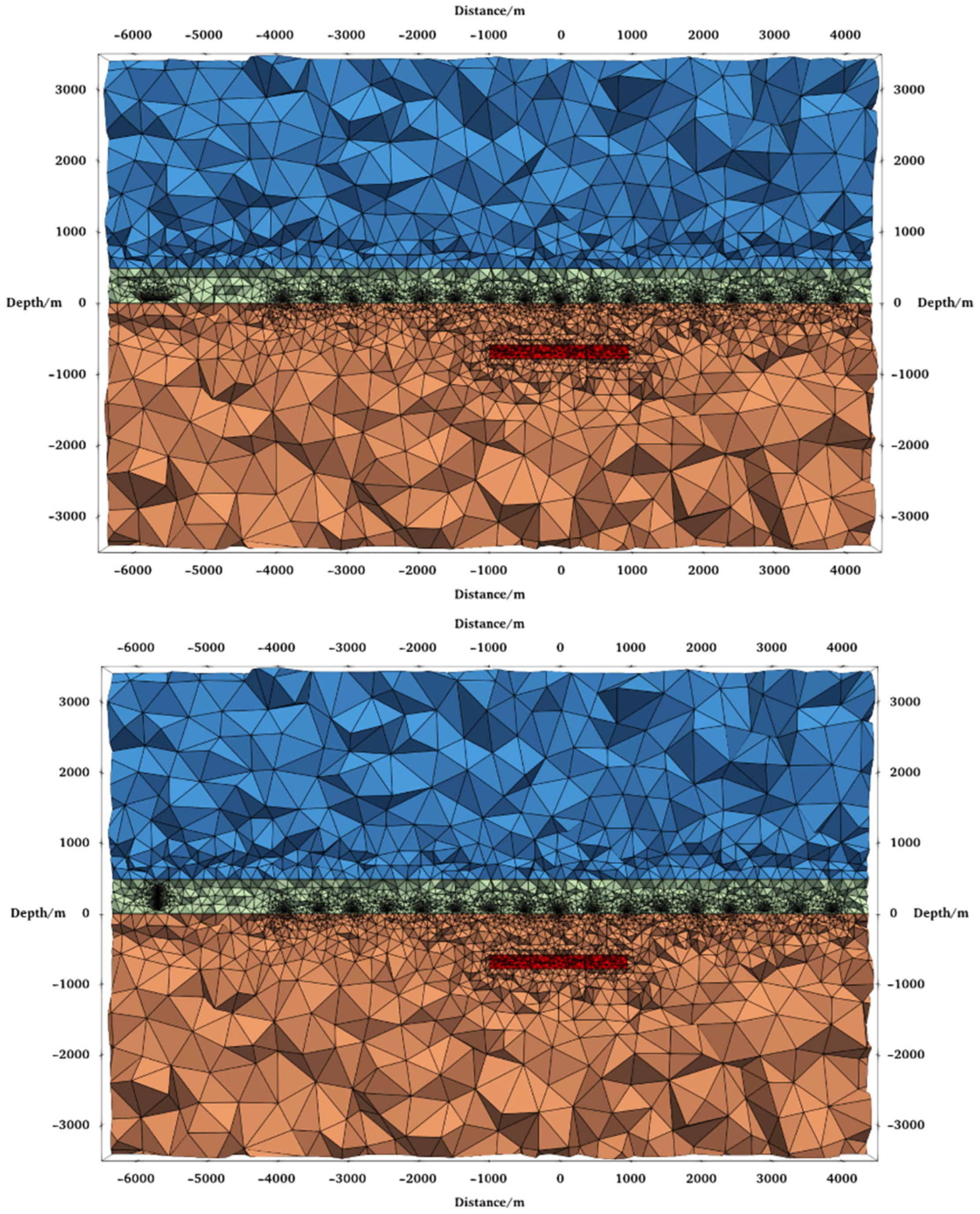
Receivers are positioned at a height of 40 m above the seabed. Local mesh refinement is implemented around the transmitter and receiver locations to guarantee numerical precision.
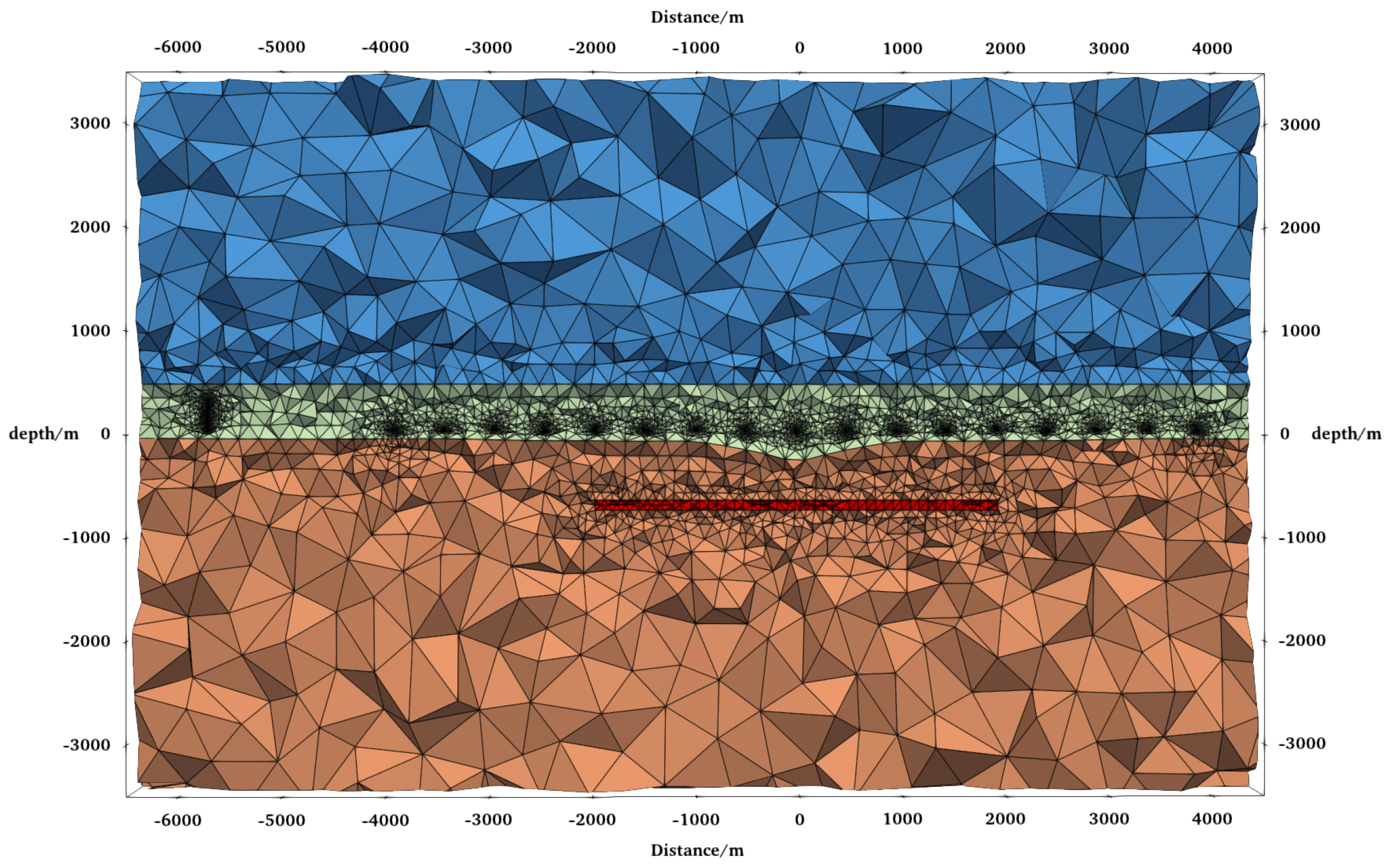
Figure 9 and
Figure 10 shows the mesh discretization of the model for the scenario in which the anomaly’s length in the x-direction measures 2000 m.
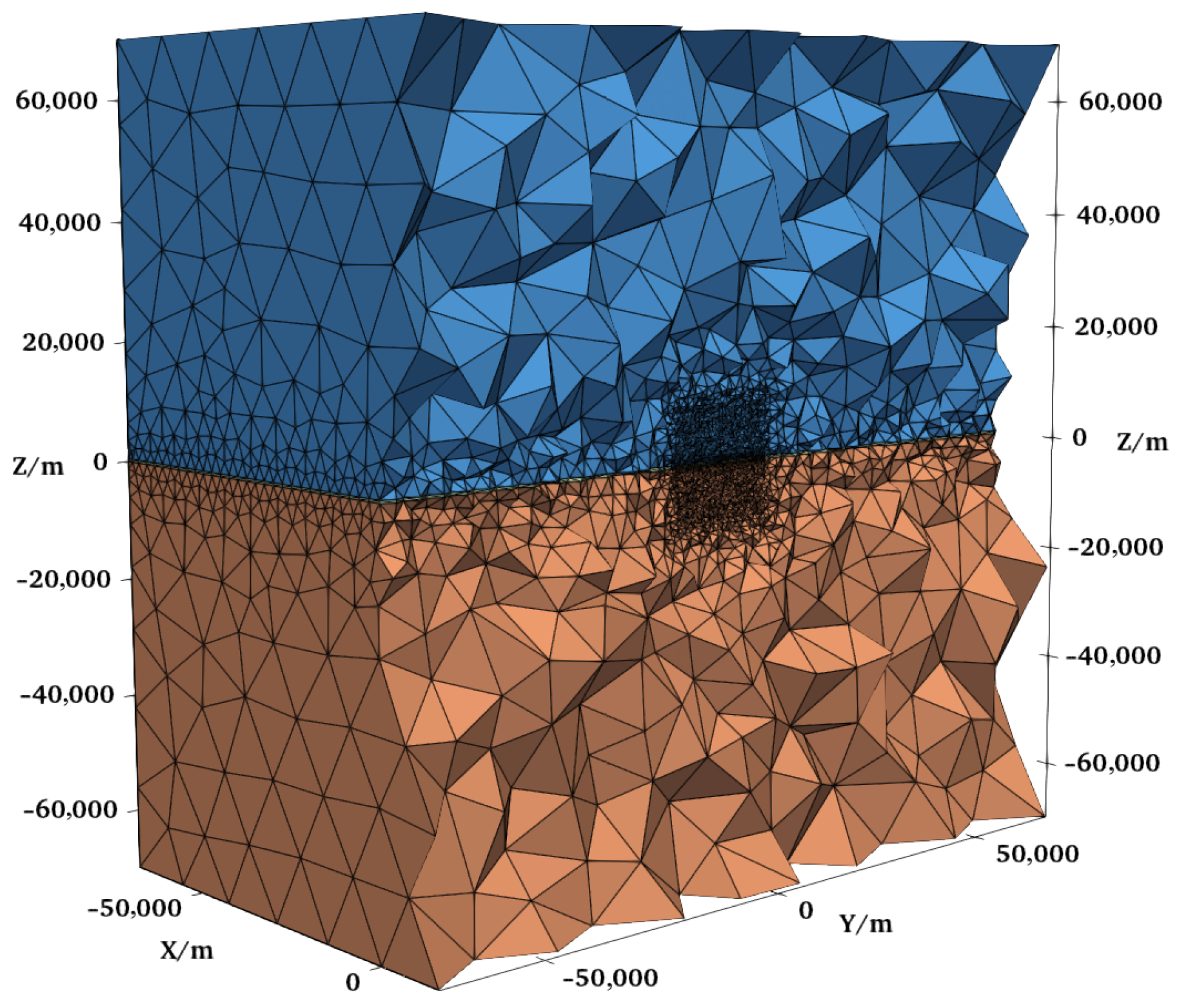
The 3D numerical model was discretized using unstructured tetrahedral meshes, as illustrated in
Figure 9. The entire computational domain spans 140,000 m, 140,000 m and 140,000 m in the X, Y and Z directions, respectively. To balance numerical accuracy and computational efficiency, a local mesh refinement strategy was adopted: the core region with a size of 20,000 m × 20,000 m × 20,000 m was discretized with dense meshes, while the mesh size was gradually coarsened towards the outer boundary of the domain. The cross-section at the x = 0 plane is provided to clearly demonstrate the spatial distribution characteristics of the meshes. For the homogeneous full-space model, the computational domain is discretized into 592,794 unstructured tetrahedral elements with a corresponding total of 100,432 nodes.
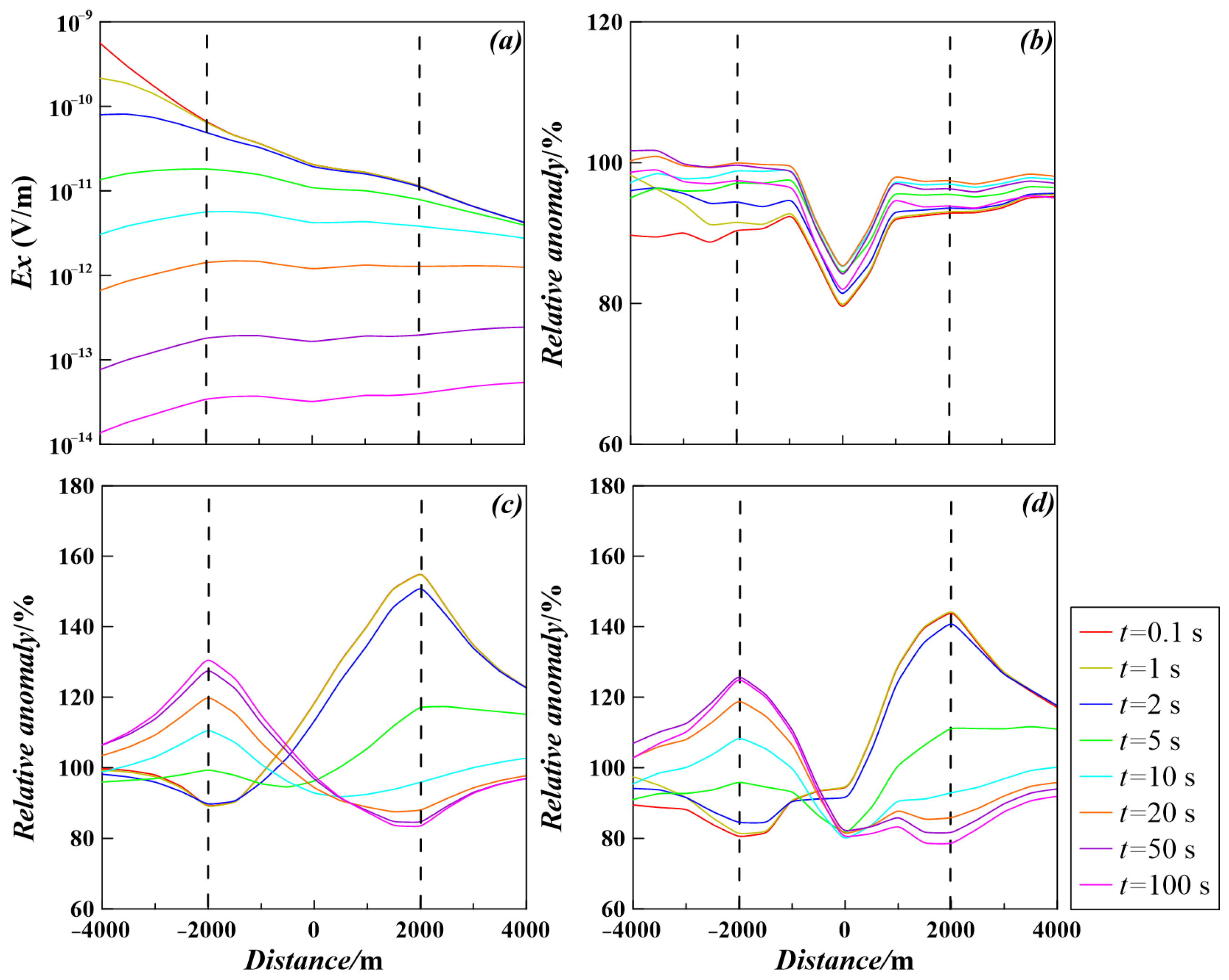
Figure 11 and
Figure 12 illustrate the profile curves of the
Ex and
Ez fields, along with their corresponding relative anomaly responses (defined as the ratio of responses with and without the anomaly), for anomalies extending 2000 m and 4000 m in the x-direction, respectively, excited by vertical and horizontal sources.
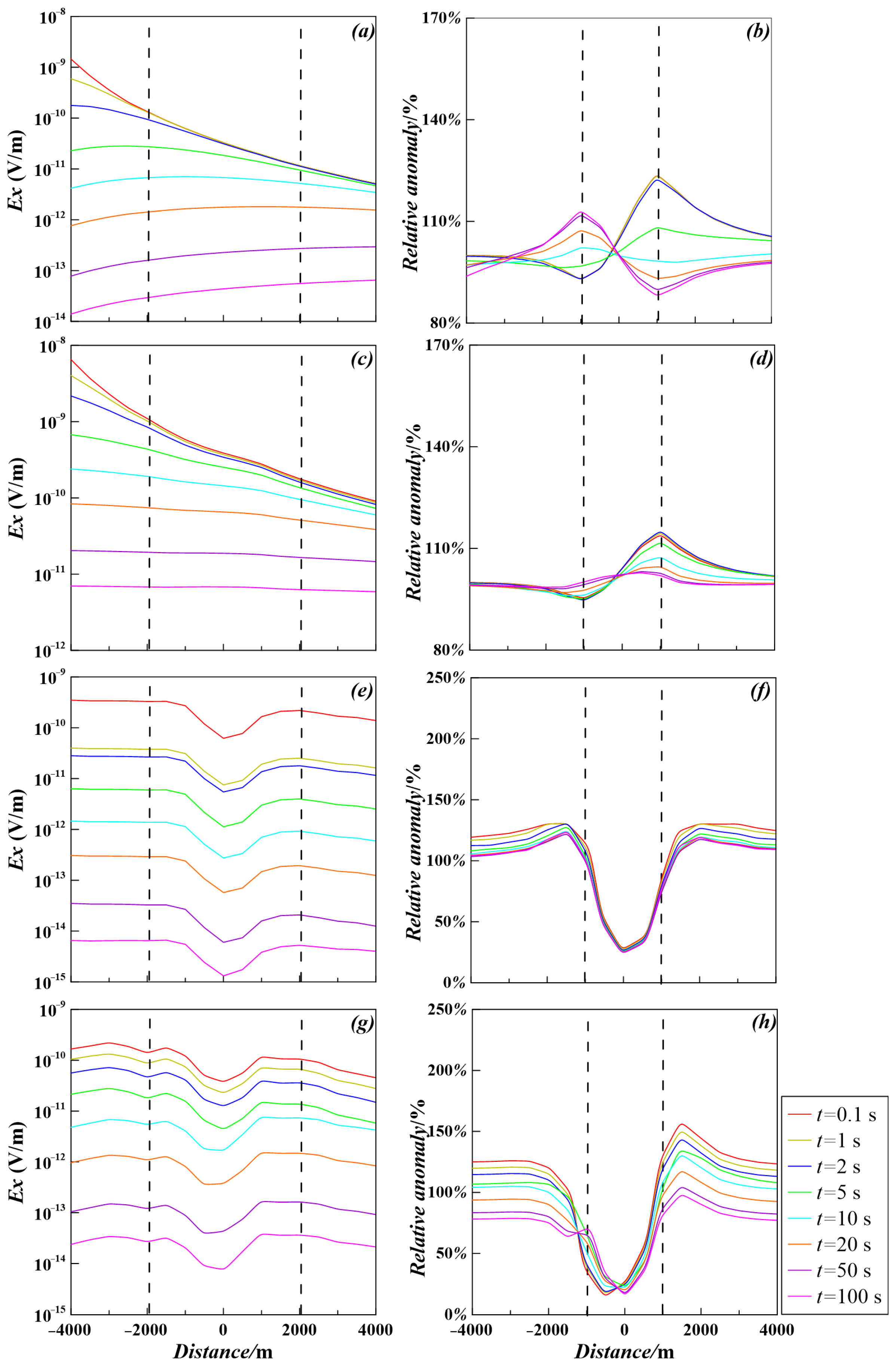
Figure 11a shows the amplitude distribution of the
Ex field generated by the VED. The
Ex field profiles show clear morphological changes at the anomaly boundaries, creating distinct inflection points that can be utilized to determine the lateral extent of the anomaly. The relative anomaly curve presented in
Figure 11b closely corresponds with the anomaly boundaries, exhibiting a “trough-peak” pattern during the early time intervals, which transitions into a “peak-trough” pattern as time progresses. The positions of the anomaly peaks and troughs consistently remain fixed at the ±2000 m boundary coordinates, showing no spatial shift over time. This component showcases remarkable precision in positioning the lateral boundaries and scale of the anomaly, achieving a maximum relative anomaly amplitude that surpasses 123%, while the minimum falls to 88%.
Figure 11e illustrates the amplitude distribution of the
Ez field generated by the VED. Inflection points are present at the boundaries in the
Ez field profiles; however, their positions are notably altered. The relative anomaly curve (
Figure 11f) reveals a stable morphology throughout both early and late times, showing notable low-value zones around ±1500 m. Although the anomaly contrast of the
Ez field is significantly high with a maximum amplitude surpassing 128%, a minimum falling to 25%, and a total variation range of 103%, the locations of its extrema are shifted inward by about 500 m compared to the actual boundaries (±2000 m), resulting in imprecise boundary localization.
Figure 11c shows the amplitude distribution of the
Ex field generated by the horizontal source. The distribution trend of the horizontal source
Ex field resembles that of the VED. Throughout both early and late periods, the relative anomaly curve exhibits distinct “trough-peak” features at the boundaries, achieving a maximum amplitude that surpasses 114% and a minimum of 95%.
Figure 11g demonstrates the amplitude distribution of the
Ez field generated by the horizontal source. The horizontal source
Ez field shows a distinct low-value area within the anomaly range; however, the center of this area does not align with the geometric center of the anomaly. The relative anomaly curve indicates low values between −2000 m and 1500 m, featuring a maximum amplitude that surpasses 155% and a minimum that falls to 16%. Although there is a very strong signal contrast, the peak positions do not align with the actual boundaries, which complicates the accurate delineation of the anomaly edges.
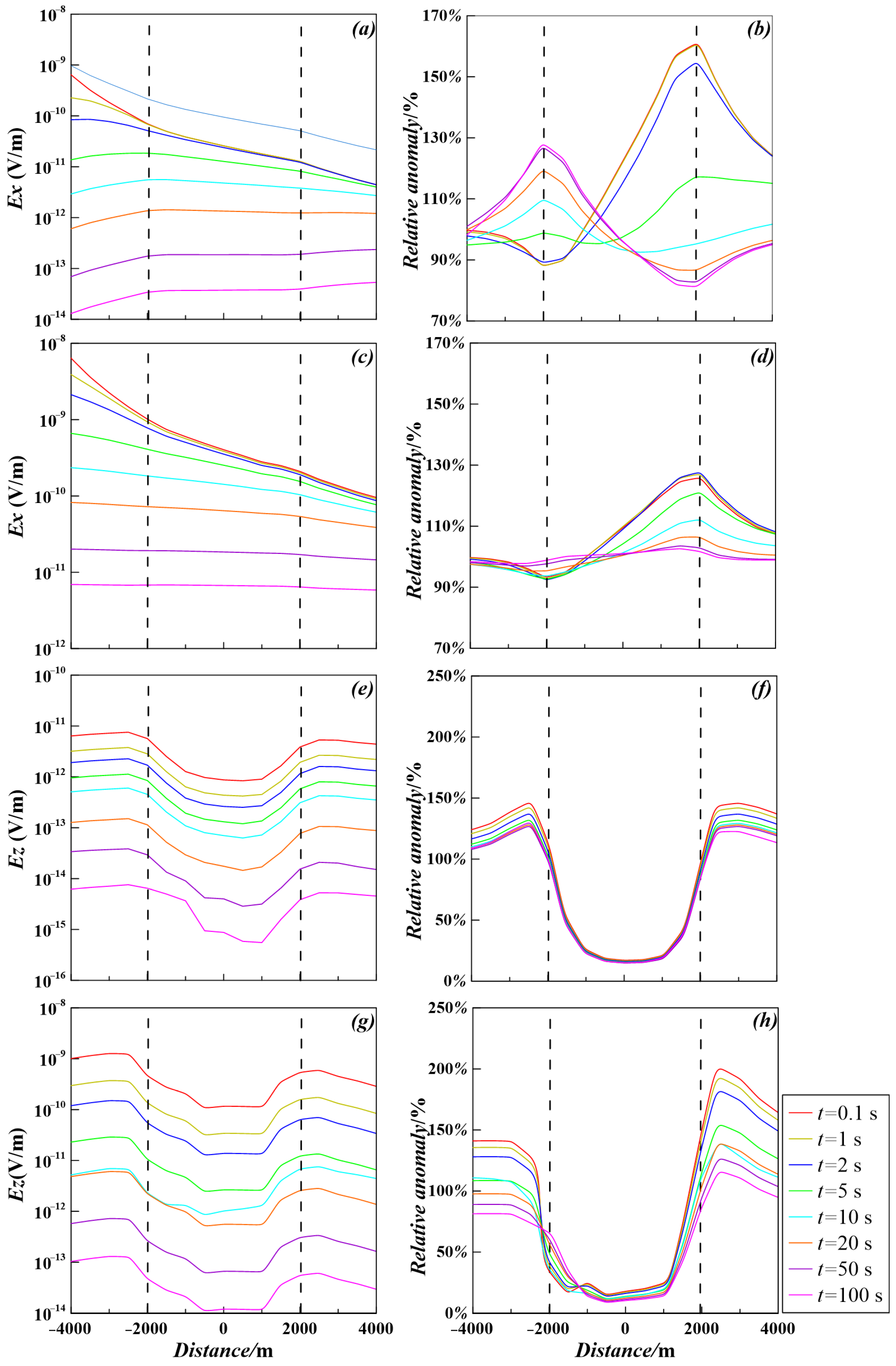
Figure 12 demonstrates the electric field responses for both horizontal and VED sources, when the scale of the anomaly is increased, with the anomaly extending 4000 m in the xx-direction.
Figure 12a illustrates the amplitude distribution of the
Ex field produced by the VSTEM. The
Ex field profiles delineate more distinct and precise inflection points at ±4000 m, accurately aligning with the actual boundaries of the anomaly. The relative anomaly curve (
Figure 12b) maintains the evolutionary pattern of “early-time trough-peak” and “late-time peak-trough,” with the peak and trough positions consistently fixed at ±4000 m. The maximum relative anomaly amplitude rises to 162%, whereas the minimum decreases to 87%, demonstrating that the VSTEM
Ex field preserves outstanding boundary identification precision even in the presence of significant anomaly conditions.
Figure 12e,f display the amplitude distribution and relative anomaly curves of the
Ez field excited by the VSTEM. The
Ez field maintains notable contrast features, with a maximum amplitude surpassing 132% and a minimum decreasing to 12%. Nonetheless, it establishes a continuous low-value area around ±3500 m, resulting in a discrepancy of roughly 500 m between its edges and the actual boundaries at ±4000 m. This indicates that the
Ez field encounters difficulties in attaining accurate boundary localization.
The integration of the response characteristics from both models, utilizing anomaly lengths of 2000 m and 4000 m in the x-direction, reveals that the Ex field generated by the VSTEM exhibits enhanced precision in boundary identification accuracy. In both models, the inflection points of the field values and the peak-trough positions of the relative anomaly curves align precisely with the true boundaries of the anomaly, demonstrating no spatial displacement. The identification accuracy remains stable even when the anomaly scale is doubled, with only the polarity of the peaks and troughs reversing over time. The horizontal source Ex field demonstrates restricted identification capability primarily during early to intermediate times, exhibiting poor performance at later times. In the meantime, the Ez field, irrespective of the source type, can indicate the presence of an anomaly; however, it shows considerable spatial shifts in all cases, making it inadequate for accurate localization.
In terms of anomaly detection capability, the 2000 m model shows an anomaly amplitude difference for the VSTEM Ex field of 35% (with a maximum of 123% and a minimum of 88%). This is greater than the 19% noted for the horizontal source, which has a maximum of 114% and a minimum of 95%. In the 4000 m model, this difference increases to 75% (maximum 162%, minimum 87%) for the VSTEM, significantly surpassing the 30% observed for the horizontal source (maximum > 124%, minimum 94%). This suggests that the VSTEM Ex field has a superior resolution capability for detecting anomalies when compared to the horizontal source Ex field. In contrast, for the 2000 m model, the amplitude difference for the horizontal source Ez attains 139% (155% compared to 16%), exceeding the 103% observed in the VSTEM Ez. In the 4000 m model, the variation for the horizontal source Ez increases dramatically to 190% (198% compared to 8%), significantly surpassing the VSTEM Ez (120%) and all Ex fields. Consequently, the Ez field is better suited for swift qualitative detection of targets.
3.4. Electromagnetic Response Characteristics of VSTEM Under Complex Geological Conditions
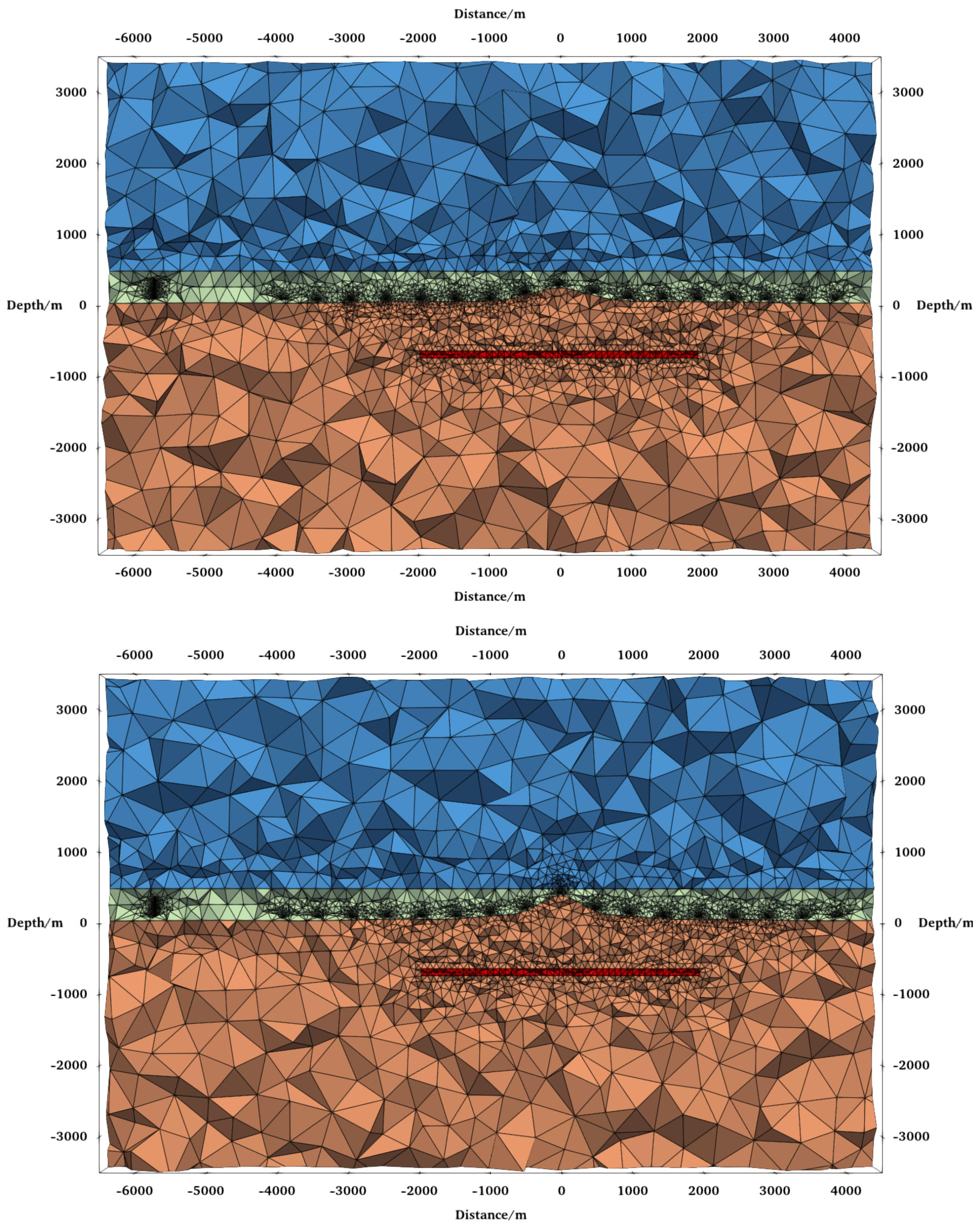
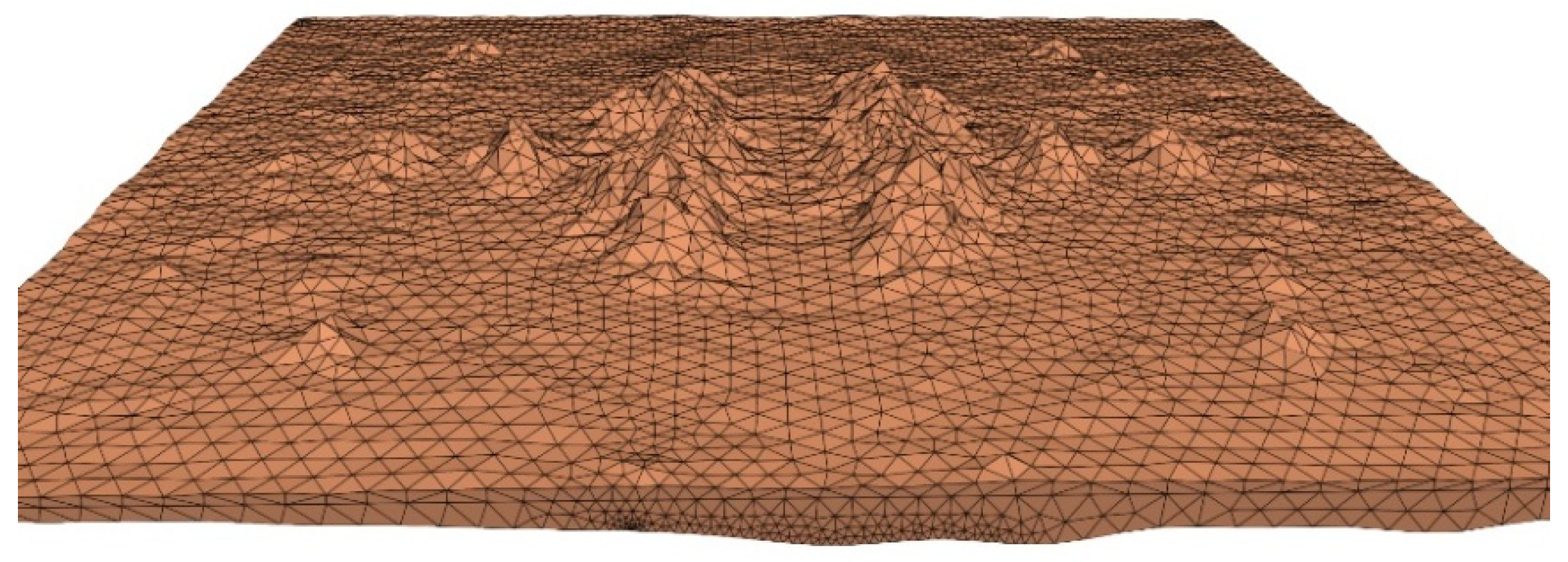
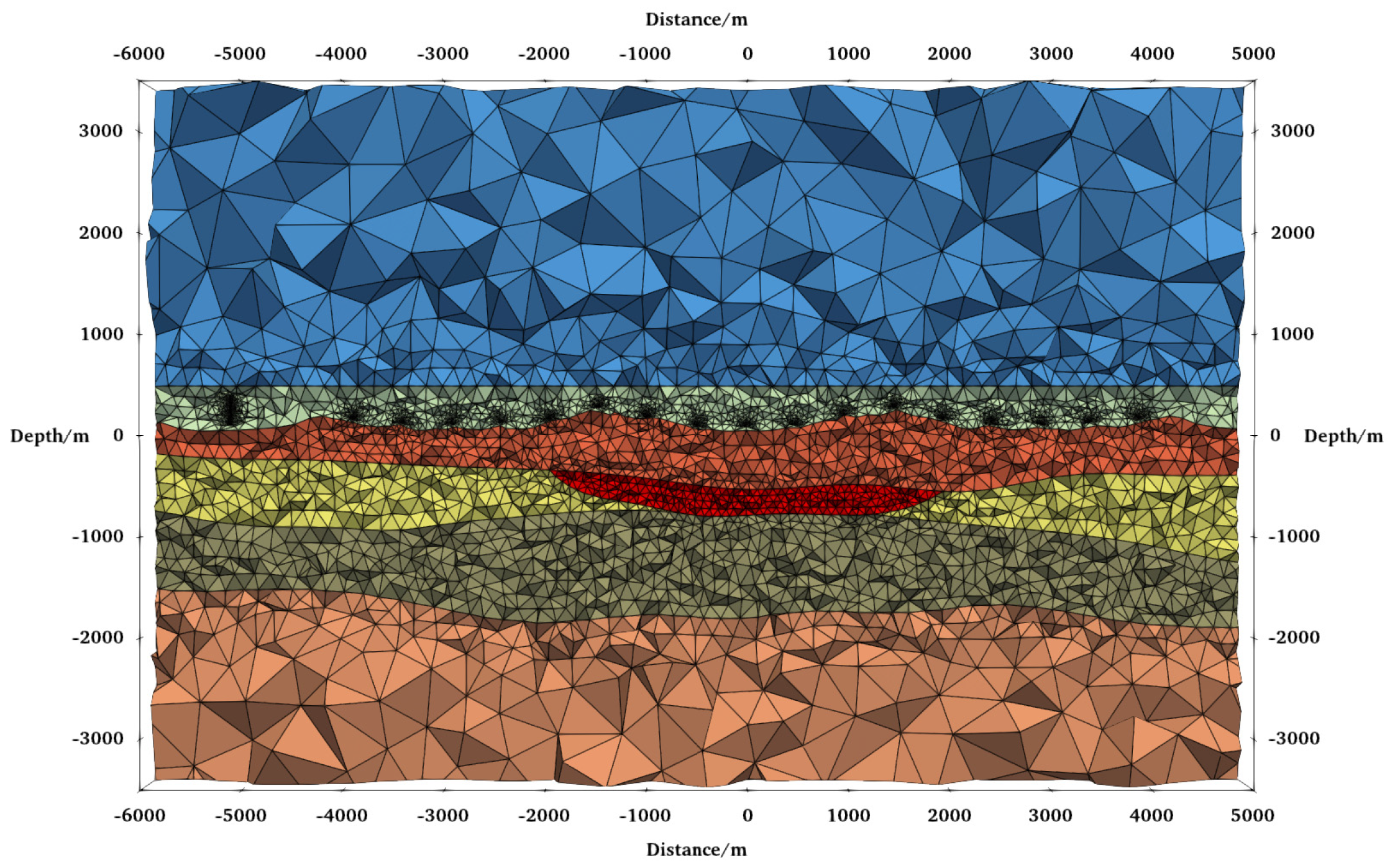
In order to investigate the electric field response characteristics of VSTEM method in relation to complex seabed topography and intricate geological structures, we developed a 3D complex hydrocarbon reservoir model (illustrated in
Figure 17 and
Figure 18) to replicate actual seabed geological conditions. The model establishes the intermediate seawater layer at a depth of 500 m, characterized by a resistivity of 0.3 Ω·m. In contrast, the overlying air layer exhibits a resistivity of 10
8 Ω·m. Under the seawater, there are four distinct stratigraphic layers. The initial sedimentary layer exhibits a varied seabed topography with a maximum relief of 250 m and a resistivity measurement of 0.8 Ω·m. The subsequent layers are characterized by resistivities of 1 Ω·m for the second layer, 2 Ω·m for the third layer, and a range of 1/5/10 Ω·m for the fourth layer. For the complex seabed topography and multi-layer stratigraphic model, the computational domain is discretized into 1,398,837 unstructured tetrahedral elements with a corresponding total of 234,852 nodes.
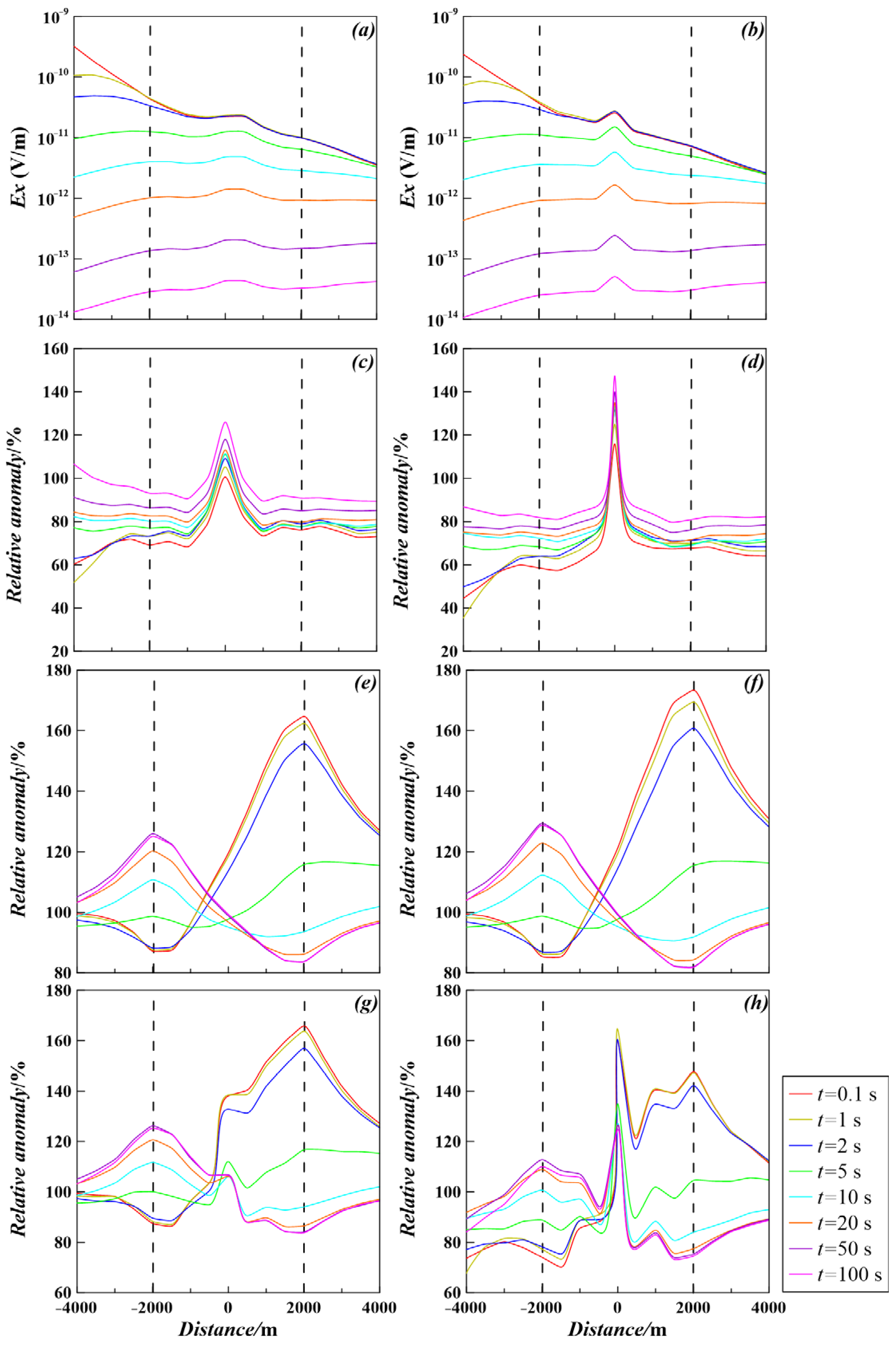
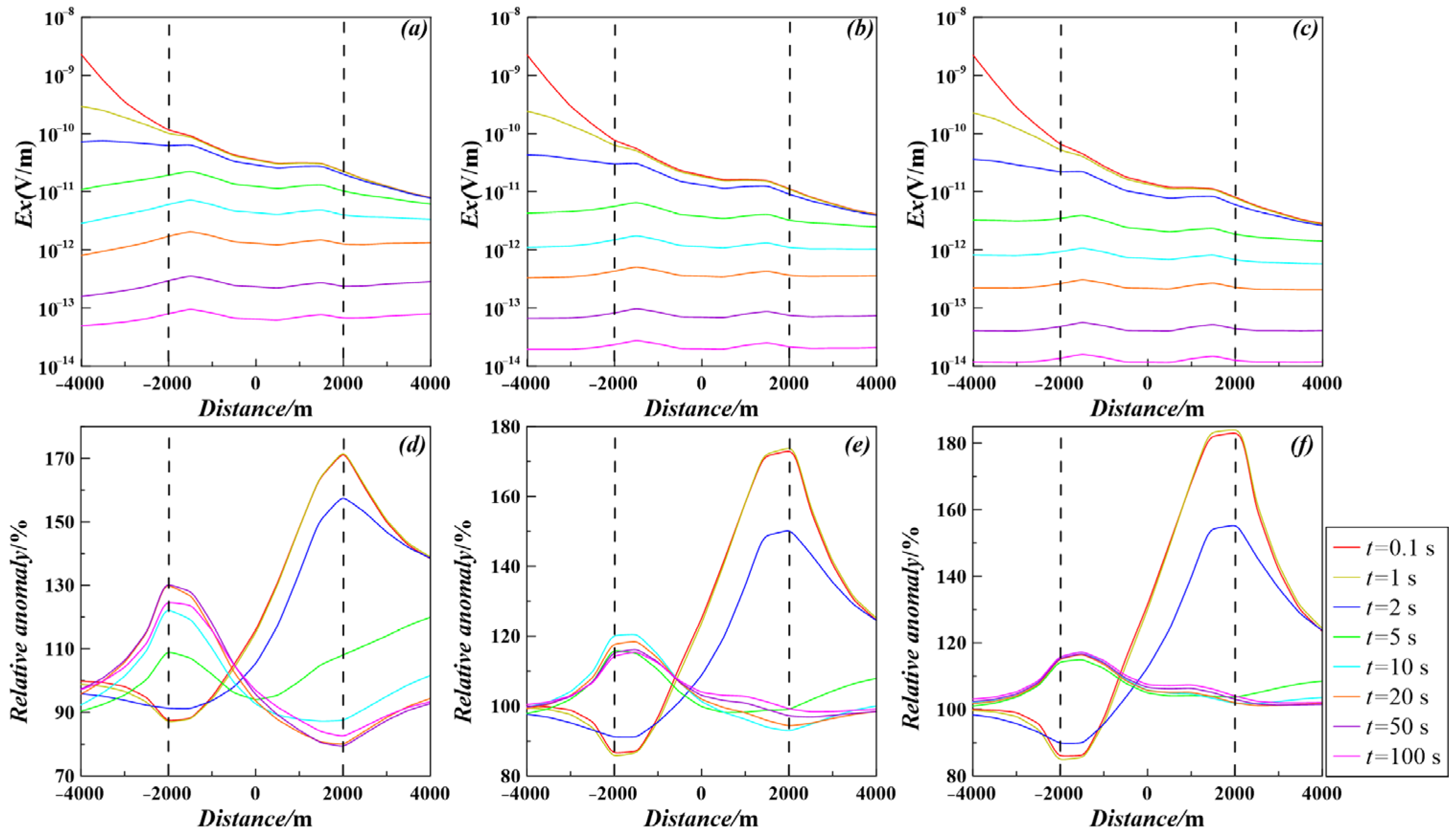
Figure 19 presents the response characteristics of the VSTEM
Ex field, highlighting its ability to detect irregular resistive hydrocarbon reservoirs amidst a backdrop of complex undulating seabed topography (250 m relief) and a four-layer geological structure. An analysis of
Figure 19a–c indicates that the
Ex field values demonstrate a consistent decay trend as the offset increases. Significant local undulations are observed near ±2000 m, a characteristic that closely aligns with the lateral extent of the irregular resistive hydrocarbon reservoir. The local morphology of the field value curves exhibits a significant correlation with the overlying 250 m high seabed topography. Field values indicate local uplifts at topographic highs and display low values in depressions, effectively illustrating the distorting effect of topography on VSTEM field propagation. It is important to note that while the field amplitude exhibits decay over time at various intervals, the overall shape of the curve and its unusual characteristics maintain a high level of consistency.
Figure 19d–f display the curves representing the relative anomaly ratios. The findings indicate that stable and distinct anomaly peaks develop at ±2000 m, with locations accurately aligning with the lateral boundaries of the irregular resistive hydrocarbon reservoir. Despite the significant interference posed by complex topography featuring a 250 m relief and multi-layer geological structures, the
Ex field ratio generated by the VSTEM efficiently determines anomaly boundaries, without any instances of anomaly confusion, false anomalies, or boundary shifts. This validates the dependability of this approach in highly intricate settings.
In a comparative analysis of varying working conditions (from left to right), it is observed that as the resistivity of the fourth-layer basement escalates from 1 Ω·m to 10 Ω·m, there is a significant increase in the anomaly peaks at the same time instance. The maximum relative anomaly amplitude rises from 170% to 183%. Additionally, the time window during which the anomaly signal is recognizable is markedly extended. A conductive basement has a significant absorption and attenuation effect on the VSTEM field, leading to a diminished return of field energy from depth, which in turn reduces the anomalous response of the hydrocarbon reservoir. In contrast, a resistive basement exhibits a diminished attenuation effect on the field, thereby promoting the retention and propagation of deep reflected field energy. This greatly enhances the difference in electrical characteristics between the hydrocarbon reservoir and the adjacent rock, facilitating the extraction and detection of subtle anomalies.
In the end, despite the challenging conditions and intricate seabed topography along with multi-layer geological formations, the VSTEM Ex field consistently exhibits reliable performance in delineating the boundaries of resistive anomaly bodies: the peaks of these anomalies align accurately with the lateral boundaries of the hydrocarbon reservoir, showing no spatial displacement or morphological alteration. Furthermore, the resistivity of the deep basement plays a crucial role in influencing the intensity of the anomalous response. An increase in basement resistivity correlates with a higher amplitude of the hydrocarbon reservoir’s anomalous response, an expanded effective detection time window, and enhanced conditions for the precise identification of deep targets.