
The Internal Geometry of Microbial Shoal and Its Reservoir Heterogeneity: Insights from Core Samples of Well X1 in the Pre-Salt Santos Basin

Abstract
1. Introduction
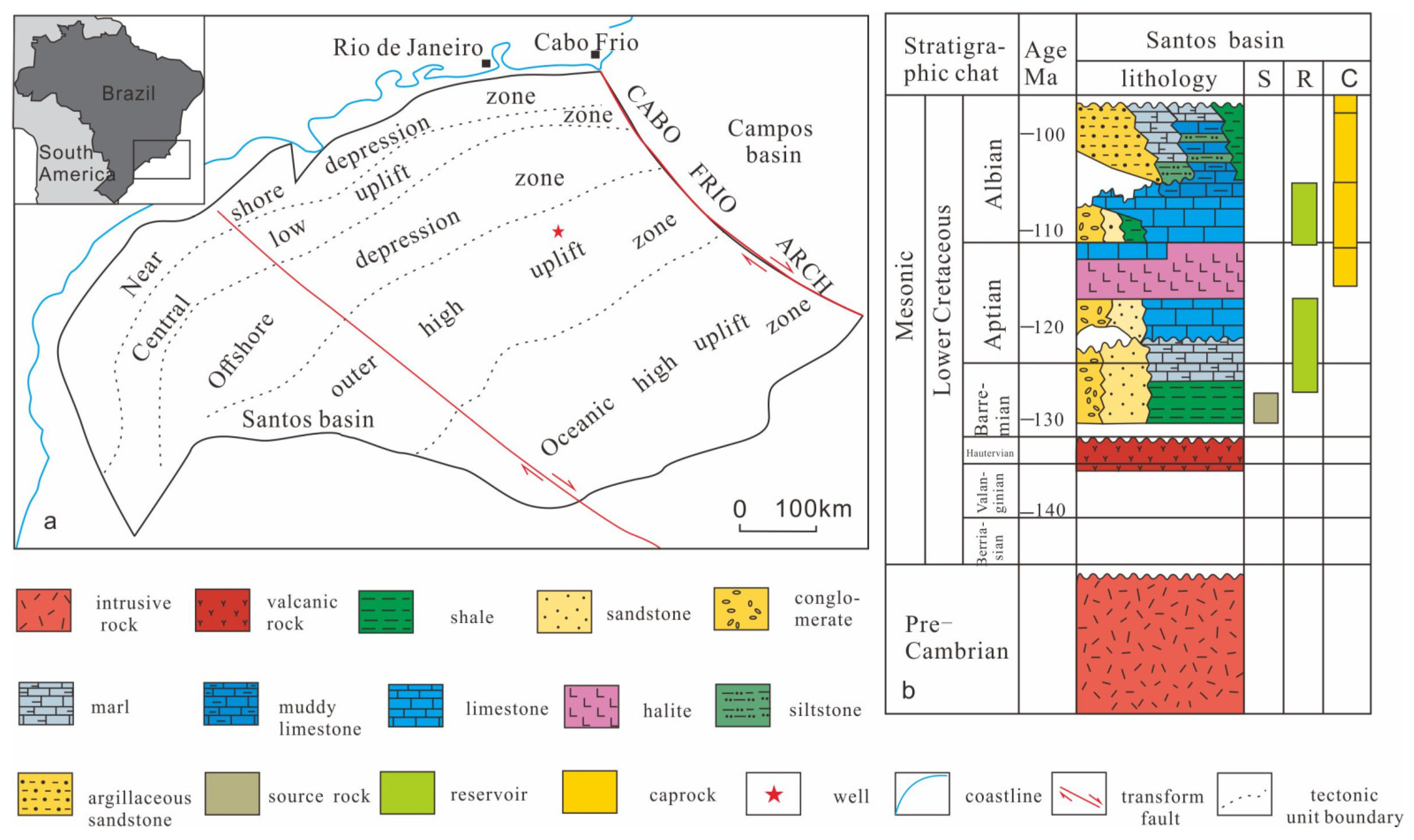
2. Geological Settings
3. Materials and Methods
3.1. Samples
3.2. Laboratory Analysis
4. Results
4.1. Internal Geometries of Microbial Shoal
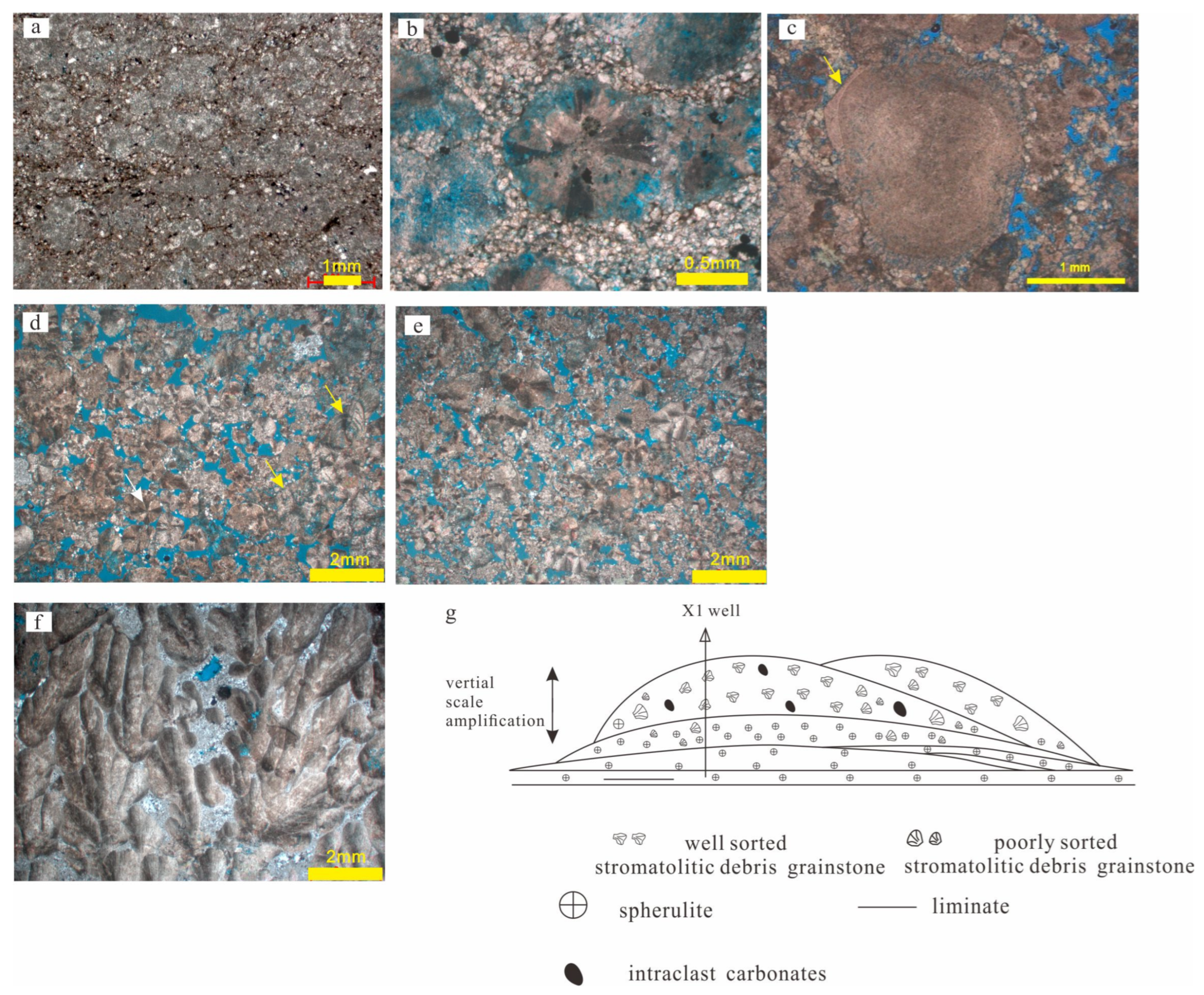
4.1.1. Rock Types of Microbial Shoal
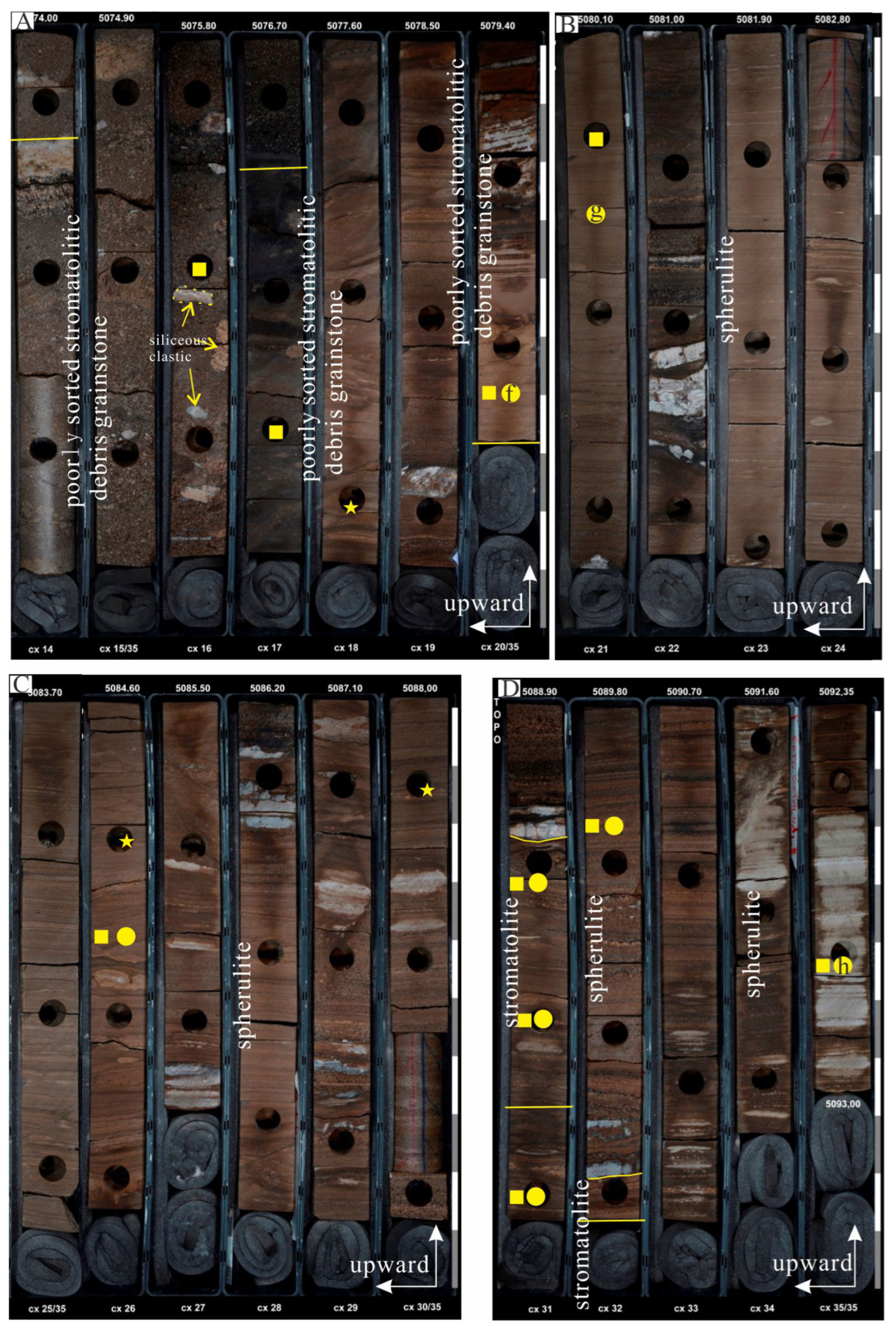
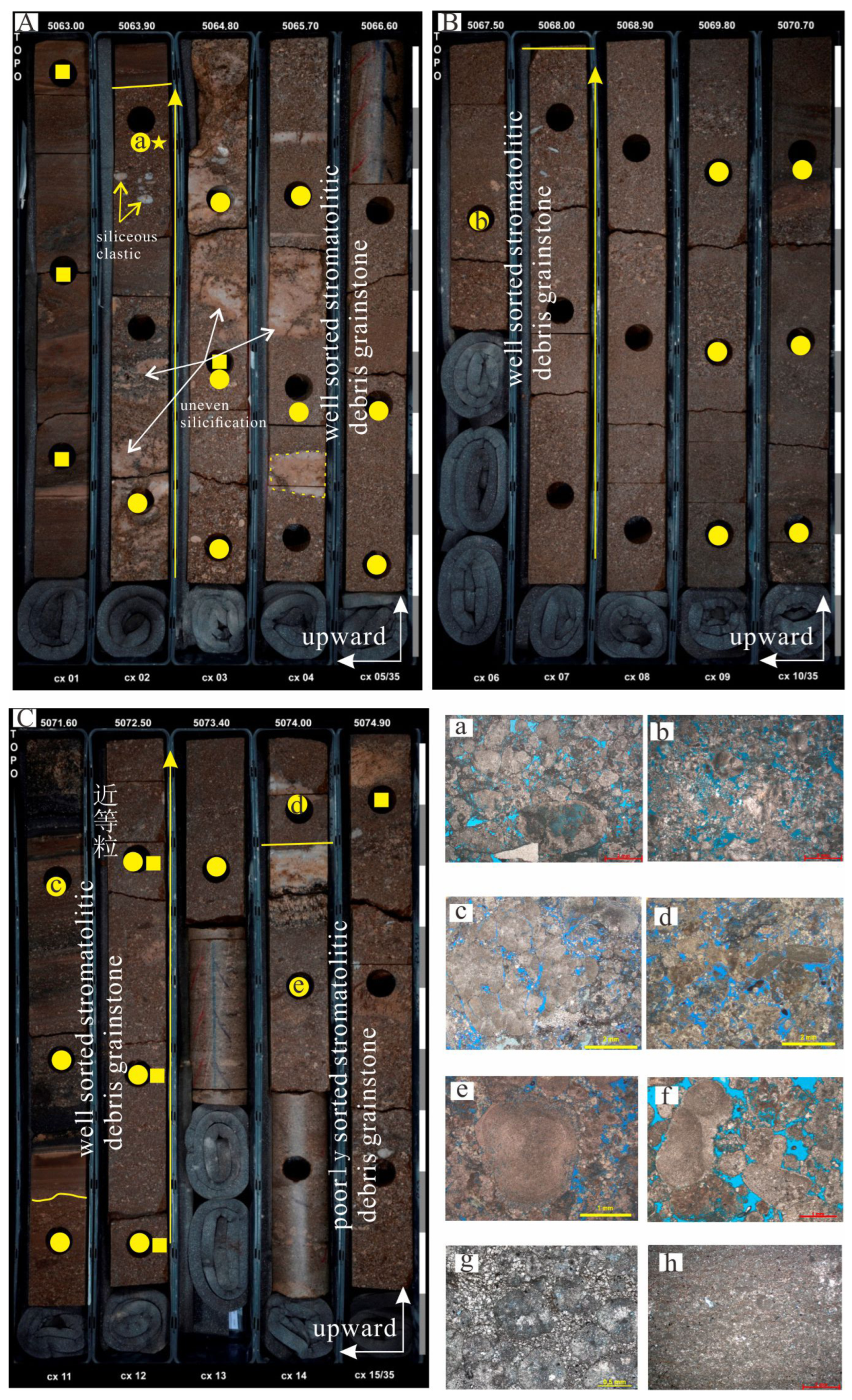
4.1.2. Lithological Assemblages and Stacking Patterns of Microbial Shoal
4.2. Heterogeneity of Microbial Shoal Reservoir
4.2.1. Types of Microbial Shoal Reservoir Spaces
4.2.2. Properties of Microbial Shoal
5. Discussion
5.1. The Influence of Microfacies on the Heterogeneity of Microbial Shoal Reservoirs
5.2. The Influence of Diagenesis on the Heterogeneity of Microbial Shoal Reservoirs
6. Conclusions
- (1)
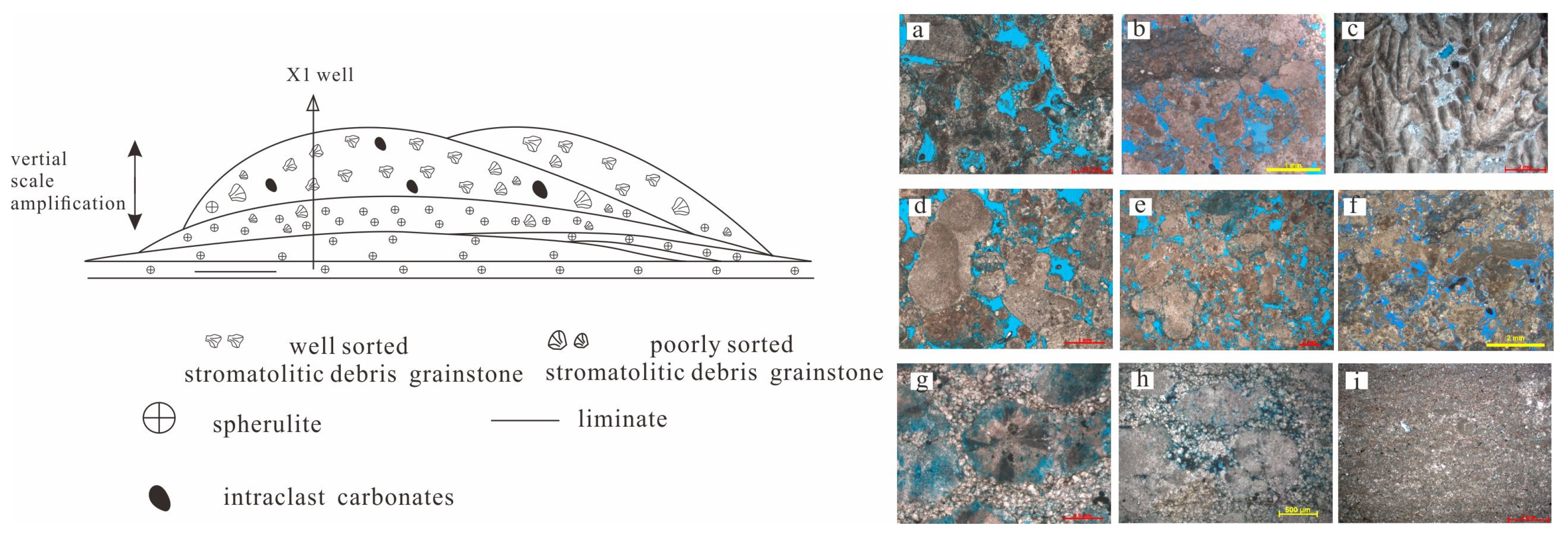
- The primary lithologies of the microbial shoal include: spherulite, poorly sorted stromatolitic debris grainstones, well-sorted stromatolitic debris grainstones, well-sorted debris of spherulites, and silicified stromatolitic debris rocks, with minor occurrences of well-sorted intraclasts.
- (2)
- Based on lithological assemblages and stacking relationships, the internal architecture of the microbial shoal is subdivided into three distinct components: the shoal core, shoal flank and the shoal base. The shoal core, located at the highest point of the shoal body, is primarily composed of well-sorted stromatolitic debris grainstones. The shoal flank, situated along the periphery of the shoal body, is primarily composed of poorly sorted stromatolitic debris grainstones. The shoal base, located at the nadir of the shoal body’s topography, is characterized by the predominance of spherulites. Ultimately, a stacking model of the shoal base, shoal core, and shoal flank was established.
- (3)
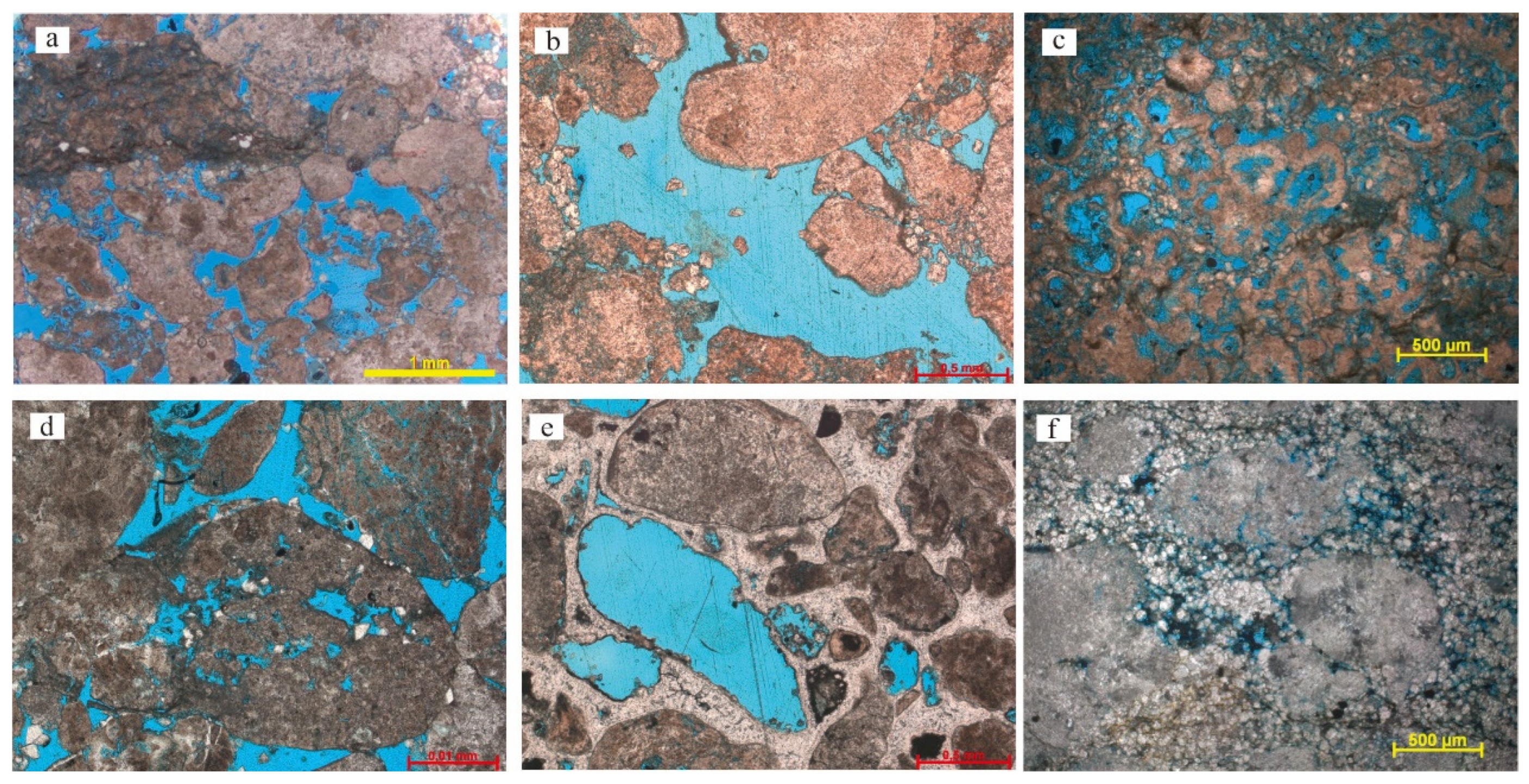
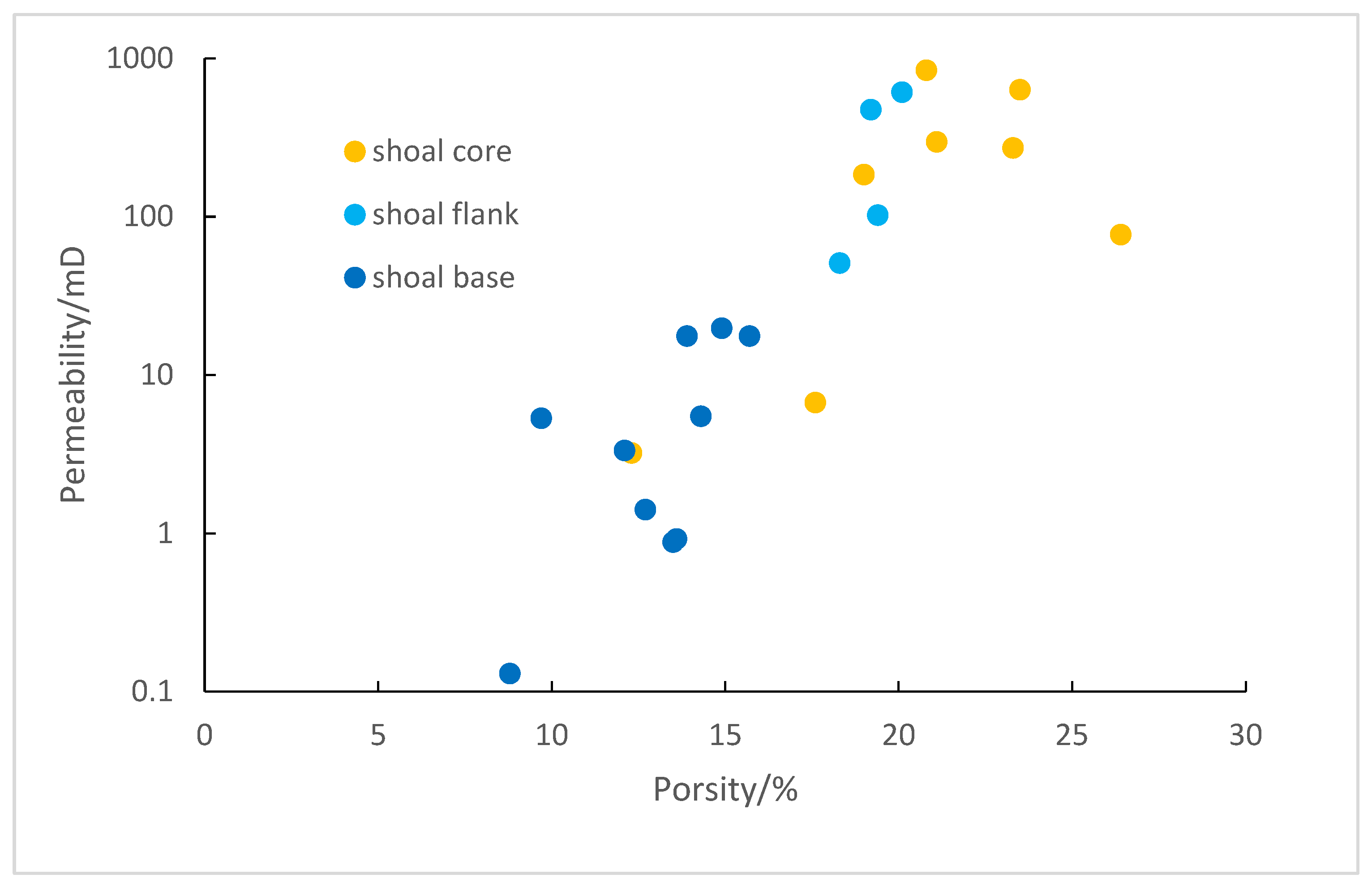
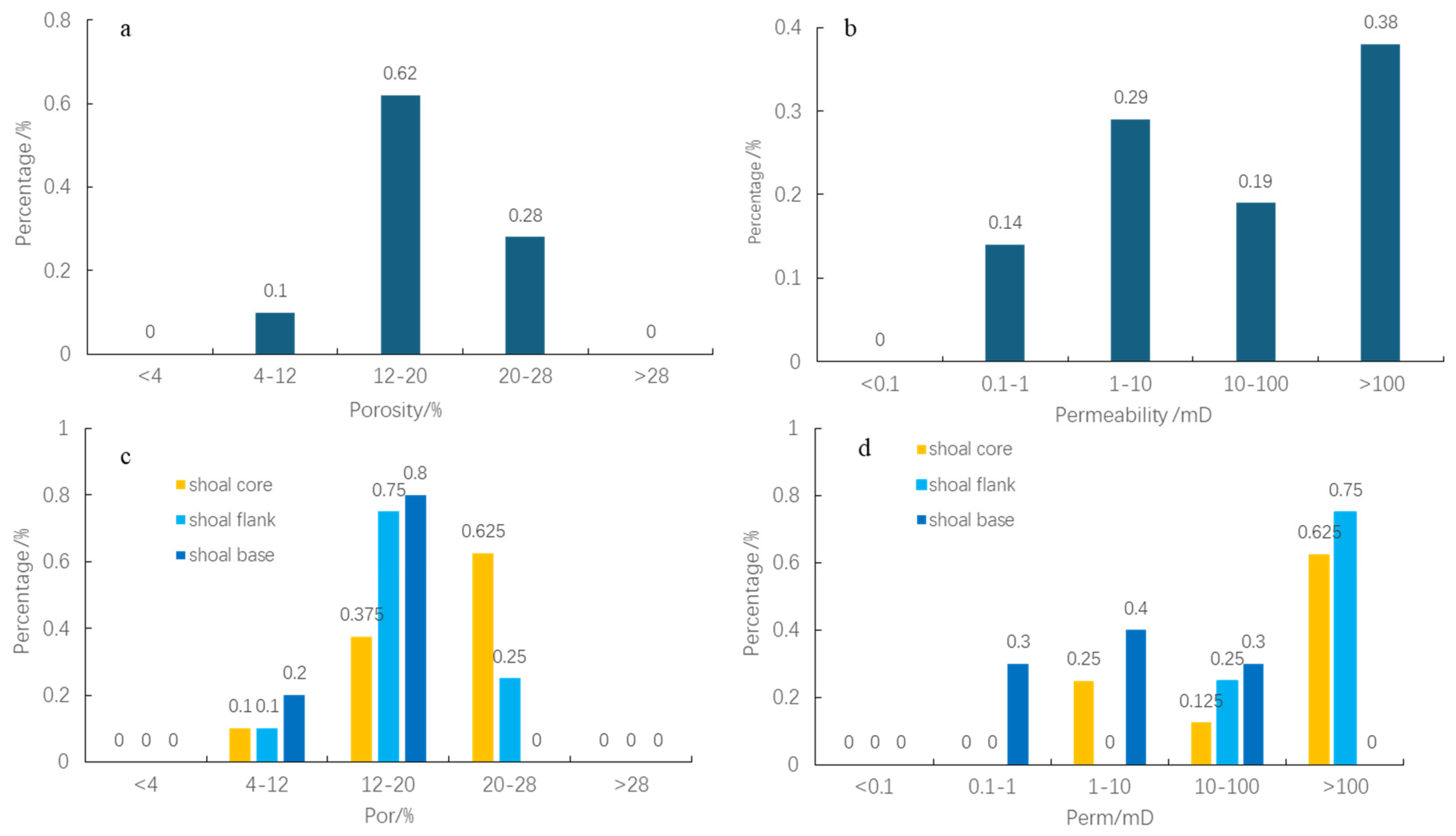
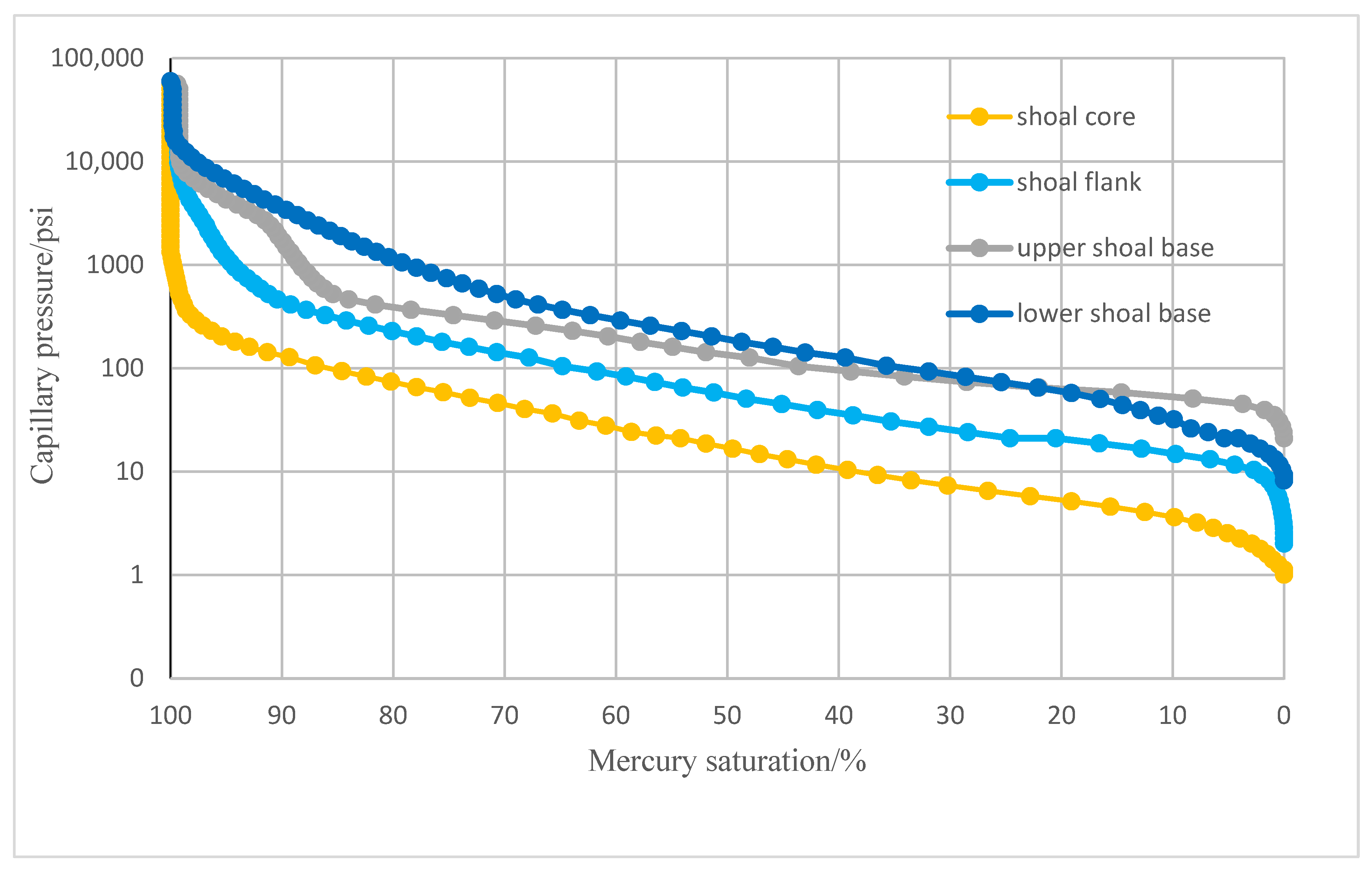
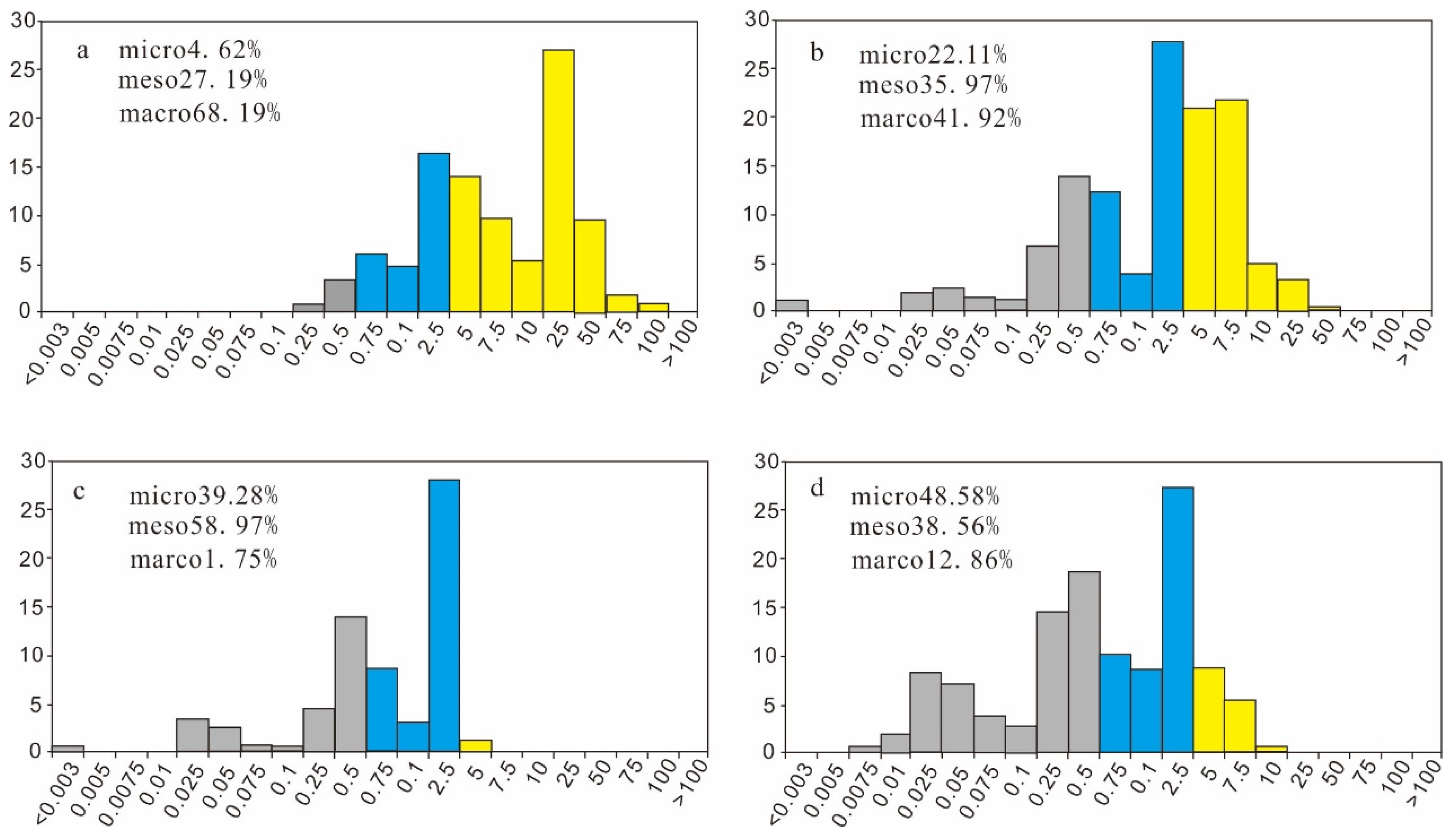
- It was determined that microfacies and diagenesis were the primary controls on microbial shoal heterogeneity. The shoal core displays a high level of hydrodynamic energy, as evidenced by the presence of coarse grain size and optimal sorting. In this instance, penecontemporaneous dissolution is most evident, leading to reservoirs that are predominantly characterized by macroporosity and optimal petrophysical properties.
- (4)
- Given that the dataset for this study is limited to a single well, the proposed internal geometry of microbial shoals (i.e., shoal base, shoal flank, and shoal core) represents an idealized, near-complete geological model. In future practical research, due to variations in drilling locations and the presence of unconformities, microbial shoals may develop distinct internal assemblages. A comprehensive analysis integrating geological, well-log, and seismic data will be required to decipher these internal configuration patterns.
Author Contributions
Funding
Data Availability Statement
Conflicts of Interest
References
- Dalrymple, R.W.; Rivers, J.M. A new look at modern carbonate shoals and coastal barrier systems. Earth-Sci. Rev. 2023, 246, 104553. [Google Scholar] [CrossRef]
- Rygel, M.; Quinton, P. Sedimentary Geology: Rocks, Environments and Stratigraphy; SUNY Potsdam: Potsdam, NY, USA, 2025; pp. 256–280. [Google Scholar]
- Dong, C.; Hu, C.; Quaye, J.A.; Wang, X.; He, G. Marine carbonate shoal reservoirs: Review and perspectives. Int. Geol. Rev. 2026, 15, 36–50. [Google Scholar] [CrossRef]
- Ma, Y.; Cai, X.; Li, M.; Li, H.; Zhu, D.; Qiu, N.; Pang, X.; Zeng, D.; Kang, Z.; Ma, A.; et al. Research advances on the mechanisms of reservoir formation and hydrocarbon accumulation and the oil and gas development methods of deep and ultra-deep marine carbonates. Pet. Explor. Dev. 2024, 51, 692–707. [Google Scholar] [CrossRef]
- Harris, P.M. Fifty years of research on the Joulters ooid sandbody—Impact on carbonate sedimentology and diagenesis and lessons learned from an invaluable analogue. Depos. Rec. 2025, 11, 1399–1432. [Google Scholar] [CrossRef]
- Zheng, T.; Wen, J.; Zhao, L.; Zeng, X.; Wang, S.; Chen, Y.; Hou, J. Reservoir heterogeneity between intra-platform and platform-margin settings in an isolated carbonate platform: A case study from the carboniferous, Pre-Caspian Basin. Front. Earth Sci. 2026, 13, 1744762. [Google Scholar] [CrossRef]
- Koehrer, B.; Aigner, T.; Forke, H.; Pöppelreiter, M. Middle to Upper Khuff (Sequences KS1 to KS4) outcrop-equivalents in the Oman Mountains: Grainstone architecture on a subregional scale. GeoArabia 2012, 14, 59–104. [Google Scholar] [CrossRef]
- Zhou, J.; Fang, C.; Ji, H.; Zhang, J.; Zhao, F. A development rule of Lower Cambrian Longwangmiao grain beaches in the Sichuan Basin. Nat. Gas Ind. 2014, 34, 27–36. (In Chinese) [Google Scholar]
- Yan, W.; Fan, T.; Zhang, G.; Gao, Z.; Li, Y.; Zhang, G.; Li, F.; Sun, M.; Lü, Y. Sedimentary characteristics of Ordovician carbonate intraclastic shoals of the Yingshan Formation, Tazhong-Shuntuoguole area, Tarim Basin. Earth Sci. Front. 2023, 30, 76–87. [Google Scholar]
- Meng, M.M.; Fan, T.L.; Duncan, I.J.; Yin, S.; Gao, Z.; Jiang, L.; Yu, C.; Jiang, L. Characterization of carbonate microfacies and reservoir pore types based on Formation MicroImager logging: A case study from the Ordovician in the Tahe Oilfield, Tarim Basin, China. Interpretation 2018, 6, 71–82. [Google Scholar] [CrossRef]
- Feng, Z. A Review of the Definitions of Terms of Sedimentary Facies. J. Paleogeogr. 2020, 22, 207–220. [Google Scholar] [CrossRef]
- Liu, H.; Wang, G.; Liu, N.; Qiao, L.; Cui, J. Characteristics and Main Controlling Factor of Shoal Reservoir Development in Jialingjiang Formation of Zizong Area, Southwestern Sichuan. J. Southwest Pet. Univ. (Sci. Technol. Ed.) 2017, 39, 1–9. (In Chinese) [Google Scholar]
- Bebout, B.D.; Major, R.P.; Harris, P.M. Internal Geometry of a Modern Carbonate Grainstone Shoal—An Analog for Hydrocarbon Reservoir Heterogeneity; Contract Report (prepared for Chevron Petroleum Technology Company); University of Texas Bureau of Economic Geology: Austin, TX, USA, 1994; pp. 1–44. [Google Scholar]
- Grotzinger, J.; Al-Rawahi, Z. Depositional facies and platform architecture of microbialite-dominated carbonate reservoirs, Ediacaran–Cambrian Ara Group, Sultanate of Oman. AAPG Bull. 2014, 98, 1453–1494. [Google Scholar] [CrossRef]
- Kenter, J.A.M.; Harris, P.M.; Della Porta, G. Steep microbial boundstone-dominated platform margins—examples and implications. Sediment. Geol. 2005, 178, 5–30. [Google Scholar] [CrossRef]
- Ullah, I.; Jamil, M.; Rahim, H.U.; Khan, I.; Ali, A.; Muzammil, M.; Abbas, W.; Umar, M.; Shah, F.; Usman, M. Impact of Diagenesis on Microbial Carbonate Reservoirs in the Upper Indus Basin, NW Himalayas. Minerals 2026, 16, 111. [Google Scholar] [CrossRef]
- Jiang, L.; Hu, A.P.; Ou, Y.L.; Liu, D.W.; Hu, Y.J.; Tang, Y.J.; Sun, P.; Liu, Y.Y.; Wang, Z.C.; Cai, C.F. Diagenetic evolution and effects on reservoir development of the Dengying and Longwangmiao formations, Central Sichuan Basin, Southwestern China. Pet. Sci. 2023, 20, 3379–3393. [Google Scholar] [CrossRef]
- Sarg, J.F.; Suriamin Tänavsuu-Milkeviciene, K.; Humphrey, J.D. Lithofacies, stable isotopic composition, and stratigraphic evolution of microbial and associated carbonates, Green River Formation (Eocene), Piceance Basin, Colorado. AAPG Bull. 2013, 97, 1937–1966. [Google Scholar] [CrossRef]
- Terra, G.; Spadini, A.R.; Franca, A.B.; Sombra, C. Carbonate rock classification applied to Brazilian sedimentary basins. Bol. Geocienc. Petrobras 2010, 18, 9–29. [Google Scholar]
- Bahniuk, A.M.; Anjos, S.; França, A.B.; Matsuda, N.; Eiler, J.; Mckenzie, J.A.; Vasconcelos, C. Development of microbial carbonates in the Lower Cretaceous Codo Formation (north-east Brazil): Implications for interpretation of microbialite facies associations and palaeoenvironmental conditions. Sedimentology 2015, 62, 155–181. [Google Scholar] [CrossRef]
- Wright, V.P.; Barnett, A.J. An abiotic model for the development of textures in some South Atlantic early Cretaceous lacustrine carbonates. In Microbial Carbonates in Space and Time: Implications for Global Exploration and Production; Bosence, D.W.J., Gibbons, K., Le Heron, D.P., Pritchard, T., Vining, B., Eds.; Special Publications; Geological Society: London, UK, 2015; Volume 418, pp. 209–219. [Google Scholar]
- Ronchi, P.; Cruciani, F. Continental carbonates as a hydrocarbon reservoir, an analog case study from the travertine of Saturnia, Italy. AAPG Bull. 2015, 99, 711–734. [Google Scholar] [CrossRef]
- Claes, H.; Erthal, M.M.; Soete, J.; Ozkul, M.; Swennen, R. Shrub and pore type classification: Petrography of travertine shrubs from the Ballık-Belevi area (Denizli, SW Turkey). Quat. Int. 2017, 437, 147–163. [Google Scholar] [CrossRef]
- Baptista, R.J.; Ferraz, A.E.; Sombra, C.; Neto, E.V.d.S.; Plawiak, R.; Silva, C.L.L.; Ferrari, A.L.; Kumar, N.; Gamboa, L.A.P. The presalt Santos Basin, a super basin of the twenty-first century. AAPG Bull. 2023, 107, 1369–1389. [Google Scholar] [CrossRef]
- Dou, L.; Wen, Z.; Wang, Z.; He, Z.; Song, C.; Chen, R.; Yang, X.; Liu, X.; Liu, Z.; Chen, Y. Sedimentary build-ups of pre-salt isolated carbonate platforms and formation of deep-water giant oil fields in Santos Basin, Brazil. Pet. Explor. Dev. 2024, 51, 949–962. [Google Scholar] [CrossRef]
- Paula Faria, D.L.; Reis, A.T.; Souza, O.G., Jr. Three-dimensional stratigraphic-sedimentological forward modeling of an Aptian carbonate reservoir deposited during the sag stage in the Santos basin, Brazil. Mar. Pet. Geol. 2017, 88, 676–695. [Google Scholar] [CrossRef]
- Sommer, V.P.; Kuchle, J.; De Ros, L.F. Seismic stratigraphic framework and seismic facies of the Aptian Pre-salt Barra Velha Formation in the Tupi Field, Santos Basin, Brazil. J. S. Am. Earth Sci. 2022, 118, 103947. [Google Scholar] [CrossRef]
- Pizarro, V.H.; Perosi, F.A.; Borghi, L.; Fetter, M. Seismic stratigraphic analysis of the Pre-salt of Berbigão, Sururu, and Atapu fields, Santos Basin, Brazil. Mar. Pet. Geol. 2025, 182, 107–529. [Google Scholar] [CrossRef]
- Zhang, D.M.; Duan, T.Z.; Zhang, Z.M.; Hao, Y.; Yao, W. Facies model of lacustrine microbial carbonates: A case study from A oilfield, Santos Basin. J. Northwest Univ. (Nat. Sci. Ed.) 2018, 48, 413–422. (In Chinese) [Google Scholar] [CrossRef]
- Araújo, C.C.; Madrucci, V.; Homewood, P.; Mettraux, M.; Ramnani, C.W.; Spadini, A.R. Stratigraphic and sedimentary constraints on presalt carbonate reservoirs of the South Atlantic Margin, Santos Basin, offshore Brazil. AAPG Bull. 2022, 106, 2513–2546. [Google Scholar] [CrossRef]
- Basso, M.; Belila, A.M.P.; Chinelatto, G.F.; Souza, J.P.d.P.; Vidal, A.C. Sedimentology and petrophysical analysis of pre-salt lacustrine carbonate reservoir from the Santos Basin, southeast Brazil. Int. J. Earth Sci. 2021, 110, 2573–2595. [Google Scholar] [CrossRef]
- Wang, D.; Liu, H.; Tang, S.; Bai, J.; Zhou, G.; Li, Z.; Tan, X.; Ceng, C.; Yang, Y. Sedimentary architecture and distribution of intra-platform shoal in sequence framework of Permian Changxing Formation in central Sichuan Basin, SW China. Pet. Explor. Dev. 2023, 50, 346–359. [Google Scholar] [CrossRef]
- Yu, X. Fundamentals of Oil and Gas Reservoir Geology; Petroleum Industry Press: Beijing, China, 2009; pp. 46–48. (In Chinese) [Google Scholar]
- Gomes, P.O.; Kilsdonk, B.; Minken, J.; Grow, T.; Barrangan, R. The Outer High of the Santos Basin, Southern São Paulo Plateau, Brazil: Pre-Salt Exploration Outbreak, Paleogeographic Setting, and Evolution of the Syn-Rift Structures; AAPG Search and Discovery: Tulsa, OK, USA, 2009; Volume 10193, 13p. [Google Scholar]
- Zhang, Z.; Zhu, Y.; Zhang, D.; Su, Y.; Yao, W.; Bao, Z.; Song, J.; Shen, W. Hydrocarbon accumulation rules and exploration inspiration of pre-salt carbonate reservoirs in the Great Campos Basin, Brazil. China Pet. Explor. 2020, 25, 75–85. (In Chinese) [Google Scholar]
- He, S.; Li, G.; Wu, C.; Liu, S.; Zhang, Z.; Su, Y.; Zhu, Y.; He, Z.; Ren, J.; Wang, Y.; et al. Sedimentary filling characteristics and controlling factors of lacustrine microbial carbonates sequence in the Santos Basin, Brazil. Pet. Explor. Dev. 2022, 49, 683–692. [Google Scholar] [CrossRef]
- Figueiredo, I.; Lana, C.; Alkmim, F.F.; Silva, M.A.; Souza, M.E.S.; Dias-Filho, D.C.; Zambonato, E.E.; Mendonça, K.R. Tracing carbonate diagenesis and hydrothermal activity during the opening of the Central South Atlantic: Insights from the Santos Basin (Brazil). Geosci. Front. 2025, 16, 102115. [Google Scholar] [CrossRef]
- Netto, P.R.; Pozo, M.; Da Silva, M.D.; Mexias, A.S.; Gomes, M.E.; Borghi, L.; Rios-Netto, A.M. Authigenic Mg-clay assemblages in the Barra Velha Formation (Upper Cretaceous) from Santos basin(Brazil): The role of syngenetic and diagenetic process. Appl. Clay Sci. 2022, 216, 106339. [Google Scholar] [CrossRef]
- SY/T 6285-2011; Methods for Oil and Gas Reservoir Evaluation. Standards Press of China: Beijing, China, 2011. (In Chinese)
- Amel, H.; Jafarian, A.; Husinec, A.; Koeshidayatullah, A.; Swennen, R. Microfacies, depositional environment and diagenetic evolution controls on the reservoir quality of the Permian upper Dalan Formation, Kish Gas field, Zagros basin. Mar. Pet. Geol. 2015, 67, 57–71. [Google Scholar] [CrossRef]
- Mohammed, A.; Velledits, F. Facies-related reservoir heterogeneity of grain-supported limestones: Insight from the Early Cretaceous Yamama Formation, southern Iraq. Carbonates Evaporites 2024, 39, 118. [Google Scholar] [CrossRef]
- Bathurst, R.G.C. Carbonate Sediments and Their Diagenesis; Elsevier Science: Amsterdam, The Netherlands, 1972; pp. 1–657. [Google Scholar]
- Moore, C.H.; Wade, W.J. Carbonate Reservoirs: Porosity and Diagenesis in a Sequence Stratigraphic Framework, 2nd ed.; Developments in Sedimentology; Elsevier: Amsterdam, The Netherlands, 2013; pp. 1–392. [Google Scholar]
- Longman, M.W. Carbonate diagenetic textures from nearsurface diagenetic environments. AAPG Bull. 1980, 64, 461–487. [Google Scholar] [CrossRef]
- Burne, R.V.; Moore, L.S.; Christy, A.G.; Troitzsch, U.; King, P.L.; Carnerup, A.M.; Hamilton, P.J. Stevensite in the modern thrombolites of Lake Clifton, West Austrialia: A missing link in microbialite mineralization? Geology 2014, 42, 575–578. [Google Scholar] [CrossRef]
- Carramal, N.G.; Oliveira, D.M.; Cacela, A.S.; Cuglieri, M.A.; Rocha, N.P.; Viana, S.M.; Toledo, S.L.; Pedrinha, S.; de Ros, L.F. Paleoenvironmental insights from the deposition and diagenesis of Aptian Presalt Magnesium silicates from the Lula field, Santos basin, Brazil. J. Sediment. Res. 2022, 92, 12–31. [Google Scholar] [CrossRef]
- Chafetz, H.; Barth, J.; Cook MGuo, X.; Zhou, J. Origins of carbonate spherulites: Implications for Brazilian Aptian pre-salt reservoir. Sediment. Geol. 2018, 365, 21–33. [Google Scholar] [CrossRef]
- Wright, V.P.; Barnett, A.J. The textural evolution and ghost matrices of the Cretaceous Barra Velha Formation carbonates from the Santos Basin, offshore Brazil. Facies 2020, 66, 7. [Google Scholar] [CrossRef]


Disclaimer/Publisher’s Note: The statements, opinions and data contained in all publications are solely those of the individual author(s) and contributor(s) and not of MDPI and/or the editor(s). MDPI and/or the editor(s) disclaim responsibility for any injury to people or property resulting from any ideas, methods, instructions or products referred to in the content. |
© 2026 by the authors. Licensee MDPI, Basel, Switzerland. This article is an open access article distributed under the terms and conditions of the Creative Commons Attribution (CC BY) license.
Share and Cite
Zhang, D.; Li, F.; Zhang, Z.; Si, C. The Internal Geometry of Microbial Shoal and Its Reservoir Heterogeneity: Insights from Core Samples of Well X1 in the Pre-Salt Santos Basin. Geosciences 2026, 16, 177. https://doi.org/10.3390/geosciences16050177
Zhang D, Li F, Zhang Z, Si C. The Internal Geometry of Microbial Shoal and Its Reservoir Heterogeneity: Insights from Core Samples of Well X1 in the Pre-Salt Santos Basin. Geosciences. 2026; 16(5):177. https://doi.org/10.3390/geosciences16050177
Chicago/Turabian StyleZhang, Demin, Fayou Li, Zhongmin Zhang, and Chaonian Si. 2026. "The Internal Geometry of Microbial Shoal and Its Reservoir Heterogeneity: Insights from Core Samples of Well X1 in the Pre-Salt Santos Basin" Geosciences 16, no. 5: 177. https://doi.org/10.3390/geosciences16050177
APA StyleZhang, D., Li, F., Zhang, Z., & Si, C. (2026). The Internal Geometry of Microbial Shoal and Its Reservoir Heterogeneity: Insights from Core Samples of Well X1 in the Pre-Salt Santos Basin. Geosciences, 16(5), 177. https://doi.org/10.3390/geosciences16050177