Article

The End of Paleogene White River Group Deposition in Wyoming and Nebraska, USA: A Distal Record of the Collapse and Emplacement of the Markagunt Gravity Slide at 23 Ma


1
Department of Earth Sciences, Montana State University, Bozeman, MT 59717, USA
2
Department of Geography, Geology and the Environment, Illinois State University, Normal, IL 61790, USA
3
Department of Geological Sciences, University of Missouri, Columbia, MO 65211, USA
4
Utah Geological Survey, Salt Lake City, UT 84114, USA
5
Department of Geology, Kent State University, Kent, OH 44242, USA
6
Department of Earth Sciences, The Ohio State University, Columbus, OH 43210, USA
7
Department of Earth & Environmental Sciences, University of Minnesota Duluth, Duluth, MN 55812, USA
*
Author to whom correspondence should be addressed.
Retired.
Geosciences 2026, 16(5), 174; https://doi.org/10.3390/geosciences16050174

Submission received: 6 February 2026 / Revised: 20 April 2026 / Accepted: 22 April 2026 / Published: 27 April 2026
(This article belongs to the Special Issue Detrital Minerals Geochronology and Sedimentary Provenance)

Abstract

The late Paleogene White River Group is a post-Laramide sedimentary succession that occurs within Laramide intermontane basins and atop some basement-cored uplifts. Detrital zircon U-Pb dates of tuffaceous sandstones from the uppermost White River Group in eastern Wyoming and western Nebraska yield a maximum depositional age of 23.07 ± 0.46 Ma, which overlaps the emplacement of the Markagunt Gravity Slide in Utah’s Marysvale Volcanic Field at 23.05 + 0.22/− 0.20 Ma. The Marysvale Volcanic Field (~31–18 Ma) lies at the east margin of the Nevadaplano, a longstanding highland in the Sevier Hinterland later dismembered by basin and range extension. Strata both proximal and distal to the Marysvale Volcanic Field show an increase in Marysvale provenance up to the emplacement of the Markagunt Gravity Slide. After emplacement, distal sediment sourcing of Miocene strata in the Great Plains shifted back to older Paleogene volcanic fields farther west in Nevada. This temporal relationship suggests that the collapse of the Marysvale Volcanic Field associated with the emplacement of the Markagunt Gravity Slide forced drainage reorganization and sediment sourcing during the transition from White River to Arikaree Group sedimentation.

1. Introduction

Large-scale, volcanogenic, long-runout gravity slides are a recently discovered type of volcanic hazard in large volcanic fields. The first well-documented subaerial gravity slide of this kind that was identified is the Eocene Heart Mountain Slide [1,2] in Wyoming, followed by the Oligocene–Miocene Marysvale Gravity Slide Complex in Utah [3,4,5]. To date, much effort has been made to study processes of gravity slide initiation [3,4,5] timing, translation, and emplacement processes [1,2,6,7,8,9]. However, little is understood about the broader regional implications of these catastrophic collapse events.
In Moll et al. [10], we identified the distal effect of Great Basin volcanism in the provenance of Eocene–Oligocene White River Group strata in South Dakota, including sourcing from the Marysvale Volcanic Field. Here, we present new detrital zircon U-Pb age data of the uppermost White River Group in eastern Wyoming and western Nebraska, at the contact with the overlying Arikaree Group. Through provenance analysis and correlating the maximum depositional age of these sediments, we identify a link between White River Group sedimentation and the 23 Ma catastrophic collapse of the Marysvale Volcanic Field. Our new data also carries implications for the duration of White River Group sedimentation that may require regional stratigraphic revision, and clarifications of the regional paleogeography of western North America during the transition from compressional to extensional tectonism.
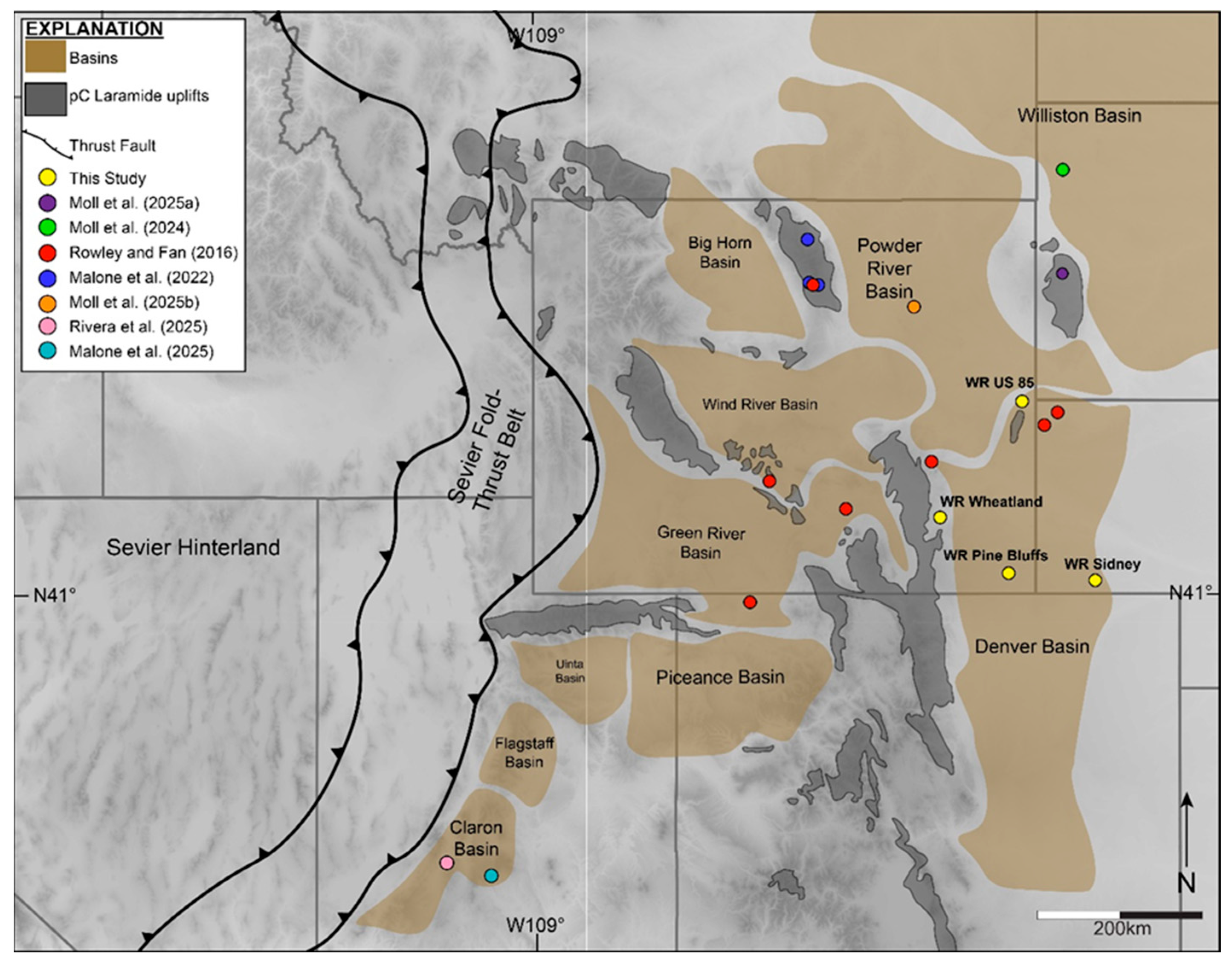
In late Jurassic to Eocene time, subduction of the Farallon plate beneath the North American continent resulted in crustal thickening from thin-skinned thrusting in the Sevier fold and thrust belt and the development of an extensive foreland basin system in the western interior of the continent [11]. During the late Cretaceous to Eocene, the foreland basin system was structurally partitioned into several internally drained, interconnected intermontane basins, bounded by blocks of Precambrian basement, uplifted by high-angle reverse faulting (Figure 1) [12,13,14,15,16,17].
The hinterland of the Sevier fold and thrust belt was a broad, high plateau called the Nevadaplano [18,19] until extensional collapse of the plateau driven by gravitational instability or slab rollback during the late Paleogene [20,21]. In the middle Cenozoic, southward-stepping volcanism across the Nevadaplano in what is known as the mid-Cenozoic ignimbrite flareup [22,23] contributed sediment into the Laramide intermontane basins, powered by a diachronous shift to an arid climate and eolian-dominated sedimentation, mostly burying the north–central Rocky Mountains in tuffaceous sediment derived from Great Basin volcanism, resulting in a low-relief topographic wedge from the hinterland, across the Laramide province, and into the midcontinent [11,13,18,24,25,26,27,28,29,30].
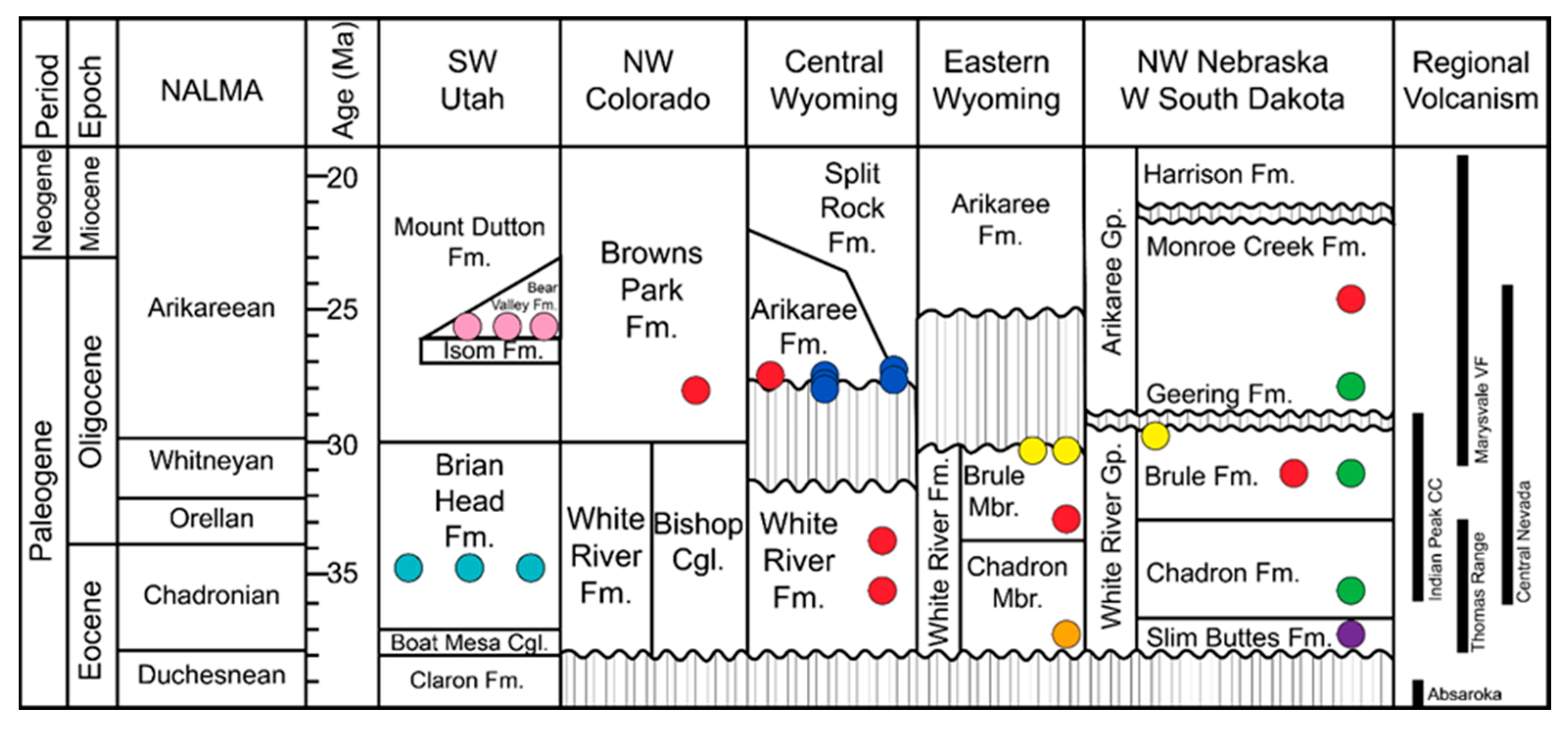
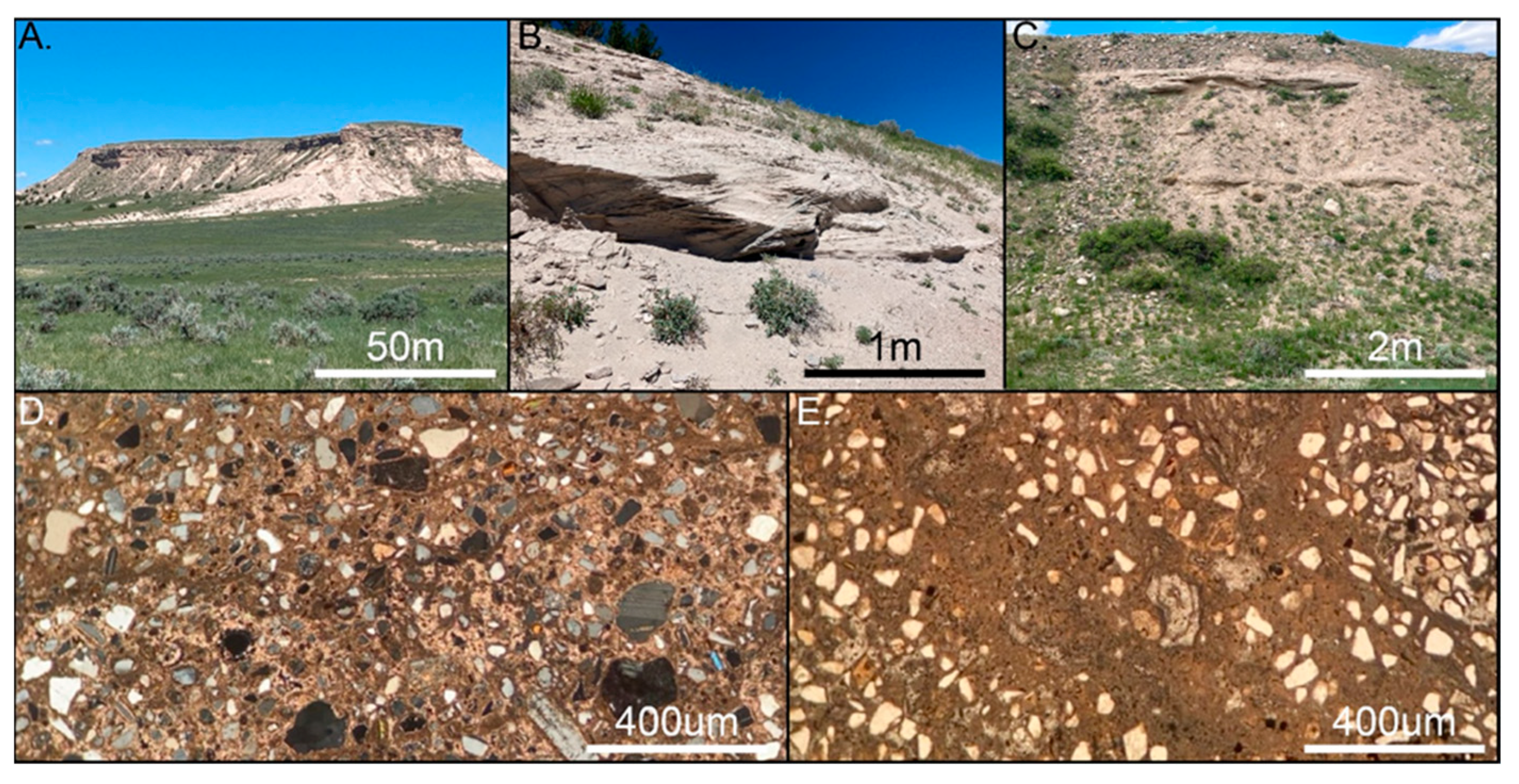
The Eocene–Oligocene White River Group forms of these expanses of eolian-dominated tuffaceous strata, found both in intermontane basins and atop Laramide uplifts in Colorado, Wyoming, South Dakota and Nebraska (Figure 1 and Figure 2) [10,25,26,27,30]. The White River Group is composed primarily of white, yellow, and brown eolian cross-bedded tuffaceous sandstones (Figure 3), as well as fluvial and lacustrine siliciclastic and mudstone deposits [10,26,31,32,33,34,35,36]. Moll et al. [10] found a west-to-southwest-progressing detrital zircon source of the White River Group that moved across the Nevadaplano, in step with the southward progression of volcanism across the region. The ~55–40 Ma Absaroka Volcanic Field was a major sediment contributor early in White River Group deposition, with sediments originating from the Great Basin volcanic fields taking precedence later in time, before a shift in source to the further south–southwest Marysvale Volcanic Field and other southwesterly areas.
The Marysvale Volcanic Field is the largest volcanic field in Utah. In the late Oligocene to early Miocene, the southern portion of the field experienced three sequential large-scale collapse events. These include the ~25.3 Ma Sevier Gravity Slide [10], the ~23.0 Ma Markagunt Gravity Slide [8] and the ~21 Ma Black Mountain Gravity Slide.
These slides were initiated by rapid inflation of the land surface due to volcanic doming, gravitational instability, and eventual catastrophic collapse and translation along a low-angle basal detachment surface over distances of tens of kilometers [3,8,9]. The low-angle basal slip surface of the Markagunt Gravity Slide resulted in a long-distance runout and catastrophic emplacement covering an area of >3500 km2 and carrying allochthonous blocks of upper-plate strata ~30 km over the land surface and rearranging the topography on a massive scale [3].
The Eocene–Oligocene Brian Head Formation, deposited immediately prior to Marysvale volcanism, is a siliciclastic unit which has a provenance derived from Great Basin volcanism and Sevier Hinterland rocks to the west [36], stratigraphically correlative with strata in the early Brule Member/Brule Formation of the White River Group (Figure 2). Interbedded with Marysvale volcanic rocks is the Oligocene Bear Valley Formation, whose upper part consists mostly of cross-bedded tuffaceous sandstones with a provenance representing accelerated growth of the Marysvale Volcanic Field immediately (~400 kyr) preceding the ~23 Ma Markagunt Gravity Slide (Figure 2).

2. Materials and Methods

Four samples were collected from tuffaceous sandstones of the uppermost Brule Member of the White River Group, directly beneath (i.e., within 5 m) the overlying Arikaree Group at four sites across eastern Wyoming and northwest Nebraska (Figure 3). Detrital zircons were extracted from White River Group sandstones using standard mineral separation techniques. Samples were processed such that all zircons were retained in the final heavy mineral fraction. Zircons were incorporated into a 1” epoxy mount, together with fragments or loose grains of Sri Lanka, FC-1, and R33 zircon crystals as the zircon standards. The mounts were sanded down to a depth of ~20 microns, polished, imaged, and cleaned prior to isotopic analysis. BSE and color CL Images were generated with a Hitachi 3400N SEM and a Gatan CL2 detector system (www.geoarizonasem.org (accessed on 15 April 2026)). U-Pb geochronologic analyses of 722 detrital zircons were conducted at the Arizona Laserchron Center by laser ablation inductively coupled mass spectrometry (LA-ICPMS) using a Thermo Element2 single-collector ICPMS. Please refer to the Element2 methodology at laserchron.org or the Supplementary Data for more details of these analytical techniques. These methods for U-Pb geochronology have also been described by [37,38,39]. The details can be found at the University of Arizona Laserchron Center website at https://sites.google.com/laserchron.org/arizonalaserchroncenter/home (accessed on 15 April 2026).
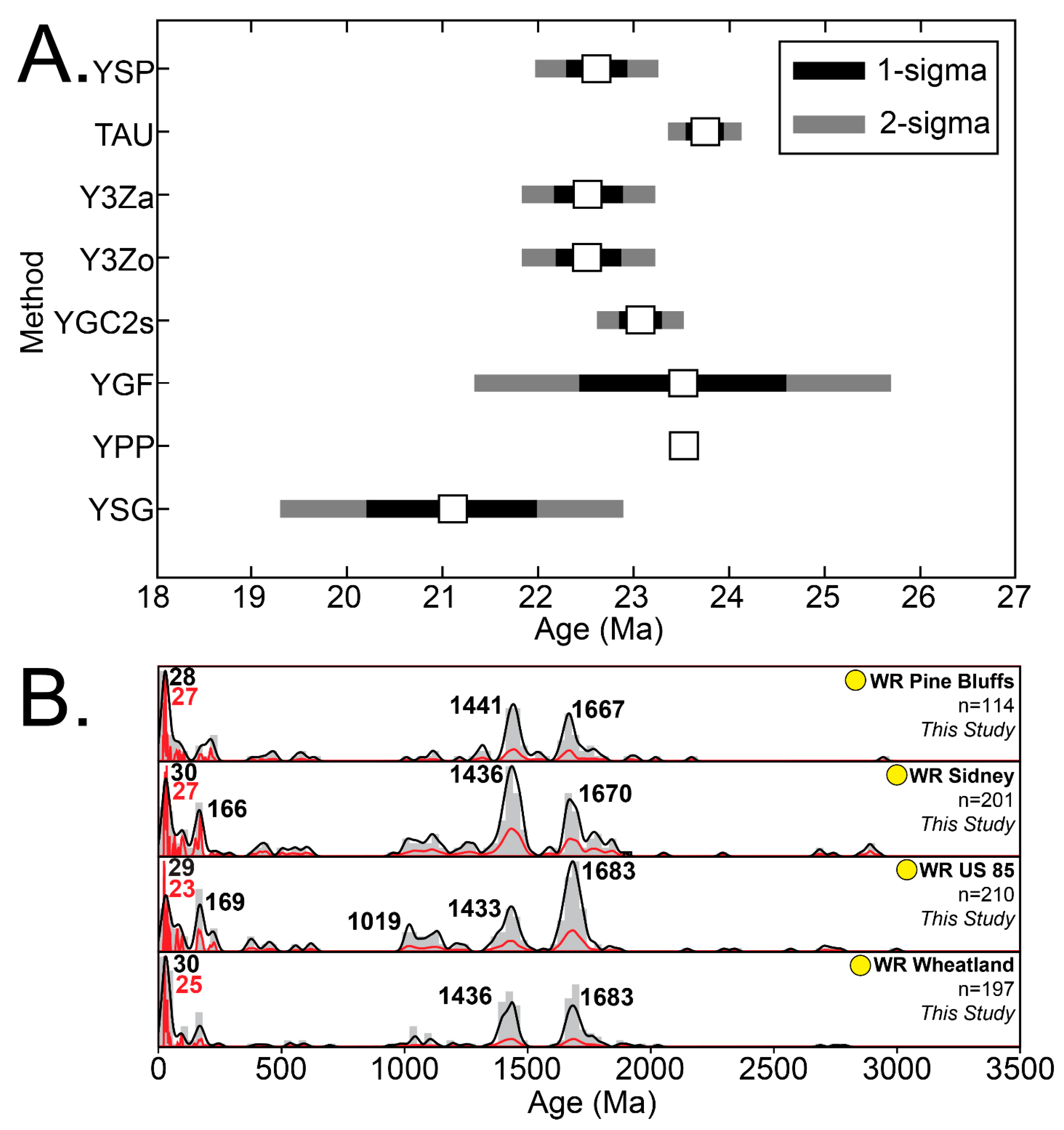
To report the maximum depositional age (MDA) of the four samples, we use the MATLAB (R2023b)-based program dzMDA (the latest version of dzMDA, as well as other commonly used MATLAB routines are freely available to download from the University of Arizona Laserchron Center website listed above, accessed on 15 April 2026) to present 8 different MDA calculations (Figure 4): (1) youngest single zircon grain (YSG), based on the youngest individual age and uncertainty; (2) youngest graphical peak (YPP), based on the youngest probability density plot (PDP) peak age; (3) youngest gaussian fit (YGF), based on a gaussian curve fit to the youngest PDP mode; (4) the youngest cluster of zircon grains with overlapping error estimates at 2-sigma (YGC2s); (5) the youngest cluster of three zircon grains with overlapping 2-sigma error estimates (Y3Zo); (6) the youngest three zircons (Y3Za), based on the weighted mean of the youngest three zircons regardless of uncertainty; (7) Tau (TAU), a method based on the weighted mean and uncertainty of all ages that fall within the probability minima of the youngest PDP age peak; and (8) the youngest statistical population (YSP), based on the weighted mean of the youngest group of ages with a mean square deviation closest to one. These statistical methods are further described in [40,41,42].
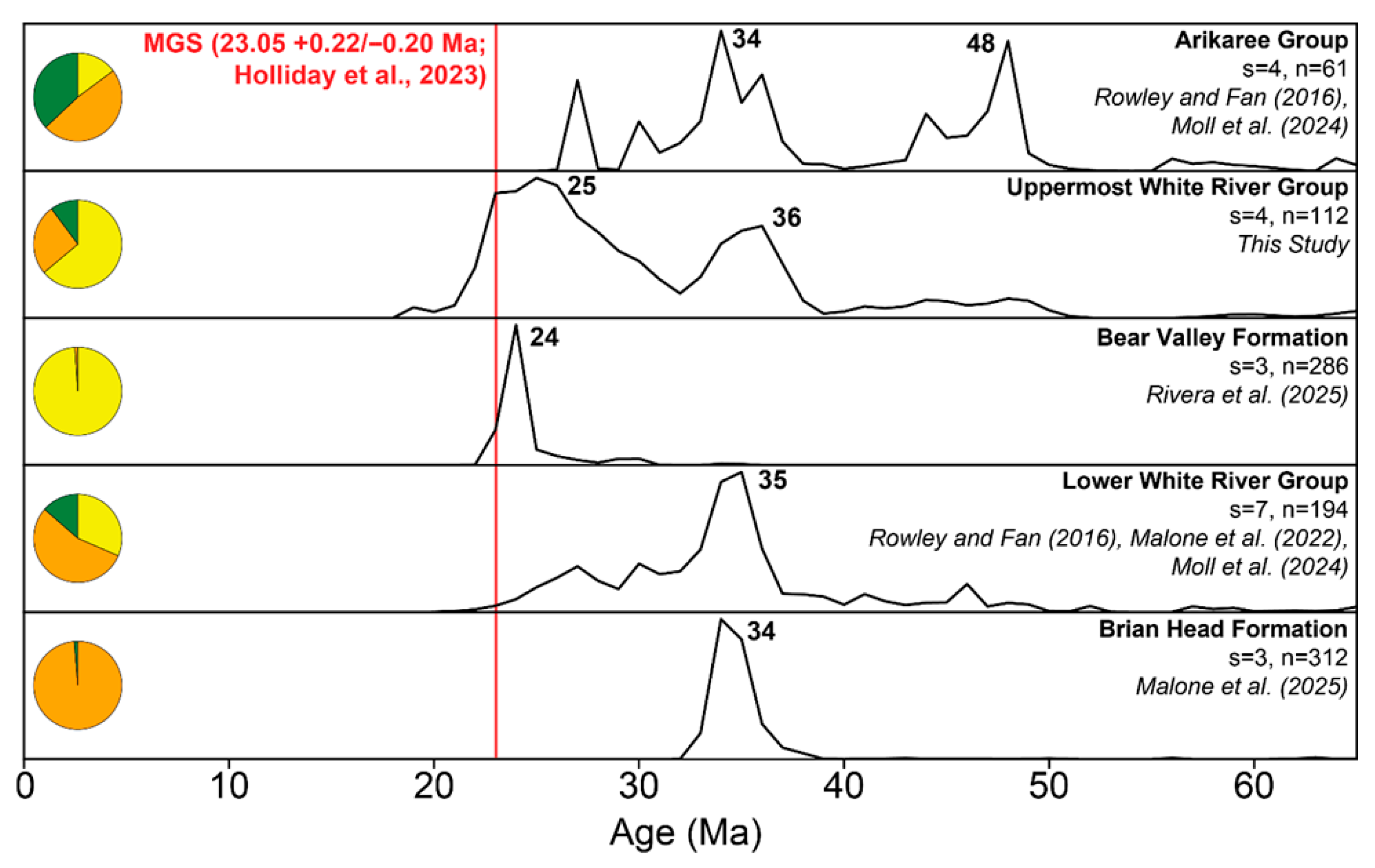
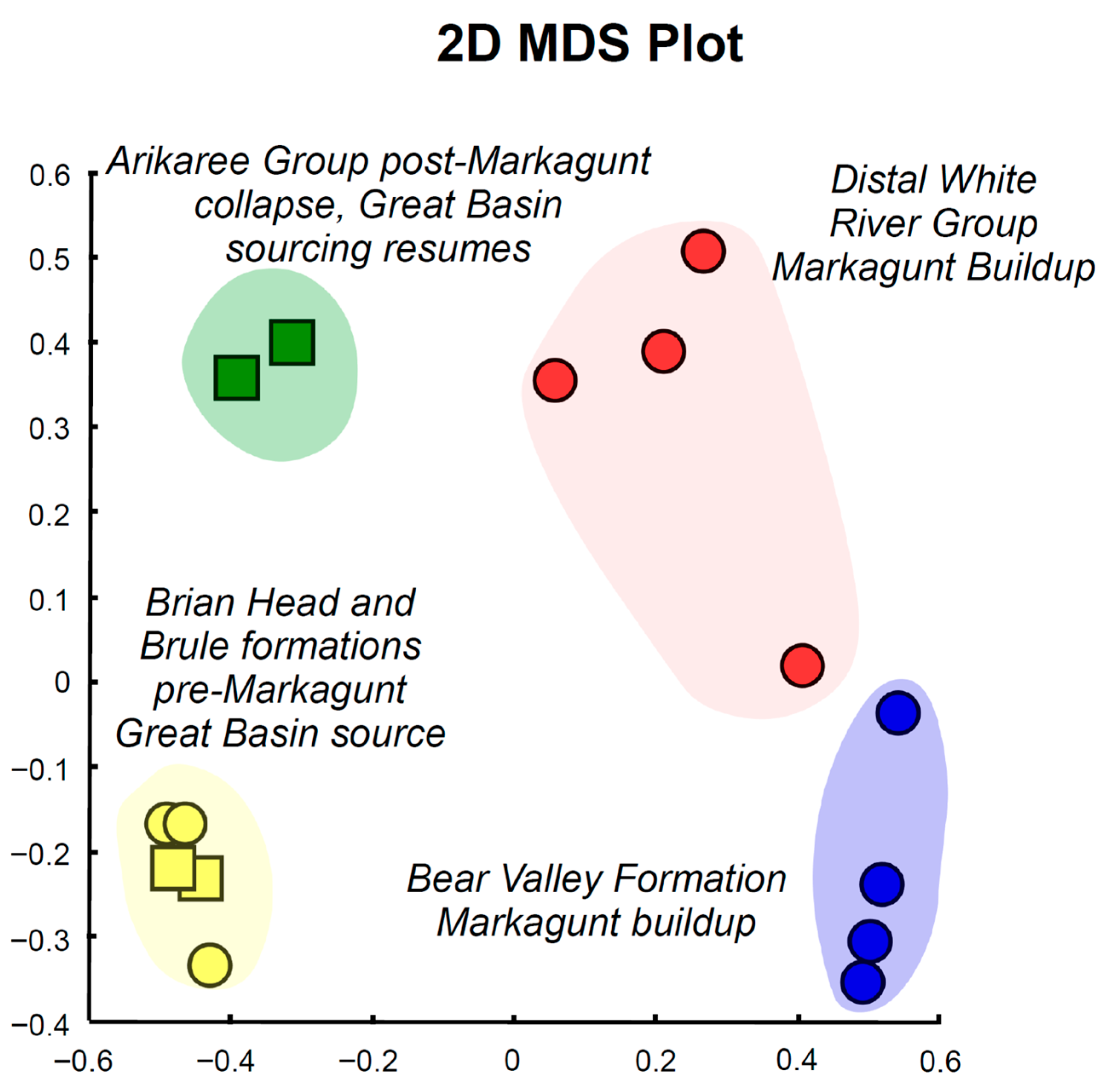
The full detrital zircon age spectra of each of the four samples are shown on kernel density estimate and probability density plots constructed using DetritalPy, a Python (3.14)-based module for visualizing and analyzing geo-thermochronologic data (Figure 4) [43]. To compare volcanic sources to the uppermost White River Group and temporally equivalent strata both distal and proximal to the Marysvale Volcanic Field, we show Cenozoic (65–0 Ma) detrital zircon U-Pb age spectra for the Arikaree Group [10,27], Bear Valley Formation [36], lower-section Brule Member strata [10,12,27], and Brian Head Formation [35] on kernel density estimates built using DetritalPy (Figure 5). Figure 6 is an MDS plot of these Cenozoic zircons constructed in DetritalPy.

3. Results

The MDA of the detrital zircon ages analyzed for the four samples ranges from 22.61 ± 0.64 Ma to 23.75 ± 0.38 Ma, with a youngest single grain age of 21.1 ± 1.8 Ma (Figure 4). The YGC2s MDA, which is 23.07 ± 0.46 Ma, is likely the best representation of the MDA due to the abundance of zircons in this youngest age population, as the method is highly reliable when abundant near-depositional ages are present and is less likely to present an age younger than the true depositional age [41]. Thus, the MDA is tightly but conservatively constrained to 23 Ma, minimizing the impact of outliers or lead loss. Each of the four samples’ detrital age spectra contain a prominent Cenozoic age peak ranging from 23 to 25 Ma (PDP) or 28–30 Ma (KDE), indicating a strong supply of sediment derived from Cenozoic sources. The smoothing of curves generated in kernel density estimation likely incorporated Paleocene and late Cretaceous ages into the youngest age peak calculation, which skews the peak ages to older dates. Older peaks (>Cenozoic) include a Jurassic age peak at ~166–169 Ma, and Precambrian age peaks at ~1.0 Ga, ~1.43 Ga, and 1.68 Ga (Figure 4.). The Cenozoic ages present in each of the four samples reflect sourcing from Great Basin Ignimbrite Flareup Volcanism [10]. The older age peaks are consistent with those found in primary North American sources that would have been exposed in the hinterland and magmatic arc of the Sevier fold-thrust belt [44,45], as well as the central Rocky Mountains [12,27]. Other proximal sources include the reworking of Jurassic eolianites and Jurassic–Cretaceous synorogenic sedimentary strata deposited in the Sevier foreland basin and incorporated in the fold-thrust belt, as many of these units display indistinguishable pre-Mesozoic detrital age spectra [46,47,48,49,50,51,52]. There is a notable lack of Archean zircons, despite several nearby Archean-aged, basement-cored Laramide uplifts.

4. Discussion

The provenance of the Cenozoic zircons fits well within the framework established in [10] of a southwestward stepping provenance shift through time, correlative with the southward progression of volcanism during the Cenozoic Ignimbrite Flareup [23,24]. A lack of Archean zircons indicates that there was little to no primary sourcing of sediment from Archean-cored Laramide uplifts that would otherwise be significant contributors of sediment. This is a result of the burial of the north–central Laramide province, which saw increased exhumation during the Miocene, as the paleo-Mississippi and paleo-Missouri river drainages began incising into the western interior of North America and forming their modern configurations. These river systems exhumed the mid-Paleogene basin fill [52,53,54,55,56,57], ultimately forming the spectacular topography evident today.
Based on the maximum depositional age of the uppermost White River Group, deposition of White River Group strata ceased after ~23.07 ± 0.46 Ma, making it as much as seven million years younger than previously thought [28] and references therein, and spanning the entire Oligocene. The unconformities identified in Wyoming, South Dakota, and Nebraska (Figure 2) include a much shorter hiatus [32]. Holliday et al. [8] tightly constrains the emplacement of the Markagunt Gravity Slide (MGS) at 23.05 + 0.22/− 0.20 Ma. The MDA of the White River Group and the emplacement of the MGS overlap and are within error, suggesting a unique cause–effect relationship of slide emplacement drastically reorganizing source areas and east-flowing drainage systems.
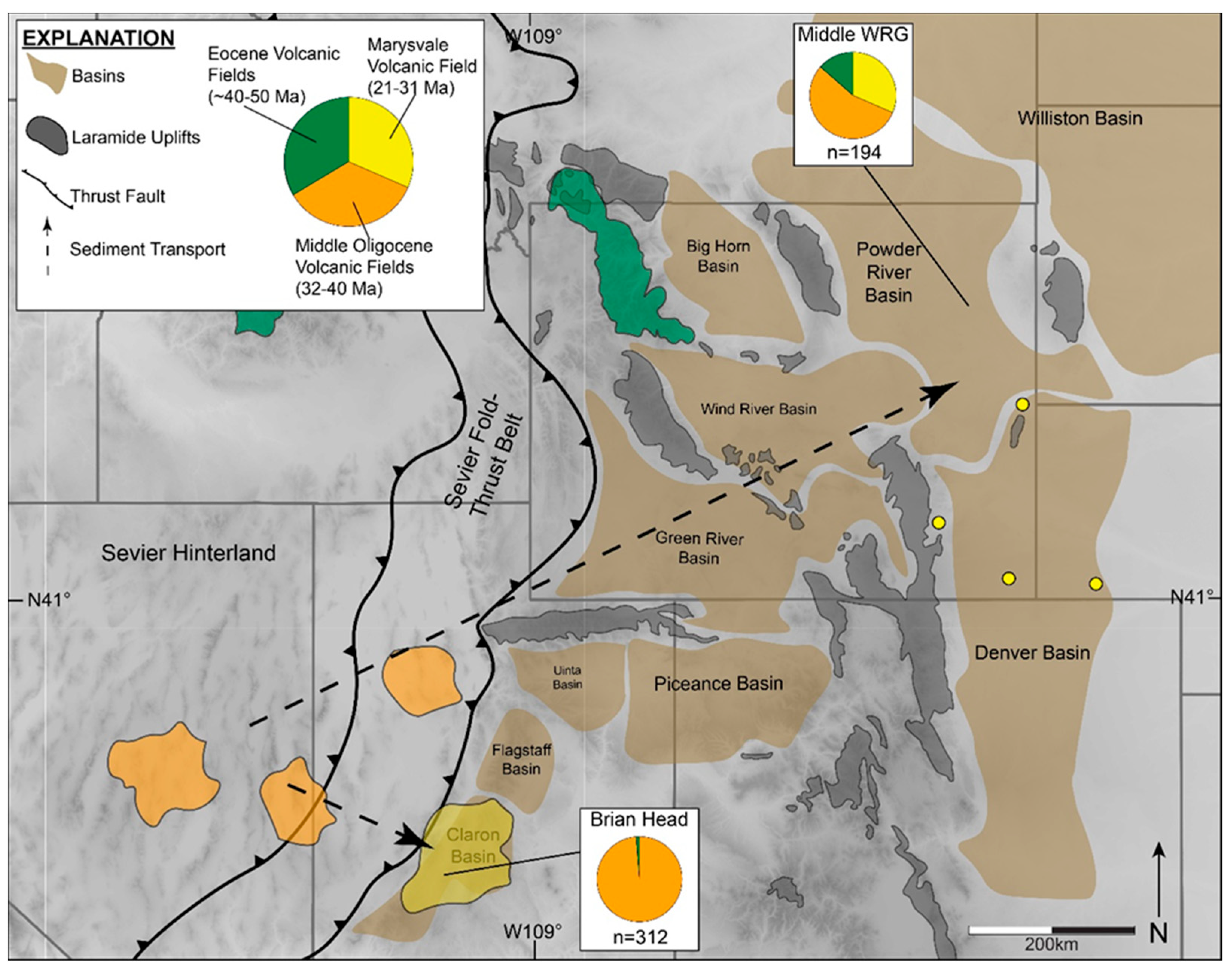
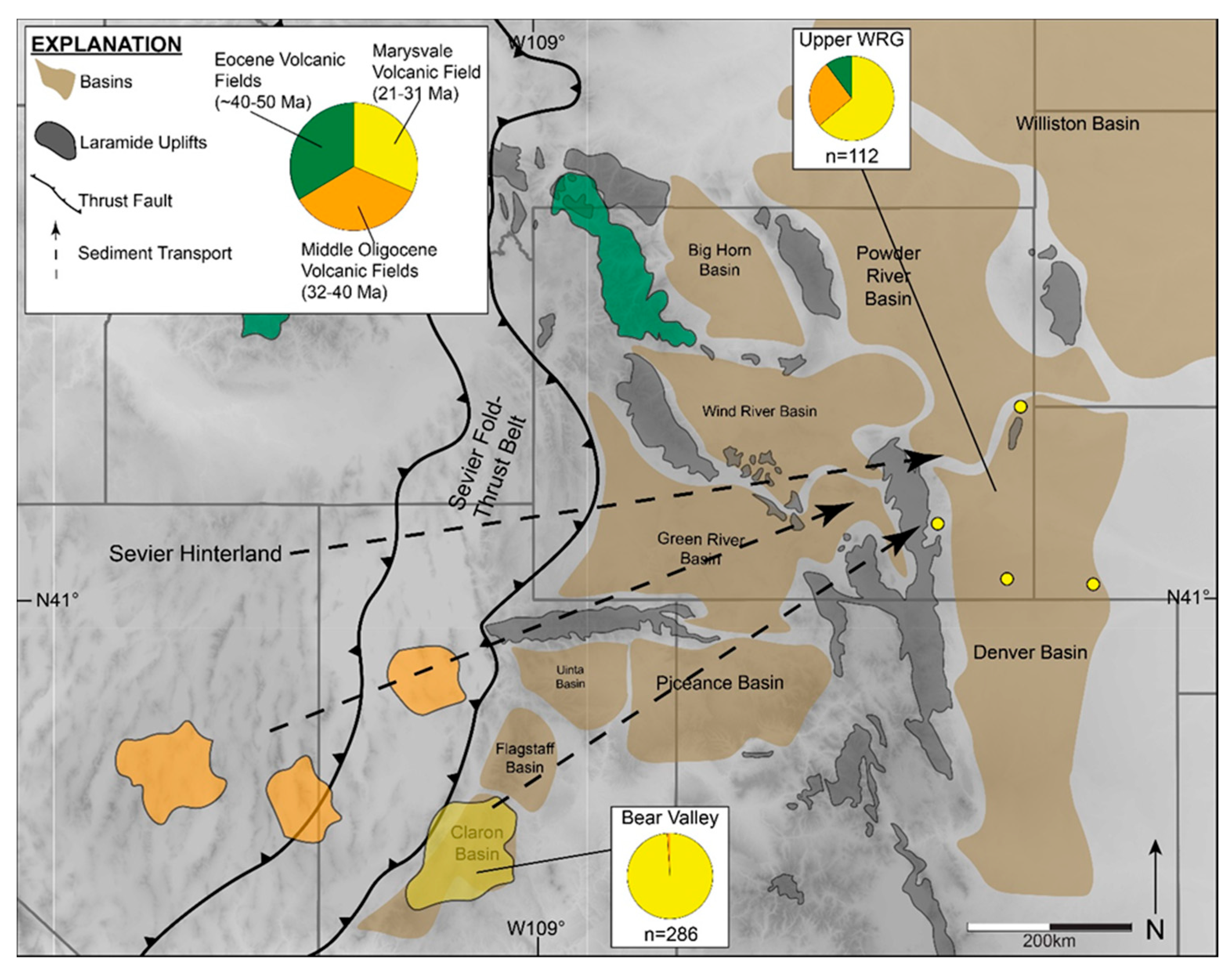
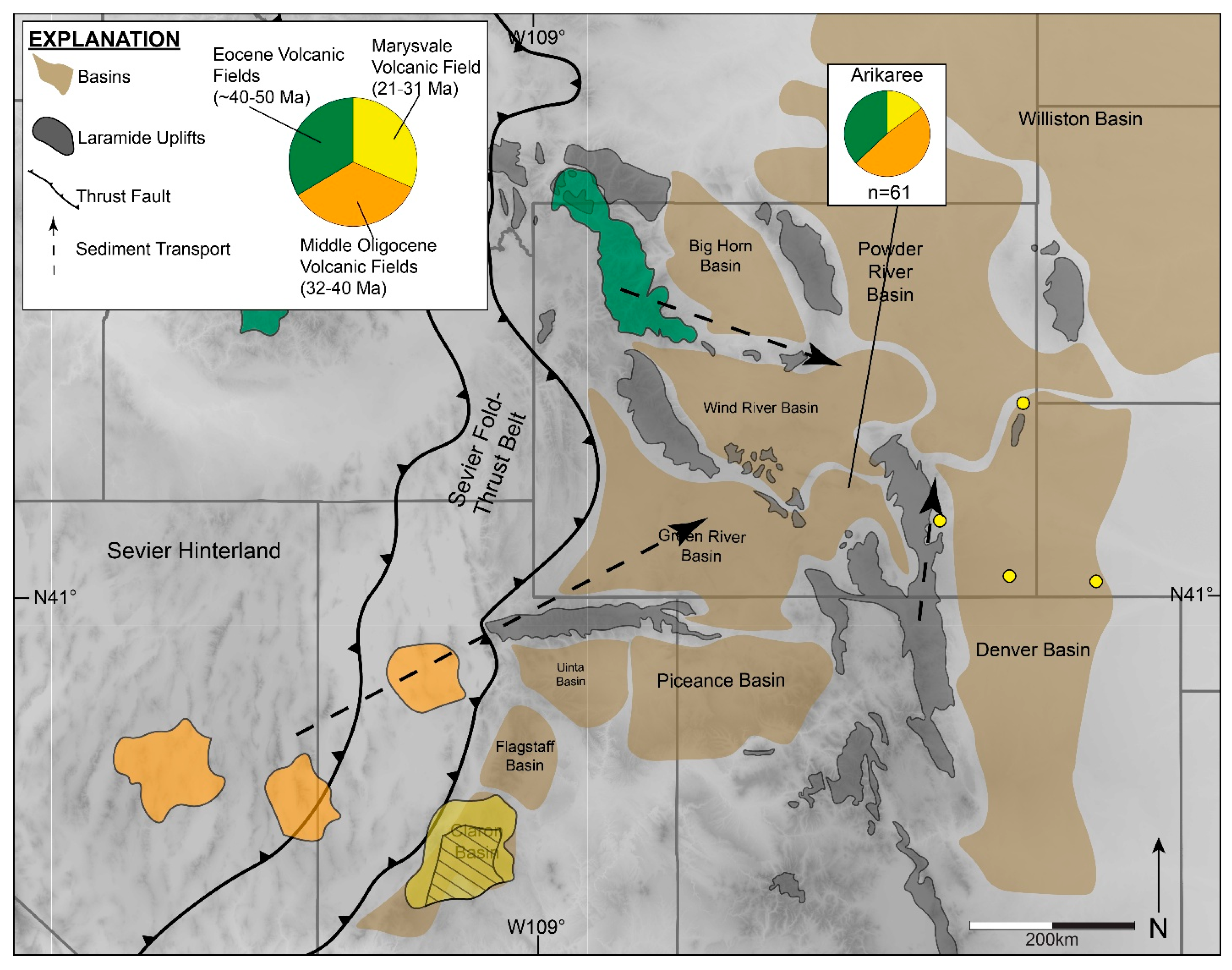
During early to middle Oligocene, strata both distal and proximal to the study area (Figure 5) show that sediment sourcing is dominated by Eocene to early Oligocene volcanism, as indicated by a strong ~35 Ma age peak and detrital zircon ages ranging from ~40 to 30 Ma (Figure 7). There is a visible up-section growth in Marysvale sediment contribution, exemplified by a ~24–25 Ma age peak, coeval with the increase in volcanism and rising topography in the Marysvale Volcanic Field (Figure 6 and Figure 8) [37]. The Marysvale peak is absent in the Arikaree Group, indicating a westward shift back to older source areas [10], including the Absaroka Volcanic Field and Great Basin volcanic fields (Figure 9).
The temporal relationship between the maximum depositional age of the White River Group and the emplacement age of the Markagunt Gravity Slide indicates that the catastrophic collapse of the Marysvale Volcanic Field highlands caused a shift in sediment sourcing from the Nevadaplano highlands to the White River Group depositional basin. The growth in sediment supply to the White River Group from Marysvale up until MGS emplacement is consistent with volcanic growth and doming of the field, which resulted in gravitational failure and initiation of the Markagunt Gravity Slide. The emplacement of the Markagunt Gravity Slide would have had a drastic and immediate effect on local topographic relief and paleodrainage. Post-Markagunt Gravity Slide volcanism is not evident in the provenance of distal sediments, as exemplified in the Arikaree Group (Figure 5 and Figure 8). This new data shows that the catastrophic collapse of the volcanic field and topographic rearrangement influenced distal sediment transport and deposition, cutting off sediment supply and resulting in the cessation of White River Group sedimentation.

5. Conclusions

Through the maximum depositional age and provenance of the uppermost White River Group, we assess how regional drainage systems may be affected by catastrophic collapse and landscape change on geologically short timescales. The temporal overlap of the maximum depositional age of the White River Group and the emplacement of the Marysvale Gravity Slide suggests that the collapse of the Marysvale Volcanic Field rearranged drainage networks, cutting off sediment supply to depositional basins hundreds of kilometers away. Our data also shows the White River Group as being as much as seven million years younger than previously thought, with sedimentation continuing at least through the latest Oligocene.

Supplementary Materials

The following supporting information can be downloaded at: https://www.mdpi.com/article/10.3390/geosciences16050174/s1. Table S1: Detrital zircon geochronology data file.

Author Contributions

Conceptualization, D.M. and J.M.; Methodology, D.M.; Formal Analysis, All authors; Data Curation, J.M.; Writing, J.M. and D.M.; Writing—Review and Editing, All Authors; Supervision, D.M., T.R., R.B., A.G., D.H. and M.B.; Project Administration, A.G., T.R., D.H. and D.M. All authors have read and agreed to the published version of the manuscript.

Funding

Funding for this research was provided by the National Science Foundation grants EAR2113158 and EAR2412838, and the Illinois State University Foundation. EAR2050246 supported the Arizona Laserchron Center operations. Megan Grobe assisted with initial analysis and conference presentation. Reviews by two anonymous reviewers improved this manuscript.

Data Availability Statement

Data for this project will be available to freely download from the authors’ ResearchGate accounts.

Conflicts of Interest

The authors declare no conflicts of interest.

References

  1. Goren, L.; Aharonov, E.; Anders, M.H. The long runout of the Heart Mountain landslide: Heating, pressurization, and carbonate decomposition. J. Geophys. Res. Solid Earth 2010, 115. [Google Scholar] [CrossRef]
  2. Malone, D.H.; Craddock, J.P.; Schmitz, M.D.; Kenderes, S.; Kraushaar, B.; Murphy, C.J.; Nielson, S.; Mitchell, T.M. Volcanic initiation of the Eocene Heart Mountain slide, Wyoming, USA. J. Geol. 2017, 125, 439–457. [Google Scholar] [CrossRef]
  3. Hacker, D.B.; Biek, R.F.; Rowley, P.D. Catastrophic emplacement of the gigantic Markagunt gravity slide, southwest Utah (USA): Implications for hazards associated with sector collapse of volcanic fields. Geology 2014, 42, 943–946. [Google Scholar] [CrossRef]
  4. Biek, R.F.; Rowley, P.D.; Hacker, D.B. The Gigantic Markagunt and Sevier Gravity Slides Resulting from Mid-Cenozoic Catastrophic Mega-Scale Failure of the Marysvale Volcanic Field, Utah, USA; Geological Society of America: Boulder, CO, USA, 2019; Volume 56, pp. 1–108. [Google Scholar] [CrossRef]
  5. Lundin, E.R. Thrusting of the Claron formation, the Bryce canyon region, Utah. Geol. Soc. Am. Bull. 1989, 101, 1038–1050. [Google Scholar] [CrossRef]
  6. Anders, M.H.; Fouke, B.W.; Zerkle, A.L.; Tavarnelli, E.; Alvarez, W.; Harlow, G.E. The role of calcining and basal fluidization in the long runout of carbonate slides: An example from the Heart Mountain Slide Block, Wyoming and Montana, U.S.A. J. Geol. 2010, 118, 577–712. [Google Scholar] [CrossRef]
  7. Braunagel, M.; Malone, D.; Hacker, D.; Biek, R.; Rivera, T.; Loffer, Z.; Holliday, M.; Griffith, W.A. Zircon geochronology records frictional weakening and restrengthening during emplacement of the Sevier gravity slide, southwest Utah (USA). Geology 2025, 53, 415–419. [Google Scholar] [CrossRef]
  8. Holliday, M.E.; Rivera, T.; Jicha, B.; Trayler, R.B.; Biek, R.F.; Braunagel, M.J.; Griffith, W.A.; Hacker, D.B.; Malone, D.H.; Mayback, D.F. Emplacement age of the Markagunt gravity slide in southwestern Utah, USA. Terra Nova 2023, 35, 66–72. [Google Scholar] [CrossRef]
  9. Rivera, T.; Holliday, M.; Jicha, B.; Malone, D.H.; Braunagel, M.J.; Bonilla Franco, V.A.; Biek, R.F.; Griffith, W.A.; Hacker, D.B. Emplacement age of the Sevier gravity slide, Utah, USA. Geochronology 2025, 7, 35–44. [Google Scholar] [CrossRef]
  10. Moll, J.R.; Maher, H.; Malone, J.R.; Malone, D.H.; Craddock, J.P. Provenance of Paleogene Strata at Slim Buttes, South Dakota: Implications for post-Laramide Evolution of Western Laurentia. Sediment. Rec. 2024, 22, 1–11. [Google Scholar] [CrossRef]
  11. DeCelles, P.G. Late Jurassic to Eocene evolution of the Cordilleran thrust belt and foreland basin system, western U.S.A. Am. J. Sci. 2004, 304, 105–168. [Google Scholar] [CrossRef]
  12. Malone, J.R.; Craddock, J.P.; Malone, D.H. Sediment provenance and stratigraphic correlations of the Paleogene White River Group in the Bighorn Mountains, Wyoming. Mt. Geol. 2022, 59, 273–293. [Google Scholar] [CrossRef]
  13. Dickinson, W.R.; Klute, M.A.; Hayes, M.J.; Janecke, S.U.; Lundin, E.R.; Mckittrick, M.A.; Olivares, M.D. Paleogeographic and paleotectonic setting of Laramide sedimentary basins in the central Rocky Mountain region. Geol. Soc. Am. Bull. 2004, 100, 1023–1039. [Google Scholar] [CrossRef]
  14. Dickinson, W.R.; Snyder, W.S. Plate tectonics of the Laramide orogeny. In Laramide Folding Associated with Basement Block Faulting in the Western United States; Geological Society of America: Boulder, CO, USA, 1978; Volume 151, pp. 355–366. [Google Scholar]
  15. Carrapa, B.; DeCelles, P.G.; Romero, M. Early Inception of the Laramide Orogeny in Southwestern Montana and Northern Wyoming: Implications for Models of Flat-Slab Subduction. J. Geophys. Res. Solid Earth 2019, 124, 2102–2123. [Google Scholar] [CrossRef]
  16. Erslev, E.A.; Worthington, L.L.; Anderson, M.L.; Miller, K.C. Laramide crustal detachment in the Rockies: Cordilleran shortening of fluid-weakened foreland crust. Rocky Mt. Geol. 2022, 57, 65–97. [Google Scholar] [CrossRef]
  17. Parker, S.D.; Pearson, D.M. A kinematic model linking the Sevier and Laramide belts in the Idaho-Montana fold-thrust belt, U.S. Cordillera. Geosphere 2023, 19, 1565–1588. [Google Scholar] [CrossRef]
  18. Best, M.G.; Barr, D.L.; Christiansen, E.H.; Gromme, S.; Deino, A.L.; Tingey, D.G. The Great Basin Altiplano during the middle Cenozoic ignimbrite flareup: Insights from volcanic rocks. Int. Geol. Rev. 2009, 51, 589–633. [Google Scholar] [CrossRef]
  19. Cassel, E.J.; Graham, S.A.; Chamberlain, C.P.; Henry, C.D. Early Cenozoic topography, morphology, and tectonics of the northern Sierra Nevada and western Basin and Range. Geosphere 2012, 8, 229–249. [Google Scholar] [CrossRef]
  20. Henry, C.D.; Hinz, N.H.; Faulds, J.E.; Colgan, J.P.; John, D.A.; Brooks, E.R.; Cassel, E.J.; Garside, L.J.; Davis, D.A.; Castor, S.B. Eocene-Early Miocene paleotopography of the Sierra Nevada-Great Basin-Nevadaplano based on widespread ash-flow tuffs and paleovalleys. Geosphere 2012, 8, 1–27. [Google Scholar] [CrossRef]
  21. Constenius, K.N. Late Paleogene extensional collapse of the Cordilleran foreland fold and thrust belt. Geol. Soc. Am. Bull. 1996, 108, 20–39. [Google Scholar] [CrossRef]
  22. Konstantinou, A. The “death” of the Sevier-Laramide orogen: Gravitational collapse of the crust or something else? In Tectonic Evolution of the Sevier-Laramide Hinterland, Thrust Belt, and Foreland, and Postorogenic Slab Rollback (180–20 Ma); Geological Society of America: Boulder, CO, USA, 2022; Volume 555, pp. 379–412. [Google Scholar] [CrossRef]
  23. Best, M.G.; Christiansen, E.H.; De Silva, S.; Lipman, P.W. Slab-rollback ignimbrite flareups in the southern Great Basin and other Cenozoic American arcs: A distinct style of arc volcanism. Geosphere 2016, 12, 1097–1135. [Google Scholar] [CrossRef]
  24. Lundstern, J.-E.; Miller, E.L. Magmatism, migrating topography, and the transition from Sevier shortening to Basin and Range extension, western United States. In Tectonic Evolution of the Sevier-Laramide Hinterland, Thrust Belt, and Foreland, and Postorogenic Slab Rollback (180–20 Ma); Geological Society of America: Boulder, CO, USA, 2022; Volume 555, pp. 335–357. [Google Scholar] [CrossRef]
  25. Moll, J.R.; Helgerson, R.T.; Malone, D.H.; Craddock, J.P. Provenance Analysis of the Oligocene Mountain Meadow Formation, Black Hills South Dakota, USA. Mt. Geol. 2025, 62, 127–142. [Google Scholar] [CrossRef]
  26. Moll, J.R.; Trzinski, A.; Saul, C.; Malone, D.H. Provenance of Post-Laramide Paleogene Strata (White River Group) at Pumpkin Buttes, Powder River Basin, Wyoming. Mt. Geol. 2024, 62, 113–126. [Google Scholar] [CrossRef]
  27. Rowley, J.; Fan, M. Middle Cenozoic diachronous shift to eolian deposition in the central Rocky Mountains: Timing, provenance, and significance for paleoclimate, tectonics, and paleogeography. Geosphere 2016, 12, 1795–1812. [Google Scholar] [CrossRef]
  28. Caylor, E.; Carrapa, B.; Jepson, G.; Sherpa, T.Z.L.; DeCelles, P.G. The Rise and Fall of Laramide Topography and the Sediment Evacuation from Wyoming. Geophys. Res. Lett. 2023, 50, e2023GL103218. [Google Scholar] [CrossRef]
  29. Ronemus, C.B.; Orme, D.A.; Guenthner, W.R.; Cox, S.E.; Kussmaul, C.A.L. Orogens of Big Sky Country: Reconstructing the Deep-Time Tectonothermal History of the Beartooth Mountains Montana Wyoming, U.S.A. Tectonics 2023, 42, e2022TC007541. [Google Scholar] [CrossRef]
  30. Mckenna, M.C.; Love, J.D. High-Level Strata Containing Early Miocene Mammals on the Bighorn Mountains, Wyoming. In American Museum Novitates, No. 2490; American Museum of Natural History: New York, NY, USA, 1972. [Google Scholar]
  31. Lillegraven, J.A. Stratigraphy, structure, and vertebrate fossils of the Oligocene Brule Formation, Slim Buttes, northwestern South Dakota. Geol. Soc. Am. Bull. 1970, 81, 831–850. [Google Scholar]
  32. Singler, C.R.; Picard, M.D. Petrography of White River Group (Oligocene) in Northwest Nebraska and adjacent Wyoming. Rocky Mt. Geol. 1979, 18, 51–67. [Google Scholar]
  33. Terry, D.O. Lithostratigraphic revision and correlation of the lower part of the White River Group: South Dakota to Nebraska. In Depositional Environments, Lithostratigraphy, and Biostratigraphy of the White River and Arikaree Groups (Late Eocene to Early Miocene, North America); Geological Society of America: Boulder, CO, USA, 1998; Volume 325, pp. 15–38. [Google Scholar] [CrossRef]
  34. Larson, E.J.; Evanoff, E. Tephrostratigraphy and source of the tuffs of the White River sequence. In Depositional Environments, Lithostratigraphy, and Biostratigraphy of the White River and Arikaree Groups (Late Eocene to Early Miocene, North America); Geological Society of America: Boulder, CO, USA, 1998; Volume 325, pp. 1–14. [Google Scholar] [CrossRef]
  35. Malone, D.; Stevens, G.; Lesmann, S.; Rivera, T.; Biek, R.; Braunagel, M.; Griffith, W.A.; Hacker, D.; Rowley, P. Claron basin provenance shift from Sevier-Laramide compression to Basin and Range extension: Detrital zircon geochronology from the Eocene-Oligocene 35 Head Formation, Utah. Geol. Intermt. West 2025, 12, 155–168. [Google Scholar] [CrossRef]
  36. Rivera, T.; Malone, D.H.; Biek, R.F.; Lesmann, S.R.; Stevens, G.; Hacker, D.; Braunagel, M.J.; Griffith, W.A.; Rowley, P.D. The Growth and Collapse of a Volcanic Field: Detrital Zircon U/Pb Geochronology and Provenance of the Oligocene Bear Valley Formation, Southwest Utah, USA. Sediment. Rec. 2025, 23, 1–7. [Google Scholar] [CrossRef]
  37. Gehrels, G.; Pecha, M. Detrital zircon U-Pb geochronology and Hf isotope geochemistry of Paleozoic and Triassic passive margin strata of western North America. Geosphere 2014, 10, 49–65. [Google Scholar] [CrossRef]
  38. Gehrels, G.E.; Valencia, V.A.; Ruiz, J. Enhanced precision, accuracy, efficiency, and spatial resolution of U-Pb ages by laser ablation–multicollector–inductively coupled plasma–mass spectrometry. Geochem. Geophys. Geosyst. 2008, 9. [Google Scholar] [CrossRef]
  39. Sundell, K.E.; Gehrels, G.E.; Pecha, M.E. Rapid U-Pb Geochronology by Laser Ablation Multi-Collector ICP-MS. Geostand. Geoanal. Res. 2021, 5, 37–57. [Google Scholar] [CrossRef]
  40. Clark, B.; Prall, J.; Hannebaum, Z.J.; Orme, D.A.; Panascí, G.; Varricchio, D.J. The earliest dated Basilemys (Testudines, Nanhsiungchelyidae) in North America informs polar dispersal during middle Cretaceous Hothouse conditions. Hist. Biol. 2025, 37, 1–8. [Google Scholar] [CrossRef]
  41. Coutts, D.S.; Matthews, W.A.; Hubbard, S.M. Assessment of widely used methods to derive depositional ages from detrital zircon populations. Geosci. Front. 2019, 10, 1421–1435. [Google Scholar] [CrossRef]
  42. Sundell, K.E.; Gehrels, G.E.; Blum, M.D.; Saylor, J.E.; Pecha, M.E.; Hundley, B.P. An exploratory study of “large-n” detrital zircon geochronology of the Book Cliffs, UT via rapid (3 s/analysis) U–Pb dating. Basin Res. 2024, 36, e12840. [Google Scholar] [CrossRef]
  43. Sharman, G.R.; Sharman, J.P.; Sylvester, Z. detritalPy: A Python-based toolset for visualizing and analysing detrital geo-thermochronologic data. Depos. Rec. 2018, 4, 202–215. [Google Scholar] [CrossRef]
  44. Malone, D.; Craddock, J.; Paul, L.; Foreman, B.; Scroggins, M.; Rappe, J. Detrital zircon geochronology of quartzite clasts, northwest Wyoming: Implications for Cordilleran Neoproterozoic stratigraphy and depositional patterns. Precambr. Res. 2017, 289, 116–128. [Google Scholar] [CrossRef]
  45. Malone, D.H.; Craddock, J.P.; Konstantinou, A. Timing and structural evolution of the Sevier thrust belt, western Wyoming. In Tectonic Evolution of the Sevier-Laramide Hinterland, Thrust Belt, and Foreland, and Postorogenic Slab Rollback (180–20 Ma); Geological Society of America: Boulder, CO, USA, 2022; Volume 555, pp. 99–132. [Google Scholar] [CrossRef]
  46. May, S.R.; Gray, G.G.; Summa, L.L.; Stewart, N.R.; Gehrels, G.E.; Pecha, M.E. Detrital zircon geochronology from the Bighorn Basin, Wyoming, USA: Implications for tectonostratigraphic evolution and paleogeography. Geol. Soc. Am. Bull. 2013, 125, 1403–1422. [Google Scholar] [CrossRef]
  47. Laskowski, A.K.; DeCelles, P.G.; Gehrels, G.E. Detrital zircon geochronology of Cordilleran retroarc foreland basin strata, western North America. Tectonics 2013, 32, 1027–1048. [Google Scholar] [CrossRef]
  48. Ronemus, C.B.; Orme, D.A.; Campbell, S.; Black, S.R.; Cook, J. Mesoproterozoic–Early Cretaceous provenance and paleogeographic evolution of the Northern Rocky Mountains: Insights from the detrital zircon record of the Bridger Range, Montana USA. Geol. Soc. Am. Bull. 2021, 133, 777–801. [Google Scholar] [CrossRef]
  49. Schwartz, T.M.; Schwartz, R.K.; Weislogel, A.L. Orogenic Recycling of Detrital Zircons Characterizes Age Distributions of North American Cordilleran Strata. Tectonics 2019, 38, 4320–4334. [Google Scholar] [CrossRef]
  50. Schwartz, T.M.; Surpless, K.D.; Colgan, J.P.; Johnstone, S.A.; Holm-Denoma, C.S. Detrital zircon record of magmatism and sediment dispersal across the North American Cordilleran arc system (28–48° N). Earth-Sci. Rev. 2021, 220, 103734. [Google Scholar] [CrossRef]
  51. Blum, M.D.; Milliken, K.T.; Pecha, M.A.; Snedden, J.W.; Frederick, B.C.; Galloway, W.E. Detrital-zircon records of Cenomanian, Paleocene, and Oligocene Gulf of Mexico drainage integration and sediment routing: Implications for scales of basin-floor fans. Geosphere 2017, 13, 2205. [Google Scholar] [CrossRef]
  52. Kainz, S.J.; Abbott, L.D.; Flowers, R.M.; Olsson, A.; Fernandez, S.; Metcalf, J.R. Cenozoic Exhumation Across the High Plains of Southeastern Colorado from (U-Th)/He Thermochronology. Lithosphere 2023, 2023, 1–26. [Google Scholar] [CrossRef]
  53. Abbey, A.L.; Niemi, N.A.; Geissman, J.W.; Winkelstern, I.Z.; Heizler, M. Early Cenozoic exhumation and paleotopography in the Arkansas River valley, southern Rocky Mountains, Colorado. Lithosphere 2018, 10, 239–266. [Google Scholar] [CrossRef]
  54. Schwartz, T.M.; Methner, K.; Mulch, A.; Graham, S.A.; Chamberlain, C.P. Paleogene topographic and climatic evolution of the Northern Rocky Mountains from integrated sedimentary and isotopic data. Geol. Soc. Am. Bull. 2019, 131, 1203–1223. [Google Scholar] [CrossRef]
  55. Zaprowski, B.J.; Evenson, E.B.; Pazzaglia, F.J.; Epstein, J.B. Knickzone propagation in the Black Hills and northern High Plains: A different perspective on the late Cenozoic exhumation of the Laramide Rocky Mountains. Geology 2001, 29, 547–550. [Google Scholar] [CrossRef]
  56. Crowley, P.D.; Reiners, P.W.; Reuter, J.M.; Kaye, G.D. Laramide exhumation of the Bighorn Mountains, Wyoming: An apatite (U-Th)/He thermochronology study. Geology 2002, 30, 27–30. [Google Scholar] [CrossRef]
  57. Fan, M.; Carrapa, B. Late Cretaceous–early Eocene Laramide uplift, exhumation, and basin subsidence in Wyoming: Crustal responses to flat slab subduction. Tectonics 2014, 33, 509–529. [Google Scholar] [CrossRef]
Figure 1. Regional tectonic map illustrating Laramide basins, basement-cored uplifts and Sevier hinterland and fold-thrust belt domains. Sample locations analyzed herein and compiled from the literature are marked by dots.
Geosciences 16 00174 g001
Figure 2. Regional stratigraphic correlation chart and regional volcanism of late Eocene to early Miocene sediments in the Laramide province and Colorado Plateau. Sample dots are colored as in Figure 1. Laramide province stratigraphy and regional volcanism modified from [10,12]. Utah stratigraphy is after [35,36]. Dots are sample localities placed at geographic (upper) stratigraphic (lower) across the region. Colors reflect the various published data. Our new samples are indicated in dark blue.
Geosciences 16 00174 g002
Figure 3. (AC) Photos of the uppermost White River Group in outcrop: (A) a butte capped by White River Group strata, off US Highway 85 in eastern Wyoming; (B) eolian trough cross-bedding in the White River Group near Pine Bluffs, Wyoming; (C) near horizontally bedded White River Group sandstones near Sidney, Nebraska. (D,E) Thin section photos (at 10× zoom) from White River Group sandstones sampled from (D) Pine Bluffs, WY (XPL), and (E) Wheatland, WY (PPL). Images of the zircons analyzed in this study are available in the Supplementary Data.
Geosciences 16 00174 g003
Figure 4. (A) Maximum depositional age calculations for the combined detrital zircon data of the four samples. MDA methods from bottom to top: youngest single grain (YSG), youngest graphical peak (YPP), youngest gaussian fit (YGF), youngest grain cluster (indicated by the squares) with overlapping 1- and sigma error estimates (YGC2s), youngest cluster of three grains with overlapping error estimates (Y2Zo), youngest three zircons (Y3Za), Tau (TAU), and youngest statistical population (YSP). (B) Kernel density estimate (KDE) and probability density plots (PDPs) for each of the four samples’ full detrital age spectra. KDE line and age peaks in black, PDP in red. Histogram bin size 10 Ma, in gray. Number of zircons analyzed per sample (n) is listed below the sample name. The detrital zircon data is available in the Supplementary Data.
Geosciences 16 00174 g004
Figure 5. Stacked and stratigraphically arranged kernel density estimates and source contribution pie charts for Cenozoic age populations in the Brian Head Formation [35], Lower Brule Member of the White River Group [12,25], Bear Valley Formation [36], Uppermost White River Group (this study) and Arikaree Group [12,27]. Source contribution pies are colored as follows—yellow: 21–31 Ma, orange: 32–40 Ma, and green: 41–50 Ma. Red line designates Markagunt Gravity Slide emplacement as in [8]. The number of samples (s) and detrital zircons (n) included are listed on the right side of each KDE.
Geosciences 16 00174 g005
Figure 6. A 2D multidimensional scaling plot of data presented in Figure 5. Red circles are the data presented here; blue circles represent the Bear Valley Formation; green squares are the Arikaree Group; yellow circles and sauares are the Brian Head and Brule formations, respectively.
Geosciences 16 00174 g006
Figure 7. Source terrane characterization and sediment transport of Brian Head and Brule formations that occurred prior to extensive volcanism in the Marysvale Volcanic Field. Tectonic features and sample locations are after Figure 1. Source terranes colorized according to pie chart colorization. Yellow dots are sample locations.
Geosciences 16 00174 g007
Figure 8. Source terrane characterization and sediment transport of Bear Valley Formation and uppermost White River Group (this study). This reconstruction reflects sediment sourcing of the White River Group during Markagunt Gravity Slide buildup prior to collapse.
Geosciences 16 00174 g008
Figure 9. Post-Markagunt Gravity Slide collapse sediment sourcing and transport of Arikaree Group. Approximate Markagunt Gravity Slide areal extent represented by shaded area over the Marysvale Volcanic Field.
Geosciences 16 00174 g009
Disclaimer/Publisher’s Note: The statements, opinions and data contained in all publications are solely those of the individual author(s) and contributor(s) and not of MDPI and/or the editor(s). MDPI and/or the editor(s) disclaim responsibility for any injury to people or property resulting from any ideas, methods, instructions or products referred to in the content.