Article

A Geophysical Survey of the Kentland Crater Formation

by
Katherine E. Broad
1,*,
Benjamin O. Sadler
1,
Peter B. James
1,
Skylar L. Hoover
2,
Nicholas L. Wagner
3 and
Don R. Hood
1
1
Department of Geosciences, College of Arts and Sciences, Baylor University, Waco, TX 76798, USA
2
School of Geosciences, College of Arts and Sciences, University of South Florida, Tampa, FL 33620, USA
3
Department of Earth, Environmental & Planetary Sciences, Brown University, Providence, RI 02912, USA
*
Author to whom correspondence should be addressed.
Geosciences 2026, 16(4), 155; https://doi.org/10.3390/geosciences16040155
Submission received: 2 March 2026 / Revised: 4 April 2026 / Accepted: 4 April 2026 / Published: 9 April 2026
(This article belongs to the Section Geophysics)

Abstract

We conducted a paired gravity and seismic survey at Kentland Crater with the goal of investigating its subsurface density structure. Our results show that the complex crater hosts a ~4.5 mGal Bouguer gravity high corresponding to the central uplift. The southeastern portion of the crater structure exhibits a low-gravity annulus at 3.5–4.5 km radius, with an adjacent high that we define as the rim at ~5.0 km radius, implying a 10 km apparent diameter. Passive seismic data is used to characterize the low-density glacial till layer, which blankets the bedrock throughout the study area. The central gravity anomaly persists after removing the gravitational influence of the till layer. Kentland’s large, positive central gravity anomaly is likely due to the removal of the low-density material beneath the original crater floor by extensive erosion via glacial scouring. We therefore suggest that the impact-induced porosity at Kentland Crater was likely confined to the original near-surface (<900 m), which aligns with recent numerical modeling. Due to the wide range of diameter estimates, we conclude that the current geometry of Kentland Crater remains ill-defined. Compiled datasets are provided here for use in future investigations.

1. Introduction

Impact cratering continues to play an important role in our pursuit of understanding the world around us. As the most common and enduring surface-altering process on planetary surfaces, craters have provided significant insights into the history of our solar system. For example, the Moon hosts the most well-preserved impact record of any planetary body and continues to serve as the foundation for interpreting the bombardment histories of bodies throughout the solar system. Since 2013, NASA’s Gravity Recovery and Interior Laboratory (GRAIL) mission has transformed our understanding of the Moon. Gravity measurements are dependent upon the bulk density of the material beneath it. Therefore, changes in gravity around a planetary body reflect the density distribution within. GRAIL gravity data has provided new insights into the lunar crustal density structure [1,2,3,4,5,6] and the evolution of crustal structure and composition through time [7,8]. The gravity signature of craters has provided insights into the relationship between crater preservation and crustal properties [9] and impacts basin formation [10,11], fundamentally changing our understanding of bombardment rates during the early formation and evolution of our solar system [12]. However, noise in gravity data limits resolution for comparing gravity anomalies of small craters (<10 km diameter for GRAIL data) to their surroundings [5]. Small impacts affect only shallow material and are statistically young. Therefore, these structures can provide insights into modern bombardment history and near-surface crustal properties. Because of the limits to satellite capabilities, ground-based studies are ideal for investigating small craters. This study utilizes geophysical survey methods to characterize the subsurface density structure of small impact craters on Earth.
The bulk density within impact structures is largely a result of the generation and destruction of porosity during crater formation, resulting in intense fracturing and significant changes in bedrock permeability. These processes, generally referred to as impact-induced porosity, have been found to be primarily determined by target properties [13,14,15,16,17]. In addition to its relevance to characterizing planetary crusts, one major reason impact-induced porosity is of interest is for resource exploration. On Earth, some impact structures in sedimentary basins have been found to be particularly effective for the sequestration and retention of resources like oil, natural gas, and precious metals [18,19,20]. For example, when a crater structure is overlain by an impermeable seal, the heavily fractured sections of a crater can facilitate migration and accumulation of hydrocarbons to form a high-volume reservoir (e.g., Red Wing Creek [21,22]). Impact events can also be detrimental to the long-term retainment of hydrocarbons in a reservoir when the introduction of fractures results in unconstrained migration (e.g., Avak impact, Alaska [23]). Similarly, porosity and fracturing within impact craters on the Moon are also of interest for resource exploration. Permanently Shadowed Regions (PSRs) within craters at the lunar poles provide an ideal environment for the sequestration of volatiles, which could be utilized in several ways for future human exploration and habitation on the Moon [24,25]. Recent numerical models suggest that volatile concentration and sublimation within a PSR is highly dependent upon the thermal gradient [26] and its long-term thermal stability [27], both of which are affected by subsurface porosity distribution.
One major determinant of final crater structure is the target material in which an impact occurs. Impact targets can vary in several ways including, but not limited to, bedrock type, age, size, and environment. The dependencies between target properties and impact formation processes are exceedingly difficult to recreate both in the lab and through computer modeling [14,18,28,29,30]. Luckily, Earth hosts a plethora of impact craters in vastly differing settings, providing a wealth of information that cannot currently be studied otherwise. This study focuses on the use of in situ geophysical survey methods that have proven to be an effective way to investigate the subsurface impact structures on all scales. For example, a recent study used gravity, magnetic, and microstructural surveys to provide compelling evidence supporting the impact formation hypothesis regarding the 35–40 km diameter Velingara depression in Senegal [31]. Another study used gravity, magnetic, and petrophysical methods to investigate the 8–10 km diameter Karla impact structure in Russia [32]. For the small-scale, deeply buried ~5 km diameter Red Wing Creek impact structure, ground-breaking three-dimensional seismic interpretation methods were recently used to characterize subsurface faulting [23]. The goal of this study is to expand the current in situ geophysical dataset of terrestrial impact craters to inform future modeling and experimental efforts. Specifically, we add to existing geophysical observations at Kentland Crater [33,34], with a focus on gravity and seismology, using modern instruments and techniques.
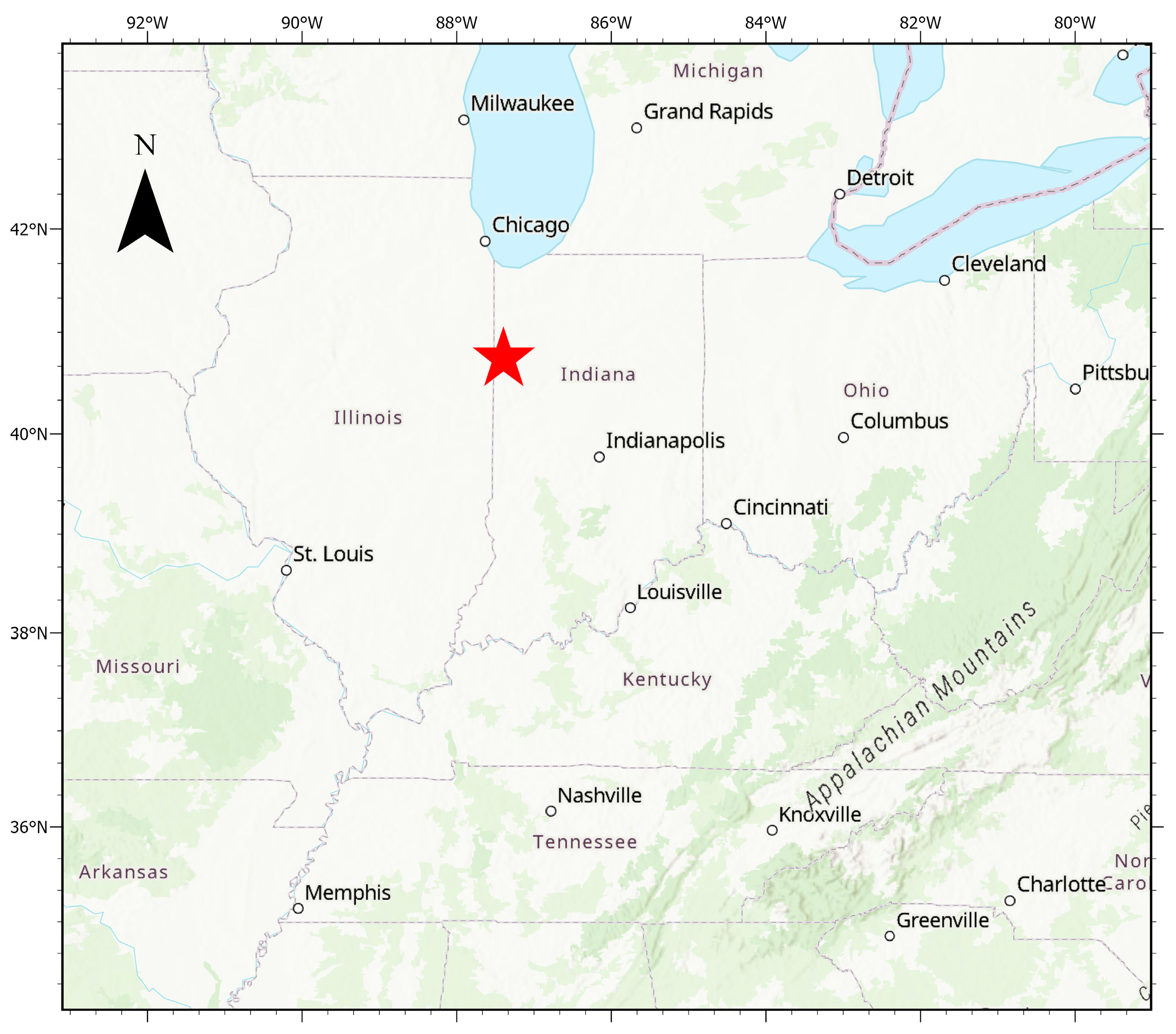
Kentland Crater is a highly eroded complex impact structure located between the towns of Kentland and Goodland in Newton County in northwest Indiana (Figure 1). Due to inconclusive results from dating proxies like fossil presence and alteration [35], rock demagnetization [36], and apatite fission tracks [37], the age of the impact is stratigraphically constrained to be <300 Ma, as its youngest present bedrock layer is Pennsylvanian (Figure 1). The youngest age estimates are loosely cited as “pre-Pleistocene” because of the presence of glacial deposits from Pleistocene-era glacial maxima, during which an estimated 300–900 m of bedrock was eroded away by glacial scouring [33,36,38,39]. During glaciation periods, the dome of uplifted bedrock at the center of Kentland Crater was more resilient than its surroundings [40], resulting in a somewhat prominent limestone outcrop that protrudes at a maximum of ~30 m above the flat-lying veneer of the glacial till characterizing the rest of northern Illinois and Indiana. This outcrop is currently being quarried by Rogers Group Inc. In the area ± 9 km from the crater center, the elevation reduces by only ~50 m in a relatively planar way from the south to the north. Therefore, the current topography at Kentland Crater is not representative of the crater structure itself. Thus, the underlying bedrock holds the only remnant evidence of the impact.
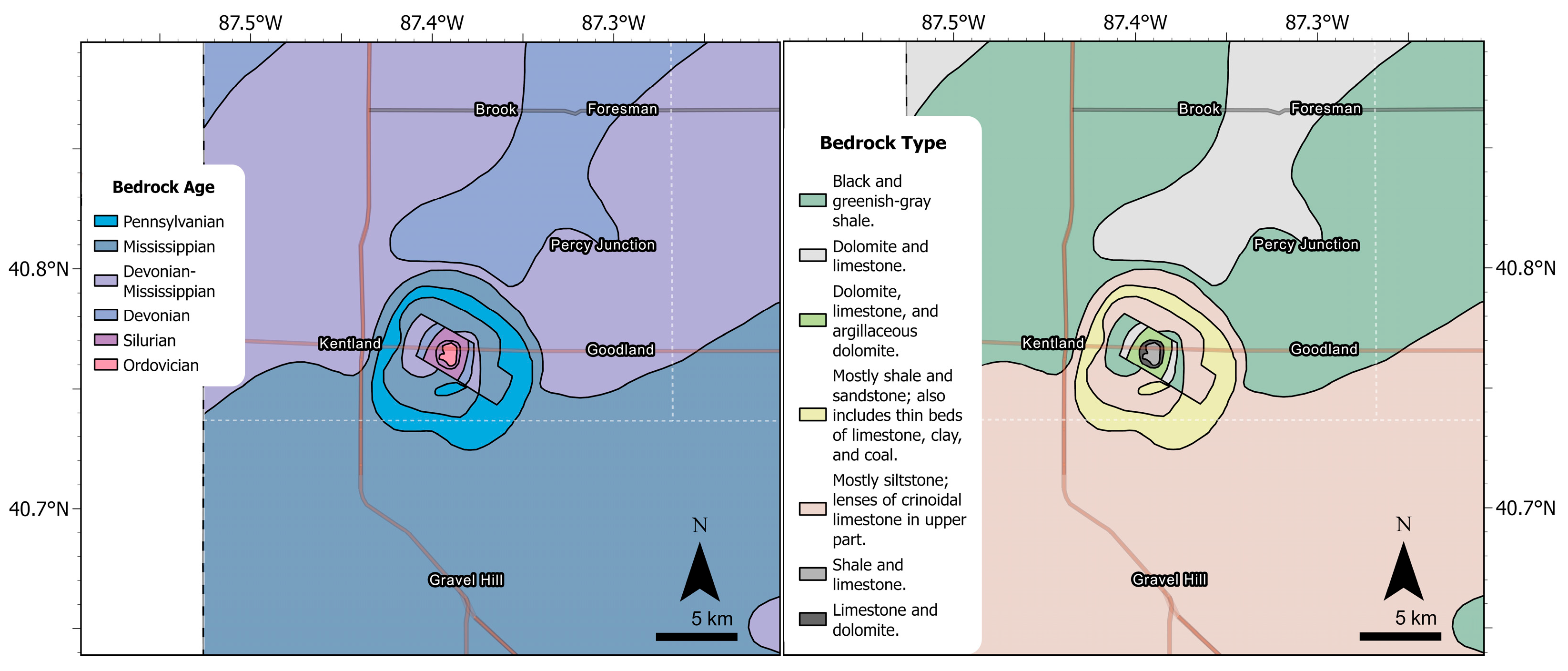
The interior of Kentland Crater hosts mostly concentric bedrock units due to glacial scouring at the conically layered central uplift (Figure 2). Bedrock units consist of primarily limestone, shale, dolomite, and sandstone. The crater straddles a major bedrock transition boundary between sandstone- and shale-dominated Mississippian and the shale- and dolomite-rich Devonian layers [41].
Since 1971, the largely accepted apparent diameter of Kentland Crater had been 12 km [33] and was identified by gravity profiles and bedrock topography. We use the term “apparent diameter”, as suggested by ref. [42], to indicate that the current diameter of a highly eroded impact crater may not be representative of the original structure. However, a recent seismic study found evidence of rim faulting only out to a radius of 4.3 km, suggesting an 8.6 km apparent diameter [34]. While ref. [34] notes that the maximum extent of rim faults should be treated as a minimum size constraint, such a significant discrepancy calls for further investigation and emphasizes how new studies with modern instrumentation can change our understanding of long-established impact sites. Our study consists of an investigation into the subsurface density structure of Kentland Crater by combining passive seismology and gravimetry.

2. Materials and Methods

2.1. Seismic Survey Methods

Seismic observations are primarily sensitive to the velocity structure with depth. The specific goal of the seismic survey in this study is to characterize trends in the thickness of the low-density till layer which “blankets” the bedrock over the whole region. For this reason, the Horizontal-to-Vertical Spectral Ratio (HVSR) method was employed to analyze ambient seismic noise, a particularly useful technique for identifying the depth of near-surface impedance contrasts [43,44,45,46,47]. Because the glacial till has a lower impedence than the sedimetary units it overlies, the HVSR analysis provides an effective tool for gauging the thickness of this till unit, the effect of which can then accounted for in the subsequent gravity analysis.

2.1.1. Seismic Field Methods

To characterize the depth of the glacial till over the bedrock, we conduct a passive seismic survey using Smartsolo 3-component nodal geophones. Horizontal-to-Vertical Spectral Ratios (HVSRs) are determined using ambient noise frequencies. Water well data from the Indiana Department of Natural Resources (IDNR) [48] is used to constrain the HVSR model (Figure 6; Supplemental Section S1).

2.1.2. Seismic Data Analysis

The HVSR technique can be used to estimate the seismic resonance frequencies beneath a single, three-component seismic station using ambient seismic noise [43]. The resonance frequency (the peak frequency amplitude of the HVSR curve) depends primarily on shear wave velocity and layer thickness, with Poisson’s ratio and density affecting amplitudes. A one-dimensional structure under a station can be approximated as layers over a halfspace using the HVSR curve [49,50]. Here, HVSR curves are used as a tool to consider the thickness and seismic velocity of the glacial till, which is considered to be overlying a halfspace composed of limestone, with the glacial till having a substantially lower seismic velocity than the limestone it overlies, making their contact a strong impedance contrast.
The hvsrpy [51] package is used for computing the HVSR curves. The ~10-day recordings are trimmed into 1800 s windows and tapered. Horizontal–vertical spectral ratios for the windowed seismograms are computed for frequencies 1–20 Hz. The HVSR curve is computed by dividing the spectral amplitudes of the horizontal components over those of the vertical component. An automated frequency-domain window-rejection algorithm is used to reject windows based on variance and increase data coherence [52]. Next, the mean HVSR curve is calculated for each station based on the accepted windowed HVSR curves. For our dataset, stations contain 439–481 1800 s windows, with accepted HVSR curves for each station ranging from 240 to 477.
These HVSR curves are then modeled using openHVSR [53]. This code generates synthetic HVSR curves based on an input velocity model and assesses the fit between the real and synthetic curves to estimate velocity structure under a given station. openHVSR considers shear wave velocity (Vs), P wave velocity/S wave velocity (Vp/Vs), layer thickness, density, and quality factors for P and S waves (Qp and Qs) when producing synthetic HVSR curves. Because the resonance peak of the HVSR curves depend primarily on Vs and layer thickness, the results of modeling HVSR curves using synthetics is more robust when one of these values is well-constrained prior to modeling. To do this, HVSR curve modeling using fixed values for glacial till thickness is performed for seismic stations within ~0.5 km of an INDR well location with a documented till depth. The Vs values resulting from this modeling are then used to establish search bounds to model HVSR curves for nearby stations, with average Vs values of ~350 m/s observed in the northern half of the array, and Vs values of ~250 m/s observed in the southern half of the array. For HVSR modeling, the glacial till is parameterized as a unit with Vs > 200 m/s or 350 m/s, depending on the station, Vp/Vs values 1.7–4, a density of 2 g/cm3, a Qs of 5–150, and a Qp/Qs of 1.5–5. The underlying limestone halfspace is parameterized with a Vp of 3000 m/s, a Vs of 1500 m/s, and a density of 2.7 g/cm3 [54,55]. Frequencies 1–10 Hz are considered for modeling.
We then combine the seismically derived till thickness values with IDNR well data [55] to create a regional till thickness map.

2.2. Gravity Survey Methods

Gravimetry yields an understanding of the lateral distribution of bulk density below the surface. For this study, we choose ground-based gravimetry to observe small-scale lateral density changes at Kentland. Ground-based gravimetry is an efficient and cost-effective method to characterize the bulk density structure of the subsurface over the entire crater region compared to studies like three-dimensional seismic interpretations, which are effective but computationally expensive, costly, and more time-consuming to deploy (e.g., [22]).

2.2.1. Gravity Field Methods

Gravity observations are made using a Scintrex (Concord, ON, Canada) CG-6 gravimeter (~1–3 μGal precision), and corresponding locations and elevations are determined by a Leica (Wetzlar, Germany) Real-Time Kinematic Global Navigation Satellite System (RTK GNSS), which typically provides cm-precision. Observations are made along the sides of public roads with a one-level tripod. Each observation value is the average of one minute of continuous record (one measurement per second for 60 s).

2.2.2. Gravity Data Analysis

The Scintrex CG-6 gravimeter provides onboard corrections for x- and y-tilt, temperature, tide, ocean load, latitude, and drift. The free air correction and Bouguer correction are then calculated to extract the free air gravity anomaly and the Bouguer anomaly, respectively. The Residual Bouguer Anomaly (RBA) is then found by removing the background, long-wavelength portions of the Bouguer anomaly to isolate the lateral gravity changes within the crater structure. The glacial till layer gleaned from the methods in Section 2.1.2 is incorporated into the Bouguer correction. Specific procedures regarding the analysis of the gravity data are provided in Supplemental Section S2.

3. Results

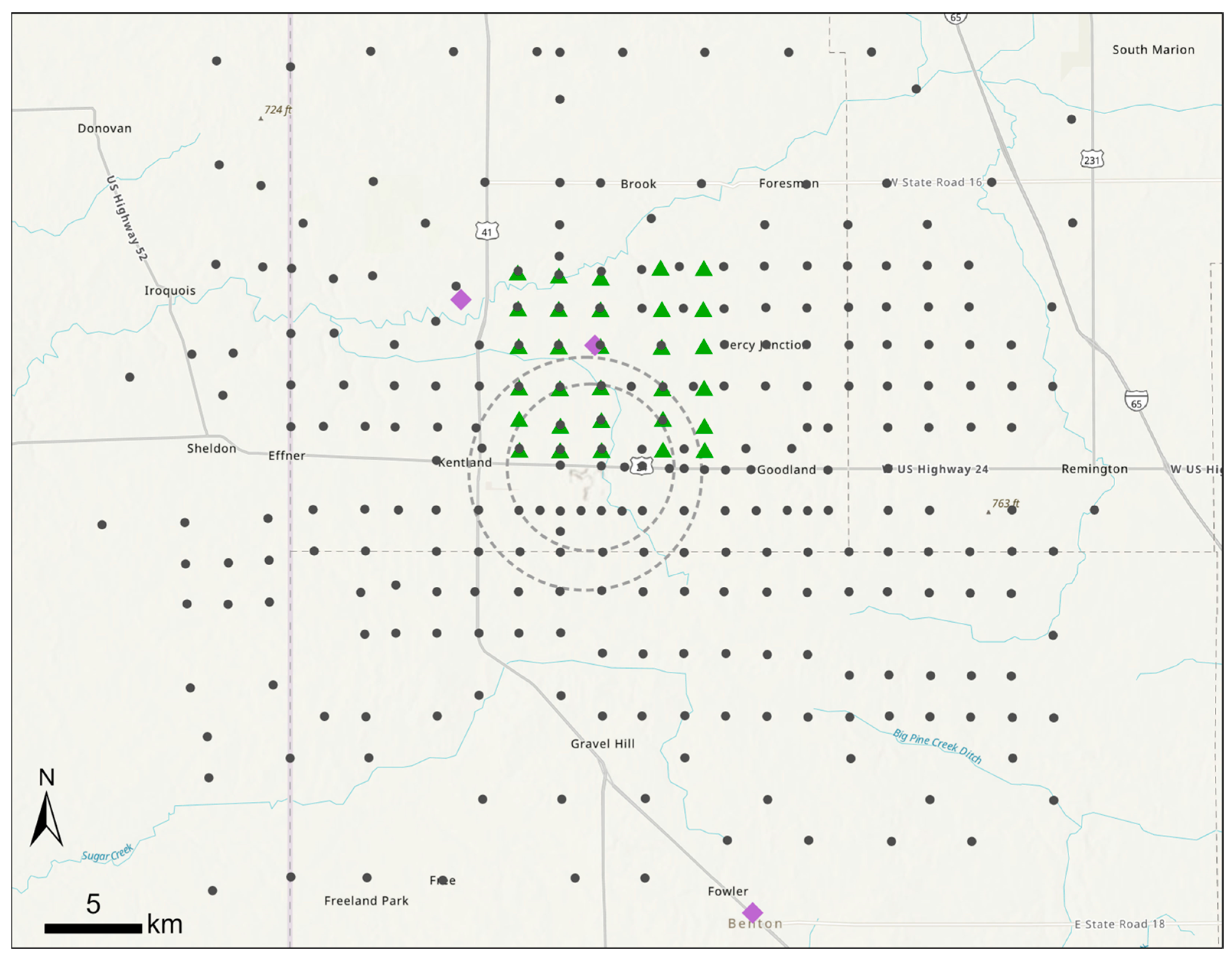
Our geophysical survey consisted of a 30-node passive seismic survey, with 357 gravity observations at 278 observation points (Figure 3).
Our survey also included gravity gradient and magnetotelluric (MT) observations, which were not analyzed in this manuscript but could be incorporated into future geophysical studies. Vertical gravity gradients were observed at fourteen locations within the Rogers Group Inc. Newton County Stone quarry. MT observations were made at three sites denoted by purple triangles in Figure 3. The collected gravity gradient and MT data are published along with the rest of the data in this study. More information on the gradiometry and MT surveys can be found in Supplemental Sections S3 and S4, respectively.

3.1. Seismic Survey Results

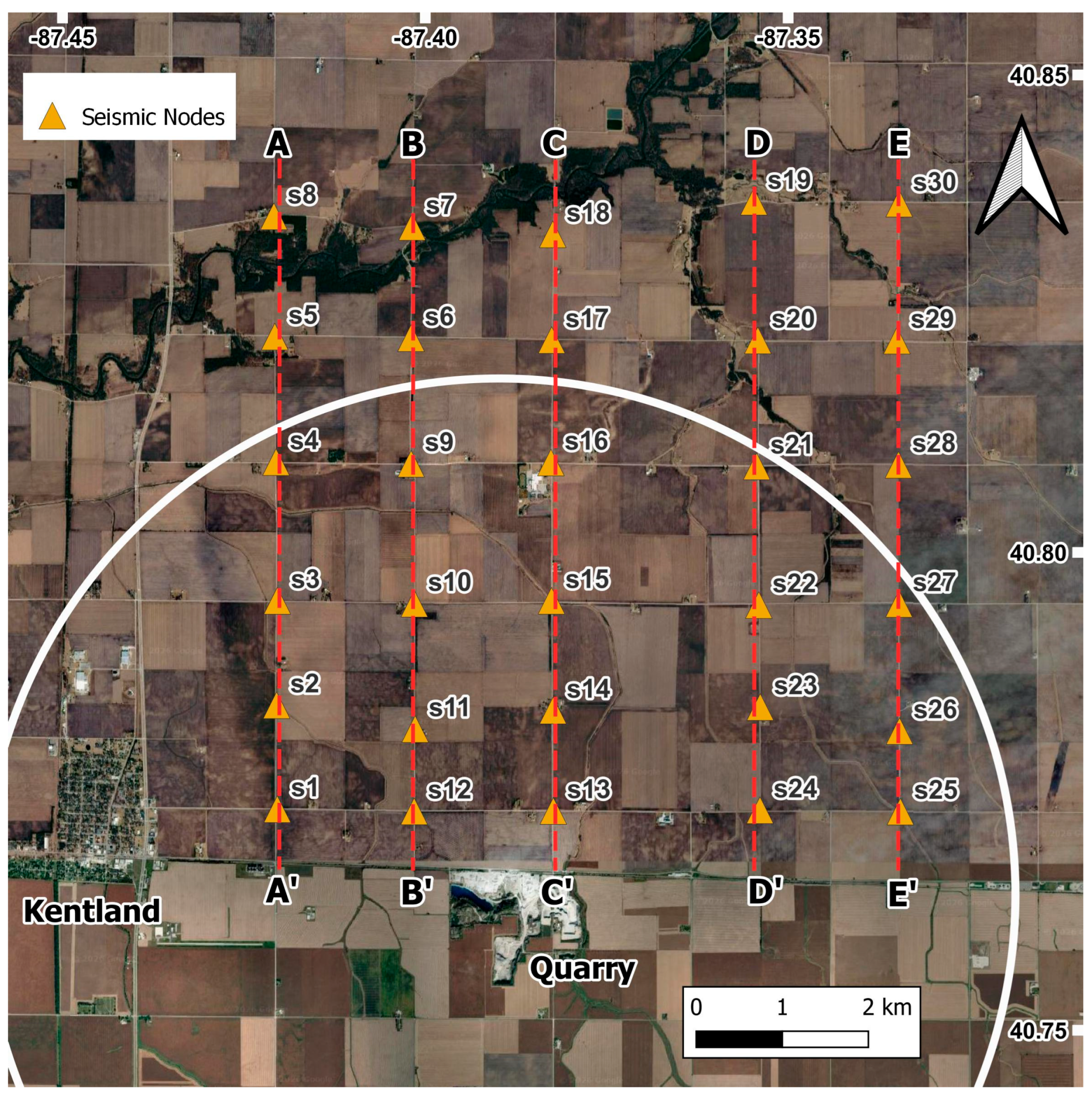
A grid of 30 Smartsolo 3-component nodal geophones were deployed over the northern portion of the Kentland structure for ~10 days with roughly 1.5 km spacing between stations. The deployment locations of the seismometers are shown in Figure 3 and Figure 4.
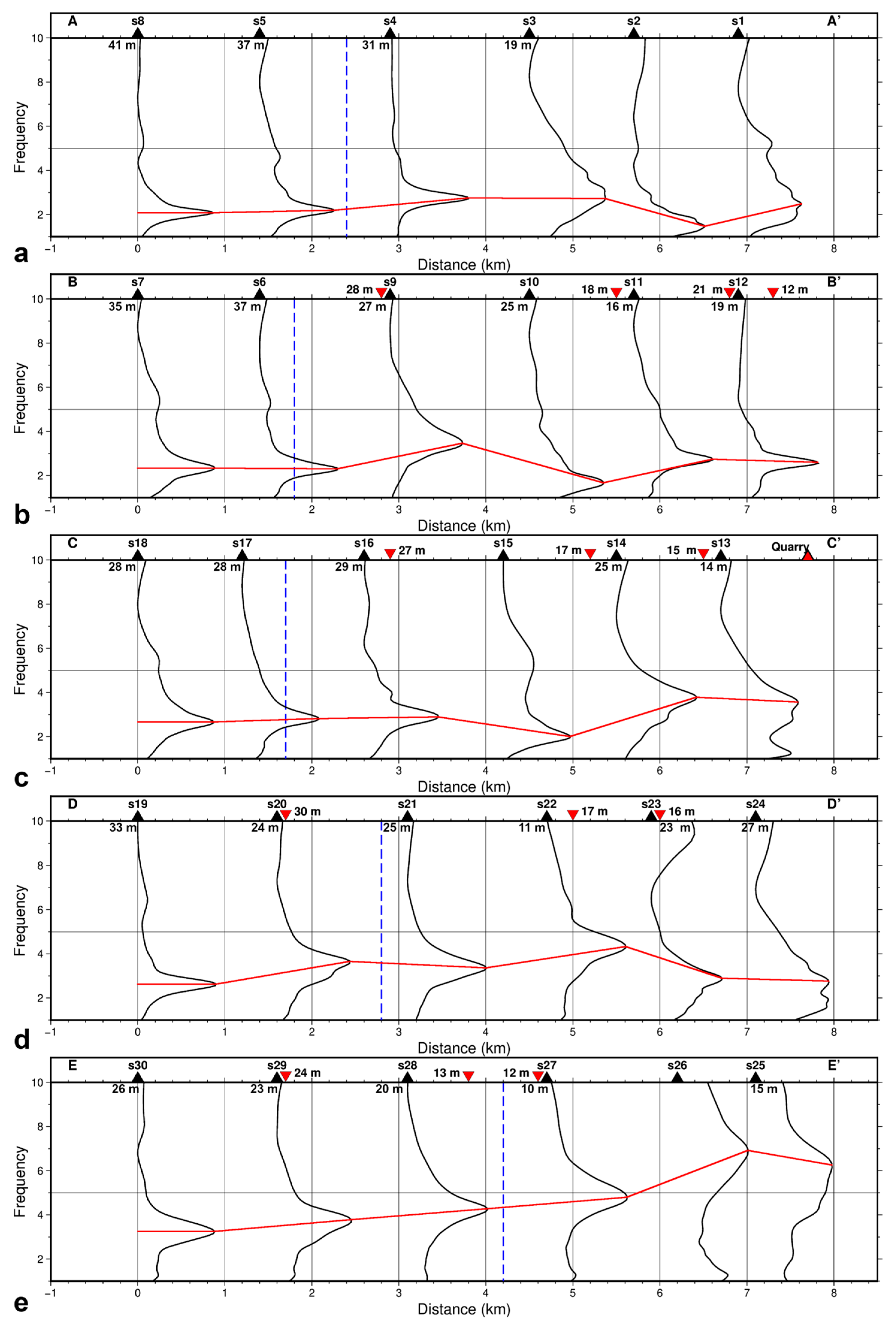
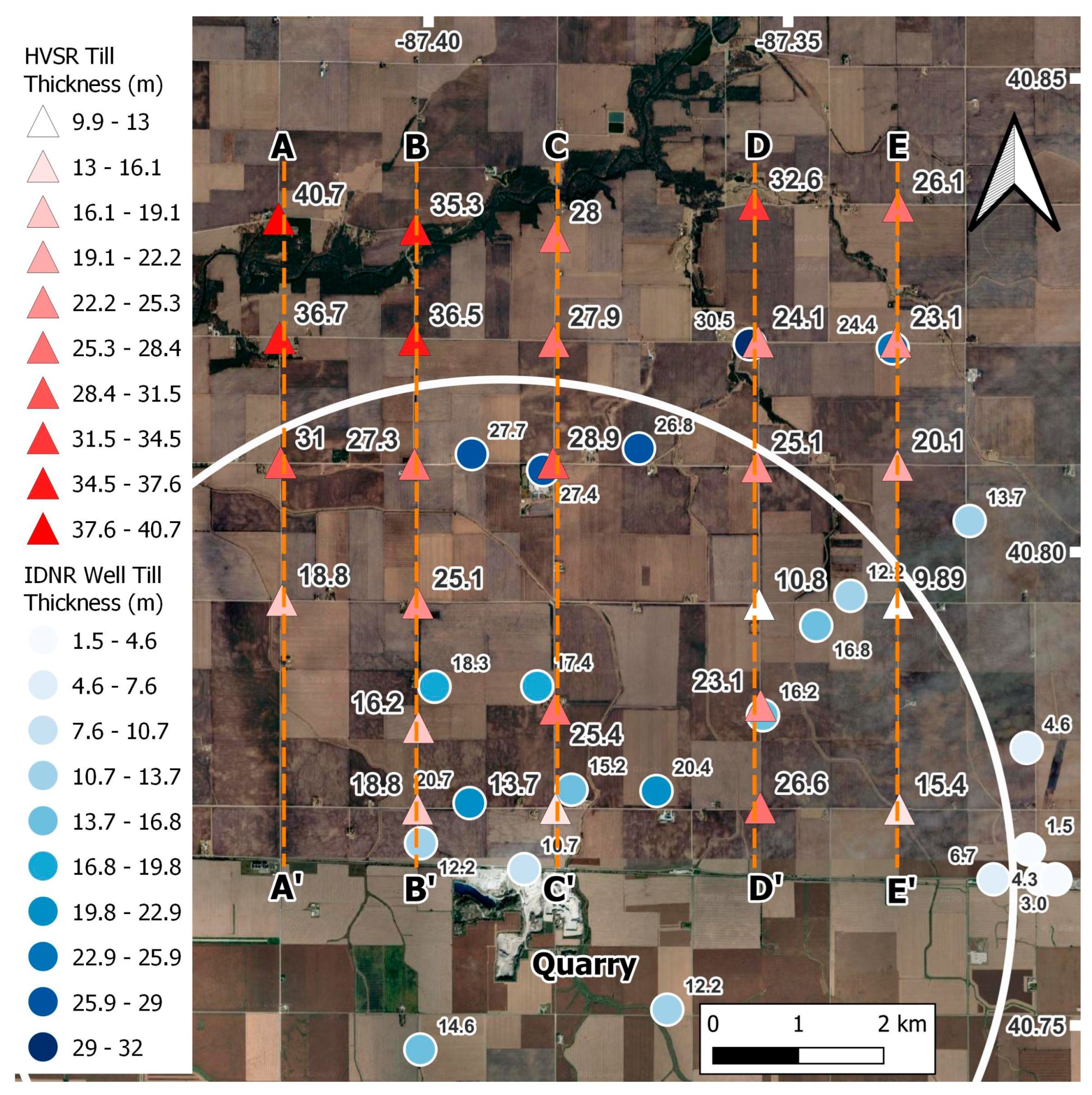
HVSR curves are shown as profiles in Figure 5, and the results of estimating glacial till thickness through modeling HVSR curves are shown in Figure 6, with HVSR curves and modeling results for each station available in Supplemental Section S1. The strength of the HVSR peak amplitude, exceeding 4 for many stations (Supplemental Figures S1.2.1–S1.2.30), is an indication of a strong seismic impedance contrast, which we have interpreted as the base of the glacial till. The HVSR curves at stations 1, 2, 15, and 26 do not exhibit a clear single peak (Figure 5a,c,e). Therefore, we deem the till depth unresolvable at those locations and exclude them from the final till thickness map (Figure 6). The HVSR-derived glacial till thickness estimations broadly match the values from the INDR well logs [48]. Our methodology assumes a simple, vertically homogenous unit of glacial till overlying a halfspace. The inaccuracy of this assumption is a source of uncertainty in our estimations of till thickness and velocity, with heterogeneity within the till body likely explaining some of the multi-peak HVSR curves we discarded before modeling. Our results show a trend of glacial till gradually shallowing from northwest to southeast.
Figure 6. Map of the study area with model results from Figure 5 and IDNR wells. Profile lines A–E, corresponding to the profiles shown in Figure 4, are shown as dashed orange lines. Node locations are denoted by triangles that are shaded according to the HVSR model-derived glacial till thickness. Each node is labeled with the corresponding model-derived till thickness value. IDNR well locations [48] are plotted as circles and are shaded according to observed glacial till thicknesses. Each well location is labeled with its exact till thickness. The approximate crater rim is denoted by a white circle with a 6 km radius.
Geosciences 16 00155 g006
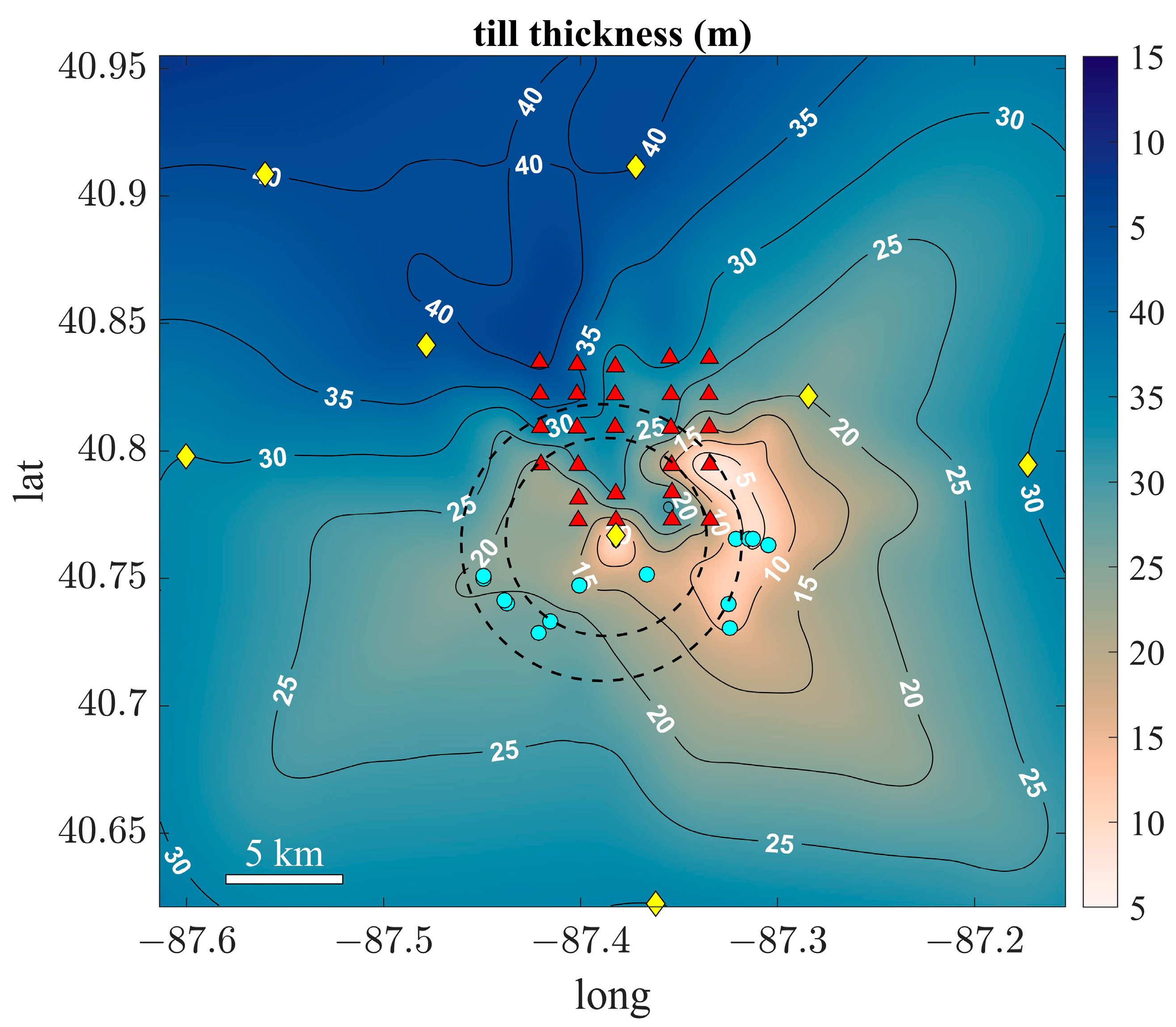
We assume that the thickening and evening out of the till layer across the whole structure is radially similar to the northern portion. The results in Figure 6 were extrapolated by adding additional IDNR well data [48] in the southern half of the crater and manually adding locations with inferred till thicknesses to expand our results to the full extent of our gravity survey. The resulting regional till thickness map is depicted in Figure 7. The interpolated till thickness at each gravity station and the till thickness map are included with our publicly available gravity dataset (see Data Availability Statement).

3.2. Gravity Survey Results

Our gravity survey covered a ~35 × 35 km area with increased resolution nearing the central peak of the Kentland crater structure, as depicted by the black dots in Figure 3. Observations were made along the sides of public roads with a one-level tripod.
In addition to the gravity data corrections noted in Section 2.2.2, we applied instrument-specific, manually determined tilt and drift corrections. These corrections are described in Supplemental Sections S2.1 and S2.2.
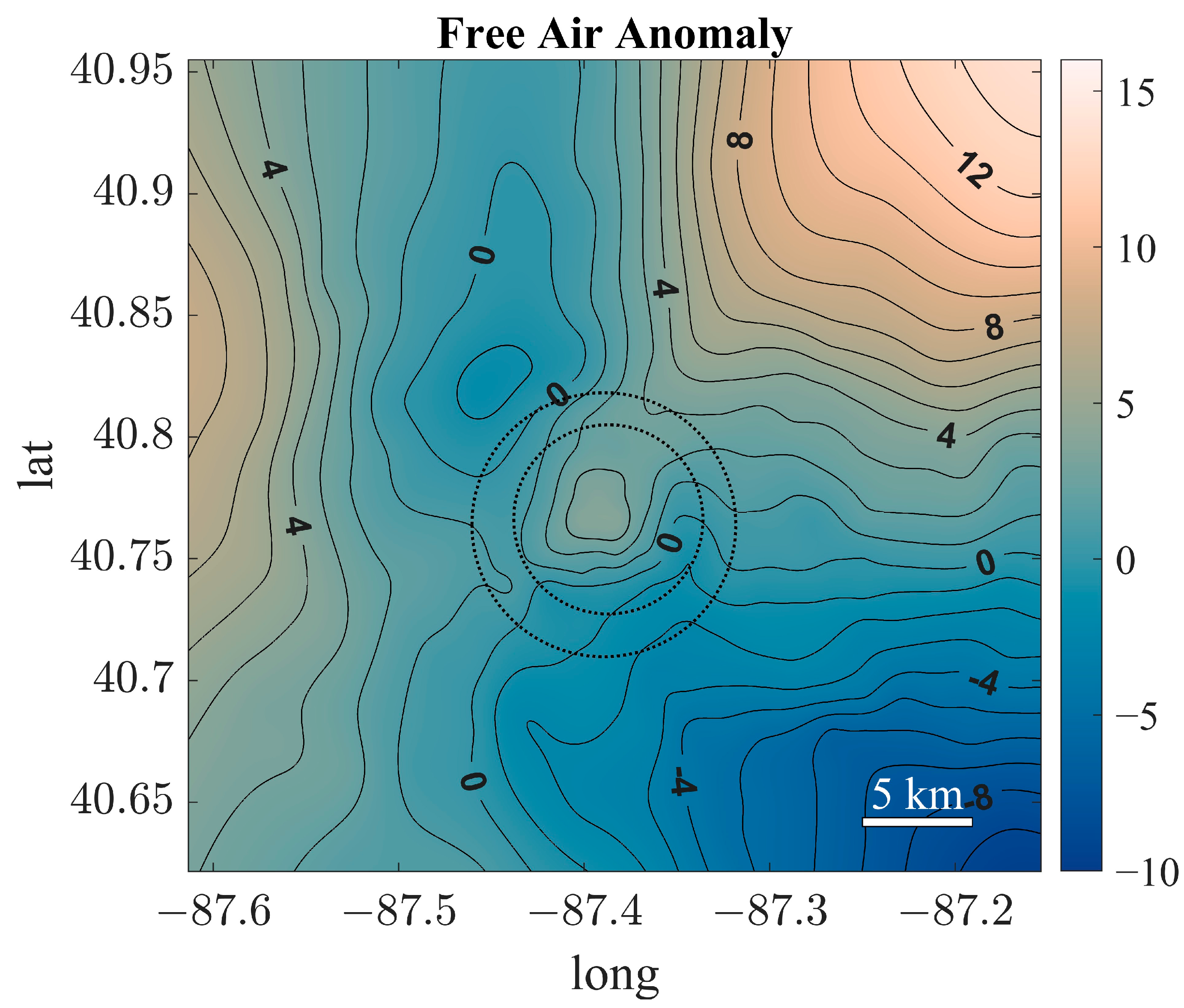
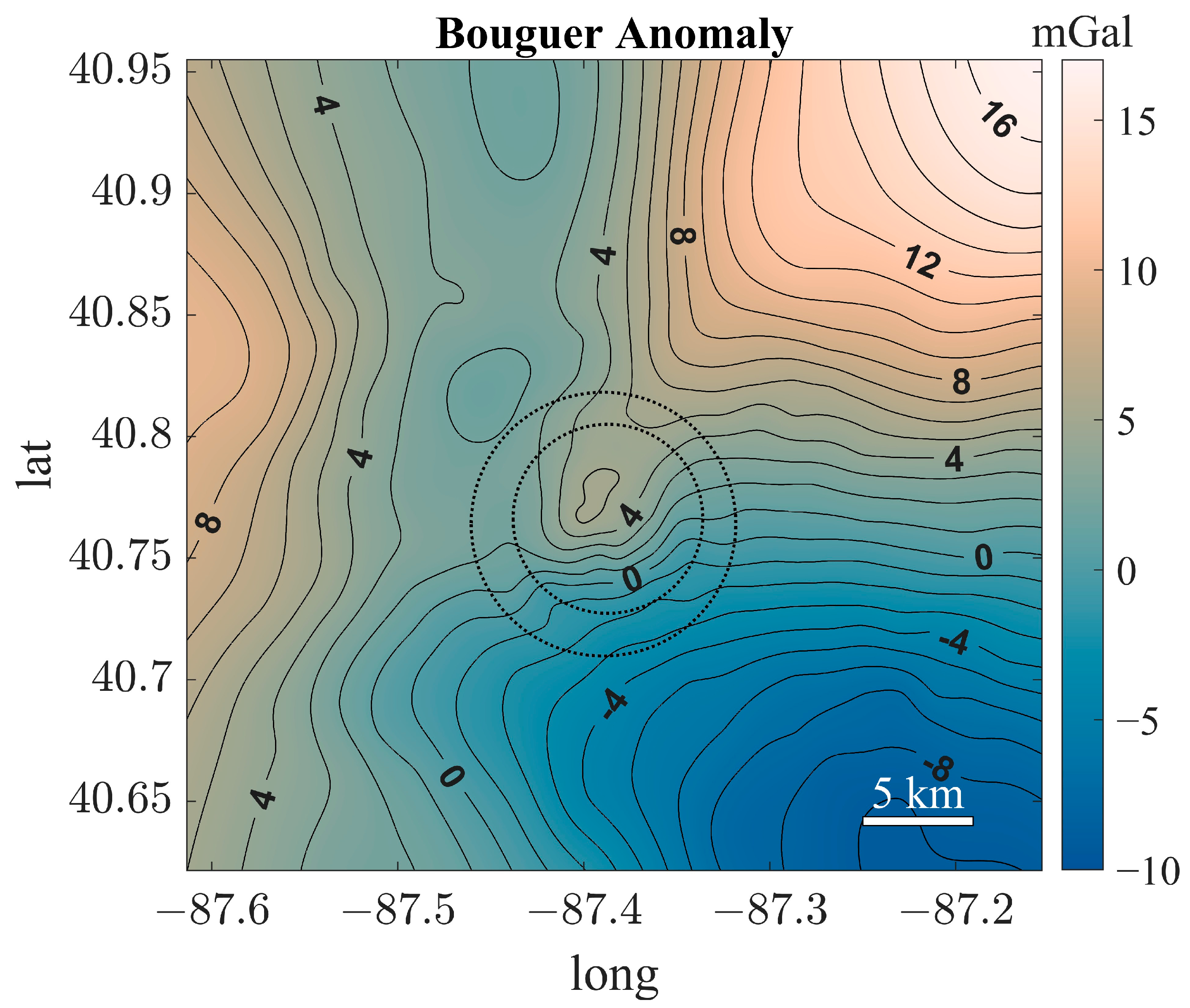
The regional free air anomaly and Bouguer anomaly are shown in Figure 8 and Figure 9, respectively. Both the free air and Bouguer anomalies reveal a prominent north–south asymmetry, likely reflective of a long-wavelength structural anomaly in the deeper crust. Additionally, we find distinct anomalous gravity signatures directly corresponding to the Kentland Crater structure, implying significant subsurface density variations within the extent of the crater unrelated to the larger regional trends.
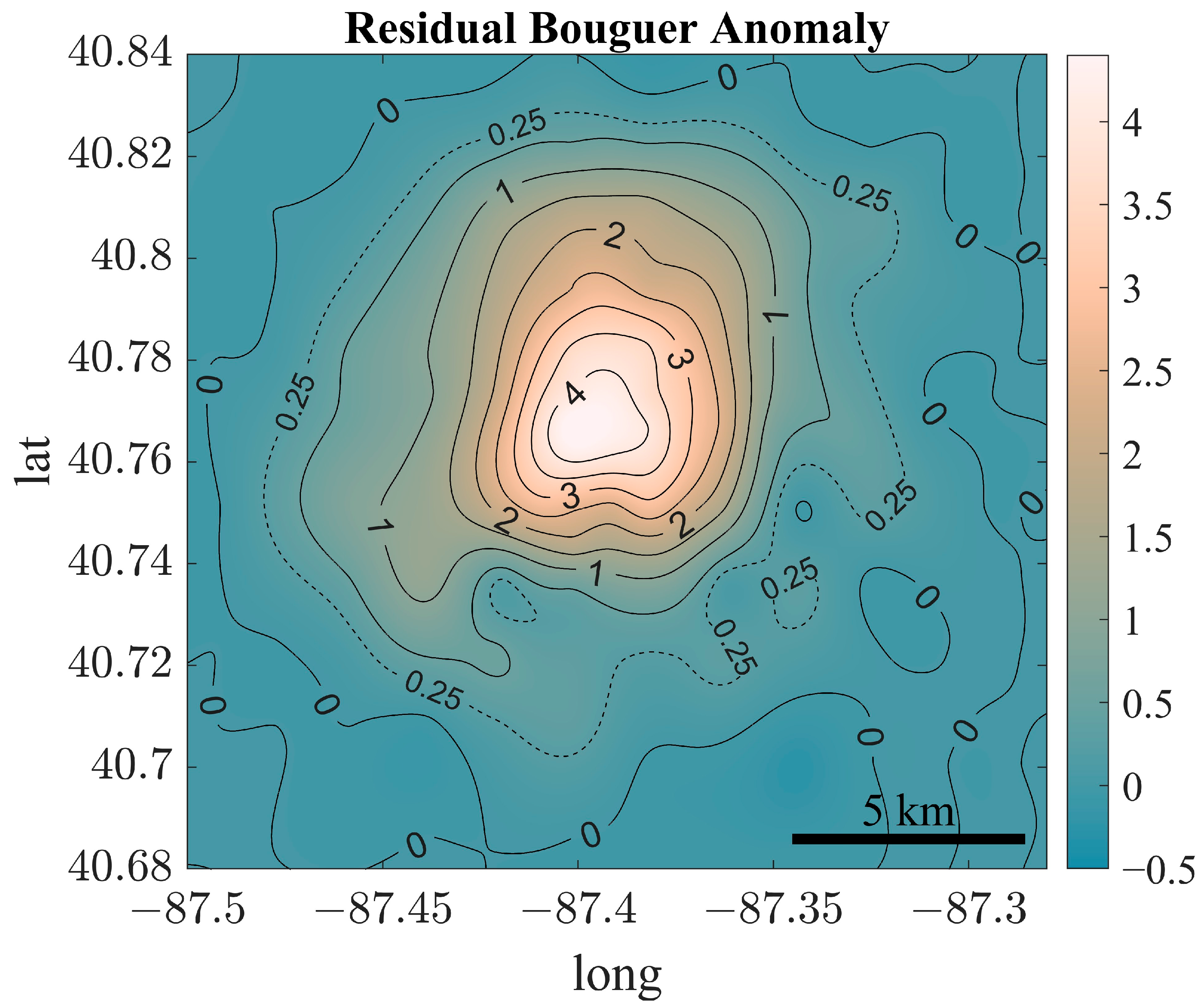
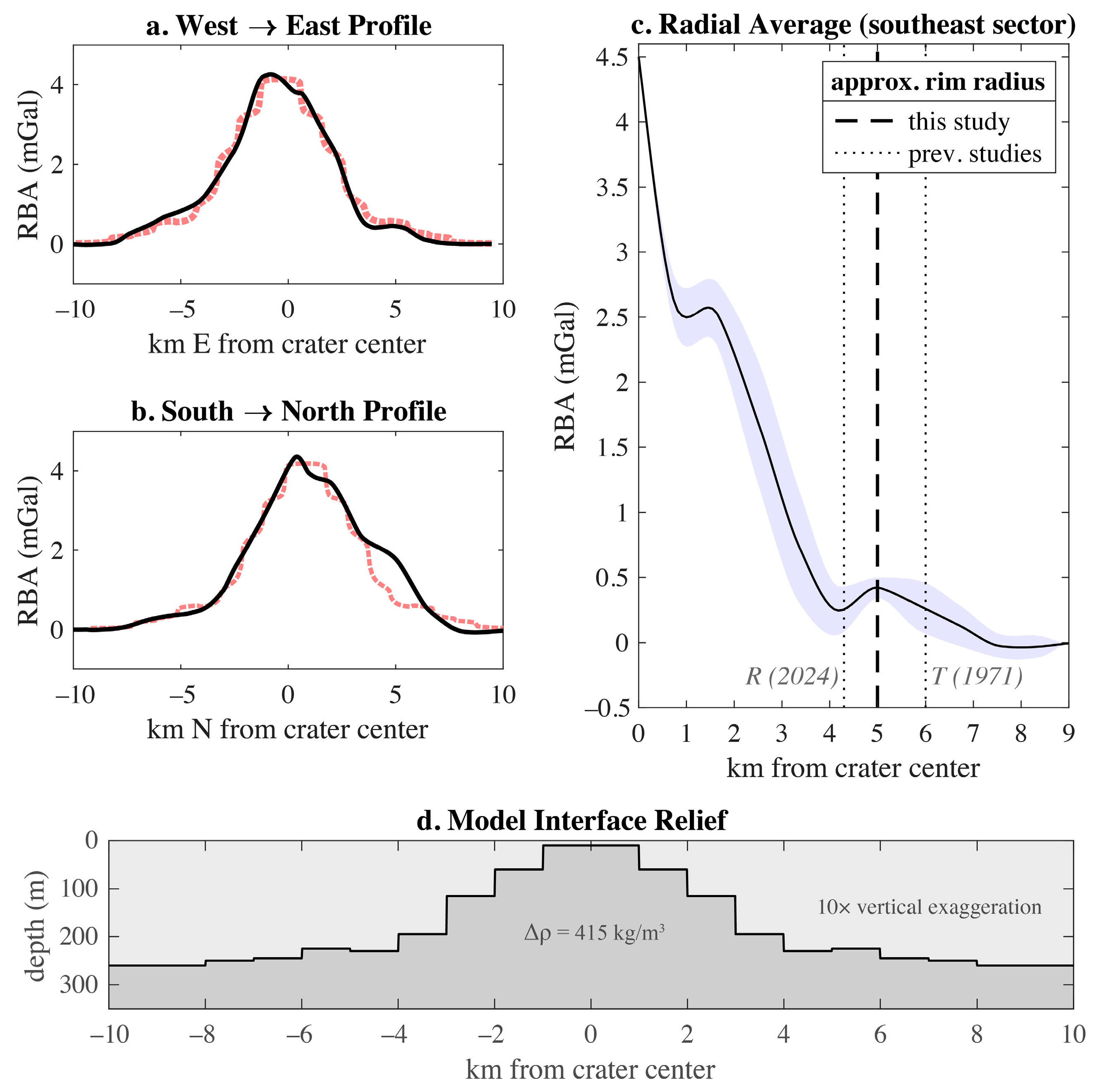
The Residual Bouguer Anomaly (RBA) shown in Figure 10 reveals a prominent ~4.5 mGal gravity high corresponding to the central uplift. Regional RBA profiles (Figure 11) display a generally symmetric long-wavelength gravity signature for the study area. One plausible interpretation of the RBA is shown in Figure 11d, corresponding to radially symmetric uplift of dense basement units (see Supplemental Section S2.4 for model details). This model demonstrates that 240 m of uplift of an interface with a density contrast of 415 kg/m3 would be sufficient to reproduce the observed RBA. It should be noted that this interpretation is non-unique; in particular, the height of the uplift trades off with the density contrast. Furthermore, this model is a proxy for what is likely a more complex geologic structure with numerous interfaces. The southeast portion of the crater contains a partial low-gravity annulus between 3.5 and 4.5 km radius, which is ~0.2 mGal lower than an adjacent gravity high at ~5 km radius (Figure 11c). If this gravity high at 5 km radius is to be interpreted as a crater rim signal, it would be within the range of previously suggested rim radii [33,34].

4. Discussion

The ~4.5 mGal Residual Bouguer Anomaly we observe at the central uplift aligns with the most recent gravity survey of the area [33], but the Residual Bouguer Anomaly corresponding to the annular low in the southeast (Figure 11c) is >1 mGal larger (~0.2 mGal in this study vs. −1 mGal observed by ref. [33]). We attribute this discrepancy to our nonuniform till correction within the gravity trough (~0.7 mGal on average), as opposed to ref. [33], which did not account for till depth changes at all.
The presence of a large, positive Residual Bouguer Anomaly at the center of a complex crater is not necessarily intuitive. While uplifted deep bedrock at the crater center does produce a more positive anomaly surrounding the central peak, as demonstrated in Figure 11, the uplift causes extensive fracturing, which might plausibly subdue its high-density gravity signal. The resulting crater infill consists of highly fractured, low-density material. This process tends to result in an overall less dense subsurface within the crater compared to the surrounding region, creating a crater-wide negative Residual Bouguer Anomaly with a higher, but still negative, gravity signal at the crater center. We see negative Residual Bouguer Anomalies at several craters similar in size to Kentland (e.g., Wells Creek, TN, USA, El’gygytgyn, Russia, Lappajärvi, Finland, Zhamanshin, Kazakhstan) [56]. We propose that, at Kentland, impact-induced porosity was largely confined to the near-surface (shallower than 900 m). Subsequent glacial scouring would have then eroded away most, if not all, of that fractured material, leaving behind the dense central uplift we see today. This conclusion aligns with recent hydrocode models, which find that impact-induced dilatation is likely distributed along the near-surface under high-gravity conditions like that on Earth, as opposed to the Moon and Mars, due to increased overburden pressures with depth [29,30].
In addition to its uncommon central uplift signal, the gravity anomaly we observe at Kentland exhibits a prominent regional north–south asymmetry (Figure 8, Figure 9 and Figure 10). This trend can be explained in part by the bedrock transition that straddles the impact structure (Figure 2). Due to southward dipping stratigraphic units, low-density Pennsylvanian and Mississippian bedrock layers thicken southward, which is reflected by a corresponding decrease in the gravity anomaly. Additionally, the annulus of Pennsylvanian bedrock is thicker and wider in the southern portion of the crater structure (Figure 2). Therefore, as reflected in our results (Figure 10), the lateral subsurface density contrasts in the southern crater interior are more prominent than in the north.
Combining our conclusion that most fractured material has been removed from the crater structure and the strong relationship between the Bouguer signal and bedrock properties, we infer that the RBA in the Kentland region reflects the lateral extent of structural uplift beneath the crater rather than the distribution of impact-induced porosity. In other words, the RBA signal at Kentland is stronger where the deepest, densest bedrock has been uplifted closer to the surface. Based on hydrocode modeling results, inward sloping stratigraphy would still be present inside of the crater rim well below 900 m in depth [57]. Therefore, in this study, we identify the apparent crater rim as the highest RBA signal outside the interior low-density annulus, which would represent the outer limit of the inward sloping stratigraphy where the densest bedrock layer outside the central uplift meets the surface. It should be noted that any apparent diameter detectable today will be inherently smaller than the original crater diameter because the extent of subsurface deformation outside of the crater center generally decreases with depth [58].
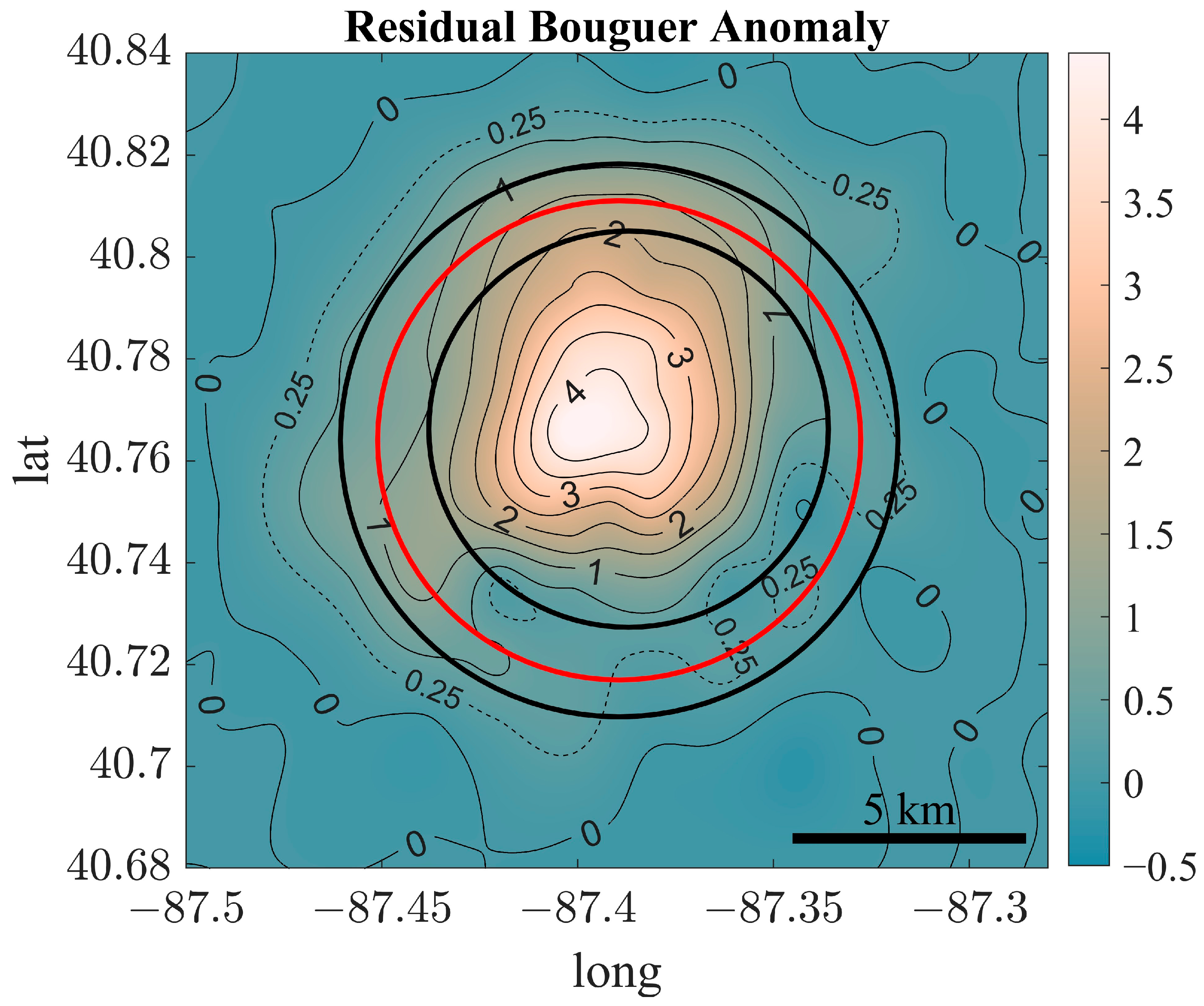
The radial average of the RBA in the southwestern portion of the crater shows a peak at ~5 km radius, ~0.2 mGal higher than the annular low (Figure 11c). Therefore, the apparent rim diameter found in this study is 10 km. These findings imply a crater structure that is smaller in diameter than [33] and larger than [34] (12 km and 8.6 km, respectively). For comparison and spatial context, the rim radii found in this publication [33,34] are represented in Figure 11c and Figure 12. The crater size discrepancy may be explained by the ways in which each study draws its conclusions. Ref. [33] identified the apparent rim diameter primarily from borehole data as a slight rise in the bedrock topography profile over the eastern half of the crater. In our results, the eastern half of the west–east profile (Figure 11a) displays a similar upwarp in gravity signal at 6 km radius. In contrast, ref. [34] identified the rim location as the most remote normal fault along a south–north seismic profile over the southern half of the crater. The southern half of our observed south–north RBA profile (Figure 11b) does not show a significant gravity anomaly at a 4.3 km radius. This discrepancy is likely due to the steeply sloping gravity signal surrounding the central uplift, the amplitude of which may be overpowering subtler density changes at coincident fault boundaries. Moreover, ref. [34] cites their apparent rim diameter as a minimum estimate for the original diameter, as it is likely that more remote faults were present in the eroded portion of the shallower structure. Unlike both refs. [33] and [34], our study locates the rim from the radial average of gravity data approximately spanning the area between the eastern half of the west–east profile and the southern half of the south–north profile (Figure 11, Supplemental Section S2.3).
Despite the differences in methods between investigations, the discrepancies between rim diameter estimates at Kentland Crater are still significant. One possible explanation is that the rim of Kentland Crater may not be radially symmetric. Considering the north–south bedrock boundary that bisects the crater structure, one may suggest that asymmetric crater morphology could be a result of differing target properties [59,60,61]. However, due to the nature and extent of erosion experienced at Kentland, we infer that it is unlikely that the bedrock discontinuity seen today was present at the time of impact. Instead, we suggest that differential erosion between the north and south could better explain the morphological dichotomy of the current crater structure.
As of the publication of this manuscript, ref. [34] provides the only modern active seismic survey at Kentland Crater and covers only the southern portion of the crater. Since our passive seismic survey does not illuminate deep subsurface structures, an active seismic investigation of the northern half of the crater could be an effective next step to resolve the true geometry of the crater. Further, an active seismic study in the north would allow us to compare the geometry of the faulting in the bedrock and the crater rim diameter on either side of the bedrock discontinuity. In turn, an additional passive seismic study in the south could refine the current bedrock topography in the crater rim region and corroborate that a remnant rim structure exists at Kentland.
Future gravity investigations that would be beneficial at Kentland could include three-dimensional inversion to identify the distribution of porosity with depth. Magnetic studies could illuminate the structure of deeper impact-induced fracturing and porosity inside and outside the crater region. Additionally, more impact modeling must be conducted for Kentland-sized impacts. Past numerical models [62] have shown that traditional impact scaling laws (e.g., [63]) are insufficient when estimating the original size of highly eroded craters. Depending on target material, erosion rates, and erosion extent, several initial crater diameters can produce the same modern-day profile. To improve model constraints for Kentland, target material properties could be better quantified via petrophysical studies throughout the region. Impact modeling with a focus on fault formation and structural uplift during transient crater collapse could provide crucial constraints on the relationship between rim diameter, rim structures, and impact-induced faulting at depth.

5. Conclusions

In this study, we combine gravity and seismic data to discern the lateral density structure of Kentland Crater. We find a large positive 4.5 mGal Residual Bouguer Anomaly corresponding to the central uplift. In the southeastern portion of the crater, we find a low-gravity annulus at a ~3.5–4.5 km radius with a surrounding gravity high at ~5 km, which we interpret as a crater rim signal. Our 10 km rim diameter falls between the two other proposed diameter estimates, 12 km [33] and 8.6 km [34]. Thus, we conclude that the exact shape, size, and original extent of Kentland Crater are still up for debate. We suggest several methods for further investigations including active and passive seismic surveys, magnetic surveys, petrophysical studies, gravity inversion, and numerical impact modeling.
All survey data and analysis results in this study are publicly accessible (see Data Availability Statement).

Supplementary Materials

The following supporting information can be downloaded at: https://www.mdpi.com/article/10.3390/geosciences16040155/s1. Table S1.2.1: Seismic station parameters, Figures S1.2.1–S1.2.30: HVSR curves for stations 1–30, respectively, Figure S2.2.1: Regional background Bouguer signal, S2.2.2: Manual drift corrections, Figure S2.3.1: Southeast sector, Figure S2.3.2: Radial averaging, Figure S2.4.1: Geometric parameters of a semi-infinite vertical cylinder, Table S2.4.1: Top depths for modelled cylindrical shells, Figure S3.1: Gravity gradient observations, Figure S4.1: Magnetotelluric results. References [64,65,66,67,68,69,70,71] are cited in the supplementary materials.

Author Contributions

Conceptualization, K.E.B., B.O.S. and P.B.J.; project management, K.E.B.; funding acquisition, P.B.J.; gravity analysis, K.E.B.; seismic analysis, B.O.S.; magnetotelluric analysis, S.L.H.; writing, K.E.B., B.O.S., P.B.J., S.L.H. and N.L.W.; fieldwork, K.E.B., B.O.S., S.L.H., N.L.W. and D.R.H. All authors have read and agreed to the published version of the manuscript.

Funding

This research was funded by American Chemical Society Petroleum Research Fund (61587-DNI8).

Data Availability Statement

The original data presented in the study are openly available in Zenodo at https://doi.org/10.5281/zenodo.18838055.

Acknowledgments

We would like to acknowledge: (1) Jonathan R. Delph for providing the seismic equipment required for this study, (2) Michael M. Sori for providing research facilities for the duration of our field study, (3) The Rogers Group Newton County Stone quarry for access to quarried areas for gravity observations, (4) Douglas R. Schmitt for providing research guidance, and (5) all those that contributed to fieldwork and data collection, including Brian A. Robitaille, M.S., Riley A. McGlasson, and Ali M. Bramson.

Conflicts of Interest

The authors declare no conflicts of interest.

Abbreviations

The following abbreviations are used in this manuscript:
NASANational Aeronautics and Space Administration
GRAILGravity Recovery and Interior Laboratory
MTMagnetotelluric
HVSRHorizontal-to-Vertical Spectral Ratio
IDNRIndiana Department of Natural Resources
RTK GNSSReal-Time Kinematic Global Navigation Satellite System
RBAResidual Bouguer Anomaly
GRSGeodetic Reference System
PSRPermanently Shadowed Region

References

  1. Wieczorek, M.A.; Neumann, G.A.; Nimmo, F.; Kiefer, W.S.; Taylor, G.J.; Melosh, H.J.; Phillips, R.J.; Solomon, S.C.; Andrews-Hanna, J.C.; Asmar, S.W.; et al. The Crust of the Moon as Seen by GRAIL. Science 2013, 339, 671–675. [Google Scholar] [CrossRef] [PubMed]
  2. Besserer, J.; Nimmo, F.; Wieczorek, M.A.; Weber, R.C.; Kiefer, W.S.; McGovern, P.J.; Andrews-Hanna, J.C.; Smith, D.E.; Zuber, M.T. GRAIL Gravity Constraints on the Vertical and Lateral Density Structure of the Lunar Crust. Geophys. Res. Lett. 2014, 41, 5771–5777. [Google Scholar] [CrossRef]
  3. Goossens, S.; Sabaka, T.J.; Wieczorek, M.A.; Neumann, G.A.; Mazarico, E.; Lemoine, F.G.; Nicholas, J.B.; Smith, D.E.; Zuber, M.T. High-Resolution Gravity Field Models from GRAIL Data and Implications for Models of the Density Structure of the Moon’s Crust. JGR Planets 2020, 125, e2019JE006086. [Google Scholar] [CrossRef]
  4. Venkatadri, T.K.; James, P.B. Variations of Porosity in Intermediate-Sized Lunar Impact Basins. Icarus 2020, 352, 113953. [Google Scholar] [CrossRef]
  5. Izquierdo, K.; Sori, M.M.; Soderblom, J.M.; Johnson, B.C.; Wiggins, S.E. Lunar Megaregolith Structure Revealed by GRAIL Gravity Data. Geophys. Res. Lett. 2021, 48, e2021GL095978. [Google Scholar] [CrossRef]
  6. Goossens, S.; Sabaka, T.J. Probing Lateral Density Variations in the Crust from Gravity and Topography: Applications to the Moon and Mars. Planet. Sci. J. 2025, 6, 71. [Google Scholar] [CrossRef]
  7. Ding, M.; Soderblom, J.M.; Bierson, C.J.; Nimmo, F.; Milbury, C.; Zuber, M.T. Constraints on Lunar Crustal Porosity From the Gravitational Signature of Impact Craters. JGR Planets 2018, 123, 2281–2294. [Google Scholar] [CrossRef]
  8. Zhu, M.-H.; Artemieva, N.; Morbidelli, A.; Yin, Q.-Z.; Becker, H.; Wünnemann, K. Reconstructing the Late-Accretion History of the Moon. Nature 2019, 571, 226–229. [Google Scholar] [CrossRef] [PubMed]
  9. Zuber, M.T.; Smith, D.E.; Watkins, M.M.; Asmar, S.W.; Konopliv, A.S.; Lemoine, F.G.; Melosh, H.J.; Neumann, G.A.; Phillips, R.J.; Solomon, S.C.; et al. Gravity Field of the Moon from the Gravity Recovery and Interior Laboratory (GRAIL) Mission. Science 2013, 339, 668–671. [Google Scholar] [CrossRef]
  10. Neumann, G.A.; Zuber, M.T.; Wieczorek, M.A.; Head, J.W.; Baker, D.M.H.; Solomon, S.C.; Smith, D.E.; Lemoine, F.G.; Mazarico, E.; Sabaka, T.J.; et al. Lunar Impact Basins Revealed by Gravity Recovery and Interior Laboratory Measurements. Sci. Adv. 2015, 1, e1500852. [Google Scholar] [CrossRef]
  11. Wahl, D.; Wieczorek, M.A.; Wünnemann, K.; Oberst, J. Crustal Porosity of Lunar Impact Basins. JGR Planets 2020, 125, e2019JE006335. [Google Scholar] [CrossRef]
  12. Huang, Y.H.; Soderblom, J.M.; Minton, D.A.; Hirabayashi, M.; Melosh, H.J. Bombardment History of the Moon Constrained by Crustal Porosity. Nat. Geosci. 2022, 15, 531–535. [Google Scholar] [CrossRef]
  13. Collins, G.S. Numerical Simulations of Impact Crater Formation with Dilatancy. JGR Planets 2014, 119, 2600–2619. [Google Scholar] [CrossRef]
  14. Milbury, C.; Johnson, B.C.; Melosh, H.J.; Collins, G.S.; Blair, D.M.; Soderblom, J.M.; Nimmo, F.; Bierson, C.J.; Phillips, R.J.; Zuber, M.T. Preimpact Porosity Controls the Gravity Signature of Lunar Craters. Geophys. Res. Lett. 2015, 42, 9711–9716. [Google Scholar] [CrossRef]
  15. Osinski, G.R.; Silber, E.A.; Clayton, J.; Grieve, R.A.F.; Hansen, K.; Johnson, C.L.; Kalynn, J.; Tornabene, L.L. Transitional Impact Craters on the Moon: Insight into the Effect of Target Lithology on the Impact Cratering Process. Meteorit. Planet. Sci. 2019, 54, 573–591. [Google Scholar] [CrossRef]
  16. Rajšić, A.; Miljković, K.; Wójcicka, N.; Collins, G.S.; Onodera, K.; Kawamura, T.; Lognonné, P.; Wieczorek, M.A.; Daubar, I.J. Numerical Simulations of the Apollo S-IVB Artificial Impacts on the Moon. Earth Space Sci. 2021, 8, e2021EA001887. [Google Scholar] [CrossRef]
  17. Ormö, J.; Raducan, S.D.; Housen, K.R.; Wünnemann, K.; Collins, G.S.; Rossi, A.P.; Melero-Asensio, I. Effect of Target Layering in Gravity-Dominated Cratering in Nature, Experiments, and Numerical Simulations. JGR Planets 2024, 129, e2023JE008110. [Google Scholar] [CrossRef]
  18. Donofrio, R.R. Impact Craters: Implications for Basement Hydrocarbon Production. J. Petro. Geo. 1981, 3, 279–302. [Google Scholar] [CrossRef]
  19. Grieve, R.A.F.; Masaitis, V.L. The Economic Potential of Terrestrial Impact Craters. Int. Geol. Rev. 1994, 36, 105–151. [Google Scholar] [CrossRef]
  20. James, S.; Chandran, S.R.; Santosh, M.; Pradeepkumar, A.P.; Praveen, M.N.; Sajinkumar, K.S. Meteorite Impact Craters as Hotspots for Mineral Resources and Energy Fuels: A Global Review. Energy Geosci. 2022, 3, 136–146. [Google Scholar] [CrossRef]
  21. Koeberl, C.; Reimold, W.U.; Brandt, D. Red Wing Creek Structure, North Dakota: Petrographical and Geochemical Studies, and Confirmation of Impact Origin. Meteroit. Planet. Sci. 1996, 31, 335–342. [Google Scholar] [CrossRef]
  22. Herber, B.D.; Weimer, P.; Bouroullec, R.; Barton, R.J.; Behringer, D.N.; Hammon, W.S., III; Gutterman, W.S. Three-Dimensional Seismic Interpretation of a Meteorite Impact Feature, Red Wing Creek Field, Williston Basin, Western North Dakota. Bulletin 2022, 106, 1499–1546. [Google Scholar] [CrossRef]
  23. Kirschner, C.E.; Grantz, A.; Mullen, M.W. Impact Origin of the Avak Structure, Arctic Alaska, and Genesis of the Barrow Gas Fields. AAPG Bull. 1992, 76, 651–679. [Google Scholar] [CrossRef]
  24. Tomka, R.; Steinmann, V.; Warren, T.; Kereszturi, A. Morphological Analysis of Polar Landing Regions for a Solar Powered Ice Drilling Mission. Icarus 2024, 411, 115927. [Google Scholar] [CrossRef]
  25. Zwierzyński, A.J.; Ciążela, J.; Boroń, P.; Binkowska, W. Lunar Cold Microtraps as Future Source of Raw Materials—Business and Technological Perspective. Appl. Sci. 2023, 13, 13030. [Google Scholar] [CrossRef]
  26. Danque, H.A.; Cannon, K.M. Lunar Polar Volatile Remobilization in Regolith-Filled Craters. Icarus 2024, 411, 115953. [Google Scholar] [CrossRef]
  27. Davidsson, B.J.R.; Hosseini, S. Determining the Conditions for Thermal Stability of Global Near-Surface Water Ice on the Moon. Mon. Not. R. Astron. Soc. 2025, 538, 809–819. [Google Scholar] [CrossRef]
  28. Xie, M.; Xiao, Z.; Xu, A. Time-Dependent Production Functions of Lunar Simple Craters on Layered Targets with Consideration of Topographic Degradation. Geophys. Res. Lett. 2019, 46, 10987–10996. [Google Scholar] [CrossRef]
  29. Wiggins, S.E.; Johnson, B.C.; Bowling, T.J.; Melosh, H.J.; Silber, E.A. Impact Fragmentation and the Development of the Deep Lunar Megaregolith. JGR Planets 2019, 124, 941–957. [Google Scholar] [CrossRef]
  30. Wiggins, S.E.; Johnson, B.C.; Collins, G.S.; Melosh, H.J.; Marchi, S. Widespread Impact-Generated Porosity in Early Planetary Crusts. Nat. Commun. 2022, 13, 4817. [Google Scholar] [CrossRef]
  31. Quesnel, Y.; Rochette, P.; Baratoux, D.; Niang, C.A.B.; Cavosie, A.J.; Fall, M.; Kouame, N.L.; Wade, S.; Kaire, M.; Faye, G.; et al. New Geophysical and Zircon Data Support an Impact Hypothesis for the Velingara Structure (Senegal). J. Afr. Earth Sci. 2024, 209, 105121. [Google Scholar] [CrossRef]
  32. Quesnel, Y.; Bezaeva, N.S.; Kuzina, D.M.; Rochette, P.; Gattacceca, J.; Uehara, M.; Badyukov, D.D.; Nasyrtdinov, B.M.; Chareev, D.A.; Champollion, C. The Karla Impact Structure (Russia) Explored by Potential-field Investigations. Meteorit. Planet. Sci. 2022, 57, 989–1003. [Google Scholar] [CrossRef]
  33. Tudor, D.S. A Geophysical Study of the Kentland Disturbed Area. Ph.D. Thesis, Indiana University, Bloomington, IN, USA, 1971. [Google Scholar]
  34. Robitaille, B.A. Seismic Reflection Survey of the Kentland Impact Structure. Master’s Thesis, Purdue University, West-Lafayette, IN, USA, 2024. [Google Scholar]
  35. Votaw, R.B. Middle Ordovician conodonts from the Kentland structure, Indiana. Geol. Soc. Am. Abstr. Progr 1980, 12, 259. [Google Scholar]
  36. Jackson, M.; Van Der Voo, R. A Paleomagnetic Estimate of the Age and Thermal History of the Kentland, Indiana Cryptoexplosion Structure. J. Geol. 1986, 94, 713–723. [Google Scholar] [CrossRef]
  37. Weber, J.C.; Poulos, C.; Donelick, R.A.; Pope, M.C.; Heller, N. The Kentland Impact Crater, Indiana (USA): An Apatite Fission-Track Age Determination Attempt. In Impact Tectonics; Koeberl, C., Henkel, H., Eds.; Springer: Berlin/Heidelberg, Germany, 2005; pp. 447–466. [Google Scholar]
  38. Laney, R.T.; Van Schmus, W.R. A Structural Study of the Kentland, Indiana Impact Site. In Proceedings of the 9th Lunar and Planetary Science Conference, Houston, TX, USA, 13–17 March 1978; Volume 2, pp. 2609–2632. [Google Scholar]
  39. Reshkin, M. The Geology of Indiana. Rocks Miner. 1986, 61, 117–123. [Google Scholar] [CrossRef]
  40. Shrock, R.R. Stratigraphy and Structure of the Area of Disturbed Ordovician Rocks near Kentland, Indiana. Am. Midl. Nat. 1937, 18, 471. [Google Scholar] [CrossRef]
  41. Gray, H.H.; Ault, C.H.; Keller, S.J. Bedrock Geologic Map of Indiana, Indiana Geological Survey Miscellaneous Map 48; Indiana Geological Survey: Bloomington, IN, USA, 1987.
  42. Turtle, E.P.; Pierazzo, E.; Collins, G.S.; Osinski, G.R.; Melosh, H.J.; Morgan, J.V.; Reimold, W.U. Impact Structures: What Does Crater Diameter Mean? In Large Meteorite Impacts III: Geological Society of America Special Paper 384; Kenkmann, T., Hörz, F., Deutsch, A., Eds.; Geological Society of America: Boulder, CO, USA, 2005; pp. 1–24. [Google Scholar]
  43. Nakamura, Y. A method for dynamic characteristics estimations of subsurface using microtremors on the ground surface. Railw. Tech. Res. Inst. Q. Rep. 1989, 30, 25–33. [Google Scholar]
  44. Lontsi, A.M.; Sánchez-Sesma, F.J.; Molina-Villegas, J.C.; Ohrnberger, M.; Krüger, F. Full Microtremor H/V(z, f) Inversion for Shallow Subsurface Characterization. Geophys. J. Int. 2015, 202, 298–312. [Google Scholar] [CrossRef]
  45. Kang, S.Y.; Kim, K.H.; Chiu, J.M.; Liu, L. Microtremor HVSR Analysis of Heterogeneous Shallow Sedimentary Structures at Pohang, South Korea. J. Geophys. Eng. 2020, 17, 861–869. [Google Scholar] [CrossRef]
  46. Kang, S.Y.; Kim, K.H.; Kim, B. Assessment of Seismic Vulnerability Using the Horizontal-to-Vertical Spectral Ratio (HVSR) Method in Haenam, Korea. Geosci. J. 2021, 25, 71–81. [Google Scholar] [CrossRef]
  47. Zhang, Y.; Lu, L.; Maupin, V.; Qin, T.; Ding, Z. Mapping 3D Sedimentary Structures with Joint Inversion of H/V Spectral Ratios and Multimode Dispersion Curves Derived from Ambient Noise—Application to the Xiong‘an New Area, China. Bull. Seismol. Soc. Am. 2025, 115, 619–645. [Google Scholar] [CrossRef]
  48. IDNR Water Well Locations. Available online: https://www.indianamap.org/datasets/idnr-water-well-locations/about (accessed on 25 March 2025).
  49. Ibs-von Seht, M.; Wohlenberg, J. Microtremor Measurements Used to Map Thickness of Soft Sediments. Bull. Seismol. Soc. Am. 1999, 89, 250–259. [Google Scholar] [CrossRef]
  50. Liang, D.; Gan, F.; Zhang, W.; Jia, L. The Application of HVSR Method in Detecting Sediment Thickness in Karst Collapse Area of Pearl River Delta, China. Environ. Earth Sci. 2018, 77, 259. [Google Scholar] [CrossRef]
  51. Vantassel, J.P. hvsrpy: An Open-Source Python Package for Microtremor and Earthquake Horizontal-to-Vertical Spectral Ratio Processing. Seismol. Res. Lett. 2025, 96, 2671–2682. [Google Scholar] [CrossRef]
  52. Cox, B.R.; Cheng, T.; Vantassel, J.P.; Manuel, L. A Statistical Representation and Frequency-Domain Window-Rejection Algorithm for Single-Station HVSR Measurements. Geophys. J. Int. 2020, 221, 2170–2183. [Google Scholar] [CrossRef]
  53. Bignardi, S.; Mantovani, A.; Abu Zeid, N. OpenHVSR: Imaging the Subsurface 2D/3D Elastic Properties through Multiple HVSR Modeling and Inversion. Comput. Geosci. 2016, 93, 103–113. [Google Scholar] [CrossRef]
  54. Manger, G.E. Porosity and Bulk Density of Sedimentary Rocks. In Contributions to Geochemistry 1963, Geological Survey Bulletin 1144-E; United States Department of the Interior: Washington, DC, USA, 1963. [Google Scholar]
  55. Harvell, R.; Miller, R. (Rogers Group Inc., Newton County, IN, USA). Geophysical Properties of Quarried Limestone at Newton County Stone in Kentland, IN, USA, 2024. Personal communication, 2024. [Google Scholar]
  56. Pilkington, M.; Grieve, R.A.F. The Geophysical Signature of Terrestrial Impact Craters. Rev. Geophys. 1992, 30, 161–181. [Google Scholar] [CrossRef]
  57. Collins, G.S.; Kenkmann, T.; Osinski, G.R.; Wünnemann, K. Mid-sized Complex Crater Formation in Mixed Crystalline-sedimentary Targets: Insight from Modeling and Observation. Meteorit. Planet. Sci. 2008, 43, 1955–1977. [Google Scholar] [CrossRef]
  58. Melosh, H.J.; Ivanov, B.A. Impact Crater Collapse. Annu. Rev. Earth Planet. Sci. 1999, 27, 385–415. [Google Scholar] [CrossRef]
  59. Gulick, S.P.S.; Barton, P.J.; Christeson, G.L.; Morgan, J.V.; McDonald, M.; Mendoza-Cervantes, K.; Pearson, Z.F.; Surendra, A.; Urrutia-Fucugauchi, J.; Vermeesch, P.M.; et al. Importance of Pre-Impact Crustal Structure for the Asymmetry of the Chicxulub Impact Crater. Nat. Geosci. 2008, 1, 131–135. [Google Scholar] [CrossRef]
  60. Bray, V.J.; Collins, G.S.; Morgan, J.V.; Schenk, P.M. The Effect of Target Properties on Crater Morphology: Comparison of Central Peak Craters on the Moon and Ganymede. Meteorit. Planet. Sci. 2008, 43, 1979–1992. [Google Scholar] [CrossRef]
  61. Cline, C.J., II; Cintala, M.J. The Effects of Target Density, Porosity, and Friction on Impact Crater Morphometry: Exploratory Experimentation Using Various Granular Materials. Meteorit. Planet. Sci. 2022, 57, 1441–1459. [Google Scholar] [CrossRef]
  62. Goldin, T.J.; Wünnemann, K.; Melosh, H.J.; Collins, G.S. Hydrocode Modeling of the Sierra Madera Impact Structure. Meteorit. Planet. Sci. 2006, 41, 1947–1958. [Google Scholar] [CrossRef]
  63. Grieve, R.A.F.; Robertson, P.B.; Dence, M.R. Constraints on the Formation of Ring Impact Structures, Based on Terrestrial Data. In Proceedings of the Lunar and Planetary Science Conference, Houston, TX, USA, 10–12 November 1981. [Google Scholar]
  64. Jenkins, A.J.O.; Messfin, D.; Moon, W. Gravity Modelling of Salt Domes and Pinnacle Reefs. J. Can. Soc. Explor. Geophys. 1983, 19, 51–56. [Google Scholar]
  65. Parasnis, D.S. Exact Expressions for the Gravitational Attraction of a Circular Lamina at all Points of Space and of a Right Circular Vertical Cylinder at Points External to it. Geophys. Prospect. 1961, 9, 382–398. [Google Scholar] [CrossRef]
  66. Reilly, W.I. Gravitational and Magnetic Effects of a Right Circular Cylinder. N. Z. J. Geol. Geophys. 1969, 12, 497–506. [Google Scholar] [CrossRef][Green Version]
  67. Telford, W.M.; Geldart, L.P.; Sheriff, R.E. Applied Geophysics; Cambridge University Press: Cambridge, UK, 1990. [Google Scholar]
  68. Masero, W.; Schnegg, P.-A.; Fontes, S.L. A Magnetotelluric Investigation of the Araguainha Impact Structure in Mato Grosso-Goiás, Central Brazil. Geophys. J. Int. 1994, 116, 366–376. [Google Scholar] [CrossRef][Green Version]
  69. Unsworth, M.; Enriquez, O.C.; Belmonte, S.; Arzate, J.; Bedrosian, P. Crustal Structure of the Chicxulub Impact Crater Imaged with Magnetotelluric Exploration. Geophys. Res. Lett. 2002, 29, 35-1–35-4. [Google Scholar] [CrossRef]
  70. Adepelumi, A.A.; Fontes, S.L.; Schnegg, P.A.; Flexor, J.M. An Integrated Magnetotelluric and Aeromagnetic Investigation of the Serra Da Cangalha Impact Crater, Brazil. Phys. Earth Planet. Inter. 2005, 150, 159–181. [Google Scholar] [CrossRef][Green Version]
  71. Oskooi, B.; Henkel, H.; Pedersen, L.B.; Bäckström, A.; Abedi, M. Magnetotelluric Investigation on Björkö Impact Structure, West of Stockholm, Sweden. Arab. J. Geosci. 2016, 9, 618. [Google Scholar] [CrossRef]
Figure 1. Kentland Crater in Kentland, IN (denoted by a red star), within the geographic context of the midwestern region of the United States. Axes are labeled by degrees latitude and longitude.
Geosciences 16 00155 g001
Figure 2. Bedrock unit maps of the Kentland Crater region. (left) Geologic ages of major bedrock units. (right) Geologic description of the major bedrock units shown in (left). For geographic context, the axes provide latitude and longitude, nearby townships are labeled, county lines are denoted by dotted white lines, and major roads are denoted by translucent brown and gray lines. The Illinois–Indiana border is denoted by a dashed line, with the area in Illinois being white. Shapefile data was downloaded from ref. [41].
Geosciences 16 00155 g002
Figure 3. Survey observation locations for gravity (black dots), seismic (green triangles), and magnetotelluric (MT) (purple diamonds) stations overlying the area in and around Kentland, IN. For geographic context, apparent crater rims found in previous studies are denoted by dashed gray circles. The larger rim represents a 6 km radius [33] centered at 87.3894° W 40.764° N, and the smaller rim represents a 4.3 km radius [34] centered at 87.3870° W 40.7662° N.
Geosciences 16 00155 g003
Figure 4. Map of nodal seismometers installed over the Kentland structure during the summer of 2022 to collect data for HVSR analysis. Individual seismic nodes are denoted by orange triangles (represented by green triangles in Figure 3) and labeled with their respective station names. Cross section profiles are plotted as dashed red lines A–A’, B–B’, C–C’, D–D’, and E–E’. The approximate crater rim is denoted by a white circle with a 6 km radius.
Geosciences 16 00155 g004
Figure 5. Median HVSR curves for deployed nodal stations. Subfigures (ae) correspond to profiles A–E shown in Figure 4. Above the HVSR curves, node locations (black triangles) are labeled with their respective station names. Additionally, nearby IDNR well locations [48] are denoted by red triangles and labeled with the observed glacial till depth. The trend in frequency peaks associated with the base of the glacial till are traced with red lines. Thicker glacial till corresponds to lower frequency peaks, while thinner glacial till corresponds to higher frequency peaks, assuming constant Vs. The dashed blue lines represent where the approximate crater rim from ref. [33] (6 km radius) intersects with the profile, where the crater interior lies to the right of the dashed line and the crater exterior lies to the left. Estimated glacial till thickness, produced by the described synthetic modeling, are written next to the HVSR curves below the station labels (further results are shown in Supplementary Figures S1.2.1–S1.2.30).
Geosciences 16 00155 g005
Figure 7. Interpolated regional till thickness map with a contour interval of 5 m. Seismic node locations from this study are denoted by red triangles. IDNR borehole datapoints [48] are denoted by cyan circles. Manually extrapolated till thickness estimates are represented by yellow diamonds. Apparent crater rims found in previous studies are denoted by dashed black circles. The larger rim represents a 6 km radius [33] centered at 87.3894° W 40.764° N, and the smaller rim represents a 4.3 km radius [34] centered at 87.3870° W 40.7662° N. Till thickness interpolation was performed via the biharmonic spline method with grid interval of 0.001 degrees in both longitude and latitude (~85 m longitude and ~110 m latitude).
Geosciences 16 00155 g007
Figure 8. Interpolated free air anomaly of the survey extent (contour interval 1 mGal). Apparent crater rims found in previous studies are denoted by dotted black circles. The larger rim represents a 6 km radius [33] centered at 87.3894° W 40.764° N, and the smaller rim represents a 4.3 km radius [34] centered at 87.3870° W 40.7662° N. Gravity anomaly interpolation was performed via the biharmonic spline method with a grid interval of 8 × 10 5 degrees in both longitude and latitude (~7 m longitude and ~9 m latitude).
Geosciences 16 00155 g008
Figure 9. Interpolated Bouguer anomaly of the survey extent (contour interval 1 mGal). Apparent crater rims found in previous studies are denoted by dotted black circles. The larger rim represents a 6 km radius [33] centered at 87.3894° W 40.764° N, and the smaller rim represents a 4.3 km radius [34] centered at 87.3870° W 40.7662° N. Gravity anomaly interpolation was performed via the biharmonic spline method with a grid interval of 8 × 10 5 degrees in both longitude and latitude (~7 m longitude and ~9 m latitude).
Geosciences 16 00155 g009
Figure 10. Residual Bouguer Anomaly (RBA) of the crater region (contour interval 0.5 mGal). An additional 0.25 mGal contour (denoted by a dashed line) is shown to emphasize the southeastern annular gravity trough. Gravity anomaly interpolation was performed via the biharmonic spline method with a grid interval of 8 × 10 5 degrees in both longitude and latitude (~7 m longitude and ~9 m latitude).
Geosciences 16 00155 g010
Figure 11. (a) West–East RBA profile (solid line) and modeled gravity associated with the relief in (d) (dashed line), (b) North–South RBA profile (solid line) and modelled gravity associated with the relief in (d) (dashed line), and (c) radial average for only the southeast sector of the crater to emphasize the annular gravity trough. The 1-σ standard deviation for the radial average is filled in light blue. The annular gravity peak (interpreted to be an approximate rim radius) is denoted by a dashed line at 5 km radius, and previously proposed radii are denoted by dotted lines, where [33] is 6 km and labeled T(1971) and [34] is 4.3 km labelled R(2024). (d) Model interface relief, from which the modelled gravity in (a,b) are calculated. This model is based on nested cylindrical shells as described in Supplemental Section S2.4. The “crater center” in all plots is located at 87.3894° W 40.764° N. Plots (a,b) are derived from the interpolated RBA map in Figure 10 (see Supplemental Section S2.3 for profile bounds). Plot (c) is derived from non-interpolated observation data (black dots in Figure 3). The definition of the “southeast sector” and an explanation of the radial averaging method are provided in Supplemental Section S2.3.
Geosciences 16 00155 g011
Figure 12. Figure 10, with crater rims denoted in Figure 11c. The red circle represents the apparent crater rim found in this study (5 km radius) and previously proposed radii are denoted by black circles. The larger black circle represents the 6 km radius in ref. [33] and the smaller black circle represents the 4.3 km radius in ref. [34]. The rims for this study and ref. [33] are centered at 87.3894° W 40.764° N, and the rim for ref. [34] is centered at 87.3870° W 40.7662° N. Interpolation gridding and method is the same as in Figure 10.
Geosciences 16 00155 g012
Disclaimer/Publisher’s Note: The statements, opinions and data contained in all publications are solely those of the individual author(s) and contributor(s) and not of MDPI and/or the editor(s). MDPI and/or the editor(s) disclaim responsibility for any injury to people or property resulting from any ideas, methods, instructions or products referred to in the content.