Article

Ediacaran Thermal Disturbance in the NW Amazonian Craton: Insights from Zircon and Apatite U–Pb Geochronology of the Guaviare Complex, Colombia


by
Amed Bonilla Pérez
1,*,
Nathan Cogné
2 and
Carlos Alfonso Zafra Mejía
1
1
Facultad del Medio Ambiente y Recursos Naturales, Universidad Distrital Francisco José de Caldas, Bogotá 110321, Colombia
2
CNRS, Géosciences Rennes—UMR 6118, Université de Rennes, F-35000 Rennes, France
*
Author to whom correspondence should be addressed.
Geosciences 2026, 16(4), 154; https://doi.org/10.3390/geosciences16040154
Submission received: 19 March 2026 / Accepted: 2 April 2026 / Published: 8 April 2026
(This article belongs to the Section Structural Geology and Tectonics)

Abstract

The northwestern Amazonian Craton exposed in eastern Colombia preserves a complex Proterozoic tectonothermal history. In this study, we present new zircon and apatite U–Pb geochronological data from orthogneisses of the Guaviare Complex (Termales Gneiss unit) to constrain the timing of crust formation, metamorphism, and subsequent thermal events. Zircon U–Pb data define a dominant concordant population at ca. 1.30 Ga, interpreted as the crystallization age of an igneous protolith. This age is consistent with Mesoproterozoic A-type magmatism previously recognized in the region and consistent with emplacement under intracratonic extensional conditions, as suggested by previous studies. A limited number of discordant zircon analyses indicate Pb loss and/or partial isotopic resetting between ~1.0 and 0.6 Ga, although no well-defined metamorphic zircon population is identified. Meanwhile, apatite U–Pb analyses from key samples yield consistent lower intercept ages between 633 ± 16 Ma and 543 ± 8 Ma, indicating a widespread Ediacaran thermal disturbance that may have affected the Guaviare Complex, temporally overlapping with alkaline magmatism in the northwestern Amazonian Craton, including the San José del Guaviare Nepheline Syenite. However, alternative mechanisms such as fluid-assisted Pb mobility, regional reheating, or prolonged cooling cannot be excluded. Finally, the combined zircon–apatite dataset highlights the value of multi-chronometer approaches for resolving complex thermal histories in cratonic domains.

1. Introduction

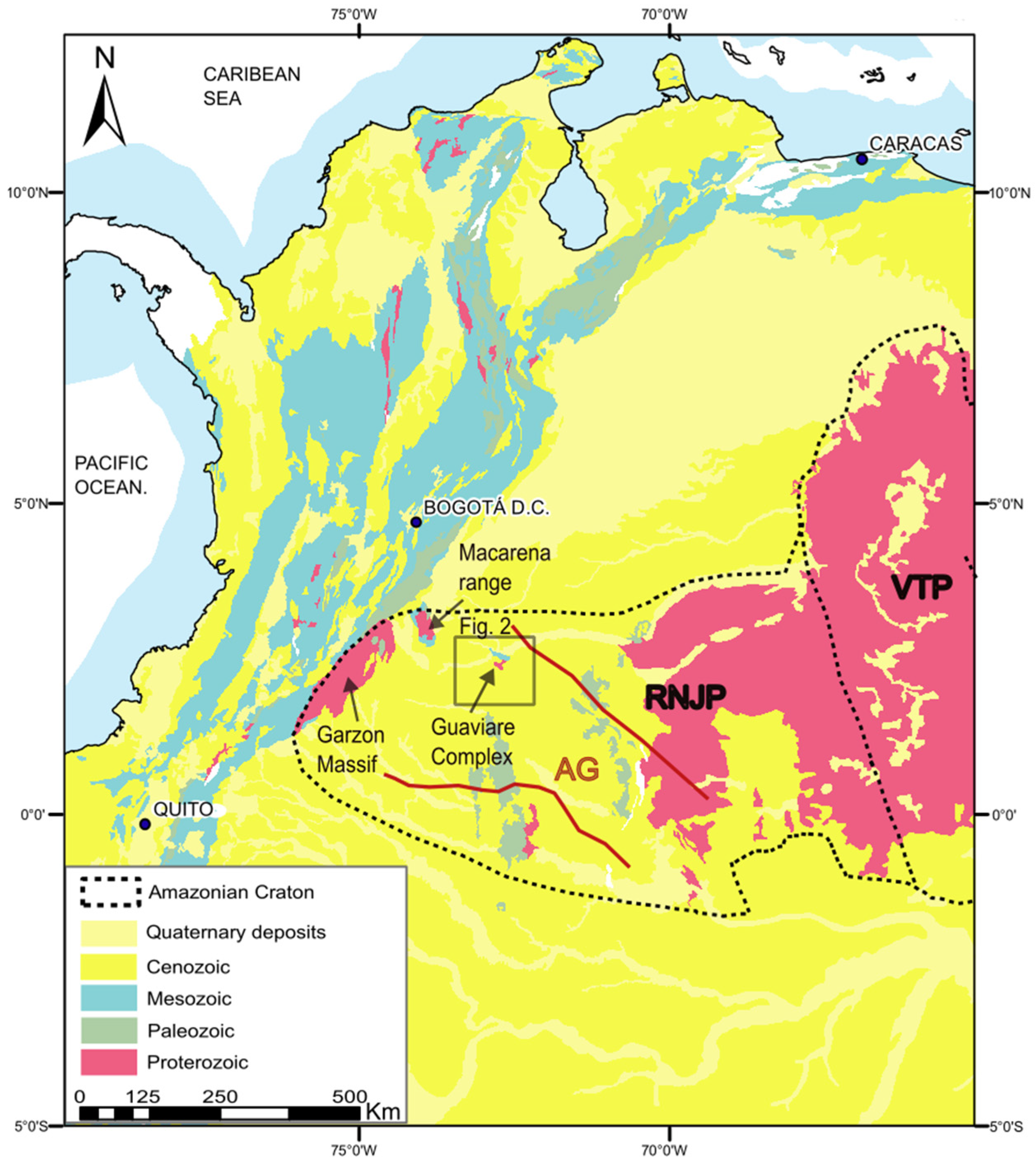
The Guaviare Complex is located in the Colombian Guaviare Department and is part of the NW-Amazonian Craton (AMC), also known as the Guiana Shield. The Guaviare Complex rocks yield U-Pb zircon ages of ~1.3 Ga, interpreted as the age of the igneous protolith [1,2,3], which is related to an extensive NW-SE tectonic structure known as the ‘Apaporis Graben’ [4]. This low-magnetic structure includes mafic dikes and volcanic-sedimentary rocks with ages spanning 1.3–0.8 Ga and can be traced from the Guaviare Complex and continues SE into Brazil (Figure 1 [4,5,6,7]), suggesting magmatism developed contemporaneously with Mesoproterozoic rifting and syn-rift sedimentation (e.g., Piraparana vulcanism, Guaviare Complex protolith).
The Guaviare Complex rocks exhibit clear metamorphic structures and textures; some lithologic units show foliation, compositional banding, and migmatite structures, resulting from at least one regional metamorphic event. Rocks with granoblastic textures also occur as granofels, quartzites, and hornfels [3]. Understanding the metamorphism of the Guaviare Complex is crucial for deciphering the Neoproterozoic history of the Amazonian Craton (AMC), as this unit at the western AMC margin was influenced by the Rodinia assemblage (late Mesoproterozoic to early Neoproterozoic), but the extent and intensity of this influence remain unclear.
The known geological history of the region and field relationships also suggest that the Guaviare Complex has been affected by Late Neoproterozoic to Ediacaran alkaline magmatism, as represented by the San José del Guaviare Nepheline Syenite unit [1,3,8], which is key to understanding how the Apaporis Graben may have been reactivated during the final break-up of Rodinia and the assembly of Gondwana [9].
As a contribution to a better understanding of this complex, we present new U–Pb LA–ICP–MS ages of zircon and apatite from key samples collected at the Termales Gneiss, which has been previously described in detail during the Servicio Geológico Colombiano mapping campaigns [1,2,3]. Our new data helps to constrain the timing of mid- to high-temperature geological events. U–Pb zircon geochronology provides insights into igneous protoliths and/or high-grade metamorphism, which is frequently cited with closure temperature T(c) > 900 °C [10], whereas U–Pb apatite geochronology constrains medium-grade metamorphism typically in the range of (T(c) ≈ 550–350 °C [11], together covering processes occurring at lower- to middle-crustal depths. Combining zircon and apatite geochronology enables the reconstruction of long-lasting thermal histories in cratonic areas and the determination of the influence of post-magmatic cooling or thermal overprinting caused by subsequent tectonometamorphic events [10,11,12,13].

2. Geological Framework

The Amazonian Craton (AMC) in northeastern South America is one of the largest cratonic areas in the world. The evolution of the AMC began during the Late Archaean, resulting from continental-craton amalgamation, and continued through the Paleoproterozoic and Mesoproterozoic, driven by several accretionary episodes that added Upper Mantle-derived and crustal material [14,15]. Most of the AMC is located in Brazil and extends northward into Colombia, Venezuela, Guyana, Suriname, and French Guiana. Geomorphologically, the AMC in Colombia is characterized by shield landscapes, featuring flat plains, low-lying hills, and extensive river systems. These landforms have been shaped by prolonged weathering and erosion and are largely covered by Phanerozoic sediments, resulting in predominantly isolated outcrops. This geomorphological setting contrasts with the adjacent Andean orogen, where active tectonics, uplift, and erosion dominate the landscape.
The exposed AMC basement in eastern Colombia corresponds to the NW of the Río Negro—Juruena Province (RNJP) [15,16], which is mainly composed of granitic gneisses and granitoids of granodioritic and tonalitic composition with ages between 1.85 and 1.50 Ga. Recently, apatite U-Pb ages indicating Early Mesoproterozoic thermal overprinting, with a spatio-temporal relationship to intraplate magmatism, were published [12]. The RNJP appears to have a pronounced western boundary, characterized by rocks deformed during the Putumayo Orogeny, which is visible as a prominent SW-NE lineament with lateral variations in density and magnetic susceptibility [4]. The westernmost visible part of the AMC is exposed at the Macarena Range, where zircons with rims reveal a late thermal overprint at around 1.4 Ga [17]. Further west, basement inliers in the Andean fold-and-thrust belt have been reported with zircon ages at around 1.0 Ga [18,19].
Figure 1. Main Precambrian outcrops in the Amazonian Craton, Colombia. VTP Ventuari-Tapajós Province; RNJP Rio Negro-Juruena Province; AG Apaporis Graben, red line is the Apaporis Graben limit [4,20].
Geosciences 16 00154 g001

2.1. The Guaviare Complex

The Guaviare Complex has been described by Maya Sánchez et al. [3] and comprises three lithostratigraphic units: Neis de Termales (Termales Gneiss), Anfibolita de Unilla (Unilla Amphibolite), and Cuarcita de La Rompida (La Rompida Quartzite). It is located within the RNJP, where the basement records Paleoproterozoic metamorphic ages between 1.85 and 1.7 Ga [21,22,23]. This province extends from the Brazilian–Venezuelan border in the east to the Macarena Range in the west, Figure 1, where it is influenced by the 1.1 to 0.9 Ga Putumayo orogen [24].
Petrographically, the rocks of the Termales Gneiss are quartz-feldspathic gneisses and granofels with photolith ages ca. 1.30 Ga [1,2,3]. High quartz and biotite content may cause lepidoblastic textures, whereas porphyroblastic textures result from feldspar and plagioclase increase [3]. The Unilla Amphibolite is composed of darker bands with relatively more mafic minerals as amphibole and lighter bands with minerals such as plagioclase, whereas the La Rompida Quartzite consists of muscovite quartzites, quartz-feldspathic granofels, and quartz-muscovite schists, and are interpreted as a result of bimodal anorogenic magmatism from a mantle source with crustal contamination. In contrast, the La Rompida Quartzite protoliths correspond to sediments derived from granitic rocks and exposed intracratonic areas with a maximum deposition age of 1.23 Ga [1,3].
Maya Sánchez et al. [3] and Amaya López et al. [1] suggest that low to moderate metamorphism affecting these units occurred between 1.28 Ga and 0.6 Ga and was likely related to the Putumayo Orogeny of Grenvillian age or an independent event.

2.2. San José Del Guaviare Nepheline Syenite

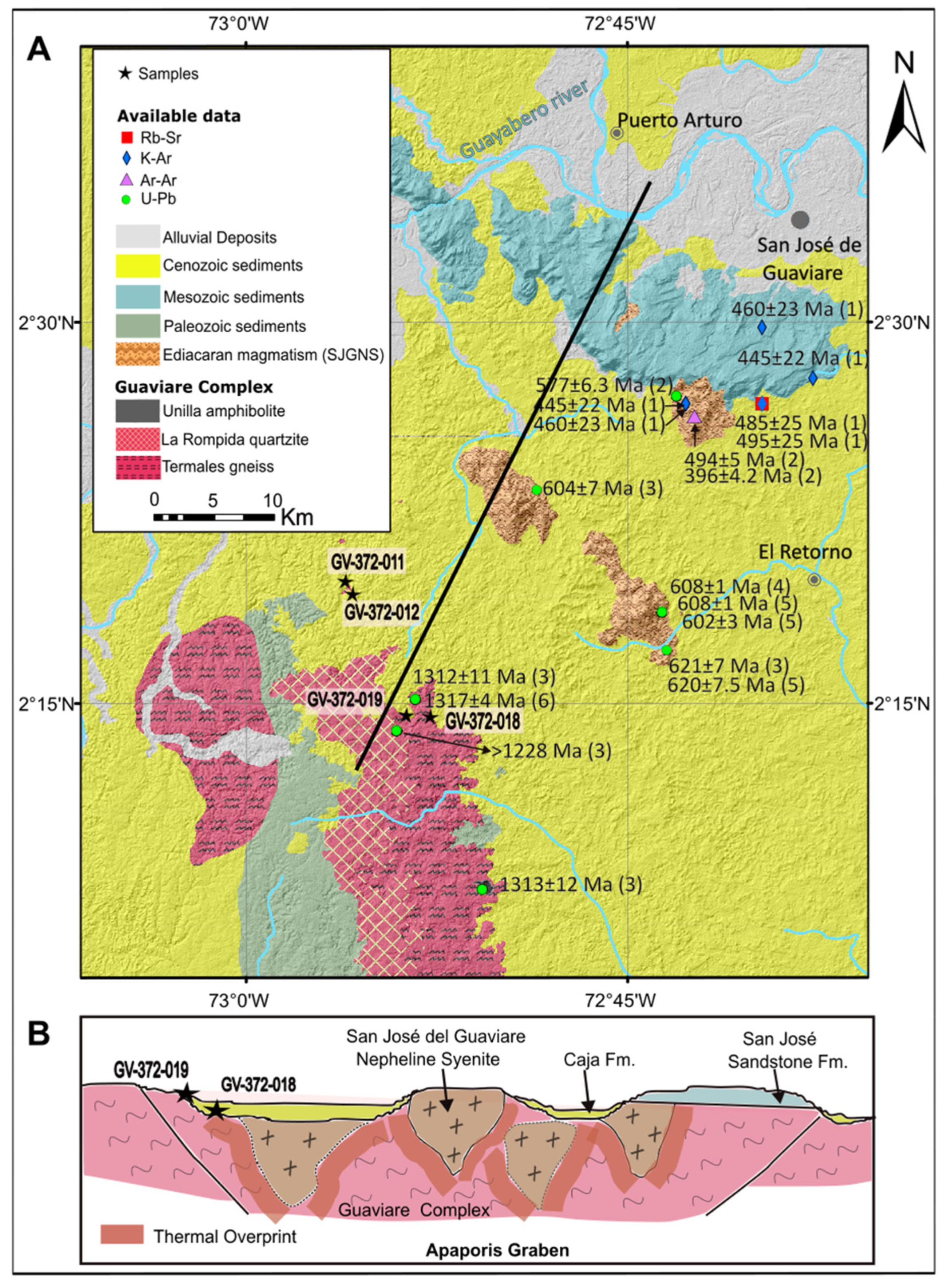
The Ediacaran San José del Guaviare Nepheline Syenite (SJGNS, Figure 2) consists of holocrystalline phaneritic rocks, predominantly inequigranular, with fine to coarse grain sizes. Some of them present a pegmatitic texture. Mineralogically, it is composed of alkali feldspar, nepheline, biotite, and arfvedsonite [25]. It was initially dated by the K-Ar method in biotites, yielding a Cambrian age [26]. Later, biotite Ar-Ar dating yielded an age of 494 ± 5 [26], which was interpreted as the cooling age. U-Pb dating of 29 zircons delivered a crystallization age of 577 ± 6.3 Ma [26]. However, comparative measurements of 92 and 29 large zircons from the SJGNS-Jordan locality, undertaken by the geochronological laboratory of the Servicio Geológico Colombiano and the University of Rennes, revealed crystallization ages of 602 ± 3 Ma and 608.8 ± 1.3 Ma, respectively [8]. This intrusion has been attributed to peralkaline intraplate magmatism and anatectic melting of the lower Crust at the western edge of the AMC [3,25,27]. The intrusive relationship between the San José del Guaviare Nepheline Syenite and the Guaviare Complex is evidenced both by contact aureoles, visible as fine to medium-grained hornfels, and by metamorphic rock xenoliths in the syenite.

3. Materials and Methods

From four Termales-Gneiss samples, zircon and apatite concentrates were recovered and analyzed. These samples were collected in the immediate vicinity of sites previously dated by zircon U-Pb geochronology Table 1 and Figure 2.
LA-ICP-MS U-Pb analysis of the zircons and apatites was performed at the GeOHeLiS Platform of Geosciences Rennes (University of Rennes, France) using an ESI NWR193UC Excimer laser coupled to an Agilent 7700x (Agilent, Santa Clara, CA, USA), Q-ICP-MS equipped with a dual pumping system to enhance sensitivity. Detailed equipment specifications are shown in Table 1. A zircon ablation spot diameter of 25 μm was used, with a repetition rate of 4 Hz and a fluence of 6 J/cm2. The instrumental conditions are listed in Table 1. GJ-1 zircon [28] was used as the primary reference material, with 91500 [29] and Plesovice zircon [30] as secondary reference materials. The measured ages for the secondary standards yielded concordia ages of 1063.8 ± 3.6 Ma (MSWD = 1) for 91500 and 336.4 ± 1.3 Ma (MSWD = 0.64) for Plesovice, both well within the analytical uncertainties of the accepted reference ages. These results confirm the accuracy and reproducibility of the analytical setup used in this study.
For apatite analyses, ablation spot diameters were 50 μm with a repetition rate of 5 Hz and a fluence of 5 J/cm2 (see Table 2 for additional analytical parameters). Madagascar apatite [31] was used as the primary reference material for correcting U/Pb fractionation and mass bias by standard bracketing. McClure [32,33] and Durango apatite [34] were analyzed as secondary standards. The secondary reference materials yielded lower intercept ages of 525.8 ± 6.4 Ma (MSWD 1.3) for McClure and 31.9 ± 0.83 Ma (MSWD 9.94) for Durango, both also within the range of their accepted reference ages, which shows the accuracy and reliability of the apatite U–Pb analytical setup used in this study.
Data were reduced using Iolite v.4.7, VizualAge_UComPbine DRS [35] for apatite, and U-Pb Geochronology DRS [36] for zircon. Isotopic ratios were plotted as Tera-Wasserburg and Wetherill diagrams using IsoplotR [37]. The lower intercepts calculated from these diagrams for apatites are interpreted as the sample U-Pb age and the intercept between the Discordia and the y-axis yields the initial common-Pb composition. All uncertainties are reported at the 2σ level, and dated populations are reported with and without systematic uncertainties, following Horstwood et al. [38].
Table 2. Analytical parameters of U-Pb apatite and zircon analyses performed at GeOHeLiS platform.
U-Pb Apatite and Zircon Analyses
Laboratory & Sample Preparation
Laboratory namePlateforme GeOHeLiS, Géosciences Rennes/OSUR, Univ. Rennes
Sample type/mineralApatite/Zircon
Sample preparationConventional mineral separation, 1 inch epoxy mount, 1 mm polish to finish
Laser ablation system
Make, Model & typeESI NWR193UC, Excimer
Ablation cellESI NWR TwoVol2
Laser wavelength 193 nm
Pulse width <5 ns
Fluence 5 (apatite) or 6 (zircon) J/cm−2
Repetition rate 5 (apatite) or 4 (zircon) Hz
Spot size 50 (apatite) or 25 (zircon) μm (round spot)
Sampling mode/patternSingle spot
Carrier gas100% He, Ar make-up gas and N2 (3 mL/min) combined using in-house smoothing device
Background collection 15 s
Ablation duration40 s
Wash-out delay10 s
Cell carrier gas flow (He)0.70 L/min
ICP-MS Instrument
Make, Model & typeAgilent 7700x, Q-ICP-MS
Sample introductionVia conventional tubing
RF power 1350 W
Sampler, skimmer conesNi
Extraction lensesX type
Make-up gas flow (Ar)0.70 L/min
Detection systemSingle collector secondary electron multiplier
Data acquisition protocolTime-resolved analysis
Scanning modePeak hopping, one point per peak
Detector modePulse counting, dead time correction applied, and analog mode when signal intensity > ~106 cps
Masses measured204(Hg + Pb), 206Pb, 207Pb, 208Pb, 232Th, 238U.
Integration time per peak 10–30 ms
Sensitivity/Efficiency 21,000 cps/ppm Pb (50 µm, 10 Hz)
Dwell time per isotope10–30 ms depending on the masses
Data Processing
Calibration strategyApatite: Madagascar used as primary reference material, Durango and McClure used as secondary reference material (quality control)
Zircon: GJ-1 zircon used as primary reference material, 91500 and Plesovice zircon used as secondary reference material (quality control)
Reference Material infoMadagascar [31]
Durango [34]
McClure [33]
GJ-1 [28]
91500 [29]
Plesovice [30]
Data processing package used Iolite v.4.7, VizualAge_UComPbine DRS [35]
for apatite, U-Pb Geochronology DRS [36] for zircon.
Mass discriminationStandard-sample bracketing with 207Pb/206Pb, 206Pb/238U and 207Pb/235U normalized to reference material
Common Pb correctionNo common Pb correction for zircon. Madagascar apatite primary standard is corrected for common Pb.
Uncertainty level and propagationAges are quoted at 2 sigma, propagation is by quadratic addition according to Horstwood et al. [38].
Quality control/ValidationAll control materials are in the reference age range, see data table

4. Results

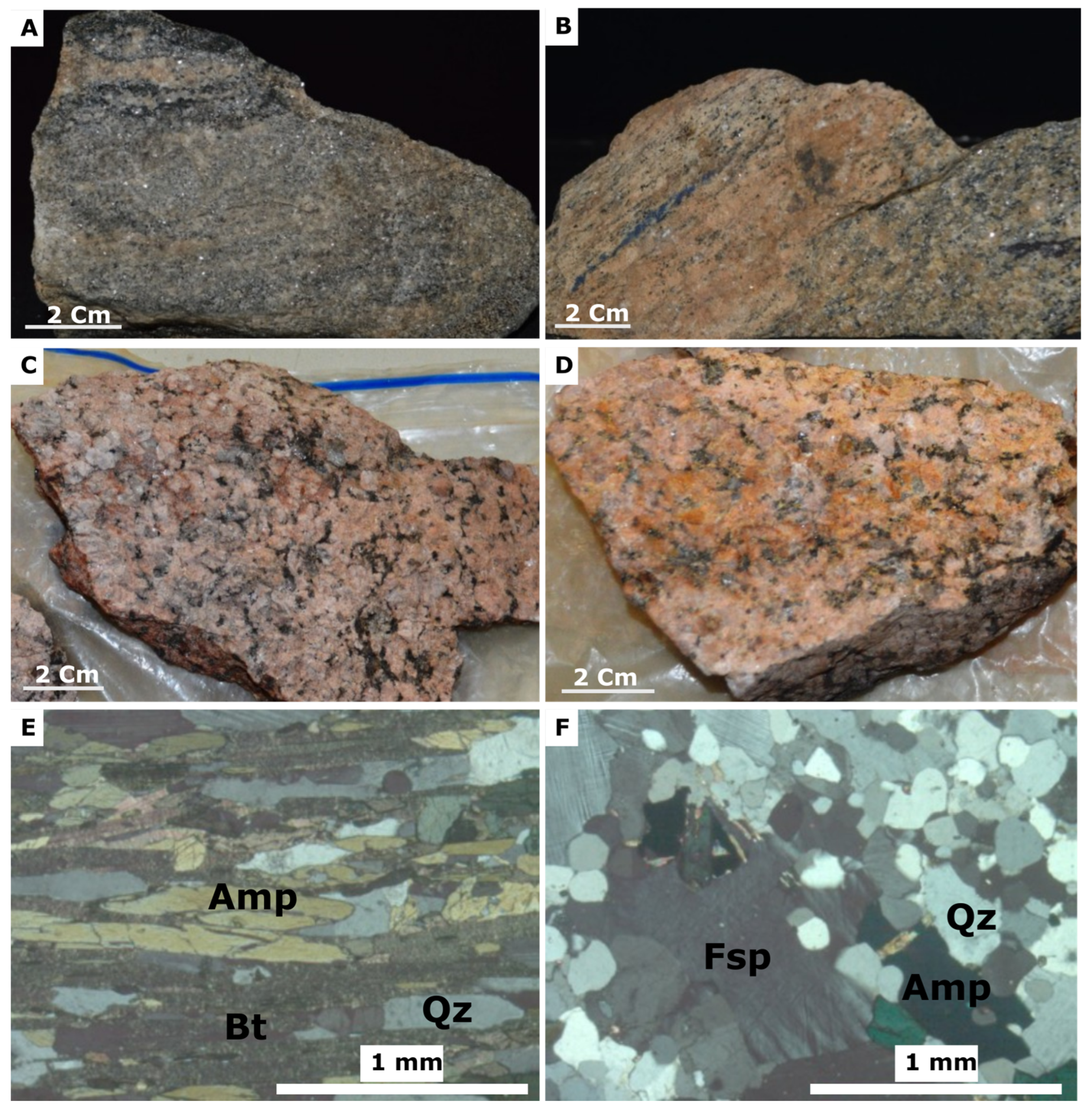
The analyzed metamorphic rocks are classified as quartz-feldspathic gneisses. The foliation structure follows a 115°/37° trend (dip dir/dip) and the joints have 120°/40° and 310°/40° orientations. These gneisses record regional metamorphic conditions and contain more than 10% modal quartz. The observed paragenesis of quartz + plagioclase + alkali feldspar + biotite ± amphibole ± titanite ± zircon is consistent with intermediate-grade metamorphism, corresponding to the amphibolite facies. They exhibit a well-developed, continuous foliation defined by the preferred orientation of biotite, muscovite, and quartz–feldspar ribbons, together with gneissic banding produced by alternating felsic and mafic mesosomes. Texturally, they exhibit nematoblastic fabrics with aligned amphibole–biotite aggregates in the mafic layers and lepidoblastic fabrics with aligned biotite in the felsic domains (Figure 3C). Detailed mapping as well as geological, petrographic, and geochemical descriptions of the Termales Gneiss are provided in Maya Sánchez et al. [3], Amaya López et al. [1], and Franco et al. [2].
Sample GV-372-018 is a medium-grained metamorphic feldspathic gneiss characterized by an inequigranular texture (Figure 3A). It is composed of approximately 70% alkali feldspar, 20% brown biotite, and 10% amphibole, suggesting a protolith of alkali-feldspar syenite. The rock displays alternating gray to black bands in which the proportion of mafic minerals, such as biotite, increases relative to felsic minerals, such as alkali feldspar. Although present in minor amounts, quartz exhibits a well-developed granoblastic texture, in contrast to alkali feldspar, forming equant, interlocking grains that reflect recrystallization (Figure 3D).
Sample GV-372-019 is a coarse-grained quartz-felspathic gneiss, exhibiting a foliated structure ranging from beige to ochre color with dark mafic bands (Figure 3A). Its composition is predominantly 45% alkali feldspar, 35% quartz, 15% hornblende, and 5% biotite, suggesting a protolith of alkali feldspar granite.
Sample GV-372 011 corresponds to an epidote-altered quartz–feldspathic orthogneiss, composed mainly of orthoclase and quartz, with minor microcline, plagioclase, and chlorite (Figure 3C), as well as accessory minerals such as magnetite and zircon. Regarding specific textures, chlorite exhibits a lepidoblastic texture.
Sample GV-372 012 corresponds to a quartz–feldspathic orthogneiss with a cataclastic to mylonitic texture (Figure 3D), displaying deformation indicators such as quartz with undulatory extinction and veins filled with fragments of quartz, plagioclase, and orthoclase of heterogeneous grain size.

4.1. Zircon Geochronology

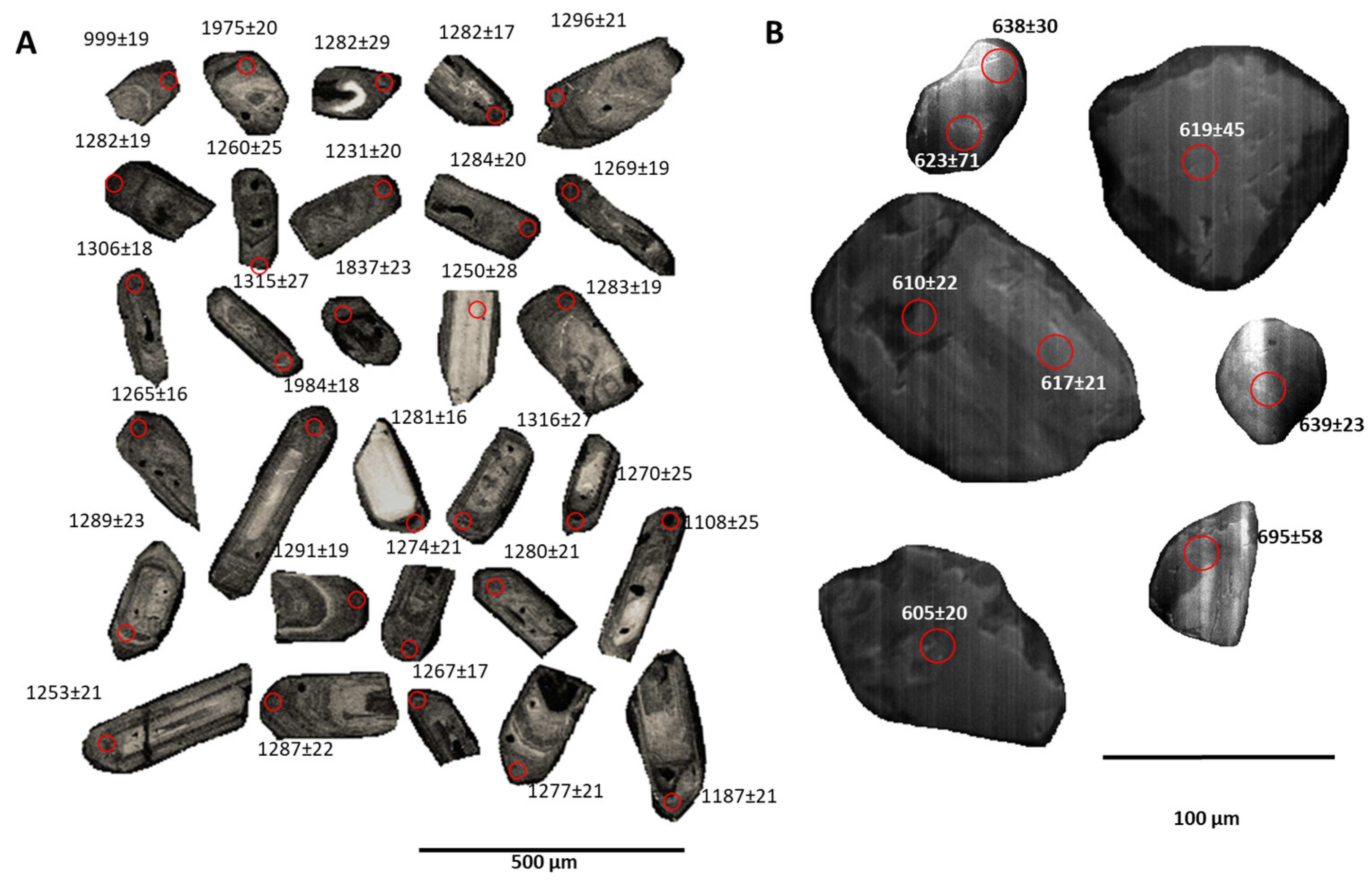
Zircon crystals in sample GV-372-019 are idiomorphic to subidiomorphic, mostly prismatic, with a subordinate subrounded population. Grain sizes range from 200 to 400 µm. Some crystals display fractures and inclusions of other minerals that were not analyzed. In cathodoluminescence (CL) images, most grains exhibit complex internal textures characterized by well-developed oscillatory zoning, commonly surrounding inherited cores of irregular to rounded morphology (Figure 4A). In addition to oscillatory zoning, several grains show sector zoning and patchy or diffuse luminescence domains, locally associated with embayed core–rim boundaries. The inherited cores typically exhibit distinct luminescence contrasts relative to the surrounding zircon, suggesting resorption prior to subsequent overgrowth. These cores are frequently mantled by oscillatory-zoned rims, consistent with magmatic crystallization. In some cases, outer domains appear homogeneous or weakly zoned, which may reflect metamorphic recrystallization or fluid-assisted modification.
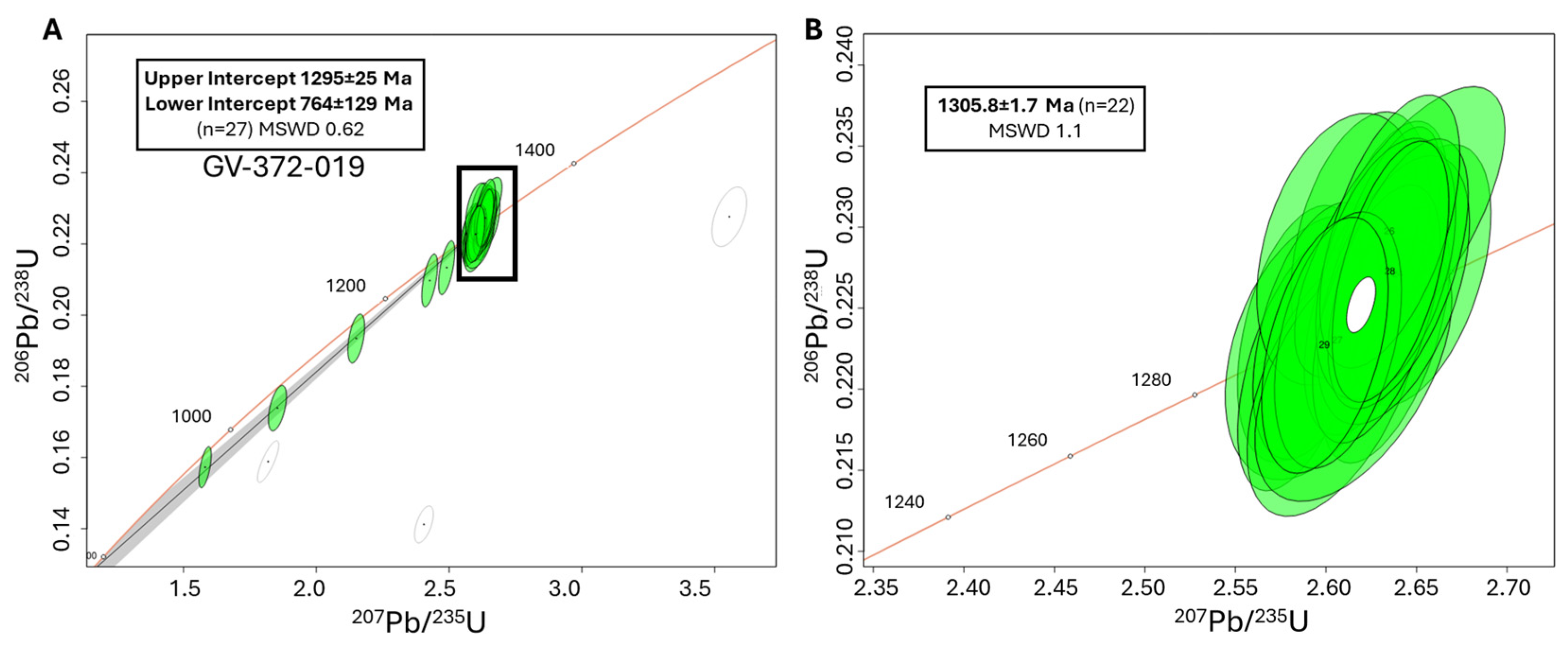
From 30 analyzed grains (Supplementary Materials), a cluster of 22 concordant analyses (<2% discordance) defines a well-constrained Concordia age of 1305.8 ± 9.7 Ma (MSWD = 1.1), interpreted as the best estimate for the timing of zircon crystallization. The use of the Concordia diagram is appropriate for these analyses, as their near-concordant nature indicates minimal Pb loss and closed-system behavior.
In addition, five discordant analyses define a linear array on the Concordia diagram and are used to construct a Discordia line, yielding an upper intercept age of 1295 ± 26 Ma and a lower intercept age of 764 ± 132 Ma (MSWD = 0.62; Figure 5A,B). The Discordia regression is employed to account for Pb loss affecting a subset of grains, allowing the separation of the primary crystallization age (upper intercept) from a later disturbance event (lower intercept).

4.2. Apatite Geochronology

Apatite crystals are rounded and range in size from 100 to 250 μm. While they are generally known for their high luminescence in cathodoluminescence (CL) imaging, obtaining clear CL images was difficult because some crystals exhibit low luminescence. Their chemical composition can influence this variation. However, some crystals display internal textures, such as magmatic zoning surrounded by a thick rim (Figure 4B).
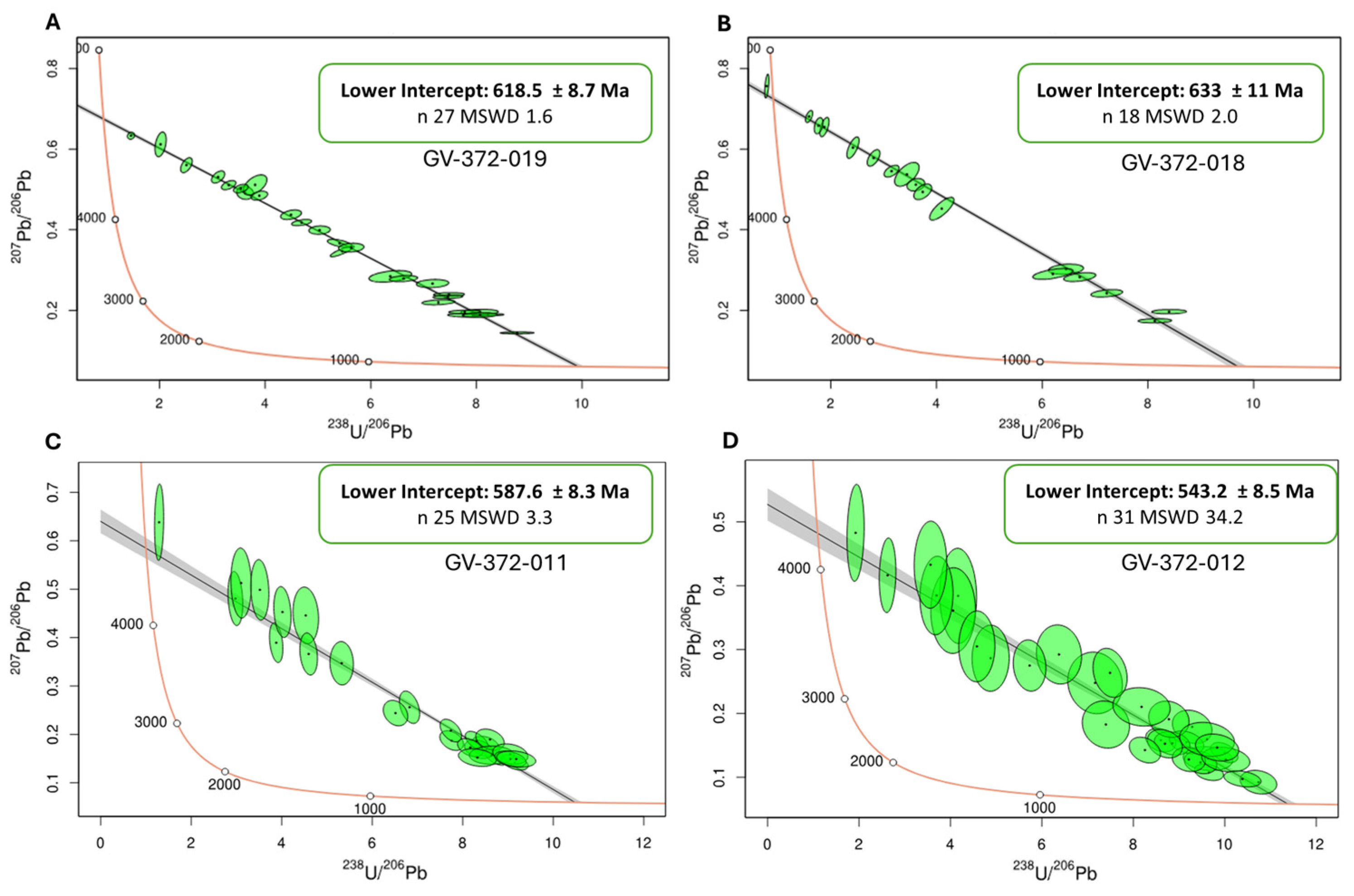
The 27 ablations on apatite grains (Supplementary Materials) from sample GV-372-019 (Figure 6A), which are aligned on a Discordia due to variable amounts of common Pb, yield a lower intercept age of 618.5 ± 8.8 Ma (MSWD = 1.6) and a 207Pb/206Pb initial ratio of 0.739. The 18 ablations on sample GV-372-018 yield a lower intercept age of 633 ± 16.1 Ma (MSWD 2, Figure 6B) and a 207Pb/206Pb initial of 0.793. The 25 ablations on sample GV-372-011 yield a lower intercept age of 587 ± 8.3 Ma (MSWD 3.3, Figure 6C) and a 207Pb/206Pb initial of 0.793. No age variation is observed between cores and rims. Finally, the 31 ablations on sample GV-372-012 yield a lower intercept age of 543 ± 8.5 Ma (MSWD 4.2, Figure 6D) and a 207Pb/206Pb initial of 0.793. No age variation is observed between cores and rims.

5. Discussion

The AMC in Colombia comprises a complex Proterozoic basement with U-Pb ages ranging from 1.85 to 1.3 Ga. Even if Phanerozoic tectonism has recently been documented by Apatite Fission Track (AFT) studies, with significant basement exhumation resulting from coeval extensional tectonics associated with Cretaceous back-arc rifts [39], the craton overall exhibits remarkable stability, in contrast to the tectonically active Andean region. This stability has preserved these ancient rocks, allowing us to characterize most geological events in detail.

5.1. Guaviare Complex Protolith Formation

The Guaviare Complex records a dominant zircon U–Pb population at ca. 1.30 Ga, consistent with previous studies [1,2,3,40], and interpreted as the crystallization age of an igneous protolith. This age is consistent with the occurrence of widespread Mesoproterozoic magmatism in the northwestern Amazonian Craton. Available geochemical data indicate that this magmatism exhibits A-type affinity, suggesting emplacement under intracratonic extensional conditions [3,4], likely associated with elevated heat flow and lithospheric thinning. Such settings are consistent with anorogenic magmatism and crustal reworking during the Mesoproterozoic. Although a broader range of zircon ages (~1.4–1.2 Ga) is observed, the main concordant cluster at ~1.30 Ga provides the most robust constraint on protolith formation. However, the current dataset does not allow a clear distinction between magmatic and inherited zircon domains in all cases. Consequently, interpretations of the tectonic setting, while consistent with an extensional regime, should be regarded as tentative.

5.2. Evidence for Mesoproterozoic Metamorphism

Metamorphism and tectonic reworking of the Guaviare Complex are recorded by a pervasive network of shear zones, faults, and penetrative metamorphic foliations, reflecting multiple deformation phases. Previous studies [1,23,40] report zircon ages between ~1.2 and 1.0 Ga, interpreted as metamorphic recrystallization during the Putumayo Orogeny. In the present dataset, some zircon domains exhibit recrystallization textures and discordance; however, no statistically robust or texturally well-defined metamorphic zircon population is identified. Therefore, although a Mesoproterozoic metamorphic event is regionally supported, it is not directly constrained by the new zircon data presented here and should be considered an inherited regional interpretation rather than a primary result of this study.
Accordingly, zircon data alone do not allow discrimination between metamorphic recrystallization, fluid-mediated Pb loss, or prolonged thermal disturbance during the Mesoproterozoic–Neoproterozoic interval. While the timing of peak metamorphic conditions cannot be directly constrained, the regional structural framework—together with previously published geochronological data—supports a correlation between the main dynamo-thermal metamorphic event affecting the Guaviare Complex and the Putumayo Orogeny. This correlation, however, remains interpretative and is not uniquely resolved by the present dataset.

5.3. Ediacaran Thermal Disturbance Recorded by Apatite

Apatite U–Pb data from four samples yield consistent lower intercept ages between ~633 and 543 Ma, indicating a widespread late Neoproterozoic thermal disturbance affecting the Guaviare Complex. The absence of systematic age differences between cores and rims suggests that Pb loss occurred at the grain scale, consistent with pervasive thermal or fluid-assisted resetting. Given the estimated apatite closure temperature range (~350–550 °C; [15]), these ages likely record a thermal event affecting mid- to upper-crustal levels. However, the mechanism responsible for this disturbance remains uncertain.
One possible explanation is thermal overprinting associated with Ediacaran alkaline magmatism, including emplacement of the San José del Guaviare Nepheline Syenite (~620–602 Ma; [3,8,25,27]). This intrusion also displays A-type geochemical affinity, indicating a recurrence of extensional magmatic conditions during the late Neoproterozoic.
Contact metamorphism could, in principle, generate the temperatures required for apatite resetting. However, the sampled localities are situated up to ~10 km from known intrusive bodies, and no quantitative thermal modeling is currently available to demonstrate that temperatures exceeding ~350–550 °C could be sustained at such distances. First-order conductive models suggest that aureole widths of several kilometers would require intrusions of substantial size (kilometer- to tens-of-kilometers scale), depending on emplacement depth and thermal properties of the host rocks. Nevertheless, it is important to consider that outcrop exposure in the study area is limited and discontinuous. As such, the spatial distribution of mapped intrusions may be incomplete, and additional intrusive bodies could remain buried beneath sedimentary cover (Figure 2), potentially reducing the apparent distance between heat sources and sampled localities.
Alternatively, the apatite ages may reflect a broader regional thermal perturbation associated with lithospheric extension, crustal thinning, or fluid circulation during the breakup of Rodinia. Fluid-assisted Pb mobility is supported by Sr isotopic disturbance reported in previous studies [3], indicating that hydrothermal processes may have contributed to isotopic resetting.
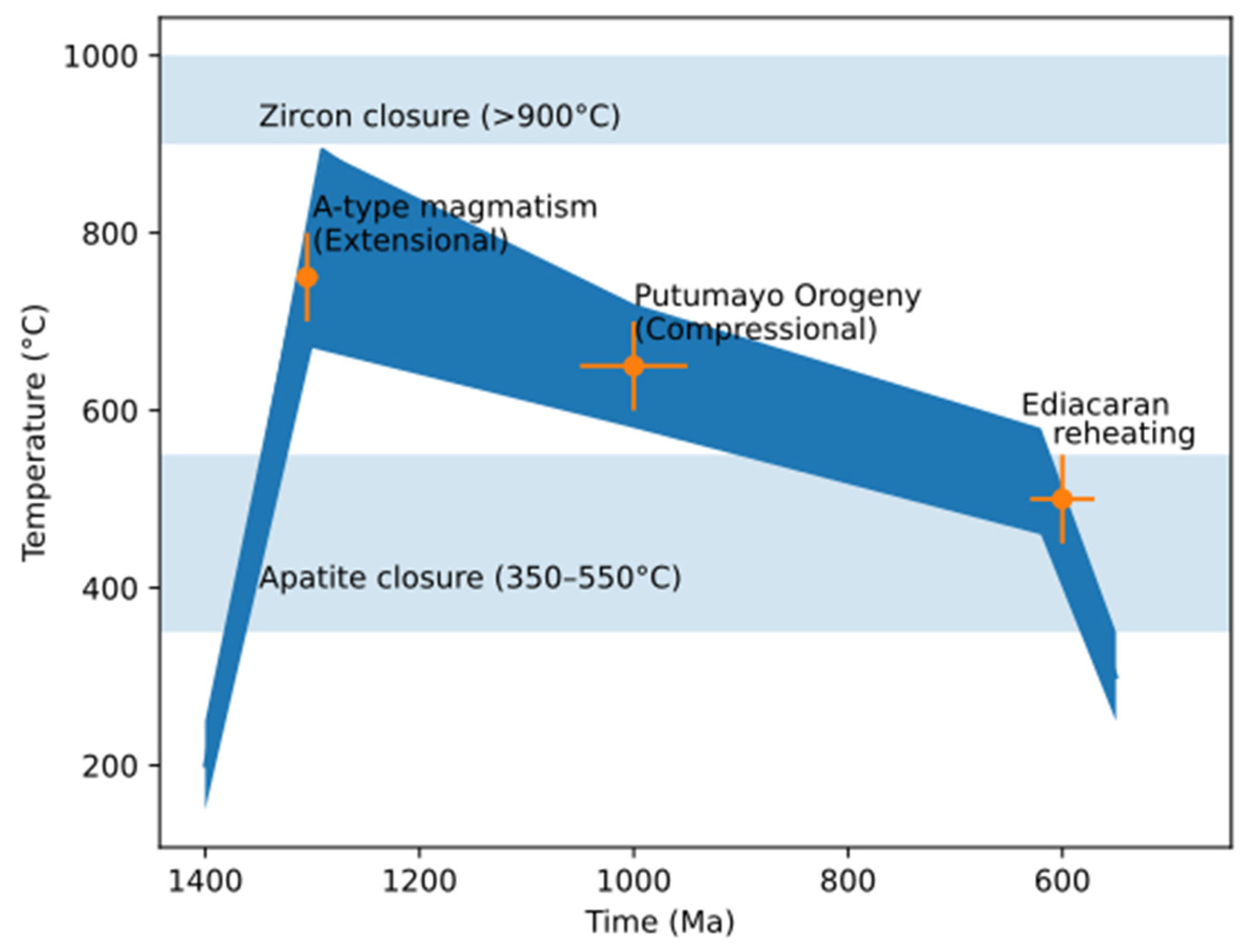
Given the available data, both localized magmatic heating and regional tectonothermal processes remain viable explanations. An integrated P–T–t framework (Figure 7) provides a physically consistent model linking Mesoproterozoic A-type magmatism, Grenvillian-age metamorphism, and Ediacaran thermal reworking, while explicitly acknowledging uncertainties.

5.4. Tectonometamorphic Implications for the Breakup of Rodinia and Gondwana Assembly

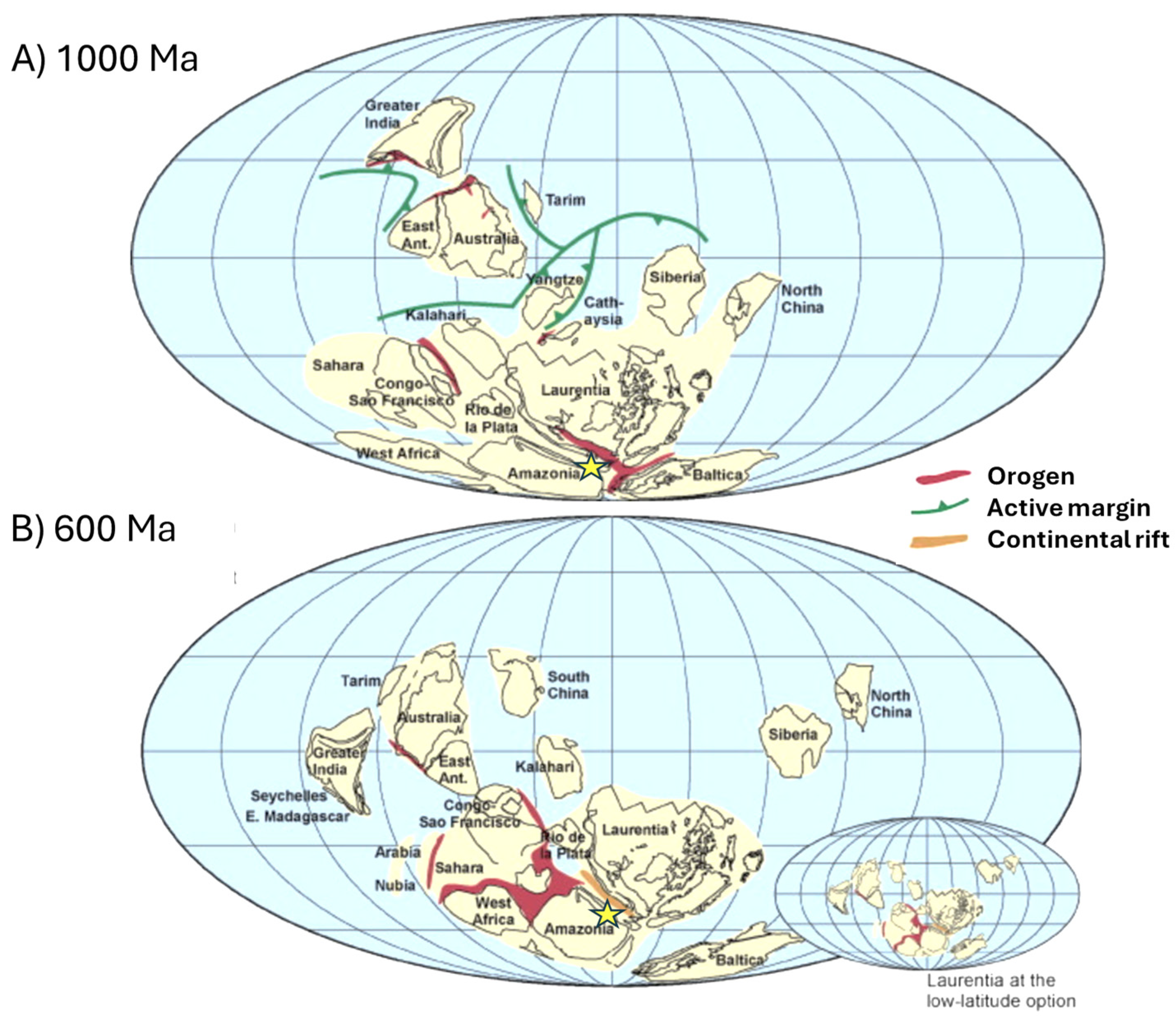
The tectonic evolution of the Amazonian Craton spans both the assembly and subsequent breakup of Rodinia, followed by its involvement in the early stages of Gondwana amalgamation. During the Mesoproterozoic–early Neoproterozoic (~1.0 Ga; Figure 8A), the northwestern Amazonian Craton was involved in collisional processes associated with the Grenville–Sunsás orogenic system, marking the final assembly of Rodinia.
In contrast, during the Ediacaran (~600 Ma; Figure 8B), the craton experienced a shift to extensional tectonics associated with the breakup of Rodinia and the opening of the Iapetus Ocean. Ediacaran alkaline magmatism, including the San José del Guaviare Nepheline Syenite and Caño Veinte syenite [41], is interpreted as part of this large extensional regime, consistent with anorogenic, rift-related settings developed during the separation of Amazonia from Laurentia [42,43,44,45,46,47,48].
The associated thermal overprint recorded in apatite may therefore reflect either localized magmatic heating linked to these intrusions or broader lithospheric-scale thermal reactivation during continental breakup.
Figure 8. Paleogeographic reconstruction [48] illustrating the tectonic evolution of the northwestern Amazonian Craton (Guaviare Complex; yellow star) during Rodinia assembly and breakup. (A) At ~1.0 Ga, Amazonia was juxtaposed against eastern Laurentia and Baltica along the Grenville–Sunsás orogenic belts, recording collisional processes associated with the final assembly of Rodinia; (B) At ~600 Ma, during the Ediacaran, the craton experienced extensional tectonics related to the breakup of Rodinia and the opening of the Iapetus Ocean. Alkaline magmatism, represented by the San José del Guaviare nepheline syenite, developed in an anorogenic, rift-related setting associated with continental fragmentation.
Geosciences 16 00154 g008

6. Conclusions

Zircon U–Pb data define a robust crystallization age of ca. 1.30 Ga for the Guaviare Complex protolith, consistent with regional Mesoproterozoic magmatism. However, evidence for a Mesoproterozoic (~1.2–1.0 Ga) metamorphic event is limited in the new dataset and mainly supported by previously published studies. No well-defined metamorphic zircon population is identified.
Apatite U–Pb ages from four samples consistently record a late Neoproterozoic thermal disturbance between ~633 and 543 Ma, indicating a regional-scale event affecting the Guaviare Complex. The mechanism responsible for this thermal disturbance remains uncertain. Both contact metamorphism related to Ediacaran alkaline intrusions and regional tectonothermal processes (621–577 Ma), including fluid-assisted resetting, are viable explanations.
Petrographic observations support elevated temperatures but do not provide definitive constraints on P–T conditions or timing, highlighting the need for integrated thermobarometric analyses.
The combined zircon–apatite dataset demonstrates the complexity of the thermal evolution of the NW Amazonian Craton and underscores the importance of multi-chronometer approaches.

Supplementary Materials

The following supporting information can be downloaded at: https://www.mdpi.com/article/10.3390/geosciences16040154/s1, Table S1: Guaviare Data.

Author Contributions

Conceptualization, A.B.P. and N.C.; methodology, N.C.; software, N.C.; validation, A.B.P., N.C. and C.A.Z.M.; formal analysis, A.B.P. and N.C.; investigation A.B.P., N.C. and C.A.Z.M.; resources, A.B.P., N.C. and C.A.Z.M.; data curation, A.B.P. and N.C.; writing—original draft preparation, A.B.P., N.C. and C.A.Z.M.; writing—review and editing, A.B.P., N.C. and C.A.Z.M. All authors have read and agreed to the published version of the manuscript.

Funding

This research received no external funding.

Data Availability Statement

Data is available as Supplementary Data.

Acknowledgments

We extend our thanks to the GEGEMA research group from the Universidad Nacional de Colombia for their collaboration in sampling and sample preparation. Special thanks to INCLAY labs for providing the CL images. We thank Zeze Amaya and Jose Alejandro Franco for fieldwork support. The authors are grateful to three anonymous reviewers for their insightful and constructive comments, which significantly improved the manuscript.

Conflicts of Interest

The authors declare no conflicts of interest.

Abbreviations

The following abbreviations are used in this manuscript:
AMCAmazonian Craton
RNJPRio Negro-Juruena Province

References

  1. López, C.A.; Álvarez, J.J.R.; Scharff, M.W.; Jiménez, F.A.C.; Botelho, N.F.; Mejía, M.I.; Sánchez, M.M.; Parra, O.M.P.; Cárdenas, C.R. The Guaviare Complex: New evidence of Mesoproterozoic (ca. 1.3 Ga) crust in the Colombian Amazonian Craton. Boletín Geol. 2020, 34, 5–34. [Google Scholar] [CrossRef]
  2. Franco, J.A.; Cramer, T.; Bonilla, A.; Santos, M.; López, R.; Trujillo, J. Edad U-Pb LA-ICP-MS en circones de las areniscas de la Formación San José en Ciudad de Piedra y de neises Mesoproterozoicos en Guaviare, Colombia. Boletín Geol. 2022, 44, 15–37. [Google Scholar]
  3. Maya, M.; Amaya, C.; Restrepo, J.; Duque, J.; Palacio, A.; Gutiérrez, P.; Pérez, O.; Ríos, C.; Arias, E.; Bedoya, J. Memoria Explicativa de la Plancha 372—El Retorno; Servicio Geológico Colombiano: Bogotá, Colombia, 2018; 330p. [Google Scholar]
  4. Moyano Nieto, I.; Prieto, G.; Ibañez-Mejia, M. Tectonic domains in the NW Amazonian Craton from geophysical and geological data. Precambrian Res. 2022, 377, 106735. [Google Scholar] [CrossRef]
  5. Etayo, F.; Buenaventura, J.; Vargas, R.; Espinosa, A.; Nuñez, A.; Gonzalez, H.; Orrego, A. Mapa Geológico de Colombia, Scale 1:1’000,000; Instituto Nacional de Investigaciones Geológico-Mineras (INGEOMINAS): Bogotá, Colombia, 1986. [Google Scholar]
  6. Galvis Vergara, J.; Huguett, A.; Ruge, P. Geología de la Amazonía Colombiana. Boletín Geol. 1979, 22, 3–86. [Google Scholar]
  7. Kroonenberg, S.B. The proterozoic basement of the Western Guiana Shield and the Northern Andes. Front. Earth Sci. 2019, 115–192. [Google Scholar] [CrossRef]
  8. Rocha, J.A.M.; Piraquive, A.; Victoria, J.A.F.; Pérez, A.B.; Urueña, L.M.P.; Cramer, T.H.; Rocha, L.d.P.R.; Escalante, N.V. Megacircones ediacáricos de la sienita nefelínica de San José del Guaviare y su potencial como material de referencia para datación U/Pb mediante LA-ICP-MS. Boletín Geol. 2019, 45, 5–22. [Google Scholar] [CrossRef]
  9. Meert, J.G.; Powell, C.M. Assembly and breakup of Rodinia: An introduction to the special volume. Precambrian Res. 2001, 110, 1–8. [Google Scholar] [CrossRef]
  10. Lee, J.K.W.; Williams, I.S.; Ellis, D.J. Pb, U and Th diffusion in natural zircon. Nature 1997, 390, 159–162. [Google Scholar] [CrossRef]
  11. Chew, D.M.; Spikings, R.A. Geochronology and Thermochronology Using Apatite: Time and Temperature, Lower Crust to Surface. Elements 2015, 3, 189–194. [Google Scholar] [CrossRef]
  12. Bonilla, A.; Franco Victoria, J.A.; Cramer, T.; De Grave, J.; Nachtergaele, S.; Cogné, N.; Piraquive, A. The NW Amazonian Craton in Guainía and Vaupés departments, Colombia: Evidence of a Mesoproterozoic thermal event from apatite LA-ICP-MS U-Pb geochronology and its relation to continental rifting. Precambrian Res. 2023, 395, 107148. [Google Scholar] [CrossRef]
  13. Kirkland, C.L.; Yakymchuk, C.; Szilas, K.; Evans, N.; Hollis, J.; McDonald, B.; Gardiner, N.J. Apatite: A U-Pb thermochronometer or geochronometer. Lithos 2018, 318–319, 143–157. [Google Scholar] [CrossRef]
  14. Geraldes, M.; Tavares, A.; Santos, A. An Overview of the Amazonian Craton Evolution: Insights for Paleocontinental Reconstruction. Int. J. Geosci. 2015, 06, 1060–1076. [Google Scholar] [CrossRef]
  15. Tassinari, C.C.G.; Macambira, M.J.B. Geochronological provinces of the Amazonian Craton. Episodes 1999, 22, 174–182. [Google Scholar] [CrossRef] [PubMed]
  16. Bonilla, A.; Cramer, T.; Hernandez, L.A. The NW-Amazonian Craton in Colombia: A Paleo-Mesoproterozoic review. J. S. Am. Earth Sci. 2025, 168, 15. [Google Scholar] [CrossRef]
  17. Ibañez Mejia, M.; Ruiz, J.; Valencia, V.; Cardona, A.; Gehrels, G.; Mora, A. The Putumayo Orogen of Amazonia and its implications for Rodinia reconstructions: New U–Pb geochronological insights into the Proterozoic tectonic evolution of northwestern South America. Precambrian Res. 2011, 191, 58–77. [Google Scholar] [CrossRef]
  18. Ramos, V. The Grenville-age basement of the Andes. J. S. Am. Earth Sci. 2011, 29, 77–91. [Google Scholar] [CrossRef]
  19. Cordani, U.G.; Cardona, A.; Jiménez, D.; Liu, D.; Nutman, A.P. Geochronology of Proterozoic basement inliers from the Colombian Andes: Tectonic history of remnants from a fragmented Grenville belt. In Terrane Processes at the Margins of Gondwana; Vaughan, A.P.M., Leat, P.T., Pankhurst, R.J., Eds.; Special Publication; Geological Society of London: London, UK, 2005; Volume 246, pp. 329–346. [Google Scholar]
  20. Gómez, J.; Montes, N.E.; Marín, E. Compiladores. In Mapa Geológico de Colombia 2023. Escala 1:1 500 000; Servicio Geológico Colombiano: Bogotá, Columbia, 2023. [Google Scholar]
  21. Cordani, U.G.; Sato, K.; Sproessner, W.; Fernandes, F.S. U-Pb zircon ages of rocks from the Amazonas Territory of Colombia and their bearing on the tectonic history of the NW sector of the Amazonian Craton. Braz. J. Geol. 2016, 46, 5–35. [Google Scholar] [CrossRef]
  22. Bonilla, A.; Cramer, T.; Poujol, M.; Cano, H.; Franco, J.A.; Amaya, Z. Petrografía, geoquímica y geocronología U/Pb en circones de rocas ígneas y metamórficas a lo largo del Río Cuiarí en Guainía, Colombia. Boletín Geol. 2019, 41, 55–84. [Google Scholar] [CrossRef]
  23. Bonilla, A.; Cramer, T.; De Grave, J.; Alessio, B.; Glorie, S.; Kroonenberg, S. The NW Amazonian Craton in Guainía and Vaupes departments, Colombia: Transition between orogenic to anorogenic environments during the Paleo-Mesoproterozoic. Precambrian Res. 2021, 360, 106223. [Google Scholar] [CrossRef]
  24. Ibañez Mejia, M. The Putumayo Orogen of Amazonia: A Synthesis. In The Geology of Colombia, Volume 1 Proterozoic—Paleozoic; Servicio Geológico Colombiano: Bogotá, Columbia, 2020; pp. 101–131. [Google Scholar] [CrossRef]
  25. Arango Mejía, M.I.; García, G.Z.; Martens, U. Caracterización Petrográfica, Geoquímica y Edad de la Sienita Nefelínica de San José Del Guaviare. Boletín Geol. 2012, 34, 15–26. [Google Scholar]
  26. Pinson, W.H.; Hurley, P.M.; Mencher, E.; Fairbairn, H.W. K-Ar and Rb-Sr Ages of Biotites from Colombia, South America. Geol. Soc. Am. Bull. 1962, 73, 907–910. [Google Scholar] [CrossRef]
  27. Franco, J.A.; Muñoz, J.A.; Piraquive, A.; Bonilla, A.; Amaya, Z.; Cramer, T.; Campos, H. Geochronology of the Nepheline Syenite of el Jordán, Guaviare Colombia, evidences of Neoproterozoic-Cambrian intraplate magmatism and itsimplications during Pan-African tectonics in western Gondwana. In EGU General Assembly Conference Abstracts; EGU: Vienna, Austria, 2018; Volume 20. [Google Scholar]
  28. Jackson, S.E.; Pearson, N.J.; Griffin, W.L.; Belousova, E.A. The application of laser ablation-inductively coupled plasma-mass spectrometry to in situ U–Pb zircon geochronology. Chem. Geol. 2004, 211, 47–69. [Google Scholar] [CrossRef]
  29. Wiedenbeck, M.A.; Alle, P.; Corfu, F.; Griffin, W.L.; Meier, M.; Oberli, F.V.; von Quadt, A.; Roddick, J.C.; Spiegel, W. Three Natural Zircon Standards for U-Th-Pb, Lu-Hf, Trace Element and Ree Analyses. Geostand. Newsl. 1995, 19, 1–23. [Google Scholar] [CrossRef]
  30. Sláma, J.; Košler, J.; Condon, D.J.; Crowley, J.L.; Gerdes, A.; Hanchar, J.M.; Horstwood, M.S.; Morris, G.A.; Nasdala, L.; Norberg, N.; et al. Plešovice zircon—A new natural reference material for U–Pb and Hf isotopic microanalysis. Chem. Geol. 2008, 249, 1–35. [Google Scholar] [CrossRef]
  31. Thomson, S.N.; Gehrels, G.E.; Ruiz, J.; Buchwaldt, R. Routine low-damage apatite U-Pb dating using laser ablation–multicollector–ICPMS. Geochem. Geophys. Geosystems 2012, 13. [Google Scholar] [CrossRef]
  32. Krestianinov, E.; Amelin, Y.; Neymark, L.A.; Aleinikoff, J.N. U-Pb systematics of uranium-rich apatite from Adirondacks: Inferences about regional geological and geochemical evolution, and evaluation of apatite reference materials for in situ dating. Chem. Geol. 2021, 581, 120417. [Google Scholar] [CrossRef]
  33. Schoene, B.; Bowring, S. U–Pb systematics of the McClure Mountain syenite: Thermochronological constraints on the age of the 40 Ar/39 Ar standard MMhb. Contrib. Mineral. Petrol. 2006, 151, 613–630. [Google Scholar] [CrossRef]
  34. McDowell, F.W.; McIntosh, W.C.; Farley, K.A. A precise 40Ar-39Ar reference age for the Durango apatite (U-Th)/He and fission-track dating standard. Chem. Geol. 2005, 214, 249–263. [Google Scholar] [CrossRef]
  35. Chew, D.M.; Petrus, J.A.; Kamber, B.S. U-Pb LA-ICPMS dating using accessory mineral standards with variable common Pb. Chem. Geol. 2014, 363, 185–199. [Google Scholar] [CrossRef]
  36. Paton, C.; Hellstrom, J.; Paul, B.; Woodhead, J.; Hergt, J. Iolite: Freeware for the visualisation and processing of mass spectrometric data. J. Anal. At. Spectrom. 2011, 26, 2508–2518. [Google Scholar] [CrossRef]
  37. Vermeesch, P. IsoplotR: A free and open toolbox for geochronology. Geosci. Front. 2018, 9, 1479–1493. [Google Scholar] [CrossRef]
  38. Horstwood, M.S.A.; Košler, J.; Gehrels, G.; Jackson, S.E.; McLean, N.M.; Paton, C.; Pearson, N.J.; Sircombe, K.; Sylvester, P.; Vermeesch, P.; et al. Community-Derived Standards for LA-ICP-MS U-(Th-)Pb Geochronology-Uncertainty Propagation, Age Interpretation and Data Reporting. Geostand. Geoanalytical Res. 2016, 40, 311–332. [Google Scholar] [CrossRef]
  39. Fonseca, A.; Nachtergaele, S.; Bonilla, A.; Dewaele, S.; De Grave, J. Extensional exhumation of cratons: Insights from the Early Cretaceous Rio Negro—Juruena belt (Amazonian Craton, Colombia). Solid Earth 2024, 15, 329–352. [Google Scholar] [CrossRef]
  40. ANH-SGC. Unificación de la Información Geológica en un Sistema Integral Basado en la Cartografía, Petro-Termocronología y Geología de Subsuelo en la Cuenca Caguán-Putumayo Fase I y II. 2022. Available online: https://geovisor.anh.gov.co/EstudiosANH/CV_216_2021%20ANH%20-%20003_2021%20SGC.zip (accessed on 24 April 2025).
  41. Buchely, F.; Gomez, L.; Buitrago, J.; Cristancho, A.; Moreno, M.; Hincapie, G.; Aranzazu, J.; Casteblanco, E.; Ceballos, L.; Quiñonez, C.; et al. Geología de la plancha 305—San Juan de Arama. Serv. Geológico Colomb. SGC, Mem. Explic. Escala 1100.000 0–120. 2015. Available online: http://recordcenter.sgc.gov.co/B15/23008010024813/documento/pdf/2105248131101000.pdf (accessed on 15 September 2025).
  42. Pisarevsky, S.A.; Murphy, J.B.; Cawood, P.A.; Collins, A.S. Late Neoproterozoic and Early Cambrian palaeogeography: Models and problems. In West Gondwana: Pre-Cenozoic Correlations Across the South Atlantic Region; Special Publications; Geological Society of London: London, UK, 2008; Volume 294, pp. 9–31. [Google Scholar]
  43. Meert, J.G.; Torsvik, T.H. The making and unmaking of a supercontinent: Rodinia revisited. Tectonophysics 2003, 375, 261–288. [Google Scholar] [CrossRef]
  44. Boris, R.; Domeier, M.; Jakob, J. On the origins of the Iapetus Ocean. Earth-Sci. Rev. 2021, 221, 103791. [Google Scholar] [CrossRef]
  45. Cawood, P.A.; Pisarevsky, S.A. Laurentia–Baltica–Amazonia relations during Rodinia assembly. Precambrian Res. 2017, 292, 386–397. [Google Scholar] [CrossRef]
  46. Spencer, C.J.; Cawood, P.A.; Hawkesworth, C.J.; Dhuime, B. Proterozoic supercontinent assembly and breakup. Earth-Sci. Rev. 2013, 120, 1–24. [Google Scholar]
  47. Cawood, P.A.; Pisarevsky, S.A.; Leitch, E.C. The core of Rodinia formed by the juxtaposition of opposed retreating and advancing accretionary orogens. Precambrian Res. 2020, 350, 105–118. [Google Scholar]
  48. Li, Z.; Bogdanova, S.; Collins, A.; Davidson, A.; De Waele, B.; Ernst, R.; Fitzsimons, I.; Fuck, R.; Gladkochub, D.; Jacobs, J.; et al. Assembly, configuration, and break-up history of Rodinia: A synthesis. Precambrian Res. 2008, 160, 179–210. [Google Scholar] [CrossRef]
Figure 2. (A) Geological map with the sample locations. Available ages (1) [26]; (2) [25]; (3) [3]; (4) [27]; (5) [8]; (6) [2]. (B) Schematic geological cross-section showing the thermal overprint interpretation.
Geosciences 16 00154 g002
Figure 3. Guaviare Complex, Termales Gneiss: (A) View on hand specimen sample GV-372-018, a gneiss with high biotite and amphibole content; (B) Sample GV-372-019, a medium to coarse-grained foliated high-alkali feldspar gneiss; (C) Sample GV-372-011 quartz–feldspathic orthogneiss; (D) Sample GV-372-012 quartz–feldspathic orthogneiss with mylonitic texture; (E) Nematoblastic fabrics by aligned amphibole–biotite aggregates in the mafic layers in sample GV-372-018; (F) Quartz crystals in a granoblastic texture around alkali feldspar in sample GV-372-018. Amp: Amphibole, Bt: Biotite, Qz: Quartz, Fsp: Alkali feldspar.
Geosciences 16 00154 g003
Figure 4. Guaviare Complex, Termales Gneiss: (A) CL image of analyzed zircons in sample GV-372-019, showing textures, ablation locations, and representative 207Pb/206Pb ages (in Ma); (B) CL image of analyzed apatites in sample GV-372-019, showing textures, ablation spots, and 207Pb-corrected ages. Note that the vertical strips are equipment luminescence saturation and do not represent internal structures.
Geosciences 16 00154 g004
Figure 5. Wetherill plots for the analyzed zircons of sample GV-372-019. (A) Discordia calculation (gray ellipses are omitted); (B) Concordant data only, corresponding to the black rectangle on (A), which corresponds to the protolith age.
Geosciences 16 00154 g005
Figure 6. Tera-Wasserburg plot for apatite grains from samples (A) GV-372-019, (B) GV-372-018, (C) GV-372-011, and (D) GV-372-012.
Geosciences 16 00154 g006
Figure 7. Conceptual P–T–t evolution of the Guaviare Complex integrating zircon and apatite U–Pb geochronology. The Mesoproterozoic A-type magmatic event (~1.30 Ga) is followed by Grenvillian-age metamorphism (~1.0 Ga). A later Ediacaran thermal overprint (~620–550 Ma), potentially associated with alkaline magmatism, partially reset the apatite U–Pb ages. Shaded fields represent approximate closure temperature ranges for zircon and apatite. The envelope illustrates uncertainty in thermal conditions, and error bars correspond to analytical uncertainties. The diagram is schematic.
Geosciences 16 00154 g007
Table 1. Sample information.
SampleLat.Long.LithologyMineralogy
GV-372-0182.179−72.855felspathic gneissalkali feldspar, brown biotite, and amphibole
GV-372-0192.186 −72.872quartz-felspathic gneissalkali feldspar, quartz, hornblende, and biotite
GV-372-0112.253−72.890quartz–feldspathic orthogneiss orthoclase and quartz, with minor microcline, plagioclase, and chlorite
GV-372-0122.253−72.890quartz–feldspathic orthogneiss orthoclase and quartz, with minor microcline, plagioclase, and chlorite
Disclaimer/Publisher’s Note: The statements, opinions and data contained in all publications are solely those of the individual author(s) and contributor(s) and not of MDPI and/or the editor(s). MDPI and/or the editor(s) disclaim responsibility for any injury to people or property resulting from any ideas, methods, instructions or products referred to in the content.