1. Introduction
CO
2 is a molecule in gaseous phase at standard conditions. It becomes liquid at pressures of approximately 7 MPa and temperatures below 30 °C, while isobaric heating above this temperature leads to supercritical CO
2 (scCO
2). Such conditions are readily encountered within the Earth’s crust, beginning at depths of around 700 m and increasing with depth. In addition to the natural occurrence of reservoirs containing even pure CO
2 phases [
1], several technological applications involve the injection of CO
2 into the upper crust, including geothermal energy production [
2] and Carbon Capture, Utilisation and Storage (CCUS) [
3]. Owing to recent developments in geothermal energy concepts, the behaviour of pure, dry CO
2 in natural crustal environments has been the subject of increasing investigation.
ScCO
2 exhibits significantly higher solubility in pure water than in its gaseous state. Depending on temperature and pressure, its solubility ranges from approximately 0.8 M at 9 MPa and 70 °C to about 1.4 M at 20 MPa and 33 °C [
4]. By comparison, its solubility under ambient conditions, as estimated using Henry’s law, is on the order of 10
−2 M.
In the early 2000s, a new concept of Engineered Geothermal Systems (EGS) emerged [
5], in which Brown proposed the use of supercritical CO
2 as a working fluid in place of water [
5]. According to Pruess [
6], this approach offers several advantages:
ScCO2 has high expansivity, resulting in a negative density gradient between injected cold CO2 and the heated fluid in the production well (reported values are approximately 0.96 g/cm3 and 0.36 g/cm3, respectively), thereby promoting buoyancy-driven circulation.
Compared with water under similar pressure gradients, scCO2 has lower viscosity, enhancing its ability to migrate through rock porosity and microfractures.
ScCO2 has lower solvent power than water, likely due to the higher molecular dipole moment of the latter, although scCO2 itself exhibits a non-zero dipole moment. Consequently, risks associated with silica dissolution and scaling may be reduced.
The interaction between CO2 and the Earth’s crust is primarily governed by temperature and pressure, which influence both the molecular properties of CO2 and its interactions with surrounding rocks. These interactions both result from and contribute to the behaviour of CO2 in geological environments, challenging earlier assumptions regarding pervasive degassing at crustal depths.
Commonly, supercritical fluids are believed to be gas and liquid at the same time: they have physical characteristics of gases, and chemical ones of the liquid state. First believed to be a homogenous field, supercritical fluids, and here specifically scCO
2, reveal to be instead a heterogeneous field. Based on current knowledge, they have two extreme subfields with different dynamic and thermodynamic behaviours, and a different self-binding molecular structure modality. These are gas-like and liquid-like, as they represent some characteristics linked to the adjacent phase, quite a reminiscent of them. Ideally, moving from one extreme to the other, their own characteristics gradually change into the other, evidencing a quite continuous transition with growing characteristics of the other, separated by a divide, that, based on dynamics, is the Frenkel line [
7].
Each regime is associated with a distinct dynamical behaviour. In the liquid-like regime, particles exhibit both oscillatory and diffusive motion, whereas in the gas-like regime motion is predominantly diffusive [
8,
9,
10]. During the transition from liquid-like (high-density) to gas-like (low-density) conditions, the system progressively loses shear modes at all frequencies, leaving diffusion as the dominant dynamic process [
11]. The Frenkel line persists even at pressures significantly exceeding the critical pressure (P > 10 Pc).
From a thermodynamic standpoint, a different boundary between these regimes has been identified. As summarised in [
12], anomalous behaviour in thermodynamic response functions—most notably the isobaric heat capacity (C
p)—defines the so-called Widom line [
13]. This line corresponds to the locus of extrema in such functions [
14,
15], including heat capacity, adiabatic index, isothermal compressibility, thermal expansion coefficient, density [
16], and sound velocity. It is often interpreted as the extension of the gas–liquid coexistence curve into the supercritical region. The Widom line represents a crossover across which fluid properties change continuously but sharply over a narrow pressure–temperature interval, transitioning between liquid-like and gas-like behaviour [
14]. However, different thermodynamic response functions yield distinct Widom lines in the pressure–temperature (P–T) plane; these lines are closely spaced but do not coincide [
16]. Collectively, they form a wedge-shaped region with well-defined lateral boundaries [
14]. For this reason, some authors refer to a Widom region or Widom delta, reflecting its characteristic shape converging towards the critical point [
17]. Unlike the Frenkel line, this Widom region disappears at sufficiently high pressures.
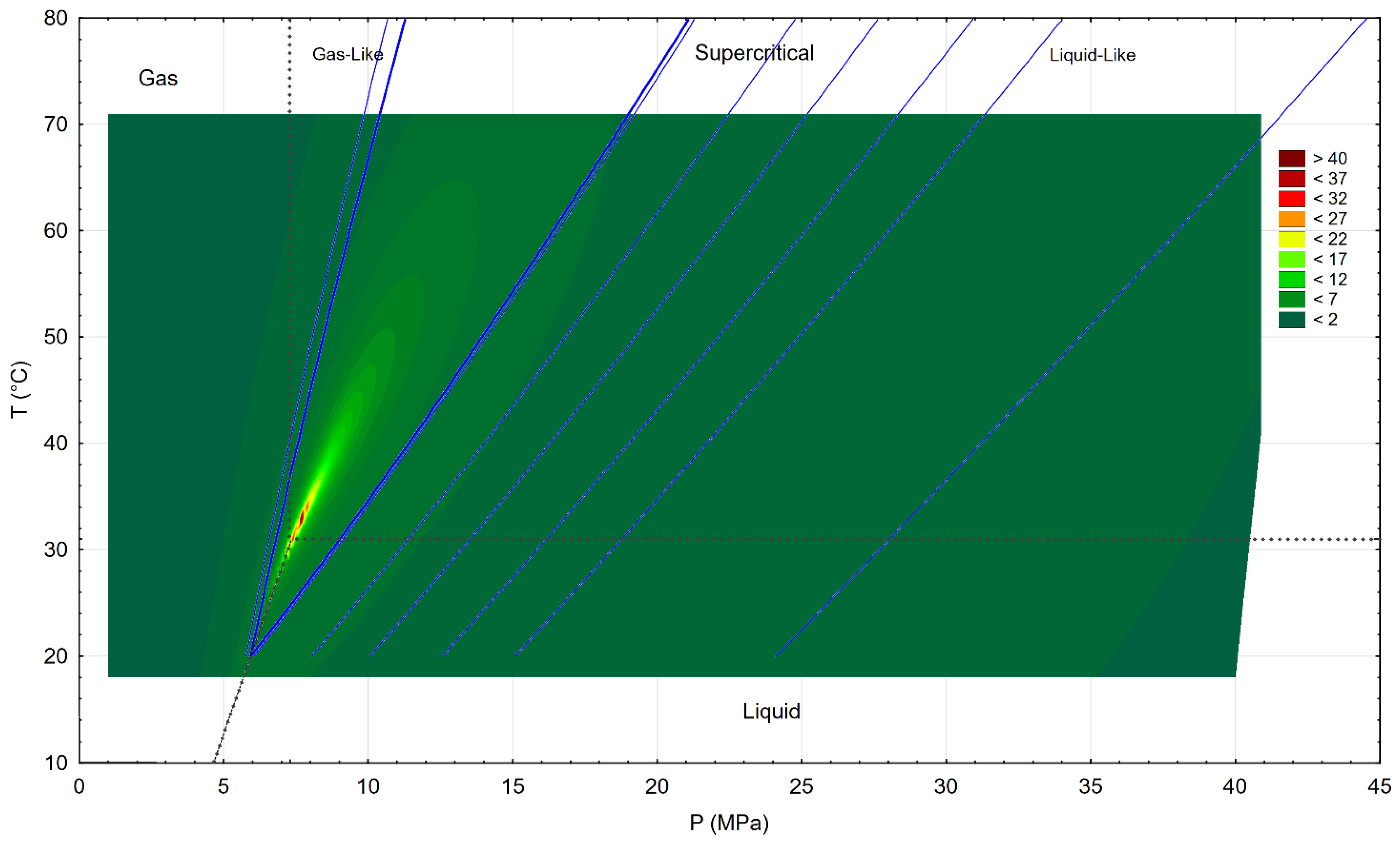
Building on geothermal research, several CO2 columns were simulated down to a depth of 5 km, assuming continuous equilibrium with the surrounding environment in terms of temperature and pressure. Greater depths were not considered due to typical economic constraints associated with geothermal systems. Using an average geothermal gradient, simulations were performed for a range of initial pressures between 5.7 and 24 MPa, representing lower and upper values reported in performed simulations in the geothermal literature. At each step, temperature was assumed to be in equilibrium with the geothermal gradient, while pressure was calculated as the cumulative effect of the overlying column. The results were plotted on a pressure–temperature (P–T) diagram, including phase boundaries and isopycnals. Two distinct and divergent groups of solutions were identified. Their divergence defines a central region that is systematically avoided by the stepwise-equilibrated CO2 columns. This region incorporates the family of Widom lines and appears to originate below the critical point, with the simulated trajectories delineating its lateral boundaries. One group of trajectories, passing through the gaseous phase, evolves into the supercritical gas-like regime, whereas the other, passing through the liquid phase, evolves into the supercritical liquid-like regime. This work presents both a description and a preliminary interpretation of this apparent avoidance of the Widom region, suggesting that CO2 retains a form of “memory” of its initial phase. This behaviour may have significant implications for CO2–rock interactions in crustal environment.
2. Methodology
This work is based on a simulation of an equilibrated vertical column carried out using the NIST facility calculator. A continuous CO2 column was therefore reproduced within the upper crust, down to a maximum depth of approximately 5 km. As this depth currently represents the practical upper limit for geothermal energy exploitation, extending the simulation further was not considered useful at this stage, given the limited economic feasibility.
To determine the static pressure along the CO
2 column, the same methodology as in [
6] was adopted. Assuming a final depth
z (i.e., 5000 m), the column was divided into 100 increments, each 50 m thick (Δz = z/N, where N = 100). At each step, the incremental static pressure was calculated according to:
where
g is the gravitational acceleration (9.81 m s
−2) and ρ
n is the density at pressure P
n and temperature T
n, as reported in [
6].
An average geothermal gradient of approximately 30 °C/km was assumed, yielding a maximum temperature of about 150 °C at 5 km depth. The temperature was incremented stepwise, ensuring consistency with the geothermal gradient. With a starting temperature of 20 °C, each increment corresponded to approximately 1.3 °C. In this way, the static pressure at each depth step was determined under conditions of thermal equilibrium with the imposed geothermal gradient. The results are plotted in
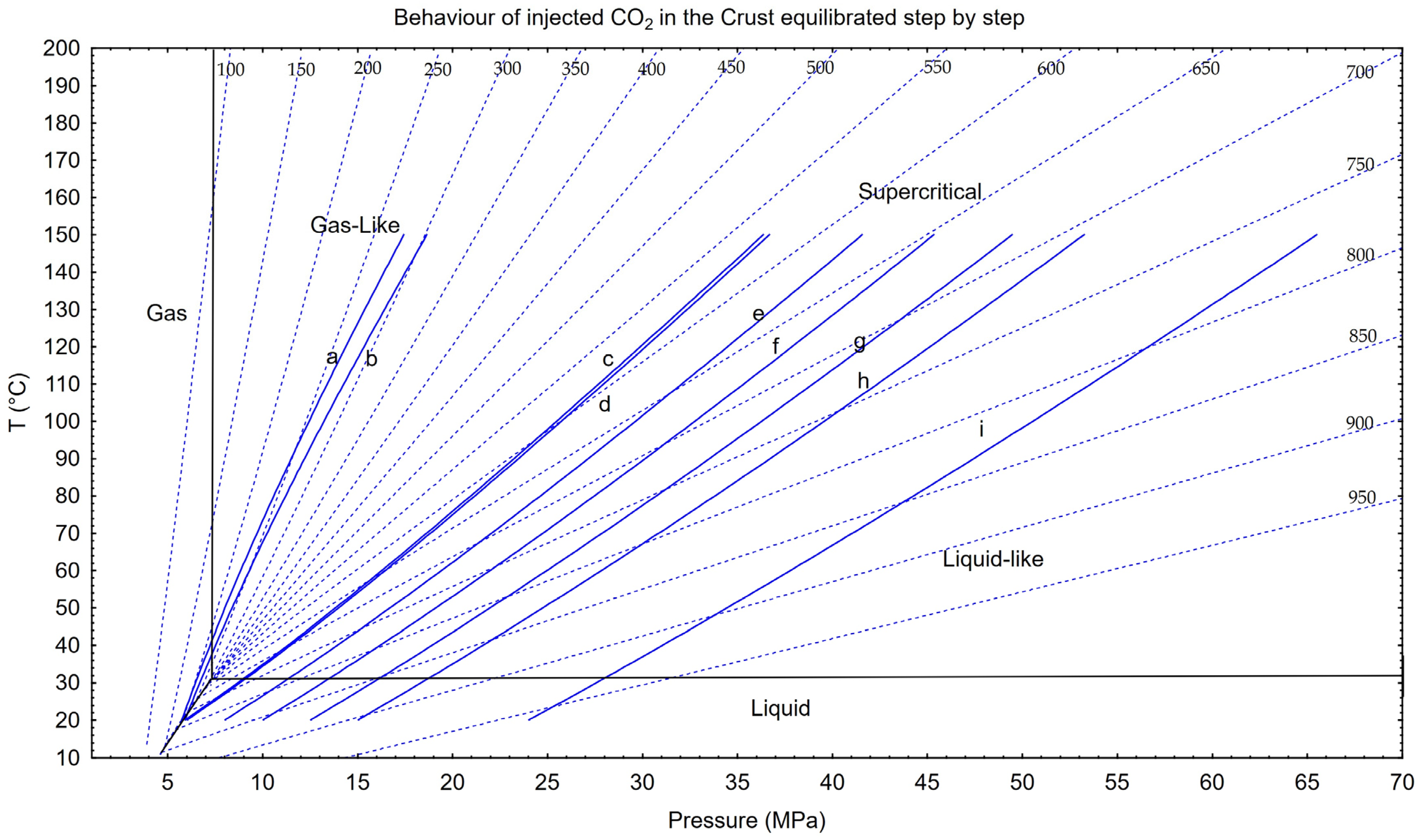
Figure 1.
The selected surface initial pressures were 5.7 MPa at 20 °C [
6], followed by 5.9, 5.906, 6, 8, 10, 12.5, and 15 MPa, as well as 24 MPa, the last one being based on a similar simulation reported in [
18]. Each initial pressure corresponds to a dataset consisting of 100 rows (one per depth increment).
To further analyse the resulting wedge-shaped region, 66 isotherms were computed over a range of pressures. The isotherms, defined at 1 °C intervals, span temperatures from 18 to 80 °C. For each isotherm, pressure ranges from 1 to 40 MPa (with 0.1 MPa increments) for temperatures up to 40 °C, and from 1 to 60 MPa (same increment) for temperatures between 41 and 80 °C.
For each isotherm, the following parameters were calculated using NIST MiniREFPROP, version 9.5 [
19], based on EoS of Span and Wagner [
20]: density (kg/m
3), internal energy, enthalpy, entropy, heat capacity ratio (Cp/Cv), speed of sound, dynamic viscosity, kinematic viscosity, among others.
3. Results and Discussion
After calculating the nine CO
2 profiles, they were superimposed onto a phase diagram. The diagram shown in
Figure 1 allows for multiple interpretations, or rather multiple levels of analysis, which ultimately converge towards a single outcome, while simultaneously raising further questions.
The first two profiles, namely (a) and (b), both originate close to the liquid–vapour equilibrium line. They initially remain within the gaseous field before entering the supercritical region. As the profiles deepen and progressively receive heat from the surrounding rock layers, their density increases despite the temperature rise. This behaviour is primarily due to the increasing weight of the overlying column, as clearly visible in the diagram.
Under the selected conditions, a very small increase in injection pressure (hereafter initial pressure, Pi), from 5.9 to 5.906 MPa, results in a marked change in behaviour. Profile (c) exhibits a distinctly different trajectory. Although it also originates near the liquid–vapour equilibrium line, it diverges from profiles (a) and (b), entering the liquid field before transitioning into the supercritical region. In contrast to the first group, it displays a continuous decrease in density with increasing depth. All subsequent profiles, with Pi ≥ 5.906 MPa, follow a similar pattern: they evolve through the liquid field and then into the supercritical region, consistently showing decreasing density along the vertical profile.
Two main groups can therefore be identified. The first group, comprising profiles (a) and (b), enters the supercritical region and appears to be predominantly pressure-controlled. The second group, comprising profiles (c) to (i), is instead more strongly influenced by temperature. Notably, a very small variation in Pi is sufficient to alter the behaviour of the entire column. Considering profiles (a) to (d), their total range in Pi is only 0.3 MPa, yet all lie on or very close to the liquid–vapour equilibrium line. In particular, the difference in Pi between the adjacent profiles (b) and (c) is only 0.006 MPa. Despite this minimal difference, the two profiles diverge significantly, immediately adopting gas-like and liquid-like behaviour, respectively, both before and—based on density trends—after entering the supercritical region.
Focusing on these four profiles, they appear to define the lateral boundaries of a wedge-shaped region, or delta-like structure, whose apex lies on or near the liquid–vapour equilibrium line in the subcritical domain. The remaining profiles, from (e) to (i), follow the liquid-like pathway due to their higher initial pressures. At this stage, two distinct groups are clearly defined, with no apparent transition across the wedge-shaped region.
This suggests that the wedge effectively governs the subsequent evolution of the profiles, determining their behaviour as soon as they depart from the liquid–vapour equilibrium line in the subcritical region.
A complementary analysis further clarifies this interpretation. Thermodynamic parameters were calculated iteratively by fixing the temperature and varying the pressure from 1 up to a maximum of 60 MPa. The corresponding variations in thermodynamic response functions were then evaluated. This procedure was repeated for successive temperature values, covering the range from 18 to 70 °C.
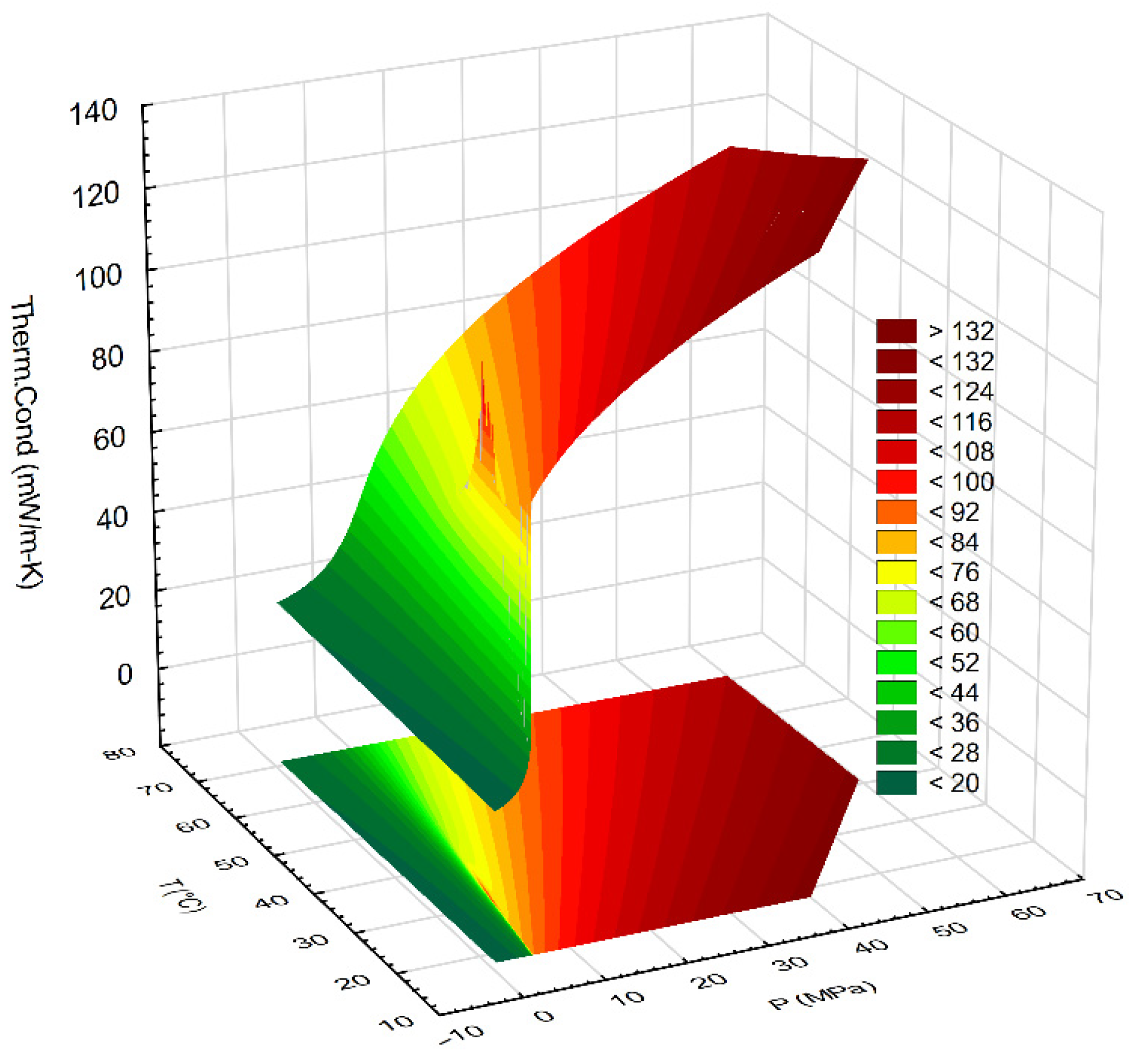
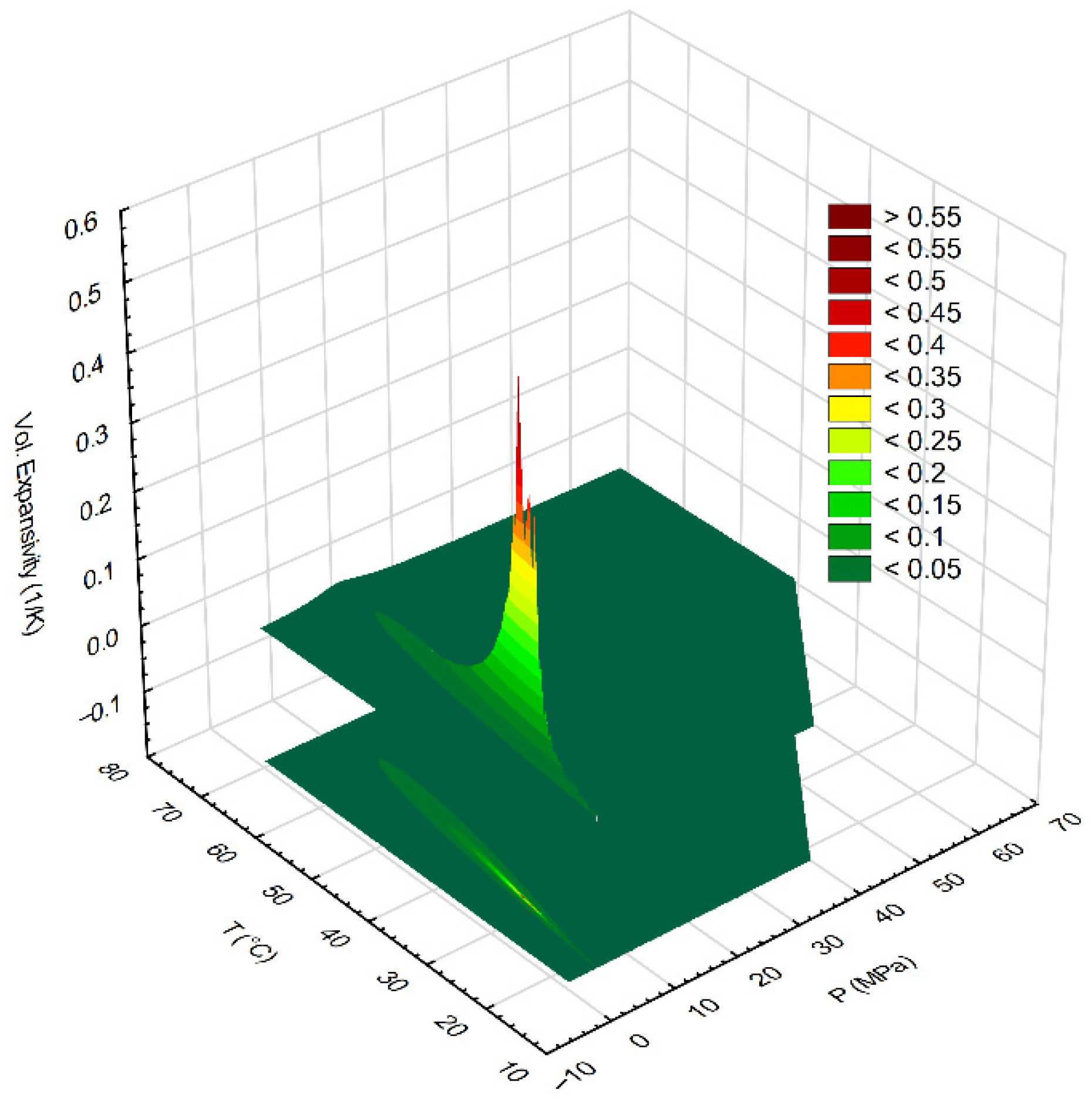
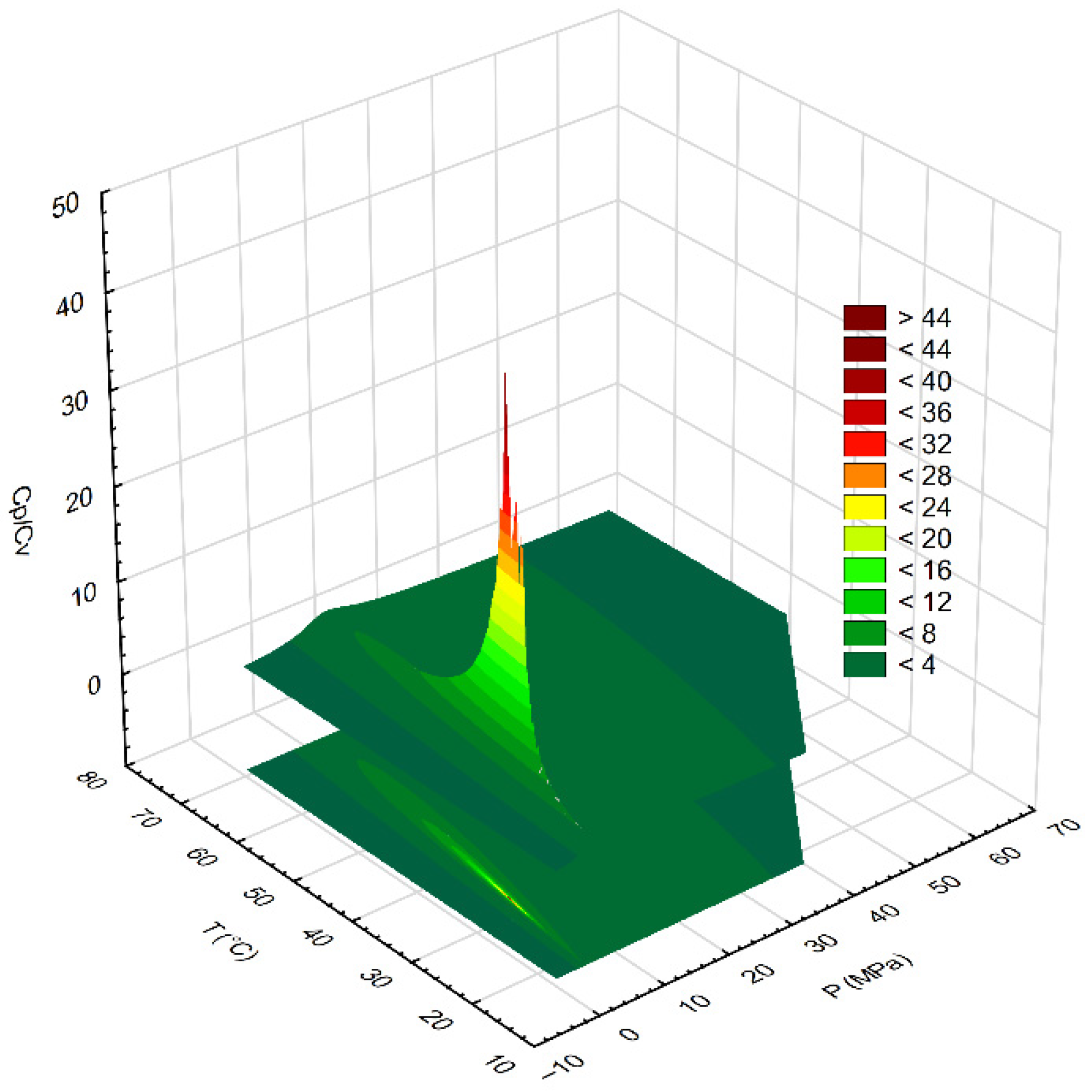
The results show that several parameters exhibit pronounced maxima within a narrow region surrounding the critical point. When projected onto a two-dimensional pressure–temperature (P–T) plane, these anomalous values form a narrow, elongated structure, confined within specific pressure limits and consistently originating below the critical point.
Thermal conductivity (
Figure 2) provides one example, although the elongated structure is even more evident in volumetric expansivity and in the adiabatic index (
Figure 3 and
Figure 4, respectively).
By superimposing the column profile–phase diagram of CO
2 (
Figure 1) onto the P–T projection of the adiabatic index, it becomes evident that profiles (b) and (c) lie along the boundaries of the region of maximum C
p/C
v, as is visible in
Figure 5. It is worth emphasising that the difference in initial pressure between these two profiles is on the order of 0.1%. This indicates that an extremely small, seemingly negligible variation in the initial pressure—particularly when located near the liquid–vapor equilibrium curve—can determine the subsequent behaviour of the entire equilibrated column.
A second observation is that the identified area of anomalous maxima in several thermodynamic response functions lies precisely between these two boundary profiles.
A third point is that such anomalous values appear even below the critical point and extend to specific ranges of temperature and pressure, approximately up to 50 °C and between about 9.5 and 11.3 MPa. Although the Widom region is typically interpreted as a crossover phenomenon within the supercritical phase, there is sufficient justification to consider it as a continuation of the liquid–vapour equilibrium line, despite the latter representing a first-order phase transition.
Given that the subcritical domain is characterised by a transition between two distinct phases, it is useful to refer to theoretical interpretations supported by molecular dynamics and, more generally, Monte Carlo computational chemistry methods. These approaches provide valuable insight into the molecular-scale structure of CO
2. One of the most debated aspects of supercritical CO
2 concerns its structural heterogeneity, both at the macroscopic level and at intermediate molecular scales, particularly in terms of the organisation of neighbouring molecules. In the gas-like regime, the structure consists of molecular clusters separated by regions of lower density, where molecules are free to diffuse in a ballistic manner. Current interpretations describe gas-like particles as small molecular clusters embedded within largely unbound molecules, which contributes to local density inhomogeneities and heterogeneities [
21]. By contrast, liquid-like particles are described as more cohesive clusters containing internal voids or pores, with comparatively lower heterogeneity [
22]. These studies also report the existence of a so-called “ridge”, defined as the locus at which density fluctuations reach a maximum; this can be interpreted as the Widom line associated with density. Approaching this ridge from opposite sides leads to convergence in average density: the gas-like regime exhibits increasing density, whereas the liquid-like regime shows a decrease.
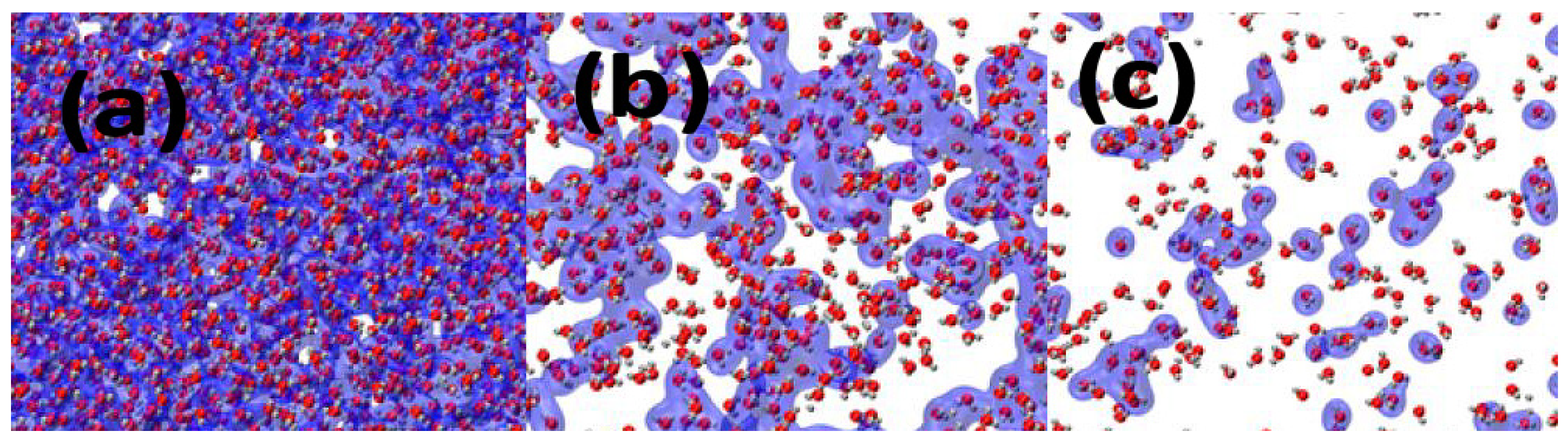
In studies of supercritical water, ref. [
21] authors investigated the molecular structure within the supercritical phase, including the formation and evolution of clusters. The corresponding illustration (
Figure 6a–c), which is also applicable to supercritical CO
2, highlights the variation in cluster structures as temperature changes along an isobaric path. Notably, the authors adopt the structure of liquid water at reduced temperature T
r = 0.88 (where T
r = T/T
c) as representative of the liquid-like configuration within the supercritical regime.
Among others, similar density-related structures have previously been reported [
23]. These authors conducted simulations to investigate the dependence of CO
2 structure on density, also analysing the configuration of CO
2 dimers in the supercritical regime at the molecular level. By examining the distance between neighbouring carbon atoms in different self-binding configurations, they applied molecular simulations based on a flexible model (i.e., allowing deviations from strict molecular planarity). They concluded that the T-shaped configuration is the most favourable, with a C–C distance of approximately 420 pm. A similar value is reported in [
24].
Furthermore, ref. [
23] also describe non-planar CO
2 structures, acknowledging the presence of a dipole moment. The origin of this dipole moment can be explained as follows: under standard conditions, CO
2 is a linear and centrosymmetric molecule with charge separation along the C–O bonds. Two equal and opposite dipole moments exist in each O–C segment, aligned along the same axis and cancelling each other out, resulting instead in a quadrupole moment [
25]. As intermolecular distances decrease, however, intermolecular interactions become stronger, leading to deviations from linearity and the emergence of a non-zero dipole moment.
This distortion, involving deviation of the O–C–O angle from 180°, has also been observed in CO
2–H
2O complexes [
26], where the resulting dipole moment ranges from 0.84 D to 3.4 D depending on the coordination number. Even in dry CO
2 systems, self-coordination leads to deviations from planarity. In dense gaseous phases, a dipole moment of approximately 0.3 D has been reported [
27], while ref. [
28] calculated a value of 0.85 D at a density of 703 kg/m
3. In addition, ref. [
29] modelled the dipole moment of CO
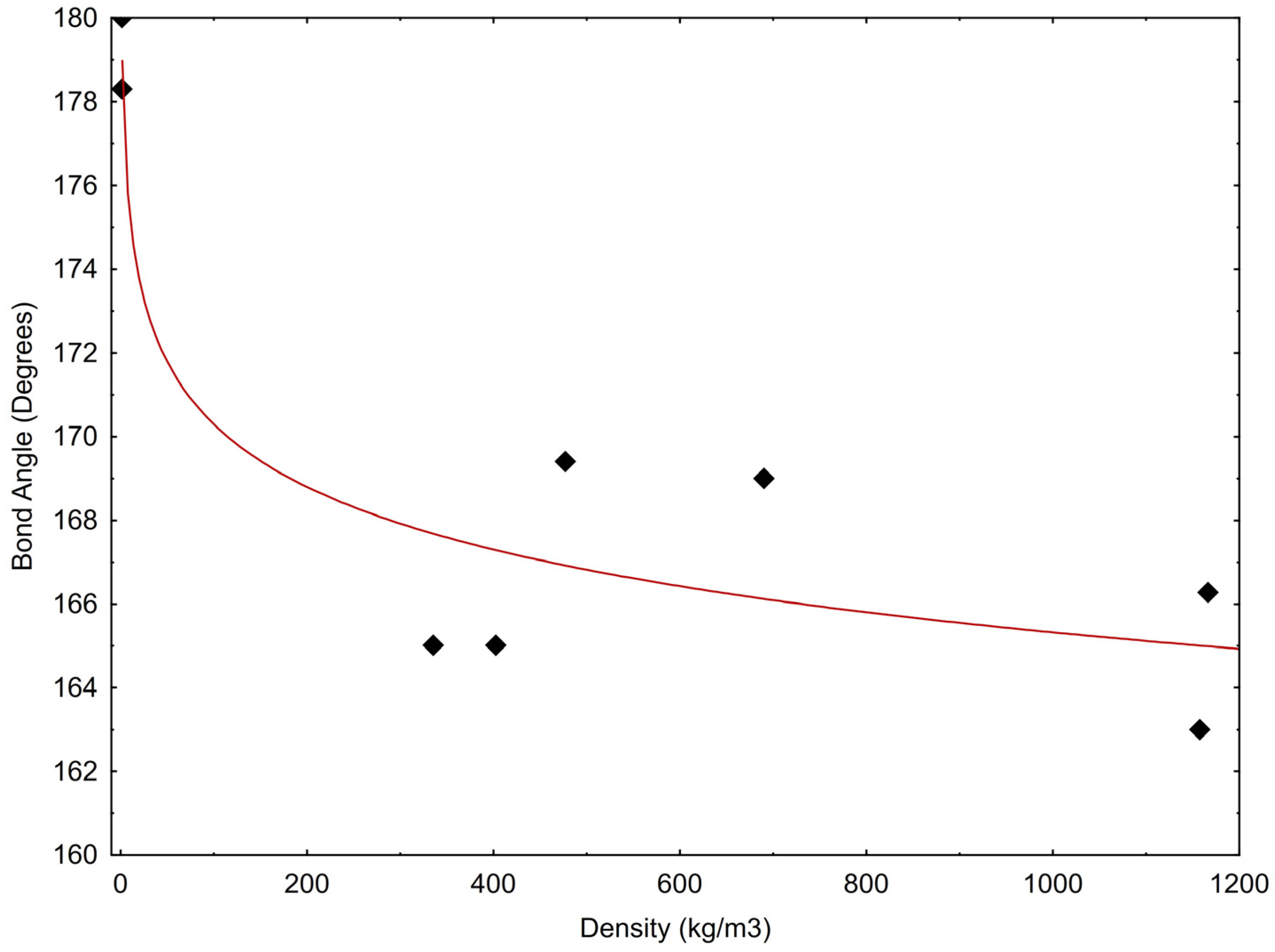
2 in a T-shaped configuration, obtaining values close to 1 D at high density. The same study also presents a relationship between density and the O–C–O bond angle, suggesting a connection between density and dipole moment (
Figure 7).
Although the available data on CO2 bond angles under pressure remain limited, preventing robust statistical analysis, there are nevertheless indications of a probable relationship between density and bond angle, and thus dipole moment. Two emerging trends can be identified:
as density increases from standard conditions, the bond angle progressively deviates from linearity;
at densities above approximately 300 kg/m3, significant angular distortion occurs, corresponding to a non-negligible dipole moment.
From this perspective, the Widom region appears to separate two domains: one characterised by bond angles close to linearity and therefore small dipole moments, and another in which the bond angle decreases below approximately 170°, resulting in a significant dipole moment.
More broadly, the Widom region separates two distinct regimes. The gas-like regime consists of clusters of dimers arranged in T-shaped configurations, together with monomers moving along predominantly ballistic trajectories. Cluster formation is facilitated by the induced polarity of CO2, enabling intermolecular self-binding; however, the resulting dipole moments are spatially sparse and heterogeneous. By contrast, the liquid-like regime is characterised by a denser and more homogeneous fluid, in which dipolar interactions are more prevalent, enhancing its effectiveness as a polar solvent.
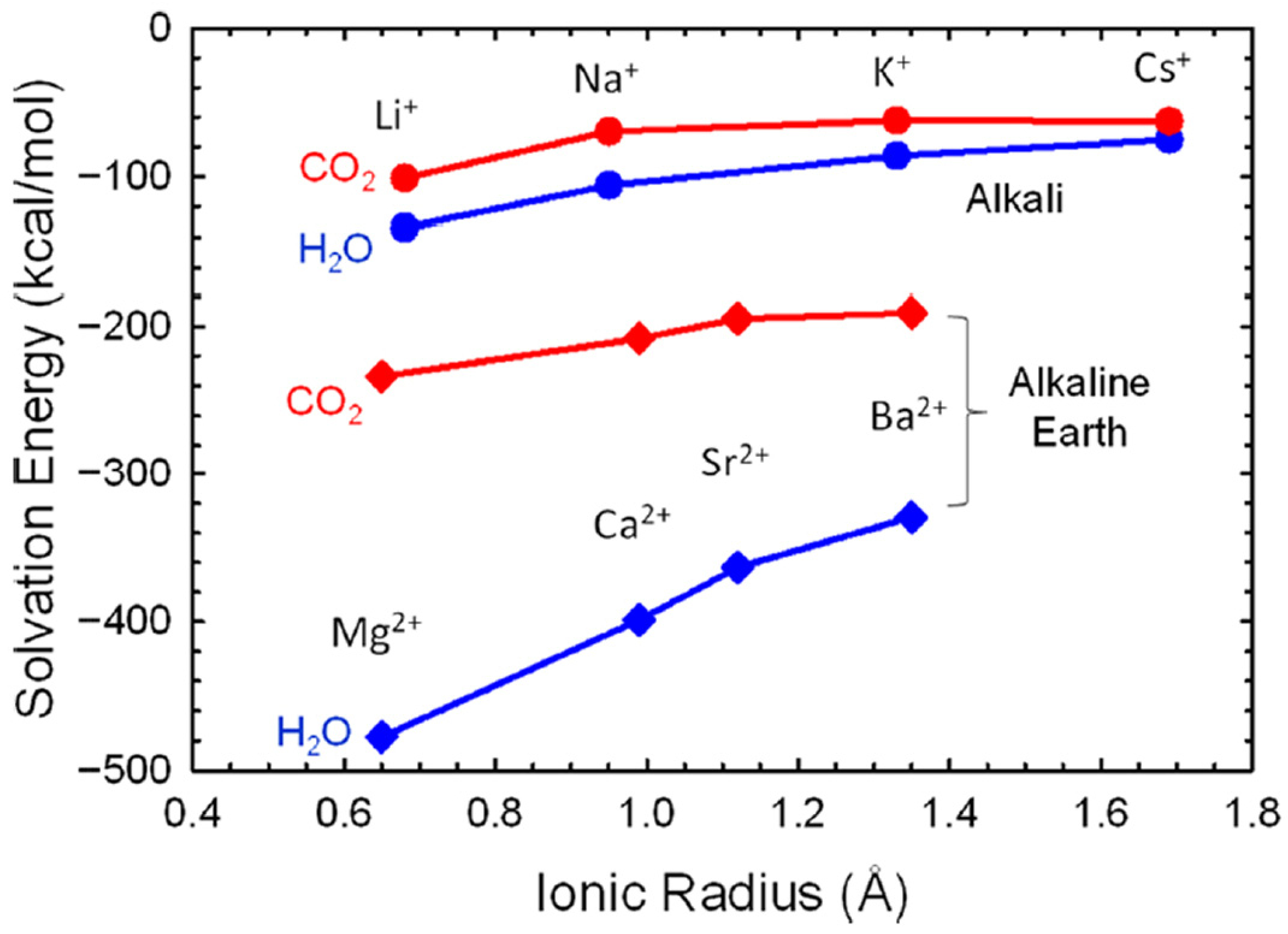
It is also worth noting the simulation study conducted in [
30], in which the solvation properties of two fluids—water and dry CO
2—were compared. Their results indicate that dense, relatively low-temperature CO
2 can exhibit ionic solvation capabilities for alkali elements comparable to those of water at the same temperature. Notably, their findings suggest that liquid CO
2 may be even more effective than water in solvating alkaline earth elements.
The authors further report that supercritical CO
2 follows a similar trend to the liquid phase, albeit with lower overall efficiency (approximately 50 kcal/mol less negative), under conditions of 620 kg/m
3, 20 MPa, and 76.85 °C. Considering the distinction between gas-like and liquid-like regimes discussed above, the values presented in
Figure 8 may be representative of the solvation capacity of dense, relatively cool supercritical CO
2.
Additional experimental evidence supports these findings. In [
31] authors report that dissolution processes involving alkaline earth-bearing plagioclase occur under both wet and dry conditions. Similarly, Ca
rich amphiboles, olivine, and clay minerals are susceptible to dissolution when interacting with dry supercritical CO
2, particularly within the liquid-like regime described above.