
Rare-Earth Element Geochemistry for the Characterization of Sedimentary Environment and Provenance: A Case Study of the Eocene Liushagang Formation, Weixi’nan Sag, Beibuwan Basin, China

Abstract
1. Introduction
2. Geological Setting
3. Materials and Methods
4. Results
4.1. REE Concentrations and Characteristics
4.2. REE Distribution Patterns
5. Discussion
5.1. Depositional Environment Analysis
5.2. Relative Depositional Residence Time and Sedimentation Rate
5.3. Provenance Characteristics
5.4. Tectonic Setting of the Provenance Area
6. Conclusions
- (1)
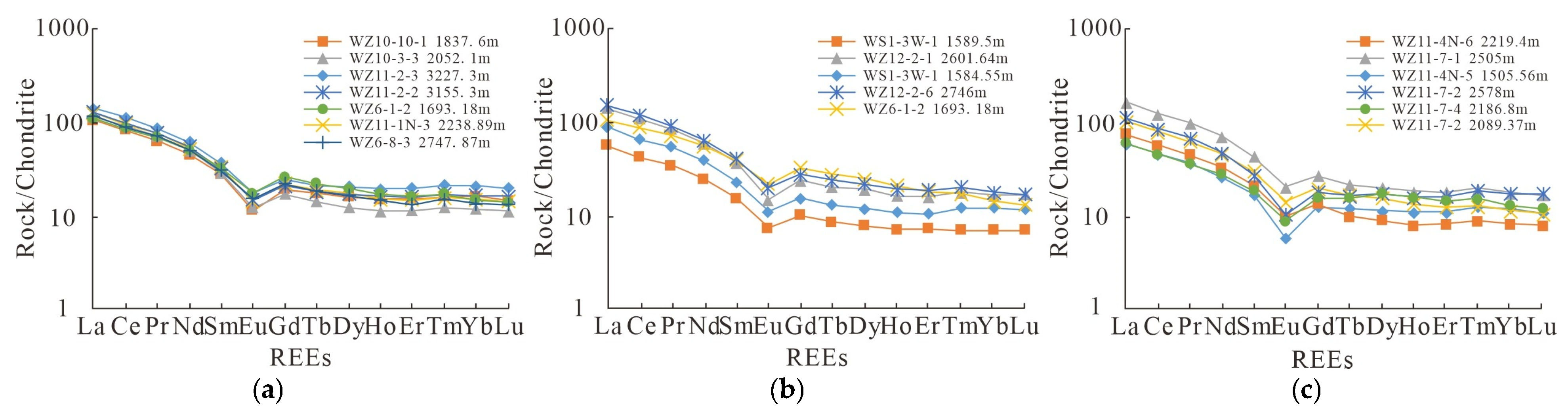
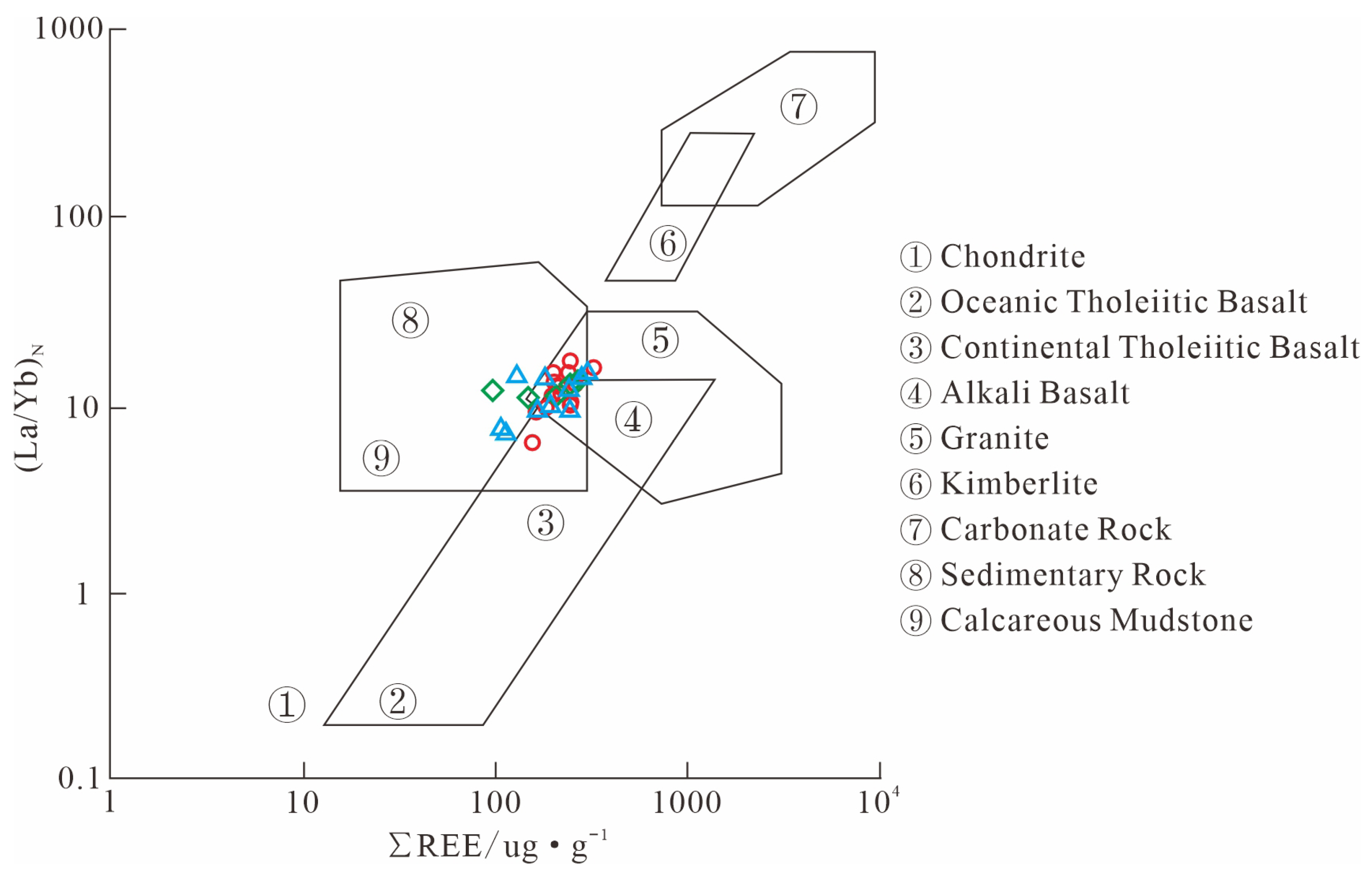
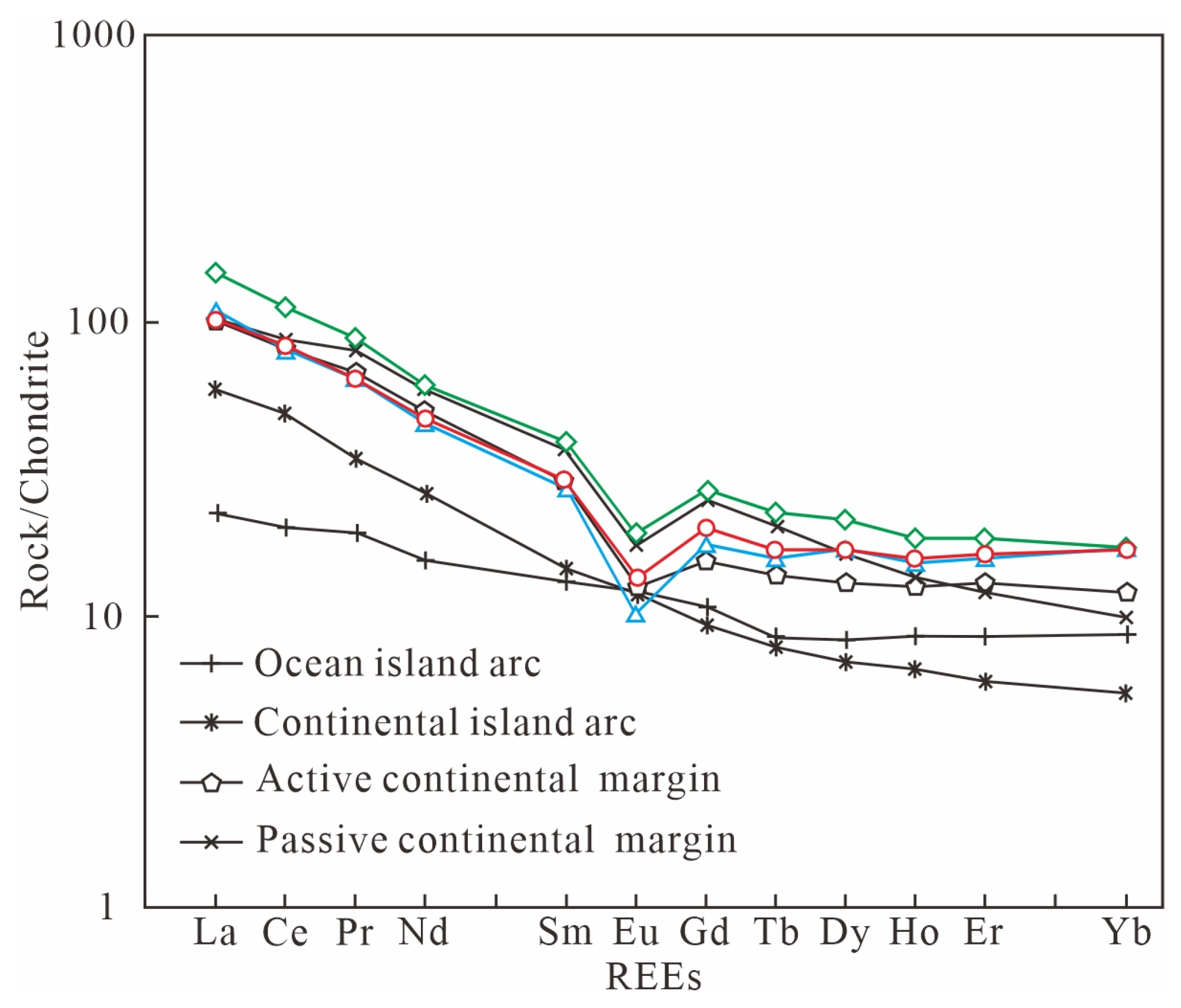
- The clastic rocks exhibit pronounced light REE (LREE) enrichment, relatively flat heavy REE (HREE) segments, and distinct negative Eu anomalies. These geochemical signatures closely mirror the upper continental crust (UCC), indicating that the sediments were predominantly derived from felsic to intermediate-acidic igneous parent rocks.
- (2)
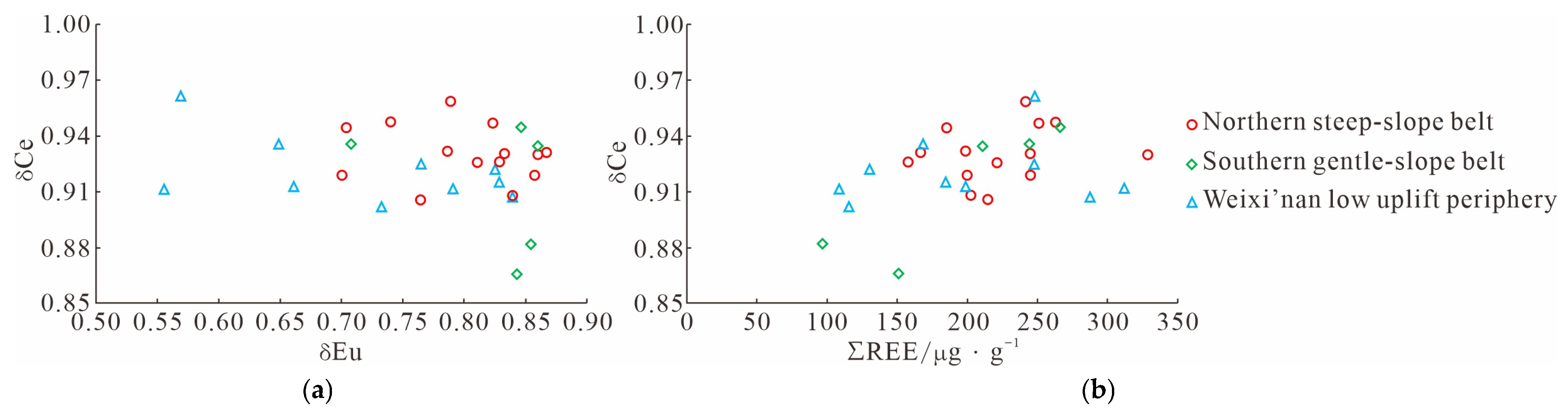
- The cerium anomalies (Ceanom) are generally normal to slightly negative, indicating that the depositional water column during the Liushagang Formation period was primarily a suboxic to anoxic-reducing environment.
- (3)
- The chondrite-normalized (La/Yb)N ratio effectively tracks the relative depositional residence time. Vertically, (La/Yb)N values decrease from member El3 upward to El1, reflecting a transition to shorter residence times and higher relative sedimentation rates (driven by El1 gravity flows). Laterally, (La/Yb)N values increase from the basin margins toward the center, accurately recording progressively lower sedimentation rates basinward.
- (4)
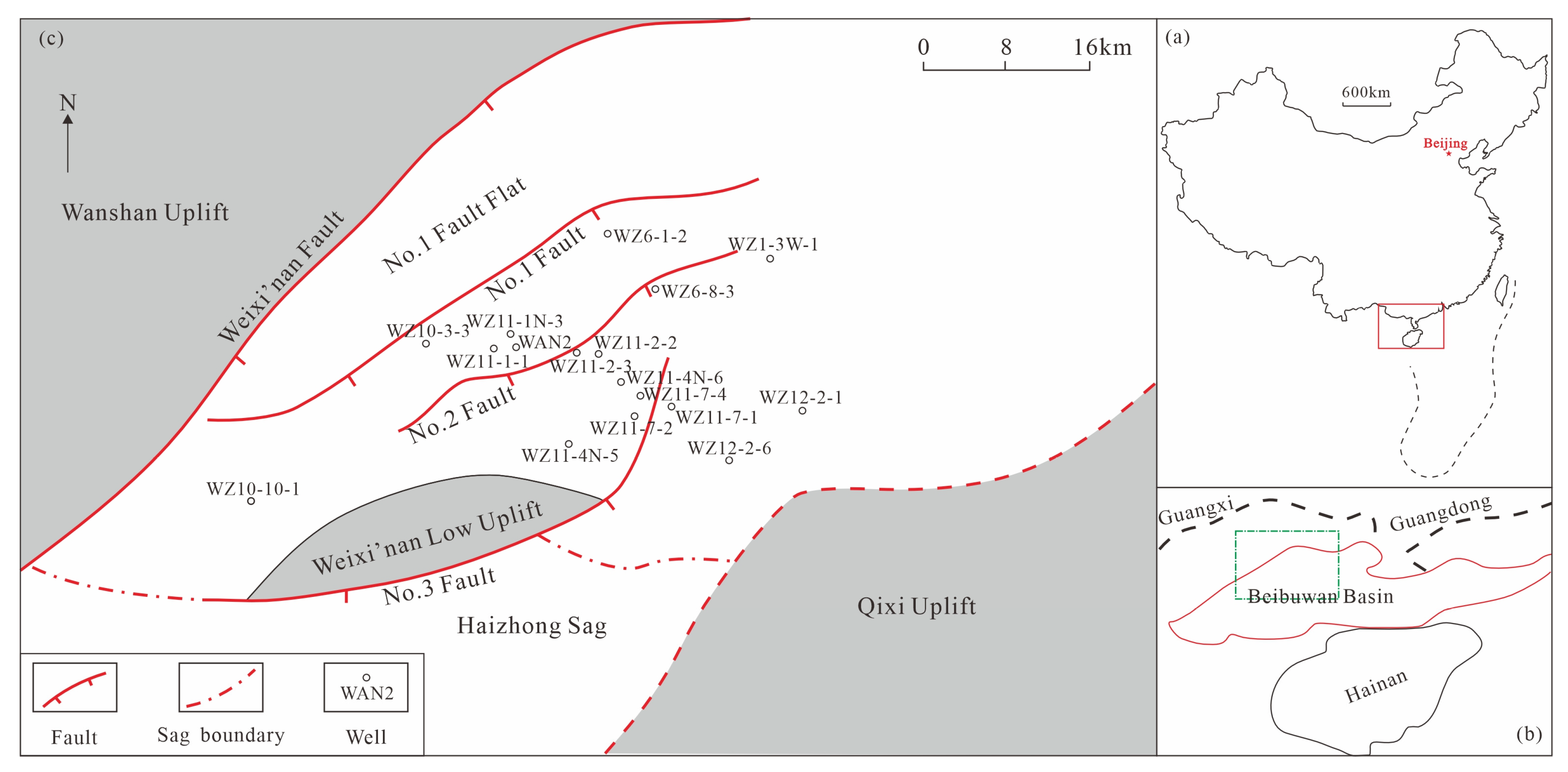
- Spatial mapping of REE parameters reveals distinct sediment routing. The northern steep-slope belt reflects a uniform, stable provenance dominated by igneous rocks. Conversely, the southern gentle-slope belt and the Weixi’nan low-uplift periphery record multisource mixed inputs, heavily influenced by localized fault activities and topographic variations.
- (5)
- While REE discrimination diagrams point to an “active continental margin” affinity, this represents an inherited geochemical memory. It reflects the original tectonic environment of the Mesozoic parent rocks in the surrounding source areas (e.g., the Weixi’nan low uplift), rather than the Cenozoic extensional rift setting of the Weixi’nan Sag depositional basin itself.
Supplementary Materials
Author Contributions
Funding
Data Availability Statement
Acknowledgments
Conflicts of Interest
References
- Taylor, S.R.; McLennan, S.M. The Continental Crust: Its Composition and Evolution; Blackwell Scientific Publication: Hoboken, NJ, USA, 1985. [Google Scholar]
- Bau, M. Rare-earth element mobility during hydrothermal and metamorphic fluid-rock interaction and the significance of the oxidation state of europium. Chem. Geol. 1991, 93, 219–230. [Google Scholar] [CrossRef]
- Chen, J.; Algeo, T.J.; Zhao, L.; Chen, Z.Q.; Cao, L.; Zhang, L.; Li, Y. Diagenetic uptake of rare earth elements by bioapatite, with an example from Lower Triassic conodonts of South China. Earth Sci. Rev. 2015, 149, 181–202. [Google Scholar] [CrossRef]
- Bhatia, M.R. Rare earth element geochemistry of Australian Paleozoic graywackes and mudrocks: Provenance and tectonic control. Sediment. Geol. 1985, 45, 97–113. [Google Scholar] [CrossRef]
- Maravelis, A.; Zelilidis, A. Petrography and geochemistry of the late Eocene–early Oligocene submarine fans and shelf deposits on Lemnos Island, NE Greece. Implications for provenance and tectonic setting. Geol. J. 2010, 45, 412–433. [Google Scholar] [CrossRef]
- Savoy, L.E.; Stevenson, R.K.; Mountjoy, E.W. Provenance of Upper Devonian-Lower Carboniferous Miogeoclinal Strata, Southeastern Canadian Cordillera: Link Between Tectonics and Sedimentation. J. Sediment. Res. 2000, 70, 181–193. [Google Scholar] [CrossRef]
- Shen, Y.L.; Jiang, B.; Xie, G.L.; Zhang, G.S.; Chang, M.H.; Wei, Z.H. Distribution characteristic of rare earth elements of mudstone of Hebei plain area. J. China Coal Soc. 2016, 41, 2813–2821, (In Chinese with English abstract). [Google Scholar]
- Hu, J.; Li, Q.; Fang, N. REE geochemical characteristics and geological significance of sedimentary rocks of the Lower Permian Zhanjin Formation in central uplift zone of Qiangtang Basin, northern Tibet Plateau. J. Palaeogeogr. 2014, 16, 926–934, (In Chinese with English abstract). [Google Scholar]
- Cao, J.; Wu, M.; Chen, Y.; Hu, K.; Bian, L.; Wang, L.; Zhang, Y. Trace and rare earth element geochemistry of Jurassic mudstones in the northern Qaidam Basin, northwest China. Geochemistry 2012, 72, 245–252. [Google Scholar] [CrossRef]
- Wang, J.; Cao, Y.; Li, J. Sequence structure and non-structural traps of the Paleogene in the Weixi’nan Sag, Beibuwan Basin. Pet. Explor. Dev. 2012, 39, 325–334. [Google Scholar] [CrossRef]
- Hu, C.; Ren, J.; Tong, D.; Xu, Y.; Wang, Z. Multiphase growth and basin control of main faults on Northern sub-basin, Beibuwan basin, Northwestern South China sea. Mar. Pet. Geol. 2024, 169, 107052. [Google Scholar] [CrossRef]
- Fyhn, M.B.W.; Cuong, T.D.; Hoang, B.H.; Hovikoski, J.; Olivarius, M.; Tuan, N.Q.; Tung, N.T.; Huyen, N.T.; Cuong, T.X.; Nytoft, H.P.; et al. Linking Paleogene Rifting and Inversion in the Northern Song Hong and Beibuwan Basins, Vietnam, with Left-Lateral Motion on the Ailao Shan-Red River Shear Zone. Tectonics 2018, 37, 2559–2585. [Google Scholar] [CrossRef]
- Zhao, Y.; Wang, H.; Yan, D.; Jiang, P.; Chen, S.; Zhou, J.; Ma, J.; Qin, C.; He, J.; Zhao, Y. Sedimentary characteristics and model of gravity flows in the eocene Liushagang Formation in Weixi’nan depression, South China Sea. J. Pet. Sci. Eng. 2020, 190, 107082. [Google Scholar] [CrossRef]
- Xu, J.-J.; Jin, Q.; Xu, X.-D.; Cheng, F.-Q.; Hu, C.-H.; Wang, B.; Chen, T. Factors controlling organic-rich shale development in the Liushagang Formation, Weixinan Sag, Beibu Gulf Basin: Implications of structural activity and the depositional environment. Pet. Sci. 2021, 18, 1011–1020. [Google Scholar] [CrossRef]
- Zhao, J.; Hong, Q.; Dong, W. Analysis on material sources and palaeogeographic landscapes of Weixinan Sag. Pet. Explor. Dev. 2001, 28, 25–28, (In Chinese with English abstract). [Google Scholar]
- Gong, Y.; Pease, V.; Wang, H.; Gan, H.; Liu, E.; Ma, Q.; Zhao, S.; He, J. Insights into evolution of a rift basin: Provenance of the middle Eocene-lower Oligocene strata of the Beibuwan Basin, South China Sea from detrital zircon. Sediment. Geol. 2021, 419, 105908. [Google Scholar] [CrossRef]
- Liu, E.; Wang, H.; Li, Y.; Zhou, W.; Leonard, N.D.; Lin, Z.; Ma, Q. Sedimentary characteristics and tectonic setting of sublacustrine fans in a half-graben rift depression, Beibuwan Basin, South China Sea. Mar. Pet. Geol. 2014, 52, 9–21. [Google Scholar] [CrossRef]
- Liu, Y.; Wu, Z.; Du, Q.; Wang, M. Late Eocene tectonic-geomorphic transition and its dynamic mechanism: Case study of the Beibuwan Basin, northern South China Sea. Geomorphology 2024, 467, 109458. [Google Scholar] [CrossRef]
- Liu, Y.; Wu, Z.; Liu, L.; Yan, S.; Hu, L.; Ping, M.; Zhang, M. Cenozoic structure and tectonics of North subbasins in Beibu Gulf Basin, northern South China Sea. Tectonophysics 2021, 812, 228912. [Google Scholar] [CrossRef]
- Zhao, L.; Liu, B.; Wen, Z.; Hu, Z. Astronomical forcing of lake-level changes along the low-latitude Asian continental margin and the global sea level responses during the early-middle Eocene. J. Asian Earth Sci. 2025, 280, 106470. [Google Scholar] [CrossRef]
- Cao, L.; Zhang, Z.; Li, H.; Zhong, N.; Xiao, L.; Jin, X.; Li, H. Mechanism for the enrichment of organic matter in the Liushagang Formation of the Weixinan Sag, Beibuwan Basin, China. Mar. Pet. Geol. 2020, 122, 104649. [Google Scholar] [CrossRef]
- Haskin, L.A.; Haskin, M.A.; Frey, F.A.; Wildeman, T.R. Relative and Absolute Terrestrial Abundances of the Rare Earths. In Origin and Distribution of the Elements; Ahrens, L.H., Ed.; Pergamon: Oxford, UK, 1968; pp. 889–912. [Google Scholar]
- Gromet, L.P.; Haskin, L.A.; Korotev, R.L.; Dymek, R.F. The “North American shale composite”: Its compilation, major and trace element characteristics. Geochim. Cosmochim. Acta 1984, 48, 2469–2482. [Google Scholar] [CrossRef]
- Lei, C.; Yin, S.; Shi, S.; Meng, L. Depositional environment and sediment provenance of the third member of the Palaeogene Shahejie Formation in the Nanpu Sag of the Bohai Bay Basin, eastern China: Evidence from trace and rare earth element geochemistry. Geol. J. 2021, 56, 5780–5791. [Google Scholar] [CrossRef]
- Liu, H.; Guo, H.; Pourret, O.; Wang, Z.; Sun, Z.; Zhang, W.; Liu, M. Distribution of rare earth elements in sediments of the North China Plain: A probe of sedimentation process. Appl. Geochem. 2021, 134, 105089. [Google Scholar] [CrossRef]
- Li, S.J.; Xi, K.H.; Wo, Y.J.; Lo, S.X.; Cao, L.G. REE geochemical characteristics and their geological signification in Silurian, West of Hunan Province and North of Guizhou Province. Geoscience 2008, 22, 273–280, (In Chinese with English abstract). [Google Scholar]
- Taylor, S.R.; McLennan, S.M.; McCulloch, M.T. Geochemistry of loess, continental crustal composition and crustal model ages. Geochim. Cosmochim. Acta 1983, 47, 1897–1905. [Google Scholar] [CrossRef]
- Shields, G.; Stille, P. Diagenetic constraints on the use of cerium anomalies as palaeoseawater redox proxies: An isotopic and REE study of Cambrian phosphorites. Chem. Geol. 2001, 175, 29–48. [Google Scholar] [CrossRef]
- McLennan, S.M. Rare earth elements in sedimentary rocks; influence of provenance and sedimentary processes. Rev. Mineral. Geochem. 1989, 21, 169–200. [Google Scholar]
- Zhang, K.; Shields, G.A. Sedimentary Ce anomalies: Secular change and implications for paleoenvironmental evolution. Earth-Sci. Rev. 2022, 229, 104015. [Google Scholar] [CrossRef]
- Lawrence, M.G.; Greig, A.; Collerson, K.D.; Kamber, B.S. Rare Earth Element and Yttrium Variability in South East Queensland Waterways. Aquat. Geochem. 2006, 12, 39–72. [Google Scholar] [CrossRef]
- Wright, J.; Schrader, H.; Holser, W.T. Paleoredox variations in ancient oceans recorded by rare earth elements in fossil apatite. Geochim. Cosmochim. Acta 1987, 51, 631–644. [Google Scholar] [CrossRef]
- Elderfield, H.; Greaves, M.J. The rare earth elements in seawater. Nature 1982, 296, 214–219. [Google Scholar] [CrossRef]
- Tribovillard, N.; Algeo, T.J.; Lyons, T.; Riboulleau, A. Trace metals as paleoredox and paleoproductivity proxies: An update. Chem. Geol. 2006, 232, 12–32. [Google Scholar] [CrossRef]
- Lučić, M.; Vdović, N.; Bačić, N.; Mikac, N.; Dinis, P. Disentangling the influence of lithology and non-provenance factors on the geochemistry of rare earth elements: A study of fine-grained sediments from the Sava River headwaters (Slovenia, Croatia). J. Soils Sediments 2021, 21, 3704–3716. [Google Scholar] [CrossRef]
- Kim, J.-H.; Torres, M.E.; Haley, B.A.; Kastner, M.; Pohlman, J.W.; Riedel, M.; Lee, Y.-J. The effect of diagenesis and fluid migration on rare earth element distribution in pore fluids of the northern Cascadia accretionary margin. Chem. Geol. 2012, 291, 152–165. [Google Scholar] [CrossRef]
- Allègre, C.J.; Minster, J.F. Quantitative models of trace element behavior in magmatic processes. Earth Planet. Sci. Lett. 1978, 38, 1–25. [Google Scholar] [CrossRef]
- Fouquet, Y.; von Stackelberg, U.; Charlou, J.L.; Erzinger, J.P.; Herzig, P.M.; Mühe, R.; Wiedicke, M. Metallogenesis in back-arc environments; the Lau Basin example. Econ. Geol. 1993, 88, 2154–2181. [Google Scholar] [CrossRef]
- Murray, R.W.; Buchholtz ten Brink, M.R.; Jones, D.L.; Gerlach, D.C.; Russ, G.P., III. Rare earth elements as indicators of different marine depositional environments in chert and shale. Geology 1990, 18, 268–271. [Google Scholar] [CrossRef]



| Structural Belt | No. of Samples (n) | ΣREE (μg·g−1) | ΣLREE/ ΣHREE | δEu | δCe | (La/Yb)N |
|---|---|---|---|---|---|---|
| Northern steep-slope belt | 14 | 157.68–328.54 (222.87) | 3.95–10.13 (7.74) | 0.70–0.87 (0.80) | 0.91–0.96 (0.93) | 0.61–1.68 (1.17) |
| Southern gentle-slope belt | 5 | 96.87–266.13 (193.88) | 5.75–8.46 (7.64) | 0.71–0.86 (0.82) | 0.87–0.94 (0.91) | 1.07–1.26 (1.17) |
| Weixi’nan low-uplift periphery | 10 | 108.49–312.04 (200.15) | 4.57–9.38 (7.45) | 0.56–0.84 (0.72) | 0.90–0.96 (0.92) | 0.70–1.50 (1.11) |
| Overall (Total) | 29 | 96.87–328.54 (210.04) | 3.95–10.13 (7.62) | 0.56–0.87 0.78 | 0.87–0.96 (0.92) | 0.61–1.68 (1.15) |
| Tectonic Setting | Provenance Type | REE Content | La/Yb | ΣLREE/ ΣHREE | δEu | ||
|---|---|---|---|---|---|---|---|
| La | Ce | ΣREE | |||||
| Oceanic Island Arc * | Undissected Magmatic Arc | 8 ± 1.7 | 19 ± 3.7 | 58 ± 10 | 4.2 ± 1.3 | 3.8 ± 0.9 | 1.04 ± 0.11 |
| Continental Island Arc * | Dissected Magmatic Arc | 27 ± 4.5 | 59 ± 8.8 | 146 ± 20 | 11 ± 3.6 | 7.7 ± 1.7 | 0.79 ± 0.13 |
| Active Continental Margin * | Uplifted Basement | 37.00 | 78.00 | 186.00 | 12.60 | 9.10 | 0.60 |
| Passive Continental Margin * | Cratonic Interior Tectonic Highlands | 39.00 | 85.00 | 210.00 | 15.90 | 8.50 | 0.56 |
| North steep-slope # | 38.18 | 77.39 | 185.73 | 12.05 | 8.23 | 0.67 | |
| South gentle-slope # | 32.98 | 66.79 | 161.57 | 12.08 | 8.26 | 0.68 | |
| Weixi’nan low-uplift periphery # | 34.61 | 69.29 | 166.79 | 11.49 | 7.97 | 0.60 | |
Disclaimer/Publisher’s Note: The statements, opinions and data contained in all publications are solely those of the individual author(s) and contributor(s) and not of MDPI and/or the editor(s). MDPI and/or the editor(s) disclaim responsibility for any injury to people or property resulting from any ideas, methods, instructions or products referred to in the content. |
© 2026 by the authors. Licensee MDPI, Basel, Switzerland. This article is an open access article distributed under the terms and conditions of the Creative Commons Attribution (CC BY) license.
Share and Cite
Su, Y.; Chen, J.; Wang, J. Rare-Earth Element Geochemistry for the Characterization of Sedimentary Environment and Provenance: A Case Study of the Eocene Liushagang Formation, Weixi’nan Sag, Beibuwan Basin, China. Geosciences 2026, 16, 105. https://doi.org/10.3390/geosciences16030105
Su Y, Chen J, Wang J. Rare-Earth Element Geochemistry for the Characterization of Sedimentary Environment and Provenance: A Case Study of the Eocene Liushagang Formation, Weixi’nan Sag, Beibuwan Basin, China. Geosciences. 2026; 16(3):105. https://doi.org/10.3390/geosciences16030105
Chicago/Turabian StyleSu, Yang, Jie Chen, and Jiao Wang. 2026. "Rare-Earth Element Geochemistry for the Characterization of Sedimentary Environment and Provenance: A Case Study of the Eocene Liushagang Formation, Weixi’nan Sag, Beibuwan Basin, China" Geosciences 16, no. 3: 105. https://doi.org/10.3390/geosciences16030105
APA StyleSu, Y., Chen, J., & Wang, J. (2026). Rare-Earth Element Geochemistry for the Characterization of Sedimentary Environment and Provenance: A Case Study of the Eocene Liushagang Formation, Weixi’nan Sag, Beibuwan Basin, China. Geosciences, 16(3), 105. https://doi.org/10.3390/geosciences16030105