Article

GPR Surveying of Carbonate Beach Strandplain Deposits in the Bahamas

by
Sydney Adelaide Richards
1,2,
John McBride
2,*,
Scott M. Ritter
2,
Kathryn J. Smith
3,
Kaleb Markert
2,
Keili M. M. Kwong
2 and
Kevin A. Rey
2
1
Chevron Corporation, 1500 Louisiana Street, Houston, TX 77004, USA
2
Department of Geological Sciences, Brigham Young University, Provo, UT 84602, USA
3
Coastal and Hydraulics Laboratory, U.S. Army Corps of Engineers Engineer Research and Development Center, Vicksburg, MS 39180, USA
*
Author to whom correspondence should be addressed.
Geosciences 2026, 16(2), 85; https://doi.org/10.3390/geosciences16020085
Submission received: 22 December 2025 / Revised: 2 February 2026 / Accepted: 11 February 2026 / Published: 17 February 2026
(This article belongs to the Section Geophysics)

Abstract

The Bahamas is an ideal location for studying the calcium carbonate sedimentation of Holocene strandplains in relation to seaward progradation. We use ground-penetrating radar (GPR) to image and interpret the fine-scale stratigraphy of three carbonate strandplains on Crooked Island, The Bahamas. GPR has been extensively used to analyse the interiors of clastic strandplain deposits worldwide, while tropical carbonate settings have received less attention. Due to the lack of outcrops in our study area on Crooked Island, we validate the interpretation of the 2D profiles by comparing them with a 3D GPR data volume collected adjacent to and over a Pleistocene aeolianite outcrop on San Salvador Island, where porosity layering can be directly observed. Data processing employed state-of-the-art techniques adapted from the petroleum industry to enhance the visualisation of reflection amplitude on the GPR images. Our data support a model in which the progradation of carbonate sediment preserved in strandplains was deposited through a combination of storm processes and gradual sediment progradation.

1. Introduction

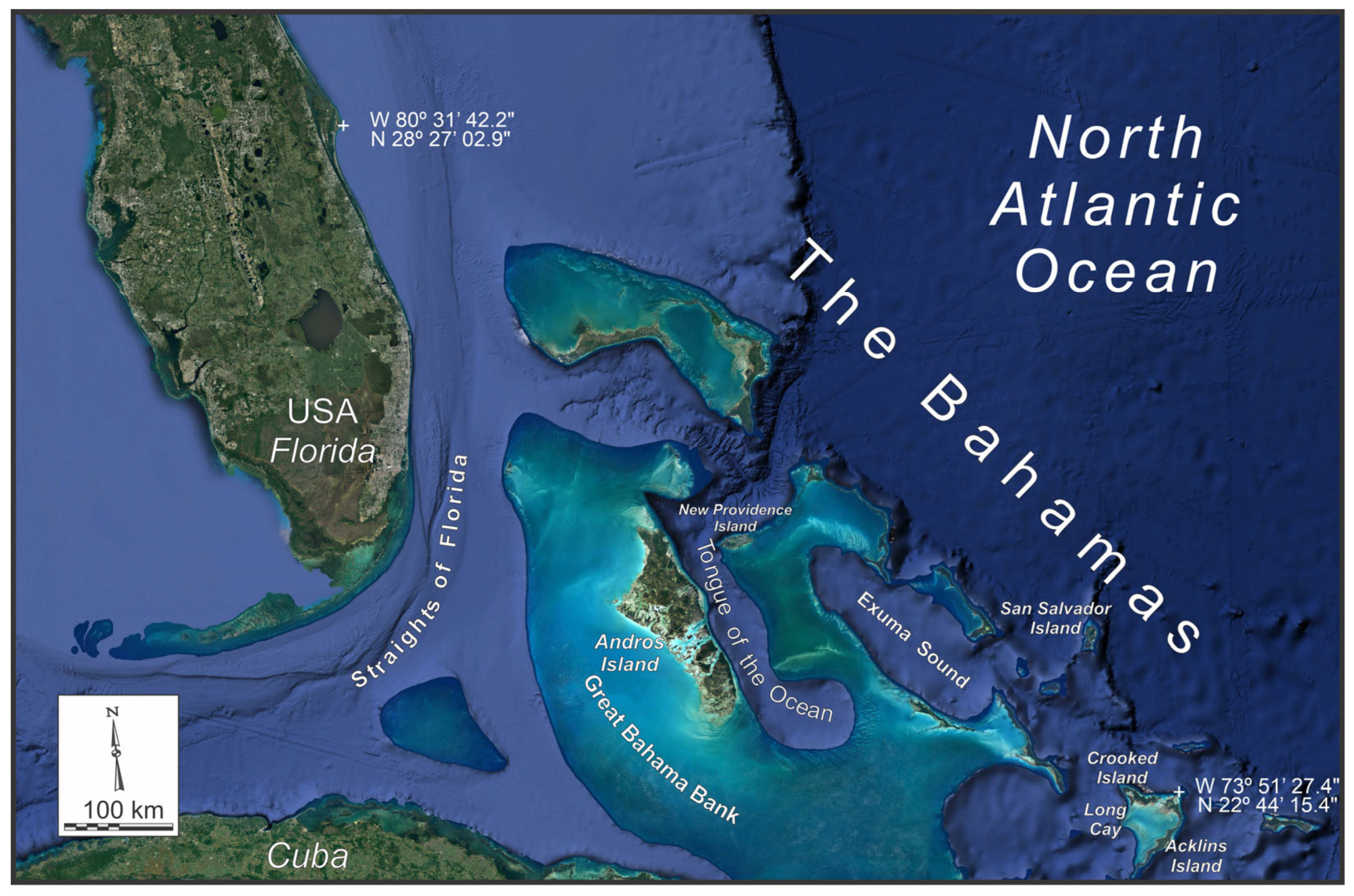
Much of the development of The Bahamas Archipelago occurs through the progradation of shoreline calcium carbonate sedimentary deposits. It remains unclear whether this is mainly due to eustasy, sediment input from catastrophic events, or a combination of both [1,2]. The extensive carbonate, shallow-water platforms of The Bahamas (Figure 1) offer one of the few living laboratories where Holocene carbonate sediments can be studied, located immediately adjacent to their (Holocene or Pleistocene) sedimentological equivalents preserved onshore [2]. Our understanding of recent sedimentary progradation can be informed by studying carbonate sand strandplain deposits. Strandplains are widespread throughout The Bahamas; thus, studying their stratigraphy is important for understanding the development of the islands. Carbonate strandplain deposits are typically classified as low-energy beach ridges that run parallel to current shorelines [3,4,5]. Since modern carbonate accumulations in The Bahamas have been studied for potential petroleum reservoir analogues [6,7,8,9,10,11,12,13,14,15], extensive research exists on ooid shoals and subtidal regions (offshore). Ground-penetrating radar (GPR) has been widely employed to investigate the internal structure of clastic strandplain deposits [16,17,18]; nevertheless, high-resolution 2D and 3D GPR imaging of the internal structure of carbonate strandplain deposits has only been conducted in a few places in The Bahamas, for example, on San Salvador Island (Figure 1) [19,20,21].
The Bahamas offers several locations for studying strandplains [22] and georadar imaging. Strandplains are found on the windward side of multiple islands in the archipelago [4]. The Bahamas is a complete carbonate system, with limited clay or clastic sedimentation [4]. Most strandplain deposits in The Bahamas are geologically recent (Late Holocene) [3,20]. These deposits are progradational regressive deposits and, due to their young age, have not been eroded or undergone other subsequent sedimentation or cementation infilling porosity [2,18]. Assuming only one matrix mineral (calcite or aragonite), radar signal depends mainly on porosity and cement variation, meaning that, above the water table, radar reflection amplitude is governed by the ratio of calcium carbonate to air [18].
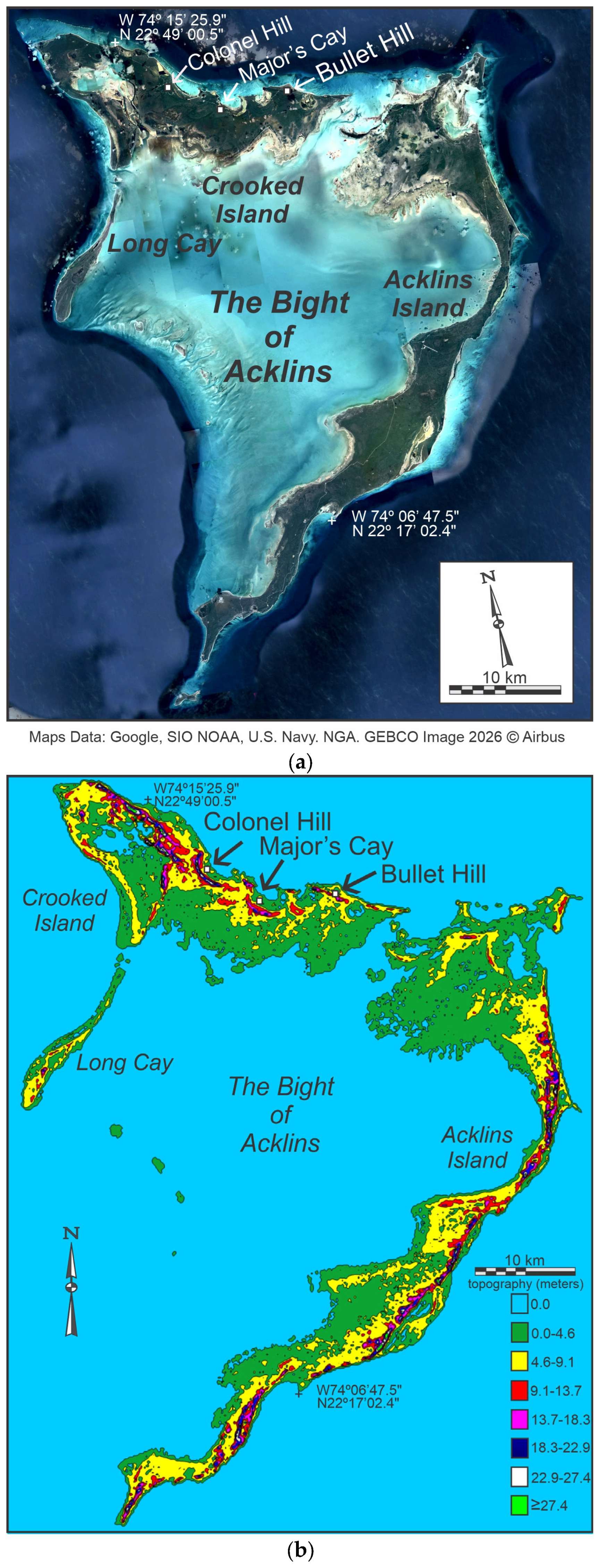
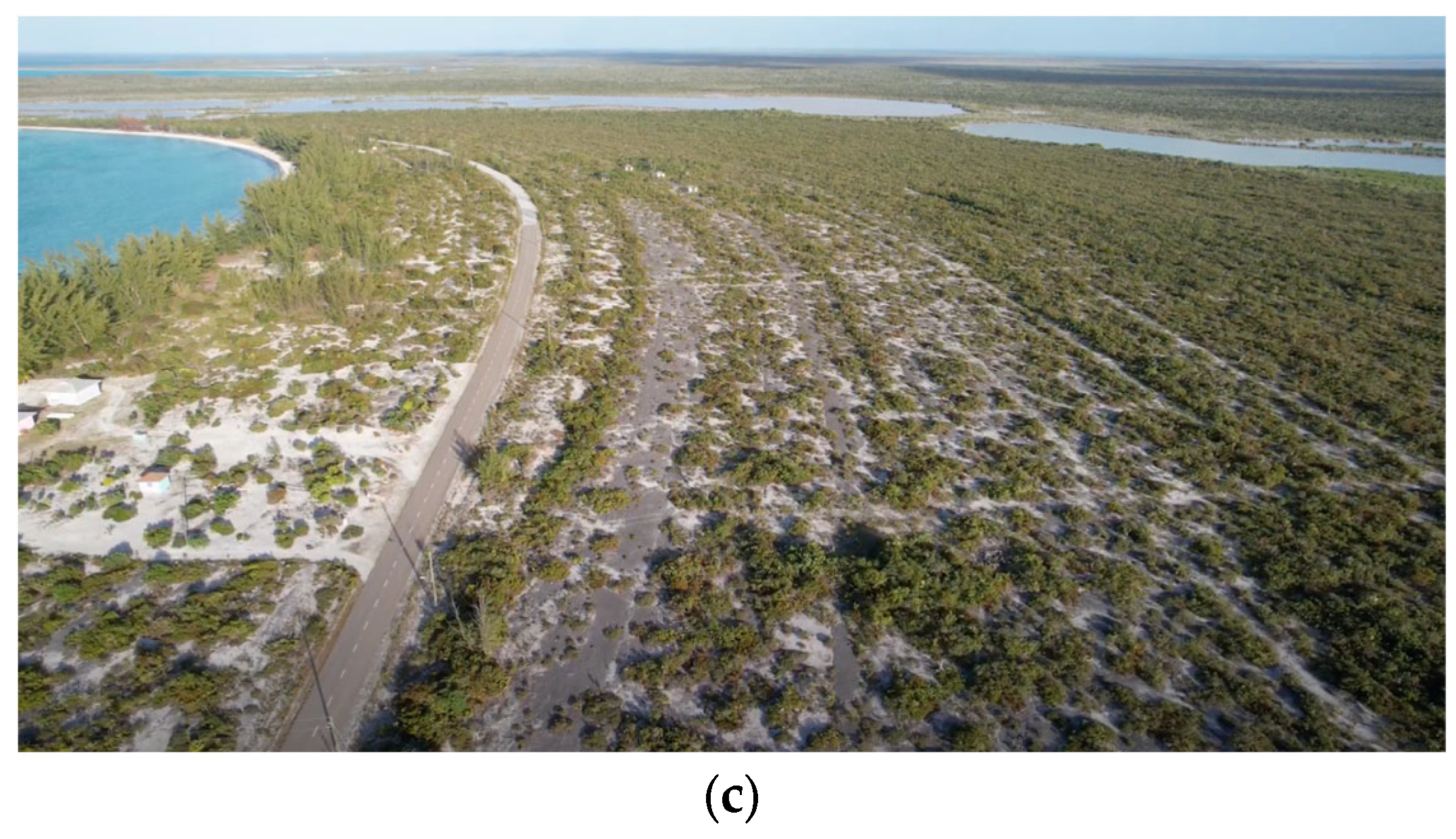
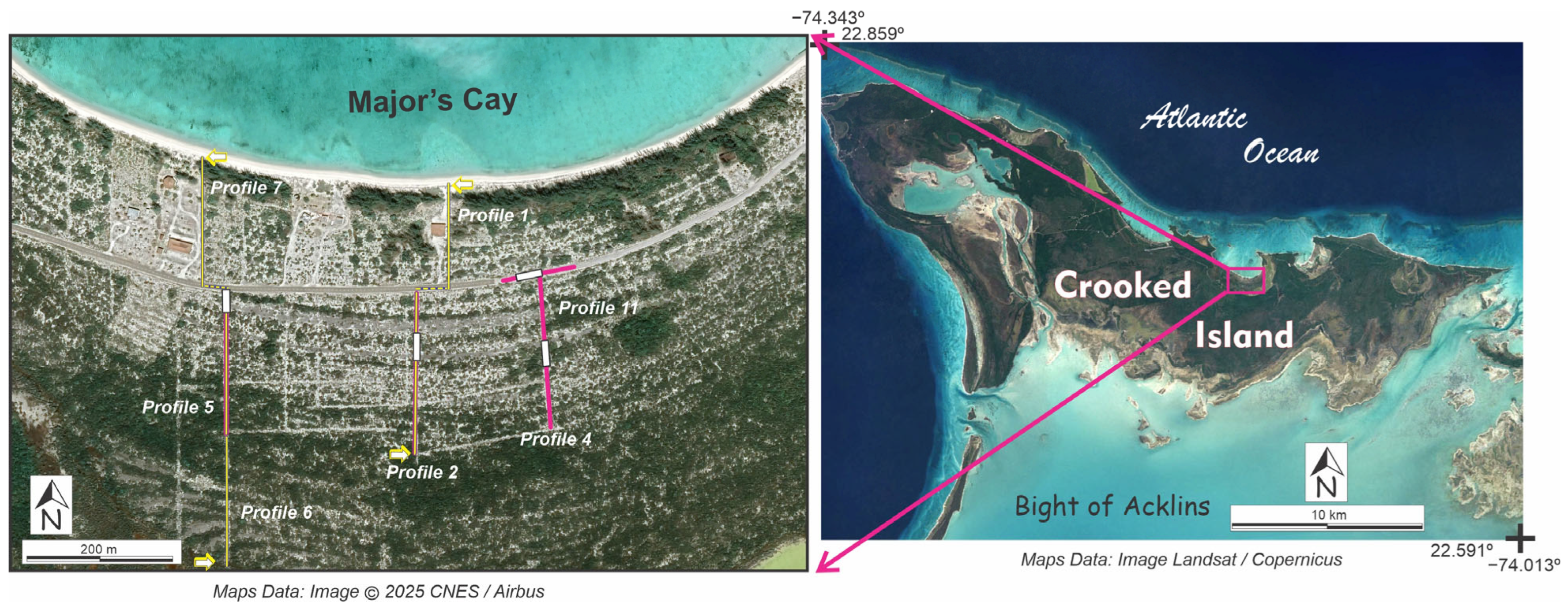
This study aims to investigate the internal structure of carbonate strandplain deposits using high-resolution radar imaging. Surface observations will augment the interpretation of the georadar data. The primary location for this study is Crooked Island, The Bahamas. The Crooked–Acklins Platform (Figure 1 and Figure 2a,b) shows a clear geomorphic expression of seaward progradation, with arcuate ridges visible in satellite imagery, potentially providing valuable insights into how such islands form (Figure 2c). We chose Crooked Island because abandoned roads through dense vegetation provide easy access to strandplain ridges and swales that would otherwise be inaccessible and because the near-subsurface (0–3 m) is dry and unaffected by groundwater (cf. Sandy Hook, San Salvador Island (Figure 1) [20].
Outcrops of Quaternary carbonate sedimentary deposits on the outer islands of the Bahamas suitable for GPR surveying are rare. To provide context for observations on Crooked Island, we compared the Crooked Island results with those from a 3D GPR dataset from San Salvador Island, where a well-lithified Pleistocene aeolianite outcrop was ideal for 3D georadar surveying. Although a Pleistocene aeolianite is not a direct sedimentological analogue for Holocene strandplain deposits, we use the San Salvador 3D georadar data, acquired with the same 400-MHz GSSI antenna and similar field parameters, to validate the relationship between layered porosity variations observed in outcrops and detailed radar reflection amplitude.

2. Previous Work

A primary focus of previous GPR research in The Bahamas has been the reconstruction of ancient depositional environments to better understand carbonate platform evolution. The clear distinction between different carbonate facies in georadar data allows researchers to visualise subsurface structures that are often invisible in outcrops [24]. Ref. [25] used 800 MHz GPR profiles to characterise the distribution of buried tree trunks and roots and differentiate their effect on sediment accumulation in San Salvador Island and Little Exuma Island. Ref. [26] surveyed dip-section 800 MHz profiles across ten ridges to document the internal architecture of swash-aligned ridge–swale sets in the Freedom Beach Strandplain on Eleuthera Island. They discussed how GPR revealed storm signatures, based on truncations imaged on the profiles. Ref. [27] used georadar surveys to determine that the origin of a storm-emplaced barrier was a single, intense storm event, in southern Eleuthera. Three-dimensional georadar was used to image the uppermost part of the Upper Pleistocene Lucayan Formation at Red Bays, Andros Island, Great Bahama Bank, detailing six radar packages and their bounding surface [20]. Ref. [21] developed a depositional analogue model for strandplains by integrating georadar surveys with carbon-14 dating of carbonate sand deposits. On Sandy Hook, San Salvador Island, ref. [28] tested various geophysical methods, including GPR, seismic reflection, and refraction, to determine stratigraphic and diagenetic variations in the carbonate sediments. Georadar data from the New Providence Platform was used to successfully image the geometries of marine isotope stage 5e (MIS 5e) strata, revealing high-energy subtidal bar settings mistaken for beach ridges [29]. From georadar data collected over six strandplains on Little and Great Exuma and Eleuthera, ref. [30] showed that beach ridges in the Bahamas are founded on erosional scarps within foreshore or backshore sands. Examples of dip GPR profiles from the Moriah Cay strandplain in Little Exuma illustrated how georadar imaging in Bahamian strandplains revealed the truncation of paleo-beach face surfaces and their relationship with overlying dune ridges [31].
Several other studies of Quaternary carbonate beach deposits using GPR data beyond The Bahamas have been published. Low-angle sheet and sigmoidal GPR stratal geometries—interpreted as oolitic shoal deposits and a barrier-bar formation, respectively—have been documented in the Pleistocene Miami Limestone of southern Florida, USA [24,32]. Refs. [33,34] discuss the Holocene stratigraphy and coastal progradation of Guichen Bay in South Australia by integrating georadar, sediment volume and dating calculations, and geomorphological techniques to understand beach-ridge evolution and sediment accumulation rates.

3. Geologic Setting

3.1. The Bahamas Archipelago

The Bahamas is an archipelago comprising numerous shallow banks and calcium carbonate islands in the northeastern Caribbean Sea [2] (Figure 1). The convergence of the North American and Caribbean tectonic plates during the rifting of Pangaea and the formation of the North American Basin in the Jurassic period caused uplift and created the basement rocks underpinning The Bahamas Archipelago [2]. The development of carbonate banks began in the late Jurassic and has continued into the Holocene [2]. The rise in sea levels during the late Holocene has driven coastal progradation and sedimentation globally, with significant effects on The Bahamas [35]. Strandplains mainly develop along wave-dominated coasts where accommodation space allows sediment to accumulate on the foreshore and backshore environments [4]. Multiple strandlines form a strandplain, which ref. [4] describes as a “wide, beach-ridge system of multiple parallel beach ridges and swales created by shoreline progradation.” Strandplain deposits appear on multiple islands in The Bahamas, e.g., Exuma, San Salvador and Crooked Island. They also occur on other carbonate islands in the Caribbean, such as the Turks and Caicos Islands.

3.2. Crooked Island

The carbonate Crooked–Acklins Platform, situated in the southeastern Bahamas, comprises three islands: Crooked Island to the north, Long Cay to the west, and Acklins Island to the southeast, which encloses a large, shallow lagoon known as the Bight of Acklins [36] (Figure 2a). Continuous shelf-margin reefs border the northern part of the platform near Crooked Island [37,38,39]. Crooked Island, our main study area, consists of Quaternary-age reefs, carbonate aeolianites, and subtidal to beach-ridge grainstones [37] (Figure 2a). It features a series of interpreted Holocene beach-ridge deposits. These low-energy beach ridges, clearly visible from satellite imagery (Figure 2a), have <0.5 metre of relief, extend up to two kilometres in an east–west direction, and prograde seaward [27] (Figure 2b,c). We interpret these as classic strandlines [36]. Although the strandplain sediments have not been isotopically dated, we infer them to be Holocene, based on dating of similar strandplain sediments that have accumulated in Sandy Hook, on the windward side of San Salvador Island [21] (Figure 1).

3.3. San Salvador Island

San Salvador Island is located approximately 140 km north–northwest of Crooked Island, our main study area, slightly north of the Tropic of Cancer [30] (Figure 1). San Salvador lies on its own carbonate platform, with sediment thickness exceeding 8000 m [40]. Similar to Crooked Island, San Salvador Island is composed of Quaternary-age aeolian dunes and reef-rock systems, overlain by Holocene beaches and strandplains [40,41,42]. The strandplain ridges on the island at Sandy Hook reach elevations of ~8 m above sea level. Hypersaline lakes occupy lower-elevation areas [43].

4. Methods

4.1. Ground-Penetrating Radar

Mapping the third dimension of sedimentary outcrops and the shallow subsurface has advanced with GPR [44,45,46]. GPR offers much higher resolution than seismic or other geophysical methods and detects rock-property changes at scales as fine as decimetres [47]. Numerous studies [24,32] have shown that radar can map fine-scale sedimentary features in limestone, especially in oceanic settings with low clay content, which is less likely to attenuate the electromagnetic signal. The low clay and salinity content of Bahamian onshore calcium carbonate sand deposits make them excellent radar targets [46,48]. The capacity of georadar to image the internal structure of these deposits is also related to the naturally high and well-organised variability in porosity within the deposits (i.e., variation between air and matrix).

4.2. 2D GPR Acquisition on Crooked Island

We collected georadar data on Crooked Island during the February dry season using a GSSI (Geophysical Survey Systems, Inc., Nashua, NH, USA) bistatic 400-MHz antenna with a field-frequency filter set to 100–800 MHz. We previously tested a GSSI 200-MHz antenna on other Bahamian islands for Holocene and Pleistocene carbonate deposits, finding that the higher-frequency antenna provided improved resolution while maintaining similar penetration depth [10,20]. The data were recorded as 2D profiles using a distance wheel, with a sample rate of 2048 samples per trace (~0.05 ns per sample), approximately 59.1 traces per metre, and a record length of 100 ns. Because the GPR surveys were conducted over mostly flat ground, no topographic correction survey was necessary. Processing of the 2D georadar data began with an exponential amplitude gain function, followed by “background” removal based on continuity across 199 traces (a typical value) to eliminate direct arrivals, arrivals through the ground (e.g., refractions), and radar ring-down effects [49]. An automatic gain control (AGC) was applied to balance low and high amplitudes [50]. This was followed by a deconvolution filter (operator length = 31 ns; prediction lag = 10–20 ns), which compressed the wavelet, suppressed multiple reflections, and whitened the frequency spectrum of the data [51]. Deconvolution thus enhanced the precision of stratigraphic interpretation. Kirchhoff migration [51] correctly repositioned dipping reflections.
The general absence of in-plane diffraction hyperbolae in the georadar data from Crooked Island precluded determining the velocity of electromagnetic signal transmission via diffraction modelling. Instead, we follow the work by ref. [26] on the Eleuthera strandplains, who determined a transmission velocity of 0.12 m/ns (dielectric constant of 6.25). This yields a vertical resolution of 7.5 cm or a detection limit of 3.8 cm.
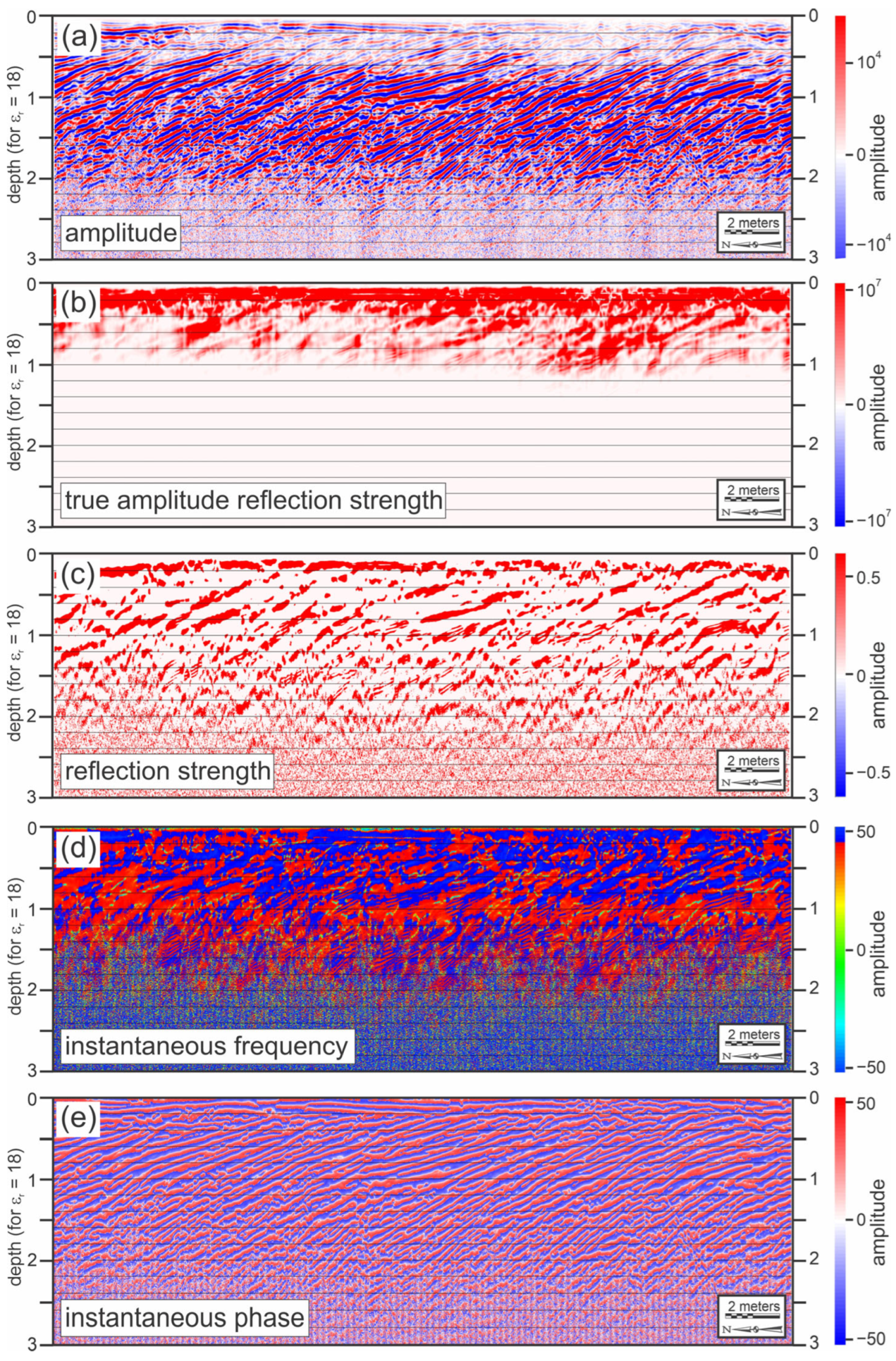
We also calculated seismic attributes [52] on a representative dip georadar profile (Figure 3a). The reflection strength attribute (Figure 3b) shows a high amplitude in porosity layering down to ~1.5 m, beyond which signal attenuation dominates, with the signal disappearing completely, even with gain compensation, by ~3.5–4.0 m (Figure 3c). As expected, the instantaneous frequency (Figure 3d) shows a gradual loss of higher frequencies with depth, reducing vertical resolution. Phase preservation (Figure 3e) remains excellent down to ~3.5 m.

4.3. 3D GPR Acquisition on San Salvador Island

We selected a 3D georadar survey area parallel to a prominent outcrop of the French Bay Member of the Grotto Beach Formation (Pleistocene, approximately 125 ka [2,20,53,54,55]) on the southern coast of San Salvador Island, a promontory between Snow Bay to the east and French Bay to the west (Figure 1). This site was chosen to provide fine-scale GPR imaging of the internal structure of a well-layered carbonate sand dune deposit, with a direct outcrop comparison used to assist the geophysical interpretation of georadar images of the strandplain deposits on Crooked Island. We collected GPR data as parallel profiles using the same antenna and similar parameters to those used on Crooked Island. A rectangular grid measuring approximately 20 ft (6.1 m) by 120 ft (36.6 m) was established along a disused dirt road without any artificial fill immediately beside the outcrop. The long dimension of the survey area ran approximately west to east. The profiles were spaced 1 ft (0.305 m), with 2048 samples per trace (~0.07 ns sample interval), 12 traces per foot (39.4 traces per metre), and a record length of 150 ns. A distance wheel attached to the antenna was used for basic positioning. Elevation corrections were not applied due to the smooth terrain (a slight, uniform westward drop in elevation of ~ 2.5 ft (0.77 m) was noted across the 3D survey area). Data processing for the 3D survey was similar to that for the Crooked Island 2D surveys. For the 3D GPR datasets, we generated vertical (depth view) and horizontal (map view) slices through the volume.
An average subsurface velocity of approximately 0.07 m/ns (dielectric constant of 18) was used to convert GPR sections from time to depth and to measure reflection dip angles for lithified Pleistocene strata on San Salvador. We note that ref. [10] used the same velocity value in their 3D GPR study of Pleistocene carbonate sediments on North Andros Island, The Bahamas. Our chosen velocity aligns with other studies of Pleistocene carbonate rocks, where ref. [56] used 0.07 m/ns, ref. [24] used 0.075 m/ns, and ref. [57] used 0.08 m/ns. A velocity of 0.07 m/ns corresponds to a theoretical vertical resolution (Rayleigh criterion) of 4.4 cm or 2.2 cm for the detection limit, based on a 400 MHz antenna.

4.4. Field Geological Observations

The interpretation of the georadar data was combined with field observations on Crooked Island and San Salvador Island. We collected drone imagery and ground videography on both islands using a DJI Model AIR 2S drone (weighing 595 g, DJI, Shenzhen, China) and a waterproof GoPro video camera (GoPro, San Mateo, CA, USA), respectively. The drone captured the Pleistocene outcrop and the 3D GPR survey site on San Salvador Island (Figure 1) and multiple locations on Crooked Island (Figure 2c), recording strandplain features from above. This was necessary due to the dense bush on the strandplain, which restricted ground access. Real-time drone imagery was essential for navigation across ridges through the thick bush of the strandplain. The videos and photos captured by the aerial drone are of higher quality than those publicly available and provide the bird’s-eye view needed in such a remote, vegetated area. On Crooked Island, we used the drone to better view and locate our data acquisition sites in Major’s Cay and Bullet Hill, but we could not operate the drone in Colonel Hill because of its proximity to the airport. The FieldMove Clino iPhone 3.0.0 application was used to measure the dip angles of the Pleistocene aeolianite outcrop on San Salvador Island.
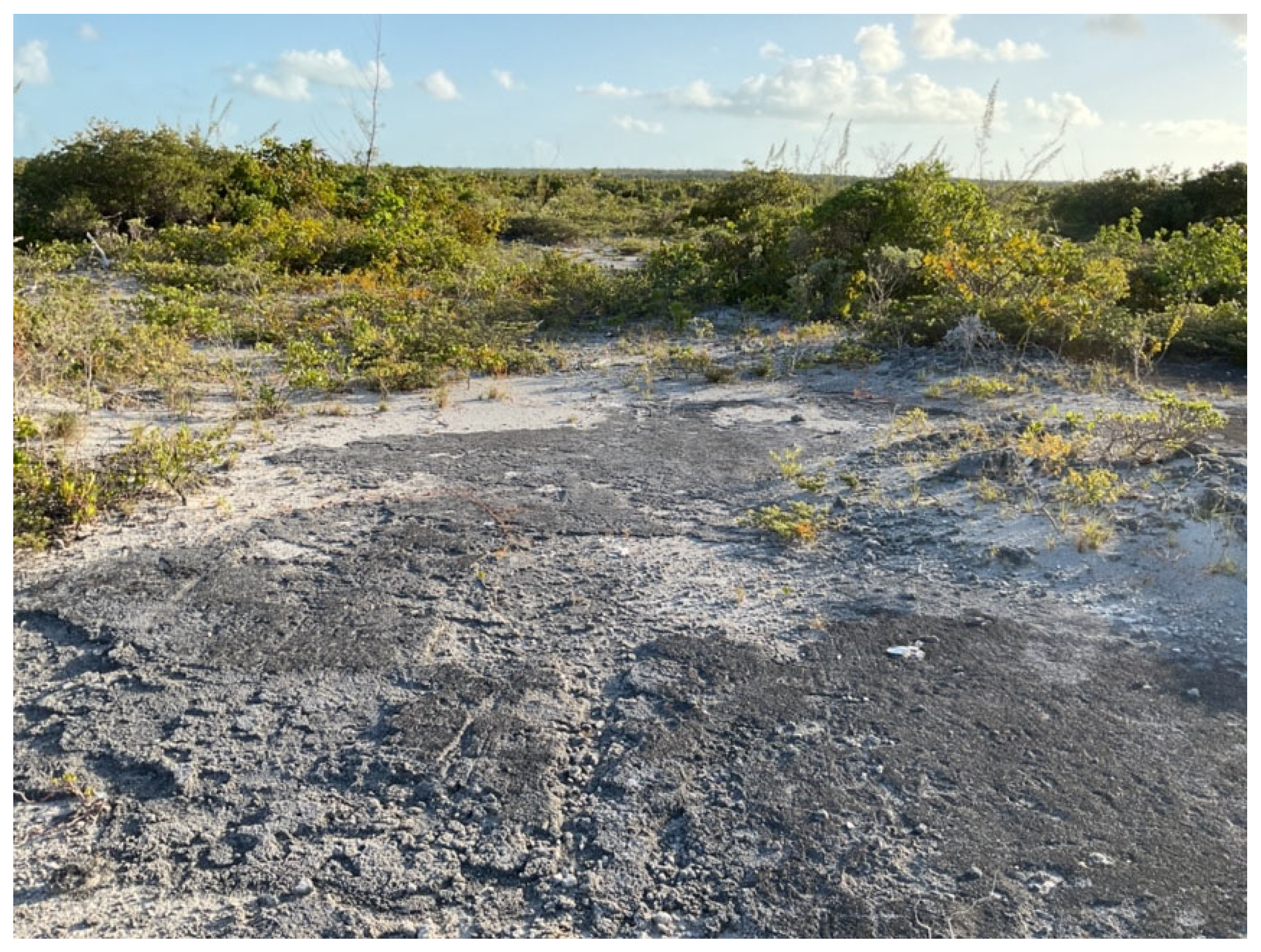
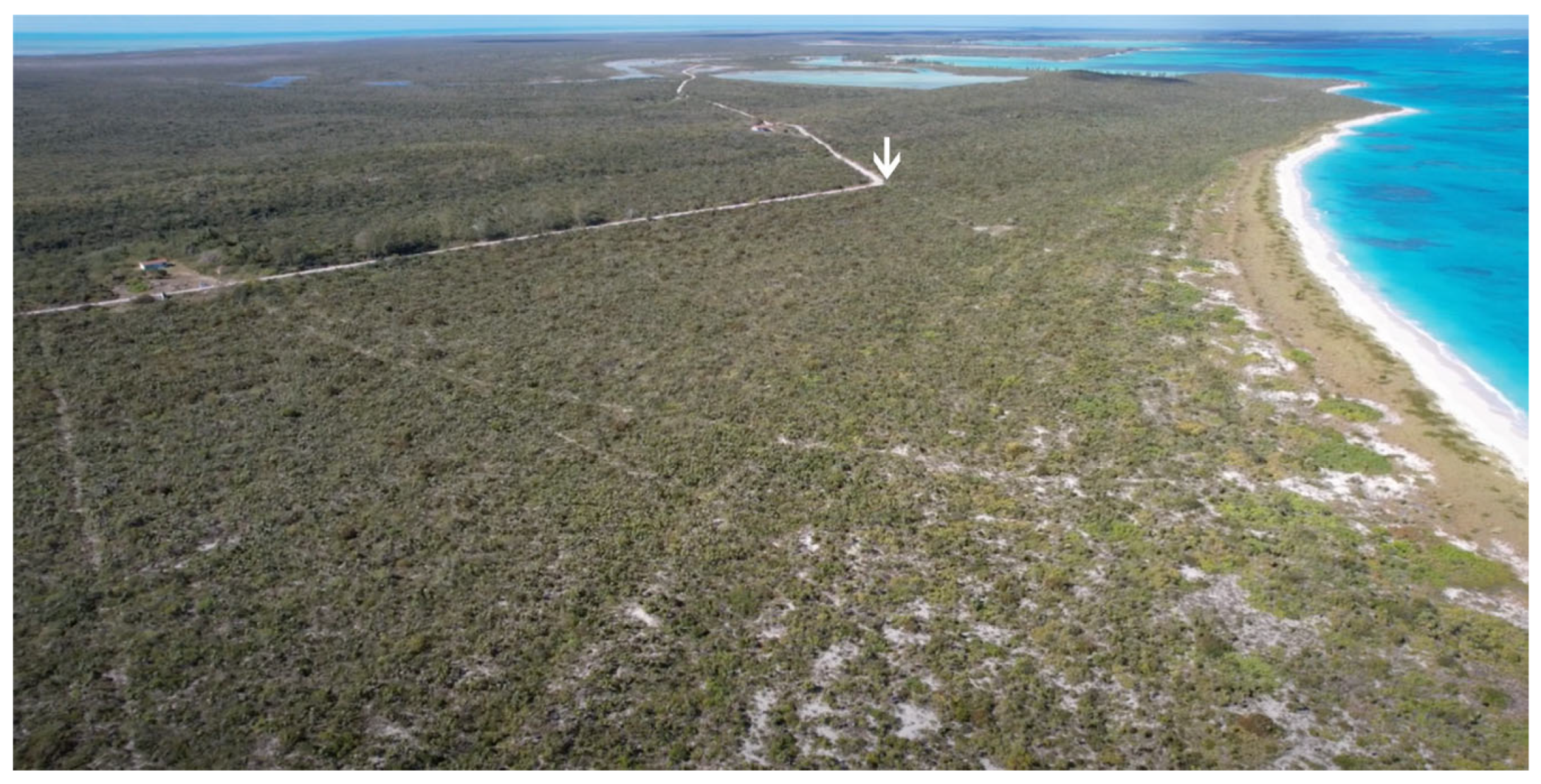
Based on our observations in the field (on the ground and with drone imagery, Figure 2c and Figure 4), we counted ~35 strandlines for the area of Major’s Cay studied (a north–south maximum width of 625 m). Satellite and drone imagery suggest a continuation of the strandplain to the south; however, we were unable to observe details of this area due to very dense, impenetrable vegetation. The height of the strandline ridges, where we could measure them, was <0.5 m. The maximum width of the strandplain at the Colonel Hill study site was 325 m, with similarly spaced strandlines. The maximum width (orthogonal to the shoreline) for the study area at Bullet Hill was 330 m with ~35 strandlines.

5. Results and Interpretation

We conducted GPR surveys at three locations on the windward side of Crooked Island and a 3D survey on San Salvador Island. Each Crooked Island location may represent strandplains at various stages (Figure 4). The three locations on Crooked Island are Major’s Cay, Colonel Hill, and Bullet Hill (Figure 2a).
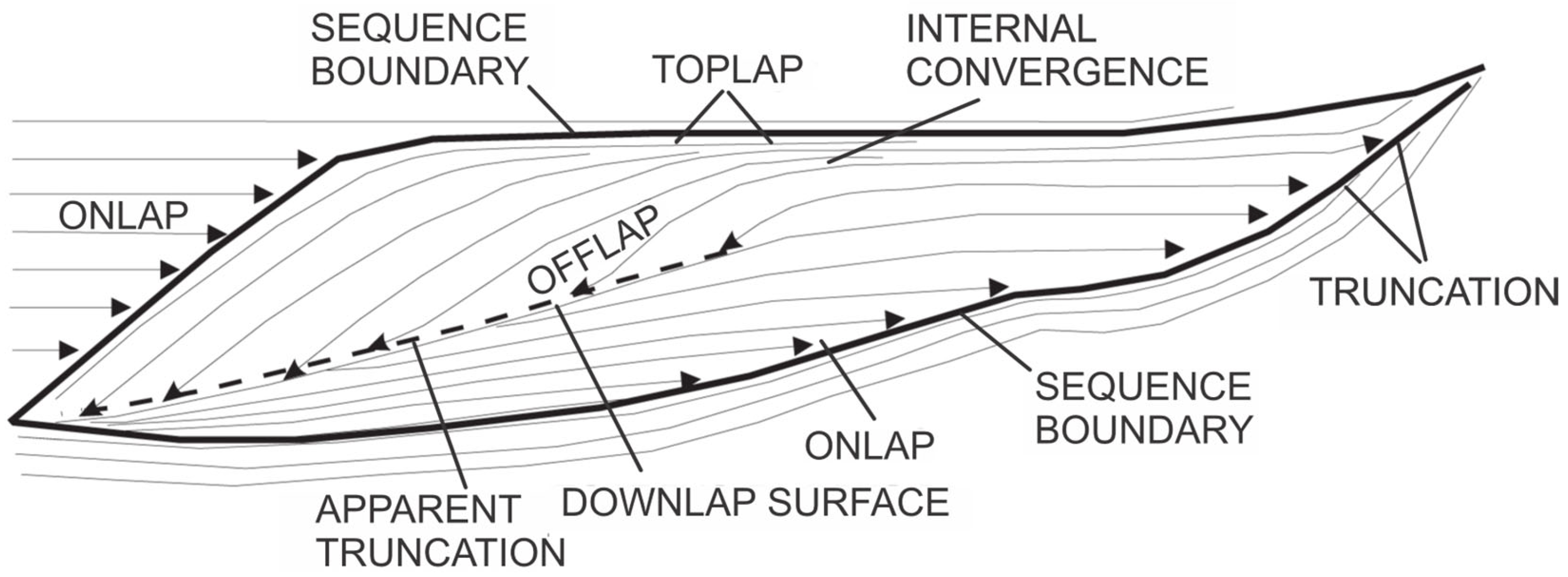
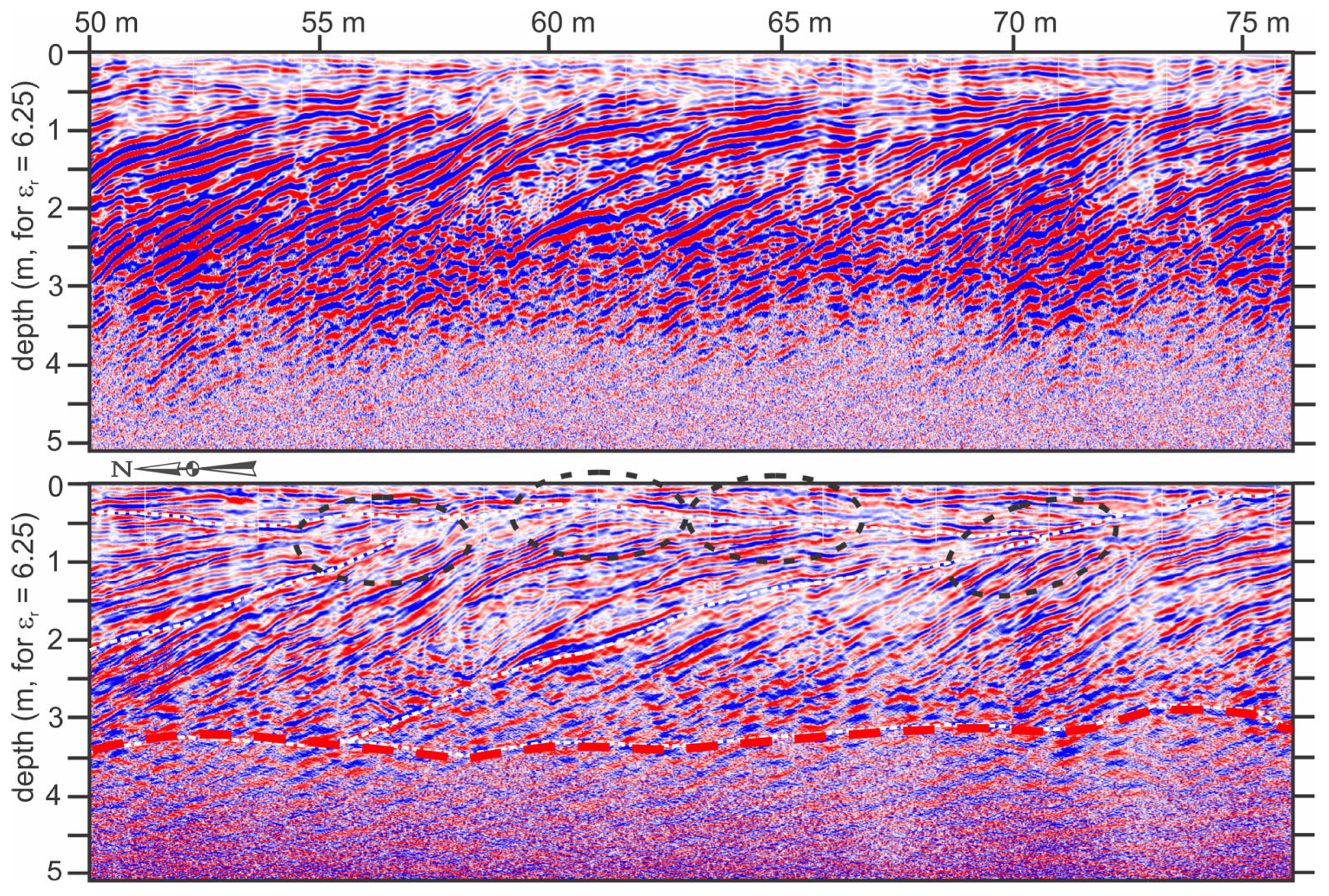
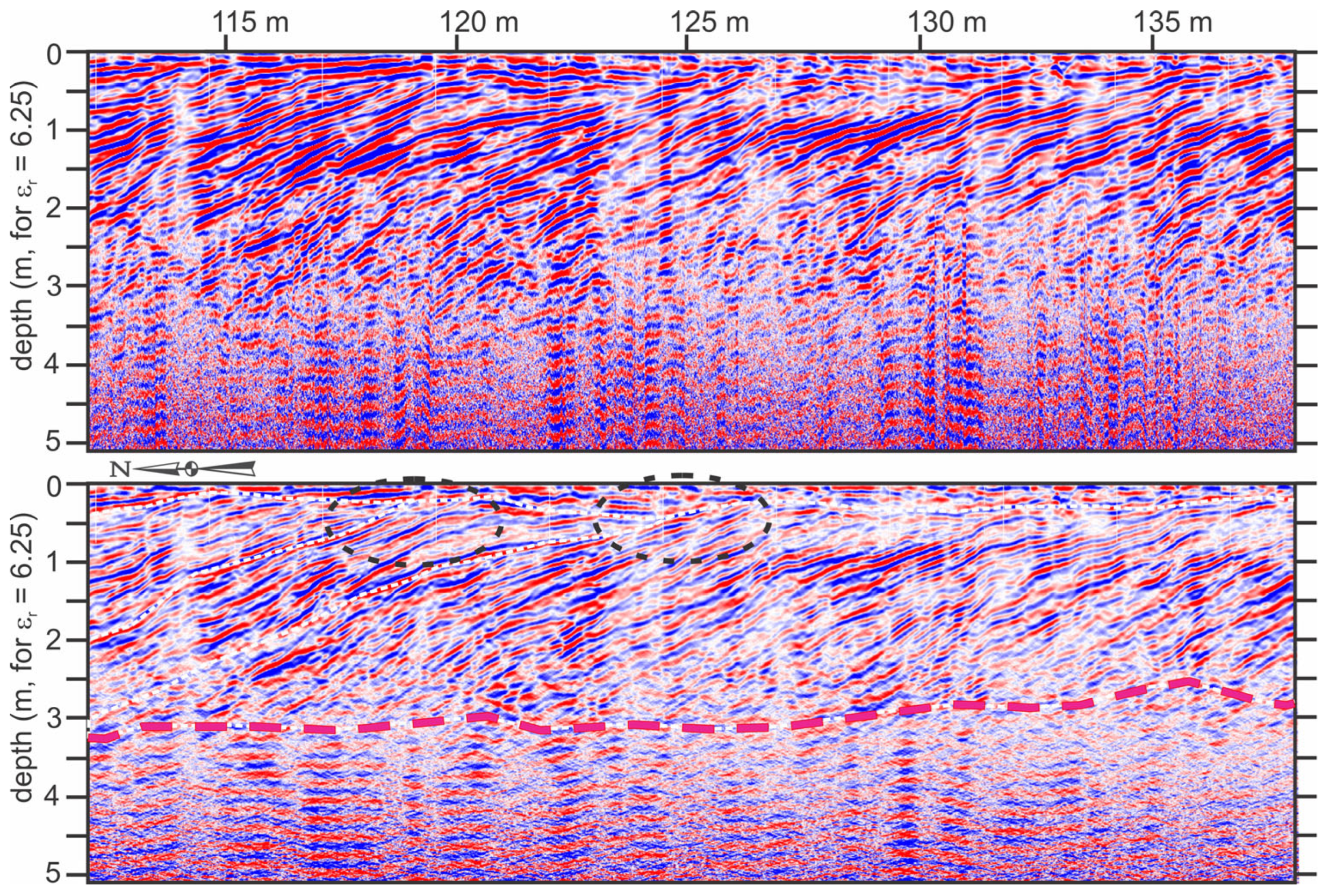
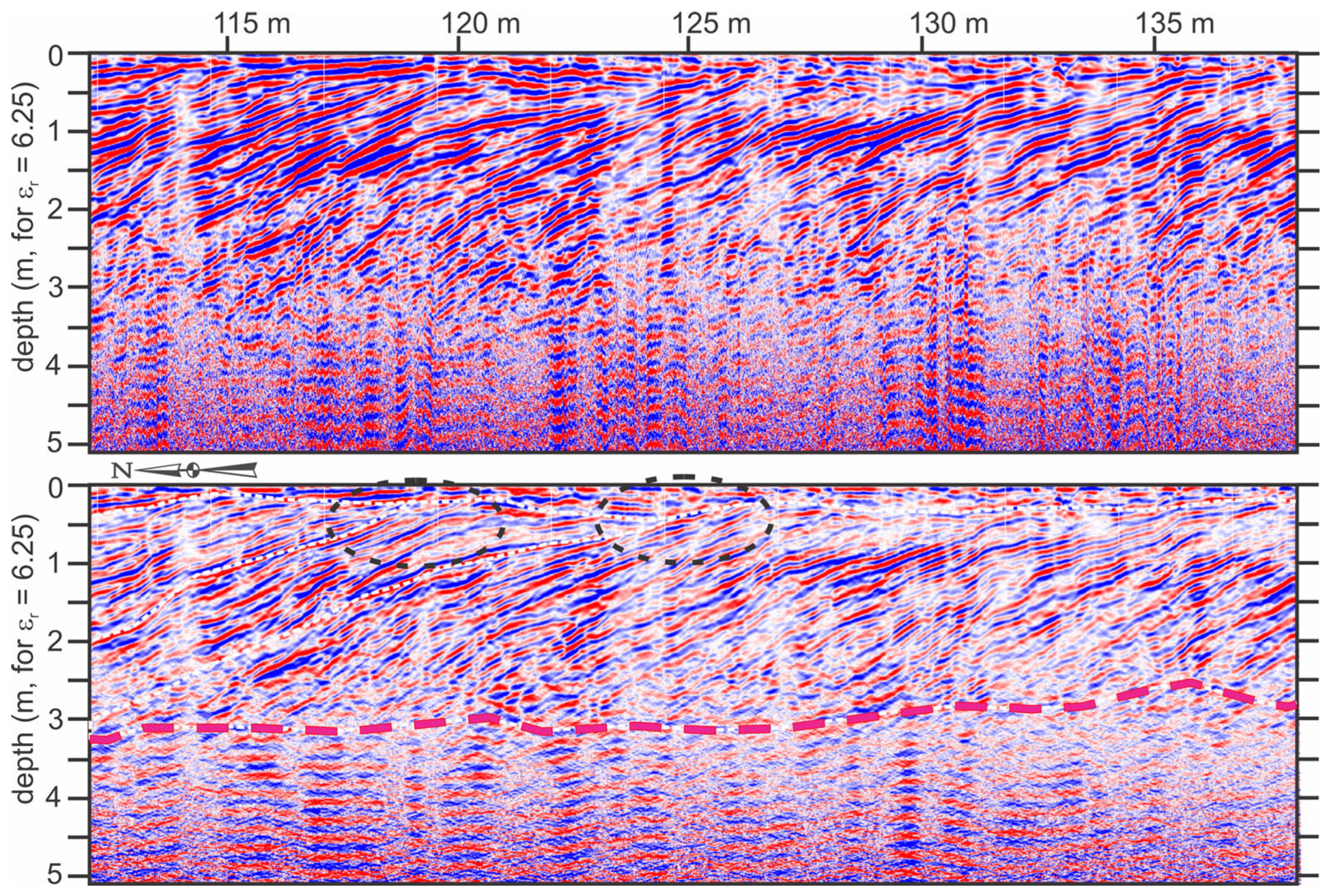
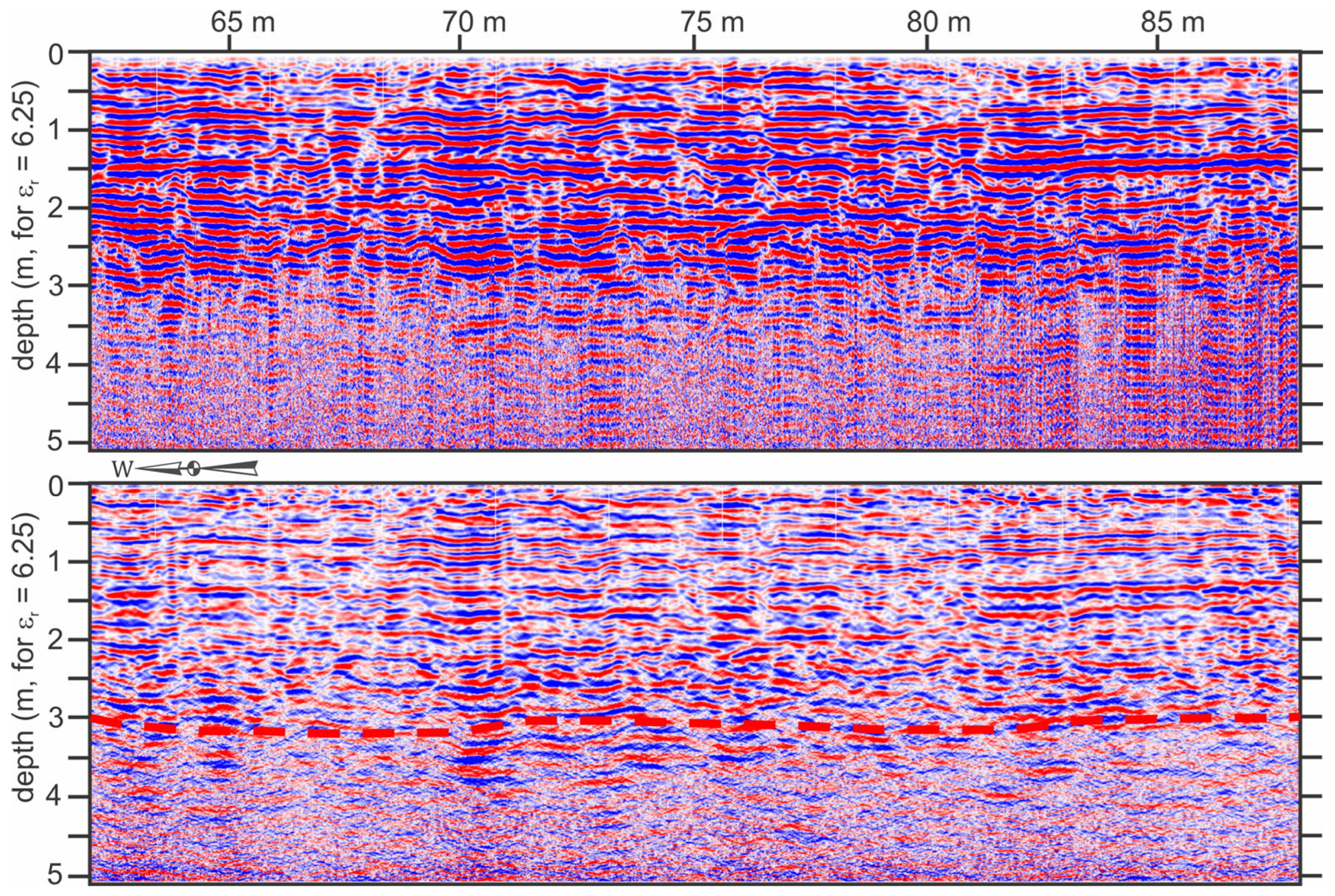
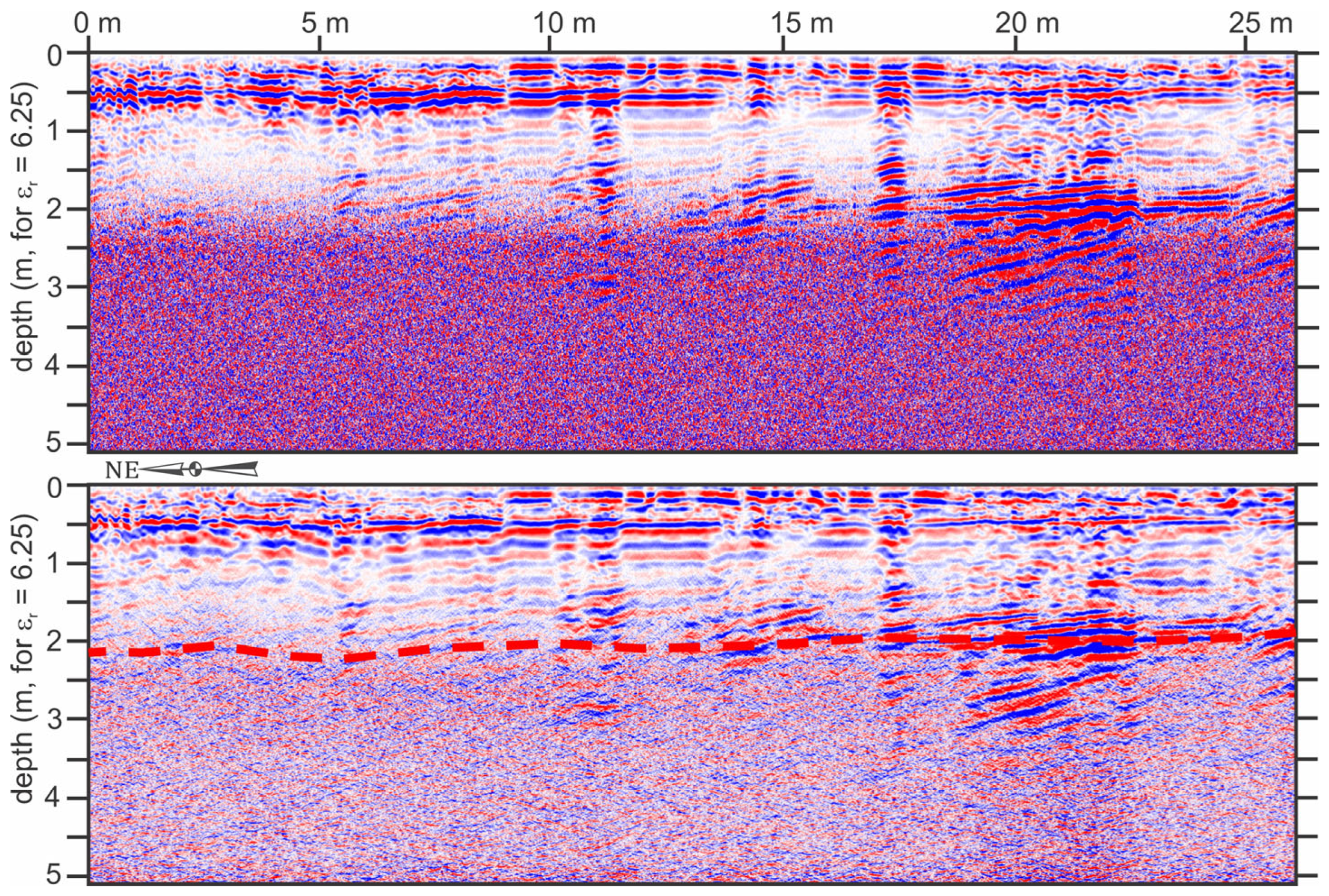
The GPR data from our main study site on Crooked Island are illustrated by strike and dip profiles, along with observations and interpretations. For each example, two versions will be shown: the top one displays only exponential gain and “background” removal; the lower one additionally includes AGC, deconvolution, and migration for clarity with a simplified stratigraphic interpretation. To enable consistent comparison of profiles, all georadar 2D sections are displayed over a 26 m length. Dip angles and directions are considered apparent. Because the dip azimuth of strandplain strata can vary along a straight line, reflection dip variation on the profile could represent an azimuth change, rather than an actual change in true dip. Interpretations of progradational radar packages are based on observed variations in reflection dip and truncations, following relationships such as onlap and toplap, as in classic seismic stratigraphic sequence interpretation methods [51] (Figure 5). Several researchers have proposed an approach to GPR based on traditional seismic stratigraphic interpretation strategies [58,59,60,61,62].
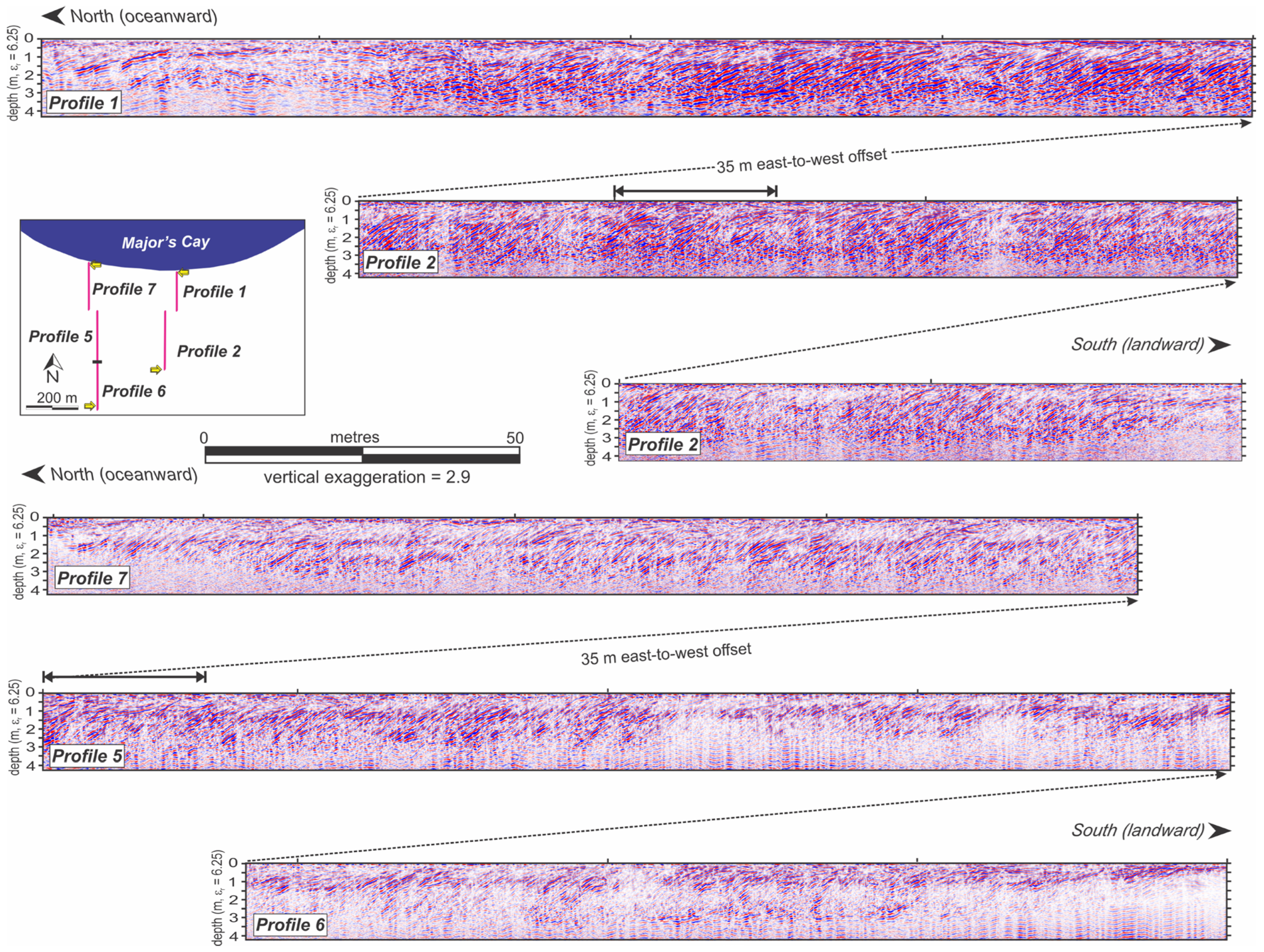
Although each profile on Crooked Island is unique, common trends emerge across all profiles. The most notable is the high radar reflection amplitude and low signal attenuation of the shallow subsurface (0–3.5 m). Additionally, most reflections dip seaward, although a few dip in the opposite direction. Distinct packages of reflection amplitude can be characterised by specific features: variations in dip angles, orientation, reflection length, and coherency among different packages reflect sedimentary characteristics, including deposition rate and accommodation space [65,66]. Georadar reflections can be organised into packages defined by abrupt changes in these features and by reflection truncations (Figure 5). However, we note that the profiles are separated by several hundred metres, whereas the individual sequence interpretations are much shorter (e.g., 10–20 m along a profile), which makes correlation between the transects difficult without spatial aliasing. Because Major’s Cay provided the broadest access to strandplain deposits (Figure 6), we show that the entire north–south transects at a smaller scale and is more vertically exaggerated for two areas (Figure 7) between the beach on the north and the marsh to the south (Figure 6). These two transects provide an overview of the radar reflection amplitude variation for the entire strandplain for Major’s Cay.
Figure 7. Two complete georadar transects in Major’s Cay on Crooked Island, Bahamas, extending from the marsh on the south and the coast on the north (Figure 6) and an inset location map. Data processing is the same as for profile excerpts (e.g., Figure 8), except for an added 15-adjacent trace mix. Double arrows show location of subsequent figure excerpts.
Geosciences 16 00085 g007
Figure 8. Dip GPR Profile 2 (excerpt) from Major’s Cay on Crooked Island (Figure 6). The profile is 26 m long and has a 1.7:1 vertical exaggeration. The top image shows rudimentary data; the bottom shows the data processed with AGC, deconvolution, and migration for clarity; and the interpreted georadar package boundaries are shown as white dashed lines. The thick red dashed line is the interpreted base of mapped reflection amplitude. Encircled are stratigraphic features referred to in the text. Note that the interpretation is relative to the profile excerpt only and does not imply correlation with other profiles.
Geosciences 16 00085 g008
For each of the three survey sites on Crooked Island (Major’s Cay, Colonel Hill, and Bullet Hill), we chose representative excerpts from the entire GPR transect (for Major’s Cay, see Figure 7) and present the results and their interpretations for each area.

5.1. Crooked Island: Major’s Cay

The key features of the georadar images for Major’s Cay are demonstrated by three dip profile excerpts aligned roughly north–south, perpendicular to the beach, and one strike profile oriented approximately east–west, parallel to the beach. The dip profiles (Figure 8, Figure 9 and Figure 10) mostly show reflections dipping northward toward the ocean. Several reflections dip landward. The ability to resolve reflection amplitude decreases between ~2.5 m and 3.5 m depth before vanishing, as indicated by a thick red dashed line (see also the seismic attribute versions in Figure 3). A recurring pattern is two or three sets of reflections in each profile, each with different dipping angles, which overlap (areas marked with dashed white lines). These sets are distinguishable by their different reflection angles. The length of reflectors in the dip profiles typically falls between 5 and 15 m (in the plane of the section). The apparent reflector angles on the dip profiles range from 5° to 10°.
Multiple progradational radar packages can be interpreted from variations in reflection dip across package boundaries (white dashed lines), which likely reflect fluctuations in the energy of the depositional environment. The dominant seaward reflection dip indicates accretion and northward migration of the beach. The landward dip near the top of some dip profiles may be caused by a strong storm, with backwashed sediment towards the interior of the island (i.e., to the south) [67] responsible for the opposite dip angles. Profile excerpts farther inland (Figure 7 and Figure 9) may indicate older sedimentation. Encircled areas on dip profiles (e.g., Figure 8, Figure 9 and Figure 10) refer to reflection truncations (unconformities) that may be interpreted as being caused by erosion during storms. Such an interpretation could imply that these truncations represent erosional palaeo-scarps, as described by ref. [26] for a strandplain on Eleuthera Island.
The profile excerpt in Figure 10 is located along the curve of the strandplain (Figure 6) and is only 0.25 km from the modern beach, suggesting that the sediments are younger than those seen on profiles farther landward. The apparent dip angles are less steep than at other locations, likely because the profile is oriented more obliquely relative to the strandplain ridges.
The strike profile excerpt (Figure 11) runs roughly east–west (Figure 6), intersecting the dip profile in Figure 9. This profile generally represents the strike profiles in Major’s Cay. The reflections in this profile are horizontally oriented (apparent), with various overlap relationships. The slight onlap between parallel reflections in places could express the truncation of progradational radar packages, as seen in the dip profiles (Figure 8, Figure 9 and Figure 10).

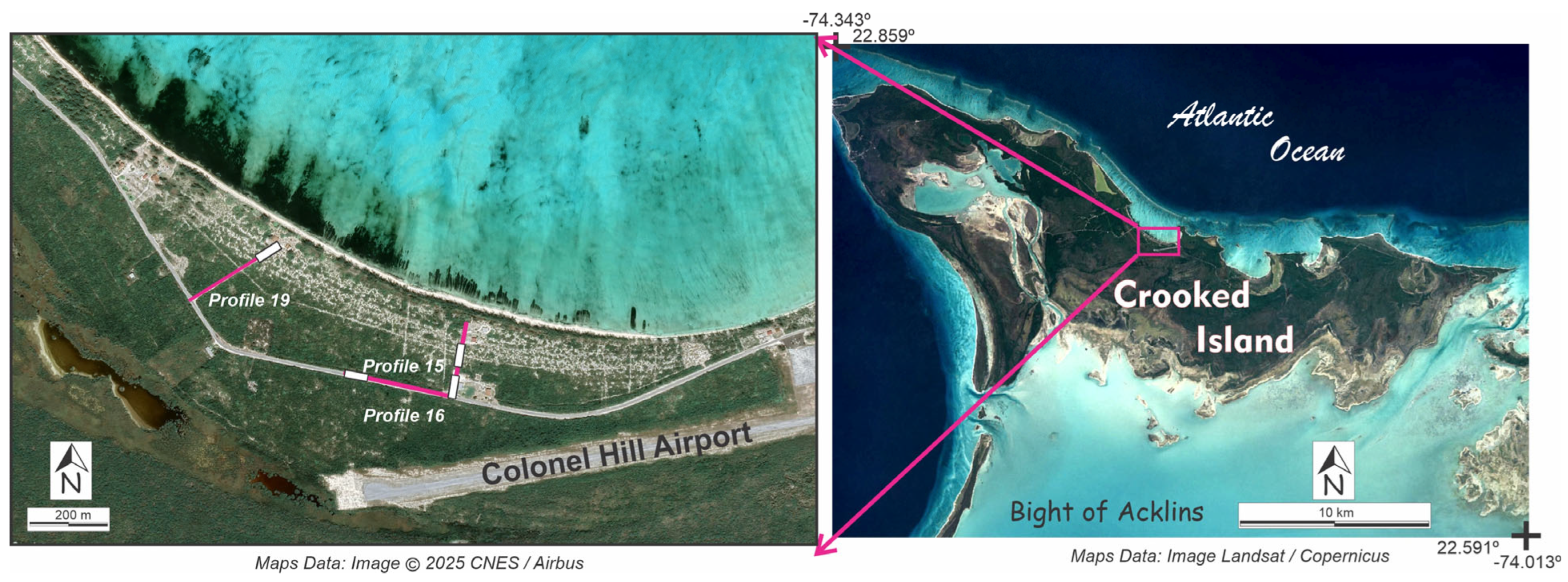
5.2. Crooked Island: Colonel Hill

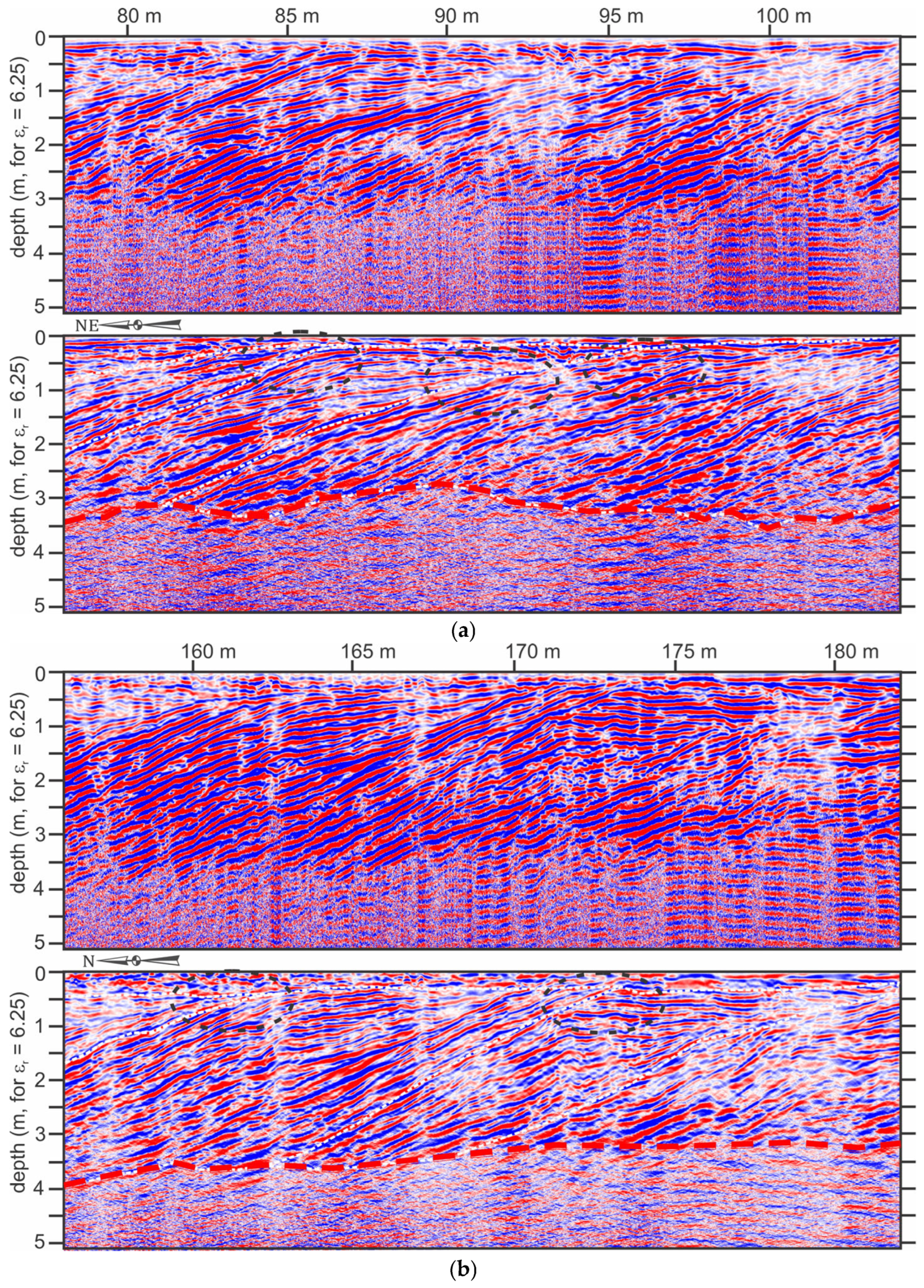
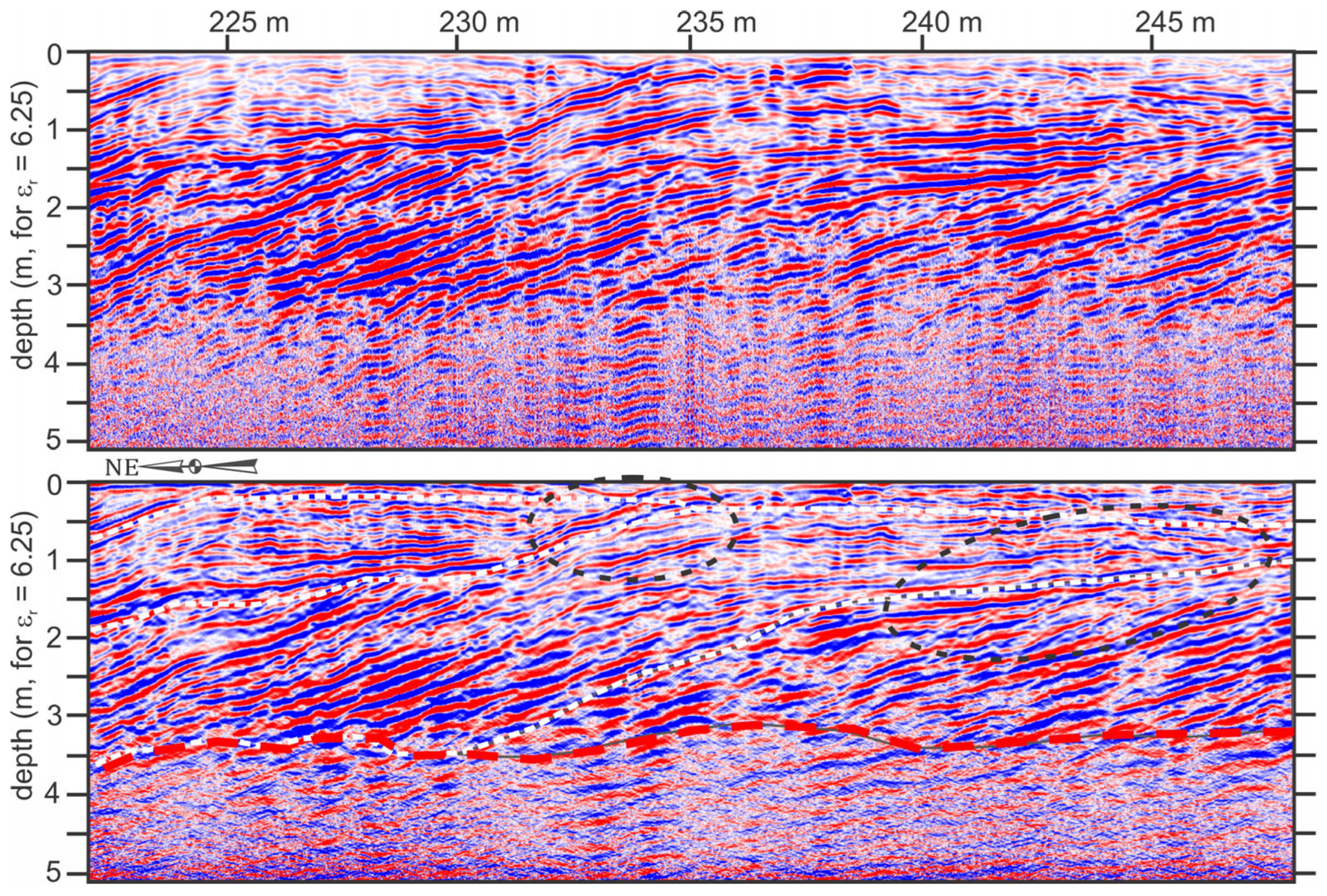
The smaller strandplain on Colonel Hill (Figure 12) is less extensive than that for Major’s Cay and has poorer road access. For Major’s Cay, we illustrate our results with three representative dip profiles and one strike profile. The dip profiles shown in Figure 13a,b and Figure 14 are located near the centre of the strandplain. Similar to the dip profiles from Major’s Cay, these sections are highly reflective and display reflections dipping northeast (apparent), towards the ocean. As with Major’s Cay, sequences can be inferred from the contrasting angles of the reflections, and encircled areas are interpreted as erosional palaeo-scarps associated with storms. The reflections vary in length but are generally comparable to those at Major’s Cay. Reflections dip between 5° and 12°, respectively. The dip profile in Figure 14 runs southwest–northeast on the western side of Colonel Hill (Figure 12), closer to its curved margin. The reflections dip northeast (apparent). The profile is 0.10 km from the beach. The reflection length averages between 8 m and 12 m. The shallowest and steepest reflections dip at 3° and 8°, respectively.
As with other dip profiles, multiple reflection packages appear at different angles, each inconsistent with the one next to it. The interpretation of the dip profiles in Colonel Hill is like that of the profiles in Major’s Cay. The reflection packages with differing angles are interpreted as progradational sequences that truncate one another. Therefore, the sedimentation style seems to align with that interpreted from Major’s Cay.
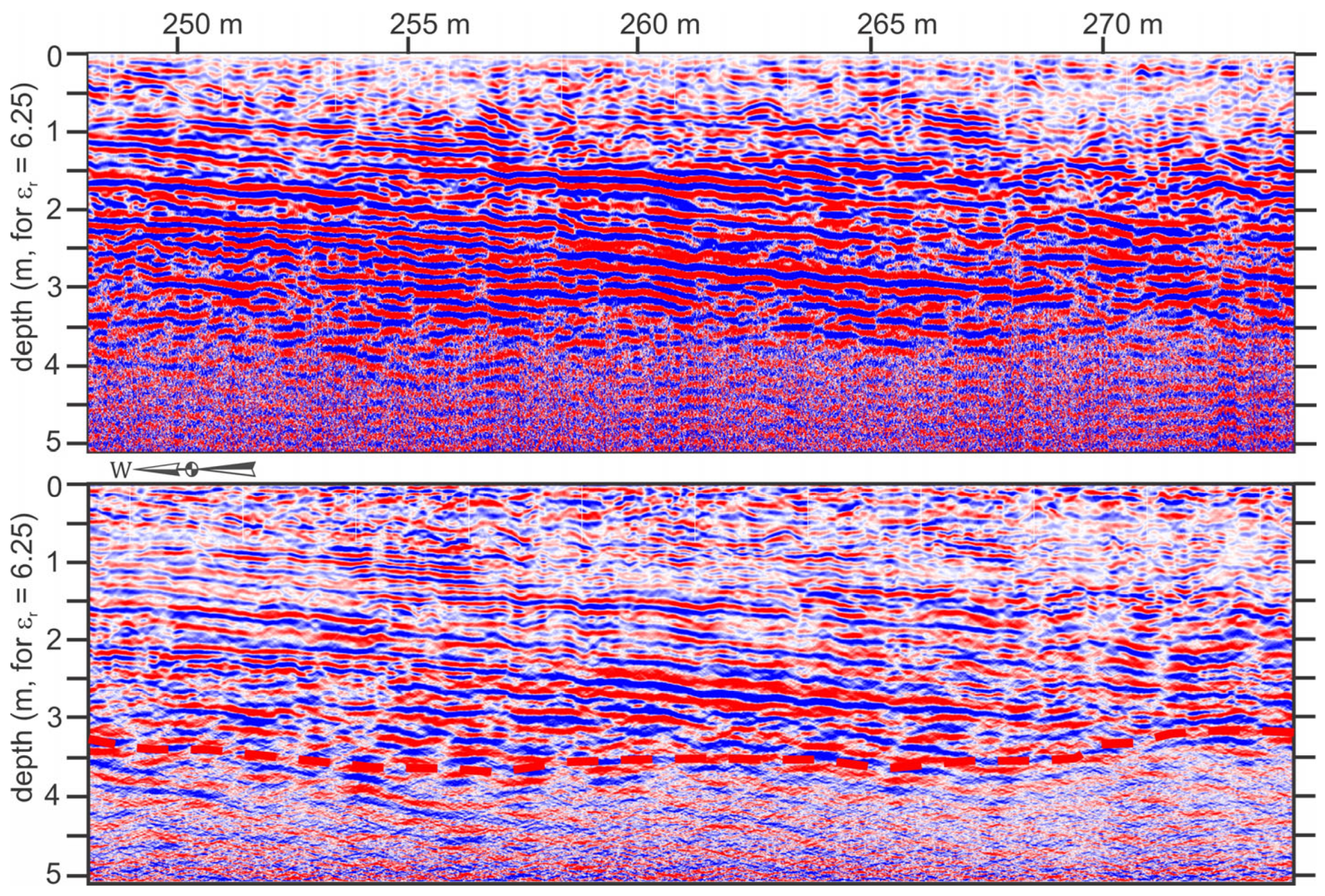
The profile excerpt in Figure 15 runs along the main road on Crooked Island (Figure 12) with a predominantly strike orientation (relative to beach ridges visible on the satellite imagery, Figure 12). This profile is situated approximately 0.26 km from the beach. Reflections dip slightly east (apparent) and can be grouped together with minimal overlap. This strike profile is interpreted to show the sequence of truncations in the dip profiles, as indicated by the convergence of reflections near the west end of the profile (encircled area, Figure 14).

5.3. Crooked Island: Bullet Hill

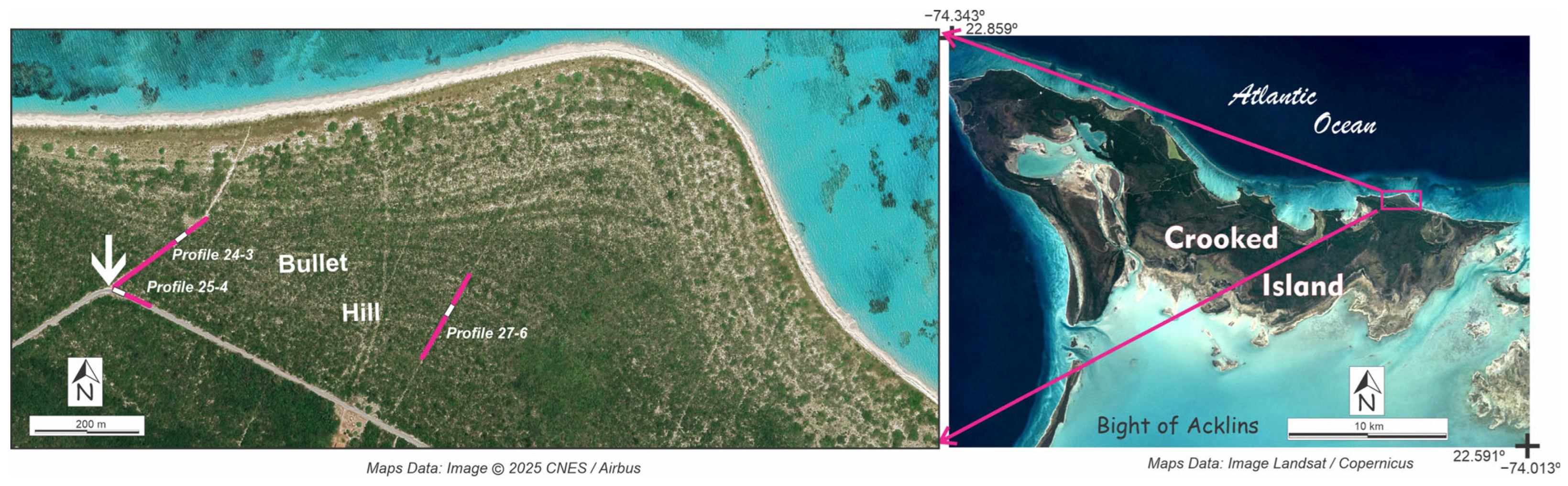
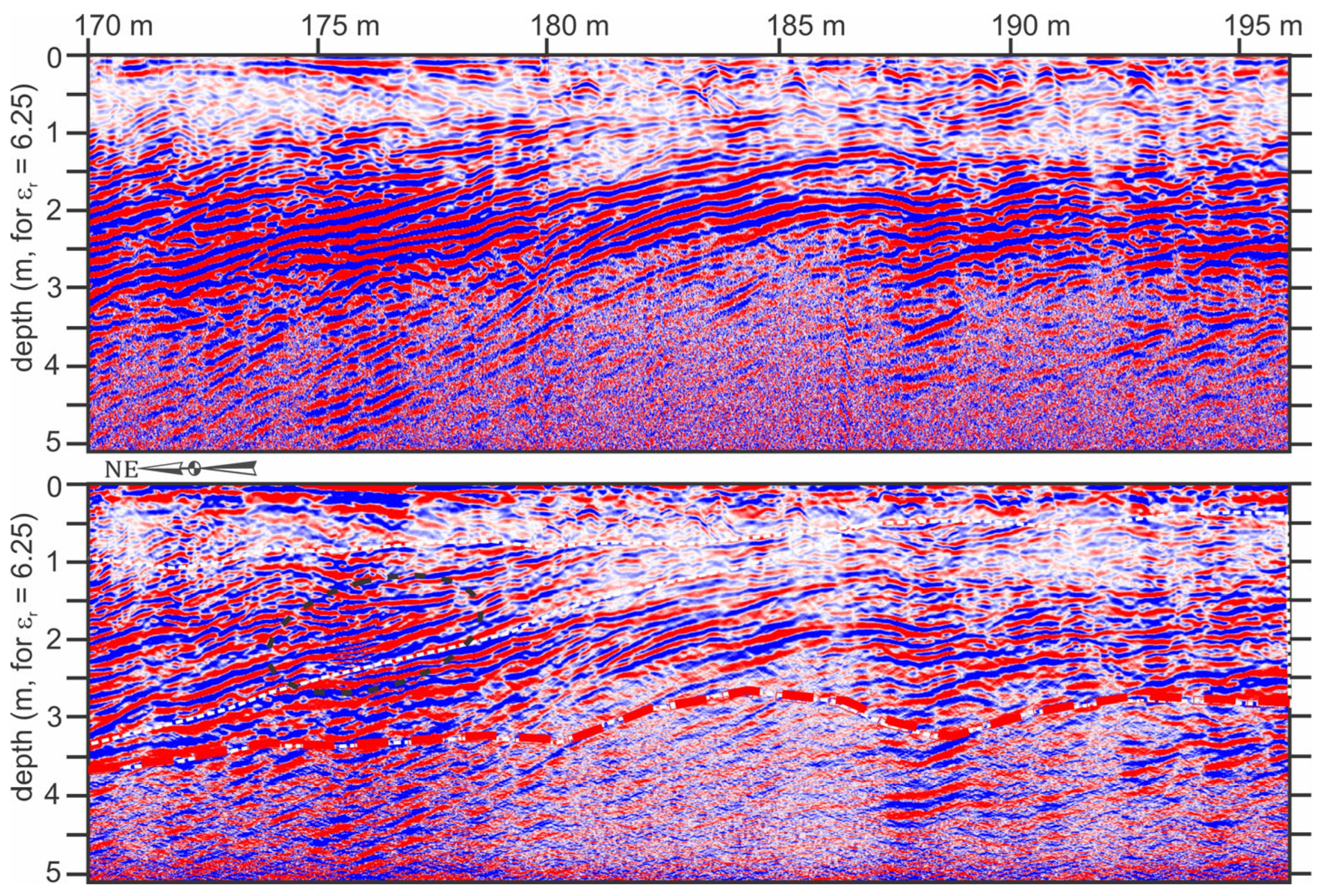
The Bullet Hill study area (Figure 16 and Figure 17) differs from the other two (Major’s Cay and Colonel Hill, Figure 6 and Figure 12, respectively), with the strandplain inverted outward (Figure 16). Also, the area is less settled, and road access suitable for radar surveying is very limited. The dip profile excerpt in Figure 18 is located on the western edge of our Bullet Hill study area (Figure 16). It is oriented southeast to northwest, towards the ocean, located approximately 0.26 km from the beach. The reflections average 10–12 m in length. The shallowest dipping and steepest reflections are 5° and 9°, respectively. Two distinct dipping packages are interpreted, like those in Major’s Cay and Colonel Hill; however, the reflection amplitude in the upper 0.75–2.0 m of the section is much reduced. The northernmost package shows imbricated reflections juxtaposed against the southern package, where reflections are more subhorizontal.
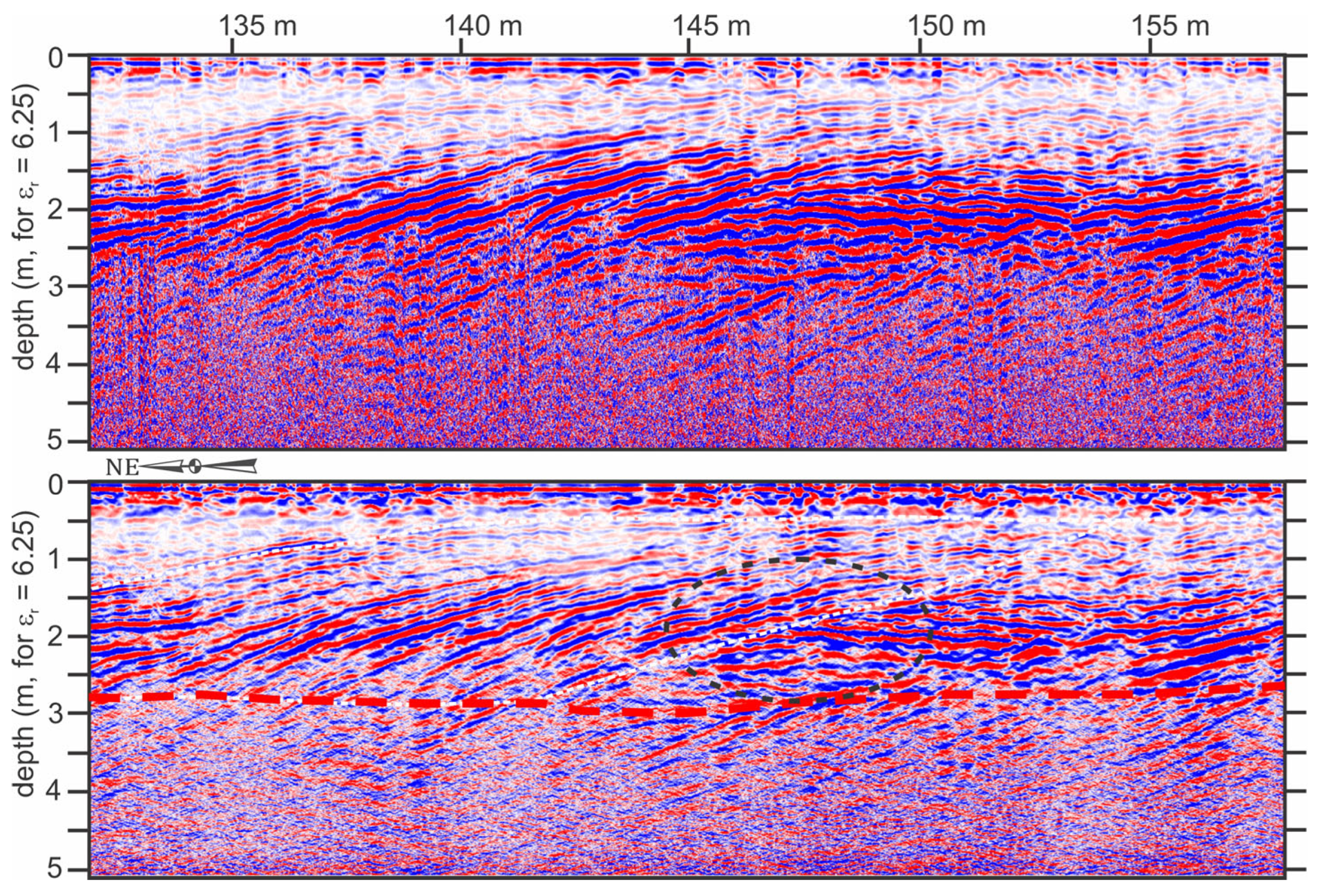
Figure 19 shows a dip profile oriented southwest to northeast along the eastern edge of the Bullet Hill area and approximately in the middle of the strandplain, 0.60 km from the shoreline. The profile is similar to the previous profile, with two distinct reflection packages—the northernmost showing imbricated reflections juxtaposed against subhorizontal reflections in the southern package. The average length of reflections is 8 to 10 m. The shallowest dipping and steepest reflections are 5° and 11°, respectively.
We collected a short strike profile (Figure 20), along the main road (Figure 16), oriented southwest–northeast on the western side of Bullet Hill, approximately 0.4 km from the shoreline. The reflection amplitude of Profile 25-4, clear only down to 1.2 m, is less than that of the other profiles discussed. Reflections are flat until a depth of 0.70 m, below which they dip slightly towards the northeast.
As with Major’s Cay and Colonel, the radar packages are interpreted as progradational sequences, onlapping with reflection truncations (Figure 5). As with Major’s Cay and Colonel Hill, sequences are defined by contrasting reflection dip angles. The encircled areas are likewise interpreted as storm-related erosional palaeo-scarps.

5.4. San Salvador Island-French Bay

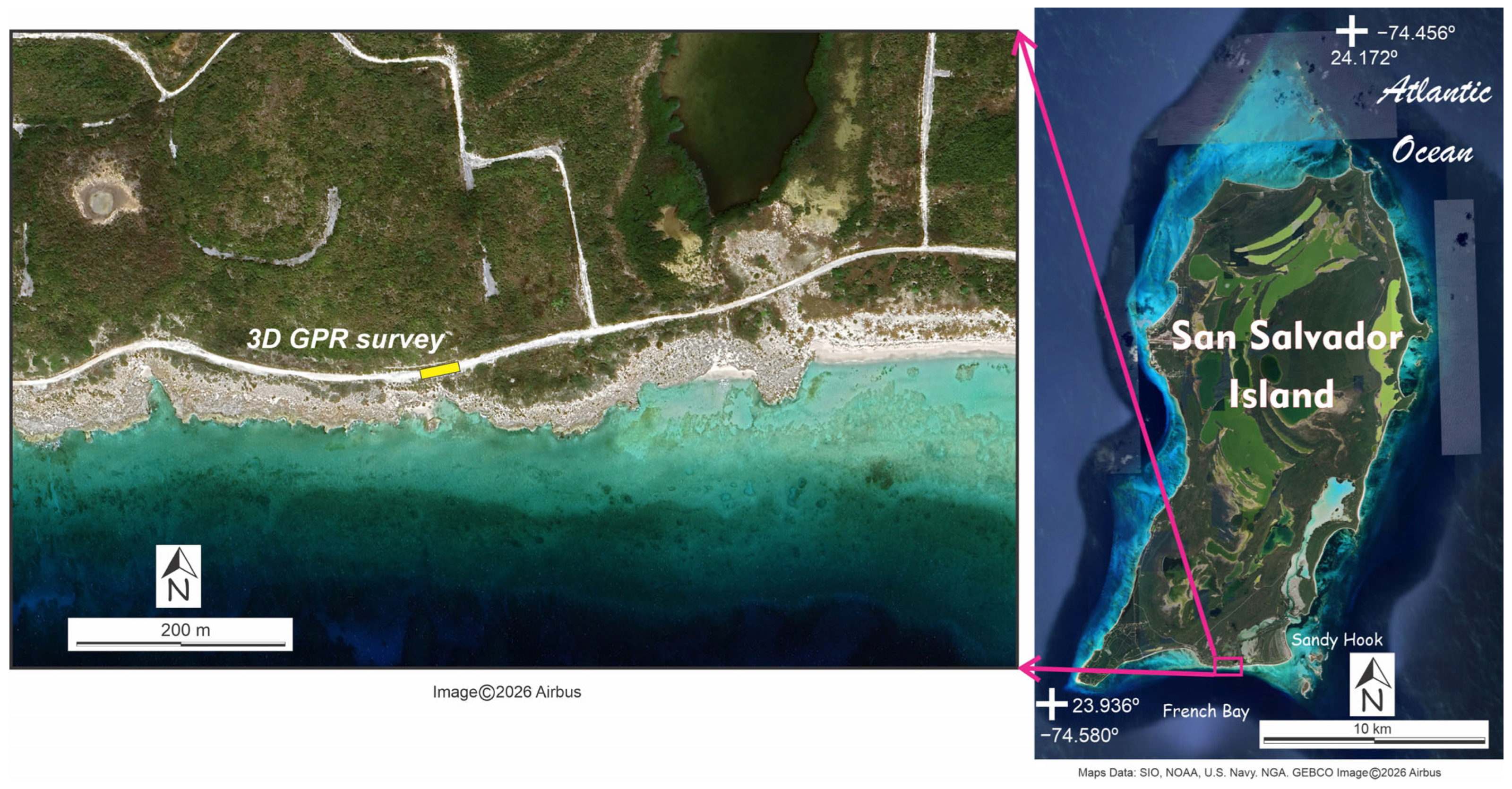
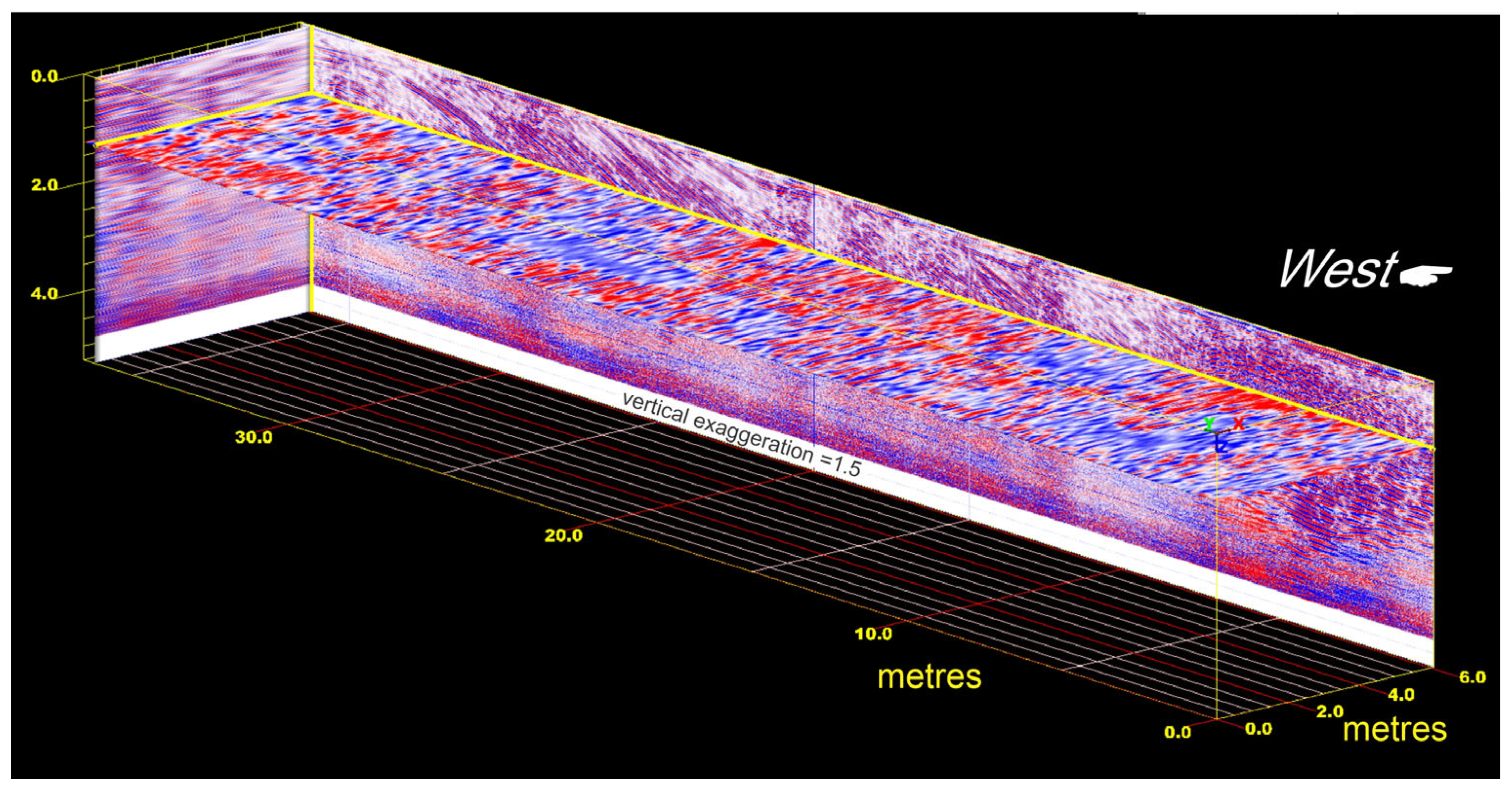
The 3D georadar dataset at French Bay (Figure 21) was surveyed east to west adjacent to a Pleistocene aeolianite outcrop (road cut) (Figure 22). The exposed strata have been classified as the Grotto Beach Formation (Pleistocene, ~125 ka) and exhibit a well-preserved transgressive-phase aeolianite dune-and-swale system [55,56,57]. Acquiring a 3D GPR volume immediately next to the well-exposed road cut allows direct comparison of porosity layering with high-quality radar imagery, serving as an approximate analogue to the strandplain reflection amplitude sequences observed on Crooked Island.
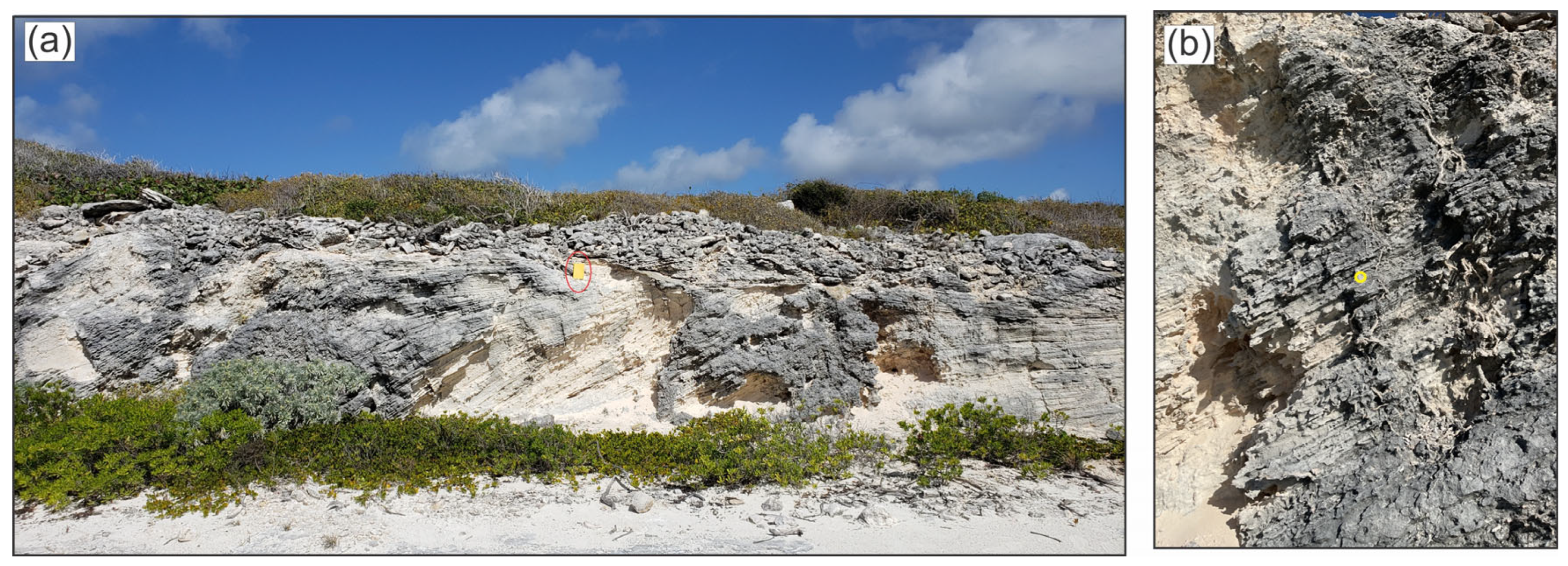
In the 3D volume (Figure 23), below a 0.2 m depth, the reflections dip westward down to 2.5 m. The average length of these reflections is 8 m. They mimic the layering observed in the outcrop next to the volume. We interpret the reflections as planar, dipping porosity alternation, directly visible as layers of alternating high and low cementation in the adjacent outcrop (Figure 22a). The planar nature is clearly visible in the horizontal depth slices as straight amplitude alignments (Figure 23). Finely layered porosity variations in the Pleistocene outcrop (Figure 22a) are expressed as thin promontories (more cemented, more indurated, and less porous) and reentrants (less cemented, more eroded, and higher porosity). Outcrop measurements (Figure 22b) indicate fine-scale porosity bedding (or laminae) at scales of 0.5–1.5 cm, which is just below the estimated 2.2 cm detection limit for vertical resolution, as discussed above. The measured angles in the georadar data range from 6° to 8°, close to the measured dip angles of the adjacent outcrop, which vary from 2° to 7°.

6. Discussion

This study provides high-resolution images of the internal radar stratigraphy of calcium carbonate sand deposits within strandplains. Carbonate strandplain stratigraphy can be clearly identified through GPR surveying, but only under specific conditions. For example, older sediments (e.g., pre-Holocene) tend to be less reflective because of increased recrystallisation over time; additionally, a high water table may mask the effects of thin, alternating layers with different porosities [20]. Future geophysical surveys over strandplains could include electrical resistivity tomography to assess the influence of the water table on georadar imaging. Precision LiDAR surveys can be used to gain a better understanding of how geomorphology relates to the georadar stratigraphic packages.
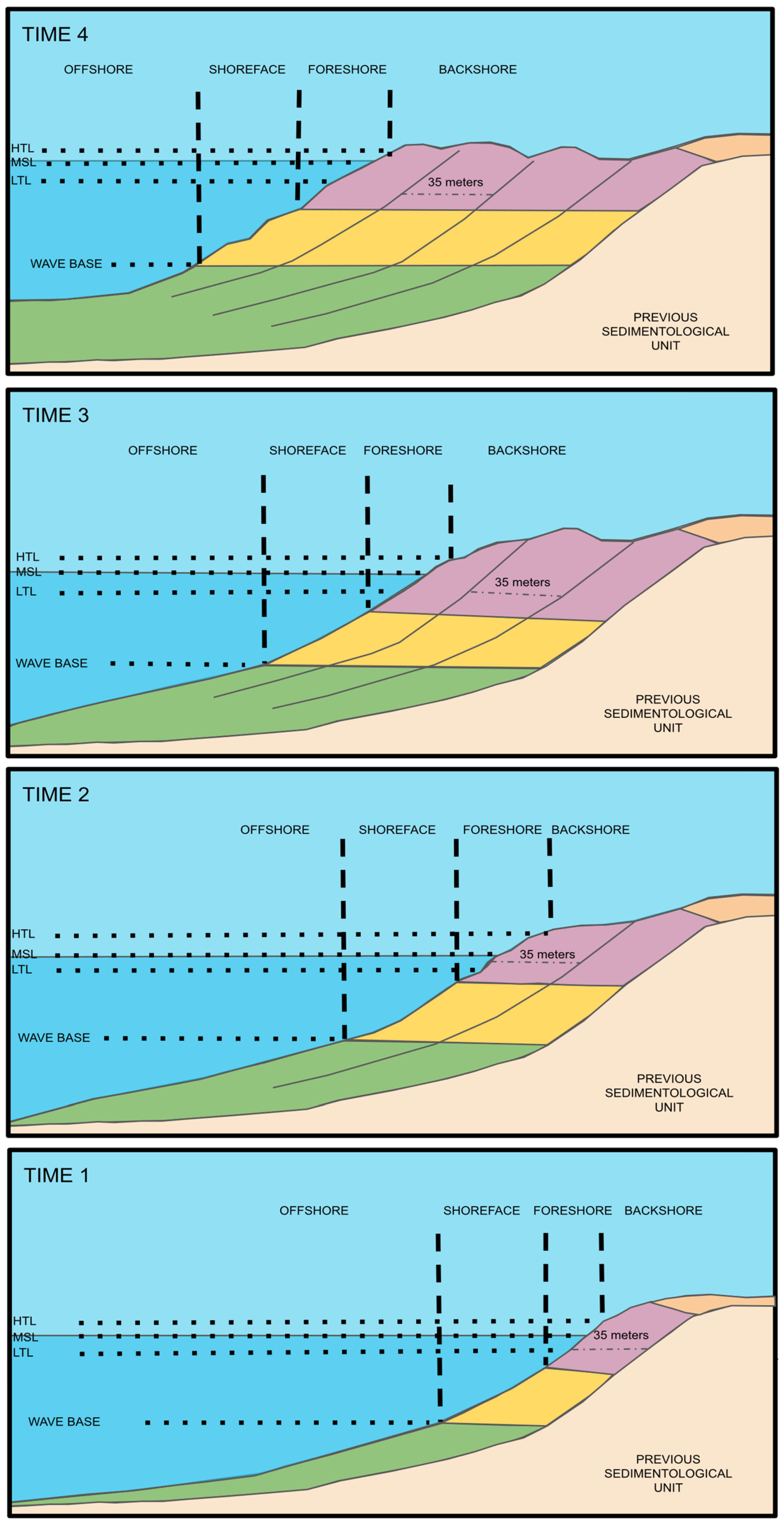
Our interpretation of the GPR data on Crooked Island, The Bahamas, allows for some general inferences. Most reflections in the GPR dataset dip seaward, indicating that sediment progradation is directed toward the modern beaches and occurs where sediment is being deposited offshore (Figure 24). Distinct progradational radar packages were interpreted in all the dip profiles, with onlapping visible in several of the strike profiles. Most of the GPR data from Crooked Island reveals three progradational radar packages within the 0.5 m to 3.5 m depth range across the 26 m length of the 2D GPR excerpt profiles. No significant, widespread erosional surfaces are interpreted from the data; however, Major’s Cay especially exhibits a small erosional surface and backfill in several dip profiles. Following a recent integrated geomorphological and georadar interpretation by ref. [26] on Eleuthera, reflection truncations observed in the dip profiles provide evidence of buried erosional scarps or ridges caused by storms.
We observe general similarities in sedimentation across the GPR profiles of the strandplains on Crooked Island; however, fine-scale distinctions are noted. The secondary sites of Colonel Hill and Bullet Hill are compared to Major’s Cay, the primary data collection area. Major’s Cay provided more opportunities to collect data in the strike and dip directions due to the many abandoned roads. Accessibility in the Colonel Hill and Bullet Hill sites is relatively limited, and they cover a smaller area. The 3D radar volume collected near Snow Bay–French Bay on San Salvador Island is somewhat like the 2D profiles from Crooked Island. The angles of the reflections resemble those on Crooked Island, but they dip towards the west, rather than present-day seaward to the south.
From an imaging perspective, the orientation of a profile in relation to its position on the strandplain—specifically, how close to perpendicular the profile is relative to the strike of the strandplain ridges—is crucial. Apparent dip angles of reflections vary between the centre and the edges of the strandplain. At Major’s Cay, the angle between the dip and strike profiles approaches 90°, whereas at Colonel Hill and Bullet Hill, the angle is smaller and inconsistent across profiles. The georadar profiles for the dip direction on Major’s Cay show an erosional surface near the top, along with shorter reflections dipping in the opposite direction, suggesting backfilling sediment. We propose that this results from storm activity causing minor erosion followed by backfilling. Bullet Hill differs markedly from Colonel Hill and Major’s Cay because of the opposite geometry of the strandplain. Instead of a “U” shape on a map (concave-seaward), the strandplain at Bullet Hill appears as an inverted “U” (convex-seaward). The latter pattern is less common in The Bahamas but has been observed on the Exuma Islands [31,35]. We suggest that the depositional progradation at Bullet Hill differs due to longshore drift, with radar reflections being shallower and shorter than those at Major’s Cay or Colonel Hill; however, further surveying of Bullet Hill is needed to understand its progradation history.

7. Summary

Ground-penetrating radar has been employed worldwide to investigate numerous shallow sedimentary environments [46], including the study of strandplains. The application of georadar to examine and document carbonate strandplains has rarely been conducted in The Bahamas. GPR imaging of the detailed stratigraphy of strandplains helps constrain interpretation of the accretionary history driven by gradual sedimentation in response to eustatic fluctuations (Figure 24). As sea levels rise, accommodation space is created, allowing the carbonate factory to produce more sediment, which accumulates and fills that space [69]. We demonstrate that The Bahamas provides an ideal location for imaging carbonate strandplains. The carbonate system lacks clastic influence that could interfere with the electromagnetic transmission. Where the strandplains are accessible, data quality can be exceptional. Data quality appears to be higher in areas with Holocene sediments than in Pleistocene rock because Holocene sediments have had less time to recrystallise or become cemented; however, we also identified and analysed a Pleistocene example on the south coast of San Salvador Island [20], where data quality was comparable to our results from Crooked Island. Overall, we believe that gradual sedimentation is a fundamental process responsible for the formation of strandplains, driven by long-term sea-level fluctuations (Figure 24), although the effect of storms is evinced by truncation patterns observed in the reflection packages [5,26,70].

Supplementary Materials

The following supporting information can be downloaded at: https://www.mdpi.com/article/10.3390/geosciences16020085/s1, Video S1: Aerial drone video over the Major’s Cay strandplain (Figure 2c); Video S2: Animation of 3D GPR volume from the shore of French Bay, San Salvador Island, The Bahamas (Figure 23).

Author Contributions

Conceptualization, S.M.R. and J.M.; methodology, S.A.R., K.J.S., K.M., K.M.M.K. and K.A.R.; software, J.M., K.J.S. and K.M.; validation, S.A.R., J.M. and S.M.R.; formal analysis, S.A.R.; investigation, S.A.R., K.J.S., J.M., K.M., K.M.M.K. and K.A.R.; resources, S.A.R. and J.M.; data curation, J.M.; writing—original draft preparation, S.A.R. and J.M.; writing—review and editing, J.M. and S.A.R.; visualization, K.J.S., S.A.R. and K.M.; supervision, S.M.R. and J.M.; project administration, J.M.; funding acquisition, J.M. and S.M.R. All authors have read and agreed to the published version of the manuscript.

Funding

This research received funding through the Department of Geological Sciences, Graduate Studies, and the College of Mathematical and Physical Sciences at Brigham Young University.

Data Availability Statement

The raw data supporting the conclusions of this article will be made available by the authors on request.

Acknowledgments

We gratefully acknowledge the generous support of this research by the Halliburton Landmark Graphics University Grant Program. We are most grateful for the four referees, whose reviews greatly improved the final version of the article.

Conflicts of Interest

The authors declare no conflicts of interest. The funders had no role in the design of the study; in the collection, analyses, or interpretation of data; in the writing of the manuscript; or in the decision to publish the results. Author Sydney Adelaide Richards led the research reported herein as a graduate student at Brigham Young University and is employed by Chevron Corporation. The authors declare that the research was conducted in the absence of any commercial or financial relationships that could be construed as a potential conflict of interest.

References

  1. Aurell, M.; McNeill, D.F.; Guyomard, T.; Kindler, P. Pleistocene shallowing-upward sequences in New Providence, Bahamas: Signature of high-frequency sea-level fluctuations in shallow carbonate platforms. J. Sediment. Res. 1995, 65, 170–182. [Google Scholar] [CrossRef]
  2. Carew, J.L.; Mylroie, J.E. Chapter 3A—Geology of the Bahamas. In Geology and Hydrology of Carbonate Islands; Developments in Sedimentology; Vacher, H.L., Quinn, T.M., Eds.; Elsevier: Amsterdam, The Netherlands, 2004; Volume 54, pp. 91–139. [Google Scholar] [CrossRef]
  3. Bigarella, J.J. Sand-ridge structures from Paraná Coastal Plain. Mar. Geol. 1964, 3, 269–278. [Google Scholar] [CrossRef]
  4. Carney, C.; Stoyka, G.S.; Boardman, M.R.; Kim, N. Depositional history and diagenesis of a Holocene strand plain, Sandy Hook, San Salvador, The Bahamas. In The Sixth Symposium on the Geology of The Bahamas; White, B., Gerace, D.T., Eds.; Bahamian Field Station: San Salvador, Bahamas, 1993; pp. 35–45. Available online: https://www.geraceresearchcentre.com/pdfs/6thGeology/35_CarneyStoykaBoardmanKim_6thGeology.pdf (accessed on 23 February 2024).
  5. Gontz, A.M.; Moss, P.T.; Wagenknecht, E.K. Stratigraphic architecture of regressive strand plain, Flinders Beach, North Stradbroke Island, Queensland, Australia. J. Coast. Res. 2014, 3, 575–585. [Google Scholar] [CrossRef]
  6. Harris, P.M. Facies anatomy and diagenesis of a Bahamian ooid shoal. In SEDIMENTA VII; Ginsburg, R.N., Ed.; Comparative Sedimentology Laboratory, Division of Marine Geology and Geophysics, University of Miami: Miami, FL, USA, 1979; pp. 1–163. Available online: https://www.searchanddiscovery.com/pdfz/documents/2009/60022harris/harris.pdf.html (accessed on 1 June 2025).
  7. Abegg, F.E.; Loope, D.B.; Harris, P.M. Carbonate Eolianites—Depositional models and diagenesis. In Modern and Ancient Carbonate Eolianites: Sedimentology, Sequence Stratigraphy, and Diagenesis; Abegg, F.E., Loope, D.B., Harris, P.M., Eds.; Special Publication 71; SEPM: Claremore, OK, USA, 2001; pp. 17–30. [Google Scholar] [CrossRef]
  8. Harris, P.M. Delineating and quantifying depositional facies patterns in carbonate reservoirs: Insight from modern analogs. AAPG Bull. 2010, 94, 61–86. [Google Scholar] [CrossRef]
  9. McBride, J.; Hazard, C.; Ritter, S.; Morris, T.; Tingey, D.; Keach, B.; Radebaugh, J.; Chandler, C.; Arnold, K.; Wolfe, G. Seeing Is Believing: GPR Enhances Analogs. AAPG Explor. 2014, 35, 44–47. Available online: https://explorer.aapg.org/Portals/0/docs/Explorer/2014/01jan/01explorer14.pdf (accessed on 5 July 2024).
  10. Hazard, C.S.; Ritter, S.M.; McBride, J.H.; Tingey, D.G.; Keach, R.W. II Ground-penetrating-radar characterization and porosity evolution of an Upper Pleistocene oolite-capped depositional Cycle, Red Bays, northwest Andros Island, Great Bahama Bank. J. Sediment. Res. 2017, 87, 523–545. [Google Scholar] [CrossRef]
  11. Herbst, S.R. Effects of Sedimentologic and Stratigraphic Heterogeneity on Production in Carbonate Reservoirs: An Integrated Outcrop, Synthetic Geologic Modeling, and Flow Simulation Study. Master’s Thesis, University of Kansas, Lawrence, KA, USA, 31 May 2017. Available online: https://kuscholarworks.ku.edu/handle/1808/26934 (accessed on 23 July 2024).
  12. Harris, P.M.; Carlos Laya, J.; Frazer, M. Evolution of a modern Ooid Sand Island (South Joulter Cay, Great Bahama Bank) and implications for subsurface studies. In Proceedings of the Second International Meeting for Applied Geoscience & Energy; ASME: New York, NY, USA, 2022; pp. 347–350. [Google Scholar] [CrossRef]
  13. Aziz, A.A.; Stewart, R.R.; Ullah, M.S.; Bhattacharya, J.P. 3D GPR characterization of sandy mouth bars in an outcrop reservoir analog: Cretaceous Ferron Sandstone, south-east Utah. In Society of Exploration Geophysicists Technical Program Expanded Abstracts; GeoScienceWorld: McLean, VA, USA, 2015; pp. 2275–2280. [Google Scholar] [CrossRef]
  14. Cooper, J.A.G.; Green, A.N.; Loureiro, C. Geological constraints on mesoscale coastal barrier behavior. Glob. Planet. Change 2018, 168, 15–34. [Google Scholar] [CrossRef]
  15. Cowell, P.J.; Kinsela, M.A. Shoreface controls on barrier evolution and shoreline change. In Barrier Dynamics and Response to Changing Climate; Springer: Berlin/Heidelberg, Germany, 2018; pp. 243–275. [Google Scholar] [CrossRef]
  16. Bristow, C.S.; Chronston, P.N.; Bailey, S.D. The structure and development of foredunes on a locally prograding coast: Insights from ground-penetrating radar surveys, Norfolk, UK. Sedimentology 2000, 47, 923–944. [Google Scholar] [CrossRef]
  17. Hede, M.U.; Bendixen, M.; Clemmensen, L.B.; Kroon, A.; Nielsen, L. Joint interpretation of Beach-Ridge architecture and coastal topography show the validity of sea-level markers observed in ground-penetrating radar data. Holocene 2013, 23, 1238–1246. [Google Scholar] [CrossRef]
  18. Hede, M.U.; Sander, L.; Clemmensen, L.B.; Kroon, A.; Pejrup, M.; Nielsen, L. Changes in Holocene relative sea-level and coastal morphology: A study of a raised beach ridge system on Samsø, Southwest Scandinavia. Holocene 2015, 25, 1402–1414. [Google Scholar] [CrossRef]
  19. Mattheus, C.R.; Farhan, S.A.; Fowler, J.K. Geomorphology of the Late Holocene Sandy Hook strand plain, San Salvador Island, The Bahamas: A record of changing hydrodynamics. In Proceedings of the Second Joint Symposium on the Natural History and Geology of The Bahamas; Niemi, T.M., Sealey, K.S., Eds.; Gerace Research Centre, University of The Bahamas: San Salvador, Bahamas, 2020; pp. 27–38. Available online: https://www.geraceresearchcentre.com/pdfs/2ndJNHG/Mattheus_Farhan_Fowler.pdf (accessed on 1 June 2023).
  20. Markert, K.R. Depositional Analysis of a Holocene Carbonate Strand Plain Using High Resolution GPR, Sediment Analysis, and C-14 Dating. Master’s Thesis, Brigham Young University, Provo, UT, USA, 1 December 2019. Available online: https://scholarsarchive.byu.edu/etd/7751 (accessed on 3 December 2025).
  21. Markert, K.; McBride, J.; Ritter, S. Depositional modeling carbonate strand plain development using high-resolution GPR and C-14 dating. In Proceedings of the AAPG Datapages/Search and Discovery Article #90350, San Antonio, TX, USA, 19–22 May 2019; Available online: http://www.searchanddiscovery.com/abstracts/html/2019/ace2019/abstracts/2227.html (accessed on 3 December 2025).
  22. Cescon, A.L.; Cooper, J.A.G.; Jackson, D.W.T. Nature distribution of beach ridges on the islands of the Greater Caribbean. J. Mar. Sci. Eng. 2024, 12, 565. [Google Scholar] [CrossRef]
  23. Wikipedia. Available online: https://en.wikipedia.org/wiki/Acklins (accessed on 1 June 2025).
  24. Neal, A.; Grasmueck, M.; McNeill, D.F.; Viggiano, D.A.; Eberli, G.P. Full-resolution 3D radar stratigraphy of complex oolitic sedimentary architecture: Miami Limestone, Florida, USA. J. Sediment. Res. 2008, 78, 638–653. [Google Scholar] [CrossRef]
  25. Savarese, M.; Buynevich, I.V.; Curran, H.A.; Bitinas, A.; Glumac, B.; Pupienis, D.; Kopcznski, K.; Dobrotin, N.; Gnivecki, P.; Boush, L.P.; et al. Sand incursion into temperate (Lithuania) and tropical (the Bahamas) maritime vegetation: Georadar visualization of target-rich aeolian lithosomes. Estuar. Coast. Shelf Sci. 2017, 195, 69–75. [Google Scholar] [CrossRef]
  26. Buynevich, I.V.; Savarese, M.; Curran, H.A. Visualization of coastal carbonate lithosomes: Color-intensity patterns and georadar imaging of a semi-lithified strandplain, Eleuthera Island, The Bahamas. J. Mar. Sci. Eng. 2025, 13, 950. [Google Scholar] [CrossRef]
  27. Park Boush, L.E.; Myrbo, A.; Buynevich, I.V.; Berman, M.J.; Michelson, A.V.; Kjellmark, E.; Gnivecki, P.; Beamer, D. A megastorm formation of a coastal lake basin (∼3.9 ka) and subsequent event chronology, southern Eleuthera, The Bahamas. Estuar. Coast. Shelf Sci. 2025, 324, 109454. [Google Scholar] [CrossRef]
  28. Carney, C.; Dominic, D.; Egan, E.; Boardman, M. Delineation of Calcite-Cemented Layers in Holocene Skeletal Carbonate Sands, San Salvador, Bahamas. In Proceedings of the AAPG Datapages/Search and Discovery Article #91005, Pittsburgh, PA, USA, 8–10 September 1991; Available online: https://www.searchanddiscovery.com/abstracts/html/1991/eastern/abstracts/1380.htm (accessed on 23 December 2025).
  29. Alothman, E.H. Deciphering the Evolution of the New Providence Platform, Bahamas, Using 2D GPR Data and Core Correlation. Master’s Thesis, University of Miami, Miami, FL, USA, 20 December 2017. Available online: https://scholarship.miami.edu/esploro/outputs/991031447394702976 (accessed on 23 December 2025).
  30. Savarese, M.; Buynevich, I.V.; Curran, H.A.; Park Boush, L.E.; Glumac, B. The origin of Holocene strandplains of the Bahamas: Influence of tropical storms and climate change. Geol. Soc. Am. 2013, 45, 752. Available online: https://gsa.confex.com/gsa/2013AM/webprogram/Paper231138.html (accessed on 13 January 2026).
  31. Buynevich, I.V.; FitzGerald, D.M. Ground-Penetrating Radar. In Encyclopedia of Coastal Science; Finkl, C.W., Makowski, C., Eds.; Springer: Cham, Switzerland, 2019; pp. 923–929. Available online: https://link.springer.com/rwe/10.1007/978-3-319-48657-4_162-2 (accessed on 28 January 2026).
  32. Grasmueck, M.; Weger, R. 3D GPR reveals complex internal structure of Pleistocene oolitic sandbar. Lead. Edge 2002, 7, 634–639. [Google Scholar] [CrossRef]
  33. Bristow, C.S.; Pucillo, K. Quantifying rates of coastal progradation from sediment volume using GPR and OSL: The Holocene fill of Guichen Bay, south-east South Australia. Sedimentology 2006, 53, 769–788. [Google Scholar] [CrossRef]
  34. Oliver, T.S.; Murray-Wallace, C.V.; Woodroffe, C.D. Holocene shoreline progradation and coastal evolution at Guichen and Rivoli Bays, southern Australia. Holocene 2019, 30, 106–124. [Google Scholar] [CrossRef]
  35. Savarese, M.; Curran, H.A. Origin of late Holocene Strand plains in the southern Exuma islands, The Bahamas: Progradation, ephemeral highstands, and storminess. In Proceedings of the 16th Symposium on the Geology of the Bahamas and Other Carbonate Regions; Glumac, B., Savarese, M., Eds.; Gerace Research Centre: San Salvador, Bahamas, 2016; pp. 39–59. Available online: https://www.geraceresearchcentre.com/pdfs/16thGeology/39_Savarese_Curran.pdf (accessed on 28 January 2026).
  36. Rankey, E.C. Contrasts between wave- and tide-dominated oolitic systems: Holocene of Crooked–Acklins platform, Southern The Bahamas. Facies 2013, 60, 405–428. [Google Scholar] [CrossRef]
  37. Rankey, E.C.; Reeder, S.L. Controls on platform-scale patterns of surface sediments, shallow Holocene platforms, The Bahamas. Sedimentology 2010, 57, 1545–1565. [Google Scholar] [CrossRef]
  38. Godefroid, F.; Kindler, P. Prominent geological features of Crooked Island, SE the Bahamas. In Proceedings of the 16th Symposium on the Geology of the Bahamas and Other Carbonate Regions; Glumac, B., Savarese, M., Eds.; Gerace Research Centre: San Salvador, Bahamas, 2016; pp. 26–38. Available online: https://www.geraceresearchcentre.com/pdfs/16thGeology/26_Godefroid_Kindler.pdf (accessed on 28 January 2026).
  39. Huber, M.E. Relationships Between Foraminifera and Geomorphology: Holocene, Crooked-Acklins Platform, Southern Bahamas. Master’s Thesis, University of Kansas, Lawrence, KA, USA, 19 July 2016. Available online: https://kuscholarworks.ku.edu/server/api/core/bitstreams/ea3727af-8ea1-4ff1-9c9e-62c9e5cceee1/content (accessed on 28 January 2026).
  40. Dietz, R.S.; Holden, J.C.; Sproll, W.P. Geotectonic evolution and subsidence of the Bahama Platform. GSA Bull. 1970, 81, 1915–1928. [Google Scholar] [CrossRef]
  41. Boardman, M.R.; Carney, C.; White, B.; Curran, H.A.; Gerace, D.T. The geology of Columbus’ landfall: A field guide to the Holocene geology of San Salvador, Bahamas. In Field Trip 3, Proceedings of the Annual Meeting of the Geological Society of America, Cincinnati, OH, USA, 26–29 October 1992; Miscellaneous Report 2; Ohio Department of Natural Resources, Division of Geological Survey: Columbus, OH, USA, 1992; p. 49. [Google Scholar]
  42. Kim, N. Petrographic characteristics of a Holocene carbonate grainstones in Southeast San Salvador, The Bahamas: Implications for the sediment reworking in a high energy lagoon. Geosci. J. 2001, 5, 349–359. [Google Scholar] [CrossRef]
  43. Davis, R.L.; Johnson, C.R. Karst Hydrology of San Salvador. In Proceedings of the 4th Symposium on the Geology of the Bahamas; Mylroie, J.E., Ed.; Gerace Research Centre: San Salvador, Bahamas, 1989; pp. 118–135. Available online: https://geraceresearchcentre.com/pdfs/4thGeology/118_DavisJohnson_4thGeology.pdf (accessed on 10 February 2026).
  44. Harari, Z. Ground-penetrating radar (GPR) for imaging stratigraphic features and groundwater in sand dunes. J. Appl. Geophys. 1996, 36, 43–52. [Google Scholar] [CrossRef]
  45. Corbeanu, R.M.; Soegaard, K.; Szerbiak, R.B.; Thurmond, J.B.; McMechan, G.A.; Wang, D.; Snelgrove, S.; Foster, C.B.; Menitove, A. Detailed internal architecture of a fluvial channel sandstone determined from outcrop, cores, and 3-D ground-penetrating radar: Example from the middle Cretaceous Ferron Sandstone, east-central Utah. AAPG Bull. 2001, 85, 1583–1608. [Google Scholar]
  46. Johnston, J.W.; Thompson, T.A.; Baedke, S.J. Systematic pattern of beach-ridge development and preservation: Conceptual model and evidence from ground penetrating radar. In Stratigraphic Analyses Using GPR; Baker, G.S., Jol, H.M., Eds.; Special Paper 432; Geological Society of America: Boulder, CO, USA, 2007. [Google Scholar] [CrossRef]
  47. Martinez, A.; Byrnes, A.P. Modeling dielectric constant values of geologic materials: An aid to ground penetrating radar data collection and interpretation. Curr. Res. Earth Sci. Kans. Geol. Surv. Bull. 2001, 247, 1–16. [Google Scholar] [CrossRef]
  48. Milsom, J. Field Geophysics, 3rd ed.; Wiley: New York, NY, USA, 2003; p. 244. [Google Scholar]
  49. Annan, P. Electromagnetic principles of ground penetrating radar. In Ground Penetrating Radar Theory and Applications; Jol, H.M., Ed.; Elsevier Science: Amsterdam, The Netherlands, 2009; pp. 3–40. [Google Scholar] [CrossRef]
  50. Alemdağ, H.; Şeren, A.; Karslı, H. Combining ground-penetrating radar sections with different antenna frequencies including time-frequency domain noise suppression filters. Geophysics 2022, 87, WB41–WB54. [Google Scholar] [CrossRef]
  51. Yilmaz, O. Seismic Data Analysis; SEG: Tulsa, OK, USA, 2001; pp. 463–653. [Google Scholar] [CrossRef]
  52. Sigurdsson, T.; Overgaard, T. Application of GPR for 3-D visualization of geological and structural variation in a limestone formation. J. Appl. Geophys. 1998, 40, 29–36. [Google Scholar] [CrossRef]
  53. Takayama, P.; Menezes, P.T.L.; Travassos, J.M. 3D GPR modeling of carbonates reservoir analogues applying geometric attributes: Coqueiro Seco Formation, Sergipe-Alagoas Basin—Brazil. In Proceedings of the Eleventh International Congress of the Brazilian Geophysical Society, Salvador, Brazil, 24–28 August 2009; p. 5. [Google Scholar] [CrossRef]
  54. Barnes, A.E. Handbook of Poststack Seismic Attributes; Geophysical References Series No. 21; SEG: Tulsa, OK, USA, 2016; pp. 177–199. [Google Scholar] [CrossRef]
  55. Hearty, P.J.; Kindler, P. New Perspectives on Bahamian Geology: San Salvador Island, The Bahamas. J. Coast. Res. 1993, 9, 577–594. Available online: www.jstor.org/stable/4298108 (accessed on 28 January 2026).
  56. Inden, R.F.; Moore, C.H. Beach Environment. In Carbonate Depositional Environments; Scholle, P.A., Bebout, D.G., Moore, C.H., Eds.; AAPG: Tulsa, OK, USA, 1983; pp. 211–265. [Google Scholar] [CrossRef]
  57. Florea, L.; Mylroie, J.; Carew, J. Karst genetic model for the French Bay Breccia deposits, San Salvador, Bahamas. Theor. Appl. Karstol. 2001, 13–14, 57–65. [Google Scholar]
  58. Gawthorpe, R.L.; Li Collier, R.E.; Alexander, J.; Bridge, J.S.; Leeder, M.R. Ground penetrating radar: Application to sandbody geometry and heterogeneity studies. Geol. Soc. Lond. Spec. Publ. 1993, 73, 421–432. [Google Scholar] [CrossRef]
  59. Fisher, S.C.; Stewart, R.R.; Jol, H.M. Ground penetrating radar (GPR) data enhancement using seismic techniques. J. Environ. Eng. Geophys. 1996, 1, 89–96. [Google Scholar] [CrossRef]
  60. Bristow, C. Facies analysis in the Lower Greensand using ground-penetrating radar. J. Geol. Soc. 1995, 152, 591–598. [Google Scholar] [CrossRef]
  61. Bristow, C.S. Internal Geometry of Ancient Tidal Bedforms Revealed Using Ground Penetrating Radar. In Tidal Signatures in Modern and Ancient Sediments; Flemming, B.W., Bartholomä, A., Eds.; Wiley: Hoboken, NJ, USA, 1995; pp. 313–328. [Google Scholar] [CrossRef]
  62. McMechan, G.A.; Gaynor, G.C.; Szerbiak, R.B. Use of ground-penetrating radar for 3-D sedimentological characterization of clastic reservoir analogs. Geophysics 1997, 62, 786–796. [Google Scholar] [CrossRef]
  63. Vail, P.R. Seismic stratigraphy interpretation procedure. In Atlas of Seismic Stratigraphy; Bally, A.W., Ed.; Studies in Geology 27; AAPG: Tulsa, OK, USA, 1987; pp. 1–10. [Google Scholar]
  64. Wiki AAPG. Available online: https://wiki.aapg.org/Seismic_sequence_analysis (accessed on 1 June 2025).
  65. Holgate, N.E.; Hampson, G.J.; Jackson, C.A.-L.; Petersen, S.A. Constraining uncertainty in interpretation of seismically imaged clinoforms in deltaic reservoirs, troll field, Norwegian North Sea: Insights from forward seismic models of outcrop analogs. AAPG Bull. 2014, 98, 2629–2663. [Google Scholar] [CrossRef]
  66. Harishidayat, D.; Emmel, B.U.; De Jager, G.; Johansen, S.E. Assessment of continental margin clinoform systems in the Sørvestsnaget Basin, western Barents Sea: From clinoform parameters towards paleo-water depth-marine geophysical research. Mar. Geophys. Res. 2022, 43, 1–23. [Google Scholar] [CrossRef]
  67. Horwitz, M.H.; Wang, P. Sedimentological characteristics of regional scale washover deposits caused by Hurricane Ivan. In Coastal Sediments ‘07; ASCE: Reston, VA, USA, 2007; pp. 1–14. [Google Scholar] [CrossRef]
  68. Laya, J.C.; Sulaica, J.; Teoh, C.P.; Whitaker, F.; Gabellone, T.; Tucker, M.E.; Tesch, P.; Miller, B.; Prince, K.; Izaguirre, I. Controls on Neogene carbonate facies and stratigraphic architecture of an isolated carbonate platform—The Caribbean Island of Bonaire. Mar. Petrol. Geol. 2018, 94, 1–18. [Google Scholar] [CrossRef]
  69. Eberli, G.P. The uncertainties involved in extracting amplitude and frequency of orbitally driven sea-level fluctuations from shallow-water carbonate cycles. Sedimentology 2013, 60, 64–84. [Google Scholar] [CrossRef]
  70. Buynevich, I.V.; Kopcznski, K.; Savarese, M.; Park Boush, L.E.; Curran, H.A.; Glumac, B.; Caris, J. Subsurface signatures of recent storm erosion and recovery along San Salvador Island, The Bahamas. In Geological Society of America Abstracts; Geological Society of America: Boulder, CO, USA, 2016; Volume 48, p. 284221. [Google Scholar] [CrossRef]
Figure 1. Satellite image of The Bahamas and Florida, USA.
Geosciences 16 00085 g001
Figure 2. (a) Satellite image of the Crooked–Acklins Platform. Located in the southeastern Bahamas, Crooked Island, one of the islands on the Crooked–Acklins Platform, is the primary study area. The three data collection sites are labelled: Colonel Hill, Major’s Cay, and Bullet Hill. (b) Topographic map of Crooked Island, Acklins Island, and Long Cay with the locations of study sites noted. Map sourced from ref. [23]. (c) Aerial drone photo taken above the strandlines in Major’s Cay, Crooked Island, The Bahamas (a). The photo faces south. The strandlines are clearly visible, following the shoreline to the left (north). See accompanying aerial drone video (by Kathryn J. Smith) provided in the Supplementary Materials (Video S1).
Geosciences 16 00085 g002aGeosciences 16 00085 g002b
Figure 3. Panel showing seismic attribute [52] testing with a representative GPR profile from the Major’s Cay area (Figure 2). The profiles have individual trace scaling and depth conversion: (a) amplitude version with only exponential gain and “background” removal applied; (b) true amplitude reflection strength (all gain functions removed); (c) reflection strength computed with AGC (window = 10 ns), converted samples to dB with a scalar = 2; (d) as above, but for instantaneous frequency; (e) as above, but for instantaneous phase.
Geosciences 16 00085 g003
Figure 4. Photo, facing south, inland of the strandplain at Major’s Cay, Crooked Island, The Bahamas. Note the well-cemented caliche surface that separates ridges at this location (Figure 2c). Photo by J. McBride.
Geosciences 16 00085 g004
Figure 5. General illustration of a stratigraphic sequence showing radar boundary relationships [63]. Illustration modified from ref. [64].
Geosciences 16 00085 g005
Figure 6. Index image of survey locations in Major’s Cay on Crooked Island, Bahamas (Figure 2a). The red lines on the left show the entire GPR survey profile, while the white outlines indicate excerpts in the corresponding profile figures. Yellow arrows indicate the georadar profiles used for the transects displayed in Figure 7.
Geosciences 16 00085 g006
Figure 9. Dip GPR Profile 4 (excerpt) from Major’s Cay on Crooked Island, The Bahamas (Figure 6). The display format is the same as in Figure 8.
Geosciences 16 00085 g009
Figure 10. Dip GPR Profile 5 from Major’s Cay on Crooked Island, The Bahamas (Figure 6). The display format is the same as in Figure 8.
Geosciences 16 00085 g010
Figure 11. Strike GPR Profile 11 in Major’s Cay on Crooked Island, The Bahamas (Figure 6). The display format is equivalent to that of Figure 8, except that no interpretation is shown due to the difficulty in discerning dip changes on a strike profile.
Geosciences 16 00085 g011
Figure 12. Index image of survey locations in Colonel Hill on Crooked Island, The Bahamas. The red lines on the left show the entire GPR survey file, while the white line indicates the excerpt in the corresponding profile figures.
Geosciences 16 00085 g012
Figure 13. (a) Dip GPR profile 15 in Colonel Hill on Crooked Island (Figure 12). (b) Dip GPR Profile 15 from Colonel Hill on Crooked Island (Figure 12). This profile is farther inland than that in Figure 13a. The display format is the same as in Figure 8.
Geosciences 16 00085 g013
Figure 14. Dip GPR profile 19 from Colonel Hill on Crooked Island (Figure 12). The display format is the same as in Figure 8.
Geosciences 16 00085 g014
Figure 15. Strike GPR Profile 16 from Colonel Hill on Crooked Island (Figure 12). The display format is the same as in Figure 8.
Geosciences 16 00085 g015
Figure 16. Index image of survey locations at Bullet Hill on Crooked Island (see Figure 1). The red lines to the left depict the entire GPR survey dataset, while the white line shows the section featured in the corresponding profile figure. The white vertical arrow matches the white vertical arrow in Figure 17.
Geosciences 16 00085 g016
Figure 17. Drone excerpt over Bullet Hill area of Crooked Island (Figure 2a). White vertical arrow matches white vertical arrow on Figure 16.
Geosciences 16 00085 g017
Figure 18. Dip GPR Profile 24-3 taken on Bullet Hill, Crooked Island (Figure 16). The display format is the same as in Figure 8.
Geosciences 16 00085 g018
Figure 19. Dip GPR Profile 27-6 on Bullet Hill on Crooked Island (Figure 16). The display format is the same as in Figure 8.
Geosciences 16 00085 g019
Figure 20. Strike GPR Profile 25-4 on Bullet Hill on Crooked Island (Figure 16). The display format is the same as in Figure 8.
Geosciences 16 00085 g020
Figure 21. Index image of survey locations at the Snow Bay–French Bay site on San Salvador Island (Figure 1). The yellow box on the left shows the location of the 3D GPR survey.
Geosciences 16 00085 g021
Figure 22. (a) Photo of the Pleistocene aeolianite exposure along the road on which the 3D GPR volume was collected, near the shore of French Bay, San Salvador Island, The Bahamas (Figure 21). The yellow notebook (encircled in red) is 18.5 cm high. (b) Close-up view of a small portion of the outcrop depicted in Figure 22a showing fine-scale porosity–cementation layering. Coin (yellow circle) is 2.5 cm in diameter. The views look north. Photos by J. McBride.
Geosciences 16 00085 g022
Figure 23. Extracted profile (vertical slice) and depth slice from 3D GPR volume of French Bay, San Salvador Island (Figure 21) [20]. The horizontal slice represents the volume at a depth of 1.25 m and a vertical averaging of 0.02 m. The vertical dip slice runs east to west, with the reflections dipping west (true dip). The vertical slice is on the southern (oceanward) edge of the volume. See accompanying video animation provided in the Supplementary Materials (Video S2).
Geosciences 16 00085 g023
Figure 24. Illustration depicting beach-ridge formation from carbonate sedimentation based on ref. [56]. The oldest geological time is at the bottom. The illustration shows how sea-level variation affects deposition and progradation in the foreshore and backshore areas. LTL, MSL, and HTL denote low-tide level, mean sea level, and high-tide level, respectively. See also ref. [68].
Geosciences 16 00085 g024
Disclaimer/Publisher’s Note: The statements, opinions and data contained in all publications are solely those of the individual author(s) and contributor(s) and not of MDPI and/or the editor(s). MDPI and/or the editor(s) disclaim responsibility for any injury to people or property resulting from any ideas, methods, instructions or products referred to in the content.