


Abstract
The Marnoso-arenacea basin (MaB) of the Northern Apennines represents one of the most significant lower–middle Miocene foredeep turbidite systems in the Mediterranean region. While the northern part of the basin (Emilia-Romagna Region) has been extensively investigated, the Umbrian portion remains less understood, particularly concerning high-resolution stratigraphic and structural frameworks. This study integrates detailed field mapping, physical stratigraphy, biostratigraphic data from calcareous nannofossils, and petrographic analyses of arenites and calcarenites to reconstruct the tectono-stratigraphic evolution of the MaB in the Umbrian portion of the basin. The basin is divided into three main tectono-stratigraphic units: Afra-Mt. Verde, Pietralunga–Gubbio–Valtopina and Mt. Vicino. The middle unit is detailed by means of stratigraphic architecture and sedimentary characteristics, which allow us to identify two distinct sub-units. Several carbonate and hybrid turbidite beds, including the Contessa megabed, serve as regional key markers, enabling robust stratigraphic correlations. Two mass-transport complexes (MTDs) have been identified and dated, revealing close relationships between sedimentation patterns and thrust propagation. Modal petrographic data indicate a mixed provenance, from the Alpine and Apennine regions, changing over time in response to tectonic segmentation. These findings enhance our understanding of the internal organization of the MaB and provide new insights into the foredeep’s paleogeography and tectono-sedimentary evolution during the Langhian–Serravallian stages.
1. Introduction
The Northern Apennines are widely recognized as a NE-verging fold-and-thrust belt formed during the Oligocene–Neogene collision between the European and Adria plates [1,2]. The Marnoso-arenacea basin (MaB) is a clastic wedge deposited in a NW-SE trending, ~300 km long, foreland basin, which developed, subparallel to the Miocene Apenninic front, during the Burdigalian and Serravallian age [3,4,5,6,7,8].
Most research has concentrated on the Northern MaB in the Emilia-Romagna region, where continuous, high-quality exposures permit detailed stratigraphic and sedimentological reconstructions [8,9,10,11,12,13,14] (Figure 1a). Studies have also examined the tectonic and paleogeographic evolution of this area [6,8,9,10,11,12,13,14,15,16,17,18].
Figure 1.
(a) Simplified scheme showing the main tectono-stratigraphic domains of the Northern Apennines; key for scheme in (a): (1) Quaternary succession, (2) periadriatic foredeep Plio-Pleistocene succession., (3) Laga fm., (4) turbidites of the Camerino basin, (5) FMA-Romagnola, (6) Marnoso-arenacea umbra (MUM) and FMA, (7) Falterona–Cervarola Fms, (8) Macigno Fm., (9) carbonate multilayer, (10) Tuscany metamorphic units, (11) Ligurian unit s.l., (12) magmatic Quaternary rocks. (b) Detailed structural geological scheme of northern Umbria–Marche area in which the main tectonic units recognized in the lower–middle Miocene Marnoso-arenacea basin are highlighted.
Conversely, the central and southern sectors of the MaB in the Umbria region (Figure 1a) lack high-resolution basin-wide reconstructions, existing studies being limited to specific areas [19,20,21,22]. A comprehensive overview of the turbiditic succession is still missing, partly due to scarce biostratigraphic and petrographic data. One important feature is the identification of hemipelagites (Schlier Formation) that mark the onset of siliciclastic succession, determining the age of the immediately overlying sediments. All these data are essential for defining the basin’s stratigraphic architecture, tectono-sedimentary evolution, and paleogeography. Moreover, models of the MaB sedimentary feeding systems rely largely on pioneering studies from the 80s to the 90s [23,24,25,26], which require reassessment in light of new petrographic techniques and recent hypotheses on the structural evolution of the Northern Apennines [27,28].
This study provides an integrated reconstruction of the turbiditic succession in the Umbrian MaB basin, using original field data, detailed geological mapping, calcareous nannofossils biostratigraphy and petrographic studies of sandstones and calcarenites. The goal is to establish a coherent tectono-stratigraphic framework by defining the lateral and vertical relationships among the principal stratigraphic units (members, lithofacies, and key beds), clarifying the spatial and temporal distribution of sedimentary bodies, the nature and direction of clastic supplies, and the role of syn-sedimentary tectonics in the partition of the basin. This multidisciplinary approach allows the identification of the main evolutionary stages of the basin, the reconstruction of its Langhian–Serravallian paleogeographic configuration, and the linkage of sedimentary and structural evolution to regional tectonic processes associated with middle–late Miocene Apennine orogenesis.
Geological Setting
The Umbria pre-Apennines sector (Figure 1b) is a ~120 km long and 40 km wide belt, between the Tuscan Nappe front [29,30] to the west, and the Umbria–Marche carbonate chain, to the east. The area is characterized by outcrops of the Marnoso-arenacea succession, consisting of foredeep turbidite deposits [31]. Most turbidity currents derived from the Alpine sectors (N-NW supplied “Alpine turbidites”), whereas secondary currents, Apennine-supplied flows (S-SW “Apennine turbidites”), originated from remobilization of the wedge-top basins deposit and small carbonate shelves. These different source producing siliciclastic and hybrid sandstones or carbonaticlastic beds [6,24,32,33]. Among the transversal-supplied beds, the Contessa mega-turbidite (Cs) is a hybrid arenite up to 15 m thick, deposited during the topmost Langhian [5,19,34].
In the northern sector (Emilia-Romagna), the Alpine-supply turbidites dominate the Langhian–Serravallian succession, whereas Apennine-supply beds are subordinate [6,24,32,33]. Conversely, in the central and southern Umbria sector, Apennine and calcareous turbidites are abundant and often dominant [19,20,21,22,27,35].
Previous studies in the Umbrian MaB have identified two siliciclastic successions, one more internal, referable to the Marnoso-arenacea Umbra Formation (MUM—Burdigalian–Langhian) and one more external associated with the classic Marnoso-arenacea Formation (FMA—Langhian–Serravallian) [36]. The relationships between MUM and FMA are essentially tectonic nature and associated with thrust faults and an intra-formational duplex of the Miocene turbidite succession, with no evidence of a continuous stratigraphic transition [2,27,37,38].
The Marnoso-arenacea successions are stacked in a series of west-dipping imbricated monoclines, known as the “Stile Romagnolo” [39]. These monoclines are made of the turbidites and the underlying Schlier hemipelagites (“ramp muds” [6]), which acted as a detachment from the carbonate multilayer [2,40,41]. These interpretations are supported not only by outcrop data but also by subsurface information, including the M.Civitello1 (Figure 1b) deep well (~5.6 km). The well provides important constraints on the deep stratigraphy and tectonic architecture of the Umbrian pre-Apennine foredeep [42].
During the middle Miocene, progressive W–E thrust propagation segmented the foredeep, causing the emplacement of mass-transport complexes [2,12,43]. These chaotic bodies incorporate lithologies derived from the dismantling of both the internal Adriatic margin (Tuscan domain) and the advancing Ligurian wedge. This composite provenance reflects recurrent mass-wasting events controlled by tectonic uplift during the progressive growth of the Northern Apennine accretionary system [2,6,43,44,45,46,47].
Most studies on the Umbrian pre-Apennine identify in the MaB basin five main tectonic units separated by regional thrust: Mt. Nero, M.S. Maria Tiberina, Pietralunga, Gubbio and Mt. Vicino [27,41,48,49]. However, only limited areas have been studied in detail using integrated stratigraphic, biostratigraphic, and petrographic data, and no basin-scale synthesis of the MaB has yet been proposed [5,9,19,20,21,22,28,50].
Post-orogenic extension reached the western part of the study area starting about 3.8 Ma [51]. Extension reshaped the foredeep architecture, with NE–SW and NNW–SSE normal fault systems later controlling the development of Quaternary intermontane basins, such as those of Gubbio and the Umbra Valley [38,42,52,53,54,55].
2. Materials and Methods
2.1. Physical Stratigraphy and Section Logging
The study of the MaB began with a review of data acquired during recent geological surveys in the framework of the Geological Cartography Projects of Italy [36], integrated with previous mapping projects and new original field data.
These datasets, well constrained by nannofossil biostratigraphy [56], were integrated and homogenized with additional data available for selected sectors [22,35,50,56].
An accurate physical-stratigraphic analysis was carried out through detailed 1:50-scale stratigraphic logging to document the main sedimentary features of each stratigraphic unit.
Stratigraphic subdivision followed standard field methods, including bed thickness, grain size, texture, compositional description (via lens inspection), and sand/pelite ratio (S/P). Field observations were validated through laboratory analyses. Turbidite facies were identified and classified in the field, according to the classification schemes proposed by [8,57,58], integrated by the subdivision of different bed types [12,13,59].
Systematic paleocurrent measurements were collected to reconstruct turbidity-flow dispersal patterns and combined with compositional data to distinguish Alpine- from Apennine-supply turbidites, which were undergoing uplift and dismantling [19].
Based on the stratigraphic logs, a grid of serial stratigraphic logs was realized in the least deformed sectors of the basin, revealing thickness variations within certain stratigraphic intervals, interpreted as reflecting local differences in subsidence and sedimentation rates, indicating possible intra-basin highs and second-order depositional depocenters.
2.2. Geological Mapping
New field data have been collected through an original 1:10.000 scale geological mapping of the study area. Data acquisition was performed digitally using the GPS-integrated Strabospot2 software v2.23.0 ([60]; https://www.strabospot.org/downloadapp, Kansas (USA), accessed on 8 February 2026) installed on an Apple iPad Pro. This software allows real-time collection of georeferenced structural and stratigraphic measurements, field notes, sketches, and photographs [61]. This approach enabled detailed characterization of outcrops and yielded a larger and more accurate dataset than traditional survey methods. Several stratigraphic logs were also reconstructed based on precisely georeferenced outcrop observations.
2.3. Biostratigraphy
A total of 15 main stratigraphic sections have been constrained through nannofossil analysis (188 samples), while 261 additional samples were collected during field mapping to better define the stratigraphic units and key beds. In total, 450 smear slides were prepared using standard procedures [62,63,64].
Recognition of marker species (Table S1) was aided by quantitative biostratigraphic analysis [64,65,66], which included, for each sample, two separate counts. The application of quantitative methodology allows the refinement of biostratigraphy, utilizing not only conventional events (e.g., first occurrence and extinction of species), but also new types of bio-horizons and datums, based on variations in the abundance of the marker taxa. Their recognition is even more relevant in turbiditic successions where the marker species show very rare and/or discontinuous distribution.
The detected assemblages were referred to the biozonal schemes proposed by [64,67,68], for the late Oligocene and early–middle Miocene in the Mediterranean domain.
These schemes were preferred because they: (i) offer higher resolution than “standard” biozonations [69,70]; (ii) avoid oceanic bio-events, which are recognized on a global scale but rarely observed in the Mediterranean area [71,72]; (iii) are more suitable for turbidites than recent works in the Apennines domain, based on pelagic sections that rely on extinction events difficult to observe in reworked sediments [73,74]; and (iv) ensure comparability with previous studies on Apennine turbidites from the last two decades.
2.4. Petrographic Analysis
A petrographic analysis was conducted on twenty-two (22) arenites, from medium to coarse in grain size, to assess the modal composition [75,76]. Approximately 500 points for each thin section were counted using the Gazzi-Dickinson point counting method [75,76,77,78]. Counted grains include monomineralic and polimineralic, and they were recalculated according to the parameters proposed by [79,80,81,82] (Table S2). Modal classification was based on the main standard components, quartz (Q), feldspars (F) and lithic fragments (L) according to [83], as well as monocrystalline quartz (Qm), K-feldspar (K) and plagioclase (P) included in the triangular diagram QmKP proposed by [79].
LmLvLs (metamorphic (Lm), volcanic (Lv) and sedimentary (Ls) lithic fragments (e.g., [80]) and RgRsRm (plutonic/gneissic (Rg), sedimentary (Rs) and metamorphic (Rm) rock fragments) proposed by [82], combining phaneritic (crystal grains size > 0.0625 mm) and aphanitic (crystal grains size < 0.0625 mm) lithic fragments are used to provide enhanced detail information of provenance. In addition to the modal composition of the arenites, the tectonic provenance is defined according to [81,83].
Furthermore, a total of 50 samples were collected from calcarenite beds. One or more thin sections from each sample were analyzed under an optical microscope to characterize their composition and biofacies associations. Microfacies analysis included the description of grain types, the quantification of siliciclastic and carbonate components (including bioclasts), matrix and cements, and the assessment of compositional and textural maturity. Carbonate textures were classified following the schemes of [84,85,86].
3. Results
3.1. Tectonic Units of Marnoso-Arenacea Formation in the Umbria Area
The Umbria FMA basin developed between the early–middle Burdigalian and the late Miocene [6,7,39,87,88]. In the deformed Umbria MaB foreland basin, several studies have identified distinct tectonic units corresponding to regional thrust-sheets bounded eastward by major faults (Figure 1b). We propose a revised subdivision that integrates the nomenclature established in the northern Valtiberina and Gubbio areas [41,89,90,91,92] with more recent works [27,28] and with new data acquired in this work. The tectonic units recognized in the MaB basin, from west to east, are (i) Afra-Mt. Verde Unit (AMV), (ii) Pietralunga–Gubbio–Valtopina Unit (PGV), and (iii) Mt. Vicino Unit (MV) (Figure 1b).
3.1.1. Afra-Monte Verde Unit (AMV)
The succession of the AVM is representative of the evolutionary stages of the basin during the middle–late Burdigalian and Langhian times [27,36,50]. This innermost part of the Marnoso-arenacea Fm has been referred to as “Marnoso-arenacea Umbra” (MUM—[22,36]) and crops out in three distinct sectors: (a) Perugia Mts Ridge, (b) M.S. Maria Tiberina (MSMT) area, and (c) High Tiber Valley (Figure 1b).
(a) In the Perugia Mts Ridge, thrusting and normal faulting caused discontinuous exposures of the MUM succession [42,93], and only the two lowest members have been recognized (Log A in Figure 2). The lowermost member (MUM1; Mn in Figure 1b, [50,94]) is characterized by a basal pelitic–arenaceous lithofacies, with an S/P << 1, characterized by thin-bedded fine-grained arenaceous strata fed by N, and an upper lithofacies, where the arenaceous strata increase in thickness and show frequently provenance from the SE. The age of this member can be referred to the early–middle Burdigalian [27,50].
Figure 2.
Comprehensive litho-biostratigraphic correlation scheme [67,68] of the Umbria Marnoso-arenacea succession cropping out Mt. Perugia Ridge to the inner side of the Apennine carbonate chain. The columns represent composite logs obtained by correlating the analyzed sections; see biostratigraphic sample label, shown in Figure 1b.
The second member (MUM2; Fb in Figure 1b; [50]) is characterized by a significant increase in thick-bedded massive and coarse-grained sandstones (S/P >> 1), mainly of transversal and southern provenance. The age of the member is early–middle Langhian [27,50].
(b) East of Monte Santa Maria Tiberina, limited MUM1 outcrops are found [20] in structural continuity with those of the Perugia Mts. The stratigraphy and facies of the formation show notable analogies in the two areas, as well as the age (early–middle Burdigalian).
(c) In the northern sector of the Tiber Valley (Afra Valley—Log B in Figure 2), the stratigraphic record is quite continuous from the top of the Schlier Fm and includes the three members (Log B in Figure 2). The lowermost part of MUM1 is well correlated with the Mn section (Log A in Figure 2), but, conversely, the uppermost portion includes thick-bedded Apennine-fed (SE/SW sedimentary input) arenaceous strata and calcarenite beds, which are more rarely found in the Perugia area. The MUM2 is made up of thick-bedded arenaceous to arenaceous–pelitic successions, rich in arkosic sandstones of transversal provenance, well-correlated with the Fb section (see previous point a). Finally, the MUM3 (early–late Langhian age) is a pelitic–arenaceous association, dominated by Alpine-fed sub-arkosic sandstones. At its top, a 7 m thick marker bed, named “Poggio La Rocca” (pr), consisting of a coarse-grained calcarenite, has been recognized [27].
3.1.2. Pietralunga–Gubbio–Valtopina Unit (PGV)
The PGV consists of a succession of turbidites and hemipelagites of late Langhian to late Serravallian age [27,28,36]. Previous authors have referred to this unit as the FMA s.s. [19,20,88,95]. West of the Gubbio anticline, the age of the basal transition of the turbidites to the Schlier Fm is poorly constrained, as the lowermost part of the succession is generally buried, except for the easternmost sector of the Mt. Subasio area (Figure 1b), where it reaches middle–late Langhian age.
The relationships with the AVM are also uncertain because the contact with this unit, between Sansepolcro and Umbertide, is frequently covered by the Tiber Valley alluvium. In the rare, analyzed outcrops, it corresponds to an East-verging thrust surface [36]. Available data do not confirm, but do not exclude, whether the most external and distal part of the MUM succession is present in continuity below the FMA, albeit with reduced thicknesses, as hypothesized by [27].
The PGV shows a thickness exceeding 1500 m. Stratigraphic revision based on the measurement and analysis of 15 main sections (location in Figure 1b) allowed the identification of six different sub-units (FMA1 to FMA6 in Log C; Figure 2), which are well-correlated, despite some local variations.
The first sub-unit corresponds to the lowest part of the FMA member [36], placed below the Contessa mega-bed (Cs). Based on this marker, we designate the sub-unit as FMA1 (Log C, Figure 2). It consists of alternating marl and sandstone strata with S/P ratios of 1:2 to 1:4. The sandstone beds, mainly supplied from N-NW (Alpine-fed), show medium-fine-grained intervals with plane-parallel and convoluted laminas, and rare transverse-supplied, hybrid arenites also occur.
The Cs is consistently recognized at the top of FMA1, with an overall thickness of ~14 m (~7 m of sandstone; Figure 3a). About 45 m below the Cs, within topmost FMA1, a ~4 m-thick litharenitic sandstone (fed from NW) overlain by 3 m thick pelite defines another distinctive marker bed, informally named the “Carbonana Bed” (cn) (Figure 3b).
Figure 3.
(a) Contessa megabed outcropping along the Assino Valley; (b) Carbonana bed, a tripartite bed, consisting of a massive basal sandstone, an intermediate interval of hybrid sandstones and a crudely laminated upper portion; inset: detail of flute casts at the base of the bed indicating a WSW directed provenance; (c) spectacular slump exposure located at the base of the FMA3 sub-unit; (d) representative outcrop of Olistostrome lc, showing the typical block-in-matrix texture; (e) 1 meter-thick calcarenite (colombina-type bed) with a thick light-grey marly tail, interbedded within the FMA3; (f) 1,5 meters-thick calcarenite interbedded within FMA2.
The second sub-unit, developing above the Cs, is defined as FMA2 (Log C, Figure 2). It consists mainly of pelitic–arenaceous and pelitic–calcarenitic turbidites with an S/P ratio that decreases from 1:4 to 1:6. Sandstone beds, thin to medium and tabular strata, show mixed supply: medium- to coarse-grained litarenites with S–SW paleocurrents (Apennine supply) and micaceous sub-arkosic sandstones with NW paleocurrents (Alpine supply). FMA2 differs from FMA1 by the occurrence of at least 14 “colombina”-type calcarenitic strata. Two of them, which have significant thickness and lateral continuity, represent potential marker beds, informally named “Strato S. Cecilia” (sc) (Log C in Figure 2 and Figure 3f) and “Strato Portole” (pt) (Log C, Figure 2).
The third sub-unit, FMA3 (Log C, Figure 2), follows the previous one and consists of a calcarenitic–pelitic–arenaceous association. FMA3 differs from the FMA2 in the higher stratigraphic position, overlying a significant olistostrome deposit (lc in Figure 2), and for a greater frequency of carbonaticlastic beds. The unit includes at least 40 colombine beds, alternating with a great number of Apennine sandstones, which occur generally as massive or slurry beds [11,12,13] and locally reach a considerable thickness (3–4 m). Four main calcarenite beds (ca, cb, va, vs; Log C, Figure 2), 1.7 to ~4 m thick, occur in a ~700 m thick succession.
The fourth sub-unit, FMA4 (Log C, Figure 2), shows a predominantly arenaceous–pelitic succession, with minor pelitic–arenaceous intervals, alternating with sporadic colombine. The main peculiarity is the clear prevalence of Apennine-supplied turbidites organized in decametric sequences with S/P varying from 2:1 to 1:2 (but locally >>1).
The fifth sub-unit, FMA5 (Log C, Figure 2), is a pelitic–arenaceous association, with an S/P ratio of 1:6–1:10, alternating with thin- to medium-bedded sandstones and m thick grey silty marls. The fine-grained arenites, mainly sourced from NW, include massive, laminated, and convoluted intervals (F8-F9a facies of [57]). The distinctive character of this unit is the complete absence of significant calcareous turbidites.
The sixth sub-unit, FMA6, consists of siliciclastic turbidites in very thick beds (1–7 m; S/P generally 1:2–1:4). The medium- to fine-grained arenitic strata show NW provenances and are predominantly characterized by cross-bedding or convoluted laminae; some slurry beds have also been observed.
In the south-eastern sector located to the east of Mt. Subasio anticline, the PGV presents a markedly reduced thickness, suggesting that it sedimented in the outer termination of the basin, affected by a lower subsidence rate. In this sector, the succession has been recently studied by [28], who have recognized, from below, four members (Figure 4): (i) Le Silve mbr., equivalent to FMA1; (ii) Molinaccio mbr. correlated with FMA2; (iii) Rancole mbr. referred to FMA3, locally topped by a chaotic body of exotic materials derived from allochthonous units (Ligurian and Tuscan nappes); and (iv) Vittiano mbr. correlated with FMA5.
Figure 4.
Comprehensive litho-biostratigraphic correlation scheme [67,68] of the Pietralunga-Gubbio-Valtopina unit cropping out northern to the southern sector of the basin. The columns represent composite logs obtained by correlating the analyzed sections shown in Figure 1b; see biostratigraphic sample label.
East of Gubbio and on the eastern limb of the anticline, the siliciclastic succession crops out in continuity with the underlying carbonate multi-layer. The best exposed sections (Log D; Figure 2) correlate well with the post-Contessa interval of the Assino area.
The Cs marks a boundary between (Log D; Figure 2): (a) a pelitic–arenaceous lithofacies dominated by Alpine-fed turbidites (FMA1) and (b) a pelitic–arenaceous–calcarenitic lithofacies characterized by a marked increase in turbidite deposits showing S-SW-directed paleocurrents (FMA2).
Unlike the Assino area, the basal part of the Gubbio succession (Log C-D in Figure 2), FMA1, above the Schlier Fm and below the Cs, is thin (~130 m), while the M. Civitello1 well, in the western sector of the anticline, drilled through 650–700 m of FMA deposits below the Cs. The Schlier Fm is younger in this unit, and olistostrome bodies are absent, suggesting that the Gubbio area, the outermost Umbria domain, was not yet part of the foredeep during the late Burdigalian–early Langhian.
Mass-Transport Complexes (MTDs)
Within the PGV, extensive mass-transport deposits occur at different stratigraphic levels. These chaotic bodies include clasts, boulders and entire packages of strata embedded within a chaotic sandy–clayey matrix, preserving features of their parent formations and depositional environments (i.e., fossils, ichnofacies, authigenic minerals, etc.), which help constrain their origin and provenance [19,44]. Two main olistostromes, named lc and sr (Figure 2 and Figure 4), have been recognized. The lc is sandwiched between the FMA2 and FMA3, whereas sr occurs at the top of the FMA3 and locally at the top of the FMA4. Both olistostromes show lenticular geometries, variable thickness, and lateral transitions, where they appear to taper and disappear. In some cases, the olistostromes are locally replaced by slumping deposits (Figure 3c).
The lc body is well exposed in the Montelovesco area [20,88]. It consists of highly heterometric, disrupted materials within a polychromatic pelitic–sandy matrix (Figure 3d) and displays a typical block-in-matrix fabric. The blocks/clasts derive from both the Tuscan (e.g., Scaglia Toscana, Argille Varicolori, cherts, Triassic evaporites) and Ligurian successions (e.g., Alberese siliceous limestones, Argille a Palombini, ophiolites).
The sr body, best exposed in the Scritto area (Figure 1b), shows a varicoloured shale–marl matrix that contains predominantly calcareous blocks and stacks of poorly deformed limestone strata, probably of sub-Ligurian origin [20,88]. These strata consist of calcareous-clastic turbidites (rudstones–grainstones) with large benthic foraminifera (e.g., nummulitidae, alveolinidae, lepidocyclinidae) and bryozoans, alternating with thin micritic and calcisiltite beds.
3.1.3. Mt. Vicino Unit (MV)
The MV (Log E, Figure 2), representing the easternmost sector of the Umbrian pre-Apennines, developed just west of the Umbria Marche carbonate chain, in a residual trough active during the early–middle Tortonian [27,36]. Biostratigraphic data from the uppermost portion of the Schlier Fm in this area indicate an early Serravallian age (Bf in Figure 1b; [27,36]). A thin “condensed” FMA succession (FMA3 and FMA5) was deposited directly above the Schlier Fm during the late Serravallian and is overlain by Mt. Vicino sandstones [37,48]. According to [96], these sandstones were deposited when contractional tectonics had already reached the outer pre-Apennines sector (east of the Gubbio anticline). Therefore, they likely represent the sedimentary infill of a narrow wedge-top basin.
The MV consists of a thick stack of turbidites, grading upward from pelitic–arenaceous to arenaceous facies, and showing a progressive increase in hybrid beds [23,24,97], reaching several hundred meters in the core of Serra Maggio syncline.
3.2. Sedimentology of Bed Types
The detailed facies analysis identified four strata types that most characterize the succession (A–D types).
Type A: Corresponds to thick to very thick beds (30 cm < h < 100 cm) showing an internal tripartite organization: (i) a lower undeformed unit characterized by medium to thick sandstone beds, medium to coarse-grained, massive (facies F5 of [57]). The uppermost part locally displays laminae with scattered rip-up mudstone clasts; sometimes showing flute or groove casts; (ii) a silty to muddy sandstone interval with mud clasts, locally displaying liquefaction structures (slurry unit; Figure 5a); and (iii) a thin laminated (<10 cm) of very fine sandstone or siltstone (facies F8–F9a of [57]; Figure 5a). These “sandwich” or muddy sandstone beds [5,9,11,59] occur mainly in FMA2–3 Apennine-fed sandstones and sporadically in FMA6 Alpine-fed beds.
Figure 5.
(a) Tripartite bed with a coarse massive base followed by a slurry unit and a plane-parallel laminated medium-fine-grained interval; (b–d) sandstone beds, evolving from medium-grained (bottom) to fine-grained with tractive intervals (parallel to cross and convolute laminas) indicative of F9a turbidite facies.
Type B: Consists of a basal very thick (>1 m) coarse- to fine-grained sandstone unit overlain by a thick mudstone interval. From bottom to top: (i) massive coarse-medium-grained sandstone (facies F5 of [57]); (ii) a medium-grained sandstone with coarse lamination (facies F7 of [57]); (iii) a decimeter-thick laminated interval of fine-grained sandstone, commonly showing wavy laminations, convolute and undulated laminae, and more rarely cross-bedding (facies F9a of [57], Figure 5b); and (iv) an upper mudstone division several meters thick. These beds are typical of FMA2–3 and are often incomplete, sometimes lacking the upper mudstone.
Type C: Consists of a massive basal medium-grained sandstone (facies F8 of [57]) that grades upward into fine-grained laminated sandstone (facies F9a of [57]) and a medium-thick mudstone unit. The upper laminated interval locally shows convolute and/or undulated laminae, and the transition to mudstone may include a thin (<10 cm) interval with liquefaction structures (Figure 5c). These beds are common and typical of Apennine-derived, medium- to thick-bedded strata.
Type D: These beds are interpreted as deposits of NW (Alpine) provenance. The fine-grained sandstones (<50 cm) are almost entirely composed of plane-parallel or undulated laminae (facies F9a of [57]; Figure 5d), showing a gradual upward transition to a thick mudstone unit. In the lower sub-units (FMA1), beds are generally thin- to very-thin-bedded, whereas in the uppermost sub-units (FMA5), thickness ranges from thin to thick.
3.3. Biostratigraphic Constraints
The massive use of biostratigraphic analysis provided an updated set of chronological constraints of the different units of the MUM and FMA successions (Figure 2 and Table S1).
The AVM (MUM1 to MUM3) ranges from the middle Burdigalian to the middle Langhian.
The MUM1 shows, in its lowermost portion, a nannofossil assemblage indicating the MNN3a biozone; the sediments contain Sphenolithus belemnos, with abundant Dyctiococcites productus, Reticulofenestra minuta, R. minutula, frequent Coccolithus pelagicus, Helicosphaera ampliaperta, H. carteri, H. mediterranea, and rare/very rare R. pseudoumbiliculs >7 µm and H. walbersdorfensis (Figure 6). In the intermediate part of MUM1, the FCO of Sph. heteromorphus attests the MNN3b zone, whereas the sharp drop in frequency of this same taxon at the top of MUM1, together with the disappearance of H. ampliaperta, testify the MNN4a of [67,68].
Figure 6.
Selected photomicrographs of calcareous nannofossils observed in the stratigraphic sections of the study area, XPL = cross-polarized image. PPL = plane-polarized image (scale bar 5 microns). (a) Helicosphaera carteri, XPL; (b) Reticulofenestra pseudoumbilicus, XPL; (c) Helicosphaera walbersdorfensis, XPL; (d) Sphenolithus heteromorphus, 45°, XPL; (e) Sphenolithus heteromorphus, 0°, XPL; (f) Helicosphaera carteri, XPL; (g) Calcidiscus leptoporus XPL; (h) Calcidiscus premacintyrei, PPL; (i) Calcidiscus leptoporus, PPL; (j) Calcidiscus leptoporus XPL; (k) Reticulofenestra pseudoumbilicus, XPL; (l) Calcidiscus macintyrei, PPL.
The MUM2 includes the Sph. heteromorphus paracme and an association with abundant Coccolithus pelagicus, frequent H. carteri, Reticulofenestra minuta and rare R. minutula, D. productus, C. premacintyrei, C. leptoporus, and C. floridanus (Figure 6). Such an association identifies the interval including the MNN4b-MNN5a biozones of [67,68].
Finally, the MUM3 contains an assemblage of nannofossils characterized by abundant D. productus, R. minuta, R. minutula, frequent C. pelagicus, H. carteri and Sph. heteromorphus and very rare H. waltrans and H. walbersdorfensis, which range between the MNN5a and the beginning of the MNN5b subzones of [67,68].
The succession of the PGV (FMA1 to FMA6) spans in age from the late Langhian to the late Serravallian. Referring to the most significant nannofossil bioevents, the basal FMA1 sub-unit is characterized by abundant D. productus, D. antarticus, R. minuta, R. minutula, and frequent occurrence of Sph. heteromorphus, H. carteri, rare C. premacintirey and C. leptoporus, and very rare and badly preserved H. walbersdorsfensis (Figure 6). This assemblage of nannofossils allows the basal portion to be referred to the MNN5a-MNN5b (lower part) biozones of [67,68]. In contrast, in the FMA2, which is above the Cs megabed, the disappearance of S. heteromorphus, the abundant H. walbersdorsfensis and the strong reduction in C. leptoporus and C. premacintirey identify the MNN5b-MNN6a biozones. Finally, the upper part of the FMA unit (FMA3–4) is characterized by the FCO of R, pseudoumbilicus > 7 µm, the significant increase in the frequency of H. walbersdorsfensis, and by the disappearance of C. premacentirey, joined to the first occurrence of C. macentirey. This latter assemblage, which indicates the MNN6b-MNN7 biozones of [67,68], falling in the middle of late Serravallian, is found also in the two uppermost FMA5 and FMA6 mbr, which are both referable to the MNN7 biozone, of [67,68], of late Serravallian.
The Gubbio succession shows a stratigraphic subdivision very similar to the previous one, ranging from the late Langhian to the Serravallian p.p. The main difference with respect to the western area is a younger age of the Schlier-FMA transition, which is attributed to an MNN5a biozone of [67,68] (Figure 2).
Similarly, the siliciclastic sedimentation in the MV shows an even younger age. The disappearance of H. walbersdorsfensis and the appearance of various genera of Discoasters, which become dominant in the assemblage, mark the passage to the MNN8 biozone of the Tortonian age.
3.4. Compositional Pattern
3.4.1. Siliciclastic Turbidites
The results of the point counting analysis of arenites are listed in Table S3. The arenites are composed predominantly of quartz, sub-angular to rounded in shape. Quartz is commonly monomineralic, with minor abundance of polycrystalline grains with and without tectonic fabric. Moreover, quartz is also frequently observed within plutonic rock fragments (e.g., granodiorite, tonalite) and gneissic phaneritic fragments (single-crystal grain size > 0.0625 mm). Quartz with replacement of calcite cement is often observed. Feldspars are mainly represented by plagioclases, which are more abundant than the K-feldspar. Microcline with perthitic texture is more abundant than orthoclase. These minerals frequently occur in plutonic phaneritic fragments. Plagioclase is also included in some gneissic rock fragments. Chemical alteration of plagioclase is common, typically expressed by a severe sericitization process.
The lithic fragment category, characterized by only aphanitic grains (single crystal < 0.0625 mm), includes both non-carbonate extrabasinal (NCE) and carbonate extrabasinal (CE) fragments [23]. This petrographic class exhibits a predominance of sedimentary rock fragments (Ls), including siliciclastic grains (NCE) such as arenites, chert, siltstone, and shale, as well as carbonate rock fragments (CE) consisting mainly of micritic, biomicritic and biosparitic limestones. Metamorphic lithic fragments are mostly represented by phyllite and fine-grained schist, including micaschist and minor serpentinite. Volcanic lithic fragments are scarce and consist mainly of felsic grains interpreted as rhyolites. Mica crystals include muscovite, biotite, and chlorite, more abundant in finer-grained arenites. These occur as monomineralic grains or are included in rock fragments with different compositions. Chloritization of biotite is a common alteration feature.
The heavy mineral suite includes staurolite, garnet, rutile and zircon, which is often sub-rounded, and opaques. The carbonate intrabasinal (CI) fraction [23] consists of diverse bioclasts, including planktonic and benthic foraminifera, algae and minor micritic intraclasts, ooids and peloids. Bioclasts are particularly abundant in the samples from the Contessa bed. The non-carbonate intrabasinal (NCI) fraction [23] is mainly composed of glauconite. The interstitial component consists of sparite and microsparite calcite cement with patchy calcite and pore-filling texture. This component also includes a minor siliciclastic matrix, often consisting of compaction matrix (pseudomatrix) produced by the crushing of labile grains such as biotite. Overall, a pervasive calcite replacement affecting undetermined grains is also observed.
Modal Composition
Modal composition of arenites displays four different compositions with a dominant litho-feldspatho-quartzose (lQF) (mean values of Q52F31L17; Figure 7A; [83]) and feldspatho-quartzose (FQ; mean values Q60F26L12) compositions. A minor abundance of arenites with feldspatho-litho-quartzose (fLQ; mean values Q52F34L14, [83]) composition characterizes some samples of the FMA3 sub-unit (Figure 7A; [83]). Moreover, the arenites of the Cs show a predominantly quartzo-feldspathic composition (QF; mean values Q46F49L5). On the whole, the QmKP plot (mean value Qm60K5P35; Figure 7B; [79]) indicates that plagioclase is more abundant than K-feldspar with a P/F ratio of about 0.8. The aphanitic lithic fragments composition shows mainly a dominance of sedimentary lithic fragments over the metamorphic, which are abundant in FMA1 and in some samples of FMA5 and MUM1 lithofacies (Figure 7C; Lm42Lv1Ls57, [80]). Volcanic lithic fragments are very poor. The phaneritic rock fragments classifications RgRsRm (mean value Rg38Rs33Rm29 Figure 7D; [82]) generally reflect a mixed composition except for FMA5 and MUM1 lithofacies, which are characterized by a higher abundance of plutonic/gneissic rock fragments (Figure 7D).
Figure 7.
Ternary diagram showing arenite composition. (A) Framework petrography: Q, quartz; F, feldspar; L, lithic fragments [83]. This diagram show 15 field as follows: Q = quartzose; F = feldspathic; L = lithic; FQ = feldspatho-quartzose; QF = quartzo-feldspathic; LF = litho feldspathic; FL = feldspatho-lithic; QL = quartzo-lithic; LQ = litho-quartzose; lFQ = litho-feldspatho-quartzose; lQF = litho-quartzo-feldspathic; qLF = quartzo-lithofeldspathic; qFL = quartzo-feldspatho-lithic; fQL = feldspatho-quartzo-lithic; fLQ = feldspatho-litho-quartzose. (B) Qm, monocrystalline quartz; K, potassium feldspar; Pl plagioclase ([79]). (C) Lithic fragments composition (Lm, metamorphic; Lv, volcanic; Ls, sedimentary) ([80]). (D) Lithic fragments composition according to [82] (Rg, plutonic/gneissic rock fragments; Rm, metamorphic rock fragments; and Rs, sedimentary volcanic fragments).
From the tectonic point of view, the arenites analyzed generally reflect mainly a recycled orogenic source according to [81,83].
3.4.2. Carbonaticlastic and Hybrid Turbidites
Carbonaticlastic and hybrid layers [23,24,97] overlying the Cs were sampled for compositional analysis, with 50 samples collected from the northern and southern sectors of the PGV.
In the northern sector (east of the Tiber basin), textures are generally poorly to moderately sorted. The siliciclastic fraction is composed primarily of mono- and poly-crystalline quartz, with minor amounts of muscovite, feldspars, chert, and glauconite, while the carbonate component is predominantly bioclastic, including large benthic foraminifera and planktonic foraminifera, bryozoans, bivalves, brachiopods, crinoids, and other echinoderm fragments (Figure 8a–d).
Figure 8.
Photomicrographs from thin sections showing the diagnostic features of the studied calcarenites and of the main key beds identified in the field. (a,b) Bioclastic grainstone–rudstone, commonly fine to very fine-grained with larger benthic foraminifera (e.g., nummulitidae) and planktonic foraminifera (e.g., Globigerinidae); (c) coarse-grained grainstone–rudstone containing large benthic foraminifera (e.g., lepidocyclinidae and nummulitidae); (d) packstone–wackestone including benthic and planktonic foraminifera and echinoderms and a low percentage of silt-sized quartz; (e,f) sub-feldspathic sandstone with mixed carbonate–siliciclastic composition, with quartz, feldspars, glauconite and rare bioclasts; a low percentage of muddy matrix is also present; (g,h) fine-grained packstone with bioclasts of planktonic foraminifera (e.g., Globigerinidae); (i) fine-grained packstone–wackestone with bioclasts of planktonic foraminifera and subordinate benthic foraminifera; (j) packstone with planktonic foraminifera, other bioclasts, and silt-sized quartz; (k,l) packstone with bioclasts, comprising planktonic foraminifera (e.g., Globigerinidae), bivalves, echinoderms and very fine-grained quartz.
Characterization of Potential Key Bed
Previous studies on the MaB have highlighted the stratigraphic significance of the carbonaticlastic strata, which frequently occur in the intermediate portion. The main key beds have been identified in the Romagna sector, including strata below and above the Cs, displaying siliciclastic, hybrid, and carbonate compositions [5,13,14,36].
The Cs is undoubtedly the best known and most studied key bed of the FMA, as its ubiquity has been demonstrated across nearly the entire foredeep basin [36].
In the Umbrian area (PGV), the Cs has also been described [5,14,19,20,24], whereas data on other potential key beds remain limited. These include the Poggio la Rocca bed, marking the uppermost part of the MUM succession [27,35], and several carbonate-dominated Colombina beds along the Assino Valley [21].
Based on the stratigraphic position, sedimentary features, microfacies characteristics and basin scale continuity, the most distinctive of these strata have been selected as potential key beds, schematically shown in Figure 2 and detailed in Table 1.
Table 1.
Description of the main key beds of the PGV, colombine locations in Figure 2.
3.5. Geometry of Stratigraphic Units at the Basin Scale
In the Romagna basin, some previous works propose 2D and pseudo-3D reconstructions of FMA stratigraphy [5,11,12,18].
Here, we have tried to apply this approach in an area with continuous, slightly deformed outcrops, drawing a grid of stratigraphic logs and correlating them using key beds, making it possible to identify changes in the thickness and facies at the basin scale. The sections were mainly aligned NW-SE, longitudinal to the basin axis (white rectangles in Figure 1b).
In the eastern Tiber basin, four well-constrained sections (Gu, Ta, Sc, Mp; in Figure 1b) have been correlated bed-by-bed using the main FMA members and key beds (Table 1). Sections Gu and Mp show FMA thicknesses of about 450 m, while Ta and Sc reach ~350 m.
The reconstruction (Figure 9) highlights that (a) FMA members display significant thickness variations, likely linked to local differences in subsidence and sedimentation rate throughout the basin; (b) MTDs show lateral thinning–thickening trends, especially moving progressively towards the SE sector, this lenticular shape, laterally closing with pinch-out, consistent with proximal submarine landslides; and (c) in the south-eastern sector, a limited-extent fan is highlighted, as previously described by [19]. This body, showing a lenticular geometry, sedimented within the basin in a confined area characterized by high subsidence or high sedimentary accumulation, which represented a local depocenter of the basin during the Serravallian.
Figure 9.
Transect of the Assino area, location in Figure 1b. Key for scheme: (1) Schlier Fm.; (2) FMA1 sub-unit; (3) FMA2 sub-unit; (4) olistostrome lc; (5) FMA3 sub-unit; (6) FMA4 sub-unit; (7) olistostrome sr.
4. Discussion
4.1. Mass-Transport Deposits
A key aspect for understanding the tectonic evolution of the basin is the occurrence of Mass-Transport Deposits (MTDs) within the PGV (Figure 2). These deposits underwent multiple episodes of mobilization associated with the eastward propagation of the thrust fronts. The timing of emplacement of the two main MTDs has been constrained on the basis of the ages of the deposits into which they are embedded. The lc body was emplaced during the early Serravallian (biozone MNN6b), and the sr body is intercalated in the middle–upper Serravallian FMA (biozone MNN7). Structurally and compositionally similar MTDs have been described elsewhere in the MaB, both in the Umbrian sector [20,88] and in the Romagna sector (Sulinello and Casaglia chaotic unit [43,44]). The stratigraphic consistency supported by the presence of colombina beds between the two bodies, sub-units FMA2–3, suggests that the MTDs recognized in the Umbrian sector can be correlated with those described by [12] in Units III and IV of the Romagna sector. Similarly, sub-unit FMA5 in the study area, located above the last MTD, can be correlated with the Firenzuola turbidite system (Unit V), also described by [12].
The emplacement of MTDs in both Umbria and Romagna may be related to the late Serravallian tectonic phase, characterized by a period of enhanced sedimentation rates, driven by rapid subsidence associated with the eastward propagation of the thrust fronts, recognized at the scale of the entire Umbria–Romagna foreland basin system.
4.2. Provenance of Sedimentary Supply
The arenites sampled in the Gubbio area show a clear compositional variability (Figure 7a), in some cases influenced by grain size control, particularly in fine-grain sandstone [98,99], which may reflect provenance from different source areas [23,24]. Overall, the samples indicate a predominant source from sedimentary rock, although some sub-units exhibit a significant proportion of metamorphic lithic fragments. From bottom to top of the succession, the following source patterns are observed: (i) the MUM1 and FMA1 sub-unit show high contents of plutonic/gneissic rock fragments, suggesting a provenance from metamorphic source rocks associated with the Alpine clastic supply; (ii) the FMA3 and FMA4 sub-unit, representing the middle part of the succession, are dominated by sedimentary aphanitic lithic fragments, suggesting an Apennine provenance; (iii) the upper portion of the FMA5 succession shows a dominant plutonic–gneissic phaneritic rock fragment, ponting to an Alpine clastic input; and (iv) the MV clearly records an Apennine-derived sediment supply.
In general, the mixed sedimentary and metamorphic provenance observed in these successions is comparable to that of the Marnoso-arenacea Fm cropping out in the Nocera Umbra area (Figure 4) [28].
The petrographic composition of samples from the FMA1, collected in the PGV, is remarkably similar. This consistency supports the correlation of the FMA1 with the Carbonana key bed.
4.3. Carbonaticlastic Inputs
The frequency and abundance of carbonaticlastic sedimentary deposits markedly increase within two main intervals of the Umbrian foredeep succession.
The lowermost interval occurs within the MUM (Burdigalian age) in the AMV and is characterized by thick-bedded calcareous turbidites and hybrid arenites containing coarse-grained lithoclasts of Ligurian origin. According to [22], the source area of these sediments was located in the shallow-water biogenic limestones of the Calcari di S. Marino Fm, which, during the early–middle Miocene, were deposited above the Ligurian nappe and subsequently transported eastward to the edge of the Umbrian foredeep.
The uppermost interval occurs in the intermediate portion of the FMA in the PGV (Serravallian age). Here, the carbonaticlastic beds range from coarse- to fine-grained, are typically overlain by a marly horizon, and correlate with the well-known colombine beds identified in the Romagna areas [6,11,19,36].
Microscopic analyses show a distinct fining- and thinning-northward trend, consistent with a southern source [23,24]. In our opinion, the coarse-grain size of some beds, the presence of well-preserved and unabraded Miocene benthic foraminifera and bryozoan bioclasts, and their considerable thickness (single beds ≥ 6 m in the Valtopina area) raise doubts on this hypothesis. Currently, the nearest zones of the Miocene Latium–Abruzzi carbonate Platform lie more than 100 km south of the study area. This distance would have been even greater during Serravallian sedimentation due to Tortonian–early Pliocene shortening.
Our hypothesis involves an alternative paleogeographic configuration during the Burdigalian MUM sedimentation. In this scenario, carbonaticlastic input could have been supplied by satellite basins developed atop the Ligurian and/or Tuscan nappes, southwest of the foredeep. These piggy-back basins may have hosted small, short-lived carbonate platforms, whose unstable margins produced bioclastic calcareous debris capable of reaching the MaB via submarine gravitational flow processes.
Further detailed analysis of the compositional and skeletal content of these deposits is required to confirm this hypothesis.
4.4. Thickness Variation at the Basin Scale
The thickness variation in the depositional bodies throughout the MaB allowed us to make inferences on the palaeogeography during late Langhian–Serravallian times. In particular, our analysis highlighted sectors of the basin characterized by differential subsidence and variations in the sedimentary feedings.
As can be inferred from the stratigraphic sections of Figure 2 and Figure 4, the units FMA1–3 show a significant reduction in thickness, both towards the eastern and the south-eastern sectors, which is coherent with a western depocenter and a ramp gradually shallowing towards E-SE. Unit FMA4 displays a south-eastward thickening and a limited lateral extension, indicating a temporary and localized depocenter in the external part of the foredeep. The MTD bodies show a lenticular geometry, with sudden thickening and lateral pinch-outs. These features likely originated primarily during deposition, but their expression has been locally enhanced by tectonic activity.
In our reconstruction, most of western-central Umbria was occupied by a multi-fed open basin plain in which distal pelitic arenaceous turbidites, coming from different source areas, accumulated. Locally, proximal transverse flows gave rise to sand-rich depositional systems, with limited areal extent, which were intercalated with the basin plain deposits (Figure 10, M. Urbino depocenter—FMA4). The repeated emplacement of mass-wasting deposits of allochthon origin, and their eastward spreading over distances of tens of km, agree with the inferred roughly flat paleo-bathymetry of this internal part of the basin.
Figure 10.
Marnoso-arenacea basin configuration in the Serravallian (post-Contessa Time). The paleocurrents shown in the stereoplots refer to flutecast and groovecast data. The scheme is inspired by that proposed for the Romagna MaB basin by [18].
More to the E and SE, the Gubbio (Ga), Subasio (Ms) and San Donato (Sd) areas (Figure 10), were characterized by incomplete or condensed successions of the lowermost stratigraphic units (FMA1–2, Figure 2 and Figure 4). This configuration suggests that these areas represented raised structural highs whose origin was due to the activity of Miocene syn-sedimentary normal faults, due to the flexure of the foreland ramp and the early stages of onset of the foredeep, as documented along the Gubbio normal fault polyphase history [55].
The presence of the Ms and Sd highs influenced the distribution area of the Contessa megabed, which occurs in all studied stratigraphic sections except for those located in the Valtopina sub-basin (Figure 10). The Ms high also played a significant role in diverting and channelizing the calcareous turbidites of southern provenance, which in the Valtopina sub-basin are considerably thicker than in the northern sectors [28].
4.5. Stages of Foredeep Evolution
The diffuse stratigraphic sampling allowed us to constrain the Umbria MUM and FMA succession with an unprecedented level of detail.
Previous stratigraphic and biostratigraphic studies have already highlighted the onset of turbidite sedimentation as diachronous across the basin. The sedimentation within the MaB occurred: (i) during the Burdigalian in the western sector, Perugia Mts Ridge-MSMT area–High Tiber Valley [22,50,56]; (ii) during the lower Langhian between the Tiber Valley and Gubbio [21,27,90,91,100]; (iii) in the upper Langhian in the eastern sector of Mt. Subasio [28]; and (iv) in the lower Serravallian in the outermost sector close to the rear of the Umbria–Marche chain [96] (Figure 11).
Figure 11.
High-resolution timing of sedimentary and tectonic events (referred to the bio-chronostratigraphic scheme [67,68] of Figure 2) recognized in each of the units of the Umbria pre-Apennines. The scheme is inspired by those proposed for the central Apennines by [101], and for the Umbria pre-Apennine by [27].
As noted above, subsidence began earlier on the western side of the basin. The onset of MUM deposition (AVM), during the MNN3a biozone and extending to MNN5a, confirms this early stage, which is not recorded in the northernmost MaB (Romagna area). Further east, uplift of the peripheral bulge caused the sedimentation of the Schlier Fm to continue over this entire time span.
During the Langhian (MNN5b), the depocenter shifted in the current PGV area, west of the present Gubbio anticline (Figure 10), favoring sedimentation in a large deep-sea basin for the entire MNN6-MNN7 interval. An exception to this is the Mt. Subasio sector, which, during the late Burdigalian and a large part of the Langhian, was an external and raised zone with respect to the main depocenter of the foredeep. During this period, the bulging area moved towards Mt. Vicino, where, up to the MNN6a area, the deposition of Schlier mud ramps continued.
During the MNN6-MNN7 interval, the basin extent progressively enlarged, as far as to include the Gubbio area, which, similarly to the Mt. Subasio area, had remained in structural high conditions up to the highest part of the MNN5b zone.
Finally, in the early Tortonian (MMN8), sedimentation shifted to the easternmost sectors at the Serra Maggio and Mt. Vicino syncline. This succession was deposited in unconformity in a very narrow strip bounded eastward by the internal limbs of the incipient Scheggia–Mt Cucco anticline. In the upper Tortonian, with the involvement of this outermost sector in the Apennine orogen, the syn-tectonic sedimentation in the Umbrian sector of the Marnoso-arenacea Foredeep was over (Figure 11).
5. Conclusions
Field and multidisciplinary analyses have enabled the large-scale correlations of sedimentary bodies within the Umbria sector of the MaB. The results highlight a progressive rejuvenation of the successions toward both the east and southeast, consistent with previous regional interpretations [27,49,100] (Figure 11).
Turbidite facies analysis confirms that the MaB was a deep, open basin fed by multiple source areas along its northern and western margins. The mature, medium- to fine-grained arenites characterized by tractive intervals (F9a facies) indicate northern “Alpine” inputs, whereas the medium-coarser-grained, texturally immature sandstones, with massive or crudely laminated structures (F5-F7 or F8 facies), were supplied from “Apennine” inputs. Locally, tripartite slurry-beds record ponding phenomena [23,24,97], suggesting the presence of thresholds, irregularities or basin confinement.
Petrographic data on the sandstones confirm these different siliciclastic facies and expand the limited existing dataset [23,24,25,76].
Two main phases of carbonaticlastic input are recognized. The first, during the late Burdigalian, corresponds to the MUM1 member and is derived from the erosional dismantling of wedge-top carbonate shelves on the Ligurian units [22]. The second, during the Serravallian age, characterizes the FMA2–3 member and includes the well-known colombine beds [6,11,19,36]. Their thickness, texture, and bioclastic content suggest nearby carbonate platforms, likely developed atop Ligurian or Tuscan nappes, rather than distant Abruzzi ramps.
Stratigraphic and biostratigraphic data also constrain the emplacement of two Serravallian olistostromes, suggesting that contractional tectonics affected western Umbria during this time interval. Furthermore, they can be correlated with mass-transport complexes in the Romagna sector, thus linking both regionally extensive episodes of tectonic instability [12].
The analysis of thickness variations among the various members reveals the onset of local and ephemeral depocenters within the basin (Mt. Urbino Depocenter—Figure 9) as well as the identification of two sub-basins delimited by topographic highs of tectonic origin (Figure 10). However, despite being an open basin to sedimentary inputs, the FMA Fm shows non-isopach thicknesses in the PGV (Figure 4). This variability suggests that such Serravallian topographic irregularities favored the formation of a complex foreland system [6]. This fragmentation can be attributed to the Miocene syn-sedimentary extensional faulting, developed during the flexure of the foreland ramp and the onset of the foredeep. These structures controlled the subsidence of the neighboring portion of the basin, causing local variation in the thickness of the succession.
Overall, this study represents a first attempt to provide a comprehensive stratigraphic, sedimentological, and structural model of the Umbria MaB at the regional scale, filling a crucial gap in the understanding of its tectono-sedimentary evolution and of the pre-Messinian orogenic phases.
Supplementary Materials
The following supporting information can be downloaded at: https://www.mdpi.com/article/10.3390/geosciences16020084/s1. This article contains supplementary electronic material, i.e., tables of recognition of marker species of nannotaxa (Table S1) and petrographic analyses performed (Tables S2 and S3), which are available to authorized users.
Author Contributions
Conceptualization, L.P., F.B., F.M. and M.R.B.; methodology, L.P.; software, L.P.; formal analysis, L.L., A.C.T. and S.C.; investigation, L.P. and F.B.; data curation, L.P., L.L., A.C.T., S.C. and F.B.; writing—original draft preparation, L.P.; writing—review and editing, F.B., F.M., A.C.T., S.C. and M.R.B.; supervision, F.B., F.M. and M.R.B.; project administration, L.P., F.B., F.M. and M.R.B.; funding acquisition, F.M. and M.R.B. All authors have read and agreed to the published version of the manuscript.
Funding
This research has been supported by the funds of the CARG—Project Geological Map of Italy 1: 50000 (https://progetto-carg.isprambiente.it/index.php; accessed on 8 February 2026), “F300—Gubbio”, F. Mirabella responsible, and “F311—Perugia”, F312—Nocera Umbra”, M.R. Barchi responsible.
Data Availability Statement
The original contributions presented in this study are included in the article/the Supplementary Materials. Further inquiries can be directed to the corresponding author.
Acknowledgments
We thank three anonymous referees for the constructive comments, which have been useful for improving the manuscript. We also acknowledge the support of the institutions and resources that made this research possible.
Conflicts of Interest
The authors declare no conflicts of interest.
References
- Alvarez, W. Rotation of the Corsica–Sardinia microplate. Nat. Phys. Sci. 1972, 235, 103–105. [Google Scholar] [CrossRef] [Scilit]
- Conti, P.; Cornamusini, G.; Carmignani, L. An outline of the geology of the Northern Apennines (Italy), with geological map at 1:250,000 scale. Ital. J. Geosci. 2020, 139, 149–194. [Google Scholar] [CrossRef] [Scilit]
- Allen, P.A.; Homewood, P. (Eds.) Foreland Basins; John Wiley & Sons: New York, NY, USA, 2009. [Google Scholar]
- De Celles, P.G.; Giles, K.N. Foreland basin systems. Basin Res. 1996, 8, 105–123. [Google Scholar] [CrossRef] [Scilit]
- Ricci Lucchi, F.; Valmori, E. Basin-wide turbidites in a Miocene, over-supplied deep-sea plain: A geometrical analysis. Sedimentology 1980, 27, 241–270. [Google Scholar] [CrossRef] [Scilit]
- Ricci Lucchi, F. The Oligocene to Recent foreland basins of the northern Apennines. Foreland Basins 1986, 8, 103–139. [Google Scholar]
- D’offizi, S.; Minelli, G.; Pialli, G. Foredeeps and thrust systems in the Northern Apennines. Boll. Di Geofis. Teor. Ed Appl. 1994, 36, 91–102. [Google Scholar]
- Mutti, E.; Tinterri, R.; Benevelli, G.; di Biase, D.; Cavanna, G. Deltaic, mixed and turbidite sedimentation of ancient foreland basins. Mar. Pet. Geol. 2003, 20, 733–755. [Google Scholar] [CrossRef] [Scilit]
- Amy, L.A.; Talling, P.J. Anatomy of turbidites and linked debrites based on long distance (120 × 30 km) bed correlation, Marnoso Arenacea Formation, Northern Apennines, Italy. Sedimentology 2006, 53, 161–212. [Google Scholar] [CrossRef] [Scilit]
- Talling, P.J.; Malgesini, G.; Sumner, E.J.; Amy, L.A.; Felletti, F.; Blackbourn, G.; Nutt, C.; Wilcox, C.; Harding, I.C.; Akbari, S. Planform geometry, stacking pattern, and extrabasinal origin of low strength and intermediate strength cohesive debris flow deposits in the Marnoso-arenacea Formation, Italy. Geosphere 2012, 8, 1207–1230. [Google Scholar] [CrossRef]
- Muzzi Magalhaes, P.; Tinterri, R. Stratigraphy and depositional setting of slurry and contained (reflected) beds in the Marnoso-arenacea Formation (Langhian-Serravallian) Northern Apennines, Italy. Sedimentology 2010, 57, 1685–1720. [Google Scholar] [CrossRef] [Scilit]
- Tinterri, R.; Tagliaferri, A. The syntectonic evolution of foredeep turbidites related to basin segmentation: Facies response to the increase in tectonic confinement (Marnoso-arenacea Formation, Miocene, Northern Apennines, Italy). Mar. Pet. Geol. 2015, 67, 81–110. [Google Scholar] [CrossRef] [Scilit]
- Tinterri, R.; Muzzi Magalhaes, P.; Tagliaferri, A.; Cunha, R.S. Convolute Laminations and Load Structures in Turbidites as Indicators of Flow Reflections and Decelerations against Bounding Slopes. Examples from the Marnoso-Arenacea Formation (Northern Italy) and Annot Sandstones (South Eastern France). Sediment. Geol. 2016, 344, 382–407. [Google Scholar] [CrossRef] [Scilit]
- Tinterri, R.; Mazza, T.; Magalhaes, P.M. Contained-reflected megaturbidites of the Marnoso-arenacea Formation (Contessa key bed) and helminthoid flysches (northern Apennines, Italy) and Hecho Group (south-western Pyrenees). Front. Earth Sci. 2022, 10, 817012. [Google Scholar] [CrossRef] [Scilit]
- Argnani, A.; Ricci Lucchi, F. Tertiary silicoclastic turbidite systems of the Northern Apennines. In Anatomy of an Orogen: The Apennines and Adjacent Mediterranean Basins; Vai, G.B., Martini, I.P., Eds.; Springer: Dordrecht, The Netherlands, 2001; pp. 327–350. [Google Scholar]
- Lucente, C.C.; Pini, G.A. Anatomy and emplacement mechanism of a large submarine slide within the Miocene foredeep in the Northern Apennines, Italy: A field perspective. Am. J. Sci. 2003, 303, 565–602. [Google Scholar] [CrossRef] [Scilit]
- Roveri, M.; Ricci Lucchi, F.; Lucente, C.C.; Manzi, V.; Mutti, E. Stratigraphy, facies and basin fill hystory of the Marnoso-arenacea Formation. In Revisiting Turbidites of the Marnoso-Arenacea Formation and Their Basin-Margin Equivalents: Problems with Classic Models, Excursion Guidebook, Proceedings of the Turbidite Workshop, 64th EAGE Conference and Exhibition, Florence, Italy, 27–30 May 2002; Mutti, E., Ricci Lucchi, F., Roveri, M., Eds.; Università Degli Studi di Parma: Parma, Italy, 2002; Volume 3, pp. 1–15. [Google Scholar]
- Lucente, C.C. Topography and palaeogeographic evolution of a middle Miocene foredeep basin plain (Northern Apennines, Italy). Sediment. Geol. 2004, 170, 107–134. [Google Scholar] [CrossRef] [Scilit]
- Ricci Lucchi, F.; Pialli, G. Apporti secondari nella Marnoso-arenacea: Torbiditi di conoide e di pianura sottomarina a est-nord-est di Perugia. Boll. Soc. Geol. Ital. 1973, 92, 669–712. [Google Scholar]
- Damiani, A.V.; Pannuzi, L.; Pialli, G. Osservazioni geologiche nelle aree comprese fra i Massici Perugini ed i Rilievi di Gubbio. G. Geol. 1983, 45, 127–150. [Google Scholar]
- Ridolfi, A.; Luchetti, L.; Menichetti, M.; Negri, A.; Pialli, G. Use of key-beds in stratigraphical and structural analysis of the marnoso-arenacea F. of the Assino valley area (northern Umbria Preapennines). G. Geol. 1995, 57, 113–129. [Google Scholar]
- Brozzetti, F. The Umbria pre-Apennines in the Monte Santa Maria Tiberina area; a new geological map with stratigraphic and structural notes. Boll. Soc. Geol. Ital. 2007, 126, 511–529. [Google Scholar]
- Zuffa, G.G. Hybrid arenites; their composition and classification. J. Sediment. Res. 1980, 50, 21–29. [Google Scholar] [CrossRef] [Scilit]
- Gandolfi, G.; Paganelli, L.; Zuffa, G.G. Petrology and dispersal pattern in the Marnoso-arenacea Formation (Miocene, Northern Apennines). J. Sediment. Res. 1983, 53, 493–507. [Google Scholar] [CrossRef] [Scilit]
- Chiocchini, U.; Chiocchini, M.; Cipriani, N.; Torricini, F. Petrografia delle unità torbiditiche della Marnoso-arenacea nell’alta Valle Tiberina. Mem. Soc. Geol. Ital. 1986, 35, 57–73. [Google Scholar]
- Cavazza, W.; Gandolfi, G. Diagenetic processes along a basin-wide marker bed as a function of burial depth. J. Sediment. Res. 1992, 62, 261–272. [Google Scholar] [CrossRef] [Scilit]
- Brozzetti, F.; Cirillo, D.; Luchetti, L. Timing of Contractional Tectonics in the Miocene Foreland Basin System of the Umbria Pre-Apennines (Italy): An Updated Overview. Geosciences 2021, 11, 97. [Google Scholar] [CrossRef] [Scilit]
- Pasqualone, L.; Brozzetti, F.; Mirabella, F.; Luchetti, L.; Tangari, A.C.; Barchi, M.R. Tectono-stratigraphic evolution of a deep-water foreland basin: A case study from the Marnoso-arenacea basin, central Italy. Ital. J. Geosci. 2024, 143, 105–129. [Google Scholar] [CrossRef] [Scilit]
- Carboni, F.; Brozzetti, F.; Mirabella, F.; Cruciani, F.; Porreca, M.; Ercoli, M.; Back, S.; Barchi, M.R. Geological and geophysical study of a thin-skinned tectonic wedge formed during an early collisional stage: The Trasimeno Tectonic Wedge (Northern Apennines, Italy). Geol. Mag. 2020, 157, 213–232. [Google Scholar] [CrossRef] [Scilit]
- Marroni, M.; Di Rosa, M.; Sanità, E.; Catanzariti, R.; Meneghini, F.; Pandolfi, L. Tectonics vs sedimentation in foredeep basins: A tale from the Oligo-Miocene Monte Falterona Formation (Northern Apennines, Italy). Open Geosci. 2025, 17, 20250772. [Google Scholar] [CrossRef] [Scilit]
- Barchi, M.R.; Alvarez, W.; Shimabukuro, D.H. The Umbria-Marche Apennines as a double orogen: Observations and hypotheses. Ital. J. Geosci. 2012, 131, 258–271. [Google Scholar] [CrossRef] [Scilit]
- Ricci Lucchi, F. The Deep-Sea Fan deposits of the miocene Marnoso-Arenacea formation, northern Apennines. Geo-Mar. Lett. 1983, 3, 203–210. [Google Scholar] [CrossRef] [Scilit]
- Ricci Lucchi, F. Turbidites in foreland and on-thrust basins of the northern Apennines. Palaeogeogr. Palaeoclimatol. Palaeoecol. 1990, 77, 51–66. [Google Scholar] [CrossRef] [Scilit]
- Van Wamel, W.A.; Zwart, P.E. The structural geology and basin development of the Romagnan-Umbrian zone (Upper Savio-and Upper Bidente Valleys, N. Italy). Neth. J. Geosci. 1990, 69, 53–68. [Google Scholar]
- Brozzetti, F.; Boncio, P.; Pialli, G. Early-middle Miocene evolution of the Tuscan Nappe-western Umbria foredeep system: Insights from stratigraphy and structural analysis. Boll. Soc. Geol. Ital. 2002, 1, 319–331. [Google Scholar]
- Servizio Geologico d’Italia. Carta Geologica D’Italia Alla Scala 1:50000. Available online: https://progetto-carg.isprambiente.it/cartografiaCARG/index.php?source=cartageologica (accessed on 8 February 2026).
- Centamore, E.; Chiocchini, U.; Cipriani, N.; Deiana, G.; Micarelli, A. Analisi dell’evoluzione tettonico-sedimentaria dei “Bacini Minori” torbiditici del Miocene medio superiore nell’Appennino umbro-marchigiano e laziale-abruzzese. Mem. Soc. Geol. Ital. 1978, 18, 135–170. [Google Scholar]
- Liotta, D.; Cernobori, L.; Nicolicl, R. Restricted rifting and its coexistence with compressional structures: Results from the CROP 3 traverse (Northern Apennines, Italy). Terra Nova 1998, 10, 16–20. [Google Scholar] [CrossRef] [Scilit]
- Signorini, R. Struttura dell’Appennino tra la Val Tiberina e l’Urbinate. Giorn. Geol. 1941, 15, 17–29. [Google Scholar]
- Pialli, G. Results of the CROP03 deep seismic reflection profile. Mem. Soc. Geol. Ital. 1998, 52, 657. [Google Scholar]
- De Feyter, A.J.; Molenaar, N.; Pialli, G.; Menichetti, M.; Veneri, F. Palaeotectonic significance of gravity displacement structures in the Miocene turbidite series of the M. Pollo Syncline (Umbro-Marchean Apennines, Italy). Neth. J. Geosci. 1990, 69, 69–86. [Google Scholar]
- Mirabella, F.; Brozzetti, F.; Lupattelli, A.; Barchi, M.R. Tectonic evolution of a low-angle extensional fault system from restored cross-sections in the Northern Apennines (Italy). Tectonics 2011, 30, TC6002. [Google Scholar] [CrossRef] [Scilit]
- Lucente, C.C.; Pini, G.A. Basin-wide mass-wasting complexes as markers of the Oligo-Miocene foredeep-accretionary wedge evolution in the northern Apennines, Italy. Basin Res. 2008, 20, 49–71. [Google Scholar] [CrossRef] [Scilit]
- Ogata, K.; Mutti, E.; Pini, G.A.; Tinterri, R. Mass transport-related stratal disruption within sedimentary mélanges: Examples from the northern Apennines (Italy) and south-central Pyrenees (Spain). Tectonophysics 2012, 568, 185–199. [Google Scholar] [CrossRef] [Scilit]
- Ogata, K.; Pini, G.A.; Festa, A.; Pogačnik, Ž.; Tunis, G.; Mountjoy, J.J.; Strasser, M. High-resolution studies of mass transport deposits: Outcrop perspective for understanding modern submarine slope failure and associated natural hazards. In Engineering Geology for Society and Territory—Volume 4; Springer International Publishing: Cham, Switzerland, 2014; pp. 209–213. [Google Scholar] [CrossRef] [Scilit]
- Pini, G.A.; Lucente, C.C.; Venturi, S.; Ogata, K. Submarine Landslides: Subaqueous Mass-Transport Deposits from Outcrops to Seismic Profiles. In Geophysical Monograph 247, 1st ed.; Ogata, K., Festa, A., Pini, G.A., American Geophysical Union, Eds.; John Wiley & Sons, Inc.: New York, NY, USA, 2020. [Google Scholar]
- Conti, S.; Mainini, A.; Serventi, P.; Fontana, D. Depositional history of Middle Miocene intrabasinal highs in the marnoso-arenacea foredeep (Tuscan-Romagna Apennines, Italy). Ital. J. Geosci. 2025, 144, 121–136. [Google Scholar] [CrossRef] [Scilit]
- Menichetti, M.; Pialli, G. Geologia strutturale del Preappennino umbro tra i Monti di Gubbio e la catena del M. Petrano-M. Cucco (Appennino Umbro-Marchigiano). Mem. Soc. Geol. Ital. 1986, 35, 371–388. [Google Scholar]
- Menichetti, M.; De Feyter, A.J.; Corsi, M. Crop 03-Il tratto Val Tiberina-Mare Adri-atico sezione geologica e caratterizzazione tettonico-sedimentaria delle avanfosse della zona umbromarchigiano-romagnola. Studi Geol. Camerti 1991, 1, 279–293. [Google Scholar]
- Luchetti, L. Biostratigrafia a nannofossili calcarei delle successioni torbiditiche mioceniche dell’area di M. Acuto e di M. Corona (Umbria nord-occidentale, Italia centrale). Boll. Soc. Geol. Ital. 1998, 117, 333–355. [Google Scholar]
- Caricchi, C.; Aldega, L.; Barchi, M.R.; Corrado, S.; Grigo, D.; Mirabella, F.; Zattin, M. Exhumation patterns along shallow low-angle normal faults: An example from the Altotiberina active fault system (Northern Apennines, Italy). Terra Nova 2015, 27, 312–321. [Google Scholar] [CrossRef] [Scilit]
- Pucci, S.; De Martini, P.M.; Pantosti, D.; Valensise, G. Geomorphology of the Gubbio Basin (Central Italy): Understanding the active tectonics and earthquake potential. Ann. Geophys. 2003, 46, 837–864. [Google Scholar] [CrossRef] [Scilit]
- Boncio, P.; Lavecchia, G. A structural model for active extension in Central Italy. J. Geodyn. 2000, 29, 233–244. [Google Scholar] [CrossRef] [Scilit]
- Brozzetti, F.; Boncio, P.; Lavecchia, G.; Pace, B. Present activity and seismogenic potential of a low-angle normal fault system (Città di Castello, Italy): Constraints from surface geology, seismic reflection data and seismicity. Tectonophysics 2009, 463, 31–46. [Google Scholar] [CrossRef] [Scilit]
- Mirabella, F.; Ciaccio, M.G.; Barchi, M.R.; Merlini, S. The Gubbio normal fault (Central Italy): Geometry, displacement distribution and tectonic evolution. J. Struct. Geol. 2004, 26, 2233–2249. [Google Scholar] [CrossRef] [Scilit]
- Luchetti, L.; Brozzetti, F.; Nini, C.; Nocchi, M.; Rettori, R. Lithostratigraphy, integrated biostratigraphy and paleoenvironmental analysis of the Monte Santa Maria Tiberina Miocenic succession (Umbria—Central Italy). Boll. Soc. Geol. Ital. 2002, 121, 589602. [Google Scholar]
- Mutti, E. Turbidite Systems: An Outcrop-Based Analysis; Petrobas: Rio de Janeiro, Brazil, 2023. [Google Scholar]
- Pickering, K.T.; Hiscott, R.N. Deep Marine Systems: Processes, Deposits, Environments, Tectonics and Sedimentation; John Wiley & Sons: New York, NY, USA, 2015. [Google Scholar]
- Tinterri, R. A new turbidite facies-tract scheme including supercritical and transitional sand–mud flows: An outcrop perspective from Mediterranean-type foreland basins. J. Sediment. Res. 2025, 95, 239–272. [Google Scholar] [CrossRef] [Scilit]
- Walker, J.D.; Tikoff, B.; Newman, J.; Clark, R.; Ash, J.; Good, J.; Bunse, E.G.; Möller, A.; Kahn, M.; Williams, R.T.; et al. StraboSpot data system for structural geology. Geosphere 2019, 15, 533–547. [Google Scholar] [CrossRef] [Scilit]
- Cirillo, D. Digital field mapping and drone-aided survey for structural geological data collection and seismic hazard assessment: Case of the 2016 central Italy earthquakes. Appl. Sci. 2020, 10, 5233. [Google Scholar] [CrossRef] [Scilit]
- Thierstein, H.R.; Geitzenauer, K.R.; Molfino, B.; Shackleton, N.J. Global synchroneity of late Quaternary coccolith datum levels Validation by oxygen isotopes. Geology 1977, 5, 400–404. [Google Scholar] [CrossRef] [Scilit]
- Backman, J. Miocene-Pliocene nannofossils and sedimentation rates in the Hatton-Rockall Basin, NE Atlantic Ocean. Stockh. Contrib. Geol. 1980, 36, 1–91. [Google Scholar]
- Rio, D.; Fornaciari, E.; Raffi, I. Late Oligocene through Early Pleistocene calcareous nannofossils distribution patterns in the western Mediterranean. Proc. Ocean. Drill. Program. Sci. Res. 1990, 107, 175–235. [Google Scholar]
- Backman, J.; Shackleton, N.J. Quantitative biochronology of Pliocene and early Pleistocene calcareous nannofossils from the Atlantic, Indian and Pacific oceans. Mar. Micropaleontol. 1983, 8, 141–170. [Google Scholar] [CrossRef] [Scilit]
- Baumann, K.H.; Andruleit, H.A.; Xin, S. Comparison of different preparation techniques for quantitative nannofossil studies. J. Nannoplankton Res. 1998, 20, 75–80. [Google Scholar] [CrossRef] [Scilit]
- Fornaciari, E.; Rio, D. Latest Oligocene to early middle Miocene quantitative calcareous nannofossil biostratigraphy in the Mediterranean region. Micropaleontology 1996, 42, 1–36. [Google Scholar] [CrossRef] [Scilit]
- Fornaciari, E.; Di Stefano, A.; Rio, D.; Negri, A. Middle Miocene quantitative calcareous nannofossil biostratigraphy in the Mediterranean region. Micropaleontology 1996, 42, 37–63. [Google Scholar] [CrossRef] [Scilit]
- Martini, E. Standard Tertiary and Quaternary calcareous nannoplankton zonation. In Proceedings of the Second International Conference on Planktonic Microfossils; Farinacci, A., Ed.; Blackwell Publishing Ltd.: Hoboken, NJ, USA, 1971; Volume 2, pp. 739–785. [Google Scholar]
- Okada, H.; Bukry, D. Supplementary modification and introduction of code numbers to the low-latitude coccolith biostratigraphic zonation (Bukry, 1973; 1975). Mar. Micropaleontol. 1980, 5, 321–325. [Google Scholar] [CrossRef] [Scilit]
- Backman, J.; Raffi, I.; Rio, D.; Fornaciari, E.; Pälike, H. Biozonation and biochronology of Miocene through Pleistocene calcareous nannofossils from low and middle latitudes. Newsl. Stratigr. 2012, 45, 221–244. [Google Scholar] [CrossRef] [Scilit]
- Raffi, I.; Agnini, C.; Backman, J.; Catanzariti, R.; Pälike, H. A Cenozoic calcareous nannofossil biozonation from low and middle latitudes: A synthesis. J. Nannoplankton Res. 2016, 36, 121–132. [Google Scholar] [CrossRef] [Scilit]
- Di Stefano, A.; Foresi, L.M.; Iaccarino, S.M.; Turco, E.; Amore, F.O.; Mazzei, R.; Morabito, S.; Salvatorini, G.; Aziz, H.A. Calcareous plankton high resolution biomagnetostratigraphy for the Langhian of the Mediterranean area. Riv. Ital. Paleontol. Stratigr. 2008, 114, 51. [Google Scholar]
- Di Stefano, A.; Baldassini, N.; Maniscalco, R.; Speranza, F.; Maffione, M.; Cascella, A.; Foresi, L.M. New bio-magnetostratigraphic data on the Miocene Moria section (Northern Apennines, Italy): Connections between the Mediterranean and the Atlantic Ocean. Newsl. Stratigr. 2015, 48, 135–152. [Google Scholar] [CrossRef] [Scilit]
- Ingersoll, R.V.; Bullard, T.F.; Ford, R.L.; Grimm, J.P.; Pickle, J.D.; Sares, S.W. The effect of grain size on detrital modes: A test of the Gazzi-Dickinson point-counting method. J. Sediment. Res. 1984, 54, 103–116. [Google Scholar]
- Zuffa, G.G. Optical analyses of arenites: Influence of methodology on compositional results. In Provenance of Arenites; Springer: Dordrecht, The Netherlands, 1985; pp. 165–189. [Google Scholar]
- Gazzi, P. Le arenarie del flysch sopracretaceo dell’Appennio modenese: Correlazioni con il flysch di Monghidero. Mineral. Petrogr. Acta 1966, 12, 69–97. [Google Scholar]
- Dickinson, W.R. Interpreting detrital modes of graywacke and arkose. J. Sediment. Res. 1970, 40, 695–707. [Google Scholar] [CrossRef] [Scilit]
- Graham, S.A.; Ingersoll, R.V.; Dickinson, W.R. Common provenance for lithic grains in Carboniferous sandstones from Ouachita Mountains and Black Warrior Basin. J. Sediment. Res. 1976, 46, 620–632. [Google Scholar] [CrossRef] [Scilit]
- Ingersoll, R.V.; Suczek, C.A. Petrology and provenance of Neogene sand from Nicobar and Bengal fans, DSDP sites 211 and 218. J. Sediment. Res. 1979, 49, 1217–1228. [Google Scholar] [CrossRef] [Scilit]
- Dickinson, W.R. Interpreting Provenance Relations from Detrital Modes of Sandstones. In Provenance of Arenites; Zuffa, G.G., Ed.; Springer: Dordrecht, The Netherlands, 1985; pp. 333–361. [Google Scholar] [CrossRef] [Scilit]
- Critelli, S.; Le Pera, E. Detrital modes and provenance of Miocene sandstones and modern sands to the Southern Apennines thrust-top basins (Italy). J. Sediment. Res. 1994, 64, 824–835. [Google Scholar] [CrossRef] [Scilit]
- Garzanti, E. Petrographic classification of sand and sandstone. Earth Sci. Rev. 2019, 192, 545–563. [Google Scholar] [CrossRef] [Scilit]
- Dunham, R.J. Classification of Carbonate Rocks According to Depositional Texture1. In Classification of Carbonate Rocks—A Symposium, volume 1; Ham, W.E., Ed.; American Association of Petroleum Geologists: Tulsa, OK, USA, 1962. [Google Scholar] [CrossRef] [Scilit]
- Embry, A.F.; Klovan, J.E. A late Devonian reef tract on northeastern Banks Island, NWT. Bull. Can. Pet. Geol. 1971, 19, 730–781. [Google Scholar]
- Lokier, S.W.; Al Junaibi, M. The petrographic description of carbonate facies: Are we all speaking the same language? Sedimentology 2016, 63, 1843–1885. [Google Scholar] [CrossRef] [Scilit]
- Merla, G. Geologia dell’Appennino settentrionale. Boll. Soc. Geol. Ital. 1951, 70, 95–382. [Google Scholar]
- Pialli, G. Osservazioni geologiche sulle formazioni flyschoidi di Castiglione Aldobrandi (foglio 123 IV NW). Mem. Soc. Geol. Ital. 1966, 5, 365–386. [Google Scholar]
- Ten Haaf, E.; Van Wamel, W.A. Nappes of the alta Romagna. Geol. Mijnb. 1979, 58, 145–152. [Google Scholar]
- Delle Rose, M.; Guerrera, F.; Moretti, E.; Rusciadelli, G. Evoluzione del segmento interno dell’Avanfossa Appenninica durante il Miocene medio (Spartiacque tosco-romagnolo). G. Geol. 1990, 52, 135–158. [Google Scholar]
- Delle Rose, M.; Guerrera, F.; Moretti, E.; Corona, F. The Marnoso-arenacea Fm. between Bocca Trabaria and Campigna (Northern Apennines): Lithostratigraphy from Schlier to the Verghereto Marls Fms., in a new structural context. G. Geol. 1991, 53, 131–145. [Google Scholar]
- De Feyter, A.J.; Menichetti, M. Back thrusting on forelimbs of rootless anticlines: Examples from the umbro-marchean Apennines (Italy). Mem. Soc. Geol. Ital. 1986, 35, 357–370. [Google Scholar]
- Minelli, G.; Menichetti, M. Tectonic evolution of the Perugia massifs area (central Italy). Boll. Soc. Geol. Ital. 1990, 109, 445–453. [Google Scholar]
- Boscherini, A.; Nocchi, M.; Pialli, G. Geologia della Riva Etrusca del Tevere tra le confluenze del T. Niccone e del T. Nese. Rend. Acc. Sc. Fis. Nat. Soc. Naz. Napoli 1982, 48, 409–444. [Google Scholar]
- Menichetti, M.; Minelli, G. Extensional tectonics and seismogenesis in Umbria (Central Italy) the Gubbio area. Boll. Soc. Geol. Ital. 1991, 110, 857–880. [Google Scholar]
- Barchi, M.R. The Neogene-Quaternary evolution of the northern Apennines: Crustal structure, style of deformation and seismicity. J. Virtual Explor. 2010, 36, 1–24. [Google Scholar] [CrossRef] [Scilit]
- Mueller, P.; Patacci, M.; Di Giulio, A. Hybrid event bed distribution in a mixed siliciclastic-calcareous turbidite succession: A cross-current perspective from the Bordighera Sandstone, Ligurian Alps, NW Italy. Ital. J. Geosci. 2021, 140, 255–274. [Google Scholar] [CrossRef] [Scilit]
- Garzanti, E.; Andò, S.; Vezzoli, G. Grain-size dependence of sediment composition and environmental bias in provenance studies. Earth Planet. Sci. Lett. 2009, 277, 422–432. [Google Scholar] [CrossRef] [Scilit]
- Tolosana-Delgado, R.; von Eynatten, H. Grain-size control on petrographic composition of sediments: Compositional regression and rounded zeros. Math. Geosci. 2009, 41, 869–886. [Google Scholar] [CrossRef] [Scilit]
- Guerrera, F.; Tramontana, M.; Donatelli, U.; Serrano, F. Space/time tectono-sedimentary evolution of the Umbria-Romagna-Marche Miocene Basin (Northern Apennines, Italy): A foredeep model. Swiss J. Geosci. 2012, 105, 325–341. [Google Scholar] [CrossRef] [Scilit]
- Cosentino, D.; Cipollari, P.; Marsili, P.; Scrocca, D. Geology of the central Apennines: A regional review. J. Virtual Explor. 2010, 36, 1–37. [Google Scholar] [CrossRef] [Scilit]
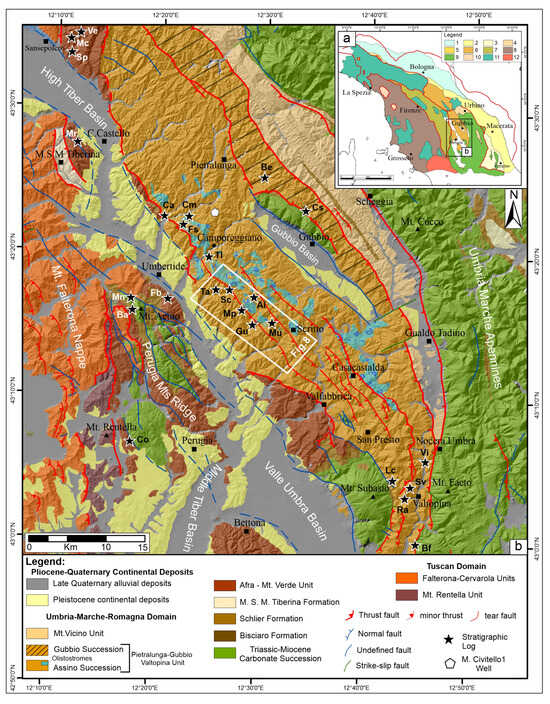
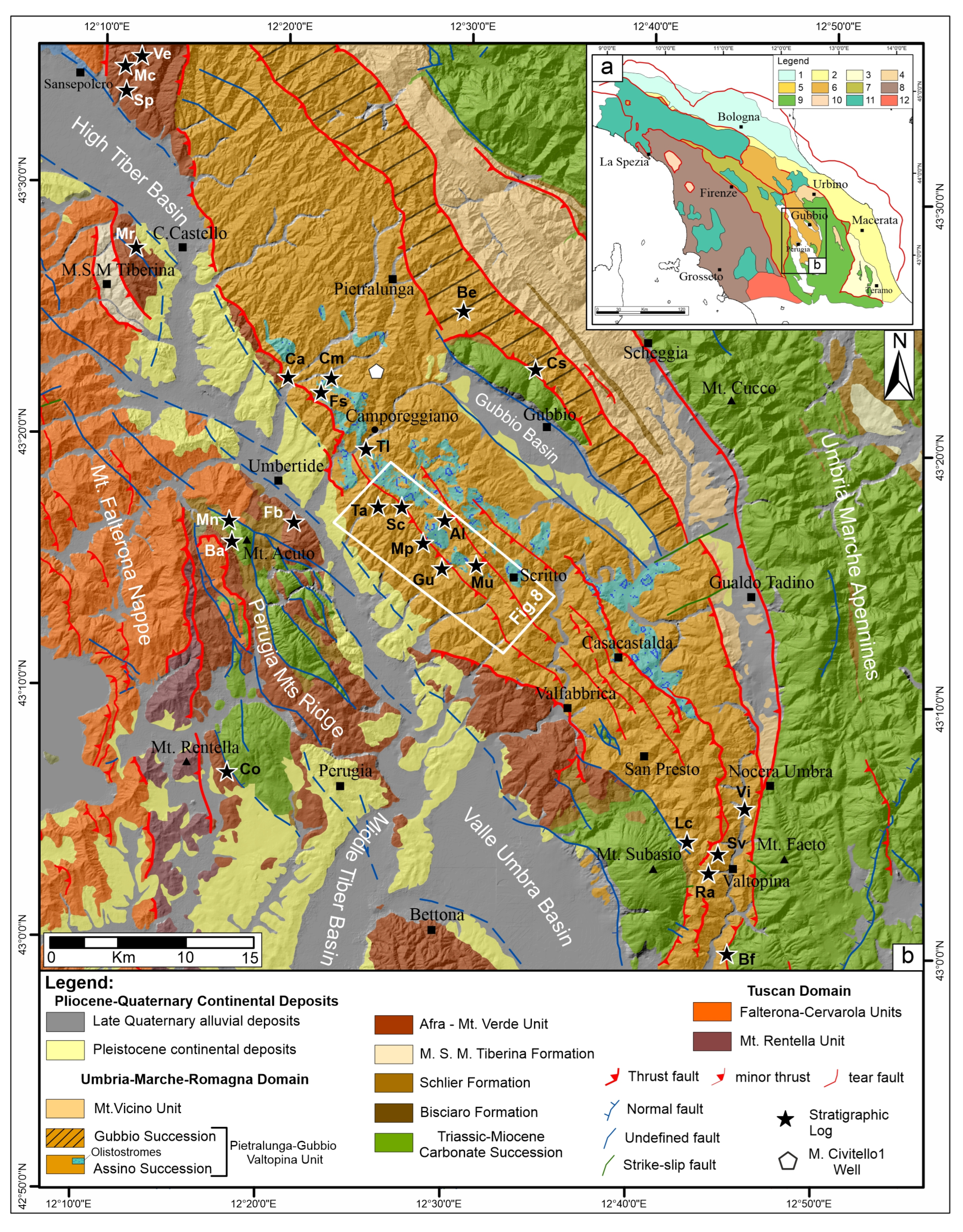
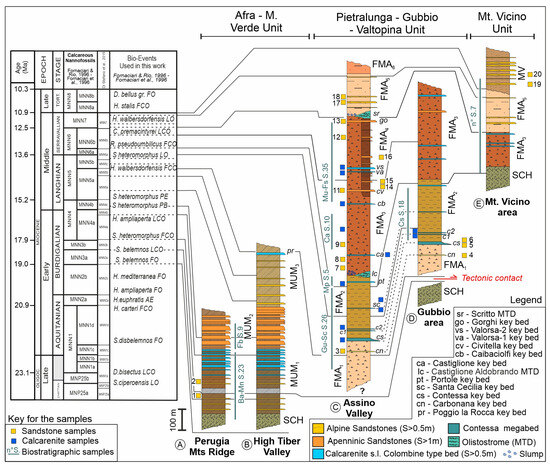
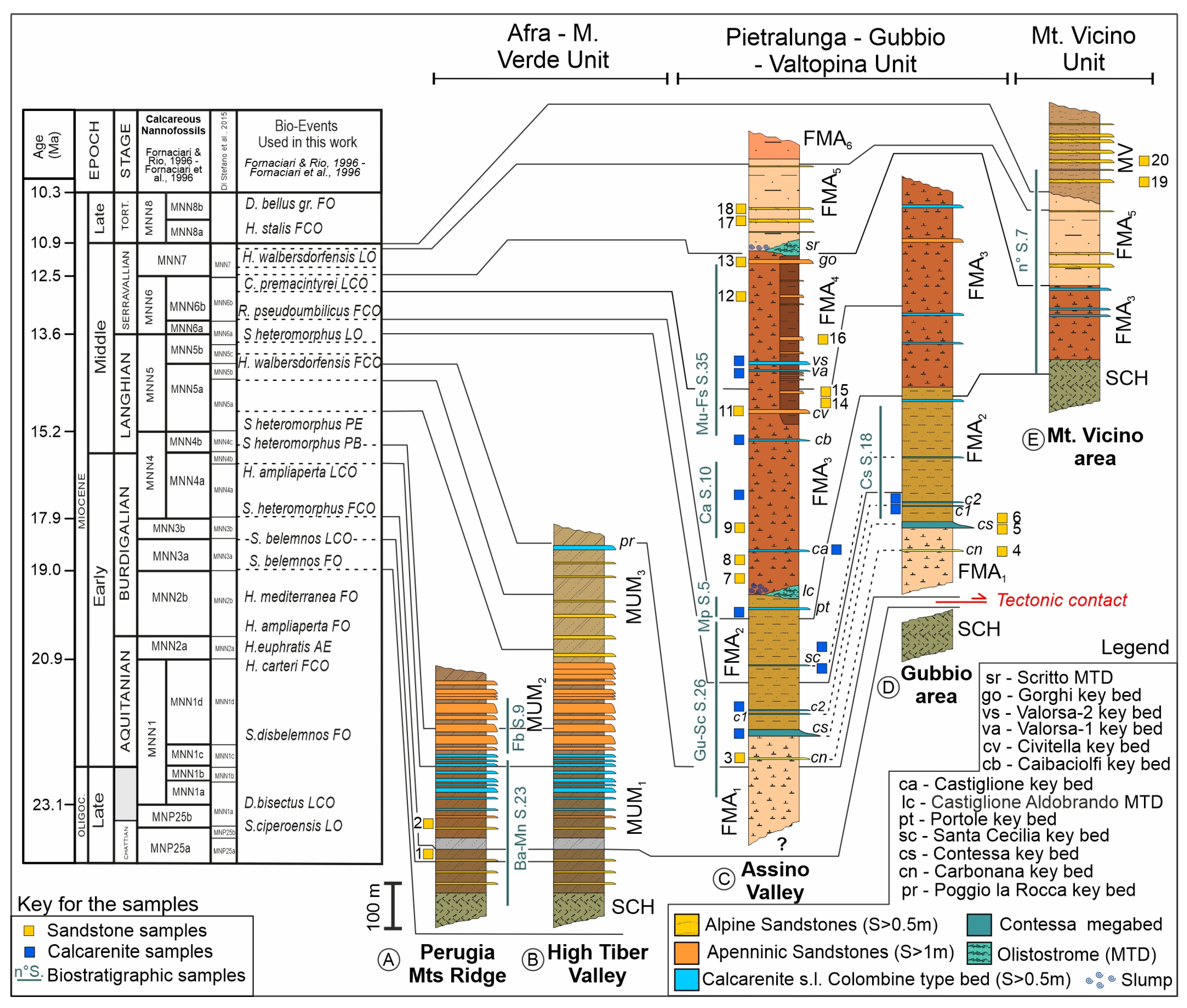
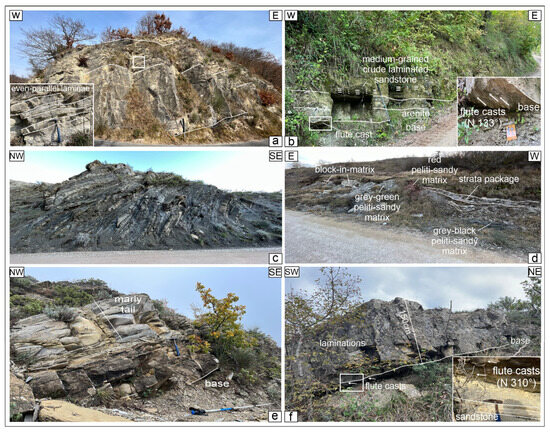
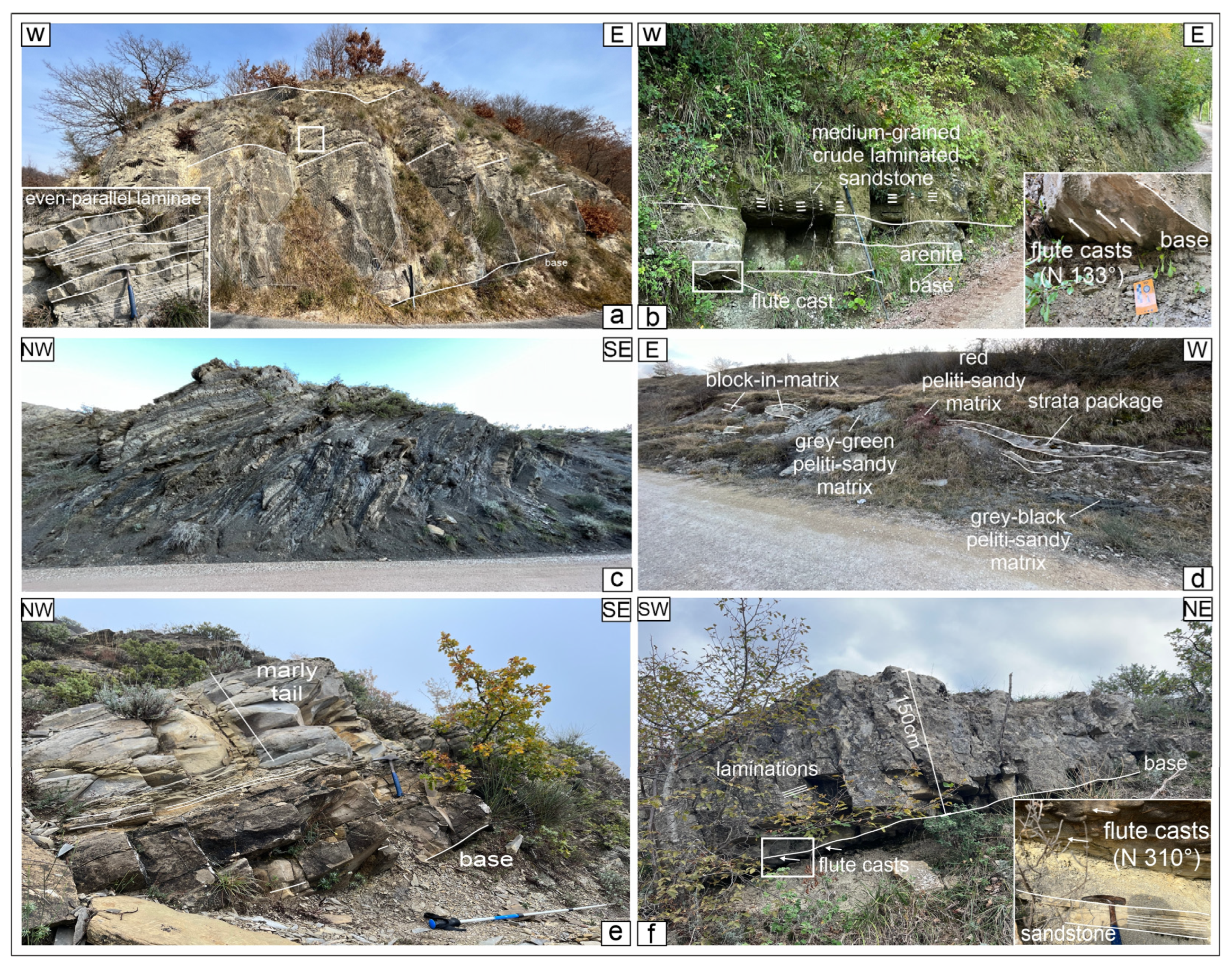
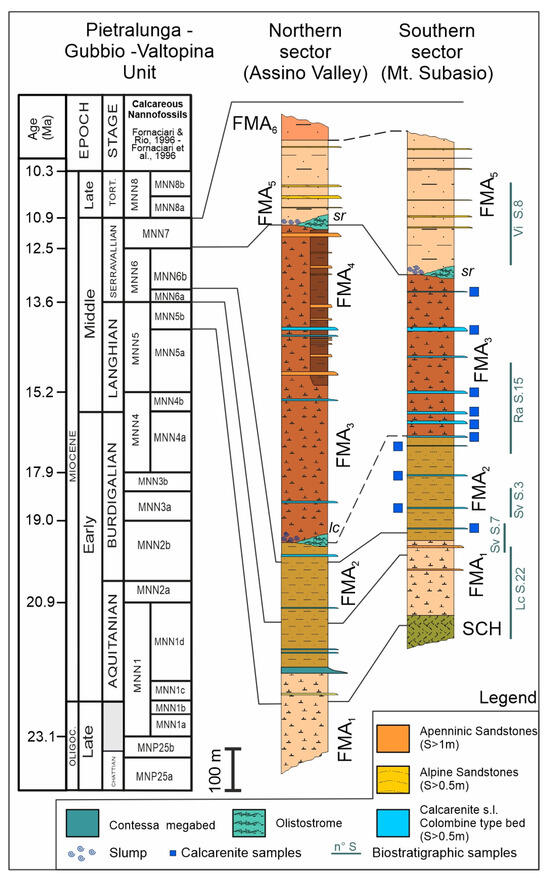
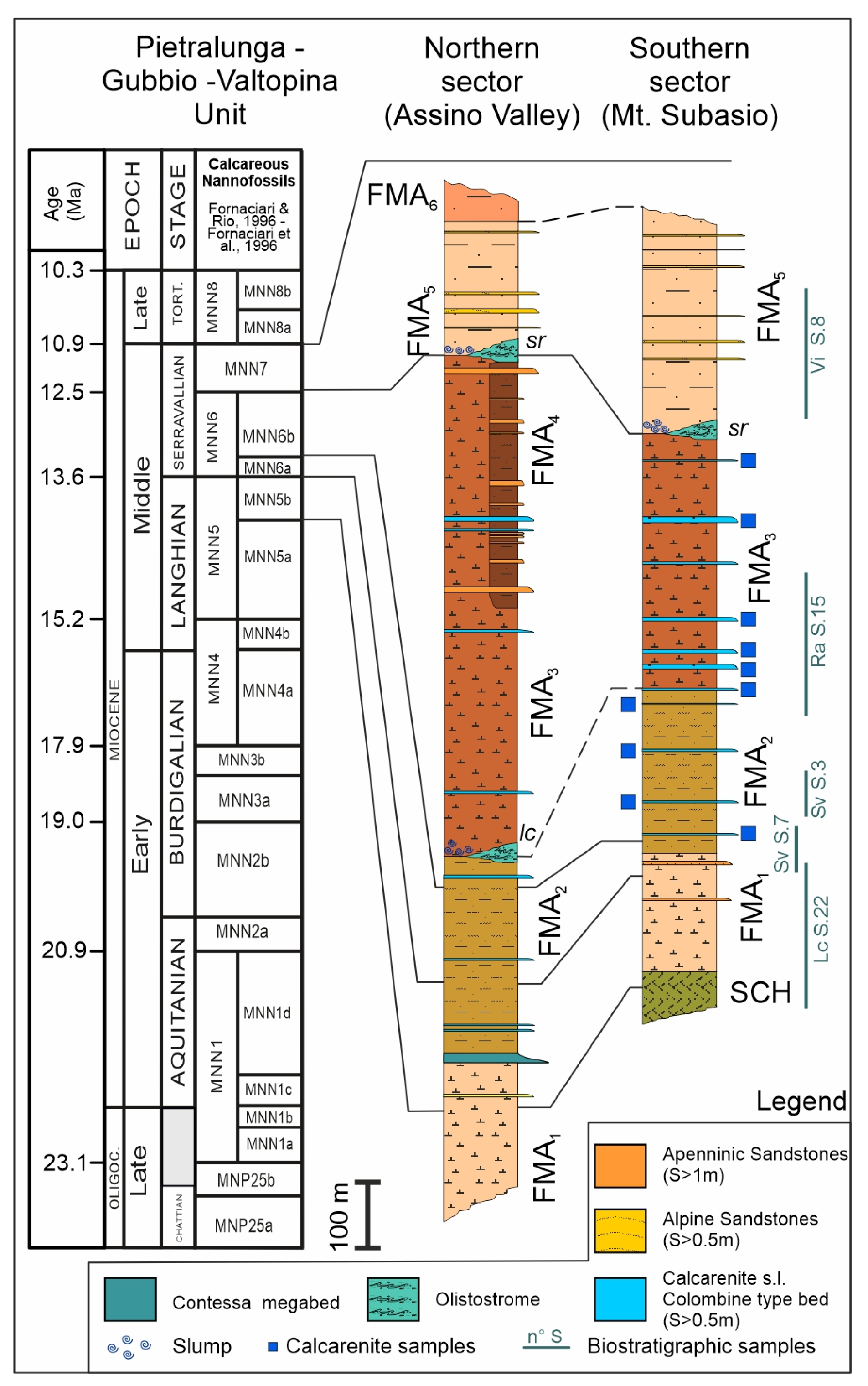
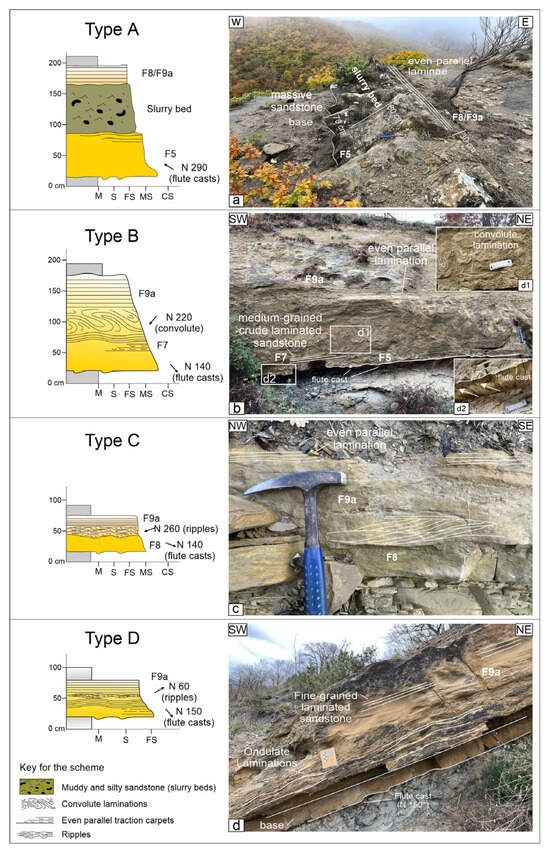
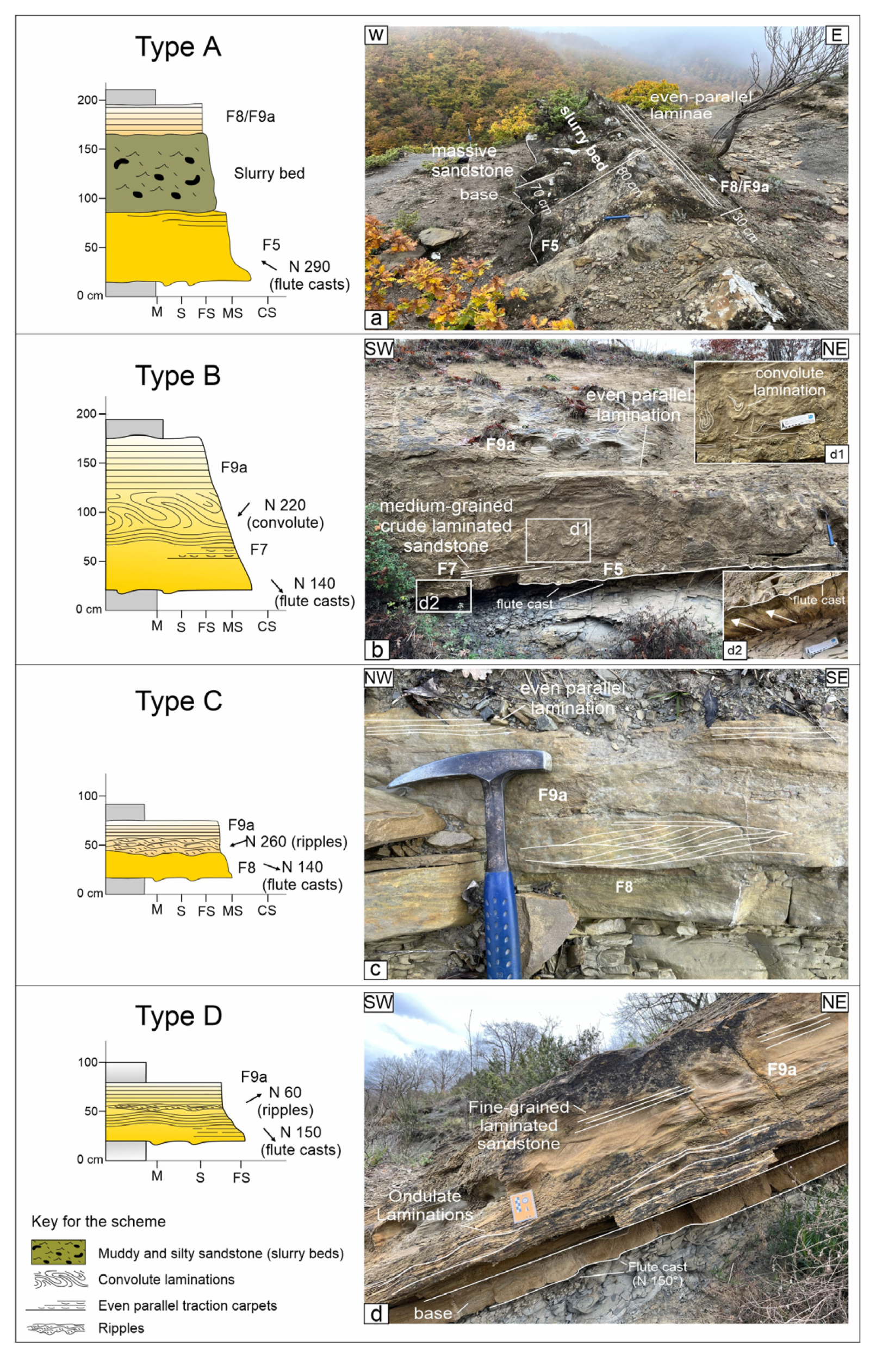
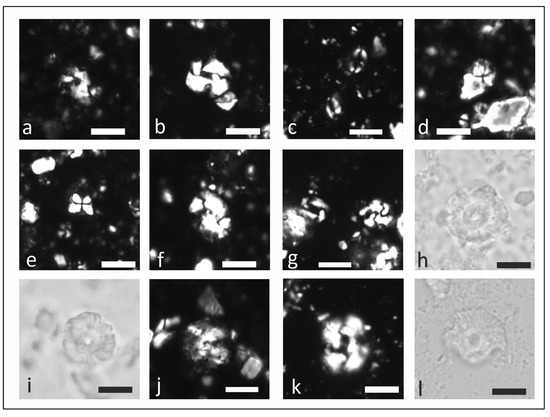
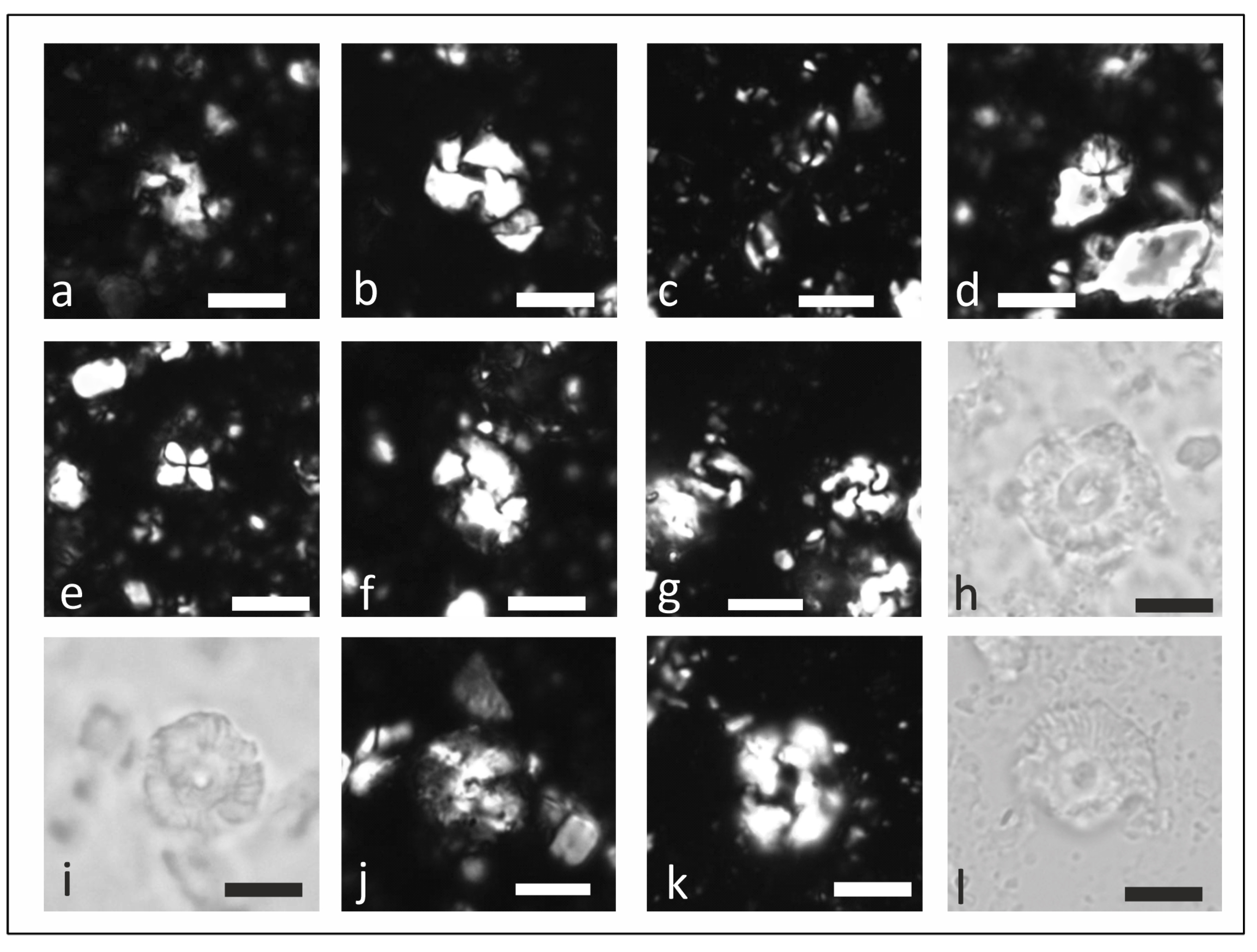
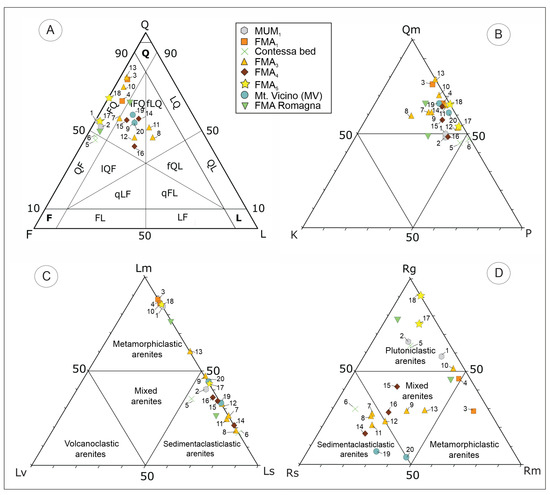
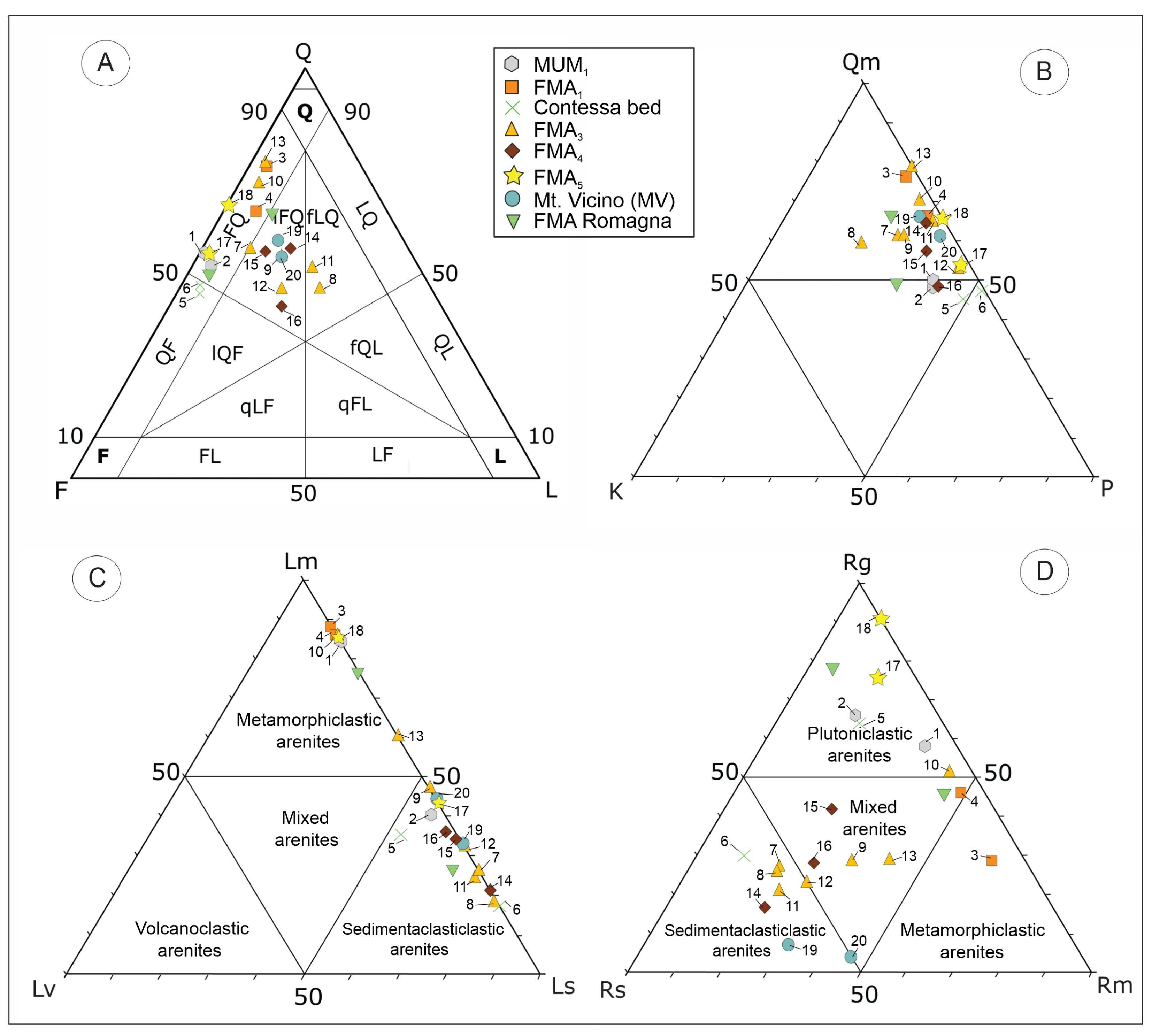
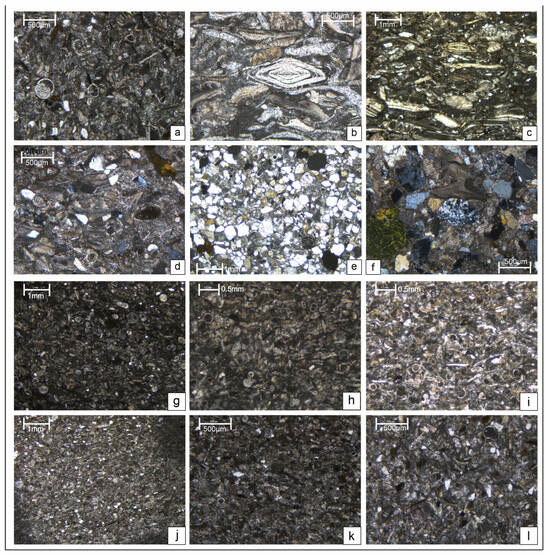
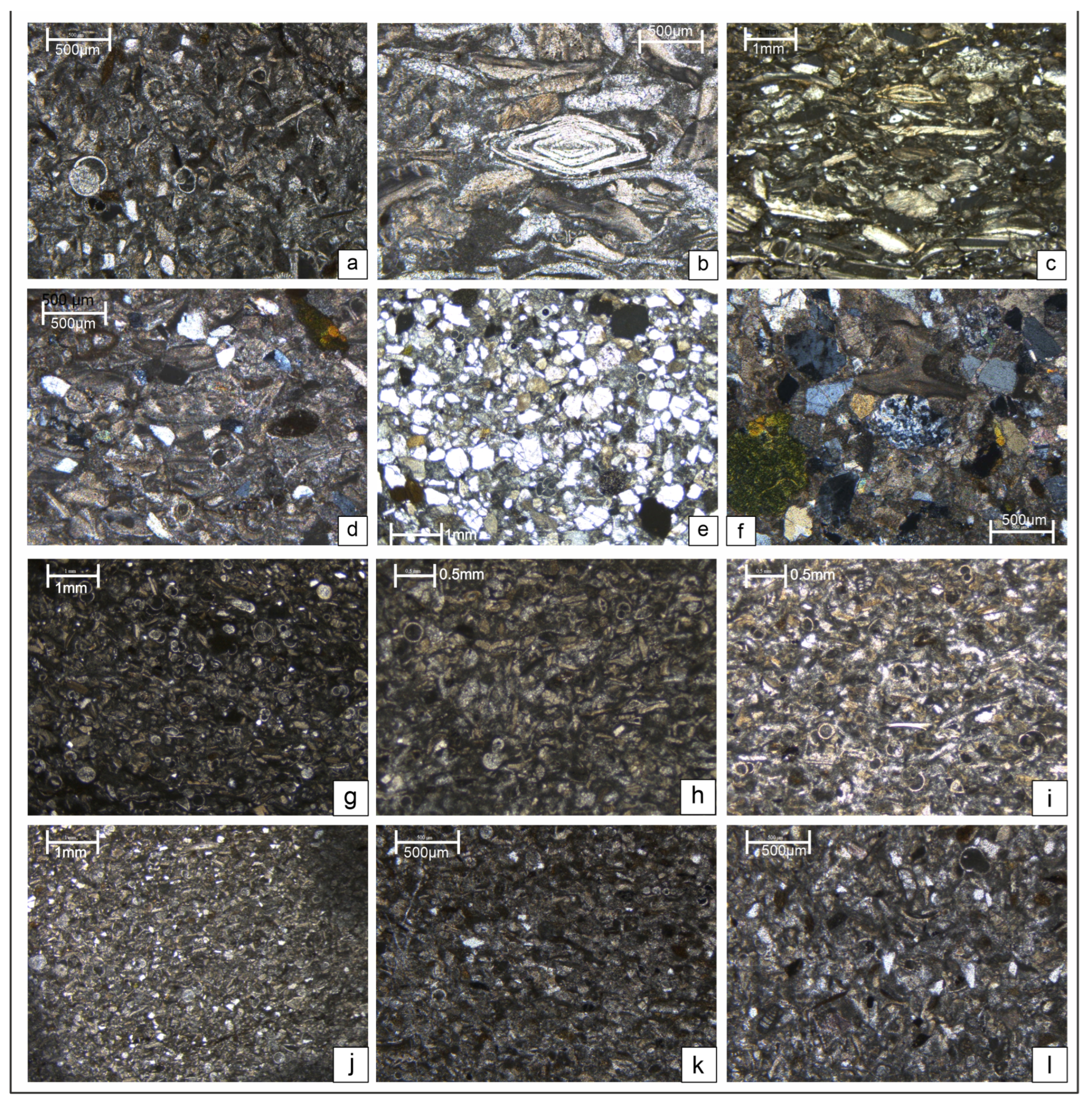
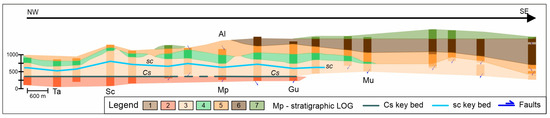
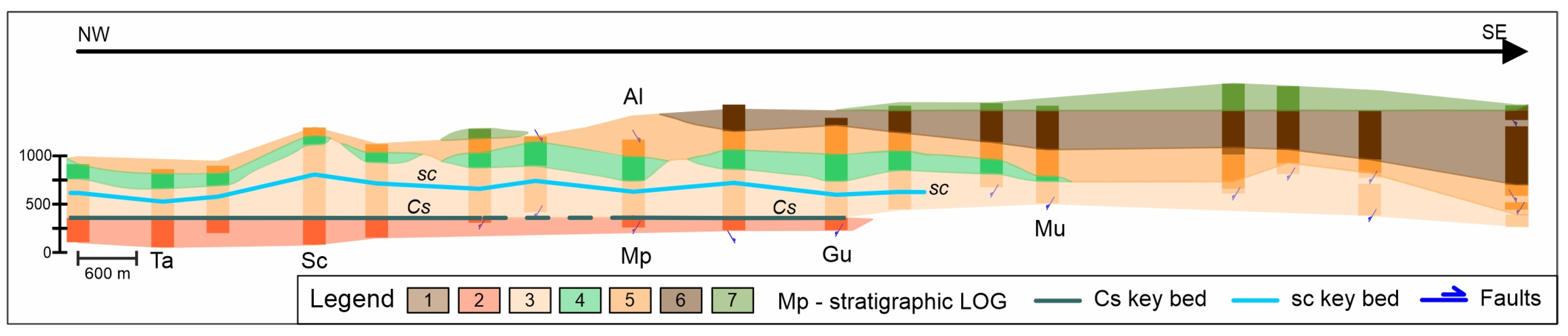
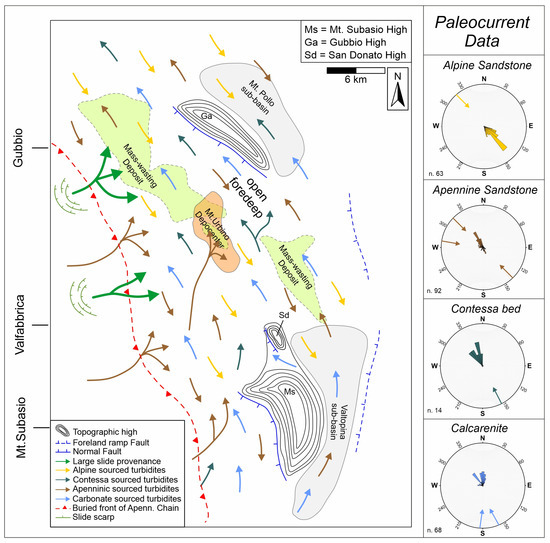
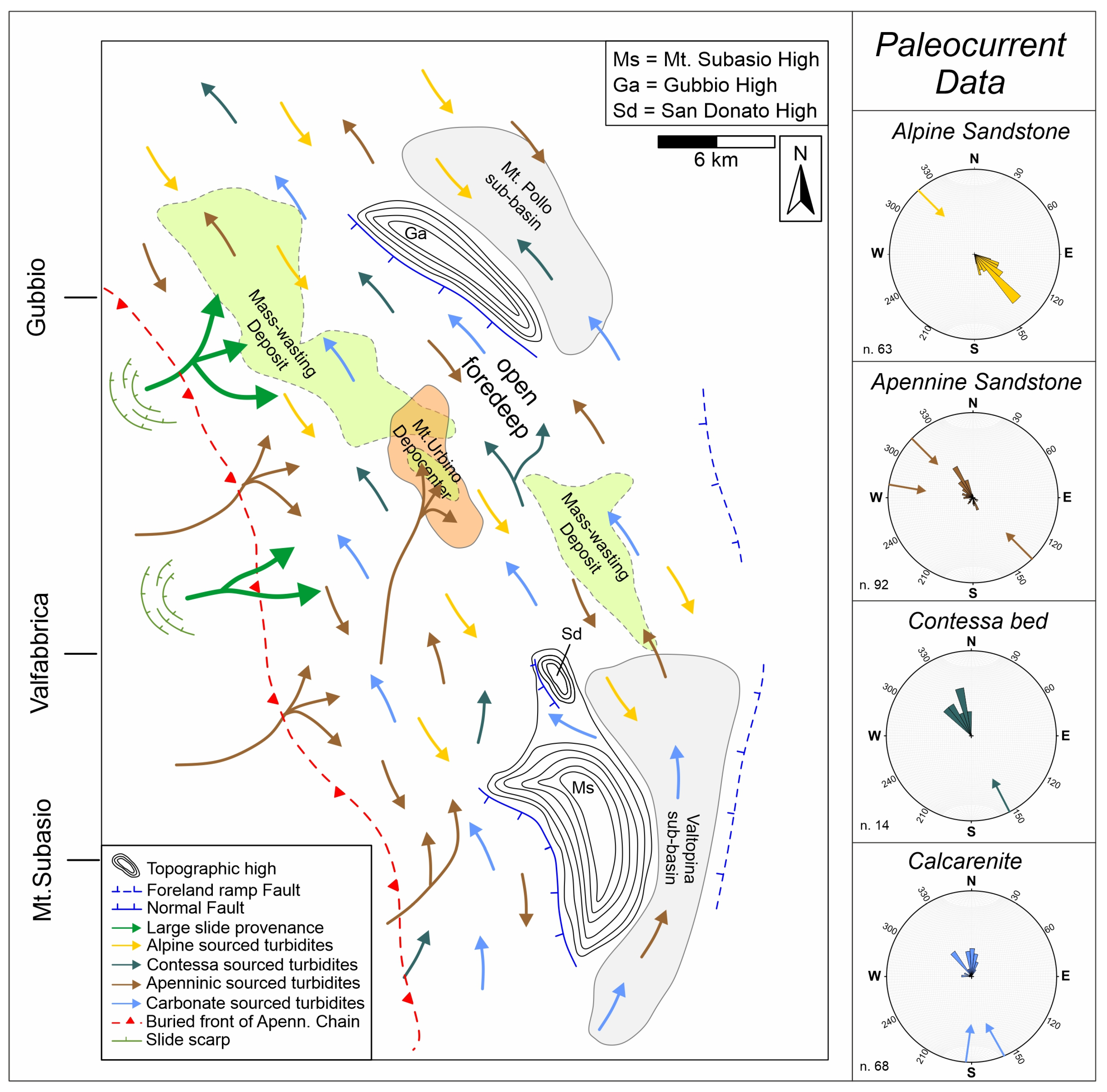
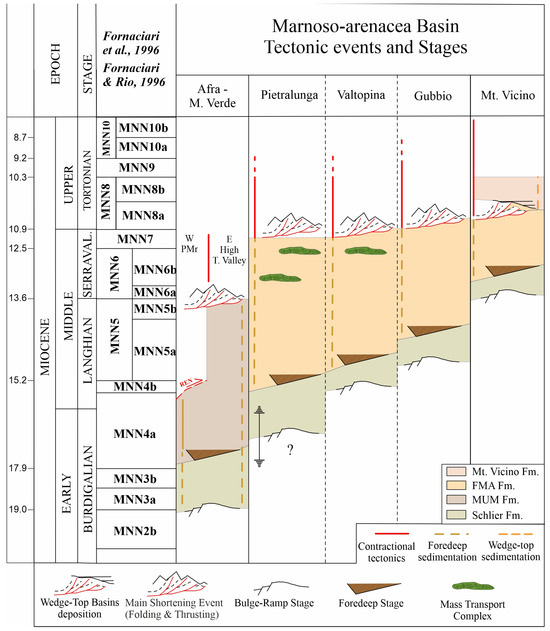
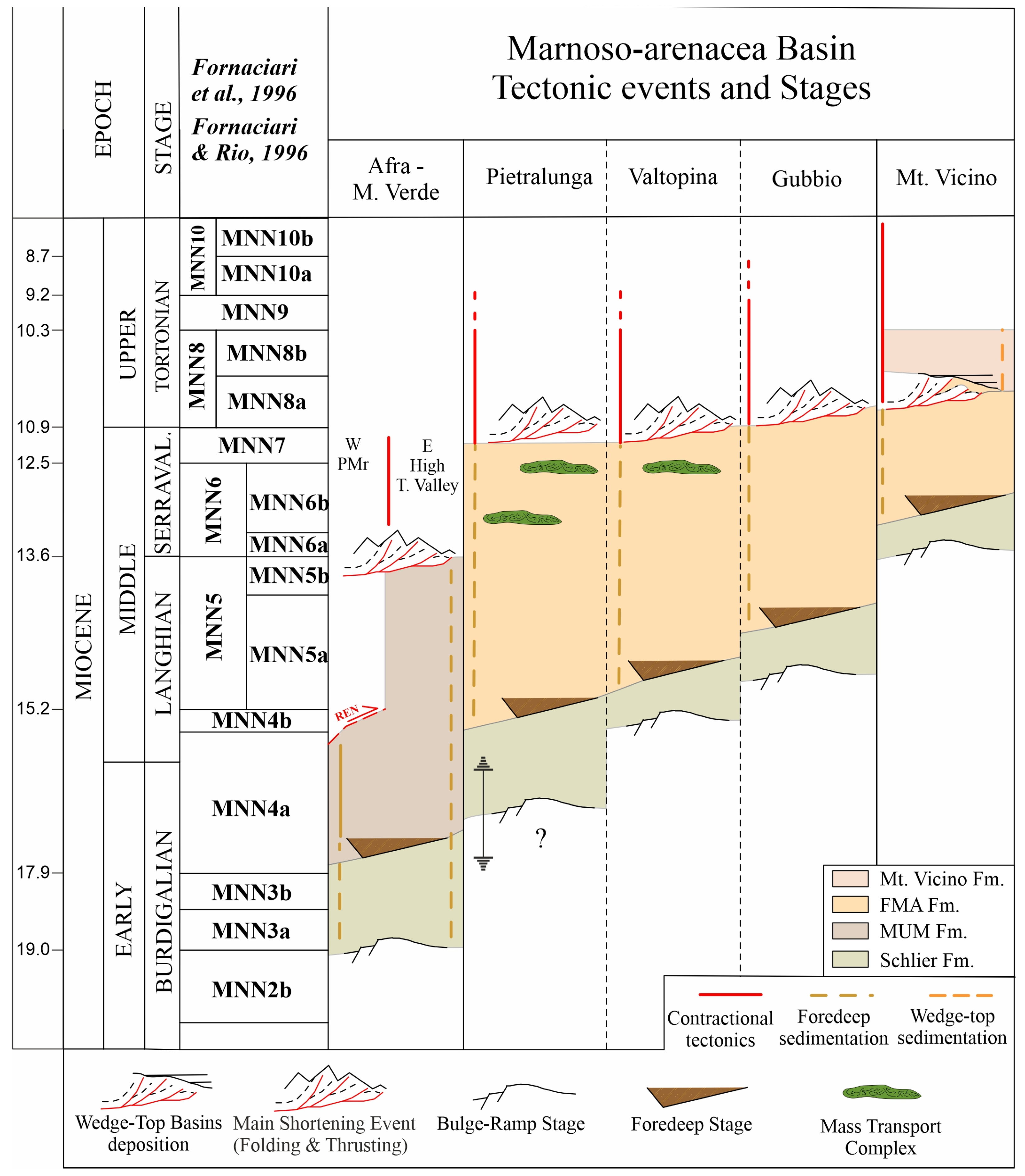

Disclaimer/Publisher’s Note: The statements, opinions and data contained in all publications are solely those of the individual author(s) and contributor(s) and not of MDPI and/or the editor(s). MDPI and/or the editor(s) disclaim responsibility for any injury to people or property resulting from any ideas, methods, instructions or products referred to in the content. |
© 2026 by the authors. Licensee MDPI, Basel, Switzerland. This article is an open access article distributed under the terms and conditions of the Creative Commons Attribution (CC BY) license.