Article

Changes in Climatic Parameters and Moistening Conditions on the South of the East European Plain


by
Edgar A. Terekhin
1,* and
Pavel A. Ukrainskiy
2
1
Department of Nature Management and Land Cadastre, Belgorod State National Research University, Pobeda 85, 308015 Belgorod, Russia
2
Department of Geography, Geoecology and Life Safety, Belgorod State National Research University, Pobeda 85, 308015 Belgorod, Russia
*
Author to whom correspondence should be addressed.
Geosciences 2026, 16(1), 23; https://doi.org/10.3390/geosciences16010023
Submission received: 6 November 2025 / Revised: 23 December 2025 / Accepted: 28 December 2025 / Published: 2 January 2026

Abstract

Analysis of regional changes in climatic parameters and moistening conditions is a necessary task for obtaining objective data on changes in landscapes. The article analyzes long-term changes in a complex of climatic variables on the south of the Central Russian Upland of the East European Plain in the last decades of the 20th century–the first decades of the 21st century. Opposite trends were identified for heat and moisture supply characteristics. The annual average temperature increased by 2.1 °C between 1980 and 2020. During this same time, the absolute values of the temperature of the warmest and coldest quarters, accumulated temperature over the period with values above 10 °C, increased significantly. The annual average temperature, the average temperature of the warmest and coldest quarters showed a positive, statistically significant trend. Precipitation characteristics, compared with temperatures, showed less pronounced trends during the study period. Annual precipitation and precipitation during the warmest quarter showed a weak negative trend. Precipitation of the coldest quarter showed an increasing trend. Contrasting changes in temperature and precipitation characteristics led to a decrease in moistening indicators during the warm season. The hydrothermal coefficient decreased by more than 18%, and the drought index increased by approximately the same amount. Spatial changes in most climatic parameters are associated with a shift in isolines to the north or northwest. The range of variations in climatic parameters across the region did not undergo significant changes.

1. Introduction

Changes in climatic parameters and moistening conditions are processes whose objective data are essential for planning environmental management, agriculture, and surface water resource utilization. This is due to the fact that climate change affects many landscape components, including vegetation [1,2], forest cover [3,4], biodiversity [5,6], water regime characteristics and surface runoff [7,8,9], the rate of biogeochemical cycles, and carbon fluxes [10,11].
Analysis of parameters determining trends in heat and moisture supply occupies an important place among complex environmental studies [12,13,14]. Climate changes manifest themselves at different spatial scales, especially at the global and continental scales. At the same time, planning specific decisions within the framework of long-term land use strategies requires data on changes in climatic characteristics at the regional scale, taking into account the landscape features of specific natural zones [15,16,17]. In this regard, the identification and analysis of trends in climatic parameters is a key task of regional research, which is also relevant for Europe [18,19,20]. Trends in moistening or aridity can be assessed using parameters of individual climatic factors and special indices. Examples include the Palmer self-calibrating drought index [21,22], the standardized precipitation index [23], the Budyko drought index, the Selyaninov hydrothermal coefficient [24], the standardized precipitation evapotranspiration index [25,26], and the non-stationary standardized precipitation evapotranspiration index (NSPEI) [27,28]. When assessing long-term changes, indicators are selected taking into account the duration of observations, the availability of initial data, and the characteristics of the study region.
Modern research in the field of regional climate change, conducted in the Northern Hemisphere, shows directional changes in factors that can have a significant impact on agriculture, forestry, and surface runoff [29,30,31,32,33]. The studies emphasize the need to evaluate a set of indicators that characterize not only average annual climatic parameters, but also the values of different seasons of the year. In flat terrain conditions, such as the East European Plain, identifying spatial changes in climatic factors is of significant importance. Spatiotemporal analysis of climatic characteristics is of particular interest for territories located on the boundaries of natural zones, for example, forest-steppe and steppe. This is due to the fact that the assessment of climate change in such areas is necessary to obtain objective data on actual changes in climatic conditions when planning regional nature management programs.
Identifying and analyzing climate change trends are particularly relevant for regions with intensive agriculture [34,35,36]. Objective data on long-term climate change in such regions is essential for preserving soil and water resources and maintaining efficient agricultural production. An example of such a region is the southern Central Russian Upland. The region is located in the forest-steppe zone of the East European Plain. The location in the transition zone between forest and steppe natural zones determines moisture characteristics. Its parameters vary quite significantly in a submeridional direction. These changes can have a significant impact on surface water features and crop production. Characteristics of the region include a high proportion of arable land [37,38], sparse forest cover, and a network of small rivers [39]. The region plays an important role in agricultural production. According to the IPCC Sixth Assessment Report [40], in the region, as in Europe, there has been a trend towards increasing hot extremes and heavy precipitation in recent decades. Depending on the forecast scenario used (RCP 2.6, RCP 8.5), by 2070–2099, the increase in annual average temperature in the region, compared to 1971–2000, could range from 1.5–2.5 to 4.5–5.5 °C [41].
The aim of this study is to analyze long-term changes in climatic characteristics in the southern Central Russian Upland. The objectives of the study included: (1) comparison of climatic parameters over different periods from the late 20th to early 21st centuries; (2) analysis of long-term climate parameter series and assessment of their trend components; (3) spatiotemporal analysis of climatic characteristics.

2. Materials and Methods

2.1. Study Area and Data

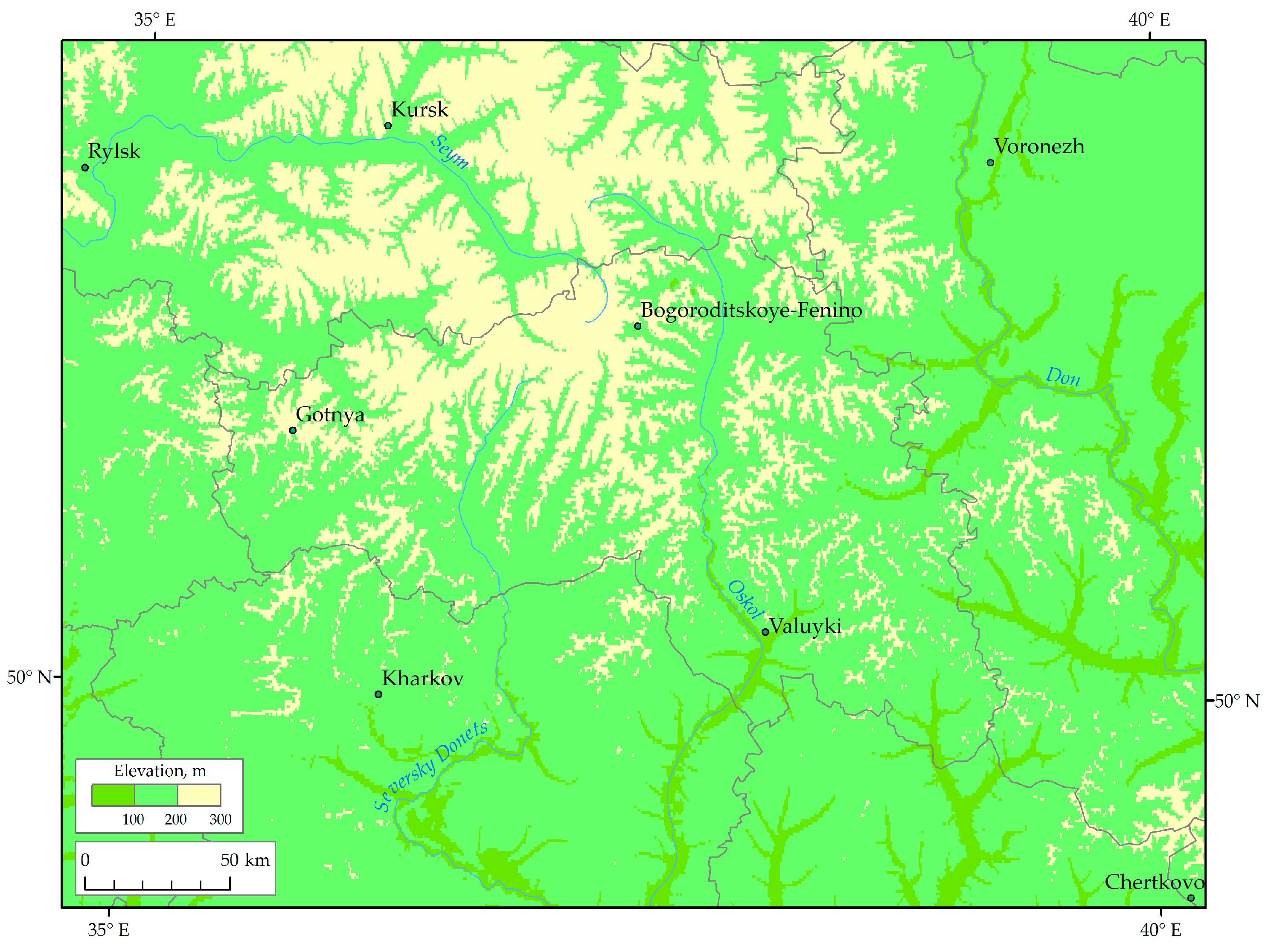
The study area is located on the East European Plain and covers the south of the Central Russian Upland (Figure 1), primarily the Belgorod oblast of Russia. The main part of the region is located in the natural forest-steppe zone. Within the study area, this zone includes the typical and southern forest-steppe physical-geographical subzones. The region is a hilly plain. The relief is widely represented by a branched network of ravine-valley systems. The ravine network is a typical element of landscapes [42,43]. The climate is temperate with distinct boundaries between summer and winter periods and, according to the Köppen classification, belongs to zone Dfb [44].
The river network is represented mainly by small rivers, many of which have their source in the region [45,46]. The river network belongs to the Don and Dnieper basins. Among the zonal soil types, chernozem and gray forest soils are widespread [47,48]. The land cover is dominated by arable land, which occupies more than half of its territory [49,50]. The natural vegetation cover is represented mainly by broad-leaved forests [51,52], forest belts, and herbaceous vegetation in the ravine-valley network. Pine forests also grow along the left banks of the largest rivers. Most of the forest belts are located along the edges of ravine-valley networks or among cultivated lands. Forested lands are highly fragmented [53,54]. Many of them are of artificial origin. The forest cover of the region is relatively small. In recent decades, a tendency for its increase has been noted [55,56]. It is largely associated with the processes of afforestation in ravine network [57] and on abandoned agricultural lands [58,59].
The information for the study was daily meteorological data on temperature and precipitation from 1980 to 2020, obtained at weather stations located in and near the study area. For the analysis, data from the weather stations Bogoroditskoye-Fenino, Gotnya, Valuyki, Rylsk, Kursk, Voronezh, Kharkov, and Chertkovo were used [60]. The analyzed weather stations were located in different parts of the study area, allowing for a spatial assessment of climatic characteristics. The absolute altitude of the weather stations did not exceed 250 m. Regular observations were conducted at all weather stations during the study period, allowing for an assessment of the long-term dynamics of climatic characteristics. The studied climatic parameters included annual average temperature, maximum temperature of the warmest month, minimum temperature of the coldest month, average temperature of the warmest quarter, average temperature of the coldest quarter, annual precipitation, precipitation of the warmest quarter, precipitation of the coldest quarter, accumulated temperature over the period with values above 10 °C, precipitation of the period with temperatures above 10 °C, the Selyaninov hydrothermal coefficient, and the Budyko drought index. The warmest quarter in the region covers July, August, and September. The coldest quarter includes January, February, and March.
The Selyaninov hydrothermal coefficient (HTC) is calculated using the formula:
H T C = P A T 0.1 AT
where PAT is the precipitation of the period with temperatures above 10 °C, and AT is the accumulated temperature over the period with values above 10 °C.
The drought index (DI) is calculated using the formula:
D I = 0.18 A T A P
where AT is the accumulated temperature over the period with values above 10 °C, and AP is the annual precipitation (mm).
We have compiled a set of indicators to comprehensively account for changes in climatic parameters that influence heat supply and moisture conditions in the region. The hydrothermal coefficient and the drought index serve as indicators of moisture conditions. Analysis of these parameters is important in the context of the potential impacts of climate change on other landscape elements and on surface waters in the region.
The study included a comparison of climatic parameters in different time slices of the analyzed period, an analysis of the time series of each climatic parameter, and a spatiotemporal assessment of climatic characteristics.

2.2. Assessment of Long-Term Changes in Climatic Characteristics

An assessment of climatic parameters at different periods made it possible to identify general patterns in the changes in the studied indicators. Three periods were selected for analysis: 1980–1985, 1995–2000, and 2015–2020. The time lag was selected to allow for an objective comparison of climatic indicators at the beginning, middle, and end of the entire study period. Given the presence of long-term climate change trends, the five-year interval allowed for accounting for possible variations in temperature and precipitation in individual years. In the region’s conditions, such variations may be associated primarily with extremely hot years. Given the frequency of years with extreme climate parameters, the chosen five-year period was sufficient to smooth out their potential impact. At this stage, data from weather stations located directly in the study region were used for analysis: Bogoroditskoye-Fenino, Gotnya, and Valuyki. For each weather station, average climatic parameter values were calculated for each period. We added this information to a pre-created weather station vector point layer. The resulting data were averaged based on information from each station. Statistical processing was performed in R version 4.1.2.
The analysis of time series of climatic parameters was performed for the entire research period, covering 1980–2020. First, for each of the 12 indicators, a long-term data series was calculated for each weather station. We then calculated an average series of values from the weather stations for each climatic characteristic. The analysis of the series included a study of the graphs of their long-term dynamics, an assessment of the trend and its direction. The trend was assessed using the Mann-Kendall test. This criterion is a nonparametric test that identifies the presence or absence of a statistically significant trend in a series. Positive or negative values of the tau statistic, respectively, indicate the presence of a corresponding trend in the series while simultaneously assessing the statistical significance of the tau value. A significance level of 0.05 was used in the study.

2.3. Spatiotemporal Analysis of Climatic Parameters

The spatiotemporal analysis of climatic parameters included the creation of raster models and an assessment of territorial differences for the periods 1980–1990 and 2010–2020. At this stage, data from weather stations located directly in the south of the Central Russian Upland and in close proximity to it were used for the analysis. The study included data from all eight weather stations studied. Raster models of each of the 12 assessed climatic parameters were prepared for both periods. Raster models were calculated using spatial interpolation of climatic parameter values from weather stations. The radial basis function method was used for interpolation. Using the resulting rasters, spatial patterns of climatic parameters were compared across both periods. At the same time, spatial variations in climatic characteristics in the region were compared across both periods. A spatiotemporal assessment of climatic parameters was performed using centroid shift analysis. For identical gradations of climatic parameters, we estimated the direction and distance by which centroids shifted from 1980–1990 to 2010–2020. The angular value is measured from the east direction along the line connecting the initial and final positions of the centroid.

3. Results

3.1. Assessment of Climatic Parameters at Different Periods

In the last decades of the 20th century and the first decades of the 21st century, trends in changes in a set of indicators related to heat and moisture supply were observed in the south of the Central Russian Upland. Temperature characteristics showed a general tendency towards increasing values. During the study period, there was an increase in annual average temperature (an increase of 2.1 °C), maximum temperature of the warmest month, and minimum temperature of the coldest month (Table 1).
Average temperatures of the warmest and coldest quarters also increased. A similar upward trend was seen in the maximum temperature of the warmest month and the minimum temperature of the coldest month. At the same time, the minimum temperature of the coldest month, both in the early 1980s and today, drops to very low levels. Consequently, each winter experiences periods of fairly severe frosts. However, these frosts are becoming less severe each year. Considering that the listed changes occurred over a period of four decades, it can be concluded that there is a fairly strong trend towards growth in heat supply characteristics in the region. Compared to temperature characteristics, precipitation trends did not show such pronounced directional changes. Annual precipitation has decreased. But the decline was not as pronounced as the increase in annual average temperature. For example, there were no visible changes in annual precipitation between the first two periods. A more significant downward shift showed precipitation of the warmest quarter and precipitation of the period with temperatures above 10 °C. In contrast, precipitation of the coldest quarter showed a consistent increase. Changes in temperature parameters between the analyzed periods were thus more significant compared to changes in precipitation characteristics. Differences in these parameter groups affected the values of the hydrothermal coefficient and drought index. The hydrothermal coefficient showed a significant decrease (by 18%), while the drought index, on the other hand, increased significantly. Thus, in recent decades, the region has been characterized by a significant increase in heat during periods of biological activity, while moisture characteristics have decreased.

3.2. Time Series Analysis of Climatic Parameters

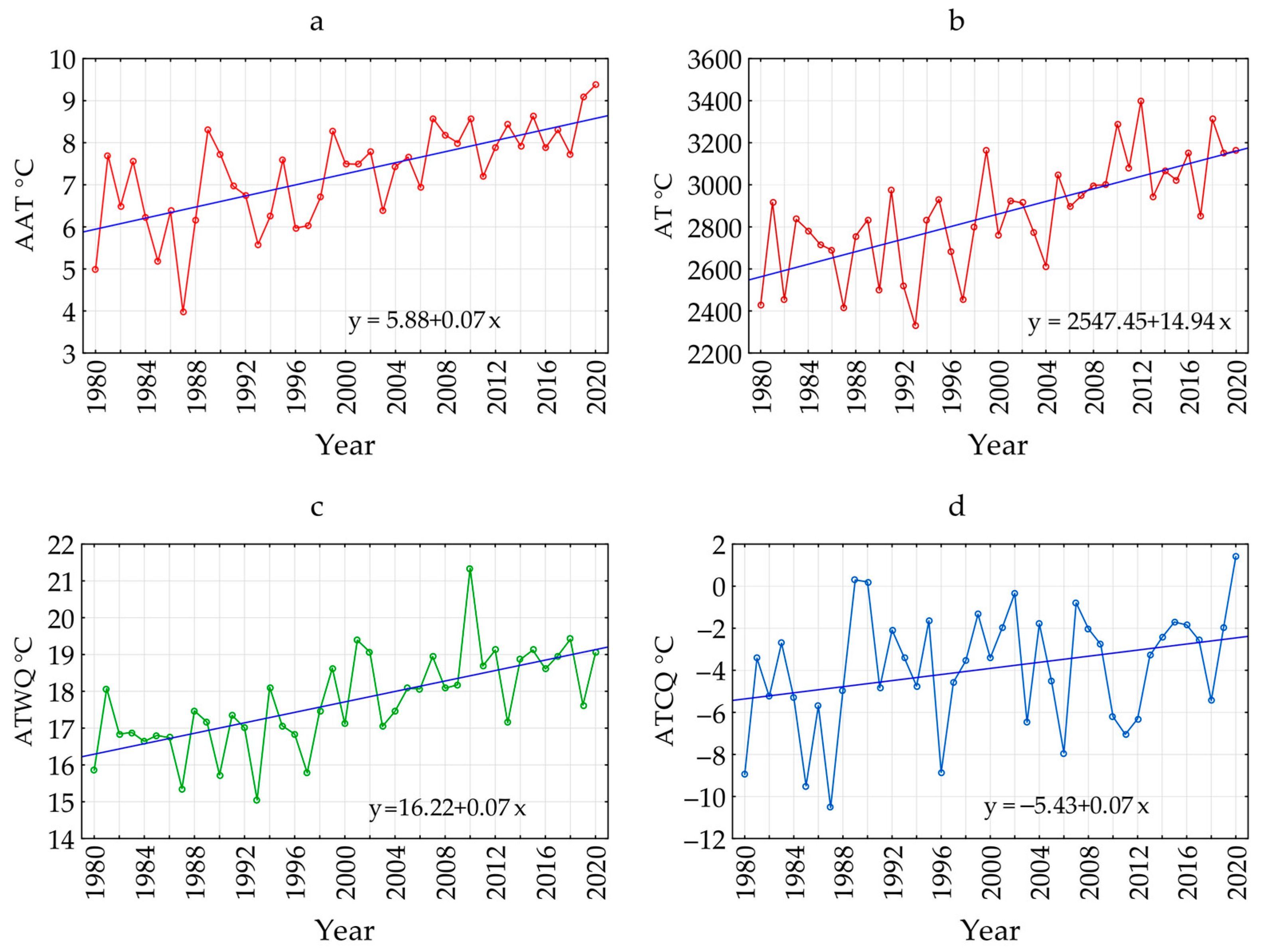
Temperature characteristics showed pronounced positive trends during the study period (Figure 2). The annual average temperature increased while annual fluctuations decreased.
Until the mid-1990s, the annual average temperature periodically dropped below 6 °C; in the last quarter century, it has never fallen below this mark. A clear positive trend was observed for accumulated temperature over the period, with values above 10 °C and an average temperature of the warmest quarter of the year. For these parameters, the largest increases were observed since the late 1990s. Since the early 2000s, the average temperature of the warmest quarter has not fallen below 17 °C. The average temperature in the coldest quarter has also shown a positive trend, but unlike the annual average temperature, it is characterized by very large annual fluctuations. This is due to the fact that during the coldest quarter, there are days with very low temperatures almost every year. At the same time, based on the time series analysis, it can be concluded that the study region was characterized by increased heat supply conditions during both the warm and cold periods of the year.
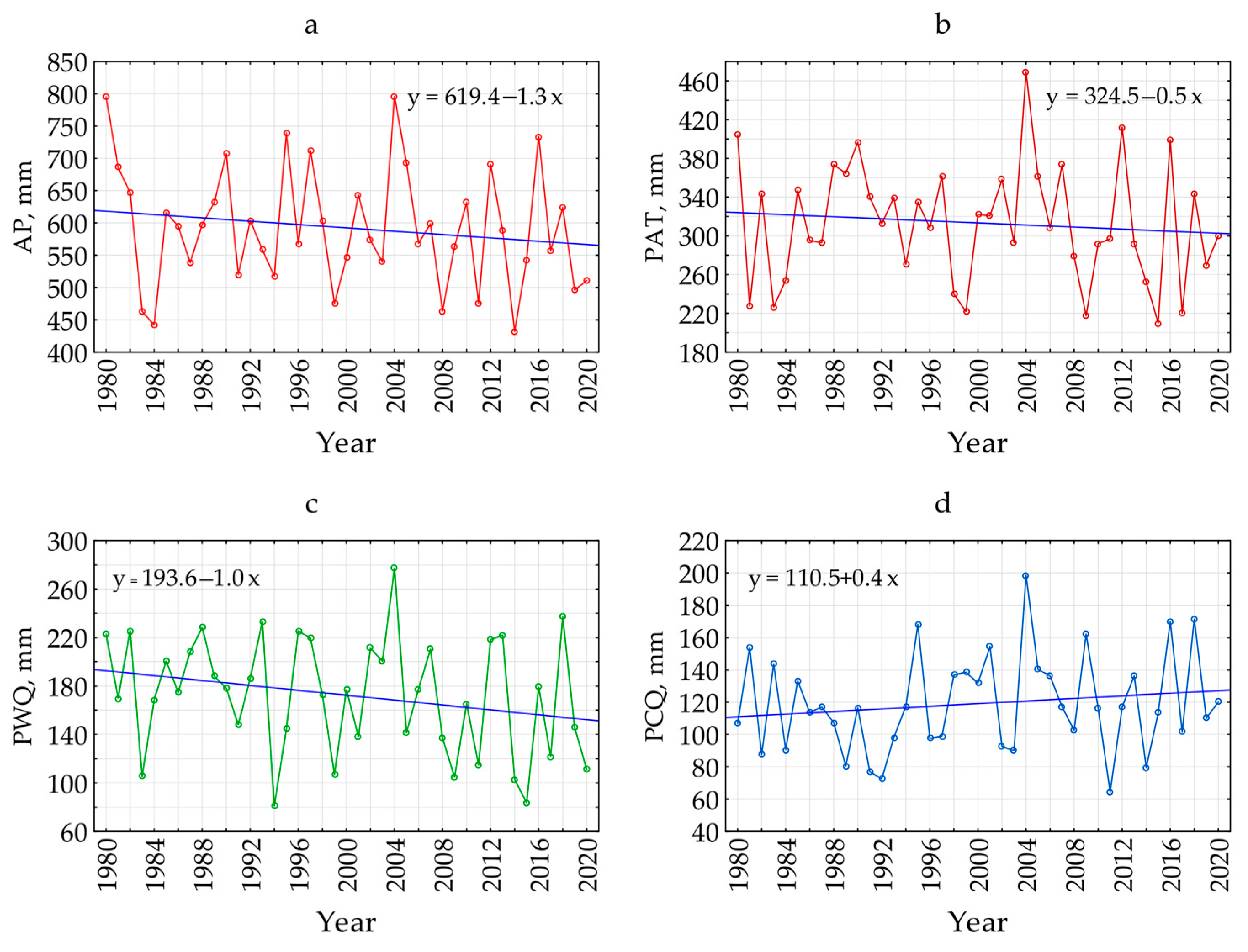
Annual precipitation, in contrast to annual average temperature, showed a decreasing trend (Figure 3). A distinctive feature of this indicator is the very strong variation in annual values throughout the entire analyzed period.
Precipitation of the period with temperatures above 10 °C and precipitation of the warmest quarter showed a negative trend, much like the trend in annual precipitation. Both indicators also showed very high annual fluctuations. These fluctuations were observed throughout the entire analyzed period. A distinctive feature of precipitation, compared to temperature indicators, is the divergent long-term trends for the warmest and coldest quarters. Precipitation of the warmest quarter, as well as annual precipitation, showed negative trends. Conversely, precipitation of the coldest quarter showed a positive trend. This precipitation type, like other precipitation categories, shows high annual fluctuations. Based on the graphs, precipitation characteristics showed less pronounced trends compared to temperature parameters. Trends in the time series of annual precipitation, precipitation of the warmest quarter and precipitation of the coldest quarter are less pronounced compared to temperature characteristics assessed in similar seasons of the year. A common feature of temperature and precipitation characteristics is more pronounced long-term changes for the warmest period compared to the coldest period.
Differences in the precipitation and temperature time series are evident when comparing the indicators of trend presence. A positive, statistically significant trend was identified for the annual average temperature, the maximum temperature of the warmest month, the average temperature of the warmest quarter, and the accumulated temperature over the period with values above 10 °C (Table 2).
The significance level of tau for the average temperature of the coldest quarter is near the threshold value, which suggests the presence of a positive trend. The exception is the minimum temperature of the coldest quarter. Despite the increase in its values, the winter period at present and in the early 1980s showed the presence of days with fairly severe frosts. For most heat supply characteristics, the long-term positive trend during the last decades of the 20th century and the first decades of the 21st century is thus confirmed. Unlike temperature characteristics, precipitation characteristics did not show a statistically significant trend. Negative absolute tau values for most precipitation parameters indicate a decreasing trend. But in all cases, the tau value is not statistically significant. The absence of statistically significant tau values, together with the graphical analysis of time series, confirms the conclusion that long-term trends in precipitation parameters are less pronounced than long-term dynamics of temperature characteristics.
Analysis of the time series parameters for the hydrothermal coefficient and drought index indicates a decrease in the characteristics of the area’s moistening during the warm period. For both indicators, the long-term trend is statistically significant. It is negative for the hydrothermal coefficient and positive for the drought index. Absolute values of tau show that changes in these indicators are close in relative magnitude, but opposite in direction.
An assessment of the time series for the studied climatic parameters thus revealed a trend toward increasing heat supply with decreasing moisture supply during the warm season. This also confirms the conclusion that temperature changes are more pronounced than precipitation. This feature is typical for the annual values of both categories of climatic characteristics and for their indicators measured in different seasons.

3.3. Spatiotemporal Analysis of Climatic Parameters in the Late 20th-Early 21st Century

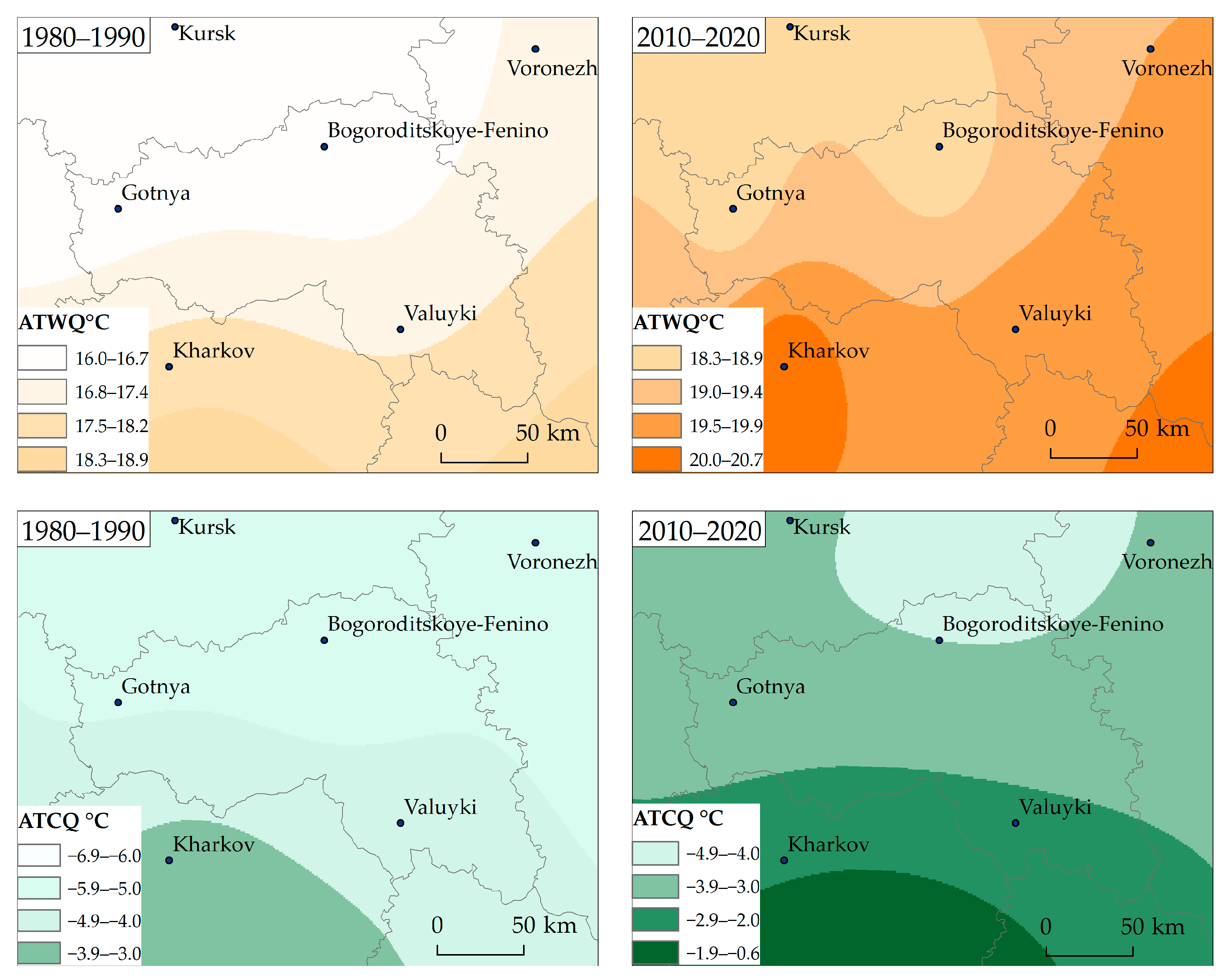
Spatial changes in heat supply parameters in the region are associated with a northward shift of their isolines. A shift in the isolines of the annual average temperature, the average temperature of the warmest and coldest quarters (Figure 4), and the accumulated temperature over the period with values above 10 °C was revealed. Geoinformation analysis showed that for the average temperature of the warmest quarter, the centroid (central point) of the southernmost gradation “18.3–18.9 °C” shifted by 308 km in the northwest direction (128° from the east) from the period 1980–1990 to the period 2010–2020. This gradation was previously located to the south of the region, but currently covers its northwestern part. For the average temperature of the coldest quarter at the same time, the centroid of the southernmost gradation (−3.9–−3.0 °C) shifted 195 km in the north-east direction (57° from the east).
The spatial variation in annual average temperature in the region in the 1980s was 5.9–7.5 °C, but in the 2010s it was already in the range of 7.7–9.5 °C. The territorial variation in the average temperature of the warmest quarter in the 1980s was in the range of 16–18 °C, and in the 2010s it was 18–20 °C. The variation in the average temperature of the coldest quarter in the 1980s was −5.7–−3.7 °C, and in the 2010s it was in the range of −4–−2.2 °C. The spatial configuration of the isolines for most of the listed indicators did not undergo significant changes. During the warmest period of the year, temperature values in the 1980s and 2010s extended from southeast to northwest. During the coldest quarter, during similar time periods, the spatial temperature trend extended from southwest to northeast. From the map diagrams in Figure 4, it follows that during the warmest and coldest periods of the year, the region’s territory moved into higher temperature gradations.
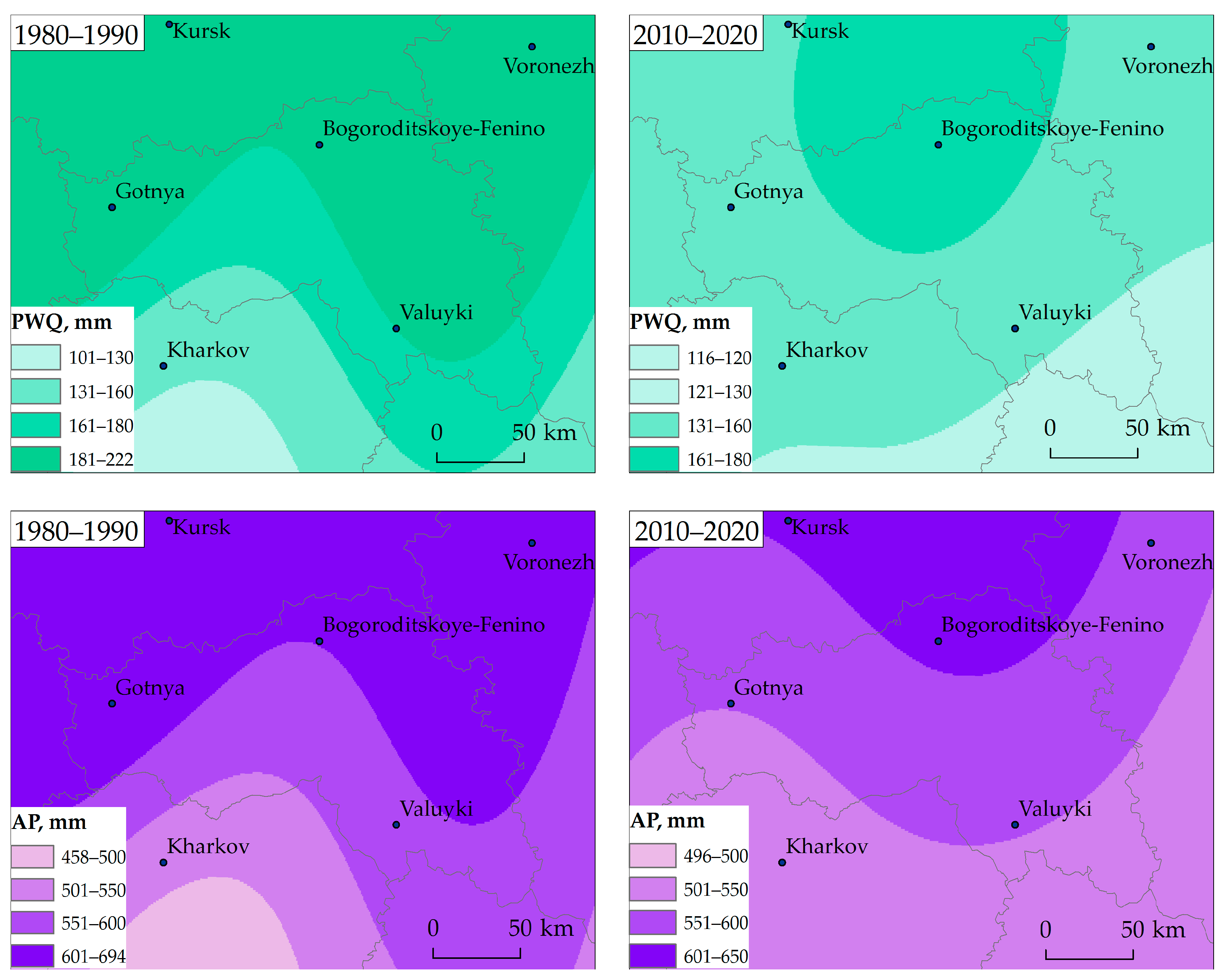
Precipitation parameters, excluding precipitation of the coldest quarter, showed a northward shift in their isolines. Unlike temperature characteristics, precipitation parameters show a more complex spatial configuration in the region (Figure 5). This pattern is typical of annual precipitation, precipitation of the period with temperatures above 10 °C, precipitation of the warmest quarter, and precipitation of the coldest quarter.
Precipitation isolines for the warmest quarter and annual precipitation, as well as temperature isolines, have shifted northward. For example, for precipitation of the warmest quarter from 1980–1990 to 2010–2020, the centroid of the “161–180 mm” gradation shifted 118 km north (95° from the east direction). For annual precipitation over the same period, the change was less significant. For example, the centroid of the “551–600 mm” gradation shifted 95 km northwest (132° from the east direction). In the 1980s, the spatial variation in annual precipitation ranged from 518 to 670 mm. In the 2010s, this figure was 512 to 608 mm. Spatial variation in precipitation for the warmest quarter in the 1980s ranged from 138 to 202 mm, and in the 2010s, it ranged from 137 to 175 mm. For precipitation in the coldest quarter, similar variations were 95–124 mm in the 1980s and 109–136 mm in the 2010s. Thus, precipitation in the warmest and coldest quarters, in contrast to similar temperature characteristics, showed changes in different directions. This feature, along with the less pronounced nature of the changes, distinguishes regional precipitation characteristics from temperature characteristics. The northward shift in annual precipitation may be due to atmospheric circulation patterns. These patterns also explain the contrasting changes in precipitation during the warmest and coldest quarters. Despite the fact that precipitation during these periods showed opposite trends, the predominance of warm-season precipitation over cold-season precipitation caused the northward shift in the isolines. Moreover, the spatial changes in precipitation parameters, as well as temperature parameters over a period of four decades, indicate a focused and rather intense shift in heat and moisture conditions in the region.
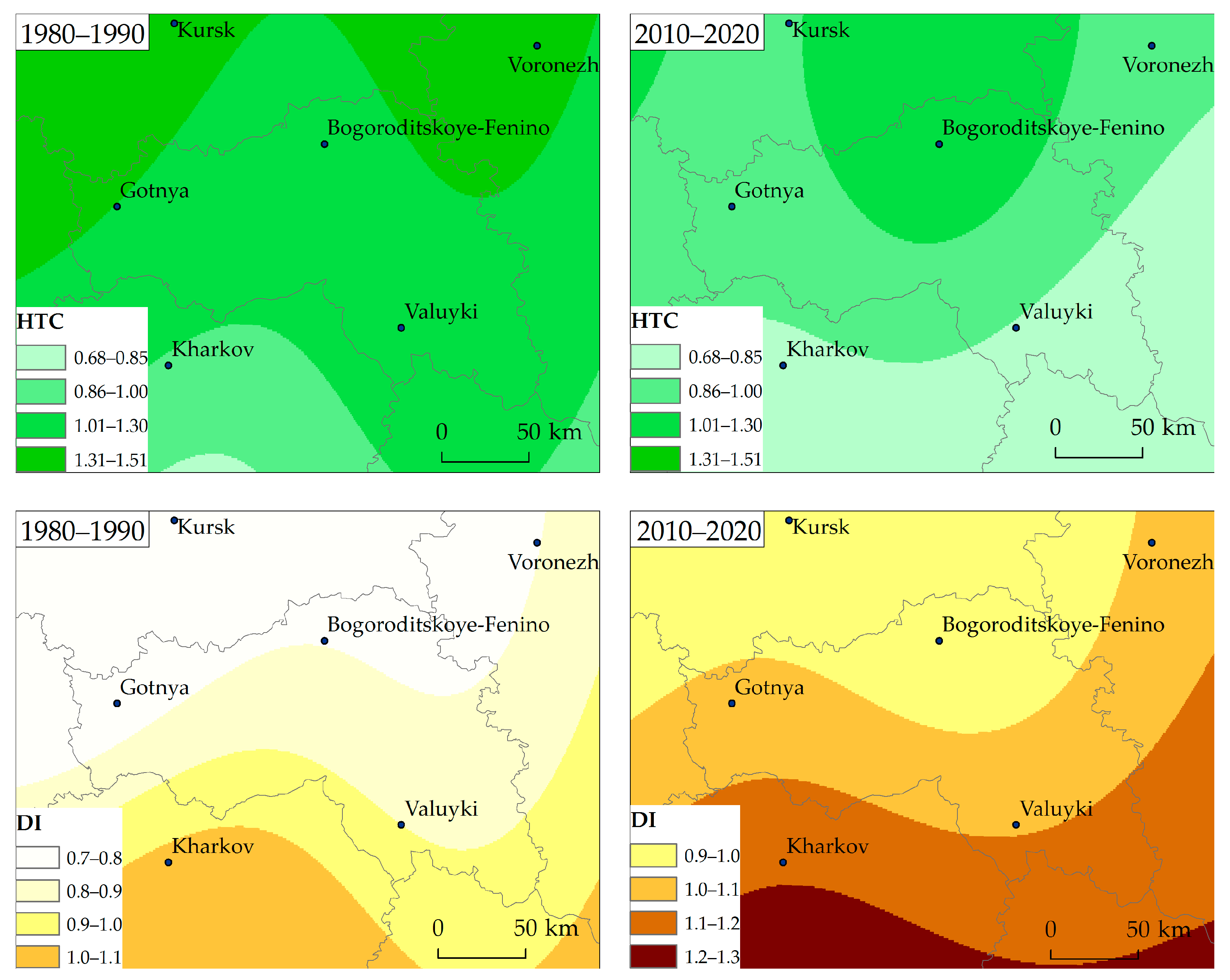
Spatial variations in the hydrothermal coefficient and drought index for the region between the 1980s and 2010s reflect a trend toward decreasing moistening during the warm season. Both indices are based on climatic parameters during periods of the year when temperatures exceed 10 °C. The hydrothermal coefficient isolines shifted northwestward (Figure 6). For example, the centroid of the “0.86–1.00” gradation shifted in this direction (135° from the east) by 162 km. The centroid of the “1.01–1.30” gradation shifted in the northwest direction (120°) by almost 140 km. While in the 1980s, its values in the region ranged from 0.85 to 1.50, in the 2010s, the spatial variation was 0.68 to 1.30.
The drought index contours also shifted toward the northwest during the study period. For example, the centroid of the 0.9–1.0 gradation shifted by 129° (from the east direction) by 172 km. In the 1980s, the drought index in the region ranged from 0.7 to 1.0. In the 2010s, its variation spanned the range of 0.9 to 1.2. In the 1980s, most of the southern Central Russian Upland was in the hydrothermal coefficient range of 1.0 to 1.3. By the 2010s, most of the territory was already in the range of 0.86 to 1.0. A characteristic feature of the hydrothermal coefficient and drought index, as well as many other indicators, is that the territorial range of variation in values has not undergone significant changes. That is, there was a pronounced shift in the contours without any noticeable changes in the range of variation in the parameter itself.

4. Discussion

The conducted analysis revealed a number of important features characterizing the change in the complex of climatic parameters in the south of the Central Russian Upland in the last decades of the 20th century to the first decades of the 21st century. The key feature is related to differences in the dynamics of temperature and precipitation characteristics. Temperature characteristics, including the annual average temperature, the average temperature of the warmest and coldest quarters, showed pronounced positive, statistically significant trends in the period 1980–2020. Significant changes were observed not only in general over the entire study period, but also when comparing temperature characteristics in its different parts. Temperature patterns showed a marked increase between the early 1980s, late 1990s and 2010s. An increase in temperature characteristics has significant implications for natural landscape components, vegetation, and surface waters. The increase in annual average temperature and the temperature of individual seasons of the year leads to an extension of the period of biological activity. At the same time, despite the increase in absolute values for both the warmest and coldest quarters, in the winter period, the minimum daily temperatures still fall to fairly low levels. A distinctive feature of the temperature of the coldest quarter from the average temperature of the warmest quarter is also a higher amplitude of fluctuations. This means that the increase in temperature characteristics still does not exclude fairly frosty periods during the cold season.
Differences in temperature and precipitation trends influenced the moisture characteristics of the territory during the warm period of the year. The increase in the accumulated temperature over the period with values above 10 °C, accompanied by a simultaneous decrease in precipitation during this period, led to a decrease in the value of the hydrothermal coefficient. The drought index increased at the same time. Changes in these parameters indicate a tendency towards a decrease in the humidity of the area, which may affect, among other things, the characteristics of surface waters. A decrease in water availability may lead to risks associated with surface runoff. These risks may be related to reduced water flow and a gradual reduction in the river network. Considering that the region is dominated by small rivers [39], the influence of the decreasing moisture factor can have a significant impact on the river network. Small rivers are more susceptible to changes in climatic conditions.
The identified trends in temperature and precipitation are consistent with estimates of the runoff dynamics of small rivers typical for the region [45,46]. According to these estimates, the region’s small rivers have been characterized by a significant decrease in runoff over recent decades. This trend is consistent with a negative trend in annual precipitation and a positive trend in the drought index.
The results of the study are consistent with estimates of modern changes in climatic characteristics in other parts of the Northern Hemisphere, including the East European Plain [29,30,31]. Temperature trends identified for the region are consistent with assessments conducted in neighboring regions [7,30], also located in forest-steppe environments. However, long-term precipitation patterns in more arid conditions may differ from those in the study region [7]. In assessing the precipitation trends identified in the study, it is important to note that their magnitude is significantly less pronounced than that of temperature trends.
The identified trends in key climatic parameters may also influence land use patterns in the study region. This is due to its specific characteristics, the high proportion of arable land, and the fact that moisture conditions can act as a predictor in land use patterns [45]. At the same time, the results of the study reflect objective trends in climatic parameters at the regional scale. The obtained results have implications for planning environmental management in the region, agriculture, water management and use of surface water.

5. Conclusions

The conducted study of a complex of climatic parameters established spatial and temporal trends for key characteristics influencing heat supply and moisture in the conditions of the southern Central Russian Upland of the East European Plain. Long-term dynamics reflecting changes in heat supply and moisture in the area were determined for 12 climatic parameters.
Temperature characteristics, including the average temperature of the warmest and coldest quarters, the accumulated temperature over the period with values above 10 °C, and the annual average temperature, showed positive statistically significant trends over the period 1980–2020. The most pronounced changes have been observed in recent decades, beginning in the second half of the 1990s. The maximum temperature of the warmest month and the minimum temperature of the coldest month showed positive dynamics. Thus, warming is observed not only in summer but also in winter. At the same time, the minimum temperatures of the coldest month remain at fairly low levels. Precipitation characteristics did not show such pronounced dynamics as temperature parameters. Annual precipitation, precipitation of the warmest quarter, and precipitation of the period with temperatures above 10 °C showed a negative trend. At the same time, precipitation in the coldest quarter showed an increasing trend. Temperature and precipitation trends have led to negative trends in moisture indicators. These include the hydrothermal coefficient and the drought index. Spatial changes in parameters were characterized by a shift in isolines in the northern and northwestern direction for most of the studied indicators. At the same time, the range of territorial variations in climatic parameters did not undergo significant changes. The obtained results can be used for planning natural resource management in regional landscapes, agriculture, the use of surface waters and water management.

Author Contributions

Conceptualization, E.A.T.; methodology, E.A.T.; software, E.A.T.; validation, E.A.T.; formal analysis, E.A.T. and P.A.U.; investigation, E.A.T.; data curation, E.A.T.; writing—original draft preparation, E.A.T. and P.A.U.; writing—review and editing, E.A.T. and P.A.U.; visualization, E.A.T.; funding acquisition, E.A.T. and P.A.U. All authors have read and agreed to the published version of the manuscript.

Funding

This research was funded by the Ministry of Science and Higher Education of the Russian Federation within the framework of State Assignment No. FZWG-2025-0006.

Data Availability Statement

The original contributions presented in the study are included in the article.

Conflicts of Interest

The authors declare no conflicts of interest.

References

  1. Richardson, A.D.; Keenan, T.F.; Migliavacca, M.; Ryu, Y.; Sonnentag, O.; Toomey, M. Climate Change, Phenology, and Phenological Control of Vegetation Feedbacks to the Climate System. Agric. For. Meteorol. 2013, 169, 156–173. [Google Scholar] [CrossRef]
  2. Henner, D.N.; Kirchengast, G. Forest Fire Risk under Climate Change in Austria and Comparable European Regions. Trees For. People 2025, 20, 100889. [Google Scholar] [CrossRef]
  3. Yang, Q.; Zhang, H.; Peng, W.; Lan, Y.; Luo, S.; Shao, J.; Chen, D.; Wang, G. Assessing Climate Impact on Forest Cover in Areas Undergoing Substantial Land Cover Change Using Landsat Imagery. Sci. Total Environ. 2019, 659, 732–745. [Google Scholar] [CrossRef]
  4. Nunes, L.J.R.; Meireles, C.I.R.; Gomes, C.J.P.; Ribeiro, N.M.C.A. The Impact of Climate Change on Forest Development: A Sustainable Approach to Management Models Applied to Mediterranean-Type Climate Regions. Plants 2022, 11, 69. [Google Scholar] [CrossRef]
  5. Weiskopf, S.R.; Rubenstein, M.A.; Crozier, L.G.; Gaichas, S.; Griffis, R.; Halofsky, J.E.; Hyde, K.J.W.; Morelli, T.L.; Morisette, J.T.; Muñoz, R.C.; et al. Climate Change Effects on Biodiversity, Ecosystems, Ecosystem Services, and Natural Resource Management in the United States. Sci. Total Environ. 2020, 733, 137782. [Google Scholar] [CrossRef]
  6. Schipper, C.A.; Hielkema, T.W.; Ziemba, A. Impact of Climate Change on Biodiversity and Implications for Nature-Based Solutions. Climate 2024, 12, 179. [Google Scholar] [CrossRef]
  7. Zhuravin, S.A.; Markov, M.L.; Gurevich, E.V. Long-Term Changes in Moisture Circulation Processes by Data of Water Balance Stations in the Central Don Basin. Water Resour. 2020, 47, 1031–1042. [Google Scholar] [CrossRef]
  8. Bunel, R.; Lecoq, N.; Copard, Y.; Massei, N. Effects of Climate Variability Changes on Runoff and Erosion in the Western European Loess Belt Region (NW, France). Sci. Total Environ. 2023, 903, 166536. [Google Scholar] [CrossRef] [PubMed]
  9. He, B.; Chang, J.; Guo, A.; Wang, L.; Li, Z.; Zhai, D.; Gao, F. Spatial and Temporal Runoff Variability in Response to Climate Change in Alpine Mountains. J. Hydrol. 2025, 654, 132779. [Google Scholar] [CrossRef]
  10. Shanin, V.N.; Mikhailov, A.V.; Bykhovets, S.S.; Komarov, A.S. Global Climate Change and Carbon Balance in Forest Ecosystems of Boreal Zones: Simulation Modeling as a Forecast Tool. Biol. Bull. 2010, 37, 619–629. [Google Scholar] [CrossRef]
  11. Bieroza, M.Z.; Hallberg, L.; Livsey, J.; Wynants, M. Climate Change Accelerates Water and Biogeochemical Cycles in Temperate Agricultural Catchments. Sci. Total Environ. 2024, 951, 175365. [Google Scholar] [CrossRef]
  12. Bojinski, S.; Verstraete, M.; Peterson, T.C.; Richter, C.; Simmons, A.; Zemp, M. The Concept of Essential Climate Variables in Support of Climate Research, Applications, and Policy. Bull. Am. Meteorol. Soc. 2014, 95, 1431–1443. [Google Scholar] [CrossRef]
  13. Safronov, A.N. Effects of Climatic Warming and Wildfires on Recent Vegetation Changes in the Lake Baikal Basin. Climate 2020, 8, 57. [Google Scholar] [CrossRef]
  14. Qiu, R.; Zheng, H. Assessing the Adaptability of Agronomic Landscape to Climate Change at Watershed Scale. Agric. Syst. 2025, 224, 104225. [Google Scholar] [CrossRef]
  15. Novikova, N.M.; Volkova, N.A.; Ulanova, S.S.; Shapovalova, I.B.; Vyshivkin, A.A. Ecosystem Responses to Hydrological Regime Changes in the Steppe Zone. Arid Ecosyst. 2011, 1, 142–148. [Google Scholar] [CrossRef]
  16. Liu, F.; Liu, H.; Xu, C.; Zhu, X.; He, W.; Qi, Y. Remotely Sensed Birch Forest Resilience against Climate Change in the Northern China Forest-Steppe Ecotone. Ecol. Indic. 2021, 125, 107526. [Google Scholar] [CrossRef]
  17. Gaines, W.L.; Hessburg, P.F.; Aplet, G.H.; Henson, P.; Prichard, S.J.; Churchill, D.J.; Jones, G.M.; Isaak, D.J.; Vynne, C. Climate Change and Forest Management on Federal Lands in the Pacific Northwest, USA: Managing for Dynamic Landscapes. For. Ecol. Manag. 2022, 504, 119794. [Google Scholar] [CrossRef]
  18. Casale, F.; Bocchiola, D. Climate Change Effects upon Pasture in the Alps: The Case of Valtellina Valley, Italy. Climate 2022, 10, 173. [Google Scholar] [CrossRef]
  19. Crespi, A.; Renner, K.; Zebisch, M.; Schauser, I.; Leps, N.; Walter, A. Analysing Spatial Patterns of Climate Change: Climate Clusters, Hotspots and Analogues to Support Climate Risk Assessment and Communication in Germany. Clim. Serv. 2023, 30, 100373. [Google Scholar] [CrossRef]
  20. Lemaitre-Basset, T.; Thirel, G.; Oudin, L.; Dorchies, D. Water Use Scenarios versus Climate Change: Investigating Future Water Management of the French Part of the Moselle. J. Hydrol. Reg. Stud. 2024, 54, 101855. [Google Scholar] [CrossRef]
  21. Wells, N.; Goddard, S.; Hayes, M.J. A Self-Calibrating Palmer Drought Severity Index. J. Clim. 2004, 17, 2335–2351. [Google Scholar] [CrossRef]
  22. Zhang, Y.; Li, G.; Ge, J.; Li, Y.; Yu, Z.; Niu, H. sc_PDSI Is More Sensitive to Precipitation than to Reference Evapotranspiration in China during the Time Period 1951–2015. Ecol. Indic. 2019, 96, 448–457. [Google Scholar] [CrossRef]
  23. Pandžić, K.; Likso, T.; Pejić, I.; Šarčević, H.; Pecina, M.; Šestak, I.; Tomšić, D.; Strelec Mahović, N. Application of the Self-Calibrated Palmer Drought Severity Index and Standardized Precipitation Index for Estimation of Drought Impact on Maize Grain Yield in Pannonian Part of Croatia. Nat. Hazard. 2022, 113, 1237–1262. [Google Scholar] [CrossRef]
  24. Voropai, N.N.; Ryazanova, A.A. Droughts in the Tomsk Oblast. Meteorol. Gidrol. 2020, 12, 39–51. (In Russian) [Google Scholar]
  25. Vicente-Serrano, S.M.; Beguería, S.; López-Moreno, J.I. A Multiscalar Drought Index Sensitive to Global Warming: The Standardized Precipitation Evapotranspiration Index. J. Clim. 2010, 23, 1696–1718. [Google Scholar] [CrossRef]
  26. Nwayor, I.J.; Robeson, S.M. Exploring the Relationship between SPI and SPEI in a Warming World. Theor. Appl. Climatol. 2024, 155, 2559–2569. [Google Scholar] [CrossRef]
  27. Sun, P.; Ge, C.; Yao, R.; Bian, Y.; Yang, H.; Zhang, Q.; Xu, C.-Y.; Singh, V.P. Development of a Nonstationary Standardized Precipitation Evapotranspiration Index (NSPEI) and Its Application across China. Atmos. Res. 2024, 300, 107256. [Google Scholar] [CrossRef]
  28. Zhang, Q.; Wang, D.; Feng, A.; Wang, G.; Hu, L.; Xu, C.-Y.; Singh, V.P. Improved Non-Stationary SPEI and Its Application in Drought Monitoring in China. J. Hydrol. 2025, 652, 132706. [Google Scholar] [CrossRef]
  29. Reznikov, A.I.; Isachenko, G.A. Changes in the Climatic Characteristics of the Western Taiga of European Russiain the Late XX–Early XXI Centuries. Izv. Rus. Geogr. Obs. 2021, 153, 3–18. (In Russian) [Google Scholar] [CrossRef]
  30. Dmitrieva, V.A.; Buchik, S.V. Thermal Regime of River Water as a Response to Climatic Processes in the Upper Don Drainage Basin. Arid Ecosyst. 2021, 11, 109–115. [Google Scholar] [CrossRef]
  31. Titkova, T.B.; Zolotokrylin, A.N. The Climate of Zonal Plain Landscapes of Russia during the Modern Global Warming in Summer. Izv. Ross. Akad. Nauk. Seriya Geogr. 2023, 87, 391–402. (In Russian) [Google Scholar] [CrossRef]
  32. Motta, C.; Naumann, G.; Gomez, D.; Formetta, G.; Feyen, L. Assessing the Economic Impact of Droughts in Europe in a Changing Climate: A Multi-Sectoral Analysis at Regional Scale. J. Hydrol. Reg. Stud. 2025, 59, 102296. [Google Scholar] [CrossRef]
  33. Sun, D.; Wang, Y.; Wu, L.; Wang, X.; Cui, Y.; Shu, H.; Ma, Y. Runoff Evolution Characteristics and Its Response to Climate Change in the Middle and Lower Reaches of Shule River Basin, Northwest China. J. Hydrol. Reg. Stud. 2025, 59, 102436. [Google Scholar] [CrossRef]
  34. Bibi, F.; Rahman, A. An Overview of Climate Change Impacts on Agriculture and Their Mitigation Strategies. Agriculture 2023, 13, 1508. [Google Scholar] [CrossRef]
  35. Khan, N.; Ma, J.; Zhang, H.; Zhang, S. Climate Change Impact on Sustainable Agricultural Growth: Insights from Rural Areas. Atmosphere 2023, 14, 1194. [Google Scholar] [CrossRef]
  36. Belolyubtsev, A.I.; Dronova, E.A.; Ilinich, V.V.; Avdeev, S.M.; Asaulyak, I.F. Agricultural Risks of Winter Season in the Modern Changing Climate. Russ. Meteorol. Hydrol. 2023, 48, 818–822. [Google Scholar] [CrossRef]
  37. Kosolapov, V.M.; Trofimov, I.A.; Trofimova, L.S.; Yakovleva, E.P. Agrolandscapes of Central Chernozem Region. Zoning and Management; Publishing House «Science»: Moscow, Russia, 2015. [Google Scholar]
  38. Buryak, Z.A.; Grigoreva, O.I.; Gusarov, A.V. A Predictive Model for Cropland Transformation at the Regional Level: A Case Study of the Belgorod Oblast, European Russia. Resources 2023, 12, 127. [Google Scholar] [CrossRef]
  39. Lisetskii, F.N.; Degtyar, A.V.; Buryak, Z.A.; Pavlyuk, Y.V.; Naroznyaya, A.G.; Zemlyakova, A.V.; Marinina, O.A. Rivers and Water Objects of Belogor’e; Konstanta: Belgorod, Russia, 2015. (In Russian) [Google Scholar]
  40. Summary for Policymakers. In Climate Change 2021—The Physical Science Basis: Working Group I Contribution to the Sixth Assessment Report of the Intergovernmental Panel on Climate Change; Intergovernmental Panel on Climate Change (IPCC), Ed.; Cambridge University Press: Cambridge, UK, 2023; pp. 3–32. ISBN 978-1-00-915788-9. [Google Scholar]
  41. Intergovernmental Panel on Climate Change (IPCC). Climate Change 2021—The Physical Science Basis: Working Group I Contribution to the Sixth Assessment Report of the Intergovernmental Panel on Climate Change; Cambridge University Press: Cambridge, UK, 2023. [Google Scholar]
  42. Nechetova, Y.V.; Narozhnyaya, A.G. Study of Gullies and Ravines Network within Belgorod Region Using GIS Technology. Land Manag. Monit. Cadastre 2010, 11, 96–100. (In Russian) [Google Scholar]
  43. Pavlyuk, Y.V.; Sablina, O.M.; Smirnova, S.V.; Gladkaya, K.A. Regularities Analysis of the Linear Erosion Development in River Basins in the South of the Central Russian Hill with the Use of GIS. Siberian J. Life Sci. Agric. 2022, 14, 192–212. (In Russian) [Google Scholar] [CrossRef]
  44. McKnight, T.L.; Hess, D. Climate Zones and Types. In Physical Geography: A Landscape Appreciation; Prentice Hall: Upper Saddle River, NJ, USA, 2000. [Google Scholar]
  45. Lisetskii, F.N.; Buryak, Z.A. Runoff of Water and Its Quality under the Combined Impact of Agricultural Activities and Urban Development in a Small River Basin. Water 2023, 15, 2443. [Google Scholar] [CrossRef]
  46. Buryak, Z.; Lisetskii, F.; Gusarov, A.; Narozhnyaya, A.; Kitov, M. Basin-Scale Approach to Integration of Agro- and Hydroecological Monitoring for Sustainable Environmental Management: A Case Study of Belgorod Oblast, European Russia. Sustainability 2022, 14, 927. [Google Scholar] [CrossRef]
  47. Lukin, S.V. Dynamics of the Agrochemical Fertility Parameters of Arable Soils in the Southwestern Region of Central Chernozemic Zone of Russia. Eurasian Soil Sci. 2017, 50, 1323–1331. [Google Scholar] [CrossRef]
  48. Khitrov, N.; Smirnova, M.; Lozbenev, N.; Levchenko, E.; Gribov, V.; Kozlov, D.; Rukhovich, D.; Kalinina, N.; Koroleva, P. Soil Cover Patterns in the Forest-Steppe and Steppe Zones of the East European Plain. Soil Sci. Annu. 2019, 70, 198–210. [Google Scholar] [CrossRef]
  49. Trofimov, I.A.; Trofimova, L.S.; Yakovleva, E.P. Preservation and Optimization of Agrolandscapes of the Central Chernozem Zone. Izv. RAN Geograph. 2017, 1, 103–109. (In Russian) [Google Scholar] [CrossRef]
  50. Degtyar, A.V.; Grigoreva, O.I. Development of Land Forests of the Belgorod Region for the 400-Year Period. Nauch. Ved. Belgorod. Gos. Univ. Ser. Estestv. Nauki 2018, 42, 574–586. (In Russian). Available online: https://cyberleninka.ru/article/n/izmenenie-lesistosti-belgorodskoy-oblasti-za-400-letniy-period (accessed on 5 October 2025).
  51. Bugaev, V.A.; Musievskii, A.L.; Tsaralunga, V.V. Oak Forests in the European Part of Russia. Izv. Vysshikh Uchebnykh Zavedenii. Lesnoy Zhurnal 2004, 2, 7–13. (In Russian) [Google Scholar]
  52. Kozharinov, A.V.; Borisov, P.V. Distribution of Oak Forests in Eastern Europe over the Last 13000 Years. Contemp. Probl. Ecol. 2013, 6, 755–760. [Google Scholar] [CrossRef]
  53. Mikhno, V.B. Landscape Features of Oak Forests Insularity in the Srednerusskaya Partially-Wooded Steppe. Vestn. Voronezhskogo Gos. Universiteta. Seriya Geografiya. Geoekologiya 2012, 1, 14–20. (In Russian) [Google Scholar]
  54. Ukrainskij, P.A.; Terekhin, E.A.; Pavlyuk, Y.V. Fragmentation of Forests in the Upper Part of the Vorskla River Basin since the End of the 18th Century. Vestn. Mosk. Univ. Seriya 5 Geogr. 2017, 1, 82–91. (In Russian) [Google Scholar]
  55. Terekhin, E.A. Spatiotemporal Spectral-Response Assessment of the Forest Cover of Small Dry Valleys in the Central Russian Forest–Steppe. Izv. Atmos. Ocean. Phys. 2021, 57, 1566–1575. (In Russian) [Google Scholar] [CrossRef]
  56. Chendev, Y.G.; Lupo, A.R.; Terekhin, E.A.; Smirnova, M.A.; Gennadiev, A.N.; Narozhnyaya, A.G.; Lebedeva, M.G.; Belevantsev, V.G. Spatiotemporal Dynamics of Forest Vegetation and Their Impacts on Soil Properties in the Forest-Steppe Zone of Central Russian Upland: A Remote Sensing, GIS Analysis, and Field Studies Approach. Forests 2023, 14, 2079. [Google Scholar] [CrossRef]
  57. Terekhin, E.A. Possibilities for Assessing the Forest Cover of Small Dry Valleys in the Central Russian Forest-Steppe Using Remote Sensing Data. Sovrem. Probl. Distantsionnogo Zondirovaniya Zemli Iz Kosmosa 2024, 21, 107–120. (In Russian) [Google Scholar] [CrossRef]
  58. Terekhin, E.A. Reforestation on Abandoned Agricultural Lands in the Central Russian Forest–Steppe. Izv. Ross. Akad. Nauk. Seriya Geogr. 2022, 86, 594–604. (In Russian) [Google Scholar] [CrossRef]
  59. Terekhin, E.A. Comparative Analysis of Reforestation Indicators on Abandoned Agricultural Lands in the Central Russian Forest Steppe Based on Remote Sensing Data. Izv. Atmos. Ocean. Phys. 2024, 60, 1113–1121. [Google Scholar] [CrossRef]
  60. All-Russian Research Institute of Hydrometeorological Information. Available online: http://meteo.ru/data/ (accessed on 1 October 2025).
Figure 1. The study area and location of the weather stations from which the data were analyzed.
Geosciences 16 00023 g001
Figure 2. Time series of annual average temperature, AAT (a), accumulated temperature over the period with values above 10 °C, AT (b), average temperature of the warmest quarter, ATWQ (c) and average temperature of the coldest quarter, ATCQ (d).
Geosciences 16 00023 g002
Figure 3. Time series of annual precipitation, AP (a), precipitation of the period with temperatures above 10 °C, PAT (b), precipitation of the warmest quarter, PWQ (c) and precipitation of the coldest quarter, PCQ (d) in the south of the Central Russian Upland.
Geosciences 16 00023 g003
Figure 4. Spatial patterns of the average temperature of the warmest (ATWQ) and coldest quarters (ATCQ) in the south of the Central Russian Upland in the 1980s and 2010s.
Geosciences 16 00023 g004
Figure 5. Spatial patterns of precipitation in the warmest quarter (PWQ) and annual precipitation (AP) in the south of the Central Russian Upland in the 1980s and 2010s.
Geosciences 16 00023 g005
Figure 6. Spatial patterns of the hydrothermal coefficient (HTC) and drought index (DI) in the south of the Central Russian Upland in the 1980s and 2010s.
Geosciences 16 00023 g006
Table 1. Climatic parameters in the south of the Central Russian Upland at different periods in 1980–2020.
Climatic Parameters1980–19851995–20002015–2020
Annual average temperature, °C6.47.08.5
Maximum temperature of the warmest month, °C25.226.927.4
Minimum temperature of the coldest month, °C−20.9−22.1−17.6
Average temperature of the warmest quarter, °C16.917.118.8
Average temperature of the coldest quarter, °C−5.9−3.9−2.0
Accumulated temperature over the period with values above 10 °C268927993108
Annual precipitation, mm608607578
Precipitation of the warmest quarter, mm182174146
Precipitation of the coldest quarter, mm119128131
Precipitation of the period with temperatures above 10 °C, mm300298290
Hydrothermal coefficient1.141.080.93
Drought index0.850.861.00
Table 2. Time series parameters for climatic characteristics in the south of the Central Russian Upland in the period 1980–2020.
Climatic ParametersTauZSignificance Level
Annual average temperature0.504.550.00
Maximum temperature of the warmest month0.333.060.00
Minimum temperature of the coldest month0.111.020.31
Average temperature of the warmest quarter0.524.770.00
Average temperature of the coldest quarter0.201.880.06
Accumulated temperature over the period with values above 10 °C0.524.750.00
Annual precipitation−0.12−1.110.27
Precipitation of the warmest quarter−0.17−1.580.11
Precipitation of the coldest quarter0.100.940.35
Precipitation of the period with temperatures above 10 °C−0.12−1.070.29
Hydrothermal coefficient−0.26−2.390.02
Drought index0.333.070.00
Disclaimer/Publisher’s Note: The statements, opinions and data contained in all publications are solely those of the individual author(s) and contributor(s) and not of MDPI and/or the editor(s). MDPI and/or the editor(s) disclaim responsibility for any injury to people or property resulting from any ideas, methods, instructions or products referred to in the content.