


Integrating Seismic and Well Data for Subsurface Geological Investigation in the Southeastern Sub-Himalayan Foreland, Bannu Basin, Pakistan


Abstract
1. Introduction
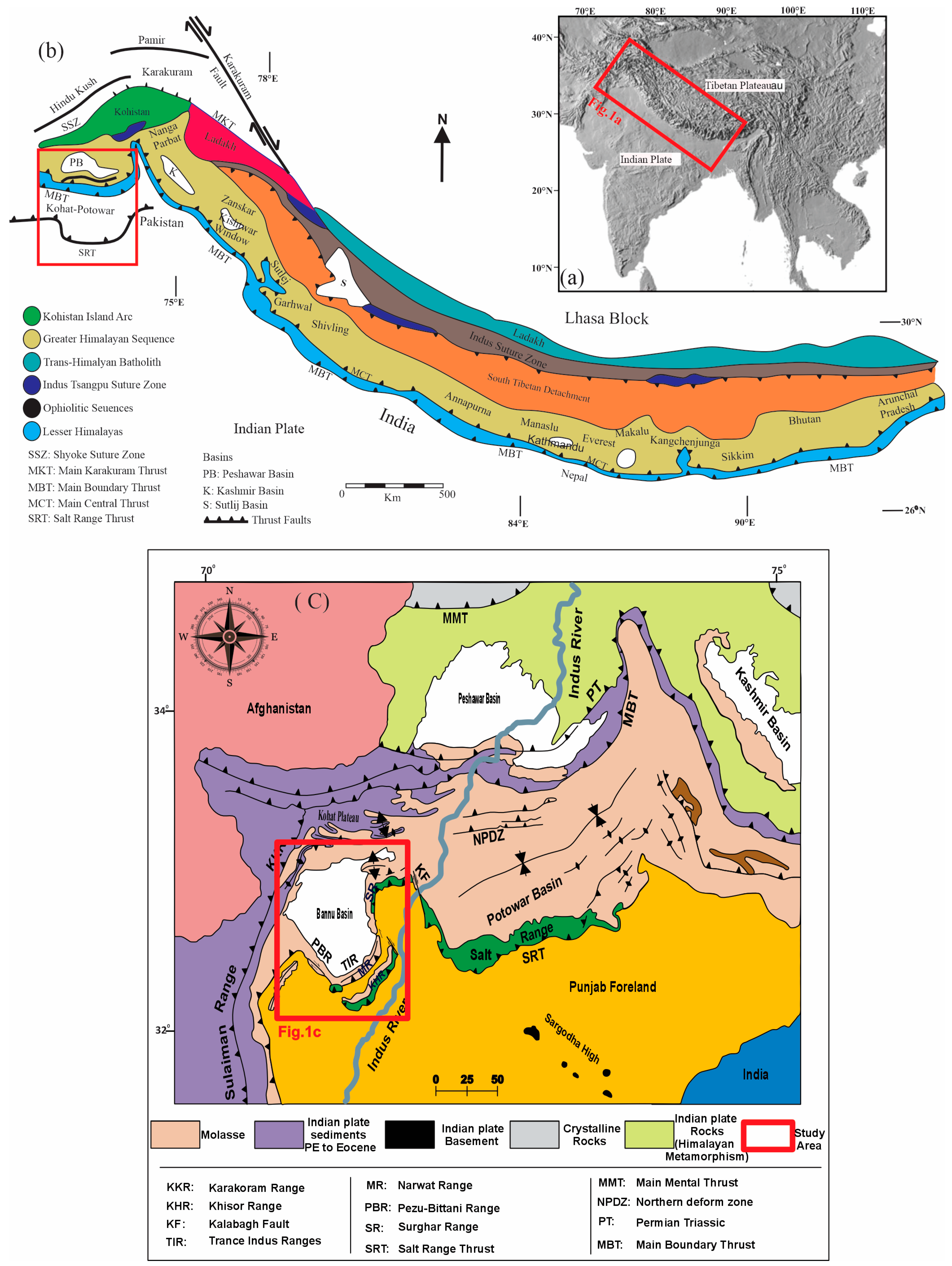
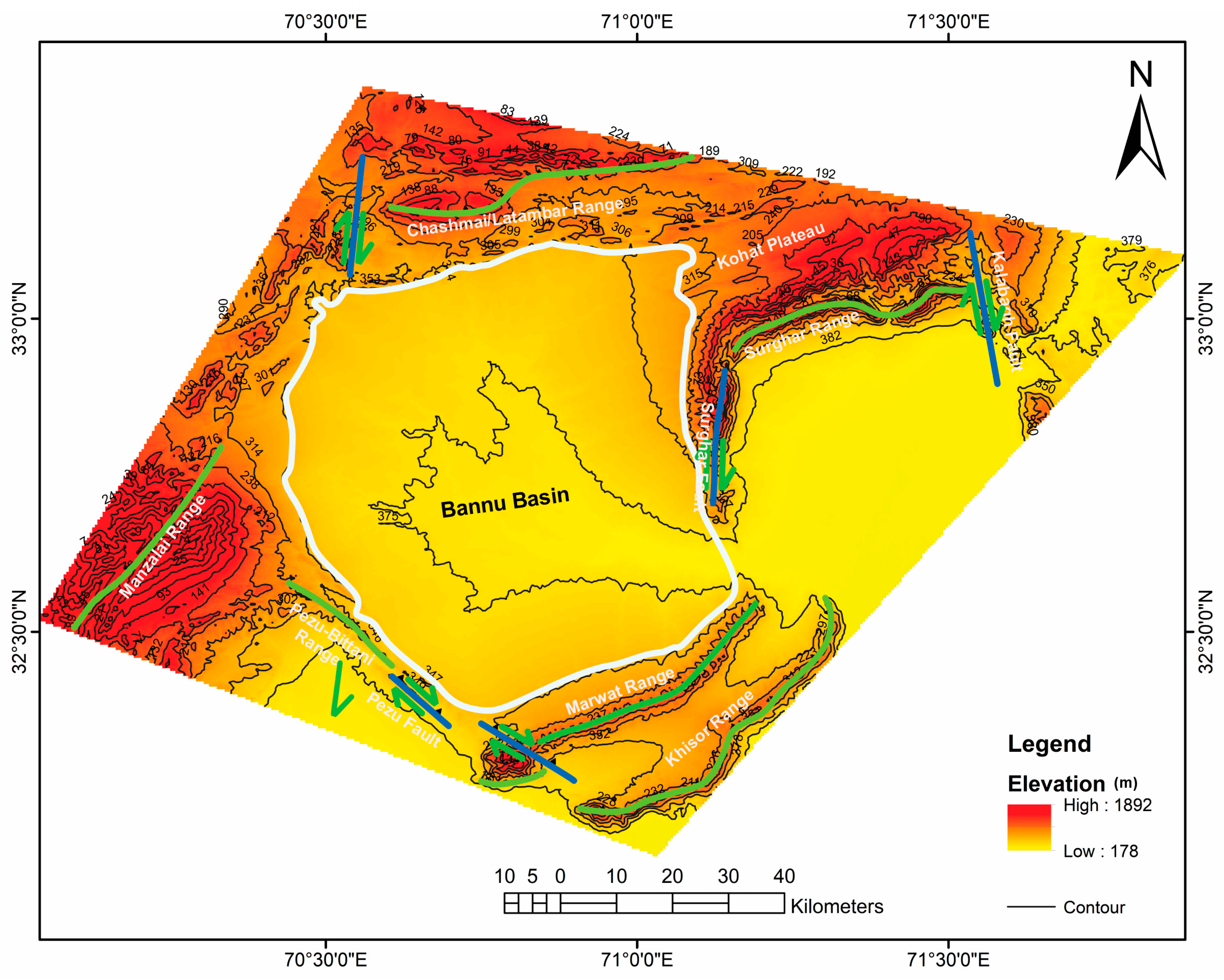
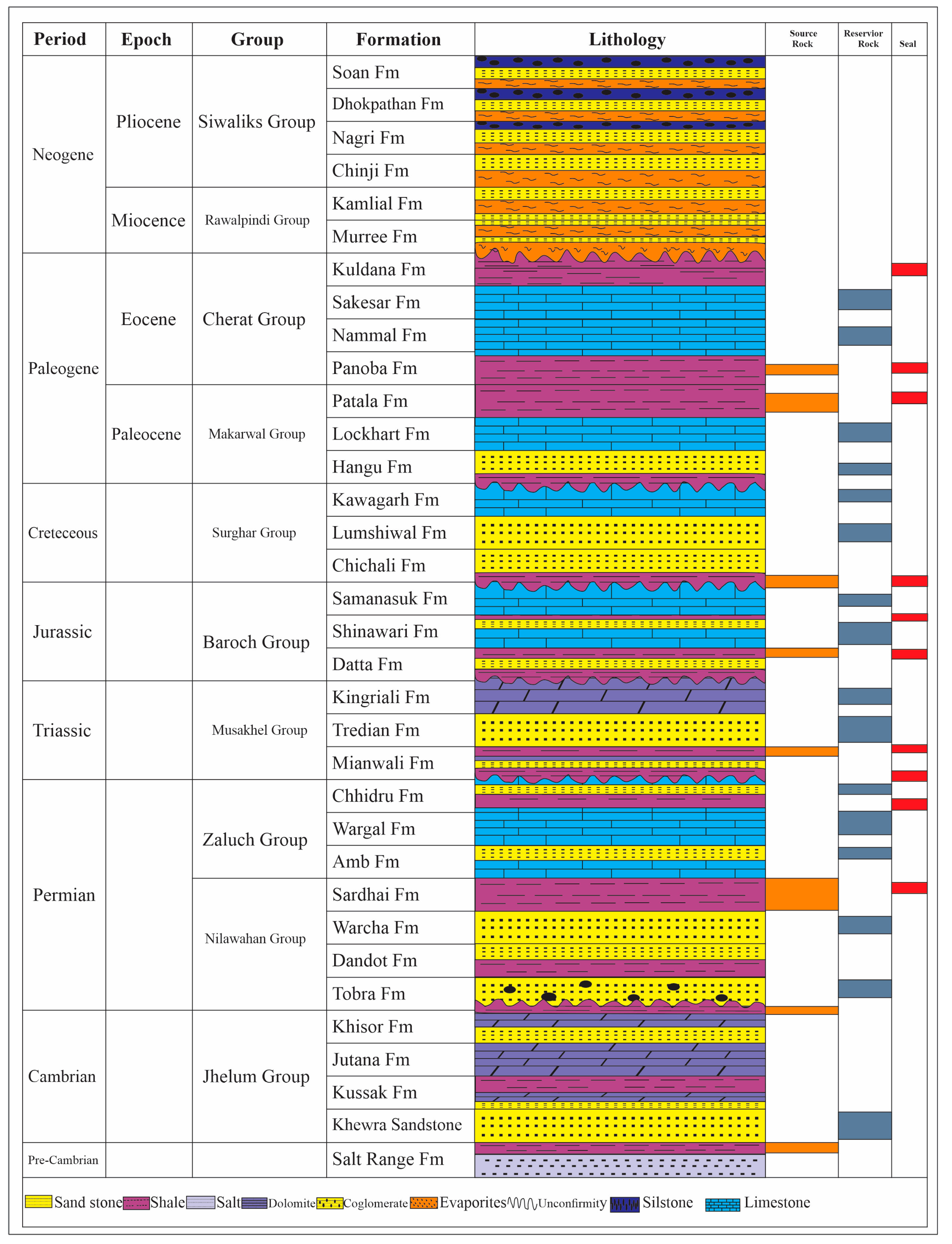
2. Geological and Structural Framework
2.1. Stratigraphy
2.1.1. Lithostratigraphy of the Neoproterozoic Salt Range Formation
2.1.2. Cambrian Lithostratigraphic Units
2.1.3. Permian–Eocene Lithostratigraphic Units
2.1.4. Miocene–Pliocene Lithostratigraphic Units
3. Methodology
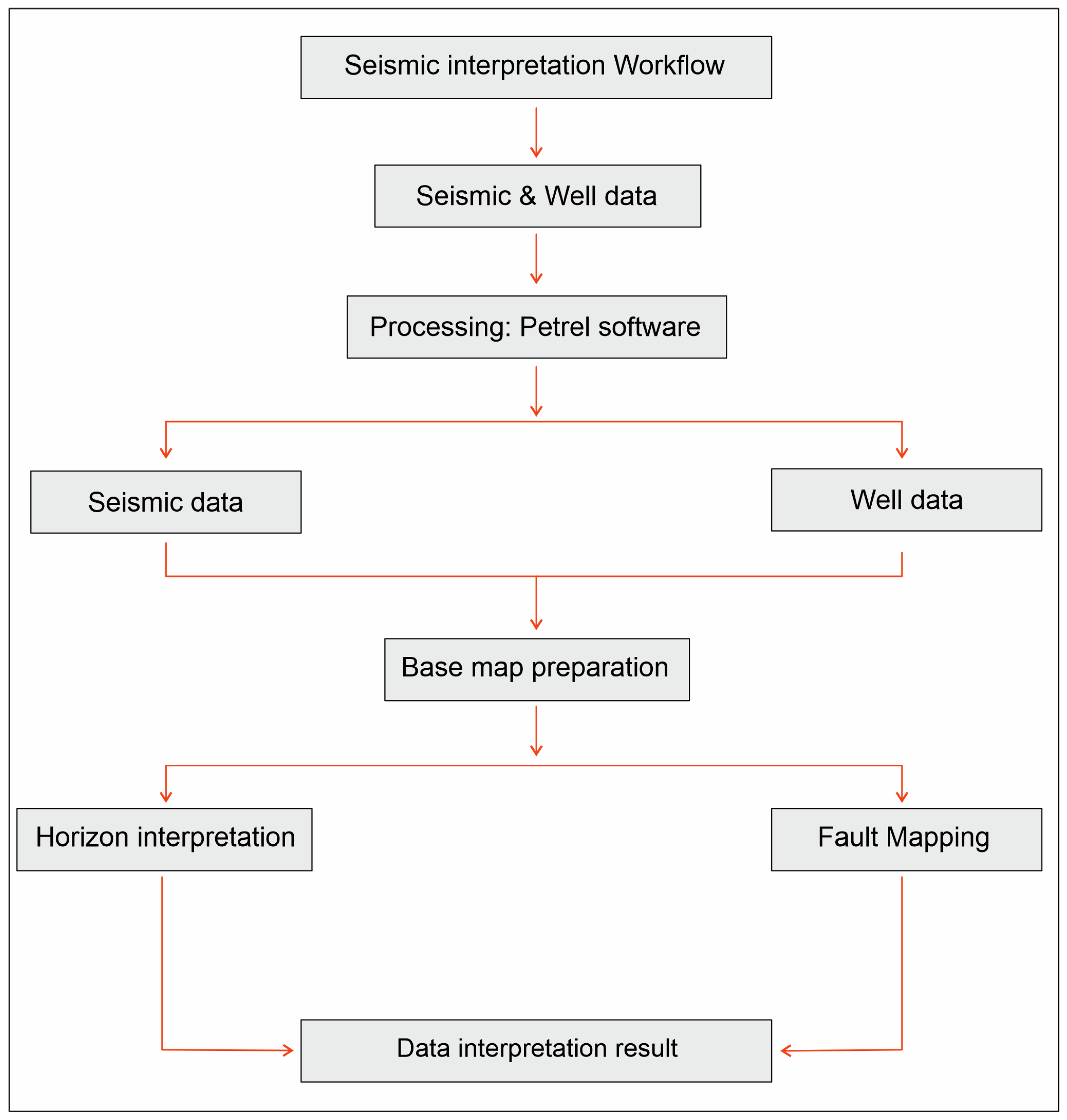
3.1. Work Flow
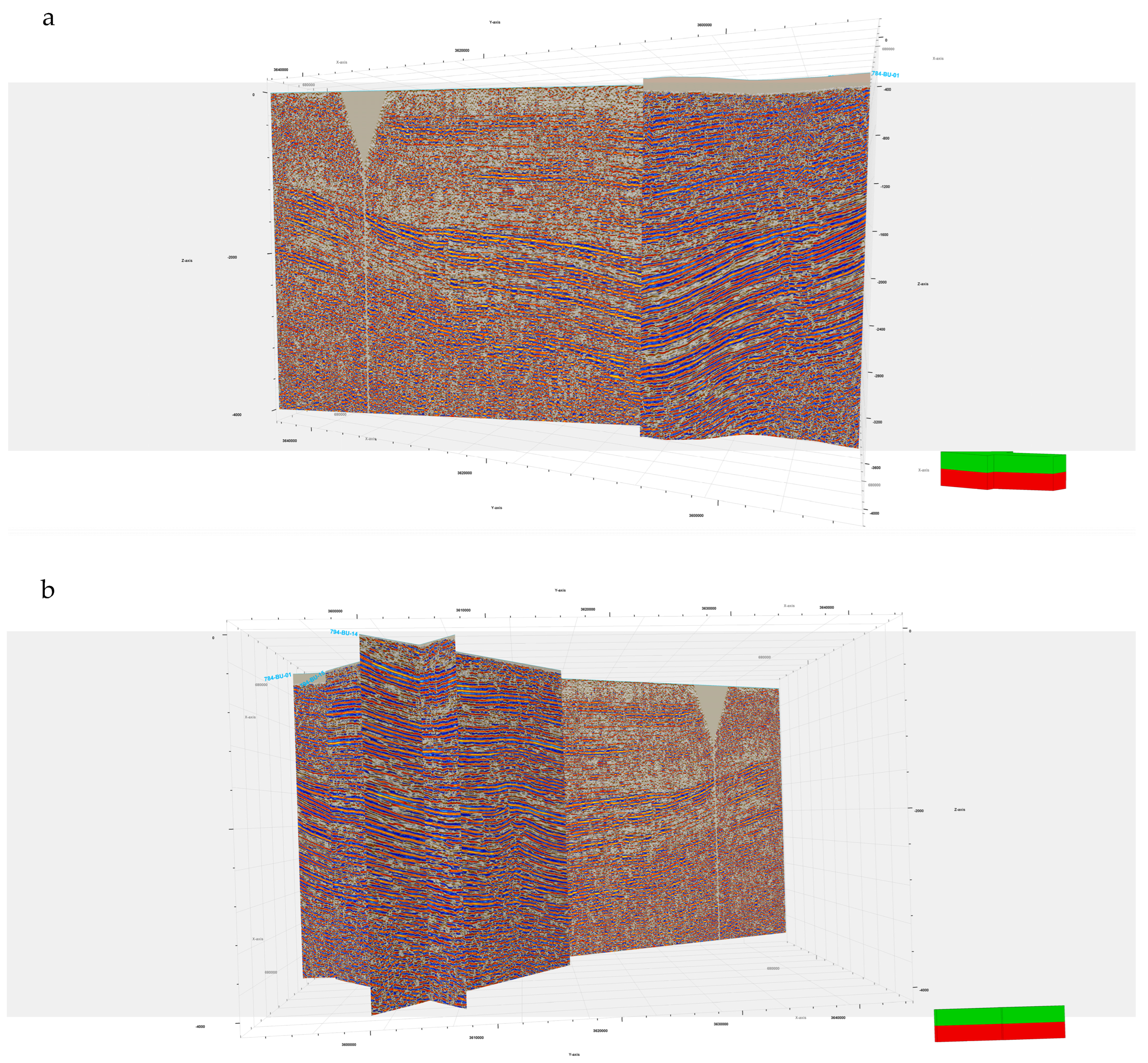
3.2. Seismic and Well Data Acquisition
3.3. Seismic to Well Tie and Time to Depth Calibration
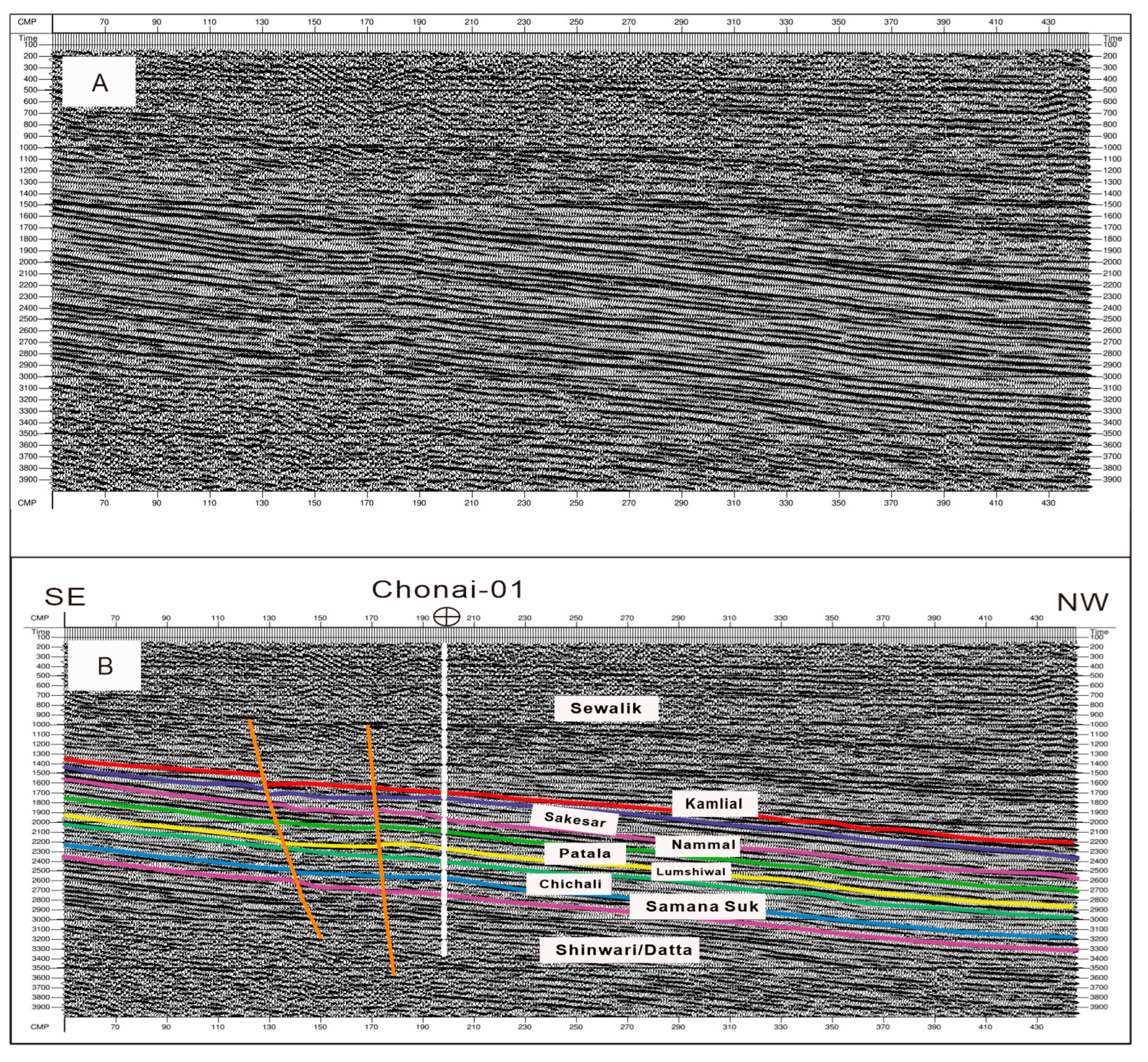
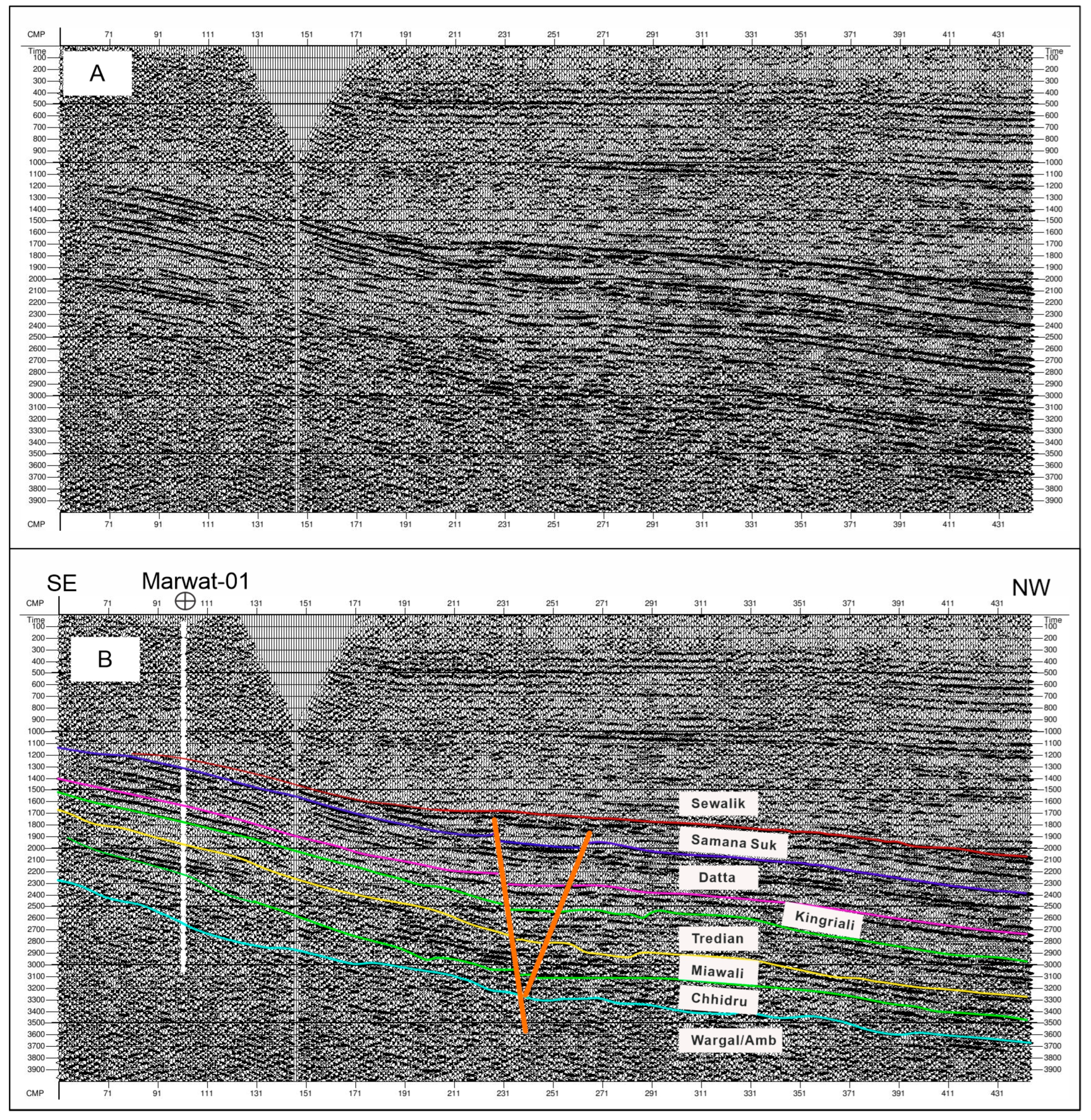
3.4. Seismic Horizon Interpretation
3.5. Fault Interpretation and Structural Mapping
4. Results
4.1. Seismic Data
4.2. Well Data
5. Discussion
6. Conclusions
- This work validates that an integrated approach combining 2D seismic interpretation with well-log analysis is critical for accurately characterizing basin style, identifying structural traps, and assessing petroleum potential in the foreland basin.
- The study methodology and results offer a framework for comparable investigations in other tectonically active regions and highlight the interplay between sedimentation, tectonics, and salt-related distortion in controlling hydrocarbon systems.
- By providing detailed insights into the structural and stratigraphic evolution of the southeastern Bannu Basin, this research lays the foundation for future exploration efforts and enriches the broader understanding of foreland basin development in the Himalayan context.
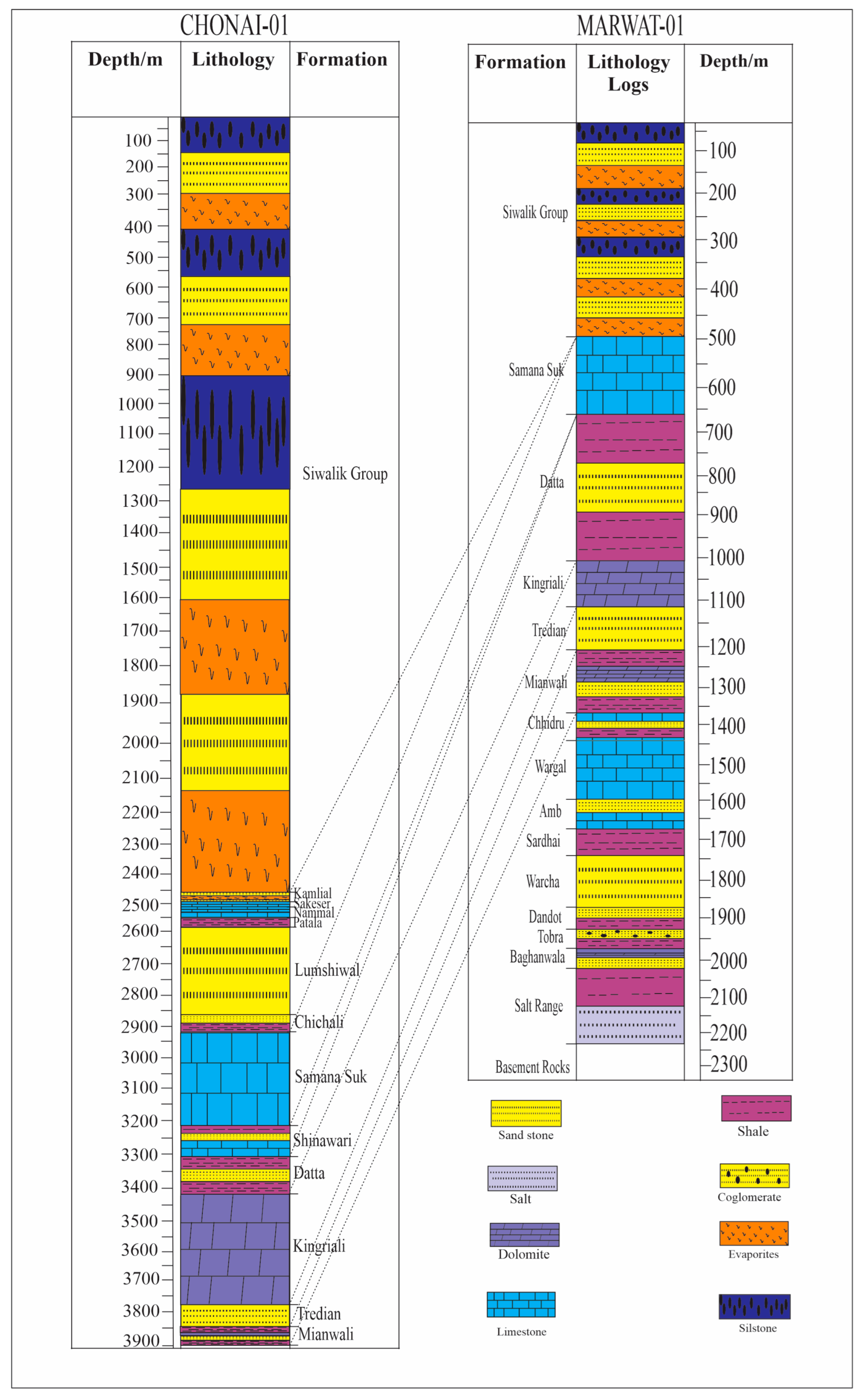
- We confirm from well tops that the Siwalik group is significantly thicker (2462 m) at the plain area of the southeastern part of the Bannu Basin, while much thinner (492 m) at the Marwat range.
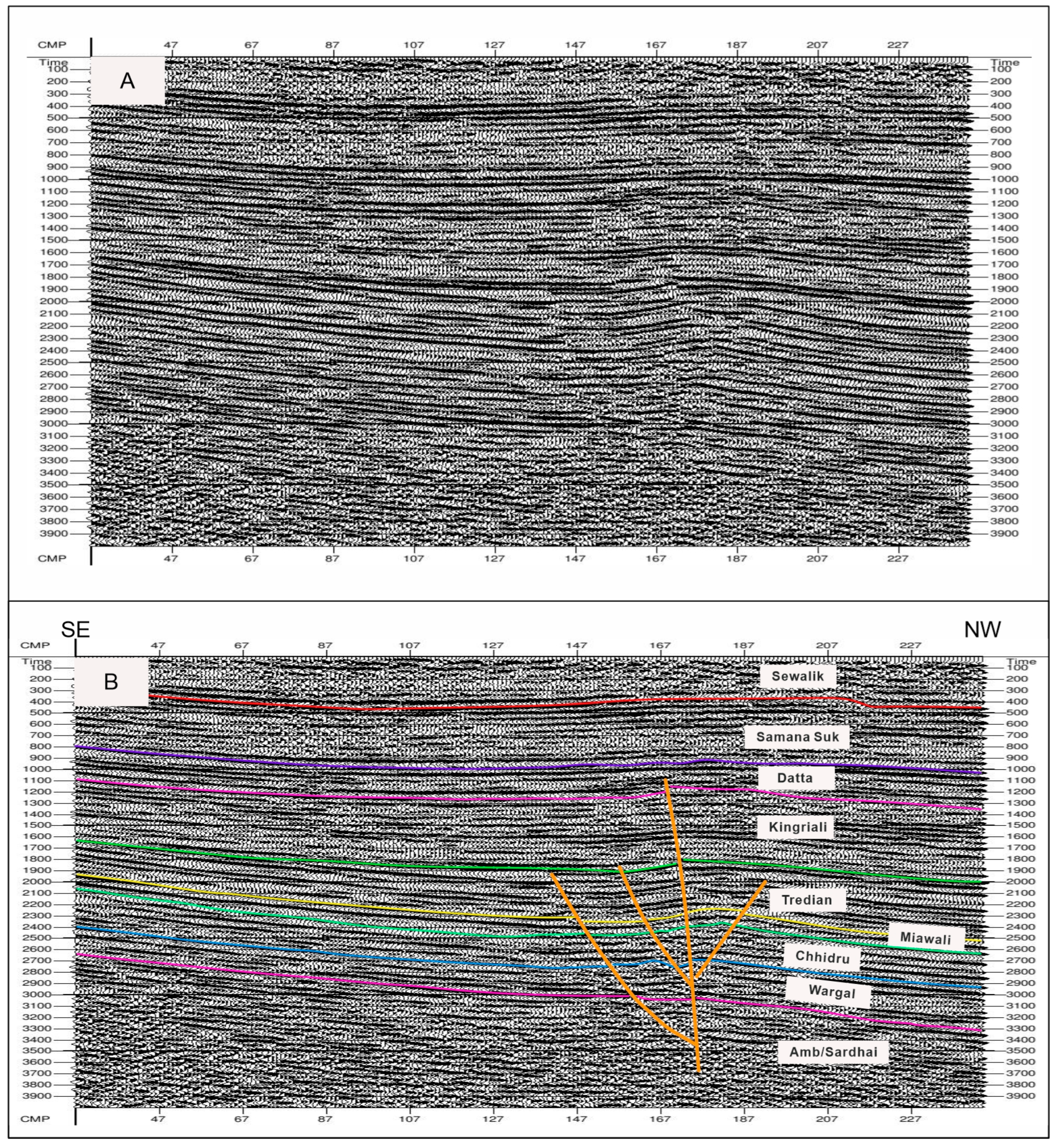
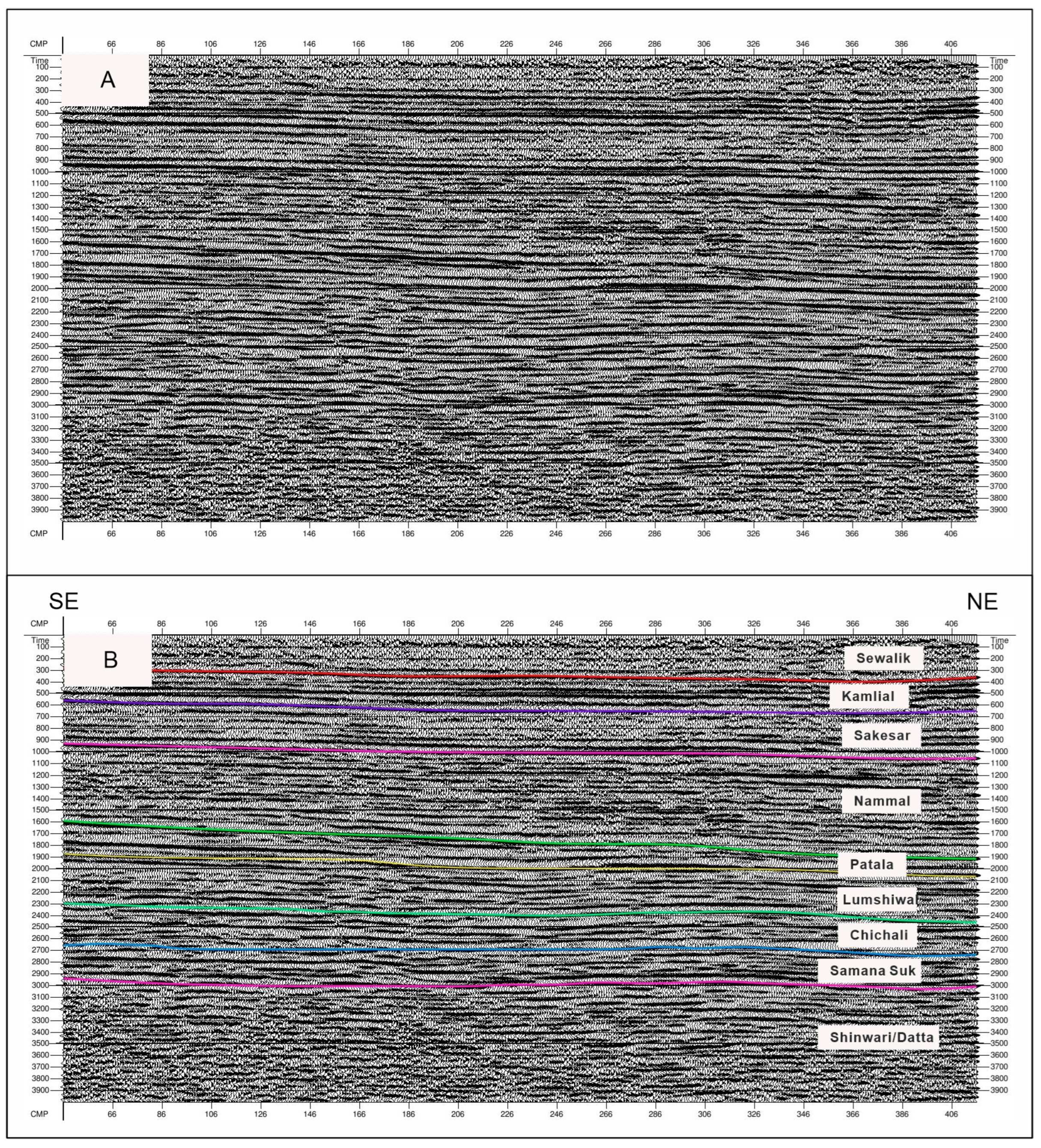
- There is an unconformity between the Siwalik and Samana Suk Formation and also between the Samana Suk and Datta Formation. The Datta formation is thicker at Marwat Range (339 m), while only 105 m thick further northwest in the Bannu Basin plain area.
- Subsurface stratigraphy from the well data indicates the absence of Paleocene, Eocene, and Miocene deposits in the eastern and southern regions, as confirmed by data from the Marwat-01 well.
- The strata shown on the seismic lines exhibit generally mild deformation, likely to be related to the salt movement. Additionally, the thickness variations can also be attributed to the halokinesis in the studied area.
Author Contributions
Funding
Informed Consent Statement
Data Availability Statement
Acknowledgments
Conflicts of Interest
References
- Craig, J.; Hakhoo, N.; Bhat, G.M.; Hafiz, M.; Khan, M.R.; Misra, R.; Pandita, S.K.; Raina, B.K.; Thurow, J.; Thusu, B.; et al. Petroleum systems and hydrocarbon potential of the North-West Himalaya of India and Pakistan. Earth-Sci. Rev. 2018, 187, 109–185. [Google Scholar] [CrossRef]
- Wang, J.; Wu, F.; Zhang, J.; Khanal, G.; Yang, L. The Himalayan Collisional Orogeny: A Metamorphic Perspective. Acta Geol. Sin. Eng. 2022, 96, 1842–1866. [Google Scholar] [CrossRef]
- Pêcher, A.; Seeber, L.; Guillot, S.; Jouanne, F.; Kausar, A.; Latif, M.; Majid, A.; Mahéo, G.; Mugnier, J.L.; Rolland, Y.; et al. Stress field evolution in the northwest Himalayan syntaxis, northern Pakistan. Tectonics 2008, 27, 2007TC002252. [Google Scholar] [CrossRef]
- Burg, J.-P.; Nievergelt, P.; Oberli, F.; Seward, D.; Davy, P.; Maurin, J.-C.; Diao, Z.; Meier, M. The Namche Barwa syntaxis: Evidence for exhumation related to compressional crustal folding. J. Asian Earth Sci. 1998, 16, 239–252. [Google Scholar] [CrossRef]
- Najman, Y.; Appel, E.; Boudagher-Fadel, M.; Bown, P.; Carter, A.; Garzanti, E.; Godin, L.; Han, J.; Liebke, U.; Oliver, G.; et al. Timing of India-Asia collision: Geological, biostratigraphic, and palaeomagnetic constraints. J. Geophys. Res. 2010, 115, 2010JB007673. [Google Scholar] [CrossRef]
- Qasim, M.; Ding, L.; Khan, M.A.; Jadoon, I.A.K.; Haneef, M.; Baral, U.; Cai, F.; Wang, H.; Yue, Y. Tectonic Implications of Detrital Zircon Ages From Lesser Himalayan Mesozoic-Cenozoic Strata, Pakistan. Geochem. Geophys. Geosyst. 2018, 19, 1636–1659. [Google Scholar] [CrossRef]
- Bouilhol, P.; Jagoutz, O.; Hanchar, J.M.; Dudas, F.O. Dating the India–Eurasia collision through arc magmatic records. Earth Planet. Sci. Lett. 2013, 366, 163–175. [Google Scholar] [CrossRef]
- Van Hinsbergen, D.J.J.; Lippert, P.C.; Dupont-Nivet, G.; McQuarrie, N.; Doubrovine, P.V.; Spakman, W.; Torsvik, T.H. Greater India Basin hypothesis and a two-stage Cenozoic collision between India and Asia. Proc. Natl. Acad. Sci. USA 2012, 109, 7659–7664. [Google Scholar] [CrossRef]
- Yin, A.; Harrison, T.M. Geologic Evolution of the Himalayan-Tibetan Orogen. Annu. Rev. Earth Planet. Sci. 2000, 28, 211–280. [Google Scholar] [CrossRef]
- Le Pichon, X.; Fournier, M.; Jolivet, L. Kinematics, topography, shortening, and extrusion in the India-Eurasia collision. Tectonics 1992, 11, 1085–1098. [Google Scholar] [CrossRef]
- Reynolds, K.; Copley, A.; Hussain, E. Evolution and dynamics of a fold-thrust belt: The Sulaiman Range of Pakistan. Geophys. J. Int. 2015, 201, 683–710. [Google Scholar] [CrossRef]
- Royden, L.H.; Burchfiel, B.C.; Van Der Hilst, R.D. The Geological Evolution of the Tibetan Plateau. Science 2008, 321, 1054–1058. [Google Scholar] [CrossRef] [PubMed]
- Mir, A.; Khan, M.R.; Wahid, A.; Iqbal, M.A.; Rezaee, R.; Ali, S.H.; Erdal, Y.D. Petroleum System Modeling of a Fold and Thrust Belt: A Case Study from the Bannu Basin, Pakistan. Energies 2023, 16, 4710. [Google Scholar] [CrossRef]
- Abir, I.A.; Khan, S.D.; Aziz, G.M.; Tariq, S. Bannu Basin, fold-and-thrust belt of northern Pakistan: Subsurface imaging and its implications for hydrocarbon exploration. Mar. Pet. Geol. 2017, 85, 242–258. [Google Scholar] [CrossRef]
- Farid, A.; Khalid, P.; Jadoon, K.Z.; Jouini, M.S. The depositional setting of the Late Quaternary sedimentary fill in southern Bannu basin, Northwest Himalayan fold and thrust belt, Pakistan. Environ. Monit. Assess. 2014, 186, 6587–6604. [Google Scholar] [CrossRef] [PubMed]
- Kordi, M. Sedimentary basin analysis of the Neo-Tethys and its hydrocarbon systems in the Southern Zagros fold-thrust belt and foreland basin. Earth-Sci. Rev. 2019, 191, 1–11. [Google Scholar] [CrossRef]
- Lacombe, O.; Mazzoli, S.; Von Hagke, C.; Rosenau, M.; Fillon, C.; Granado, P. Style of deformation and tectono-sedimentary evolution of fold-and-thrust belts and foreland basins: From nature to models. Tectonophysics 2019, 767, 228163. [Google Scholar] [CrossRef]
- Khan, M.; Khan, R.; Madayipu, N.; Zhong, Y.; Khan, A. Structural and Stratigraphic Study of Hazara-Kashmir Syntaxis with the Aid of Geographic Information System and Field Data Approach. J. Geol. Soc. India 2024, 100, 78–90. [Google Scholar] [CrossRef]
- Khan, M.A.; Ahmed, R.; Raza, H.A.; Kemal, A. Geology of Petroleum in Kohat-Potwar Depression, Pakistan. AAPG Bull. 1986, 70, 396–414. [Google Scholar] [CrossRef]
- Zeb, S.F.; Zafar, M.; Jehandad, S.; Khan, T.; Siyar, S.M.; Qadir, A. Integrated geochemical study of Chichali Formation from Kohat sub-basin, Khyber Pakhtunkhwa, Pakistan. J. Pet. Explor. Prod. Technol. 2020, 10, 2737–2752. [Google Scholar] [CrossRef]
- Ishaq, K.; Wahid, S.; Yaseen, M.; Hanif, M.; Ali, S.; Ahmad, J.; Mehmood, M. Analysis of subsurface structural trend and stratigraphic architecture using 2D seismic data: A case study from Bannu Basin, Pakistan. J. Pet. Explor. Prod. Technol. 2021, 11, 1019–1036. [Google Scholar] [CrossRef]
- Bruno, P.P.G. Seismic Exploration Methods for Structural Studies and for Active Fault Characterization: A Review. Appl. Sci. 2023, 13, 9473. [Google Scholar] [CrossRef]
- Caineng, Z.; Guangya, Z.; Shizhen, T.; Suyun, H.; Xiaodi, L.; Jianzhong, L.; Dazhong, D.; Rukai, Z.; Xuanjun, Y.; Lianhua, H.; et al. Geological features, major discoveries and unconventional petroleum geology in the global petroleum exploration. Pet. Explor. Dev. 2010, 37, 129–145. [Google Scholar] [CrossRef]
- Nanda, N.C. Seismic Stratigraphy and Seismo-Tectonics in Petroleum Exploration. In Seismic Data Interpretation and Evaluation for Hydrocarbon Exploration and Production; Advances in Oil and Gas Exploration & Production; Springer International Publishing: Cham, Switzerland, 2021; pp. 101–115. ISBN 978-3-030-75300-9. [Google Scholar]
- Chakraborty, T.; Taral, S.; More, S.; Bera, S. Cenozoic Himalayan Foreland Basin: An Overview and Regional Perspective of the Evolving Sedimentary Succession. In Geodynamics of the Indian Plate; Gupta, N., Tandon, S.K., Eds.; Springer Geology; Springer International Publishing: Cham, Switzerland, 2020; pp. 395–437. ISBN 978-3-030-15988-7. [Google Scholar]
- Ashraf, A.; Roohi, R.; Naz, R.; Mustafa, N. Monitoring cryosphere and associated flood hazards in high mountain ranges of Pakistan using remote sensing technique. Nat. Hazards 2014, 73, 933–949. [Google Scholar] [CrossRef]
- Wahid, A.; Salim, A.M.A.; Gaafar, G.R.; Yusoff, A.W.I.W. Tectonic development of the Northwest Bonaparte Basin, Australia by using Digital Elevation Model (DEM). IOP Conf. Ser. Earth Environ. Sci. 2016, 30, 012005. [Google Scholar] [CrossRef]
- Miall, A.D.; Catuneanu, O.; Eriksson, P.G.; Mazumder, R. Chapter 23 A brief synthesis of Indian Precambrian basins: Classification and genesis of basin-fills. Memoirs 2015, 43, 339–347. [Google Scholar] [CrossRef]
- Bhat, G.M.; Craig, J.; Hafiz, M.; Hakhoo, N.; Thurow, J.W.; Thusu, B.; Cozzi, A. Geology and hydrocarbon potential of Neoproterozoic–Cambrian Basins in Asia: An introduction. SP 2012, 366, 1–17. [Google Scholar] [CrossRef]
- Cloetingh, S.; Burov, E. Lithospheric folding and sedimentary basin evolution: A review and analysis of formation mechanisms: Lithospheric folding and sedimentary basin evolution. Basin Res. 2011, 23, 257–290. [Google Scholar] [CrossRef]
- Rowan, M.G. Passive-margin salt basins: Hyperextension, evaporite deposition, and salt tectonics. Basin Res. 2014, 26, 154–182. [Google Scholar] [CrossRef]
- Gao, D. Latest developments in seismic texture analysis for subsurface structure, facies, and reservoir characterization: A review. Geophysics 2011, 76, W1–W13. [Google Scholar] [CrossRef]
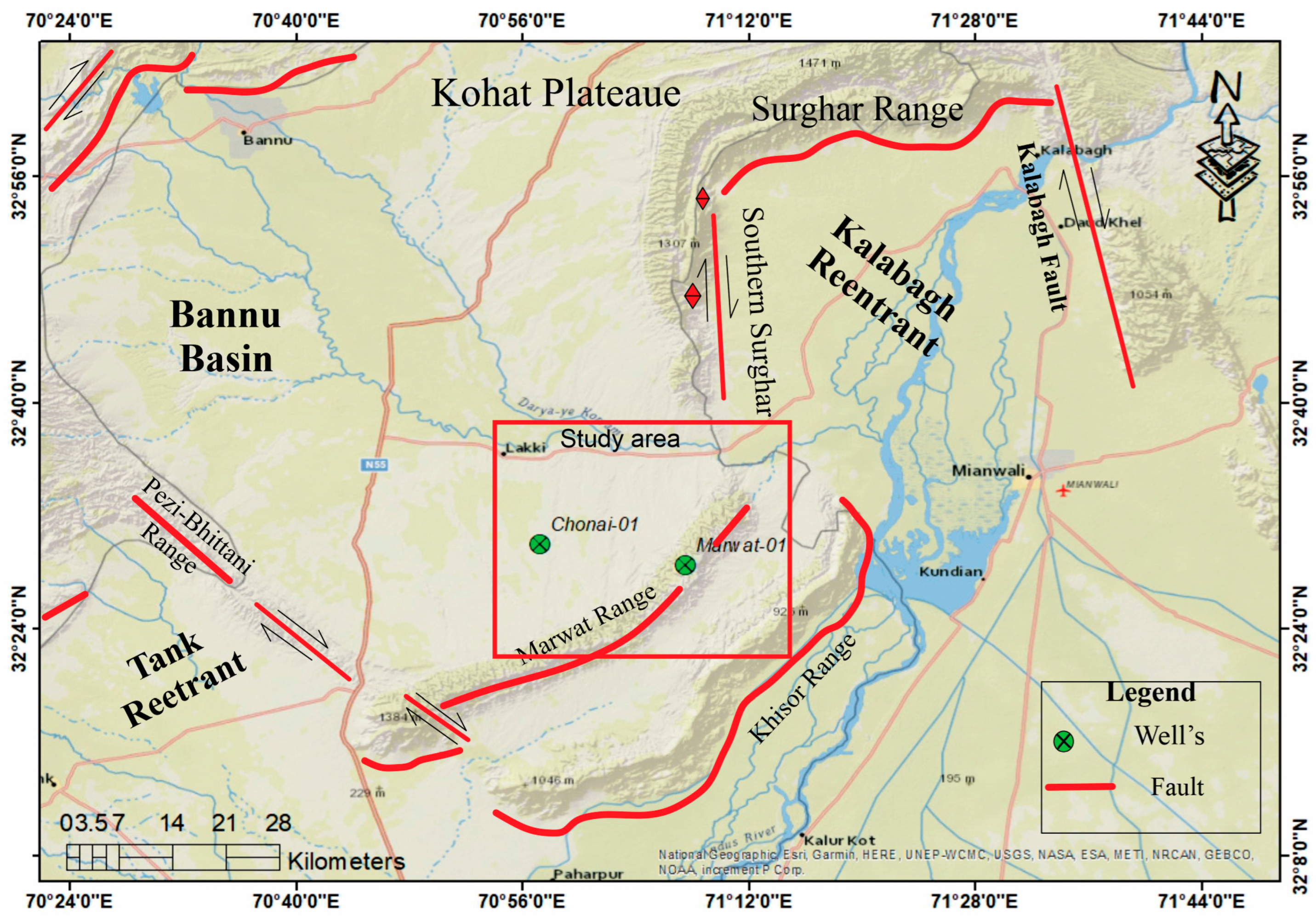

| Well Name: CHONAI-01 | Operator: Petro-Canada | Depth: 3900 m | ||
|---|---|---|---|---|
| Latitude: 32 29 59.31 | Longtitude: 70 57 19.18 | Well type: Exploratory | ||
| Status abandoned | Province: NWFP | Drilling Year: 1990 | ||
| S. No | Formations | Formation age | Top (m) | Thickness (m) |
| 1 | Siwalik | Miocene—Pliocene -Pliocene | 0 | 2462 |
| 2 | Kamlial | Miocene | 2463 | 22 |
| 3 | Sakesar | Eocene | 2484 | 28 |
| 4 | Nammal | Eocene | 2512 | 11 |
| 5 | Patala | Paleocene | 2522 | 68 |
| 6 | Lumshiwal | Early Cretaceous | 2590 | 290 |
| 7 | Chichali | Early Cretaceous | 2880 | 51 |
| 8 | Samana Suk | Middle Jurassic | 2931 | 285 |
| 9 | Shinawari | Middle Jurassic | 3215 | 100 |
| 10 | Datta | Early Jurassic | 3315 | 105 |
| 11 | Kingriali | Late Triassic | 3420 | 375 |
| 12 | Tredian | Middle Triassic | 3795 | 52 |
| 13 | Mianwali | Early Triassic | 3847 | 53 |
| Well Name: MARWAT-01 | Operator: Pakistan Petroleum Limited | Depth: 2240.70 m | ||
|---|---|---|---|---|
| Latitude: 32 24 53.00 | Longitude: 71 04 01.50 | Well type: Exploratory | ||
| Status abandoned | Province: NWFP | Drilling Year: 1970 | ||
| S. No | Formations | Formation age | Top (m) | Thickness (m) |
| 1 | Siwalik | Miocene—Pliocene -Pliocene | 5 | 492 |
| 2 | Samana Suk | Middle Jurassic | 497 | 175 |
| 3 | Datta | Early Jurassic | 672 | 339 |
| 4 | Kingriali | Late Triassic | 1011 | 121 |
| 5 | Tredian | Middle Triassic | 1132 | 76 |
| 6 | Mianwali | Early Triassic | 1208 | 155 |
| 7 | Chhidru | Late Permian | 1363 | 86 |
| 8 | Wargal | Late Permian | 1449 | 151 |
| 9 | Amb | Late Permian | 1600 | 84 |
| 10 | Sardhai | Early Permian | 1684 | 63 |
| 11 | Warcha | Early Permian | 1747 | 133 |
| 12 | Dandot | Early Permian | 1880 | 58 |
| 13 | Tobra | Early Permian | 1938 | 22 |
| 14 | Baghanwala | Middle Cambrian | 1960 | 53 |
| 15 | Salt Range | PRE-Cambrian | 2013 | 228 |
Disclaimer/Publisher’s Note: The statements, opinions and data contained in all publications are solely those of the individual author(s) and contributor(s) and not of MDPI and/or the editor(s). MDPI and/or the editor(s) disclaim responsibility for any injury to people or property resulting from any ideas, methods, instructions or products referred to in the content. |
© 2025 by the authors. Licensee MDPI, Basel, Switzerland. This article is an open access article distributed under the terms and conditions of the Creative Commons Attribution (CC BY) license.
Share and Cite
Ali, A.; Qian, R.; Ma, Z.; Javid, N. Integrating Seismic and Well Data for Subsurface Geological Investigation in the Southeastern Sub-Himalayan Foreland, Bannu Basin, Pakistan. Geosciences 2026, 16, 11. https://doi.org/10.3390/geosciences16010011
Ali A, Qian R, Ma Z, Javid N. Integrating Seismic and Well Data for Subsurface Geological Investigation in the Southeastern Sub-Himalayan Foreland, Bannu Basin, Pakistan. Geosciences. 2026; 16(1):11. https://doi.org/10.3390/geosciences16010011
Chicago/Turabian StyleAli, Akbar, Rongyi Qian, Zhenning Ma, and Nasim Javid. 2026. "Integrating Seismic and Well Data for Subsurface Geological Investigation in the Southeastern Sub-Himalayan Foreland, Bannu Basin, Pakistan" Geosciences 16, no. 1: 11. https://doi.org/10.3390/geosciences16010011
APA StyleAli, A., Qian, R., Ma, Z., & Javid, N. (2026). Integrating Seismic and Well Data for Subsurface Geological Investigation in the Southeastern Sub-Himalayan Foreland, Bannu Basin, Pakistan. Geosciences, 16(1), 11. https://doi.org/10.3390/geosciences16010011

