Article

First Identification of the Alien Species Mimosina affinis Millet, 1900, in the Tyrrhenian Sea

by
Valentino Di Donato
1,*,
Diana Barra
1,
Flavia Molisso
2,
Marco Sacchi
2,
Giuseppe Aiello
1,
Roberta Parisi
3 and
Luciana Ferraro
2
1
Dipartimento di Scienze della Terra, dell’Ambiente e delle Risorse (DiSTAR), Università degli Studi di Napoli “Federico II”—Complesso di Monte Sant’Angelo (Edificio L) Via Cinthia, 21, 80126 Naples, Italy
2
Istituto di Scienze Marine-Consiglio Nazionale delle Ricerche ISMAR-CNR, Calata Porta di Massa, 80133 Naples, Italy
3
Dipartimento di Chimica e Biologia “A. Zambelli”, Università degli Studi di Salerno, Via Giovanni Paolo II, 132, 84084 Fisciano, Salerno, Italy
*
Author to whom correspondence should be addressed.
Geosciences 2026, 16(1), 1; https://doi.org/10.3390/geosciences16010001
Submission received: 7 November 2025 / Revised: 12 December 2025 / Accepted: 16 December 2025 / Published: 19 December 2025
(This article belongs to the Section Climate and Environment)

Abstract

In recent decades, the Mediterranean Sea has been experiencing faunal changes associated with the impact of biological invasions resulting from the influx of invasive alien species (IAS). During the CNR-ISMAR Carg0222 oceanographic cruise, Mimosina affinis, a benthic foraminifera species of Indo-Pacific origin previously reported in more eastern sectors of the Mediterranean, was detected in the Tyrrhenian Sea, at the seafloor off the Italian coast. The study of benthic foraminiferal assemblages, conducted along with sedimentological analysis of seafloor deposits, allowed to reconstruct the distribution of Mimosina affinis in the investigated area and define its relationship with seabed characteristics. The species is commonly found in samples collected at a water depth not shallower than nine metres, showing a preference for silty fine sand sediments. The abundance of the species, in terms of relative abundance, is higher in biocoenoses than in thanatocoenoses, suggesting that the species is established and actively spreading in the studied area.

1. Introduction

The Mediterranean Sea is a basin with unique characteristics related to its semi-enclosed nature and to the subtropical climate of the region, characterised by mild wet winters and warm to hot, dry summers. With its peculiar thermohaline circulation driven by high evaporation rates, the Mediterranean is considered as one of the most responsive regions to global climate change ([1,2,3] and references therein). Its stratigraphic record documents significant changes in the composition of fossil associations in response to paleoclimatic and palaeoceanographic changes. Among these, the so-called and well-known “climate hosts” stand out, perhaps the best-known being Arctica islandica and Thetystrombus latus, commonly referred to in the literature as Strombus bubonius. In other cases, changes in the composition of assemblages were determined by the modification of the palaeohydrological setting of the Mediterranean. Indeed, the Mediterranean Sea is at present characterised by strong oligotrophic conditions, which result in a reduced flux of organic matter and good oxygenation of bottom waters [4,5,6]. This setting is associated with the current anti-estuarine circulation, characterised at the Gibraltar threshold by a surface inflow of Atlantic waters and an outflow of intermediate and, in part, Western Mediterranean Deep Waters [7,8,9]. However, the Quaternary stratigraphic record of the Mediterranean includes layers with high organic carbon content (sapropels), which testify to different palaeohydrological conditions. Benthic assemblages within and around these sapropels indicate high fluxes of organic matter and suboxic to anoxic conditions, associated with increased primary productivity and the weakening, if not reversal, of the thermohaline circulation in the Mediterranean. These events are linked to the Northern Hemisphere summer insolation maxima [10,11,12,13].
In recent decades, the Mediterranean Sea has also been experiencing faunal changes, this time associated with the impact of biological invasions resulting from the influx of invasive alien species (IAS) [14,15]. These species, introduced through maritime trade, such as the Suez Canal expansion, aquaculture, and ballast water discharge, are becoming established with increasing frequency and success, partly as a consequence of climate change, which is leading to higher temperatures and other environmental shifts in the Mediterranean [16]. Rising sea temperatures and changing salinity levels, driven by climate change, have significantly enhanced the survival and spread of non-native species [17]. Many of these organisms are adapted to warmer conditions, allowing them to thrive in Mediterranean habitats where native species are increasingly under stress. These shifts not only threaten biodiversity but also reduce the resilience of native ecosystems [18,19]. One of the most notable phenomena is Lessepsian migration, a term coined by Por [20,21] after the Suez Canal engineer Ferdinand de Lesseps, which describes the movement of species from the Red Sea to the Mediterranean through the canal [22].
Recent studies have shown that the diversity and distribution of Mediterranean benthic foraminifera species are also being affected by the arrival of alien species, with some non-native foraminifera becoming established in areas where they were previously absent [23]. An example of Lessepsian migration involving the benthic foraminifera Pararotalia calcariformata is reported by [24].
In February 2022, an oceanographic cruise (CNR-ISMAR Carg0222) was conducted with the Italian Institute for Environmental Protection and Research (ISPRA) research vessel “Lighea” to collect seafloor samples The survey was conducted as part of the Geological Mapping Project (CARG) of Italy at 1:50.000 scale and aimed at completing the marine areas of Geological Sheets n. 429 “Mondragone” and n. 416 “Sessa Aurunca”. The sampling provided an opportunity to investigate the sedimentological characteristics and associate benthic foraminiferal assemblages of the seafloor along the Tyrrhenian coast between Lazio and Campania. During the analysis, Mimosina affinis, a foraminiferal species of Indo-Pacific origin first described from the Malay Archipelago [25,26], was identified in this area.
This species is considered alien to the Mediterranean Sea and, to our knowledge, has not previously been reported from the seafloor sediments of the western Mediterranean. In the eastern Mediterranean, records exist from the Bay of Vlore [27] and other sites along the Albanian coast [28], as well as from the Aegean Sea [29].
The following sections describe the occurrence and distribution of Mimosina affinis in relation to the main sedimentological characteristics of the seafloor.

2. Study Area

The study area encompasses the marine sector covered by Geological Sheets n. 429 “Mondragone” and n. 416 “Sessa Aurunca”, located in the central part of the coastal belt of the Gulf of Gaeta, a major embayment along the central-eastern Tyrrhenian margin, between the Circeo Promontory to the northwest and the island of Ischia to the southeast (Figure 1).
Table 1. Main characters of the facies identified in sea bottom sediments of studied area.
FaciesEnvironmentDescription
Facies 1Delta front depositsAt Volturno River mouth, 1–20 m depth; medium to coarse well-sorted sands with shell fragments near the mouth, grading to finer silty sands offshore; reworked by wave base; locally forming small coastal bars.
Facies 2Submerged beachGently sloping seabed with fine to medium, well-sorted sands, mainly lithoclasts, with subordinate bioclasts; scarce silty matrix.
Facies 3Organogenic lithoherm (bioherm)Coralligenous crusts forming raised/terraced buildups with in situ organogenic production and associated bioclastic sediments; typical of the Sinuessa area, forming blocks separated by channels on rocky substrate.
Facies 4Bioclastic depositCoarse bioclastic sands and gravels, with subordinate finer bioclastic sands in scarce silty matrix; derived from breakdown of benthic communities; coarse facies in depressions or at margins of coralligenous buildups; finer facies around bioconstructions.
Facies 5Inner shelf depositFine silty sands and sandy silts with variable fine biodetritus; located between outer submerged beach and storm wave base, extending beyond 30 m depth.
This segment of the northern Campania continental shelf extends offshore from Mt. Massico and from the mouths of the Volturno and Garigliano rivers, representing the seaward continuation of the coastal plain that developed during the Late Pleistocene–Holocene as a response to post-glacial eustatic sea-level rise following the Last Glacial Maximum.
The sedimentary infill of the coastal plain–continental shelf system consists of alternating marine and continental clastic deposits, interbedded with volcanic products, including a thick ignimbritic unit correlated with the Campanian Grey Tuff (39.8 ka [30]).
Recent offshore research, based on sequence-stratigraphic interpretation of high-resolution single-channel seismic reflection profiles (Sub-bottom CHIRP and Sparker) indicates, that the Late Pleistocene succession is characterised by prograding clino-stratified units, truncated at the top by an erosional surface corresponding to the Last Glacial Maximum (Marine Isotopic Stage 2, MIS 2). This surface records multiple events, ranging from subaerial exposure of the entire continental shelf to subsequent post-glacial transgression [31,32,33].
The overlying Transgressive System Tract (TST) and Highstand System Tract (HST) deposits form a seaward-thinning sedimentary wedge [34], representing the stratigraphic record of the last sea-level rise from −120 m to the present level, which occurred between 18 ka and 5 ka BP. Since around 6 ka BP, during the last highstand, the shallow-marine area has evolved in response to coastal progradation [31,35,36], showing substantial stratigraphic and morphological continuity with the coastal plain.
The continental shelf displays a gentle slope, reaching a maximum width of about 20 km off the Garigliano River and narrowing to roughly 10 km near Cuma, while the shelf break occurs at depths of approximately −120 to −130 m [37,38]. In correspondence with river mouths, within the −50 m isobath, bathymetric contours exhibit a pronounced seaward curvature associated with present and recent deltaic complexes [38]. Additionally, a set of nearshore sand bars has developed parallel to the coastline, in water depths of approximately 2–4 m [39].
Offshore Mt. Massico, the Sinuessa Bank represents a morphologically elevated area characterised by a subcropping volcanic substratum correlated with the Campanian Grey Tuff [39,40]. The area is colonised by coralligenous bioconstructions and bioclastic sediments. This morphologically prominent, locally terraced feature rises several metres above the surrounding seabed and extends between 5 and 7 m and 15 m water depth, parallel to the coastline sector between Baia Azzurra and Mondragone.

3. Material and Methods

During the CNR-ISMAR Carg0222 oceanographic cruise, 53 samples were collected along the Campania and Lazio coasts within a bathymetric range of 0–30 m depth (Figure 1).
Sampling was performed by means of Van Veen grab with upper doors to facilitate the collection of semi-disturbed samples to ensure a minimum of disturbance of the sediment surface. The samples were photographed and preliminarily described on board before sub-sampling. For the finer sediments, 0–1 cm surface layer was collected, whereas for coarser sediments, 0–2 cm layer was sampled. Each sample was then sub-sampled by taking approximately 100 g for sedimentological analyses, while a portion for micropalaeontological investigations was placed in a 100 mL container where the collected volume was recorded and equal volume of ethanol-rose bengal solution (2 g × L−1) was added [41]. All sub-samples were stored at 4 °C until laboratory processing, which included grain-size analyses, examination of benthic microfauna, and composition of the sediments.
Grain-size analysis was conducted at the Sedimentology Laboratory of ISMAR, Naples. Samples were pre-treated with hydrogen peroxide, rinsed with water, and then sieved at 63 µm to separate coarse (>63 µm) and fine (<63 µm) fractions. The coarse fraction was analysed by dry sieving with an ASTM sieve set (4000–63 µm), while the fine fraction was characterised with a laser particle sizer (Helos/Quixel Sympatec, Clausthal-Zellerfeld Germany). Grain-size parameters (mean size (Mz), sorting, skewness, kurtosis), expressed in phi units, were calculated following [42], and sediment types were classified according to Folk’s scheme [43], which relates textural variability to depositional environments.
The definition of facies was established using Side Scan Sonar acoustic backscatter, calibrated by geological samples and by scuba divers’ inspections, ROV imaging, and wire-mounted underwater camera.
As pointed out in [41], the determination of biocoenoses should require replicated surveys, which were not included in the original geological mapping programme. Therefore, the present study should be regarded as a single snapshot of the distribution of benthic foraminifera in the analysed seafloor area as of February 2022.
The analysis of benthic foraminiferal assemblages was conducted on the >125-micron size fraction. To define biocoenoses, the analysis was based on the count of all specimens present in the whole sample, whereas for total assemblages, the analyses were performed in representative aliquots containing at least 300 specimens. Only shells having all chambers completely stained with bright red (except for the last chamber) were considered living at the time of collection.
To illustrate the distribution of total assemblages and biocoenoses in the study samples, we considered both the assemblage density, expressed as the number of specimens per 1 cm2 surface area (normalised to a thickness of 1 cm), and the relative abundance within the assemblages. To evaluate the relationships between the distribution of Mimosina affinis and parameters such as depth and mean size, we adopted Spearman’s ranks correlation coefficient [44]. We also considered p-values for testing the hypothesis of no correlation against the alternative hypothesis of a nonzero correlation [45]. Statistics were computed with MATLAB Version: 24.2.0.2833386 (R2024b) [46].
All maps and graphics were produced with Ocean Data View [47]. Interpolation of data was made by means of Data Interpolating Variational Analysis (DIVA) Gridding [48].

4. Results

4.1. Sedimentological Data

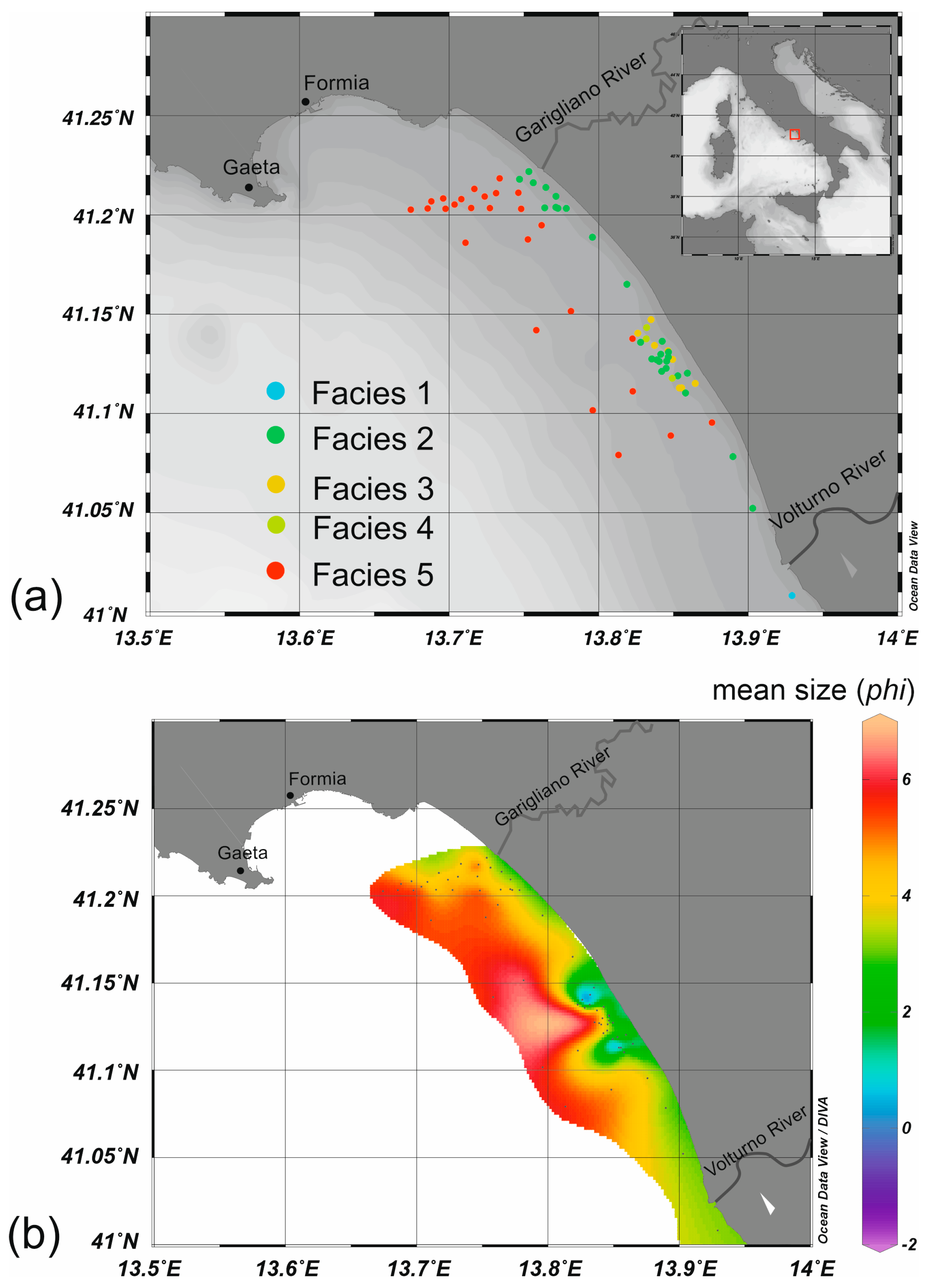
The coastal–marine system of the study area is characterised by the interaction of terrigenous inputs, wave reworking, and biogenic accretion, which together produce a range of depositional environments extending from the river mouth to the inner shelf. Data acquired during the CNR-ISMAR Carg0222 oceanographic cruise enabled classification of the seafloor sediments into five different facies and are described in Table 1 (for more details, see Supplementary Material S2). The location of the samples with associated facies and mean size (phi) distribution are shown in Figure 1.
At the river mouths, deposits are mainly composed of medium to coarse sand that grade offshore into finer silty sand, reworked by wave base and locally form small coastal bars (Mz: 3.2 phi) (Facies 1). Laterally, the system continues as a gently sloping seabed of fine- to medium-grained, well-sorted sand with scarce silty matrix, dominated by lithoclasts and subordinate bioclasts (Mz: 3.1–5.9 phi) (Facies 2). In the Sinuessa area, coralligenous crusts form raised and terraced organogenic buildups with associated bioclastic sediments (Mz: −1.5 to −1.4 phi) (Facies 3). This coralligenous reef system, covering an area of about 9 km2, rises 1–2 m above the seafloor and extends between 5 and 7 m and 15 m water depth, running parallel to the coastline off the sector between Baia Azzurra and Mondragone [49]. Around this structure, coarse to fine bioclastic sand and gravel are found (Mz: −1.4–0.9 phi) as a result of local accumulation from the decay of benthic communities (Facies 4). Further offshore, the system grades into fine silty sand and sandy silt (Mz: 3.8–5.9 phi), deposited between the submerged beach and the storm wave base beyond 30 m depth (Facies 5). In general, the facies distribution and the mean size parameter identified in the study area show a strong correlation with water depth (Figure 1).

4.2. Benthic Foraminifera

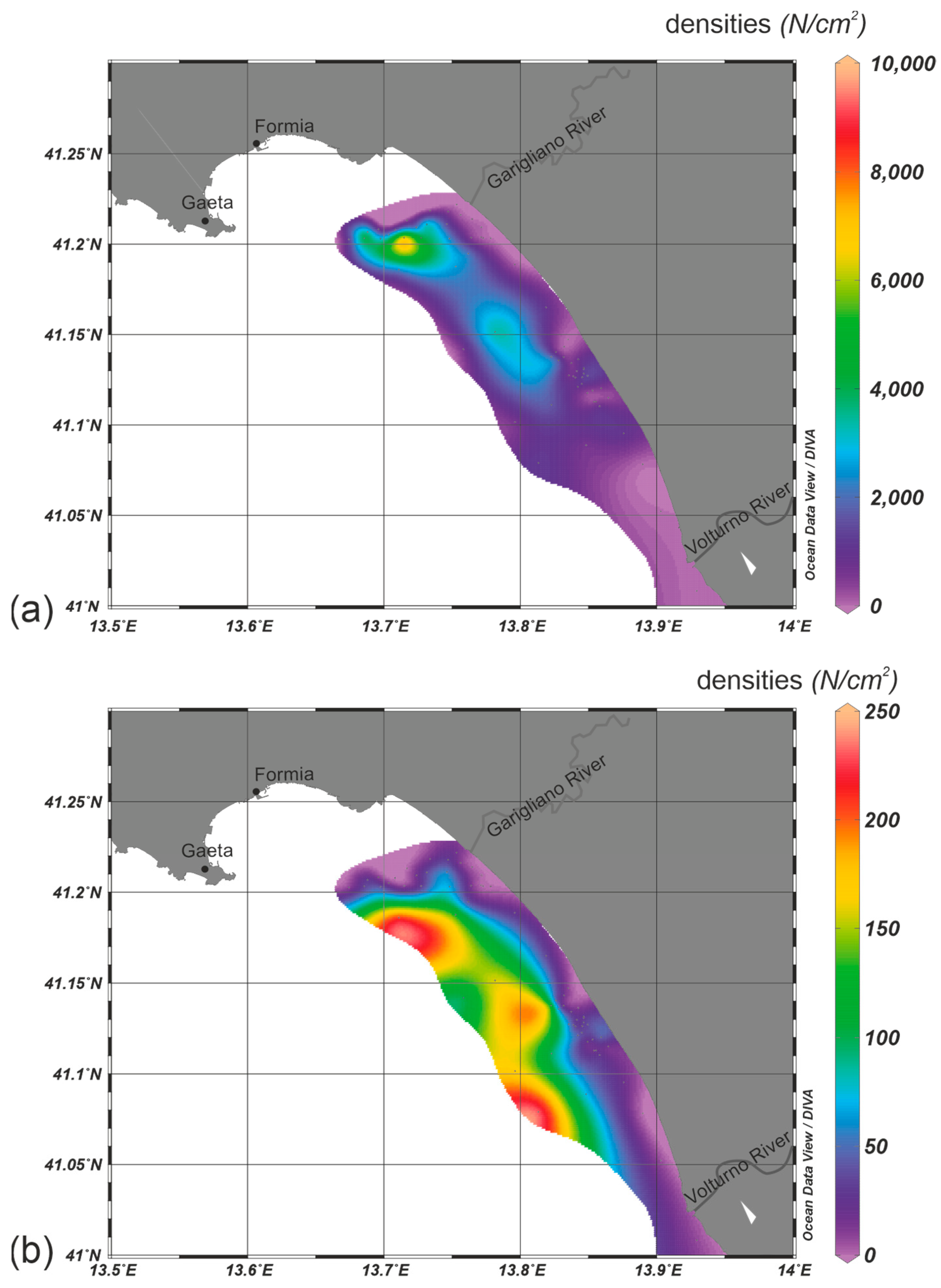
Overall, the distribution of densities of benthic foraminiferal assemblages in the studied dataset is asymmetrical and right skeeved (see Supplementary Material S1). The abundance of foraminiferal biocoenoses is approximately 25 times lower than that of the total assemblages. In general, the benthic microfauna exhibits higher densities (Table 2 and Figure 2) in Facies 5, which corresponds to the inner shelf, characterised by fine-grained sediments (Figure 1), reaching values of up to 2.259 foraminifera/cm2. In contrast, the single sample recovered from the Facies 1 near the Volturno delta front shows the poorest benthic foraminiferal assemblages.

4.3. Distribution of Mimosina affinis in the Study Area

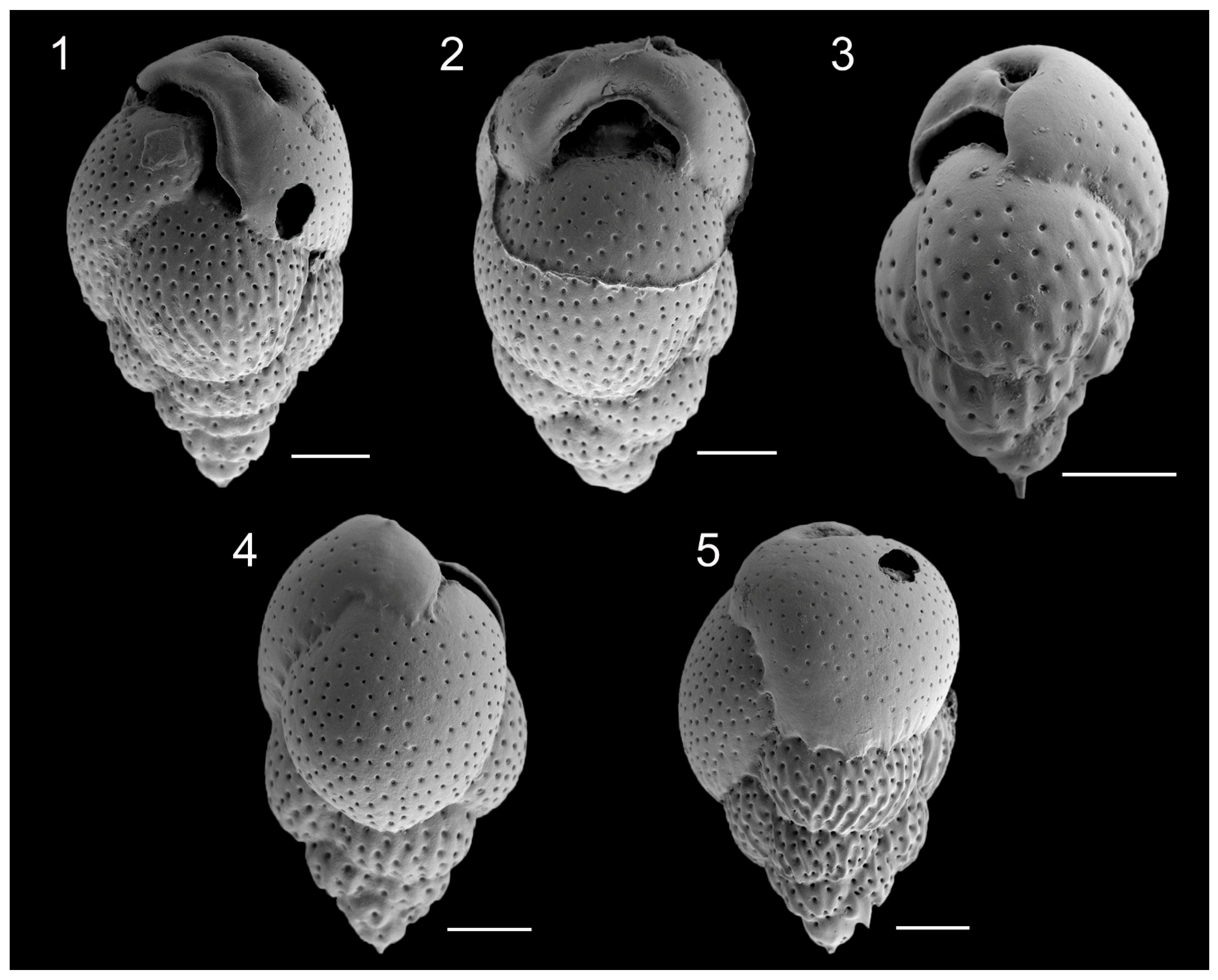
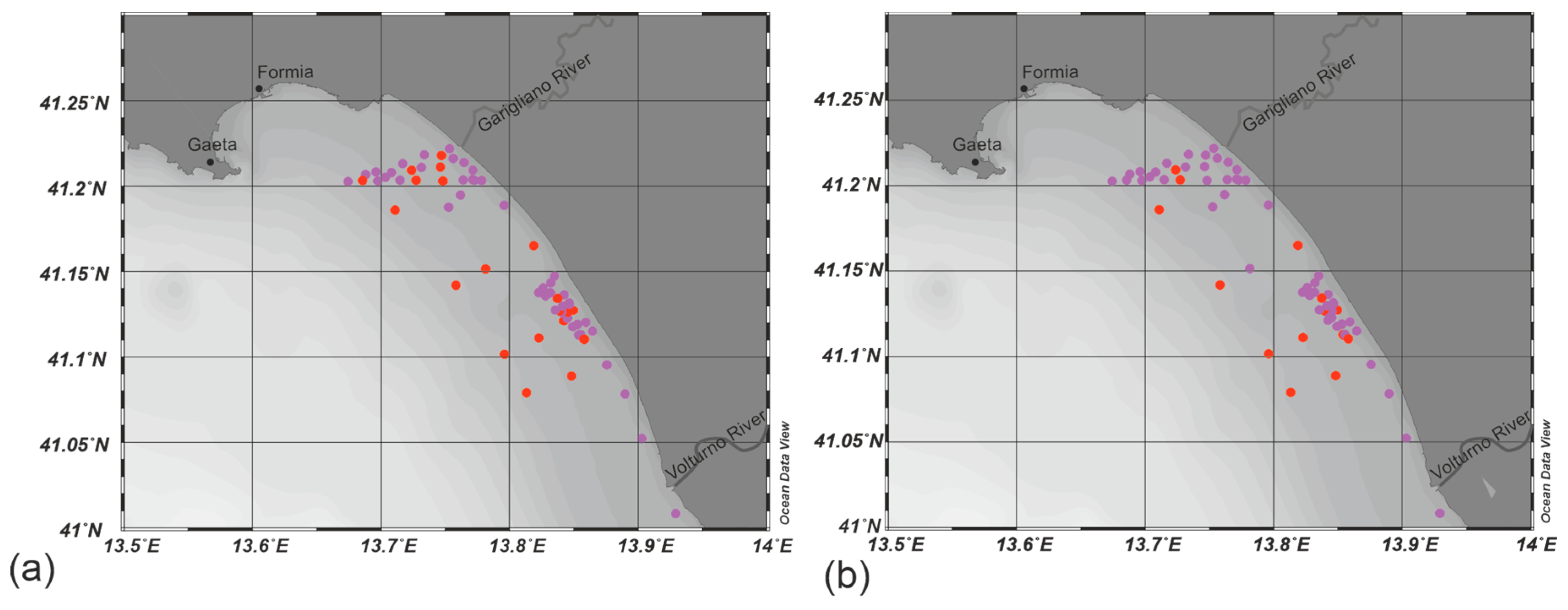
In the total assemblages, Mimosina affinis (Figure 3) was found in 21 of the 65 samples analysed (Figure 4), with a maximum recorded value of 3.65% at station 429G31 (see Supplementary Material S2). Median relative abundance and densities computed on samples in which Mimosina affinis is present are 0.64 and 0.36, respectively (Table 3). In the biocenosis, Mimosina affinis was detected in 14 of the 65 samples analysed, with a notable 8.22% abundance at station 429G52 and even higher relative abundances at some stations, although these were characterised by a low total number of foraminifera specimens (2 out of a total of 10 at station 429G01 and 2 out of a total of 22 at station 429G31). In samples in which Mimosina affinis occurs in the biocoenosis, its abundance average was around 4.06% (Table 3).

4.4. Distribution of Mimosina affinis in Relation to Facies, Grain Size Parameters and Bathymetry

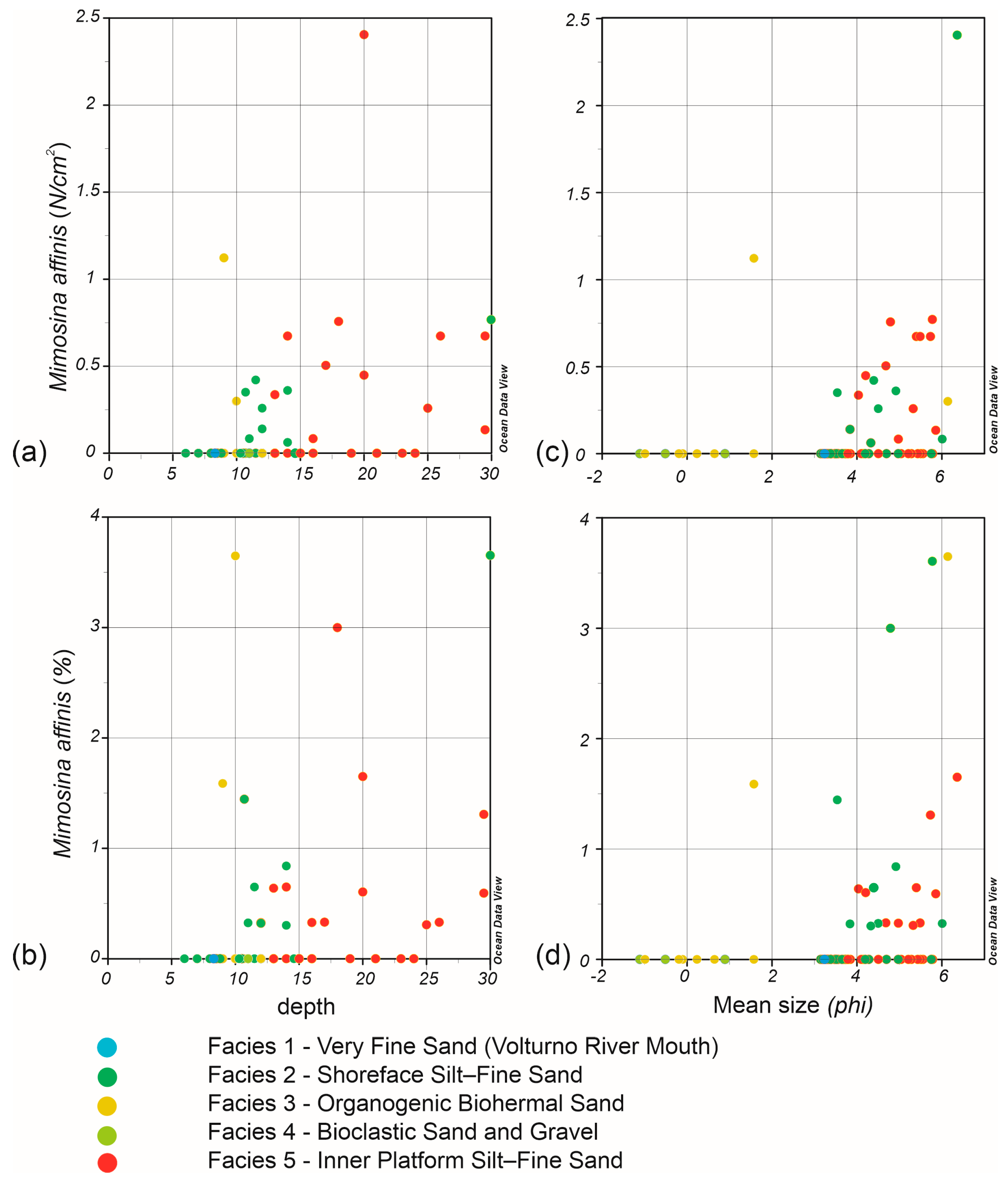
Figure 5 and Figure 6 illustrate the relationship between the abundance of Mimosina affinis, expressed both as density and percentage, in the total assemblages and biocoenoses, with respect to depth and sea bottom grain size. Scatter plots do not highlight a clear relationship between relative abundance and bathymetry, as percentages never exceed 4%. However, the proportion of samples in which the species was not detected appears to be higher in shallower environments. Moreover, Mimosina affinis is absent from samples collected at depths shallower than nine metres. Spearman’s rank correlation values computed between density and percentages with respect to depths are 0.31 and 0.35, respectively. p-values of the associated test are 0.0113 and 0.0047, respectively. These results do not appear to be conclusive, i.e., for an alpha level of 0.01, the first result would not be statistically significant, whereas the second would be.
As regards the relationship of Mimosina affinis with sea bottom grain size, a general tendency to be more abundant in sediment characterised by higher phi values of the mean size (Figure 5 and Figure 6) can be observed. Spearman’s rank correlation values computed between density and percentages with respect to phi values are 0.48 and 0.47, respectively. p-values of the associated test are 6.0159 × 10 −5 and 8.8384 × 10⁻⁵, respectively, indicating a statistically significant correlation, even if a restrictive confidence interval is adopted.
In terms of distribution within the defined facies (Table 3), Mimosina affinis, although showing a somewhat patchy pattern, appears to be more abundant in Facies 5, which is characterised by mostly coarse to very coarse silt. This facies generally hosts richer benthic associations dominated by the Ammonia tepida morphogroup, Ammonia beccarii, Cribroelphidium poeyanum, Rectuvigerina phlegeri, Bulimina elongata, Elphidium decipiens, Eggerelloides scabrum, Nonionoides turgidus, Haynesina depressula, Elphidium punctatum, Quinqueloculina seminulum, and Triloculina schreiberiana (Supplementary Material S3).
Mimosina affinis occurs in 11 of the 26 samples analysed from Facies 5 (Table 3), with a mean abundance of 0.28 individuals/cm2 and a maximum of 2.4 individuals/cm2 in sample 429G41 collected at a depth of 20 m (Supplementary Material S4).
In terms of percentage abundance, the maximum value of around 3.65% is reached in both Facies 3 (sampled at a 10 m depth) and Facies 5 (sampled at a 30 m depth). The species also shows slightly higher average relative abundance (0.65%) in Facies 3, associated with lithoid organogenic buildups, where foraminiferal assemblages are mainly composed of Ammonia beccarii, Rotalinoides gaimardi, and Elphidium crispum. Mimosina affinis is also present in 7 of the 27 samples taken in Facies 2 (submerged beach), but as already noted, only at depths greater than 9 m. It is absent from Facies 4 and from the sample taken in Facies 1, which is moreover characterised by very poor foraminiferal assemblages.
Regarding the distribution of Mimosina affinis in the biocoenoses, relatively higher densities and relative abundance in the assemblages are recorded in Facies 3 and 6. The maximum value, out of a total of 77 specimens (8.21%) was found in a sample from Facies 5 (station 429G52; see Supplementary Material S4) at a depth of 18 m. In sample 429G31 from Facies 3, collected at a 10 m depth, 2 specimens of Mimosina affinis were found out of a total of 22 foraminifera.

5. Discussion and Conclusions

The quantitative study of benthic foraminiferal assemblages, integrated with sedimentological parameters and conducted along the northern coast of the Gulf of Gaeta, documents the first occurrence of the benthic foraminifer Mimosina affinis in the Tyrrhenian Sea, western Mediterranean. Mediterranean records of this species were previously reported from Vlore Bay, Albania, and the Aegean Sea [27,29]. Until the present study, this species had not been identified in research conducted in the central Tyrrhenian Sea, as reported in previous articles [32,50,51].
Mimosina affinis is regarded as an alien species in the Mediterranean Sea, originally described for the first time by [25] from the Malay Archipelago. This species is thought to originate from the Indo-Pacific region and has also been reported from New Caledonia, and the Gulf of Aqaba [52,53]. However, to date, very limited information is available regarding its habitat preferences. In the study area, its spatial distribution appears to be related to water depth and sediment grain size, showing a preference to silty fine sands sediments in the depth range of 9–30 m. This pattern closely resembles that observed in the eastern Mediterranean, in Vlore Bay (Albanian coast), where the species occurs in fine clayey sand at depths between 10 and 21 m, with a relative abundance ranging from 0.4 to 3.3% [27]. Mimosina affinis has also been recorded from soft-substrata assemblages in Thermaikos Gulf, a semi-enclosed embayment of the NW basin of the Aegean, with shallow bathymetry (<40 m depth) [29].
The northern Albanian coast is characterised by extensive lowlands with high river runoff, where shallow-water bottom communities are subjected to substantial terrigenous input, resulting in increased turbidity and nutrient enrichment of the water column. Similarly, in the Gulf of Gaeta, the distribution of Mimosina affinis appears confined to the coastal area near the Garigliano River mouth, likely reflecting eutrophic conditions associated with nutrient inputs linked to the river discharge during the winter months [54].
Regarding the introduction of Mimosina affinis in the Mediterranean [26], several potential pathways are considered, including transport via the Suez Canal Corridor, ship ballast water, and attachment to floating substrates. In [27], this species shows a very restricted distribution, mainly associated with samples collected close to major ports, probably suggesting that its presence may be linked to transportation via ballast water possibly, followed by dispersal through local currents.
The introduction of non-indigenous species is primarily a human-induced phenomenon resulting from (1) the opening and enlargement of natural barriers, (2) the intensification of international trade and maritime traffic, (3) the accelerated warming caused by greenhouse gas emissions, and (4) the degradation and pollution of coastal environments. The presence of another non-native benthic foraminifera, Virgulinella fragilis Grindell & Collen, 1976, was detected by [55] along the northwestern Adriatic coast, probably spread in the area by human activities, such as marine shipping. Alien species may decrease or increase attributes of ecosystems (e.g., total biomass or species diversity), thus causing negative and positive environmental impacts. Impacts include the decline or extinction of native species, damage to food webs, and changes to ecosystem processes. For example, invasive foraminifera can change the physical and chemical makeup of marine sediments, altering the habitat for other organisms that live in or depend on that sediment [56].
In the future, an integrated sampling of both recent and fossil foraminiferal assemblages would be valuable to determine when Mimosina affinis first appeared in the Gulf of Gaeta. For this purpose, further survey campaigns will be planned to systematically trace and document the presence of this alien species, particularly within the context of the European Marine Strategy Framework Directive (MSFD). Moreover, to confirm the alien status of Mimosina affinis in the Mediterranean Sea, molecular studies could be conducted to establish whether the specimens observed in the study are genetically similar to populations in their native range.

Supplementary Materials

The following supporting information can be downloaded at https://www.mdpi.com/article/10.3390/geosciences16010001/s1, S1: Supplementary Figure S1 (see caption inside). S2. Mimosina affinis distribution data and_granulometrical_data, S3. Foraminifera_counts_(total_assemblages). S4. Foraminifera_counts_(biocoenoses).

Author Contributions

Conceptualization, V.D.D. and L.F.; Methodology, G.A., D.B., V.D.D., L.F., F.M., M.S. and R.P.; Formal Analysis, G.A., D.B., V.D.D., L.F., F.M., R.P. and M.S.; Investigation, G.A., D.B., V.D.D., L.F., F.M., R.P. and M.S.; Resources, F.M.; Data Curation, D.B., V.D.D., L.F. and F.M.; Writing—Original Draft Preparation, V.D.D., L.F., F.M. and M.S.; Writing—Review and Editing, V.D.D. and L.F.; Visualisation, R.P., V.D.D. and F.M.; Supervision, M.S.; Project Administration, M.S.; Funding Acquisition, M.S. All authors have read and agreed to the published version of the manuscript.

Funding

Financial support for this research was provided by the Regione Campania within the frame of the CARG Project (Geologic and geothematic cartography of Italy, 1:50.000 scale), coordinated by the Italian Institute for Environmental Protection and Research (ISPRA), for the geological mapping of marine areas included in Sheets n. 429 “Mondragone” (Regione Campania: CUP B56J20000870002) and n. 416 “Sessa Aurunca” (Regione Campania: CUP B55F20002400002).

Data Availability Statement

The original contributions presented in this study are included in the article/Supplementary Materials. Further inquiries can be directed to the corresponding author.

Acknowledgments

Seafloor sediment samples collected for this study were acquired by the Marine Science Institute (ISMAR) of the Italian Research Council of Italy (CNR) during two oceanographic cruises, respectively, in February 2022 (cruise CNR-ISMAR Carg0222) onboard the research vessel “Lighea” of the Italian Institute for Environmental Protection and Research (ISPRA) and in April 2023 (cruise CNR-ISMAR Carg0423) onboard the motor boats “Idrosfera” and “Enviroconsult”, offshore the Gulf of Gaeta. We would like to thank the anonymous reviewers for their valuable comments and constructive suggestions, which greatly improved the quality of this work.

Conflicts of Interest

The authors declare no conflicts of interest.

References

  1. Lionello, P.; Scarascia, L. The relation between climate change in the Mediterranean region and global warming. Reg. Environ. Change 2018, 18, 1481–1493. [Google Scholar] [CrossRef]
  2. Lazoglou, G.; Papadopoulos-Zachos, A.; Georgiades, P.; Zittis, G.; Velikou, K.; Manios, E.M.; Anagnostopoulou, C. Identification of climate change hotspots in the Mediterranean. Sci. Rep. 2024, 14, 29817. [Google Scholar] [CrossRef]
  3. Giorgi, F.; Bi, X. Regional changes in surface climate interannual variability for the 21st century from ensembles of global model simulation. Geophys. Res. Lett. 2005, 32, L13701. [Google Scholar] [CrossRef]
  4. Béthoux, J.P.; Gentili, B.; Morin, P.; Nicolas, E.; Pierre, C.; Ruiz-Pino, D. The Mediterranean Sea: A miniature ocean for climatic and environmental studies and a key for the climatic functioning of the North Atlantic. Prog. Oceanogr. 1999, 44, 131–146. [Google Scholar] [CrossRef]
  5. Krom, M.D.; Emeis, K.C.; Van Cappellen, P. Why is the eastern Mediterranean phosphorus limited? Prog. Oceanogr. 2010, 85, 236–244. [Google Scholar] [CrossRef]
  6. Powley, H.R.; Krom, M.D.; Van Cappellen, P. Understanding the unique biogeochemistry of the Mediterranean Sea: Insights from a coupled phosphorus and nitrogen model. Glob. Biogeochem. Cycles 2017, 31, 1010–1031. [Google Scholar] [CrossRef]
  7. Millot, C. Circulation in the Western Mediterranean Sea. J. Ma. Syst. 1999, 20, 423–442. [Google Scholar] [CrossRef]
  8. Robinson, A.R.; Golnaraghi, M.; Leslie, W.G.; Artegiani, A.; Hecht, A.; Lazzoni, E.; Michelato, A.; Sansone, E.; Theocharis, A.; Ünlüata, Ü. The eastern Mediterranean general circulation: Features, structure and variability. Dyn. Atmos. Ocean. 1991, 15, 215–240. [Google Scholar] [CrossRef]
  9. Béthoux, J.P. Mean water fluxes across sections in the Mediterranean Sea, evaluated on the basis of water and salt budgets and of observed salinities. Oceanol. Acta 1980, 3, 79–88. [Google Scholar]
  10. Rossignol-Strick, M.; Nesteroff, V.; Olive, P.; Vergnaud-Grazzini, C. After the deluge; Mediterranean stagnation and sapropel formation. Nature 1982, 295, 105–110. [Google Scholar] [CrossRef]
  11. Rohling, E.J.; Hilgen, F.J. The eastern Mediterranean climate at times of sapropel formation: A review. Geol. Mijnb. 1991, 70, 253–264. [Google Scholar]
  12. Fontugne, M.R.; Calvert, S.E. Late Pleistocene variability of the carbon isotopic composition of organic matter in the eastern Mediterranean: Monitor of changes in carbon sources and atmospheric CO2 concentrations. Paleoceanography 1992, 7, 1–20. [Google Scholar] [CrossRef]
  13. Rohling, E.J.; Marino, G.; Grant, K.M. Mediterranean climate and oceanography, and the periodic development of anoxic events (sapropels). Earth Sci. Rev. 2015, 143, 62–97. [Google Scholar] [CrossRef]
  14. Galil, B.S. Taking stock: Inventory of alien species in the Mediterranean Sea. Biol. Invasions 2009, 11, 359–372. [Google Scholar] [CrossRef]
  15. Occhipinti-Ambrogi, A. Global change and marine communities: Alien species and climate change. Mar. Pollut. Bull. 2007, 55, 342–352. [Google Scholar] [CrossRef]
  16. Caruso, A.; Cosentino, C. The first colonization of the Genus Amphistegina and other exotic benthic foraminifera of the Pelagian Islands and south-eastern Sicily (central Mediterranean Sea). Mar. Micropaleontol. 2014, 111, 38–52. [Google Scholar] [CrossRef]
  17. Pecl, G.T.; Araújo, M.B.; Bell, J.D.; Blanchard, J.; Bonebrake, T.C.; Chen, I.-C.; Clark, T.D.; Colwell, R.K.; Danielsen, F.; Evengård, B.; et al. Biodiversity redistribution under climate change: Impacts on ecosystems and human well-being. Science 2017, 355, eaai9214. [Google Scholar] [CrossRef]
  18. Molnar, J.L.; Gamboa, R.L.; Revenga, C.; Spalding, M.D. Assessing the global threat of invasive species to marine biodiversity. Front. Ecol. Environ. 2008, 6, 485–492. [Google Scholar] [CrossRef]
  19. Katsanevakis, S.; Wallentinus, I.; Zenetos, A.; Leppäkoski, E.; Çinar, M.E.; Oztürk, B.; Grabowski, M.; Golani, D.; Cardoso, A.C. Impacts of invasive alien marine species on ecosystem services and biodiversity: A pan-European review. Aquat. Invasions 2014, 9, 391–423. [Google Scholar] [CrossRef]
  20. Por, F.D. Lesseps an Migration: The Influx of Red Sea Biota into the Mediterranean by Way of the Suez Canal; Springer: Berlin/Heidelberg, Germany, 1978; Available online: https://rcin.org.pl/dlibra/doccontent?id=183176 (accessed on 15 December 2025).
  21. Golani, D. Colonization of the Mediterranean by Red Sea Fishes via the Suez Canal—Lessepsian Migration. In Fish Invasions of the Mediterranean—Change and Renewal; Golani, D., Appelbaum-Golani, B., Eds.; Pensoft: Sofia, Bulgaria, 2010; pp. 145–188. [Google Scholar]
  22. Galil, B.S.; Marchini, A.; Occhipinti-Ambrogi, A.; Minchin, D. East is east and West is west? Management of marine bioinvasions in the Mediterranean Sea. Estuar. Coast. Shelf Sci. 2015, 201, 7–16. [Google Scholar] [CrossRef]
  23. Tomašových, A.; Schönfeld, J.; Wesselingh, F.P. The influence of climate-driven environmental changes on the Mediterranean foraminifera: Tracking ecological shifts in response to climate change. Mar. Micropaleontol. 2018, 143, 47–61. [Google Scholar] [CrossRef]
  24. Meriç, E.; Yokes, M.B.; Avsar, K.N.; Kirki-Elmas, E.; Dinçer, F.; Karhan, S.U.; Kalkan, E.; Demir, V. First report of Pararotalia calcariformata from the Hatay coastline (Turkey—North-eastern Mediterranean). Mar. Biodivers. Rec. 2013, 6, e31. [Google Scholar] [CrossRef]
  25. Millett, F.W. Report on the recent foraminifera of the Malay Archipelago collected by Mr. A. Durrand, F.R.M.S.—Part IX. J. R. Microsc. Soc. 1900, 20, 539–549. [Google Scholar] [CrossRef][Green Version]
  26. Stulpinaite, R.; Hyams-Kaphzan, O.; Langer, M.R. Alien and cryptogenic Foraminifera in the Mediterranean Sea: A revision of taxa as part of the EU 2020 Marine Strategy Framework Directive. Mediterr. Mar. Sci. 2020, 21, 719–758. [Google Scholar] [CrossRef]
  27. Mouanga, G.H. Impact and Range Extension of Invasive Foraminifera in the NW Mediterranean Sea: Implications for Diversity and Ecosystem Functioning. Ph.D. Thesis, Steinmann-Institut für Geologie, Mineralogie und Paläontologie, Bonn, Germany, 2017. [Google Scholar]
  28. Nasto, I.; Sota, D.; Vashaj, B.; Kamberaj, A.; Lushnjari, K.; Islamaj, M.; Koco, K.; Mahmutaj, M.; Kicaj, H. Aliens in Albania–which, when, where, why? A chronological analysis of the invasion of alien species in the albanian, ionian, and adriatic coasts. J. Nat. Sci. Math. Math. Math. UT 2023, 8, 523–534. [Google Scholar]
  29. Delliou, A.V.; Antoniadou, C.; Chintiroglou, C.C. Diversity of Benthic Foraminifera from Sublittoral Sediments in Thermaikos Gulf (North Aegean Sea) with New Mediterranean Records. In Proceedings of the 43rd CIESM Congress, Palermo, Italy, 14–18 October 2024; pp. 14–18. [Google Scholar]
  30. Giaccio, B.; Hajdas, I.; Isaia, R.; Deino, A.L.; Nomade, S. Dating of the campanian ignimbrite (y-5) reconciles the time-scales of climatic-cultural processes at 40 ka. Nat. Publ. Group 2017, 7, srep45940. [Google Scholar] [CrossRef]
  31. Sacchi, M.; Molisso, F.; Pacifico, A.; Vigliotti, M.; Sabbarese, C.; Ruberti, D. Late-Holocene to recent evolution of Lake Patria, South Italy: An example of a coastal lagoon within a Mediterranean delta system. Global Planet. Change 2014, 117, 9–27. [Google Scholar] [CrossRef]
  32. Ferraro, L.; Giordano, L.; Bonomo, S.; Cascella, A.; Di Martino, G.; Innangi, S.; Gherardi, S. Monitoraggio integrato di un’area marino-costiera: La foce del fiume Volturno (Mar Tirreno centrale). Quad. Geofis. 2017, 146, 1–70. [Google Scholar] [CrossRef]
  33. Misuraca, M.; Budillon, F.; Tonielli, R.; Di Martino, G.; Innangi, S.; Ferraro, L. Coastal evolution, hydrothermal migration pathways and soft deformation along the campania continental shelf (Southern Tyrrhenian Sea): Insights from high-resolution seismic profiles. Geosciences 2018, 8, 121. [Google Scholar] [CrossRef]
  34. Hunt, D.; Tucker, M.E. Standard Parasequences and the Forced Regressive Wedge System Tract; Deposition during Base Level Fall. Sediment. Geo. 1992, 81, 1–9. [Google Scholar] [CrossRef]
  35. Margaritelli, G.; Vallefuoco, M.; Di Rita, F.; Capotondi, L.; Bellucci, L.; Insinga, D.; Petrosino, P.; Bonomo, S.; Cacho, I.; Cascella, A.; et al. Marine response to climate changes during the last five millennia in the central Mediterranean Sea. Global Planet. Change 2016, 142, 53–72. [Google Scholar] [CrossRef]
  36. Iorio, M.; Punzo, M.; Carotenuto, A.; Cavuoto, G.; Corniello, A.; Di Fiore, V.; Donnarumma, G.; Fedi, M.; Massarotti, N.; Pelosi, N.; et al. Shallow geothermal field multidisciplinary exploration: New data from Campi Flegrei caldera (CFc) for low-middle enthalpy resource exploitation. Geothermics 2024, 121, 103049. [Google Scholar] [CrossRef]
  37. Got, H.; Aloïsi, J.C.; Monaco, A. Sedimentary processes in Mediterranean deltas and shelves. In Geological Evolution of the Mediterranean Basins; Wezel, F.C., Stanley, D.J., Eds.; Pergamon: New York, NY, USA, 1985; pp. 354–376. [Google Scholar]
  38. Pennetta, M.; Valente, A.; Abate, D.; Boudillon, G.; De Pippo, T.; Leone, M.; Terlizzi, F. Influenza della morfologia costiera sulla circolazione e sedimentazione sulla piattaforma continentale campano-laziale tra Gaeta e Cuma (Italia meridionale). Boll. Soc. Geol. It. 1998, 117, 281–295. [Google Scholar]
  39. Pennetta, M.; Stanislao, C.; D’Ambrosio, V.; Marchese, F.; Minopoli, C.; Trocciola, A.; Valente, R. Geomorphological features of the archaeological marine area of Sinuessa in Campania, southern Italy. Quat. Int. 2016, 425, 198–213. [Google Scholar] [CrossRef]
  40. Pennetta, M.; Trocciola, A. Sinuessa, un Approdo Sommerso di Epoca Romana, Archeologia, Geomorfologia Costiera, Strategie Sostenibili di Valorizzazione; Monografia a cura di Micla Pennetta e Alfredo Trocciola; ENEA: Stockholm, Sweden, 2017; ISBN 978-88-8286-340-1. [Google Scholar]
  41. Schönfeld, J.; Alve, E.; Geslin, E.; Jorissen, J.; Korsun, S.; Spezzaferri, S. The Fobimo Group. The FOBIMO (FOraminiferal BIo-MOnitoring) initiative—Towards a standardised protocol for soft-bottom benthic foraminiferal monitoring studies. Mar. Micropaleontol. 2012, 94–95, 1–13. [Google Scholar] [CrossRef]
  42. Folk, R.L.; Ward, W.C. A Study in the Significance of Grain-Size Parameters. J. Sediment. Petrol. 1957, 27, 3–26. [Google Scholar] [CrossRef]
  43. Folk, R. The distinction between grain size and mineral composition in sedimentary-rock nomenclature. J. Geol. 1954, 62, 344–359. [Google Scholar] [CrossRef]
  44. Spearman, C. The Proof and Measurement of Association between Two Things. Am. J. Psychol. 1904, 15, 72–101. [Google Scholar] [CrossRef]
  45. Best, D.J.; Roberts, D.E. Algorithm AS 89: The Upper Tail Probabilities of Spearman’s rho. Appl. Stat. 1975, 24, 377–379. [Google Scholar] [CrossRef]
  46. The MathWorks Inc. MATLAB Version: 24.2.0.2833386 (R2024b), The MathWorks Inc.: Natick, MA, USA, 2024. Available online: https://www.mathworks.com (accessed on 15 December 2025).
  47. Schlitzer, Reiner, Ocean Data View, odv.awi.de. 2025. Available online: https://odv.awi.de/ (accessed on 15 December 2025).
  48. Troupin, C.; Barth, A.; Sirjacobs, D.; Ouberdous, M.; Brankart, J.-M.; Brasseur, P.; Rixen, M.; Alvera-Azcárate, A.; Belounis, M.; Capet, A.; et al. Generation of analysis and consistent error fields using the Data Interpolating Variational Analysis (Diva). Ocean Model. 2012, 52–53, 90–101. [Google Scholar] [CrossRef]
  49. Ferrigno, F.; Di Martino, G.; Donnarumma, L.; Innangi, S.; Molisso, F.; Rendina, F.; Sandulli, R.; Tonielli, R.; Russo, G.F.; Sacchi, M. Unexpected and Extraordinarily Shallow Coralligenous Banks at the Sinuessa Site, a Heritage of the Campania Coast (SW Italy, Mediterranean Sea). Water 2024, 16, 2942. [Google Scholar] [CrossRef]
  50. Faugno, A.; Alivernini, M.; Di Bella, L. Benthic foraminiferal assemblages as tools for environmental characterization: An example from the Gulf of Gaeta, Tyrrhenian Sea (Italy). N. Jb. Geol. Paläon. T Abh. 2015, 275, 219–232. [Google Scholar] [CrossRef]
  51. Ferraro, L.; Bonomo, S.; Alberico, I.; Cascella, A.; Giordano, L.; Lirer, F.; Vallefuoco, M. Live benthic foraminifera from the Volturno River mouth (Italy–central Tyrrhenian). Rend. Lincei Sci. Fis. Nat. 2018, 29, 559–570. [Google Scholar] [CrossRef]
  52. Hottinger, L.; Halicz, E.; Reiss, Z. Recent Foraminifer Ida from the Gulf of Aqaba (Red Sea). Academia Scientiarum et Artium Slovenica 1993. Classis IV: Historia Naturalis, 33, and Znanstvenoraziskovalni Tsenter SAZU; Paleontoloski Institut lvana Rakovca: Lubljana, Slovenia, 1993. [Google Scholar]
  53. Debenay, J.P. A Guide to 1000 Foraminifera from Southwestern Pacific: New Caledonia; IRD Editions: Marseille, France, 2012. [Google Scholar]
  54. Aguzzi, L. Stato Dell’ Ambiente Marino Costiero del Golfo di Gaeta (LT). Dieci Anni di Monitoraggi: 2001–2011; Arpa Lazio: Rome, Italy, 2012; p. 88. [Google Scholar]
  55. D’Onofrio, R.; Vitelletti, M.L.; Riminucci, F.; Rossi, V.; Capotondi, L. Virgulinella fragilis in the North Adriatic Coastal Sediments: A New Non-Indigenous Benthic Foraminiferal Taxon? Biology 2025, 14, 421. [Google Scholar] [CrossRef]
  56. Cosentino, C.; Guastella, R.; Mancin, N.; Caruso, A. Spatial and vertical distribution of the genus Amphistegina and its relationship with the indigenous benthic foraminiferal assemblages in the Pelagian Archipelago (Central Mediterranean Sea). Mar. Micropaleontol. 2024, 188, 102344. [Google Scholar] [CrossRef]
Figure 1. (a) Location of samples collected during the CNR-ISMAR Carg0222 oceanographic cruise with classification into the five recognised facies (see Table 1); red box: study area; (b) interpolated distribution of the mean size parameter (phi) at the sea bottom of the studied area.
Geosciences 16 00001 g001
Figure 2. Interpolated density of benthic foraminiferal assemblages expressed as number of specimens/cm2. (a) Total assemblages; (b) biocoenoses. Note that the colour bars are scaled differently.
Geosciences 16 00001 g002
Figure 3. 1–5 Mimosina affinis Millett, 1900, sample 429G52,18 m depth; scale bar = 50 μm.
Geosciences 16 00001 g003
Figure 4. Distribution of Mimosina affinis in the analysed samples (red: presence; magenta: not detected). (a) Total assemblages; (b) biocoenoses.
Geosciences 16 00001 g004
Figure 5. (ad): Scatter plots of Mimosina affinis densities and relative abundance in total assemblages vs. depth and mean size. Samples are coloured according to the facies to which they belong.
Geosciences 16 00001 g005
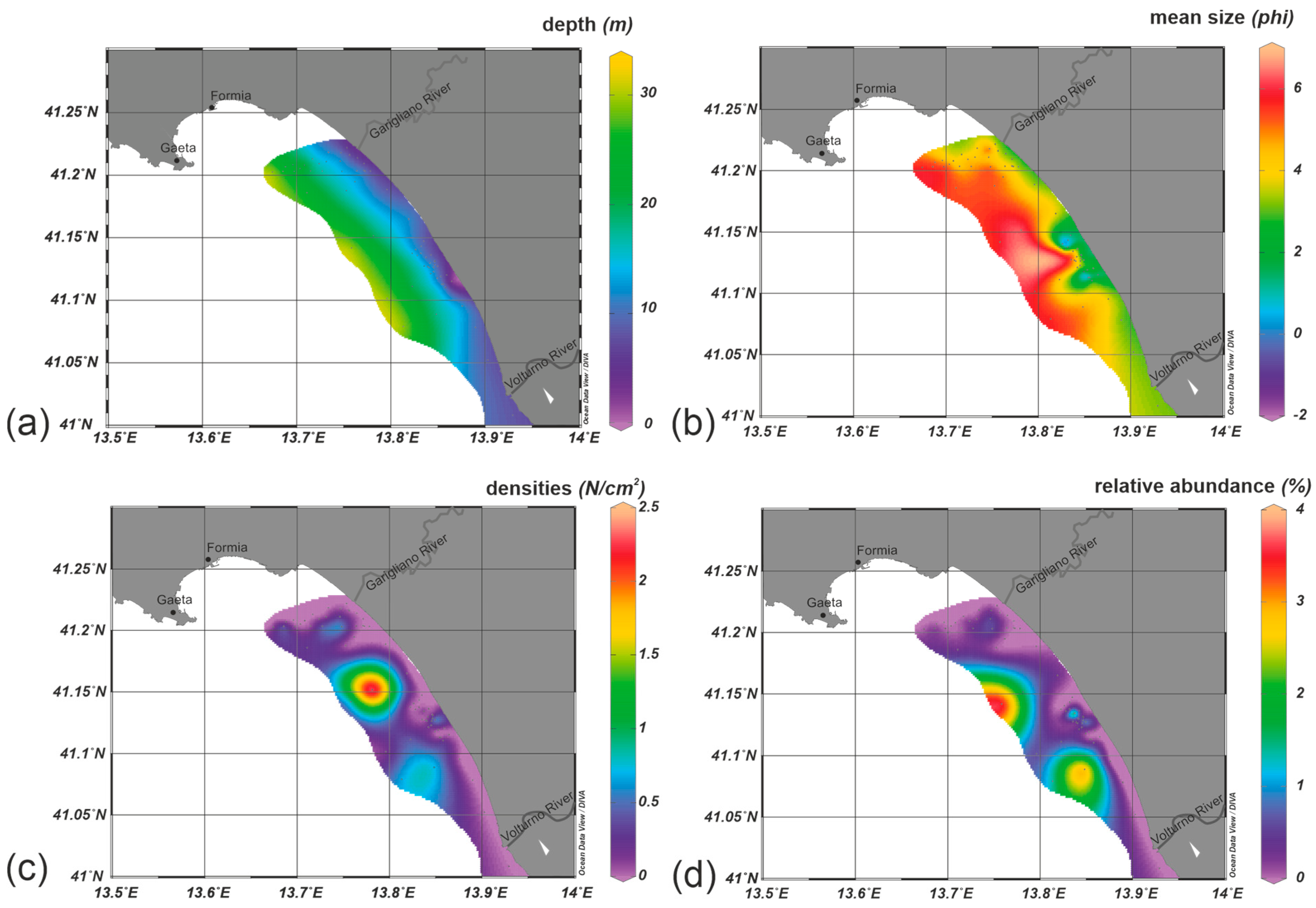
Figure 6. Comparison of depth and mean size with Mimosina affinis distribution in the studied area. (a) Depth (m); (b) mean size (phi); (c) density (total assemblages); (d) relative abundance (total assemblages).
Geosciences 16 00001 g006
Table 2. Assemblage density of benthic foraminiferal assemblages in the investigated area and in the facies recognised. The depth range of the samples recovered from each facies is also reported. Q1 and Q3 indicate first and third quartile, respectively.
SamplesMaxQ1MedianQ3
Overall studied area659664 (237)137 (6)577 (22)1796 (56)
Facies 1 (depth 8.3)1 33
Facies 2 (depth range 6–14.6 m)272871 (86)77 (6)464 (22)1015 (41)
Facies 3 (depth range 9–12 m)81680 (43)34 (5)81 (11)190 (26)
Facies 4 (depth range 10.5–12)3140 (34)55 (5)92 (6)128 (27)
Facies 5 (depth range 12–30)269664 (221)604 (12)1883 (45)2496 (97)
Table 3. Table summarising the relative abundance (%) and density (N/cm2) of Mimosina affinis in the overall studied area and in the identified facies. Numbers in parentheses refer to biocenosis.
Occurrence Rates%N/cm2
Overall area21/65 (14/65)Median 0.64 (0.93)Median 0.36 (0.02)
Facies 10/1 (0/1)-.-- (-.--)-.-- (-.--)
Facies 27/27 (4/27)Median 0.33 (4.00)
Max 1.44 (5.13)
Median 0.26 (0.06)
Max 0.42 (0.07)
Facies 32/8 (2/8)Median 2.62 (9.09)
Max 3.65 (9.09)
Mean 0.71 (0.12)
Max 1.12 (0.12)
Facies 40/3 (0/3)-.-- (-.--)-.-- (-.--)
Facies 511/26 (8/26)Median 0.62 (3.50)
Max 3.61 (8.22)
Median 0.59 (0.12)
Max 2.41 (0.25)
Disclaimer/Publisher’s Note: The statements, opinions and data contained in all publications are solely those of the individual author(s) and contributor(s) and not of MDPI and/or the editor(s). MDPI and/or the editor(s) disclaim responsibility for any injury to people or property resulting from any ideas, methods, instructions or products referred to in the content.