


The Structural and Diagenetic Coupling Controls the Distribution of Deep Carbonate Rock Reservoirs in the Southern of Tahe Oilfield, Tarim Basin
Abstract
1. Introduction
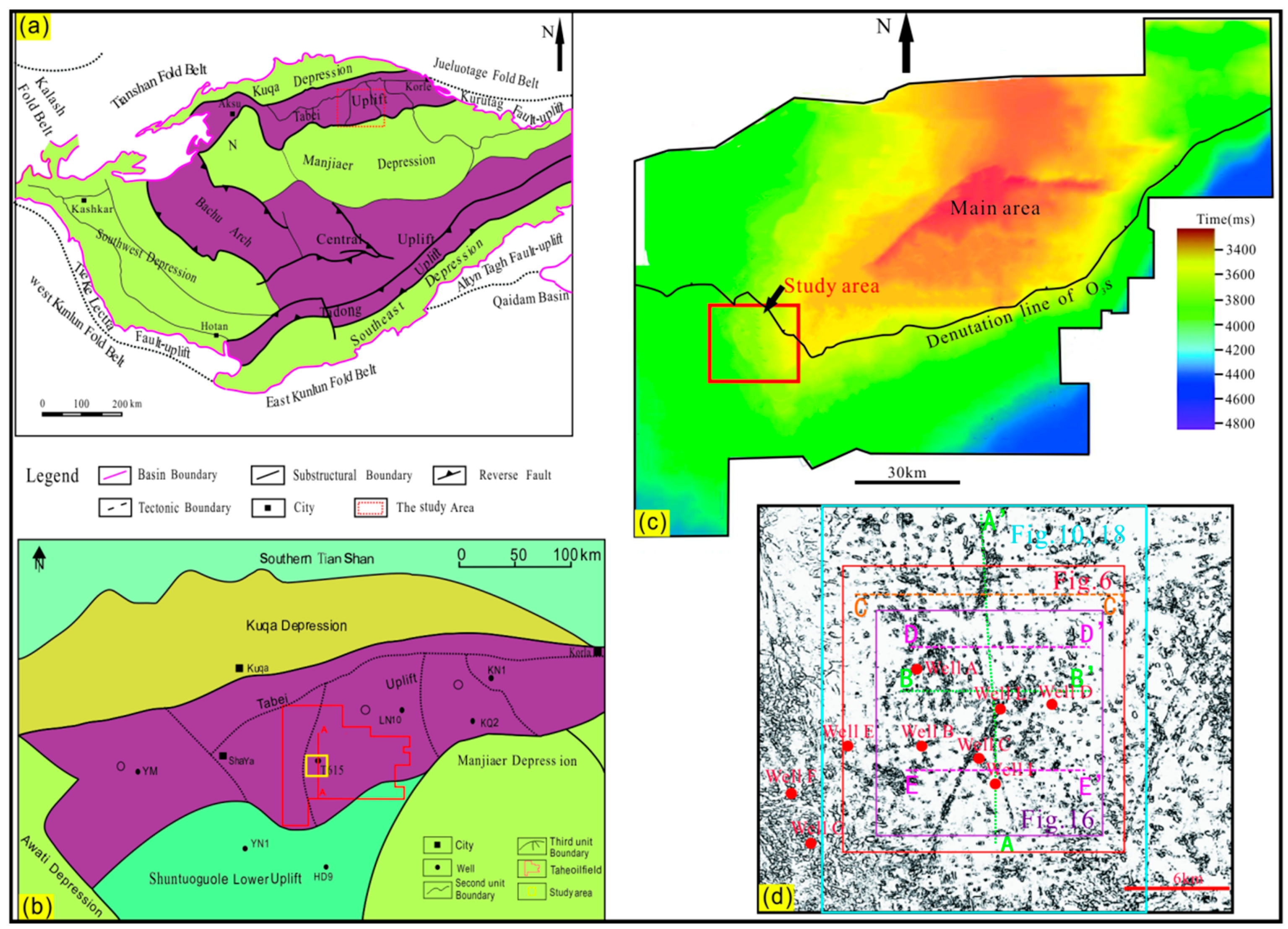
2. Geological Setting
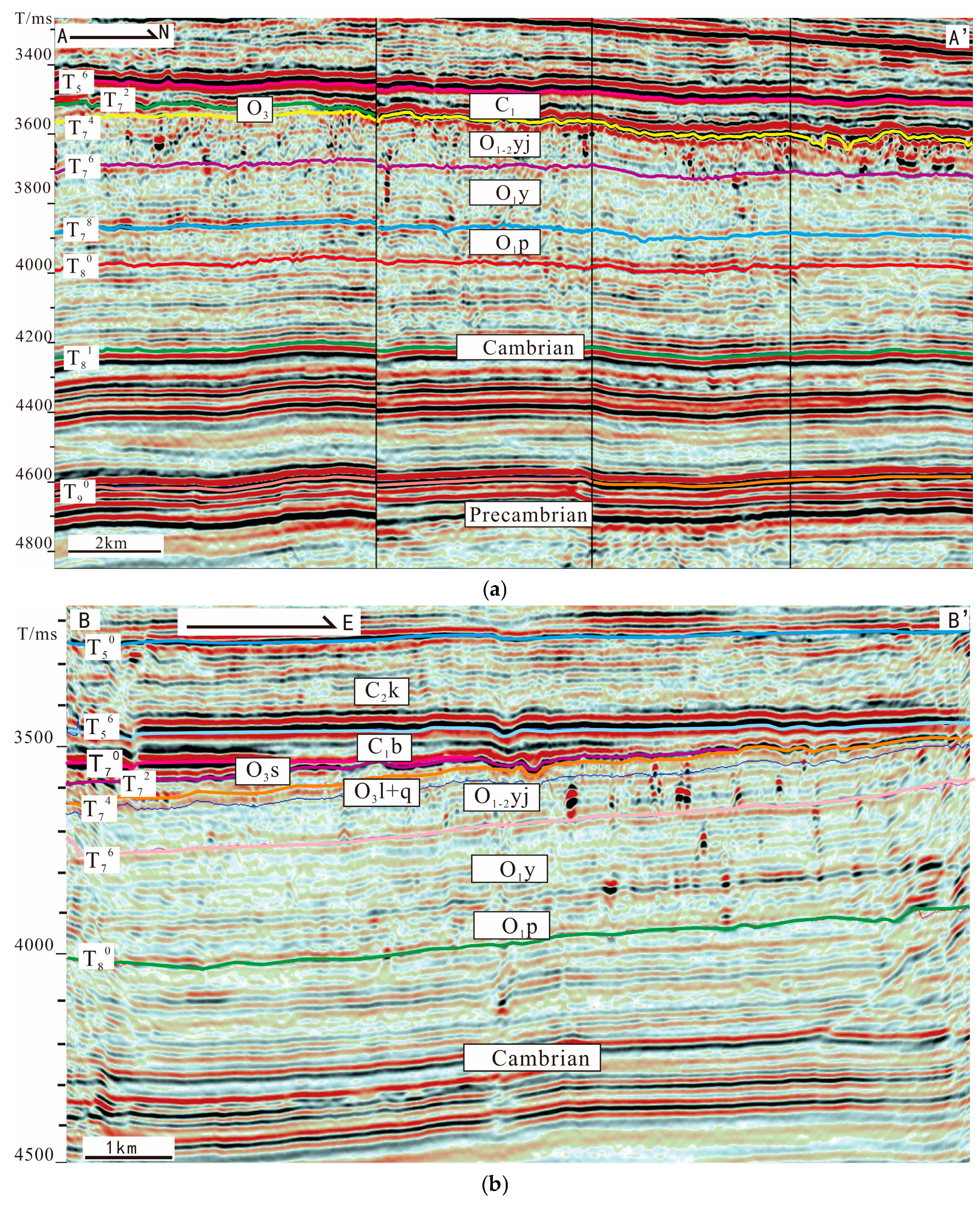
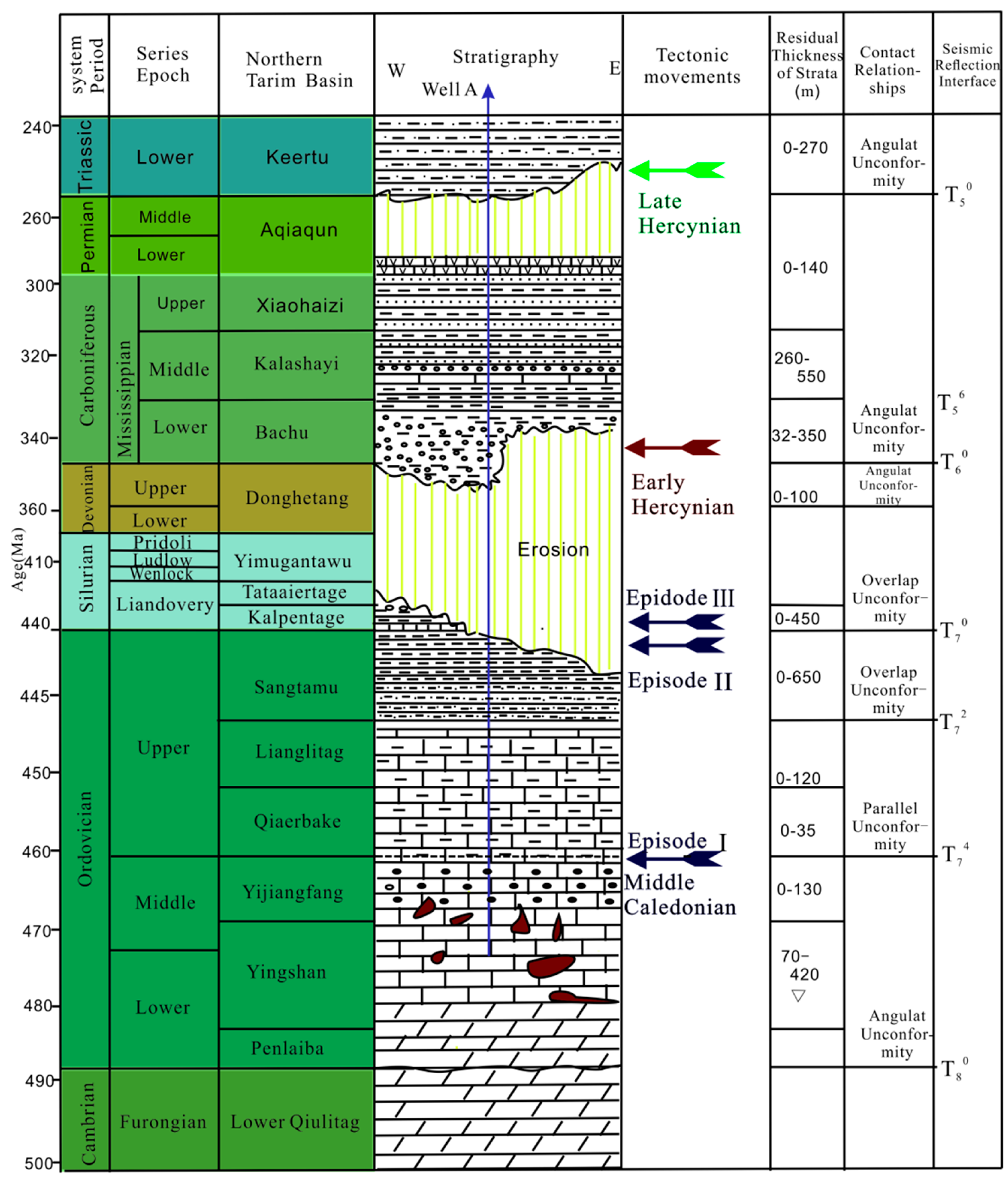
3. Data and Methods
3.1. Core Samples, Well Logging, and Seismic Data
- (1)
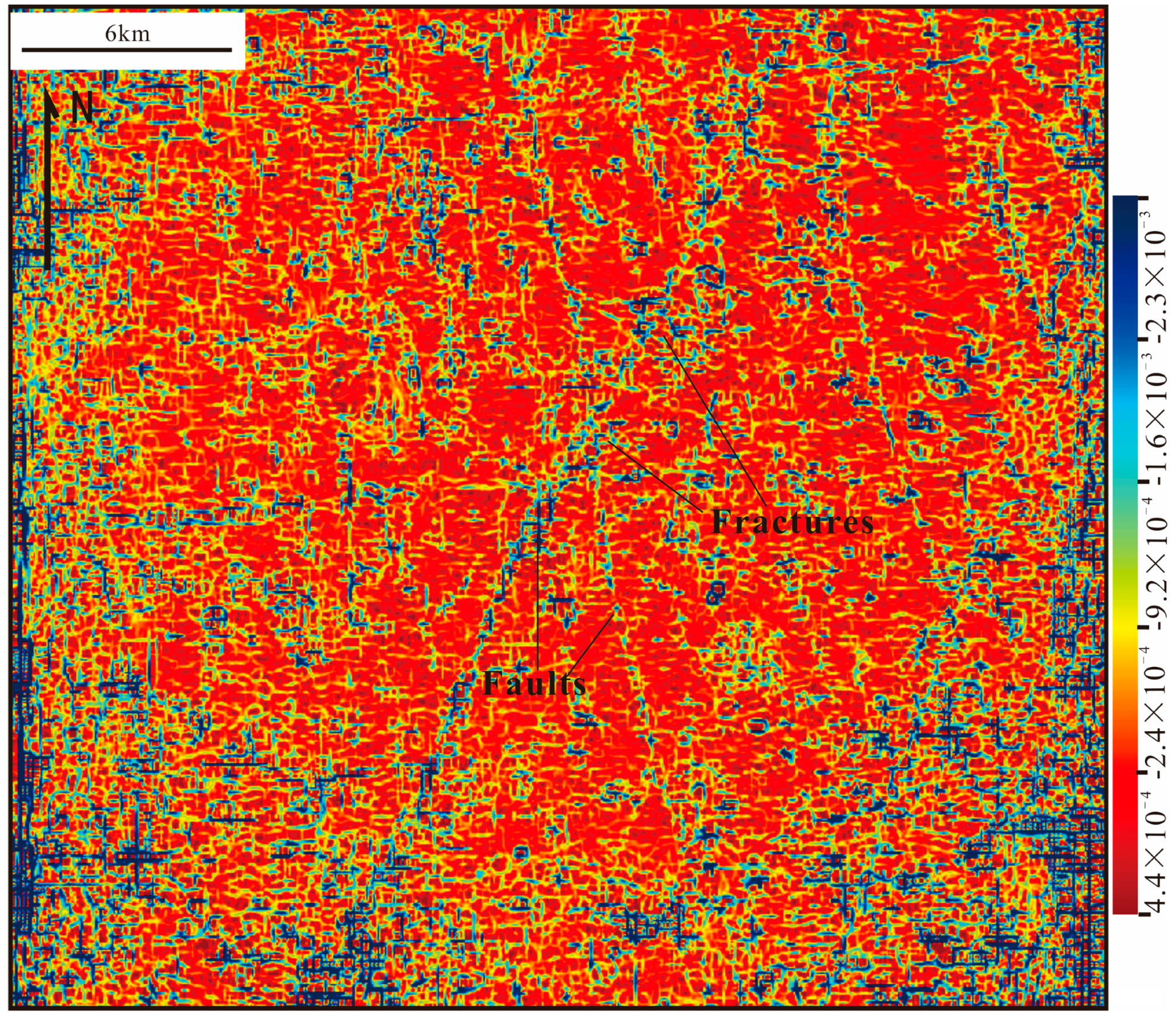
- Noise filtering and attribute extraction: The SVI software first uses a noise filter to denoise the raw seismic data. The goal of the denoising process is to reduce non-seismic signals caused by seismic instruments, environmental noise, or geological interference, thereby improving the signal-to-noise ratio. SVI applies multiple noise-suppression techniques—e.g., low-pass, high-pass, and time-frequency filters—to attenuate band-limited noise. Following denoising, it derives composite attributes (such as tensor and envelope attributes) from the processed seismic volume. Tensor attributes characterize seismic-wave anisotropy, whereas envelope attributes depict the spatial distribution of signal strength.
- (2)
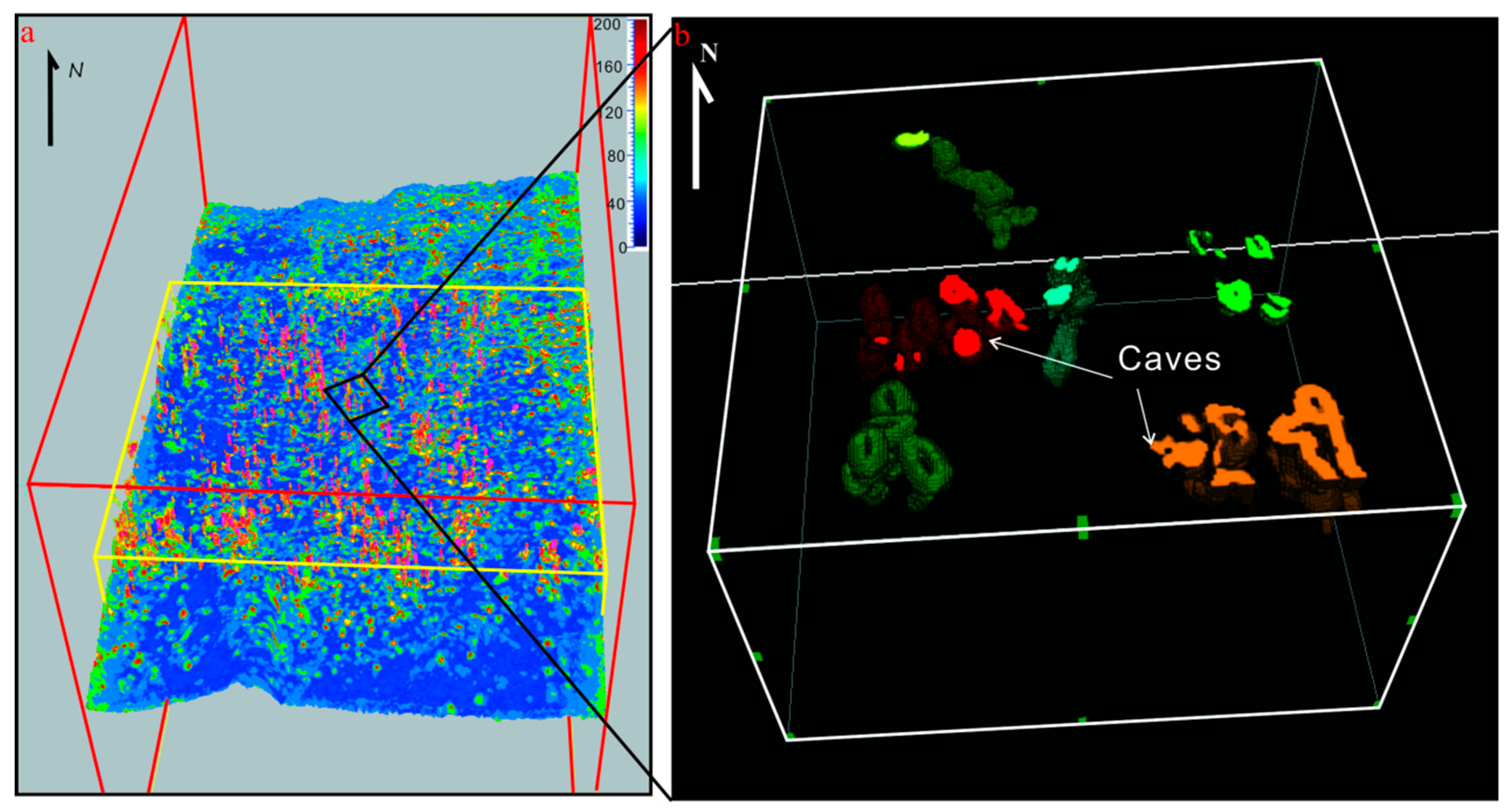
- Signal enhancement and target recognition: The SVI software enhances the signals of fractures and geological bodies (such as caves and reservoirs). This process strengthens the signal from specific regions in the seismic data (e.g., fracture zones or reservoirs), increasing its contrast with surrounding rock layers to enhance the clarity of the target signal. Common enhancement methods include amplitude adjustment, frequency amplification, and differential processing of local areas. The enhanced signals help highlight the characteristics of fractures and geological bodies, facilitating further target recognition.
- (3)
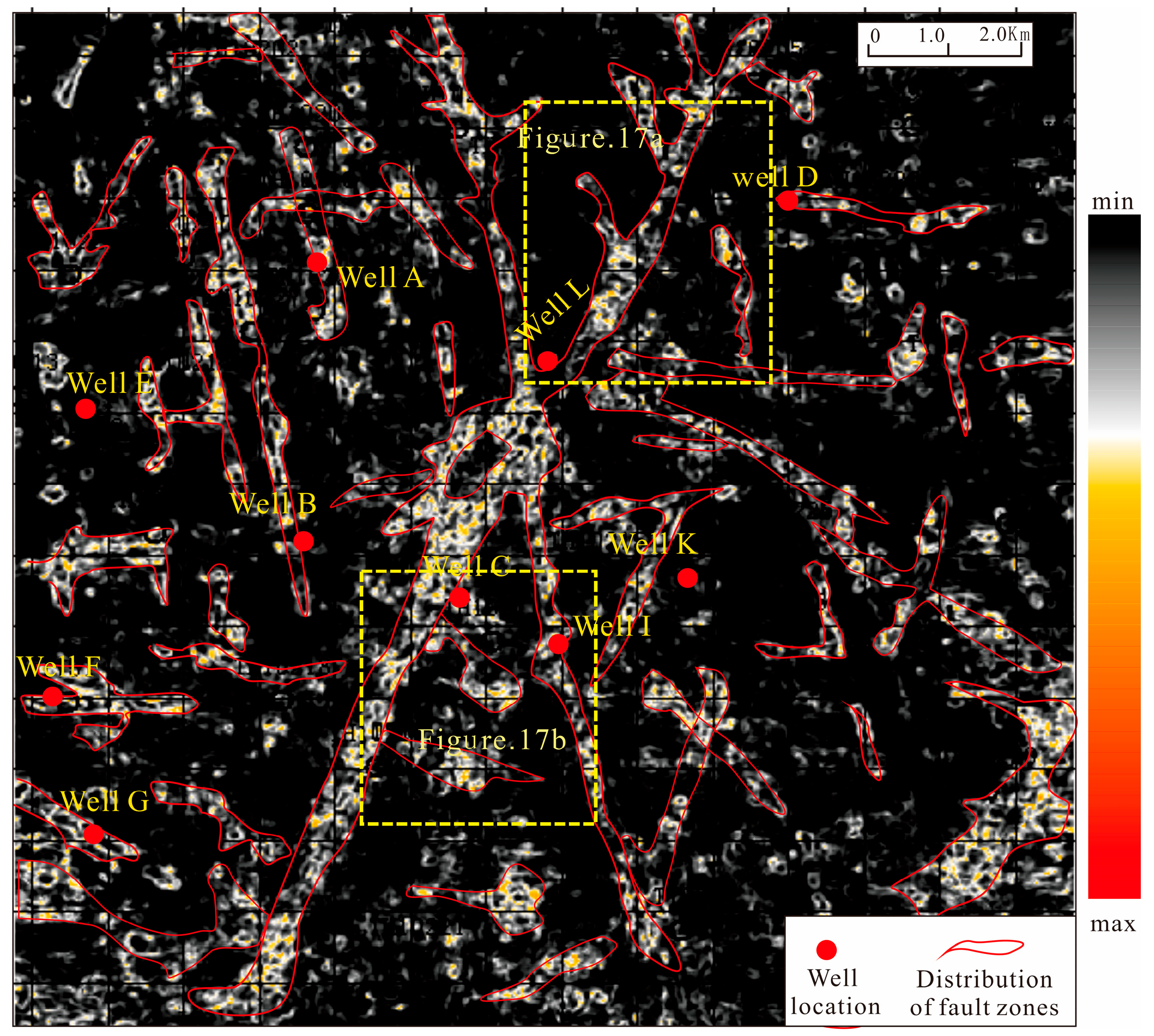
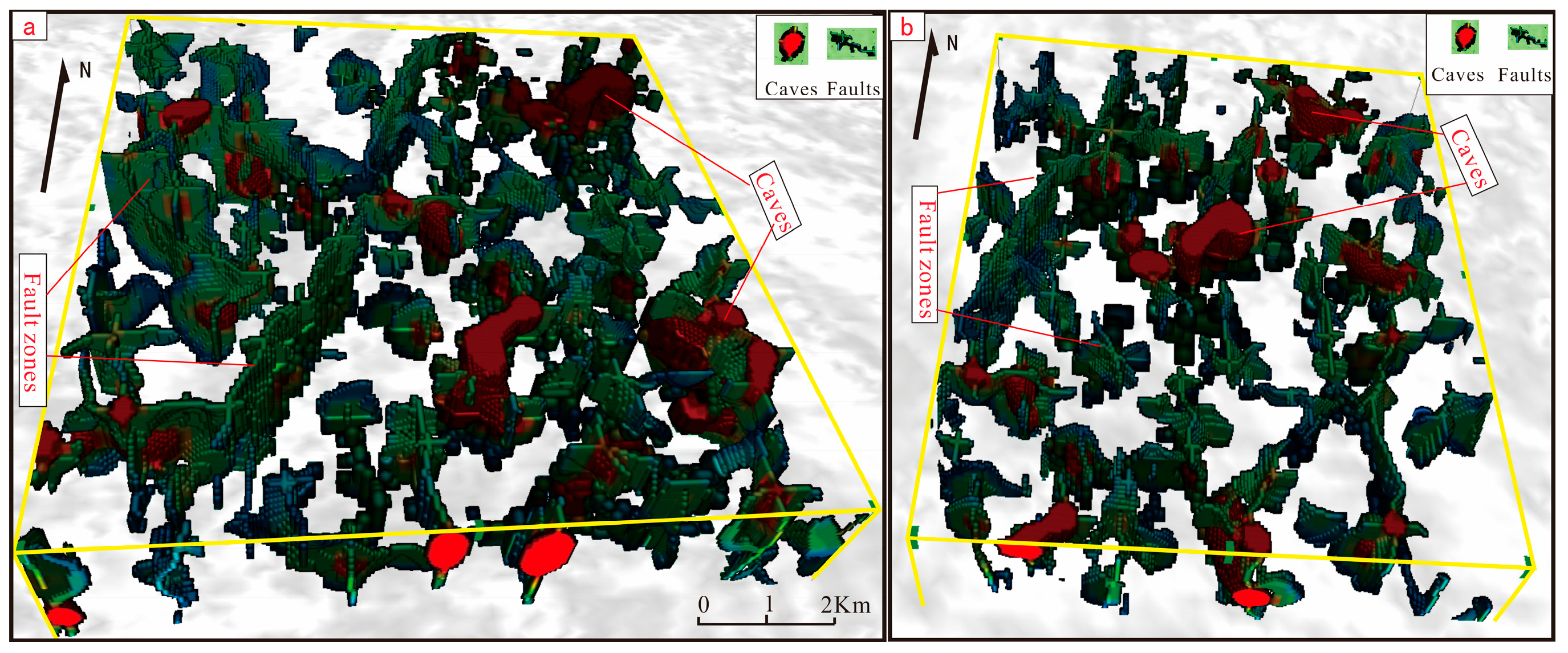
- Data fusion and visualization: The SVI software fuses the data of identified fractures and geological bodies. This step integrates different data sources (such as spatial coordinates, physical properties, and geometric forms) to construct a comprehensive geological model. The software performs spatial registration, coordinate transformation, and attribute fusion to ensure the compatibility and consistency of different datasets. Through this data fusion, a complete spatial distribution map of fractures and geological bodies can be obtained. Finally, the SVI software uses advanced visualization techniques to display the fused geological data in the form of 3D models or cross-sectional diagrams.
3.2. Geochemistry
4. Results
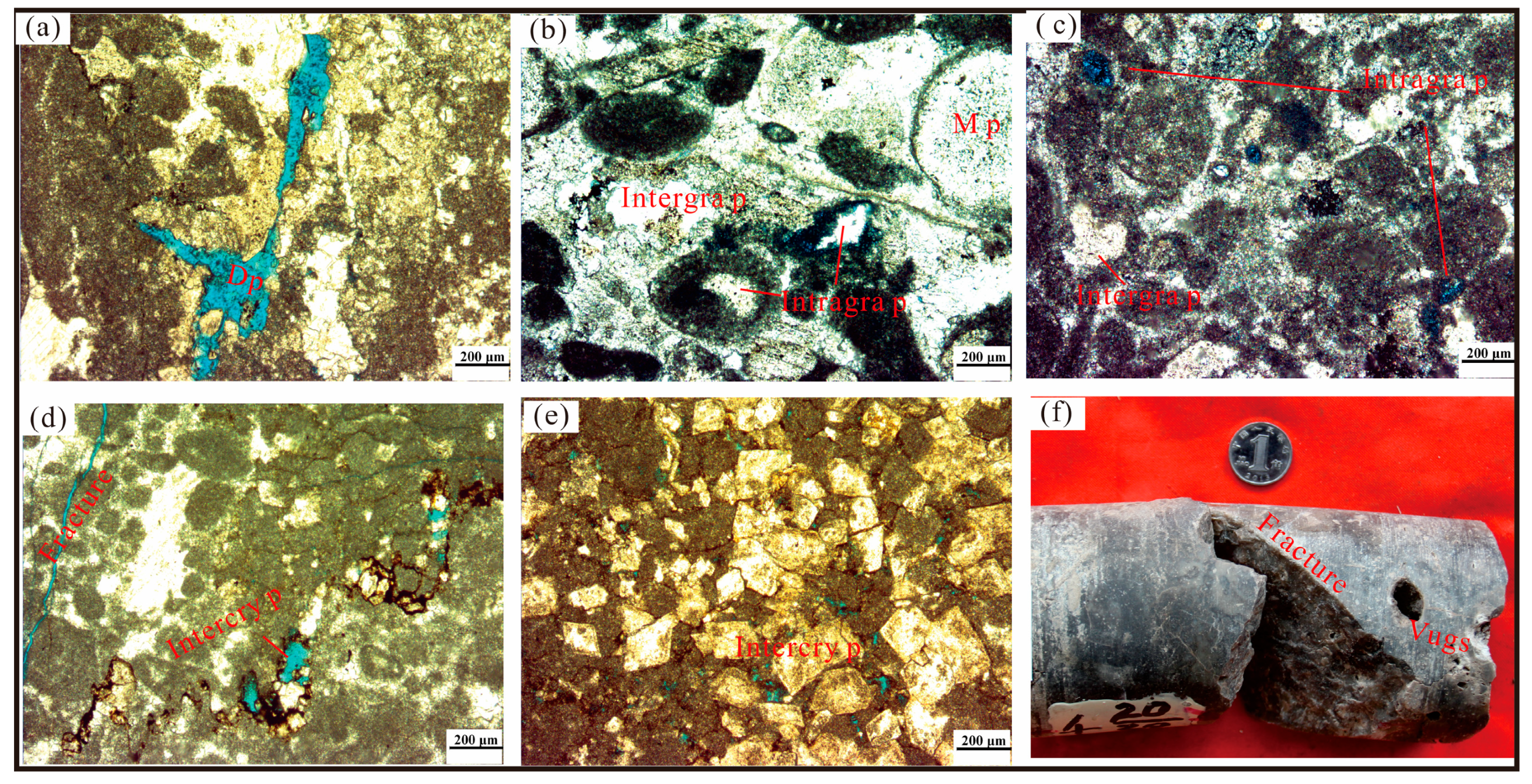
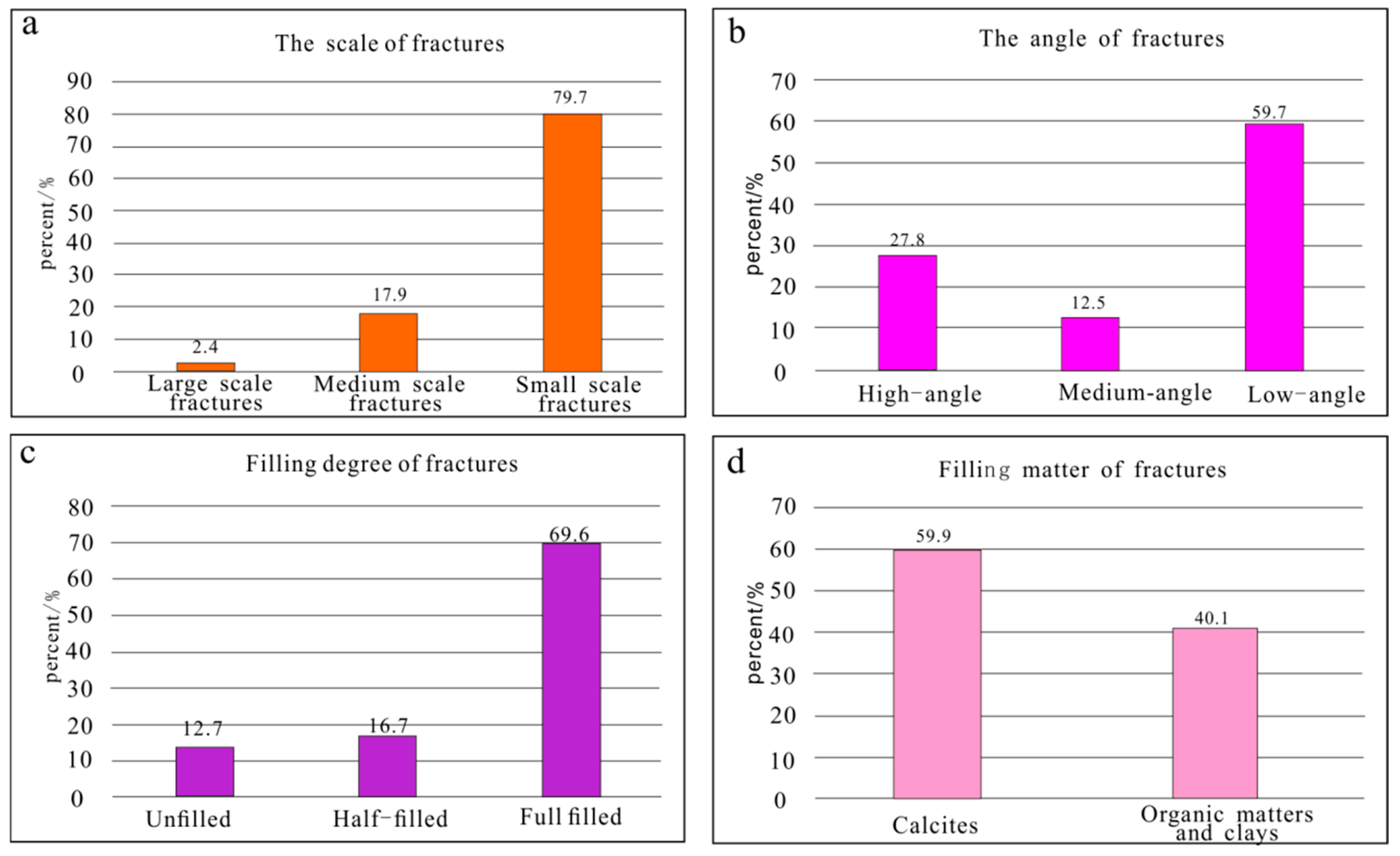
4.1. Reservoir Types and Characteristics
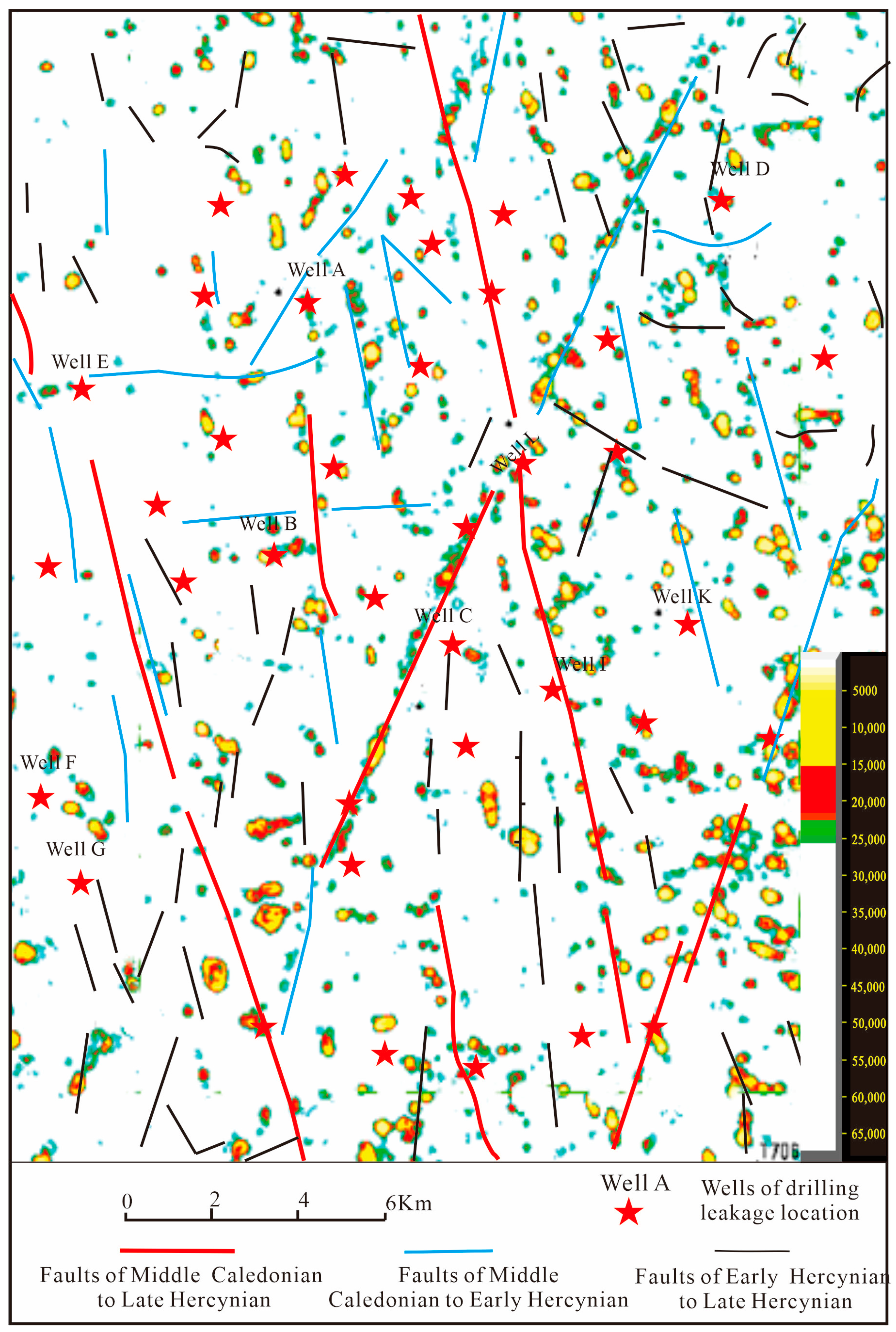
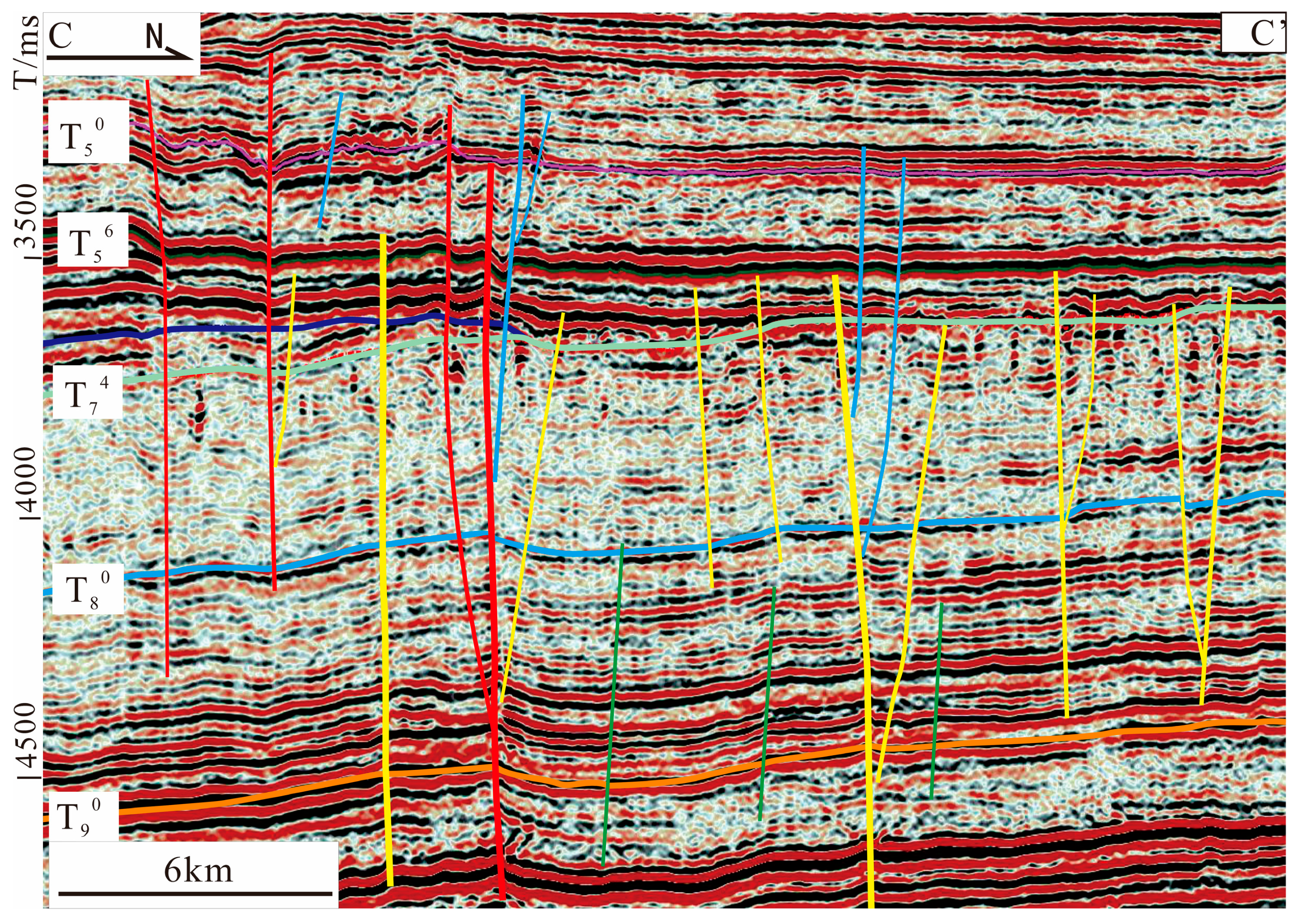
4.2. Paleozoic Fault Characteristics and Evolution
4.2.1. Multi-Stages of Paleozoic Faults
- (1)
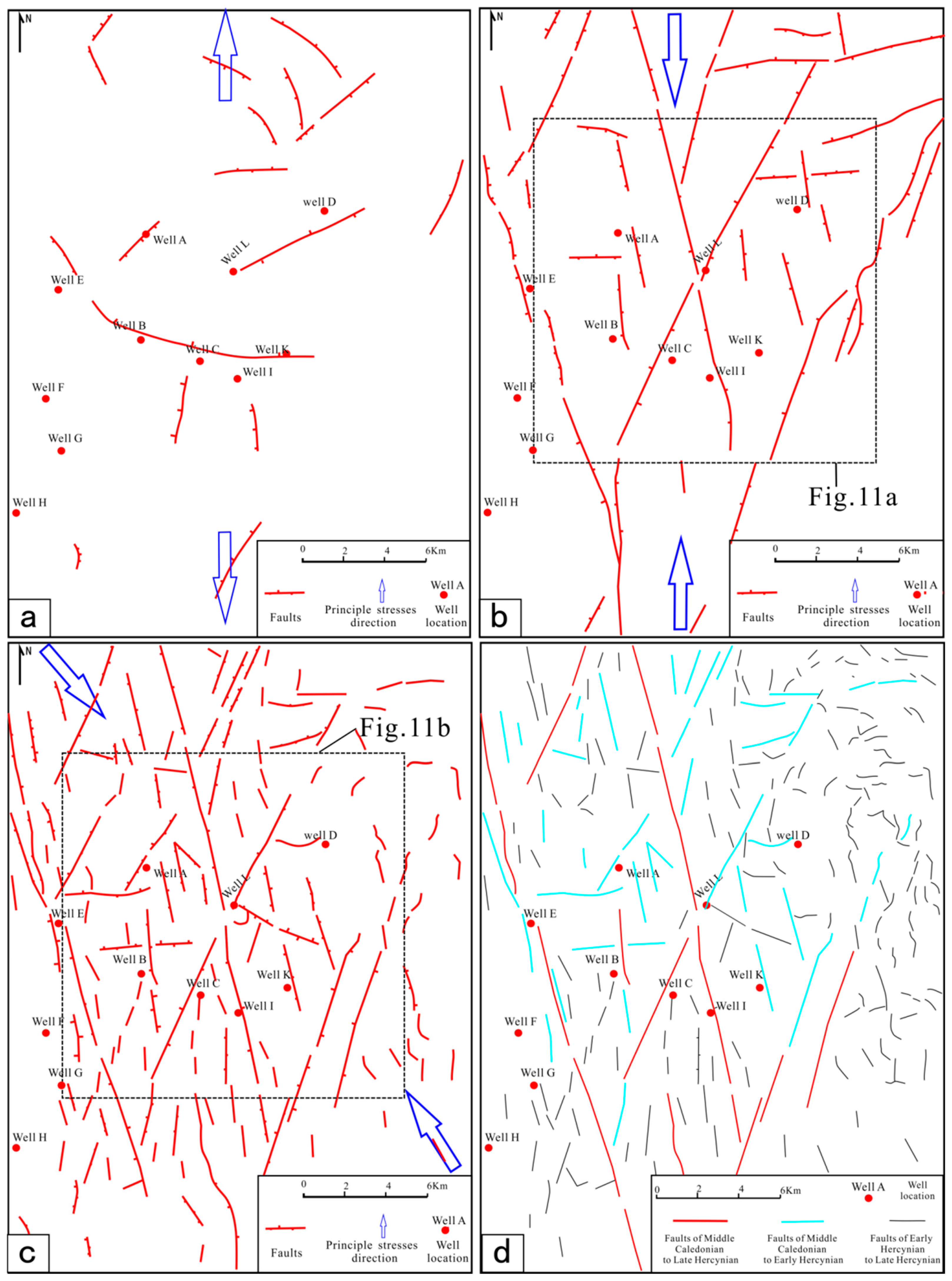
- Extensional normal faults during the Cambrian–Early Ordovician
- (2)
- Strike-slip faults in the Middle Ordovician
- (3)
- Reactivation of strike-slip faults in the Silurian–Devonian
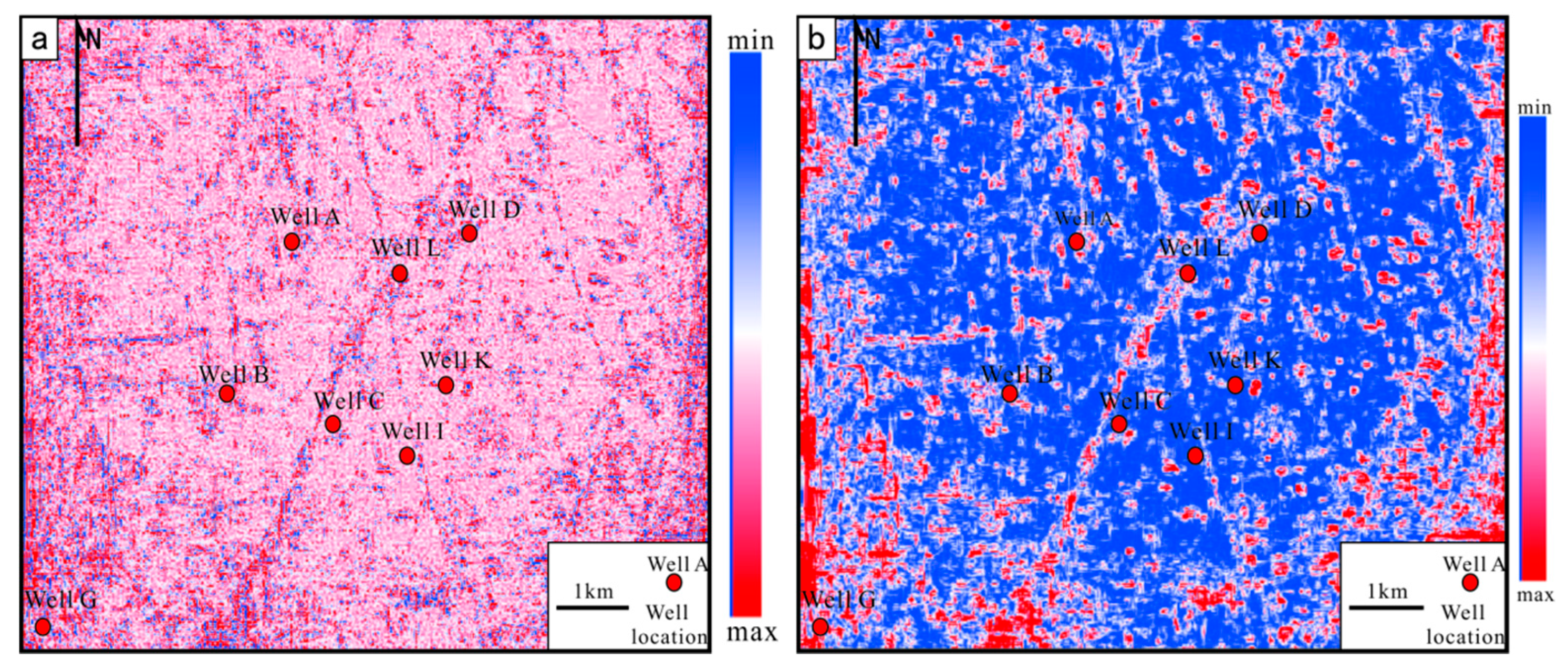
- (4)
- Faults related to volcanic activities during the Permian
4.2.2. Inheritance of Paleozoic Faults
- (1)
- From Middle Caledonian to Late Hercynian continual activity
- (2)
- From Middle Caledonian to Early Hercynian continual activity
- (3)
- Early Hercynian and Late Hercynian active faults
4.3. Geochemical Characteristics
4.3.1. C and O Isotopes
4.3.2. Sr Isotope
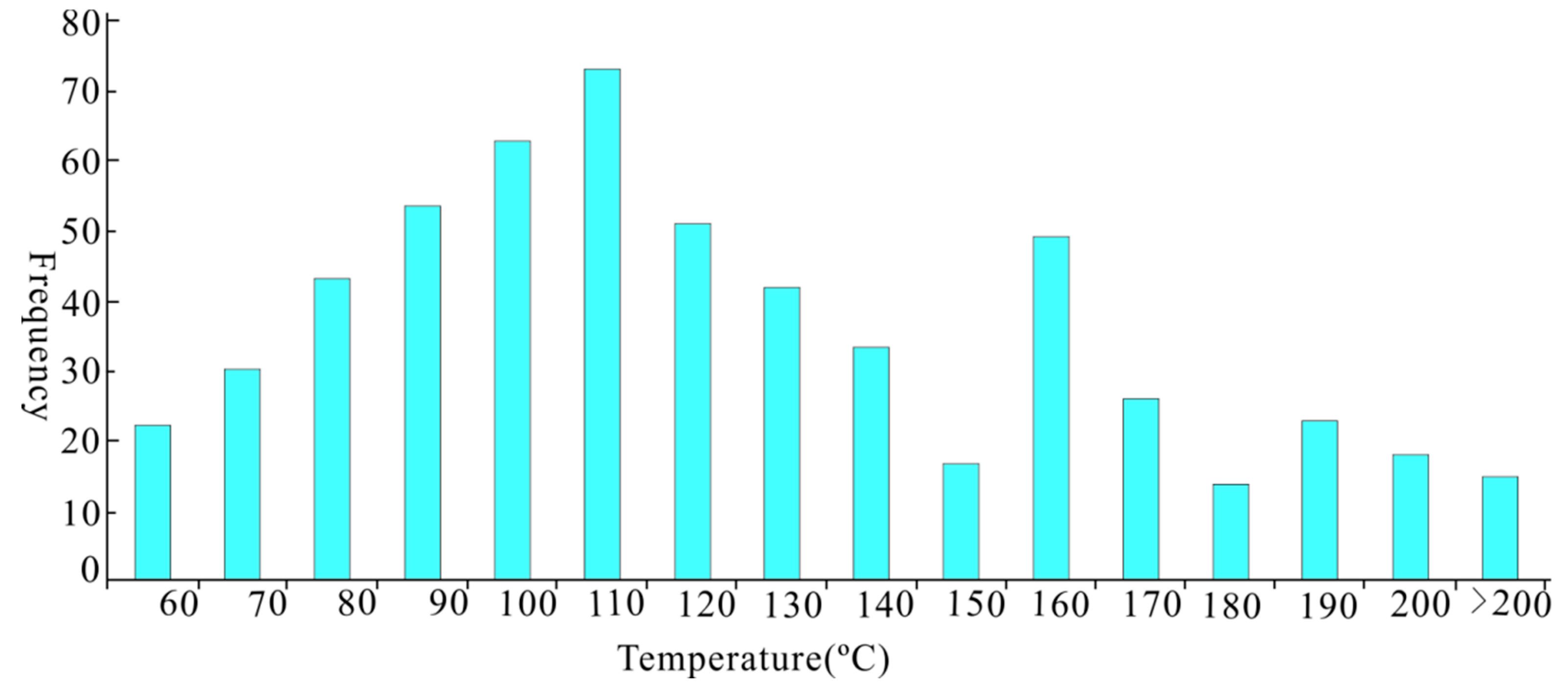
4.3.3. Fluid Inclusions
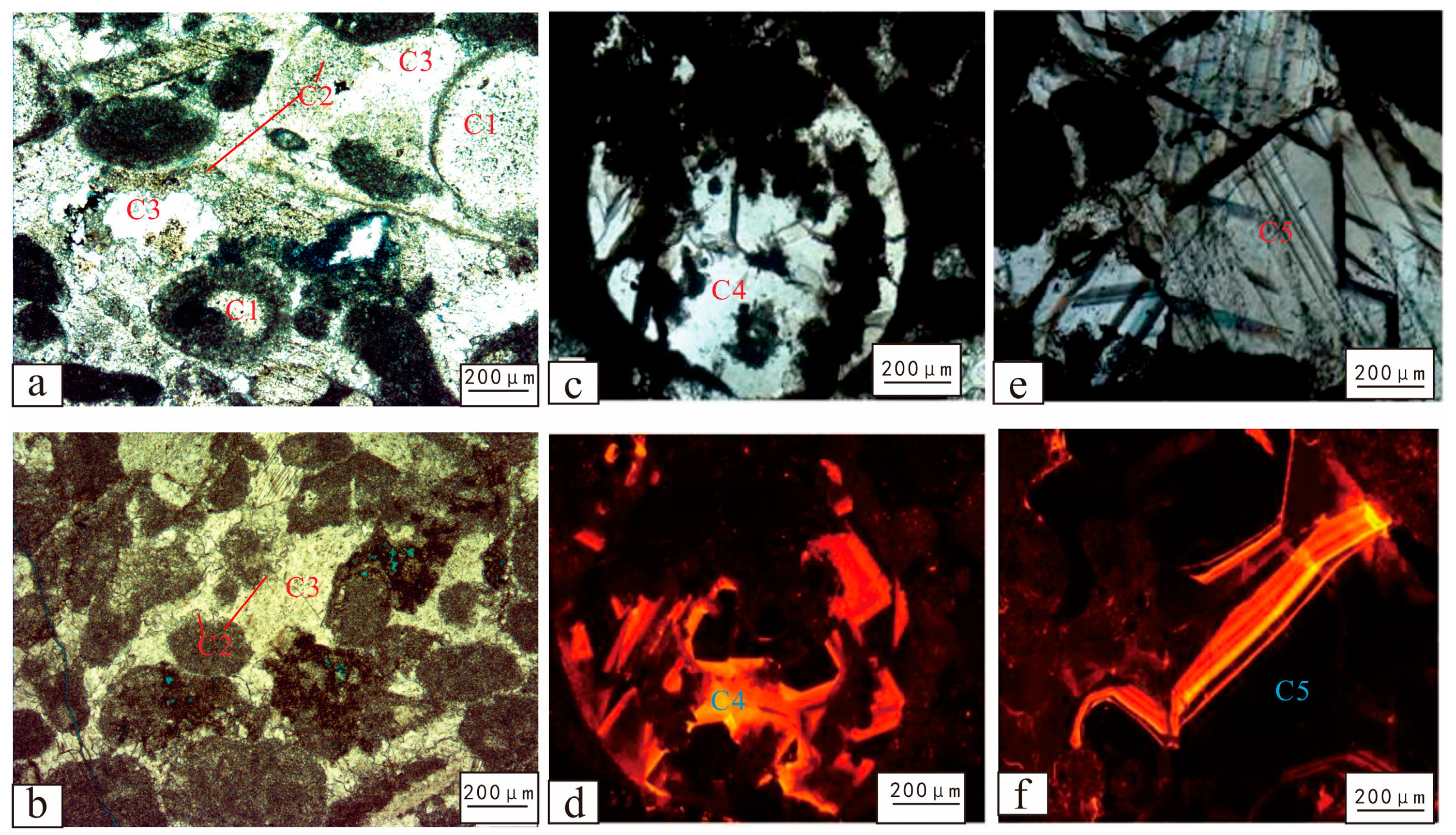
4.4. Fluids Types and Evolution Constraints According to Petrological and Geochemical Characteristics
5. Discussion
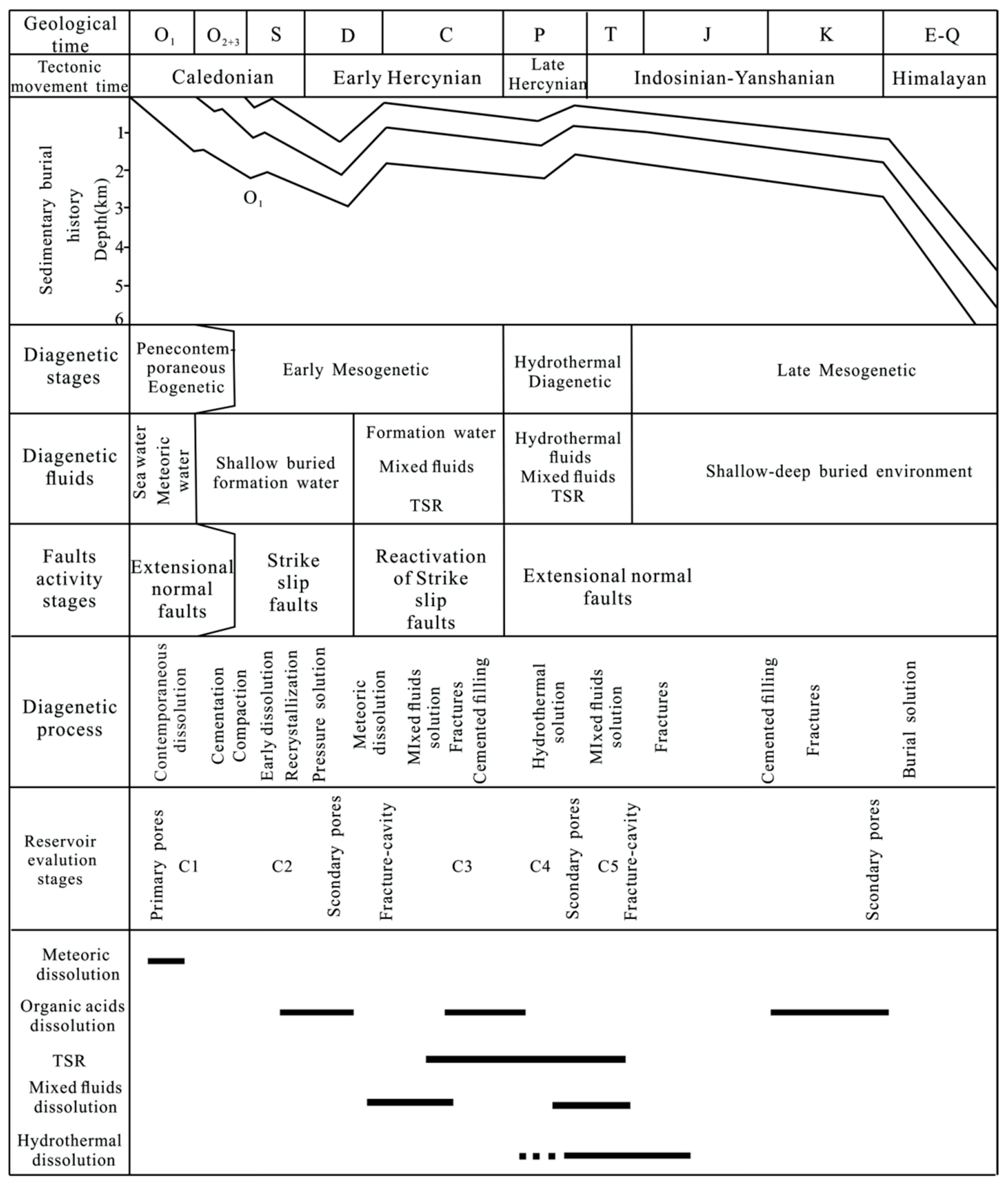
5.1. Diagenesis and Fluid Evolution
5.2. Effect of Faults on Carbonate Reservoir Development
5.3. Effect of Strike-Slip Faults and Diagenetic Fluids on the Origin and Evolution of Carbonate Reservoirs
6. Conclusions
7. Research Limitations
8. Patents
Author Contributions
Funding
Data Availability Statement
Conflicts of Interest
References
- Zenger, D.H.; Junham, J.B.; Ethington, R.L. Concepts and Models of Dolomitization; SEPM Special Publication; SEPM Society for Sedimentary Geology: Tulsa, OK, USA, 1980; Volume 28, p. 320. [Google Scholar]
- Pang, X.Q.; Jia, C.Z.; Pang, H.; Yang, H.J. Destruction of hydrocarbon reservoirs due to tectonic modifications: Conceptual models and quantitative evaluation on the Tarim Basin, China. Mar. Pet. Geol. 2018, 91, 401–421. [Google Scholar] [CrossRef]
- Yousufia, M.M.; Elhaja, M.E.M.; Moniruzzamanb, M.; Abdalla, M. A review on use of emulsified acids for matrix acidizing in carbonate reservoirs. Int. J. Appl. Eng. Res. 2018, 13, 8151–8164. [Google Scholar] [CrossRef]
- He, Z.L.; Zhang, J.T.; Ding, Q.; You, D.H.; Peng, S.T.; Zhu, D.Y.; Qian, Y.X. Factors controlling the formation of high-quality deep to ultra-deep carbonate reservoirs. Oil Gas Geol. 2017, 38, 633–644. [Google Scholar]
- Ma, Y.S.; He, Z.L.; Zhao, P.R.; Zhu, H.Q.; Han, J.; You, D.H.; Zhang, J.T. A new progress in formation mechanism of deep and ultra-deep carbonate reservoir. Acta Pet. Sin. 2019, 40, 1415–1425. [Google Scholar]
- IHS. Energy-World [EB/OL]. Houston, Texas: IHS; 2014-09-01. Available online: https://www.ihs.com/Info/ecc/a/new-energy-world.html (accessed on 1 September 2014).
- Yun, L.; Zhai, X.X. Discussion on characteristics of the Cambrianreservoirs and hydrocarbon accumulation in Well Tashen 1, Tarim Basin. Oil Gas Geol. 2008, 29, 726–732. [Google Scholar]
- Zhu, D.; Meng, Q.; Jin, Z.; Liu, Q.; Hu, W. Formation mechanism of deep Cambrian dolomite reservoirs in the Tarim Basin, northwestern China. Mar. Pet. Geol. 2015, 59, 232–244. [Google Scholar] [CrossRef]
- Zhu, G.Y.; Zou, C.N.; Yang, H.J.; Wang, K.; Zheng, D.M.; Zhu, Y.F.; Wang, Y. Hydrocarbon accumulation mechanisms and industrial exploration depth of large-area fracture–cavity carbonates in the Tarim Basin, western China. Mar. Pet. Geol. 2015, 133, 889–907. [Google Scholar] [CrossRef]
- Wu, G.H.; Zhao, K.Z.; Qu, H.Z.; Nicola, S.; Zhang, Y.T.; Han, J.F.; Xu, Y.F. Permeability distribution and scaling in multi-stages carbonate damage zones: Insight from strike-slip fault zones in the Tarim Basin, NW China. Mar. Pet. Geology. 2020, 114, 104208. [Google Scholar] [CrossRef]
- Lan, X.D.; Lü, X.X.; Zhu, Y.M.; Yu, H.F. The geometry and origin of strike-slip faults cutting the Tazhong low rise megaanticline (central uplift, Tarim Basin, China) and their control on hydrocarbon distribution in carbonate reservoirs. Mar. Pet. Geol. 2015, 22, 633–645. [Google Scholar] [CrossRef]
- Hendrix, M.S.; Brassell, A.C.; Carroll, A.R.; Graham, S.A. Sedimentology, organic geochemistry, and petroleum potential of Jurassic coal measures: Tarim, Junggar, and Turpan basins, northwest China. AAPG Bull. 1995, 79, 929–959. [Google Scholar] [CrossRef]
- Jin, Z.J.; Zhu, D.Y.; Hu, W.X.; Zhang, X.F.; Zhang, J.T.; Song, Y.C. Mesogenetic dissolution of the middle Ordovician limestone in the Tahe oilfield of Tarim basin, NW China. Mar. Pet. Geol. 2009, 26, 753–763. [Google Scholar] [CrossRef]
- Han, C.C.; Lin, C.Y.; Lu, X.B.; Tian, J.J.; Ren, L.H.; Ma, C.F. Petrological and geochemical constraints on fluid types and formation mechanisms of the Ordovician carbonate reservoirs in Tahe Oilfield, Tarim Basin, NW China. J. Pet. Sci. Eng. 2019, 178, 106–120. [Google Scholar] [CrossRef]
- Ye, N.; Zhang, S.N.; Qing, H.R.; Lie, Y.T.; Huang, Q.Y.; Liu, D. Dolomitization and its impact on porosity development and preservation in the deeply burial Lower Ordovician carbonate rocks of Tarim Basin, NW China. J. Pet. Sci. Eng. 2019, 182, 106303. [Google Scholar] [CrossRef]
- Loucks, R.G.; Mescher, P.K.; McMechan, G.A. Three-dimensional architecture of a coalesced, collapsed paleocave system in the Lower Ordovician Ellenburger Group, central Texas. AAPG Bull. 2004, 88, 545–564. [Google Scholar] [CrossRef]
- Zeng, H.; Loucks, R.; Janson, X.; Wang, G.; Xia, Y.; Yuan, B.; Xu, L. Three dimensional seismic geomorphology and analysis of the Ordovician paleokarst drainage system in the central Tabei Uplift, northern Tarim Basin, western China. AAPG Bull. 2011, 95, 2061–2083. [Google Scholar] [CrossRef]
- Zeng, H.; Wang, G.; Janson, X.; Loucks, R.; Xia, Y.; Xu, L.; Yuan, B. Characterizing seismic bright spots in deeply buried, ordovician paleokarst strata, Central tabei uplift, tarim Basin, western China. Geophysics 2011, 76, 127–137. [Google Scholar] [CrossRef]
- Yuan, S.X.; Jia, C.Z.; Gao, R.S. Sedimentation characteristics and reservoir geological model of Mid -Lower Ordovician carbonate rock in Tazhong northern slope. Acta Pet. Sin. 2012, 33 (Suppl. S1), 80–88. [Google Scholar]
- Yang, H.; Zhu, G.; Wang, Y.; Su, J.; Zhang, B. The geological characteristics of reservoirs and major controlling factors of hydrocarbon accumulation in the Ordovician of Tazhong area, Tarim Basin. Energy Explor. Exploit. 2014, 32, 345–368. [Google Scholar] [CrossRef]
- Tian, F.; Jin, Q.; Lu, X.; Lei, Y.; Zhang, L.; Zheng, S.; Liu, N. Multi-layered Ordovician paleokarst reservoir detection and spatial delineation: A case study in the Tahe Oilfield, Tarim Basin, Western China. Mar. Pet. Geol. 2016, 69, 53–73. [Google Scholar] [CrossRef]
- Tian, F.; Lu, X.; Zheng, S.; Zhang, H.; Rong, Y.; Yang, D.; Liu, N. Structure and filling characteristics of paleokarst reservoirs in the northern Tarim Basin, revealed by outcrop, core and borehole images. Open Geosci. 2017, 9, 266–280. [Google Scholar] [CrossRef]
- Lu, X.B.; Wang, Y.; Tian, F.; Li, X.; Yang, D.; Li, T.; He, X. New insights into the carbonate karstic fault system and reservoir formation in the Southern Tahe area of the Tarim Basin. Mar. Pet. Geol. 2017, 86, 587–605. [Google Scholar] [CrossRef]
- Tian, F.; Luo, X.R.; Zhang, W. Integrated geological-geophysical characterizations of deeply buried fractured-vuggy carbonate reservoirs in Ordovician strata, Tarim Basin. Mar. Pet. Geol. 2019, 99, 292–309. [Google Scholar] [CrossRef]
- Wu, G.H.; Yang, H.J.; He, S.; Cao, S.J.; Liu, X.; Jing, B. Effects of structural segmentation and faulting on carbonate reservoir properties: A case study from the Central Uplift of the Tarim Basin, China. Mar. Pet. Geol. 2016, 71, 183–197. [Google Scholar] [CrossRef]
- Li, Y.; Xue, Z.J.; Cheng, Z.; Jiang, H.J.; Wang, R.Y. Progress and development directions of deep oil and gas exploration and development in China. China Pet. Explor. 2020, 25, 43–57. [Google Scholar]
- Lu, X.B.; Hu, W.G.; Wang, Y.; Li, X.H.; Li, T.; Lv, Y.P.; He, X.M.; Yang, D.B. Characteristics and development practice of fault-karst carbonate reservoirs in Tahe area, Tarim Basin. Oil Gas Geol. 2015, 36, 347–354. [Google Scholar]
- Dong, S.; Li, Z.; Jiang, L. The ordovicianesilurian tectonic evolution of the northeastern margin of the tarim block, NW China: Constraints from detrital zircon geochronological records. J. Asian Earth Sci. 2016, 122, 1–19. [Google Scholar] [CrossRef]
- Lu, Z.Y.; Chen, H.H.; Qing, H.R.; Chi, G.X.; Chen, Q.L.; You, D.H.; Yin, H.; Zhang, S.Y. Petrography, fluid inclusion and isotope studies in Ordovician carbonate reservoirs in the Shunnan area, Tarim basin, NW China: Implications for the nature and timing of silicification. Sediment. Geol. 2017, 359, 29–43. [Google Scholar] [CrossRef]
- Kim, Y.S.; Sanderson, D.J. Structural similarity and variety at the tips in a wide range of strike–slip faults: A review. Terra Nova 2006, 18, 330–344. [Google Scholar] [CrossRef]
- Aydin, A.; Berryman, J.G. Analysis of the growth of strike-slip faults using effective medium theory. J. Struct. Geol. 2010, 32, 1629–1642. [Google Scholar] [CrossRef]
- Storti, F.; Billi, A.; Salvini, F. Particle size distribution in natural carbonate fault rocks: Insights for non-self similar cataclasis. Earth Planet. Sci. Lett. 2003, 206, 173–186. [Google Scholar] [CrossRef]
- Micarelli, L.; Benedicto, A.; Wibberley, C.A.J. Structural evolution and permeability of normal fault zones in highly porous carbonate rocks. J. Struct. Geol. 2006, 28, 1214–1227. [Google Scholar] [CrossRef]
- Agosta, F.; Prasad, M.; Aydin, A. Physical properties of carbonate fault rocks, Fucino basin (Central Italy): Implications for fault seal in platform carbonates. Geofluids 2007, 7, 19–32. [Google Scholar] [CrossRef]
- Childs, C.; Manzocchi, T.; Walsh, J.J.; Bonson, C.G.; Nicol, A.; Schöpfer, M.P.J. A geometric model of fault zone and fault rock thickness variations. J. Struct. Geol. 2009, 31, 117–127. [Google Scholar] [CrossRef]
- Choi, J.H.; Edwards, P.; Ko, K.; Kim, Y.S. Definition and classification of fault damage zones: A review and a new methodological approach. Earth-Sci. Rev. 2016, 152, 70–87. [Google Scholar] [CrossRef]
- Agosta, F. Fluid flow properties of basin-bounding normal faults in platform carbonates, Fucino Basin, central Italy. In the Internal Structure of Fault Zones: Implications for Mechanical and Fluid-flow Properties; Wibberley, C.A.J., Kurz, W., Imber, J., Holdsworth, R.E., Collettini, C., Eds.; Special Publications; Geological Society: London, UK, 2008; Volume 299, pp. 277–291. [Google Scholar]
- Williams, R.T.; Goodwin, L.B.; Mozley, P.S. Diagenetic controls on the evolution of fault-zone architecture and permeability structure: Implications for episodicity of fault-zone fluid transport in extensional basins. GSA Bull. 2017, 129, 464–478. [Google Scholar] [CrossRef]
- Jia, L.Q. Sulfur isotopic compositions of individual organosulfur compounds and their genetic links in the Lower Paleozoic petroleum pools of the Tarim Basin, NW China. Geochim. Cosmochim. Acta 2016, 182, 88–108. [Google Scholar]
- Yuan, F.; Tian, J.; Hao, F.; Liu, Z.; Zhang, K.; Wang, X. Fault characterization and its significance on hydrocarbon migration and accumulation of western Tazhong Uplift, Tarim Basin: Insight from seismic, geochemistry, fluid inclusion and in situ U-Pb dating. Mar. Pet. Geol. 2024, 170, 107137. [Google Scholar] [CrossRef]
- Gong, F.; Song, Y.; Zeng, L.; Peng, S.; Zou, G.; Wang, G. Effect of fluid saturation on the elastic properties of carbonate rocks with different pore structures in a strike-slip fault zone. Geoenergy Sci. Eng. 2025, 255, 214110. [Google Scholar] [CrossRef]
- Yu, J.B.; Li, Z.; Yang, L. Fault system impact on paleokarst distribution in the Ordovician Yingshan Formation in the central Tarim basin, northwest China. Mar. Pet. Geol. 2016, 75, 105–118. [Google Scholar] [CrossRef]
- Li, C.X.; Wang, X.F.; Li, B.L.; He, D.F. Paleozoic fault systems of the Tazhong Uplift, Tarim Basin, China. Mar. Pet. Geol. 2013, 39, 48–58. [Google Scholar] [CrossRef]
- Zhu, G.Y.; Zhang, Z.Y.; Zhou, X.X.; Lia, T.T.; Han, J.F.; Sun, C.H. The complexity, secondary geochemical process, genetic mechanism and distribution prediction of deep marine oil and gas in the Tarim Basin, China. Earth-Sci. Rev. 2019, 39, 48–58. [Google Scholar] [CrossRef]
- Tian, F.; Di, Q.Y.; Jin, Q.; Cheng, F.Q.; Zhang, W.; Lin, L.M.; Wang, Y.; Yang, D.B.; Niu, C.K.; Li, Y.X. Multiscale geological-geophysical characterization of the epigenic origin and deeply buried paleokarst system in Tahe Oilfield, Tarim Basin. Mar. Pet. Geol. 2019, 102, 16–32. [Google Scholar] [CrossRef]
- Xu, B.; Jian, P.; Zheng, H.F.; Zou, H.B.; Zhang, L.F.; Liu, D.Y. U-Pb zircon geochronology and geochemistry of Neoproterozoic volcanic rocks in the Tarim Block of northwest China: Implications for the breakup of Rodinia supercontinent and Neoproterozoic glaciations. Precambrian Res. 2005, 136, 107–123. [Google Scholar] [CrossRef]
- Wu, G.H.; Sun, J.H.; Guo, Q.Y.; Tang, T.; Chen, Z.Y.; Feng, X.J. The distribution of detrital zircon UePb ages and its significance to Precambrian basement in Tarim Basin. Acta Geosci. Sin. 2010, 31, 64–72, (In Chinese with abstract). [Google Scholar]
- Xu, K.; Yu, B.S.; Gong, H.N.; Ruan, Z.; Pan, Y.L.; Ren, Y. Carbonate reservoirs modified by magmatic intrusions in the Bachu area, Tarim Basin, NW China. Mar. Pet. Geol. 2015, 6, 779–790. [Google Scholar] [CrossRef]
- Ding, W.L.; Fan, T.L.; Yu, B.S.; Huang, X.B.; Liu, C. Ordovician carbonate reservoir fracture characteristics and fracture distribution forecasting in the Tazhong area of Tarim Basin, Northwest China. J. Pet. Sci. Eng. 2012, 86–87, 62–70. [Google Scholar] [CrossRef]
- Denison, R.E.; Koepnick, R.B.; Burke, W.H.; Hetherington, E.A. Construction of the Cambrian and Ordovician seawater 87Sr/86Sr curve. Chem. Geol. 1998, 152, 325–340. [Google Scholar] [CrossRef]
- Han, C.C.; Tian, J.J.; Hu, C.L.; Liu, H.L.; Wang, W.F.; Huan, Z.P.; Feng, S. Lithofacies characteristics and their controlling effects on reservoirs in buried hills of metamorphic rocks: A case study of late Paleozoic units in the Aryskum depression, South Turgay Basin, Kazakhstan. J. Pet. Sci. Eng. 2020, 191, 107–137. [Google Scholar] [CrossRef]
- Ngong, R.N.; Hu, M.Y.; Gao, D. Tectonic and geothermal controls on dolomitization and dolomitizing fluid flows in the Cambrian-Lower Ordovician carbonate successions in the western and central Tarim basin, NW China. J. Asian Earth Sci. 2019, 172, 359–382. [Google Scholar] [CrossRef]
- Wu, J.; Fan, T.L.; Gao, Z.Q.; Yin, X.X.; Fan, X.; Li, C.C.; Yue, W.Y.; Lia, C.; Zhang, C.J.; Zhang, J.H.; et al. A conceptual model to investigate the impact of diagenesis and residual bitumen on the characteristics of Ordovician carbonate cap rock from Tarim Basin, China. J. Pet. Sci. Eng. 2018, 168, 226–245. [Google Scholar] [CrossRef]
- Li, P.P.; Hao, F.; Zhang, B.Q.; Zou, H.Y.; Yu, X.Y.; Wang, G.W. Heterogeneous distribution of pyrobitumen attributable to oil cracking and its effect on carbonate reservoirs: Feixianguan Formation in the Jiannan gas field, China. AAPG Bull. 2015, 99, 763–789. [Google Scholar] [CrossRef]
- Chen, L.; Kang, Z.H.; Li, P.; Rong, Y.M.; Dai, H.B. Development characteristics and geological model of Ordovician karst carbonate reservoir space in Tahe oilfield. Geoscience 2013, 27, 356–365. [Google Scholar]
- Woodcock, N.H.; Sayers, N.J.; Dickson, J.A. Fluid flow history from damage zone cements near the dent and Rawthey faults, NW England. J. Geol. Soc. 2008, 165, 829–837. [Google Scholar] [CrossRef]
- Richey, D.; Evans, J.P. Fault architecture, linkage and internal structure: Field examples from the iron wash fault zone, central Utah. Gulf Coast Assoc. Geol. Soc. 2013, 42, 91–112. [Google Scholar]
- Bonson, C.G.; Childs, C.; Walsh, J.J.; SchPfer, M.P.J.; Carboni, V. Geometric and kinematic controls on the internal structure of a large normal fault in massive limestones: The maghlaq fault, malta. J. Struct. Geol. 2007, 29, 336–354. [Google Scholar] [CrossRef]
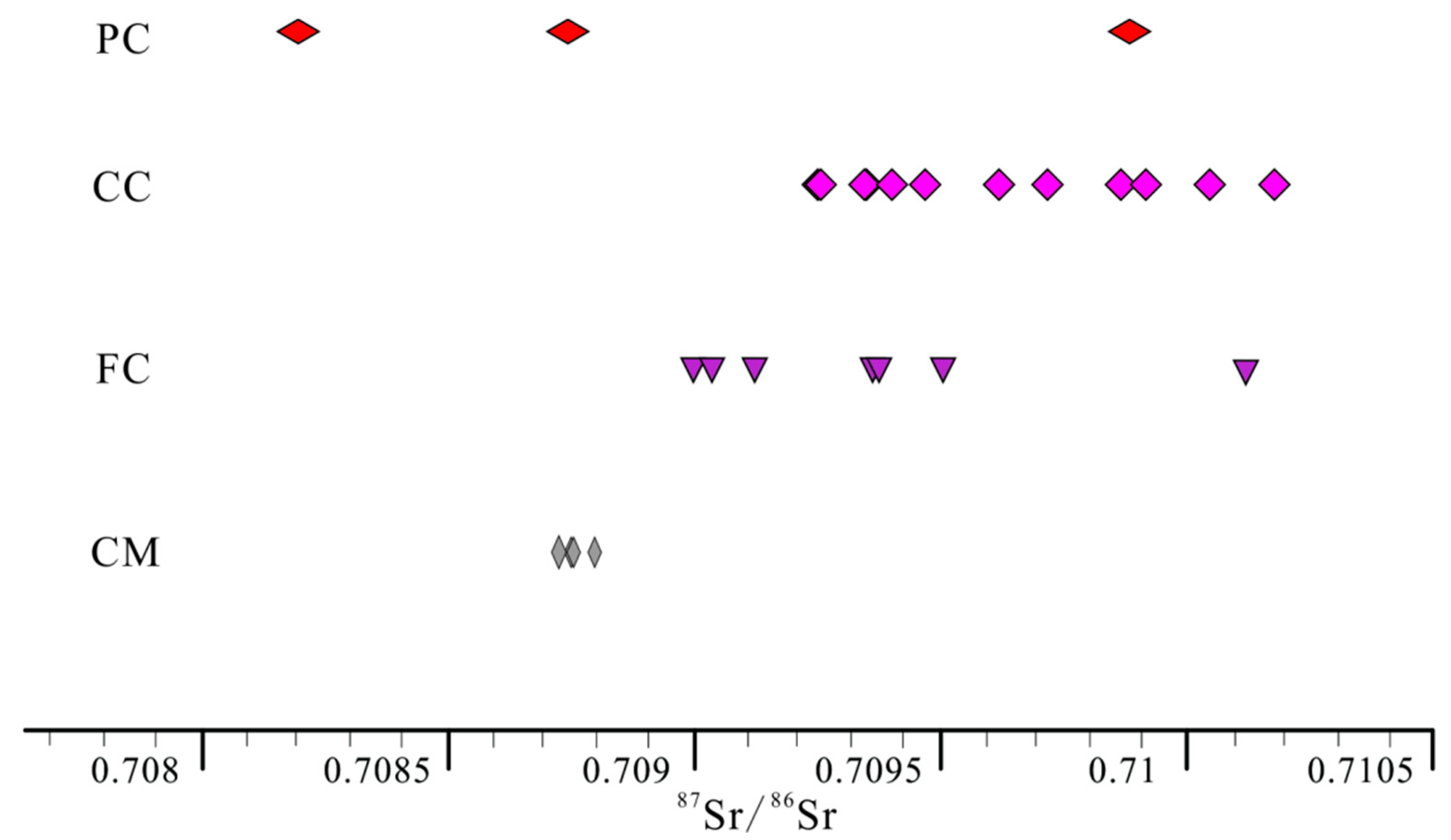
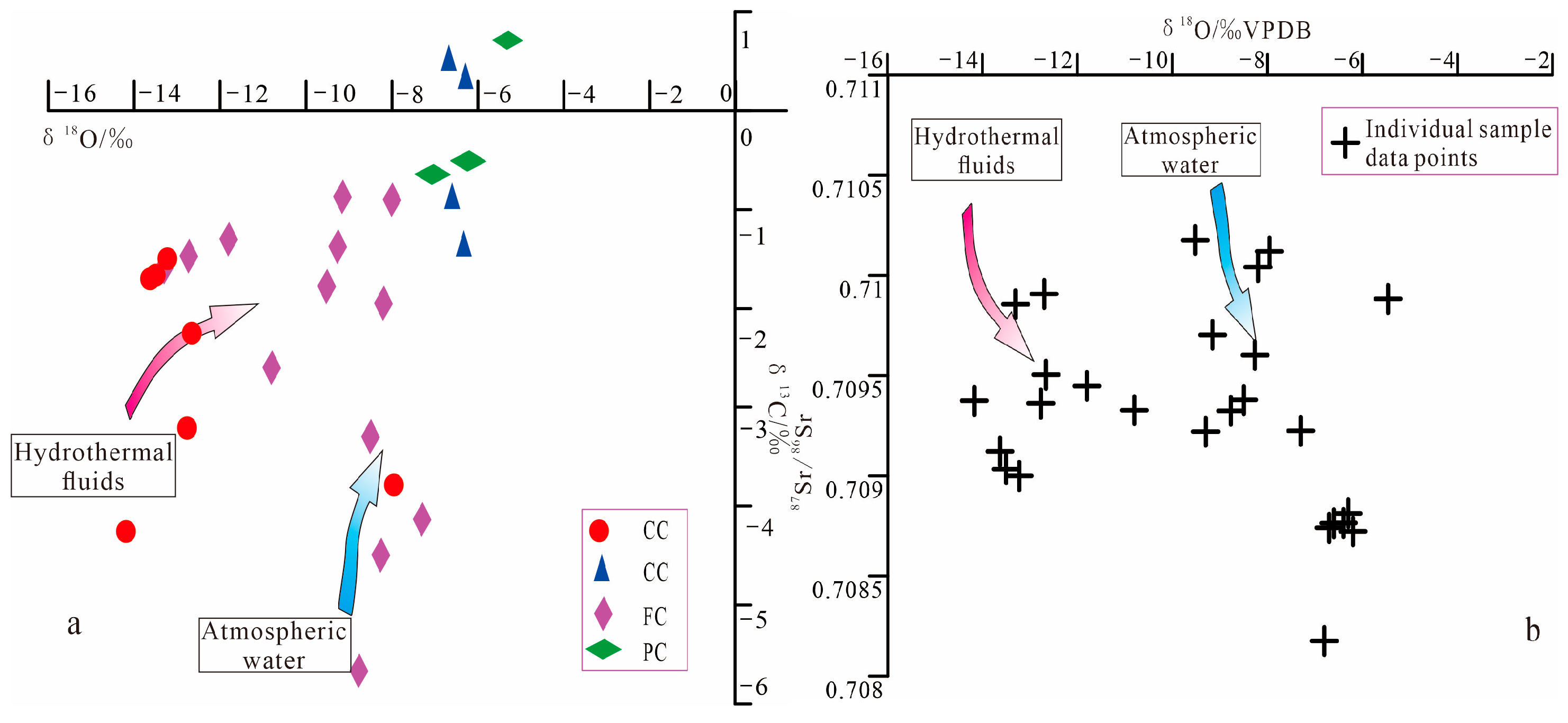

| Sample Number | Formation | Types | Depth (m) | δ13C | δ18O | 87Sr/86Sr | |
|---|---|---|---|---|---|---|---|
| ‰VPDB | ‰VPDB | ||||||
| 2-1 | O1-2y | FC | 5870.7 | −1.3 | −11.8 | 0.709449 | |
| 2-2 | O2yj | CC | 5856.35 | −4.26 | −14.17 | 0.709375 | |
| 2-3 | O1y | CC | 5656.35 | −3.787 | −7.957 | 0.71012 | |
| 2-4 | O2yj | FC | 5586.81 | −4.499 | −8.261 | 0.709603 | |
| 2-5 | O2yj | FC | 5806.35 | −2.6 | −10.8 | 0.709328 | |
| 2-6 | O2yj | FC | 6162.64 | −4.67 | −8.77 | 0.709325 | |
| 2-7 | O2yj | CM | 5723.6 | −1.5 | −6.4 | 0.708765 | |
| 2-8 | O2yj | CM | 5665.1 | −0.9 | −6.6 | 0.708764 | |
| 2-9 | O2yj | CM | 6058.3 | 0.5 | −6.7 | 0.708741 | |
| 2-10 | O2yj | CM | 6180 | 0.3 | −6.3 | 0.708813 | |
| 2-11 | O1y | CC | 5816.33 | −2.25 | −12.66 | 0.709505 | |
| 2-12 | O1y | CC | 5447.5 | −1.498 | −13.227 | 0.709 | |
| 2-13 | O1y | CC | 5447.8 | −1.653 | −13.498 | 0.709035 | |
| 2-14 | O1y | CC | 5448.5 | −1.703 | −13.629 | 0.709122 | |
| 2-15 | O2yj | CC | 5673.5 | −3.21 | −12.77 | 0.709362 | |
| 2-16 | O2yj | PC | 6323.5 | 0.72 | −5.461 | 0.709883 | |
| 2-17 | O2yj | FC | 5896.6 | −1.5 | −12.7 | 0.709908 | |
| 2-18 | O2yj | FC | 5898.66 | −1.778 | −9.519 | 0.710177 | |
| 2-19 | O2yj | FC | 5892.42 | −1.6 | −13.3 | 0.709857 | |
| 2-20 | O1 | FC | 5960.1 | −1.948 | −8.199 | 0.710042 | |
| 2-21 | O1 | FC | 5960.5 | −0.87 | −9.154 | 0.709704 | |
| 2-22 | O2yj | FC | 6078.65 | −4.137 | −7.3 | 0.709225 | |
| 2-23 | O1 | FC | 5693.72 | −3.298 | −8.5 | 0.709379 | |
| 2-24 | O1 | FC | 5958.82 | −1.4 | −9.3 | 0.709221 | |
| 2-25 | O2yj | PC | 5518.01 | −0.6 | −6.2 | 0.708723 | |
| 2-26 | O2yj | PC | 6289.04 | −0.9 | −6.8 | 0.708176 | |
| Diagenetic Stage | Major Period/Event | Dominant Fluids and Sources | Key Diagenetic Processes | Diagnostic Evidence (Isotopes/Th/Structure) | Typical Pores/Fill (Stage) |
|---|---|---|---|---|---|
| Syn-diagenesis | Middle Caledonian – first episode (uplift + meteoric involvement) | Meteoric water (near-surface infiltration) | Selective dissolution; early calcite cementation | Abundant moldic and intergranular pores under microscope; low-temperature interval widespread | Moldic and intergranular pores filled by calcite (C1) |
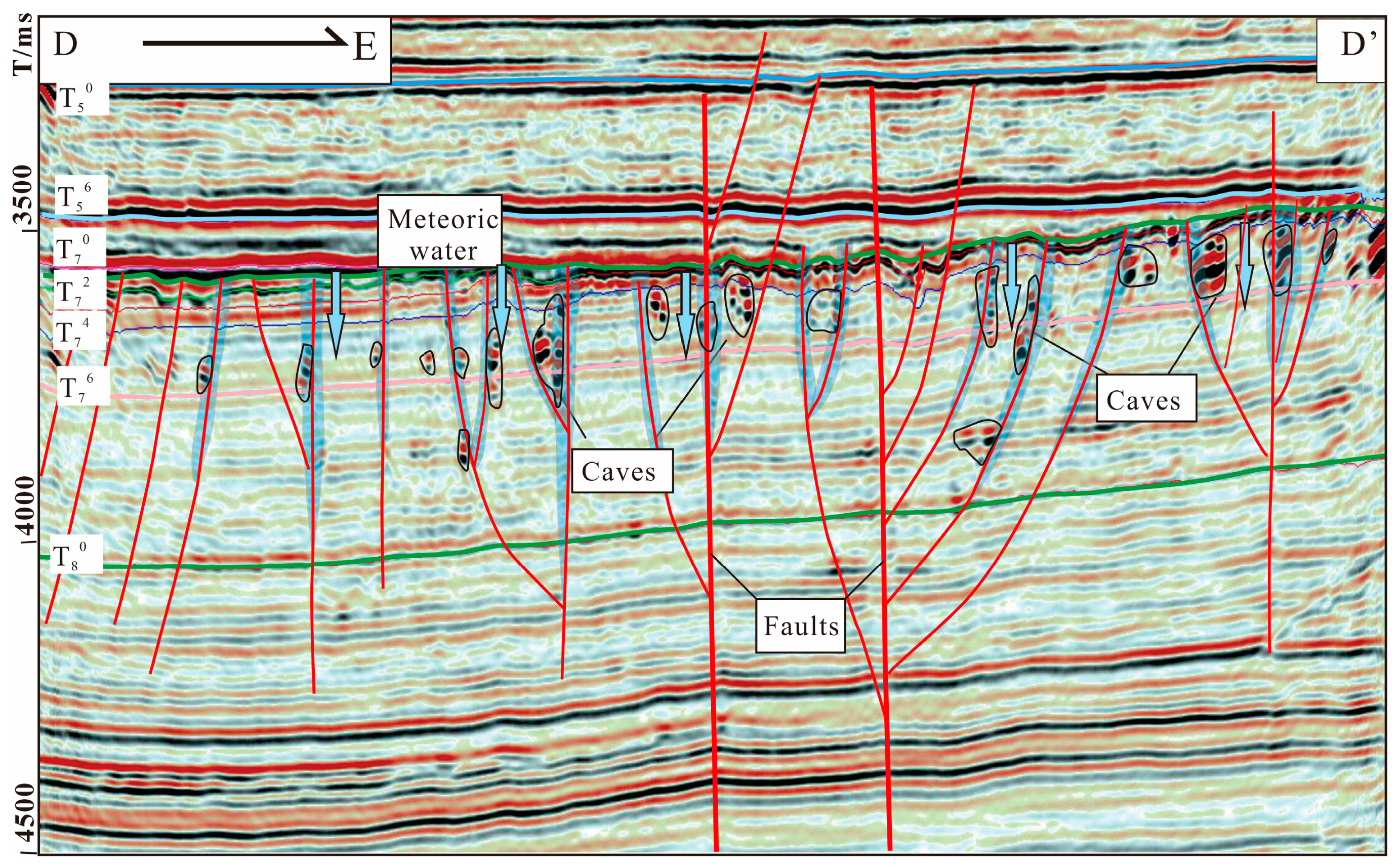
| Early mesogenetic diagenesis | Stable sedimentation–initial burial; Middle Caledonian second/third episodes and Early Hercynian strike-slip faulting | Burial fluids + mixed fluids (meteoric + formation water); organic acids, CO2, H2S | Secondary dissolution, pressure-solution, recrystallization, compaction, cementation and filling; faults enhance downward percolation and mixing | δ18O = −6.8 to −5.5‰; δ13C = −1.5 to 0.72‰; Th = 60–90 °C; mixed fluids: δ18O = −10.8 to −8.2‰, δ13C = −2.6 to −0.87‰; extensive strike-slip faults and fracture networks | Inter-/intragranular dissolution pores later re-filled by calcite (C2 and C3) |
| Hydrothermal diagenesis | Early–Late Permian; intense magmatism/volcanism in Late Hercynian | High-temperature hydrothermal fluids (CO2-, H2S-, SO2-rich); TSR acidity superimposed | Hydrothermal dissolution and overprint; lateral flow along faults and early vugs/caves; mineral precipitation and filling | δ18O = −14.17 to −11.8‰; δ13C = −4.67 to −1.3‰; Th = 160–200 °C; flower structures/strike-slip faults control flow | Large fractures–caves; calcite cements C4 and C5 (with dolomite, quartz, barite, fluorite, etc.) |
| Late mesogenetic diagenesis | Post-stabilization of basin; continued tectonism | Tectonically related fluids + ongoing TSR influence; formation water dominant | Pressure-solution and carbonate cementation dominate; dissolution wanes; compaction and filling increase | Structural–TSR factors dominate pore modification; cement filling increases | Compaction and late filling pores prevail; residual fractures locally |
Disclaimer/Publisher’s Note: The statements, opinions and data contained in all publications are solely those of the individual author(s) and contributor(s) and not of MDPI and/or the editor(s). MDPI and/or the editor(s) disclaim responsibility for any injury to people or property resulting from any ideas, methods, instructions or products referred to in the content. |
© 2025 by the authors. Licensee MDPI, Basel, Switzerland. This article is an open access article distributed under the terms and conditions of the Creative Commons Attribution (CC BY) license (https://creativecommons.org/licenses/by/4.0/).
Share and Cite
Wang, Y.; Chen, H.; Liu, Y.; Wang, S.; Han, C.; Li, Z.; Ma, Y. The Structural and Diagenetic Coupling Controls the Distribution of Deep Carbonate Rock Reservoirs in the Southern of Tahe Oilfield, Tarim Basin. Geosciences 2025, 15, 435. https://doi.org/10.3390/geosciences15110435
Wang Y, Chen H, Liu Y, Wang S, Han C, Li Z, Ma Y. The Structural and Diagenetic Coupling Controls the Distribution of Deep Carbonate Rock Reservoirs in the Southern of Tahe Oilfield, Tarim Basin. Geosciences. 2025; 15(11):435. https://doi.org/10.3390/geosciences15110435
Chicago/Turabian StyleWang, Yan, Huaxin Chen, Yongli Liu, Shilin Wang, Changcheng Han, Zhengqiang Li, and Yu Ma. 2025. "The Structural and Diagenetic Coupling Controls the Distribution of Deep Carbonate Rock Reservoirs in the Southern of Tahe Oilfield, Tarim Basin" Geosciences 15, no. 11: 435. https://doi.org/10.3390/geosciences15110435
APA StyleWang, Y., Chen, H., Liu, Y., Wang, S., Han, C., Li, Z., & Ma, Y. (2025). The Structural and Diagenetic Coupling Controls the Distribution of Deep Carbonate Rock Reservoirs in the Southern of Tahe Oilfield, Tarim Basin. Geosciences, 15(11), 435. https://doi.org/10.3390/geosciences15110435

