Article

Gas Permeability Behavior in Frozen Sand Controlled by Formation and Dissociation of Pore Gas Hydrates


Skolkovo Innovation Center, Skolkovo Institute of Science and Technology, 30. Build. 1, Bolshoi Boulevard, 121205 Moscow, Russia
*
Author to whom correspondence should be addressed.
Geosciences 2022, 12(9), 321; https://doi.org/10.3390/geosciences12090321

Submission received: 5 August 2022 / Revised: 23 August 2022 / Accepted: 23 August 2022 / Published: 28 August 2022
(This article belongs to the Special Issue Permafrost and Gas Hydrate Response to Ground Temperature Rising)

Abstract

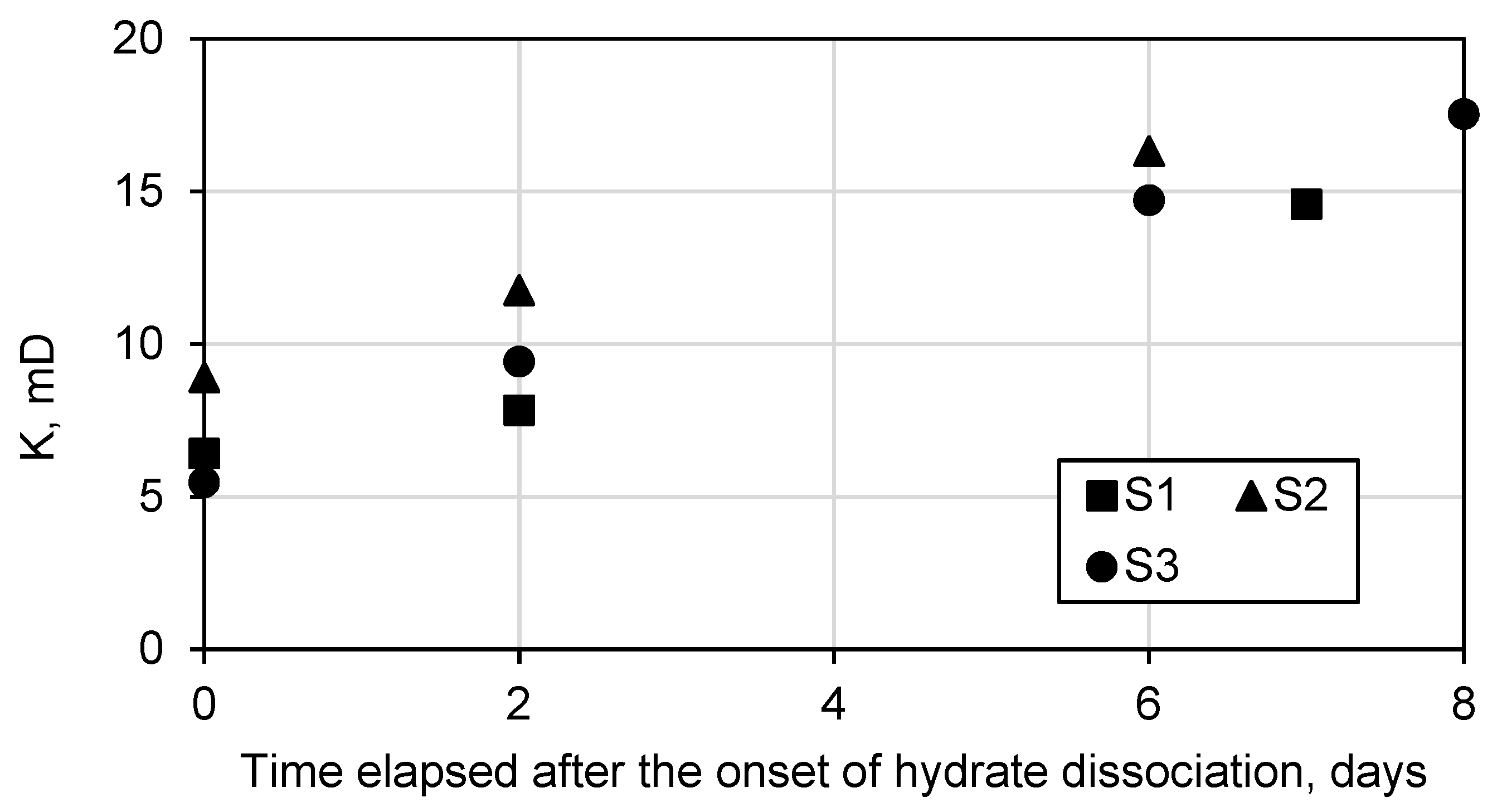
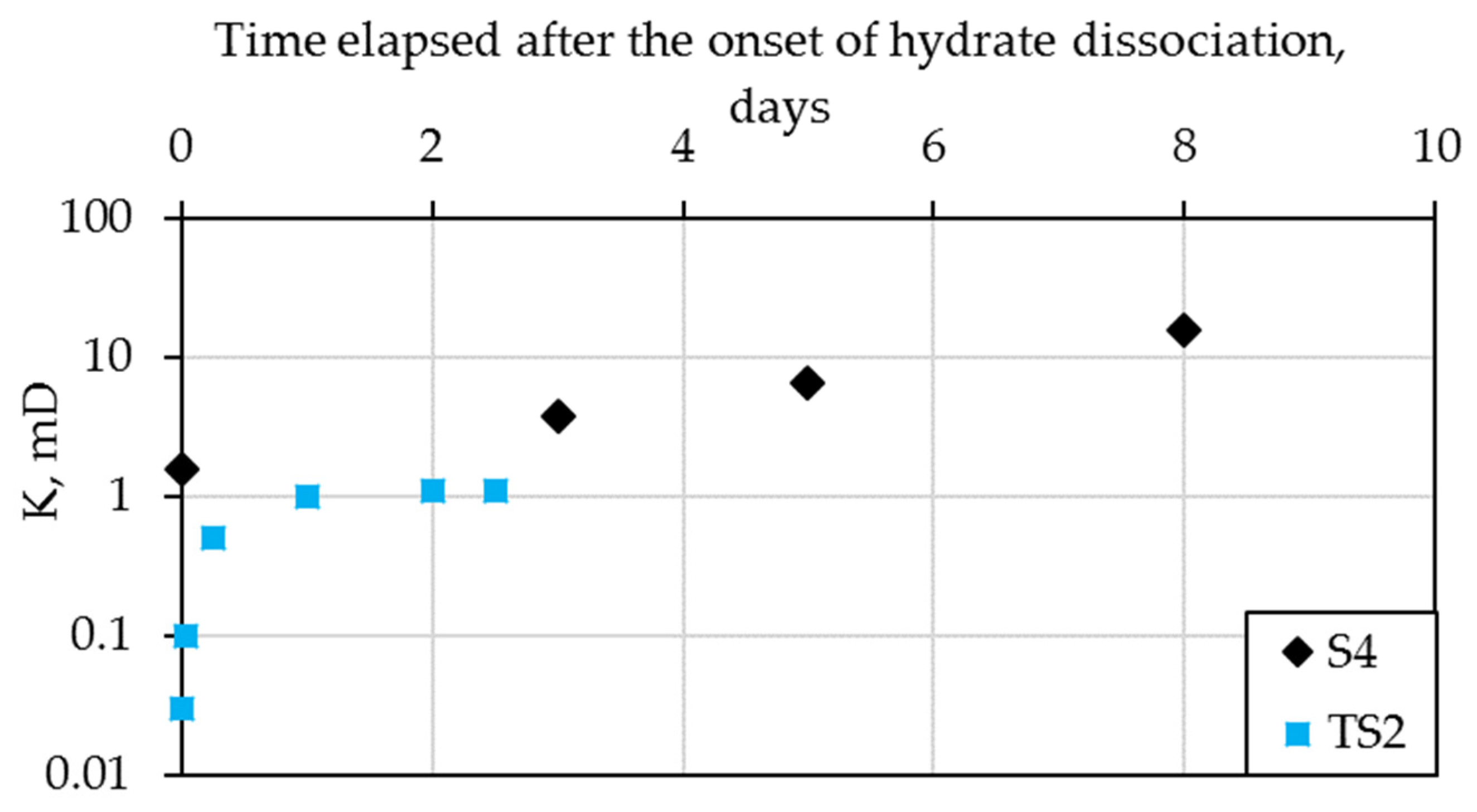
Formation and dissociation of pore gas hydrates in permafrost can change its properties, including fluid flow capacity. Permeability is one of the most significant parameters in the study of hydrate-containing rocks, especially in the case of gas burial or extraction. Gas permeability variations in frozen sand partially saturated with CO2 or CH4 hydrates are studied experimentally at a constant negative temperature of −5 °C, as well as during freezing–thawing cycles. The gas permeability behavior is controlled by the formation and dissociation of pore gas hydrates in frozen sand samples. The samples with an initial ice saturation of 40 to 60% become at least half as permeable, as 40% of pore ice converts to hydrate. The dissociation process of accumulated hydrates was modeled by both depressurizing methane or CO2 to atmospheric pressure and by stepwise injection of gaseous nitrogen up to 3 MPa into a frozen sample. In sand samples, with a decrease in gas pressure and without subsequent injection of nitrogen, a decrease in pore hydrate dissociation due to self-preservation was noted, which is reflected by a deceleration of gas permeability. Nitrogen injection did not lead to a decrease in the rate of dissociation in the frozen hydrate-containing sample, respectively, as there was no decrease in the rate of gas permeability.
Keywords: frozen sand; gas permeability; methane; carbon dioxide; formation, dissociation and self-preservation of pore gas hydrates frozen sand; gas permeability; methane; carbon dioxide; formation, dissociation and self-preservation of pore gas hydrates