
Article

Rock Glacier Dynamics by a Thermo-Elastic-Viscoplastic Constitutive Relationship
1
College of Forestry, Oregon State University, Corvallis, OR 97333, USA
2
Department of Civil and Environmental Engineering, Politecnico di Milano, 20133 Milan, Italy
*
Author to whom correspondence should be addressed.
Geosciences 2021, 11(10), 417; https://doi.org/10.3390/geosciences11100417

Submission received: 20 July 2021 / Revised: 21 September 2021 / Accepted: 28 September 2021 / Published: 7 October 2021
(This article belongs to the Collection Early Career Scientists’ (ECS) Contributions to Geosciences)

Abstract

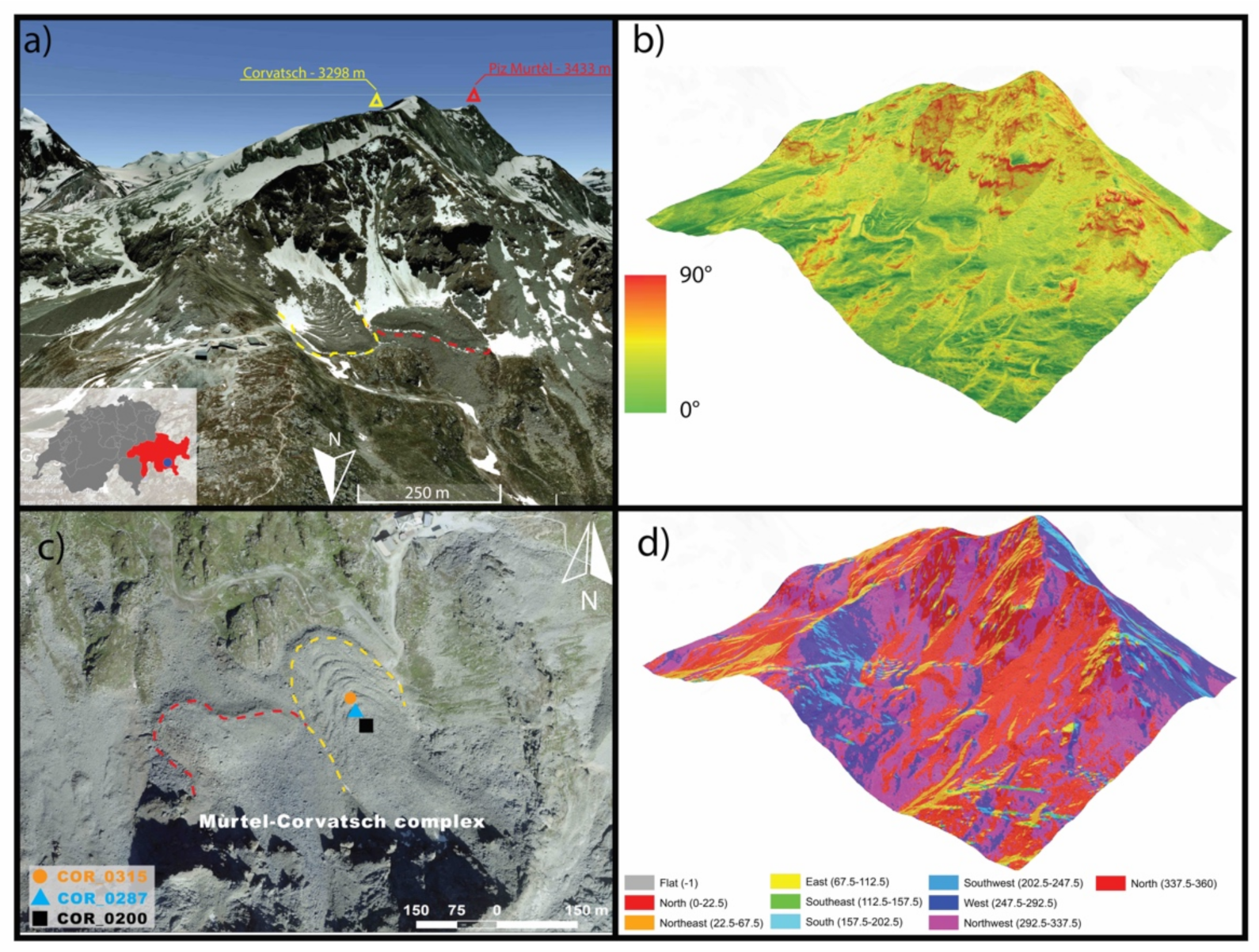
As a result of mountain permafrost creep, rock glaciers are common features in high-altitude periglacial areas. From a practical point of view, beyond their localization and inventorying, both the monitoring and prediction of their evolution due to climate changes are crucial. One of the effects of climate change is the thickening of the basal shear zone (the portion of the rock glacier where most deformations are localized), eventually leading to the development of unexpected and unprecedented (in terms of location, magnitude, frequency, and timing) instability phenomena. These phenomena bear consequences for the understanding of landscape evolution, natural hazards, and the safe and sustainable operation of high-mountain infrastructures. Most of the studies about active rock glaciers are focused on the analysis of monitoring data, while just a few studies are focused on modeling their behavior to understand their possible further evolution. The active rock glacier response is characterized by a viscous (rate-dependent) behavior, influenced by seasonal temperature oscillations, and characterized by a seasonal transition from slow to fast. In this work, a new thermo-mechanical model based on the delayed plasticity theory and calibrated on experimental results is proposed. The model is employed to evaluate the influence of geometry and forcing (air temperature) on a real rock glacier (Murtèl-Corvatsch rock glacier) creep behavior.
Keywords: mountain permafrost; rock glacier; climate change mountain permafrost; rock glacier; climate change