Article

Appropriate Dietary Levels of Soybean Lecithin and Krill Oil Phospholipids Promote Growth, Antioxidant Capacity, and Lipid Metabolism While Reducing Lipid Deposition in Atlantic Salmon (Salmo salar) Fry

1
Fisheries College, Ocean University of China, Qingdao 266003, China
2
School of Marine Science and Engineering, Qingdao Agricultural University, Qingdao 266109, China
3
Qingdao Qicai Seed Technology Co., Ltd., Qingdao 266600, China
4
Engineering Research Centre of Mariculture (Ministry of Education), Ocean University of China, Qingdao 266003, China
*
Authors to whom correspondence should be addressed.
Animals 2026, 16(9), 1393; https://doi.org/10.3390/ani16091393
Submission received: 4 April 2026 / Revised: 26 April 2026 / Accepted: 29 April 2026 / Published: 2 May 2026

Simple Summary

As demand for Atlantic salmon continues to grow rapidly in China, optimizing feed formulation and nutritional management for Atlantic salmon fry is becoming increasingly important for efficient and sustainable aquaculture. In this study, we examined whether two common phospholipid sources, soybean lecithin and krill oil phospholipids, could improve the growth, feed utilization, antioxidant defenses, and fat metabolism of Atlantic salmon fry. We found that appropriate levels of both ingredients in the diet promoted growth, improved feed efficiency, strengthened natural antioxidant defenses, and reduced excess fat buildup in the body and liver. Krill oil phospholipids showed stronger effects on body fatty acids, especially by increasing eicosapentaenoic acid, a beneficial omega-3 fatty acid, and induced more pronounced hepatic gene expression changes related to lipid utilization and immune function. In contrast, phospholipid supplementation had little effect on the overall gut bacterial community. Overall, both phospholipid sources supported healthier early growth in Atlantic salmon fry, while krill oil phospholipids may provide additional metabolic benefits. These findings can help improve feed formulation for salmon fry, reduce excessive lipid deposition, enhance antioxidant capacity, and provide useful guidance for more efficient and sustainable aquaculture.

Abstract

This study evaluated the effects of dietary phospholipid (PL) source and supplementation level on growth performance, antioxidant capacity, and lipid metabolism in Atlantic salmon (Salmo salar) fry. A 56-day feeding trial was conducted using a basal diet containing 1.76% PL and six experimental diets with an additional 1.5%, 3.0%, or 4.5% PL provided by soybean lecithin (SL) or krill oil phospholipids (KOP). Dietary supplementation with 3.0–4.5% SL and 1.5–4.5% KOP significantly improved growth performance, whereas feed conversion ratio was significantly reduced in the 3.0–4.5% SL and 3.0% KOP groups (p < 0.05). At equivalent inclusion levels, no significant differences were observed between SL and KOP in growth performance parameters (p > 0.05). PL supplementation also reduced whole-body lipid deposition and enhanced visceral lipase activity in all groups except the 1.5% SL group, while antioxidant capacity was improved in all PL-supplemented groups (p < 0.05). SL had no significant effect on whole-body fatty acid composition (p > 0.05), whereas moderate to high levels of KOP significantly altered the fatty acid profile, characterized by reduced monounsaturated fatty acids and n-6 polyunsaturated fatty acids, along with increased eicosapentaenoic acid (EPA) levels (p < 0.05). Transcriptomic analysis indicated that PL supplementation affected hepatic lipid metabolism, with both PL sources downregulating apoa2-like, while KOP induced stronger hepatic transcriptional responses related to lipid utilization and innate immune signaling than SL (padj < 0.05). However, gut microbiota analysis revealed no significant differences in the relative abundances of the dominant phyla or in α- and β-diversity among the control, 3.0% KOP, and 4.5% SL groups (p > 0.05). Overall, dietary PL supplementation promoted growth, improved antioxidant capacity, enhanced lipid metabolism, and reduced lipid deposition in Atlantic salmon fry, with KOP exerting stronger effects than SL on fatty acid composition and hepatic gene expression.

1. Introduction

Phospholipids (PLs), a major group of complex lipids, serve as essential components of cell membrane bilayers, lipoproteins, and bile. They play critical roles in maintaining cellular structure [1], facilitating lipid transport and absorption [2], and enhancing immune function [3]. Numerous studies have shown that dietary PL supplementation is of considerable nutritional importance in fish. Supplementation with appropriate levels of PLs can significantly promote fry growth in various fish species [4,5], promote normal skeletal development [6], and influence lipid deposition in fish tissues [7,8]. In addition, PLs participate in regulating intestinal and hepatic functions. Dietary PLs can improve intestinal morphology [9], modulate gut microbial composition [10], and increase intestinal lipase activity [11,12]. Moreover, PLs effectively enhance hepatic antioxidant capacity [13] and regulate hepatic lipid metabolism, including the inhibition of lipogenesis [14,15], the promotion of fatty acid oxidation [8], and the modulation of lipid transport [16,17].
Atlantic salmon (Salmo salar), a high-value aquaculture species, is extensively farmed worldwide [18]. As shown by data from the Food and Agriculture Organization of the United Nations (FAO), global farmed Atlantic salmon production has increased steadily over the past decades, reaching 2.713 million tonnes in 2023, accounting for approximately 7.4% of global marine aquaculture production [19]. China’s imports of Atlantic salmon (fresh, chilled, and frozen) grew by 12.6% in 2024 and 49.6% in 2025, reaching 156,551 tonnes in 2025 [20]. However, according to the China Fishery Statistical Yearbook, China’s total production of salmonids was about 49,709 tonnes in 2024, including only 1887 tonnes of salmon [21]. This suggests that domestic aquaculture production remains insufficient to meet the rapidly increasing consumer demand. In recent years, China has gradually strengthened its development of the Atlantic salmon germplasm resources, seed production, and aquaculture industry. The 14th Five-Year Plan for National Fishery Development emphasizes the promotion of facility fisheries and aquatic breeding innovation to advance fishery modernization [22]. Currently, Atlantic salmon aquaculture in China has reached a certain scale, including land-based recirculating aquaculture systems operated by Guoxin Oriental and offshore farming represented by the “Deep Blue No.1” facility. Therefore, research on feed formulation for Atlantic salmon fry is essential for supporting the sustainable growth of Atlantic salmon aquaculture in China.
Previous research has shown that the nutritional effects of dietary PLs in Atlantic salmon are influenced by both PL sources and the developmental stage of the fish. During the fry stage of Atlantic salmon, supplementation with appropriate levels of PLs in the diet can promote growth and improve feed efficiency, alleviate lipid accumulation in intestinal and hepatic tissues, and reduce skeletal deformities [23,24,25,26]. The relatively high requirement for PLs during early life stages may be associated with the low expression of PL biosynthetic genes in developing intestinal tissue, thereby restricting lipid transport capacity [27]. As development progresses, traditional perspectives suggest that the reliance of Atlantic salmon on exogenous PLs generally declines [23,25]. However, lysophospholipid supplementation during the seawater farming stage has recently been shown to significantly improve growth performance, digestive efficiency, and hepatic metabolism [28]. These findings highlight the need to optimize PL sources and supplementation levels across production stages in Atlantic salmon.
In fish nutrition research, dietary PLs are mainly derived from terrestrial animals [29], aquatic animals [30], and plants [31]. Soybean lecithin (SL), characterized by wide availability and cost-effectiveness, has been extensively utilized in aquafeed research [32,33]. Meanwhile, krill oil phospholipids (KOP) have attracted increasing attention because of their distinct nutritional characteristics and functional potential [34,35]. Previous studies on the phospholipid requirements of Atlantic salmon fry have reported inconsistent results regarding the growth-promoting effects of KOP and SL: some studies suggest that KOP is more effective [25], whereas others found no significant difference between the two sources [26]. Given these inconsistent findings, a more systematic comparison of SL and KOP is needed to clarify their differential effects in Atlantic salmon fry. The present study investigated the influence of PL sources (SL versus KOP) and graded supplementation levels on growth, whole-body composition, and fatty acid profiles in Atlantic salmon fry. In addition, their impacts on liver lipid deposition (assessed by Oil Red O staining), digestive physiology (amylase, trypsin, lipase, and alkaline phosphatase activities), antioxidant activities (total antioxidant capacity, catalase, and superoxide dismutase), and lipid peroxidation (malondialdehyde levels) were assessed. To further understand how different PL sources affect nutrient metabolism, liver transcriptome sequencing and gut microbiota analyses were conducted in the groups showing the best growth performance. This study was designed to provide a scientific basis for optimizing dietary PL selection and supplementation strategies for Atlantic salmon fry.

2. Materials and Methods

2.1. Experimental Diets

With reference to the studies of Taylor and Jaxion-Harm et al. [25,26], seven experimental diets were prepared for Atlantic salmon fry, each containing 60% protein and 17% lipid. Dietary protein was derived mainly from brown fish meal, white fish meal, and wheat gluten, while fish oil and soybean oil supplied the lipid fraction. The ingredient composition and fatty acid composition of the experimental diets are presented in Table 1 and Table 2, respectively.
A basal diet containing 1.76% total PLs was used as the control (P0). Based on the basal formulation, total PL levels were increased by 1.5%, 3.0%, or 4.5% on a dry matter basis through supplementation with SL or KOP. Diets supplemented with SL were designated as S1, S2, and S3, whereas those supplemented with KOP were designated as K1, K2, and K3. To maintain comparable total lipid levels and fatty acid composition, SL replaced soybean oil on an equivalent lipid basis, whereas krill oil was incorporated on an equivalent lipid basis by primarily replacing fish oil and, when necessary, partially replacing soybean oil to achieve the target KOP supplementation levels. Because krill oil contains natural astaxanthin, additional astaxanthin was supplemented to ensure equal astaxanthin levels among all treatments.
All powdered ingredients were finely ground and passed through an 80-mesh sieve, and the minor ingredients were then premixed and thoroughly blended with the major ingredients in a feed mixer. Subsequently, the pre-weighed oils and the required amount of water were slowly incorporated into the mixture to form a homogeneous dough. The dough was then processed into pellets using a twin-screw extrusion puffing machine (FT36-28D, Shandong Zhennuo Intelligent Equipment Co., Ltd., Jinan, China). After cooling, the pellets were sieved sequentially through 14-, 20-, 30-, 40-, and 60-mesh screens to obtain five size grades, covering a particle-size range of < 0.25 to 1.40 mm. Once all diets had been prepared in the required pellet sizes, the pellets were dried in a ventilated oven at 80 °C, cooled to room temperature, packed in light-proof sealed bags containing desiccant, and stored in a cool place until use.

2.2. Experimental Fish, Husbandry, and Sampling Procedures

The feeding trial was carried out in an Atlantic salmon culture system at Qicai Seed Industry Technology Co., Ltd., Qingdao, Shandong Province, China. Before the trial, Atlantic salmon juveniles were acclimated to the rearing system for two weeks under the experimental culture conditions and diets. At the start of the experiment, the initial body weight and body length were 0.16 ± 0.01 g and 2.55 ± 0.02 cm, respectively. After a 24 h fasting period, fish were randomly distributed into seven groups, each with three replicate tanks containing 100 fish in 100 L of water. According to the recommendations of Handeland et al. [36], surface light intensity was maintained at approximately 60 lx under continuous illumination. Water was supplied through a flow-through system at an exchange rate of 1.6 L/min. During the experimental period, the average water temperature was 15.8 °C, with daily fluctuations within ±0.5 °C. Dissolved oxygen, pH, salinity, ammonia nitrogen, and nitrite were maintained at 9.5 ± 1.3 mg/L, 6.9 ± 0.2, 0.98 ± 0.10‰, 0.7 ± 0.3 mg/L, and 0.8 ± 0.2 mg/L, respectively. Atlantic salmon fry were initially fed the smallest pellet grade, and pellet size was progressively increased as they grew; feeding was carried out to apparent satiation four times daily. Feed intake was recorded daily, and uneaten feed was collected, dried, and weighed. Mortality was also monitored daily. The feeding trial lasted eight weeks.
At the end of the trial, all fish were fasted for 24 h and anesthetized with MS-222 before sampling. Fish in each tank were counted, and final body weight and body length were recorded. Fifteen fish per tank were randomly sampled for analysis of whole-body moisture, crude ash, crude protein, crude lipid, and fatty acid composition. In addition, viscera from nine fish per tank were collected for analyses of digestive enzyme activities, antioxidant-related indices, and malondialdehyde content. Liver and intestinal tissues from three fish per tank were pooled to generate one composite sample per tank for transcriptomic analysis and microbiota sequencing, respectively. All of the above samples were immediately frozen in liquid nitrogen and stored at −80 °C until further analysis. Additionally, liver tissues from three fish per tank were fixed in 10% neutral buffered formalin at room temperature in the dark for Oil Red O staining. Each treatment group contained three replicate culture tanks, and the culture tank was used as the biological replicate (n = 3). All experimental procedures complied with the guidelines for animal experimentation of Ocean University of China. Further details are provided in Appendix A.

2.3. Proximate Composition Analysis

Proximate composition of the experimental diets and whole fish was analyzed according to the Official Methods of Analysis of AOAC INTERNATIONAL, 22nd Edition (2023) [37], including moisture, crude ash, crude protein, and crude lipid. Moisture was determined by oven-drying the samples at 105 °C to constant weight. Crude protein was quantified using an automatic Kjeldahl nitrogen analyzer (Kjeltec 2200, FOSS Analytical A/S, Hillerød, Denmark). Crude lipid was measured by Soxhlet extraction. For crude ash determination, the samples were first charred on an electric heating plate and then incinerated in a muffle furnace (SX2-4-10NP, Shanghai Yiheng Scientific Instrument Co., Ltd., Shanghai, China) at 550 °C until constant weight was reached.

2.4. Fatty Acid Composition Analysis

Fatty acid composition was analyzed by gas chromatography (GC) following the procedure described in reference [38]. Freeze-dried diet and whole-fish samples were finely ground, and about 100 mg of each was accurately transferred into a 10 mL stoppered graduated tube. Then, 3 mL of 1 N KOH-methanol was added, and saponification was carried out in a water bath at 75 °C for 20 min. After the mixture had cooled to room temperature, 3 mL of 2 N HCl-methanol was added for methylation, followed by a further incubation at 75 °C for 20 min. Once the reaction was complete, the samples were cooled again, mixed vigorously with 1 mL of n-hexane to extract fatty acid methyl esters (FAMEs), and left overnight to allow phase separation. The samples were subsequently centrifuged at 5000 rpm for 5 min, after which the upper n-hexane phase was collected for GC analysis. A 1 μL aliquot from each sample was injected into the GC system. Separation was performed on a TRACE TR-FAME GC column (60 m × 0.25 mm × 0.25 μm; Thermo Fisher Scientific, Waltham, MA, USA). Both injector and detector were maintained at 250 °C, and the split ratio was set to 100:1. Nitrogen served as the carrier gas at a flow rate of 1.0 mL/min. Fatty acid levels were calculated by peak area normalization and expressed as percentages of total fatty acids (%TFA).

2.5. Analysis of Enzyme Activities and Biochemical Parameters

During the early fry stage, fish individuals are small and their organs are not fully differentiated; therefore, related studies commonly use whole-body homogenates [39,40] or visceral mass samples [41] for enzyme activity analysis. In the present study, visceral mass was therefore used as the analytical material. Samples were homogenized in phosphate-buffered saline (PBS, 0.01 M) at 4 °C with a cryogenic grinder (JXFSTPRP-24, Shanghai Jingxin Industrial Development Co., Ltd., Shanghai, China) and then centrifuged at 3000 rpm for 10 min. The resulting supernatant was collected for analysis of enzyme activities and related biochemical indices. Digestive enzymes, including amylase, trypsin, lipase, and alkaline phosphatase, as well as antioxidant enzymes (catalase and superoxide dismutase), total antioxidant capacity, and malondialdehyde levels were determined using commercial kits (Nanjing Jiancheng Bioengineering Institute, Nanjing, China) following the manufacturer’s protocols. Protein concentration for activity normalization was determined using the Bradford method. All measurements were performed using spectrophotometric methods.

2.6. Oil Red O Staining of Liver Sections

Liver tissues were rapidly embedded in OCT compound on a freezing stage and frozen completely. Cryosections were prepared using a cryostat (CryoStar NX50, Thermo Fisher Scientific, Waltham, MA, USA) at a thickness of 8–10 μm. After equilibration at room temperature, the sections were fixed in a general tissue fixative for 15 min, rinsed with distilled water, air-dried, stained with Oil Red O, counterstained with hematoxylin, and mounted in glycerol gelatin. All reagents used in this procedure were purchased from Servicebio (Wuhan, China). Oil Red O–stained liver sections were observed and photographed using a light microscope (Axio Scope A1 Research Grade Biomicroscope, Carl Zeiss Microscopy GmbH, Jena, Germany).
Hepatic lipid droplets were imaged and quantified using ImageJ software v1.54p (National Institutes of Health, Bethesda, MD, USA).

2.7. Liver Transcriptome Sequencing and Analysis

Following an integrated assessment of growth performance and feed utilization efficiency, liver samples from the control group (P0) and from the best-performing treatment groups within each PL source (n = 3 per group) were selected for transcriptomic analysis. Libraries were sequenced in paired-end mode (PE150, 150 bp) on an Illumina NovaSeq 6000 platform (Illumina, San Diego, CA, USA). Raw RNA-seq reads underwent quality control, and adaptor-contaminated as well as low-quality sequences were removed to generate clean, high-quality reads. The clean reads were aligned to the Atlantic salmon reference genome Ssal_v3.1 (Ensembl release 112) using HISAT2 v2.0.5. Transcript assembly and gene structure prediction were carried out with StringTie v1.3.3b. Gene functional annotation was performed based on official Ensembl annotations, supplemented with homologous annotations from Swiss-Prot and protein domain annotations from Pfam.
Gene abundance was estimated using featureCounts v1.5.0-p3. Differentially expressed genes (DEGs) were screened using DESeq2 v1.20.0 with thresholds of |log2FoldChange| > 1 and adjusted p-value (padj) < 0.05. Gene Ontology (GO) annotation and Kyoto Encyclopedia of Genes and Genomes (KEGG) pathway enrichment analyses for the identified DEGs were carried out with the clusterProfiler package v3.8.1.
The RNA-seq dataset generated in this study has been submitted to the Genome Sequence Archive (GSA) at the National Genomics Data Center (NGDC) under accession number CRA038318 and is currently under controlled access.

2.8. Gut Microbiota Sequencing and Analysis

Following an integrated evaluation of growth performance and feed utilization efficiency, intestinal samples from the control group (P0) and the best-performing treatment groups within each PL source were selected for gut microbiota analysis (n = 3 per group). Total genomic DNA was isolated from these intestinal samples with the DNeasy® PowerSoil® Pro Kit (QIAGEN, Hilden, Germany). The V3–V4 region of the bacterial 16S rRNA gene was amplified with primers 338F and 806R. The resulting PCR amplicons were purified with a PCR Clean-Up Kit (Shanghai Meiji Yuhua Biomedical Technology Co., Ltd., Shanghai, China) and quantified on a Qubit 4.0 fluorometer (Thermo Fisher Scientific, Waltham, MA, USA). Sequencing libraries were prepared following standard Illumina protocols and subsequently sequenced on an Illumina NextSeq 2000 platform (Illumina, San Diego, CA, USA) in paired-end mode.
After rarefaction to the lowest sequencing depth across all samples, high-quality reads were clustered into operational taxonomic units (OTUs) at 97% sequence similarity using UPARSE (v11). Taxonomic assignment was conducted in QIIME (v1.9.1) against the SILVA rRNA database (v138). OTUs identified as chloroplast or mitochondrial sequences were discarded, and a normalized OTU abundance table was generated for downstream analyses. Rarefaction curves based on the Sobs index were used to assess whether sequencing depth was sufficient. Differences in α-diversity among groups were tested with the Kruskal–Wallis rank-sum test, followed by Dunn’s test for pairwise comparisons when appropriate. p-values were corrected using the false discovery rate (FDR), and statistical significance was defined as padj < 0.05. The same procedure was used to compare the relative abundances of dominant bacterial phyla among groups. β-diversity patterns were assessed by principal coordinates analysis (PCoA) based on Bray–Curtis distances, and group separation was further evaluated using analysis of similarities (ANOSIM). Analyses of α- and β-diversity were mainly performed in Mothur (v1.30.2) and QIIME (v1.9.1).
The gut microbiota sequencing dataset generated in this study has been submitted to the GSA at the NGDC under accession number CRA038823 and is currently under controlled access.

2.9. Calculations and Statistical Analysis

Growth performance parameters were calculated as follows:
Weight gain (WG, %) = 100 × (final body weight (FBW, g) − initial body weight (IBW, g))/initial body weight (IBW, g);
Specific growth rate (SGR, %/d) = 100 × [ln(FBW) − ln(IBW)]/rearing period (days);
Survival rate (SR, %) = 100 × (final number of fish)/(initial number of fish);
Condition factor (CF, g/cm3) = 100 × FBW (g)/[final body length (cm)]3;
Feed conversion ratio (FCR) = feed intake (g)/body weight gain (g).
Except for the transcriptomic and gut microbiota data, all other data were first tested for normality and homogeneity of variances using the Shapiro–Wilk test and Levene’s test, respectively. After confirming that the assumptions were met, one-way analysis of variance (ANOVA) was performed using SPSS 25.0 software, followed by Tukey’s post hoc test to evaluate differences among groups. If the assumptions of normality were not met, group differences would have been analyzed using the Kruskal–Wallis test followed by Dunn’s multiple-comparison test. All these datasets met the assumptions of normality and homogeneity of variance. Results are presented as mean ± standard error of the mean (SEM), with n = 3 biological replicates per group.

3. Results

3.1. Growth Performance

In the SL treatments, 1.5% supplementation (S1) did not significantly affect FBW, WG, or SGR compared with the control group (P0) (p > 0.05), whereas 3.0–4.5% supplementation (S2–S3) significantly increased FBW, WG, and SGR and reduced FCR (p < 0.05). Moreover, the S3 group exhibited significantly higher FBW, WG, and SGR than the S1 group (p < 0.05). In the KOP treatments, all supplementation levels (K1–K3) significantly increased FBW, WG, and SGR (p < 0.05), while FCR was significantly reduced only in K2 (p < 0.05). Neither phospholipid source nor supplementation level had a significant effect on SR or CF (p > 0.05). Furthermore, at equivalent supplementation levels, no significant differences were detected between the two PL sources for FBW, WG, SGR, SR, CF, or FCR (p > 0.05) (Table 3).

3.2. Proximate Composition of Whole Fish

Dietary PL supplementation exerted differential effects on the proximate composition of Atlantic salmon (Table 4). Compared with the control group (P0), whole-body crude lipid content was significantly reduced in the S2, S3, K1, K2, and K3 groups (p < 0.001). Compared with the P0 group, no significant differences were detected in moisture, crude ash, or crude protein contents in the phospholipid-supplemented groups (p > 0.05).

3.3. Fatty Acid Composition of Whole Fish

The whole-body fatty acid composition of Atlantic salmon fry is presented in Table 5. Compared with the control group, SL supplementation did not significantly affect the whole-body fatty acid profile of the fry (p > 0.05), whereas KOP supplementation produced more pronounced changes in fatty acid composition, characterized by increased SFA, n-3 LC-PUFA, and EPA contents and decreased MUFA and n-6 PUFA contents. Among SFAs, C14:0 increased significantly in all KOP groups (p < 0.05), C16:0 increased in the K3 group (p < 0.05), and C20:0 decreased in the K2 and K3 groups (p < 0.05). Total SFA content was significantly higher than that of the control group only in the K3 group (p < 0.05). Regarding MUFAs, C18:1n9c was significantly lower in the K3 group compared with the control group (p < 0.05), and total MUFA content was significantly reduced in the K2 and K3 groups (p < 0.05). The most pronounced changes were observed in PUFAs. Total n-6 PUFA content decreased in K2 and K3, with C18:2n6c also reduced in K3 (p < 0.05). In contrast, total n-3 PUFA and n-3 LC-PUFA contents increased in K3, while EPA was elevated in both K2 and K3 (p < 0.05).

3.4. Digestive Enzyme Activity

Compared with the control group, lipase (LPS) activity in the visceral tissues was significantly higher in the S2, S3, K1, K2, and K3 groups (p < 0.05). At the same supplementation level, no significant differences in LPS activity were observed between SL and KOP treatments (p > 0.05). No significant differences were observed among the groups in the activities of trypsin (TRY), amylase (AMS), or alkaline phosphatase (AKP) (p > 0.05) (Table 6).

3.5. Antioxidant Capacity

In the visceral tissues, all phospholipid-supplemented groups showed significantly higher total antioxidant capacity (T-AOC), catalase (CAT) activity, and superoxide dismutase (SOD) activity than the control group (p < 0.05), while malondialdehyde (MDA) levels were significantly lower in all phospholipid-supplemented groups except S1 (p < 0.05) (Table 7).

3.6. Hepatic Oil Red O Staining

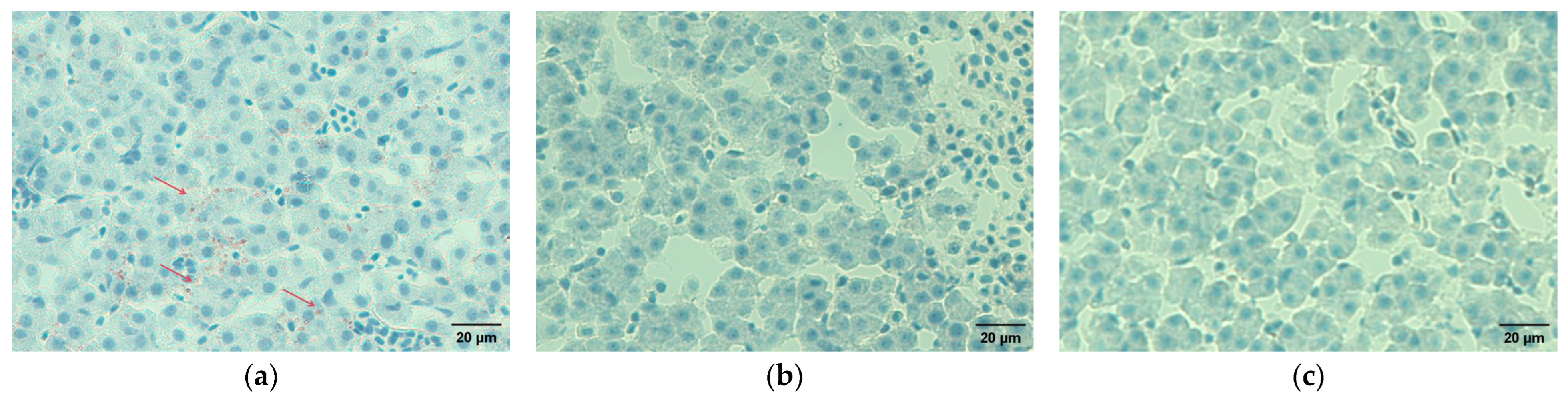
Oil Red O staining revealed the presence of lipid droplets in liver sections from the control group, whereas no obvious lipid droplet accumulation was observed in the SL groups (S1, S2, and S3) or the KOP groups (K1, K2, and K3) (Figure 1).

3.7. Liver Transcriptome Analysis

3.7.1. Overview of Transcriptome Sequencing Data

Based on growth performance and feed efficiency results, the K2 group from the KOP treatment and the S3 group from the SL treatment were selected for liver transcriptome analysis, as they represented the best-performing groups within their respective PL sources, with the highest weight gain and the lowest FCR. A total of nine RNA-seq libraries were constructed, including the P0 group (P0_1, P0_2, P0_3), the S3 group (S3_1, S3_2, S3_3), and the K2 group (K2_1, K2_2, K2_3). After adaptor trimming and removal of low-quality reads, each library generated an average of approximately 4.30 × 10⁷ clean reads, with mean Q20 and Q30 values of 98.17% and 95.26%, respectively (Table A1). Clean reads were mapped to the Atlantic salmon reference genome (Ssal_v3.1), resulting in an average mapping rate of approximately 89.90%. Overall, the sequencing data exhibited high quality and sufficient depth, supporting their suitability for subsequent differential gene expression analyses.

3.7.2. Differential Gene Expression Analysis

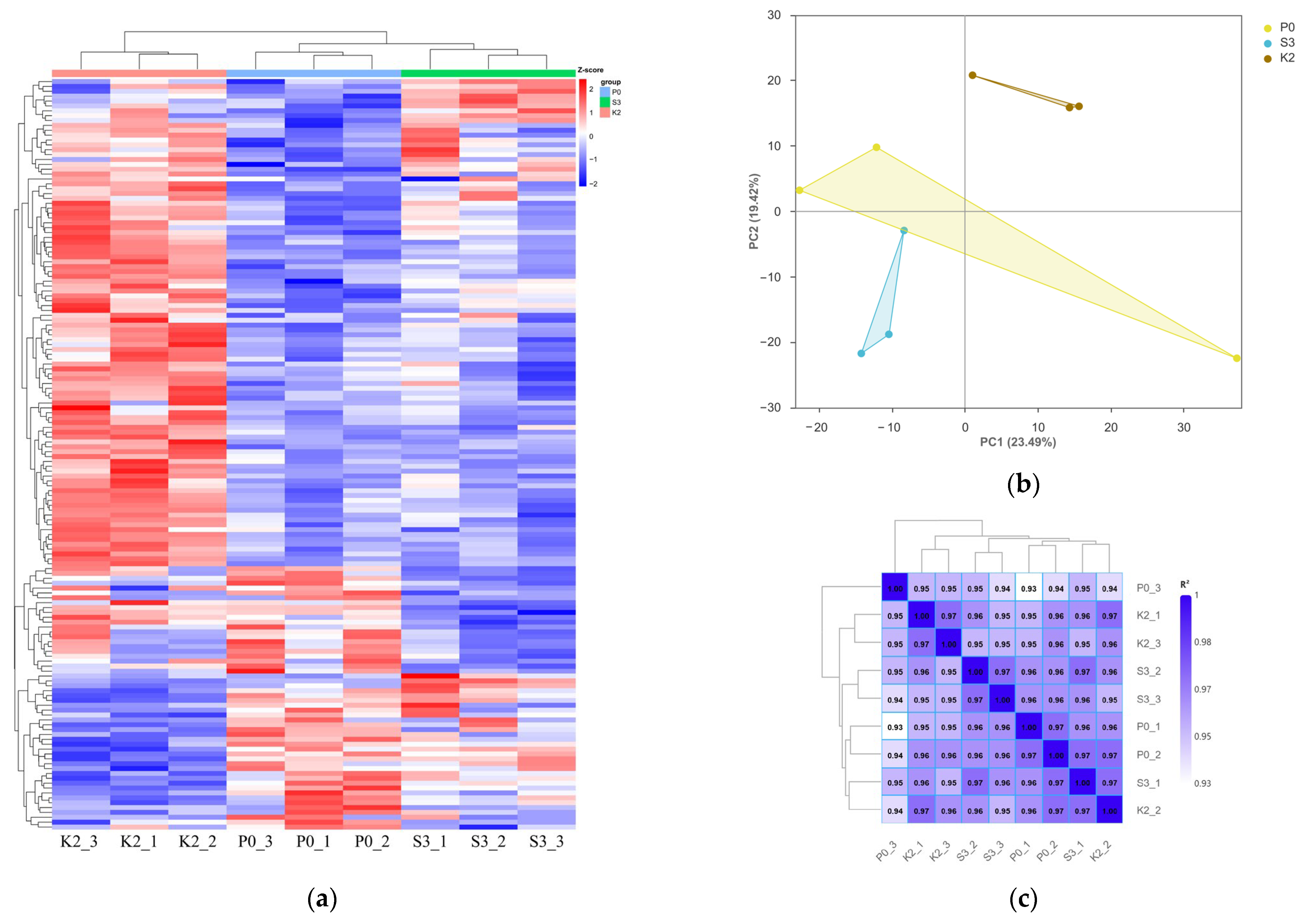
Relative to P0, the S3 and K2 groups had 14 and 92 significantly upregulated genes, and 24 and 29 significantly downregulated genes, respectively (padj < 0.05), indicating that K2 induced a markedly stronger transcriptomic response than S3. Hierarchical clustering of the 154 DEGs identified from the three-group comparison showed clear separation by dietary treatment and high consistency among biological replicates (Figure 2a). Principal component analysis (PCA) showed that the K2 group was clearly separated from the P0 group, whereas the S3 group remained relatively closer to P0 but still exhibited a clear separation trend (Figure 2b). Notably, the treatment groups were not completely separated along the PC1 and PC2 axes, indicating that the dietary treatments induced relatively moderate rather than drastic alterations in the overall gene expression landscape. Sample correlation analysis further demonstrated strong reproducibility among biological replicates, with correlation coefficients ≥ 0.93 across all samples (Figure 2c).

3.7.3. GO Enrichment Analysis

Compared with the P0 group, eight GO terms were significantly enriched in the S3 group (padj < 0.05), with the five most representative terms presented in Table 8 and the complete list provided in Table A2. Among these representative terms, the four most significantly enriched GO terms all involved significant downregulation of apoa2-like and apoa1/a4/e-domain-like (padj < 0.05). In addition, ctgf was significantly upregulated in the “extracellular region” term, whereas col1a1b and col5a2a were significantly upregulated in the “extracellular matrix structural constituent” term (padj < 0.05).
Relative to the P0 group, the K2 group displayed significant enrichment of nine GO terms (padj < 0.05), with the most representative terms summarized in Table 9 and the full list provided in Table A3. Among these representative terms, the “extracellular region” term showed the most pronounced enrichment, with six genes exhibiting significant expression changes: ccl19, ctgf, mmp13, adm2, and anos1-like were significantly upregulated, whereas mgp-like was significantly downregulated (padj < 0.05). Notably, ccl19 was significantly upregulated in all enriched GO terms except “O-methyltransferase activity”, whereas comtd1 and adm2 were significantly upregulated in the “O-methyltransferase activity” and “receptor ligand activity” terms, respectively (padj < 0.05).
A total of one GO term was significantly enriched in the K2 group compared with the S3 group (padj < 0.05) (Table 10). This term was “DNA replication”, and eight genes involved in this process were all significantly downregulated in the K2 group, including pcna-like, rrm1-like, mcm7-like, mcm6-like, orc5, rir1, pola1, and prim1 (padj < 0.05).

3.7.4. KEGG Pathway Analysis

No significant enrichment of KEGG pathways was detected in the S3 group compared with the P0 group (padj > 0.05). However, DEGs in the K2 group relative to the P0 group were significantly enriched in the Toll-like receptor signaling pathway and the cell adhesion molecules pathway (padj < 0.05; Table 11). Within the Toll-like receptor signaling pathway, tnr5, map3k8, jak1-like, rela, and hsp90ab1-like were significantly upregulated (padj < 0.05). In the cell adhesion molecules pathway, alcama-like, nrcam-like, vcam1-like, jam2a, sdc4-like, and tnr5 were significantly upregulated (padj < 0.05), whereas esam-like was significantly downregulated (padj < 0.05).
Compared with the S3 group, seven KEGG pathways were significantly enriched in the K2 group (padj < 0.05; Table 12), mainly involving amino acid metabolism, DNA replication, immune signal transduction, pyrimidine metabolism, phosphonate and phosphinate metabolism, and steroid biosynthesis. Among these pathways, genes involved in the RIG-I-like receptor signaling pathway were predominantly upregulated (padj < 0.05), whereas those involved in DNA replication and steroid biosynthesis were predominantly downregulated (padj < 0.05).

3.7.5. Analysis of Hepatic Lipid Metabolism–Related Genes

As shown in Table 13, the lipid transport-related gene apoa2-like was significantly downregulated in both the S3 and K2 groups (padj < 0.05). In the S3 group, apoa1/a4/e-domain-like was also significantly downregulated, whereas the phospholipid metabolism-related gene chdh was significantly upregulated (padj < 0.05). In the K2 group, genes related to lipid droplet mobilization and remodeling, including pnpla3 and lpin1a; positive regulators of lipid synthesis, including medag-like and mid1ip1b-like; and phospholipid metabolism-related genes, including aspg, sgms2b, and pi4k2b, were all significantly upregulated (padj < 0.05), whereas msmo1-like, which is involved in cholesterol biosynthesis, was significantly downregulated (padj < 0.05).
Direct comparison between the K2 and S3 groups revealed marked differences in the hepatic expression of lipid metabolism-related genes, as summarized in Table 14, with full data provided in Table A4. Compared with the S3 group, multiple genes were significantly upregulated in the K2 group (padj < 0.05), including genes involved in fatty acid uptake and activation (slc27a4, slc27a6, and acsl4-like); genes associated with fatty acid synthesis and storage (fasn, acod, dgat1a, and plin2-like), as well as positive regulators of lipid deposition (medag-like and mid1ip1b-like); genes related to phospholipid synthesis (pcyt1b-like, pcyt2, and pisd-like), sphingomyelin synthesis (sgms1b and sgms2b), and phospholipid remodeling and degradation (plpp1-like and tmem86b). Among genes involved in lipid transport and lipoprotein metabolism, apoeb-like and lipg-like were upregulated (padj < 0.05), whereas angptl3 was downregulated in the K2 group (padj < 0.05). However, genes related to phospholipid/lipid transfer signaling, namely cerk and c2cd2l, were downregulated in the K2 group (padj < 0.05). Notably, cholesterol biosynthesis-related genes (sqle, lss, dhcr7, and ebp) were all significantly downregulated (padj < 0.05), whereas cyp7a1, a key gene involved in the conversion of cholesterol to bile acids, was significantly upregulated (padj < 0.05).

3.8. Gut Microbiota Analysis

A total of nine sets of 16S rRNA gene sequencing data were obtained in this study, including the P0 group (P0_1, P0_2, and P0_3), the S3 group (S3_1, S3_2, and S3_3), and the K2 group (K2_1, K2_2, and K2_3). All samples were rarefied to the minimum sequencing depth, retaining 40,679 high-quality sequences per sample. High-quality sequences were clustered into OTUs at 97% sequence similarity, yielding a total of 1654 OTUs after removal of chloroplast- and mitochondria-derived sequences. Rarefaction curve analysis showed that both the Sobs and Shannon indices reached a plateau at a sequencing depth of 40,679 reads, indicating that the sequencing depth was sufficient to capture the richness and diversity of the intestinal microbiota in Atlantic salmon.
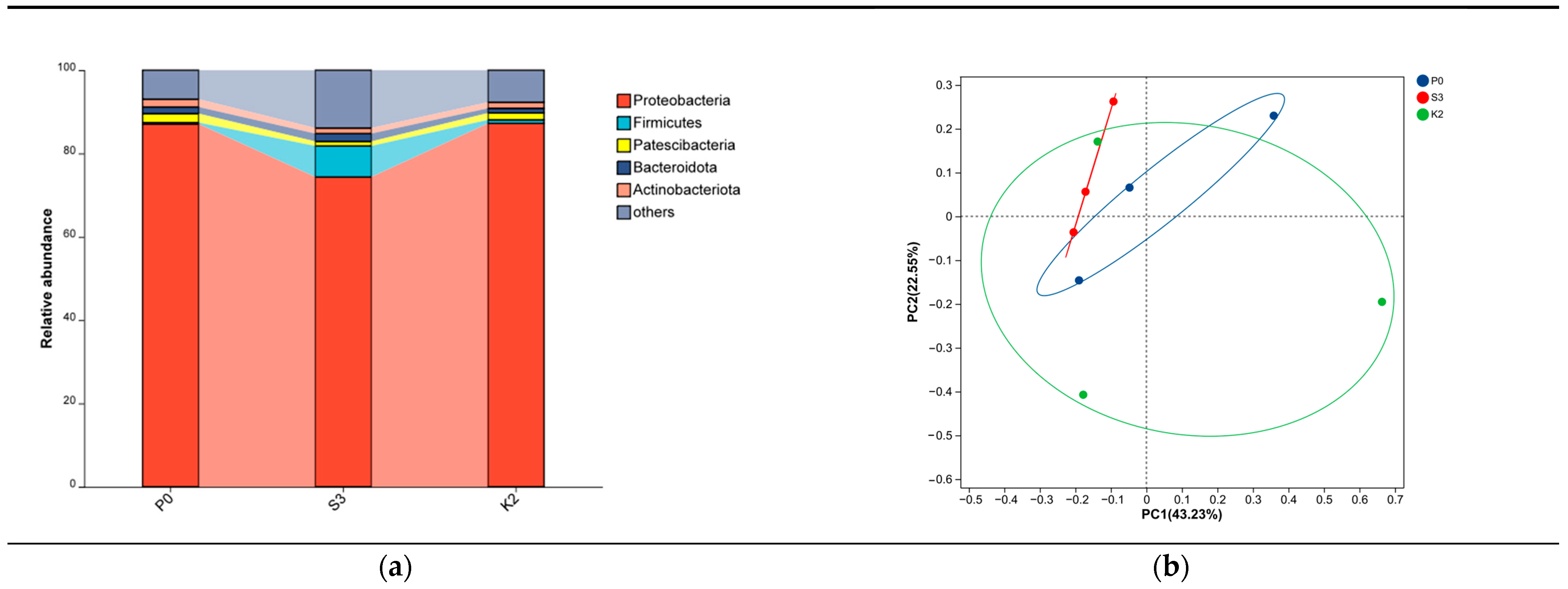
The FDR-corrected Kruskal–Wallis rank-sum test revealed no significant differences in the Sobs, Ace, Chao, Shannon, or Simpson indices among the different rearing groups (padj > 0.05) (Table 15). At the phylum level, the overall microbial community composition was similar among the three groups, with Proteobacteria, Firmicutes, and Actinobacteriota identified as the dominant phyla (Figure 3a). No statistically significant differences in the relative abundance of the major phyla were observed among groups (padj > 0.05). Principal coordinates analysis (PCoA) based on Bray–Curtis distances demonstrated a high degree of overlap in intestinal microbial community structures among the treatment groups, and ANOSIM analysis further confirmed that the differences among groups were not significant (R = −0.021, p > 0.05) (Figure 3b).

4. Discussion

Previous reports have shown that PLs may support the growth of fish fry. In juveniles of largemouth bass (Micropterus salmoides), gilthead seabream (Sparus aurata), and rainbow trout (Oncorhynchus mykiss), dietary PLs provided at appropriate levels significantly enhanced growth [9,42,43], indicating that PLs are essential nutrients in the early developmental stages of fish. This experiment also demonstrated that dietary supplementation with 3.0–4.5% SL or 1.5–4.5% KOP significantly improved the growth performance of Atlantic salmon fry, and the two PL sources showed comparable growth-promoting effects at equivalent supplementation levels. Notably, although all KOP supplementation levels improved growth performance, only the 3.0% KOP group significantly reduced FCR, suggesting that the effect of KOP on feed utilization may not continuously increase with supplementation level and that 3.0% KOP may be more favorable under the present experimental conditions. Jaxion-Harm fed Atlantic salmon fry at first feeding diets containing SL or KOP with comparable total PL contents (approximately 3.5–3.6%) and similarly observed no significant differences between the two PL sources in promoting fry growth [26]. However, Taylor reported that in larger fry (0.75–2.5 g), diets containing krill oil with 2.6% or 3.2% total glycerophospholipids resulted in significantly greater growth-promoting effects than SL diets at equivalent glycerophospholipid levels [25]. These different findings may be related to multiple factors, including fish size, basal diet composition, phospholipid molecular structure, and rearing environment.
To explore the mechanism underlying the growth-promoting effects of PL supplementation, visceral digestive enzyme activities were further measured in the fry, and both PL sources significantly increased lipase activity; similar increases have also been reported in juvenile Chinese sturgeon (Acipenser sinensis) [44], rainbow trout fry [5], and largemouth bass [10]. Elevated lipase activity may reflect a potential enhancement of lipid digestion by PLs, possibly increasing the availability of fatty acids for metabolic utilization. In addition to stimulating lipase activity, PLs may synergistically improve lipid digestion efficiency through multiple mechanisms, including enhancing lipid emulsification, maintaining intestinal epithelial cell membrane stability, and participating in the regulation of digestion-related neural signaling via their metabolic products [32,45,46,47]. Given that the digestive system remains immature during early fish development [48,49], dietary PL supplementation may improve the utilization efficiency of dietary lipids and thus provide more energy for fry growth, which could partially underlie the feed-efficiency- and growth-enhancing effects of exogenous PLs.
However, improved lipid digestion did not result in increased lipid deposition. Lipid content is an important indicator reflecting fat accumulation, energy reserves, and overall metabolic status in fish. In this experiment, the inclusion of 3.0–4.5% SL or 1.5–4.5% KOP significantly reduced whole-body crude lipid content and alleviated hepatic lipid deposition in Atlantic salmon fry. Similar lipid-lowering effects of PL supplementation, including reduced tissue lipid deposition [25,44,50] and lower whole-body crude lipid levels [14,44], have been reported previously. These results suggest that the absorbed lipids were not excessively stored, but were more likely transported and utilized for energy metabolism, thereby exerting a lipid-lowering effect.
This interpretation was further supported by the transcriptional changes observed in the present study. Several differentially expressed genes were associated with lipid transport, suggesting that dietary PL supplementation may alter hepatic lipid export and lipoprotein-mediated lipid trafficking. The expression of apoa2, which encodes a liver-expressed apolipoprotein associated with high-density lipoprotein (HDL) [51], was downregulated in the PL-supplemented groups, possibly reflecting changes in HDL assembly or metabolic demand. In addition, the significant downregulation of apoa1/a4/e-domain-like in the 4.5% SL group may indicate suppression of ApoA1/A4/E-related lipoprotein functions, thereby affecting HDL formation [52], chylomicron assembly [53], and receptor-mediated lipoprotein clearance [54]. Carmona-Antoñanzas et al. found that the phospholipid synthesis capacity of Atlantic salmon is limited during early developmental stages and proposed that dietary phosphatidylcholine (PC) supplementation may promote chylomicron (CM) formation [27]. This interpretation is further supported by other studies showing that dietary PLs promote the formation of lipoproteins, including CM and very low-density lipoproteins (VLDL), thereby enhancing lipid export and reducing lipid deposition in tissues [7,55]. In the present study, the downregulation of apoa2 and apoa1/a4/e-domain-like may only reflect potential alterations in lipoprotein assembly and lipid transport dynamics, rather than directly indicating enhanced lipid transport. Reduced lipid accumulation may have decreased the need for compensatory apolipoprotein-mediated lipid transport, suggesting that PL supplementation may be associated with a more balanced state of lipid utilization, turnover, and storage. Although transcriptomic analysis did not reveal substantial changes in other key lipid transport genes, proteomic and lipidomic analyses may further clarify the roles of apolipoproteins in phospholipid-mediated lipid metabolism.
Studies have shown that pnpla3 preferentially hydrolyzes PUFA-rich triglycerides, mobilizes PUFAs for phospholipid remodeling, and promotes the hepatic release of large VLDL particles, thereby maintaining the balance between hepatic lipid storage and export [56]. Lpin1 not only possesses phosphatidic acid phosphatase activity and plays a key role in triglyceride and phospholipid synthesis [57], but also facilitates hepatic fatty acid oxidation and energy expenditure by coactivating PGC-1α and PPARA [58]. Based on these findings, the significant upregulation of pnpla3 and lpin1 in the 3.0% KOP group may indicate that KOP enhances hepatic lipid turnover and export capacity by promoting lipid droplet remodeling, lipid mobilization, and fatty acid oxidation. In addition, the upregulation of medag and mid1ip1 may reflect a hepatic response to altered lipid influx after PL supplementation, with MID1IP1 related to the positive regulation of fatty acid synthesis and MEDAG more closely associated with lipid accumulation [59,60]. Furthermore, the upregulation of aspg, sgms2b, and pi4k2b suggests that dietary PL supplementation may also influence phospholipid-related metabolic pathways, including lysophospholipid metabolism, sphingomyelin synthesis, and membrane lipid trafficking [61,62,63]. Taken together, these transcriptional changes suggest that dietary PL supplementation may have influenced hepatic lipid turnover, metabolic utilization, and phospholipid-related metabolic pathways, which may contribute to lipid homeostasis in Atlantic salmon fry.
In addition to modulating lipid metabolism, PL supplementation also improved the antioxidant defense and immune status of the fry, suggesting a beneficial role in maintaining physiological homeostasis. Overall, both PL sources enhanced antioxidant capacity and alleviated lipid peroxidation, as reported previously [10,64]. This beneficial effect may be attributed to the involvement of PLs in membrane architecture, which contributes to cellular protection against free radicals [65]. Moreover, by promoting fatty acid metabolism and reducing lipid accumulation, PL supplementation may alleviate oxidative stress, thereby further enhancing antioxidant capacity [50]. Beyond this general improvement in antioxidant status, KOP supplementation may also exert positive effects on innate immune processes. Transcriptome analysis showed that, compared with the P0 group, the KOP group exhibited significant enrichment of signaling pathways and functional categories related to innate immunity, particularly the Toll-like receptor signaling pathway, accompanied by significant upregulation of genes such as tlr5, map3k8, and rela, indicating a potential role of KOP in regulating the host innate immune response [66]. Comparisons among different PL sources further supported the potential role of KOP in innate immune regulation, with immune-related genes involved in the RIG-I-like receptor signaling pathway, including ddx3xa, traf3, and tank, showing higher expression levels in the KOP group. Similar immune-enhancing effects of KOP have been reported in Pacific white shrimp (Litopenaeus vannamei), where dietary KOP more effectively improved immune-related parameters than SL [67]. In juvenile leopard coral grouper (Plectropomus leopardus), krill meal supplementation was also associated with enrichment of the Toll-like receptor signaling pathway [35], further supporting the immunomodulatory potential of krill-derived ingredients. These findings collectively suggest that the immune-related transcriptional changes observed in the KOP group may be associated with their higher n-3 LC-PUFA content of KOP [68].
Furthermore, PL supplementation also altered multiple genes involved in liver extracellular microenvironment remodeling. As a typical extracellular matrix regulatory factor, ctgf is involved in cell proliferation, migration, adhesion, and extracellular matrix formation [69]. Its significant upregulation in both the KOP and SL groups suggests that both PL sources may participate in hepatic extracellular microenvironment and matrix remodeling. In addition, col1a1b and col5a2a were significantly upregulated in the 4.5% SL group. Since the collagens encoded by these genes are important structural components of the extracellular matrix [70], phospholipid supplementation may influence the formation of extracellular matrix structure. Meanwhile, KOP treatment also markedly influenced extracellular region-related transcripts, including ccl19, mmp13, and mgp-like, collectively suggesting that processes related to extracellular signaling, matrix turnover, and local homeostasis maintenance in the liver may be regulated [71,72,73]. Overall, these ECM-related transcriptional changes suggest that dietary PL supplementation, particularly KOP, may be involved in regulating hepatic extracellular matrix remodeling and local tissue homeostasis, which may have implications for liver condition.
Compared with the control group, the two PL sources exerted markedly different effects on the fatty acid profile of Atlantic salmon. Dietary KOP induced more pronounced changes, with the 3.0% and 4.5% supplementation groups showing reduced whole-body MUFA and n-6 PUFA levels, along with elevated EPA content. Additionally, the 4.5% KOP group exhibited significantly higher n-3 PUFA and n-3 LC-PUFA contents. Notably, these changes largely reflected the fatty acid profiles of the corresponding diets. In contrast, SL supplementation did not significantly alter whole-body fatty acid composition, a finding likely attributable to the similarity between the fatty acid profile of SL and that of the soybean oil it replaced. In addition, soybean lecithin-derived fatty acids may have been efficiently utilized, oxidized, or selectively incorporated into specific lipid pools, such as membrane phospholipids, rather than accumulating sufficiently to alter the overall whole-body fatty acid profile. Similar diet-reflective patterns of body fatty acid composition have also been reported in studies on pikeperch (Sander lucioperca), rainbow trout, and the Chinese mitten crab (Eriocheir sinensis) [30,74,75].
These differential whole-body fatty acid responses suggest that the two PL sources influenced lipid deposition and utilization through distinct metabolic regulatory mechanisms, which was further supported by direct comparison of the expression of liver genes involved in lipid metabolism. Compared with the 4.5% SL group, the 3.0% KOP group exhibited more pronounced transcriptional changes in hepatic lipid metabolism, suggesting alterations in fatty acid uptake and activation, lipogenesis and storage, lipoprotein assembly and transport, phospholipid synthesis and remodeling, as well as cholesterol catabolism. Specifically, the higher expression of slc27a6, slc27a4, and acsl4-like in the KOP group suggests more active hepatic uptake, intracellular transport, and acylation of exogenous long-chain fatty acids [76,77]. Concurrently, the significant upregulation of key lipogenic genes, including fasn, dgat1a, and acod, points to enhanced fatty acid synthesis, triacylglycerol assembly, and unsaturated fatty acid production [78,79,80]. This was accompanied by the upregulation of plin2-like, reflecting enhanced lipid droplet dynamics [81], and increased expression of positive lipogenic regulators medag-like and mid1ip1b-like, further supporting this anabolic trend. Beyond synthesis and storage, the upregulation of apoeb-like and lipg-like, coupled with the downregulation of angptl3, suggests that krill oil promotes hepatic lipid assembly, transport, and lipoprotein metabolism while relieving the inhibition of lipid utilization, thereby potentially contributing to altered hepatic lipid turnover [82,83,84]. Taken together, these findings suggest that the KOP group showed transcriptional features consistent with more active fatty acid synthesis, remodeling, transient storage, and subsequent export.
Notably, the apparent paradox between enhanced expression of lipid synthesis-related genes and reduced lipid deposition may be explained by the metabolic partitioning of newly synthesized fatty acids. Specifically, these fatty acids may not have been primarily stored as neutral lipids, but instead may have been preferentially directed toward phospholipid remodeling, lipid export, β-oxidation, or cholesterol-to-bile-acid conversion, thereby reflecting enhanced hepatic lipid turnover rather than simple lipid accumulation. In addition, the upregulation of genes related to LC-PUFA uptake and activation (slc27a6, slc27a4, and acsl4-like) and fatty acid desaturation/remodeling (acod) may partly explain the significantly higher whole-body EPA content in the KOP group than in the SL group, suggesting that this difference may be attributable not only to direct dietary input but also to more active hepatic fatty acid uptake, activation, remodeling, and LC-PUFA metabolism. In addition to its higher EPA and DHA contents, the stronger hepatic transcriptional response induced by KOP may also be associated with the phospholipid-bound form of EPA and DHA in krill oil, particularly within phosphatidylcholine molecular species, which may improve their bioavailability and facilitate lipid absorption, lipoprotein assembly, and membrane phospholipid remodeling [34,45,55].
Beyond these changes in hepatic fatty acid and neutral lipid metabolism, the 3.0% KOP group also displayed marked changes in pathways related to phospholipid metabolism and cholesterol homeostasis. Several genes involved in phospholipid synthesis and remodeling were significantly upregulated, including the rate-limiting enzymes for PE and PC synthesis, pcyt2 and pcyt1b-like [85], the sphingomyelin synthesis-related genes sgms1b and sgms2b [86], and genes involved in phospholipid remodeling and degradation, plpp1-like and tmem86b [87,88]. This coordinated regulation suggests that KOP may influence hepatic membrane lipid renewal and phospholipid remodeling. Furthermore, the upregulation of the key bile acid synthesis gene cyp7a1, together with the downregulation of genes involved in de novo cholesterol synthesis (sqle, lss, ebp, and dhcr7), indicates enhanced bile acid synthesis from cholesterol and reduced endogenous sterol production in the KOP group [89,90]. Previous studies have shown that PUFAs can inhibit cholesterol biosynthesis [91]; therefore, the suppression of de novo cholesterol synthesis observed in the present study may be partly attributable to the higher level of n-3 LC-PUFA in the KOP group, particularly EPA. Moreover, the enhanced conversion of cholesterol to bile acids may facilitate improved lipid emulsification and absorption [92]. Compared with the KOP group, the 4.5% SL group exhibited specific and significant upregulation of cerk and c2cd2l, suggesting that SL may contribute more substantially to the maintenance of sphingolipid-related signaling and phospholipid transport homeostasis [93,94].
In comparison with the SL group, the KOP treatment showed enrichment of the DNA replication pathway in both GO and KEGG analyses, with key genes involved in replication origin recognition (orc5), DNA unwinding and replication fork progression (mcm6-like and mcm7-like), RNA primer synthesis and replication initiation (prim1 and pola1), maintenance of DNA chain elongation processivity (pcna-like), Okazaki fragment processing (fen1-like), and deoxyribonucleotide supply (rrm1-like and rir1) being collectively downregulated, suggesting lower transcriptional activity related to hepatocellular DNA replication, proliferation, and renewal [95,96,97]. Meanwhile, the Pyrimidine metabolism pathway was also significantly altered, with dck2-like and rir1 downregulated, whereas cdd, nt5c3, and tymp were upregulated, suggesting a remodeling of pyrimidine metabolism that may affect nucleoside salvage utilization and deoxyribonucleotide homeostasis, thereby influencing the supply of substrates for DNA synthesis and being consistent with the downregulation of the DNA replication pathway described above [98,99,100]. Given the comparable growth performance between the two groups, the downregulation of DNA replication-related genes more likely reflects adaptive hepatic transcriptional regulation in response to different PL sources rather than overall growth suppression. Together with the upregulation of immune-related genes and changes in lipid metabolism-related gene expression in the KOP group, this transcriptional pattern suggests that KOP may shift the hepatic functional state from one relatively oriented toward cell proliferation and renewal to one more focused on nutrient utilization, lipid metabolic regulation, and immune readiness. Overall, KOP supplementation may support normal growth while promoting metabolic and immune homeostasis through this redistribution of hepatic transcriptional activity.
In addition, the enrichment of the Cysteine and methionine metabolism and Glycine, serine and threonine metabolism pathways in the KOP group further suggests a remodeling of hepatic one-carbon metabolism and the transsulfuration pathway. In particular, the upregulation of cbs-like and cth, representing enhanced transsulfuration, suggests increased conversion of homocysteine to cysteine and a potential strengthening of glutathione/H2S-related antioxidant metabolism [101]. Furthermore, the upregulation of mat2ab together with the downregulation of dnmt1, dnmt3ab, and mtap suggests adjustments in methyl donor generation, DNA methylation-related processes, and the methionine salvage pathway [102,103,104]. In combination with the alterations in amino acid metabolic branches reflected by the upregulation of sds-like and tdh and the downregulation of pipox [105], these findings indicate that krill oil may affect hepatic amino acid metabolic networks and the way metabolic resources are allocated. Overall, the coordinated changes in one-carbon metabolism, transsulfuration, and related amino acid degradation/salvage pathways in the KOP group suggest that krill oil may contribute to supporting growth, lipid metabolic regulation, and hepatic antioxidant metabolic adaptation by modulating methyl donor utilization, redox homeostasis, and amino acid metabolic flux.
Earlier studies suggest that dietary PL supplementation may influence intestinal microbiota in fish. For instance, in largemouth bass, PL supplementation decreased the relative abundance of opportunistic pathogens, including Klebsiella and Aeromonas [10,32], whereas in rice field eel (Monopterus albus), it enhanced intestinal microbiota diversity and richness [106]. In contrast, the present study found that dietary PLs from different sources appeared to have limited effects on the gut microbial community structure of Atlantic salmon fry. Such inconsistencies among studies may be attributable to differences in host species, developmental stage, and rearing environment, in addition to dietary composition [107,108]. The absence of significant changes in the present study may be related to the relatively short 56-day feeding period, the potential colonization resistance of the gut microbial community during the early developmental stage of Atlantic salmon fry [109], and the balanced nutritional composition of the basal diet, which together may have weakened the modulatory effects of dietary PLs on the gut microbial community.

5. Conclusions

Dietary supplementation with 3.0–4.5% soybean lecithin or 1.5–4.5% krill oil phospholipids significantly improved the growth performance of Atlantic salmon fry, with 3.0–4.5% soybean lecithin and 3.0% krill oil phospholipids showing more pronounced improvements in feed utilization efficiency. In addition, phospholipid supplementation decreased whole-body crude lipid content, increased lipase activity, and enhanced antioxidant status. In terms of fatty acid composition, soybean lecithin did not significantly alter the whole-body profile, whereas krill oil phospholipids, especially at 3.0–4.5%, increased EPA and shifted the lipid profile toward higher n-3 LC-PUFA and lower MUFA/n-6 PUFA levels. Transcriptomic analysis revealed that dietary phospholipids alleviated hepatic lipid deposition by promoting lipid transport, turnover, and phospholipid metabolic remodeling. Notably, krill oil phospholipids induced stronger hepatic reprogramming than soybean lecithin, mainly reflected by enhanced responses related to fatty acid uptake and activation, phospholipid remodeling, cholesterol-to-bile-acid conversion, and RIG-I-like receptor-mediated innate immune signaling, together with reduced DNA replication-related activity. In addition, no significant effects were detected on gut microbiota α-diversity, β-diversity, or dominant phylum abundance under the present experimental conditions.
From an applied perspective, both soybean lecithin and krill oil phospholipids can be considered effective phospholipid sources in diets for Atlantic salmon fry; among them, krill oil phospholipids may have potential application value in promoting EPA deposition, improving lipid metabolic regulation, and supporting immune-related functions. However, this study has some limitations, including the relatively short feeding duration and the difficulty in obtaining sufficient blood samples from small fry, which limited the measurement of serum-related indicators. Future studies should include long-term feeding evaluations and, when fish size allows, incorporate serum lipoprotein measurements and lipidomic analyses to further clarify the long-term effects and underlying mechanisms of different phospholipid sources in Atlantic salmon fry.

Author Contributions

Conceptualization, Y.Z., J.C., M.L. and Q.G.; methodology, Y.Z., J.C. and M.L.; investigation, Y.Z. and J.C.; resources, Q.G., J.C. and M.L.; data curation, Y.Z.; formal analysis, Y.Z.; visualization, Y.Z.; writing—original draft preparation, Y.Z.; writing—review and editing, J.C., M.L. and Q.G.; supervision, J.C. and M.L.; project administration, M.L. and Q.G.; funding acquisition, M.L. and Q.G. All authors have read and agreed to the published version of the manuscript.

Funding

This research was funded by the National Key Research and Development Program of China, grant number 2024YFD2400903; the Shandong Technical System of Fish Industry, grant number SDAIT-12-05; and the Qingdao Municipal Science and Technology Bureau, grant number 24-1-3-hygg-21-hy.

Institutional Review Board Statement

The animal study protocol was approved by the Special Committee of Scientific Ethics, Ocean University of China (protocol code OUC-AE-2024-248 and date of approval: 8 May 2024).

Data Availability Statement

The RNA-seq dataset generated in this study has been deposited in the Genome Sequence Archive (GSA) at the National Genomics Data Center (NGDC) under accession number CRA038318. The gut microbiota sequencing dataset has been deposited in the same repository under accession number CRA038823. Both datasets are currently under controlled access due to privacy protection requirements and will be made publicly available after February 2028.

Acknowledgments

The authors would like to thank Yan Liu and other members of the laboratory for their support in the procurement of reagents and consumables, as well as assistance with administrative procedures. We also thank Pengchao Liu, Danyang Zhang, Longlong Song, Qiang Wang and other laboratory members for their help with sampling and subsequent experiments. In addition, we sincerely thank Cheng Quan and other staff of Qingdao Qicai Seed Industry Technology Co., Ltd. for their assistance during the aquaculture experiment.

Conflicts of Interest

Author Ming Liu was employed by the company Qingdao Qicai Seed Technology Co., Ltd. All the authors declare that the research was conducted in the absence of any commercial or financial relationships that could be construed as a potential conflict of interest.

Abbreviations

ANOSIManalysis of similarities
CATcatalase
CMchylomicron
CFcondition factor
DEGsdifferentially expressed genes
EPAeicosapentaenoic acid
FBWfinal body weight
FCRfeed conversion ratio
GOGene Ontology
HDLhigh-density lipoprotein
IBWinitial body weight
KEGGKyoto Encyclopedia of Genes and Genomes
KOPkrill oil phospholipid
LC-PUFAlong-chain polyunsaturated fatty acids
MDAmalondialdehyde
MUFAmonounsaturated fatty acids
OTUsoperational taxonomic units
PCphosphatidylcholine
PCoAprincipal coordinates analysis
PEphosphatidylethanolamine
PLphospholipid
PUFAspolyunsaturated fatty acids
SFAsaturated fatty acid
SGRspecific growth rate
SLsoybean lecithin
SODsuperoxide dismutase
SRsurvival rate
T-AOCtotal antioxidant capacity
VLDLvery low-density lipoprotein
WGweight gain

Appendix A. Additional Details on Experimental Design and Bias Control

Experimental fish allocation and sample size rationale: The culture tank was used as the experimental unit. A total of 2100 fish were allocated to seven groups, with three replicate tanks per group and 100 fish per tank, resulting in 21 tanks in total. The number of fish stocked per tank was determined based on the requirements for subsequent sampling, potential mortality during the trial, and growth performance evaluation, rather than on a formal a priori sample size calculation.
Randomization and blinding: To minimize potential confounding effects, tanks from different treatment groups were assigned to positions within the rearing system using a random number method, and the order of sampling and subsequent measurements was also randomized. Owing to the practical requirements of diet preparation and feeding management, blinding was not feasible during group allocation or trial conduct, and the personnel involved were therefore aware of the group assignments. To reduce potential bias, all groups were managed under identical apparent satiation feeding and routine husbandry procedures. Furthermore, outcome assessment and data analysis were performed using random codes, which were not decoded according to the original group assignments until the stage of result presentation.
Inclusion and exclusion criteria for experimental animals: Before the start of the trial, all experimental fish were acclimated for two weeks under the same rearing conditions and experimental diets. Fish that remained in normal condition after acclimation were included in the trial following a 24 h fasting period before the formal start of the experiment. During the experiment, any animal, experimental unit, sample, or data point affected by non-treatment-related equipment failure, abnormal water quality, or inadequate sample quality was predefined for exclusion from the analysis.
Humane endpoints and monitoring: Humane endpoints were predefined in this study to avoid severe suffering or a moribund state in the experimental fish. During the rearing period, fish were monitored at least four times daily as part of routine husbandry, and the monitoring frequency was increased during periods of water quality fluctuation, handling stress, or other high-risk conditions. Monitoring indicators included swimming behavior, feeding response, body posture and balance, respiratory status, body surface and fin damage, and responsiveness to external stimuli. Fish were considered to have reached humane endpoints if they showed persistent loss of balance without rapid recovery, sustained inability to swim or feed normally, markedly reduced or absent responsiveness to stimuli, severe respiratory distress or a prolonged moribund state, or severe and irreversible body surface injury, hemorrhage, or infection. Fish reaching humane endpoints or found dead were promptly removed and recorded; dead fish were disposed of according to the harmless disposal procedures of Qingdao Qicai Seed Technology Co., Ltd.
Adverse events: No expected or unexpected adverse events occurred during the study.
Table A1. Statistics of transcriptome sequencing output, quality control, and read mapping in Atlantic salmon fry.
Sample IDClean Reads (×107)Q20 (%)Q30 (%)GC Content (%)Mapping Rate (%)
P0_14.5098.2495.4752.2890.28
P0_24.1398.1795.1951.9490.01
P0_34.4798.1595.2151.686.87
S3_14.2498.1795.2451.290.2
S3_23.9398.195.152.3990.54
S3_34.1498.1695.2352.8790.57
K2_14.4898.2595.4651.8290.34
K2_24.4598.1895.2951.2490.26
K2_34.3598.1295.1652.7190.01
mean ± SEM4.30 ± 0.0798.17 ± 0.0295.26 ± 0.0452.01 ± 0.2089.90 ± 0.38
Table A2. Significantly enriched GO terms in the S3 group compared with the P0 group (padj < 0.05).
CategoryGO IDDescriptionGene CountpadjUpregulated GenesDownregulated Genes
BP 1GO:0042157lipoprotein metabolic process2< 0.0001apoa2-like,
apoa1/a4/e-domain-like
BPGO:0006869lipid transport2< 0.0001apoa2-like,
apoa1/a4/e-domain-like
BPGO:0010876lipid localization2< 0.0001apoa2-like,
apoa1/a4/e-domain-like
BPGO:0033036macromolecule localization20.0009apoa2-like,
apoa1/a4/e-domain-like
BPGO:0071702organic substance transport20.0009apoa2-like,
apoa1/a4/e-domain-like
CC 2GO:0005576extracellular region30.0001ctgfapoa2-like,
apoa1/a4/e-domain-like
MF 3GO:0008289lipid binding20.0014apoa2-like,
apoa1/a4/e-domain-like
MFGO:0005201extracellular matrix structural constituent20.0054col1a1b, col5a2a-
The S3 group represents the diet supplemented with 4.5% SL. Gene abbreviation annotations are the same as those in Table 8. “–“ indicates that no up- or down-regulated differentially expressed genes were detected. Gene symbols are italicized throughout the tables and text; terms ending with “-like” are considered part of the gene symbol and are therefore italicized together with the gene name. 1 BP, Biological Process; 2 CC, Cellular Component; 3 MF, Molecular Function.
Table A3. Significantly enriched GO terms in the K2 group compared with the P0 group (padj < 0.05).
CategoryGO IDDescriptionGene CountpadjUpregulated GenesDownregulated
Genes
CC 1GO:0005576extracellular region60.0001 ccl19, ctgf, mmp13, adm2, anos1-likemgp-like
MF 2GO:0008171O-methyltransferase activity10.0014 comtd1
MFGO:0008009chemokine activity10.0061 ccl19
MFGO:0042379chemokine receptor binding10.0061 ccl19
MFGO:0001664G protein-coupled receptor binding10.0061 ccl19
MFGO:0005125cytokine activity10.0109 ccl19
MFGO:0005126cytokine receptor binding10.0283 ccl19
MFGO:0030545receptor regulator activity20.0455 ccl19, adm2
MFGO:0048018receptor ligand activity20.0455 ccl19, adm2
The K2 group was supplemented with 3.0% KOP. Gene abbreviation annotations are the same as those in Table 8. “–“ indicates that no up- or down-regulated differentially expressed genes were detected. Gene symbols are italicized throughout the tables and text; terms ending with “-like” are considered part of the gene symbol and are therefore italicized together with the gene name. 1 CC, Cellular Component; 2 MF, Molecular Function.
Table A4. Full list of lipid metabolism–related genes differentially expressed between the K2 and S3 groups (padj < 0.05).
GeneGene Full NameEnsembl Gene IDK2 vs. S3Description of Main Function
slc27a4solute carrier family 27 member 4ENSSSAG000000418011.432 Long-chain fatty acid transport
slc27a6solute carrier family 27 member 6ENSSSAG000000768261.786 Long-chain fatty acid transport
acsl4-likeacyl-CoA synthetase long chain family member 4-likeENSSSAG000000569541.580 Activation of long-chain fatty acids to acyl-CoA
fasnfatty acid synthaseENSSSAG000000018871.340 De novo fatty acid synthesis
acodacyl-CoA desaturaseENSSSAG000000540751.366 Associated with acyl-CoA desaturation
dgat1adiacylglycerol O-acyltransferase 1aENSSSAG000000471001.420 Key enzyme in triglyceride synthesis
plin2-likeperilipin 2-likeENSSSAG000000407711.915 Lipid droplet coat protein involved in lipid storage
medag-likemesenteric estrogen-dependent adipogenesis protein-likeENSSSAG000001040281.863 Regulatory factor related to adipogenesis
mid1ip1b-likemidline 1 interacting protein 1b-likeENSSSAG000001040991.558 Related to the regulation of adipogenesis
pcyt2ethanolamine-phosphate cytidylyltransferaseENSSSAG000000007211.010 Key enzyme in PE 1 synthesis pathway
pcyt1b-likecholine-phosphate cytidylyltransferase B-likeENSSSAG000000780072.252 Key enzyme in PC 2 synthesis pathway
pisd-likephosphatidylserine decarboxylase-likeENSSSAG000000776071.865 Conversion of PS 3 to PE by decarboxylation
sgms1bsphingomyelin synthase 1bENSSSAG000000786061.529 Sphingomyelin synthesis
sgms2bsphingomyelin synthase 2bENSSSAG000000453601.504 Sphingomyelin synthesis
plpp1-likephospholipid phosphatase 1-likeENSSSAG000000668261.476 Dephosphorylation of lysophospholipids
tmem86btransmembrane protein 86BENSSSAG000000849931.763 Lysoplasmalogenase involved in ether phospholipid metabolism
apoeb-likeapolipoprotein Eb-likeENSSSAG000000862961.202 Apolipoprotein involved in lipid transport
angptl3angiopoietin like 3ENSSSAG00000081037−1.677 Regulates lipoprotein lipase activity
lipg-likelipase G, endothelial type-likeENSSSAG000000534861.322 Endothelial lipase involved in lipoprotein lipid hydrolysis
cerkceramide kinaseENSSSAG00000063672−1.102 Ceramide kinase
c2cd2lC2 calcium-dependent domain containing 2-likeENSSSAG00000053874−1.458 Related to phospholipid transport
cyp7a1cytochrome P450 family 7 subfamily A member 1ENSSSAG000000732003.573 Rate-limiting step in the conversion of cholesterol to bile acids
sqlesqualene epoxidaseENSSSAG00000094161−1.004 Key enzyme in cholesterol synthesis
lsslanosterol synthaseENSSSAG00000045554−1.526 Lanosterol synthase
ebpemopamil binding proteinENSSSAG00000111808−1.310 Related to cholesterol biosynthesis
dhcr77-dehydrocholesterol reductaseENSSSAG00000086305−1.003Late step in cholesterol synthesis
The S3 group represented the diet supplemented with 4.5% SL, and the K2 group represented the diet supplemented with 3.0% KOP. Gene abbreviation annotations are the same as those in Table 8. Gene symbols are italicized throughout the tables and text; terms ending with “-like” are considered part of the gene symbol and are therefore italicized together with the gene name. The “K2 vs. S3” column represents the log2 (Fold Change) values of the K2 group relative to the S3 group. 1 PE, phosphatidylethanolamine; 2 PC, phosphatidylcholine; 3 PS, phosphatidylserine.

References

  1. Yang, X.; Liang, J.; Ding, L.; Li, X.; Lam, S.-M.; Shui, G.; Ding, M.; Huang, X. Phosphatidylserine synthase regulates cellular homeostasis through distinct metabolic mechanisms. PLoS Genet. 2019, 15, e1008548. [Google Scholar] [CrossRef]
  2. Jonas, A.; Phillips, M.C. Lipoprotein structure. In Biochemistry of Lipids, Lipoproteins and Membranes, 5th ed.; Vance, D.E., Vance, J.E., Eds.; Elsevier: San Diego, CA, USA, 2008; pp. 485–506. [Google Scholar] [CrossRef]
  3. Morris, G.; Gevezova, M.; Sarafian, V.; Maes, M. Redox regulation of the immune response. Cell. Mol. Immunol. 2022, 19, 1079–1101. [Google Scholar] [CrossRef]
  4. Li, B.; Li, Z.; Sun, Y.; Wang, S.; Huang, B.; Wang, J. Effects of dietary lysolecithin (LPC) on growth, apparent digestibility of nutrient and lipid metabolism in juvenile turbot Scophthalmus maximus L. Aquac. Fish. 2019, 4, 61–66. [Google Scholar] [CrossRef]
  5. Azarm, H.M.; Kenari, A.A.; Hedayati, M. Effect of dietary phospholipid sources and levels on growth performance, enzymes activity, cholecystokinin and lipoprotein fractions of rainbow trout (Oncorhynchus mykiss) fry. Aquac. Res. 2013, 44, 634–644. [Google Scholar] [CrossRef]
  6. Fang, Z.; Gong, Y.; Wang, S.; Han, Z.; Huang, X.; Chen, N.; Li, S. Transcriptome analysis provides insights into the skeletal malformation induced by dietary phospholipids deficiency in largemouth bass (Micropterus salmoides) larvae. Aquac. Int. 2024, 32, 3957–3971. [Google Scholar] [CrossRef]
  7. Cai, Z.; Mai, K.; Ai, Q. Regulation of hepatic lipid deposition by phospholipid in large yellow croaker. Br. J. Nutr. 2017, 118, 999–1009. [Google Scholar] [CrossRef]
  8. Lin, X.; Cao, Y.; Wang, X.; Meng, X.; Huang, H.; Zhou, H.; Deng, J.; Tan, B. Suitable dietary phospholipids improve lipid deposition, but excessive dietary phospholipids disorder lipid metabolism in juvenile leopard coral grouper (Plectropomus leopardus). Aquac. Rep. 2024, 37, 102265. [Google Scholar] [CrossRef]
  9. Wu, J.; Yang, W.; Song, R.; Li, Z.; Jia, X.; Zhang, H.; Zhang, P.; Xue, X.; Li, S.; Xie, Y.; et al. Dietary soybean lecithin improves growth, immunity, antioxidant capability and intestinal barrier functions in largemouth bass Micropterus salmoides juveniles. Metabolites 2023, 13, 512. [Google Scholar] [CrossRef]
  10. Liu, B.; Liu, H.; Tan, B.; Dong, X.; Xie, S.; Deng, W. Effects of enzymatic soybean phospholipid replacing soybean oil on growth performance, glycolipid metabolism and intestinal flora of largemouth bass (Micropterus salmoides). Aquac. Rep. 2024, 38, 102280. [Google Scholar] [CrossRef]
  11. Sivaramakrishnan, T.; Ambasankar, K.; Kumaraguru Vasagam, K.P.; Syama Dayal, J.; Sandeep, K.P.; Bera, A.; Makesh, M.; Kailasam, M.; Vijayan, K.K. Effect of dietary soy lecithin inclusion levels on growth, feed utilization, fatty acid profile, deformity and survival of milkfish (Chanos chanos) larvae. Aquac. Res. 2021, 52, 5366–5374. [Google Scholar] [CrossRef]
  12. Amer, A.-R.; Eweedah, N.M.; Amer, A.A.; Gewaily, M.S.; Younis, N.A.; Ahmed, H.A.; Dawood, M.A.O. Dietary effect of soybean lecithin on the growth performance, digestive enzyme activity, blood biomarkers, and antioxidative status of striped catfish (Pangasianodon hypophthalmus). PLoS ONE 2023, 18, e0291954. [Google Scholar] [CrossRef]
  13. Elsayed Sallam, A.; Mohamed Kotit, A.; Moustafa Almisherfi, H. Dietary lysophospholipid improves growth performance, antioxidant capacity and immunity response of red tilapia (Oreochromis niloticus × O. mossambicus). Egypt. J. Aquat. Res. 2024, 50, 424–429. [Google Scholar] [CrossRef]
  14. Tian, J.; Wen, H.; Lu, X.; Liu, W.; Wu, F.; Yang, C.-G.; Jiang, M.; Yu, L.-J. Dietary phosphatidylcholine impacts on growth performance and lipid metabolism in adult Genetically Improved Farmed Tilapia (GIFT) strain of Nile tilapia Oreochromis niloticus. Br. J. Nutr. 2018, 119, 12–21. [Google Scholar] [CrossRef] [PubMed]
  15. Wang, S.; Zhang, Y.; Xie, R.; Zhang, N.; Zhang, H.; Chen, N.; Li, S. Effects of dietary phospholipids on growth performance, fatty acid composition and lipid metabolism of early juvenile largemouth bass (Micropterus salmoides). Aquac. Res. 2022, 53, 5628–5637. [Google Scholar] [CrossRef]
  16. Weng, M.; Zhang, W.; Zhang, Z.; Tang, Y.; Lai, W.; Dan, Z.; Liu, Y.; Zheng, J.; Gao, S.; Mai, K.; et al. Effects of dietary lysolecithin on growth performance, serum biochemical indexes, antioxidant capacity, lipid metabolism and inflammation-related genes expression of juvenile large yellow croaker (Larimichthys crocea). Fish Shellfish. Immunol. 2022, 128, 50–59. [Google Scholar] [CrossRef]
  17. Zheng, H.; Wang, B.; Li, Q.-L.; Zhao, T.; Xu, P.-C.; Song, Y.-F.; Luo, Z. Dietary lecithin attenuates adverse effects of high fat diet on growth performance, lipid metabolism, endoplasmic reticulum stress and antioxidant capacity in the intestine of largemouth bass (Micropterus salmoides). Aquaculture 2025, 595, 741688. [Google Scholar] [CrossRef]
  18. Torrissen, O.; Olsen, R.E.; Toresen, R.; Hemre, G.I.; Tacon, A.G.J.; Asche, F.; Hardy, R.W.; Lall, S. Atlantic salmon (Salmo salar): The “super-chicken” of the sea? Rev. Fish. Sci. 2011, 19, 257–278. [Google Scholar] [CrossRef]
  19. FAO. Fishery and Aquaculture Statistics—Yearbook 2023; Food and Agriculture Organization of the United Nations: Rome, Italy, 2025. [Google Scholar] [CrossRef]
  20. China Customs Statistics Query Platform. Available online: http://stats.customs.gov.cn/ (accessed on 3 March 2026).
  21. Agriculture and Rural Affairs Fishery Administration; National Fisheries Technology Extension Center; China Society of Fisheries. China Fishery Statistical Yearbook 2025; China Agriculture Press: Beijing, China, 2025. (In Chinese) [Google Scholar]
  22. Ministry of Agriculture and Rural Affairs of the People’s Republic of China. Notice of the Ministry of Agriculture and Rural Affairs on Issuing the “14th Five-Year Plan for National Fishery Development”. Available online: https://www.moa.gov.cn/nybgb/2022/202201/202203/t20220302_6390252.htm (accessed on 22 March 2026). (In Chinese)
  23. Poston, H.A. Effect of body size on growth, survival, and chemical composition of Atlantic salmon fed soy lecithin and choline. Progress. Fish Cult. 1990, 52, 226–230. [Google Scholar] [CrossRef]
  24. Poston, H.A. Response of Atlantic salmon fry to feed-grade lecithin and choline. Progress. Fish Cult. 1991, 53, 224–228. [Google Scholar] [CrossRef]
  25. Taylor, J.F.; Martinez-Rubio, L.; del Pozo, J.; Walton, J.M.; Tinch, A.E.; Migaud, H.; Tocher, D.R. Influence of dietary phospholipid on early development and performance of Atlantic salmon (Salmo salar). Aquaculture 2015, 448, 262–272. [Google Scholar] [CrossRef]
  26. Jaxion-Harm, J. Effects of dietary phospholipids on early stage Atlantic salmon (Salmo salar) performance: A comparison among phospholipid sources. Aquaculture 2021, 544, 737055. [Google Scholar] [CrossRef]
  27. Carmona-Antoñanzas, G.; Taylor, J.F.; Martinez-Rubio, L.; Tocher, D.R. Molecular mechanism of dietary phospholipid requirement of Atlantic salmon, Salmo salar, fry. Biochim. Biophys. Acta (BBA) Mol. Cell Biol. Lipids 2015, 1851, 1428–1441. [Google Scholar] [CrossRef] [PubMed]
  28. Ibarz, A.; Sanahuja, I.; Nuez-Ortín, W.G.; Martínez-Rubio, L.; Fernández-Alacid, L. Physiological benefits of dietary lysophospholipid supplementation in a marine fish model: Deep analyses of modes of action. Animals 2023, 13, 1381. [Google Scholar] [CrossRef] [PubMed]
  29. Devassykutty, M.; Ignatius, B.; Vijayagopal, P.; Ebeneezar, S.; Sawant, P.B.; Babitha Rani, A.M.; Varghese, E.; Sayooj, P.; Sajina, K.A. Egg yolk lecithin as a dietary supplement in juvenile silver pompano, Trachinotus blochii: Effects on growth and health parameters. Thalass. Int. J. Mar. Sci. 2024, 40, 1379–1388. [Google Scholar] [CrossRef]
  30. Hamza, N.; Kestemont, P.; Khemis, I.B.; Mhetli, M.; Cahu, C. Effect of different sources and levels of dietary phospholipids on performances and fatty acid composition of pikeperch (Sander lucioperca) larvae. Aquac. Nutr. 2012, 18, 249–257. [Google Scholar] [CrossRef]
  31. Wang, Z.; Karrar, E.; Wang, Y.; Liu, R.; Chang, M.; Wang, X. The bioactive of four dietary phospholipid sources on heavy metal-induced skeletal muscle injury in zebrafish: A comparison of phospholipid profiles. Food Biosci. 2022, 47, 101630. [Google Scholar] [CrossRef]
  32. Wang, S.; Han, Z.; Turchini, G.M.; Wang, X.; Fang, Z.; Chen, N.; Xie, R.; Zhang, H.; Li, S. Effects of dietary phospholipids on growth performance, digestive enzyme activity and intestinal health of largemouth bass (Micropterus salmoides) larvae. Front. Immunol. 2022, 12, 827946. [Google Scholar] [CrossRef]
  33. Jafari, F.; Noori, F.; Agh, N.; Estevez, A.; Ghasemi, A.; Alcaraz, C.; Gisbert, E. Phospholipids improve the performance, physiological and antioxidative responses, and lpl and igf1 gene expressions in juvenile stellate sturgeon (Acipenser stellatus). Aquaculture 2021, 541, 736809. [Google Scholar] [CrossRef]
  34. Shahidi, F.; Abad, A. Why is Antarctic krill (Euphausia superba) oil on the spotlight? A review. Food Prod. Process. Nutr. 2024, 6, 88. [Google Scholar] [CrossRef]
  35. Wang, M.; Wu, S.; Ding, H.; Wang, M.; Ma, J.; Xiao, J.; Wang, B.; Bao, Z.; Hu, J. Dietary Antarctic krill improves antioxidant capacity and immunity and reduces lipid accumulation: Insights from physiological and transcriptomic analyses of Plectropomus leopardus. BMC Genom. 2024, 25, 210. [Google Scholar] [CrossRef]
  36. Handeland, S.O.; Imsland, A.K.; Ebbesson, L.O.E.; Nilsen, T.O.; Hosfeld, C.D.; Baeverfjord, G.; Espmark, Å.; Rosten, T.; Skilbrei, O.T.; Hansen, T.; et al. Low light intensity can reduce Atlantic salmon smolt quality. Aquaculture 2013, 384, 19–24. [Google Scholar] [CrossRef]
  37. AOAC INTERNATIONAL. Official Methods of Analysis of AOAC INTERNATIONAL, 22nd ed.; Oxford University Press: New York, NY, USA, 2023. [Google Scholar]
  38. Ali, A.H.; Zou, X.; Lu, J.; Abed, S.M.; Yao, Y.; Tao, G.; Jin, Q.; Wang, X. Identification of phospholipids classes and molecular species in different types of egg yolk by using UPLC-Q-TOF-MS. Food Chem. 2017, 221, 58–66. [Google Scholar] [CrossRef]
  39. Zambonino Infante, J.L.; Cahu, C.L. Ontogeny of the gastrointestinal tract of marine fish larvae. Comp. Biochem. Physiol. Part C Toxicol. Pharmacol. 2001, 130, 477–487. [Google Scholar] [CrossRef]
  40. Suzer, C.; Kamacı, H.O.; Çoban, D.; Yıldırım, Ş.; Fırat, K.; Saka, Ş. Functional changes in digestive enzyme activities of meagre (Argyrosomus regius Asso, 1801) during early ontogeny. Fish Physiol. Biochem. 2013, 39, 967–977. [Google Scholar] [CrossRef]
  41. Yin, Z.; Liu, Q.; Liu, Y.; Gao, S.; He, Y.; Yao, C.; Huang, W.; Gong, Y.; Mai, K.; Ai, Q. Early life intervention using probiotic Clostridium butyricum improves intestinal development, immune response, and gut microbiota in large yellow croaker (Larimichthys crocea) larvae. Front. Immunol. 2021, 12, 640767. [Google Scholar] [CrossRef] [PubMed]
  42. Saleh, R.; Betancor, M.; Mohamed, A.H.; Ali, T.E.-S.; Izquierdo, M. Different phosphatidylcholine and n-3 HUFA contents in microdiets for gilthead seabream (Sparus aurata) larvae: Effects on histological changes in intestine and liver. Aquac. Int. 2022, 30, 2885–2900. [Google Scholar] [CrossRef]
  43. Fontagné-Dicharry, S.; Lataillade, E.; Surget, A.; Larroquet, L.; Cluzeaud, M.; Kaushik, S. Antioxidant defense system is altered by dietary oxidized lipid in first-feeding rainbow trout (Oncorhynchus mykiss). Aquaculture 2014, 424–425, 220–227. [Google Scholar] [CrossRef]
  44. Chen, J.; Sui, C.; Hu, Y.; Qin, H.; Zhang, D.; Wei, J.; Cao, B.; Li, Q. Effects of dietary phospholipids on growth performance, antioxidant capacity, and lipid metabolism of juvenile Chinese sturgeon (Acipenser sinensis), a critically endangered sturgeon in the Yangtze River. Aquac. Rep. 2024, 39, 102366. [Google Scholar] [CrossRef]
  45. Tocher, D.R.; Bendiksen, E.Å.; Campbell, P.J.; Bell, J.G. The role of phospholipids in nutrition and metabolism of teleost fish. Aquaculture 2008, 280, 21–34. [Google Scholar] [CrossRef]
  46. Batista, R.O.; Richter, B.L.; Banze, J.F.; Schleder, D.D.; Salhi, M.; Nobrega, R.O.; Silva, M.F.O.; Mattioni, B.; Pettigrew, J.E.; Fracalossi, D.M. Soy lecithin supplementation promotes growth and increases lipid digestibility in GIFT Nile tilapia raised at suboptimal temperature. Fishes 2023, 8, 404. [Google Scholar] [CrossRef]
  47. Sampaio Moura, N.; Schledwitz, A.; Alizadeh, M.; Kodan, A.; Njei, L.-P.; Raufman, J.-P. Cholinergic mechanisms in gastrointestinal neoplasia. Int. J. Mol. Sci. 2024, 25, 5316. [Google Scholar] [CrossRef]
  48. Joly, L.J.; Loots, C.; Meunier, C.L.; Boersma, M.; Collet, S.; Lefebvre, V.; Zambonino-Infante, J.-L.; Giraldo, C. Maturation of the digestive system of Downs herring larvae (Clupea harengus, Linnaeus, 1758): Identification of critical periods through ontogeny. Mar. Biol. 2021, 168, 82. [Google Scholar] [CrossRef]
  49. Sahlmann, C.; Gu, J.; Kortner, T.M.; Lein, I.; Krogdahl, Å.; Bakke, A.M. Ontogeny of the digestive system of Atlantic salmon (Salmo salar L.) and effects of soybean meal from start-feeding. PLoS ONE 2015, 10, e0124179. [Google Scholar] [CrossRef]
  50. Li, Q.-L.; Wang, B.; Zheng, H.; Wu, L.-X.; Xu, P.-C.; Tan, X.-Y. The effects of phospholipids (PL) addition in the high fat diet on growth performance, oxidative stress, lipid and protein metabolism, and muscle development in yellow catfish Pelteobagrus fulvidraco. Aquaculture 2025, 598, 741947. [Google Scholar] [CrossRef]
  51. Florea, G.; Tudorache, I.F.; Fuior, E.V.; Ionita, R.; Dumitrescu, M.; Fenyo, I.M.; Bivol, V.G.; Gafencu, A.V. Apolipoprotein A-II, a player in multiple processes and diseases. Biomedicines 2022, 10, 1578. [Google Scholar] [CrossRef] [PubMed]
  52. Cochran, B.J.; Ong, K.L.; Manandhar, B.; Rye, K.A. APOA1: A protein with multiple therapeutic functions. Curr. Atheroscler. Rep. 2021, 23, 11. [Google Scholar] [CrossRef] [PubMed]
  53. Wang, F.; Kohan, A.B.; Lo, C.M.; Liu, M.; Howles, P.; Tso, P. Apolipoprotein A-IV: A protein intimately involved in metabolism. J. Lipid Res. 2015, 56, 1403–1418. [Google Scholar] [CrossRef]
  54. Kockx, M.; Traini, M.; Kritharides, L. Cell-specific production, secretion, and function of apolipoprotein E. J. Mol. Med. 2018, 96, 361–371. [Google Scholar] [CrossRef]
  55. Zheng, H.; Tan, X.-Y.; Wang, B.; Zhong, C.-C.; Wei, X.-L.; Song, C.-C.; Luo, Z. Dietary phospholipids alleviate high fat diet-induced intestinal lipid deposition through ATF4-PPARα-MTTP/SAR1B pathway in yellow catfish. J. Nutr. Biochem. 2026, 151, 110261. [Google Scholar] [CrossRef]
  56. Johnson, S.M.; Bao, H.; McMahon, C.E.; Chen, Y.; Burr, S.D.; Anderson, A.M.; Madeyski-Bengtson, K.; Lindén, D.; Han, X.; Liu, J. PNPLA3 is a triglyceride lipase that mobilizes polyunsaturated fatty acids to facilitate hepatic secretion of large-sized very low-density lipoprotein. Nat. Commun. 2024, 15, 4847. [Google Scholar] [CrossRef]
  57. Donkor, J.; Sariahmetoglu, M.; Dewald, J.; Brindley, D.N.; Reue, K. Three mammalian lipins act as phosphatidate phosphatases with distinct tissue expression patterns. J. Biol. Chem. 2007, 282, 3450–3457. [Google Scholar] [CrossRef]
  58. Finck, B.N.; Gropler, M.C.; Chen, Z.; Leone, T.C.; Croce, M.A.; Harris, T.E.; Lawrence, J.C.; Kelly, D.P. Lipin 1 is an inducible amplifier of the hepatic PGC-1α/PPARα regulatory pathway. Cell Metab. 2006, 4, 199–210. [Google Scholar] [CrossRef]
  59. Zhang, H.; Chen, X.; Sairam, M.R. Novel genes of visceral adiposity: Identification of mouse and human mesenteric estrogen-dependent adipose (MEDA)-4 gene and its adipogenic function. Endocrinology 2012, 153, 2665–2676. [Google Scholar] [CrossRef]
  60. Izumi, A.; Hiraguchi, H.; Kodaka, M.; Ikeuchi, E.; Narita, J.; Kobayashi, R.; Matsumoto, Y.; Suzuki, T.; Yamamoto, Y.; Sato, R.; et al. MIG12 is involved in the LXR activation-mediated induction of the polymerization of mammalian acetyl-CoA carboxylase. Biochem. Biophys. Res. Commun. 2021, 567, 138–142. [Google Scholar] [CrossRef]
  61. Li, F.; Huang, H.S.; Zhao, Q.; Zhang, W.; Shi, T.; Lv, W.; Zhu, Q.; Liu, H.; Xu, Y.; Huang, H.; et al. Hepatic ASPG-mediated lysophosphatidylinositol catabolism impairs insulin signal transduction. EMBO J. 2025, 44, 5005–5036. [Google Scholar] [CrossRef] [PubMed]
  62. Huitema, K.; van den Dikkenberg, J.; Brouwers, J.F.H.M.; Holthuis, J.C.M. Identification of a family of animal sphingomyelin synthases. EMBO J. 2004, 23, 33–44. [Google Scholar] [CrossRef] [PubMed]
  63. Balla, T. Phosphoinositides: Tiny lipids with giant impact on cell regulation. Physiol. Rev. 2013, 93, 1019–1137. [Google Scholar] [CrossRef] [PubMed]
  64. Lin, S.-M.; Li, F.-J.; Yuangsoi, B.; Doolgindachbaporn, S. Effect of dietary phospholipid levels on growth, lipid metabolism, and antioxidative status of juvenile hybrid snakehead (Channa argus × Channa maculata). Fish Physiol. Biochem. 2018, 44, 401–410. [Google Scholar] [CrossRef]
  65. Pamplona, R. Membrane phospholipids, lipoxidative damage and molecular integrity: A causal role in aging and longevity. Biochim. Biophys. Acta (BBA) Bioenerg. 2008, 1777, 1249–1262. [Google Scholar] [CrossRef]
  66. Takeuchi, O.; Akira, S. Pattern Recognition Receptors and Inflammation. Cell 2010, 140, 805–820. [Google Scholar] [CrossRef]
  67. Liang, X.; Luo, X.; Lin, H.; Han, F.; Qin, J.G.; Chen, L.; Xu, C.; Li, E. Growth, health, and gut microbiota of female Pacific white shrimp (Litopenaeus vannamei) broodstock fed different phospholipid sources. Antioxidants 2022, 11, 1143. [Google Scholar] [CrossRef] [PubMed]
  68. Huyben, D.; Cronin, T.; Bartie, K.L.; Matthew, C.; Sissener, N.H.; Hundal, B.K.; Homer, N.Z.M.; Ruyter, B.; Glencross, B. Steroidogenic and innate immune responses in Atlantic salmon are influenced by dietary total lipid, long-chain polyunsaturated fatty acids and dissolved oxygen. Aquaculture 2023, 564, 739028. [Google Scholar] [CrossRef]
  69. Huang, G.; Brigstock, D.R. Regulation of hepatic stellate cells by connective tissue growth factor. Front. Biosci. (Landmark Ed.) 2012, 17, 2495–2507. [Google Scholar] [CrossRef]
  70. Jessen, J.R. Recent advances in the study of zebrafish extracellular matrix proteins. Dev. Biol. 2015, 401, 110–121. [Google Scholar] [CrossRef]
  71. Comerford, I.; Harata-Lee, Y.; Bunting, M.D.; Gregor, C.; Kara, E.E.; McColl, S.R. A myriad of functions and complex regulation of the CCR7/CCL19/CCL21 chemokine axis in the adaptive immune system. Cytokine Growth Factor Rev. 2013, 24, 269–283. [Google Scholar] [CrossRef] [PubMed]
  72. Chang, M. Matrix metalloproteinase profiling and their roles in disease. RSC Adv. 2023, 13, 6304–6316. [Google Scholar] [CrossRef]
  73. Gheduzzi, D.; Boraldi, F.; Annovi, G.; Paolinelli DeVincenzi, C.; Schurgers, L.J.; Vermeer, C.; Quaglino, D.; Pasquali Ronchetti, I. Matrix Gla protein is involved in elastic fiber calcification in the dermis of pseudoxanthoma elasticum patients. Lab. Investig. 2007, 87, 998–1008. [Google Scholar] [CrossRef]
  74. Azarm, H.M.; Abedian-Kenari, A.; Hedayati, M. Growth response and fatty acid composition of rainbow trout (Oncorhynchus mykiss) fry fed diets containing different levels of soybean and egg lecithin. Aquac. Int. 2013, 21, 497–509. [Google Scholar] [CrossRef]
  75. Lin, Z.; Han, F.; Lu, J.; Guo, J.; Qi, C.; Wang, C.; Xiao, S.; Bu, X.; Wang, X.; Qin, J.; et al. Influence of dietary phospholipid on growth performance, body composition, antioxidant capacity and lipid metabolism of Chinese mitten crab, Eriocheir sinensis. Aquaculture 2020, 516, 734653. [Google Scholar] [CrossRef]
  76. Anderson, C.M.; Stahl, A. SLC27 fatty acid transport proteins. Mol. Asp. Med. 2013, 34, 516–528. [Google Scholar] [CrossRef]
  77. Kuwata, H.; Hara, S. Role of acyl-CoA synthetase ACSL4 in arachidonic acid metabolism. Prostaglandins Other Lipid Mediat. 2019, 144, 106363. [Google Scholar] [CrossRef]
  78. Smith, S. The animal fatty acid synthase: One gene, one polypeptide, seven enzymes. FASEB J. 1994, 8, 1248–1259. [Google Scholar] [CrossRef]
  79. Yen, C.-L.E.; Stone, S.J.; Koliwad, S.; Harris, C.; Farese, R.V., Jr. Thematic Review Series: Glycerolipids. DGAT enzymes and triacylglycerol biosynthesis. J. Lipid Res. 2008, 49, 2283–2301. [Google Scholar] [CrossRef]
  80. Cerone, M.; Smith, T.K. Desaturases: Structural and mechanistic insights into the biosynthesis of unsaturated fatty acids. IUBMB Life 2022, 74, 1036–1051. [Google Scholar] [CrossRef]
  81. Xu, S.; Zou, F.; Diao, Z.; Zhang, S.; Deng, Y.; Zhu, X.; Cui, L.; Yu, J.; Zhang, Z.; Bamigbade, A.T.; et al. Perilipin 2 and lipid droplets provide reciprocal stabilization. Biophys. Rep. 2019, 5, 145–160. [Google Scholar] [CrossRef]
  82. Tikka, A.; Jauhiainen, M. The role of ANGPTL3 in controlling lipoprotein metabolism. Endocrine 2016, 52, 187–193. [Google Scholar] [CrossRef] [PubMed]
  83. Getz, G.S.; Reardon, C.A. Apoprotein E as a lipid transport and signaling protein in the blood, liver, and artery wall. J. Lipid Res. 2009, 50, S156–S161. [Google Scholar] [CrossRef]
  84. Khetarpal, S.A.; Vitali, C.; Levin, M.G.; Klarin, D.; Park, J.; Pampana, A.; Millar, J.S.; Kuwano, T.; Sugasini, D.; Subbaiah, P.V.; et al. Endothelial lipase mediates efficient lipolysis of triglyceride-rich lipoproteins. PLoS Genet. 2021, 17, e1009802. [Google Scholar] [CrossRef] [PubMed]
  85. Tavasoli, M.; Lahire, S.; Reid, T.; Brodovsky, M.; McMaster, C.R. Genetic diseases of the Kennedy pathways for membrane synthesis. J. Biol. Chem. 2020, 295, 17877–17886. [Google Scholar] [CrossRef]
  86. Jiang, X.-C.; Chiang, Y.-P. Sphingomyelin Synthase Family and Phospholipase Cs. Adv. Exp. Med. Biol. 2022, 1372, 77–86. [Google Scholar] [CrossRef]
  87. Pilquil, C.; Dewald, J.; Cherney, A.; Gorshkova, I.; Tigyi, G.; English, D.; Natarajan, V.; Brindley, D.N. Lipid Phosphate Phosphatase-1 Regulates Lysophosphatidate-induced Fibroblast Migration by Controlling Phospholipase D2-dependent Phosphatidate Generation. J. Biol. Chem. 2006, 281, 38418–38429. [Google Scholar] [CrossRef]
  88. Paul, S.; Morgan, P.; Pernes, G.; Schooneveldt, Y.; Duong, T.; Mellett, N.A.; Huynh, K.; Murphy, A.J.; Lancaster, G.I.; Meikle, P.J. Modulation of endogenous plasmalogens by genetic ablation of lysoplasmalogenase (Tmem86b) in mice. J. Lipid Res. 2025, 66, 100808. [Google Scholar] [CrossRef] [PubMed]
  89. Chiang, J.Y.L.; Ferrell, J.M. Up to date on cholesterol 7 alpha-hydroxylase (CYP7A1) in bile acid synthesis. Liver Res. 2020, 4, 47–63. [Google Scholar] [CrossRef] [PubMed]
  90. Ershov, P.; Kaluzhskiy, L.; Mezentsev, Y.; Yablokov, E.; Gnedenko, O.; Ivanov, A. Enzymes in the Cholesterol Synthesis Pathway: Interactomics in the Cancer Context. Biomedicines 2021, 9, 895. [Google Scholar] [CrossRef] [PubMed]
  91. Karanth, S.; Tran, V.M.; Kuberan, B.; Schlegel, A. Polyunsaturated fatty acyl-coenzyme as are inhibitors of cholesterol biosynthesis in zebrafish and mice. Dis. Models Mech. 2013, 6, 1365–1377. [Google Scholar] [CrossRef]
  92. Chiang, J.Y.L. Bile acids: Regulation of synthesis. J. Lipid Res. 2009, 50, 1955–1966. [Google Scholar] [CrossRef]
  93. Gómez-Muñoz, A.; Gangoiti, P.; Granado, M.H.; Arana, L.; Ouro, A. Ceramide-1-phosphate in cell survival and inflammatory signaling. In Sphingolipids as Signaling and Regulatory Molecules; Advances in Experimental Medicine and Biology; Chalfant, C., Del Poeta, M., Eds.; Springer: Berlin/Heidelberg, Germany, 2010; Volume 688, pp. 118–130. [Google Scholar] [CrossRef]
  94. Sun, E.W.; Guillén-Samander, A.; Bian, X.; Wu, Y.; Cai, Y.; Messa, M.; De Camilli, P. Lipid transporter TMEM24/C2CD2L is a Ca2+-regulated component of ER-plasma membrane contacts in mammalian neurons. Proc. Natl. Acad. Sci. USA 2019, 116, 5775–5784. [Google Scholar] [CrossRef]
  95. Bell, S.P.; Labib, K. Chromosome Duplication in Saccharomyces cerevisiae. Genetics 2016, 203, 1027–1067. [Google Scholar] [CrossRef]
  96. Burgers, P.M.J.; Kunkel, T.A. Eukaryotic DNA Replication Fork. Annu. Rev. Biochem. 2017, 86, 417–438. [Google Scholar] [CrossRef]
  97. Buj, R.; Aird, K.M. Deoxyribonucleotide Triphosphate Metabolism in Cancer and Metabolic Disease. Front. Endocrinol. 2018, 9, 177. [Google Scholar] [CrossRef]
  98. Staub, M.; Eriksson, S. The Role of Deoxycytidine Kinase in DNA Synthesis and Nucleoside Analog Activation. In Deoxynucleoside Analogs in Cancer Therapy; Peters, G.J., Ed.; Humana Press: Totowa, NJ, USA, 2006; pp. 29–52. [Google Scholar] [CrossRef]
  99. Wang, P.; Wang, C.; Wang, Y. Nucleotide salvage, genome instability, and potential therapeutic applications. Nucleic Acids Res. 2026, 54, gkag099. [Google Scholar] [CrossRef]
  100. Huang, B.; Yuan, Q.; Sun, J.; Wang, C.; Yang, D. Thymidine phosphorylase in nucleotide metabolism: Physiological functions and its implications in tumorigenesis and anti-cancer therapy. Front. Immunol. 2025, 16, 1561560. [Google Scholar] [CrossRef]
  101. Zhang, H.-F.; Klein Geltink, R.I.; Parker, S.J.; Sorensen, P.H. Transsulfuration, minor player or crucial for cysteine homeostasis in cancer. Trends Cell Biol. 2022, 32, 800–814. [Google Scholar] [CrossRef]
  102. Lauinger, L.; Kaiser, P. Sensing and Signaling of Methionine Metabolism. Metabolites 2021, 11, 83. [Google Scholar] [CrossRef]
  103. Ren, W.; Gao, L.; Song, J. Structural Basis of DNMT1 and DNMT3A-Mediated DNA Methylation. Genes 2018, 9, 620. [Google Scholar] [CrossRef]
  104. Fan, N.; Zhang, Y.; Zou, S. Methylthioadenosine phosphorylase deficiency in tumors: A compelling therapeutic target. Front. Cell Dev. Biol. 2023, 11, 1173356. [Google Scholar] [CrossRef]
  105. Pan, S.; Fan, M.; Liu, Z.; Li, X.; Wang, H. Serine, glycine and one-carbon metabolism in cancer (Review). Int. J. Oncol. 2021, 58, 158–170. [Google Scholar] [CrossRef]
  106. Tang, Z.; Lin, D.X.; Cai, M.L.; Zhang, J.Z.; Zhu, B.; Shi, Y.; Zhong, L.; Hu, Y. Effects of dietary soybean lecithin supplementation in low-fishmeal high-lipid diets on growth performance, serum biochemical parameters and intestinal microbiota of Monopterus albus. Acta Hydrobiol. Sin. 2024, 48, 361–371. (In Chinese) [Google Scholar]
  107. Kanika, N.H.; Liaqat, N.; Chen, H.; Ke, J.; Lu, G.; Wang, J.; Wang, C. Fish gut microbiome and its application in aquaculture and biological conservation. Front. Microbiol. 2025, 15, 1521048. [Google Scholar] [CrossRef] [PubMed]
  108. Cui, X.; Zhang, Q.R.; Zhang, Q.D.; Zhang, Y.Y.; Chen, H.; Liu, G.; Zhu, L. Research Progress of the Gut Microbiome in Hybrid Fish. Microorganisms 2022, 10, 891. [Google Scholar] [CrossRef] [PubMed]
  109. Fiedler, A.W.; Drågen, M.K.R.; Lorentsen, E.D.; Vadstein, O.; Bakke, I. The stability and composition of the gut and skin microbiota of Atlantic salmon throughout the yolk sac stage. Front. Microbiol. 2023, 14, 1177972. [Google Scholar] [CrossRef]
Figure 1. Oil Red O staining of liver sections from Atlantic salmon fed diets containing different phospholipid sources. Lipid droplets within hepatocytes are stained red (indicated by red arrows), while nuclei are counterstained blue. Scale bar = 10 μm. All groups were examined histologically. Obvious lipid deposition was observed only in the control group (P0); therefore, only P0 and the representative non-lipid deposition groups (S1 and K1) are shown. (a) P0 group; (b) S1 group; (c) K1 group.
Animals 16 01393 g001
Figure 2. Overall expression patterns of differentially expressed genes in the liver of Atlantic salmon fed diets with different phospholipid sources. (a) Hierarchical clustering heatmap of differentially expressed genes; (b) principal component analysis (PCA) plot; (c) sample-to-sample correlation analysis. In the PCA plot, the shaded polygons connect biological replicates within the same treatment group and were automatically generated by the plotting software to visualize sample clustering.
Animals 16 01393 g002
Figure 3. Intestinal microbiota composition and β-diversity of Atlantic salmon under different dietary phospholipid sources. (a) Relative abundance of intestinal microbiota at the phylum level. (b) Principal coordinates analysis (PCoA) based on Bray–Curtis distances (OTU level). Each point represents one sample. ANOSIM showed no significant differences among groups (R = −0.021, p = 0.547).
Animals 16 01393 g003
Table 1. Formulation and nutrient composition of the experimental diets (% dry matter).
IngredientsP0S1S2S3K1K2K3
Brown fishmeal22.0022.0022.0022.0022.0022.0022.00
White fishmeal40.0040.0040.0040.0040.0040.0040.00
Wheat gluten12.2012.2012.2012.2012.2012.2012.20
Soy protein concentrate4.004.004.004.004.004.004.00
Pregelatinized starch4.944.944.944.944.944.954.95
Mineral premix 11.501.501.501.501.501.501.50
NaCl0.800.800.800.800.800.800.80
Ca(H2PO4)21.001.001.001.001.001.001.00
Vitamin premix 20.550.550.550.550.550.550.55
Antifungal agent0.100.100.100.100.100.100.10
Antioxidant0.050.050.050.050.050.050.05
Feeding attractant0.200.200.200.200.200.200.20
Astaxanthin0.0090.0090.0090.0090.0060.0030.000
Choline chloride0.150.150.150.150.150.150.15
Soybean lecithin 30.001.563.134.690.000.000.00
Krill oil 40.000.000.000.003.757.5011.25
Soybean oil6.004.442.881.316.005.001.25
Fish oil6.506.506.506.502.750.000.00
Total100100100100100100100
Proximate analysis (Mean values, % dry weight)
Crude protein60.4460.5160.1160.0159.3060.5660.12
Crude lipid17.3317.3517.4017.1217.0416.9317.29
Ash14.6914.8614.6314.9915.0315.0315.02
The experimental diets included a control diet without phospholipid supplementation (P0), SL-supplemented diets at inclusion levels of 1.5%, 3.0%, and 4.5% (S1, S2, and S3), and krill oil-supplemented diets at the same inclusion levels (K1, K2, and K3). 1 Mineral premix (mg/kg diet): MgSO4·7H2O, 300.0; FeSO4·H2O, 150.0; ZnSO4·H2O, 100.0; MnSO4·H2O, 50.0; CuSO4·5H2O, 10.0; KIO3, 0.8; CoCl2, 0.3; Na2SeO3, 0.4. 2 Vitamin premix (mg/kg diet): vitamin A, 10.0; vitamin D3, 20.0; vitamin E, 500.0; vitamin K3, 28.0; vitamin B1, 56.0; vitamin B2, 25.0; calcium pantothenate, 100.0; niacin, 180.0; pyridoxine HCl, 50.0; biotin, 1.8; vitamin B12, 0.1; folic acid, 5.0; vitamin C, 500.0; inositol, 500.0. 3 Soybean lecithin containing 96% phospholipids was obtained from Beijing Chinaholder Biotech Co., Ltd. (Beijing, China). 4 Krill oil containing 40% phospholipids was obtained from Aker BioMarine ASA (Lysaker, Norway).
Table 2. Fatty acid composition of the experimental diets and major lipid sources (% identified fatty acids).
Fatty AcidsDietLipid Source
P0S1S2S3K1K2K3Soybean LecithinKrill OilFish OilSoybean Oil
C14:02.81 2.90 2.99 3.09 3.71 5.16 8.06 0.0811.124.38ND 1
C16:018.49 19.35 20.32 21.37 18.36 19.13 22.79 20.9023.8322.3511.00
C18:04.35 4.38 4.42 4.46 3.87 3.32 2.70 4.421.324.434.02
C20:00.60 0.60 0.59 0.59 0.48 0.35 0.28 0.17ND0.740.34
SFAs 226.79 28.11 29.45 30.75 27.09 29.02 35.47 26.9438.8334.3815.69
C16:1n73.87 3.98 4.11 4.25 3.58 3.70 5.30 0.105.556.020.00
C18:1n9c 321.09 19.96 18.83 17.63 19.60 17.62 14.41 9.7211.2821.1023.70
C20:12.27 2.32 2.37 2.43 1.75 1.35 1.61 0.070.763.410.22
MUFAs 428.97 27.99 27.08 26.13 26.11 23.15 22.45 9.8818.8631.6624.09
C18:2n6c24.24 23.51 22.82 22.06 24.77 22.05 7.73 56.801.979.0253.60
C20:4n60.67 0.69 0.71 0.74 0.54 0.45 0.60 ND0.421.05ND
n-6 PUFAs 525.57 24.99 24.27 23.57 26.03 23.22 8.93 56.843.6511.3953.61
C18:3n33.43 3.31 3.19 3.06 3.76 3.77 2.55 6.332.231.496.60
C20:5n36.816.967.127.318.8712.0818.06ND23.008.05ND
C22:6n38.33 8.56 8.82 9.11 8.03 8.64 12.39 ND13.0512.40ND
n-3 PUFAs 618.66 18.90 19.21 19.54 20.77 24.59 33.15 6.3338.6622.566.60
n-3
LC-PUFAs 7
15.22 15.59 16.02 16.48 17.01 20.82 30.60 ND36.4321.07ND
Dietary groups are described in Table 1. 1 ND, not detected; 2 SFAs, saturated fatty acids; 3 cis-fatty acids; 4 MUFAs, monounsaturated fatty acids; 5 n-6 PUFAs, n-6 polyunsaturated fatty acids; 6 n-3 PUFAs, n-3 polyunsaturated fatty acids; 7 n-3 LC-PUFAs, n-3 long-chain polyunsaturated fatty acids.
Table 3. Effects of different phospholipid sources and supplementation levels on growth performance in Atlantic Salmon.
P0S1S2S3K1K2K3
IBW (g)0.16 ± 0.010.16 ± 0.010.16 ± 0.010.16 ± 0.010.16 ± 0.010.16 ± 0.010.16 ± 0.01
FBW (g)1.75 ± 0.01 a1.87 ± 0.02 ab1.98 ± 0.03 bc2.13 ± 0.04 c2.03 ± 0.06 bc2.14 ± 0.01 c2.07 ± 0.07 c
WG (%)1022.97 ±
8.53 a
1099.94 ±
13.37 ab
1170.32 ±
16.30 bc
1271.98 ± 23.56 c1207.14 ±
39.14 bc
1275.27 ±
6.18 c
1233.21 ±
45.73 c
SGR (%/d)4.32 ± 0.01 a4.44 ± 0.02 ab4.54 ± 0.02 bc4.68 ± 0.03 c4.59 ± 0.05 bc4.68 ± 0.01 c4.62 ± 0.06 c
SR (%)95.85 ± 1.0696.91 ± 1.1797.58 ± 0.3598.28 ± 1.2495.51 ± 0.9397.23 ± 0.7097.24 ± 0.70
CF (g/cm3)1.33 ± 0.151.28 ± 0.021.40 ± 0.031.41 ± 0.091.35 ± 0.021.34 ± 0.071.27 ± 0.03
FCR0.94 ± 0.01 b0.88 ± 0.01 ab0.83 ± 0.01 a0.81 ± 0.03 a0.86 ± 0.03 ab0.82 ± 0.01 a0.85 ± 0.04 ab
Dietary groups are described in Table 1. Data are presented as means ± SEM (n = 3). Different superscript letters within the same row indicate significant differences among groups (p < 0.05) based on one-way ANOVA followed by Tukey’s test.
Table 4. Effects of different phospholipid sources and supplementation levels on the proximate composition of Atlantic salmon (%).
P0S1S2S3K1K2K3
Moisture76.80 ± 0.15 ab76.24 ± 0.36 ab76.01 ± 0.21 ab75.78 ± 0.15 a77.03 ± 0.12 b76.28 ± 0.35 ab75.77 ± 0.15 a
Ash9.46 ± 0.4710.32 ± 0.2110.87 ± 0.310.53 ± 0.8210.41 ± 0.2610.88 ± 0.210.91 ± 0.22
Crude lipid33.05 ± 0.62 c31.29 ± 0.22 bc29.15 ± 0.41 ab28.96 ± 0.41 a29.16 ± 0.69 ab28.39 ± 0.21 a27.31 ± 0.31 a
Crude protein57.99 ± 0.6858.37 ± 0.6160.72 ± 0.9659.91 ± 0.9659.79 ± 1.8360.4 ± 1.4161.74 ± 0.94
Dietary groups are described in Table 1. Data are presented as means ± SEM (n = 3). Except for moisture, all other proximate components are expressed on a dry matter basis. Different superscript letters within the same row indicate significant differences among groups (p < 0.05).
Table 5. Effects of different phospholipid sources and supplementation levels on the fatty acid composition of Atlantic salmon whole body (% identified fatty acids).
P0S1S2S3K1K2K3
C14:02.35 ± 0.17 a2.67 ± 0.08 a2.48 ± 0.14 a2.72 ± 0.20 a3.50 ± 0.16 b4.52 ± 0.12 c6.71 ± 0.17 d
C16:017.63 ± 0.87 a20.80 ± 0.92 ab19.31 ± 0.45 ab21.05 ± 1.18 ab20.19 ± 0.67 ab19.71 ± 1.05 ab23.17 ± 0.79 b
C18:05.99 ± 0.516.63 ± 0.955.87 ± 0.265.78 ± 0.425.56 ± 0.894.73 ± 0.474.31 ± 0.53
C20:00.36 ± 0.00 bc0.40 ± 0.00 c0.30 ± 0.04 b0.34 ± 0.01 bc0.30 ± 0.00 b0.17 ± 0.01 a0.11 ± 0.00 a
SFAs 127.59 ± 0.53 a31.41 ± 0.57 a29.50 ± 0.08 a31.03 ± 1.52 a31.06 ± 0.89 a30.54 ± 0.61 a36.14 ± 0.70 b
C16:1n73.75 ± 0.324.52 ± 0.734.08 ± 0.595.11 ± 0.073.98 ± 0.483.86 ± 0.655.25 ± 0.36
C18:1n9c 223.54 ± 0.85 b24.50 ± 0.95 b21.84 ± 0.58 ab20.85 ± 1.05 ab23.30 ± 0.68 b20.68 ± 0.80 ab18.45 ± 0.53 a
C20:12.14 ± 0.182.38 ± 0.222.25 ± 0.122.34 ± 0.282.03 ± 0.161.72 ± 0.241.91 ± 0.20
MUFAs 331.07 ± 0.28 c33.35 ± 1.22 c30.47 ± 0.57 abc30.15 ± 0.77 abc30.85 ± 0.17 bc27.73 ± 0.71 ab27.08 ± 0.45 a
C18:2n6c22.62 ± 0.85 b19.70 ± 0.60 b20.92 ± 0.95 b19.37 ± 0.70 b21.18 ± 1.10 b20.37 ± 0.50 b9.61 ± 0.40 a
C20:4n60.76 ± 0.080.69 ± 0.070.82 ± 0.100.81 ± 0.120.56 ± 0.050.56 ± 0.090.61 ± 0.08
n-6 PUFAs 425.73 ± 0.31 c22.79 ± 0.61 bc22.91 ± 0.41 bc22.4 ± 1.16 bc23.47 ± 0.54 bc22.44 ± 0.47 b11.07 ± 0.66 a
C18:3n32.39 ± 0.171.56 ± 0.192.04 ± 0.052.15 ± 0.221.74 ± 0.322.21 ± 0.162.27 ± 0.22
C20:5n32.49 ± 0.18 ab2.18 ± 0.20 a3.02 ± 0.17 ab2.88 ± 0.14 ab3.39 ± 0.19 b5.28 ± 0.29 c8.21 ± 0.33 d
C22:6n310.74 ± 0.85 ab8.55 ± 0.95 a11.78 ± 0.68 ab11.24 ± 1.25 ab9.36 ± 0.80 a11.59 ± 1.15 ab15.13 ± 0.73 b
n-3 PUFAs 515.62 ± 1.00 ab12.45 ± 1.16 a17.11 ± 0.93 ab16.42 ± 1.53 ab14.63 ± 1.37 ab19.28 ± 1.37 b25.72 ± 0.98 c
n-3
LC-PUFAs 6
13.23 ± 1.03 ab10.89 ± 1.2 a15.08 ± 0.92 ab14.27 ± 1.45 ab12.89 ± 1.11 ab17.07 ± 1.54 b23.45 ± 1.08 c
Dietary groups are described in Table 1. Data are presented as means ± SEM (n = 3). Different superscript letters within the same row indicate significant differences among groups (p < 0.05). Notes are the same as in Table 2.
Table 6. Effects of dietary supplementation with different phospholipid sources and levels on digestive enzyme activity in the viscera of Atlantic salmon fry.
P0S1S2S3K1K2K3
AMS (U/mg prot)0.28 ± 0.010.30 ± 0.000.25 ± 0.020.24 ± 0.010.25 ± 0.020.22 ± 0.030.21 ± 0.03
TRY (×103 U/mg prot)17.29 ± 0.3719.97 ± 0.5217.31 ± 0.4716.22 ± 0.7716.37 ± 1.1216.97 ± 1.9415.98 ± 1.14
LPS (U/g prot)9.05 ± 0.08 a10.05 ± 0.39 ab11.04 ± 0.39 bc11.88 ± 0.58 bc11.65 ± 0.71 bc12.20 ± 0.28 c11.84 ± 0.37 bc
AKP (King units/g prot)70.09 ± 5.3285.93 ± 4.6777.05 ± 4.7272.31 ± 9.0685.54 ± 7.0580.76 ± 5.5266.98 ± 4.57
Dietary groups are described in Table 1. Data are presented as means ± SEM (n = 3). Different superscript letters within the same row indicate significant differences among groups (p < 0.05).
Table 7. Effects of dietary supplementation with different phospholipid sources and levels on oxidative stress biomarker levels in the viscera of Atlantic salmon.
P0S1S2S3K1K2K3
T-AOC (U/mgprot)12.36 ± 0.71 a17.08 ± 1.37 bc17.17 ± 1.01 bc16.73 ± 0.59 bc17.73 ± 0.83 bc18.24 ± 0.91 bc20.10 ± 0.28 c
CAT (U/mgprot)144.76 ±
3.18 a
194.36 ±
8.52 bc
201.46 ±
6.52 bc
203.96 ±
2.77 bc
203.98 ±
15.48 bc
232.2 ±
10.01 c
234.91 ±
15.15 c
SOD (U/mgprot)22.84 ± 0.70 a33.04 ± 2.31 b33.28 ± 0.53 b34.35 ± 1.68 b31.28 ± 2.01 b34.5 ± 0.04 b31.83 ± 1.43 b
MDA (nmol/mgprot)11.24 ± 0.38 e10.37 ± 0.23 de9.16 ± 0.23 cd7.86 ± 0.19 bc7.59 ± 0.13 b5.98 ± 0.16 a7.25 ± 0.37 ab
Dietary groups are described in Table 1. Data are presented as means ± SEM (n = 3). Different superscript letters within the same row indicate significant differences among groups (p < 0.05).
Table 8. Representative significantly enriched GO terms in the S3 group compared with the P0 group (padj < 0.05).
CategoryGO IDDescriptionGene CountpadjUpregulated GenesDownregulated Genes
BP 1GO:0042157Lipoprotein metabolic process2<0.0001apoa2-like,
apoa1/a4/e-domain-like
BPGO:0006869Lipid transport2<0.0001apoa2-like,
apoa1/a4/e-domain-like
CC 2GO:0005576Extracellular region30.0001ctgfapoa2-like,
apoa1/a4/e-domain-like
MF 3GO:0008289Lipid binding20.0014apoa2-like,
apoa1/a4/e-domain-like
MFGO:0005201Extracellular matrix structural constituent20.0054col1a1b, col5a2a
The S3 group represents the diet supplemented with 4.5% SL. “–“ indicates that no up- or down-regulated differentially expressed genes were detected; apoa1/a4/e-domain-like was annotated based on Pfam, whereas other genes labeled with “–like” were identified as highly homologous genes via Swiss-Prot; genes without the “–like” suffix have been confirmed in the Atlantic salmon genome; genes without annotation in both cases are provided with Ensembl gene IDs. Gene symbols are italicized throughout the tables and text; terms ending with “-like” are considered part of the gene symbol and are therefore italicized together with the gene name. 1 BP, Biological Process; 2 CC, Cellular Component; 3 MF, Molecular Function.
Table 9. Representative significantly enriched GO terms in the K2 group compared with the P0 group (padj < 0.05).
CategoryGO IDDescriptionGene CountpadjUpregulated
Genes
Downregulated Genes
CC 1GO:0005576Extracellular region60.0001ccl19, ctgf, mmp13, adm2, anos1-likemgp-like
MF 2GO:0008171O-methyltransferase activity10.0014comtd1
MFGO:0008009Chemokine activity10.0061ccl19
MFGO:0005125Cytokine activity10.0109ccl19
MFGO:0048018Receptor ligand activity20.0455ccl19, adm2
The K2 group was supplemented with 3.0% KOP. Gene abbreviation annotations are the same as those in Table 8. “–“ indicates that no up- or down-regulated differentially expressed genes were detected. Gene symbols are italicized throughout the tables and text; terms ending with “-like” are considered part of the gene symbol and are therefore italicized together with the gene name. 1 CC, Cellular Component; 2 MF, Molecular Function.
Table 10. Representative significantly enriched GO terms in the K2 group compared with the S3 group (padj < 0.05).
CategoryGO IDDescriptionGene countpadjUpregulated
Genes
Downregulated
Genes
BP 1GO:0006260DNA replication80.0058 pcna-like, rrm1-like, mcm7-like, mcm6-like, orc5, rir1, pola1, prim1
The K2 group was supplemented with 3.0% KOP, the S3 group represents the diet supplemented with 4.5% SL. Gene abbreviation annotations are the same as those in Table 8. “–“ indicates that no up- or down-regulated differentially expressed genes were detected. Gene symbols are italicized throughout the tables and text; terms ending with “-like” are considered part of the gene symbol and are therefore italicized together with the gene name. 1 BP, Biological Process.
Table 11. Significantly enriched KEGG pathways in the K2 group compared with the P0 group (padj < 0.05).
KEGG IDDescriptionGene CountpadjUpregulated GenesDownregulated Genes
sasa04620Toll-like receptor signaling pathway60.0068tnr5, map3k8, jak1-like, rela,
hsp90ab1-like, ENSSSAG00000096942
sasa04514Cell adhesion molecules70.0068alcama-like, nrcam-like, vcam1-like, jam2a, sdc4-like, tnr5esam-like
The K2 group was supplemented with 3.0% KOP. Gene abbreviation annotations are the same as those in Table 8. “–“ indicates that no up- or down-regulated differentially expressed genes were detected. Gene symbols are italicized throughout the tables and text; terms ending with “-like” are considered part of the gene symbol and are therefore italicized together with the gene name.
Table 12. Significantly enriched KEGG pathways in the K2 group compared with the S3 group (padj < 0.05).
KEGG IDDescriptionGene CountpadjUpregulated GenesDownregulated Genes
sasa00270Cysteine and methionine metabolism80.0055 lacc1, cbs-like, mat2ab, sds-like, cthdnmt3ab, dnmt1, mtap
sasa03030DNA replication60.0344 pcna-like, fen1-like, mcm7-like, mcm6-like, pola1, prim1
sasa04622RIG-I-like receptor signaling pathway70.0408 hsp90ab1-like, map3k7-like, ddx3xa, cyld, tank, traf3, casp8-like
sasa00260Glycine, serine and threonine metabolism50.0408 tdh, cbs-like, sds-like, cthpipox
sasa00240Pyrimidine metabolism60.0455 cdd, nt5c3, tympcant1, dck2-like, rir1
sasa00440Phosphonate and phosphinate metabolism30.0492 pcyt2, pcyt1b-like, ENSSSAG00000110707
sasa00100Steroid biosynthesis40.0492ebp-like, dhcr7-like, sqle-like, and lss
The K2 group was supplemented with 3.0% KOP. Gene abbreviation annotations are the same as those in Table 8. “–“ indicates that no up- or down-regulated differentially expressed genes were detected. Gene symbols are italicized throughout the tables and text; terms ending with “-like” are considered part of the gene symbol and are therefore italicized together with the gene name.
Table 13. Differential expression of lipid metabolism–related genes in the S3 and K2 groups relative to the P0 group (padj < 0.05).
GeneGene Full NameEnsembl Gene IDS3 vs. P0K2 vs. P0
pnpla3patatin-like phospholipase domain-containing protein 3ENSSSAG000000773501.3932.107 **
lpin1alipin 1aENSSSAG000000551671.4102.308 ***
msmo1-likemethylsterol monooxygenase 1-likeENSSSAG00000098783−0.557−1.430 **
medag-likemesenteric estrogen-dependent adipogenesis-associated gene-likeENSSSAG00000104028−0.0301.835 ***
mid1ip1b-likeMID1 interacting protein 1B-likeENSSSAG00000104099−0.3481.216 *
apoa2-likeApolipoprotein A-II-likeENSSSAG00000072959−1.515 ***−0.806 *
apoa1/a4/e-domain-likeApolipoprotein A1/A4/E
domain-like
ENSSSAG00000101683−1.453 ***−0.211
chdhcholine dehydrogenaseENSSSAG000000580401.177 *0.311
aspgasparaginaseENSSSAG00000008371−0.0061.575 *
sgms2bsphingomyelin synthase 2bENSSSAG000000453600.0631.569 *
pi4k2bphosphatidylinositol 4-kinase
type II beta
ENSSSAG00000098343−0.4661.713 **
The S3 group represented the diet supplemented with 4.5% SL, and the K2 group represented the diet supplemented with 3.0% KOP. Gene abbreviation annotations are the same as those in Table 8. Gene symbols are italicized throughout the tables and text; terms ending with “-like” are considered part of the gene symbol and are therefore italicized together with the gene name. Values in the last two columns are log2 (Fold Change) relative to the control group. *, padj < 0.05; **, padj < 0.01; ***, padj < 0.001.
Table 14. Functional summary of lipid metabolism–related genes differentially expressed between the K2 and S3 groups (padj < 0.05).
Functional CategoryRepresentative GenesK2 vs. S3Putative Implication
Fatty acid uptake and activationslc27a4, slc27a6, acsl4-like1.432 to 1.786Enhanced fatty acid uptake and activation
Fatty acid synthesis and storagefasn, acod, dgat1a, plin2-like, medag-like, mid1ip1b-like1.340 to 1.915Enhanced lipogenesis and lipid storage
Phospholipid synthesis and remodelingpcyt2, pcyt1b-like, pisd-like, sgms1b, sgms2b, plpp1-like, tmem86b1.010 to 2.252Enhanced phospholipid synthesis and remodeling
Lipid transport and lipoprotein metabolismapoeb-like(+), angptl3(−), lipg-like(+)−1.677 to 1.322Altered lipoprotein transport and lipid turnover
Phospholipid/lipid transfer signalingcerk, c2cd2l−1.458 to −1.102Differential regulation of lipid signaling and transfer
Cholesterol and bile acid metabolismcyp7a1(+), sqle(−), lss(-), ebp(−), dhcr7(−)−1.526 to 3.573Altered cholesterol turnover, with enhanced bile acid synthesis
The S3 group represented the diet supplemented with 4.5% SL, and the K2 group represented the diet supplemented with 3.0% KOP. Gene abbreviation annotations are the same as those in Table 8. Gene symbols are italicized throughout the tables and text; terms ending with “-like” are considered part of the gene symbol and are therefore italicized together with the gene name. The “K2 vs. S3” column represents the log2 (Fold Change) values of the K2 group relative to the S3 group.
Table 15. α-diversity indices of intestinal microbiota in Atlantic salmon fed diets containing different phospholipid sources.
α-Diversity IndexP0S3K2
Sobs391.67 ± 50.50496.33 ± 92.40345.33 ± 87.51
Ace415.20 ± 43.41525.09 ± 88.27384.30 ± 67.33
Chao418.20 ± 48.58527.55 ± 86.52380.11 ± 83.62
Simpson0.15 ± 0.170.10 ± 0.030.18 ± 0.11
Shannon3.38 ± 0.893.55 ± 0.232.92 ± 0.93
P0 represents the control group, S3 represents the 4.5% SL group, and K2 represents the 3.0% KOP group. Values are presented as mean ± SD (n = 3). Differences among groups were evaluated using the Kruskal–Wallis test followed by Dunn’s test (padj < 0.05).
Disclaimer/Publisher’s Note: The statements, opinions and data contained in all publications are solely those of the individual author(s) and contributor(s) and not of MDPI and/or the editor(s). MDPI and/or the editor(s) disclaim responsibility for any injury to people or property resulting from any ideas, methods, instructions or products referred to in the content.