Article

The Heterogeneous Nuclear Ribonucleoprotein K (hnrnpk) Gene Targeted by miR-460a-5p Functions in the Gonadal Differentiation and Development in Chinese Tongue Sole (Cynoglossus semilaevis)


1
State Key Laboratory of Mariculture Biobreeding and Sustainable Goods, Laboratory for Marine Fisheries Science and Food Production Processes, Qingdao Marine Science and Technology Center, Yellow Sea Fisheries Research Institute, Chinese Academy of Fishery Sciences, Qingdao 266071, China
2
Laboratory for Marine Fisheries Science and Food Production Processes, Qingdao Marine Science and Technology Center, Qingdao 266237, China
*
Authors to whom correspondence should be addressed.
Animals 2026, 16(9), 1327; https://doi.org/10.3390/ani16091327
Submission received: 25 March 2026 / Revised: 22 April 2026 / Accepted: 24 April 2026 / Published: 27 April 2026
(This article belongs to the Special Issue Morphological and Physiological Research on Fish: Second Edition)

Simple Summary

Chinese tongue sole (Cynoglossus semilaevis) is an economically important fish species in China, but its aquaculture productivity is seriously constrained by sex-related issues. Specifically, females grow much faster and larger than males, yet some genetic females naturally change sex into pseudomales under farming conditions, reducing the number of females in the population. Therefore, understanding how sex is regulated in this species is crucial for developing techniques to produce all-female stocks. In this study, we investigated a gene called hnrnpk and its role in sex regulation. We found that hnrnpk is more active in females than in males and is controlled by several upstream regulators, including transcription factors and a microRNA (miR-460a-5p). Experiments showed that hnrnpk can influence the expression of other sex-related genes in a cell type-dependent manner. Additionally, when we artificially increased hnrnpk expression in testicular cells, we observed changes in gene-splicing patterns and cell-signaling pathways. Together, these findings identify hnrnpk as an important player in gonadal development and suggest it could serve as a potential target for sex control strategies to improve aquaculture efficiency.

Abstract

Chinese tongue sole (Cynoglossus semilaevis), an economically important mariculture species in China, exhibits pronounced sexual dimorphism in growth, underscoring the importance of elucidating sex regulatory mechanisms for aquaculture development. Heterogeneous nuclear ribonucleoprotein K (hnrnpk) critically regulates mammalian reproductive development, yet its role in fish sex regulation remains elusive. Here, we systematically investigated the underlying function and mechanisms of hnrnpk in C. semilaevis through integrated molecular cloning, expression profiling, upstream regulatory analysis, functional assays, and transcriptome sequencing. We found that hnrnpk was highly expressed in the gonad and liver, with female-biased expression during gonadal development. Promoter activity assays revealed that sox2 and c-Jun enhanced hnrnpk transcription, whereas foxl2 and ar suppressed it. Additionally, hnrnpk was directly targeted by miR-460a-5p in C. semilaevis, revealing multi-level transcriptional and post-transcriptional regulation. Functional analyses showed that hnrnpk regulated cyp19a1a in a cell type-dependent and dose-sensitive manner: the expression of cyp19a1a was both upregulated in hnrnpk-knockdown ovarian cells and hnrnpk-overexpression testicular cells. Interestingly, foxl2 was upregulated in hnrnpk-knockdown ovarian cells but suppressed in hnrnpk-overexpression testicular cells, which showed the distinct regulation mechanisms in the different sexual programs. Transcriptomic analyses further revealed that several sex-related genes (sox9a with downregulation, etc.) were significantly regulated, and cell development and cycle pathways were dramatically enriched in functional enrichment analyses. This might indicate that hnrnpk overexpression drives C. semilaevis testis (CSTE) toward feminization reprogramming through sox9 switching and multi-pathway perturbations. Overall, our findings might reveal that hnrnpk, a female-biased gene regulated by miR-460a-5p and transcription factors, influences sex-related gene expression through sox9 switching. This study will offer new insights for C. semilaevis hnrnpk into sex determination and also provide a potential target for monosex breeding in aquaculture.

1. Introduction

Chinese tongue sole (Cynoglossus semilaevis) is an economically important mariculture species in China that exhibits pronounced sexual dimorphism and characterizes the faster growth and larger body sizes in females than males. Meanwhile, C. semilaevis possesses a ZW/ZZ genetic sex determination system, except genetic factors. Sex differentiation is also susceptible to temperature and other environmental factors. In an aquaculture environment, some genetic females (ZW) undergo sex reversal into physiological males (pseudomales), increasing male proportions in farmed populations and severely constraining aquaculture productivity [1,2]. This naturally occurring sex reversal reduces the availability of females that grow faster and larger than males. Consequently, all-female breeding stock is particularly precious. However, different fish species show diverse mechanisms for gender determination, and the detailed molecular regulation mechanisms of sex differentiation are still limited. Elucidating the molecular mechanisms underlying sex determination and differentiation in C. semilaevis, therefore, holds both theoretical significance and practical value for developing sex control technologies to enhance aquaculture efficiency.
Heterogeneous nuclear ribonucleoprotein K (hnrnpk), a crucial member of the HNRNP family, contains an N-terminal ROKNT domain and three tandem KH domains (KH1, KH2, KH3). KH domains function in RNA/DNA binding and protein–protein interaction, which enable hnrnpk to participate in transcriptional regulation, RNA splicing, translational control, DNA repair, and chromatin remodeling [3,4]. In teleost, hnrnp family genes, including hnrnpk, played multifaceted roles in development, immune regulation, and environmental stress response. For example, in zebrafish (Danio rerio), hnrnpk was expressed in multiple tissues during development, including the central nervous system, gut, otic vesicle, pectoral fin, and ventral mesoderm, and was predicted to participate in mRNA splicing and transcription regulation via RNA polymerase II [5]. In common carp (Cyprinus carpio), the hnrnp family member hnrnp A/B was shown to act as a negative regulator of type I interferon response, promoting viral replication by interacting with mita (mediator of IRF3 activation), tbk1 (TANK-binding kinase 1), and irf3 (interferon regulatory factor 3) to initiate their autophagic degradation [6]. In rainbow trout (Oncorhynchus mykiss), salinity stress induced alternative splicing of multiple hnrnp family members, including hnrnpa0 (heterogeneous nuclear ribonucleoprotein A0), hnrnp1a (heterogeneous nuclear ribonucleoprotein 1A), hnrnp1b (heterogeneous nuclear ribonucleoprotein 1B), and hnrnpc (heterogeneous nuclear ribonucleoprotein C), which might affect RNA recognition motif (RRM) domain integrity and subsequently influence downstream target gene expression [7]. Although it has been extensively known that hnrnpk functions in viral infection and tumorigenesis, it also plays the key roles in reproduction, centering on precise post-transcriptional regulation, including mRNA stability, translation efficiency, and alternative splicing [8,9]. In mammals, hnrnpk is a key regulator of both male and female reproduction. In males, it plays essential roles in spermatogenesis; in females, it is involved in primordial follicle assembly and oocyte survival. For example, spermatogenic arrest and male infertility were induced in mouse spermatogonia by deleting hnrnpk [10]. It was also reported that primordial follicle assembly and development were disrupted in rat ovaries through knocking down the hnrnpk, thereby increasing oocyte apoptosis [11]. These studies adequately establish hnrnpk as an important regulator in mammalian reproductive development. However, few studies were reported on the function of hnrnpk in regulating sex-related gene expression in teleosts, let alone research on sex regulation. Therefore, it is urgent to explore the regulatory roles of hnrnpk in sex determination and differentiation in C. semilaevis.
In addition, the crucial roles of miRNAs in sexual regulation and differentiation systems have been much accounted for and reported in vertebrates. In mammals, the miR-17-92 cluster was essential for ovarian development, with its deletion leading to complete male-to-female sex reversal in XY mice [12]. In fish, multiple miRNAs were identified as key regulators of gonadal development, among which miR-26a-5p directly targeted cyp19a1a to facilitate female sex reversal in orange-spotted grouper (Epinephelus coioides) [13]. In common carp (Cyprinus carpio), miR-153b-3p regulated the proliferation and differentiation of male germ cells by targeting amh [14]. Notably, in C. semilaevis, ssa-mir-196a-4 was shown to directly target lgr8 and play an important role in testis development [15]. These findings highlighted the conserved and critical functions of miRNAs in sex differentiation across teleosts. Meanwhile, miR-460 family members were reported to participate in vertebrate developmental regulation [16], while their regulation mechanisms for the expression of the downstream gene expressions in fish remain unclear. Also, the detailed regulation of miR-460-5p targeting hnrnpk to be involved in the sex control and differentiation in C. semilaevis still needs more efforts to explore.
Despite the growing understanding of hnrnpk functions in mammalian reproduction, its role in sex regulation and gonadal development in teleosts remains completely unknown. In particular, it is unclear whether hnrnpk is regulated by miRNAs and how it participates in sex-related gene expression and sex differentiation in fish. Here, we systematically investigated the expression profile, upstream regulatory mechanisms, and functional role of hnrnpk in sex-related gene expression and gonadal development in C. semilaevis. Our findings will provide new insights into RNA-binding protein mechanisms within sex determination networks and offer a potential molecular target for sex control in aquaculture.

2. Materials and Methods

2.1. Ethics Statement and Animal Euthanasia

All experimental procedures involving C. semilaevis were conducted in accordance with the guidelines established by the Experimental Animal Care, Ethics, and Safety Inspection Committee of the Yellow Sea Fisheries Research Institute, Chinese Academy of Fishery Sciences (Approval No.: YSFRI-2025019). Fish were anesthetized with 120 mg/L of MS-222 (Sigma, Darmstadt, Germany) to minimize suffering prior to euthanasia.

2.2. Cell Culture

Human embryonic kidney (HEK 293T) cells were cultured in high-glucose DMEM medium (Solarbio, Beijing, China) supplemented with 10% fetal bovine serum (FBS; Gibco, Grand Island, NY, USA) and 1% penicillin/streptomycin/amphotericin antibiotic solution (Solarbio, Beijing, China). Cells were cultured in an ESCO CO2 incubator (ESCO Micro Pte Ltd., Singapore) at 37 °C in a humidified atmosphere containing 5% CO2.
C. semilaevis testis (CSTE) [17] and ovary (CSO) [18] cells were cultured in L-15 medium (Solarbio, Beijing, China) supplemented with 20% FBS, 1% penicillin/streptomycin/amphotericin antibiotic solution, 14 mM of β-mercaptoethanol (VWR, Radnor, PA, USA), 5 ng/mL of epidermal growth factor (EGF; Beyotime, Shanghai, China), 5 ng/mL of basic fibroblast growth factor (bFGF; Beyotime, Shanghai, China), and 5 ng/mL of leukemia inhibitory factor (LIF; Beyotime, Shanghai, China). These cells were maintained at 24 °C in SANYO incubator (SANYO Electric Co., Ltd., Osaka, Japan) for subsequent experiments.

2.3. Fish Samples, Genetic Sex Identification, Total RNA Extraction, and cDNA Synthesis

The experimental fish were obtained from Weizhuo Aquatic Technology Company (Tangshan, Hebei, China). Genetic sex identification was performed following our previously established methods [19]. Male and female individuals were dissected at different developmental stages (40 days, 60 days, 3 months, 5 months, 8 months, 1 year, and 2 years), and tissues, including liver, spleen, kidney, intestine, gill, brain, skin, and gonad, were collected. Due to the small size of individuals at 40 and 60 days post-hatching, whole visceral masses were collected instead of individual tissues. Moreover, gonad tissue and the surrounding muscle tissue were inevitably collected and were regarded as the gonadal samples. Three biological replicates of sampled tissues were designed for each time point of developmental stage. All tissue samples were immediately preserved in liquid nitrogen.
Total RNA was extracted using TRIzol reagent (Invitrogen, Carlsbad, CA, USA) following the manufacturer’s instructions. RNA integrity was assessed by 0.8% agarose gel electrophoresis (visualization of intact 28S and 18S ribosomal RNA bands), and concentration and purity were determined using a NanoDrop spectrophotometer (Thermo Fisher Scientific, Waltham, MA, USA) to confirm all extracted samples with an A260/280 ratio > 1.8. The first strand of cDNA was synthesized using the PrimeScript RT Reagent Kit with gDNA Eraser (TaKaRa, Kusatsu, Japan) according to the manufacturer’s instructions and stored at −80 °C.

2.4. Molecular Cloning, Phylogenetic Analysis, and Structural Characterization of the Hnrnpk Coding Region

The hnrnpk sequence was obtained from the genome and transcriptome databases of C. semilaevis established by our laboratory [1,20]. Primers for amplifying the coding sequence (CDS) of hnrnpk were designed using Primer Premier 5.0 (Table 1). Full-length cDNA was synthesized using the First Strand cDNA Synthesis Kit ReverTra Ace-α (Toyobo, Osaka, Japan). The target fragments were amplified and cloned into the 5 min TA/Blunt-Zero Cloning Kit (Vazyme, Nanjing, China). The recombinant plasmids were subsequently transformed into DH5α Chemically Competent Cells (Coolaber, Beijing, China). Positive clones were selected and subjected to Sanger sequencing at Sangon Biotech (Shanghai, China).
Based on the CDS sequence of hnrnpk, homologous sequences from other vertebrates were retrieved via BLAST (https://blast.ncbi.nlm.nih.gov, accessed on 28 February 2026) search against the NCBI database [21]. Amino acid sequences of HNRNPK from 16 vertebrate species, including Solea senegalensis, Paralichthys olivaceus, Epinephelus lanceolatus, Hippoglossus stenolepis, Hippoglossus hippoglossus, Platichthys flesus, Pleuronectes platessa, Xiphophorus maculatus, Limanda limanda, Larimichthys crocea, Scophthalmus maximus, Danio rerio, Homo sapiens, Mus musculus, Gallus gallus, and Lampetra fluviatilis, were collected for sequence alignment and phylogenetic analysis. Phylogenetic analysis was performed using the maximum likelihood method. In detail, sequences were aligned with ClustalW implemented in MEGA12 [22], and the alignment results were visualized using the ESPript 3.2 online server (https://espript.ibcp.fr, accessed on 20 April 2026). The best-fitting substitution model was selected based on the Bayesian Information Criterion (BIC). The JTT+G model (Jones-Taylor-Thornton with gamma-distributed rate heterogeneity among sites) was selected as the optimal model for tree reconstruction. A maximum likelihood tree was reconstructed under this model with five discrete gamma categories, and the tree was rooted using Lampetra fluviatilis as an outgroup. Nodal support was assessed using 1000 bootstrap replicates [22]. All sites were used in the analysis without any filtering for gaps or missing data. For domain analysis, amino acid sequences of HNRNPK from 17 vertebrate species were submitted to NCBI Batch CD-Search against the CDD database with default parameters (E-value = 0.01) [23,24]. Identified domains were visualized using TBtools-II (v2.471) [25]. Additionally, the molecular weight and theoretical pI of the encoded protein were predicted using ExPASy (https://web.expasy.org/protparam/, accessed on 28 February 2026).

2.5. Expression Analysis of Hnrnpk in Different Tissues and Gonadal Developmental Stages of C. semilaevis

Specific primers for hnrnpk were designed using Primer Premier 5.0, with β-actin (Table 1) serving as the internal reference gene [26]. The expression patterns of hnrnpk were examined in various tissues (gonad, muscle, liver, kidney, brain, and intestine) from 5-month-old individuals, a stage characterized by rapid gonadal development and the emergence of sexual dimorphism, as well as in gonads at different developmental stages (40 days, 60 days, 3 months, 5 months, 8 months, 1 year, and 2 years). Three biological replicates were used for each tissue and each developmental stage. In brief, quantitative real-time PCR (qPCR) was performed using an ABI 7500 Fast real-time PCR system (Applied Biosystems, Foster City, CA, USA) with THUNDERBIRD® SYBR® qPCR Mix (Toyobo, Osaka, Japan) according to the manufacturer’s instructions. The cDNA synthesized with the PrimeScript RT Reagent Kit with gDNA Eraser (TaKaRa, Kusatsu, Japan) was used as template. The thermal cycling conditions were as follows: 95 °C for 30 s, followed by 40 cycles of 95 °C for 5 s and 60 °C for 34 s. Melting curve analysis was performed to confirm amplification specificity. Relative expression levels were calculated using the 2−ΔΔCt method.

2.6. Cloning and Functional Analysis of the Hnrnpk Promoter

To investigate the transcriptional regulation mechanism of hnrnpk, the promoter region was first predicted. Based on the genomic sequence of C. semilaevis, the 2000 bp region upstream of the ATG start codon was subjected to bioinformatic analysis using the online database AnimalTFDB v4.0 (https://guolab.wchscu.cn/AnimalTFDB4//#/, accessed on 28 December 2025). A 1954 bp candidate promoter region was identified, which contained typical core promoter elements and multiple putative transcription factor binding sites, including sox2, c-Jun, foxl2, and ar. The putative promoter region of hnrnpk was amplified by PCR using specific primers. The purified PCR product was inserted into the HindIII-linearized pGL3-Basic vector (Promega, Madison, WI, USA) using the TOROIVD® One Step Fusion Cloning MIX Seamless cloning kit (TOROIVD, Shanghai, China), generating the reporter plasmid pGL3-hnrnpk. For luciferase reporter assays, HEK293T cells were seeded in 24-well plates and transiently transfected with 800 ng/well of pGL3-hnrnpk, pGL3-Control, and pGL3-Basic using Lipo8000™ transfection reagent (Beyotime, Shanghai, China), respectively. To normalize transfection efficiency, 40 ng/well of the pRL-TK Renilla luciferase plasmid was co-transfected as an internal control. After 48 h of incubation, cells were lysed, and firefly and Renilla luciferase activities were then measured sequentially using the Dual-Luciferase Reporter Assay System (Beyotime, Shanghai, China) on a Varioskan Flash multimode microplate reader (Thermo Fisher Scientific, Vantaa, Finland). Relative luciferase activity was calculated by normalizing firefly luciferase activity to Renilla luciferase activity.
To investigate the regulatory effects of transcription factors on hnrnpk promoter activity, the previously constructed overexpression plasmids pcDNA3.1-sox2, pcDNA3.1-c-Jun, pcDNA3.1-foxl2, and pcDNA3.1-ar were used for subsequent experiments. These plasmids carried the coding sequences of sox2, c-Jun, foxl2, and ar, respectively, and were constructed using the pcDNA3.1 vector (Invitrogen, Carlsbad, CA, USA). Each TF expression construct was co-transfected into HEK293T cells with the pGL3-hnrnpk reporter plasmid, after which luciferase activity was measured as described above.

2.7. Dual-Luciferase Reporter Assay

To validate the targeting relationship between miR-460a-5p and hnrnpk, a dual-luciferase reporter system was employed. Potential miRNAs targeting hnrnpk were predicted using RNAhybrid software (v2.2.1), and miR-460a-5p was selected based on the optimal minimum free-energy value [27]. The 3′ untranslated region (UTR) fragment of hnrnpk mRNA was amplified by PCR and inserted into the pmirGLO vector (Promega, Madison, WI, USA) between the NheI and SalI restriction sites. The resulting wild-type reporter plasmid (hnrnpk-3′UTR-WT) was confirmed by sequencing. Subsequently, a mutant reporter plasmid (hnrnpk-3′UTR-MUT) was generated by site-directed mutagenesis of the wild-type construct using mutation-specific primers and the Fast MultiSite Mutagenesis System (FM201-01; TransGen Biotech, Beijing, China), following the manufacturer’s instructions. miR-460a-5p mimics and negative control mimics were designed and synthesized. For luciferase reporter assays, HEK293T cells were co-transfected with either the wild-type or mutant reporter plasmid, along with either miR-460a-5p mimics or negative control mimics, using Lipo8000™ transfection reagent (Beyotime, Shanghai, China). This cell line has been widely used for miRNA target validation in fish species [28,29]. After 48 h of transfection, luciferase activities were measured as described in Section 2.5.

2.8. Knockdown and Overexpression

For the knockdown experiment, three small interfering RNAs (siRNAs) targeting the CDS of hnrnpk, labeled as siRNA-1, siRNA-2, and siRNA-3, were designed and synthesized by Sangon Biotech (Shanghai, China). The siRNA sequences and the primers for hnrnpk-interacting genes are listed in Table 1. For transfection, the CSO were seeded and transfected with each siRNA at a final concentration of 50 nmol/L using the riboFECT™ CP Transfection Kit (RiboBio, Guangzhou, China). A non-silencing siRNA (siRNA-NC) was used as a negative control. All transfections were performed in three biological replicates. At 72 h post-transfection, cells were harvested for the subsequent total RNA extraction. For the overexpression, Primers (Table 1) containing homology arms of the pcDNA3.1 vector were designed to amplify the coding sequence of hnrnpk. The purified PCR product was cloned into the pcDNA3.1 vector linearized with HindIII using the TOROIVD® One-Step Fusion Cloning Kit, generating the recombinant plasmid pcDNA3.1-hnrnpk. CSTE cells seeded in six-well plates were transiently transfected with pcDNA3.1-hnrnpk or the empty vector (as a negative control) using Lipo8000™ Transfection Reagent according to the manufacturer’s instructions. At 48 h post-transfection, cells were harvested for the following experiments. Subsequently, the total RNA of the harvested cells above was extracted using TRIzol reagent. RNA extraction, cDNA synthesis, and qPCR were performed as described in Section 2.2. The knockdown efficiency of each siRNA was first verified by qPCR. The expression patterns of hnrnpk and other sex-related genes were determined and analyzed by qPCR.

2.9. RNA Extraction, Library Construction, and Sequencing for Hnrnpk-Overexpression CSTE Cells

For the transcriptome analysis, both the hnrnpk-overexpression group and the empty vector control group were set up with three biological replicates. Total RNA was isolated from CSTE cells overexpressing hnrnpk and those transfected with the empty vector (negative control) using TRIzol reagent (Thermo Fisher Scientific, Waltham, MA, USA) according to the manufacturer’s instructions. RNA quality was assessed using a Bioanalyzer 2100 (Agilent Technologies, Santa Clara, CA, USA), and samples with RNA integrity number (RIN) > 7.0 were used for library construction. mRNA was purified from 5 μg of total RNA using Dynabeads Oligo (dT) (Thermo Fisher Scientific, Waltham, MA, USA), fragmented, and reverse-transcribed into cDNA. The cDNA libraries were constructed using a strand-specific library preparation method with dual-index adapters, followed by PCR amplification (95 °C for 3 min; 8 cycles of 98 °C for 15 s, 60 °C for 15 s, and 72 °C for 30 s; final extension at 72 °C for 5 min) [30]. Library quality was validated, and paired-end sequencing (2 × 150 bp) was performed on the Illumina NovaSeq 6000 platform (San Diego, CA, USA). A total of 217 million clean reads were generated, with an average mapping rate of 97.1% to the reference genome. The raw sequencing data generated in this study were deposited in the NCBI Sequence Read Archive (SRA) under BioProject accession PRJNA1438903 and SRA study accession SRP684648.

2.10. Differential Expression Analyses

Raw reads were filtered to remove adapter-contaminated reads, polyA/polyG reads, and low-quality reads using Cutadapt [31]. Clean reads were aligned to the C. semilaevis reference genome established by our laboratory using HISAT2 (v2.2.1) [32]. Transcript assembly and quantification were performed using StringTie (v2.1.6) [30]. Differential expression analysis between the negative control group and the hnrnpk overexpression group was conducted using DESeq2, with significantly differentially expressed genes (DEGs) defined as |fold change| ≥ 2 and false discovery rate (FDR) < 0.05 [33].
Functional enrichment analysis of DEGs was performed using Gene Ontology (GO) and KEGG pathway databases, with p < 0.05 considered statistically significant. Gene set enrichment analysis (GSEA) was conducted using GSEA software (v4.1.0) to identify significantly enriched biological pathways. Alternative splicing events were analyzed using rMATS (v4.1.1), with FDR < 0.05 as the significance threshold. SNP/InDel calling and annotation were performed using Samtools (v0.1.19) and ANNOVAR (v2024Oct14) [34].

2.11. Validation of Differentially Expressed Genes by qPCR

To validate the reliability of the transcriptome data, 10 differentially expressed genes (DEGs) were selected for qPCR analysis, including hnrnpk, pde4cl, suv39h1, lamb1l, ccne2l, sox9-A, sox9a, foxl2, cyp19a1a, and neurl3. Total RNA was extracted from the same batches used for RNA-seq, and cDNA was synthesized as described in Section 2.3. The qPCR system was performed using specific primers (Table 1) under the same conditions described in Section 2.5. Relative expression levels were calculated using the 2−ΔΔCt method with β-actin as the internal reference gene. All reactions were performed in triplicate biological repetition, and data were presented as mean ± SD.

2.12. Statistical Analysis for Data

Comparisons between two groups were performed using Student’s t-test, and comparisons among multiple groups were performed using one-way ANOVA. p < 0.05 was considered statistically significant, and p < 0.01 was considered extremely significant. All statistical analyses were performed using GraphPad Prism software (version 10.1.2, GraphPad Software, Boston, MA, USA).

3. Results

3.1. Molecular Characterization and Phylogenetic Analysis of Hnrnpk

The CDS of hnrnpk of C. semilaevis was cloned by PCR and determined to be 1302 bp length (Supplementary Figure S1), encoding a protein of 433 amino acids with a predicted molecular weight of 48.16 kDa and a theoretical isoelectric point of 6.74 (Table 2). High-sequence identities (ranging from 95.99% to 96.32%) were observed with other hnrnpk variants from the same species, further confirming the specificity of the cloned fragment.
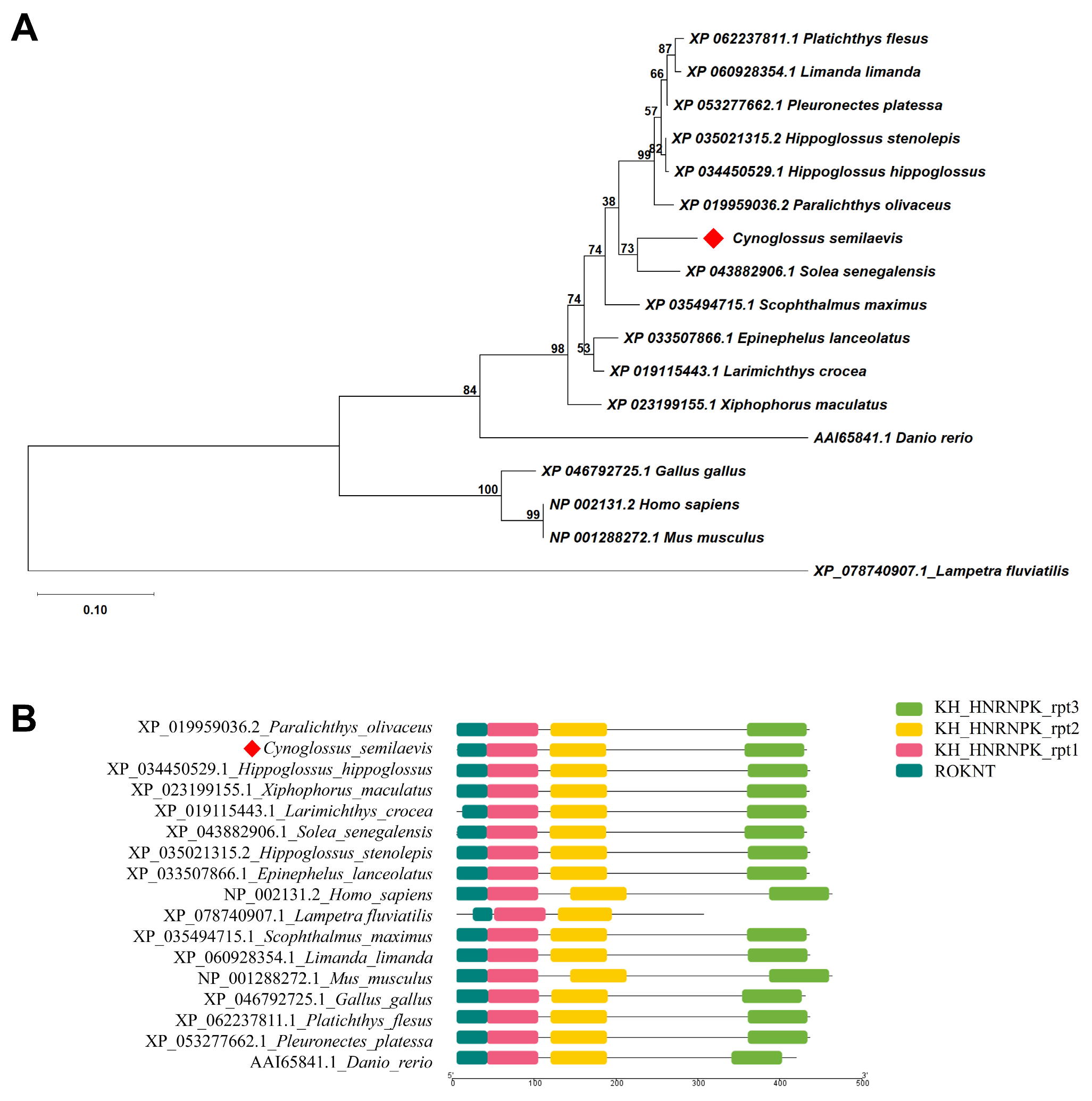
To elucidate the evolutionary status of C. semilaevis hnrnpk, phylogenetic analysis and conserved domain prediction were performed on hnrnpk proteins from various vertebrate species. The resulting phylogenetic tree clearly clustered hnrnpk proteins according to their genetic relationships. The evolutionary status of C. semilaevis hnrnpk sequence was well supported by a monophyletic group with Pleuronectiformes species. Briefly, hnrnpk of C. semilaevis showed the closest relationship with Solea senegalensis hnrnpk, followed by S. maximus, H. hippoglossus, H. stenolepis, and P. olivaceus (Figure 1). Furthermore, conserved domain analysis showed that hnrnpk of C. semilaevis contained the characteristic three tandem KH domains (KH1, KH2, KH3) and a C-terminal ROKNT repeat region, which was similar to the structure of other teleost, as well as mammals, birds, and those higher vertebrates. These results revealed a high degree of structural conservation in hnrnpk proteins throughout the evolution from teleost fish to mammals (Figure 1 and Figure S2).

3.2. Expression Profiles of C. semilaevis hnrnpk During Gonadal Development and in Tissue Distribution

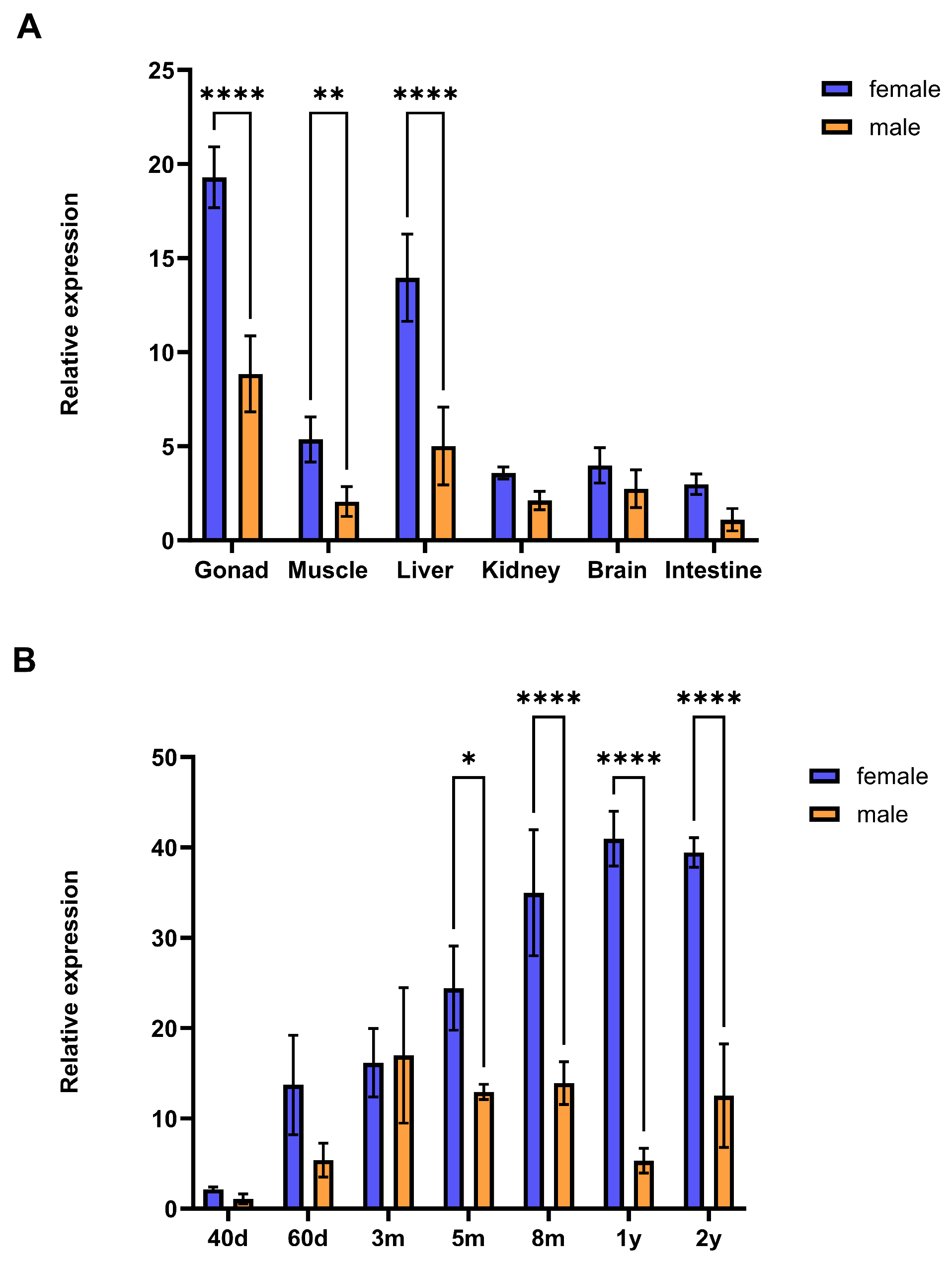
To investigate the expression profiles of C. semilaevis hnrnpk, qPCR was performed to examine its temporal and spatial expression patterns. Tissue distribution analysis showed that hnrnpk was ubiquitously expressed in all examined tissues. The most predominant expression was found in the gonad, and followed by liver, muscle, brain, and so on. Notably, females exhibited consistently higher expression levels than males across all tissues, particularly in the gonad, liver, and muscle (Figure 2A). During gonadal development of C. semilaevis, hnrnpk displayed distinct sex-dependent expression patterns. In females, expression levels increased progressively with age, peaked at 1y. In the individual of 2y, the expression slightly decreased, and the expression profile still maintained a high level. In males, a rapid increasing expression was observed in the early developmental stages, which reached a peaked expression at 3m. At the other subsequent time points, the expressions were fluctuated at moderate levels. Similarly, a higher expression level was also found at each time point in females than that in males (Figure 2B).

3.3. Transcriptional Regulation of Hnrnpk: Promoter Activity Analysis and Transcription Factor Validation

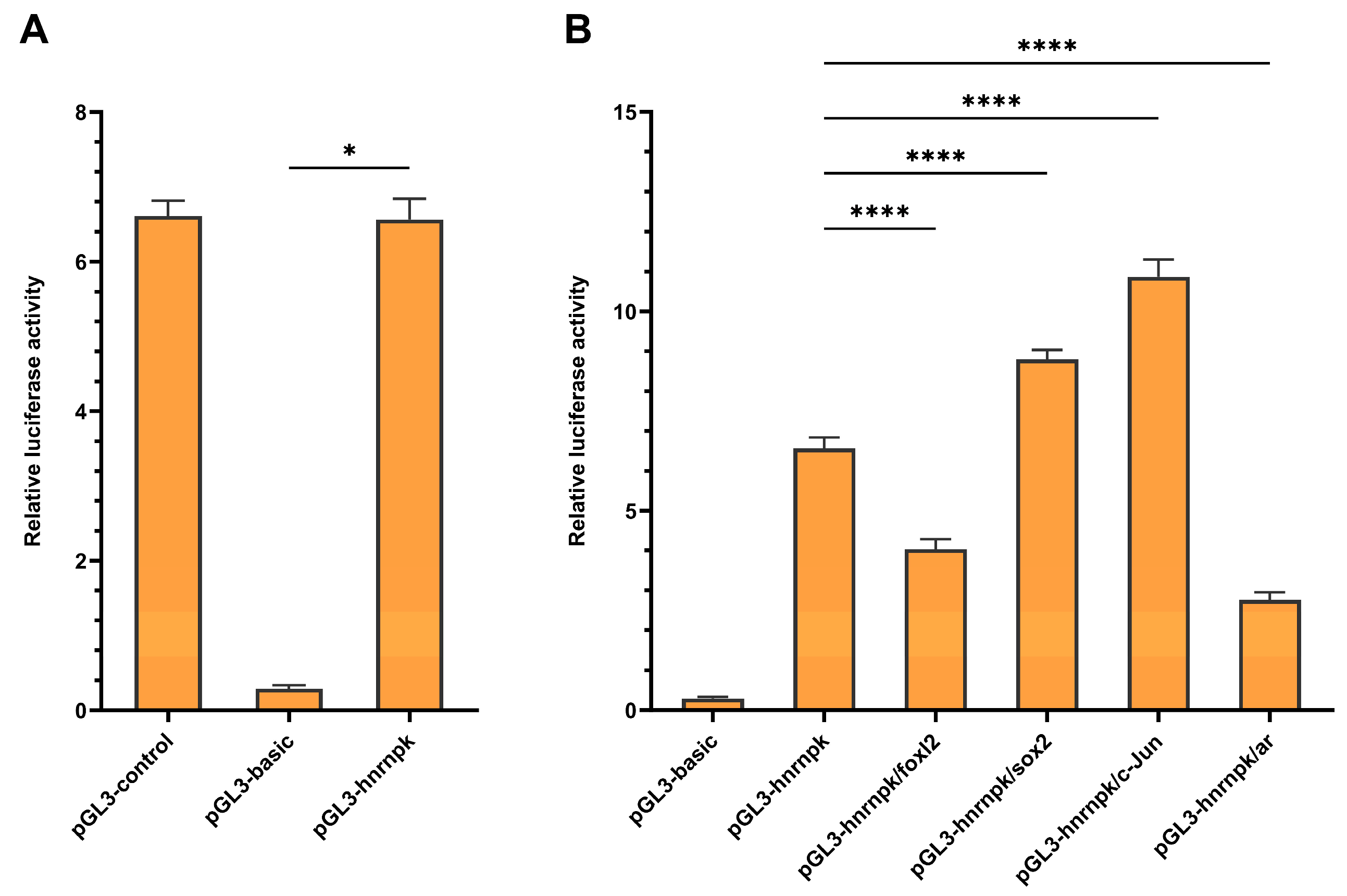
To investigate the transcriptional regulation of hnrnpk, a 1954 bp fragment identified from the predicted promoter region was cloned as the candidate promoter. Dual-luciferase reporter assays showed that this fragment exhibited significant promoter activity, with relative luciferase activity approximately 23-fold higher than that of the pGL3-Basic negative control (Figure 3A). Moreover, the functionality of the transcription factor binding sites was predicted. HEK293T cells were co-transfected with the pGL3-hnrnpk reporter plasmid and overexpression plasmids for sox2, c-Jun, foxl2, or ar. The results showed that Sox2 and c-Jun significantly enhanced hnrnpk promoter activity (by approximately 1.34-fold and 1.65-fold, respectively), whereas foxl2 and ar significantly suppressed it (by approximately 39% and 58%, respectively, Figure 3B).

3.4. Potential Regulatory Relationship Between Hnrnpk and miR-460a-5p

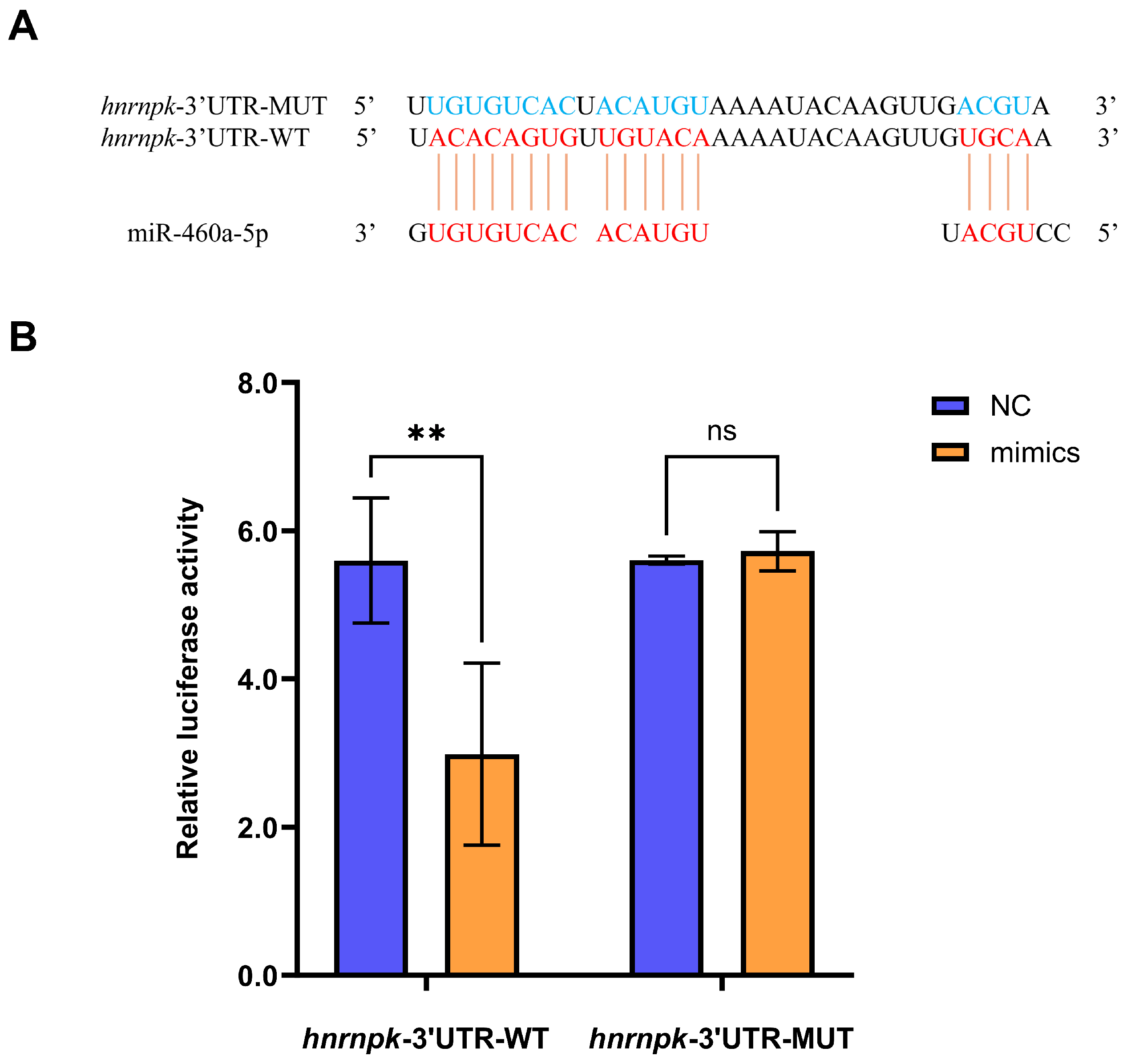
Through the bioinformatic analysis, hnrnpk was predicted as a candidate target gene of miR-460a-5p, with putative binding sites identified in its 3′ untranslated region (UTR) (Figure 4A). To validate this targeting relationship, we conducted dual-luciferase reporter assays in HEK 293T cells. Co-transfection with the miR-460a-5p mimic significantly reduced the luciferase activity of the hnrnpk-3′UTR-WT reporter relative to the negative control. Conversely, mutation of the hnrnpk-3′UTR-MUT construct completely abrogated this inhibitory effect (Figure 4B). Meanwhile, the miRNA negative control group (NC) was also conducted to transfect with wild/mutant plasmids in the HEK 293T cells for luciferase activity, while no effect was observed on luciferase activity in these cells. These findings confirmed that hnrnpk could be a direct target of miR-460a-5p.

3.5. Cell Type-Dependent Regulation of Sex-Related Genes by Hnrnpk

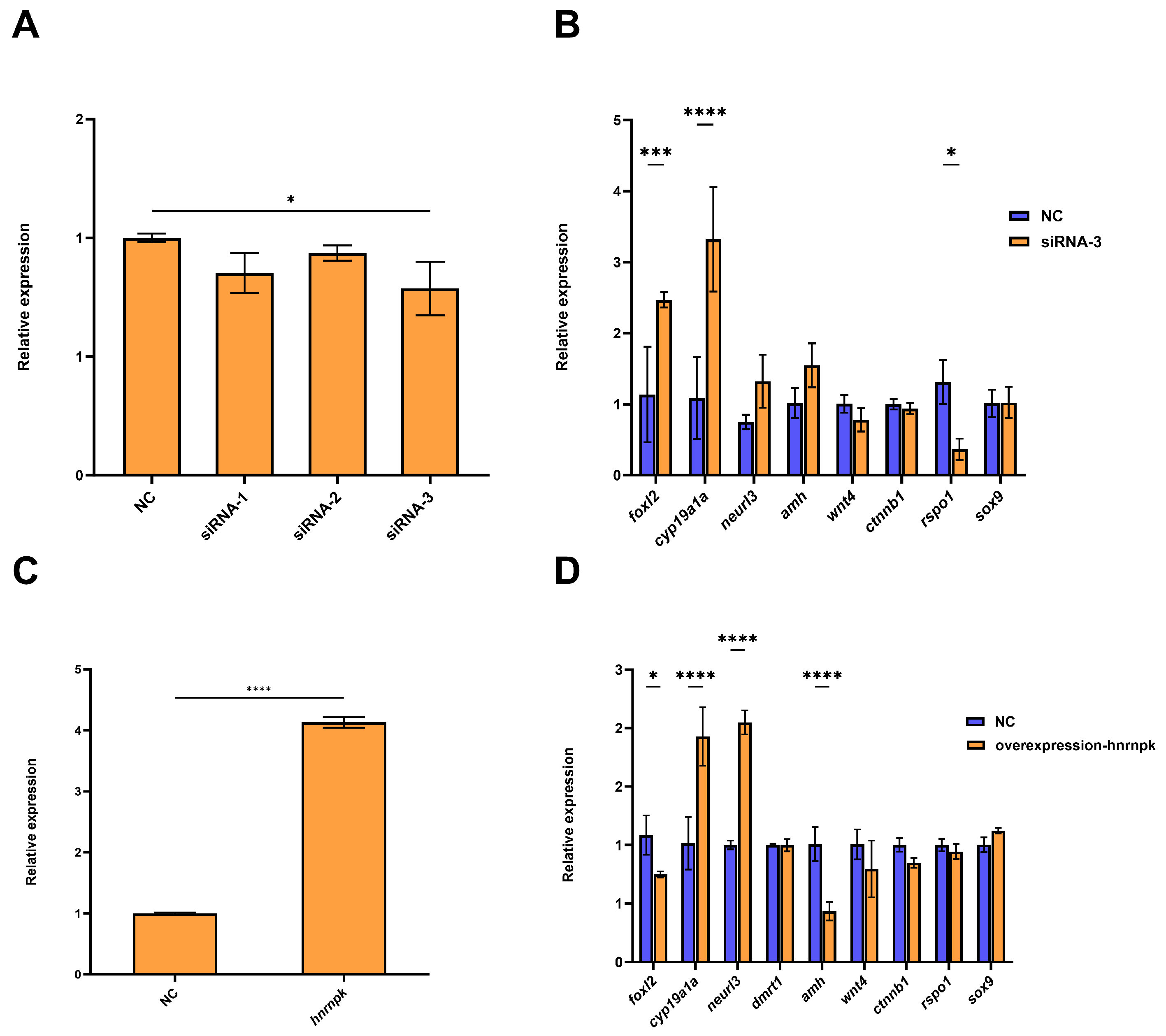
To investigate the role of hnrnpk in sex regulation, we performed loss-of-function and gain-of-function experiments in CSO and CSTE cells, respectively. For the knockdown experiment, three siRNAs were used to knock down hnrnpk in CSO, while siRNA-3 showed the lowest expression among these three siRNAs, which meant the strongest knockdown efficiency. Therefore, siRNA-3 was selected as the optimal candidate for the subsequent knockdown experiment (Figure 5A). In the hnrnpk-knockdown CSO cells, the expression of the female-related genes was affected, cytochrome P450 family 19 subfamily A member 1a (cyp19a1a) was significantly upregulated with the highest fold-change (3.1-fold change), and foxl2 was also significantly upregulated with 2.2-fold change, while R-spondin 1 (rspo1) was significantly downregulated with 0.28-fold change. No significant changes were observed in other genes (Figure 5B). For the overexpression experiment, hnrnpk was overexpressed in CSTE cells, which was successfully confirmed by the extremely high expression level of hnrnpk gene examined by fluorescence microscopy (Figure 5C). In detail, the expression of foxl2 and anti-Müllerian hormone (amh) was significantly downregulated (0.69-fold and 0.43-fold, respectively), while cyp19a1a and neuralized E3 ubiquitin protein ligase 3 (neurl3) were significantly upregulated (1.90-fold and 2.05-fold, respectively). The expression of other genes showed no significant changes (Figure 5D).

3.6. Transcriptomic Landscape Reveals Mechanisms of Hnrnpk-Induced Reprogramming in CSTE

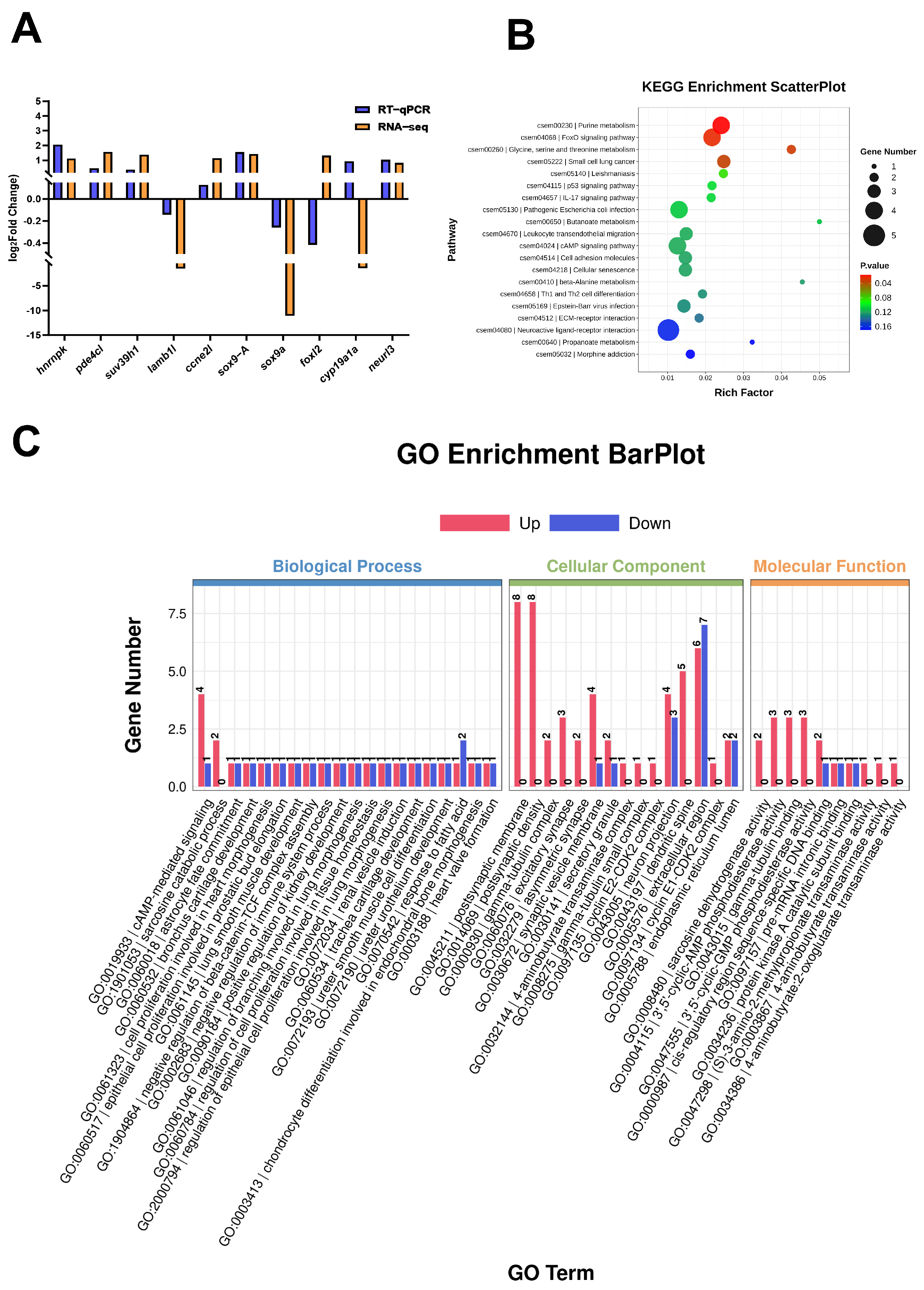
To further elucidate the transcriptional regulation of hnrnpk in sex control and differentiation in C. semilaevis, the transcriptome sequencing analyses were subsequently performed in the hnrnpk-overexpression CSTE. A total of 126 significantly differentially expressed genes (DEGs) were identified compared to the control group (|log2FC| ≥ 1, Q < 0.05), comprising 89 up-regulated and 37 down-regulated genes. Among these, two sox9 gene transcripts showed opposing expression patterns. Briefly, sox-9-A was significantly up-regulated (log2FC = 1.42), while sox9a was significantly down-regulated (log2FC = −11.05). In addition, several other sex-related genes were significantly altered. The cAMP-specific 3′,5′-cyclic phosphodiesterase 4C-like (pde4cl), G1/S-specific cyclin-E2-like (ccne2l) and histone methyltransferase SUV39H1 (suv39h1) were significantly up-regulated with the fold change of log2FC = 1.57, log2FC = 1.15, and log2FC = 1.37, respectively. Conversely, the basement membrane component LAMB1-like (lamb1l) was significantly down-regulated (log2FC = −1.55) (Figure 6A).
KEGG pathway enrichment analysis showed that these DEGs were significantly enriched in pathways, among which the top 20 significantly enriched pathways were listed in Figure 6B. The results revealed that DEGs were mainly enriched in the FoxO-signaling pathway, glycine, serine, and threonine metabolism, and the small cell lung cancer pathways (Figure 6B).
GO functional enrichment analysis revealed profound cellular state transitions across three domains, including Biological Process (BP), Molecular Function (MF), and Cellular Component (CC) (Figure 6C). In BP, the DEGs were enriched in cAMP-mediated signaling, sarcosine catabolic process, astrocyte fate commitment, bronchus cartilage development, and so on. In MF, the DEGs were significantly enriched in terms, including sarcosine dehydrogenase activity, 3′,5′-cyclic-AMP phosphodiesterase activity, gamma-tubulin binding, and so on. In CC, significantly enriched terms included postsynaptic membrane, postsynaptic density, gamma–tubulin complex, and so on. In addition, several GO terms associated with the function of sex control and differentiation, such as male germ-line sex determination, Sertoli cell differentiation, male gonad development, etc., were also significantly enriched as shown in Table 3.

4. Discussion

Hnrnpk is a key member of the HNRNP family. Hnrnpk could be involved in the functions of transcriptional regulation, RNA splicing, translational control, DNA repair, and chromatin remodeling [3,4]. It also plays the key roles in spermatogenesis and female reproduction, as well as reproduction centers on precise post-transcriptional regulation [10,11]. Even though several investigations have been well-studied on hnrnpk in higher vertebrates, the function of C. semilaevis hnrnpk gene targeted by miRNAs in participating in regulating sex control and differentiation during the development of C. semilaevis was still limited. In this regard, miR-460-5p was predicted to target hnrnpk, which was verified by dual-luciferase reporter assay in HEK 293T cells, and the regulatory functions of hnrnpk in sex control and differentiation were explored following significantly different expression levels of hnrnpk in C. semilaevis gonadal tissues during different developmental stages, and the overexpression and knockdown analyses in the gonadal cells, based on the basic information of the identification of hnrnpk, including the full-length cDNA and protein sequences.

4.1. Structural Conservation and Female-Biased Expression of Hnrnpk

The deduced protein sequence of the cloned C. semilaevis hnrnpk contained highly conserved domains, showing structural conservation with those of other vertebrates, especially in teleosts. The gene structure of C. semilaevis hnrnpk has been determined to encode a 433-amino acid protein containing three canonical KH domains and a C-terminal ROKNT repeat region, which demonstrated a well conservation in the genomic organizations of other fish species, even higher vertebrates. Therefore, these findings revealed a high conservation of teleost hnrnpk in the evolution. The high phylogenetic and structural conservation of HNRNPK from teleosts to mammals suggests that its core functions are evolutionarily conserved in vertebrates [35].
To investigate the functions of C. semilaevis hnrnpk, tissue distribution analysis was performed, which revealed that hnrnpk was most abundantly expressed in the gonad, with females exhibiting consistently higher expression levels than males across all examined tissues. During gonadal development, expression levels in females peaked at the period of sexual maturity (1y) and still maintained a high level (2y), significantly exceeding those in males. This developmental stage coincides with the critical period of gonadal maturation [36,37], which suggested a female-biased expression pattern of hnrnpk in C. semilaevis. For example, in rats, hnrnpk was expressed in neonatal ovaries, and its knockdown disrupts primordial follicle assembly and increases oocyte apoptosis [11]. In the African clawed frog (Xenopus laevis), hnrnpk was present in oocytes, eggs, and early embryos, where it associates with maternal mRNAs [8]. Moreover, in Japanese flounder (P. olivaceus), a related KH domain-containing RNA-binding protein, fmr1, was highly expressed in the ovary [38], suggesting that KH domain proteins might play key roles in teleost ovarian development. In this study, the female-biased expression of hnrnpk, particularly its dynamic changes during gonadal development, strongly suggests that this gene may play a role in sex-related processes, providing a foundation for subsequent investigations into its upstream regulatory network and downstream functional mechanisms.

4.2. Transcriptional and Post-Transcriptional Regulation of Hnrnpk in C. semilaevis

To elucidate the molecular basis underlying the female-biased expression of hnrnpk, we systematically analyzed its upstream regulatory mechanisms. Promoter activity assays revealed that hnrnpk transcription is coordinately regulated by multiple sex-related transcription factors: sox2 and c-Jun significantly enhanced its promoter activity, whereas foxl2 and ar markedly suppressed it. It was reported that these factors functioned on sex-related bioprocesses in several previous studies. For instance, sox2, a pluripotency factor, played critical roles in oogenesis and early embryogenesis [39]. The factor c-Jun directly binded the promoters of star and other genes to regulate testicular function and steroidogenesis in teleosts [40]. Foxl2, a core transcription factor for ovarian differentiation and maintenance in teleosts, is specifically expressed in female granulosa cells [41,42], and ar, as the androgen receptor, mediates androgen signaling and spermatogenesis [43]. The coordinated regulation of the hnrnpk promoter by these sex-related factors showed an obvious antagonistic relationship between activators (sox2, c-Jun) and repressors (foxl2, ar), which provided a key transcriptional basis for its female-biased expression.
Post-transcriptional mechanisms also contribute to hnrnpk regulation. Several recent studies also indicated that hnrnpk genes could be regulated by different miRNAs to perform diverse functions. In this study, dual-luciferase reporter assays confirmed that miR-460a-5p directly targets the hnrnpk 3′UTR and significantly inhibits its expression. In mammals, accumulating evidence indicated that hnrnpk interacted with multiple miRNAs to regulate various biological processes. In porcine skeletal muscle satellite cells, miR-133a-3p directly targeted hnrnpk, establishing a regulatory axis that controled myogenic differentiation through modulation of ucp2 expression [44]. In prostate cancer, miR-206 and miR-613 directly targeted the 3′UTR of hnrnpk, suppressing its expression and thereby inhibiting tumor cell proliferation and tumor growth [45]. In pediatric epilepsy, miR-873-5p directly targeted hnrnpk, contributing to oxidative stress and inflammatory responses [46].
However, which miRNAs regulate hnrnpk expression and what functions they mediate in fish remain unexplored. Notably, miR-460-5p responds to environmental temperature changes in birds [16], while the half-smooth tongue sole exhibits temperature-sensitive sex determination [2]. The miR-460a-5p-mediated inhibition of hnrnpk, potentially acting in concert with its differential expression between female and male gonads and integrating environmental signals, may collectively shape the sex-specific expression pattern of hnrnpk. However, the precise regulatory network needs to be investigated by deeper studies in the future.

4.3. Cell Type-Dependent Regulatory Effects of C. semilaevis hnrnpk on Sex-Related Genes in CSO and CSTE Cells

To investigate the role of hnrnpk in sex regulation, we performed loss-of-function and gain-of-function experiments in CSO and CSTE cells, respectively. In hnrnpk-knockdown CSO cells, several sex-related genes were significantly regulated. Briefly, female-related genes (foxl2 and its downstream target cyp19a1a) were significantly upregulated. Loss-of-function studies have firmly established hnrnpk as a critical regulator of mammalian reproduction. In mice, germ cell-specific deletion of hnrnpk leads to spermatogenic arrest and complete male infertility [10,47]. In rats, siRNA-mediated knockdown of hnrnpk in neonatal ovaries disrupts primordial follicle assembly and increases oocyte apoptosis [11]. In vertebrates, the expression of hnrnpk in reproductive tissues has also been documented. In X. laevis, hnrnpk is present in oocytes, eggs, and early embryos, where it associates with maternal mRNAs [8]. In fish, however, direct evidence for hnrnpk expression or function in gonads is lacking, with most studies on hnrnpk family members focusing on antiviral immunity [6,48].
It was well known that foxl2 played as a core transcription factor for ovarian differentiation in teleosts, which could directly activate cyp19a1a transcription [41,49], and cyp19a1a encodes aromatase, which catalyzes estrogen synthesis and serves as a key rate-limiting enzyme for female sex maintenance [50]. Loss-of-function studies have shown that disruption of either gene leads to female-to-male sex reversal or impaired ovarian development [51,52], underscoring their critical roles in establishing the female reproductive program. Consistently, rspo1 is an activator of the WNT/β-catenin-signaling pathway and participates in ovarian differentiation in fish, with its expression levels closely associated with female development [53,54]. In C. semilaevis, rspo1 has also been confirmed to exhibit female-biased expression and to be involved in the regulation of the WNT-signaling pathway [53]. In the present study, rspo1 was significantly downregulated upon hnrnpk knockdown, suggesting that hnrnpk may be involved in the regulatory network of female-related genes in CSO cells, potentially through the modulation of the WNT-signaling pathway via rspo1. These findings may imply that the C. semilaevis hnrnpk gene can be used as a potential regulatory factor to mediate the sex differentiation or development of the ovary in C. semilaevis.
In hnrnpk-overexpression CSTE cells, a relatively more complete regulatory pattern of C. semilaevis hnrnpk gene was identified in sex control and regulation. In the current study, the expression of foxl2 and amh was significantly suppressed, and neurl3 was dramatically upregulated. Similarly, in mammals, the essential role of hnrnpk in male reproduction was demonstrated through both expression and functional studies. In mice, hnrnpk was highly expressed in the testis, localizing to the nuclei of pachytene spermatocytes, round spermatids, and Sertoli cells [55], with dynamic expression patterns also observed during testis development in rats and pigs [56]. Loss-of-function studies have further shown that germ cell-specific deletion of hnrnpk could cause spermatogenic arrest at the pachytene stage and complete male infertility [10,57]. Mechanistically, hnrnpk directly binded to the 3′UTR of piRNA pathway transcripts, enhancing their translational efficiency and thereby regulating piRNA production and spermatogenesis [10]. Collectively, these findings established hnrnpk as an indispensable regulator of male reproductive development in mammals. Unlike previous studies that primarily employed loss-of-function strategies (knockout or knockdown) to explore the reproductive function of hnrnpk in mice, the present study provided the first evidence in vertebrates that overexpression of hnrnpk also could modulate sex-related gene expression. Amh, a member of the TGF-β superfamily, serves as a key regulator of male gonadal development in teleosts [58,59]. In C. semilaevis, amh exhibits gonad-specific expression, with significantly higher expression levels in males than in females [60], and its downregulation disrupts the male maintenance program [59]. Moreover, neurl3, an E3 ubiquitin ligase located on the Z chromosome, regulates spermatogenesis in half-smooth tongue sole [61]. Consistent with its role in male reproduction, significantly downregulated amh and significantly upregulated neurl3 were found upon hnrnpk overexpression in CSTE, further supporting the involvement of hnrnpk in male reproductive and spermatogenesis pathways.
Interestingly, the cyp19a1a gene was still significantly upregulated, which might also be due to a compensatory mechanism. Due to the suppressed expression of foxl2, cyp19a1a, as the downstream target gene of foxl2, might receive fewer signals from foxl2 to stimulate its expression, and then, foxl2-independent alternative pathways might be activated to enhance the expression of cyp19a1a. These alternative pathways were also demonstrated by previous studies. The cyp19a1a transcriptional regulation in fish was complex, and multiple factors, including Nr5a1 (Sf1) and cAMP signaling, participated in its expression control [50,62]. Meanwhile, the male-determining gene dmrt1 showed no significant change. Dmrt1, a Z chromosome-linked male-determining gene, is essential for testicular development [63]. The unchanged dmrt1 expression indicates that the site where C. semilaevis hnrnpk performs its function might be located downstream of dmrt1, which means that C. semilaevis hnrnpk could participate in the regulation of gonadal differentiation and development, but not in the sex determination. However, more efforts are urgently needed to verify our hypothesis in the future.
These results indicated that hnrnpk expression should be maintained within a precise range in C. semilaevis. The deficiency of hnrnpk in the CSO upregulated the expression of foxl2 and cyp19a1a, while its excess in the CSTE similarly induced abnormal cyp19a1a activation. This effect pattern might reveal the dosage sensitivity of hnrnpk function in C. semilaevis. Notably, hnrnpk exhibited context-dependent regulation of cyp19a1a. In the CSO, its upregulation accompanied foxl2 upregulation, aligning with the classical pattern, but in the CSTE, its upregulation coexisted with foxl2 suppression, suggesting foxl2-independent alternative pathways. However, this complex pattern prompted us to further explore the underlying mechanisms through transcriptome sequencing.

4.4. Transcriptomic Analyses Further Supported the Regulatory Functions of Hnrnpk in C. semilaevis Gonad Development

To further explore the mechanism underlying the paradoxical uncoupling of foxl2 and cyp19a1a observed in hnrnpk-overexpressing CSTE cells—specifically, the upregulation of cyp19a1a despite foxl2 suppression—we performed transcriptome sequencing on CSTE cells overexpressing hnrnpk. Transcriptome analysis revealed significant changes in multiple genes critical for sex determination and gonadal development. Most notably, the two isoforms of sox9 exhibited completely opposite expression patterns. The canonical male isoform sox9a was dramatically suppressed (log2FC = −11.05), while a functionally uncharacterized non-canonical isoform, designated as sox9-A, was significantly upregulated (log2FC = 1.42). Sox9 is central to the vertebrate sex determination cascade, driving Sertoli cell differentiation in mammals [64,65,66]. In teleosts, sox9a has been established as a critical regulator of testicular development, showing testis-specific high expression in species such as C. semilaevis and Oryzias latipes [1,67]. These results indicated that hnrnpk overexpression might directly disrupt the core program of male sex maintenance.
In addition, KEGG pathway-enrichment analysis revealed significant enrichment in several pathways associated with gonadal development. For instance, the FoxO-signaling pathway implicated in ovarian follicle development and oocyte maturation in both mammals and fish [68,69] was significantly enriched. S-phase kinase-associated protein 2 (skp2), a gene within this pathway, was significantly upregulated. Skp2 was reported to promote cell cycle progression by targeting p27Kip1 for degradation [70]. Enrichment of the FoxO pathway suggested that hnrnpk overexpression might aberrantly activate ovarian cycle progression, thereby promoting development programs of ovary in C. semilaevis. Moreover, the purine metabolism pathway, closely linked to cAMP signaling [71], was also significantly enriched. It was reported that the cAMP levels were regulated by PDE4 family members to influence Sertoli cell responsiveness to FSH (Follicle-Stimulating Hormone) during spermatogenesis [72], and cAMP also served as a critical second messenger, enabling Sertoli cells to respond to FSH [73]. In this study, multiple cAMP-specific phosphodiesterase genes within this pathway, including cAMP-specific 3′,5′-cyclic phosphodiesterase 4B-like (pde4bl) and cAMP-specific 3′,5′-cyclic phosphodiesterase 4C-like (pde4cl), were significantly upregulated. The marked upregulation of PDEs indicated the suppression of cAMP signaling, which might further compromise the male maintenance program.

5. Conclusions

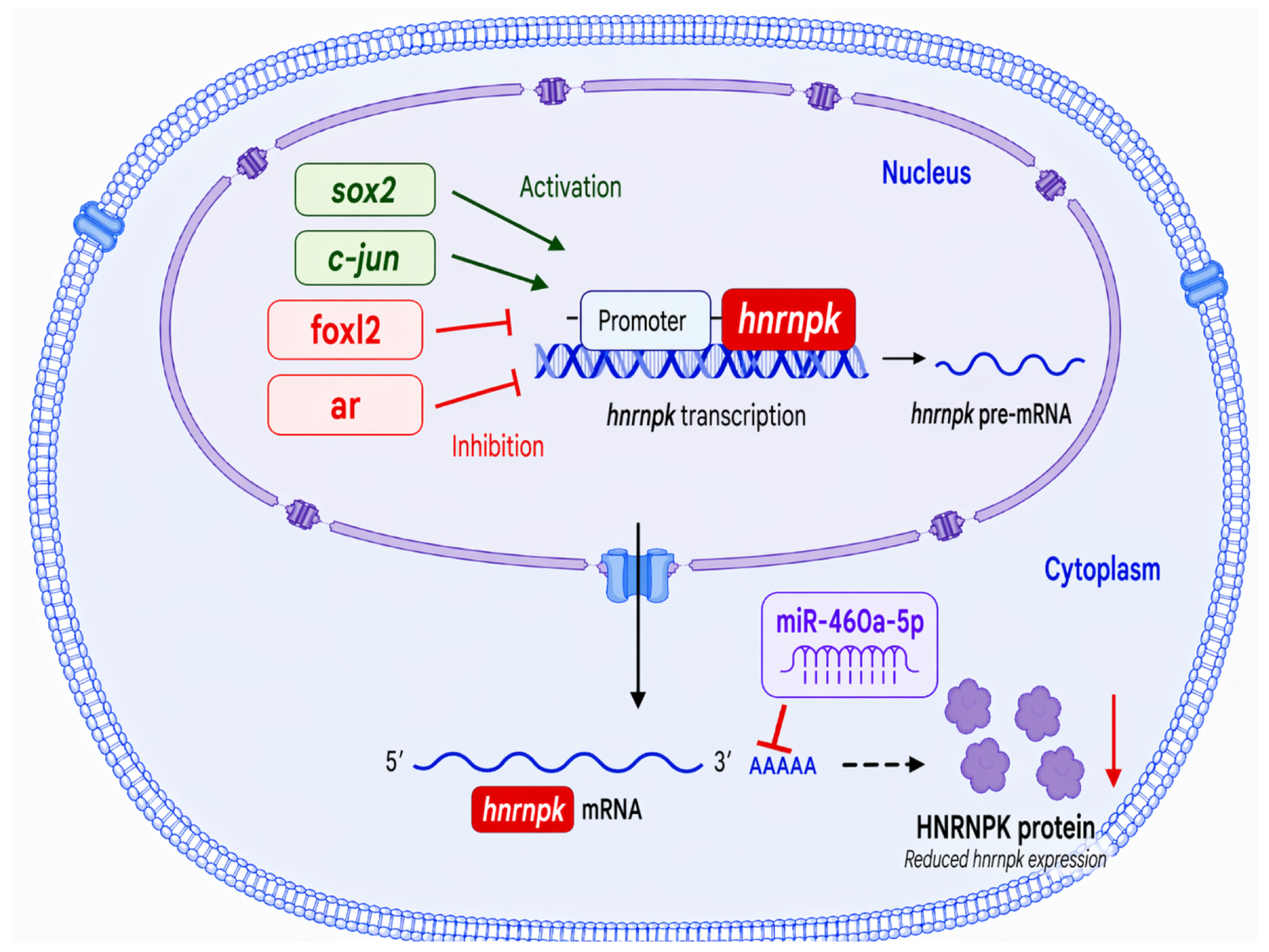
In this study, we characterized the role of hnrnpk in regulating sex-related gene expression in C. semilaevis. The CDS of hnrnpk was cloned and identified, which was used to reveal its female-biased expression during gonadal development. As shown in Figure 7, our findings also demonstrated that hnrnpk expression could be regulated at both transcriptional (sox2/c-Jun activation, foxl2/ar repression) and post-transcriptional (miR-460a-5p targeting) levels. Meanwhile, functional assays showed that hnrnpk could regulate cyp19a1a in a cell type-dependent and dose-sensitive manner. Transcriptome analyses further demonstrated that hnrnpk overexpression could suppress the canonical male isoform sox9a and activate multiple sexual regulation-related signaling pathways. Overall, our findings demonstrate that hnrnpk, a female-biased gene regulated by multiple mechanisms, plays multiple roles in gonadal development through miR-460a-5p targeting and sox9 isoform switching. This study will offer new insights into sex determination for C. semilaevis hnrnpk and also provide a potential target for monosex breeding in aquaculture.

Supplementary Materials

The following supporting information can be downloaded at: https://www.mdpi.com/article/10.3390/ani16091327/s1, Figure S1: The CDS of hnrnpk in C. semilaevis, total length 1302 bp. Figure S2: Multiple sequence alignment of HNRNPK amino acid sequences. Multiple sequence alignment of HNRNPK homologous protein sequences from 17 species was performed using MEGA software with the ClustalW algorithm. The alignment results were visualized using ESPript 3.0. Red background indicates strictly conserved residues across all aligned sequences, red characters denote conservative substitutions, and other colors represent regions with lower sequence conservation. Table S1: Biological Process; Molecular Function; Cellular Component.

Author Contributions

Conceptualization, K.L., S.C. and C.G.; Methodology, S.C. and C.G.; Validation, K.L., Q.L., W.L. and H.Y.; Formal analysis, Q.L. and W.L.; Resources, H.Y., Q.L., W.L., S.C. and C.G.; Data curation, K.L., C.G. and H.Y.; Writing—original draft preparation, K.L.; Writing—review and editing, K.L., C.G., H.Y., Q.L. and S.C.; Visualization, W.L., Q.L. and H.Y.; Supervision, C.G., S.C., H.Y., Q.L. and W.L.; Project administration, C.G. and S.C.; Funding acquisition, C.G. and S.C. All authors have read and agreed to the published version of the manuscript.

Funding

This work was supported by the National Natural Science Foundation of China (32230107), Shandong Key R&D Program (Competitive Innovation Platform) (2024CXPT071-1), Central Public-interest Scientific Institution Basal Research Fund, CAFS (2023TD20), National Natural Science Foundation of China (32503166), Shandong Provincial Natural Science Foundation (ZR2025QC143).

Institutional Review Board Statement

All experimental procedures involving C. semilaevis were conducted in accordance with the guidelines established by the Experimental Animal Care, Ethics, and Safety Inspection Committee of the Yellow Sea Fisheries Research Institute, Chinese Academy of Fishery Sciences (Approval No.: YSFRI-2025019; Date: 14 March 2024).

Informed Consent Statement

Not applicable.

Data Availability Statement

Transcriptome data were deposited in the SRA database under BioProject accession PRJNA1438903 and SRA study accession SRP684648.

Conflicts of Interest

The authors declare no conflicts of interest.

References

  1. Chen, S.; Zhang, G.; Shao, C.; Huang, Q.; Liu, G.; Zhang, P.; Song, W.; An, N.; Chalopin, D.; Volff, J.N.; et al. Whole-genome sequence of a flatfish provides insights into ZW sex chromosome evolution and adaptation to a benthic lifestyle. Nat. Genet. 2014, 46, 253–260. [Google Scholar] [CrossRef] [PubMed]
  2. Shao, C.; Li, Q.; Chen, S.; Zhang, P.; Lian, J.; Hu, Q.; Sun, B.; Jin, L.; Liu, S.; Wang, Z.; et al. Epigenetic modification and inheritance in sexual reversal of fish. Genome Res. 2014, 24, 604–615. [Google Scholar] [CrossRef] [PubMed]
  3. Geuens, T.; Bouhy, D.; Timmerman, V. The hnRNP family: Insights into their role in health and disease. Hum. Genet. 2016, 135, 851–867. [Google Scholar] [CrossRef] [PubMed]
  4. Han, S.P.; Tang, Y.H.; Smith, R. Functional diversity of the hnRNPs: Past, present and perspectives. Biochem. J. 2010, 430, 379–392. [Google Scholar] [CrossRef]
  5. Braems, E.; Bercier, V.; Van Schoor, E.; Heeren, K.; Beckers, J.; Fumagalli, L.; Dedeene, L.; Moisse, M.; Geudens, I.; Hersmus, N.; et al. HNRNPK alleviates RNA toxicity by counteracting DNA damage in C9orf72 ALS. Acta Neuropathol. 2022, 144, 465–488. [Google Scholar] [CrossRef]
  6. Zhang, Y.; Cen, J.; Wu, H.; Gao, W.; Jia, Z.; Adamek, M.; Zou, J. Autophagy mediated degradation of MITA/TBK1/IRF3 by a hnRNP family member attenuates interferon production in fish. Fish Shellfish Immunol. 2024, 149, 109563. [Google Scholar] [CrossRef]
  7. Liu, D.; Yu, H.; Xue, N.; Bao, H.; Gao, Q.; Tian, Y. Alternative splicing patterns of hnrnp genes in gill tissues of rainbow trout (Oncorhynchus mykiss) during salinity changes. Comp. Biochem. Physiol. B Biochem. Mol. Biol. 2024, 271, 110948. [Google Scholar] [CrossRef]
  8. Iwasaki, T.; Koretomo, Y.; Fukuda, T.; Paronetto, M.P.; Sette, C.; Fukami, Y.; Sato, K. Expression, phosphorylation, and mRNA-binding of heterogeneous nuclear ribonucleoprotein K in Xenopus oocytes, eggs, and early embryos. Dev. Growth Differ. 2008, 50, 23–40. [Google Scholar] [CrossRef]
  9. Liu, Y.; Gervasi, C.; Szaro, B.G. A crucial role for hnRNP K in axon development in Xenopus laevis. Development 2008, 135, 3125–3135. [Google Scholar] [CrossRef]
  10. Xu, H.; Guo, J.; Huang, Y.; Zhang, M.; Wang, Y.; Xia, L.; Cheng, X.; Meng, T.; Hao, R.; Wei, X.; et al. Insights into the role of hnRNPK in spermatogenesis via the piRNA pathway. Sci. Rep. 2025, 15, 6438. [Google Scholar] [CrossRef]
  11. Wang, N.; Zhang, P.; Guo, X.; Zhou, Z.; Sha, J. Hnrnpk, a protein differentially expressed in immature rat ovarian development, is required for normal primordial follicle assembly and development. Endocrinology 2011, 152, 1024–1035. [Google Scholar] [CrossRef] [PubMed]
  12. Hurtado, A.; Mota-Gómez, I.; Lao, M.; Real, F.M.; Jedamzick, J.; Burgos, M.; Lupiáñez, D.G.; Jiménez, R.; Barrionuevo, F.J. Complete male-to-female sex reversal in XY mice lacking the miR-17~92 cluster. Nat. Commun. 2024, 15, 3809. [Google Scholar] [CrossRef] [PubMed]
  13. Yu, Q.; Peng, C.; Ye, Z.; Tang, Z.; Li, S.; Xiao, L.; Liu, S.; Yang, Y.; Zhao, M.; Zhang, Y.; et al. An estradiol-17β/miRNA-26a/cyp19a1a regulatory feedback loop in the protogynous hermaphroditic fish, Epinephelus coioides. Mol. Cell Endocrinol. 2020, 504, 110689. [Google Scholar] [CrossRef] [PubMed]
  14. Ma, W.; Chen, K.; Jiang, M.; Jia, S.; Chen, J.; Tao, B.; Song, Y.; Li, Y.; Wang, Y.; Xiao, W.; et al. MiR-153b-3p regulates the proliferation and differentiation of male germ cells by targeting amh in common carp (Cyprinus carpio). Aquaculture 2021, 535, 736420. [Google Scholar] [CrossRef]
  15. Tang, L.; You, W.; Wang, Q.; Huang, F.; Shao, C. MicroRNA ssa-mir-196a-4 deceases lgr8 expression in testis development of Chinese tongue sole (Cynoglossus semilaevis). Comp. Biochem. Physiol. B Biochem. Mol. Biol. 2022, 258, 110695. [Google Scholar] [CrossRef]
  16. Naraballobh, W.; Trakooljul, N.; Murani, E.; Krischek, C.; Janisch, S.; Wicke, M.; Ponsuksili, S.; Wimmers, K. miRNAs regulate acute transcriptional changes in broiler embryos in response to modification of incubation temperature. Sci. Rep. 2018, 8, 11371. [Google Scholar] [CrossRef]
  17. Zhang, B.; Wang, X.; Sha, Z.; Yang, C.; Liu, S.; Wang, N.; Chen, S.L. Establishment and characterization of a testicular cell line from the half-smooth tongue sole, Cynoglossus semilaevis. Int. J. Biol. Sci. 2011, 7, 452–459. [Google Scholar] [CrossRef]
  18. Sun, A.; Wang, T.Z.; Wang, N.; Liu, X.F.; Sha, Z.X.; Chen, S.L. Establishment and characterization of an ovarian cell line from half-smooth tongue sole Cynoglossus semilaevis. J. Fish Biol. 2015, 86, 46–59. [Google Scholar] [CrossRef]
  19. Ma, H.Y.; Chen, S.L.; Li, J.; Tian, Y.S.; Ji, X.S.; Zhang, L.J. Development of female-specific AFLP marker CseF783 and its application in genetic sex identification in half-smooth tongue sole (Cynoglossus semilaevis). Yi Chuan 2009, 31, 88–94. [Google Scholar] [CrossRef]
  20. Xu, W.; Cui, Z.; Wang, N.; Zhang, M.; Wang, J.; Xu, X.; Liu, Y.; Chen, S. Transcriptomic analysis revealed gene expression profiles during the sex differentiation of Chinese tongue sole (Cynoglossus semilaevis). Comp. Biochem. Physiol. Part D Genom. Proteom. 2021, 40, 100919. [Google Scholar] [CrossRef]
  21. Sayers, E.W.; Beck, J.; Bolton, E.E.; Brister, J.R.; Chan, J.; Connor, R.; Feldgarden, M.; Fine, A.M.; Funk, K.; Hoffman, J.; et al. Database resources of the National Center for Biotechnology Information in 2025. Nucleic Acids Res. 2025, 53, D20–D29. [Google Scholar] [CrossRef]
  22. Kumar, S.; Stecher, G.; Suleski, M.; Sanderford, M.; Sharma, S.; Tamura, K. MEGA12: Molecular Evolutionary Genetic Analysis Version 12 for Adaptive and Green Computing. Mol. Biol. Evol. 2024, 41, msae263. [Google Scholar] [CrossRef] [PubMed]
  23. Marchler-Bauer, A.; Derbyshire, M.K.; Gonzales, N.R.; Lu, S.; Chitsaz, F.; Geer, L.Y.; Geer, R.C.; He, J.; Gwadz, M.; Hurwitz, D.I.; et al. CDD: NCBI’s conserved domain database. Nucleic Acids Res. 2015, 43, D222–D226. [Google Scholar] [CrossRef] [PubMed]
  24. Wang, J.; Chitsaz, F.; Derbyshire, M.K.; Gonzales, N.R.; Gwadz, M.; Lu, S.; Marchler, G.H.; Song, J.S.; Thanki, N.; Yamashita, R.A.; et al. The conserved domain database in 2023. Nucleic Acids Res. 2023, 51, D384–D388. [Google Scholar] [CrossRef] [PubMed]
  25. Letunic, I.; Bork, P. Interactive Tree of Life (iTOL) v6: Recent updates to the phylogenetic tree display and annotation tool. Nucleic Acids Res. 2024, 52, W78–W82. [Google Scholar] [CrossRef]
  26. Li, Z.; Yang, L.; Wang, J.; Shi, W.; Pawar, R.A.; Liu, Y.; Xu, C.; Cong, W.; Hu, Q.; Lu, T.; et al. beta-Actin is a useful internal control for tissue-specific gene expression studies using quantitative real-time PCR in the half-smooth tongue sole Cynoglossus semilaevis challenged with LPS or Vibrio anguillarum. Fish Shellfish Immunol. 2010, 29, 89–93. [Google Scholar] [CrossRef]
  27. Rehmsmeier, M.; Steffen, P.; Hochsmann, M.; Giegerich, R. Fast and effective prediction of microRNA/target duplexes. Rna 2004, 10, 1507–1517. [Google Scholar] [CrossRef]
  28. Liu, Y.; Liu, Y.; Han, M.; Du, X.; Liu, X.; Zhang, Q.; Liu, J. Edwardsiella tarda-induced miR-7a functions as a suppressor in PI3K/AKT/GSK3β signaling pathway by targeting insulin receptor substrate-2 (IRS2a and IRS2b) in Paralichthys olivaceus. Fish Shellfish Immunol. 2019, 89, 477–485. [Google Scholar] [CrossRef]
  29. Liu, Z.; Ma, F.; Kang, Y.; Liu, X. Gene ssa-miR-301a-3p improves rainbow trout (Oncorhynchus mykiss) resistance to heat stress by targeting hsp90b2. PeerJ 2022, 10, e13476. [Google Scholar] [CrossRef]
  30. Pertea, M.; Kim, D.; Pertea, G.M.; Leek, J.T.; Salzberg, S.L. Transcript-level expression analysis of RNA-seq experiments with HISAT, StringTie and Ballgown. Nat. Protoc. 2016, 11, 1650–1667. [Google Scholar] [CrossRef]
  31. Kechin, A.; Boyarskikh, U.; Kel, A.; Filipenko, M. cutPrimers: A New Tool for Accurate Cutting of Primers from Reads of Targeted Next Generation Sequencing. J. Comput. Biol. 2017, 24, 1138–1143. [Google Scholar] [CrossRef] [PubMed]
  32. Kim, D.; Paggi, J.M.; Park, C.; Bennett, C.; Salzberg, S.L. Graph-based genome alignment and genotyping with HISAT2 and HISAT-genotype. Nat. Biotechnol. 2019, 37, 907–915. [Google Scholar] [CrossRef] [PubMed]
  33. Love, M.I.; Huber, W.; Anders, S. Moderated estimation of fold change and dispersion for RNA-seq data with DESeq2. Genome. Biol. 2014, 15, 550. [Google Scholar] [CrossRef] [PubMed]
  34. Subramanian, A.; Tamayo, P.; Mootha, V.K.; Mukherjee, S.; Ebert, B.L.; Gillette, M.A.; Paulovich, A.; Pomeroy, S.L.; Golub, T.R.; Lander, E.S.; et al. Gene set enrichment analysis: A knowledge-based approach for interpreting genome-wide expression profiles. Proc. Natl. Acad. Sci. USA 2005, 102, 15545–15550. [Google Scholar] [CrossRef]
  35. Nishanth, M.J.; Jha, S. Evolutionary Analysis of the hnRNP Interactomes and Their Functions in Eukaryotes. Biochem. Genet. 2025, 63, 4876–4900. [Google Scholar] [CrossRef]
  36. Liu, Y.; Bai, S.; Li, X.; Jin, C.; Wang, Z.; Zhai, J.; Li, W.; Li, H.; Liu, J.; Zhang, Q. Chronic low salinity stress rescued masculinization effect in farmed Cynoglossus semilaevis population. Mar. Pollut. Bull. 2024, 200, 116074. [Google Scholar] [CrossRef]
  37. Wang, J.; Huang, Y.; Cui, Z.; Zhang, K.; Wang, N.; Luo, J.; Song, Y.; Hu, B.; Li, M.; Chen, Y.; et al. Single-nucleus RNA sequencing reveals the underlying roadmap of early gonadal differentiation in teleost. Sci. China Life Sci. 2026, 69, 937–953. [Google Scholar] [CrossRef]
  38. Xiang, Y.Z.; Zhang, J.; Wang, X.; Shi, Z. Molecular Characterization and Expression Analysis of frmr1 Gene in Japanese Flounder. Genom. Appl. Biol. 2019, 38, 4395–4403. [Google Scholar] [CrossRef]
  39. Sarkar, A.; Hochedlinger, K. The sox family of transcription factors: Versatile regulators of stem and progenitor cell fate. Cell Stem Cell 2013, 12, 15–30. [Google Scholar] [CrossRef]
  40. Tenugu, S.; Senthilkumaran, B. Analysis of star promoter in common carp and catfish testis: Role of c-jun and its association with testicular function as a transcription factor. J. Steroid. Biochem. Mol. Biol. 2025, 253, 106817. [Google Scholar] [CrossRef]
  41. Hu, Q.; Guo, W.; Gao, Y.; Tang, R.; Li, D. Molecular cloning and analysis of gonadal expression of Foxl2 in the rice-field eel Monopterus albus. Sci. Rep. 2014, 4, 6884. [Google Scholar] [CrossRef] [PubMed]
  42. Uhlenhaut, N.H.; Treier, M. Foxl2 function in ovarian development. Mol. Genet. Metab. 2006, 88, 225–234. [Google Scholar] [CrossRef] [PubMed]
  43. Smith, L.B.; Walker, W.H. The regulation of spermatogenesis by androgens. Semin. Cell Dev. Biol. 2014, 30, 2–13. [Google Scholar] [CrossRef] [PubMed]
  44. Xu, Y.; Cheng, X.; Zhang, M.; Guo, J.; Ren, K.; Zhou, K.; Li, T.; Wang, Y.; Li, Q.; Meng, T.; et al. Unraveling the hnRNPK/miR-133a-3p/UCP2 axis: A novel regulatory circuit governing porcine skeletal muscle satellite cell fate. Cell Signal. 2025, 136, 112160. [Google Scholar] [CrossRef]
  45. Wu, H.L.; Li, S.M.; Huang, Y.C.; Xia, Q.D.; Zhou, P.; Li, X.M.; Yu, X.; Wang, S.G.; Ye, Z.Q.; Hu, J. Transcriptional regulation and ubiquitination-dependent regulation of HnRNPK oncogenic function in prostate tumorigenesis. Cancer Cell Int. 2021, 21, 641. [Google Scholar] [CrossRef]
  46. Li, Q.; Li, N. The dysregulation and regulatory mechanism of long non-coding RNA LBX2-AS1 in children with epilepsy. Ital. J. Pediatr. 2025, 51, 189. [Google Scholar] [CrossRef]
  47. Gao, H.; Yang, S.; Ning, A.; Yin, L.; Lan, Y.; Cheng, K.; Xiong, W.; Xiong, X.; Zhang, J.; Chen, J.; et al. Azoospermia phenotype and scRNA-seq reveal hnRNPK as a factor essential for male germ cell development in mice. Nucleic. Acids Res. 2026, 54, gkag108. [Google Scholar] [CrossRef]
  48. Zhang, Y.; Jia, Z.; Yuan, G.; Chen, K.; Cen, J.; Wang, J.; Feng, H.; Adamek, M.; Zou, J. HnRNPC triggers the degradation of MITA to suppress the interferon-mediated antiviral response. Vet. Res. 2025, 56, 45. [Google Scholar] [CrossRef]
  49. Yamaguchi, T.; Yamaguchi, S.; Hirai, T.; Kitano, T. Follicle-stimulating hormone signaling and Foxl2 are involved in transcriptional regulation of aromatase gene during gonadal sex differentiation in Japanese flounder, Paralichthys olivaceus. Biochem. Biophys. Res. Commun. 2007, 359, 935–940. [Google Scholar] [CrossRef]
  50. Guiguen, Y.; Fostier, A.; Piferrer, F.; Chang, C.F. Ovarian aromatase and estrogens: A pivotal role for gonadal sex differentiation and sex change in fish. Gen. Comp. Endocrinol. 2010, 165, 352–366. [Google Scholar] [CrossRef]
  51. Ren, Z.; Ye, D.; Su, N.; Wang, C.; He, L.; Wang, H.; He, M.; Sun, Y. foxl2l is a germ cell-intrinsic gatekeeper of oogenesis in zebrafish. Zool. Res. 2024, 45, 1116–1130. [Google Scholar] [CrossRef] [PubMed]
  52. Xie, D.-K.; Wang, H.-P.; Othman, R.; Yao, H.; O’Bryant, P.; Rapp, D.; Hong, Y.-J. Transcriptome profile of sex-related gene expression and effects of cyp19a1 siRNA-silencing on sex differentiation and determination in yellow perch. Aquaculture 2024, 590, 741036. [Google Scholar] [CrossRef]
  53. Liu, J.; Liu, T.; Niu, J.; Wu, X.; Zhai, J.; Zhang, Q.; Qi, J. Expression pattern and functional analysis of R-spondin1 in tongue sole Cynoglossus semilaevis. Gene 2018, 642, 453–460. [Google Scholar] [CrossRef] [PubMed]
  54. Zhou, L.; Charkraborty, T.; Zhou, Q.; Mohapatra, S.; Nagahama, Y.; Zhang, Y. Rspo1-activated signalling molecules are sufficient to induce ovarian differentiation in XY medaka (Oryzias latipes). Sci. Rep. 2016, 6, 19543. [Google Scholar] [CrossRef]
  55. Wang, X.L.; Li, J.M.; Yuan, S.Q. Characterization of the protein expression and localization of hnRNP family members during murine spermatogenesis. Asian J. Androl. 2023, 25, 314–321. [Google Scholar] [CrossRef]
  56. Xu, H.; Zhang, P.; Li, R.; Wu, W.; Wang, S.; Xu, Y. Expression analysis of multifunctional RNA-binding protein hnRNP K during development of mammalian testis. Pol. J. Vet. Sci. 2018, 21, 343–351. [Google Scholar] [CrossRef]
  57. Xu, H.; Guo, J.; Wu, W.; Han, Q.; Huang, Y.; Wang, Y.; Li, C.; Cheng, X.; Zhang, P.; Xu, Y. Deletion of Hnrnpk Gene Causes Infertility in Male Mice by Disrupting Spermatogenesis. Cells 2022, 11, 1277. [Google Scholar] [CrossRef]
  58. Pfennig, F.; Standke, A.; Gutzeit, H.O. The role of Amh signaling in teleost fish—Multiple functions not restricted to the gonads. Gen. Comp. Endocrinol. 2015, 223, 87–107. [Google Scholar] [CrossRef]
  59. Yan, Y.; Tao, Y.; Cao, Z.; Lu, S.; Xu, P.; Qiang, J. The Effect of Knocked-Down Anti-Müllerian Hormone mRNA on Reproductive Characters of Male Nile Tilapia (Oreochromis niloticus) through Inhibition of the TGF-Beta Signaling Pathway. Fishes 2022, 7, 299. [Google Scholar] [CrossRef]
  60. Shanshan, L.; Bing, S.; Zhuo, L.; Jing, Z.; Songlin, C. Cloning and expression of anti-Müllerian hormone gene in half-smooth tongue-sole, Cynoglossus semilaevis. J. Fish. Sci. China 2013, 20, 35–43. [Google Scholar] [CrossRef]
  61. Xu, W.; Li, H.; Dong, Z.; Cui, Z.; Zhang, N.; Meng, L.; Zhu, Y.; Liu, Y.; Li, Y.; Guo, H.; et al. Ubiquitin ligase gene neurl3 plays a role in spermatogenesis of half-smooth tongue sole (Cynoglossus semilaevis) by regulating testis protein ubiquitination. Gene 2016, 592, 215–220. [Google Scholar] [CrossRef] [PubMed]
  62. Gan, R.; Cai, J.; Sun, C.; Wang, Z.; Yang, W.; Meng, F.; Zhang, L.; Zhang, W. Transcription factors Dmrt1a, Foxl2, and Nr5a1a potentially interact to regulate cyp19a1a transcription in ovarian follicles of ricefield eel (Monopterus albus). J. Steroid. Biochem. Mol. Biol. 2023, 231, 106310. [Google Scholar] [CrossRef] [PubMed]
  63. Cui, Z.; Liu, Y.; Wang, W.; Wang, Q.; Zhang, N.; Lin, F.; Wang, N.; Shao, C.; Dong, Z.; Li, Y.; et al. Genome editing reveals dmrt1 as an essential male sex-determining gene in Chinese tongue sole (Cynoglossus semilaevis). Sci. Rep. 2017, 7, 42213. [Google Scholar] [CrossRef] [PubMed]
  64. Augstenová, B.; Ma, W.J. Decoding Dmrt1: Insights into vertebrate sex determination and gonadal sex differentiation. J. Evol. Biol. 2025, 38, 811–831. [Google Scholar] [CrossRef]
  65. Kent, J.; Wheatley, S.C.; Andrews, J.E.; Sinclair, A.H.; Koopman, P. A male-specific role for SOX9 in vertebrate sex determination. Development 1996, 122, 2813–2822. [Google Scholar] [CrossRef]
  66. Peng, W.; Zhao, Q.; Chen, J.; Peng, H.; Jiang, H. Gene therapy for disorders of sex development: Current applications and future challenges. Front. Genet. 2025, 16, 1661127. [Google Scholar] [CrossRef]
  67. Dufresnes, C.; Crochet, P.A.; Rozenblut-Kościsty, B.; Litvinchuk, S.N.; Rodrigues, N.; Perrin, N.; Jeffries, D.L. The Heterogametic Transition in European Bufo Toads Switches the Sex Linkage of Key Vertebrate Sex Determination Genes and Associates with a Large Sex Chromosome Effect. Mol. Biol. Evol. 2025, 42, msaf142. [Google Scholar] [CrossRef]
  68. Kobayashi, H.; Shigetomi, H.; Nishio, M.; Umetani, M.; Imanaka, S.; Hashimoto, H. Molecular Regulation of FOXO1 and Its Pathophysiological Significance in Endometriosis: A Narrative Review. Antioxidants 2025, 15, 3. [Google Scholar] [CrossRef]
  69. Yan, C.; Ou, Y.; Sun, X.; Sun, Y.; Zhao, J.; Qin, N.; Xu, R. FSH-Induced Nuclear Exclusion of FOXO1 Mediated by PI3K/Akt Signaling Pathway in Granulosa Cells Is Associated with Follicle Selection and Growth of the Hen Ovary. Cells 2025, 14, 1864. [Google Scholar] [CrossRef]
  70. Fagundes, R.; Teixeira, L.K. Cyclin E/CDK2: DNA Replication, Replication Stress and Genomic Instability. Front. Cell Dev. Biol. 2021, 9, 774845. [Google Scholar] [CrossRef]
  71. Yang, L.; Ru, Y.; Cai, X.; Yin, Z.; Liu, X.; Xiao, Y.; Zhang, H.; Zheng, X.; Wang, P.; Zhang, Z. MoImd4 mediates crosstalk between MoPdeH-cAMP signalling and purine metabolism to govern growth and pathogenicity in Magnaporthe oryzae. Mol. Plant Pathol. 2019, 20, 500–518. [Google Scholar] [CrossRef]
  72. Xing, R.; Fang, Z.; Zhou, Y.; Liu, R.; Wang, Y.; Wang, D.; Xu, S.; Wang, X.; Guo, C. The effects of different MT treatment methods on the ovarian transcriptome of Pampus argenteus. Comp. Biochem. Physiol. Part D Genom. Proteom. 2025, 55, 101496. [Google Scholar] [CrossRef]
  73. Salanova, M.; Chun, S.Y.; Iona, S.; Puri, C.; Stefanini, M.; Conti, M. Type 4 cyclic adenosine monophosphate-specific phosphodiesterases are expressed in discrete subcellular compartments during rat spermiogenesis. Endocrinology 1999, 140, 2297–2306. [Google Scholar] [CrossRef][Green Version]
Figure 1. Phylogenetic tree and conserved domain analysis of HNRNPK. (A) Maximum likelihood phylogenetic tree constructed based on HNRNPK amino acid sequences from 17 vertebrate species. Numbers at nodes indicate bootstrap support percentages from 1000 replicates. The HNRNPK sequence of C. semilaevis is marked with a red diamond. (B) Schematic representation of conserved domains in HNRNPK proteins from 17 vertebrate species. The HNRNPK sequence of C. semilaevis is also marked with a red diamond. All sequences contain three canonical KH domains (KH_HNRNPK_rpt1, KH_HNRNPK_rpt2, and KH_HNRNPK_rpt3, indicated by red, yellow, and light green boxes, respectively) and a C-terminal ROKNT repeat region (indicated by a dark green box). Domain annotations were based on the NCBI CDD database, and visualization was generated using TBtools-II software.
Animals 16 01327 g001
Figure 2. Expression patterns of hnrnpk in various tissues and during gonadal development of C. semilaevis. (A) Relative expression levels of hnrnpk in different tissues at 5m in C. semilaevis determined by qPCR. Examined tissues included gonad, muscle, liver, kidney, brain, and intestine. (B) Relative expression levels of hnrnpk in female and male gonads at different developmental stages: 40 days, 60 days, 3 months, 5 months, 8 months, 1 year, and 2 years. Data are expressed as mean ± SD (n = 3). * (p < 0.05), ** (p < 0.01), and **** (p < 0.0001) indicated significant differences between females and males.
Animals 16 01327 g002
Figure 3. Promoter activity analysis and transcription factor validation of hnrnpk. (A) Dual-luciferase reporter assay of hnrnpk promoter activity. HEK293T cells were transfected with pGL3-hnrnpk, pGL3-Control (positive control), or pGL3-Basic (negative control), and luciferase activities were measured 48 h post-transfection. Data were presented as mean ± SD (n = 3). * (p < 0.05) indicated extremely significant differences compared to the negative control. (B) Regulatory effects of transcription factors (sox2, c-Jun, foxl2, and ar) on hnrnpk promoter activity. HEK293T cells were co-transfected with each transcription factor expression plasmid and pGL3-hnrnpk, and luciferase activities were measured 48 h post-transfection. Data were presented as mean ± SD (n = 3). **** (p <0.0001) indicates significant differences compared to the control group.
Animals 16 01327 g003
Figure 4. Targeting validation of hnrnpk by miR-460a-5p. (A) Schematic diagram of the miR-460a-5p binding site in the hnrnpk 3′UTR. The predicted seed region binding site for miR-460a-5p is indicated in red, and the mutated sequence is shown in blue. (B) Dual-luciferase reporter assay validating miR-460a-5p targeting of the hnrnpk 3′UTR. HEK293T cells were co-transfected with wild-type (WT) or mutant (MUT) 3′UTR reporter plasmids and miR-460a-5p mimics or negative control (NC), and luciferase activities were measured 48 h post-transfection. Data were mean ± SD (n = 3). ** (p < 0.01) indicated extremely significant differences compared to the NC group, ns, not significant.
Animals 16 01327 g004
Figure 5. Cell type-dependent regulation of sex-related genes by hnrnpk. (A) Knockdown efficiency of three siRNAs in CSO cells. Cells were transfected with siRNA-1, siRNA-2, siRNA-3, or siRNA-NC (negative control), and hnrnpk expression levels were detected by qPCR. (B) Effects of hnrnpk knockdown on sex-related gene expression in ovarian cells. CSO cells were transfected with siRNA-3. (C) Overexpression efficiency of hnrnpk in CSTE cells. Cells were transfected with pcDNA3.1-hnrnpk or empty vector (NC), and hnrnpk expression levels were detected by qPCR. (D) Effects of hnrnpk overexpression on sex-related gene expression in CSTE. CSTE cells were transfected with pcDNA3.1-hnrnpk or NC. All data were mean ± SD (n = 3). * (p < 0.05), *** (p < 0.001), and **** (p < 0.0001) indicated significant differences compared to the NC group.
Animals 16 01327 g005
Figure 6. Transcriptomic landscape reveals mechanisms of hnrnpk-induced reprogramming in CSTE cells. (A) qPCR validation of differential genes. (B) KEGG pathway-enrichment analysis of DEGs (top 20 pathways). Bubble plot shows significantly enriched pathways. (C) GO functional enrichment analysis of DEGs. Significantly enriched terms in Biological Process (BP), Molecular Function (MF), and Cellular Component (CC) are shown.
Animals 16 01327 g006
Figure 7. A hypothesis of the potential regulatory mechanism of the hnrnpk gene targeted by miR-460a-5p in the gonadal differentiation and development of C. semilaevis.
Animals 16 01327 g007
Table 1. Primers used in present study.
PrimersSequence (5′—3′)Primer Application
hnrnpk-CDS-F
hnrnpk-CDS-R
hnrnpk-F
hnrnpk-R
β-actin-F
β-actin-R
hnrnpk-pro-F
hnrnpk-pro-R
miRNA-460a-5p-s
miRNA-460a-5p-a
siRNA-1-s
siRNA-1-a
siRNA-2-s
siRNA-2-a
siRNA-3-s
siRNA-3-a
pcDNA3.1-hnrnpk-F
pcDNA3.1-hnrnpk-R
foxl2-F
foxl2-R
cyp19a1a-F
cyp19a1a-R
neurl3-F
neurl3-R
dmrt1-F
dmrt1-R
amh-F
amh-R
wnt4-F
wnt4-R
ctnnb1-F
ctnnb1-R
figla-F
figla-R
rspo1-F
rspo1-R
sox9-F
sox9-R
pde4cl-F
pde4cl-R
suv39h1-F
suv39h1-R
lamb1l-F
lamb1l-R
ccne2l-F
ccne2l-R
sox9-A-F
sox9-A-R
sox9a-F
sox9a-R
ATGGAGACAGAAATTGAA
CAGCAAATGACCAGAGTA
GATGGTTGAGCTTCGCAT
GGGACTGACACACTGGCA
TTCCAGCCTTCCTTCCTT
TACCTCCAGACAGCACAG
ATCTGCGATCTAAGTAAGCTTAGGCAAACGGAACCTGGATAT
CAGTACCGGAATGCCAAGCTTGGTCTTCTGACAGTCAAAGCGAC
CCUGCAUUGUACACACUGUGUG
CACAGUGUGUACAAUGCAGGUU
GGAUGCAGAUGAACAGAAA/dT//dT/
UUUCUGUUCAUCUGCAUCC/dT//dT/
CGAGGAAUUCAGACGAGAU/dT//dT/
AUCUCGUCUGAAUUCCUCG/dT//dT/
GAAGAGUACCAGCAGUAUA/dT//dT/
UAUACUGCUGGUACUCUUC/dT//dT/
GCTAGCGTTTAAACTTAAGCTTATGGAGACAGAAATTGAACAGC
AGGATCCCATTGTACCAAGCTTCAGCAAATGACCAGAGTACTG
CCGGCCTGTGAAGAC
TGCAGGTACTTAGGCG
GGTGAGGATGTGACCCAGTGT
ACGGGCTGAAATCGCAAG
CTGGTGTTTAGCAGCCGTCCT
CCAGAACTCCAGCACTGACCC
GGAGGAAGAACTTGGGATTTG
AGGTAGGAGGTTGCTGGG
CAGCACAAACCAGGGAAG
AACACCAGGAGCAGGACA
ACATGTGAGCGGTTACGAGG
CACTTTGCCAAACACAGGCA
TTTGTGCCCTACGTCACCTC
ATGAGTGGCCAGTGTGATGG
AGGAAGCCCAGTAAAGTA
TTAGGAAATCAGACCCAC
ATCAAGTGTAAGCCCAAG
TTCCTCATTCCAAAGTAT
GTCCGTTTGTAGAGGAGGCA
GCCCATACTGGACGCAG
AGGCGGAGTCATCGGGCT
CGGAAGAGTTGTGGGGCG
CCAGACTCACACTCATCC
TCTTACACTCACATCCCA
TCACAGCAACATCAGCCT
TGTCCCGTTACATCCATC
TCAGGAGCAGAAGCACAA
GACTCGACACCAGCCAAC
TGAAGATGACGGAGGAAC
CTCAGGATTCCGTTCTCG
ACAGCCATGCTGGATTGC
TGGGCCCCAACATTAGCT
CDS cloning
CDS cloning
qPCR
qPCR
qPCR
qPCR
promoter cloning
promoter cloning
miRNA
miRNA
siRNA
siRNA
siRNA
siRNA
siRNA
siRNA
overexpression
overexpression
qPCR
qPCR
qPCR
qPCR
qPCR
qPCR
qPCR
qPCR
qPCR
qPCR
qPCR
qPCR
qPCR
qPCR
qPCR
qPCR
qPCR
qPCR
qPCR
qPCR
qPCR
qPCR
qPCR
qPCR
qPCR
qPCR
qPCR
qPCR
qPCR
qPCR
qPCR
qPCR
Table 2. Characteristics of the CDS region and its deduced protein of hnrnpk in C. semilaevis.
ParameterValue
CDS length1302 bp
Number of amino acids433 aa
Predicted molecular weight48.16 kDa
theoretical isoelectric point6.74
Table 3. Significantly enriched Biological Process GO terms associated with sex control and differentiation.
GO_IDGO TermGene Countp ValueQ. ValueUp-Regulated GenesDown-Regulated Genes ZScore
GO:0019100Male germ-line sex determination2.00.00009 0.004transcription factor Sox-9-ASRY (sex determining region Y)-box 9 isoform X1−0.577
GO:2000020positive regulation of male gonad development2.00.00019 0.007transcription factor Sox-9-ASRY (sex determining region Y)-box 9 isoform X10.000
GO:0060008Sertoli cell differentiation2.00.00031 0.009transcription factor Sox-9-ASRY (sex determining region Y)-box 9 isoform X10.000
GO:0060009Sertoli cell development2.00.00046 0.011transcription factor Sox-9-ASRY (sex determining region Y)-box 9 isoform X10.816
GO:0030238male sex determination1.00.02778 0.098 transcription factor Sox-9-A 1.000
GO:0008584male gonad development3.00.00967 0.065transcription factor Sox-9-A,
tumor necrosis factor ligand superfamily member 10-like
SRY (sex determining region Y)-box 9 isoform X12.749
Disclaimer/Publisher’s Note: The statements, opinions and data contained in all publications are solely those of the individual author(s) and contributor(s) and not of MDPI and/or the editor(s). MDPI and/or the editor(s) disclaim responsibility for any injury to people or property resulting from any ideas, methods, instructions or products referred to in the content.