1. Introduction
Islands are natural experiment locations that allow us to test theoretical predictions regarding the evolution of natural history traits, such as body size, sexual dimorphism, sex ratio, body growth rates, abundance, or patterns of survival and reproductive effort [
1,
2]. Small and isolated islands are characterised by a depressed number of terrestrial vertebrates, leading to increased population densities, that is, the so-called density compensation [
3]. On several small islets of the Balearic Islands (Spain), there is only one terrestrial vertebrate, an endemic lacertid lizard, the Lilford’s wall lizard,
Podarcis lilfordi (Günther, 1874) on the Mallorca and Menorca Islands, or the Pityusic wall lizard,
Podarcis pityusensis (Boscà, 1883) on the Ibiza Islands [
4]. This presents an excellent opportunity to test the effect of the lack of terrestrial competitors and predators on the reduction in ecological constraints, the rise in population densities, and the influence on natural history traits [
5,
6].
Extremely variable densities have been observed in
Podarcis species inhabiting the Mediterranean islands, ranging from low densities of 100 to 300 individuals per hectare in several populations of Eastern Mediterranean [
7] to several hundred or thousand individuals per hectare [
6,
8,
9,
10]. In the western Mediterranean, densities on small islets can be very high, both for the Lilford’s wall lizard [
10] and the Pityusic wall lizard (unpublished result), although we still lack published data with densities estimated by means of reliable quantitative methods for this species. In addition, it is well known that large body sizes of lizards are common on islands without terrestrial predators [
11,
12]. Intraspecifically, insular lizards tend to grow to more extreme sizes than mainland lizards [
13].
P. pityusensis is a robust lizard with an elevated head and rounded snout. The snout–vent length (SVL) can reach almost 100 mm. The coloration and pattern are extremely variable, and a clear sexual dimorphism is observed, both in body size, larger in males, and in coloration, with duller and more cryptic tones in females. The Pityusic wall lizard was studied from a systematic viewpoint during the whole 20th century [
14,
15,
16,
17] and references therein. During this research, all known populations were extensively collected and studied, with the description of several subspecies (for a summary, see [
4]), as a recognition of a considerable phenotypic variation among populations. However, despite the large variation in body size, sexual dimorphism, body scalation, and coloration observed, a low level of genetic diversity was detected among populations [
18]. Likely the earliest genetic divergence among
P. pityusensis populations took place around 0.18–2.29 Ma [
18]. The fragmentation of the western Pityusic islands, collectively known as the Bledas Islands, occurred around 14,000 years ago.
In this scenario, several translocations between the populations of
P. pityusensis took place, even in recent times [
19]. Thus, the migration of gene copies from the Formentera Island to the Ibiza Island and some coastal islets has been detected, showing the existence of mitochondrial captures after the introduction of individuals from the Formentera Island [
19]. However, the offshore islets from the western Ibiza coast appear to maintain clearly differentiated genetic traits with respect to these translocations from Formentera. This fact may have significant importance for the conservation genetics of the species, since the populations of the most remote western islets of Ibiza would be isolated from mitochondrial colonisation originating from the populations of the two main islands (Ibiza and Formentera) and, for this reason, it would be the best representation of the genetic composition of the original
P. pityusensis lineage [
19].
In 2010, during the annual survey regarding the conservation status of the Pityusic wall lizard, a new population was detected at the western Ibiza coast at Vaixell Islet [
20,
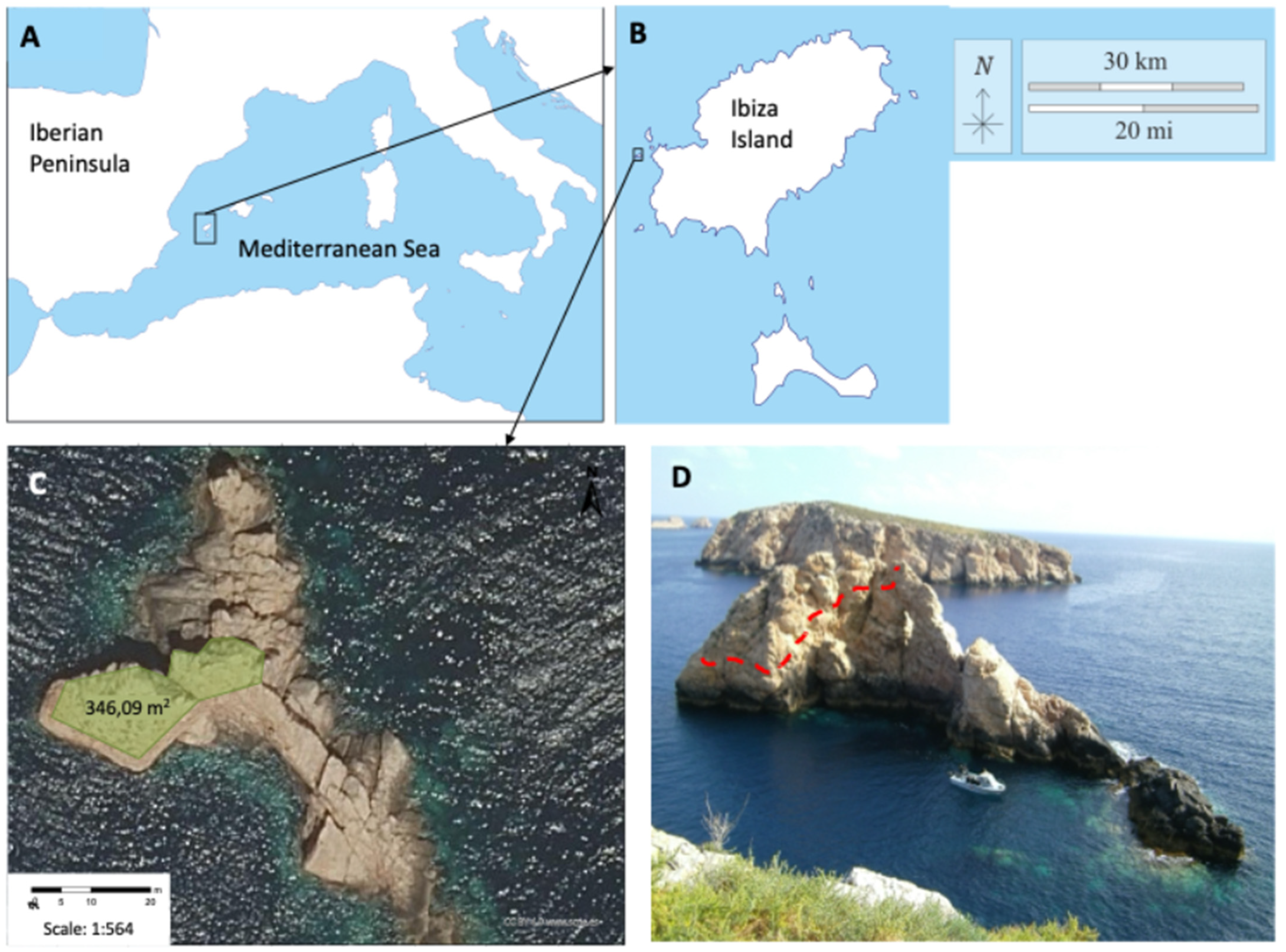
21]. Vaixell probably became isolated from the nearest island, Na Gorra (
Figure 1D), around 8500 years ago [
22]. In two previous works [
20,
21], we analysed the status of this population, its relationship with the remaining populations of the Pityusic wall lizard, and the story of the population in relation with lizard introductions made by the German herpetologist, Martin Eisentraut, during the first third of the 20th century. Eisentraut [
23] introduced 51 lizards from the Ibiza Island to Vaixell but, apparently, none reproduced or survived [
20,
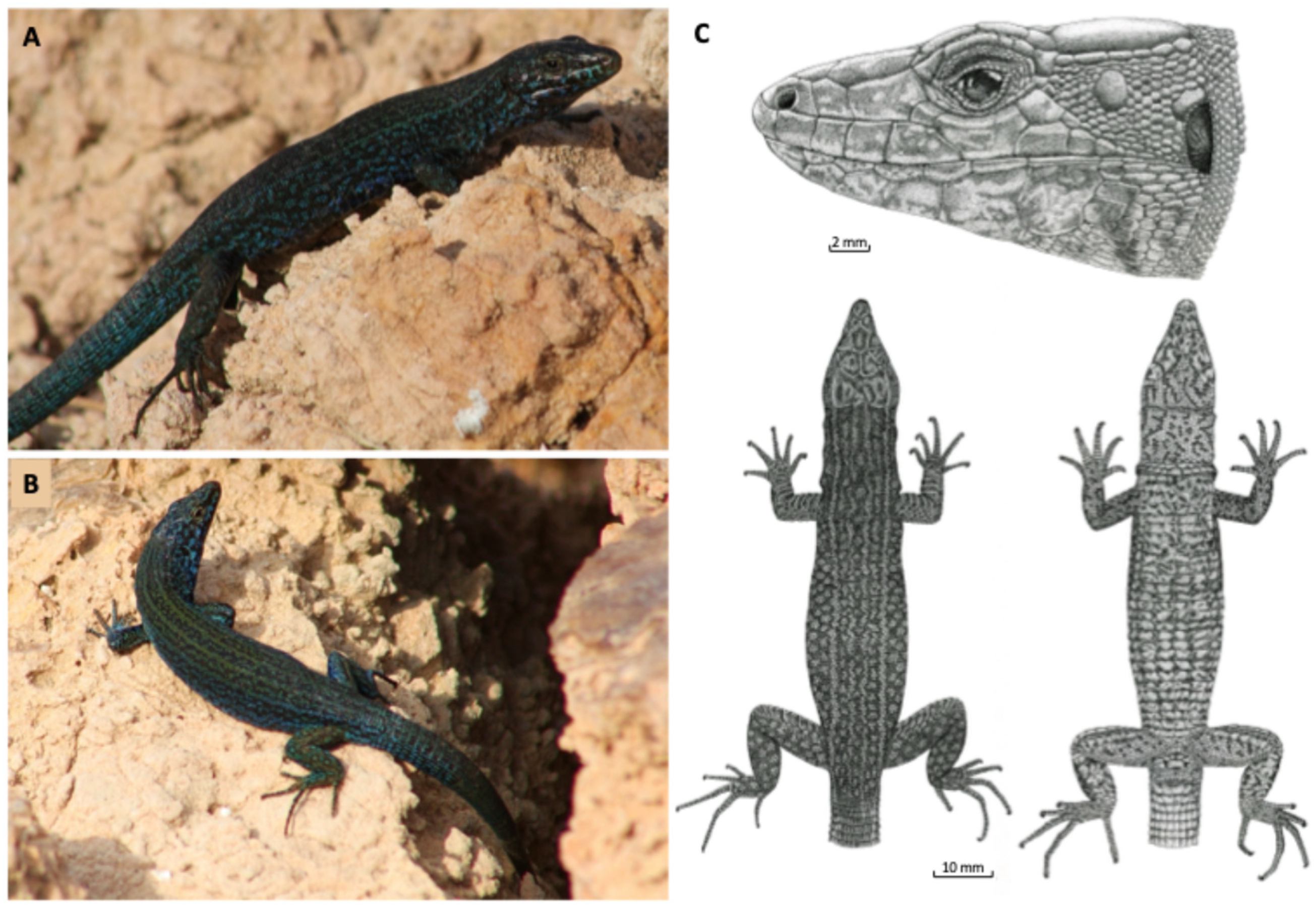
21]. Paradoxically, the Vaixell lizard population is an excellent example of a population “not contaminated” by translocations, despite having suffered this episode of deliberate introduction which, fortunately, was not successful. The design and coloration of lizards from Vaixell were already described, pointing out that it is a melanistic population of very large lizards (
Figure 2 and [
21]). Among the populations of
P. pityusensis, lizards from Vaixell showed the largest body sizes [
15,
21].
In this study, we examine how the characteristics of Es Vaixell Islet influence the natural history and ecological traits of its lizard population. We want to explore the adaptive capabilities of an original population of P. pityusensis that has not been contaminated by other populations and that has remained in extreme isolation for thousands of years, subjected to the selective pressures resulting from the extremely limited habitat and the radical scarcity of trophic resources. We describe the basic demographic characteristics of this unique population, with an estimation of its population size and the patterns of body growth. After nine visits occurring in different years, we are ready to present some aspects of the natural history of this population in the medium term. We analyse the population density, as well as its adult sex ratio (ASR) and their annual variations, the intensity of missing toes and autotomized tails. We also study the diet and how these lizards grow and reach such large body length. Our main hypothesis is that the Pityusic wall lizard has adapted to extreme conditions of this very small islet due to it being the only terrestrial vertebrate. Our prediction is that the abundance, adult body size, sex ratio, and diet are the result of adaptive processes shaped by the islet’s conditions. In particular, the growth rate of individuals could be a response to the lizards’ ecological conditions, especially during their juvenile phase.
4. Discussion
On Vaixell Islet, we have a population of large lizards living on a very small islet, with a significant lack of available resources and an absence of terrestrial predators. In this situation, indicators of potential predation pressure acquire relevance. In this sense, we interpret the high incidence of missing toes observed in lizards from Vaixell as a direct reflection of aggressive interactions between individuals. Vervust et al. [
48] consider the incidence of missing toes to be exceptionally high (55.48% of individuals) in the
Podarcis siculus population of Pod Mrčaru (Croatia). We have already seen that our incidence values in males from Vaixell are even higher. This seems to be the most plausible interpretation in the case of the Pityusic wall lizard, as also observed in the Italian wall lizards studied by Vervust et al. [
48]. Consequently, high population density could promote intraspecific competition. Perhaps the most surprising finding is the absence of differences in the proportion of missing toes between males and females, which indicates that adult females are involved in aggressive encounters just like males. On Vaixell Islet, strong predator pressure does not appear to exist (see above), and yet we find a very high rate of autotomized tails, similar in males and females, which, given the high population density, can also be interpreted as a reflection of frequent aggressive interactions. Even if the high proportion of autotomized tails has traditionally been interpreted as an index of predation pressure [
49,
50], this interpretation is problematic, as Schoener pointed out [
51]. In
Podarcis gaigeae from the Skiros Archipelago (Greece), where predation pressure is relaxed, the proportion of regenerated tails has also been considered as reflecting high levels of intraspecific aggression [
52].
On Vaixell Islet, as in most of the populations of
P. pityusensis (unpub. results), there is an equilibrated adult sex ratio (ASR), with only an annual random variability. Es Vaixell has a high lizard density, which usually happens in these small islets of the Balearic Archipelago within the two endemic species of lacertid lizards [
6,
10]. However, this density translates into a reduced population size due to the small surface available to lizards. In addition, these lizards have largest body sizes among all known populations of the Pityusic wall lizard [
21]. Such body sizes correspond to individuals of notable longevity, with specimens that are more than 10 years old. This fact indicates that, in such extreme conditions, it is very probable that a strict selection process takes place, resulting in the survival of large individuals that reach significant longevities. In captivity, longevity of around 18 to even 30 years was observed in males and females of
P. pityusensis [
53,
54]. Moreover, the tendency towards larger body sizes is characteristic of the small coastal islets of Ibiza, among which Vaixell is no exception [
21]. Case [
2] discussed the importance of environmental factors on the body size of insular populations, relying, in the case of lacertid lizards, on the studies of Mertens [
55], Kramer, and Mertens [
56,
57]. In insular reptiles, food availability appears not to be a sufficient factor for explaining the observed body sizes, so the absence of predators has to be considered [
2]. Meiri [
12] specifically points out that the absence of mammalian predators could be the fundamental factor for larger body sizes in species of the genus
Podarcis.
In reptiles, there are highly plastic growth patterns dependent on environmental factors such as food availability and temperature, reflecting an adaptive strategy [
58]. In theory, the Gompertz model could better describe the growth of turtles and crocodiles and may be less suitable for lizards and snakes, whereas the von Bertalanffy model would be a better option [
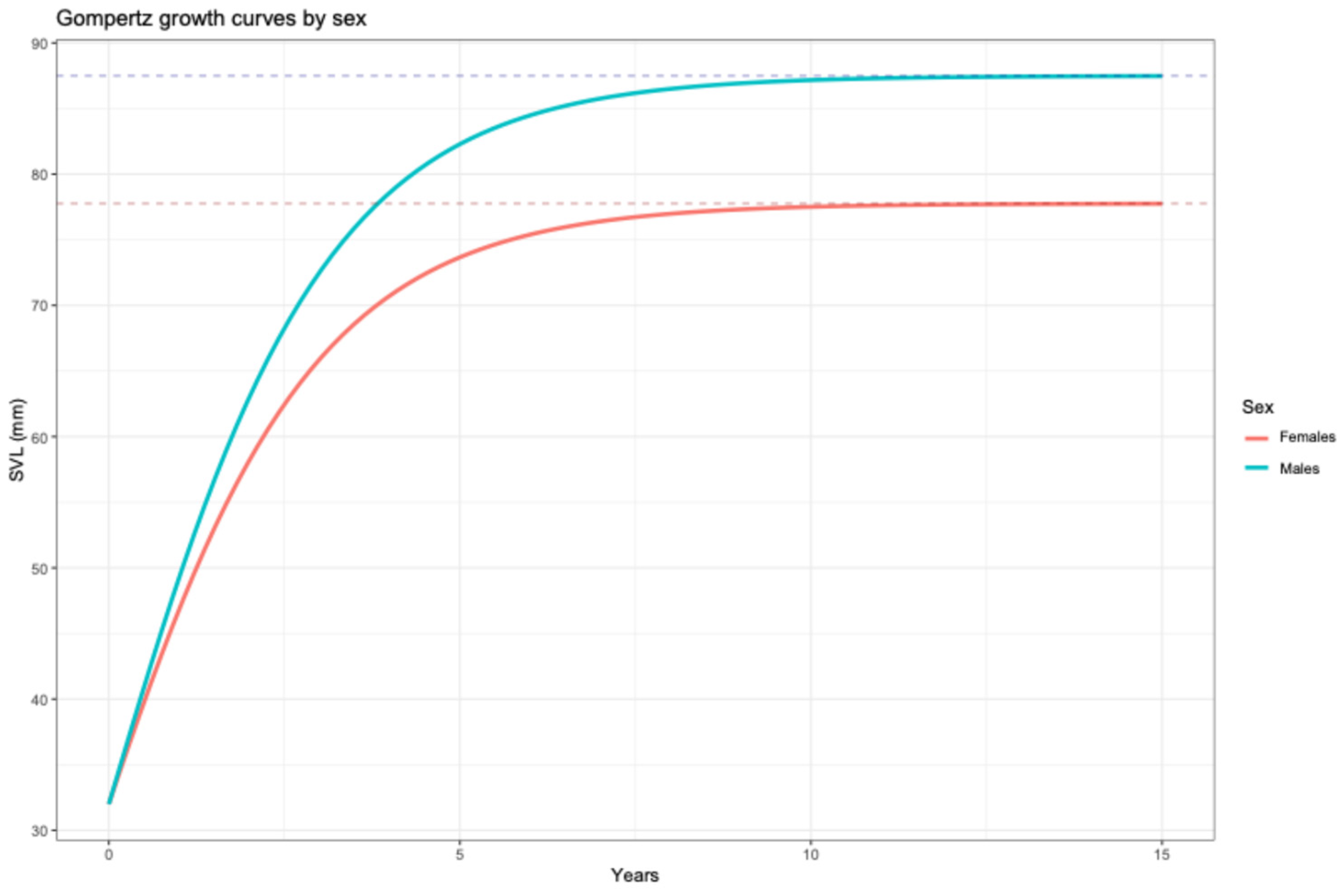
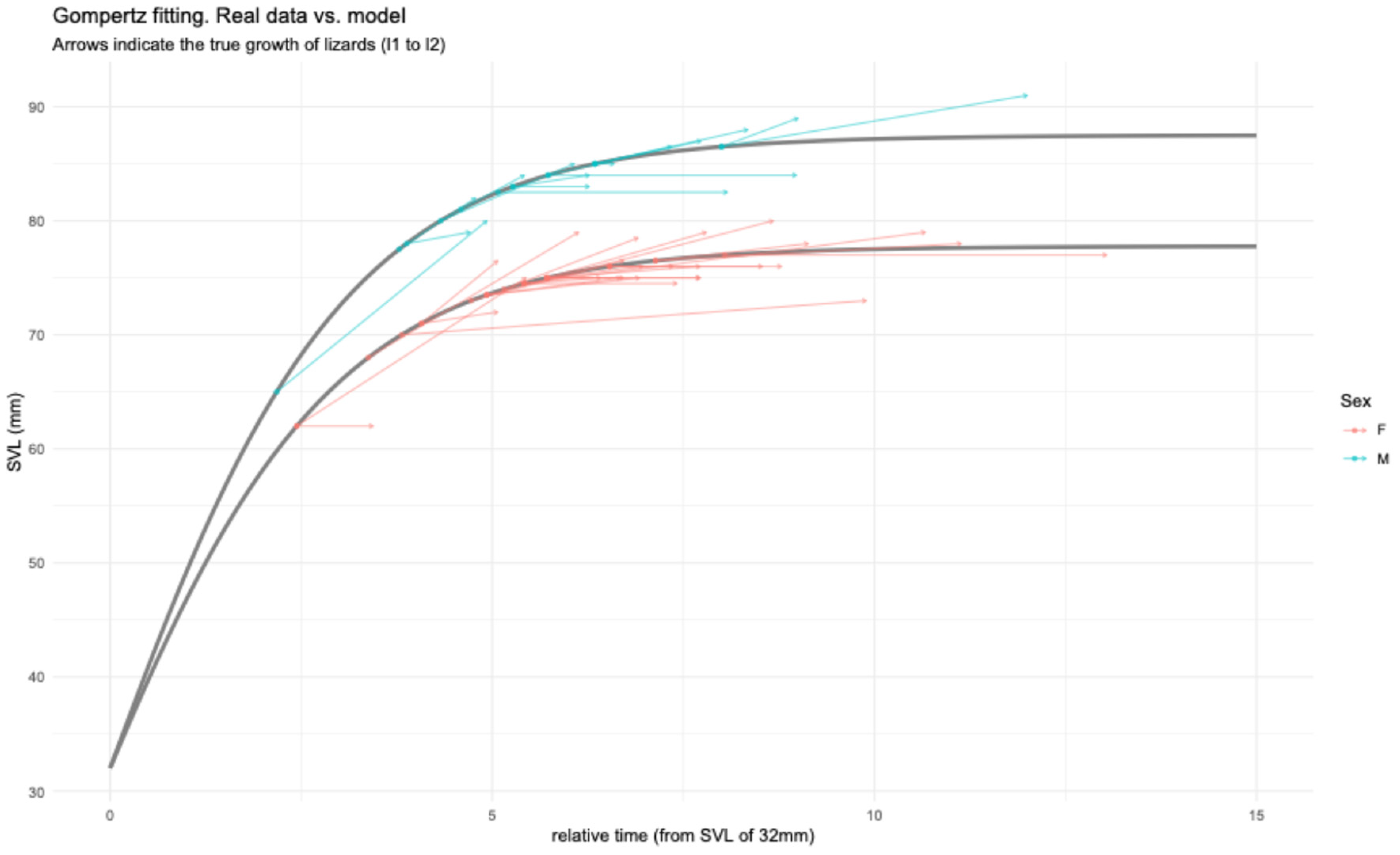
59]. For the lizards of Vaixell, the best fit is obtained with the Gompertz model. We have observed that sex significantly affected asymptotic size, but no differences were found in growth rate (g) between males and females. A similar result was observed in
Anolis lizards from Bahamanian populations [
31]. Working on Moltona Islet (Mallorca, Balearic Islands) with
Podarcis lilfordi, the sister species of
P. pityusensis, Rotger et al. [
60] found a similar k growth parameter in males and females of
P. lilfordi. These authors showed that the final asymptotic body size was, as in our case, different in males and females.
The final Gompertz model accumulated most of the AIC weight (w
i > 0.90,
Table 5), indicating a clear superiority over the other two fitted models that do not adequately describe the growth of this species. The asymptotic size estimated by the Gompertz model for males (SVL = 87.49 mm,
Table 5) is slightly lower than the maximum size observed in the population (SVL = 93.5 mm of one individual male). This result is expected in a mixed-effects model in which L
∞ represents the population average and not the maximum physiological limit of the species. We can conclude that adult males reach significantly larger body sizes than females (
Table 5).
It was established that the growth of insular lizards has a very rapid juvenile phase after hatching, and then it declines monotonically. Although post-hatching growth is generally studied, it is a continuation of an embryonic growth curve [
58]. In the lizards of Vaixell, when fitting the Gompertz model, the inflexion point is mathematically located very close to, before, or after hatching. In our case, most of the metabolic acceleration occurred before hatching, with the maternal yolk being consumed in the egg. In
P. pityusensis and other lizard species, the residual yolk in the egg contributes very little or nothing to the post-embryonic growth of juveniles [
61].
In their general body growth model, West et al. [
62] point out that the slowing of growth is a consequence of the way organisms distribute energy. Although their study only includes endotherms (birds and mammals) and fish-like ectotherms, they demonstrate that growth begins to slow within the egg when the cost of forming and maintaining tissues equals the circulatory system’s capacity to supply nutrients. In lizards, eggs are highly dependent on humidity, so, as the embryo grows, the egg swells by absorbing water, the shell tightens, and gas conductance changes [
63,
64]. The embryo then reaches its critical size, at which its oxygen demand exceeds its supply capacity. At this point, growth slows. For example, Thompson and Stewart [
64] demonstrated in
Eumeces fasciatus that the oxygen consumption of the embryo increases very rapidly until day 15 of incubation, but around day 21 it slows down and, although growth continues, it is significantly slower. This strategy suggests a maximum energy allocation during embryonic development and the very early postnatal life stages, which likely minimises the time spent at the sizes most vulnerable to predation. However, the lizard population of Vaixell does not appear to experience significantly higher predation pressure than other nearby populations of
P. pityusensis. But, in this population, we can consider conspecifics as terrestrial predators, even if such predation cases were occasional.
The diet of the lizards from Vaixell is like the diet described in several populations of
P. pityusensis [
65]. Although the area with vegetation covers about 346 m
2, the lizards move even through low areas of the islet, reaching the water’s edge where they capture marine isopods such as
Ligia italica, as is the case in other populations of
P. pityusensis (unpublished data). In a previous metabarcoding analysis that included some Vaixell faeces [
66], we identified
Ligia italica, as well as a terrestrial isopod,
Halophiloscia hirsuta, a common species in Balearic Islands that lives under stones, even in areas without vegetation [
67,
68]. The opportunistic nature of the lizards of Vaixell is evident not only in their consumption of these isopods, but also in their capture of flies such as
Acartomyia mariae, a Culicidae whose larvae develop in brackish pools [
69], like those that appear on coastal islets after storms. The metabarcoding analysis also detected the presence of an unidentified orthopteran from the family Tettigonidae [
70]. Lizards in this population consume less than half the volume of plant material compared to other populations from the coastal islets of western Ibiza [
18] (and unpublished data). This is probably the result of a very limited availability of plant matter, especially fleshy fruits from shrubs. Only fruits from
Asparagus horridus [
18] were detected. In fact, the DNA from plants was absent in our previous metabarcoding study [
66].
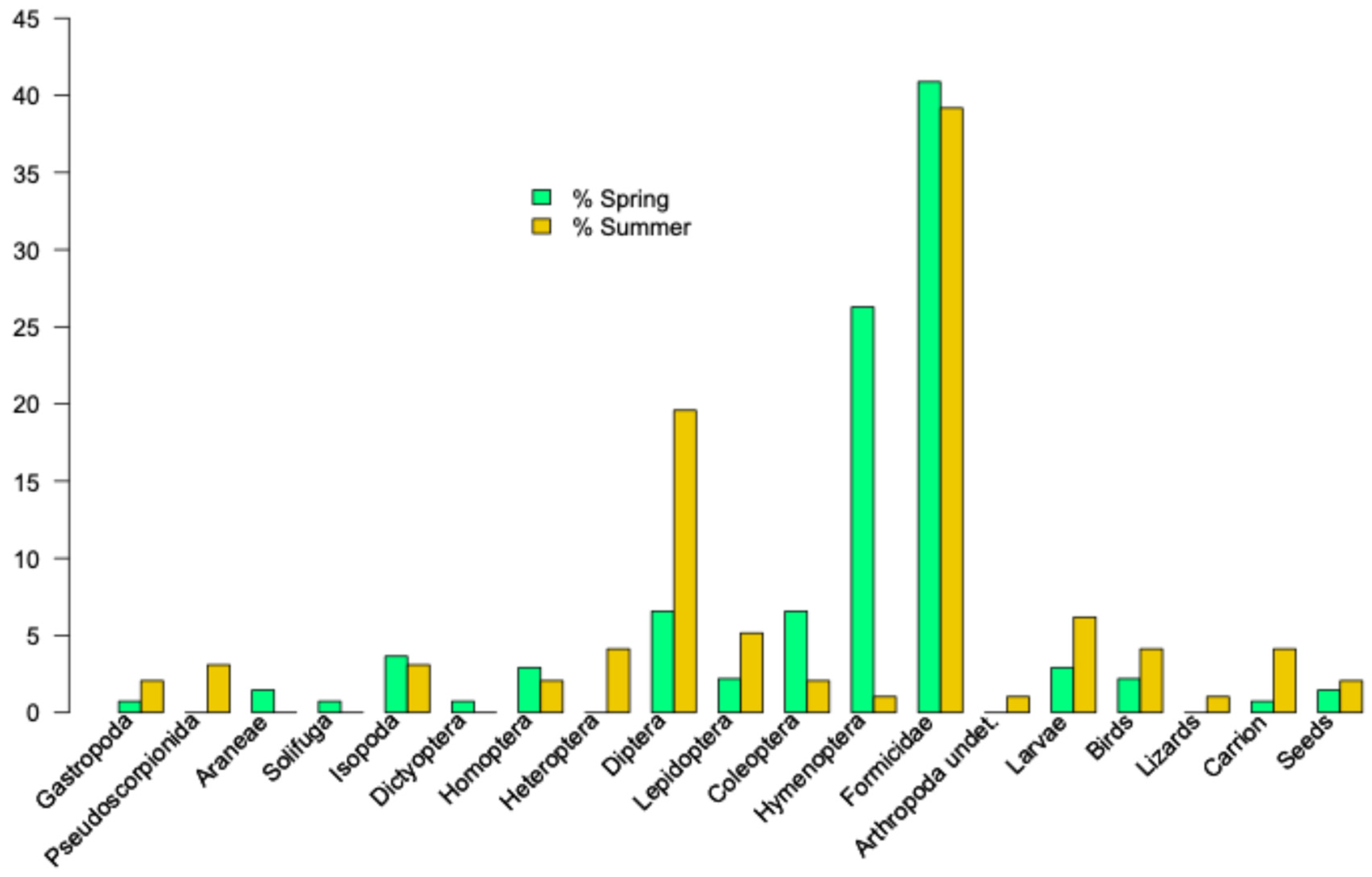
Despite the small sample of faeces analysed, we recorded the presence of a juvenile individual in the summer diet of
P. pityusensis from Vaixell (
Figure 5 and
Table A4). In fact, “partial cannibalism”, that is, the consumption of tails by conspecifics, has been reported in Pityusic wall lizards kept in captivity [
71]. Cases of cannibalism are frequent in populations of
P. pityusensis [
72,
73] and several insular populations of lacertid lizards [
74] (and references therein)]. Thus, it is likely that lizards from Vaixell do not suffer greater predation pressure from avian predators than other populations (unpublished data), but the scarcity of resources and, in general, the extreme conditions under which this small population lives may result in a greater predation pressure from conspecifics, increasing the cases of cannibalism against smaller individuals. This selective pressure may have shaped growth rates with peaks before hatching as an adaptive strategy for quickly reaching body sizes that would allow newborns to avoid this conspecific predation pressure. Of course, due to the frequent presence of cannibalism in many other populations of the Pityusic wall lizard, we cannot rule out that this strategy is common to other populations. Studying five populations of
Podarcis gaigeae with differences in predation pressure, lizard density, and seabird presence, Pafilis et al. [
7] noted that larger adult body sizes were observed in populations with higher lizard density and lower predation pressure. Larger adult lizards are found in populations where juveniles are born with a larger body size, increasing their chances of survival against predation by conspecifics [
2].
The Pityusic wall lizard is characterised by an extraordinary phenotypic variability, encompassing not only the most obvious morphological features, such as coloration, pattern, and body size, but also less conspicuous traits like behavioural, ecological, and natural history characteristics [
4]. This variability likely originated from the ancestral mixing of genomes that underwent introgression from lineages that had evolved independently for millions of years [
75]. It is therefore not surprising that, in this scenario, isolated populations with particular morphological and ecological features appear, especially if environmental conditions have acted as drivers of adaptive changes. A genetic analysis showed that the lizards from Vaixell are remarkably close to lizards from Na Gorra, a nearby islet with which they shared a common ancestor [
21]. Lizards from Vaixell were later arbitrarily assigned to the subspecies
Podarcis pityusensis gorrae, without any systematic or morphological study and, in fact, without any observation or even a single specimen [
76]. However, here, we do not try to discuss the subspecific status of lizards of Vaixell, because in the case of the Pityusic wall lizard, our point of view is that the description and enumeration of subspecies should be abandoned and replaced with the recognition of evolutionary significant units (ESUs), as we proposed in the case of the Lilford’s wall lizard,
Podarcis lilfordi [
77].
Vaixell is a very illustrative case of life on very small islets of the Mediterranean and, for this reason alone, this population deserves strict protection. The most advisable course of action would be to completely avoid landing on this population, only allowing annual monitoring and avoiding disturbing the delicate balance of this small population of lizards living in such extreme conditions. Es Vaixell is an extraordinary example of adaptation, not only to the harsh environmental conditions of the islet, but also an example of resistance to human pressure, represented here by Eisentraut’s regrettable experiment conducted almost 100 years ago. The survival of the native lizards and the disappearance of the introduced ones indicate that the ecological and natural history traits of the native population are adaptive and that they are not simply the product of genetic drift in a population with a very small number of individuals.